
Request Free Sample ×

Kindly complete the form below to receive a free sample of this Report

* Please use a valid business email

Leading companies partner with us for data-driven Insights

clients tt-cursor
Hero Background
English
Chinese
French
Japanese
Korean
German
Spanish

Web3 Payments Market Trends

ID: MRFR/BS/10721-HCR
128 Pages
Ankit Gupta
April 2026

Web3 Payments Market Size, Share and Research Report By Type (Public, Private, Consortium, Hybrid), By Application (Cryptocurrency, Conversational AI, Data & Transaction Storage, Payments, Smart Contracts, Others) And By Region (North America, Europe, Asia-Pacific, And Rest Of The World) –Industry Forecast Till 2035

Share:
Download PDF ×

We do not share your information with anyone. However, we may send you emails based on your report interest from time to time. You may contact us at any time to opt-out.

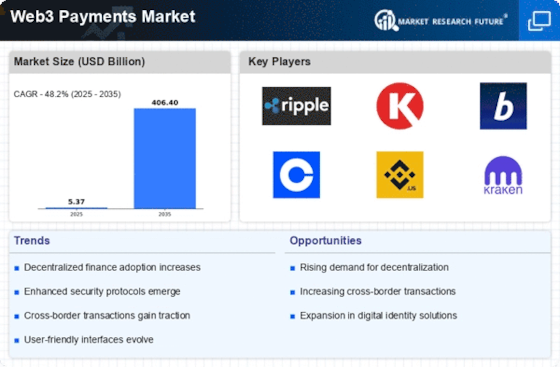
Web3 Payments Market Infographic
Purchase Options

Market Trends

Key Emerging Trends in the Web3 Payments Market

The Web3 payments business is growing rapidly, and market share positioning solutions are crucial to companies in this arena. Web3 payments companies use separation. Companies may differentiate and attract a certain market segment by delivering appealing features and services. Some companies focus on regular cross-line interactions, while others emphasize security and protection. This distinction allows companies to target specific customer wants and preferences, giving them a market advantage.

Advancement is another Web3 payments market share factor. Companies that constantly innovate are more likely to gain market share. This might include using blockchain technology for security and simplicity, creating simple interfaces for decentralized finance (DeFi) apps, or implementing brilliant agreement capacities for computerized payments. By staying ahead of mechanical advances, companies may attract educated customers and become industry leaders.

Organizations and coordination are crucial to Web3 payments market share. To expand their reach and offer complementary services, companies may form strategic partnerships with other companies, blockchain initiatives, or financial foundations. A Web3 payments company may work with a decentralized loaning platform to let customers receive and lend digital resources. These organizations enhance client offerings and allow companies to use each other's clientele, increasing market share.

Web3 payments market share positioning requires client-driven solutions. Focusing on customer experience, service, and local dedication usually builds a loyal following and attracts new clients through word-of-mouth and recommendations. Implementing input systems, providing Web3 education, and providing responsive customer service may change an organization's market divide by building customer trust and satisfaction.

Global development and containment efforts boost Web3 payments industry share. As digital money and decentralized banking gain popularity worldwide, companies who expand to new markets and tailor their services to local tastes might gain an edge. This may entail supporting several languages, coordinating district-specific installment schemes, and meeting administrative requirements in different jurisdictions. Organizations may capture more Web3 payments by focusing on global marketplaces.


Author
Author Profile
Ankit Gupta
Team Lead - Research

Ankit Gupta is a seasoned market intelligence and strategic research professional with over six plus years of experience in the ICT and Semiconductor industries. With academic roots in Telecom, Marketing, and Electronics, he blends technical insight with business strategy. Ankit has led 200+ projects, including work for Fortune 500 clients like Microsoft and Rio Tinto, covering market sizing, tech forecasting, and go-to-market strategies. Known for bridging engineering and enterprise decision-making, his insights support growth, innovation, and investment planning across diverse technology markets.

Leave a Comment

FAQs

What is the current valuation of the Web3 Payments Market as of 2024?

<p>The Web3 Payments Market was valued at 5.365 USD Billion in 2024.</p>

What is the projected market size for the Web3 Payments Market in 2035?

<p>The market is projected to reach 406.4 USD Billion by 2035.</p>

What is the expected CAGR for the Web3 Payments Market during the forecast period 2025 - 2035?

<p>The expected CAGR for the Web3 Payments Market during 2025 - 2035 is 48.2%.</p>

Which companies are considered key players in the Web3 Payments Market?

<p>Key players include Ripple, Circle, BitPay, Coinbase, Binance, Kraken, Paxos, Stellar, and Algorand.</p>

What are the main segments of the Web3 Payments Market?

<p>The main segments include Type and Application, with various subcategories under each.</p>

How does the 'Payments' application segment perform in terms of valuation?

<p>The 'Payments' application segment is valued at 2.0 USD Billion, indicating strong market interest.</p>

What is the valuation range for the Hybrid type segment in the Web3 Payments Market?

The Hybrid type segment is valued between 1.865 and 166.4 USD Billion.

What is the valuation of the Cryptocurrency application segment?

The Cryptocurrency application segment is valued at 0.75 USD Billion.

How does the Consortium type segment compare to others in terms of valuation?

The Consortium type segment is valued at 1.0 USD Billion, which is lower than the Hybrid segment.

What does the future hold for the Web3 Payments Market beyond 2035?

While specific projections beyond 2035 are not available, the market is likely to continue evolving rapidly.

Market Summary

As per Market Research Future analysis, the Web3 Payments Market Size was estimated at 5.365 USD Billion in 2024. The Web3 Payments industry is projected to grow from 7.951 USD Billion in 2025 to 406.4 USD Billion by 2035, exhibiting a compound annual growth rate (CAGR) of 48.2% during the forecast period 2025 - 2035

Key Market Trends & Highlights

The Web3 Payments Market is experiencing robust growth driven by technological advancements and evolving consumer preferences.

  • The North American region remains the largest market for Web3 payments, showcasing a strong inclination towards decentralized finance solutions. Asia-Pacific is emerging as the fastest-growing region, with increasing investments in blockchain technology and digital currencies. The public segment dominates the market, while the private segment is witnessing rapid growth due to rising demand for innovative payment solutions. Key market drivers include the rise of cryptocurrency usage and advancements in blockchain technology, which are fueling the demand for enhanced privacy and cross-border transactions.

Market Size & Forecast

2024 Market Size 5.365 (USD Billion)
2035 Market Size 406.4 (USD Billion)
CAGR (2025 - 2035) 48.2%
Largest Regional Market Share in 2024 North America

Major Players

Ripple (US), Circle (US), BitPay (US), Coinbase (US), Binance (MT), Kraken (US), Paxos (US), Stellar (US), Algorand (US)

Market Trends

The Web3 Payments Market is currently experiencing a transformative phase, characterized by the integration of decentralized technologies into traditional payment systems. This evolution appears to be driven by a growing demand for transparency, security, and efficiency in financial transactions. As consumers and businesses alike seek alternatives to conventional banking methods, the adoption of blockchain technology is becoming increasingly prevalent. This shift not only enhances transaction speed but also reduces costs associated with cross-border payments, thereby appealing to a broader audience. Furthermore, the rise of digital currencies and decentralized finance platforms is reshaping the landscape, suggesting a potential for significant growth in this sector. In addition to technological advancements, regulatory frameworks are evolving to accommodate the unique characteristics of the Web3 Payments Market. Governments and financial institutions are beginning to recognize the importance of establishing guidelines that foster innovation while ensuring consumer protection. This regulatory clarity may encourage more participants to enter the market, thereby enhancing competition and driving further innovation. As the ecosystem matures, it is likely that partnerships between traditional financial entities and blockchain-based platforms will emerge, creating a more integrated financial environment that benefits all stakeholders involved.

Increased Adoption of Decentralized Finance (DeFi) Solutions

The Web3 Payments Market is witnessing a notable rise in the adoption of DeFi solutions, which offer users greater control over their financial assets. This trend indicates a shift away from traditional banking systems, as individuals seek more autonomy and flexibility in managing their funds.

Integration of Central Bank Digital Currencies (CBDCs)

The exploration and implementation of CBDCs by various nations suggest a significant trend within the Web3 Payments Market. These digital currencies, issued by central banks, may enhance the efficiency of payment systems while providing a bridge between traditional finance and decentralized technologies.

Enhanced Security Protocols and User Privacy

As concerns regarding data security and privacy continue to grow, the Web3 Payments Market is likely to see advancements in security protocols. This trend emphasizes the importance of safeguarding user information while facilitating seamless transactions in a decentralized environment.

Web3 Payments Market Market Drivers

Rise of Cryptocurrency Usage

The increasing acceptance of cryptocurrencies as a legitimate form of payment is a pivotal driver for the Web3 Payments Market. As more businesses and consumers embrace digital currencies, the demand for seamless payment solutions rises. In 2025, it is estimated that over 300 million people will use cryptocurrencies for transactions, reflecting a significant shift in payment preferences. This trend is further fueled by the growing number of platforms facilitating cryptocurrency transactions, which enhances accessibility and usability. Consequently, the Web3 Payments Market is likely to experience substantial growth as it adapts to the evolving landscape of digital currency usage.

Consumer Demand for Enhanced Privacy

As concerns over data privacy and security continue to rise, the Web3 Payments Market is witnessing a growing demand for payment solutions that prioritize user privacy. Consumers are increasingly wary of traditional payment systems that require extensive personal information. Web3 payment solutions, which often utilize decentralized networks, can offer enhanced privacy features, appealing to privacy-conscious users. In 2025, it is projected that the market for privacy-focused payment solutions will grow significantly, as more individuals seek alternatives that protect their financial data. This shift towards privacy-centric solutions is likely to drive innovation and adoption within the Web3 Payments Market.

Advancements in Blockchain Technology

Technological innovations in blockchain are transforming the Web3 Payments Market. Enhanced scalability, speed, and efficiency of blockchain networks are making them more suitable for payment processing. For instance, the implementation of layer-2 solutions has significantly reduced transaction times and costs, making blockchain a more attractive option for businesses. As of 2025, the market for blockchain technology is projected to reach approximately 67 billion USD, indicating a robust interest in its applications, including payments. This technological evolution is likely to drive the adoption of Web3 payment solutions, as businesses seek to leverage the benefits of blockchain.

Regulatory Developments and Compliance

The evolving regulatory landscape surrounding cryptocurrencies and digital payments is a crucial factor influencing the Web3 Payments Market. Governments are increasingly recognizing the need for frameworks that ensure consumer protection and financial stability. In 2025, it is anticipated that more than 50 countries will have established comprehensive regulations for digital currencies, which could enhance trust and legitimacy in the market. This regulatory clarity may encourage more businesses to adopt Web3 payment solutions, as compliance becomes more manageable. Thus, the Web3 Payments Market stands to benefit from a more structured environment that fosters innovation while safeguarding users.

Growing Demand for Cross-Border Transactions

The need for efficient cross-border payment solutions is driving growth in the Web3 Payments Market. Traditional payment systems often impose high fees and lengthy processing times for international transactions. In contrast, Web3 payment solutions offer lower costs and faster processing, appealing to businesses engaged in global trade. By 2025, it is estimated that cross-border payments will exceed 30 trillion USD, highlighting the immense potential for Web3 solutions to capture this market. As businesses seek to optimize their payment processes, the Web3 Payments Market is likely to see increased adoption of decentralized payment methods that facilitate international transactions.

Market Segment Insights

By Type: Public (Largest) vs. Private (Fastest-Growing)

<p>In the Web3 Payments Market, the segmentation by type reveals a diverse landscape dominated by Public and Private models. The Public type, characterized by its open and decentralized approach, holds the largest share due to widespread adoption and community trust. Conversely, the Private and Consortium types are also significant but appeal mostly to enterprises seeking bespoke solutions. Generally, while Public structures support general use cases, Private sectors cater to exclusive partnerships, which impact their share differently.</p>

<p>Public (Dominant) vs. Private (Emerging)</p>

<p>The Public type in the Web3 Payments Market serves as a cornerstone, facilitating transactions in a trustless and transparent environment, leading to high accessibility for users. Its dominance lies in fostering innovation and collaboration among global participants. On the other hand, the Private type is emerging rapidly as enterprises recognize the value of customized solutions that offer advantages like enhanced privacy and security. While Public systems thrive on openness, Private solutions cater to organizations that necessitate control over transactions, indicating a clear divergence in their market positions.</p>

By Application: Payments (Largest) vs. Cryptocurrency (Fastest-Growing)

<p>In the Web3 Payments Market, the application segment is predominantly characterized by Payments, which holds the largest market share due to its immediate relevance and utility in real-world transactions. Following Payments, Cryptocurrency applications are also significant, showcasing increasing adoption as more users embrace decentralized financial options. Other segments like Conversational AI and Data & Transaction Storage contribute to the landscape but with comparatively smaller shares, reflecting niche roles in the broader market growth.</p>

<p>Payments (Dominant) vs. Cryptocurrency (Emerging)</p>

<p>Payments have established themselves as the dominant application within the Web3 Payments Market due to their foundational role in facilitating transactions using blockchain technology. They offer immediate benefits of efficiency and low transaction costs, appealing to both consumers and businesses. Conversely, Cryptocurrency is an emerging segment, rapidly gaining ground due to its adoption as a medium of exchange and an investment asset. As institutional and retail interest grows, coupled with the development of user-friendly wallets and platforms, Cryptocurrency applications are poised for robust growth, appealing to those seeking decentralized financial services.</p>

Get more detailed insights about Web3 Payments Market Research Report – Forecast till 2035

Regional Insights

North America : Innovation and Leadership Hub

North America is the largest market for Web3 payments, holding approximately 45% of the global share. The region's growth is driven by technological advancements, increasing adoption of cryptocurrencies, and supportive regulatory frameworks. The U.S. government has been proactive in establishing guidelines that foster innovation while ensuring consumer protection, which has catalyzed market expansion. Leading the charge are the United States and Canada, with the U.S. being home to major players like Ripple, Coinbase, and Kraken. The competitive landscape is characterized by a mix of established firms and emerging startups, all vying for market share. The presence of significant venture capital investment further fuels innovation, making North America a focal point for Web3 payment solutions.

Europe : Regulatory Framework and Growth

Europe is rapidly becoming a significant player in the Web3 payments market, holding around 30% of the global share. The region's growth is driven by increasing digitalization, a strong focus on blockchain technology, and favorable regulatory environments. The European Union is actively working on regulations that aim to create a secure and transparent framework for cryptocurrency transactions, which is expected to further boost market growth. Countries like Germany, France, and the Netherlands are leading the charge, with a growing number of startups and established companies entering the Web3 space. The competitive landscape is vibrant, with key players such as Binance and BitPay establishing a strong presence. The region's commitment to innovation and regulatory clarity positions it well for future growth in Web3 payments.

Asia-Pacific : Emerging Powerhouse in Payments

Asia-Pacific is witnessing rapid growth in the Web3 payments market, accounting for approximately 20% of the global share. The region's expansion is fueled by increasing smartphone penetration, a tech-savvy population, and a growing interest in decentralized finance. Countries like China and India are at the forefront, with governments exploring blockchain technology to enhance financial inclusion and efficiency. The competitive landscape is diverse, featuring both established players and innovative startups. Key players such as Stellar and Algorand are making significant strides in the region. The presence of a large unbanked population presents unique opportunities for Web3 payment solutions, making Asia-Pacific a critical area for future growth.

Middle East and Africa : Resource-Rich Frontier

The Middle East and Africa are emerging as a frontier for Web3 payments, holding about 5% of the global market share. The region's growth is driven by increasing internet penetration, a young population, and a rising interest in cryptocurrencies. Countries like Nigeria and South Africa are leading the way, with governments beginning to recognize the potential of blockchain technology for economic development. The competitive landscape is still developing, with a mix of local startups and international players entering the market. The presence of key players like Paxos is indicative of the growing interest in Web3 solutions. As regulatory frameworks evolve, the region is poised for significant growth in the Web3 payments sector.

Key Players and Competitive Insights

Leading market players are investing heavily in research and development in order to expand their product lines, which will help the Web3 Payments Market, grow even more. Market participants are also undertaking a variety of strategic activities to expand their global footprint, with important market developments including new product launches, contractual agreements, mergers and acquisitions, higher investments, and collaboration with other organizations. To expand and survive in a more competitive and rising market climate, Web3 Payments industry must offer cost-effective items.Manufacturing locally to minimize operational costs is one of the key business tactics used by manufacturers in the global Web3 Payments industry to benefit clients and increase the market sector. In recent years, the Web3 Payments industry has offered some of the most significant advantages to medicine. Major players in the Web3 Payments Market, including Filecoin, Web3 Foundation, Zel Technologies Limited, Livepeer Inc, Brunswick Corporation, Helium Systems Inc, Kusama, Polygon Technology, Kadena LLC, Ocean Protocol Foundation Ltd, others, are attempting to increase market demand by investing in research and development operations.The Web3 Foundation places a central emphasis on the Polkadot network, which stands as a multi-chain blockchain platform facilitating interoperability among diverse blockchains, enabling seamless communication and data sharing. Substantial backing from the Web3 Foundation is dedicated to advancing the development and expansion of the Polkadot ecosystem. Specifically, the Web3 Foundation extends grants and financial assistance to individuals, teams, and projects engaged in the construction of solutions utilizing Polkadot and Web3 technologies. These grants serve as incentives to foster innovation and bolster growth within this ecosystem.Additionally, the Web3 Foundation plays an active role in research and development endeavors concerning blockchain technology, consensus mechanisms, and decentralized systems. Their contributions significantly propel the progress of Web3 technologies as a whole.A decentralized storage network called Filecoin offers dependable and secure data storage. It is based on the IPFS system, which use content addressing to store data decentralized from any one server or central authority. In exchange for supplying the network with storage space, Filecoin miners receive Filecoin (FIL) tokens. Comparing Filecoin to conventional centralized storage solutions reveals a number of benefits. Data is not kept on a single server that could be compromised or taken offline, making it safer in the first place. Data is replicated over numerous network nodes, making it more dependable.Thirdly, because users only pay for the storage they really use, it is more cost-effective.

Key Companies in the Web3 Payments Market include

Industry Developments

August 2023: The Company launched a dedicated Web3 Payments Market team and has since been running a number of innovative campaigns, such as its "Learn about Web3" program and its "Web3 is for everyone" campaign.

Future Outlook

Web3 Payments Market Future Outlook

The Web3 Payments Market is projected to grow at a 48.2% CAGR from 2025 to 2035, driven by increased blockchain adoption, decentralized finance innovations, and enhanced transaction security.

New opportunities lie in:

  • Integration of smart contracts for automated payment processing.</p><p>Development of cross-border payment solutions leveraging stablecoins.</p><p>Creation of decentralized identity verification systems for secure transactions.

By 2035, the Web3 Payments Market is expected to be a cornerstone of global financial transactions.

Market Segmentation

Web3 Payments Market Type Outlook

  • Public
  • Private
  • Consortium
  • Hybrid

Web3 Payments Market Application Outlook

  • Cryptocurrency
  • Conversational AI
  • Data & Transaction Storage
  • Payments
  • Smart Contracts
  • Others

Report Scope

MARKET SIZE 2024 5.365(USD Billion)
MARKET SIZE 2025 7.951(USD Billion)
MARKET SIZE 2035 406.4(USD Billion)
COMPOUND ANNUAL GROWTH RATE (CAGR) 48.2% (2025 - 2035)
REPORT COVERAGE Revenue Forecast, Competitive Landscape, Growth Factors, and Trends
BASE YEAR 2024
Market Forecast Period 2025 - 2035
Historical Data 2019 - 2024
Market Forecast Units USD Billion
Key Companies Profiled Ripple (US), Circle (US), BitPay (US), Coinbase (US), Binance (MT), Kraken (US), Paxos (US), Stellar (US), Algorand (US)
Segments Covered Type, Application, Region
Key Market Opportunities Integration of decentralized finance solutions enhances transaction efficiency in the Web3 Payments Market.
Key Market Dynamics Rising consumer demand for decentralized finance solutions drives innovation in Web3 payment systems and regulatory adaptations.
Countries Covered North America, Europe, APAC, South America, MEA

FAQs

What is the current valuation of the Web3 Payments Market as of 2024?

<p>The Web3 Payments Market was valued at 5.365 USD Billion in 2024.</p>

What is the projected market size for the Web3 Payments Market in 2035?

<p>The market is projected to reach 406.4 USD Billion by 2035.</p>

What is the expected CAGR for the Web3 Payments Market during the forecast period 2025 - 2035?

<p>The expected CAGR for the Web3 Payments Market during 2025 - 2035 is 48.2%.</p>

Which companies are considered key players in the Web3 Payments Market?

<p>Key players include Ripple, Circle, BitPay, Coinbase, Binance, Kraken, Paxos, Stellar, and Algorand.</p>

What are the main segments of the Web3 Payments Market?

<p>The main segments include Type and Application, with various subcategories under each.</p>

How does the 'Payments' application segment perform in terms of valuation?

<p>The 'Payments' application segment is valued at 2.0 USD Billion, indicating strong market interest.</p>

What is the valuation range for the Hybrid type segment in the Web3 Payments Market?

The Hybrid type segment is valued between 1.865 and 166.4 USD Billion.

What is the valuation of the Cryptocurrency application segment?

The Cryptocurrency application segment is valued at 0.75 USD Billion.

How does the Consortium type segment compare to others in terms of valuation?

The Consortium type segment is valued at 1.0 USD Billion, which is lower than the Hybrid segment.

What does the future hold for the Web3 Payments Market beyond 2035?

While specific projections beyond 2035 are not available, the market is likely to continue evolving rapidly.

  1. SECTION I: EXECUTIVE SUMMARY AND KEY HIGHLIGHTS
    1. | 1.1 EXECUTIVE SUMMARY
    2. | | 1.1.1 Market Overview
    3. | | 1.1.2 Key Findings
    4. | | 1.1.3 Market Segmentation
    5. | | 1.1.4 Competitive Landscape
    6. | | 1.1.5 Challenges and Opportunities
    7. | | 1.1.6 Future Outlook
  2. SECTION II: SCOPING, METHODOLOGY AND MARKET STRUCTURE
    1. | 2.1 MARKET INTRODUCTION
    2. | | 2.1.1 Definition
    3. | | 2.1.2 Scope of the study
    4. | | | 2.1.2.1 Research Objective
    5. | | | 2.1.2.2 Assumption
    6. | | | 2.1.2.3 Limitations
    7. | 2.2 RESEARCH METHODOLOGY
    8. | | 2.2.1 Overview
    9. | | 2.2.2 Data Mining
    10. | | 2.2.3 Secondary Research
    11. | | 2.2.4 Primary Research
    12. | | | 2.2.4.1 Primary Interviews and Information Gathering Process
    13. | | | 2.2.4.2 Breakdown of Primary Respondents
    14. | | 2.2.5 Forecasting Model
    15. | | 2.2.6 Market Size Estimation
    16. | | | 2.2.6.1 Bottom-Up Approach
    17. | | | 2.2.6.2 Top-Down Approach
    18. | | 2.2.7 Data Triangulation
    19. | | 2.2.8 Validation
  3. SECTION III: QUALITATIVE ANALYSIS
    1. | 3.1 MARKET DYNAMICS
    2. | | 3.1.1 Overview
    3. | | 3.1.2 Drivers
    4. | | 3.1.3 Restraints
    5. | | 3.1.4 Opportunities
    6. | 3.2 MARKET FACTOR ANALYSIS
    7. | | 3.2.1 Value chain Analysis
    8. | | 3.2.2 Porter's Five Forces Analysis
    9. | | | 3.2.2.1 Bargaining Power of Suppliers
    10. | | | 3.2.2.2 Bargaining Power of Buyers
    11. | | | 3.2.2.3 Threat of New Entrants
    12. | | | 3.2.2.4 Threat of Substitutes
    13. | | | 3.2.2.5 Intensity of Rivalry
    14. | | 3.2.3 COVID-19 Impact Analysis
    15. | | | 3.2.3.1 Market Impact Analysis
    16. | | | 3.2.3.2 Regional Impact
    17. | | | 3.2.3.3 Opportunity and Threat Analysis
  4. SECTION IV: QUANTITATIVE ANALYSIS
    1. | 4.1 BFSI, BY Type (USD Billion)
    2. | | 4.1.1 Public
    3. | | 4.1.2 Private
    4. | | 4.1.3 Consortium
    5. | | 4.1.4 Hybrid
    6. | 4.2 BFSI, BY Application (USD Billion)
    7. | | 4.2.1 Cryptocurrency
    8. | | 4.2.2 Conversational AI
    9. | | 4.2.3 Data & Transaction Storage
    10. | | 4.2.4 Payments
    11. | | 4.2.5 Smart Contracts
    12. | | 4.2.6 Others
    13. | 4.3 BFSI, BY Region (USD Billion)
    14. | | 4.3.1 North America
    15. | | | 4.3.1.1 US
    16. | | | 4.3.1.2 Canada
    17. | | 4.3.2 Europe
    18. | | | 4.3.2.1 Germany
    19. | | | 4.3.2.2 UK
    20. | | | 4.3.2.3 France
    21. | | | 4.3.2.4 Russia
    22. | | | 4.3.2.5 Italy
    23. | | | 4.3.2.6 Spain
    24. | | | 4.3.2.7 Rest of Europe
    25. | | 4.3.3 APAC
    26. | | | 4.3.3.1 China
    27. | | | 4.3.3.2 India
    28. | | | 4.3.3.3 Japan
    29. | | | 4.3.3.4 South Korea
    30. | | | 4.3.3.5 Malaysia
    31. | | | 4.3.3.6 Thailand
    32. | | | 4.3.3.7 Indonesia
    33. | | | 4.3.3.8 Rest of APAC
    34. | | 4.3.4 South America
    35. | | | 4.3.4.1 Brazil
    36. | | | 4.3.4.2 Mexico
    37. | | | 4.3.4.3 Argentina
    38. | | | 4.3.4.4 Rest of South America
    39. | | 4.3.5 MEA
    40. | | | 4.3.5.1 GCC Countries
    41. | | | 4.3.5.2 South Africa
    42. | | | 4.3.5.3 Rest of MEA
  5. SECTION V: COMPETITIVE ANALYSIS
    1. | 5.1 Competitive Landscape
    2. | | 5.1.1 Overview
    3. | | 5.1.2 Competitive Analysis
    4. | | 5.1.3 Market share Analysis
    5. | | 5.1.4 Major Growth Strategy in the BFSI
    6. | | 5.1.5 Competitive Benchmarking
    7. | | 5.1.6 Leading Players in Terms of Number of Developments in the BFSI
    8. | | 5.1.7 Key developments and growth strategies
    9. | | | 5.1.7.1 New Product Launch/Service Deployment
    10. | | | 5.1.7.2 Merger & Acquisitions
    11. | | | 5.1.7.3 Joint Ventures
    12. | | 5.1.8 Major Players Financial Matrix
    13. | | | 5.1.8.1 Sales and Operating Income
    14. | | | 5.1.8.2 Major Players R&D Expenditure. 2023
    15. | 5.2 Company Profiles
    16. | | 5.2.1 Ripple (US)
    17. | | | 5.2.1.1 Financial Overview
    18. | | | 5.2.1.2 Products Offered
    19. | | | 5.2.1.3 Key Developments
    20. | | | 5.2.1.4 SWOT Analysis
    21. | | | 5.2.1.5 Key Strategies
    22. | | 5.2.2 Circle (US)
    23. | | | 5.2.2.1 Financial Overview
    24. | | | 5.2.2.2 Products Offered
    25. | | | 5.2.2.3 Key Developments
    26. | | | 5.2.2.4 SWOT Analysis
    27. | | | 5.2.2.5 Key Strategies
    28. | | 5.2.3 BitPay (US)
    29. | | | 5.2.3.1 Financial Overview
    30. | | | 5.2.3.2 Products Offered
    31. | | | 5.2.3.3 Key Developments
    32. | | | 5.2.3.4 SWOT Analysis
    33. | | | 5.2.3.5 Key Strategies
    34. | | 5.2.4 Coinbase (US)
    35. | | | 5.2.4.1 Financial Overview
    36. | | | 5.2.4.2 Products Offered
    37. | | | 5.2.4.3 Key Developments
    38. | | | 5.2.4.4 SWOT Analysis
    39. | | | 5.2.4.5 Key Strategies
    40. | | 5.2.5 Binance (MT)
    41. | | | 5.2.5.1 Financial Overview
    42. | | | 5.2.5.2 Products Offered
    43. | | | 5.2.5.3 Key Developments
    44. | | | 5.2.5.4 SWOT Analysis
    45. | | | 5.2.5.5 Key Strategies
    46. | | 5.2.6 Kraken (US)
    47. | | | 5.2.6.1 Financial Overview
    48. | | | 5.2.6.2 Products Offered
    49. | | | 5.2.6.3 Key Developments
    50. | | | 5.2.6.4 SWOT Analysis
    51. | | | 5.2.6.5 Key Strategies
    52. | | 5.2.7 Paxos (US)
    53. | | | 5.2.7.1 Financial Overview
    54. | | | 5.2.7.2 Products Offered
    55. | | | 5.2.7.3 Key Developments
    56. | | | 5.2.7.4 SWOT Analysis
    57. | | | 5.2.7.5 Key Strategies
    58. | | 5.2.8 Stellar (US)
    59. | | | 5.2.8.1 Financial Overview
    60. | | | 5.2.8.2 Products Offered
    61. | | | 5.2.8.3 Key Developments
    62. | | | 5.2.8.4 SWOT Analysis
    63. | | | 5.2.8.5 Key Strategies
    64. | | 5.2.9 Algorand (US)
    65. | | | 5.2.9.1 Financial Overview
    66. | | | 5.2.9.2 Products Offered
    67. | | | 5.2.9.3 Key Developments
    68. | | | 5.2.9.4 SWOT Analysis
    69. | | | 5.2.9.5 Key Strategies
    70. | 5.3 Appendix
    71. | | 5.3.1 References
    72. | | 5.3.2 Related Reports
  6. LIST OF FIGURES
    1. | 6.1 MARKET SYNOPSIS
    2. | 6.2 NORTH AMERICA MARKET ANALYSIS
    3. | 6.3 US MARKET ANALYSIS BY TYPE
    4. | 6.4 US MARKET ANALYSIS BY APPLICATION
    5. | 6.5 CANADA MARKET ANALYSIS BY TYPE
    6. | 6.6 CANADA MARKET ANALYSIS BY APPLICATION
    7. | 6.7 EUROPE MARKET ANALYSIS
    8. | 6.8 GERMANY MARKET ANALYSIS BY TYPE
    9. | 6.9 GERMANY MARKET ANALYSIS BY APPLICATION
    10. | 6.10 UK MARKET ANALYSIS BY TYPE
    11. | 6.11 UK MARKET ANALYSIS BY APPLICATION
    12. | 6.12 FRANCE MARKET ANALYSIS BY TYPE
    13. | 6.13 FRANCE MARKET ANALYSIS BY APPLICATION
    14. | 6.14 RUSSIA MARKET ANALYSIS BY TYPE
    15. | 6.15 RUSSIA MARKET ANALYSIS BY APPLICATION
    16. | 6.16 ITALY MARKET ANALYSIS BY TYPE
    17. | 6.17 ITALY MARKET ANALYSIS BY APPLICATION
    18. | 6.18 SPAIN MARKET ANALYSIS BY TYPE
    19. | 6.19 SPAIN MARKET ANALYSIS BY APPLICATION
    20. | 6.20 REST OF EUROPE MARKET ANALYSIS BY TYPE
    21. | 6.21 REST OF EUROPE MARKET ANALYSIS BY APPLICATION
    22. | 6.22 APAC MARKET ANALYSIS
    23. | 6.23 CHINA MARKET ANALYSIS BY TYPE
    24. | 6.24 CHINA MARKET ANALYSIS BY APPLICATION
    25. | 6.25 INDIA MARKET ANALYSIS BY TYPE
    26. | 6.26 INDIA MARKET ANALYSIS BY APPLICATION
    27. | 6.27 JAPAN MARKET ANALYSIS BY TYPE
    28. | 6.28 JAPAN MARKET ANALYSIS BY APPLICATION
    29. | 6.29 SOUTH KOREA MARKET ANALYSIS BY TYPE
    30. | 6.30 SOUTH KOREA MARKET ANALYSIS BY APPLICATION
    31. | 6.31 MALAYSIA MARKET ANALYSIS BY TYPE
    32. | 6.32 MALAYSIA MARKET ANALYSIS BY APPLICATION
    33. | 6.33 THAILAND MARKET ANALYSIS BY TYPE
    34. | 6.34 THAILAND MARKET ANALYSIS BY APPLICATION
    35. | 6.35 INDONESIA MARKET ANALYSIS BY TYPE
    36. | 6.36 INDONESIA MARKET ANALYSIS BY APPLICATION
    37. | 6.37 REST OF APAC MARKET ANALYSIS BY TYPE
    38. | 6.38 REST OF APAC MARKET ANALYSIS BY APPLICATION
    39. | 6.39 SOUTH AMERICA MARKET ANALYSIS
    40. | 6.40 BRAZIL MARKET ANALYSIS BY TYPE
    41. | 6.41 BRAZIL MARKET ANALYSIS BY APPLICATION
    42. | 6.42 MEXICO MARKET ANALYSIS BY TYPE
    43. | 6.43 MEXICO MARKET ANALYSIS BY APPLICATION
    44. | 6.44 ARGENTINA MARKET ANALYSIS BY TYPE
    45. | 6.45 ARGENTINA MARKET ANALYSIS BY APPLICATION
    46. | 6.46 REST OF SOUTH AMERICA MARKET ANALYSIS BY TYPE
    47. | 6.47 REST OF SOUTH AMERICA MARKET ANALYSIS BY APPLICATION
    48. | 6.48 MEA MARKET ANALYSIS
    49. | 6.49 GCC COUNTRIES MARKET ANALYSIS BY TYPE
    50. | 6.50 GCC COUNTRIES MARKET ANALYSIS BY APPLICATION
    51. | 6.51 SOUTH AFRICA MARKET ANALYSIS BY TYPE
    52. | 6.52 SOUTH AFRICA MARKET ANALYSIS BY APPLICATION
    53. | 6.53 REST OF MEA MARKET ANALYSIS BY TYPE
    54. | 6.54 REST OF MEA MARKET ANALYSIS BY APPLICATION
    55. | 6.55 KEY BUYING CRITERIA OF BFSI
    56. | 6.56 RESEARCH PROCESS OF MRFR
    57. | 6.57 DRO ANALYSIS OF BFSI
    58. | 6.58 DRIVERS IMPACT ANALYSIS: BFSI
    59. | 6.59 RESTRAINTS IMPACT ANALYSIS: BFSI
    60. | 6.60 SUPPLY / VALUE CHAIN: BFSI
    61. | 6.61 BFSI, BY TYPE, 2024 (% SHARE)
    62. | 6.62 BFSI, BY TYPE, 2024 TO 2035 (USD Billion)
    63. | 6.63 BFSI, BY APPLICATION, 2024 (% SHARE)
    64. | 6.64 BFSI, BY APPLICATION, 2024 TO 2035 (USD Billion)
    65. | 6.65 BENCHMARKING OF MAJOR COMPETITORS
  7. LIST OF TABLES
    1. | 7.1 LIST OF ASSUMPTIONS
    2. | | 7.1.1
    3. | 7.2 North America MARKET SIZE ESTIMATES; FORECAST
    4. | | 7.2.1 BY TYPE, 2025-2035 (USD Billion)
    5. | | 7.2.2 BY APPLICATION, 2025-2035 (USD Billion)
    6. | 7.3 US MARKET SIZE ESTIMATES; FORECAST
    7. | | 7.3.1 BY TYPE, 2025-2035 (USD Billion)
    8. | | 7.3.2 BY APPLICATION, 2025-2035 (USD Billion)
    9. | 7.4 Canada MARKET SIZE ESTIMATES; FORECAST
    10. | | 7.4.1 BY TYPE, 2025-2035 (USD Billion)
    11. | | 7.4.2 BY APPLICATION, 2025-2035 (USD Billion)
    12. | 7.5 Europe MARKET SIZE ESTIMATES; FORECAST
    13. | | 7.5.1 BY TYPE, 2025-2035 (USD Billion)
    14. | | 7.5.2 BY APPLICATION, 2025-2035 (USD Billion)
    15. | 7.6 Germany MARKET SIZE ESTIMATES; FORECAST
    16. | | 7.6.1 BY TYPE, 2025-2035 (USD Billion)
    17. | | 7.6.2 BY APPLICATION, 2025-2035 (USD Billion)
    18. | 7.7 UK MARKET SIZE ESTIMATES; FORECAST
    19. | | 7.7.1 BY TYPE, 2025-2035 (USD Billion)
    20. | | 7.7.2 BY APPLICATION, 2025-2035 (USD Billion)
    21. | 7.8 France MARKET SIZE ESTIMATES; FORECAST
    22. | | 7.8.1 BY TYPE, 2025-2035 (USD Billion)
    23. | | 7.8.2 BY APPLICATION, 2025-2035 (USD Billion)
    24. | 7.9 Russia MARKET SIZE ESTIMATES; FORECAST
    25. | | 7.9.1 BY TYPE, 2025-2035 (USD Billion)
    26. | | 7.9.2 BY APPLICATION, 2025-2035 (USD Billion)
    27. | 7.10 Italy MARKET SIZE ESTIMATES; FORECAST
    28. | | 7.10.1 BY TYPE, 2025-2035 (USD Billion)
    29. | | 7.10.2 BY APPLICATION, 2025-2035 (USD Billion)
    30. | 7.11 Spain MARKET SIZE ESTIMATES; FORECAST
    31. | | 7.11.1 BY TYPE, 2025-2035 (USD Billion)
    32. | | 7.11.2 BY APPLICATION, 2025-2035 (USD Billion)
    33. | 7.12 Rest of Europe MARKET SIZE ESTIMATES; FORECAST
    34. | | 7.12.1 BY TYPE, 2025-2035 (USD Billion)
    35. | | 7.12.2 BY APPLICATION, 2025-2035 (USD Billion)
    36. | 7.13 APAC MARKET SIZE ESTIMATES; FORECAST
    37. | | 7.13.1 BY TYPE, 2025-2035 (USD Billion)
    38. | | 7.13.2 BY APPLICATION, 2025-2035 (USD Billion)
    39. | 7.14 China MARKET SIZE ESTIMATES; FORECAST
    40. | | 7.14.1 BY TYPE, 2025-2035 (USD Billion)
    41. | | 7.14.2 BY APPLICATION, 2025-2035 (USD Billion)
    42. | 7.15 India MARKET SIZE ESTIMATES; FORECAST
    43. | | 7.15.1 BY TYPE, 2025-2035 (USD Billion)
    44. | | 7.15.2 BY APPLICATION, 2025-2035 (USD Billion)
    45. | 7.16 Japan MARKET SIZE ESTIMATES; FORECAST
    46. | | 7.16.1 BY TYPE, 2025-2035 (USD Billion)
    47. | | 7.16.2 BY APPLICATION, 2025-2035 (USD Billion)
    48. | 7.17 South Korea MARKET SIZE ESTIMATES; FORECAST
    49. | | 7.17.1 BY TYPE, 2025-2035 (USD Billion)
    50. | | 7.17.2 BY APPLICATION, 2025-2035 (USD Billion)
    51. | 7.18 Malaysia MARKET SIZE ESTIMATES; FORECAST
    52. | | 7.18.1 BY TYPE, 2025-2035 (USD Billion)
    53. | | 7.18.2 BY APPLICATION, 2025-2035 (USD Billion)
    54. | 7.19 Thailand MARKET SIZE ESTIMATES; FORECAST
    55. | | 7.19.1 BY TYPE, 2025-2035 (USD Billion)
    56. | | 7.19.2 BY APPLICATION, 2025-2035 (USD Billion)
    57. | 7.20 Indonesia MARKET SIZE ESTIMATES; FORECAST
    58. | | 7.20.1 BY TYPE, 2025-2035 (USD Billion)
    59. | | 7.20.2 BY APPLICATION, 2025-2035 (USD Billion)
    60. | 7.21 Rest of APAC MARKET SIZE ESTIMATES; FORECAST
    61. | | 7.21.1 BY TYPE, 2025-2035 (USD Billion)
    62. | | 7.21.2 BY APPLICATION, 2025-2035 (USD Billion)
    63. | 7.22 South America MARKET SIZE ESTIMATES; FORECAST
    64. | | 7.22.1 BY TYPE, 2025-2035 (USD Billion)
    65. | | 7.22.2 BY APPLICATION, 2025-2035 (USD Billion)
    66. | 7.23 Brazil MARKET SIZE ESTIMATES; FORECAST
    67. | | 7.23.1 BY TYPE, 2025-2035 (USD Billion)
    68. | | 7.23.2 BY APPLICATION, 2025-2035 (USD Billion)
    69. | 7.24 Mexico MARKET SIZE ESTIMATES; FORECAST
    70. | | 7.24.1 BY TYPE, 2025-2035 (USD Billion)
    71. | | 7.24.2 BY APPLICATION, 2025-2035 (USD Billion)
    72. | 7.25 Argentina MARKET SIZE ESTIMATES; FORECAST
    73. | | 7.25.1 BY TYPE, 2025-2035 (USD Billion)
    74. | | 7.25.2 BY APPLICATION, 2025-2035 (USD Billion)
    75. | 7.26 Rest of South America MARKET SIZE ESTIMATES; FORECAST
    76. | | 7.26.1 BY TYPE, 2025-2035 (USD Billion)
    77. | | 7.26.2 BY APPLICATION, 2025-2035 (USD Billion)
    78. | 7.27 MEA MARKET SIZE ESTIMATES; FORECAST
    79. | | 7.27.1 BY TYPE, 2025-2035 (USD Billion)
    80. | | 7.27.2 BY APPLICATION, 2025-2035 (USD Billion)
    81. | 7.28 GCC Countries MARKET SIZE ESTIMATES; FORECAST
    82. | | 7.28.1 BY TYPE, 2025-2035 (USD Billion)
    83. | | 7.28.2 BY APPLICATION, 2025-2035 (USD Billion)
    84. | 7.29 South Africa MARKET SIZE ESTIMATES; FORECAST
    85. | | 7.29.1 BY TYPE, 2025-2035 (USD Billion)
    86. | | 7.29.2 BY APPLICATION, 2025-2035 (USD Billion)
    87. | 7.30 Rest of MEA MARKET SIZE ESTIMATES; FORECAST
    88. | | 7.30.1 BY TYPE, 2025-2035 (USD Billion)
    89. | | 7.30.2 BY APPLICATION, 2025-2035 (USD Billion)
    90. | 7.31 PRODUCT LAUNCH/PRODUCT DEVELOPMENT/APPROVAL
    91. | | 7.31.1
    92. | 7.32 ACQUISITION/PARTNERSHIP
    93. | | 7.32.1

BFSI Market Segmentation

BFSI By Type (USD Billion, 2025-2035)

  • Public
  • Private
  • Consortium
  • Hybrid

BFSI By Application (USD Billion, 2025-2035)

  • Cryptocurrency
  • Conversational AI
  • Data & Transaction Storage
  • Payments
  • Smart Contracts
  • Others
Infographic

Free Sample Request

Kindly complete the form below to receive a free sample of this Report

Get Free Sample

Customer Strories

Compare Licence

×
Features License Type
Single User Multiuser License Enterprise User
Price $4,950 $5,950 $7,250
Maximum User Access Limit 1 User Upto 10 Users Unrestricted Access Throughout the Organization
Free Customization
Direct Access to Analyst
Deliverable Format
Platform Access
Discount on Next Purchase 10% 15% 15%
Printable Versions