Waterproofing Chemicals Market (2026 - 2035)

ID: MRFR/CnM/3115-CR 111 Pages Chitranshi Jaiswal Last Updated: November 18, 2026
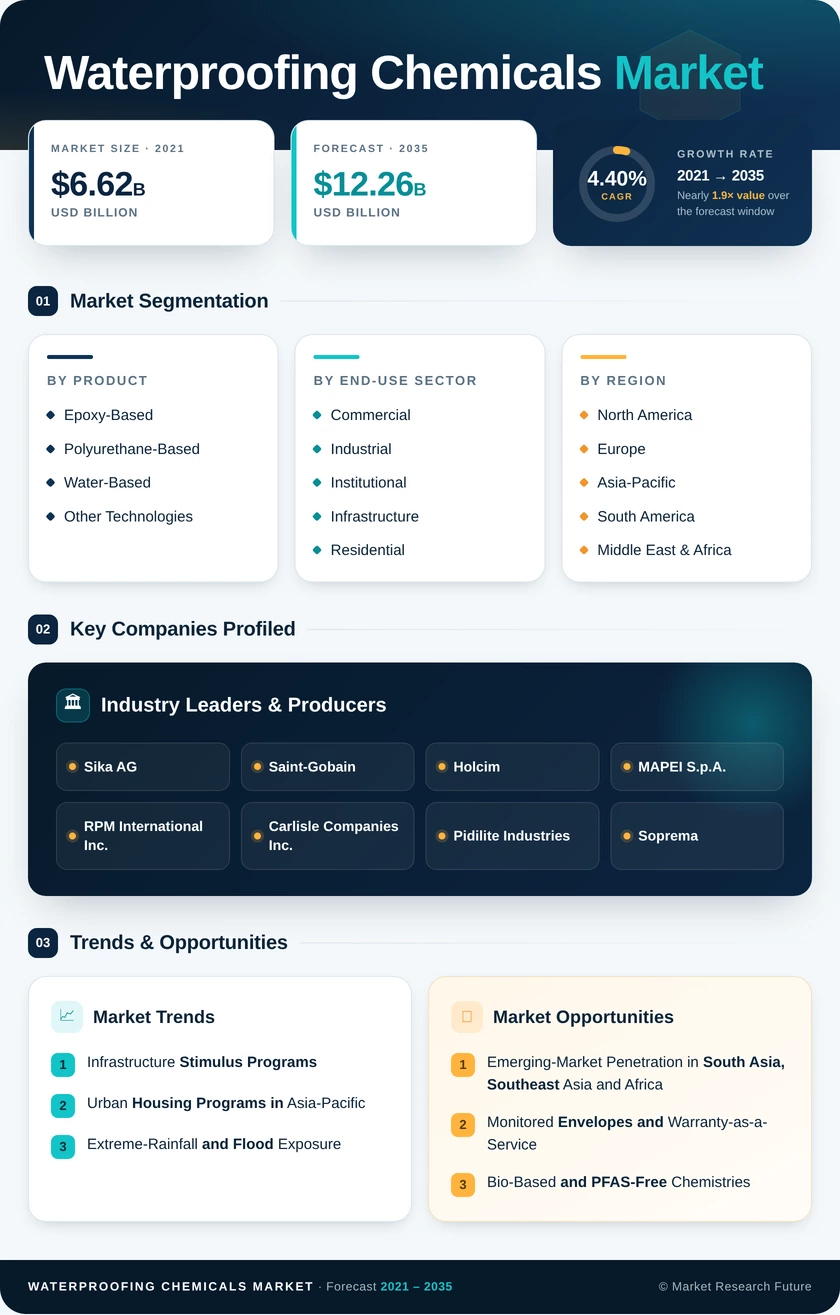
Waterproofing Chemicals Market Research Report Information By Product (Epoxy-Based, Polyurethane-Based, Water-Based, and Other Technologies), By End-Use Sector (Commercial, Industrial and Institutional, Infrastructure, and Residential), And By Region (North America, Europe, Asia-Pacific, and Rest of the World) – Market Forecast Till 2035.
Waterproofing Chemicals Market
Market Size
Forecast Period2026-2035
CAGR (2026-2035)4.40%
2025 Market SizeUSD 7.97 Billion
2035 Market SizeUSD 12.26 Billion
Key Players
Sika AG
Saint-Gobain
Holcim
MAPEI S.p.A.
RPM International Inc.
Carlisle Companies Inc.
Opportunities
  • Emerging-Market Penetration in South Asia, Southeast Asia and Africa
  • Monitored Envelopes and Warranty-as-a-Service
  • Bio-Based and PFAS-Free Chemistries
  1. 1 Market Summary | |
  2. 2 Key Report Takeaways | |
    1. 2.1 By Product | |
    2. 2.2 By End-Use Sector | |
    3. 2.3 By Region | |
  3. 3 Market Size and Forecast (2021–2035) | |
  4. 4 Driver Impact Analysis | |
    1. 4.1 Infrastructure Stimulus Programs | |
    2. 4.2 Urban Housing Programs in Asia-Pacific | |
    3. 4.3 Extreme-Rainfall and Flood Exposure | |
    4. 4.4 Building Renovation Mandates in Europe | |
    5. 4.5 Low-VOC and PFAS Rules Favoring Reformulated Chemistries | |
    6. 4.6 Gulf Giga-Project Construction | |
  5. 5 Restraints Impact Analysis | |
    1. 5.1 Raw Material Price Volatility | |
    2. 5.2 Skilled Applicator Shortage | |
    3. 5.3 Interest-Rate Sensitivity of New Construction | |
    4. 5.4 Reformulation and Compliance Costs | |
    5. 5.5 Cold-Climate Cure Limitations | |
  6. 6 Opportunities | |
    1. 6.1 Emerging-Market Penetration in South Asia, Southeast Asia and Africa | |
    2. 6.2 Monitored Envelopes and Warranty-as-a-Service | |
    3. 6.3 Bio-Based and PFAS-Free Chemistries | |
    4. 6.4 Reflective Roof Systems Linked to Energy Codes | |
    5. 6.5 Rehabilitation of Aging Infrastructure | |
  7. 7 Regional Market Share and Country-Level Analysis | |
    1. 7.1 North America | | |
      1. 7.1.1 United States | | |
      2. 7.1.2 Canada | | |
      3. 7.1.3 Mexico | |
    2. 7.2 Europe | | |
      1. 7.2.1 Germany | | |
      2. 7.2.2 UK | | |
      3. 7.2.3 France | | |
      4. 7.2.4 Italy | | |
      5. 7.2.5 Spain | | |
      6. 7.2.6 Nordic Countries | | |
      7. 7.2.7 Russia | | |
      8. 7.2.8 Rest of Europe | |
    3. 7.3 Asia-Pacific | | |
      1. 7.3.1 China | | |
      2. 7.3.2 India | | |
      3. 7.3.3 Japan | | |
      4. 7.3.4 South Korea | | |
      5. 7.3.5 ASEAN | | |
      6. 7.3.6 Rest of Asia-Pacific | |
    4. 7.4 South America | | |
      1. 7.4.1 Brazil | | |
      2. 7.4.2 Argentina | | |
      3. 7.4.3 Rest of South America | |
    5. 7.5 Middle East & Africa | | |
      1. 7.5.1 Saudi Arabia | | |
      2. 7.5.2 UAE | | |
      3. 7.5.3 South Africa | | |
      4. 7.5.4 Egypt | | |
      5. 7.5.5 Rest of MEA | |
  8. 8 Future Outlook (2026–2035) | |
    1. 8.1 Robotic Application and Digital Inspection | |
    2. 8.2 Climate Adaptation Spending | |
    3. 8.3 Embodied Carbon and Product Disclosure | |
    4. 8.4 Consolidation and System Selling | |
  9. 9 Segmentation Analysis | |
    1. 9.1 By Product | | |
      1. 9.1.1 Epoxy-Based | | |
      2. 9.1.2 Polyurethane-Based | | |
      3. 9.1.3 Water-Based | | |
      4. 9.1.4 Other Technologies | |
    2. 9.2 By End-Use Sector | | |
      1. 9.2.1 Commercial | | |
      2. 9.2.2 Industrial and Institutional | | |
      3. 9.2.3 Infrastructure | | |
      4. 9.2.4 Residential | |
  10. 10 Competitive Landscape | |
    1. 10.1 Market Concentration Analysis | |
    2. 10.2 Competitive Benchmarking | |
  11. 11 Recent News & Developments | |
  12. 12 Report Scope and Methodology | |
  13. 13 Detailed Sources and Citations | |
  14. 14 Frequently Asked Questions (FAQs) | | LIST OF TABLES | |
  15. TABLE 1 Global Market Snapshot, 2025–2035 | |
  16. TABLE 2 Global Market Size and Forecast, 2021–2035 (USD Billion) | |
  17. TABLE 3 Driver Impact Analysis | |
  18. TABLE 4 Restraints Impact Analysis | |
  19. TABLE 5 Regional Summary, 2025 (USD Billion, Share, CAGR) | |
  20. TABLE 6 North America, by Country, 2025 | |
  21. TABLE 7 Europe, by Country, 2025 | |
  22. TABLE 8 Asia-Pacific, by Country, 2025 | |
  23. TABLE 9 South America, by Country, 2025 | |
  24. TABLE 10 Middle East & Africa, by Country, 2025 | |
  25. TABLE 11 Segmentation by Product, 2025 | |
  26. TABLE 12 Segmentation by End-Use Sector, 2025 | |
  27. TABLE 13 Competitive Benchmarking of Key Players | |
  28. TABLE 14 Report Scope and Methodology | |
  29. TABLE 15 Detailed Sources and Citations | |
  30. TABLE 16 Segmentation Quick Reference | | LIST OF FIGURES | |
  31. FIGURE 1 Market Dynamics Overview (Drivers, Restraints, Opportunities) | |
  32. FIGURE 2 Industry Value Chain Analysis | |
  33. FIGURE 3 Porter's Five Forces Analysis | |
  34. FIGURE 4 Global Market Size Trend, 2021–2035 (USD Billion) | |
  35. FIGURE 5 Share by Product, 2025 | |
  36. FIGURE 6 Share by End-Use Sector, 2025 | |
  37. FIGURE 7 Regional Share, 2025 | |
  38. FIGURE 8 Country-Level Comparison by Region, 2025 | |
  39. FIGURE 9 Competitive Landscape: Estimated Revenue Share Ranges of Key Players | |
  40. FIGURE 10 Timeline of Recent Strategic Developments, 2023–2025

Segmentation Quick Reference

DimensionSub-SegmentsDominant SegmentFastest Growing Segment
By ProductEpoxy-Based; Polyurethane-Based; Water-Based; Other TechnologiesWater-Based (40.9% share)Other Technologies (5.1% CAGR)
By End-Use SectorCommercial; Industrial and Institutional; Infrastructure; ResidentialResidential (32.8% share)Industrial and Institutional (5.2% CAGR)
By RegionNorth America; Europe; Asia-Pacific; South America; Middle East & AfricaAsia-Pacific (44.6% share)Middle East & Africa (5.6% CAGR)

Market Segmentation Overview

By Product

Sub-SegmentKey Trend
Epoxy-BasedSteady use in chemically aggressive settings such as wastewater tanks and industrial floors
Polyurethane-BasedPreferred for high-elongation joints, roofs and below-grade work
Water-BasedGaining share as VOC caps and PFAS restrictions tighten
Other TechnologiesSilane-terminated and nano-ceramic hybrids offering multi-function durability

Water-Based formulations lead this dimension with a 40.9% share because VOC ceilings and PFAS restrictions make them the safest route to compliance for roofs and interior wet areas. Other Technologies grow fastest at 5.1%, as silane-terminated polyethers and nano-ceramic films deliver adhesion, UV resistance and breathability in fewer coats. Polyurethane-Based systems hold firm where elongation matters, while Epoxy-Based products stay specialized in chemical-exposure environments.

By End-Use Sector

Sub-SegmentKey Trend
CommercialDemand tied to roof refurbishment cycles and podium upgrades
Industrial and InstitutionalRapid adoption of sensor-equipped, monitored envelope systems
InfrastructureLong service-life clauses on bridges, tunnels and rail
ResidentialLargest volume base, driven by housing programs and wet-area renovation

Residential remains the largest end use at 32.8%, supported by public housing programs in India and Brazil and energy-retrofit grants across Europe, although fragmented installer networks slow premium adoption. Industrial and Institutional grows fastest at 5.2% because data center, hospital and factory owners pay for monitored, warrantied systems to avoid downtime. Infrastructure trails closely at 4.7%, with bridge and tunnel rehabilitation keeping demand for high-performance products steady.


Download PDF ×

We do not share your information with anyone. However, we may send you emails based on your report interest from time to time. You may contact us at any time to opt-out.