Request Free Sample ×

Kindly complete the form below to receive a free sample of this Report

* Please use a valid business email

Leading companies partner with us for data-driven Insights

clients tt-cursor
Hero Background
English
Chinese
French
Japanese
Korean
German
Spanish

Water Soluble Polymer Market Trends

ID: MRFR/CnM/7024-HCR
185 Pages
Anshula Mandaokar
March 2026

Water-Soluble Polymer Market Research Report Information By Raw Material (Synthetic, Semi-Synthetic and Natural), Type (Polyacrylamide and Copolymers, Guar Gum & Derivatives, Casein, Polyvinyl Alcohol, Gelatin, Polyacrylic Acid and others), Application (Wastewater Treatment, Cosmetics and Personal Care Products, Oil & Gas, Food, Pulp and Paper, Pharmaceuticals and others), And By Region (North America, Europe, Asia-Pacific, and Middle East & Africa, Latin America) - Forecast Till 2035

Share:
Download PDF ×

We do not share your information with anyone. However, we may send you emails based on your report interest from time to time. You may contact us at any time to opt-out.

Water Soluble Polymer Market Infographic
Purchase Options

Market Trends

Introduction

Water-soluble polymers in 2023 will be a result of the combined effects of several macro-economic factors, including technological changes, regulations, and changing consumer habits. In the field of polymer chemistry, there are new trends in the development of the properties of products, and new possibilities for using them in various industries, from agriculture to pharmaceuticals. The introduction of stricter regulations in the field of the environment will push manufacturers to take a sustainable path and develop green products, which will affect the structure of the product range. Also, a growing demand for biodegradable and non-toxic materials will affect the market, and this will force the players to change their strategies. In order to understand the future of the market, it is necessary to know these changes and trends, which will be accompanied by an increase in competition and the speed of change.

Top Trends

  1. Sustainability Initiatives
    In the market for water-soluble polymers, the demand for sustainable products is reshaping the industry. Regulations and subsidies also promote the use of eco-friendly materials. The European Green Deal, for example, is designed to reduce the amount of plastic waste, thereby increasing the demand for biodegradable alternatives. This trend is expected to benefit the companies that are taking a stand for sustainable development, whose brand loyalty and market share will increase.
  2. Technological Advancements
    A number of developments in the chemistry of polymers and their processing have resulted in the development of high-performance water-soluble polymers. Companies like Ashland are able to take advantage of these developments to enhance the performance of their products. The introduction of “smart” polymers that react to external stimuli is also gaining momentum. This is a trend that will lead to new applications in a variety of industries, including agriculture and pharmaceuticals.
  3. Rising Demand in Agriculture
    The use of water-soluble polymers in agriculture has been increasing, mainly for soil conditioning and the controlled release of fertilizers. Leaders like SNF develop specific products to improve the yield and water retention of the soil. According to industry data, the use of these polymers can improve the soil by up to 30 per cent. This trend is expected to lead to significant growth in the agricultural market.
  4. Expansion in Personal Care Products
    Water-soluble polymers are increasingly used in cosmetic products to improve the texture and stability of the product. Companies like AkzoNobel are constantly innovating to meet the demand for products with multiple properties. These water-soluble polymers are expected to grow by 15% in the cosmetics industry by 2025. This trend will lead to new product lines and increased competition among the companies.
  5. Increased Regulatory Scrutiny
    Authorities are imposing restrictions on the use of chemicals, which has a direct impact on the water-soluble polymer market. For example, the REACH regulation in Europe requires thorough risk assessment. In order to comply with this regulation, companies need to adapt their formulations, which can lead to higher R&D costs. This trend may result in market concentration as smaller players are unable to meet these demands.
  6. Growth in Oil and Gas Applications
    Oil and gas extraction processes are increasingly using water-soluble polymers, especially in hydraulic fracturing. Firms like Arkema S.A. develop polymers which modify the properties of the fluids. As energy companies are looking to improve their efficiency and reduce their impact on the environment, demand for these products is expected to rise. This trend may lead to strategic alliances between the polymer producers and the energy companies.
  7. Emerging Markets Expansion
    In the course of the industrialization and urbanization of the new countries, a rapid increase in the consumption of soluble polymers is being experienced. To take advantage of this growth, Kemira is concentrating on the markets of Asia-Pacific and Latin America. By the year 2025, according to estimates, the consumption of polymers in these regions will increase by 20 percent. This growth creates opportunities for new players to enter the market and for existing players to expand their market position.
  8. Focus on Customization
    It is therefore becoming increasingly common to design water-soluble polymers to suit the specific needs of the industry. Companies such as the Dow Corning Company offer tailor-made solutions for a wide variety of applications. This not only enhances the performance of the products but also increases customer loyalty. In a highly competitive market, the ability to provide a bespoke service is expected to set the company apart.
  9. Integration of Digital Technologies
    The use of digital technology in production is transforming the water-soluble polymer market. The use of the Internet of Things and artificial intelligence is used to optimize production and supply chains. This can lead to a reduction in costs and an increase in product quality. Those who adopt this technology will gain a competitive advantage.
  10. Increased Collaboration and Partnerships
    Polymer producers and end users are increasingly collaborating to drive innovation. Strategic alliances are forming between the likes of Mitsubishi, DIC and others to develop new products. These alliances are sharing knowledge and accelerating product development. Future collaborations will bring breakthroughs in polymer applications across industries.

Conclusion: Navigating Competitive Waters in 2023

The water-soluble polymer market will be highly competitive and highly fragmented in 2023. The regional trends show a growing demand for sustainable solutions, which forces the suppliers to develop and adapt their products. The large players have the advantage of their wide distribution network and brand loyalty, while the newcomers have the advantage of agility and newer technology. Artificial intelligence, automation and a focus on sustainable development will be the decisive factors for market leaders. Strategically, the ability to be flexible and responsive to market changes will be decisive for the success of the companies.


Author
Author Profile
Anshula Mandaokar
Team Lead - Research

Anshula Mandaokar holds an academic degree in Chemical Engineering and has been contributing to the field for more than 5 years. She has expertise in Market Research and Business Consulting and serves as a Team Lead for a reputed Market Research firm under the Chemicals and Materials domain spectrum. She has worked on multiple projects, generating explicit results in a quick turnaround time. Her understanding of data interpretation justifies her role as a leader.

Leave a Comment

FAQs

What is the projected market valuation of the Global Water-Soluble Polymer Market by 2035?

<p>The projected market valuation for the Global Water-Soluble Polymer Market is 68.91 USD Billion by 2035.</p>

What was the market valuation of the Global Water-Soluble Polymer Market in 2024?

<p>The overall market valuation was 37.22 USD Billion in 2024.</p>

What is the expected CAGR for the Global Water-Soluble Polymer Market during the forecast period 2025 - 2035?

<p>The expected CAGR for the Global Water-Soluble Polymer Market during the forecast period 2025 - 2035 is 5.76%.</p>

Which companies are considered key players in the Global Water-Soluble Polymer Market?

<p>Key players in the market include BASF SE, Dow Inc., Ashland Global Holdings Inc., SNF Group, and others.</p>

What are the main segments of the Global Water-Soluble Polymer Market?

<p>The main segments include Raw Material, Type, and Application.</p>

What was the valuation of the Synthetic segment in the Raw Material category in 2024?

<p>The valuation of the Synthetic segment in the Raw Material category was 18.61 USD Billion in 2024.</p>

Which application had the highest valuation in the Global Water-Soluble Polymer Market in 2024?

<p>The Wastewater Treatment application had the highest valuation at 8.0 USD Billion in 2024.</p>

What is the projected valuation for the Polyacrylamide and Copolymers type by 2035?

<p>The projected valuation for the Polyacrylamide and Copolymers type is 18.0 USD Billion by 2035.</p>

How does the valuation of Natural polymers compare to Semi-Synthetic polymers in 2024?

<p>In 2024, Natural polymers were valued at 8.61 USD Billion, while Semi-Synthetic polymers were valued at 10.0 USD Billion.</p>

What is the projected growth for the Household Detergents application from 2024 to 2035?

<p>The projected growth for the Household Detergents application is from 7.0 USD Billion in 2024 to 12.0 USD Billion by 2035.</p>

Market Summary

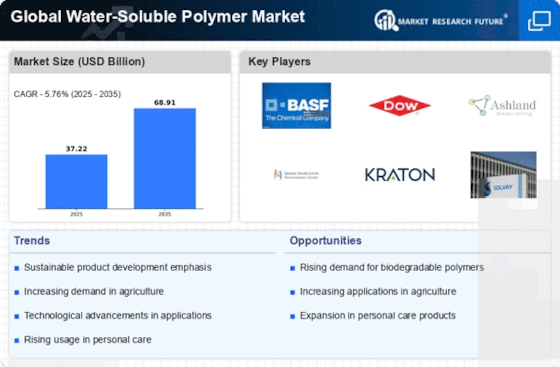
As per Market Research Future analysis, the Global Water-Soluble Polymer Market Size was estimated at 37.22 USD Billion in 2024. The water-soluble polymer industry is projected to grow from 39.36 USD Billion in 2025 to 68.91 USD Billion by 2035, exhibiting a compound annual growth rate (CAGR) of 5.76% during the forecast period 2025 - 2035

Key Market Trends & Highlights

The Global Water-Soluble Polymer Market is poised for substantial growth driven by sustainability and technological advancements.

  • North America remains the largest market for water-soluble polymers, reflecting a robust demand across various industries.
  • Asia-Pacific is identified as the fastest-growing region, indicating a shift towards increased consumption and application of these materials.
  • Synthetic polymers, particularly polyacrylamide and copolymers, dominate the market, while natural polymers like guar gum and derivatives are experiencing rapid growth.
  • The rising demand in personal care products and expansion in food and beverage applications are key drivers propelling market growth.

Market Size & Forecast

2024 Market Size 37.22 (USD Billion)
2035 Market Size 68.91 (USD Billion)
CAGR (2025 - 2035) 5.76%
Largest Regional Market Share in 2024 Asia Pacific

Major Players

BASF SE (DE), Dow Inc. (US), Ashland Global Holdings Inc. (US), SNF Group (FR), Kraton Corporation (US), Solvay S.A. (BE), Evonik Industries AG (DE), Mitsubishi Chemical Corporation (JP), Wacker Chemie AG (DE)

Market Trends

The Global Water-Soluble Polymer Market is currently experiencing a dynamic evolution, driven by various factors that influence its growth trajectory. The increasing demand for environmentally friendly materials across multiple industries, including agriculture, food, and pharmaceuticals, appears to be a significant catalyst. As sustainability becomes a priority, manufacturers are focusing on developing biodegradable and non-toxic polymers, which may enhance their market appeal. Furthermore, advancements in technology and production processes are likely to lead to improved product performance and functionality, thereby attracting a broader customer base. In addition, the rising awareness regarding water conservation and efficient resource management is propelling the adoption of water-soluble polymers in applications such as water treatment and soil conditioning. This trend suggests a shift towards innovative solutions that address pressing environmental challenges. As the market continues to expand, it seems poised for further growth, with potential opportunities emerging in developing regions where industrialization is on the rise. The interplay of these factors indicates a promising future for the Global Water-Soluble Polymer Market, as it adapts to meet the evolving needs of various sectors.

Sustainability Focus

The emphasis on sustainable practices is reshaping the Global Water-Soluble Polymer Market. Companies are increasingly prioritizing the development of eco-friendly polymers that minimize environmental impact. This trend reflects a broader societal shift towards sustainability, influencing consumer preferences and regulatory frameworks.

Technological Advancements

Innovations in production techniques and material science are driving enhancements in the performance of water-soluble polymers. These advancements may lead to the creation of more efficient and versatile products, catering to diverse applications across industries.

Growing Applications in Agriculture

The agricultural sector is witnessing a surge in the use of water-soluble polymers for soil conditioning and nutrient delivery. This trend indicates a growing recognition of the benefits these materials offer in enhancing crop yield and resource efficiency.

Water Soluble Polymer Market Market Drivers

Growth in Oil and Gas Industry

The oil and gas industry is increasingly incorporating water-soluble polymers in various applications, including drilling fluids and enhanced oil recovery processes. These polymers play a vital role in improving the efficiency of drilling operations and reducing environmental impact. The demand for water-soluble polymers in this sector is expected to grow, with projections indicating a compound annual growth rate of around 5% over the next few years. This growth is likely to be fueled by the ongoing exploration and production activities in emerging markets. Thus, the Global Water-Soluble Polymer Market stands to gain from the expanding applications in the oil and gas sector.

Innovations in Biodegradable Polymers

The development of biodegradable water-soluble polymers is becoming increasingly relevant in various industries, including packaging and agriculture. These innovations are driven by the growing emphasis on sustainability and the reduction of plastic waste. The market for biodegradable polymers is anticipated to grow at a compound annual growth rate of approximately 7% in the coming years. This trend indicates a shift towards more environmentally friendly materials, which aligns with consumer preferences for sustainable products. As a result, the Global Water-Soluble Polymer Market is likely to experience significant growth as manufacturers adopt these innovative solutions to meet regulatory requirements and consumer expectations.

Rising Demand in Personal Care Products

The increasing consumer awareness regarding personal hygiene and skincare is driving the demand for water-soluble polymers in the personal care sector. These polymers are utilized in various formulations, including shampoos, conditioners, and lotions, due to their ability to enhance texture and stability. The personal care segment is projected to witness a growth rate of approximately 5% annually, indicating a robust market for water-soluble polymers. As consumers seek products that are both effective and environmentally friendly, the Global Water-Soluble Polymer Market is likely to benefit from this trend, as these polymers are often derived from renewable resources, aligning with sustainability goals.

Expansion in Food and Beverage Applications

The food and beverage industry is increasingly adopting water-soluble polymers for their thickening, gelling, and stabilizing properties. These polymers are essential in the formulation of sauces, dressings, and dairy products, where they improve texture and shelf life. The market for food-grade water-soluble polymers is expected to grow significantly, with estimates suggesting a compound annual growth rate of around 4.5% over the next few years. This growth is indicative of the rising consumer preference for convenience foods and the need for clean-label products. Consequently, the Global Water-Soluble Polymer Market is poised to expand as manufacturers seek innovative solutions to meet evolving consumer demands.

Increased Use in Pharmaceutical Formulations

The pharmaceutical sector is witnessing a surge in the utilization of water-soluble polymers for drug delivery systems and formulations. These polymers enhance the solubility and bioavailability of active pharmaceutical ingredients, which is crucial for effective treatment outcomes. The market for pharmaceutical-grade water-soluble polymers is projected to grow at a rate of approximately 6% annually, driven by the increasing prevalence of chronic diseases and the demand for advanced drug delivery technologies. This trend suggests that the Global Water-Soluble Polymer Market will continue to evolve, as pharmaceutical companies increasingly rely on these materials to develop innovative therapies.

Market Segment Insights

By Raw Material: Synthetic (Largest) vs. Natural (Fastest-Growing)

<p>In the Global Water-Soluble Polymer Market, the synthetic segment holds the largest market share, driven by its versatility and widespread applications across industries such as pharmaceuticals, food, and personal care. This segment is characterized by the production of polymers through chemical processes, resulting in consistent quality and performance that meets industrial standards. On the other hand, the natural segment is witnessing rapid growth, fueled by increasing consumer demand for sustainable and biodegradable materials. This trend aligns with the global shift towards eco-friendliness and the use of renewable resources, significantly impacting market dynamics.</p>

<p>Synthetic: Dominant vs. Natural: Emerging</p>

<p>The synthetic segment is defined by its engineered properties, which provide functionalities such as thickening, gelling, and film-forming capabilities, making it integral for applications in various sectors. With its established production techniques, synthetic polymers are favored in applications requiring reliability and consistent performance. Conversely, the natural segment, derived from renewable resources, is emerging as a vital alternative due to growing environmental concerns. Natural polymers offer biodegradability and non-toxic characteristics, appealing to eco-conscious consumers and industries looking for sustainable solutions. As regulations tighten around synthetic material usage, the natural segment is poised for accelerated growth, marking a significant shift in market preferences.</p>

By Type: Polyacrylamide and Copolymers (Largest) vs. Guar Gum & Derivatives (Fastest-Growing)

<p>The Global Water-Soluble Polymer Market is primarily dominated by <a href="https://www.marketresearchfuture.com/reports/polyacrylamide-market-7910" target="_blank" title="polyacrylamide">Polyacrylamide</a> and its copolymers, which have established a significant market share due to key applications in water treatment and oil recovery. Following closely, Guar Gum and its derivatives have gained traction, especially in food, cosmetics, and pharmaceuticals, leading to a notable competitive position.</p>

<p>Polyacrylamide (Dominant) vs. Guar Gum (Emerging)</p>

<p>Polyacrylamide and its copolymers dominate the water-soluble polymer segment due to their versatility in applications ranging from wastewater treatment to enhanced oil recovery. Their ability to form gels and flocculants makes them indispensable in many industrial processes. Conversely, Guar Gum is emerging rapidly, valued for its natural origin and thickening properties, particularly in food formulations and personal care products. The growing trend towards natural and sustainable products positively impacts Guar Gum's demand, making it a significant player in the market.</p>

By Application: Wastewater Treatment (Largest) vs. Personal Care Products (Fastest-Growing)

<p>The Global Water-Soluble Polymer Market is witnessing a diverse spread across its applications. Wastewater treatment dominates the landscape, holding a significant portion of overall market share. Following closely are personal care products and household detergents, which are increasingly capturing the attention of industry players. Construction materials, textiles, and oil & gas sectors showcase promising contributions, but their share remains comparatively smaller. In terms of growth trends, personal care products emerge as the fastest-growing segment, propelled by rising consumer preference for eco-friendly and biodegradable products. Similarly, the wastewater treatment sector continues to expand due to increasing regulatory pressures and environmental concerns regarding water quality. Innovations in formulations and sustainable practices are further driving this growth, making the market dynamic and competitive.</p>

<p>Wastewater Treatment (Dominant) vs. Personal Care Products (Emerging)</p>

<p>Wastewater treatment applications are crucial in the Global Water-Soluble Polymer Market, leveraging these polymers to enhance filtration and clarification processes. Their ability to bind contaminants makes them indispensable in municipal and industrial settings. As environmental regulations tighten, the demand for effective solutions in waste management amplifies the market position of wastewater treatment. On the other hand, personal care products represent the emerging segment, characterized by a push towards natural and biodegradable ingredients. The rising awareness of sustainability among consumers is driving innovation in this area, with water-soluble polymers playing a key role in formulating skin care, hair care, and cosmetic products. This shift foregrounds both segments’ growing importance in meeting environmental standards and consumer expectations.</p>

Get more detailed insights about Water-Soluble Polymer Market Research Report - Global Forecast till 2035

Regional Insights

North America : Innovation and Demand Surge

North America is the largest market for water-soluble polymers, holding approximately 40% of the global market share. The region's growth is driven by increasing demand in industries such as pharmaceuticals, food processing, and personal care. Regulatory support for sustainable practices and innovations in polymer technology further catalyze market expansion. The U.S. and Canada are the primary contributors to this growth, with a strong focus on R&D and eco-friendly solutions. The competitive landscape in North America is characterized by the presence of major players like Dow Inc., BASF SE, and Ashland Global Holdings. These companies are investing heavily in innovation and sustainability, enhancing their product offerings. The region's robust infrastructure and advanced manufacturing capabilities also support the growth of water-soluble polymers, making it a hub for industry advancements.

Europe : Sustainability and Regulation Focus

Europe is the second-largest market for water-soluble polymers, accounting for around 30% of the global market share. The region's growth is significantly influenced by stringent environmental regulations and a strong push towards sustainable products. Countries like Germany and France are at the forefront, driving demand through innovative applications in agriculture, cosmetics, and food industries. The European Union's Green Deal further supports the transition to eco-friendly materials, enhancing market potential. Leading countries in Europe include Germany, France, and the UK, where key players like Solvay S.A. and Evonik Industries are actively engaged in developing sustainable polymer solutions. The competitive landscape is marked by collaborations and partnerships aimed at enhancing product performance and reducing environmental impact. This focus on sustainability positions Europe as a leader in the global water-soluble polymer market.

Asia-Pacific : Rapid Growth and Industrialization

Asia-Pacific is witnessing rapid growth in the water-soluble polymer market, holding approximately 25% of the global market share. The region's expansion is driven by increasing industrialization, urbanization, and rising demand from sectors such as agriculture and textiles. Countries like China and India are leading this growth, supported by favorable government policies and investments in infrastructure. The growing awareness of environmental issues is also pushing for more sustainable polymer solutions in the region. China is the largest market in Asia-Pacific, with significant contributions from local manufacturers and multinational companies. The competitive landscape features key players like Mitsubishi Chemical Corporation and Wacker Chemie AG, who are focusing on innovation and product diversification. The region's growing manufacturing capabilities and investment in R&D are expected to further enhance its position in the global market for water-soluble polymers.

Middle East and Africa : Emerging Markets and Opportunities

The Middle East and Africa region is gradually emerging in the water-soluble polymer market, holding about 5% of the global market share. The growth is primarily driven by increasing demand in sectors such as oil and gas, agriculture, and construction. Countries like South Africa and the UAE are leading the way, with investments in infrastructure and a growing focus on sustainable practices. The region's potential for growth is significant, given the rising industrial activities and government initiatives to promote local manufacturing. In the competitive landscape, local players are beginning to establish their presence, while international companies are exploring opportunities in the region. The market is characterized by a mix of established firms and new entrants, focusing on innovative applications of water-soluble polymers. As the region continues to develop, the demand for these polymers is expected to rise, driven by both industrial and consumer needs.

Key Players and Competitive Insights

The market for water soluble polymers is extremely competitive, with major market players developing new products, partnering with other companies, and acquiring smaller companies to expand their production capabilities, product portfolios, and industries across the globe.
BASF and Nippon Paint China, the leading coatings manufacturer, have jointly launched eco-friendly industrial packaging that incorporates the Nippon Paint dry-mixed mortar series products. This new packaging material is commercialized for producing a dry mortar product of Nippon Paint, using BASF’s water-based acrylic dispersion Joncryl High-Performance Barrier (HPB) as the barrier material.
Kemira Oyj announced in February 2022 that it had begun global-scale production of its newly introduced polyacrylamide polymer based on biobased feedstock. The first shipment of commercial volumes has been dispatched to one of Helsinki Region Environmental Services (HSY) wastewater treatment plants for testing.
Researchers at the Tokyo Institute of Technology developed a peptide sensor in Nov 2021 that can discriminate polymers soluble in water from those entering sewers, which is another problem similar to microplastic pollution. It offers machine learning technology that uses peptides bonded polymer for the detection and quantification of pollutants simultaneously present in the solution.
In its two factories, starting in May 2021, LG Chem will produce bi-based polymers. ISCC Plus has certified LG Chem under nine bio-balanced products: SAP, PO(polyolefin), and PC(polycarbonate) compounds, among others.
Flexibility and slightly increased capacity were added to BASF’s Ludwigshafen plant producing water-soluble polyacrylate in January 2020. An expanded plant in specialty chemicals at the manufacturing stage is expected to provide enhanced capacity to BASF’s customers in household and commercial cleaning product industries, as well as the chemical and formulator industries.

Key Companies in the Water Soluble Polymer Market include

Industry Developments

  • Q2 2024: BASF expands production capacity for water-soluble polymers at Ludwigshafen site BASF announced the expansion of its production capacity for water-soluble polymers at its Ludwigshafen site in Germany, aiming to meet growing demand from the water treatment and oil & gas industries.
  • Q1 2024: Arkema inaugurates new waterborne polymer facility in Changshu, China Arkema officially opened a new facility in Changshu, China, dedicated to the production of waterborne and water-soluble polymers, strengthening its presence in the Asia-Pacific region.
  • Q2 2024: Solvay launches new range of bio-based water-soluble polymers for personal care Solvay introduced a new portfolio of bio-based water-soluble polymers designed for use in personal care products, targeting sustainability-conscious manufacturers.
  • Q3 2024: Ashland announces partnership with Watergenics for advanced water-soluble polymer solutions Ashland entered into a strategic partnership with Watergenics to co-develop advanced water-soluble polymer solutions for industrial water treatment applications.
  • Q2 2024: Kemira invests €40 million to expand water-soluble polymer production in Finland Kemira announced a €40 million investment to expand its water-soluble polymer production capacity at its Oulu, Finland site, supporting increased demand in municipal and industrial water treatment.
  • Q1 2024: SNF Group opens new water-soluble polymer plant in Texas SNF Group inaugurated a new manufacturing facility in Texas, USA, dedicated to the production of water-soluble polymers for water treatment and oilfield applications.
  • Q2 2024: Dow introduces next-generation water-soluble polymers for enhanced oil recovery Dow launched a new line of water-soluble polymers engineered to improve efficiency in enhanced oil recovery processes, targeting the energy sector.
  • Q3 2024: Evonik appoints new head of water-soluble polymers business unit Evonik announced the appointment of Dr. Anna Müller as the new head of its water-soluble polymers business unit, effective September 2024.
  • Q2 2024: Clariant and Sinopec sign joint venture agreement for water-soluble polymer production in China Clariant and Sinopec entered into a joint venture to build and operate a new water-soluble polymer production facility in China, aiming to serve the growing Asian market.
  • Q1 2024: Lubrizol launches new water-soluble polymer for pharmaceutical applications Lubrizol introduced a new water-soluble polymer specifically designed for use in pharmaceutical formulations, enhancing drug solubility and delivery.
  • Q2 2024: Henkel unveils sustainable water-soluble adhesive for packaging industry Henkel launched a new sustainable water-soluble adhesive aimed at improving recyclability in the packaging industry.
  • Q3 2024: AkzoNobel expands water-soluble polymer R&D center in the Netherlands AkzoNobel announced the expansion of its research and development center in the Netherlands, focusing on innovation in water-soluble polymer technologies.

Future Outlook

Water Soluble Polymer Market Future Outlook

The Global Water-Soluble Polymer Market is projected to grow at a 5.76% CAGR from 2025 to 2035, driven by increasing demand in various industries and advancements in polymer technology.

New opportunities lie in:

  • Development of biodegradable water-soluble polymers for eco-friendly applications.
  • Expansion into emerging markets with tailored product offerings.
  • Investment in R&D for innovative applications in pharmaceuticals and agriculture.

By 2035, the market is expected to achieve robust growth, positioning itself as a leader in sustainable polymer solutions.

Market Segmentation

Water Soluble Polymer Market Type Outlook

  • Polyacrylamide and Copolymers
  • Guar Gum & Derivatives
  • Casein
  • Polyvinyl Alcohol
  • Gelatin
  • Polyacrylic Acid
  • Others

Water Soluble Polymer Market Application Outlook

  • Wastewater Treatment
  • Personal Care Products
  • Construction Materials
  • Household Detergents
  • Paint
  • Textiles
  • Oil & Gas

Water Soluble Polymer Market Raw Material Outlook

  • Synthetic
  • Semi-Synthetic
  • Natural

Report Scope

MARKET SIZE 2024 37.22(USD Billion)
MARKET SIZE 2025 39.36(USD Billion)
MARKET SIZE 2035 68.91(USD Billion)
COMPOUND ANNUAL GROWTH RATE (CAGR) 5.76% (2025 - 2035)
REPORT COVERAGE Revenue Forecast, Competitive Landscape, Growth Factors, and Trends
BASE YEAR 2024
Market Forecast Period 2025 - 2035
Historical Data 2019 - 2024
Market Forecast Units USD Billion
Key Companies Profiled BASF SE (DE), Dow Inc. (US), Ashland Global Holdings Inc. (US), SNF Group (FR), Kraton Corporation (US), Solvay S.A. (BE), Evonik Industries AG (DE), Mitsubishi Chemical Corporation (JP), Wacker Chemie AG (DE)
Segments Covered Raw Material, Region
Key Market Opportunities Growing demand for sustainable packaging solutions drives innovation in the Global Water-Soluble Polymer Market.
Key Market Dynamics Rising demand for eco-friendly products drives innovation and competition in the water-soluble polymer sector.
Countries Covered North America, Europe, APAC, South America, MEA

FAQs

What is the projected market valuation of the Global Water-Soluble Polymer Market by 2035?

<p>The projected market valuation for the Global Water-Soluble Polymer Market is 68.91 USD Billion by 2035.</p>

What was the market valuation of the Global Water-Soluble Polymer Market in 2024?

<p>The overall market valuation was 37.22 USD Billion in 2024.</p>

What is the expected CAGR for the Global Water-Soluble Polymer Market during the forecast period 2025 - 2035?

<p>The expected CAGR for the Global Water-Soluble Polymer Market during the forecast period 2025 - 2035 is 5.76%.</p>

Which companies are considered key players in the Global Water-Soluble Polymer Market?

<p>Key players in the market include BASF SE, Dow Inc., Ashland Global Holdings Inc., SNF Group, and others.</p>

What are the main segments of the Global Water-Soluble Polymer Market?

<p>The main segments include Raw Material, Type, and Application.</p>

What was the valuation of the Synthetic segment in the Raw Material category in 2024?

<p>The valuation of the Synthetic segment in the Raw Material category was 18.61 USD Billion in 2024.</p>

Which application had the highest valuation in the Global Water-Soluble Polymer Market in 2024?

<p>The Wastewater Treatment application had the highest valuation at 8.0 USD Billion in 2024.</p>

What is the projected valuation for the Polyacrylamide and Copolymers type by 2035?

<p>The projected valuation for the Polyacrylamide and Copolymers type is 18.0 USD Billion by 2035.</p>

How does the valuation of Natural polymers compare to Semi-Synthetic polymers in 2024?

<p>In 2024, Natural polymers were valued at 8.61 USD Billion, while Semi-Synthetic polymers were valued at 10.0 USD Billion.</p>

What is the projected growth for the Household Detergents application from 2024 to 2035?

<p>The projected growth for the Household Detergents application is from 7.0 USD Billion in 2024 to 12.0 USD Billion by 2035.</p>

  1. SECTION I: EXECUTIVE SUMMARY AND KEY HIGHLIGHTS
    1. | 1.1 EXECUTIVE SUMMARY
    2. | | 1.1.1 Market Overview
    3. | | 1.1.2 Key Findings
    4. | | 1.1.3 Market Segmentation
    5. | | 1.1.4 Competitive Landscape
    6. | | 1.1.5 Challenges and Opportunities
    7. | | 1.1.6 Future Outlook
  2. SECTION II: SCOPING, METHODOLOGY AND MARKET STRUCTURE
    1. | 2.1 MARKET INTRODUCTION
    2. | | 2.1.1 Definition
    3. | | 2.1.2 Scope of the study
    4. | | | 2.1.2.1 Research Objective
    5. | | | 2.1.2.2 Assumption
    6. | | | 2.1.2.3 Limitations
    7. | 2.2 RESEARCH METHODOLOGY
    8. | | 2.2.1 Overview
    9. | | 2.2.2 Data Mining
    10. | | 2.2.3 Secondary Research
    11. | | 2.2.4 Primary Research
    12. | | | 2.2.4.1 Primary Interviews and Information Gathering Process
    13. | | | 2.2.4.2 Breakdown of Primary Respondents
    14. | | 2.2.5 Forecasting Model
    15. | | 2.2.6 Market Size Estimation
    16. | | | 2.2.6.1 Bottom-Up Approach
    17. | | | 2.2.6.2 Top-Down Approach
    18. | | 2.2.7 Data Triangulation
    19. | | 2.2.8 Validation
  3. SECTION III: QUALITATIVE ANALYSIS
    1. | 3.1 MARKET DYNAMICS
    2. | | 3.1.1 Overview
    3. | | 3.1.2 Drivers
    4. | | 3.1.3 Restraints
    5. | | 3.1.4 Opportunities
    6. | 3.2 MARKET FACTOR ANALYSIS
    7. | | 3.2.1 Value chain Analysis
    8. | | 3.2.2 Porter's Five Forces Analysis
    9. | | | 3.2.2.1 Bargaining Power of Suppliers
    10. | | | 3.2.2.2 Bargaining Power of Buyers
    11. | | | 3.2.2.3 Threat of New Entrants
    12. | | | 3.2.2.4 Threat of Substitutes
    13. | | | 3.2.2.5 Intensity of Rivalry
    14. | | 3.2.3 COVID-19 Impact Analysis
    15. | | | 3.2.3.1 Market Impact Analysis
    16. | | | 3.2.3.2 Regional Impact
    17. | | | 3.2.3.3 Opportunity and Threat Analysis
  4. SECTION IV: QUANTITATIVE ANALYSIS
    1. | 4.1 Chemicals and Materials, BY Raw Material (USD Billion)
    2. | | 4.1.1 Synthetic
    3. | | 4.1.2 Semi-Synthetic
    4. | | 4.1.3 Natural
    5. | 4.2 Chemicals and Materials, BY Type (USD Billion)
    6. | | 4.2.1 Polyacrylamide and Copolymers
    7. | | 4.2.2 Guar Gum & Derivatives
    8. | | 4.2.3 Casein
    9. | | 4.2.4 Polyvinyl Alcohol
    10. | | 4.2.5 Gelatin
    11. | | 4.2.6 Polyacrylic Acid
    12. | | 4.2.7 Others
    13. | 4.3 Chemicals and Materials, BY Application (USD Billion)
    14. | | 4.3.1 Wastewater Treatment
    15. | | 4.3.2 Personal Care Products
    16. | | 4.3.3 Construction Materials
    17. | | 4.3.4 Household Detergents
    18. | | 4.3.5 Paint
    19. | | 4.3.6 Textiles
    20. | | 4.3.7 Oil & Gas
    21. | 4.4 Chemicals and Materials, BY Region (USD Billion)
    22. | | 4.4.1 North America
    23. | | | 4.4.1.1 US
    24. | | | 4.4.1.2 Canada
    25. | | 4.4.2 Europe
    26. | | | 4.4.2.1 Germany
    27. | | | 4.4.2.2 UK
    28. | | | 4.4.2.3 France
    29. | | | 4.4.2.4 Russia
    30. | | | 4.4.2.5 Italy
    31. | | | 4.4.2.6 Spain
    32. | | | 4.4.2.7 Rest of Europe
    33. | | 4.4.3 APAC
    34. | | | 4.4.3.1 China
    35. | | | 4.4.3.2 India
    36. | | | 4.4.3.3 Japan
    37. | | | 4.4.3.4 South Korea
    38. | | | 4.4.3.5 Malaysia
    39. | | | 4.4.3.6 Thailand
    40. | | | 4.4.3.7 Indonesia
    41. | | | 4.4.3.8 Rest of APAC
    42. | | 4.4.4 South America
    43. | | | 4.4.4.1 Brazil
    44. | | | 4.4.4.2 Mexico
    45. | | | 4.4.4.3 Argentina
    46. | | | 4.4.4.4 Rest of South America
    47. | | 4.4.5 MEA
    48. | | | 4.4.5.1 GCC Countries
    49. | | | 4.4.5.2 South Africa
    50. | | | 4.4.5.3 Rest of MEA
  5. SECTION V: COMPETITIVE ANALYSIS
    1. | 5.1 Competitive Landscape
    2. | | 5.1.1 Overview
    3. | | 5.1.2 Competitive Analysis
    4. | | 5.1.3 Market share Analysis
    5. | | 5.1.4 Major Growth Strategy in the Chemicals and Materials
    6. | | 5.1.5 Competitive Benchmarking
    7. | | 5.1.6 Leading Players in Terms of Number of Developments in the Chemicals and Materials
    8. | | 5.1.7 Key developments and growth strategies
    9. | | | 5.1.7.1 New Product Launch/Service Deployment
    10. | | | 5.1.7.2 Merger & Acquisitions
    11. | | | 5.1.7.3 Joint Ventures
    12. | | 5.1.8 Major Players Financial Matrix
    13. | | | 5.1.8.1 Sales and Operating Income
    14. | | | 5.1.8.2 Major Players R&D Expenditure. 2023
    15. | 5.2 Company Profiles
    16. | | 5.2.1 BASF SE (DE)
    17. | | | 5.2.1.1 Financial Overview
    18. | | | 5.2.1.2 Products Offered
    19. | | | 5.2.1.3 Key Developments
    20. | | | 5.2.1.4 SWOT Analysis
    21. | | | 5.2.1.5 Key Strategies
    22. | | 5.2.2 Dow Inc. (US)
    23. | | | 5.2.2.1 Financial Overview
    24. | | | 5.2.2.2 Products Offered
    25. | | | 5.2.2.3 Key Developments
    26. | | | 5.2.2.4 SWOT Analysis
    27. | | | 5.2.2.5 Key Strategies
    28. | | 5.2.3 Ashland Global Holdings Inc. (US)
    29. | | | 5.2.3.1 Financial Overview
    30. | | | 5.2.3.2 Products Offered
    31. | | | 5.2.3.3 Key Developments
    32. | | | 5.2.3.4 SWOT Analysis
    33. | | | 5.2.3.5 Key Strategies
    34. | | 5.2.4 SNF Group (FR)
    35. | | | 5.2.4.1 Financial Overview
    36. | | | 5.2.4.2 Products Offered
    37. | | | 5.2.4.3 Key Developments
    38. | | | 5.2.4.4 SWOT Analysis
    39. | | | 5.2.4.5 Key Strategies
    40. | | 5.2.5 Kraton Corporation (US)
    41. | | | 5.2.5.1 Financial Overview
    42. | | | 5.2.5.2 Products Offered
    43. | | | 5.2.5.3 Key Developments
    44. | | | 5.2.5.4 SWOT Analysis
    45. | | | 5.2.5.5 Key Strategies
    46. | | 5.2.6 Solvay S.A. (BE)
    47. | | | 5.2.6.1 Financial Overview
    48. | | | 5.2.6.2 Products Offered
    49. | | | 5.2.6.3 Key Developments
    50. | | | 5.2.6.4 SWOT Analysis
    51. | | | 5.2.6.5 Key Strategies
    52. | | 5.2.7 Evonik Industries AG (DE)
    53. | | | 5.2.7.1 Financial Overview
    54. | | | 5.2.7.2 Products Offered
    55. | | | 5.2.7.3 Key Developments
    56. | | | 5.2.7.4 SWOT Analysis
    57. | | | 5.2.7.5 Key Strategies
    58. | | 5.2.8 Mitsubishi Chemical Corporation (JP)
    59. | | | 5.2.8.1 Financial Overview
    60. | | | 5.2.8.2 Products Offered
    61. | | | 5.2.8.3 Key Developments
    62. | | | 5.2.8.4 SWOT Analysis
    63. | | | 5.2.8.5 Key Strategies
    64. | | 5.2.9 Wacker Chemie AG (DE)
    65. | | | 5.2.9.1 Financial Overview
    66. | | | 5.2.9.2 Products Offered
    67. | | | 5.2.9.3 Key Developments
    68. | | | 5.2.9.4 SWOT Analysis
    69. | | | 5.2.9.5 Key Strategies
    70. | 5.3 Appendix
    71. | | 5.3.1 References
    72. | | 5.3.2 Related Reports
  6. LIST OF FIGURES
    1. | 6.1 MARKET SYNOPSIS
    2. | 6.2 NORTH AMERICA MARKET ANALYSIS
    3. | 6.3 US MARKET ANALYSIS BY RAW MATERIAL
    4. | 6.4 US MARKET ANALYSIS BY TYPE
    5. | 6.5 US MARKET ANALYSIS BY APPLICATION
    6. | 6.6 CANADA MARKET ANALYSIS BY RAW MATERIAL
    7. | 6.7 CANADA MARKET ANALYSIS BY TYPE
    8. | 6.8 CANADA MARKET ANALYSIS BY APPLICATION
    9. | 6.9 EUROPE MARKET ANALYSIS
    10. | 6.10 GERMANY MARKET ANALYSIS BY RAW MATERIAL
    11. | 6.11 GERMANY MARKET ANALYSIS BY TYPE
    12. | 6.12 GERMANY MARKET ANALYSIS BY APPLICATION
    13. | 6.13 UK MARKET ANALYSIS BY RAW MATERIAL
    14. | 6.14 UK MARKET ANALYSIS BY TYPE
    15. | 6.15 UK MARKET ANALYSIS BY APPLICATION
    16. | 6.16 FRANCE MARKET ANALYSIS BY RAW MATERIAL
    17. | 6.17 FRANCE MARKET ANALYSIS BY TYPE
    18. | 6.18 FRANCE MARKET ANALYSIS BY APPLICATION
    19. | 6.19 RUSSIA MARKET ANALYSIS BY RAW MATERIAL
    20. | 6.20 RUSSIA MARKET ANALYSIS BY TYPE
    21. | 6.21 RUSSIA MARKET ANALYSIS BY APPLICATION
    22. | 6.22 ITALY MARKET ANALYSIS BY RAW MATERIAL
    23. | 6.23 ITALY MARKET ANALYSIS BY TYPE
    24. | 6.24 ITALY MARKET ANALYSIS BY APPLICATION
    25. | 6.25 SPAIN MARKET ANALYSIS BY RAW MATERIAL
    26. | 6.26 SPAIN MARKET ANALYSIS BY TYPE
    27. | 6.27 SPAIN MARKET ANALYSIS BY APPLICATION
    28. | 6.28 REST OF EUROPE MARKET ANALYSIS BY RAW MATERIAL
    29. | 6.29 REST OF EUROPE MARKET ANALYSIS BY TYPE
    30. | 6.30 REST OF EUROPE MARKET ANALYSIS BY APPLICATION
    31. | 6.31 APAC MARKET ANALYSIS
    32. | 6.32 CHINA MARKET ANALYSIS BY RAW MATERIAL
    33. | 6.33 CHINA MARKET ANALYSIS BY TYPE
    34. | 6.34 CHINA MARKET ANALYSIS BY APPLICATION
    35. | 6.35 INDIA MARKET ANALYSIS BY RAW MATERIAL
    36. | 6.36 INDIA MARKET ANALYSIS BY TYPE
    37. | 6.37 INDIA MARKET ANALYSIS BY APPLICATION
    38. | 6.38 JAPAN MARKET ANALYSIS BY RAW MATERIAL
    39. | 6.39 JAPAN MARKET ANALYSIS BY TYPE
    40. | 6.40 JAPAN MARKET ANALYSIS BY APPLICATION
    41. | 6.41 SOUTH KOREA MARKET ANALYSIS BY RAW MATERIAL
    42. | 6.42 SOUTH KOREA MARKET ANALYSIS BY TYPE
    43. | 6.43 SOUTH KOREA MARKET ANALYSIS BY APPLICATION
    44. | 6.44 MALAYSIA MARKET ANALYSIS BY RAW MATERIAL
    45. | 6.45 MALAYSIA MARKET ANALYSIS BY TYPE
    46. | 6.46 MALAYSIA MARKET ANALYSIS BY APPLICATION
    47. | 6.47 THAILAND MARKET ANALYSIS BY RAW MATERIAL
    48. | 6.48 THAILAND MARKET ANALYSIS BY TYPE
    49. | 6.49 THAILAND MARKET ANALYSIS BY APPLICATION
    50. | 6.50 INDONESIA MARKET ANALYSIS BY RAW MATERIAL
    51. | 6.51 INDONESIA MARKET ANALYSIS BY TYPE
    52. | 6.52 INDONESIA MARKET ANALYSIS BY APPLICATION
    53. | 6.53 REST OF APAC MARKET ANALYSIS BY RAW MATERIAL
    54. | 6.54 REST OF APAC MARKET ANALYSIS BY TYPE
    55. | 6.55 REST OF APAC MARKET ANALYSIS BY APPLICATION
    56. | 6.56 SOUTH AMERICA MARKET ANALYSIS
    57. | 6.57 BRAZIL MARKET ANALYSIS BY RAW MATERIAL
    58. | 6.58 BRAZIL MARKET ANALYSIS BY TYPE
    59. | 6.59 BRAZIL MARKET ANALYSIS BY APPLICATION
    60. | 6.60 MEXICO MARKET ANALYSIS BY RAW MATERIAL
    61. | 6.61 MEXICO MARKET ANALYSIS BY TYPE
    62. | 6.62 MEXICO MARKET ANALYSIS BY APPLICATION
    63. | 6.63 ARGENTINA MARKET ANALYSIS BY RAW MATERIAL
    64. | 6.64 ARGENTINA MARKET ANALYSIS BY TYPE
    65. | 6.65 ARGENTINA MARKET ANALYSIS BY APPLICATION
    66. | 6.66 REST OF SOUTH AMERICA MARKET ANALYSIS BY RAW MATERIAL
    67. | 6.67 REST OF SOUTH AMERICA MARKET ANALYSIS BY TYPE
    68. | 6.68 REST OF SOUTH AMERICA MARKET ANALYSIS BY APPLICATION
    69. | 6.69 MEA MARKET ANALYSIS
    70. | 6.70 GCC COUNTRIES MARKET ANALYSIS BY RAW MATERIAL
    71. | 6.71 GCC COUNTRIES MARKET ANALYSIS BY TYPE
    72. | 6.72 GCC COUNTRIES MARKET ANALYSIS BY APPLICATION
    73. | 6.73 SOUTH AFRICA MARKET ANALYSIS BY RAW MATERIAL
    74. | 6.74 SOUTH AFRICA MARKET ANALYSIS BY TYPE
    75. | 6.75 SOUTH AFRICA MARKET ANALYSIS BY APPLICATION
    76. | 6.76 REST OF MEA MARKET ANALYSIS BY RAW MATERIAL
    77. | 6.77 REST OF MEA MARKET ANALYSIS BY TYPE
    78. | 6.78 REST OF MEA MARKET ANALYSIS BY APPLICATION
    79. | 6.79 KEY BUYING CRITERIA OF CHEMICALS AND MATERIALS
    80. | 6.80 RESEARCH PROCESS OF MRFR
    81. | 6.81 DRO ANALYSIS OF CHEMICALS AND MATERIALS
    82. | 6.82 DRIVERS IMPACT ANALYSIS: CHEMICALS AND MATERIALS
    83. | 6.83 RESTRAINTS IMPACT ANALYSIS: CHEMICALS AND MATERIALS
    84. | 6.84 SUPPLY / VALUE CHAIN: CHEMICALS AND MATERIALS
    85. | 6.85 CHEMICALS AND MATERIALS, BY RAW MATERIAL, 2024 (% SHARE)
    86. | 6.86 CHEMICALS AND MATERIALS, BY RAW MATERIAL, 2024 TO 2035 (USD Billion)
    87. | 6.87 CHEMICALS AND MATERIALS, BY TYPE, 2024 (% SHARE)
    88. | 6.88 CHEMICALS AND MATERIALS, BY TYPE, 2024 TO 2035 (USD Billion)
    89. | 6.89 CHEMICALS AND MATERIALS, BY APPLICATION, 2024 (% SHARE)
    90. | 6.90 CHEMICALS AND MATERIALS, BY APPLICATION, 2024 TO 2035 (USD Billion)
    91. | 6.91 BENCHMARKING OF MAJOR COMPETITORS
  7. LIST OF TABLES
    1. | 7.1 LIST OF ASSUMPTIONS
    2. | | 7.1.1
    3. | 7.2 North America MARKET SIZE ESTIMATES; FORECAST
    4. | | 7.2.1 BY RAW MATERIAL, 2025-2035 (USD Billion)
    5. | | 7.2.2 BY TYPE, 2025-2035 (USD Billion)
    6. | | 7.2.3 BY APPLICATION, 2025-2035 (USD Billion)
    7. | 7.3 US MARKET SIZE ESTIMATES; FORECAST
    8. | | 7.3.1 BY RAW MATERIAL, 2025-2035 (USD Billion)
    9. | | 7.3.2 BY TYPE, 2025-2035 (USD Billion)
    10. | | 7.3.3 BY APPLICATION, 2025-2035 (USD Billion)
    11. | 7.4 Canada MARKET SIZE ESTIMATES; FORECAST
    12. | | 7.4.1 BY RAW MATERIAL, 2025-2035 (USD Billion)
    13. | | 7.4.2 BY TYPE, 2025-2035 (USD Billion)
    14. | | 7.4.3 BY APPLICATION, 2025-2035 (USD Billion)
    15. | 7.5 Europe MARKET SIZE ESTIMATES; FORECAST
    16. | | 7.5.1 BY RAW MATERIAL, 2025-2035 (USD Billion)
    17. | | 7.5.2 BY TYPE, 2025-2035 (USD Billion)
    18. | | 7.5.3 BY APPLICATION, 2025-2035 (USD Billion)
    19. | 7.6 Germany MARKET SIZE ESTIMATES; FORECAST
    20. | | 7.6.1 BY RAW MATERIAL, 2025-2035 (USD Billion)
    21. | | 7.6.2 BY TYPE, 2025-2035 (USD Billion)
    22. | | 7.6.3 BY APPLICATION, 2025-2035 (USD Billion)
    23. | 7.7 UK MARKET SIZE ESTIMATES; FORECAST
    24. | | 7.7.1 BY RAW MATERIAL, 2025-2035 (USD Billion)
    25. | | 7.7.2 BY TYPE, 2025-2035 (USD Billion)
    26. | | 7.7.3 BY APPLICATION, 2025-2035 (USD Billion)
    27. | 7.8 France MARKET SIZE ESTIMATES; FORECAST
    28. | | 7.8.1 BY RAW MATERIAL, 2025-2035 (USD Billion)
    29. | | 7.8.2 BY TYPE, 2025-2035 (USD Billion)
    30. | | 7.8.3 BY APPLICATION, 2025-2035 (USD Billion)
    31. | 7.9 Russia MARKET SIZE ESTIMATES; FORECAST
    32. | | 7.9.1 BY RAW MATERIAL, 2025-2035 (USD Billion)
    33. | | 7.9.2 BY TYPE, 2025-2035 (USD Billion)
    34. | | 7.9.3 BY APPLICATION, 2025-2035 (USD Billion)
    35. | 7.10 Italy MARKET SIZE ESTIMATES; FORECAST
    36. | | 7.10.1 BY RAW MATERIAL, 2025-2035 (USD Billion)
    37. | | 7.10.2 BY TYPE, 2025-2035 (USD Billion)
    38. | | 7.10.3 BY APPLICATION, 2025-2035 (USD Billion)
    39. | 7.11 Spain MARKET SIZE ESTIMATES; FORECAST
    40. | | 7.11.1 BY RAW MATERIAL, 2025-2035 (USD Billion)
    41. | | 7.11.2 BY TYPE, 2025-2035 (USD Billion)
    42. | | 7.11.3 BY APPLICATION, 2025-2035 (USD Billion)
    43. | 7.12 Rest of Europe MARKET SIZE ESTIMATES; FORECAST
    44. | | 7.12.1 BY RAW MATERIAL, 2025-2035 (USD Billion)
    45. | | 7.12.2 BY TYPE, 2025-2035 (USD Billion)
    46. | | 7.12.3 BY APPLICATION, 2025-2035 (USD Billion)
    47. | 7.13 APAC MARKET SIZE ESTIMATES; FORECAST
    48. | | 7.13.1 BY RAW MATERIAL, 2025-2035 (USD Billion)
    49. | | 7.13.2 BY TYPE, 2025-2035 (USD Billion)
    50. | | 7.13.3 BY APPLICATION, 2025-2035 (USD Billion)
    51. | 7.14 China MARKET SIZE ESTIMATES; FORECAST
    52. | | 7.14.1 BY RAW MATERIAL, 2025-2035 (USD Billion)
    53. | | 7.14.2 BY TYPE, 2025-2035 (USD Billion)
    54. | | 7.14.3 BY APPLICATION, 2025-2035 (USD Billion)
    55. | 7.15 India MARKET SIZE ESTIMATES; FORECAST
    56. | | 7.15.1 BY RAW MATERIAL, 2025-2035 (USD Billion)
    57. | | 7.15.2 BY TYPE, 2025-2035 (USD Billion)
    58. | | 7.15.3 BY APPLICATION, 2025-2035 (USD Billion)
    59. | 7.16 Japan MARKET SIZE ESTIMATES; FORECAST
    60. | | 7.16.1 BY RAW MATERIAL, 2025-2035 (USD Billion)
    61. | | 7.16.2 BY TYPE, 2025-2035 (USD Billion)
    62. | | 7.16.3 BY APPLICATION, 2025-2035 (USD Billion)
    63. | 7.17 South Korea MARKET SIZE ESTIMATES; FORECAST
    64. | | 7.17.1 BY RAW MATERIAL, 2025-2035 (USD Billion)
    65. | | 7.17.2 BY TYPE, 2025-2035 (USD Billion)
    66. | | 7.17.3 BY APPLICATION, 2025-2035 (USD Billion)
    67. | 7.18 Malaysia MARKET SIZE ESTIMATES; FORECAST
    68. | | 7.18.1 BY RAW MATERIAL, 2025-2035 (USD Billion)
    69. | | 7.18.2 BY TYPE, 2025-2035 (USD Billion)
    70. | | 7.18.3 BY APPLICATION, 2025-2035 (USD Billion)
    71. | 7.19 Thailand MARKET SIZE ESTIMATES; FORECAST
    72. | | 7.19.1 BY RAW MATERIAL, 2025-2035 (USD Billion)
    73. | | 7.19.2 BY TYPE, 2025-2035 (USD Billion)
    74. | | 7.19.3 BY APPLICATION, 2025-2035 (USD Billion)
    75. | 7.20 Indonesia MARKET SIZE ESTIMATES; FORECAST
    76. | | 7.20.1 BY RAW MATERIAL, 2025-2035 (USD Billion)
    77. | | 7.20.2 BY TYPE, 2025-2035 (USD Billion)
    78. | | 7.20.3 BY APPLICATION, 2025-2035 (USD Billion)
    79. | 7.21 Rest of APAC MARKET SIZE ESTIMATES; FORECAST
    80. | | 7.21.1 BY RAW MATERIAL, 2025-2035 (USD Billion)
    81. | | 7.21.2 BY TYPE, 2025-2035 (USD Billion)
    82. | | 7.21.3 BY APPLICATION, 2025-2035 (USD Billion)
    83. | 7.22 South America MARKET SIZE ESTIMATES; FORECAST
    84. | | 7.22.1 BY RAW MATERIAL, 2025-2035 (USD Billion)
    85. | | 7.22.2 BY TYPE, 2025-2035 (USD Billion)
    86. | | 7.22.3 BY APPLICATION, 2025-2035 (USD Billion)
    87. | 7.23 Brazil MARKET SIZE ESTIMATES; FORECAST
    88. | | 7.23.1 BY RAW MATERIAL, 2025-2035 (USD Billion)
    89. | | 7.23.2 BY TYPE, 2025-2035 (USD Billion)
    90. | | 7.23.3 BY APPLICATION, 2025-2035 (USD Billion)
    91. | 7.24 Mexico MARKET SIZE ESTIMATES; FORECAST
    92. | | 7.24.1 BY RAW MATERIAL, 2025-2035 (USD Billion)
    93. | | 7.24.2 BY TYPE, 2025-2035 (USD Billion)
    94. | | 7.24.3 BY APPLICATION, 2025-2035 (USD Billion)
    95. | 7.25 Argentina MARKET SIZE ESTIMATES; FORECAST
    96. | | 7.25.1 BY RAW MATERIAL, 2025-2035 (USD Billion)
    97. | | 7.25.2 BY TYPE, 2025-2035 (USD Billion)
    98. | | 7.25.3 BY APPLICATION, 2025-2035 (USD Billion)
    99. | 7.26 Rest of South America MARKET SIZE ESTIMATES; FORECAST
    100. | | 7.26.1 BY RAW MATERIAL, 2025-2035 (USD Billion)
    101. | | 7.26.2 BY TYPE, 2025-2035 (USD Billion)
    102. | | 7.26.3 BY APPLICATION, 2025-2035 (USD Billion)
    103. | 7.27 MEA MARKET SIZE ESTIMATES; FORECAST
    104. | | 7.27.1 BY RAW MATERIAL, 2025-2035 (USD Billion)
    105. | | 7.27.2 BY TYPE, 2025-2035 (USD Billion)
    106. | | 7.27.3 BY APPLICATION, 2025-2035 (USD Billion)
    107. | 7.28 GCC Countries MARKET SIZE ESTIMATES; FORECAST
    108. | | 7.28.1 BY RAW MATERIAL, 2025-2035 (USD Billion)
    109. | | 7.28.2 BY TYPE, 2025-2035 (USD Billion)
    110. | | 7.28.3 BY APPLICATION, 2025-2035 (USD Billion)
    111. | 7.29 South Africa MARKET SIZE ESTIMATES; FORECAST
    112. | | 7.29.1 BY RAW MATERIAL, 2025-2035 (USD Billion)
    113. | | 7.29.2 BY TYPE, 2025-2035 (USD Billion)
    114. | | 7.29.3 BY APPLICATION, 2025-2035 (USD Billion)
    115. | 7.30 Rest of MEA MARKET SIZE ESTIMATES; FORECAST
    116. | | 7.30.1 BY RAW MATERIAL, 2025-2035 (USD Billion)
    117. | | 7.30.2 BY TYPE, 2025-2035 (USD Billion)
    118. | | 7.30.3 BY APPLICATION, 2025-2035 (USD Billion)
    119. | 7.31 PRODUCT LAUNCH/PRODUCT DEVELOPMENT/APPROVAL
    120. | | 7.31.1
    121. | 7.32 ACQUISITION/PARTNERSHIP
    122. | | 7.32.1

Chemicals and Materials Market Segmentation

Chemicals and Materials By Raw Material (USD Billion, 2025-2035)

  • Synthetic
  • Semi-Synthetic
  • Natural

Chemicals and Materials By Type (USD Billion, 2025-2035)

  • Polyacrylamide and Copolymers
  • Guar Gum & Derivatives
  • Casein
  • Polyvinyl Alcohol
  • Gelatin
  • Polyacrylic Acid
  • Others

Chemicals and Materials By Application (USD Billion, 2025-2035)

  • Wastewater Treatment
  • Personal Care Products
  • Construction Materials
  • Household Detergents
  • Paint
  • Textiles
  • Oil & Gas
Infographic

Free Sample Request

Kindly complete the form below to receive a free sample of this Report

Get Free Sample

Customer Strories

Compare Licence

×
Features License Type
Single User Multiuser License Enterprise User
Price $4,950 $5,950 $7,250
Maximum User Access Limit 1 User Upto 10 Users Unrestricted Access Throughout the Organization
Free Customization
Direct Access to Analyst
Deliverable Format
Platform Access
Discount on Next Purchase 10% 15% 15%
Printable Versions