×
Request Free Sample ×

Kindly complete the form below to receive a free sample of this Report

* Please use a valid business email

Leading companies partner with us for data-driven Insights

clients tt-cursor
Hero Background
English
Chinese
French
Japanese
Korean
German
Spanish

Water Purifier Market Trends

ID: MRFR/Equip/1617-CR
100 Pages
Pradeep Nandi
September 2022

Water Purifier Market Research Report Information By Product Type (RO Water Purifier, UV Water Purifier and Activated Carbon Filter), End-Use (Residential and Commercial), And By Region (North America, Europe, Asia-Pacific, And Rest Of The World) – Market Forecast Till 2035

Share:
Download PDF ×

We do not share your information with anyone. However, we may send you emails based on your report interest from time to time. You may contact us at any time to opt-out.

Water Purifier Market Infographic
×
Water Purifier Market Infographic Full View
Purchase Options

Market Trends

Key Emerging Trends in the Water Purifier Market

The commercial water filter market presents a myriad of opportunities for growth and development as it addresses the escalating global concerns related to water quality and safety. These opportunities span across various dimensions, reflecting the market's potential for expansion and innovation.

One significant opportunity lies in the increasing awareness of water-borne diseases and the need for preventive measures. As individuals become more conscious of the health risks associated with contaminated water, the demand for commercial water filters is expected to surge. Manufacturers and service providers in the water filtration industry can capitalize on this heightened awareness by promoting the benefits of their products and services, emphasizing the role of effective water filtration in safeguarding public health.

The growing per capita income in developing countries, particularly in regions like Asia-Pacific, opens up new avenues for market players. As household incomes rise, individuals are likely to invest more in technologies and solutions that enhance their quality of life, including access to clean and safe water. Commercial water filter manufacturers can tap into this opportunity by strategically positioning their products in these emerging markets, addressing the evolving needs of consumers who prioritize health and well-being.

Technological advancements offer another promising avenue for the commercial water filter market. The emergence of smart filtration systems and innovative water purification technologies presents an opportunity for manufacturers to differentiate their products in a competitive market. Smart filtration systems, equipped with advanced sensors and automation features, not only enhance the efficiency of water purification but also cater to consumers who value convenience and technological integration in their daily lives.

Government initiatives and regulations focused on water quality provide a supportive environment for market growth. Increased investments in water infrastructure and the implementation of stringent standards for water treatment create opportunities for commercial water filter manufacturers to collaborate with governmental bodies. By aligning their products with regulatory requirements, companies can establish themselves as reliable partners in ensuring water safety and compliance with environmental standards.

The global push toward sustainability and eco-friendly solutions also creates opportunities for the commercial water filter market. As consumers become more environmentally conscious, there is a growing demand for water filtration systems that minimize environmental impact. Manufacturers can explore the development of eco-friendly filter materials, energy-efficient technologies, and sustainable production practices to meet the evolving preferences of environmentally conscious consumers.

Furthermore, collaborations and partnerships within the industry present opportunities for synergies and collective innovation. By fostering collaborations with research institutions, universities, and other stakeholders, commercial water filter manufacturers can stay at the forefront of technological advancements and gain access to cutting-edge research. Collaborative efforts can lead to the development of more efficient filtration methods, improved materials, and novel approaches to water purification.

The ongoing global efforts to address water scarcity issues offer yet another avenue for market growth. With water scarcity becoming a critical concern in many regions, commercial water filter solutions that enable efficient water usage and conservation are poised for increased demand. Manufacturers can focus on developing water-saving technologies, promoting responsible water consumption, and actively participating in initiatives aimed at sustainable water resource management.

The commercial water filter market is rife with opportunities that extend beyond traditional market dynamics. Leveraging the growing awareness of water quality, embracing technological advancements, aligning with sustainability goals, and actively engaging with regulatory frameworks are key strategies for market players to unlock the full potential of these opportunities and contribute to a healthier, safer, and more sustainable water future.

Author
Pradeep Nandi
Senior Research Analyst

I have a bachelor's degree in mechanical engineering and an MBA. I have more than two years of expertise in the retail, food, and beverage, chemical, and material industries, and hence have developed a sound cross-domain expertise. A firm believer in lifelong learning and sharing of knowledge. Having a proclivity for hatching ideas and trying to absorb as much information as possible in a short amount of time. Introducing corporates to the data and insight, which enables them to move from probability to possibility, has been my key areas of interest. 

Leave a Comment

FAQs

How much is the Water Purifier market?

In 2023, the market for water purifiers was estimated to be worth USD 63,075.3 billion.

What is the market growth rate for water purifiers?

The market for water purifiers is anticipated to expand at a CAGR of 13.86% from 2024 to 2032.

Which Region accounted for the highest proportion of the market for water purifiers?

The Region with the biggest market share for water purifiers was Asia Pacific.

Who are the key players in the Water Purifier market?

Smith, Unilever, EcoWater Systems LLC, Panasonic Corporation Coway Co. Ltd., KENT RO Systems Ltd., and Livpure Pvt. Ltd. are the major companies in the water purifier industry

Which Product type led the Water Purifier market?

The RO Water Purifier category dominated the market in 2021.

Which End-User had the largest market share in the Water Purifier market?

The Residential had the largest share in the global Water Purifier market.

Market Summary

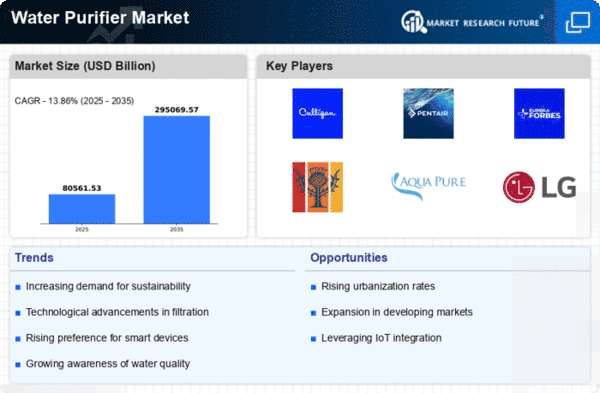
As per MRFR analysis, the Water Purifier Market Size was estimated at 70754.9 USD Billion in 2024. The Water Purifier industry is projected to grow from 80562.96 in 2025 to 295069.57 by 2035, exhibiting a compound annual growth rate (CAGR) of 13.86 during the forecast period 2025 - 2035.

Key Market Trends & Highlights

The Water Purifier Market is experiencing a dynamic shift towards eco-friendly and technologically advanced solutions.

  • The North American market remains the largest, driven by increasing health awareness and stringent regulatory standards.
  • Asia-Pacific is the fastest-growing region, reflecting a rising demand for water purification solutions amid urbanization.
  • The residential segment continues to dominate, while the commercial segment is witnessing rapid growth due to heightened health consciousness.
  • Key market drivers include increasing water contamination and rising disposable incomes, which are propelling the adoption of advanced filtration technologies.

Market Size & Forecast

2024 Market Size 70754.9 (USD Billion)
2035 Market Size 295069.57 (USD Billion)
CAGR (2025 - 2035) 13.86%
Largest Regional Market Share in 2024 Asia-Pacific

Major Players

<p>Culligan (US), Pentair (US), Eureka Forbes (IN), Brita (DE), Aqua Pure (US), LG Electronics (KR), Whirlpool (US), Tata Water (IN), Blue Star (IN)</p>

Market Trends

The Water Purifier Market is currently experiencing a dynamic evolution, driven by increasing awareness regarding water quality and health implications associated with contaminated water sources. Consumers are becoming more discerning about the quality of water they consume, leading to a surge in demand for advanced purification technologies. This trend is further fueled by growing concerns over environmental sustainability, prompting manufacturers to innovate and develop eco-friendly solutions. As a result, the market landscape is shifting towards products that not only ensure safe drinking water but also minimize ecological footprints. Moreover, the competitive landscape within the Water Purifier Market is intensifying, with numerous players striving to differentiate their offerings through unique features and enhanced functionalities. The integration of smart technologies, such as IoT-enabled devices, is becoming increasingly prevalent, allowing users to monitor water quality in real-time. This technological advancement appears to resonate well with tech-savvy consumers, who prioritize convenience and efficiency. Consequently, the market is likely to witness a proliferation of smart water purifiers that cater to the evolving preferences of consumers, thereby shaping the future trajectory of the industry.

Rise of Eco-Friendly Solutions

There is a noticeable shift towards environmentally sustainable water purification products. Manufacturers are increasingly focusing on developing systems that utilize renewable materials and energy-efficient processes, appealing to environmentally conscious consumers.

Integration of Smart Technologies

The incorporation of smart technology into water purifiers is gaining traction. Devices equipped with IoT capabilities allow users to track water quality and usage patterns, enhancing user experience and promoting proactive maintenance.

Growing Health Awareness

Heightened awareness regarding health risks associated with contaminated water is driving demand for water purifiers. Consumers are more inclined to invest in advanced filtration systems that promise improved safety and quality of drinking water.

Water Purifier Market Market Drivers

Rising Disposable Income

Rising disposable income levels across various demographics are contributing to the expansion of the Global Water Purifier Market Industry. As consumers gain more financial flexibility, they are increasingly willing to invest in high-quality water purification systems. This trend is particularly evident in emerging economies, where a growing middle class prioritizes health and wellness. The willingness to spend on advanced purification technologies is expected to drive market growth significantly. With a projected CAGR of 13.93% from 2025 to 2035, the industry is poised for substantial expansion, reflecting changing consumer priorities and economic conditions.

Increasing Water Scarcity

The Global Water Purifier Market Industry is experiencing a surge in demand due to increasing water scarcity across various regions. As populations grow and urbanization accelerates, the availability of clean drinking water diminishes. For instance, regions like sub-Saharan Africa and parts of Asia face severe water shortages, prompting a shift towards water purification solutions. This trend is reflected in the market's projected growth, with the industry expected to reach 70754.9 USD Billion in 2024 and potentially 297081.2 USD Billion by 2035. The urgency to address water scarcity issues drives consumers and governments alike to invest in water purification technologies.

Market Growth Projections

The Global Water Purifier Market Industry is poised for remarkable growth, with projections indicating a market size of 70754.9 USD Billion in 2024 and an anticipated increase to 297081.2 USD Billion by 2035. This growth trajectory suggests a robust demand for water purification solutions driven by various factors, including health awareness, technological advancements, and government initiatives. The projected CAGR of 13.93% from 2025 to 2035 underscores the industry's potential for expansion. This upward trend in market size reflects the increasing recognition of the importance of clean drinking water and the necessity for effective purification systems.

Technological Advancements

Technological advancements play a pivotal role in shaping the Global Water Purifier Market Industry. Innovations in Industrial Filtration technologies, such as reverse osmosis and UV purification, enhance the efficiency and effectiveness of water purifiers. These advancements not only improve the quality of purified water but also make systems more user-friendly and accessible. As a result, consumers are increasingly adopting modern purification solutions, driving market growth. The integration of smart technologies, such as IoT-enabled purifiers, further enhances consumer engagement and satisfaction. This trend is expected to propel the market towards a valuation of 70754.9 USD Billion in 2024, with continued growth anticipated in the coming years.

Health Awareness and Safety Concerns

The Global Water Purifier Market Industry is significantly influenced by heightened health awareness and safety concerns among consumers. As individuals become increasingly cognizant of the potential contaminants in tap water, the demand for effective purification systems rises. Reports indicate that consumers are more inclined to purchase water purifiers that ensure the removal of harmful substances, such as lead and bacteria. This shift in consumer behavior is likely to contribute to the industry's robust growth, with a projected CAGR of 13.93% from 2025 to 2035. The focus on health and safety is reshaping the market landscape, encouraging innovation in purification technologies.

Government Initiatives and Regulations

Government initiatives and regulations aimed at ensuring safe drinking water significantly impact the Global Water Purifier Market Industry. Many governments are implementing stringent regulations regarding water quality, compelling households and businesses to invest in purification systems. For instance, initiatives promoting the use of water purifiers in rural areas are gaining traction, as they aim to reduce waterborne diseases. These regulatory frameworks not only enhance public health but also stimulate market demand. As the industry evolves, it is likely to witness substantial growth, with projections indicating a market size of 297081.2 USD Billion by 2035, driven by supportive government policies.

Market Segment Insights

By Application: Residential (Largest) vs. Commercial (Fastest-Growing)

<p>In the Water Purifier Market, the application segment comprises Residential, Commercial, Industrial, and Municipal sectors. The Residential segment holds the largest market share, driven by the increasing awareness of health and hygiene among consumers seeking safe drinking water. In contrast, the Commercial segment is witnessing rapid growth as businesses prioritize water purification for employee safety and compliance with health regulations, positioning it as the fastest-growing segment in the market.</p>

<p>Residential: Dominant vs. Commercial: Emerging</p>

<p>The Residential segment is characterized by a wide variety of water purification technologies such as reverse osmosis and UV filtration, adapting to household needs for clean drinking water. This segment thrives on consumer trust and affordability, making it the dominant force in the market. In contrast, the Commercial segment is emerging rapidly, fueled by the growing demand for advanced water purification systems in offices, restaurants, and retail spaces. Commercial applications often require scalable and efficient solutions to meet high water consumption needs, evolving toward smart purification systems that integrate with existing infrastructure. As regulations tighten around water safety, this segment is set to become increasingly significant.</p>

By Technology: Reverse Osmosis (Largest) vs. Ultraviolet (Fastest-Growing)

<p>The Water Purifier Market showcases a diverse array of technologies, with Reverse Osmosis (RO) systems commanding the largest market share due to their efficient filtration capabilities and widespread adoption in both residential and commercial settings. Ultraviolet (UV) purifiers, while currently smaller in market share compared to RO, are rapidly gaining traction as health-conscious consumers increasingly prioritize the removal of harmful pathogens, enhancing their appeal in urban and densely populated areas. In terms of growth trends, the demand for water purification systems is propelled by the rising awareness of waterborne diseases and the necessity for clean drinking water. Furthermore, technological advancements, such as the integration of smart features in UV systems and the development of energy-efficient RO units, are likely to sustain this upward trajectory, driving increased penetration in emerging markets where clean water infrastructure is lacking.</p>

<p>Technology: Reverse Osmosis (Dominant) vs. Ultraviolet (Emerging)</p>

<p>Reverse Osmosis (RO) is currently the dominant technology in the Water Purifier Market, characterized by its ability to eliminate a broad spectrum of contaminants, including heavy metals and salts. This technology is extensively utilized in both households and industries due to its effectiveness, leading to its established position. Conversely, Ultraviolet (UV) purification, while emerging, is gaining significant momentum for its unique capability to neutralize bacteria and viruses without the need for chemicals. It is ideal for areas where microbial contamination is the primary concern, and its eco-friendliness appeals to environmentally conscious consumers. As population density increases and public health awareness rises, both technologies are expected to evolve, with RO maintaining its lead while UV systems expand their market share.</p>

By End Use: Household (Largest) vs. Food and Beverage (Fastest-Growing)

<p>The Water Purifier Market is primarily segmented into four key end uses: Household, Food and Beverage, Healthcare, and Pharmaceutical. Among these, the Household segment remains the largest, as consumers increasingly prioritize access to clean and safe drinking water at home. Meanwhile, the Food and Beverage segment is experiencing rapid growth, fueled by the rising demand for purified water to ensure high-quality production standards in food processing and beverage manufacturing. Growth trends in the Water Purifier Market are largely driven by increasing health awareness and stringent regulations concerning water quality across various industries. The Healthcare segment is witnessing heightened demand for purification technologies to ensure patient safety, while the Pharmaceutical sector is emphasizing water purification systems to adhere to stringent quality compositions, fostering substantial growth in both areas.</p>

<p>Household (Dominant) vs. Pharmaceutical (Emerging)</p>

<p>The Household segment dominates the Water Purifier Market, characterized by a wide range of consumer preferences for various purification technologies, including reverse osmosis and UV purification. This segment reflects a growing trend in health-conscious households investing in reliable water purification systems for safe drinking water, unhindered by contaminants. In contrast, the Pharmaceutical segment is an emerging market player, with increasing regulatory demands for high-quality water, particularly for its role in drug formulation and production. Pharmaceutical companies are investing in advanced purification technologies to meet these compliance standards, presenting growth opportunities as the emphasis on clean water persists in this highly regulated industry.</p>

Get more detailed insights about Water Purifier Market Research Report—Global Forecast till 2035

Regional Insights

North America : Established Market with Innovation

The North American water purifier market is projected to reach $21,226.47 million by 2025, driven by increasing health awareness and stringent regulations on water quality. The demand for advanced filtration technologies is rising, as consumers seek solutions to contaminants in drinking water. Regulatory bodies are emphasizing the importance of clean water access, further propelling market growth. Leading countries like the US and Canada dominate the market, with key players such as Culligan, Pentair, and Whirlpool driving innovation. The competitive landscape is characterized by a mix of established brands and emerging startups, focusing on eco-friendly and smart water purification solutions. The presence of major manufacturers ensures a robust supply chain and diverse product offerings.

Europe : Sustainable Solutions in Demand

Europe's water purifier market is expected to reach €16,900 million by 2025, fueled by increasing environmental concerns and regulatory frameworks promoting sustainable practices. The EU's stringent water quality directives are encouraging investments in advanced purification technologies, leading to a surge in demand for efficient water treatment solutions. Germany, France, and the UK are leading the market, with companies like Brita and LG Electronics at the forefront. The competitive landscape is marked by innovation in product design and functionality, catering to eco-conscious consumers. The presence of established brands alongside local manufacturers enhances market dynamics, ensuring a wide range of options for consumers.

Asia-Pacific : Rapid Growth and Adoption

The Asia-Pacific region is the largest market for water purifiers, projected to reach $29,000 million by 2025. This growth is driven by rising urbanization, increasing population, and heightened awareness of waterborne diseases. Governments are implementing policies to improve water quality, which is further boosting demand for purification systems. Countries like India and China are leading the market, with key players such as Eureka Forbes and Tata Water expanding their reach. The competitive landscape is vibrant, with numerous local and international brands vying for market share. Innovations in technology and affordability are key factors driving consumer adoption in this diverse region.

Middle East and Africa : Emerging Market with Potential

The Middle East and Africa water purifier market is projected to reach $2,828.43 million by 2025, driven by increasing water scarcity and health concerns. Governments are prioritizing access to clean water, leading to investments in water treatment infrastructure. The demand for efficient purification solutions is on the rise, particularly in urban areas facing water quality challenges. Countries like South Africa and the UAE are at the forefront of this market, with local and international players such as Blue Star and LG Electronics competing for market share. The competitive landscape is evolving, with a focus on affordability and accessibility of water purification technologies to meet the needs of diverse populations.

Key Players and Competitive Insights

The Water Purifier Market is currently characterized by a dynamic competitive landscape, driven by increasing consumer awareness regarding water quality and health. Major players such as Culligan (US), Pentair (US), and Eureka Forbes (IN) are strategically positioning themselves through innovation and regional expansion. Culligan (US) focuses on enhancing its product offerings with advanced filtration technologies, while Pentair (US) emphasizes sustainability in its operations, aiming to reduce environmental impact. Eureka Forbes (IN) leverages its strong distribution network to penetrate deeper into emerging markets, thereby shaping a competitive environment that is increasingly focused on technological advancement and customer-centric solutions.

The market structure appears moderately fragmented, with numerous players vying for market share. Key business tactics include localizing manufacturing to reduce costs and optimize supply chains, which is particularly relevant in regions with varying regulatory standards. The collective influence of these key players fosters a competitive atmosphere where innovation and operational efficiency are paramount, allowing them to respond swiftly to market demands and consumer preferences.

In November 2025, Culligan (US) announced a partnership with a leading technology firm to develop smart water purification systems that integrate IoT capabilities. This strategic move is likely to enhance customer engagement and provide real-time monitoring of water quality, thereby positioning Culligan as a frontrunner in the smart home technology segment. Such innovations may not only attract tech-savvy consumers but also set a new standard for water purification solutions.

In October 2025, Pentair (US) launched a new line of eco-friendly water purifiers designed to minimize plastic waste. This initiative aligns with the growing consumer demand for sustainable products and reflects Pentair's commitment to environmental stewardship. By focusing on sustainability, Pentair is not only addressing regulatory pressures but also appealing to a broader audience that prioritizes eco-conscious purchasing decisions.

In September 2025, Eureka Forbes (IN) expanded its product range by introducing a series of affordable water purifiers tailored for rural markets. This strategic expansion is indicative of the company's intent to capture untapped segments and enhance its market presence. By addressing the specific needs of rural consumers, Eureka Forbes is likely to strengthen its brand loyalty and increase market penetration in these regions.

As of December 2025, current competitive trends in the Water Purifier Market are heavily influenced by digitalization, sustainability, and the integration of AI technologies. Strategic alliances among key players are shaping the landscape, fostering innovation and enhancing product offerings. The shift from price-based competition to a focus on technological advancement and supply chain reliability is evident, suggesting that future competitive differentiation will hinge on the ability to innovate and deliver sustainable solutions.

Key Companies in the Water Purifier Market include

Industry Developments

  • Q1 2024: A. O. Smith Corporation Completes Acquisition of Pureit from Unilever PLC A. O. Smith Corporation announced the completion of its acquisition of Pureit, Unilever's water purification business, for approximately $120 million. The deal expands A. O. Smith’s residential water purifier portfolio, especially in India.[1]
  • Q2 2024: Pentair Launches New Smart Water Purifier Market Line in North America Pentair introduced a new range of smart water purifiers featuring IoT-enabled monitoring and real-time water quality analytics, targeting residential and commercial customers in the U.S.[3]
  • Q2 2024: Brita Unveils Advanced Filter Technology for PFAS Removal Brita launched a new water filter product line designed to remove PFAS contaminants, responding to heightened regulatory scrutiny and consumer demand for safer drinking water.[3]
  • Q2 2024: A. O. Smith Appoints New President for Global Water Purification Division A. O. Smith named a new president to lead its global water purification division, aiming to accelerate innovation and international expansion following the Pureit acquisition.[1]
  • Q3 2024: Culligan International Announces Partnership with Samsung for Smart Home Water Purification Culligan International entered a strategic partnership with Samsung to integrate Culligan’s water purification technology into Samsung’s smart home ecosystem, enhancing connected water safety solutions.[4]
  • Q3 2024: Xylem Opens New Water Purifier Market Manufacturing Facility in Vietnam Xylem inaugurated a new manufacturing plant in Vietnam dedicated to producing advanced water purifiers for Southeast Asian markets, supporting regional growth and supply chain resilience.
  • Q4 2024: Pentair Wins Major Contract to Supply Water Purification Systems to U.S. School Districts Pentair secured a multi-million dollar contract to provide water purification systems to several large U.S. school districts, addressing concerns over lead and other contaminants in drinking water.[3]
  • Q4 2024: Eureka Forbes Launches Solar-Powered Water Purifier Market for Rural India Eureka Forbes introduced a solar-powered water purifier designed for off-grid rural communities in India, aiming to improve access to safe drinking water in underserved regions.
  • Q1 2025: Aquasana Raises $40 Million in Series C Funding to Expand U.S. Water Purifier Market Operations Aquasana, a leading U.S. water purifier brand, closed a $40 million Series C funding round to scale manufacturing and accelerate product innovation in smart filtration technologies.
  • Q1 2025: LG Chem Receives EPA Approval for New Reverse Osmosis Membrane LG Chem obtained U.S. EPA approval for its latest reverse osmosis membrane, enabling the launch of new high-efficiency water purifiers in the American market.
  • Q2 2025: Tata Group Announces Joint Venture with Grundfos for Water Purification Solutions Tata Group and Grundfos formed a joint venture to develop and market advanced water purification systems for industrial and residential use across Asia.
  • Q2 2025: Waterdrop Launches Direct-to-Consumer Subscription Model for Filter Replacement Waterdrop, a U.S. water purifier startup, launched a subscription service for filter replacements, aiming to improve customer retention and ensure consistent water quality.

Future Outlook

Water Purifier Market Future Outlook

<p>The Water Purifier Market is projected to grow at a 13.86% CAGR from 2024 to 2035, driven by increasing health awareness, technological advancements, and rising water contamination concerns.</p>

New opportunities lie in:

  • <p>Expansion into smart water purification systems for residential use.</p>
  • <p>Development of subscription-based filter replacement services.</p>
  • <p>Partnerships with health organizations for community water purification initiatives.</p>

<p>By 2035, the market is expected to be robust, reflecting substantial growth and innovation.</p>

Market Segmentation

Water Purifier Market End Use Outlook

  • Household
  • Food and Beverage
  • Healthcare
  • Pharmaceutical

Water Purifier Market Technology Outlook

  • Reverse Osmosis
  • Ultraviolet
  • Activated Carbon
  • Distillation

Water Purifier Market Application Outlook

  • Residential
  • Commercial
  • Industrial
  • Municipal

Report Scope

MARKET SIZE 202470754.9(USD Billion)
MARKET SIZE 202580562.96(USD Billion)
MARKET SIZE 2035295069.57(USD Billion)
COMPOUND ANNUAL GROWTH RATE (CAGR)13.86% (2024 - 2035)
REPORT COVERAGERevenue Forecast, Competitive Landscape, Growth Factors, and Trends
BASE YEAR2024
Market Forecast Period2025 - 2035
Historical Data2019 - 2024
Market Forecast UnitsUSD Billion
Key Companies ProfiledCulligan (US), Pentair (US), Eureka Forbes (IN), Brita (DE), Aqua Pure (US), LG Electronics (KR), Whirlpool (US), Tata Water (IN), Blue Star (IN)
Segments CoveredApplication, Technology, End Use
Key Market OpportunitiesIntegration of advanced filtration technologies to meet evolving consumer health and safety standards in the Water Purifier Market.
Key Market DynamicsRising consumer awareness drives demand for advanced water purification technologies amid increasing regulatory scrutiny.
Countries CoveredNorth America, Europe, APAC, South America, MEA

FAQs

How much is the Water Purifier market?

In 2023, the market for water purifiers was estimated to be worth USD 63,075.3 billion.

What is the market growth rate for water purifiers?

The market for water purifiers is anticipated to expand at a CAGR of 13.86% from 2024 to 2032.

Which Region accounted for the highest proportion of the market for water purifiers?

The Region with the biggest market share for water purifiers was Asia Pacific.

Who are the key players in the Water Purifier market?

Smith, Unilever, EcoWater Systems LLC, Panasonic Corporation Coway Co. Ltd., KENT RO Systems Ltd., and Livpure Pvt. Ltd. are the major companies in the water purifier industry

Which Product type led the Water Purifier market?

The RO Water Purifier category dominated the market in 2021.

Which End-User had the largest market share in the Water Purifier market?

The Residential had the largest share in the global Water Purifier market.

  1. SECTION I: EXECUTIVE SUMMARY AND KEY HIGHLIGHTS
    1. | 1.1 EXECUTIVE SUMMARY
  2. SECTION II: SCOPING, METHODOLOGY AND MARKET STRUCTURE
    1. | 2.1 MARKET INTRODUCTION
    2. | 2.2 RESEARCH METHODOLOGY
  3. SECTION III: QUALITATIVE ANALYSIS
    1. | 3.1 MARKET DYNAMICS
    2. | 3.2 MARKET FACTOR ANALYSIS
  4. SECTION IV: QUANTITATIVE ANALYSIS
    1. | 4.1 Chemicals and Materials, BY Application (USD Billion)
    2. | 4.2 Chemicals and Materials, BY Technology (USD Billion)
    3. | 4.3 Chemicals and Materials, BY End Use (USD Billion)
    4. | 4.4 Chemicals and Materials, BY Region (USD Billion)
  5. SECTION V: COMPETITIVE ANALYSIS
    1. | 5.1 Competitive Landscape
    2. | 5.2 Company Profiles
    3. | 5.3 Appendix

Water Purifier Market Segmentation

Market Segmentation Overview

  • Detailed segmentation data will be available in the full report
  • Comprehensive analysis by multiple parameters
  • Regional and country-level breakdowns
  • Market size forecasts by segment
Infographic

Free Sample Request

Kindly complete the form below to receive a free sample of this Report

Get Free Sample

Customer Strories

Compare Licence

×
Features License Type
Single User Multiuser License Enterprise User
Price $4,950 $5,950 $7,250
Maximum User Access Limit 1 User Upto 10 Users Unrestricted Access Throughout the Organization
Free Customization
Direct Access to Analyst
Deliverable Format
Platform Access
Discount on Next Purchase 10% 15% 15%
Printable Versions