Request Free Sample ×

Kindly complete the form below to receive a free sample of this Report

* Please use a valid business email

Leading companies partner with us for data-driven Insights

clients tt-cursor
Hero Background
English
Chinese
French
Japanese
Korean
German
Spanish

Water Electrolysis Market Size

ID: MRFR/Equip/2789-CR
118 Pages
Varsha More
February 2020

Water Electrolysis Market Research Report By Technology (Alkaline Electrolysis, Proton Exchange Membrane Electrolysis, Solid Oxide Electrolysis), By Application (Hydrogen Production, Energy Storage, Fuel Cells), By End Use (Industrial, Transportation, Power Generation), By Electrolyzer Size (Small Scale, Medium Scale, Large Scale) and By Regional (North America, Europe, South America, Asia Pacific, Middle East and Africa) - Growth & Industry Forecast to 2035

Share:
Download PDF ×

We do not share your information with anyone. However, we may send you emails based on your report interest from time to time. You may contact us at any time to opt-out.

Water Electrolysis Market Infographic
Purchase Options

Water Electrolysis Size

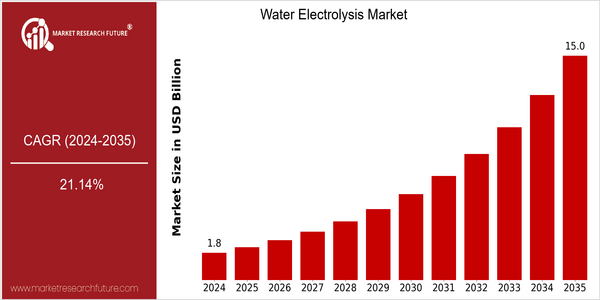
Market Size Snapshot

Year Value
2024 USD 1.82 Billion
2035 USD 15.0 Billion
CAGR (2025-2035) 21.14 %

Note – Market size depicts the revenue generated over the financial year

The electrolysis of water market is expected to reach $1.8 billion by 2024, with a projected growth to $ 15.0 billion by 2035. The remarkable growth of the market is estimated at a CAGR of 21.14% from 2025 to 2035. The demand for hydrogen as a clean energy source, driven by the world's shift towards green energy, is the main driving force of the market. The development of water electrolysis technology, such as proton exchange membrane (PEM) and alkaline electrolysis, has increased the efficiency and lowered the cost, which is expected to drive the market. The leading companies in the water electrolysis industry, such as Siemens, ITM Power, and Nel ASA, are actively investing in R & D to develop new products and services. The strategic collaboration of large-scale hydrogen production projects and the investment in renewable energy integration will also be an important factor affecting the competition in the market. The policy of reducing carbon dioxide emissions and promoting hydrogen as an energy carrier will promote the development of the water electrolysis market.
home-ubuntu-www-mrf_ne_design-batch-5-cp-water-electrolysis-market size

Regional Market Size

Regional Deep Dive

The electrolysis of water is experiencing a high growth rate in different regions of the world. The growing demand for hydrogen is accompanied by a shift in the energy industry towards the use of clean and renewable energy sources. In North America, Europe, Asia-Pacific, the Middle East and Africa, and Latin America, the dynamics of the market are influenced by regional policies, technological development and the launch of green hydrogen projects. Each region has its own characteristics in terms of government support, industrial applications and market maturity, which determine the global market for water electrolysis.

Europe

  • The European Union's Green Deal and Hydrogen Strategy are pivotal in driving investments in water electrolysis, with countries like Germany and the Netherlands leading the charge in establishing hydrogen infrastructure.
  • Innovations in electrolyzer technology, such as the development of high-temperature electrolysis by companies like Siemens Energy, are enhancing efficiency and reducing operational costs, thereby making hydrogen more competitive.

Asia Pacific

  • Japan and South Korea are at the forefront of hydrogen technology, with government-backed projects like Japan's 'Basic Hydrogen Strategy' promoting water electrolysis as a key component of their energy transition.
  • Chinese manufacturers are rapidly scaling up electrolyzer production, supported by government incentives, which is expected to significantly lower costs and increase market penetration in the region.

Latin America

  • Brazil is emerging as a key player in the water electrolysis market, with government support for renewable energy projects and initiatives aimed at producing green hydrogen from its abundant hydropower resources.
  • Innovative partnerships between local companies and international firms are fostering technology transfer and investment in electrolyzer technology, which is expected to enhance the region's capabilities in hydrogen production.

North America

  • The U.S. Department of Energy has launched initiatives to promote hydrogen production through electrolysis, aiming to reduce costs and enhance efficiency, which is expected to accelerate market adoption.
  • Major companies like Plug Power and Nel ASA are investing heavily in electrolyzer technology, focusing on scaling production capabilities to meet the rising demand for hydrogen fuel in transportation and industrial sectors.

Middle East And Africa

  • Countries like Saudi Arabia are investing in large-scale hydrogen projects, such as the NEOM project, which aims to produce green hydrogen through water electrolysis, positioning the region as a future hydrogen hub.
  • The UAE is also exploring water electrolysis as part of its broader strategy to diversify its energy sources and reduce carbon emissions, with initiatives like the Abu Dhabi Hydrogen Alliance.

Did You Know?

“Water electrolysis can produce hydrogen with a purity level of over 99.999%, making it suitable for various applications, including fuel cells and industrial processes.” — International Energy Agency (IEA)

Segmental Market Size

The electrolysis of water market is booming. The demand for hydrogen as a clean fuel is growing. The trend is mainly due to the increasingly stringent regulations on carbon dioxide emissions and the need for sustainable energy solutions in various industries. The development of new electrolysis methods such as proton exchange membrane (PEM) and alkaline electrolysis further increases the efficiency and reduces the cost of operation, which makes them more attractive to both investors and companies. The market is currently at the stage of commercialization, and there are notable examples of projects carried out by companies such as Siemens Energy and Nel Hydrogen in Europe and North America. The main applications of water electrolysis are transportation, hydrogen fuel cells, and industrial processes, including ammonia production. The growth in the water electrolysis market is accelerating due to macro-economic trends, such as the development of sustainable energy and the use of renewable energy sources. In the long run, innovation in electrolysis and the use of renewable energy sources will continue to determine the future of the industry.

Future Outlook

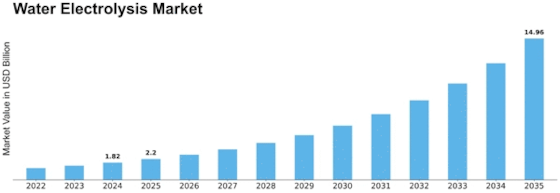
The market for water electrolysis is projected to grow at a CAGR of 21.14% from 2024 to 2035. This growth is largely due to the increasing demand for clean hydrogen, which is driven by the urgent need to transition to sustainable energy sources and reduce carbon emissions. The adoption of water electrolysis is expected to penetrate various sectors, such as transportation, industry and energy storage, with hydrogen production possibly reaching 15 to 20 percent by 2035. Also, technological developments, such as increasing the efficiency of the electrolysis and reducing the cost of the plant, are expected to promote market growth. In addition, advances in materials science, such as the development of more efficient catalysts, will improve the performance of the water electrolysis system and make it more economically viable. Also, government policies and subsidies to encourage the use of green hydrogen will play a significant role in shaping the market. Also, the integration of the electrolysis system with the power grid and the development of hydrogen infrastructure will contribute to the growth of the market, and water electrolysis will be the foundation of the future energy system.

Water Electrolysis Market Size Graph
Author
Author Profile
Varsha More
Senior Research Analyst

Experienced business professional with a demonstrated history of working in the CFnB industry. Skilled in market research, and market estimation. Strong professional with a Masters focused in marketing management.

Leave a Comment

FAQs

What is the current valuation of the Water Electrolysis Market in 2024?

<p>The Water Electrolysis Market was valued at 1.82 USD Billion in 2024.</p>

What is the projected market size for the Water Electrolysis Market by 2035?

<p>The market is projected to reach 14.96 USD Billion by 2035.</p>

What is the expected CAGR for the Water Electrolysis Market during the forecast period 2025 - 2035?

<p>The expected CAGR for the Water Electrolysis Market during 2025 - 2035 is 21.11%.</p>

Which technology segment is anticipated to dominate the Water Electrolysis Market?

<p>The Solid Oxide Electrolysis segment is projected to grow significantly, reaching 6.81 USD Billion by 2035.</p>

How does the Hydrogen Production application segment perform in the Water Electrolysis Market?

<p>The Hydrogen Production application segment was valued at 0.91 USD Billion in 2024 and is expected to grow to 7.48 USD Billion by 2035.</p>

What are the key players in the Water Electrolysis Market?

<p>Key players include Nel Hydrogen, ITM Power, Siemens Energy, and Plug Power, among others.</p>

What is the expected performance of the Industrial end-use segment in the Water Electrolysis Market?

<p>The Industrial end-use segment was valued at 0.73 USD Billion in 2024 and is projected to reach 5.83 USD Billion by 2035.</p>

What is the market outlook for the Medium Scale electrolyzer size segment?

<p>The Medium Scale electrolyzer size segment is expected to grow from 0.73 USD Billion in 2024 to 5.98 USD Billion by 2035.</p>

How does the Fuel Cells application segment compare to others in the Water Electrolysis Market?

<p>The Fuel Cells application segment was valued at 0.36 USD Billion in 2024 and is projected to reach 2.99 USD Billion by 2035.</p>

What trends are influencing the Water Electrolysis Market in 2025?

<p>Trends indicate a strong shift towards sustainable hydrogen production technologies, particularly in the Solid Oxide Electrolysis segment.</p>

Market Summary

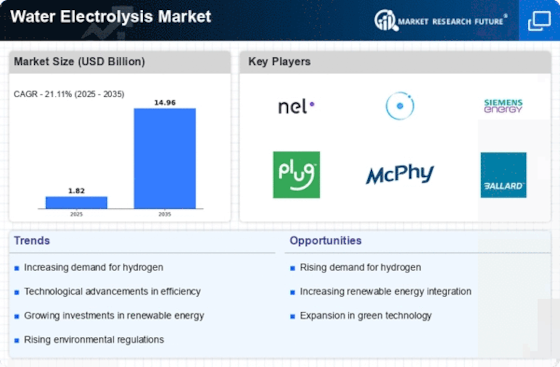
As per Market Research Future analysis, the Water Electrolysis Market Size was estimated at 1.82 USD Billion in 2024. The Water Electrolysis industry is projected to grow from 2.204 USD Billion in 2025 to 14.96 USD Billion by 2035, exhibiting a compound annual growth rate (CAGR) of 21.1% during the forecast period 2025 - 2035

Key Market Trends & Highlights

The Water Electrolysis Market is poised for substantial growth driven by technological advancements and increasing demand for clean energy solutions.

  • The market is witnessing a rising demand for green hydrogen, particularly in North America, which is currently the largest market. Technological advancements in electrolysis are enhancing efficiency and reducing costs, thereby attracting more investments. Asia-Pacific is emerging as the fastest-growing region, fueled by supportive government policies and incentives for clean energy. Key market drivers include increasing investment in renewable energy and a growing awareness of environmental sustainability.

Market Size & Forecast

2024 Market Size 1.82 (USD Billion)
2035 Market Size 14.96 (USD Billion)
CAGR (2025 - 2035) 21.11%
Largest Regional Market Share in 2024 Europe

Major Players

Nel Hydrogen (NO), ITM Power (GB), <a href="https://www.siemens-energy.com/global/en/home/products-services/product-offerings/hydrogen-solutions.html">Siemens </a>Energy (DE), Plug Power (US), McPhy Energy (FR), Ballard Power Systems (CA), Hydrogenics (CA), <a href="https://www.thyssenkrupp-uhde.com/en/products-and-technologies/hydrogen-and-gas-technologies/hydrogen">Thyssenkrupp</a> (DE), Enel Green Power (IT)

Market Trends

The Water Electrolysis Market is currently experiencing a transformative phase, driven by the increasing demand for clean energy solutions and the global shift towards sustainable practices. This market appears to be gaining momentum as industries and governments alike recognize the potential of hydrogen as a clean fuel alternative. The technology involved in water electrolysis is evolving, with advancements in efficiency and cost-effectiveness, which may further enhance its adoption across various sectors. As the world grapples with climate change, the role of water electrolysis in producing green hydrogen is becoming increasingly pivotal, suggesting a promising future for this market. Moreover, the Water Electrolysis Market is likely to benefit from supportive policies and investments aimed at promoting renewable energy sources. The integration of electrolysis technology into existing energy systems could facilitate a smoother transition towards a hydrogen economy. While challenges remain, such as the need for infrastructure development and the optimization of energy sources, the overall outlook for the Water Electrolysis Market appears optimistic. Stakeholders are encouraged to monitor technological advancements and regulatory frameworks that may influence market dynamics in the coming years.

Rising Demand for Green Hydrogen

The expansion of the Global Water Electrolysis Market is primarily driven by the increasing transition toward green hydrogen as a key component of the sustainable energy landscape. The market is witnessing a surge in interest due to the increasing demand for green hydrogen. This trend is largely driven by the need for sustainable energy solutions and the decarbonization of various industries. As companies seek to reduce their carbon footprints, the production of hydrogen through electrolysis is becoming a viable option.

Technological Advancements

This comprehensive water electrolysis report highlights the critical role of technological advancements and supportive government policies in accelerating the adoption of carbon-neutral industrial processes. Recent innovations in electrolysis technology are enhancing the efficiency and cost-effectiveness of hydrogen production. These advancements may lead to improved performance and lower operational costs, making water electrolysis a more attractive option for energy generation and storage.

Supportive Regulatory Frameworks

Governments worldwide are implementing policies that favor the development of renewable energy technologies, including water electrolysis. This supportive environment could accelerate market growth, as incentives and funding opportunities encourage investment in hydrogen production and infrastructure.

Water Electrolysis Market Market Drivers

Growing Demand for Clean Energy Solutions

The Water Electrolysis Market is witnessing a notable increase in demand for clean energy solutions. As industries and consumers alike seek alternatives to fossil fuels, hydrogen produced through water electrolysis emerges as a viable option. The market for hydrogen is expected to grow significantly, with estimates suggesting a compound annual growth rate of over 15% through the next decade. This demand is fueled by the transportation sector, where hydrogen fuel cells are gaining traction as a clean energy source. Furthermore, the industrial sector is increasingly adopting hydrogen for processes such as ammonia production and refining. This growing appetite for clean energy solutions is likely to propel the Water Electrolysis Market forward, as stakeholders recognize the potential of hydrogen as a sustainable energy carrier.

Increasing Investment in Renewable Energy

The Water Electrolysis Market is experiencing a surge in investment as nations pivot towards renewable energy sources. This shift is driven by the need to reduce carbon emissions and combat climate change. In 2025, investments in renewable energy technologies are projected to reach unprecedented levels, with electrolysis playing a pivotal role in hydrogen production. The International Energy Agency indicates that the hydrogen economy could attract over 300 billion USD in investments by 2030. This influx of capital is likely to enhance the development of water electrolysis technologies, making them more efficient and cost-effective, thereby expanding their application across various sectors. As a result, the Water Electrolysis Market is poised for substantial growth, driven by the increasing focus on sustainable energy solutions.

Technological Innovations in Electrolysis

The Water Electrolysis Market is benefiting from rapid technological innovations that enhance the efficiency and scalability of electrolysis systems. Recent advancements in materials science, such as the development of more efficient catalysts, have the potential to reduce energy consumption and operational costs. For instance, new membrane technologies are being introduced that improve the performance of electrolyzers, making them more competitive with traditional hydrogen production methods. The market is projected to see a significant increase in the deployment of advanced electrolysis systems, with a forecasted growth rate of approximately 20% annually over the next five years. These innovations not only improve the economic viability of water electrolysis but also expand its applicability across various sectors, thereby driving the Water Electrolysis Market forward.

Supportive Government Policies and Incentives

The Water Electrolysis Market is increasingly influenced by supportive government policies and incentives aimed at promoting clean energy technologies. Many governments are implementing frameworks that encourage the adoption of hydrogen as a clean energy source, including subsidies for electrolysis projects and tax incentives for research and development. In 2025, several countries are expected to announce ambitious hydrogen strategies, which may include funding for large-scale electrolysis plants. These initiatives are likely to create a favorable environment for investment in the Water Electrolysis Market, facilitating the growth of infrastructure necessary for hydrogen production and distribution. As a result, the alignment of government policies with market needs is expected to significantly bolster the Water Electrolysis Market.

Rising Awareness of Environmental Sustainability

The Water Electrolysis Market is experiencing a heightened awareness of environmental sustainability among consumers and businesses. As climate change concerns escalate, there is a growing recognition of the need for sustainable energy solutions. This awareness is driving demand for hydrogen produced through water electrolysis, waste management as it is seen as a clean alternative to conventional fossil fuels. Market Research Future indicates that consumers are increasingly willing to pay a premium for products and services that are environmentally friendly. This shift in consumer behavior is likely to encourage companies to invest in water electrolysis technologies, thereby expanding the Water Electrolysis Market. The emphasis on sustainability is expected to shape market dynamics, influencing both production methods and consumer preferences in the coming years.

Market Segment Insights

By Technology: Alkaline Electrolysis (Largest) vs. Proton Exchange Membrane Electrolysis (Fastest-Growing)

The Water Electrolysis Market is characterized by a diverse range of technologies, with Alkaline Electrolysis holding the largest market share. This technology is favored due to its low capital costs and well-established operational efficiencies. In comparison, Proton Exchange Membrane (PEM) Electrolysis, while currently smaller in market share, is rapidly gaining attention thanks to its ability to operate at higher efficiencies and flexibility in various applications, including fluctuating renewable energy sources. As the market evolves, both technologies are witnessing dynamic growth trends influenced by the global push for clean energy solutions. Alkaline Electrolysis continues to dominate due to its reliability, particularly in large-scale operations, while PEM Electrolysis is recognized as the fastest-growing segment. Factors such as government incentives, technological advancements, and the pressing need for sustainable hydrogen production are driving interest and investment in PEM technology, ultimately reshaping the competitive landscape of the market.

Technology: Alkaline Electrolysis (Dominant) vs. Proton Exchange Membrane Electrolysis (Emerging)

Alkaline Electrolysis remains the dominant force in the Water Electrolysis Market, primarily due to its cost-effectiveness and maturity in industrial applications. This technology excels in producing hydrogen from <a href="https://www.marketresearchfuture.com/reports/water-purifier-market-2178">water purifier</a> through an alkaline solution, which enables high efficiency and durability. The infrastructure for Alkaline systems is widely established, making it a preferred choice for large-scale hydrogen production. Conversely, Proton Exchange Membrane Electrolysis is emerging as a pivotal technology due to its compact design and ability to operate efficiently across varying load conditions. This flexibility positions PEM Electrolysis as a frontrunner in niche applications, particularly where quick response times are necessary, such as integration with renewable energy sources. As demand for cleaner hydrogen grows, both segments play critical roles in shaping the future energy landscape.

By Application: Hydrogen Production (Largest) vs. Energy Storage (Fastest-Growing)

The water electrolysis market is characterized by its diverse applications, with hydrogen production taking the lead as the largest segment. This segment significantly contributes to the overall market share, thanks to the increasing demand for hydrogen in various industries including transportation and manufacturing. Following closely is the energy storage segment, which has emerged as a critical player, particularly in renewable energy integration, enabling the efficient use of intermittent energy sources by storing excess energy produced during peak times for later use. Both segments complement each other in promoting sustainable energy solutions, ensuring the continued growth of the market. Growth trends in the water electrolysis market reveal a promising trajectory, especially with the rising emphasis on clean energy sources and reducing carbon emissions. The hydrogen production segment is driven by advancements in electrolysis technology, making the process more efficient and cost-effective. Meanwhile, energy storage is witnessing rapid growth as businesses and utilities increasingly adopt it to optimize energy usage and improve grid reliability. Fuel cells are also on an upward trend, supported by government policies and investments aimed at promoting clean transport and energy solutions.

Hydrogen Production (Dominant) vs. Fuel Cells (Emerging)

Hydrogen production remains the dominant segment in the water electrolysis market, tapping into the growing need for clean hydrogen as an alternative energy source. This segment benefits from extensive investments and research aimed at enhancing electrolysis technologies, thereby improving efficiency and reducing operational costs. On the other hand, fuel cells represent an emerging segment with substantial growth potential, as they are pivotal in clean energy applications like transportation and portable power generation. While hydrogen production focuses on generating hydrogen from water, fuel cells utilize this hydrogen to produce electricity through electrochemical reactions. The synergy between these segments fosters innovation and drives market expansion.

By End Use: Industrial (Largest) vs. Transportation (Fastest-Growing)

In the Water Electrolysis Market, the end-use segments are primarily categorized into Industrial, Transportation, and Power Generation. Industrial applications dominate this market, leveraging water electrolysis for hydrogen production, which is integral for various manufacturing processes. Transportation is emerging rapidly, powered by the adoption of hydrogen fuel cell vehicles that promise a cleaner alternative to fossil fuels. Power Generation is also gaining momentum, utilizing hydrogen as an energy storage solution to balance supply and demand effectively.

Industrial (Dominant) vs. Transportation (Emerging)

The Industrial segment is the backbone of the Water Electrolysis Market, facilitating crucial hydrogen production that supports chemical, petrochemical, and refining processes. This segment benefits from established infrastructure and extensive applications of hydrogen, making it the most stable in the market. Conversely, the Transportation segment is swiftly gaining traction. The rise in renewable energy initiatives and the push for greener technologies have amplified the focus on hydrogen fuel cells in vehicles, marking it as an emerging force in the sector. With supportive government policies and technological advancements, this segment is poised for rapid growth, attracting investments and innovation aimed at sustainable mobility.

By Electrolyzer Size: Large Scale (Largest) vs. Small Scale (Fastest-Growing)

In the Water Electrolysis Market, the distribution of the electrolyzer size segment showcases that Large Scale units account for a significant share, largely due to their efficiency and capacity to meet large demand scenarios. Small Scale electrolyzers are gaining traction among end-users that prioritize space-saving solutions, highlighting a shift in market dynamics towards more modular systems. This distribution reflects evolving preferences influenced by project scope and application requirements.

Electrolyzer Size: Large Scale (Dominant) vs. Small Scale (Emerging)

Large Scale electrolyzers are positioned as the dominant force in the market, offering reliability and efficiency for industrial applications. Their capacity to produce large volumes of hydrogen makes them ideal for heavy-duty operations and large-scale renewable energy projects. On the other hand, Small Scale electrolyzers are emerging as a versatile solution for smaller applications, appealing to decentralized energy systems and small businesses. Their modularity and lower upfront costs provide a competitive edge in niche markets, further driving their growth as sustainability initiatives gain momentum.

Get more detailed insights about Water Electrolysis Market Research Report - Global Forecast till 2035

Regional Insights

The Water Electrolysis Market is poised for significant growth, with various regions contributing uniquely to this dynamics. In 2024, North America is valued at USD 0.54 billion and is expected to increase to USD 4.23 billion by 2035, reflecting a strong emphasis on clean hydrogen production technologies. Europe follows closely, with a current market value of USD 0.65 billion, projected to reach USD 5.15 billion, largely driven by stringent environmental regulations and a robust focus on renewable energy sources.

South America, although smaller, shows promise with a valuation of USD 0.15 Billion in 2024, growing to USD 1.05 billion, highlighting emerging hydrogen initiatives.

Asia Pacific holds a notable position with a market worth USD 0.42 billion, increasing to USD 3.69 billion, indicating its potential for industrial applications and sustainable energy solutions. Lastly, the Middle East and Africa region, currently valued at USD 0.06 billion, is anticipated to grow to USD 0.88 billion, due to increasing investments in sustainable technologies. Each region's growth reflects its commitments to transitioning towards a greener economy, driven by the rising demand for clean energy solutions, significant technological advancements, and supportive government policies.

The Water Electrolysis Market segmentation thus showcases the varying but interconnected approaches regions are taking towards harnessing the potential of water electrolysis.

Key Players and Competitive Insights

The Water Electrolysis Market is experiencing significant growth as the focus on renewable energy and clean hydrogen production intensifies. This market is characterized by a diverse range of technologies and stakeholders, including multinational corporations, specialized technology providers, and research institutions. Competitive insights indicate a landscape driven by innovation, where companies are investing heavily in research and development to enhance the efficiency of electrolyzer technologies. The competitive dynamics are largely influenced by market drivers, such as the increasing demand for green hydrogen, government initiatives supporting clean energy, and the advent of advanced electrolysis methods. As incumbents and new entrants vie for market share, strategic partnerships, mergers, and acquisitions become vital for expanding technological capabilities and regional outreach. Cummins Inc. has established a notable presence in the Water Electrolysis Market, leveraging its expertise in power solutions and energy transition technologies. The company's strong reputation for innovation in energy systems allows it to produce efficient hydrogen electrolyzers that cater to diverse industrial applications. Cummins Inc. benefits from its extensive distribution networks and customer relationships across various regions, which enhance its competitive edge. The company's commitment to sustainability aligns with global trends towards reducing greenhouse gas emissions, allowing it to position itself effectively within this growing market. Additionally, Cummins Inc. is known for its strategic investments in expanding its product portfolio and enhancing the technological capabilities of its hydrogen solutions, setting it apart from competitors. Nel ASA stands out as a significant player in the Water Electrolysis Market, focusing on the production of hydrogen-based technologies with an emphasis on electrolyzer manufacturing. The company offers a range of key products and services that cater to various sectors, including industrial hydrogen applications and renewable energy integration. Nel ASA's strengths lie in its robust technological advancements and a comprehensive approach to hydrogen production, allowing it to stay competitive in an evolving market. Its strategic focus on innovation has resulted in significant collaborations and partnerships aimed at enhancing production efficiency. Moreover, Nel ASA actively engages in mergers and acquisitions to bolster its market presence and expand its capabilities in electrolyzer technologies globally. This positioning allows the company to capitalize on the increasing demand for cleaner hydrogen solutions across regions as the market continues to develop.

Key Companies in the Water Electrolysis Market include

Industry Developments

  • Q2 2024: Siemens Energy and Air Liquide inaugurate gigawatt-scale electrolyzer factory in Germany Siemens Energy and Air Liquide opened a new gigawatt-scale electrolyzer manufacturing facility in Berlin, aiming to ramp up production of PEM electrolyzers for green hydrogen projects across Europe.
  • Q2 2024: Plug Power secures $1.5 billion contract to supply electrolyzers for green hydrogen plant in Texas Plug Power announced a major contract win to deliver electrolyzer systems for a large-scale green hydrogen production facility in Texas, marking one of the largest deals in the U.S. water electrolysis sector.
  • Q2 2024: Nel ASA partners with Iberdrola to develop green hydrogen projects in Spain Norwegian electrolyzer manufacturer Nel ASA entered a strategic partnership with Iberdrola to supply and co-develop water electrolysis systems for multiple green hydrogen projects in Spain.
  • Q3 2024: Thyssenkrupp Nucera wins contract for 500 MW electrolyzer plant in Saudi Arabia Thyssenkrupp Nucera announced it will supply alkaline electrolyzers for a 500 MW green hydrogen facility in NEOM, Saudi Arabia, supporting the region’s ambitious hydrogen economy plans.
  • Q3 2024: Cummins launches new 5 MW PEM electrolyzer platform Cummins unveiled its latest 5 MW proton exchange membrane (PEM) electrolyzer, targeting utility-scale green hydrogen projects and industrial decarbonization efforts.
  • Q3 2024: ITM Power secures $100 million funding round led by Snam and Vitol UK-based ITM Power raised $100 million in new funding to expand its electrolyzer manufacturing capacity, with strategic investments from Snam and Vitol.
  • Q4 2024: John Cockerill opens new electrolyzer assembly plant in India Belgian engineering firm John Cockerill inaugurated a new electrolyzer assembly facility in Gujarat, India, to serve the growing demand for green hydrogen in South Asia.
  • Q4 2024: Enapter receives regulatory approval for AEM electrolyzer in Japan Enapter, a German electrolyzer manufacturer, received Japanese government approval for its anion exchange membrane (AEM) electrolyzer technology, enabling commercial deployment in the country.
  • Q1 2025: Sunfire signs partnership with Shell for offshore hydrogen production Sunfire, a German electrolyzer company, entered a partnership with Shell to deploy solid oxide electrolyzers for offshore green hydrogen production in the North Sea.
  • Q1 2025: H2 Green Steel acquires electrolyzer startup HydroGenics Swedish steelmaker H2 Green Steel acquired HydroGenics, a startup specializing in advanced water electrolysis technology, to accelerate its green steel production plans.
  • Q2 2025: Siemens Energy appoints new Head of Electrolyzer Division Siemens Energy announced the appointment of Dr. Anna Müller as the new Head of its Electrolyzer Division, signaling a strategic focus on scaling up water electrolysis technologies.
  • Q2 2025: Bloom Energy wins contract for 200 MW electrolyzer installation in South Korea Bloom Energy secured a contract to supply 200 MW of solid oxide electrolyzers for a major green hydrogen project in South Korea, supporting the country’s clean energy transition.

Future Outlook

Water Electrolysis Market Future Outlook

The Water Electrolysis Market is projected to grow at a 21.11% CAGR from 2025 to 2035, driven by increasing demand for clean hydrogen and renewable energy integration.

New opportunities lie in:

  • <p>Development of modular electrolysis systems for decentralized hydrogen production. Investment in advanced materials to enhance electrolyzer efficiency and lifespan. Partnerships with renewable energy providers for integrated hydrogen solutions.</p>

By 2035, the Water Electrolysis Market is expected to be a cornerstone of the global hydrogen economy.

Market Segmentation

Water Electrolysis Market End Use Outlook

  • Industrial
  • Transportation
  • Power Generation

Water Electrolysis Market Technology Outlook

  • Alkaline Electrolysis
  • Proton Exchange Membrane Electrolysis
  • Solid Oxide Electrolysis

Water Electrolysis Market Application Outlook

  • Hydrogen Production
  • Energy Storage
  • Fuel Cells

Water Electrolysis Market Electrolyzer Size Outlook

  • Small Scale
  • Medium Scale
  • Large Scale

Report Scope

MARKET SIZE 2024 1.82(USD Billion)
MARKET SIZE 2025 2.204(USD Billion)
MARKET SIZE 2035 14.96(USD Billion)
COMPOUND ANNUAL GROWTH RATE (CAGR) 21.11% (2025 - 2035)
REPORT COVERAGE Revenue Forecast, Competitive Landscape, Growth Factors, and Trends
BASE YEAR 2024
Market Forecast Period 2025 - 2035
Historical Data 2019 - 2024
Market Forecast Units USD Billion
Key Companies Profiled Nel Hydrogen (NO), ITM Power (GB), Siemens Energy (DE), Plug Power (US), McPhy Energy (FR), Ballard Power Systems (CA), Hydrogenics (CA), Thyssenkrupp (DE), Enel Green Power (IT)
Segments Covered Technology, Application, End Use, Electrolyzer Size, Regional
Key Market Opportunities Advancements in renewable energy integration enhance growth potential in the Water Electrolysis Market.
Key Market Dynamics Rising demand for clean hydrogen fuels drives innovation and competition in the water electrolysis market.
Countries Covered North America, Europe, APAC, South America, MEA

FAQs

What is the current valuation of the Water Electrolysis Market in 2024?

<p>The Water Electrolysis Market was valued at 1.82 USD Billion in 2024.</p>

What is the projected market size for the Water Electrolysis Market by 2035?

<p>The market is projected to reach 14.96 USD Billion by 2035.</p>

What is the expected CAGR for the Water Electrolysis Market during the forecast period 2025 - 2035?

<p>The expected CAGR for the Water Electrolysis Market during 2025 - 2035 is 21.11%.</p>

Which technology segment is anticipated to dominate the Water Electrolysis Market?

<p>The Solid Oxide Electrolysis segment is projected to grow significantly, reaching 6.81 USD Billion by 2035.</p>

How does the Hydrogen Production application segment perform in the Water Electrolysis Market?

<p>The Hydrogen Production application segment was valued at 0.91 USD Billion in 2024 and is expected to grow to 7.48 USD Billion by 2035.</p>

What are the key players in the Water Electrolysis Market?

<p>Key players include Nel Hydrogen, ITM Power, Siemens Energy, and Plug Power, among others.</p>

What is the expected performance of the Industrial end-use segment in the Water Electrolysis Market?

<p>The Industrial end-use segment was valued at 0.73 USD Billion in 2024 and is projected to reach 5.83 USD Billion by 2035.</p>

What is the market outlook for the Medium Scale electrolyzer size segment?

<p>The Medium Scale electrolyzer size segment is expected to grow from 0.73 USD Billion in 2024 to 5.98 USD Billion by 2035.</p>

How does the Fuel Cells application segment compare to others in the Water Electrolysis Market?

<p>The Fuel Cells application segment was valued at 0.36 USD Billion in 2024 and is projected to reach 2.99 USD Billion by 2035.</p>

What trends are influencing the Water Electrolysis Market in 2025?

<p>Trends indicate a strong shift towards sustainable hydrogen production technologies, particularly in the Solid Oxide Electrolysis segment.</p>

  1. SECTION I: EXECUTIVE SUMMARY AND KEY HIGHLIGHTS
    1. | 1.1 EXECUTIVE SUMMARY
    2. | | 1.1.1 Market Overview
    3. | | 1.1.2 Key Findings
    4. | | 1.1.3 Market Segmentation
    5. | | 1.1.4 Competitive Landscape
    6. | | 1.1.5 Challenges and Opportunities
    7. | | 1.1.6 Future Outlook
  2. SECTION II: SCOPING, METHODOLOGY AND MARKET STRUCTURE
    1. | 2.1 MARKET INTRODUCTION
    2. | | 2.1.1 Definition
    3. | | 2.1.2 Scope of the study
    4. | | | 2.1.2.1 Research Objective
    5. | | | 2.1.2.2 Assumption
    6. | | | 2.1.2.3 Limitations
    7. | 2.2 RESEARCH METHODOLOGY
    8. | | 2.2.1 Overview
    9. | | 2.2.2 Data Mining
    10. | | 2.2.3 Secondary Research
    11. | | 2.2.4 Primary Research
    12. | | | 2.2.4.1 Primary Interviews and Information Gathering Process
    13. | | | 2.2.4.2 Breakdown of Primary Respondents
    14. | | 2.2.5 Forecasting Model
    15. | | 2.2.6 Market Size Estimation
    16. | | | 2.2.6.1 Bottom-Up Approach
    17. | | | 2.2.6.2 Top-Down Approach
    18. | | 2.2.7 Data Triangulation
    19. | | 2.2.8 Validation
  3. SECTION III: QUALITATIVE ANALYSIS
    1. | 3.1 MARKET DYNAMICS
    2. | | 3.1.1 Overview
    3. | | 3.1.2 Drivers
    4. | | 3.1.3 Restraints
    5. | | 3.1.4 Opportunities
    6. | 3.2 MARKET FACTOR ANALYSIS
    7. | | 3.2.1 Value chain Analysis
    8. | | 3.2.2 Porter's Five Forces Analysis
    9. | | | 3.2.2.1 Bargaining Power of Suppliers
    10. | | | 3.2.2.2 Bargaining Power of Buyers
    11. | | | 3.2.2.3 Threat of New Entrants
    12. | | | 3.2.2.4 Threat of Substitutes
    13. | | | 3.2.2.5 Intensity of Rivalry
    14. | | 3.2.3 COVID-19 Impact Analysis
    15. | | | 3.2.3.1 Market Impact Analysis
    16. | | | 3.2.3.2 Regional Impact
    17. | | | 3.2.3.3 Opportunity and Threat Analysis
  4. SECTION IV: QUANTITATIVE ANALYSIS
    1. | 4.1 Medical Device, BY Technology (USD Billion)
    2. | | 4.1.1 Alkaline Electrolysis
    3. | | 4.1.2 Proton Exchange Membrane Electrolysis
    4. | | 4.1.3 Solid Oxide Electrolysis
    5. | 4.2 Medical Device, BY Application (USD Billion)
    6. | | 4.2.1 Hydrogen Production
    7. | | 4.2.2 Energy Storage
    8. | | 4.2.3 Fuel Cells
    9. | 4.3 Medical Device, BY End Use (USD Billion)
    10. | | 4.3.1 Industrial
    11. | | 4.3.2 Transportation
    12. | | 4.3.3 Power Generation
    13. | 4.4 Medical Device, BY Electrolyzer Size (USD Billion)
    14. | | 4.4.1 Small Scale
    15. | | 4.4.2 Medium Scale
    16. | | 4.4.3 Large Scale
    17. | 4.5 Medical Device, BY Region (USD Billion)
    18. | | 4.5.1 North America
    19. | | | 4.5.1.1 US
    20. | | | 4.5.1.2 Canada
    21. | | 4.5.2 Europe
    22. | | | 4.5.2.1 Germany
    23. | | | 4.5.2.2 UK
    24. | | | 4.5.2.3 France
    25. | | | 4.5.2.4 Russia
    26. | | | 4.5.2.5 Italy
    27. | | | 4.5.2.6 Spain
    28. | | | 4.5.2.7 Rest of Europe
    29. | | 4.5.3 APAC
    30. | | | 4.5.3.1 China
    31. | | | 4.5.3.2 India
    32. | | | 4.5.3.3 Japan
    33. | | | 4.5.3.4 South Korea
    34. | | | 4.5.3.5 Malaysia
    35. | | | 4.5.3.6 Thailand
    36. | | | 4.5.3.7 Indonesia
    37. | | | 4.5.3.8 Rest of APAC
    38. | | 4.5.4 South America
    39. | | | 4.5.4.1 Brazil
    40. | | | 4.5.4.2 Mexico
    41. | | | 4.5.4.3 Argentina
    42. | | | 4.5.4.4 Rest of South America
    43. | | 4.5.5 MEA
    44. | | | 4.5.5.1 GCC Countries
    45. | | | 4.5.5.2 South Africa
    46. | | | 4.5.5.3 Rest of MEA
  5. SECTION V: COMPETITIVE ANALYSIS
    1. | 5.1 Competitive Landscape
    2. | | 5.1.1 Overview
    3. | | 5.1.2 Competitive Analysis
    4. | | 5.1.3 Market share Analysis
    5. | | 5.1.4 Major Growth Strategy in the Medical Device
    6. | | 5.1.5 Competitive Benchmarking
    7. | | 5.1.6 Leading Players in Terms of Number of Developments in the Medical Device
    8. | | 5.1.7 Key developments and growth strategies
    9. | | | 5.1.7.1 New Product Launch/Service Deployment
    10. | | | 5.1.7.2 Merger & Acquisitions
    11. | | | 5.1.7.3 Joint Ventures
    12. | | 5.1.8 Major Players Financial Matrix
    13. | | | 5.1.8.1 Sales and Operating Income
    14. | | | 5.1.8.2 Major Players R&D Expenditure. 2023
    15. | 5.2 Company Profiles
    16. | | 5.2.1 Nel Hydrogen (NO)
    17. | | | 5.2.1.1 Financial Overview
    18. | | | 5.2.1.2 Products Offered
    19. | | | 5.2.1.3 Key Developments
    20. | | | 5.2.1.4 SWOT Analysis
    21. | | | 5.2.1.5 Key Strategies
    22. | | 5.2.2 ITM Power (GB)
    23. | | | 5.2.2.1 Financial Overview
    24. | | | 5.2.2.2 Products Offered
    25. | | | 5.2.2.3 Key Developments
    26. | | | 5.2.2.4 SWOT Analysis
    27. | | | 5.2.2.5 Key Strategies
    28. | | 5.2.3 Siemens Energy (DE)
    29. | | | 5.2.3.1 Financial Overview
    30. | | | 5.2.3.2 Products Offered
    31. | | | 5.2.3.3 Key Developments
    32. | | | 5.2.3.4 SWOT Analysis
    33. | | | 5.2.3.5 Key Strategies
    34. | | 5.2.4 Plug Power (US)
    35. | | | 5.2.4.1 Financial Overview
    36. | | | 5.2.4.2 Products Offered
    37. | | | 5.2.4.3 Key Developments
    38. | | | 5.2.4.4 SWOT Analysis
    39. | | | 5.2.4.5 Key Strategies
    40. | | 5.2.5 McPhy Energy (FR)
    41. | | | 5.2.5.1 Financial Overview
    42. | | | 5.2.5.2 Products Offered
    43. | | | 5.2.5.3 Key Developments
    44. | | | 5.2.5.4 SWOT Analysis
    45. | | | 5.2.5.5 Key Strategies
    46. | | 5.2.6 Ballard Power Systems (CA)
    47. | | | 5.2.6.1 Financial Overview
    48. | | | 5.2.6.2 Products Offered
    49. | | | 5.2.6.3 Key Developments
    50. | | | 5.2.6.4 SWOT Analysis
    51. | | | 5.2.6.5 Key Strategies
    52. | | 5.2.7 Hydrogenics (CA)
    53. | | | 5.2.7.1 Financial Overview
    54. | | | 5.2.7.2 Products Offered
    55. | | | 5.2.7.3 Key Developments
    56. | | | 5.2.7.4 SWOT Analysis
    57. | | | 5.2.7.5 Key Strategies
    58. | | 5.2.8 Thyssenkrupp (DE)
    59. | | | 5.2.8.1 Financial Overview
    60. | | | 5.2.8.2 Products Offered
    61. | | | 5.2.8.3 Key Developments
    62. | | | 5.2.8.4 SWOT Analysis
    63. | | | 5.2.8.5 Key Strategies
    64. | | 5.2.9 Enel Green Power (IT)
    65. | | | 5.2.9.1 Financial Overview
    66. | | | 5.2.9.2 Products Offered
    67. | | | 5.2.9.3 Key Developments
    68. | | | 5.2.9.4 SWOT Analysis
    69. | | | 5.2.9.5 Key Strategies
    70. | 5.3 Appendix
    71. | | 5.3.1 References
    72. | | 5.3.2 Related Reports
  6. LIST OF FIGURES
    1. | 6.1 MARKET SYNOPSIS
    2. | 6.2 NORTH AMERICA MARKET ANALYSIS
    3. | 6.3 US MARKET ANALYSIS BY TECHNOLOGY
    4. | 6.4 US MARKET ANALYSIS BY APPLICATION
    5. | 6.5 US MARKET ANALYSIS BY END USE
    6. | 6.6 US MARKET ANALYSIS BY ELECTROLYZER SIZE
    7. | 6.7 CANADA MARKET ANALYSIS BY TECHNOLOGY
    8. | 6.8 CANADA MARKET ANALYSIS BY APPLICATION
    9. | 6.9 CANADA MARKET ANALYSIS BY END USE
    10. | 6.10 CANADA MARKET ANALYSIS BY ELECTROLYZER SIZE
    11. | 6.11 EUROPE MARKET ANALYSIS
    12. | 6.12 GERMANY MARKET ANALYSIS BY TECHNOLOGY
    13. | 6.13 GERMANY MARKET ANALYSIS BY APPLICATION
    14. | 6.14 GERMANY MARKET ANALYSIS BY END USE
    15. | 6.15 GERMANY MARKET ANALYSIS BY ELECTROLYZER SIZE
    16. | 6.16 UK MARKET ANALYSIS BY TECHNOLOGY
    17. | 6.17 UK MARKET ANALYSIS BY APPLICATION
    18. | 6.18 UK MARKET ANALYSIS BY END USE
    19. | 6.19 UK MARKET ANALYSIS BY ELECTROLYZER SIZE
    20. | 6.20 FRANCE MARKET ANALYSIS BY TECHNOLOGY
    21. | 6.21 FRANCE MARKET ANALYSIS BY APPLICATION
    22. | 6.22 FRANCE MARKET ANALYSIS BY END USE
    23. | 6.23 FRANCE MARKET ANALYSIS BY ELECTROLYZER SIZE
    24. | 6.24 RUSSIA MARKET ANALYSIS BY TECHNOLOGY
    25. | 6.25 RUSSIA MARKET ANALYSIS BY APPLICATION
    26. | 6.26 RUSSIA MARKET ANALYSIS BY END USE
    27. | 6.27 RUSSIA MARKET ANALYSIS BY ELECTROLYZER SIZE
    28. | 6.28 ITALY MARKET ANALYSIS BY TECHNOLOGY
    29. | 6.29 ITALY MARKET ANALYSIS BY APPLICATION
    30. | 6.30 ITALY MARKET ANALYSIS BY END USE
    31. | 6.31 ITALY MARKET ANALYSIS BY ELECTROLYZER SIZE
    32. | 6.32 SPAIN MARKET ANALYSIS BY TECHNOLOGY
    33. | 6.33 SPAIN MARKET ANALYSIS BY APPLICATION
    34. | 6.34 SPAIN MARKET ANALYSIS BY END USE
    35. | 6.35 SPAIN MARKET ANALYSIS BY ELECTROLYZER SIZE
    36. | 6.36 REST OF EUROPE MARKET ANALYSIS BY TECHNOLOGY
    37. | 6.37 REST OF EUROPE MARKET ANALYSIS BY APPLICATION
    38. | 6.38 REST OF EUROPE MARKET ANALYSIS BY END USE
    39. | 6.39 REST OF EUROPE MARKET ANALYSIS BY ELECTROLYZER SIZE
    40. | 6.40 APAC MARKET ANALYSIS
    41. | 6.41 CHINA MARKET ANALYSIS BY TECHNOLOGY
    42. | 6.42 CHINA MARKET ANALYSIS BY APPLICATION
    43. | 6.43 CHINA MARKET ANALYSIS BY END USE
    44. | 6.44 CHINA MARKET ANALYSIS BY ELECTROLYZER SIZE
    45. | 6.45 INDIA MARKET ANALYSIS BY TECHNOLOGY
    46. | 6.46 INDIA MARKET ANALYSIS BY APPLICATION
    47. | 6.47 INDIA MARKET ANALYSIS BY END USE
    48. | 6.48 INDIA MARKET ANALYSIS BY ELECTROLYZER SIZE
    49. | 6.49 JAPAN MARKET ANALYSIS BY TECHNOLOGY
    50. | 6.50 JAPAN MARKET ANALYSIS BY APPLICATION
    51. | 6.51 JAPAN MARKET ANALYSIS BY END USE
    52. | 6.52 JAPAN MARKET ANALYSIS BY ELECTROLYZER SIZE
    53. | 6.53 SOUTH KOREA MARKET ANALYSIS BY TECHNOLOGY
    54. | 6.54 SOUTH KOREA MARKET ANALYSIS BY APPLICATION
    55. | 6.55 SOUTH KOREA MARKET ANALYSIS BY END USE
    56. | 6.56 SOUTH KOREA MARKET ANALYSIS BY ELECTROLYZER SIZE
    57. | 6.57 MALAYSIA MARKET ANALYSIS BY TECHNOLOGY
    58. | 6.58 MALAYSIA MARKET ANALYSIS BY APPLICATION
    59. | 6.59 MALAYSIA MARKET ANALYSIS BY END USE
    60. | 6.60 MALAYSIA MARKET ANALYSIS BY ELECTROLYZER SIZE
    61. | 6.61 THAILAND MARKET ANALYSIS BY TECHNOLOGY
    62. | 6.62 THAILAND MARKET ANALYSIS BY APPLICATION
    63. | 6.63 THAILAND MARKET ANALYSIS BY END USE
    64. | 6.64 THAILAND MARKET ANALYSIS BY ELECTROLYZER SIZE
    65. | 6.65 INDONESIA MARKET ANALYSIS BY TECHNOLOGY
    66. | 6.66 INDONESIA MARKET ANALYSIS BY APPLICATION
    67. | 6.67 INDONESIA MARKET ANALYSIS BY END USE
    68. | 6.68 INDONESIA MARKET ANALYSIS BY ELECTROLYZER SIZE
    69. | 6.69 REST OF APAC MARKET ANALYSIS BY TECHNOLOGY
    70. | 6.70 REST OF APAC MARKET ANALYSIS BY APPLICATION
    71. | 6.71 REST OF APAC MARKET ANALYSIS BY END USE
    72. | 6.72 REST OF APAC MARKET ANALYSIS BY ELECTROLYZER SIZE
    73. | 6.73 SOUTH AMERICA MARKET ANALYSIS
    74. | 6.74 BRAZIL MARKET ANALYSIS BY TECHNOLOGY
    75. | 6.75 BRAZIL MARKET ANALYSIS BY APPLICATION
    76. | 6.76 BRAZIL MARKET ANALYSIS BY END USE
    77. | 6.77 BRAZIL MARKET ANALYSIS BY ELECTROLYZER SIZE
    78. | 6.78 MEXICO MARKET ANALYSIS BY TECHNOLOGY
    79. | 6.79 MEXICO MARKET ANALYSIS BY APPLICATION
    80. | 6.80 MEXICO MARKET ANALYSIS BY END USE
    81. | 6.81 MEXICO MARKET ANALYSIS BY ELECTROLYZER SIZE
    82. | 6.82 ARGENTINA MARKET ANALYSIS BY TECHNOLOGY
    83. | 6.83 ARGENTINA MARKET ANALYSIS BY APPLICATION
    84. | 6.84 ARGENTINA MARKET ANALYSIS BY END USE
    85. | 6.85 ARGENTINA MARKET ANALYSIS BY ELECTROLYZER SIZE
    86. | 6.86 REST OF SOUTH AMERICA MARKET ANALYSIS BY TECHNOLOGY
    87. | 6.87 REST OF SOUTH AMERICA MARKET ANALYSIS BY APPLICATION
    88. | 6.88 REST OF SOUTH AMERICA MARKET ANALYSIS BY END USE
    89. | 6.89 REST OF SOUTH AMERICA MARKET ANALYSIS BY ELECTROLYZER SIZE
    90. | 6.90 MEA MARKET ANALYSIS
    91. | 6.91 GCC COUNTRIES MARKET ANALYSIS BY TECHNOLOGY
    92. | 6.92 GCC COUNTRIES MARKET ANALYSIS BY APPLICATION
    93. | 6.93 GCC COUNTRIES MARKET ANALYSIS BY END USE
    94. | 6.94 GCC COUNTRIES MARKET ANALYSIS BY ELECTROLYZER SIZE
    95. | 6.95 SOUTH AFRICA MARKET ANALYSIS BY TECHNOLOGY
    96. | 6.96 SOUTH AFRICA MARKET ANALYSIS BY APPLICATION
    97. | 6.97 SOUTH AFRICA MARKET ANALYSIS BY END USE
    98. | 6.98 SOUTH AFRICA MARKET ANALYSIS BY ELECTROLYZER SIZE
    99. | 6.99 REST OF MEA MARKET ANALYSIS BY TECHNOLOGY
    100. | 6.100 REST OF MEA MARKET ANALYSIS BY APPLICATION
    101. | 6.101 REST OF MEA MARKET ANALYSIS BY END USE
    102. | 6.102 REST OF MEA MARKET ANALYSIS BY ELECTROLYZER SIZE
    103. | 6.103 KEY BUYING CRITERIA OF MEDICAL DEVICE
    104. | 6.104 RESEARCH PROCESS OF MRFR
    105. | 6.105 DRO ANALYSIS OF MEDICAL DEVICE
    106. | 6.106 DRIVERS IMPACT ANALYSIS: MEDICAL DEVICE
    107. | 6.107 RESTRAINTS IMPACT ANALYSIS: MEDICAL DEVICE
    108. | 6.108 SUPPLY / VALUE CHAIN: MEDICAL DEVICE
    109. | 6.109 MEDICAL DEVICE, BY TECHNOLOGY, 2024 (% SHARE)
    110. | 6.110 MEDICAL DEVICE, BY TECHNOLOGY, 2024 TO 2035 (USD Billion)
    111. | 6.111 MEDICAL DEVICE, BY APPLICATION, 2024 (% SHARE)
    112. | 6.112 MEDICAL DEVICE, BY APPLICATION, 2024 TO 2035 (USD Billion)
    113. | 6.113 MEDICAL DEVICE, BY END USE, 2024 (% SHARE)
    114. | 6.114 MEDICAL DEVICE, BY END USE, 2024 TO 2035 (USD Billion)
    115. | 6.115 MEDICAL DEVICE, BY ELECTROLYZER SIZE, 2024 (% SHARE)
    116. | 6.116 MEDICAL DEVICE, BY ELECTROLYZER SIZE, 2024 TO 2035 (USD Billion)
    117. | 6.117 BENCHMARKING OF MAJOR COMPETITORS
  7. LIST OF TABLES
    1. | 7.1 LIST OF ASSUMPTIONS
    2. | | 7.1.1
    3. | 7.2 North America MARKET SIZE ESTIMATES; FORECAST
    4. | | 7.2.1 BY TECHNOLOGY, 2025-2035 (USD Billion)
    5. | | 7.2.2 BY APPLICATION, 2025-2035 (USD Billion)
    6. | | 7.2.3 BY END USE, 2025-2035 (USD Billion)
    7. | | 7.2.4 BY ELECTROLYZER SIZE, 2025-2035 (USD Billion)
    8. | 7.3 US MARKET SIZE ESTIMATES; FORECAST
    9. | | 7.3.1 BY TECHNOLOGY, 2025-2035 (USD Billion)
    10. | | 7.3.2 BY APPLICATION, 2025-2035 (USD Billion)
    11. | | 7.3.3 BY END USE, 2025-2035 (USD Billion)
    12. | | 7.3.4 BY ELECTROLYZER SIZE, 2025-2035 (USD Billion)
    13. | 7.4 Canada MARKET SIZE ESTIMATES; FORECAST
    14. | | 7.4.1 BY TECHNOLOGY, 2025-2035 (USD Billion)
    15. | | 7.4.2 BY APPLICATION, 2025-2035 (USD Billion)
    16. | | 7.4.3 BY END USE, 2025-2035 (USD Billion)
    17. | | 7.4.4 BY ELECTROLYZER SIZE, 2025-2035 (USD Billion)
    18. | 7.5 Europe MARKET SIZE ESTIMATES; FORECAST
    19. | | 7.5.1 BY TECHNOLOGY, 2025-2035 (USD Billion)
    20. | | 7.5.2 BY APPLICATION, 2025-2035 (USD Billion)
    21. | | 7.5.3 BY END USE, 2025-2035 (USD Billion)
    22. | | 7.5.4 BY ELECTROLYZER SIZE, 2025-2035 (USD Billion)
    23. | 7.6 Germany MARKET SIZE ESTIMATES; FORECAST
    24. | | 7.6.1 BY TECHNOLOGY, 2025-2035 (USD Billion)
    25. | | 7.6.2 BY APPLICATION, 2025-2035 (USD Billion)
    26. | | 7.6.3 BY END USE, 2025-2035 (USD Billion)
    27. | | 7.6.4 BY ELECTROLYZER SIZE, 2025-2035 (USD Billion)
    28. | 7.7 UK MARKET SIZE ESTIMATES; FORECAST
    29. | | 7.7.1 BY TECHNOLOGY, 2025-2035 (USD Billion)
    30. | | 7.7.2 BY APPLICATION, 2025-2035 (USD Billion)
    31. | | 7.7.3 BY END USE, 2025-2035 (USD Billion)
    32. | | 7.7.4 BY ELECTROLYZER SIZE, 2025-2035 (USD Billion)
    33. | 7.8 France MARKET SIZE ESTIMATES; FORECAST
    34. | | 7.8.1 BY TECHNOLOGY, 2025-2035 (USD Billion)
    35. | | 7.8.2 BY APPLICATION, 2025-2035 (USD Billion)
    36. | | 7.8.3 BY END USE, 2025-2035 (USD Billion)
    37. | | 7.8.4 BY ELECTROLYZER SIZE, 2025-2035 (USD Billion)
    38. | 7.9 Russia MARKET SIZE ESTIMATES; FORECAST
    39. | | 7.9.1 BY TECHNOLOGY, 2025-2035 (USD Billion)
    40. | | 7.9.2 BY APPLICATION, 2025-2035 (USD Billion)
    41. | | 7.9.3 BY END USE, 2025-2035 (USD Billion)
    42. | | 7.9.4 BY ELECTROLYZER SIZE, 2025-2035 (USD Billion)
    43. | 7.10 Italy MARKET SIZE ESTIMATES; FORECAST
    44. | | 7.10.1 BY TECHNOLOGY, 2025-2035 (USD Billion)
    45. | | 7.10.2 BY APPLICATION, 2025-2035 (USD Billion)
    46. | | 7.10.3 BY END USE, 2025-2035 (USD Billion)
    47. | | 7.10.4 BY ELECTROLYZER SIZE, 2025-2035 (USD Billion)
    48. | 7.11 Spain MARKET SIZE ESTIMATES; FORECAST
    49. | | 7.11.1 BY TECHNOLOGY, 2025-2035 (USD Billion)
    50. | | 7.11.2 BY APPLICATION, 2025-2035 (USD Billion)
    51. | | 7.11.3 BY END USE, 2025-2035 (USD Billion)
    52. | | 7.11.4 BY ELECTROLYZER SIZE, 2025-2035 (USD Billion)
    53. | 7.12 Rest of Europe MARKET SIZE ESTIMATES; FORECAST
    54. | | 7.12.1 BY TECHNOLOGY, 2025-2035 (USD Billion)
    55. | | 7.12.2 BY APPLICATION, 2025-2035 (USD Billion)
    56. | | 7.12.3 BY END USE, 2025-2035 (USD Billion)
    57. | | 7.12.4 BY ELECTROLYZER SIZE, 2025-2035 (USD Billion)
    58. | 7.13 APAC MARKET SIZE ESTIMATES; FORECAST
    59. | | 7.13.1 BY TECHNOLOGY, 2025-2035 (USD Billion)
    60. | | 7.13.2 BY APPLICATION, 2025-2035 (USD Billion)
    61. | | 7.13.3 BY END USE, 2025-2035 (USD Billion)
    62. | | 7.13.4 BY ELECTROLYZER SIZE, 2025-2035 (USD Billion)
    63. | 7.14 China MARKET SIZE ESTIMATES; FORECAST
    64. | | 7.14.1 BY TECHNOLOGY, 2025-2035 (USD Billion)
    65. | | 7.14.2 BY APPLICATION, 2025-2035 (USD Billion)
    66. | | 7.14.3 BY END USE, 2025-2035 (USD Billion)
    67. | | 7.14.4 BY ELECTROLYZER SIZE, 2025-2035 (USD Billion)
    68. | 7.15 India MARKET SIZE ESTIMATES; FORECAST
    69. | | 7.15.1 BY TECHNOLOGY, 2025-2035 (USD Billion)
    70. | | 7.15.2 BY APPLICATION, 2025-2035 (USD Billion)
    71. | | 7.15.3 BY END USE, 2025-2035 (USD Billion)
    72. | | 7.15.4 BY ELECTROLYZER SIZE, 2025-2035 (USD Billion)
    73. | 7.16 Japan MARKET SIZE ESTIMATES; FORECAST
    74. | | 7.16.1 BY TECHNOLOGY, 2025-2035 (USD Billion)
    75. | | 7.16.2 BY APPLICATION, 2025-2035 (USD Billion)
    76. | | 7.16.3 BY END USE, 2025-2035 (USD Billion)
    77. | | 7.16.4 BY ELECTROLYZER SIZE, 2025-2035 (USD Billion)
    78. | 7.17 South Korea MARKET SIZE ESTIMATES; FORECAST
    79. | | 7.17.1 BY TECHNOLOGY, 2025-2035 (USD Billion)
    80. | | 7.17.2 BY APPLICATION, 2025-2035 (USD Billion)
    81. | | 7.17.3 BY END USE, 2025-2035 (USD Billion)
    82. | | 7.17.4 BY ELECTROLYZER SIZE, 2025-2035 (USD Billion)
    83. | 7.18 Malaysia MARKET SIZE ESTIMATES; FORECAST
    84. | | 7.18.1 BY TECHNOLOGY, 2025-2035 (USD Billion)
    85. | | 7.18.2 BY APPLICATION, 2025-2035 (USD Billion)
    86. | | 7.18.3 BY END USE, 2025-2035 (USD Billion)
    87. | | 7.18.4 BY ELECTROLYZER SIZE, 2025-2035 (USD Billion)
    88. | 7.19 Thailand MARKET SIZE ESTIMATES; FORECAST
    89. | | 7.19.1 BY TECHNOLOGY, 2025-2035 (USD Billion)
    90. | | 7.19.2 BY APPLICATION, 2025-2035 (USD Billion)
    91. | | 7.19.3 BY END USE, 2025-2035 (USD Billion)
    92. | | 7.19.4 BY ELECTROLYZER SIZE, 2025-2035 (USD Billion)
    93. | 7.20 Indonesia MARKET SIZE ESTIMATES; FORECAST
    94. | | 7.20.1 BY TECHNOLOGY, 2025-2035 (USD Billion)
    95. | | 7.20.2 BY APPLICATION, 2025-2035 (USD Billion)
    96. | | 7.20.3 BY END USE, 2025-2035 (USD Billion)
    97. | | 7.20.4 BY ELECTROLYZER SIZE, 2025-2035 (USD Billion)
    98. | 7.21 Rest of APAC MARKET SIZE ESTIMATES; FORECAST
    99. | | 7.21.1 BY TECHNOLOGY, 2025-2035 (USD Billion)
    100. | | 7.21.2 BY APPLICATION, 2025-2035 (USD Billion)
    101. | | 7.21.3 BY END USE, 2025-2035 (USD Billion)
    102. | | 7.21.4 BY ELECTROLYZER SIZE, 2025-2035 (USD Billion)
    103. | 7.22 South America MARKET SIZE ESTIMATES; FORECAST
    104. | | 7.22.1 BY TECHNOLOGY, 2025-2035 (USD Billion)
    105. | | 7.22.2 BY APPLICATION, 2025-2035 (USD Billion)
    106. | | 7.22.3 BY END USE, 2025-2035 (USD Billion)
    107. | | 7.22.4 BY ELECTROLYZER SIZE, 2025-2035 (USD Billion)
    108. | 7.23 Brazil MARKET SIZE ESTIMATES; FORECAST
    109. | | 7.23.1 BY TECHNOLOGY, 2025-2035 (USD Billion)
    110. | | 7.23.2 BY APPLICATION, 2025-2035 (USD Billion)
    111. | | 7.23.3 BY END USE, 2025-2035 (USD Billion)
    112. | | 7.23.4 BY ELECTROLYZER SIZE, 2025-2035 (USD Billion)
    113. | 7.24 Mexico MARKET SIZE ESTIMATES; FORECAST
    114. | | 7.24.1 BY TECHNOLOGY, 2025-2035 (USD Billion)
    115. | | 7.24.2 BY APPLICATION, 2025-2035 (USD Billion)
    116. | | 7.24.3 BY END USE, 2025-2035 (USD Billion)
    117. | | 7.24.4 BY ELECTROLYZER SIZE, 2025-2035 (USD Billion)
    118. | 7.25 Argentina MARKET SIZE ESTIMATES; FORECAST
    119. | | 7.25.1 BY TECHNOLOGY, 2025-2035 (USD Billion)
    120. | | 7.25.2 BY APPLICATION, 2025-2035 (USD Billion)
    121. | | 7.25.3 BY END USE, 2025-2035 (USD Billion)
    122. | | 7.25.4 BY ELECTROLYZER SIZE, 2025-2035 (USD Billion)
    123. | 7.26 Rest of South America MARKET SIZE ESTIMATES; FORECAST
    124. | | 7.26.1 BY TECHNOLOGY, 2025-2035 (USD Billion)
    125. | | 7.26.2 BY APPLICATION, 2025-2035 (USD Billion)
    126. | | 7.26.3 BY END USE, 2025-2035 (USD Billion)
    127. | | 7.26.4 BY ELECTROLYZER SIZE, 2025-2035 (USD Billion)
    128. | 7.27 MEA MARKET SIZE ESTIMATES; FORECAST
    129. | | 7.27.1 BY TECHNOLOGY, 2025-2035 (USD Billion)
    130. | | 7.27.2 BY APPLICATION, 2025-2035 (USD Billion)
    131. | | 7.27.3 BY END USE, 2025-2035 (USD Billion)
    132. | | 7.27.4 BY ELECTROLYZER SIZE, 2025-2035 (USD Billion)
    133. | 7.28 GCC Countries MARKET SIZE ESTIMATES; FORECAST
    134. | | 7.28.1 BY TECHNOLOGY, 2025-2035 (USD Billion)
    135. | | 7.28.2 BY APPLICATION, 2025-2035 (USD Billion)
    136. | | 7.28.3 BY END USE, 2025-2035 (USD Billion)
    137. | | 7.28.4 BY ELECTROLYZER SIZE, 2025-2035 (USD Billion)
    138. | 7.29 South Africa MARKET SIZE ESTIMATES; FORECAST
    139. | | 7.29.1 BY TECHNOLOGY, 2025-2035 (USD Billion)
    140. | | 7.29.2 BY APPLICATION, 2025-2035 (USD Billion)
    141. | | 7.29.3 BY END USE, 2025-2035 (USD Billion)
    142. | | 7.29.4 BY ELECTROLYZER SIZE, 2025-2035 (USD Billion)
    143. | 7.30 Rest of MEA MARKET SIZE ESTIMATES; FORECAST
    144. | | 7.30.1 BY TECHNOLOGY, 2025-2035 (USD Billion)
    145. | | 7.30.2 BY APPLICATION, 2025-2035 (USD Billion)
    146. | | 7.30.3 BY END USE, 2025-2035 (USD Billion)
    147. | | 7.30.4 BY ELECTROLYZER SIZE, 2025-2035 (USD Billion)
    148. | 7.31 PRODUCT LAUNCH/PRODUCT DEVELOPMENT/APPROVAL
    149. | | 7.31.1
    150. | 7.32 ACQUISITION/PARTNERSHIP
    151. | | 7.32.1

Medical Device Market Segmentation

Medical Device By Technology (USD Billion, 2025-2035)

  • Alkaline Electrolysis
  • Proton Exchange Membrane Electrolysis
  • Solid Oxide Electrolysis

Medical Device By Application (USD Billion, 2025-2035)

  • Hydrogen Production
  • Energy Storage
  • Fuel Cells

Medical Device By End Use (USD Billion, 2025-2035)

  • Industrial
  • Transportation
  • Power Generation

Medical Device By Electrolyzer Size (USD Billion, 2025-2035)

  • Small Scale
  • Medium Scale
  • Large Scale
Infographic

Free Sample Request

Kindly complete the form below to receive a free sample of this Report

Get Free Sample

Customer Strories

Compare Licence

×
Features License Type
Single User Multiuser License Enterprise User
Price $4,950 $5,950 $7,250
Maximum User Access Limit 1 User Upto 10 Users Unrestricted Access Throughout the Organization
Free Customization
Direct Access to Analyst
Deliverable Format
Platform Access
Discount on Next Purchase 10% 15% 15%
Printable Versions