Request Free Sample ×

Kindly complete the form below to receive a free sample of this Report

* Please use a valid business email

Leading companies partner with us for data-driven Insights

clients tt-cursor
Hero Background
English
Chinese
French
Japanese
Korean
German
Spanish

Water Bottle Market Trends

ID: MRFR/CG/10957-CR
146 Pages
Pradeep Nandi
May 2024

Water Bottles Market Size, Share, Industry Trend & Analysis Research Report Information by Material Type (Plastic, Stainless Steel, Glass, and Others), Product Type (Insulated, Non-Insulated, Filter, Infuser, and Others), By Distribution Channel (Offline and Online), and By Region (North America, Europe, Asia-Pacific, Rest of the World) - Forecast Till 2035

Share:
Download PDF ×

We do not share your information with anyone. However, we may send you emails based on your report interest from time to time. You may contact us at any time to opt-out.

Water Bottle Market Infographic
Purchase Options

Market Trends

Key Emerging Trends in the Water Bottle Market

In the competitive landscape of the water bottle market, market share positioning strategies are essential for brands to establish a strong foothold and gain a competitive edge. With an increasing focus on sustainability, health consciousness, and convenience, water bottle manufacturers employ various strategies to capture market share and meet evolving consumer preferences.

One key strategy revolves around product differentiation and innovation. In a market flooded with options, brands differentiate themselves by offering unique features such as insulation technology for temperature retention, ergonomic designs for ease of use, and customized branding options. By constantly innovating and introducing new product lines, brands can attract consumers seeking novel solutions that align with their lifestyle and preferences. For example, introducing eco-friendly materials like recycled plastic or stainless steel appeals to environmentally conscious consumers, while smart water bottles with hydration tracking capabilities cater to tech-savvy individuals monitoring their daily water intake.

Moreover, strategic partnerships and collaborations play a significant role in market share positioning within the water bottle industry. Partnering with well-known athletes, celebrities, or influencers helps brands tap into specific target markets and leverage their influence to enhance brand visibility and credibility. Endorsements from trusted figures resonate with consumers, influencing their purchasing decisions and driving brand loyalty. Collaborations with outdoor gear brands or fitness companies also allow water bottle manufacturers to expand their reach and access new distribution channels, further strengthening their market position.

Furthermore, effective branding and marketing strategies are crucial for shaping consumer perceptions and gaining market share. Brands invest in creative branding initiatives, storytelling, and compelling visual content to convey their brand values, resonate with target audiences, and differentiate themselves from competitors. Emphasizing sustainability, health benefits, or lifestyle aspirations in marketing campaigns helps brands connect with consumers on a deeper level, fostering brand loyalty and driving repeat purchases. Additionally, strategic placement in retail stores, online marketplaces, and social media platforms ensures maximum visibility and accessibility, further bolstering market share.

Additionally, pricing strategies play a pivotal role in market share positioning within the water bottle market. Brands must strike a balance between offering competitive prices and maintaining profit margins while considering factors such as manufacturing costs, competitor pricing, and perceived value. Offering a range of price points to cater to different consumer segments allows brands to capture a broader market share and remain competitive in both premium and budget-friendly segments. Promotional discounts, bundle offers, and seasonal sales also help brands attract price-sensitive consumers and drive sales volume, further solidifying their market position.

Moreover, distribution and retail partnerships are critical for expanding market reach and increasing market share in the water bottle industry. Collaborating with established retailers, e-commerce platforms, and specialty stores ensures widespread availability and accessibility of products to consumers across various channels. Strategic placement in high-traffic areas, such as gyms, outdoor recreation stores, and grocery stores, maximizes visibility and encourages impulse purchases. Additionally, international expansion and distribution agreements enable brands to tap into global markets and capitalize on emerging trends and opportunities, further strengthening their market share position.

Furthermore, customer engagement and feedback mechanisms are integral to gaining market share and maintaining a competitive advantage. Actively soliciting feedback from consumers through surveys, social media channels, and customer reviews allows brands to understand evolving preferences, identify areas for improvement, and tailor their products and services accordingly. Building a community around the brand through user-generated content, loyalty programs, and interactive campaigns fosters brand advocacy and strengthens relationships with consumers, driving long-term loyalty and market share growth.

Author
Author Profile
Pradeep Nandi
Senior Research Analyst

I have a bachelor's degree in mechanical engineering and an MBA. I have more than two years of expertise in the retail, food, and beverage, chemical, and material industries, and hence have developed a sound cross-domain expertise. A firm believer in lifelong learning and sharing of knowledge. Having a proclivity for hatching ideas and trying to absorb as much information as possible in a short amount of time. Introducing corporates to the data and insight, which enables them to move from probability to possibility, has been my key areas of interest. 

Leave a Comment

FAQs

What is the current valuation of the Water Bottles Market as of 2024?

<p>The overall market valuation was 5197.32 USD Million in 2024.</p>

What is the projected market valuation for the Water Bottles Market in 2035?

<p>The projected valuation for 2035 is 9733.78 USD Million.</p>

What is the expected CAGR for the Water Bottles Market during the forecast period 2025 - 2035?

<p>The expected CAGR for the Water Bottles Market during the forecast period 2025 - 2035 is 5.87%.</p>

Which material type segment has the highest valuation in the Water Bottles Market?

<p>The Plastic segment has a valuation range of 2500.0 to 4500.0 USD Million, indicating its prominence.</p>

How does the valuation of insulated water bottles compare to non-insulated ones?

<p>The valuation for insulated water bottles ranges from 1040.0 to 1950.0 USD Million, whereas non-insulated bottles range from 1800.0 to 3500.0 USD Million.</p>

What are the key distribution channels for the Water Bottles Market?

<p>The key distribution channels include Offline, with a valuation range of 3118.66 to 5770.27 USD Million, and Online, ranging from 2078.66 to 3963.51 USD Million.</p>

Which companies are considered key players in the Water Bottles Market?

<p>Key players in the market include Nestle, Coca-Cola, PepsiCo, Danone, Unilever, Suntory, Reed's, Fiji Water, and Voss Water.</p>

What is the valuation range for the glass water bottle segment?

<p>The glass water bottle segment has a valuation range of 800.0 to 1500.0 USD Million.</p>

What is the projected growth trend for the Water Bottles Market?

<p>The Water Bottles Market appears to be on a growth trajectory, with a projected valuation increase to 9733.78 USD Million by 2035.</p>

How does the performance of the filter product type compare to others?

<p>The filter product type has a valuation range of 800.0 to 1500.0 USD Million, which is competitive compared to other product types.</p>

Market Summary

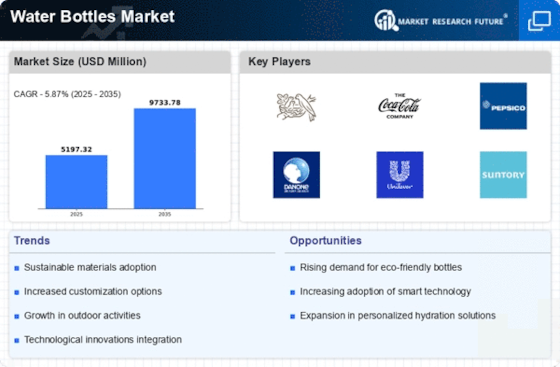
As per Market Research Future analysis, the Water Bottles Market Size was estimated at 5197.32 USD Million in 2024. The Water Bottles industry is projected to grow from 5502.4 USD Million in 2025 to 9733.78 USD Million by 2035, exhibiting a compound annual growth rate (CAGR) of 5.87% during the forecast period 2025 - 2035

Key Market Trends & Highlights

The Water Bottles Market is experiencing a dynamic shift towards sustainability and health-conscious innovations.

  • North America remains the largest market for water bottles, driven by a growing emphasis on sustainability and health. The Asia-Pacific region is emerging as the fastest-growing market, reflecting increasing urbanization and consumer awareness. Plastic water bottles continue to dominate the market, while stainless steel options are rapidly gaining traction due to their eco-friendly appeal. Key market drivers include sustainability initiatives and health consciousness, which are shaping consumer preferences across various segments.

Market Size & Forecast

2024 Market Size 5197.32 (USD Million)
2035 Market Size 9733.78 (USD Million)
CAGR (2025 - 2035) 5.87%
Largest Regional Market Share in 2024 Asia Pacific

Major Players

Nestle (CH), <a href="https://www.coca-cola.com/us/en">Coca-Cola (US)</a>, PepsiCo (US), Danone (FR), <a href="https://www.unilever.com/">Unilever (GB)</a>, Suntory (JP), Reed's (US), <a href="https://www.fijiwater.com/">Fiji Water (US)</a>, Voss Water (NO)

Market Trends

The Water Bottles Market is currently experiencing a dynamic evolution, driven by a confluence of consumer preferences and environmental considerations. As awareness regarding sustainability intensifies, there is a marked shift towards eco-friendly materials and reusable designs. This trend reflects a growing inclination among consumers to reduce plastic waste and embrace products that align with their values. The growth of the market for bottled water, driven by rising health awareness and urban consumption patterns, indirectly supports demand for reusable water bottles as consumers seek sustainable hydration alternatives. Consequently, manufacturers are increasingly innovating to create bottles that not only serve functional purposes but also resonate with environmentally conscious consumers. Moreover, the rise of health and wellness trends has further propelled the Water Bottles Market. Consumers are increasingly seeking features such as insulation, durability, and eco-friendly materials when deciding what they consider the best water bottle on the market, driving innovation and product differentiation in the global water bottles industry. Individuals are becoming more health-aware, leading to a demand for bottles that promote hydration and convenience. Features such as built-in filters, infusers for flavoring, and smart technology integration are gaining traction. This multifaceted landscape suggests that the Water Bottles Market is poised for continued growth, as it adapts to the evolving needs and preferences of consumers, while also addressing pressing environmental challenges. While the bottled water market share continues to expand globally, growing environmental concerns are accelerating consumer transition toward reusable water bottles.

Sustainability Focus

The Water Bottles Market is increasingly prioritizing sustainability, with manufacturers exploring biodegradable materials and reusable designs. This trend reflects a broader societal shift towards reducing plastic waste and promoting eco-friendly practices. The global reusable water bottle market size is witnessing steady expansion, supported by sustainability initiatives, rising health consciousness, and innovation in materials such as stainless steel and glass.

Health and Wellness Integration

As health consciousness rises, the demand for water bottles that support hydration and wellness is growing. Features such as built-in filters and infusers are becoming popular, catering to consumers seeking convenience and enhanced drinking experiences.

Smart Technology Adoption

The integration of smart technology into water bottles is emerging as a notable trend. Bottles equipped with tracking features and hydration reminders appeal to tech-savvy consumers, enhancing the overall user experience.

The global bottle market is experiencing unprecedented growth, driven by rising environmental awareness and stricter regulations on plastic usage. Within the broader bottle market, the water bottle industry stands out as a key innovator, integrating sustainable materials like recycled plastics and biodegradable compounds. Industry leaders in the water bottle industry are responding to consumer demand by developing products that combine functionality with environmental responsibility, positioning the bottle market for sustained expansion through 2035.

Water Bottle Market Market Drivers

E-commerce Growth

The Water Bottles Market is witnessing a significant transformation due to the rapid growth of e-commerce. Online shopping platforms provide consumers with a wider variety of options, making it easier to compare products and prices. This trend is particularly relevant in 2025, as e-commerce sales in the water bottle segment are expected to account for over 30% of total sales. The convenience of online purchasing, coupled with targeted marketing strategies, allows brands to reach a broader audience. As more consumers turn to online channels for their shopping needs, the Water Bottles Market must adapt to this shift by enhancing their digital presence and optimizing their online sales strategies.

Urbanization Trends

The Water Bottles Market is also influenced by urbanization trends, as more individuals migrate to urban areas where access to clean drinking water may be limited. This urban shift drives the demand for portable and convenient hydration solutions. In densely populated cities, the need for reusable water bottles is amplified, as consumers seek to reduce their reliance on single-use plastics. The market is projected to grow by 5% annually, reflecting the increasing necessity for accessible hydration options in urban settings. Brands that effectively market their products as essential for urban lifestyles are likely to capture a larger share of the Water Bottles Market.

Health Consciousness

The Water Bottles Market is significantly shaped by the increasing health consciousness among consumers. As individuals become more aware of the importance of hydration for overall well-being, the demand for water bottles is surging. In 2025, the market is expected to witness a growth rate of around 6% annually, driven by the rising popularity of fitness and wellness trends. Consumers are opting for water bottles that offer features such as insulation, infusers for fruits, and built-in filters, which enhance the drinking experience. This focus on health not only drives sales but also encourages brands to innovate and diversify their product offerings to meet the evolving needs of health-oriented consumers.

Sustainability Initiatives

The Water Bottles Market is increasingly influenced by sustainability initiatives. Consumers are becoming more environmentally conscious, leading to a rising demand for eco-friendly products. This shift is evident as brands adopt sustainable materials, such as recycled plastics and biodegradable options, to appeal to eco-aware consumers. In 2025, the market for reusable water bottles is projected to reach approximately 10 billion USD, reflecting a growing preference for sustainable alternatives. Companies that prioritize sustainability not only enhance their brand image but also tap into a lucrative segment of the market. This trend is likely to continue, as regulations around plastic usage tighten and consumers seek products that align with their values.

Technological Advancements

The Water Bottles Market is experiencing a wave of technological advancements that are reshaping consumer expectations. Smart water bottles equipped with features such as hydration tracking, temperature control, and connectivity to mobile applications are gaining traction. These innovations cater to tech-savvy consumers who seek convenience and functionality in their daily hydration routines. The introduction of smart technology is projected to contribute to a market growth of approximately 8% by 2025. As brands invest in research and development to create high-tech solutions, the competition within the Water Bottles Market intensifies, pushing traditional manufacturers to adapt or risk obsolescence.

Market Segment Insights

By Material Type: Plastic (Largest) vs. Stainless Steel (Fastest-Growing)

<p>The Water Bottles Market demonstrates a diverse distribution among different material types. Plastic remains the largest segment, commanding a substantial share due to its lightweight nature, affordability, and widespread availability. Stainless steel has emerged as a strong competitor, appreciated for its durability, insulation properties, and eco-friendliness, leading to an increase in consumer preference especially among environmentally conscious buyers. As a result, the market has seen varying growth rates across these segments, influencing market dynamics significantly. Growth trends in the Water Bottles Market are favoring sustainable and health-conscious choices. Stainless steel is rapidly gaining traction as consumers shift towards reusable options that reduce plastic waste. Meanwhile, innovations in plastic materials, such as BPA-free and recycled options, are also contributing to its sustained demand. The increasing awareness of health and wellness is further driving the growth of glass bottles, positioned as premium alternatives for discerning consumers.</p>

<p>Plastic (Dominant) vs. Stainless Steel (Emerging)</p>

<p>Plastic water bottles dominate the market owing to their affordability, convenience, and extensive availability. They are lightweight and versatile, making them a popular choice for everyday use. However, the rising concerns regarding environmental impact have led to developments in the production of sustainable plastic options, such as recycled plastics. On the other hand, stainless steel is an emerging segment that has gained favor for its durability and ability to maintain beverage temperature. As consumers become increasingly aware of environmental issues, stainless steel is positioned to capture both health-conscious and eco-friendly audiences. Its robust nature and longevity make it a desirable alternative, appealing to segments that prioritize quality and sustainability.</p>

By Product Type: Insulated (Largest) vs. Filter (Fastest-Growing)

<p>The Water Bottles Market exhibits a diverse range of product types, with insulated water bottles dominating the sector due to their versatility and durability. Non-insulated bottles also hold a significant position, catering to consumers seeking lighter options. However, filtration bottles are gaining traction, drawing attention towards the need for clean drinking water on the go, while infuser bottles appeal to consumers wanting to enhance their hydration experience with flavors. Other categories, including collapsible and sporting bottles, also contribute to the market's diversity.</p>

<p>Insulated (Dominant) vs. Filter (Emerging)</p>

<p>Insulated water bottles have secured their position as the dominant product type in the market, favored for their ability to maintain beverage temperatures for extended periods. Typically made from stainless steel or double-walled construction materials, they not only provide practical benefits but also appeal to eco-conscious consumers. On the other hand, filter water bottles are emerging rapidly, driven by growing health awareness and the increasing importance of hydration. These bottles integrate filtration technology that removes impurities, making them ideal for outdoor activities and travel. As urbanization rises and people seek convenience alongside health, the adoption of filter bottles is expected to continue expanding, representing a significant shift in consumer preferences.</p>

By Distribution Channel: Offline (Largest) vs. Online (Fastest-Growing)

<p>The Water Bottles Market has seen a significant distribution channel performance variance, with offline sales taking the lead as the largest segment. Offline channels, such as retail stores, supermarkets, and convenience stores, have traditionally accounted for a major portion of sales due to consumer preference for the immediate availability of products. This segment maintains established buyer habits, where consumers prefer purchasing from physical locations, enhancing customer engagement through personalized service. On the other hand, the online distribution channel is recognized as the fastest-growing segment in the Water Bottles Market. The surge in e-commerce usage in recent years has been a game changer, driven by the convenience of online shopping and the increasing adoption of mobile devices. As consumers shift towards digital platforms for their purchasing needs, online sales of water bottles are expected to accelerate, bolstered by effective marketing strategies and product availability across various websites.</p>

<p>Offline (Dominant) vs. Online (Emerging)</p>

<p>The offline distribution channel in the Water Bottles Market is characterized by its established network, comprising supermarkets, convenience stores, and specialized retailers. This dominant segment relies heavily on customer footfall and offers a tactile shopping experience, allowing consumers to assess product quality and freshness. Conversely, the online channel represents an emerging trend, gaining traction as consumers embrace the benefits of e-commerce. This channel is characterized by its vast reach, streamlined purchasing processes, and attractive offers, making it an appealing alternative for tech-savvy consumers. While offline sales benefit from customer loyalty and brand visibility, the online segment's growth is fueled by its accessibility and the rise of subscription services, presenting a dynamic contrast in the market.</p>

Get more detailed insights about Water Bottle Market Research Report – Forecast till 2035

Regional Insights

bottled water

Key Players and Competitive Insights

The market for water bottles is highly competitive, with a wide range of companies fighting for market share in an industry driven by growing consumer awareness of sustainability and hydration. Prominent international brands, including S'well, SIGG Switzerland Bottles AG, CamelBak, and Tupperware, have positioned themselves as frontrunners in the market by providing an extensive selection of innovative and long-lasting water bottle merchandise. These businesses frequently differentiate themselves by utilizing cutting-edge technologies, including double-wall insulation to maintain body temperature, environmentally sustainable materials, and streamlined design aesthetics that accommodate the changing tastes of customers. In addition, the market has observed the rise of specialized entities and new ventures that target market sectors, including environmentally conscious individuals, fitness enthusiasts, or outdoor explorers. Prominent brands such as Klean Kanteen have achieved recognition through their focus on resilience and long-lasting qualities, targeting outdoor enthusiasts who are in search of dependable hydration alternatives. The growing concern for sustainability has resulted in the emergence of environmentally responsible water bottle alternatives, such as Hydro Flask and S'well, which advocate for reusable alternatives to single-use plastic bottles and incorporate recycled materials. This trend is consistent with the increasing environmental awareness of consumers, which contributes to the market's overall transition towards more sustainable practices.

Key Companies in the Water Bottle Market include

Industry Developments

June 2023: Vera Bradley and Tupperware announced the release of their newest limited-edition product partnership. Sea Air Floral and Cloud Vine Multi, two of Vera Bradley's newest patterns, are included in a new range of must-have Tupperware food and drink containers from the two brands, which builds on the success of the well-liked 2022 series. There are snack sets, sandwich keepers, and reusable ECO water bottles available in each of the colorful floral motifs.

February 2023: Thermos L.L.C. Thermos Brand proudly presents the brand-new IconTM Series, which has been mastering the art of keeping food fresh, water cold, and coffee hot since 1904. The most recent masterwork is the IconTM Series. Thermos Brand goods have been honored for 119 years in the hot beverage and food storage areas, and these possibilities are part of the new portfolio. Furthermore, a broad range of goods with an emphasis on cold beverages and hydration are now part of the new portfolio.

All of the items in the series include a True-CoatTM Finish and a GriptecTM Non-Slip Base since they were created with the consumer in mind.

Future Outlook

Water Bottle Market Future Outlook

The Water Bottles Market Size is projected to grow at a 5.87% CAGR from 2025 to 2035, driven by sustainability trends, health consciousness, and technological advancements.

New opportunities lie in:

  • <p>Expansion into eco-friendly materials for bottle production. Development of smart water bottles with hydration tracking features. Partnerships with fitness brands for co-branded promotional campaigns.</p>

By 2035, the market is expected to be robust, reflecting evolving consumer preferences and innovative product offerings.

Market Segmentation

Water Bottle Market Product Type Outlook

  • Insulated
  • Non-Insulated
  • Filter
  • Infuser
  • Others

Water Bottle Market Material Type Outlook

  • Plastic
  • Stainless Steel
  • Glass
  • Others

Water Bottle Market Distribution Channel Outlook

  • Offline
  • Online

Report Scope

MARKET SIZE 2024 5197.32(USD Million)
MARKET SIZE 2025 5502.4(USD Million)
MARKET SIZE 2035 9733.78(USD Million)
COMPOUND ANNUAL GROWTH RATE (CAGR) 5.87% (2025 - 2035)
REPORT COVERAGE Revenue Forecast, Competitive Landscape, Growth Factors, and Trends
BASE YEAR 2024
Market Forecast Period 2025 - 2035
Historical Data 2019 - 2024
Market Forecast Units USD Million
Key Companies Profiled Nestle (CH), Coca-Cola (US), PepsiCo (US), Danone (FR), Unilever (GB), Suntory (JP), Reed's (US), Fiji Water (US), Voss Water (NO)
Segments Covered Material Type, Distribution Channel, Region
Key Market Opportunities Growing demand for sustainable materials in the Water Bottles Market presents significant innovation opportunities.
Key Market Dynamics Rising consumer preference for sustainable materials drives innovation and competition in the water bottles market.
Countries Covered North America, Europe, APAC, South America, MEA

FAQs

What is the current valuation of the Water Bottles Market as of 2024?

<p>The overall market valuation was 5197.32 USD Million in 2024.</p>

What is the projected market valuation for the Water Bottles Market in 2035?

<p>The projected valuation for 2035 is 9733.78 USD Million.</p>

What is the expected CAGR for the Water Bottles Market during the forecast period 2025 - 2035?

<p>The expected CAGR for the Water Bottles Market during the forecast period 2025 - 2035 is 5.87%.</p>

Which material type segment has the highest valuation in the Water Bottles Market?

<p>The Plastic segment has a valuation range of 2500.0 to 4500.0 USD Million, indicating its prominence.</p>

How does the valuation of insulated water bottles compare to non-insulated ones?

<p>The valuation for insulated water bottles ranges from 1040.0 to 1950.0 USD Million, whereas non-insulated bottles range from 1800.0 to 3500.0 USD Million.</p>

What are the key distribution channels for the Water Bottles Market?

<p>The key distribution channels include Offline, with a valuation range of 3118.66 to 5770.27 USD Million, and Online, ranging from 2078.66 to 3963.51 USD Million.</p>

Which companies are considered key players in the Water Bottles Market?

<p>Key players in the market include Nestle, Coca-Cola, PepsiCo, Danone, Unilever, Suntory, Reed's, Fiji Water, and Voss Water.</p>

What is the valuation range for the glass water bottle segment?

<p>The glass water bottle segment has a valuation range of 800.0 to 1500.0 USD Million.</p>

What is the projected growth trend for the Water Bottles Market?

<p>The Water Bottles Market appears to be on a growth trajectory, with a projected valuation increase to 9733.78 USD Million by 2035.</p>

How does the performance of the filter product type compare to others?

<p>The filter product type has a valuation range of 800.0 to 1500.0 USD Million, which is competitive compared to other product types.</p>

  1. SECTION I: EXECUTIVE SUMMARY AND KEY HIGHLIGHTS
    1. | 1.1 EXECUTIVE SUMMARY
    2. | | 1.1.1 Market Overview
    3. | | 1.1.2 Key Findings
    4. | | 1.1.3 Market Segmentation
    5. | | 1.1.4 Competitive Landscape
    6. | | 1.1.5 Challenges and Opportunities
    7. | | 1.1.6 Future Outlook
  2. SECTION II: SCOPING, METHODOLOGY AND MARKET STRUCTURE
    1. | 2.1 MARKET INTRODUCTION
    2. | | 2.1.1 Definition
    3. | | 2.1.2 Scope of the study
    4. | | | 2.1.2.1 Research Objective
    5. | | | 2.1.2.2 Assumption
    6. | | | 2.1.2.3 Limitations
    7. | 2.2 RESEARCH METHODOLOGY
    8. | | 2.2.1 Overview
    9. | | 2.2.2 Data Mining
    10. | | 2.2.3 Secondary Research
    11. | | 2.2.4 Primary Research
    12. | | | 2.2.4.1 Primary Interviews and Information Gathering Process
    13. | | | 2.2.4.2 Breakdown of Primary Respondents
    14. | | 2.2.5 Forecasting Model
    15. | | 2.2.6 Market Size Estimation
    16. | | | 2.2.6.1 Bottom-Up Approach
    17. | | | 2.2.6.2 Top-Down Approach
    18. | | 2.2.7 Data Triangulation
    19. | | 2.2.8 Validation
  3. SECTION III: QUALITATIVE ANALYSIS
    1. | 3.1 MARKET DYNAMICS
    2. | | 3.1.1 Overview
    3. | | 3.1.2 Drivers
    4. | | 3.1.3 Restraints
    5. | | 3.1.4 Opportunities
    6. | 3.2 MARKET FACTOR ANALYSIS
    7. | | 3.2.1 Value chain Analysis
    8. | | 3.2.2 Porter's Five Forces Analysis
    9. | | | 3.2.2.1 Bargaining Power of Suppliers
    10. | | | 3.2.2.2 Bargaining Power of Buyers
    11. | | | 3.2.2.3 Threat of New Entrants
    12. | | | 3.2.2.4 Threat of Substitutes
    13. | | | 3.2.2.5 Intensity of Rivalry
    14. | | 3.2.3 COVID-19 Impact Analysis
    15. | | | 3.2.3.1 Market Impact Analysis
    16. | | | 3.2.3.2 Regional Impact
    17. | | | 3.2.3.3 Opportunity and Threat Analysis
  4. SECTION IV: QUANTITATIVE ANALYSIS
    1. | 4.1 Consumer and Retail, BY Material Type (USD Million)
    2. | | 4.1.1 Plastic
    3. | | 4.1.2 Stainless Steel
    4. | | 4.1.3 Glass
    5. | | 4.1.4 Others
    6. | 4.2 Consumer and Retail, BY Product Type (USD Million)
    7. | | 4.2.1 Insulated
    8. | | 4.2.2 Non-Insulated
    9. | | 4.2.3 Filter
    10. | | 4.2.4 Infuser
    11. | | 4.2.5 Others
    12. | 4.3 Consumer and Retail, BY Distribution Channel (USD Million)
    13. | | 4.3.1 Offline
    14. | | 4.3.2 Online
    15. | 4.4 Consumer and Retail, BY Region (USD Million)
    16. | | 4.4.1 North America
    17. | | | 4.4.1.1 US
    18. | | | 4.4.1.2 Canada
    19. | | 4.4.2 Europe
    20. | | | 4.4.2.1 Germany
    21. | | | 4.4.2.2 UK
    22. | | | 4.4.2.3 France
    23. | | | 4.4.2.4 Russia
    24. | | | 4.4.2.5 Italy
    25. | | | 4.4.2.6 Spain
    26. | | | 4.4.2.7 Rest of Europe
    27. | | 4.4.3 APAC
    28. | | | 4.4.3.1 China
    29. | | | 4.4.3.2 India
    30. | | | 4.4.3.3 Japan
    31. | | | 4.4.3.4 South Korea
    32. | | | 4.4.3.5 Malaysia
    33. | | | 4.4.3.6 Thailand
    34. | | | 4.4.3.7 Indonesia
    35. | | | 4.4.3.8 Rest of APAC
    36. | | 4.4.4 South America
    37. | | | 4.4.4.1 Brazil
    38. | | | 4.4.4.2 Mexico
    39. | | | 4.4.4.3 Argentina
    40. | | | 4.4.4.4 Rest of South America
    41. | | 4.4.5 MEA
    42. | | | 4.4.5.1 GCC Countries
    43. | | | 4.4.5.2 South Africa
    44. | | | 4.4.5.3 Rest of MEA
  5. SECTION V: COMPETITIVE ANALYSIS
    1. | 5.1 Competitive Landscape
    2. | | 5.1.1 Overview
    3. | | 5.1.2 Competitive Analysis
    4. | | 5.1.3 Market share Analysis
    5. | | 5.1.4 Major Growth Strategy in the Consumer and Retail
    6. | | 5.1.5 Competitive Benchmarking
    7. | | 5.1.6 Leading Players in Terms of Number of Developments in the Consumer and Retail
    8. | | 5.1.7 Key developments and growth strategies
    9. | | | 5.1.7.1 New Product Launch/Service Deployment
    10. | | | 5.1.7.2 Merger & Acquisitions
    11. | | | 5.1.7.3 Joint Ventures
    12. | | 5.1.8 Major Players Financial Matrix
    13. | | | 5.1.8.1 Sales and Operating Income
    14. | | | 5.1.8.2 Major Players R&D Expenditure. 2023
    15. | 5.2 Company Profiles
    16. | | 5.2.1 Nestle (CH)
    17. | | | 5.2.1.1 Financial Overview
    18. | | | 5.2.1.2 Products Offered
    19. | | | 5.2.1.3 Key Developments
    20. | | | 5.2.1.4 SWOT Analysis
    21. | | | 5.2.1.5 Key Strategies
    22. | | 5.2.2 Coca-Cola (US)
    23. | | | 5.2.2.1 Financial Overview
    24. | | | 5.2.2.2 Products Offered
    25. | | | 5.2.2.3 Key Developments
    26. | | | 5.2.2.4 SWOT Analysis
    27. | | | 5.2.2.5 Key Strategies
    28. | | 5.2.3 PepsiCo (US)
    29. | | | 5.2.3.1 Financial Overview
    30. | | | 5.2.3.2 Products Offered
    31. | | | 5.2.3.3 Key Developments
    32. | | | 5.2.3.4 SWOT Analysis
    33. | | | 5.2.3.5 Key Strategies
    34. | | 5.2.4 Danone (FR)
    35. | | | 5.2.4.1 Financial Overview
    36. | | | 5.2.4.2 Products Offered
    37. | | | 5.2.4.3 Key Developments
    38. | | | 5.2.4.4 SWOT Analysis
    39. | | | 5.2.4.5 Key Strategies
    40. | | 5.2.5 Unilever (GB)
    41. | | | 5.2.5.1 Financial Overview
    42. | | | 5.2.5.2 Products Offered
    43. | | | 5.2.5.3 Key Developments
    44. | | | 5.2.5.4 SWOT Analysis
    45. | | | 5.2.5.5 Key Strategies
    46. | | 5.2.6 Suntory (JP)
    47. | | | 5.2.6.1 Financial Overview
    48. | | | 5.2.6.2 Products Offered
    49. | | | 5.2.6.3 Key Developments
    50. | | | 5.2.6.4 SWOT Analysis
    51. | | | 5.2.6.5 Key Strategies
    52. | | 5.2.7 Reed's (US)
    53. | | | 5.2.7.1 Financial Overview
    54. | | | 5.2.7.2 Products Offered
    55. | | | 5.2.7.3 Key Developments
    56. | | | 5.2.7.4 SWOT Analysis
    57. | | | 5.2.7.5 Key Strategies
    58. | | 5.2.8 Fiji Water (US)
    59. | | | 5.2.8.1 Financial Overview
    60. | | | 5.2.8.2 Products Offered
    61. | | | 5.2.8.3 Key Developments
    62. | | | 5.2.8.4 SWOT Analysis
    63. | | | 5.2.8.5 Key Strategies
    64. | | 5.2.9 Voss Water (NO)
    65. | | | 5.2.9.1 Financial Overview
    66. | | | 5.2.9.2 Products Offered
    67. | | | 5.2.9.3 Key Developments
    68. | | | 5.2.9.4 SWOT Analysis
    69. | | | 5.2.9.5 Key Strategies
    70. | 5.3 Appendix
    71. | | 5.3.1 References
    72. | | 5.3.2 Related Reports
  6. LIST OF FIGURES
    1. | 6.1 MARKET SYNOPSIS
    2. | 6.2 NORTH AMERICA MARKET ANALYSIS
    3. | 6.3 US MARKET ANALYSIS BY MATERIAL TYPE
    4. | 6.4 US MARKET ANALYSIS BY PRODUCT TYPE
    5. | 6.5 US MARKET ANALYSIS BY DISTRIBUTION CHANNEL
    6. | 6.6 CANADA MARKET ANALYSIS BY MATERIAL TYPE
    7. | 6.7 CANADA MARKET ANALYSIS BY PRODUCT TYPE
    8. | 6.8 CANADA MARKET ANALYSIS BY DISTRIBUTION CHANNEL
    9. | 6.9 EUROPE MARKET ANALYSIS
    10. | 6.10 GERMANY MARKET ANALYSIS BY MATERIAL TYPE
    11. | 6.11 GERMANY MARKET ANALYSIS BY PRODUCT TYPE
    12. | 6.12 GERMANY MARKET ANALYSIS BY DISTRIBUTION CHANNEL
    13. | 6.13 UK MARKET ANALYSIS BY MATERIAL TYPE
    14. | 6.14 UK MARKET ANALYSIS BY PRODUCT TYPE
    15. | 6.15 UK MARKET ANALYSIS BY DISTRIBUTION CHANNEL
    16. | 6.16 FRANCE MARKET ANALYSIS BY MATERIAL TYPE
    17. | 6.17 FRANCE MARKET ANALYSIS BY PRODUCT TYPE
    18. | 6.18 FRANCE MARKET ANALYSIS BY DISTRIBUTION CHANNEL
    19. | 6.19 RUSSIA MARKET ANALYSIS BY MATERIAL TYPE
    20. | 6.20 RUSSIA MARKET ANALYSIS BY PRODUCT TYPE
    21. | 6.21 RUSSIA MARKET ANALYSIS BY DISTRIBUTION CHANNEL
    22. | 6.22 ITALY MARKET ANALYSIS BY MATERIAL TYPE
    23. | 6.23 ITALY MARKET ANALYSIS BY PRODUCT TYPE
    24. | 6.24 ITALY MARKET ANALYSIS BY DISTRIBUTION CHANNEL
    25. | 6.25 SPAIN MARKET ANALYSIS BY MATERIAL TYPE
    26. | 6.26 SPAIN MARKET ANALYSIS BY PRODUCT TYPE
    27. | 6.27 SPAIN MARKET ANALYSIS BY DISTRIBUTION CHANNEL
    28. | 6.28 REST OF EUROPE MARKET ANALYSIS BY MATERIAL TYPE
    29. | 6.29 REST OF EUROPE MARKET ANALYSIS BY PRODUCT TYPE
    30. | 6.30 REST OF EUROPE MARKET ANALYSIS BY DISTRIBUTION CHANNEL
    31. | 6.31 APAC MARKET ANALYSIS
    32. | 6.32 CHINA MARKET ANALYSIS BY MATERIAL TYPE
    33. | 6.33 CHINA MARKET ANALYSIS BY PRODUCT TYPE
    34. | 6.34 CHINA MARKET ANALYSIS BY DISTRIBUTION CHANNEL
    35. | 6.35 INDIA MARKET ANALYSIS BY MATERIAL TYPE
    36. | 6.36 INDIA MARKET ANALYSIS BY PRODUCT TYPE
    37. | 6.37 INDIA MARKET ANALYSIS BY DISTRIBUTION CHANNEL
    38. | 6.38 JAPAN MARKET ANALYSIS BY MATERIAL TYPE
    39. | 6.39 JAPAN MARKET ANALYSIS BY PRODUCT TYPE
    40. | 6.40 JAPAN MARKET ANALYSIS BY DISTRIBUTION CHANNEL
    41. | 6.41 SOUTH KOREA MARKET ANALYSIS BY MATERIAL TYPE
    42. | 6.42 SOUTH KOREA MARKET ANALYSIS BY PRODUCT TYPE
    43. | 6.43 SOUTH KOREA MARKET ANALYSIS BY DISTRIBUTION CHANNEL
    44. | 6.44 MALAYSIA MARKET ANALYSIS BY MATERIAL TYPE
    45. | 6.45 MALAYSIA MARKET ANALYSIS BY PRODUCT TYPE
    46. | 6.46 MALAYSIA MARKET ANALYSIS BY DISTRIBUTION CHANNEL
    47. | 6.47 THAILAND MARKET ANALYSIS BY MATERIAL TYPE
    48. | 6.48 THAILAND MARKET ANALYSIS BY PRODUCT TYPE
    49. | 6.49 THAILAND MARKET ANALYSIS BY DISTRIBUTION CHANNEL
    50. | 6.50 INDONESIA MARKET ANALYSIS BY MATERIAL TYPE
    51. | 6.51 INDONESIA MARKET ANALYSIS BY PRODUCT TYPE
    52. | 6.52 INDONESIA MARKET ANALYSIS BY DISTRIBUTION CHANNEL
    53. | 6.53 REST OF APAC MARKET ANALYSIS BY MATERIAL TYPE
    54. | 6.54 REST OF APAC MARKET ANALYSIS BY PRODUCT TYPE
    55. | 6.55 REST OF APAC MARKET ANALYSIS BY DISTRIBUTION CHANNEL
    56. | 6.56 SOUTH AMERICA MARKET ANALYSIS
    57. | 6.57 BRAZIL MARKET ANALYSIS BY MATERIAL TYPE
    58. | 6.58 BRAZIL MARKET ANALYSIS BY PRODUCT TYPE
    59. | 6.59 BRAZIL MARKET ANALYSIS BY DISTRIBUTION CHANNEL
    60. | 6.60 MEXICO MARKET ANALYSIS BY MATERIAL TYPE
    61. | 6.61 MEXICO MARKET ANALYSIS BY PRODUCT TYPE
    62. | 6.62 MEXICO MARKET ANALYSIS BY DISTRIBUTION CHANNEL
    63. | 6.63 ARGENTINA MARKET ANALYSIS BY MATERIAL TYPE
    64. | 6.64 ARGENTINA MARKET ANALYSIS BY PRODUCT TYPE
    65. | 6.65 ARGENTINA MARKET ANALYSIS BY DISTRIBUTION CHANNEL
    66. | 6.66 REST OF SOUTH AMERICA MARKET ANALYSIS BY MATERIAL TYPE
    67. | 6.67 REST OF SOUTH AMERICA MARKET ANALYSIS BY PRODUCT TYPE
    68. | 6.68 REST OF SOUTH AMERICA MARKET ANALYSIS BY DISTRIBUTION CHANNEL
    69. | 6.69 MEA MARKET ANALYSIS
    70. | 6.70 GCC COUNTRIES MARKET ANALYSIS BY MATERIAL TYPE
    71. | 6.71 GCC COUNTRIES MARKET ANALYSIS BY PRODUCT TYPE
    72. | 6.72 GCC COUNTRIES MARKET ANALYSIS BY DISTRIBUTION CHANNEL
    73. | 6.73 SOUTH AFRICA MARKET ANALYSIS BY MATERIAL TYPE
    74. | 6.74 SOUTH AFRICA MARKET ANALYSIS BY PRODUCT TYPE
    75. | 6.75 SOUTH AFRICA MARKET ANALYSIS BY DISTRIBUTION CHANNEL
    76. | 6.76 REST OF MEA MARKET ANALYSIS BY MATERIAL TYPE
    77. | 6.77 REST OF MEA MARKET ANALYSIS BY PRODUCT TYPE
    78. | 6.78 REST OF MEA MARKET ANALYSIS BY DISTRIBUTION CHANNEL
    79. | 6.79 KEY BUYING CRITERIA OF CONSUMER AND RETAIL
    80. | 6.80 RESEARCH PROCESS OF MRFR
    81. | 6.81 DRO ANALYSIS OF CONSUMER AND RETAIL
    82. | 6.82 DRIVERS IMPACT ANALYSIS: CONSUMER AND RETAIL
    83. | 6.83 RESTRAINTS IMPACT ANALYSIS: CONSUMER AND RETAIL
    84. | 6.84 SUPPLY / VALUE CHAIN: CONSUMER AND RETAIL
    85. | 6.85 CONSUMER AND RETAIL, BY MATERIAL TYPE, 2024 (% SHARE)
    86. | 6.86 CONSUMER AND RETAIL, BY MATERIAL TYPE, 2024 TO 2035 (USD Million)
    87. | 6.87 CONSUMER AND RETAIL, BY PRODUCT TYPE, 2024 (% SHARE)
    88. | 6.88 CONSUMER AND RETAIL, BY PRODUCT TYPE, 2024 TO 2035 (USD Million)
    89. | 6.89 CONSUMER AND RETAIL, BY DISTRIBUTION CHANNEL, 2024 (% SHARE)
    90. | 6.90 CONSUMER AND RETAIL, BY DISTRIBUTION CHANNEL, 2024 TO 2035 (USD Million)
    91. | 6.91 BENCHMARKING OF MAJOR COMPETITORS
  7. LIST OF TABLES
    1. | 7.1 LIST OF ASSUMPTIONS
    2. | | 7.1.1
    3. | 7.2 North America MARKET SIZE ESTIMATES; FORECAST
    4. | | 7.2.1 BY MATERIAL TYPE, 2025-2035 (USD Million)
    5. | | 7.2.2 BY PRODUCT TYPE, 2025-2035 (USD Million)
    6. | | 7.2.3 BY DISTRIBUTION CHANNEL, 2025-2035 (USD Million)
    7. | 7.3 US MARKET SIZE ESTIMATES; FORECAST
    8. | | 7.3.1 BY MATERIAL TYPE, 2025-2035 (USD Million)
    9. | | 7.3.2 BY PRODUCT TYPE, 2025-2035 (USD Million)
    10. | | 7.3.3 BY DISTRIBUTION CHANNEL, 2025-2035 (USD Million)
    11. | 7.4 Canada MARKET SIZE ESTIMATES; FORECAST
    12. | | 7.4.1 BY MATERIAL TYPE, 2025-2035 (USD Million)
    13. | | 7.4.2 BY PRODUCT TYPE, 2025-2035 (USD Million)
    14. | | 7.4.3 BY DISTRIBUTION CHANNEL, 2025-2035 (USD Million)
    15. | 7.5 Europe MARKET SIZE ESTIMATES; FORECAST
    16. | | 7.5.1 BY MATERIAL TYPE, 2025-2035 (USD Million)
    17. | | 7.5.2 BY PRODUCT TYPE, 2025-2035 (USD Million)
    18. | | 7.5.3 BY DISTRIBUTION CHANNEL, 2025-2035 (USD Million)
    19. | 7.6 Germany MARKET SIZE ESTIMATES; FORECAST
    20. | | 7.6.1 BY MATERIAL TYPE, 2025-2035 (USD Million)
    21. | | 7.6.2 BY PRODUCT TYPE, 2025-2035 (USD Million)
    22. | | 7.6.3 BY DISTRIBUTION CHANNEL, 2025-2035 (USD Million)
    23. | 7.7 UK MARKET SIZE ESTIMATES; FORECAST
    24. | | 7.7.1 BY MATERIAL TYPE, 2025-2035 (USD Million)
    25. | | 7.7.2 BY PRODUCT TYPE, 2025-2035 (USD Million)
    26. | | 7.7.3 BY DISTRIBUTION CHANNEL, 2025-2035 (USD Million)
    27. | 7.8 France MARKET SIZE ESTIMATES; FORECAST
    28. | | 7.8.1 BY MATERIAL TYPE, 2025-2035 (USD Million)
    29. | | 7.8.2 BY PRODUCT TYPE, 2025-2035 (USD Million)
    30. | | 7.8.3 BY DISTRIBUTION CHANNEL, 2025-2035 (USD Million)
    31. | 7.9 Russia MARKET SIZE ESTIMATES; FORECAST
    32. | | 7.9.1 BY MATERIAL TYPE, 2025-2035 (USD Million)
    33. | | 7.9.2 BY PRODUCT TYPE, 2025-2035 (USD Million)
    34. | | 7.9.3 BY DISTRIBUTION CHANNEL, 2025-2035 (USD Million)
    35. | 7.10 Italy MARKET SIZE ESTIMATES; FORECAST
    36. | | 7.10.1 BY MATERIAL TYPE, 2025-2035 (USD Million)
    37. | | 7.10.2 BY PRODUCT TYPE, 2025-2035 (USD Million)
    38. | | 7.10.3 BY DISTRIBUTION CHANNEL, 2025-2035 (USD Million)
    39. | 7.11 Spain MARKET SIZE ESTIMATES; FORECAST
    40. | | 7.11.1 BY MATERIAL TYPE, 2025-2035 (USD Million)
    41. | | 7.11.2 BY PRODUCT TYPE, 2025-2035 (USD Million)
    42. | | 7.11.3 BY DISTRIBUTION CHANNEL, 2025-2035 (USD Million)
    43. | 7.12 Rest of Europe MARKET SIZE ESTIMATES; FORECAST
    44. | | 7.12.1 BY MATERIAL TYPE, 2025-2035 (USD Million)
    45. | | 7.12.2 BY PRODUCT TYPE, 2025-2035 (USD Million)
    46. | | 7.12.3 BY DISTRIBUTION CHANNEL, 2025-2035 (USD Million)
    47. | 7.13 APAC MARKET SIZE ESTIMATES; FORECAST
    48. | | 7.13.1 BY MATERIAL TYPE, 2025-2035 (USD Million)
    49. | | 7.13.2 BY PRODUCT TYPE, 2025-2035 (USD Million)
    50. | | 7.13.3 BY DISTRIBUTION CHANNEL, 2025-2035 (USD Million)
    51. | 7.14 China MARKET SIZE ESTIMATES; FORECAST
    52. | | 7.14.1 BY MATERIAL TYPE, 2025-2035 (USD Million)
    53. | | 7.14.2 BY PRODUCT TYPE, 2025-2035 (USD Million)
    54. | | 7.14.3 BY DISTRIBUTION CHANNEL, 2025-2035 (USD Million)
    55. | 7.15 India MARKET SIZE ESTIMATES; FORECAST
    56. | | 7.15.1 BY MATERIAL TYPE, 2025-2035 (USD Million)
    57. | | 7.15.2 BY PRODUCT TYPE, 2025-2035 (USD Million)
    58. | | 7.15.3 BY DISTRIBUTION CHANNEL, 2025-2035 (USD Million)
    59. | 7.16 Japan MARKET SIZE ESTIMATES; FORECAST
    60. | | 7.16.1 BY MATERIAL TYPE, 2025-2035 (USD Million)
    61. | | 7.16.2 BY PRODUCT TYPE, 2025-2035 (USD Million)
    62. | | 7.16.3 BY DISTRIBUTION CHANNEL, 2025-2035 (USD Million)
    63. | 7.17 South Korea MARKET SIZE ESTIMATES; FORECAST
    64. | | 7.17.1 BY MATERIAL TYPE, 2025-2035 (USD Million)
    65. | | 7.17.2 BY PRODUCT TYPE, 2025-2035 (USD Million)
    66. | | 7.17.3 BY DISTRIBUTION CHANNEL, 2025-2035 (USD Million)
    67. | 7.18 Malaysia MARKET SIZE ESTIMATES; FORECAST
    68. | | 7.18.1 BY MATERIAL TYPE, 2025-2035 (USD Million)
    69. | | 7.18.2 BY PRODUCT TYPE, 2025-2035 (USD Million)
    70. | | 7.18.3 BY DISTRIBUTION CHANNEL, 2025-2035 (USD Million)
    71. | 7.19 Thailand MARKET SIZE ESTIMATES; FORECAST
    72. | | 7.19.1 BY MATERIAL TYPE, 2025-2035 (USD Million)
    73. | | 7.19.2 BY PRODUCT TYPE, 2025-2035 (USD Million)
    74. | | 7.19.3 BY DISTRIBUTION CHANNEL, 2025-2035 (USD Million)
    75. | 7.20 Indonesia MARKET SIZE ESTIMATES; FORECAST
    76. | | 7.20.1 BY MATERIAL TYPE, 2025-2035 (USD Million)
    77. | | 7.20.2 BY PRODUCT TYPE, 2025-2035 (USD Million)
    78. | | 7.20.3 BY DISTRIBUTION CHANNEL, 2025-2035 (USD Million)
    79. | 7.21 Rest of APAC MARKET SIZE ESTIMATES; FORECAST
    80. | | 7.21.1 BY MATERIAL TYPE, 2025-2035 (USD Million)
    81. | | 7.21.2 BY PRODUCT TYPE, 2025-2035 (USD Million)
    82. | | 7.21.3 BY DISTRIBUTION CHANNEL, 2025-2035 (USD Million)
    83. | 7.22 South America MARKET SIZE ESTIMATES; FORECAST
    84. | | 7.22.1 BY MATERIAL TYPE, 2025-2035 (USD Million)
    85. | | 7.22.2 BY PRODUCT TYPE, 2025-2035 (USD Million)
    86. | | 7.22.3 BY DISTRIBUTION CHANNEL, 2025-2035 (USD Million)
    87. | 7.23 Brazil MARKET SIZE ESTIMATES; FORECAST
    88. | | 7.23.1 BY MATERIAL TYPE, 2025-2035 (USD Million)
    89. | | 7.23.2 BY PRODUCT TYPE, 2025-2035 (USD Million)
    90. | | 7.23.3 BY DISTRIBUTION CHANNEL, 2025-2035 (USD Million)
    91. | 7.24 Mexico MARKET SIZE ESTIMATES; FORECAST
    92. | | 7.24.1 BY MATERIAL TYPE, 2025-2035 (USD Million)
    93. | | 7.24.2 BY PRODUCT TYPE, 2025-2035 (USD Million)
    94. | | 7.24.3 BY DISTRIBUTION CHANNEL, 2025-2035 (USD Million)
    95. | 7.25 Argentina MARKET SIZE ESTIMATES; FORECAST
    96. | | 7.25.1 BY MATERIAL TYPE, 2025-2035 (USD Million)
    97. | | 7.25.2 BY PRODUCT TYPE, 2025-2035 (USD Million)
    98. | | 7.25.3 BY DISTRIBUTION CHANNEL, 2025-2035 (USD Million)
    99. | 7.26 Rest of South America MARKET SIZE ESTIMATES; FORECAST
    100. | | 7.26.1 BY MATERIAL TYPE, 2025-2035 (USD Million)
    101. | | 7.26.2 BY PRODUCT TYPE, 2025-2035 (USD Million)
    102. | | 7.26.3 BY DISTRIBUTION CHANNEL, 2025-2035 (USD Million)
    103. | 7.27 MEA MARKET SIZE ESTIMATES; FORECAST
    104. | | 7.27.1 BY MATERIAL TYPE, 2025-2035 (USD Million)
    105. | | 7.27.2 BY PRODUCT TYPE, 2025-2035 (USD Million)
    106. | | 7.27.3 BY DISTRIBUTION CHANNEL, 2025-2035 (USD Million)
    107. | 7.28 GCC Countries MARKET SIZE ESTIMATES; FORECAST
    108. | | 7.28.1 BY MATERIAL TYPE, 2025-2035 (USD Million)
    109. | | 7.28.2 BY PRODUCT TYPE, 2025-2035 (USD Million)
    110. | | 7.28.3 BY DISTRIBUTION CHANNEL, 2025-2035 (USD Million)
    111. | 7.29 South Africa MARKET SIZE ESTIMATES; FORECAST
    112. | | 7.29.1 BY MATERIAL TYPE, 2025-2035 (USD Million)
    113. | | 7.29.2 BY PRODUCT TYPE, 2025-2035 (USD Million)
    114. | | 7.29.3 BY DISTRIBUTION CHANNEL, 2025-2035 (USD Million)
    115. | 7.30 Rest of MEA MARKET SIZE ESTIMATES; FORECAST
    116. | | 7.30.1 BY MATERIAL TYPE, 2025-2035 (USD Million)
    117. | | 7.30.2 BY PRODUCT TYPE, 2025-2035 (USD Million)
    118. | | 7.30.3 BY DISTRIBUTION CHANNEL, 2025-2035 (USD Million)
    119. | 7.31 PRODUCT LAUNCH/PRODUCT DEVELOPMENT/APPROVAL
    120. | | 7.31.1
    121. | 7.32 ACQUISITION/PARTNERSHIP
    122. | | 7.32.1

Consumer and Retail Market Segmentation

Consumer and Retail By Material Type (USD Million, 2025-2035)

  • Plastic
  • Stainless Steel
  • Glass
  • Others

Consumer and Retail By Product Type (USD Million, 2025-2035)

  • Insulated
  • Non-Insulated
  • Filter
  • Infuser
  • Others

Consumer and Retail By Distribution Channel (USD Million, 2025-2035)

  • Offline
  • Online
Infographic

Free Sample Request

Kindly complete the form below to receive a free sample of this Report

Get Free Sample

Customer Strories

Compare Licence

×
Features License Type
Single User Multiuser License Enterprise User
Price $4,950 $5,950 $7,250
Maximum User Access Limit 1 User Upto 10 Users Unrestricted Access Throughout the Organization
Free Customization
Direct Access to Analyst
Deliverable Format
Platform Access
Discount on Next Purchase 10% 15% 15%
Printable Versions