Request Free Sample ×

Kindly complete the form below to receive a free sample of this Report

* Please use a valid business email

Leading companies partner with us for data-driven Insights

clients tt-cursor
Hero Background
English
Chinese
French
Japanese
Korean
German
Spanish

Volumetric Display Market Share

ID: MRFR/SEM/3607-HCR
200 Pages
Ankit Gupta
March 2026

Volumetric Display Market Size, Share and Research Report By Technology (Multiview Display, Light Field Display, Holographic Display, 3D Display), By Application (Medical Imaging, Educational Visualization, Entertainment, Architectural Visualization, Telecommunications), By End Use (Commercial, Industrial, Healthcare, Education), By Display Size (Small, Medium, Large) and By Regional (North America, Europe, South America, Asia Pacific, Middle East and Africa) - Inudustry Forecast to 2035

Share:
Download PDF ×

We do not share your information with anyone. However, we may send you emails based on your report interest from time to time. You may contact us at any time to opt-out.

Volumetric Display Market Infographic
Purchase Options

Market Share

Volumetric Display Market Share Analysis

The very competitive market for volumetric displays shows how important market share plans are to a company's success. Using new technologies to set yourself apart is a popular strategy. Organizations want to be the best in their fields by putting a lot of money into research and development, making new features, and improving the general usefulness of their volumetric displays. These businesses want to get a big share of the market by making products that are better than competitors in terms of picture quality, contact, and the number of uses they can be put to. They do this by always being on the cutting edge of new technology. One more important part of a good market placement strategy is focusing on certain uses and industries. One area where a business may choose to specialize is in industry, healthcare, games, or education. Businesses can create a niche market for themselves by making changes to their volumetric screens to meet the needs of certain industries. They can get specialized knowledge, build trusting relationships in the industry, and meet the specific needs of clients in those areas by using this approach. All of these things help them take a strategic place in the market. Companies that make volumetric displays can also place themselves in the market by working with other companies and forming relationships. Businesses can form agreements with industry giants, startups, and research centers that have a lot of experience to speed up innovation and market growth. Companies can get into new markets, split the costs of development, and use related technologies through joint partnerships. This gives them a competitive edge and a bigger effect in the volumetric display industry. When businesses try to get a bigger share of the market, they mostly use marketing and brand positioning. To get people to stick with a brand, they need to make a strong brand personality, make it clear what makes their products special, and run successful marketing campaigns. Top companies in the field usually put a lot of emphasis on things like how consistent their volumetric displays are, how well they help customers, and how easy they are to use overall. Increasing market share, this brand plan brings in new customers and encourages them to buy from you again. To get a bigger piece of the volumetric display business, going abroad is another option. Companies could try to grow their world reach by going into new places and getting more customers there. As part of this plan, goods will be changed to fit the needs of different areas, local laws will be taken into account, and a strong delivery network will be built. Companies can take advantage of new possibilities and improve their place as key players in the competitive volumetric display market by carefully increasing their reach.


Author
Author Profile
Ankit Gupta
Team Lead - Research

Ankit Gupta is a seasoned market intelligence and strategic research professional with over six plus years of experience in the ICT and Semiconductor industries. With academic roots in Telecom, Marketing, and Electronics, he blends technical insight with business strategy. Ankit has led 200+ projects, including work for Fortune 500 clients like Microsoft and Rio Tinto, covering market sizing, tech forecasting, and go-to-market strategies. Known for bridging engineering and enterprise decision-making, his insights support growth, innovation, and investment planning across diverse technology markets.

Leave a Comment

FAQs

What is the projected market valuation of the Volumetric Display Market by 2035?

<p>The Volumetric Display Market is projected to reach a valuation of 8.145 USD Billion by 2035.</p>

What was the market valuation of the Volumetric Display Market in 2024?

<p>In 2024, the Volumetric Display Market had a valuation of 1.354 USD Billion.</p>

What is the expected CAGR for the Volumetric Display Market during the forecast period 2025 - 2035?

<p>The expected CAGR for the Volumetric Display Market during the forecast period 2025 - 2035 is 17.72%.</p>

Which technology segment is anticipated to have the highest growth in the Volumetric Display Market?

<p>The Holographic Display segment is anticipated to grow from 0.4 USD Billion in 2024 to 2.0 USD Billion by 2035.</p>

What applications are driving growth in the Volumetric Display Market?

<p>Key applications driving growth include Entertainment, which is expected to rise from 0.4 USD Billion in 2024 to 2.5 USD Billion by 2035.</p>

Who are the key players in the Volumetric Display Market?

<p>Key players in the Volumetric Display Market include Light Field Lab, Voxon Photonics, and Looking Glass Factory.</p>

What is the projected growth for the Medical Imaging application in the Volumetric Display Market?

<p>The Medical Imaging application is projected to grow from 0.3 USD Billion in 2024 to 1.8 USD Billion by 2035.</p>

How does the display size segment impact the Volumetric Display Market?

<p>The Medium display size segment is expected to grow from 0.542 USD Billion in 2024 to 3.234 USD Billion by 2035.</p>

What end-use sectors are contributing to the Volumetric Display Market's growth?

<p>The Commercial end-use sector is projected to expand from 0.5 USD Billion in 2024 to 2.5 USD Billion by 2035.</p>

What trends are influencing the Volumetric Display Market in 2025?

<p>In 2025, trends such as advancements in holographic technology and increased demand in healthcare and education are influencing the Volumetric Display Market.</p>

Market Summary

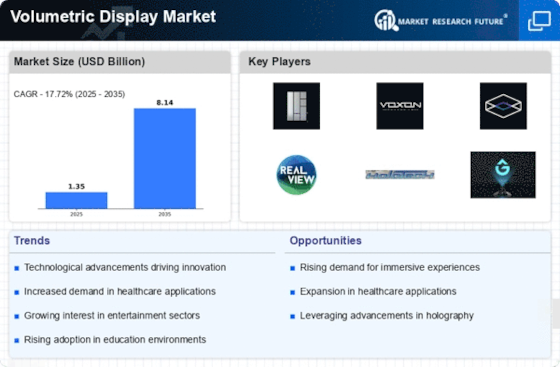
As per Market Research Future analysis, the Volumetric Display Market Size was estimated at 1.354 USD Billion in 2024. The Volumetric Display industry is projected to grow from 1.594 USD Billion in 2025 to 8.145 USD Billion by 2035, exhibiting a compound annual growth rate (CAGR) of 17.72% during the forecast period 2025 - 2035

Key Market Trends & Highlights

The Volumetric Display Market is poised for substantial growth driven by technological advancements and diverse applications.

  • North America remains the largest market for volumetric displays, driven by robust demand across various sectors. The Asia-Pacific region is emerging as the fastest-growing market, fueled by increasing investments in innovative display technologies. Holographic displays dominate the market, while 3D displays are rapidly gaining traction due to their interactive capabilities. Technological advancements in display technology and rising applications in education and training are key drivers propelling market expansion.

Market Size & Forecast

2024 Market Size 1.354 (USD Billion)
2035 Market Size 8.145 (USD Billion)
CAGR (2025 - 2035) 17.72%
Largest Regional Market Share in 2024 North America

Major Players

Light Field Lab (US), Voxon Photonics (AU), Looking Glass Factory (US), RealView Imaging (IL), HoloTech Switzerland (CH), 3D Holographic Displays (US), Zebra Imaging (US), Aerial Technologies (US)

Market Trends

The Volumetric Display Market is currently experiencing a notable evolution, driven by advancements in technology and increasing demand across various sectors. The Volumetric Display This market encompasses a range of display technologies that create three-dimensional images, allowing for a more immersive viewing experience. Industries such as healthcare, entertainment, and education are increasingly adopting volumetric displays for applications like medical imaging, gaming, and interactive learning. The integration of augmented reality and virtual reality with volumetric displays appears to enhance user engagement, suggesting a promising trajectory for future growth. Volumetric displays represent an approach to 3D visualization that allows images to be viewed from multiple angles without the need for special eyewear. Moreover, the Volumetric Display Market is likely to benefit from ongoing research and development efforts aimed at improving display quality and reducing production costs. As manufacturers explore innovative materials and techniques, the potential for wider adoption in consumer electronics and advertising becomes more apparent. The convergence of various technologies, including artificial intelligence and machine learning, may further propel the market forward, creating opportunities for new applications and enhancing existing ones. Overall, the Volumetric Display Market seems poised for significant expansion, driven by technological advancements and evolving consumer preferences.

Technological Advancements

Recent innovations in display technology are reshaping the Volumetric Display Market. Enhanced image resolution and improved rendering techniques are making three-dimensional displays more appealing to consumers and businesses alike. As these technologies evolve, they are likely to facilitate broader applications across diverse sectors.

Increased Adoption in Healthcare

The healthcare sector is increasingly recognizing the value of volumetric displays for medical imaging and surgical planning. These displays provide a more intuitive understanding of complex anatomical structures, potentially improving patient outcomes. This trend suggests a growing integration of volumetric technology in medical practices.

Emergence of Interactive Experiences

There is a noticeable shift towards interactive volumetric displays in entertainment and education. These displays allow users to engage with content in a more dynamic manner, enhancing learning and entertainment experiences. This trend indicates a potential for growth in markets focused on immersive technologies.

Volumetric Display Market Market Drivers

Growth in Advertising and Marketing

The Volumetric Display Market is experiencing growth due to its applications in advertising and marketing. Brands are increasingly utilizing volumetric displays to create eye-catching advertisements that stand out in crowded marketplaces. These displays allow for dynamic and interactive content that can engage consumers more effectively than traditional advertising methods. As companies seek to differentiate themselves, the use of volumetric displays in retail environments is expected to rise. Market analysts predict that the advertising sector could represent a substantial portion of the volumetric display market, with an anticipated growth rate of around 20% over the next few years, highlighting the potential for innovative marketing strategies.

Increased Demand in Education and Training

The Volumetric Display Market is witnessing heightened demand in educational and training environments. Institutions are increasingly adopting volumetric displays to create interactive learning experiences that enhance student engagement and comprehension. For instance, medical schools utilize these displays for anatomy visualization, allowing students to interact with 3D models of human organs. This trend is supported by a growing recognition of the effectiveness of immersive learning tools, which can lead to improved retention rates. The market for educational volumetric displays is expected to expand significantly, with projections indicating a potential increase in adoption rates by over 30% in the coming years, thereby solidifying the role of volumetric displays in modern education.

Advancements in Medical Imaging Technologies

The Volumetric Display Market is significantly influenced by advancements in medical imaging technologies. As healthcare providers seek to improve diagnostic accuracy and patient outcomes, volumetric displays are being integrated into medical imaging systems. These displays facilitate the visualization of complex data, such as MRI and CT scans, in three dimensions, allowing for better interpretation by medical professionals. The increasing emphasis on precision medicine and personalized healthcare is likely to drive demand for volumetric displays in clinical settings. Projections indicate that the healthcare sector could account for a considerable share of the volumetric display market, with growth rates potentially exceeding 25% as these technologies become more prevalent in medical practice.

Rising Applications in Entertainment and Gaming

The Volumetric Display Market is increasingly being integrated into the entertainment and gaming sectors. As consumers seek more immersive experiences, volumetric displays offer a unique solution by providing three-dimensional visuals that enhance storytelling and gameplay. The gaming industry, in particular, is projected to see substantial growth, with volumetric displays potentially capturing a significant share of the market. This shift is driven by advancements in graphics technology and consumer demand for innovative gaming experiences. Analysts suggest that the entertainment sector could account for nearly 40% of the volumetric display market by 2030, indicating a robust future for this technology in creating captivating visual narratives.

Technological Advancements in Display Technology

The Volumetric Display Market is experiencing a surge in technological advancements that enhance display capabilities. Innovations such as holography and light field technology are revolutionizing how three-dimensional images are rendered. These advancements allow for more realistic and immersive visual experiences, which are increasingly sought after in various sectors, including entertainment and education. The market is projected to grow at a compound annual growth rate of approximately 25% over the next five years, driven by these technological improvements. As companies invest in research and development, the potential for new applications in fields such as architecture and design becomes apparent, further propelling the Volumetric Display Market.

Market Segment Insights

By Technology: Holographic Display (Largest) vs. 3D Display (Fastest-Growing)

The Volumetric Display Market showcases a distinctive distribution among its technological segments, with Holographic Display emerging as the largest player. Holographic Displays account for a notable percentage of the Volumetric Display market, driven by advancements in rendering technologies that cater to high-end applications. Meanwhile, the 3D Display segment demonstrates significant traction, appealing particularly in gaming and visual simulations. As immersive technologies gain popularity, the demand for 3D Displays is accelerating, leading to a more competitive landscape. Factors propelling growth in the Volumetric Display Market include technological innovations, a surge in augmented and virtual reality applications, and increased investments in research and development. Holographic Displays benefit from their ability to render realistic visuals that enhance user experience across various fields, while 3D Displays are rapidly being adopted in entertainment and education sectors. These trends indicate a promising future for both segments as the Volumetric Display market continues to evolve.

Technology: Holographic Display (Dominant) vs. 3D Display (Emerging)

Holographic Displays represent the dominant technology in the Volumetric Display Market, characterized by their ability to produce three-dimensional images in space without the need for special glasses. They are primarily utilized in sectors requiring high precision and realism, such as medical imaging, aerospace, and advanced simulations. Their market position is supported by ongoing advancements in optics and display technologies, driving demand for engaging user experiences. Meanwhile, 3D Displays, positioned as an emerging technology, are gaining ground, especially in consumer electronics and gaming. These displays provide enhanced depth perception and are continuously being optimized for better performance and accessibility, making them increasingly appealing to a broader audience.

By Application: Medical Imaging (Largest) vs. Educational Visualization (Fastest-Growing)

The Volumetric Display Market is characterized by a diverse application landscape, with Medical Imaging holding the largest share among various segment values. This sector's significant presence is attributable to the need for advanced imaging techniques that enhance diagnostic accuracy and patient care. Following closely, Educational Visualization is emerging as a fast-growing segment, driven by the increasing demand for interactive learning tools that enhance student engagement and experience. In terms of growth trends, the Medical Imaging segment is expected to maintain its dominance due to ongoing technological advancements and the increasing prevalence of chronic diseases requiring innovative imaging solutions. In contrast, the Educational Visualization sector is experiencing rapid growth spurred by institutions adopting immersive technologies for teaching. As virtual reality and augmented reality gain traction, this segment could witness unprecedented growth, affirming its emerging position in the Volumetric Display market.

Medical Imaging (Dominant) vs. Educational Visualization (Emerging)

Medical Imaging is recognized as the dominant segment in the Volumetric Display Market, primarily due to its critical role in modern healthcare. This application leverages volumetric displays to create 3D representations of complex medical data, improving clinicians' abilities to visualize and interpret patient information, leading to better outcomes. Meanwhile, Educational Visualization is categorized as an emerging segment designed to revolutionize how educational content is delivered. By employing immersive and interactive 3D visualizations, this application enhances learning experiences, making complex concepts easier to understand. With educational institutions increasingly turning towards innovative teaching methods, the demand for volumetric displays in this sector is expected to accelerate, highlighting its potential as a significant player in the Volumetric Display market.

By End Use: Commercial (Largest) vs. Healthcare (Fastest-Growing)

In the Volumetric Display Market, the distribution of market share among various end-use segments reveals significant insights. The Commercial segment represents the largest share, driven by applications in advertising, product showcases, and entertainment. Its popularity is attributed to the engaging and interactive experiences volumetric displays offer, making them a preferred choice for enhancing customer engagement and brand visibility. The Industrial segment follows, utilizing volumetric displays for simulations and training, while both Healthcare and Education segments exhibit emerging potential in their respective applications, leveraging immersive visualizations for better understanding and engagement in complex scenarios.

Commercial (Dominant) vs. Healthcare (Emerging)

The Commercial segment stands out as the dominant force in the Volumetric Display Market, primarily due to its robust applications in marketing and advertising. Volumetric displays in this sector enhance product presentations, allowing customers to interactively engage with products. On the other hand, the Healthcare segment is emerging rapidly, driven by the adoption of volumetric displays for surgical planning, patient education, and diagnostic imaging. Healthcare providers are increasingly recognizing the importance of three-dimensional visuals in improving patient outcomes and understanding complex medical data. This juxtaposition of commercial dominance and healthcare's emerging role highlights the diverse applications of volumetric displays across industries.

By Display Size: Large (Largest) vs. Medium (Fastest-Growing)

The Volumetric Display Market features a diverse range of display sizes, with large displays commanding the largest market share due to their ability to deliver a more immersive visual experience and cater to professional applications such as medical imaging and scientific visualization. Medium displays, while smaller, have shown remarkable growth in adoption across various sectors, supported by advancements in technology and increasing demand for versatile display solutions. In terms of growth trends, medium displays are rapidly emerging as the fastest-growing segment, driven by innovations in manufacturing processes and a heightened focus on user-friendly interfaces. The evolution of augmented reality and virtual reality technologies has also fueled interest in volumetric displays, prompting increased investments in R&amp;D. This segment is attracting businesses looking for cost-effective solutions that still offer high-quality visual performance, leading to a promising outlook for medium displays in the coming years.

Display Size: Large (Dominant) vs. Medium (Emerging)

The large display segment is characterized by its commanding presence in the volumetric display market, providing unparalleled visual experiences, particularly in commercial, medical, and entertainment applications. These displays often support high-resolution imagery and allow for intricate detail, making them an essential choice for sectors that prioritize visual fidelity. Meanwhile, medium displays have gained traction as an emerging segment, appealing to businesses that require a balance between size and functionality. The adaptability of medium displays to various environments and their cost-effective nature enable them to cater to a wider audience, from educational institutions to smaller enterprises, fostering growth and innovation within the volumetric display market.

Get more detailed insights about Volumetric Display Market Research Report - Forecast To 2035

Regional Insights

The Volumetric Display Market is projected to witness significant growth across various regions. In 2023, the North America region accounted for a market valuation of 0.5 USD Billion, reflecting its dominant position due to advanced technological infrastructure and a growing demand for innovative display solutions, and it is expected to reach 2.3 USD Billion by 2032. Europe follows with a market valuation of 0.3 USD Billion in 2023, driven by research and development investments, which may increase to 1.8 USD Billion by 2032.

The APAC region, valued at 0.25 USD Billion in 2023, is becoming increasingly important as it embraces digital transformation and is anticipated to achieve a valuation of 0.9 USD Billion by 2032.

Meanwhile, both South America and the MEA regions show smaller but noteworthy valuations of 0.05 USD Billion each in 2023, projected to grow to 0.5 USD Billion by 2032. These regions represent emerging markets for the Volumetric Display Market, presenting opportunities for expansion as demand for advanced visualization technologies increases. The significant growth in North America highlights its majority holding within the Volumetric Display Market segmentation, while APAC's rising profile signals a shift towards greater adoption in developing economies.

Key Players and Competitive Insights

The Volumetric Display Market is characterized by innovation and rapid developments driven by advances in technology and increasing demand for immersive visual experiences across various sectors, including entertainment, healthcare and education. Competitive insights into this market reveal a dynamic landscape where companies strive to differentiate themselves through unique product offerings, proprietary technologies, and strategic collaborations. As volumetric displays gain traction for their ability to render three-dimensional content without the need for special glasses, key players focus on enhancing display quality, optimizing user interaction, and expanding applications to capture a larger share of the Volumetric Display market. The competitive environment is influenced by factors such as technological capabilities, intellectual property, market penetration strategies, and consumer trends that demand high-quality, multi-dimensional visual experiences. Voxon Photonics has established a notable presence in the Volumetric Display Market with its pioneering technology aimed at delivering high-quality 3D images viewed from any angle. The company's strength lies in its unique display solutions that utilize a combination of holographic and volumetric techniques to create immersive experiences. Voxon Photonics is well-regarded for its innovation in volumetric display systems, making strides in areas such as real-time rendering, user interactivity, and compact designs suitable for both commercial and educational applications. Its robust technology has positioned it as a competitive player, enabling industries to leverage volumetric displays for training, simulation, and visual communication, leading to expanded market opportunities and potential partnerships within diverse sectors. VividQ brings a compelling presence in the Volumetric Display Market by focusing on software solutions that support the creation of high-quality volumetric content. The company's strength lies in its advanced algorithms and tools that enhance the rendering process for volumetric displays, allowing for more sophisticated visualizations and experiences. VividQ's technology enables hardware manufacturers to improve the functionality and appeal of their volumetric display products, enhancing the overall value proposition to end-users. Furthermore, the company's commitment to research and development fosters innovation and provides a significant competitive edge, enabling collaboration with device manufacturers and content creators to push the boundaries of how 3D content is generated and experienced. As a result, VividQ has positioned itself as a key player stirring advancements in volumetric displays, ultimately contributing to the market's evolution.

Key Companies in the Volumetric Display Market include

Industry Developments

Recent developments in the Volumetric Display Market have highlighted significant technological advancements and increasing investments. Companies like Voxon Photonics are innovating with new 3D volumetric displays that enhance viewing experiences across industries, including medical imaging and entertainment. VividQ is expanding its software solutions for holographic displays, which has garnered attention from various sectors looking to harness augmented and virtual reality applications. Holoeye Photonics and 3D Holographics are advancing their product lines, focusing on high-resolution displays that cater to educational and professional needs. Ongoing developments in volumetric displays reflect broader advances in display technologies and immersive visualization methods.

Moreover, Display Technologies and Light Field Lab are exploring collaborative projects aimed at enhancing the consumer electronics market. Some key players are also noticing a growth in market valuations, contributing to increased competition and innovation. In terms of mergers and acquisitions, there have been strategic moves among companies in this field, with several partnerships emerging to combine strengths and technologies. For instance, Samsung Electronics has been reportedly aligning with startups focusing on volumetric imaging to enhance its product offerings, while Microsoft continues to invest in volumetric display technology as part of its broader strategy in AR and VR advancements.

Overall, these activities underscore the dynamic nature of the Volumetric Display Market.

Future Outlook

Volumetric Display Market Future Outlook

The Volumetric Display Market is projected to grow at a 17.72% CAGR from 2025 to 2035, driven by advancements in technology, increasing demand for immersive experiences, and applications in various industries.

New opportunities lie in:

  • <p>Development of volumetric display solutions for medical imaging applications. Integration of volumetric displays in virtual reality training environments. Partnerships with automotive manufacturers for advanced driver-assistance systems.</p>

By 2035, the Volumetric Display Market is expected to achieve substantial growth and innovation.

Market Segmentation

Volumetric Display Market End Use Outlook

  • Commercial
  • Industrial
  • Healthcare
  • Education

Volumetric Display Market Technology Outlook

  • Multiview Display
  • Light Field Display
  • Holographic Display
  • 3D Display

Volumetric Display Market Application Outlook

  • Medical Imaging
  • Educational Visualization
  • Entertainment
  • Architectural Visualization
  • Telecommunications

Volumetric Display Market Display Size Outlook

  • Small
  • Medium
  • Large

Report Scope

MARKET SIZE 2024 1.354(USD Billion)
MARKET SIZE 2025 1.594(USD Billion)
MARKET SIZE 2035 8.145(USD Billion)
COMPOUND ANNUAL GROWTH RATE (CAGR) 17.72% (2025 - 2035)
REPORT COVERAGE Revenue Forecast, Competitive Landscape, Growth Factors, and Trends
BASE YEAR 2024
Market Forecast Period 2025 - 2035
Historical Data 2019 - 2024
Market Forecast Units USD Billion
Key Companies Profiled Light Field Lab (US), Voxon Photonics (AU), Looking Glass Factory (US), RealView Imaging (IL), HoloTech Switzerland (CH), 3D Holographic Displays (US), Zebra Imaging (US), Aerial Technologies (US)
Segments Covered Technology, Application, End Use, Display Size, Regional
Key Market Opportunities Integration of artificial intelligence enhances interactivity in the Volumetric Display Market.
Key Market Dynamics Technological advancements drive innovation in volumetric displays, enhancing applications across various industries and consumer sectors.
Countries Covered North America, Europe, APAC, South America, MEA

FAQs

What is the projected market valuation of the Volumetric Display Market by 2035?

<p>The Volumetric Display Market is projected to reach a valuation of 8.145 USD Billion by 2035.</p>

What was the market valuation of the Volumetric Display Market in 2024?

<p>In 2024, the Volumetric Display Market had a valuation of 1.354 USD Billion.</p>

What is the expected CAGR for the Volumetric Display Market during the forecast period 2025 - 2035?

<p>The expected CAGR for the Volumetric Display Market during the forecast period 2025 - 2035 is 17.72%.</p>

Which technology segment is anticipated to have the highest growth in the Volumetric Display Market?

<p>The Holographic Display segment is anticipated to grow from 0.4 USD Billion in 2024 to 2.0 USD Billion by 2035.</p>

What applications are driving growth in the Volumetric Display Market?

<p>Key applications driving growth include Entertainment, which is expected to rise from 0.4 USD Billion in 2024 to 2.5 USD Billion by 2035.</p>

Who are the key players in the Volumetric Display Market?

<p>Key players in the Volumetric Display Market include Light Field Lab, Voxon Photonics, and Looking Glass Factory.</p>

What is the projected growth for the Medical Imaging application in the Volumetric Display Market?

<p>The Medical Imaging application is projected to grow from 0.3 USD Billion in 2024 to 1.8 USD Billion by 2035.</p>

How does the display size segment impact the Volumetric Display Market?

<p>The Medium display size segment is expected to grow from 0.542 USD Billion in 2024 to 3.234 USD Billion by 2035.</p>

What end-use sectors are contributing to the Volumetric Display Market's growth?

<p>The Commercial end-use sector is projected to expand from 0.5 USD Billion in 2024 to 2.5 USD Billion by 2035.</p>

What trends are influencing the Volumetric Display Market in 2025?

<p>In 2025, trends such as advancements in holographic technology and increased demand in healthcare and education are influencing the Volumetric Display Market.</p>

  1. SECTION I: EXECUTIVE SUMMARY AND KEY HIGHLIGHTS
    1. | 1.1 EXECUTIVE SUMMARY
    2. | | 1.1.1 Market Overview
    3. | | 1.1.2 Key Findings
    4. | | 1.1.3 Market Segmentation
    5. | | 1.1.4 Competitive Landscape
    6. | | 1.1.5 Challenges and Opportunities
    7. | | 1.1.6 Future Outlook
  2. SECTION II: SCOPING, METHODOLOGY AND MARKET STRUCTURE
    1. | 2.1 MARKET INTRODUCTION
    2. | | 2.1.1 Definition
    3. | | 2.1.2 Scope of the study
    4. | | | 2.1.2.1 Research Objective
    5. | | | 2.1.2.2 Assumption
    6. | | | 2.1.2.3 Limitations
    7. | 2.2 RESEARCH METHODOLOGY
    8. | | 2.2.1 Overview
    9. | | 2.2.2 Data Mining
    10. | | 2.2.3 Secondary Research
    11. | | 2.2.4 Primary Research
    12. | | | 2.2.4.1 Primary Interviews and Information Gathering Process
    13. | | | 2.2.4.2 Breakdown of Primary Respondents
    14. | | 2.2.5 Forecasting Model
    15. | | 2.2.6 Market Size Estimation
    16. | | | 2.2.6.1 Bottom-Up Approach
    17. | | | 2.2.6.2 Top-Down Approach
    18. | | 2.2.7 Data Triangulation
    19. | | 2.2.8 Validation
  3. SECTION III: QUALITATIVE ANALYSIS
    1. | 3.1 MARKET DYNAMICS
    2. | | 3.1.1 Overview
    3. | | 3.1.2 Drivers
    4. | | 3.1.3 Restraints
    5. | | 3.1.4 Opportunities
    6. | 3.2 MARKET FACTOR ANALYSIS
    7. | | 3.2.1 Value chain Analysis
    8. | | 3.2.2 Porter's Five Forces Analysis
    9. | | | 3.2.2.1 Bargaining Power of Suppliers
    10. | | | 3.2.2.2 Bargaining Power of Buyers
    11. | | | 3.2.2.3 Threat of New Entrants
    12. | | | 3.2.2.4 Threat of Substitutes
    13. | | | 3.2.2.5 Intensity of Rivalry
    14. | | 3.2.3 COVID-19 Impact Analysis
    15. | | | 3.2.3.1 Market Impact Analysis
    16. | | | 3.2.3.2 Regional Impact
    17. | | | 3.2.3.3 Opportunity and Threat Analysis
  4. SECTION IV: QUANTITATIVE ANALYSIS
    1. | 4.1 Semiconductor & Electronics, BY Technology (USD Billion)
    2. | | 4.1.1 Multiview Display
    3. | | 4.1.2 Light Field Display
    4. | | 4.1.3 Holographic Display
    5. | | 4.1.4 3D Display
    6. | 4.2 Semiconductor & Electronics, BY Application (USD Billion)
    7. | | 4.2.1 Medical Imaging
    8. | | 4.2.2 Educational Visualization
    9. | | 4.2.3 Entertainment
    10. | | 4.2.4 Architectural Visualization
    11. | | 4.2.5 Telecommunications
    12. | 4.3 Semiconductor & Electronics, BY End Use (USD Billion)
    13. | | 4.3.1 Commercial
    14. | | 4.3.2 Industrial
    15. | | 4.3.3 Healthcare
    16. | | 4.3.4 Education
    17. | 4.4 Semiconductor & Electronics, BY Display Size (USD Billion)
    18. | | 4.4.1 Small
    19. | | 4.4.2 Medium
    20. | | 4.4.3 Large
    21. | 4.5 Semiconductor & Electronics, BY Region (USD Billion)
    22. | | 4.5.1 North America
    23. | | | 4.5.1.1 US
    24. | | | 4.5.1.2 Canada
    25. | | 4.5.2 Europe
    26. | | | 4.5.2.1 Germany
    27. | | | 4.5.2.2 UK
    28. | | | 4.5.2.3 France
    29. | | | 4.5.2.4 Russia
    30. | | | 4.5.2.5 Italy
    31. | | | 4.5.2.6 Spain
    32. | | | 4.5.2.7 Rest of Europe
    33. | | 4.5.3 APAC
    34. | | | 4.5.3.1 China
    35. | | | 4.5.3.2 India
    36. | | | 4.5.3.3 Japan
    37. | | | 4.5.3.4 South Korea
    38. | | | 4.5.3.5 Malaysia
    39. | | | 4.5.3.6 Thailand
    40. | | | 4.5.3.7 Indonesia
    41. | | | 4.5.3.8 Rest of APAC
    42. | | 4.5.4 South America
    43. | | | 4.5.4.1 Brazil
    44. | | | 4.5.4.2 Mexico
    45. | | | 4.5.4.3 Argentina
    46. | | | 4.5.4.4 Rest of South America
    47. | | 4.5.5 MEA
    48. | | | 4.5.5.1 GCC Countries
    49. | | | 4.5.5.2 South Africa
    50. | | | 4.5.5.3 Rest of MEA
  5. SECTION V: COMPETITIVE ANALYSIS
    1. | 5.1 Competitive Landscape
    2. | | 5.1.1 Overview
    3. | | 5.1.2 Competitive Analysis
    4. | | 5.1.3 Market share Analysis
    5. | | 5.1.4 Major Growth Strategy in the Semiconductor & Electronics
    6. | | 5.1.5 Competitive Benchmarking
    7. | | 5.1.6 Leading Players in Terms of Number of Developments in the Semiconductor & Electronics
    8. | | 5.1.7 Key developments and growth strategies
    9. | | | 5.1.7.1 New Product Launch/Service Deployment
    10. | | | 5.1.7.2 Merger & Acquisitions
    11. | | | 5.1.7.3 Joint Ventures
    12. | | 5.1.8 Major Players Financial Matrix
    13. | | | 5.1.8.1 Sales and Operating Income
    14. | | | 5.1.8.2 Major Players R&D Expenditure. 2023
    15. | 5.2 Company Profiles
    16. | | 5.2.1 Light Field Lab (US)
    17. | | | 5.2.1.1 Financial Overview
    18. | | | 5.2.1.2 Products Offered
    19. | | | 5.2.1.3 Key Developments
    20. | | | 5.2.1.4 SWOT Analysis
    21. | | | 5.2.1.5 Key Strategies
    22. | | 5.2.2 Voxon Photonics (AU)
    23. | | | 5.2.2.1 Financial Overview
    24. | | | 5.2.2.2 Products Offered
    25. | | | 5.2.2.3 Key Developments
    26. | | | 5.2.2.4 SWOT Analysis
    27. | | | 5.2.2.5 Key Strategies
    28. | | 5.2.3 Looking Glass Factory (US)
    29. | | | 5.2.3.1 Financial Overview
    30. | | | 5.2.3.2 Products Offered
    31. | | | 5.2.3.3 Key Developments
    32. | | | 5.2.3.4 SWOT Analysis
    33. | | | 5.2.3.5 Key Strategies
    34. | | 5.2.4 RealView Imaging (IL)
    35. | | | 5.2.4.1 Financial Overview
    36. | | | 5.2.4.2 Products Offered
    37. | | | 5.2.4.3 Key Developments
    38. | | | 5.2.4.4 SWOT Analysis
    39. | | | 5.2.4.5 Key Strategies
    40. | | 5.2.5 HoloTech Switzerland (CH)
    41. | | | 5.2.5.1 Financial Overview
    42. | | | 5.2.5.2 Products Offered
    43. | | | 5.2.5.3 Key Developments
    44. | | | 5.2.5.4 SWOT Analysis
    45. | | | 5.2.5.5 Key Strategies
    46. | | 5.2.6 3D Holographic Displays (US)
    47. | | | 5.2.6.1 Financial Overview
    48. | | | 5.2.6.2 Products Offered
    49. | | | 5.2.6.3 Key Developments
    50. | | | 5.2.6.4 SWOT Analysis
    51. | | | 5.2.6.5 Key Strategies
    52. | | 5.2.7 Zebra Imaging (US)
    53. | | | 5.2.7.1 Financial Overview
    54. | | | 5.2.7.2 Products Offered
    55. | | | 5.2.7.3 Key Developments
    56. | | | 5.2.7.4 SWOT Analysis
    57. | | | 5.2.7.5 Key Strategies
    58. | | 5.2.8 Aerial Technologies (US)
    59. | | | 5.2.8.1 Financial Overview
    60. | | | 5.2.8.2 Products Offered
    61. | | | 5.2.8.3 Key Developments
    62. | | | 5.2.8.4 SWOT Analysis
    63. | | | 5.2.8.5 Key Strategies
    64. | 5.3 Appendix
    65. | | 5.3.1 References
    66. | | 5.3.2 Related Reports
  6. LIST OF FIGURES
    1. | 6.1 MARKET SYNOPSIS
    2. | 6.2 NORTH AMERICA MARKET ANALYSIS
    3. | 6.3 US MARKET ANALYSIS BY TECHNOLOGY
    4. | 6.4 US MARKET ANALYSIS BY APPLICATION
    5. | 6.5 US MARKET ANALYSIS BY END USE
    6. | 6.6 US MARKET ANALYSIS BY DISPLAY SIZE
    7. | 6.7 CANADA MARKET ANALYSIS BY TECHNOLOGY
    8. | 6.8 CANADA MARKET ANALYSIS BY APPLICATION
    9. | 6.9 CANADA MARKET ANALYSIS BY END USE
    10. | 6.10 CANADA MARKET ANALYSIS BY DISPLAY SIZE
    11. | 6.11 EUROPE MARKET ANALYSIS
    12. | 6.12 GERMANY MARKET ANALYSIS BY TECHNOLOGY
    13. | 6.13 GERMANY MARKET ANALYSIS BY APPLICATION
    14. | 6.14 GERMANY MARKET ANALYSIS BY END USE
    15. | 6.15 GERMANY MARKET ANALYSIS BY DISPLAY SIZE
    16. | 6.16 UK MARKET ANALYSIS BY TECHNOLOGY
    17. | 6.17 UK MARKET ANALYSIS BY APPLICATION
    18. | 6.18 UK MARKET ANALYSIS BY END USE
    19. | 6.19 UK MARKET ANALYSIS BY DISPLAY SIZE
    20. | 6.20 FRANCE MARKET ANALYSIS BY TECHNOLOGY
    21. | 6.21 FRANCE MARKET ANALYSIS BY APPLICATION
    22. | 6.22 FRANCE MARKET ANALYSIS BY END USE
    23. | 6.23 FRANCE MARKET ANALYSIS BY DISPLAY SIZE
    24. | 6.24 RUSSIA MARKET ANALYSIS BY TECHNOLOGY
    25. | 6.25 RUSSIA MARKET ANALYSIS BY APPLICATION
    26. | 6.26 RUSSIA MARKET ANALYSIS BY END USE
    27. | 6.27 RUSSIA MARKET ANALYSIS BY DISPLAY SIZE
    28. | 6.28 ITALY MARKET ANALYSIS BY TECHNOLOGY
    29. | 6.29 ITALY MARKET ANALYSIS BY APPLICATION
    30. | 6.30 ITALY MARKET ANALYSIS BY END USE
    31. | 6.31 ITALY MARKET ANALYSIS BY DISPLAY SIZE
    32. | 6.32 SPAIN MARKET ANALYSIS BY TECHNOLOGY
    33. | 6.33 SPAIN MARKET ANALYSIS BY APPLICATION
    34. | 6.34 SPAIN MARKET ANALYSIS BY END USE
    35. | 6.35 SPAIN MARKET ANALYSIS BY DISPLAY SIZE
    36. | 6.36 REST OF EUROPE MARKET ANALYSIS BY TECHNOLOGY
    37. | 6.37 REST OF EUROPE MARKET ANALYSIS BY APPLICATION
    38. | 6.38 REST OF EUROPE MARKET ANALYSIS BY END USE
    39. | 6.39 REST OF EUROPE MARKET ANALYSIS BY DISPLAY SIZE
    40. | 6.40 APAC MARKET ANALYSIS
    41. | 6.41 CHINA MARKET ANALYSIS BY TECHNOLOGY
    42. | 6.42 CHINA MARKET ANALYSIS BY APPLICATION
    43. | 6.43 CHINA MARKET ANALYSIS BY END USE
    44. | 6.44 CHINA MARKET ANALYSIS BY DISPLAY SIZE
    45. | 6.45 INDIA MARKET ANALYSIS BY TECHNOLOGY
    46. | 6.46 INDIA MARKET ANALYSIS BY APPLICATION
    47. | 6.47 INDIA MARKET ANALYSIS BY END USE
    48. | 6.48 INDIA MARKET ANALYSIS BY DISPLAY SIZE
    49. | 6.49 JAPAN MARKET ANALYSIS BY TECHNOLOGY
    50. | 6.50 JAPAN MARKET ANALYSIS BY APPLICATION
    51. | 6.51 JAPAN MARKET ANALYSIS BY END USE
    52. | 6.52 JAPAN MARKET ANALYSIS BY DISPLAY SIZE
    53. | 6.53 SOUTH KOREA MARKET ANALYSIS BY TECHNOLOGY
    54. | 6.54 SOUTH KOREA MARKET ANALYSIS BY APPLICATION
    55. | 6.55 SOUTH KOREA MARKET ANALYSIS BY END USE
    56. | 6.56 SOUTH KOREA MARKET ANALYSIS BY DISPLAY SIZE
    57. | 6.57 MALAYSIA MARKET ANALYSIS BY TECHNOLOGY
    58. | 6.58 MALAYSIA MARKET ANALYSIS BY APPLICATION
    59. | 6.59 MALAYSIA MARKET ANALYSIS BY END USE
    60. | 6.60 MALAYSIA MARKET ANALYSIS BY DISPLAY SIZE
    61. | 6.61 THAILAND MARKET ANALYSIS BY TECHNOLOGY
    62. | 6.62 THAILAND MARKET ANALYSIS BY APPLICATION
    63. | 6.63 THAILAND MARKET ANALYSIS BY END USE
    64. | 6.64 THAILAND MARKET ANALYSIS BY DISPLAY SIZE
    65. | 6.65 INDONESIA MARKET ANALYSIS BY TECHNOLOGY
    66. | 6.66 INDONESIA MARKET ANALYSIS BY APPLICATION
    67. | 6.67 INDONESIA MARKET ANALYSIS BY END USE
    68. | 6.68 INDONESIA MARKET ANALYSIS BY DISPLAY SIZE
    69. | 6.69 REST OF APAC MARKET ANALYSIS BY TECHNOLOGY
    70. | 6.70 REST OF APAC MARKET ANALYSIS BY APPLICATION
    71. | 6.71 REST OF APAC MARKET ANALYSIS BY END USE
    72. | 6.72 REST OF APAC MARKET ANALYSIS BY DISPLAY SIZE
    73. | 6.73 SOUTH AMERICA MARKET ANALYSIS
    74. | 6.74 BRAZIL MARKET ANALYSIS BY TECHNOLOGY
    75. | 6.75 BRAZIL MARKET ANALYSIS BY APPLICATION
    76. | 6.76 BRAZIL MARKET ANALYSIS BY END USE
    77. | 6.77 BRAZIL MARKET ANALYSIS BY DISPLAY SIZE
    78. | 6.78 MEXICO MARKET ANALYSIS BY TECHNOLOGY
    79. | 6.79 MEXICO MARKET ANALYSIS BY APPLICATION
    80. | 6.80 MEXICO MARKET ANALYSIS BY END USE
    81. | 6.81 MEXICO MARKET ANALYSIS BY DISPLAY SIZE
    82. | 6.82 ARGENTINA MARKET ANALYSIS BY TECHNOLOGY
    83. | 6.83 ARGENTINA MARKET ANALYSIS BY APPLICATION
    84. | 6.84 ARGENTINA MARKET ANALYSIS BY END USE
    85. | 6.85 ARGENTINA MARKET ANALYSIS BY DISPLAY SIZE
    86. | 6.86 REST OF SOUTH AMERICA MARKET ANALYSIS BY TECHNOLOGY
    87. | 6.87 REST OF SOUTH AMERICA MARKET ANALYSIS BY APPLICATION
    88. | 6.88 REST OF SOUTH AMERICA MARKET ANALYSIS BY END USE
    89. | 6.89 REST OF SOUTH AMERICA MARKET ANALYSIS BY DISPLAY SIZE
    90. | 6.90 MEA MARKET ANALYSIS
    91. | 6.91 GCC COUNTRIES MARKET ANALYSIS BY TECHNOLOGY
    92. | 6.92 GCC COUNTRIES MARKET ANALYSIS BY APPLICATION
    93. | 6.93 GCC COUNTRIES MARKET ANALYSIS BY END USE
    94. | 6.94 GCC COUNTRIES MARKET ANALYSIS BY DISPLAY SIZE
    95. | 6.95 SOUTH AFRICA MARKET ANALYSIS BY TECHNOLOGY
    96. | 6.96 SOUTH AFRICA MARKET ANALYSIS BY APPLICATION
    97. | 6.97 SOUTH AFRICA MARKET ANALYSIS BY END USE
    98. | 6.98 SOUTH AFRICA MARKET ANALYSIS BY DISPLAY SIZE
    99. | 6.99 REST OF MEA MARKET ANALYSIS BY TECHNOLOGY
    100. | 6.100 REST OF MEA MARKET ANALYSIS BY APPLICATION
    101. | 6.101 REST OF MEA MARKET ANALYSIS BY END USE
    102. | 6.102 REST OF MEA MARKET ANALYSIS BY DISPLAY SIZE
    103. | 6.103 KEY BUYING CRITERIA OF SEMICONDUCTOR & ELECTRONICS
    104. | 6.104 RESEARCH PROCESS OF MRFR
    105. | 6.105 DRO ANALYSIS OF SEMICONDUCTOR & ELECTRONICS
    106. | 6.106 DRIVERS IMPACT ANALYSIS: SEMICONDUCTOR & ELECTRONICS
    107. | 6.107 RESTRAINTS IMPACT ANALYSIS: SEMICONDUCTOR & ELECTRONICS
    108. | 6.108 SUPPLY / VALUE CHAIN: SEMICONDUCTOR & ELECTRONICS
    109. | 6.109 SEMICONDUCTOR & ELECTRONICS, BY TECHNOLOGY, 2024 (% SHARE)
    110. | 6.110 SEMICONDUCTOR & ELECTRONICS, BY TECHNOLOGY, 2024 TO 2035 (USD Billion)
    111. | 6.111 SEMICONDUCTOR & ELECTRONICS, BY APPLICATION, 2024 (% SHARE)
    112. | 6.112 SEMICONDUCTOR & ELECTRONICS, BY APPLICATION, 2024 TO 2035 (USD Billion)
    113. | 6.113 SEMICONDUCTOR & ELECTRONICS, BY END USE, 2024 (% SHARE)
    114. | 6.114 SEMICONDUCTOR & ELECTRONICS, BY END USE, 2024 TO 2035 (USD Billion)
    115. | 6.115 SEMICONDUCTOR & ELECTRONICS, BY DISPLAY SIZE, 2024 (% SHARE)
    116. | 6.116 SEMICONDUCTOR & ELECTRONICS, BY DISPLAY SIZE, 2024 TO 2035 (USD Billion)
    117. | 6.117 BENCHMARKING OF MAJOR COMPETITORS
  7. LIST OF TABLES
    1. | 7.1 LIST OF ASSUMPTIONS
    2. | | 7.1.1
    3. | 7.2 North America MARKET SIZE ESTIMATES; FORECAST
    4. | | 7.2.1 BY TECHNOLOGY, 2025-2035 (USD Billion)
    5. | | 7.2.2 BY APPLICATION, 2025-2035 (USD Billion)
    6. | | 7.2.3 BY END USE, 2025-2035 (USD Billion)
    7. | | 7.2.4 BY DISPLAY SIZE, 2025-2035 (USD Billion)
    8. | 7.3 US MARKET SIZE ESTIMATES; FORECAST
    9. | | 7.3.1 BY TECHNOLOGY, 2025-2035 (USD Billion)
    10. | | 7.3.2 BY APPLICATION, 2025-2035 (USD Billion)
    11. | | 7.3.3 BY END USE, 2025-2035 (USD Billion)
    12. | | 7.3.4 BY DISPLAY SIZE, 2025-2035 (USD Billion)
    13. | 7.4 Canada MARKET SIZE ESTIMATES; FORECAST
    14. | | 7.4.1 BY TECHNOLOGY, 2025-2035 (USD Billion)
    15. | | 7.4.2 BY APPLICATION, 2025-2035 (USD Billion)
    16. | | 7.4.3 BY END USE, 2025-2035 (USD Billion)
    17. | | 7.4.4 BY DISPLAY SIZE, 2025-2035 (USD Billion)
    18. | 7.5 Europe MARKET SIZE ESTIMATES; FORECAST
    19. | | 7.5.1 BY TECHNOLOGY, 2025-2035 (USD Billion)
    20. | | 7.5.2 BY APPLICATION, 2025-2035 (USD Billion)
    21. | | 7.5.3 BY END USE, 2025-2035 (USD Billion)
    22. | | 7.5.4 BY DISPLAY SIZE, 2025-2035 (USD Billion)
    23. | 7.6 Germany MARKET SIZE ESTIMATES; FORECAST
    24. | | 7.6.1 BY TECHNOLOGY, 2025-2035 (USD Billion)
    25. | | 7.6.2 BY APPLICATION, 2025-2035 (USD Billion)
    26. | | 7.6.3 BY END USE, 2025-2035 (USD Billion)
    27. | | 7.6.4 BY DISPLAY SIZE, 2025-2035 (USD Billion)
    28. | 7.7 UK MARKET SIZE ESTIMATES; FORECAST
    29. | | 7.7.1 BY TECHNOLOGY, 2025-2035 (USD Billion)
    30. | | 7.7.2 BY APPLICATION, 2025-2035 (USD Billion)
    31. | | 7.7.3 BY END USE, 2025-2035 (USD Billion)
    32. | | 7.7.4 BY DISPLAY SIZE, 2025-2035 (USD Billion)
    33. | 7.8 France MARKET SIZE ESTIMATES; FORECAST
    34. | | 7.8.1 BY TECHNOLOGY, 2025-2035 (USD Billion)
    35. | | 7.8.2 BY APPLICATION, 2025-2035 (USD Billion)
    36. | | 7.8.3 BY END USE, 2025-2035 (USD Billion)
    37. | | 7.8.4 BY DISPLAY SIZE, 2025-2035 (USD Billion)
    38. | 7.9 Russia MARKET SIZE ESTIMATES; FORECAST
    39. | | 7.9.1 BY TECHNOLOGY, 2025-2035 (USD Billion)
    40. | | 7.9.2 BY APPLICATION, 2025-2035 (USD Billion)
    41. | | 7.9.3 BY END USE, 2025-2035 (USD Billion)
    42. | | 7.9.4 BY DISPLAY SIZE, 2025-2035 (USD Billion)
    43. | 7.10 Italy MARKET SIZE ESTIMATES; FORECAST
    44. | | 7.10.1 BY TECHNOLOGY, 2025-2035 (USD Billion)
    45. | | 7.10.2 BY APPLICATION, 2025-2035 (USD Billion)
    46. | | 7.10.3 BY END USE, 2025-2035 (USD Billion)
    47. | | 7.10.4 BY DISPLAY SIZE, 2025-2035 (USD Billion)
    48. | 7.11 Spain MARKET SIZE ESTIMATES; FORECAST
    49. | | 7.11.1 BY TECHNOLOGY, 2025-2035 (USD Billion)
    50. | | 7.11.2 BY APPLICATION, 2025-2035 (USD Billion)
    51. | | 7.11.3 BY END USE, 2025-2035 (USD Billion)
    52. | | 7.11.4 BY DISPLAY SIZE, 2025-2035 (USD Billion)
    53. | 7.12 Rest of Europe MARKET SIZE ESTIMATES; FORECAST
    54. | | 7.12.1 BY TECHNOLOGY, 2025-2035 (USD Billion)
    55. | | 7.12.2 BY APPLICATION, 2025-2035 (USD Billion)
    56. | | 7.12.3 BY END USE, 2025-2035 (USD Billion)
    57. | | 7.12.4 BY DISPLAY SIZE, 2025-2035 (USD Billion)
    58. | 7.13 APAC MARKET SIZE ESTIMATES; FORECAST
    59. | | 7.13.1 BY TECHNOLOGY, 2025-2035 (USD Billion)
    60. | | 7.13.2 BY APPLICATION, 2025-2035 (USD Billion)
    61. | | 7.13.3 BY END USE, 2025-2035 (USD Billion)
    62. | | 7.13.4 BY DISPLAY SIZE, 2025-2035 (USD Billion)
    63. | 7.14 China MARKET SIZE ESTIMATES; FORECAST
    64. | | 7.14.1 BY TECHNOLOGY, 2025-2035 (USD Billion)
    65. | | 7.14.2 BY APPLICATION, 2025-2035 (USD Billion)
    66. | | 7.14.3 BY END USE, 2025-2035 (USD Billion)
    67. | | 7.14.4 BY DISPLAY SIZE, 2025-2035 (USD Billion)
    68. | 7.15 India MARKET SIZE ESTIMATES; FORECAST
    69. | | 7.15.1 BY TECHNOLOGY, 2025-2035 (USD Billion)
    70. | | 7.15.2 BY APPLICATION, 2025-2035 (USD Billion)
    71. | | 7.15.3 BY END USE, 2025-2035 (USD Billion)
    72. | | 7.15.4 BY DISPLAY SIZE, 2025-2035 (USD Billion)
    73. | 7.16 Japan MARKET SIZE ESTIMATES; FORECAST
    74. | | 7.16.1 BY TECHNOLOGY, 2025-2035 (USD Billion)
    75. | | 7.16.2 BY APPLICATION, 2025-2035 (USD Billion)
    76. | | 7.16.3 BY END USE, 2025-2035 (USD Billion)
    77. | | 7.16.4 BY DISPLAY SIZE, 2025-2035 (USD Billion)
    78. | 7.17 South Korea MARKET SIZE ESTIMATES; FORECAST
    79. | | 7.17.1 BY TECHNOLOGY, 2025-2035 (USD Billion)
    80. | | 7.17.2 BY APPLICATION, 2025-2035 (USD Billion)
    81. | | 7.17.3 BY END USE, 2025-2035 (USD Billion)
    82. | | 7.17.4 BY DISPLAY SIZE, 2025-2035 (USD Billion)
    83. | 7.18 Malaysia MARKET SIZE ESTIMATES; FORECAST
    84. | | 7.18.1 BY TECHNOLOGY, 2025-2035 (USD Billion)
    85. | | 7.18.2 BY APPLICATION, 2025-2035 (USD Billion)
    86. | | 7.18.3 BY END USE, 2025-2035 (USD Billion)
    87. | | 7.18.4 BY DISPLAY SIZE, 2025-2035 (USD Billion)
    88. | 7.19 Thailand MARKET SIZE ESTIMATES; FORECAST
    89. | | 7.19.1 BY TECHNOLOGY, 2025-2035 (USD Billion)
    90. | | 7.19.2 BY APPLICATION, 2025-2035 (USD Billion)
    91. | | 7.19.3 BY END USE, 2025-2035 (USD Billion)
    92. | | 7.19.4 BY DISPLAY SIZE, 2025-2035 (USD Billion)
    93. | 7.20 Indonesia MARKET SIZE ESTIMATES; FORECAST
    94. | | 7.20.1 BY TECHNOLOGY, 2025-2035 (USD Billion)
    95. | | 7.20.2 BY APPLICATION, 2025-2035 (USD Billion)
    96. | | 7.20.3 BY END USE, 2025-2035 (USD Billion)
    97. | | 7.20.4 BY DISPLAY SIZE, 2025-2035 (USD Billion)
    98. | 7.21 Rest of APAC MARKET SIZE ESTIMATES; FORECAST
    99. | | 7.21.1 BY TECHNOLOGY, 2025-2035 (USD Billion)
    100. | | 7.21.2 BY APPLICATION, 2025-2035 (USD Billion)
    101. | | 7.21.3 BY END USE, 2025-2035 (USD Billion)
    102. | | 7.21.4 BY DISPLAY SIZE, 2025-2035 (USD Billion)
    103. | 7.22 South America MARKET SIZE ESTIMATES; FORECAST
    104. | | 7.22.1 BY TECHNOLOGY, 2025-2035 (USD Billion)
    105. | | 7.22.2 BY APPLICATION, 2025-2035 (USD Billion)
    106. | | 7.22.3 BY END USE, 2025-2035 (USD Billion)
    107. | | 7.22.4 BY DISPLAY SIZE, 2025-2035 (USD Billion)
    108. | 7.23 Brazil MARKET SIZE ESTIMATES; FORECAST
    109. | | 7.23.1 BY TECHNOLOGY, 2025-2035 (USD Billion)
    110. | | 7.23.2 BY APPLICATION, 2025-2035 (USD Billion)
    111. | | 7.23.3 BY END USE, 2025-2035 (USD Billion)
    112. | | 7.23.4 BY DISPLAY SIZE, 2025-2035 (USD Billion)
    113. | 7.24 Mexico MARKET SIZE ESTIMATES; FORECAST
    114. | | 7.24.1 BY TECHNOLOGY, 2025-2035 (USD Billion)
    115. | | 7.24.2 BY APPLICATION, 2025-2035 (USD Billion)
    116. | | 7.24.3 BY END USE, 2025-2035 (USD Billion)
    117. | | 7.24.4 BY DISPLAY SIZE, 2025-2035 (USD Billion)
    118. | 7.25 Argentina MARKET SIZE ESTIMATES; FORECAST
    119. | | 7.25.1 BY TECHNOLOGY, 2025-2035 (USD Billion)
    120. | | 7.25.2 BY APPLICATION, 2025-2035 (USD Billion)
    121. | | 7.25.3 BY END USE, 2025-2035 (USD Billion)
    122. | | 7.25.4 BY DISPLAY SIZE, 2025-2035 (USD Billion)
    123. | 7.26 Rest of South America MARKET SIZE ESTIMATES; FORECAST
    124. | | 7.26.1 BY TECHNOLOGY, 2025-2035 (USD Billion)
    125. | | 7.26.2 BY APPLICATION, 2025-2035 (USD Billion)
    126. | | 7.26.3 BY END USE, 2025-2035 (USD Billion)
    127. | | 7.26.4 BY DISPLAY SIZE, 2025-2035 (USD Billion)
    128. | 7.27 MEA MARKET SIZE ESTIMATES; FORECAST
    129. | | 7.27.1 BY TECHNOLOGY, 2025-2035 (USD Billion)
    130. | | 7.27.2 BY APPLICATION, 2025-2035 (USD Billion)
    131. | | 7.27.3 BY END USE, 2025-2035 (USD Billion)
    132. | | 7.27.4 BY DISPLAY SIZE, 2025-2035 (USD Billion)
    133. | 7.28 GCC Countries MARKET SIZE ESTIMATES; FORECAST
    134. | | 7.28.1 BY TECHNOLOGY, 2025-2035 (USD Billion)
    135. | | 7.28.2 BY APPLICATION, 2025-2035 (USD Billion)
    136. | | 7.28.3 BY END USE, 2025-2035 (USD Billion)
    137. | | 7.28.4 BY DISPLAY SIZE, 2025-2035 (USD Billion)
    138. | 7.29 South Africa MARKET SIZE ESTIMATES; FORECAST
    139. | | 7.29.1 BY TECHNOLOGY, 2025-2035 (USD Billion)
    140. | | 7.29.2 BY APPLICATION, 2025-2035 (USD Billion)
    141. | | 7.29.3 BY END USE, 2025-2035 (USD Billion)
    142. | | 7.29.4 BY DISPLAY SIZE, 2025-2035 (USD Billion)
    143. | 7.30 Rest of MEA MARKET SIZE ESTIMATES; FORECAST
    144. | | 7.30.1 BY TECHNOLOGY, 2025-2035 (USD Billion)
    145. | | 7.30.2 BY APPLICATION, 2025-2035 (USD Billion)
    146. | | 7.30.3 BY END USE, 2025-2035 (USD Billion)
    147. | | 7.30.4 BY DISPLAY SIZE, 2025-2035 (USD Billion)
    148. | 7.31 PRODUCT LAUNCH/PRODUCT DEVELOPMENT/APPROVAL
    149. | | 7.31.1
    150. | 7.32 ACQUISITION/PARTNERSHIP
    151. | | 7.32.1

Semiconductor & Electronics Market Segmentation

Semiconductor & Electronics By Technology (USD Billion, 2025-2035)

  • Multiview Display
  • Light Field Display
  • Holographic Display
  • 3D Display

Semiconductor & Electronics By Application (USD Billion, 2025-2035)

  • Medical Imaging
  • Educational Visualization
  • Entertainment
  • Architectural Visualization
  • Telecommunications

Semiconductor & Electronics By End Use (USD Billion, 2025-2035)

  • Commercial
  • Industrial
  • Healthcare
  • Education

Semiconductor & Electronics By Display Size (USD Billion, 2025-2035)

  • Small
  • Medium
  • Large
Infographic

Free Sample Request

Kindly complete the form below to receive a free sample of this Report

Get Free Sample

Customer Strories

Compare Licence

×
Features License Type
Single User Multiuser License Enterprise User
Price $4,950 $5,950 $7,250
Maximum User Access Limit 1 User Upto 10 Users Unrestricted Access Throughout the Organization
Free Customization
Direct Access to Analyst
Deliverable Format
Platform Access
Discount on Next Purchase 10% 15% 15%
Printable Versions