×
Request Free Sample ×

Kindly complete the form below to receive a free sample of this Report

* Please use a valid business email

Leading companies partner with us for data-driven Insights

clients tt-cursor
Hero Background
English
Chinese
French
Japanese
Korean
German
Spanish

Volt/VAR Management Market Analysis

ID: MRFR/EnP/6180-HCR
111 Pages
Anshula Mandaokar
October 2025

Volt/VAR Management Market Research Report Information By Application (Distribution & Transmission), By Component (Hardware and Software & Services), By End-Use (Utilities and Industrial), And By Region (North America, Europe, Asia-Pacific, And Rest Of The World) –Market Forecast Till 2035

Share:
Download PDF ×

We do not share your information with anyone. However, we may send you emails based on your report interest from time to time. You may contact us at any time to opt-out.

Volt VAR Management Market Infographic
Purchase Options

Market Analysis

In-depth Analysis of Volt VAR Management Market Industry Landscape

The Volt/VAR Management Market is driven by the need to reduce transmission and distribution (T&D) losses, decrease operational costs, rising power demand, and distributed energy production complexity. Most hardware-software Volt/VAR systems are used in North America. Laws and incentives that assist organizations conserve energy throughout the system and decrease peak demand will boost the Volt/VAR Management Market. Modern electricity lines are becoming more complex and using more green energy. This is a major market driver. Volt/VAR Management technologies are crucial for power grid voltage and reactive power regulation. As the power system adapts to distant energy supplies, electric automobiles, and shifting energy demand, Volt/VAR Management solutions become increasingly prevalent. These systems ensure power distribution efficiency and reliability. New technology is improving grid management choices, transforming the Volt/VAR Management business. Research and development aim to make Volt/VAR Management tools smarter and more capable. Advanced formulae, real-time analytics, and communication technology make these systems complicated. Based on grid changes, utilities may adjust voltage and reactive power levels before they happen. Renewable energy sources like solar and wind power are affecting Volt/VAR Management. Renewable energy output is variable and intermittant, making grid stability difficult. Volt/VAR Management systems correct these issues by dynamically adjusting voltage and reactive power to match green energy demand. Good Volt/VAR management becomes increasingly crucial when green energy is employed to generate electricity. Volt/VAR Management is growing because electric firms aim to stabilize the system and reduce energy waste. By optimizing voltage and reactive power, these systems reduce line losses and improve grid efficiency. The utilities demand more robust and efficient electricity delivery networks. Volt/VAR Management is crucial to their strategies to ensure clients always have energy. Smart grids and advanced metering infrastructure (AMI) accelerate the Volt/VAR Management business. Grid devices, monitors, and control systems may communicate and exchange data in real time using smart grid technology. Volt/VAR Management systems leverage smart grid data to make better, quicker choices. This boosts power delivery network efficiency and response time. Growing need for energy efficiency and ecological alters markets. Volt/VAR Management technologies reduce energy waste, improve grid performance, and reduce environmental impact. Volt/VAR Management technologies may improve energy efficiency and sustainability for environmentally conscious enterprises. Volt/VAR Management is affected by electric vehicles and EVs. Electric vehicles are becoming more popular, causing power grid issues. More EV charging stations and loads must be handled. Volt/VAR Management technologies improve grid performance for electric vehicle charging. This ensures grid stability while adding EVs. Competition from new technology, agreements, and industry consolidation shapes the Volt/VAR Management market. Energy management and grid solution companies collaborate to bring Volt/VAR Management to bigger grid management systems. When corporations combine or purchase, they share resources and expertise. This allows market participants to provide entire solutions for power supply and utility enterprises' shifting demands.


Author
Anshula Mandaokar
Team Lead - Research

Anshula Mandaokar holds an academic degree in Chemical Engineering and has been contributing to the field for more than 5 years. She has expertise in Market Research and Business Consulting and serves as a Team Lead for a reputed Market Research firm under the Chemicals and Materials domain spectrum. She has worked on multiple projects, generating explicit results in a quick turnaround time. Her understanding of data interpretation justifies her role as a leader.

Leave a Comment

FAQs

How much is the Volt/VAR Management market?

The Volt/VAR Management market size was valued at USD 0.42 Billion in 2023.

What is the growth rate of the Volt/VAR Management market?

The market is projected to grow at a CAGR of 5.76% during the forecast period, 2024-2032.

Which region held the largest market share in the Volt/VAR Management market?

North America had the largest share in the market

Who are the key players in the Volt/VAR Management market?

The key players in the market are ABB, S&C Electric Company, DC Systems, Beckwith Electric, Utilidata, Open Systems International, Landis+Gyr,

Which Application led the Volt/VAR Management market?

The distribution dominated the market in 2022.

Which End Use had the largest market share in the Volt/VAR Management market?

The store based had the largest share in the market.

Market Summary

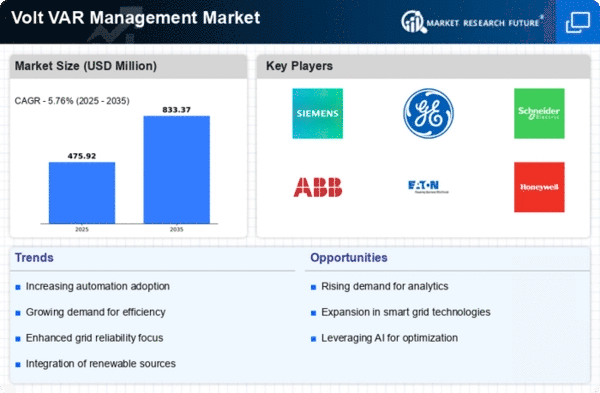
As per MRFR analysis, the Volt VAR Management Market Size was estimated at 450.0 USD Million in 2024. The Volt VAR Management industry is projected to grow from 475.93 USD Million in 2025 to 833.37 USD Million by 2035, exhibiting a compound annual growth rate (CAGR) of 5.76% during the forecast period 2025 - 2035.

Key Market Trends & Highlights

The Volt VAR Management Market is experiencing robust growth driven by technological advancements and regulatory support.

  • The integration of smart technologies is transforming the Volt VAR Management landscape, particularly in North America. A strong focus on renewable energy integration is evident, especially in the rapidly expanding Asia-Pacific region. Voltage regulation remains the largest segment, while reactive power control is emerging as the fastest-growing segment in the market. Increased demand for energy efficiency and advancements in grid modernization are key drivers propelling market growth.

Market Size & Forecast

2024 Market Size 450.0 (USD Million)
2035 Market Size 833.37 (USD Million)
CAGR (2025 - 2035) 5.76%
Largest Regional Market Share in 2024 North America

Major Players

<a href="https://www.siemens.com/global/en/products/buildings/hvac/oem/variable-air-volume.html">Siemens</a> (DE), General Electric (US), Schneider Electric (FR), ABB (CH), Eaton (US), <a href="https://process.honeywell.com/us/en/products/control-and-supervisory-systems/drives/honeywell-variable-frequency-drive">Honeywell</a> (US), Rockwell Automation (US), S&amp;C Electric Company (US), Landis+Gyr (CH)

Market Trends

The Volt VAR Management Market is currently experiencing a transformative phase, driven by the increasing demand for efficient energy management solutions. Utilities and energy providers are recognizing the necessity of optimizing voltage and reactive power to enhance grid reliability and reduce energy losses. This market appears to be influenced by advancements in smart grid technologies, which facilitate real-time monitoring and control of voltage levels. As a result, stakeholders are likely to invest in innovative solutions that not only improve operational efficiency but also contribute to sustainability goals. Furthermore, regulatory frameworks are evolving, encouraging the adoption of Volt VAR management systems to meet stringent performance standards. In addition, the integration of renewable energy sources into the grid is reshaping the Volt VAR Management Market. The intermittent nature of these energy sources necessitates sophisticated management strategies to maintain grid stability. Consequently, there is a growing emphasis on developing advanced algorithms and software solutions that can dynamically adjust voltage levels in response to fluctuating energy supply and demand. This trend suggests a shift towards more automated and intelligent systems, which may enhance the overall resilience of the electrical grid. As the market continues to evolve, collaboration among technology providers, utilities, and regulatory bodies will likely play a crucial role in shaping future developments.

Integration of Smart Technologies

The Volt VAR Management Market is witnessing a notable trend towards the integration of smart technologies. This shift is characterized by the adoption of advanced sensors, communication networks, and data analytics tools that enable real-time monitoring and control of voltage and reactive power. Such technologies enhance operational efficiency and facilitate proactive decision-making, ultimately leading to improved grid performance.

Focus on Renewable Energy Integration

Another significant trend in the Volt VAR Management Market is the increasing focus on integrating renewable energy sources. As the share of renewables in the energy mix grows, the need for effective voltage and reactive power management becomes more critical. This trend drives the development of innovative solutions that can adapt to the variable nature of renewable energy generation, ensuring grid stability.

Regulatory Support and Standards

Regulatory support is emerging as a key driver in the Volt VAR Management Market. Governments and regulatory bodies are establishing standards and incentives that promote the adoption of Volt VAR management systems. This trend indicates a growing recognition of the importance of efficient voltage control in achieving energy efficiency and sustainability goals.

Volt VAR Management Market Market Drivers

Market Segment Insights

By Application: Voltage Regulation (Largest) vs. Reactive Power Control (Fastest-Growing)

The Volt VAR Management Market is characterized by a diverse array of applications, with voltage regulation taking the lead as the predominant sector. It holds the largest share of market activity, underlining its critical importance in maintaining stable voltage levels across power networks. Following closely, reactive power control is emerging rapidly, reflecting a noticeable trend in enhancing energy efficiency and system reliability, thus capturing the interest of stakeholders in the market.

Voltage Regulation (Dominant) vs. Reactive Power Control (Emerging)

Voltage regulation is indispensable in the Volt VAR Management market, serving as a fundamental pillar that supports the stability of electrical systems. This application ensures consistent voltage levels, mitigating potential outages or equipment damage. On the other hand, reactive power control is gaining traction as an emerging force, driven by advancements in technology and a growing emphasis on optimizing utility performance. This shift is propelled by regulatory mandates and the increasing integration of renewable energy sources. Together, these applications shape the future of the market, highlighting the need for advanced management solutions.

By End Use: Utilities (Largest) vs. Industrial (Fastest-Growing)

In the Volt VAR Management Market, the end-use segment distribution reveals that Utilities hold a significant share, dominating the market landscape. They utilize Volt VAR management solutions to effectively manage voltage levels and ensure the reliability of <a href="https://www.marketresearchfuture.com/reports/power-distribution-cables-market-1767">power distribution</a>. Conversely, Industrial applications are experiencing rapid growth as more manufacturing facilities adopt these solutions to optimize energy consumption and maintain equipment performance. This shift indicates a changing landscape where traditional energy sectors are complemented by industrial advancements. The growth trends within this segment are driven by the increasing demand for efficient energy management solutions across various sectors. Utilities are focused on upgrading infrastructure and incorporating smart technologies, while the Industrial sector is embracing volatility management to enhance operational efficiency. Furthermore, the push for sustainability and regulatory compliance incentivizes both segments to adopt advanced Volt VAR management strategies, fostering overall market expansion.

Utilities (Dominant) vs. Industrial (Emerging)

Utilities are the cornerstone of the Volt VAR Management Market, representing a dominant segment due to their extensive reliance on effective voltage management to ensure stable electricity supply. These entities prioritize systems that enhance grid reliability, reduce outages, and mitigate energy losses. As they invest in upgrading their infrastructures with smart grid technologies, utilities are also increasingly integrating renewable energy sources. On the other hand, the Industrial segment is viewed as emerging and shows considerable potential as industries seek to optimize energy efficiency amid rising operational costs. This segment's rapid growth is attributed to innovations in automation and digital monitoring solutions that allow for real-time voltage management, positioning them as both adopters and innovators in the Volt VAR Management landscape.

By Technology: Static VAR Compensator (Largest) vs. Dynamic VAR Compensator (Fastest-Growing)

In the Volt VAR Management Market, the distribution of market share among the technology segment showcases that Static VAR Compensators hold the largest percentage, owing to their established application in power systems for voltage regulation. In contrast, Dynamic VAR Compensators are quickly gaining traction due to the increasing demand for dynamic reactive power support and enhanced grid stability in modern electrical networks. As energy systems evolve, these technologies are vital to maintaining power quality and reliability. Growth trends in the technology segment indicate a rapid shift towards advanced VAR management solutions. The increasing integration of renewable energy sources into the grid is driving the demand for Dynamic VAR Compensators, which offer rapid response times to fluctuations in power. Furthermore, the continuous technological advancements and investments in smart grid initiatives are expected to propel both Static and Dynamic VAR Compensators in the upcoming years, solidifying their critical role in modern energy infrastructure.

Technology: Static VAR Compensator (Dominant) vs. Dynamic VAR Compensator (Emerging)

Static VAR Compensators have established themselves as the dominant technology in the Volt VAR Management Market due to their effectiveness in providing steady-state voltage support and improving overall system efficiency. They play a crucial role in stabilizing voltage levels in transmission and distribution systems, making them indispensable for utility companies. On the other hand, Dynamic VAR Compensators are emerging as a vital solution for addressing the challenges posed by intermittent renewable energy sources. Their ability to provide instantaneous reactive power support allows them to enhance grid resiliency and reliability, particularly in areas experiencing high penetration of wind and solar energy. As both technologies evolve, their complementary capabilities are expected to redefine VAR management, catering to the increasing complexity of modern power systems.

By Component: Control Systems (Largest) vs. Power Electronics (Fastest-Growing)

In the Volt VAR Management Market, the component segment showcases a diverse distribution of market shares among four key values: Control Systems, Sensors, Communication Equipment, and Power Electronics. Control Systems maintain the largest share due to their critical role in managing voltage and reactive power, solidifying their position as the backbone of VAR management. Meanwhile, Power Electronics, although currently smaller in market share, demonstrates rapid growth as technological advancements and efficiency improvements drive their adoption in utility applications.

Control Systems (Dominant) vs. Power Electronics (Emerging)

Control Systems are paramount in the Volt VAR Management Market, providing essential functionalities that optimize voltage levels and enhance reliability in power distribution networks. This segment is characterized by sophisticated algorithms and automation capabilities that ensure efficient power factor correction. Contrarily, Power Electronics represent an emerging segment, gaining traction with innovations in materials and designs that promote higher efficiency and smaller footprints in energy conversion processes. As the demand for renewable energy integration and smart grid technologies rises, Power Electronics are poised for substantial expansion, which could transform the dynamics of the VAR management landscape.

By Deployment: Cloud-Based (Largest) vs. Hybrid (Fastest-Growing)

In the Volt VAR Management Market, the deployment segment exhibits a varied distribution among on-premises, cloud-based, and hybrid solutions. Cloud-based deployment holds the largest market share, favored for its scalability and accessibility. On-premises solutions, while still significant, are gradually being overshadowed by the increasing preference for cloud options. Hybrid models are gaining traction as industries seek the flexibility of utilizing both cloud and on-premises features, appealing to diverse organizational needs.

Cloud-Based (Dominant) vs. Hybrid (Emerging)

Cloud-based deployment stands out as the dominant choice within the Volt VAR Management Market, primarily due to its remarkable ability to offer scalable solutions that cater to the evolving needs of organizations. This segment allows for easier integration, frequent updates, and reduced infrastructure costs. Conversely, hybrid deployments emerge as a compelling alternative for companies reluctant to abandon their existing on-premises systems while still reaping the benefits of cloud computing. The hybrid model appeals to organizations facing unique compliance or security challenges, effectively combining the best of both worlds, making it a critical player in the market.

Get more detailed insights about Volt/VAR Management Market Research Report- Forecast till 2035

Regional Insights

North America : Market Leader in VAR Management

North America is poised to maintain its leadership in the Volt VAR Management market, holding a significant share of 225.0 million in 2025. The region's growth is driven by increasing demand for energy efficiency and regulatory support for smart grid technologies. Government initiatives aimed at reducing carbon emissions and enhancing grid reliability are further propelling market expansion. The integration of advanced technologies in energy management is also a key factor influencing demand trends. The competitive landscape in North America is robust, featuring major players such as Siemens, General Electric, and Schneider Electric. The U.S. stands out as the leading country, with substantial investments in infrastructure and innovation. Companies are focusing on strategic partnerships and technological advancements to enhance their market presence. The emphasis on renewable energy sources and smart grid solutions is expected to drive further growth in this region.

Europe : Emerging Market with Growth Potential

Europe is witnessing a transformative phase in the Volt VAR Management market, with a market size of 120.0 million in 2025. The region's growth is fueled by stringent regulations aimed at enhancing energy efficiency and sustainability. The European Union's Green Deal and various national policies are driving investments in smart grid technologies, creating a favorable environment for market expansion. The increasing focus on renewable energy sources is also a significant catalyst for demand. Leading countries in Europe include Germany, France, and the UK, where key players like ABB and Schneider Electric are actively innovating. The competitive landscape is characterized by a mix of established firms and emerging startups, all vying for market share. The presence of strong regulatory frameworks encourages companies to invest in advanced technologies, ensuring that Europe remains a vital player in The Volt VAR Management.

Asia-Pacific : Rapid Growth in Energy Management

Asia-Pacific is emerging as a significant player in the Volt VAR Management market, with a projected size of 80.0 million in 2025. The region's growth is driven by rapid urbanization, increasing energy demands, and government initiatives promoting energy efficiency. Countries like China and India are investing heavily in smart grid technologies, which are essential for managing energy distribution effectively. Regulatory support for renewable energy integration is also a key driver of market growth. China leads the region in market share, supported by major investments from companies like General Electric and Rockwell Automation. The competitive landscape is evolving, with both multinational corporations and local firms striving to capture market opportunities. The focus on sustainable energy solutions and technological advancements is expected to further enhance the region's position in the global market.

Middle East and Africa : Emerging Market with Challenges

The Middle East and Africa region is gradually developing its Volt VAR Management market, with a size of 25.0 million in 2025. The growth is primarily driven by increasing energy demands and the need for efficient energy management solutions. Governments are recognizing the importance of modernizing their energy infrastructure, which is leading to investments in smart grid technologies. However, challenges such as political instability and limited financial resources can hinder progress in this region. Leading countries include South Africa and the UAE, where key players like S&C Electric Company are making strides. The competitive landscape is still in its infancy, with opportunities for both local and international companies to establish a foothold. As the region continues to invest in energy efficiency and sustainability, the Volt VAR Management market is expected to grow, albeit at a slower pace compared to other regions.

Key Players and Competitive Insights

The Volt VAR Management Market is currently characterized by a dynamic competitive landscape, driven by the increasing demand for efficient voltage regulation and reactive power management solutions. Key players such as Siemens (DE), General Electric (US), and Schneider Electric (FR) are at the forefront, each adopting distinct strategies to enhance their market positioning. Siemens (DE) emphasizes innovation through its digital solutions, focusing on integrating IoT technologies to optimize grid performance. General Electric (US) appears to be pursuing a strategy of regional expansion, particularly in emerging markets, to capitalize on the growing need for energy management systems. Schneider Electric (FR) is heavily investing in sustainability initiatives, aligning its operations with global environmental goals, which seems to resonate well with current market demands. Collectively, these strategies contribute to a competitive environment that is increasingly focused on technological advancement and sustainability.
In terms of business tactics, companies are localizing manufacturing and optimizing supply chains to enhance operational efficiency. The market structure is moderately fragmented, with several key players exerting influence over various segments. This fragmentation allows for a diverse range of solutions, catering to different customer needs while fostering competition among established and emerging firms.
In November 2025, Siemens (DE) announced a strategic partnership with a leading renewable energy provider to develop advanced VAR management solutions tailored for wind and solar applications. This collaboration is significant as it not only enhances Siemens' product offerings but also positions the company as a leader in integrating renewable energy sources into existing grids, thereby addressing the growing demand for sustainable energy solutions.
In October 2025, General Electric (US) launched a new suite of software tools designed to enhance grid resilience and optimize VAR management. This initiative is crucial as it reflects GE's commitment to leveraging digital technologies to improve operational efficiency and reliability in energy distribution, which is increasingly vital in today's energy landscape.
In September 2025, Schneider Electric (FR) unveiled its latest energy management platform, which incorporates AI-driven analytics for real-time VAR optimization. This development underscores Schneider's focus on innovation and its ability to provide cutting-edge solutions that meet the evolving needs of customers in a rapidly changing market.
As of December 2025, the Volt VAR Management Market is witnessing trends such as digitalization, sustainability, and AI integration, which are reshaping competitive dynamics. Strategic alliances are becoming increasingly important, as companies seek to leverage complementary strengths to enhance their offerings. Looking ahead, competitive differentiation is likely to evolve from traditional price-based competition to a focus on innovation, technology, and supply chain reliability, indicating a shift towards more sophisticated and sustainable solutions.

Key Companies in the Volt VAR Management Market include

Industry Developments

August 2020:Larsen & Turbo, an Indian construction engineering company, has sold its electrical and automation business to Schneider Electric. This French company is a pioneer in energy and automation systems, for INR 14,000 crores. This is a significant development that may impact the growth of the Volt/VAr management industry.

Future Outlook

Volt VAR Management Market Future Outlook

The Volt VAR Management Market is projected to grow at a 5.76% CAGR from 2025 to 2035, driven by technological advancements, regulatory support, and increasing demand for energy efficiency.

New opportunities lie in:

  • Integration of AI-driven analytics for predictive maintenance
  • Development of cloud-based VAR management solutions
  • Expansion into emerging markets with tailored VAR services

By 2035, the market is expected to achieve robust growth, positioning itself as a leader in energy management solutions.

Market Segmentation

Volt VAR Management Market End Use Outlook

  • Utilities
  • Industrial
  • Commercial
  • Residential

Volt VAR Management Market Component Outlook

  • Control Systems
  • Sensors
  • Communication Equipment
  • Power Electronics

Volt VAR Management Market Deployment Outlook

  • On-Premises
  • Cloud-Based
  • Hybrid

Volt VAR Management Market Technology Outlook

  • Static VAR Compensator
  • Dynamic VAR Compensator
  • Synchronous Condenser
  • Capacitor Banks

Volt VAR Management Market Application Outlook

  • Voltage Regulation
  • Reactive Power Control
  • Power Quality Improvement
  • Grid Stability
  • Load Balancing

Report Scope

MARKET SIZE 2024 450.0(USD Million)
MARKET SIZE 2025 475.93(USD Million)
MARKET SIZE 2035 833.37(USD Million)
COMPOUND ANNUAL GROWTH RATE (CAGR) 5.76% (2025 - 2035)
REPORT COVERAGE Revenue Forecast, Competitive Landscape, Growth Factors, and Trends
BASE YEAR 2024
Market Forecast Period 2025 - 2035
Historical Data 2019 - 2024
Market Forecast Units USD Million
Key Companies Profiled Siemens (DE), General Electric (US), Schneider Electric (FR), ABB (CH), Eaton (US), Honeywell (US), Rockwell Automation (US), S&C Electric Company (US), Landis+Gyr (CH)
Segments Covered Application, End Use, Technology, Component, Deployment
Key Market Opportunities Integration of advanced analytics and artificial intelligence in Volt VAR Management Market enhances grid efficiency and reliability.
Key Market Dynamics Rising demand for energy efficiency drives innovation in Volt VAR Management technologies and regulatory compliance.
Countries Covered North America, Europe, APAC, South America, MEA

FAQs

How much is the Volt/VAR Management market?

The Volt/VAR Management market size was valued at USD 0.42 Billion in 2023.

What is the growth rate of the Volt/VAR Management market?

The market is projected to grow at a CAGR of 5.76% during the forecast period, 2024-2032.

Which region held the largest market share in the Volt/VAR Management market?

North America had the largest share in the market

Who are the key players in the Volt/VAR Management market?

The key players in the market are ABB, S&amp;C Electric Company, DC Systems, Beckwith Electric, Utilidata, Open Systems International, Landis+Gyr,

Which Application led the Volt/VAR Management market?

The distribution dominated the market in 2022.

Which End Use had the largest market share in the Volt/VAR Management market?

The store based had the largest share in the market.

  1. SECTION I: EXECUTIVE SUMMARY AND KEY HIGHLIGHTS
    1. | 1.1 EXECUTIVE SUMMARY
    2. | 1.1.1 Market Overview
    3. | 1.1.2 Key Findings
    4. | 1.1.3 Market Segmentation
    5. | 1.1.4 Competitive Landscape
    6. | 1.1.5 Challenges and Opportunities
    7. | 1.1.6 Future Outlook
  2. SECTION II: SCOPING, METHODOLOGY AND MARKET STRUCTURE
    1. | 2.1 MARKET INTRODUCTION
    2. | 2.1.1 Definition
    3. | 2.1.2 Scope of the study
    4. |-- 2.1.2.1 Research Objective
    5. |-- 2.1.2.2 Assumption
    6. |-- 2.1.2.3 Limitations
    7. | 2.2 RESEARCH METHODOLOGY
    8. | 2.2.1 Overview
    9. | 2.2.2 Data Mining
    10. | 2.2.3 Secondary Research
    11. | 2.2.4 Primary Research
    12. |-- 2.2.4.1 Primary Interviews and Information Gathering Process
    13. |-- 2.2.4.2 Breakdown of Primary Respondents
    14. | 2.2.5 Forecasting Model
    15. | 2.2.6 Market Size Estimation
    16. |-- 2.2.6.1 Bottom-Up Approach
    17. |-- 2.2.6.2 Top-Down Approach
    18. | 2.2.7 Data Triangulation
    19. | 2.2.8 Validation
  3. SECTION III: QUALITATIVE ANALYSIS
    1. | 3.1 MARKET DYNAMICS
    2. | 3.1.1 Overview
    3. | 3.1.2 Drivers
    4. | 3.1.3 Restraints
    5. | 3.1.4 Opportunities
    6. | 3.2 MARKET FACTOR ANALYSIS
    7. | 3.2.1 Value chain Analysis
    8. | 3.2.2 Porter's Five Forces Analysis
    9. |-- 3.2.2.1 Bargaining Power of Suppliers
    10. |-- 3.2.2.2 Bargaining Power of Buyers
    11. |-- 3.2.2.3 Threat of New Entrants
    12. |-- 3.2.2.4 Threat of Substitutes
    13. |-- 3.2.2.5 Intensity of Rivalry
    14. | 3.2.3 COVID-19 Impact Analysis
    15. |-- 3.2.3.1 Market Impact Analysis
    16. |-- 3.2.3.2 Regional Impact
    17. |-- 3.2.3.3 Opportunity and Threat Analysis
  4. SECTION IV: QUANTITATIVE ANALYSIS
    1. | 4.1 Energy & Power, BY Application (USD Million)
    2. | 4.1.1 Voltage Regulation
    3. | 4.1.2 Reactive Power Control
    4. | 4.1.3 Power Quality Improvement
    5. | 4.1.4 Grid Stability
    6. | 4.1.5 Load Balancing
    7. | 4.2 Energy & Power, BY End Use (USD Million)
    8. | 4.2.1 Utilities
    9. | 4.2.2 Industrial
    10. | 4.2.3 Commercial
    11. | 4.2.4 Residential
    12. | 4.3 Energy & Power, BY Technology (USD Million)
    13. | 4.3.1 Static VAR Compensator
    14. | 4.3.2 Dynamic VAR Compensator
    15. | 4.3.3 Synchronous Condenser
    16. | 4.3.4 Capacitor Banks
    17. | 4.4 Energy & Power, BY Component (USD Million)
    18. | 4.4.1 Control Systems
    19. | 4.4.2 Sensors
    20. | 4.4.3 Communication Equipment
    21. | 4.4.4 Power Electronics
    22. | 4.5 Energy & Power, BY Deployment (USD Million)
    23. | 4.5.1 On-Premises
    24. | 4.5.2 Cloud-Based
    25. | 4.5.3 Hybrid
    26. | 4.6 Energy & Power, BY Region (USD Million)
    27. | 4.6.1 North America
    28. |-- 4.6.1.1 US
    29. |-- 4.6.1.2 Canada
    30. | 4.6.2 Europe
    31. |-- 4.6.2.1 Germany
    32. |-- 4.6.2.2 UK
    33. |-- 4.6.2.3 France
    34. |-- 4.6.2.4 Russia
    35. |-- 4.6.2.5 Italy
    36. |-- 4.6.2.6 Spain
    37. |-- 4.6.2.7 Rest of Europe
    38. | 4.6.3 APAC
    39. |-- 4.6.3.1 China
    40. |-- 4.6.3.2 India
    41. |-- 4.6.3.3 Japan
    42. |-- 4.6.3.4 South Korea
    43. |-- 4.6.3.5 Malaysia
    44. |-- 4.6.3.6 Thailand
    45. |-- 4.6.3.7 Indonesia
    46. |-- 4.6.3.8 Rest of APAC
    47. | 4.6.4 South America
    48. |-- 4.6.4.1 Brazil
    49. |-- 4.6.4.2 Mexico
    50. |-- 4.6.4.3 Argentina
    51. |-- 4.6.4.4 Rest of South America
    52. | 4.6.5 MEA
    53. |-- 4.6.5.1 GCC Countries
    54. |-- 4.6.5.2 South Africa
    55. |-- 4.6.5.3 Rest of MEA
  5. SECTION V: COMPETITIVE ANALYSIS
    1. | 5.1 Competitive Landscape
    2. | 5.1.1 Overview
    3. | 5.1.2 Competitive Analysis
    4. | 5.1.3 Market share Analysis
    5. | 5.1.4 Major Growth Strategy in the Energy & Power
    6. | 5.1.5 Competitive Benchmarking
    7. | 5.1.6 Leading Players in Terms of Number of Developments in the Energy & Power
    8. | 5.1.7 Key developments and growth strategies
    9. |-- 5.1.7.1 New Product Launch/Service Deployment
    10. |-- 5.1.7.2 Merger & Acquisitions
    11. |-- 5.1.7.3 Joint Ventures
    12. | 5.1.8 Major Players Financial Matrix
    13. |-- 5.1.8.1 Sales and Operating Income
    14. |-- 5.1.8.2 Major Players R&D Expenditure. 2023
    15. | 5.2 Company Profiles
    16. | 5.2.1 Siemens (DE)
    17. |-- 5.2.1.1 Financial Overview
    18. |-- 5.2.1.2 Products Offered
    19. |-- 5.2.1.3 Key Developments
    20. |-- 5.2.1.4 SWOT Analysis
    21. |-- 5.2.1.5 Key Strategies
    22. | 5.2.2 General Electric (US)
    23. |-- 5.2.2.1 Financial Overview
    24. |-- 5.2.2.2 Products Offered
    25. |-- 5.2.2.3 Key Developments
    26. |-- 5.2.2.4 SWOT Analysis
    27. |-- 5.2.2.5 Key Strategies
    28. | 5.2.3 Schneider Electric (FR)
    29. |-- 5.2.3.1 Financial Overview
    30. |-- 5.2.3.2 Products Offered
    31. |-- 5.2.3.3 Key Developments
    32. |-- 5.2.3.4 SWOT Analysis
    33. |-- 5.2.3.5 Key Strategies
    34. | 5.2.4 ABB (CH)
    35. |-- 5.2.4.1 Financial Overview
    36. |-- 5.2.4.2 Products Offered
    37. |-- 5.2.4.3 Key Developments
    38. |-- 5.2.4.4 SWOT Analysis
    39. |-- 5.2.4.5 Key Strategies
    40. | 5.2.5 Eaton (US)
    41. |-- 5.2.5.1 Financial Overview
    42. |-- 5.2.5.2 Products Offered
    43. |-- 5.2.5.3 Key Developments
    44. |-- 5.2.5.4 SWOT Analysis
    45. |-- 5.2.5.5 Key Strategies
    46. | 5.2.6 Honeywell (US)
    47. |-- 5.2.6.1 Financial Overview
    48. |-- 5.2.6.2 Products Offered
    49. |-- 5.2.6.3 Key Developments
    50. |-- 5.2.6.4 SWOT Analysis
    51. |-- 5.2.6.5 Key Strategies
    52. | 5.2.7 Rockwell Automation (US)
    53. |-- 5.2.7.1 Financial Overview
    54. |-- 5.2.7.2 Products Offered
    55. |-- 5.2.7.3 Key Developments
    56. |-- 5.2.7.4 SWOT Analysis
    57. |-- 5.2.7.5 Key Strategies
    58. | 5.2.8 S&C Electric Company (US)
    59. |-- 5.2.8.1 Financial Overview
    60. |-- 5.2.8.2 Products Offered
    61. |-- 5.2.8.3 Key Developments
    62. |-- 5.2.8.4 SWOT Analysis
    63. |-- 5.2.8.5 Key Strategies
    64. | 5.2.9 Landis+Gyr (CH)
    65. |-- 5.2.9.1 Financial Overview
    66. |-- 5.2.9.2 Products Offered
    67. |-- 5.2.9.3 Key Developments
    68. |-- 5.2.9.4 SWOT Analysis
    69. |-- 5.2.9.5 Key Strategies
    70. | 5.3 Appendix
    71. | 5.3.1 References
    72. | 5.3.2 Related Reports

Energy & Power Market Segmentation

Energy & Power By Application (USD Million, 2025-2035)

  • Voltage Regulation
  • Reactive Power Control
  • Power Quality Improvement
  • Grid Stability
  • Load Balancing

Energy & Power By End Use (USD Million, 2025-2035)

  • Utilities
  • Industrial
  • Commercial
  • Residential

Energy & Power By Technology (USD Million, 2025-2035)

  • Static VAR Compensator
  • Dynamic VAR Compensator
  • Synchronous Condenser
  • Capacitor Banks

Energy & Power By Component (USD Million, 2025-2035)

  • Control Systems
  • Sensors
  • Communication Equipment
  • Power Electronics

Energy & Power By Deployment (USD Million, 2025-2035)

  • On-Premises
  • Cloud-Based
  • Hybrid
Infographic

Free Sample Request

Kindly complete the form below to receive a free sample of this Report

Get Free Sample

Customer Strories

Compare Licence

×
Features License Type
Single User Multiuser License Enterprise User
Price $4,950 $5,950 $7,250
Maximum User Access Limit 1 User Upto 10 Users Unrestricted Access Throughout the Organization
Free Customization
Direct Access to Analyst
Deliverable Format
Platform Access
Discount on Next Purchase 10% 15% 15%
Printable Versions