×
Request Free Sample ×

Kindly complete the form below to receive a free sample of this Report

* Please use a valid business email

Leading companies partner with us for data-driven Insights

clients tt-cursor
Hero Background

visual-positioning-system-market

ID: MRFR/ICT/66308-CR
200 Pages
MRFR Team
December 2025

Share:
Download PDF ×

We do not share your information with anyone. However, we may send you emails based on your report interest from time to time. You may contact us at any time to opt-out.

visual-positioning-system-market Infographic
Purchase Options

visual-positioning-system-market Summary

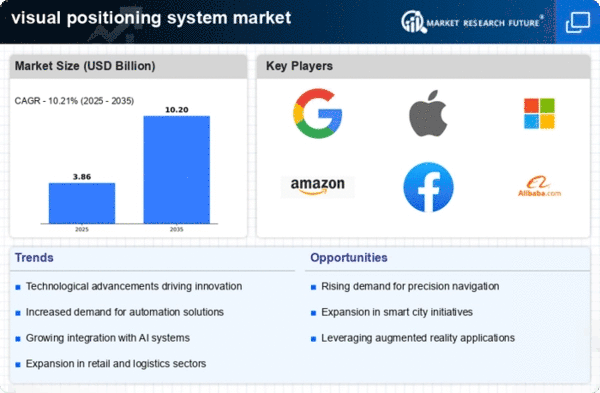
As per MRFR analysis, the visual positioning system market size was estimated at 3.5 USD Billion in 2024. The visual positioning system industry is projected to grow from 3.86 USD Billion in 2025 to 10.2 USD Billion by 2035, exhibiting a compound annual growth rate (CAGR) of 10.21 during the forecast period 2025 - 2035.

Key Market Trends & Highlights

The visual positioning system market is experiencing robust growth driven by technological advancements and increasing demand across various sectors.

  • The integration with augmented reality is enhancing user experiences in the visual positioning system market.
  • Safety and security concerns are prompting greater adoption of visual positioning systems in both retail and logistics sectors.
  • Advancements in sensor technology are propelling the development of more accurate and efficient positioning solutions.
  • Rising demand for automation and the expansion of smart cities are key drivers fueling market growth, particularly in North America and Asia-Pacific.

Market Size & Forecast

2024 Market Size 3.5 (USD Billion)
2035 Market Size 10.2 (USD Billion)
CAGR (2025 - 2035) 10.21%

Major Players

Google (US), Apple (US), Microsoft (US), Amazon (US), Facebook (US), Alibaba (CN), Samsung (KR), Sony (JP), NVIDIA (US), Qualcomm (US)

visual-positioning-system-market Trends

The visual positioning system market is currently experiencing a transformative phase, driven by advancements in technology and increasing demand for precise location services. This market encompasses a range of applications, including augmented reality, robotics, and autonomous vehicles, which rely heavily on accurate positioning data. As industries seek to enhance operational efficiency and improve user experiences, the integration of visual positioning systems into various sectors appears to be gaining momentum. Furthermore, the growing emphasis on smart cities and the Internet of Things (IoT) is likely to propel the adoption of these systems, as they provide critical data for navigation and spatial awareness. In addition, the visual positioning system market seems to be influenced by the rising need for enhanced safety and security measures. Organizations are increasingly recognizing the value of real-time location tracking and monitoring capabilities, which can mitigate risks and improve response times in emergency situations. As a result, investments in research and development are expected to increase, fostering innovation and the introduction of new solutions. Overall, the visual positioning system market is poised for growth, with various factors converging to create a dynamic landscape that could redefine how location-based services are utilized across multiple industries.

Integration with Augmented Reality

The visual positioning system market is witnessing a notable trend towards integration with augmented reality technologies. This convergence enhances user experiences by providing interactive and immersive environments, allowing users to visualize information in real-time. As industries such as retail and education adopt these systems, the demand for seamless integration is likely to grow.

Focus on Safety and Security

There is an increasing emphasis on safety and security within the visual positioning system market. Organizations are recognizing the importance of real-time tracking and monitoring capabilities, which can significantly enhance emergency response and risk management. This trend suggests a shift towards solutions that prioritize safety in various applications.

Advancements in Sensor Technology

The visual positioning system market is also characterized by rapid advancements in sensor technology. Innovations in imaging and sensing capabilities are enabling more accurate and reliable positioning solutions. As these technologies evolve, they are expected to drive the development of new applications and improve existing systems.

Market Segment Insights

By Application: Retail (Largest) vs. Logistics (Fastest-Growing)

In the visual positioning system market, the application segment shows a varied distribution with retail capturing the largest share. Retail uses visual positioning systems to enhance customer experiences and streamline inventory management, leading to significant adoption. Following closely, logistics represents the fastest-growing area as businesses increasingly rely on these technologies to optimize supply chains and improve tracking efficiencies. Other applications such as healthcare, manufacturing, and transportation also contribute to market dynamics, but at slower growth rates.

Logistics: Efficient Tracking (Dominant) vs. Healthcare: Patient Management (Emerging)

In logistics, visual positioning systems are pivotal for efficient tracking and management of assets. These systems facilitate real-time location data, improving supply chain visibility and operational efficiency. The dominant position in logistics is propelled by the demand for automation and accuracy in inventory management. In contrast, the healthcare sector represents an emerging application. Here, visual positioning systems aid in patient management, ensuring safety and resource allocation within healthcare facilities. Although growing, healthcare lags behind logistics due to regulatory hurdles and integration challenges with existing systems.

By Technology: Camera-based Systems (Largest) vs. LiDAR Systems (Fastest-Growing)

The visual positioning system market demonstrates a diverse technology landscape, where camera-based systems hold a substantial market share, driven by their widespread adoption in various applications. Infrared systems and ultrasonic systems also contribute to this market, but their presence is not as dominant. LiDAR systems, known for their precision in real-time positioning, are becoming increasingly popular, particularly in autonomous vehicles and smart city applications. Hybrid systems are also emerging, providing a blend of technologies to enhance overall functionality and performance. Growth trends in this segment are significantly influenced by advancements in technology and increasing demand for automation across industries. The automotive and robotics sectors are key drivers for the adoption of LiDAR systems, as they enhance navigation and safety features. Meanwhile, camera-based systems continue to thrive in surveillance and augmented reality applications, ensuring their dominance. As industries evolve, the integration of these technologies is likely to accelerate, highlighting their potential in various market segments.

Camera-based Systems: Dominant vs. LiDAR Systems: Emerging

Camera-based systems are currently the dominant technology in the visual positioning system market, widely recognized for their versatility in applications such as security monitoring, inventory management, and robotics. Their ability to capture detailed images and process visual data in real-time positions them advantageously, making them a preferred choice for many sectors. On the other hand, LiDAR systems are emerging rapidly, known for their accuracy and efficiency in measuring distances using laser light. This technology is particularly favored in land surveying and autonomous driving due to its ability to create detailed 3D maps and navigate complex environments. While camera systems excel in visual recognition tasks, LiDAR systems are revolutionizing mapping and positioning, indicating a dynamic interaction between these technologies in the market.

By End Use: Consumer Electronics (Largest) vs. Automotive (Fastest-Growing)

The visual positioning system market has seen significant distribution across various end-use segments, with Consumer Electronics holding the largest share. This sector's demand is driven by the integration of advanced technologies in personal gadgets such as smartphones, tablets, and wearable devices. As technology advances, the need for enhanced positioning systems in this sector has evolved, leading to steady market presence and growth. On the other hand, the Automotive segment is emerging as the fastest-growing category. The demand for advanced driver-assistance systems (ADAS) and autonomous vehicles propels growth in this area, driven by technological advancements and increasing consumer safety standards. The shift toward smart transportation solutions is expected to further boost the automotive sector's significance in the visual positioning system market.

Consumer Electronics: Dominant vs. Automotive: Emerging

Within the visual positioning system market, the Consumer Electronics segment stands out as a dominant player. The continuous innovation in devices such as smartphones, drones, and smart wearables necessitates precise positioning technologies, making it a critical component for manufacturers. This segment's strong market position is characterized by high consumer demand for features such as location-based services, augmented reality applications, and seamless navigation systems. Conversely, the Automotive segment, deemed emerging, is rapidly evolving due to the rise of autonomous vehicles and smart city initiatives. The increasing integration of visual positioning systems in vehicles for navigation, traffic management, and enhanced safety features marks its growth trajectory. This sector is expected to capitalize on technological advancements, leading to transformative impacts on transportation.

Get more detailed insights about visual-positioning-system-market

Regional Insights

North America : Innovation and Market Leadership

North America continues to lead the visual positioning system market, holding a significant share of 1.75B in 2024. The region's growth is driven by rapid technological advancements, increasing demand for augmented reality (AR) applications, and supportive regulatory frameworks. Companies are investing heavily in R&D to enhance their offerings, which is further fueled by the growing adoption of smart devices and IoT technologies. The competitive landscape is dominated by major players such as Google, Apple, and Microsoft, all based in the US. These companies are leveraging their technological expertise and extensive resources to innovate and capture market share. The presence of a robust startup ecosystem also contributes to the region's dynamic market, fostering new solutions and applications in visual positioning systems.

Europe : Emerging Market with Growth Potential

Europe's visual positioning system market is valued at 1.0B, reflecting a growing interest in AR and location-based services. The region benefits from strong regulatory support aimed at fostering innovation and ensuring data privacy. Increasing investments in smart city initiatives and digital infrastructure are key drivers of market growth, as businesses seek to enhance user experiences through advanced positioning technologies. Leading countries such as Germany, France, and the UK are at the forefront of this market, with numerous tech firms and startups developing innovative solutions. The competitive landscape is characterized by collaborations between established companies and emerging players, creating a vibrant ecosystem. As the demand for seamless navigation and enhanced user engagement rises, Europe is poised for significant advancements in visual positioning systems.

Asia-Pacific : Rapid Growth and Adoption

The Asia-Pacific region, with a market size of 0.6B, is witnessing rapid growth in the visual positioning system sector. Factors such as increasing smartphone penetration, urbanization, and a burgeoning tech-savvy population are driving demand. Governments are also promoting smart city projects, which further catalyze the adoption of advanced positioning technologies. Regulatory frameworks are evolving to support innovation while ensuring user privacy and data security. Countries like China, Japan, and South Korea are leading the charge, with major tech companies like Alibaba and Samsung investing heavily in R&D. The competitive landscape is vibrant, with both established firms and startups vying for market share. As the region embraces digital transformation, the visual positioning system market is expected to expand significantly, driven by innovative applications and services.

Middle East and Africa : Emerging Market with Challenges

The Middle East and Africa region, with a market size of 0.15B, is still in the nascent stages of visual positioning system adoption. However, there is a growing interest in leveraging technology for urban development and enhanced user experiences. Key drivers include increasing smartphone usage and government initiatives aimed at digital transformation. Regulatory frameworks are gradually being established to support innovation while addressing privacy concerns. Countries like South Africa and the UAE are leading the way, with investments in smart city projects and digital infrastructure. The competitive landscape is evolving, with local startups emerging alongside international players. As the region continues to develop its technological capabilities, the visual positioning system market is expected to grow, albeit at a slower pace compared to other regions.

Key Players and Competitive Insights

The visual positioning system market is currently characterized by intense competition and rapid technological advancements. Key growth drivers include the increasing demand for augmented reality (AR) applications, the proliferation of smart devices, and the integration of artificial intelligence (AI) in positioning technologies. Major players such as Google (US), Apple (US), and NVIDIA (US) are strategically positioned to leverage their technological prowess and extensive ecosystems. Google (US) focuses on enhancing its AR capabilities through continuous innovation, while Apple (US) emphasizes seamless integration of visual positioning in its hardware and software offerings. NVIDIA (US) is heavily investing in AI-driven solutions, which collectively shape a competitive environment that is increasingly reliant on cutting-edge technology and user-centric applications.

In terms of business tactics, companies are localizing manufacturing and optimizing supply chains to enhance efficiency and reduce costs. The market appears moderately fragmented, with a mix of established players and emerging startups. The collective influence of these key players is significant, as they drive innovation and set industry standards, thereby shaping the overall market structure.

In November 2025, Google (US) announced the launch of its new AR navigation feature, which utilizes advanced visual positioning technology to provide real-time guidance in urban environments. This strategic move is likely to enhance user engagement and solidify Google’s position as a leader in the AR space, potentially attracting more developers to its platform. The integration of this feature into Google Maps could redefine how users interact with their surroundings, indicating a shift towards more immersive navigation experiences.

In October 2025, Apple (US) unveiled its latest iPhone model, which includes enhanced visual positioning capabilities designed to improve indoor navigation. This development underscores Apple’s commitment to integrating advanced positioning technologies into its consumer devices, thereby enhancing user experience and maintaining its competitive edge. The focus on indoor navigation reflects a growing trend towards providing comprehensive location-based services, which could open new revenue streams for the company.

In September 2025, NVIDIA (US) announced a partnership with a leading automotive manufacturer to integrate its visual positioning technology into autonomous vehicles. This collaboration is poised to accelerate the adoption of AI-driven navigation systems in the automotive sector, highlighting NVIDIA’s strategic focus on expanding its influence beyond traditional computing markets. The implications of this partnership could be profound, as it positions NVIDIA at the forefront of the autonomous driving revolution, potentially reshaping transportation as a whole.

As of December 2025, current competitive trends in the visual positioning system market are heavily influenced by digitalization, sustainability, and AI integration. Strategic alliances among key players are fostering innovation and enhancing technological capabilities, which are essential for maintaining competitive differentiation. The market appears to be shifting from price-based competition towards a focus on innovation, technology, and supply chain reliability. This evolution suggests that companies will increasingly prioritize unique technological advancements and sustainable practices to distinguish themselves in a crowded marketplace.


Key Companies in the visual-positioning-system-market market include

Future Outlook

visual-positioning-system-market Future Outlook

The visual positioning system market is projected to grow at a 10.21% CAGR from 2024 to 2035, driven by advancements in technology, increased demand for automation, and enhanced data analytics capabilities.

New opportunities lie in:

  • Integration of AI-driven analytics for real-time decision-making
  • Development of customized positioning solutions for various industries
  • Expansion into emerging markets with tailored product offerings

By 2035, the visual positioning system market is expected to achieve substantial growth and innovation.

Market Segmentation

visual-positioning-system-market End Use Outlook

  • Consumer Electronics
  • Automotive
  • Aerospace
  • Industrial
  • Smart Cities

visual-positioning-system-market Technology Outlook

  • Camera-based Systems
  • Infrared Systems
  • Ultrasonic Systems
  • LiDAR Systems
  • Hybrid Systems

visual-positioning-system-market Application Outlook

  • Retail
  • Logistics
  • Healthcare
  • Manufacturing
  • Transportation

Report Scope

MARKET SIZE 20243.5(USD Billion)
MARKET SIZE 20253.86(USD Billion)
MARKET SIZE 203510.2(USD Billion)
COMPOUND ANNUAL GROWTH RATE (CAGR)10.21% (2024 - 2035)
REPORT COVERAGERevenue Forecast, Competitive Landscape, Growth Factors, and Trends
BASE YEAR2024
Market Forecast Period2025 - 2035
Historical Data2019 - 2024
Market Forecast UnitsUSD Billion
Key Companies ProfiledGoogle (US), Apple (US), Microsoft (US), Amazon (US), Facebook (US), Alibaba (CN), Samsung (KR), Sony (JP), NVIDIA (US), Qualcomm (US)
Segments CoveredApplication, Technology, End Use
Key Market OpportunitiesIntegration of artificial intelligence enhances accuracy and efficiency in the visual positioning system market.
Key Market DynamicsTechnological advancements drive competitive forces in the visual positioning system market, enhancing accuracy and efficiency.
Countries CoveredNorth America, Europe, APAC, South America, MEA

Leave a Comment

Download Free Sample

Kindly complete the form below to receive a free sample of this Report

Compare Licence

×
Features License Type
Single User Multiuser License Enterprise User
Price $4,950 $5,950 $7,250
Maximum User Access Limit 1 User Upto 10 Users Unrestricted Access Throughout the Organization
Free Customization
Direct Access to Analyst
Deliverable Format
Platform Access
Discount on Next Purchase 10% 15% 15%
Printable Versions