
×
Request Free Sample ×

Kindly complete the form below to receive a free sample of this Report

* Please use a valid business email

Leading companies partner with us for data-driven Insights

clients tt-cursor
Hero Background
English
Chinese
French
Japanese
Korean
German
Spanish

Virtual Reality Headsets Market Analysis

ID: MRFR/SEM/1182-HCR
200 Pages
Aarti Dhapte
February 2026

Virtual Reality Headsets Market Size, Share and Research Report: By Application (Gaming, Education, Healthcare, Real Estate, Military Training), By Type (Standalone, Tethered, Mobile), By Technology (Augmented Reality, Mixed Reality, Virtual Reality), By End Use (Consumer, Commercial, Government) and By Regional (North America, Europe, South America, Asia Pacific, Middle East and Africa) - Industry Forecast Till 2035

Share:
Download PDF ×

We do not share your information with anyone. However, we may send you emails based on your report interest from time to time. You may contact us at any time to opt-out.

Virtual Reality Headsets Market Infographic
Purchase Options

Market Analysis

In-depth Analysis of Virtual Reality Headsets Market Industry Landscape

Recently, as a result of technological developments and consumer preferences, the market dynamics for virtual reality (VR) headsets have been forced to undergo major changes. The VR headset market is a fine balance of innovation and consolidation in the market. VR headsets market trends depend heavily on technological improvement. Every year, the hardware and software capabilities are being pushed to new limits by manufacturers who constantly try to provide users with an even richer immersive experience. As a result, the more advanced and rich-featured VR headsets have emerged with their high resolution displays, better tracking systems (sometimes reflecting eye movements) and comfortable designs. The endless development of technology makes early adopters the first links in a chain, and as mainstream users' overall experience becomes more compelling it can serve as motor for spreading. The market dynamics of VR headsets have, in particular, been dominated by changes in consumer preferences. As consumers grow more discriminating and picky, manufacturers are forced to meet various wants. There are also tethered VR headsets, which are connected to powerful computing devices for high-end experiences appropriate to gaming or professional applications. Standalone VR headsets, by contrast, offer greater convenience and availability because they work independently of other devices. By tapping into smartphones, mobile VR headsets provide a portable and low-level entry for users to the world of immersive experiences. Knowledge of these consumer preferences and the ability to adapt are key for manufacturers trying to keep pace in VR's rapidly changing headset scene. The key features of the market dynamics for VR headsets are competition among leading players. Now competing for market share are major technology companies, from established giants with the name recognition to sparkling-new startups that bring innovation and price competition. As a result of this competition, there is now a rainbow of VR headset options at all price points and for every possible type of user. Furthermore, joint ventures and alliances on the basis of complementary strengths are becoming common as companies seek to make full use between them. The competitive environment is very dynamic. Players are continually trying to differentiate themselves by offering exclusive content or integrating their ecosystems and creating unique service offerings, making for a colorful and fun market scene Another notable aspect of the dynamics in VR headset industries: market consolidation. As the market becomes more saturated, small firms will face difficulties in maintaining their businesses. This may result in acquisitions and mergers of smaller companies. This consolidation often stems from the need for technological expertise, market presence or exclusive content. Sizeable actors' moves to buy or merge with smaller entities can lead changes in the shape of entire markets, both affectively and by creating norms.


Author
Aarti Dhapte
AVP - Research

A consulting professional focused on helping businesses navigate complex markets through structured research and strategic insights. I partner with clients to solve high-impact business problems across market entry strategy, competitive intelligence, and opportunity assessment. Over the course of my experience, I have led and contributed to 100+ market research and consulting engagements, delivering insights across multiple industries and geographies, and supporting strategic decisions linked to $500M+ market opportunities. My core expertise lies in building robust market sizing, forecasting, and commercial models (top-down and bottom-up), alongside deep-dive competitive and industry analysis. I have played a key role in shaping go-to-market strategies, investment cases, and growth roadmaps, enabling clients to make confident, data-backed decisions in dynamic markets.

Leave a Comment

FAQs

What is the current valuation of the Virtual Reality Headsets Market?

<p>As of 2024, the market valuation was 21.01 USD Billion.</p>

What is the projected market size for the Virtual Reality Headsets Market by 2035?

<p>The market is expected to reach a valuation of 331.42 USD Billion by 2035.</p>

What is the expected CAGR for the Virtual Reality Headsets Market during the forecast period?

<p>The market is anticipated to grow at a CAGR of 28.5% from 2025 to 2035.</p>

Which application segments are leading in the Virtual Reality Headsets Market?

<p>The leading application segments include Gaming, with a projected value of 120.0 USD Billion, and Education, expected to reach 40.0 USD Billion.</p>

What are the key end-use segments in the Virtual Reality Headsets Market?

<p>Key end-use segments encompass Entertainment, projected at 101.42 USD Billion, and Consumer, expected to reach 80.0 USD Billion.</p>

Which technology segments are driving growth in the Virtual Reality Headsets Market?

<p>Virtual Reality technology leads with a projected value of 120.0 USD Billion, followed by Augmented Reality at 80.0 USD Billion.</p>

What product types are prevalent in the Virtual Reality Headsets Market?

<p>Tethered Headsets dominate the market with a projected value of 120.0 USD Billion, while Standalone Headsets are expected to reach 80.0 USD Billion.</p>

What display types are most common in the Virtual Reality Headsets Market?

<p>OLED displays are leading with a projected value of 120.0 USD Billion, followed by LCD displays expected to reach 80.0 USD Billion.</p>

Who are the key players in the Virtual Reality Headsets Market?

<p>Key players include Meta Platforms, Sony, HTC, Valve Corporation, Oculus, Samsung Electronics, Pimax, Microsoft, and Google.</p>

How does the Virtual Reality Headsets Market compare to other technology markets?

<p>The Virtual Reality Headsets Market shows robust growth potential, with a projected valuation increase from 21.01 USD Billion in 2024 to 331.42 USD Billion by 2035.</p>

Market Summary

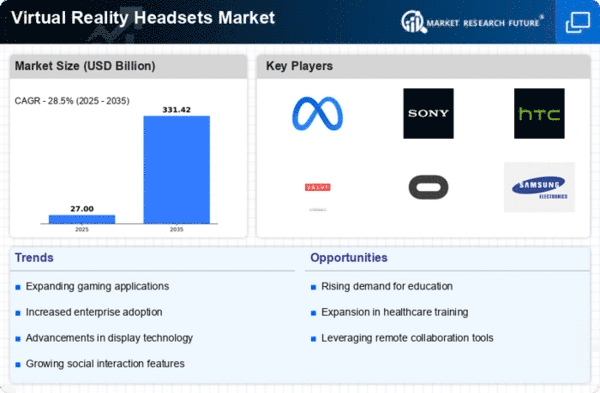
As per MRFR analysis, the Virtual Reality Headsets Market Size was estimated at 21.01 USD Billion in 2024. The Virtual Reality Headsets industry is projected to grow from 26.99 USD Billion in 2025 to 331.42 USD Billion by 2035, exhibiting a compound annual growth rate (CAGR) of 28.5% during the forecast period 2025 - 2035.

Key Market Trends & Highlights

The Virtual Reality Headsets Market is experiencing robust growth driven by diverse applications and technological advancements.

  • The North American region remains the largest market for virtual reality headsets, showcasing a strong consumer base. The Asia-Pacific region is identified as the fastest-growing market, reflecting increasing investments in VR technology. The gaming segment continues to dominate the market, while the education segment is emerging as the fastest-growing area for VR applications. Technological advancements in VR and rising demand in the gaming sector are key drivers propelling market expansion.

Market Size & Forecast

2024 Market Size 21.01 (USD Billion)
2035 Market Size 331.42 (USD Billion)
CAGR (2025 - 2035) 28.5%
Largest Regional Market Share in 2024 North America

Major Players

Meta Platforms (US), Sony (JP), HTC (TW), Valve Corporation (US), Oculus (US), Samsung Electronics (KR), Pimax (CN), Microsoft (US), Google (US)

Market Trends

The Virtual Reality Headsets Market is currently experiencing a transformative phase, characterized by rapid technological advancements and increasing consumer interest. As immersive experiences become more accessible, various sectors, including gaming, education, and healthcare, are integrating virtual reality solutions into their offerings. This integration not only enhances user engagement but also provides innovative ways to interact with digital content. The market appears to be driven by a combination of improved hardware capabilities, such as higher resolution displays and more responsive tracking systems, alongside a growing library of content tailored for virtual environments. Moreover, the competitive landscape of the Virtual Reality Headsets Market is evolving, with numerous players striving to differentiate their products through unique features and pricing strategies. Companies are likely focusing on user comfort and affordability, which may lead to broader adoption among diverse demographics. As the technology matures, it seems plausible that the market will witness an influx of new entrants, further stimulating innovation and potentially reshaping consumer expectations. Overall, the future of the Virtual Reality Headsets Market appears promising, with ongoing developments suggesting a sustained trajectory of growth and diversification in applications across various industries.

Increased Adoption in Education

The Virtual Reality Headsets Market is witnessing a notable rise in the adoption of virtual reality technologies within educational institutions. This trend suggests that educators are increasingly recognizing the potential of immersive learning experiences to enhance student engagement and comprehension. By utilizing virtual environments, students can explore complex concepts in a more interactive manner, which may lead to improved retention and understanding.

Expansion in Healthcare Applications

Healthcare professionals are increasingly integrating virtual reality solutions into training and therapeutic practices. This trend indicates a growing recognition of the benefits that virtual reality can offer in medical simulations and patient treatment. By providing realistic scenarios for training and therapeutic interventions, the Virtual Reality Headsets Market is likely to see expanded applications that enhance both learning and patient care.

Emergence of Social Virtual Reality

The concept of social virtual reality is gaining traction, as users seek more interactive and communal experiences within virtual environments. This trend suggests that the Virtual Reality Headsets Market is evolving to accommodate social interactions, allowing users to connect and collaborate in shared spaces. As platforms develop to support these social experiences, the market may attract a broader audience, enhancing its overall appeal.

Virtual Reality Headsets Market Market Drivers

Technological Advancements

The Global Virtual Reality Headsets Market Industry is experiencing rapid growth driven by continuous technological advancements. Innovations in display technology, such as higher resolution screens and improved refresh rates, enhance user experiences significantly. For instance, the introduction of OLED displays has improved color accuracy and response times, making virtual environments more immersive. Furthermore, advancements in motion tracking and haptic feedback systems contribute to a more realistic interaction within virtual spaces. These developments not only attract consumers but also encourage enterprises to adopt VR solutions for training and simulations, thereby expanding the market's reach.

Increased Adoption in Gaming

The gaming sector remains a pivotal driver for the Global Virtual Reality Headsets Market Industry. As gaming technology evolves, VR headsets have become increasingly popular among gamers seeking immersive experiences. In 2024, the market is projected to reach 10 USD Billion, largely fueled by the release of high-profile VR games and exclusive content. Major gaming companies are investing heavily in VR capabilities, which enhances the appeal of their platforms. This trend is expected to continue, with the gaming segment likely to dominate the market, as more gamers seek out VR experiences that offer unprecedented levels of engagement and interactivity.

Expansion of Content Ecosystem

The expansion of the content ecosystem is crucial for the Global Virtual Reality Headsets Market Industry. As more developers create VR content across various genres, including gaming, education, and virtual tourism, the appeal of VR headsets increases. Platforms that support user-generated content and facilitate easy access to diverse VR experiences are particularly influential. This proliferation of content not only attracts new users but also encourages existing users to invest in upgraded hardware. With projections indicating that the market could reach 60 USD Billion by 2035, the continuous growth of the content ecosystem is expected to play a vital role in sustaining this momentum.

Growth in Enterprise Applications

The Global Virtual Reality Headsets Market Industry is witnessing a surge in enterprise applications, particularly in training and development. Companies across various sectors, including healthcare, manufacturing, and education, are increasingly utilizing VR for simulations and training programs. This shift is driven by the need for cost-effective and efficient training solutions that can replicate real-world scenarios. For example, VR training modules in healthcare allow medical professionals to practice procedures in a risk-free environment. As organizations recognize the benefits of VR in enhancing employee skills and reducing training costs, the market is expected to expand significantly, contributing to a projected CAGR of 17.69% from 2025 to 2035.

Rising Demand for Immersive Experiences

Consumer demand for immersive experiences is a key factor propelling the Global Virtual Reality Headsets Market Industry. As individuals seek more engaging forms of entertainment and social interaction, VR technology offers unique opportunities for exploration and connection. This trend is evident in the rise of virtual events, social VR platforms, and immersive storytelling in media. The ability to transport users to different environments fosters a sense of presence that traditional media cannot replicate. Consequently, this growing appetite for immersive experiences is likely to drive sales of VR headsets, further solidifying the industry's position in the global market.

Market Segment Insights

By Application: Gaming (Largest) vs. Education (Fastest-Growing)

The Virtual Reality Headsets Market is seeing a significant distribution of market share among key application segments. Gaming continues to dominate this landscape, showcasing a substantial share due to rising consumer interest and advancements in gaming technology. As gaming experiences evolve with more immersive features, this segment remains a cornerstone of VR headsets' appeal. Education, on the other hand, is rapidly increasing its market presence as institutions integrate VR into curriculums, enabling experiential learning opportunities that were previously unattainable.

Gaming: Dominant vs. Education: Emerging

The gaming segment stands as the dominant force within the Virtual Reality Headsets Market, characterized by a strong consumer base drawn to the immersive experience offered by VR technology. Major gaming companies are investing heavily in VR compatibility, creating exclusive titles that maximize the headset capabilities. Meanwhile, the education segment is emerging powerfully, driven by an increased acceptance of interactive and immersive learning tools. Educational institutions are leveraging VR for simulations and virtual classrooms, facilitating engagement and understanding in complex subjects. As both segments evolve, gaming continues to capture the majority of attention and resources, while education carves a path for future growth through innovative applications.

By End Use: Consumer (Largest) vs. Healthcare (Fastest-Growing)

<p>The Virtual Reality Headsets Market is primarily segmented by end-use applications, with the consumer segment holding the largest share. This segment is driven by increased adoption among gaming enthusiasts and tech-savvy consumers seeking immersive experiences. The entertainment industry heavily influences this, creating significant demand for VR gaming, social VR experiences, and interactive applications. Other segments, such as commercial and industrial, also contribute to the overall market but do not match the consumer segment's share. In contrast, the healthcare segment is recognized as the fastest-growing category, fueled by the rising adoption of VR technology for surgical training, therapy, and patient engagement. As healthcare professionals increasingly embrace virtual training solutions and patient rehabilitation programs utilizing VR headsets, the segment is expanding rapidly, showcasing the technology's transformative potential in medical training and treatment applications.</p>

<p>Consumer (Dominant) vs. Healthcare (Emerging)</p>

<p>The consumer segment currently dominates the Virtual Reality Headsets Market, characterized by a vibrant ecosystem of gaming, social interaction, and entertainment offerings. This sector sees continuous innovation and frequent product launches, tailored to meet the evolving preferences of users. Gaming companies and developers significantly drive this segment, focusing on enhancing user experiences through immersive storytelling and graphics. Conversely, the healthcare segment emerges as a notable player, leveraging VR technologies for training simulations and therapeutic applications. As medical institutions increasingly invest in VR tools for education and rehabilitation, the demand surges. Both segments highlight the versatility of VR headsets, appealing to very different consumer bases while driving technological advancements.</p>

By Technology: Virtual Reality (Largest) vs. Haptic Feedback (Fastest-Growing)

<p>The Virtual Reality Headsets Market is primarily dominated by the Virtual Reality (VR) segment, which holds a significant market share compared to other technologies. VR continues to attract consumers and businesses due to its immersive experience, making it the largest segment in this market. On the other hand, Augmented Reality (AR) and Mixed Reality (MR) also contribute to the landscape but have a smaller market share compared to VR. Additionally, Haptic Feedback and 360-Degree Video are emerging as important components in enhancing user experience, particularly in gaming and training applications.</p>

<p>Haptic Feedback: Dominant vs. 360-Degree Video: Emerging</p>

<p>Haptic Feedback technology enhances the virtual experience by providing tactile sensations, making it a dominant force within the VR segment. This technology allows users to feel physical feedback from virtual interactions, deepening immersion in gaming and simulations. In contrast, 360-Degree Video is an emerging segment that offers interactive visual content experiences. While it is gaining traction, it works best in conjunction with other technologies like VR and AR. Haptic Feedback's role is crucial in bridging the gap between virtual and physical worlds, whereas 360-Degree Video attracts those wanting immersive views without the need for complete VR equipment.</p>

By Product Type: Standalone Headsets (Largest) vs. Tethered Headsets (Fastest-Growing)

<p>In the Virtual Reality Headsets Market, the distribution of market share reveals that standalone headsets dominate the sector due to their all-in-one functionality and ease of use. These devices have captured a significant portion of the market, appealing to both casual users and gamers seeking convenience without the need for additional equipment. Tethered headsets, while having a smaller market share, are the fastest-growing segment, driven by advancements in gaming technology and high-quality immersion experiences that appeal to dedicated gamers and enterprises alike. Growth trends in the Virtual Reality Headsets Market indicate a clear shift towards standalone and mobile headsets. The advent of advanced processors in standalone units has propelled their popularity, facilitating greater access to VR experiences without cumbersome setups. Tethered headsets are gaining traction as more advanced VR content is developed, catering to professional environments and users desiring premium graphics and performance. This dynamic interplay between segments highlights an evolving landscape with diverse consumer preferences shaping overall market directions.</p>

<p>Standalone Headsets (Dominant) vs. Tethered Headsets (Emerging)</p>

<p>Standalone headsets have established themselves as the dominant choice in the Virtual Reality Headsets Market, largely due to their user-friendly nature and the elimination of external hardware dependencies. These devices are app-centric and designed for ease of portability, making them widely accessible to consumers who prefer simplicity and convenience. In contrast, tethered headsets represent an emerging segment characterized by high fidelity and immersive experiences. These headsets, connected to powerful PCs, cater to a niche market that prioritizes graphical performance and detailed simulations. As technology progresses, the tethered segment is expected to appeal increasingly to gamers and professionals seeking an unparalleled virtual experience, thereby carving out a significant space in the ever-evolving VR landscape.</p>

By Display Type: OLED (Largest) vs. LCD (Fastest-Growing)

<p>In the Virtual Reality Headsets Market, OLED leads the display type segment due to its superior color accuracy, contrast, and response times. This technology captures the largest market share, making it a preferred choice for high-end VR experiences. In contrast, LCD displays, while known for their cost-effectiveness, are gaining traction rapidly, driven by advancements in technology that enhance their performance and visual appeal. As manufacturers seek to cater to a broader audience, the demand for LCD technology is growing, positioning it as the fastest-growing segment within the VR headset market. The growth trends in this segment indicate a shift towards improving user experiences in virtual environments. Enhanced pixel resolution and refresh rates are key drivers propelling both OLED and LCD displays. As VR applications expand into gaming, education, and training, the need for high-quality visuals will spur further innovations, especially in LCD technology, making it increasingly competitive against OLED in the coming years.</p>

<p>OLED (Dominant) vs. LCD (Emerging)</p>

<p>OLED displays are characterized by their remarkable visual quality, providing vivid colors and deep blacks, which are essential for immersive virtual reality experiences. They have established dominance in the VR market due to their superior image quality and rapid refresh rates, making them ideal for gaming and other interactive applications. Meanwhile, LCD technology is emerging with innovative improvements such as faster response times and better backlight control, which are closing the gap with OLEDs. As manufacturers strive for cost-efficiency and versatility, LCD headsets are becoming increasingly appealing to budget-conscious consumers, positioning them as strong contenders in the evolving virtual reality landscape.</p>

Get more detailed insights about Virtual Reality Headsets Market Research Report - Forecast to 2035

Regional Insights

North America : Innovation and Market Leadership

North America continues to lead the Virtual Reality Headsets Market, holding a significant share of 10.5 in 2024. The region's growth is driven by technological advancements, increasing consumer demand for immersive experiences, and substantial investments in VR technology. Regulatory support for innovation and development further catalyzes market expansion, making it a hub for VR advancements. The United States stands out as a key player, with major companies like Meta Platforms, Oculus, and Valve Corporation driving competition. The presence of tech giants fosters a robust ecosystem for VR development, ensuring a diverse range of products. As the market evolves, North America is expected to maintain its leadership position, supported by continuous innovation and consumer engagement.

Europe : Emerging Market with Growth Potential

Europe's Virtual Reality Headsets Market is poised for growth, with a market size of 5.0 in 2024. The region benefits from increasing adoption in sectors like gaming, education, and healthcare, driven by a growing interest in immersive technologies. Regulatory frameworks promoting digital innovation and investment in VR infrastructure are key growth catalysts, enhancing the market's appeal. Leading countries such as Germany, the UK, and France are at the forefront of this expansion, with a competitive landscape featuring companies like Sony and HTC. The presence of established tech firms and startups alike fosters innovation, ensuring a diverse product offering. As Europe embraces VR technology, the market is expected to flourish, supported by favorable regulations and consumer interest.

Asia-Pacific : Rapid Growth and Adoption

The Asia-Pacific region is witnessing a surge in the Virtual Reality Headsets Market, with a market size of 4.51 in 2024. This growth is fueled by rising disposable incomes, increasing smartphone penetration, and a growing interest in gaming and entertainment. Regulatory initiatives aimed at promoting technology adoption and digital transformation are also contributing to market expansion, making it a vibrant landscape for VR development. Countries like Japan, China, and South Korea are leading the charge, with key players such as HTC and Samsung Electronics actively participating in the market. The competitive landscape is characterized by rapid innovation and a focus on consumer engagement, ensuring a diverse range of VR products. As the region continues to embrace VR technology, significant growth is anticipated in the coming years.

Middle East and Africa : Emerging Market with Untapped Potential

The Middle East and Africa (MEA) region is emerging as a potential market for Virtual Reality Headsets, with a market size of 1.0 in 2024. The growth is driven by increasing interest in VR applications across various sectors, including education, tourism, and entertainment. Government initiatives aimed at fostering technology adoption and digital innovation are crucial in shaping the market landscape, providing a foundation for future growth. Countries like the UAE and South Africa are leading the way in VR adoption, with a growing number of startups and tech companies entering the space. The competitive landscape is evolving, with both local and international players vying for market share. As awareness and interest in VR technology increase, the MEA region is expected to witness significant growth opportunities in the coming years.

Key Players and Competitive Insights

The Virtual Reality Headsets Market is currently characterized by a dynamic competitive landscape, driven by rapid technological advancements and increasing consumer demand for immersive experiences. Major players such as Meta Platforms (US), Sony (JP), and HTC (TW) are at the forefront, each adopting distinct strategies to enhance their market positioning. Meta Platforms (US) continues to focus on innovation, particularly in social VR experiences, while Sony (JP) leverages its strong gaming ecosystem to integrate VR into its PlayStation offerings. HTC (TW), on the other hand, emphasizes enterprise solutions, catering to businesses seeking VR applications for training and collaboration. Collectively, these strategies contribute to a competitive environment that is both fragmented and evolving, as companies vie for market share through differentiation and technological prowess.
Key business tactics within the market include localizing manufacturing and optimizing supply chains to enhance efficiency and reduce costs. The competitive structure appears moderately fragmented, with several key players holding substantial market shares while also facing competition from emerging companies. This fragmentation allows for a diverse range of products and innovations, fostering a competitive atmosphere where established firms must continuously adapt to maintain their positions.
In November 2025, Meta Platforms (US) announced a significant partnership with a leading gaming studio to develop exclusive VR content aimed at enhancing user engagement. This strategic move underscores Meta's commitment to creating a robust ecosystem that not only attracts users but also retains them through unique offerings. By integrating exclusive content, Meta is likely to strengthen its competitive edge in the market, appealing to both gamers and social VR enthusiasts.
In October 2025, Sony (JP) unveiled its latest VR headset, which features advanced haptic feedback technology designed to enhance user immersion. This launch is pivotal as it positions Sony to capitalize on the growing demand for high-fidelity gaming experiences. The incorporation of haptic feedback may set a new standard in the industry, compelling competitors to innovate further to keep pace with consumer expectations.
In September 2025, HTC (TW) expanded its product line by introducing a new VR headset tailored for educational institutions, focusing on interactive learning experiences. This strategic pivot towards the education sector reflects HTC's recognition of the potential for VR in enhancing educational outcomes. By targeting this niche market, HTC may not only diversify its revenue streams but also establish itself as a leader in educational technology solutions.
As of December 2025, current competitive trends indicate a strong emphasis on digitalization, sustainability, and AI integration within the Virtual Reality Headsets Market. Strategic alliances are increasingly shaping the landscape, as companies collaborate to leverage complementary strengths and enhance product offerings. Looking ahead, competitive differentiation is likely to evolve from traditional price-based competition towards a focus on innovation, technological advancements, and supply chain reliability. This shift suggests that companies that prioritize R&D and sustainable practices may gain a significant advantage in the marketplace.

Key Companies in the Virtual Reality Headsets Market include

Industry Developments

Recent developments in the Virtual Reality Headsets Market have shown significant growth, particularly driven by advancements in technology and increasing applications across various sectors, including gaming, education, and healthcare. Companies like Meta and Sony continue to enhance their product offerings with upgrades, such as improved resolution and field of view, making virtual experiences more immersive. In October 2023, Samsung unveiled its latest VR headset model, garnering attention for its ergonomic design and seamless integration with other devices. 

Additionally, Microsoft has been expanding its presence in the enterprise sector, leveraging VR for training and collaboration. In December 2024, Google confirmed Samsung is developing a standalone mixed-reality headset running on Android XR, named Project Moohan, with a developer kit expected in October 2024 and a consumer release planned around March 2025.

The market valuation for companies, including Oculus and HTC, has seen considerable upward adjustment due to increased consumer interest and investment in the metaverse. Over the past few years, notable trends included the rise of remote working tools, particularly in August 2022, which propelled virtual reality applications in professional settings. Overall, the Virtual Reality Headsets Market reflects a dynamic landscape with ongoing innovations and strategic partnerships.

Future Outlook

Virtual Reality Headsets Market Future Outlook

The Virtual Reality Headsets Market is projected to grow at a 28.5% CAGR from 2025 to 2035, driven by advancements in technology, increasing consumer demand, and expanding applications across various sectors.

New opportunities lie in:

  • Development of enterprise-focused VR training solutions
  • Integration of VR with AI for personalized user experiences
  • Expansion into emerging markets with affordable headset options

By 2035, the market is expected to achieve substantial growth, solidifying its position as a key technology sector.

Market Segmentation

Virtual Reality Headsets Market End Use Outlook

  • Consumer
  • Commercial
  • Industrial
  • Healthcare
  • Entertainment

Virtual Reality Headsets Market Technology Outlook

  • Virtual Reality
  • Augmented Reality
  • Mixed Reality
  • 360-Degree Video
  • Haptic Feedback

Virtual Reality Headsets Market Application Outlook

  • Gaming
  • Education
  • Healthcare
  • Military
  • Real Estate

Virtual Reality Headsets Market Connectivity Outlook

  • Wired
  • Wireless
  • Bluetooth
  • Wi-Fi
  • 5G

Virtual Reality Headsets Market Display Type Outlook

  • OLED
  • LCD
  • MicroLED
  • Retina
  • Projection

Report Scope

MARKET SIZE 2024 21.01(USD Billion)
MARKET SIZE 2025 26.99(USD Billion)
MARKET SIZE 2035 331.42(USD Billion)
COMPOUND ANNUAL GROWTH RATE (CAGR) 28.5% (2025 - 2035)
REPORT COVERAGE Revenue Forecast, Competitive Landscape, Growth Factors, and Trends
BASE YEAR 2024
Market Forecast Period 2025 - 2035
Historical Data 2019 - 2024
Market Forecast Units USD Billion
Key Companies Profiled Meta Platforms (US), Sony (JP), HTC (TW), Valve Corporation (US), Oculus (US), Samsung Electronics (KR), Pimax (CN), Microsoft (US), Google (US)
Segments Covered Application, End Use, Technology, Display Type, Connectivity
Key Market Opportunities Integration of advanced artificial intelligence enhances user experience in the Virtual Reality Headsets Market.
Key Market Dynamics Technological advancements and shifting consumer preferences drive competitive dynamics in the Virtual Reality Headsets Market.
Countries Covered North America, Europe, APAC, South America, MEA

FAQs

What is the current valuation of the Virtual Reality Headsets Market?

<p>As of 2024, the market valuation was 21.01 USD Billion.</p>

What is the projected market size for the Virtual Reality Headsets Market by 2035?

<p>The market is expected to reach a valuation of 331.42 USD Billion by 2035.</p>

What is the expected CAGR for the Virtual Reality Headsets Market during the forecast period?

<p>The market is anticipated to grow at a CAGR of 28.5% from 2025 to 2035.</p>

Which application segments are leading in the Virtual Reality Headsets Market?

<p>The leading application segments include Gaming, with a projected value of 120.0 USD Billion, and Education, expected to reach 40.0 USD Billion.</p>

What are the key end-use segments in the Virtual Reality Headsets Market?

<p>Key end-use segments encompass Entertainment, projected at 101.42 USD Billion, and Consumer, expected to reach 80.0 USD Billion.</p>

Which technology segments are driving growth in the Virtual Reality Headsets Market?

<p>Virtual Reality technology leads with a projected value of 120.0 USD Billion, followed by Augmented Reality at 80.0 USD Billion.</p>

What product types are prevalent in the Virtual Reality Headsets Market?

<p>Tethered Headsets dominate the market with a projected value of 120.0 USD Billion, while Standalone Headsets are expected to reach 80.0 USD Billion.</p>

What display types are most common in the Virtual Reality Headsets Market?

<p>OLED displays are leading with a projected value of 120.0 USD Billion, followed by LCD displays expected to reach 80.0 USD Billion.</p>

Who are the key players in the Virtual Reality Headsets Market?

<p>Key players include Meta Platforms, Sony, HTC, Valve Corporation, Oculus, Samsung Electronics, Pimax, Microsoft, and Google.</p>

How does the Virtual Reality Headsets Market compare to other technology markets?

<p>The Virtual Reality Headsets Market shows robust growth potential, with a projected valuation increase from 21.01 USD Billion in 2024 to 331.42 USD Billion by 2035.</p>

  1. SECTION I: EXECUTIVE SUMMARY AND KEY HIGHLIGHTS
    1. | 1.1 EXECUTIVE SUMMARY
    2. | | 1.1.1 Market Overview
    3. | | 1.1.2 Key Findings
    4. | | 1.1.3 Market Segmentation
    5. | | 1.1.4 Competitive Landscape
    6. | | 1.1.5 Challenges and Opportunities
    7. | | 1.1.6 Future Outlook
  2. SECTION II: SCOPING, METHODOLOGY AND MARKET STRUCTURE
    1. | 2.1 MARKET INTRODUCTION
    2. | | 2.1.1 Definition
    3. | | 2.1.2 Scope of the study
    4. | | | 2.1.2.1 Research Objective
    5. | | | 2.1.2.2 Assumption
    6. | | | 2.1.2.3 Limitations
    7. | 2.2 RESEARCH METHODOLOGY
    8. | | 2.2.1 Overview
    9. | | 2.2.2 Data Mining
    10. | | 2.2.3 Secondary Research
    11. | | 2.2.4 Primary Research
    12. | | | 2.2.4.1 Primary Interviews and Information Gathering Process
    13. | | | 2.2.4.2 Breakdown of Primary Respondents
    14. | | 2.2.5 Forecasting Model
    15. | | 2.2.6 Market Size Estimation
    16. | | | 2.2.6.1 Bottom-Up Approach
    17. | | | 2.2.6.2 Top-Down Approach
    18. | | 2.2.7 Data Triangulation
    19. | | 2.2.8 Validation
  3. SECTION III: QUALITATIVE ANALYSIS
    1. | 3.1 MARKET DYNAMICS
    2. | | 3.1.1 Overview
    3. | | 3.1.2 Drivers
    4. | | 3.1.3 Restraints
    5. | | 3.1.4 Opportunities
    6. | 3.2 MARKET FACTOR ANALYSIS
    7. | | 3.2.1 Value chain Analysis
    8. | | 3.2.2 Porter's Five Forces Analysis
    9. | | | 3.2.2.1 Bargaining Power of Suppliers
    10. | | | 3.2.2.2 Bargaining Power of Buyers
    11. | | | 3.2.2.3 Threat of New Entrants
    12. | | | 3.2.2.4 Threat of Substitutes
    13. | | | 3.2.2.5 Intensity of Rivalry
    14. | | 3.2.3 COVID-19 Impact Analysis
    15. | | | 3.2.3.1 Market Impact Analysis
    16. | | | 3.2.3.2 Regional Impact
    17. | | | 3.2.3.3 Opportunity and Threat Analysis
  4. SECTION IV: QUANTITATIVE ANALYSIS
    1. | 4.1 Semiconductor & Electronics, BY Application (USD Billion)
    2. | | 4.1.1 Gaming
    3. | | 4.1.2 Education
    4. | | 4.1.3 Healthcare
    5. | | 4.1.4 Military
    6. | | 4.1.5 Real Estate
    7. | 4.2 Semiconductor & Electronics, BY End Use (USD Billion)
    8. | | 4.2.1 Consumer
    9. | | 4.2.2 Commercial
    10. | | 4.2.3 Industrial
    11. | | 4.2.4 Healthcare
    12. | | 4.2.5 Entertainment
    13. | 4.3 Semiconductor & Electronics, BY Technology (USD Billion)
    14. | | 4.3.1 Virtual Reality
    15. | | 4.3.2 Augmented Reality
    16. | | 4.3.3 Mixed Reality
    17. | | 4.3.4 360-Degree Video
    18. | | 4.3.5 Haptic Feedback
    19. | 4.4 Semiconductor & Electronics, BY Product Type (USD Billion)
    20. | | 4.4.1 Standalone Headsets
    21. | | 4.4.2 Tethered Headsets
    22. | | 4.4.3 Mobile Headsets
    23. | | 4.4.4 PC-Based Headsets
    24. | 4.5 Semiconductor & Electronics, BY Display Type (USD Billion)
    25. | | 4.5.1 LCD
    26. | | 4.5.2 OLED
    27. | | 4.5.3 MicroLED
    28. | | 4.5.4 Retina
    29. | 4.6 Semiconductor & Electronics, BY Region (USD Billion)
    30. | | 4.6.1 North America
    31. | | | 4.6.1.1 US
    32. | | | 4.6.1.2 Canada
    33. | | 4.6.2 Europe
    34. | | | 4.6.2.1 Germany
    35. | | | 4.6.2.2 UK
    36. | | | 4.6.2.3 France
    37. | | | 4.6.2.4 Russia
    38. | | | 4.6.2.5 Italy
    39. | | | 4.6.2.6 Spain
    40. | | | 4.6.2.7 Rest of Europe
    41. | | 4.6.3 APAC
    42. | | | 4.6.3.1 China
    43. | | | 4.6.3.2 India
    44. | | | 4.6.3.3 Japan
    45. | | | 4.6.3.4 South Korea
    46. | | | 4.6.3.5 Malaysia
    47. | | | 4.6.3.6 Thailand
    48. | | | 4.6.3.7 Indonesia
    49. | | | 4.6.3.8 Rest of APAC
    50. | | 4.6.4 South America
    51. | | | 4.6.4.1 Brazil
    52. | | | 4.6.4.2 Mexico
    53. | | | 4.6.4.3 Argentina
    54. | | | 4.6.4.4 Rest of South America
    55. | | 4.6.5 MEA
    56. | | | 4.6.5.1 GCC Countries
    57. | | | 4.6.5.2 South Africa
    58. | | | 4.6.5.3 Rest of MEA
  5. SECTION V: COMPETITIVE ANALYSIS
    1. | 5.1 Competitive Landscape
    2. | | 5.1.1 Overview
    3. | | 5.1.2 Competitive Analysis
    4. | | 5.1.3 Market share Analysis
    5. | | 5.1.4 Major Growth Strategy in the Semiconductor & Electronics
    6. | | 5.1.5 Competitive Benchmarking
    7. | | 5.1.6 Leading Players in Terms of Number of Developments in the Semiconductor & Electronics
    8. | | 5.1.7 Key developments and growth strategies
    9. | | | 5.1.7.1 New Product Launch/Service Deployment
    10. | | | 5.1.7.2 Merger & Acquisitions
    11. | | | 5.1.7.3 Joint Ventures
    12. | | 5.1.8 Major Players Financial Matrix
    13. | | | 5.1.8.1 Sales and Operating Income
    14. | | | 5.1.8.2 Major Players R&D Expenditure. 2023
    15. | 5.2 Company Profiles
    16. | | 5.2.1 Meta Platforms (US)
    17. | | | 5.2.1.1 Financial Overview
    18. | | | 5.2.1.2 Products Offered
    19. | | | 5.2.1.3 Key Developments
    20. | | | 5.2.1.4 SWOT Analysis
    21. | | | 5.2.1.5 Key Strategies
    22. | | 5.2.2 Sony (JP)
    23. | | | 5.2.2.1 Financial Overview
    24. | | | 5.2.2.2 Products Offered
    25. | | | 5.2.2.3 Key Developments
    26. | | | 5.2.2.4 SWOT Analysis
    27. | | | 5.2.2.5 Key Strategies
    28. | | 5.2.3 HTC (TW)
    29. | | | 5.2.3.1 Financial Overview
    30. | | | 5.2.3.2 Products Offered
    31. | | | 5.2.3.3 Key Developments
    32. | | | 5.2.3.4 SWOT Analysis
    33. | | | 5.2.3.5 Key Strategies
    34. | | 5.2.4 Valve Corporation (US)
    35. | | | 5.2.4.1 Financial Overview
    36. | | | 5.2.4.2 Products Offered
    37. | | | 5.2.4.3 Key Developments
    38. | | | 5.2.4.4 SWOT Analysis
    39. | | | 5.2.4.5 Key Strategies
    40. | | 5.2.5 Oculus (US)
    41. | | | 5.2.5.1 Financial Overview
    42. | | | 5.2.5.2 Products Offered
    43. | | | 5.2.5.3 Key Developments
    44. | | | 5.2.5.4 SWOT Analysis
    45. | | | 5.2.5.5 Key Strategies
    46. | | 5.2.6 Samsung Electronics (KR)
    47. | | | 5.2.6.1 Financial Overview
    48. | | | 5.2.6.2 Products Offered
    49. | | | 5.2.6.3 Key Developments
    50. | | | 5.2.6.4 SWOT Analysis
    51. | | | 5.2.6.5 Key Strategies
    52. | | 5.2.7 Pimax (CN)
    53. | | | 5.2.7.1 Financial Overview
    54. | | | 5.2.7.2 Products Offered
    55. | | | 5.2.7.3 Key Developments
    56. | | | 5.2.7.4 SWOT Analysis
    57. | | | 5.2.7.5 Key Strategies
    58. | | 5.2.8 Microsoft (US)
    59. | | | 5.2.8.1 Financial Overview
    60. | | | 5.2.8.2 Products Offered
    61. | | | 5.2.8.3 Key Developments
    62. | | | 5.2.8.4 SWOT Analysis
    63. | | | 5.2.8.5 Key Strategies
    64. | | 5.2.9 Google (US)
    65. | | | 5.2.9.1 Financial Overview
    66. | | | 5.2.9.2 Products Offered
    67. | | | 5.2.9.3 Key Developments
    68. | | | 5.2.9.4 SWOT Analysis
    69. | | | 5.2.9.5 Key Strategies
    70. | 5.3 Appendix
    71. | | 5.3.1 References
    72. | | 5.3.2 Related Reports
  6. LIST OF FIGURES
    1. | 6.1 MARKET SYNOPSIS
    2. | 6.2 NORTH AMERICA MARKET ANALYSIS
    3. | 6.3 US MARKET ANALYSIS BY APPLICATION
    4. | 6.4 US MARKET ANALYSIS BY END USE
    5. | 6.5 US MARKET ANALYSIS BY TECHNOLOGY
    6. | 6.6 US MARKET ANALYSIS BY PRODUCT TYPE
    7. | 6.7 US MARKET ANALYSIS BY DISPLAY TYPE
    8. | 6.8 CANADA MARKET ANALYSIS BY APPLICATION
    9. | 6.9 CANADA MARKET ANALYSIS BY END USE
    10. | 6.10 CANADA MARKET ANALYSIS BY TECHNOLOGY
    11. | 6.11 CANADA MARKET ANALYSIS BY PRODUCT TYPE
    12. | 6.12 CANADA MARKET ANALYSIS BY DISPLAY TYPE
    13. | 6.13 EUROPE MARKET ANALYSIS
    14. | 6.14 GERMANY MARKET ANALYSIS BY APPLICATION
    15. | 6.15 GERMANY MARKET ANALYSIS BY END USE
    16. | 6.16 GERMANY MARKET ANALYSIS BY TECHNOLOGY
    17. | 6.17 GERMANY MARKET ANALYSIS BY PRODUCT TYPE
    18. | 6.18 GERMANY MARKET ANALYSIS BY DISPLAY TYPE
    19. | 6.19 UK MARKET ANALYSIS BY APPLICATION
    20. | 6.20 UK MARKET ANALYSIS BY END USE
    21. | 6.21 UK MARKET ANALYSIS BY TECHNOLOGY
    22. | 6.22 UK MARKET ANALYSIS BY PRODUCT TYPE
    23. | 6.23 UK MARKET ANALYSIS BY DISPLAY TYPE
    24. | 6.24 FRANCE MARKET ANALYSIS BY APPLICATION
    25. | 6.25 FRANCE MARKET ANALYSIS BY END USE
    26. | 6.26 FRANCE MARKET ANALYSIS BY TECHNOLOGY
    27. | 6.27 FRANCE MARKET ANALYSIS BY PRODUCT TYPE
    28. | 6.28 FRANCE MARKET ANALYSIS BY DISPLAY TYPE
    29. | 6.29 RUSSIA MARKET ANALYSIS BY APPLICATION
    30. | 6.30 RUSSIA MARKET ANALYSIS BY END USE
    31. | 6.31 RUSSIA MARKET ANALYSIS BY TECHNOLOGY
    32. | 6.32 RUSSIA MARKET ANALYSIS BY PRODUCT TYPE
    33. | 6.33 RUSSIA MARKET ANALYSIS BY DISPLAY TYPE
    34. | 6.34 ITALY MARKET ANALYSIS BY APPLICATION
    35. | 6.35 ITALY MARKET ANALYSIS BY END USE
    36. | 6.36 ITALY MARKET ANALYSIS BY TECHNOLOGY
    37. | 6.37 ITALY MARKET ANALYSIS BY PRODUCT TYPE
    38. | 6.38 ITALY MARKET ANALYSIS BY DISPLAY TYPE
    39. | 6.39 SPAIN MARKET ANALYSIS BY APPLICATION
    40. | 6.40 SPAIN MARKET ANALYSIS BY END USE
    41. | 6.41 SPAIN MARKET ANALYSIS BY TECHNOLOGY
    42. | 6.42 SPAIN MARKET ANALYSIS BY PRODUCT TYPE
    43. | 6.43 SPAIN MARKET ANALYSIS BY DISPLAY TYPE
    44. | 6.44 REST OF EUROPE MARKET ANALYSIS BY APPLICATION
    45. | 6.45 REST OF EUROPE MARKET ANALYSIS BY END USE
    46. | 6.46 REST OF EUROPE MARKET ANALYSIS BY TECHNOLOGY
    47. | 6.47 REST OF EUROPE MARKET ANALYSIS BY PRODUCT TYPE
    48. | 6.48 REST OF EUROPE MARKET ANALYSIS BY DISPLAY TYPE
    49. | 6.49 APAC MARKET ANALYSIS
    50. | 6.50 CHINA MARKET ANALYSIS BY APPLICATION
    51. | 6.51 CHINA MARKET ANALYSIS BY END USE
    52. | 6.52 CHINA MARKET ANALYSIS BY TECHNOLOGY
    53. | 6.53 CHINA MARKET ANALYSIS BY PRODUCT TYPE
    54. | 6.54 CHINA MARKET ANALYSIS BY DISPLAY TYPE
    55. | 6.55 INDIA MARKET ANALYSIS BY APPLICATION
    56. | 6.56 INDIA MARKET ANALYSIS BY END USE
    57. | 6.57 INDIA MARKET ANALYSIS BY TECHNOLOGY
    58. | 6.58 INDIA MARKET ANALYSIS BY PRODUCT TYPE
    59. | 6.59 INDIA MARKET ANALYSIS BY DISPLAY TYPE
    60. | 6.60 JAPAN MARKET ANALYSIS BY APPLICATION
    61. | 6.61 JAPAN MARKET ANALYSIS BY END USE
    62. | 6.62 JAPAN MARKET ANALYSIS BY TECHNOLOGY
    63. | 6.63 JAPAN MARKET ANALYSIS BY PRODUCT TYPE
    64. | 6.64 JAPAN MARKET ANALYSIS BY DISPLAY TYPE
    65. | 6.65 SOUTH KOREA MARKET ANALYSIS BY APPLICATION
    66. | 6.66 SOUTH KOREA MARKET ANALYSIS BY END USE
    67. | 6.67 SOUTH KOREA MARKET ANALYSIS BY TECHNOLOGY
    68. | 6.68 SOUTH KOREA MARKET ANALYSIS BY PRODUCT TYPE
    69. | 6.69 SOUTH KOREA MARKET ANALYSIS BY DISPLAY TYPE
    70. | 6.70 MALAYSIA MARKET ANALYSIS BY APPLICATION
    71. | 6.71 MALAYSIA MARKET ANALYSIS BY END USE
    72. | 6.72 MALAYSIA MARKET ANALYSIS BY TECHNOLOGY
    73. | 6.73 MALAYSIA MARKET ANALYSIS BY PRODUCT TYPE
    74. | 6.74 MALAYSIA MARKET ANALYSIS BY DISPLAY TYPE
    75. | 6.75 THAILAND MARKET ANALYSIS BY APPLICATION
    76. | 6.76 THAILAND MARKET ANALYSIS BY END USE
    77. | 6.77 THAILAND MARKET ANALYSIS BY TECHNOLOGY
    78. | 6.78 THAILAND MARKET ANALYSIS BY PRODUCT TYPE
    79. | 6.79 THAILAND MARKET ANALYSIS BY DISPLAY TYPE
    80. | 6.80 INDONESIA MARKET ANALYSIS BY APPLICATION
    81. | 6.81 INDONESIA MARKET ANALYSIS BY END USE
    82. | 6.82 INDONESIA MARKET ANALYSIS BY TECHNOLOGY
    83. | 6.83 INDONESIA MARKET ANALYSIS BY PRODUCT TYPE
    84. | 6.84 INDONESIA MARKET ANALYSIS BY DISPLAY TYPE
    85. | 6.85 REST OF APAC MARKET ANALYSIS BY APPLICATION
    86. | 6.86 REST OF APAC MARKET ANALYSIS BY END USE
    87. | 6.87 REST OF APAC MARKET ANALYSIS BY TECHNOLOGY
    88. | 6.88 REST OF APAC MARKET ANALYSIS BY PRODUCT TYPE
    89. | 6.89 REST OF APAC MARKET ANALYSIS BY DISPLAY TYPE
    90. | 6.90 SOUTH AMERICA MARKET ANALYSIS
    91. | 6.91 BRAZIL MARKET ANALYSIS BY APPLICATION
    92. | 6.92 BRAZIL MARKET ANALYSIS BY END USE
    93. | 6.93 BRAZIL MARKET ANALYSIS BY TECHNOLOGY
    94. | 6.94 BRAZIL MARKET ANALYSIS BY PRODUCT TYPE
    95. | 6.95 BRAZIL MARKET ANALYSIS BY DISPLAY TYPE
    96. | 6.96 MEXICO MARKET ANALYSIS BY APPLICATION
    97. | 6.97 MEXICO MARKET ANALYSIS BY END USE
    98. | 6.98 MEXICO MARKET ANALYSIS BY TECHNOLOGY
    99. | 6.99 MEXICO MARKET ANALYSIS BY PRODUCT TYPE
    100. | 6.100 MEXICO MARKET ANALYSIS BY DISPLAY TYPE
    101. | 6.101 ARGENTINA MARKET ANALYSIS BY APPLICATION
    102. | 6.102 ARGENTINA MARKET ANALYSIS BY END USE
    103. | 6.103 ARGENTINA MARKET ANALYSIS BY TECHNOLOGY
    104. | 6.104 ARGENTINA MARKET ANALYSIS BY PRODUCT TYPE
    105. | 6.105 ARGENTINA MARKET ANALYSIS BY DISPLAY TYPE
    106. | 6.106 REST OF SOUTH AMERICA MARKET ANALYSIS BY APPLICATION
    107. | 6.107 REST OF SOUTH AMERICA MARKET ANALYSIS BY END USE
    108. | 6.108 REST OF SOUTH AMERICA MARKET ANALYSIS BY TECHNOLOGY
    109. | 6.109 REST OF SOUTH AMERICA MARKET ANALYSIS BY PRODUCT TYPE
    110. | 6.110 REST OF SOUTH AMERICA MARKET ANALYSIS BY DISPLAY TYPE
    111. | 6.111 MEA MARKET ANALYSIS
    112. | 6.112 GCC COUNTRIES MARKET ANALYSIS BY APPLICATION
    113. | 6.113 GCC COUNTRIES MARKET ANALYSIS BY END USE
    114. | 6.114 GCC COUNTRIES MARKET ANALYSIS BY TECHNOLOGY
    115. | 6.115 GCC COUNTRIES MARKET ANALYSIS BY PRODUCT TYPE
    116. | 6.116 GCC COUNTRIES MARKET ANALYSIS BY DISPLAY TYPE
    117. | 6.117 SOUTH AFRICA MARKET ANALYSIS BY APPLICATION
    118. | 6.118 SOUTH AFRICA MARKET ANALYSIS BY END USE
    119. | 6.119 SOUTH AFRICA MARKET ANALYSIS BY TECHNOLOGY
    120. | 6.120 SOUTH AFRICA MARKET ANALYSIS BY PRODUCT TYPE
    121. | 6.121 SOUTH AFRICA MARKET ANALYSIS BY DISPLAY TYPE
    122. | 6.122 REST OF MEA MARKET ANALYSIS BY APPLICATION
    123. | 6.123 REST OF MEA MARKET ANALYSIS BY END USE
    124. | 6.124 REST OF MEA MARKET ANALYSIS BY TECHNOLOGY
    125. | 6.125 REST OF MEA MARKET ANALYSIS BY PRODUCT TYPE
    126. | 6.126 REST OF MEA MARKET ANALYSIS BY DISPLAY TYPE
    127. | 6.127 KEY BUYING CRITERIA OF SEMICONDUCTOR & ELECTRONICS
    128. | 6.128 RESEARCH PROCESS OF MRFR
    129. | 6.129 DRO ANALYSIS OF SEMICONDUCTOR & ELECTRONICS
    130. | 6.130 DRIVERS IMPACT ANALYSIS: SEMICONDUCTOR & ELECTRONICS
    131. | 6.131 RESTRAINTS IMPACT ANALYSIS: SEMICONDUCTOR & ELECTRONICS
    132. | 6.132 SUPPLY / VALUE CHAIN: SEMICONDUCTOR & ELECTRONICS
    133. | 6.133 SEMICONDUCTOR & ELECTRONICS, BY APPLICATION, 2024 (% SHARE)
    134. | 6.134 SEMICONDUCTOR & ELECTRONICS, BY APPLICATION, 2024 TO 2035 (USD Billion)
    135. | 6.135 SEMICONDUCTOR & ELECTRONICS, BY END USE, 2024 (% SHARE)
    136. | 6.136 SEMICONDUCTOR & ELECTRONICS, BY END USE, 2024 TO 2035 (USD Billion)
    137. | 6.137 SEMICONDUCTOR & ELECTRONICS, BY TECHNOLOGY, 2024 (% SHARE)
    138. | 6.138 SEMICONDUCTOR & ELECTRONICS, BY TECHNOLOGY, 2024 TO 2035 (USD Billion)
    139. | 6.139 SEMICONDUCTOR & ELECTRONICS, BY PRODUCT TYPE, 2024 (% SHARE)
    140. | 6.140 SEMICONDUCTOR & ELECTRONICS, BY PRODUCT TYPE, 2024 TO 2035 (USD Billion)
    141. | 6.141 SEMICONDUCTOR & ELECTRONICS, BY DISPLAY TYPE, 2024 (% SHARE)
    142. | 6.142 SEMICONDUCTOR & ELECTRONICS, BY DISPLAY TYPE, 2024 TO 2035 (USD Billion)
    143. | 6.143 BENCHMARKING OF MAJOR COMPETITORS
  7. LIST OF TABLES
    1. | 7.1 LIST OF ASSUMPTIONS
    2. | | 7.1.1
    3. | 7.2 North America MARKET SIZE ESTIMATES; FORECAST
    4. | | 7.2.1 BY APPLICATION, 2025-2035 (USD Billion)
    5. | | 7.2.2 BY END USE, 2025-2035 (USD Billion)
    6. | | 7.2.3 BY TECHNOLOGY, 2025-2035 (USD Billion)
    7. | | 7.2.4 BY PRODUCT TYPE, 2025-2035 (USD Billion)
    8. | | 7.2.5 BY DISPLAY TYPE, 2025-2035 (USD Billion)
    9. | 7.3 US MARKET SIZE ESTIMATES; FORECAST
    10. | | 7.3.1 BY APPLICATION, 2025-2035 (USD Billion)
    11. | | 7.3.2 BY END USE, 2025-2035 (USD Billion)
    12. | | 7.3.3 BY TECHNOLOGY, 2025-2035 (USD Billion)
    13. | | 7.3.4 BY PRODUCT TYPE, 2025-2035 (USD Billion)
    14. | | 7.3.5 BY DISPLAY TYPE, 2025-2035 (USD Billion)
    15. | 7.4 Canada MARKET SIZE ESTIMATES; FORECAST
    16. | | 7.4.1 BY APPLICATION, 2025-2035 (USD Billion)
    17. | | 7.4.2 BY END USE, 2025-2035 (USD Billion)
    18. | | 7.4.3 BY TECHNOLOGY, 2025-2035 (USD Billion)
    19. | | 7.4.4 BY PRODUCT TYPE, 2025-2035 (USD Billion)
    20. | | 7.4.5 BY DISPLAY TYPE, 2025-2035 (USD Billion)
    21. | 7.5 Europe MARKET SIZE ESTIMATES; FORECAST
    22. | | 7.5.1 BY APPLICATION, 2025-2035 (USD Billion)
    23. | | 7.5.2 BY END USE, 2025-2035 (USD Billion)
    24. | | 7.5.3 BY TECHNOLOGY, 2025-2035 (USD Billion)
    25. | | 7.5.4 BY PRODUCT TYPE, 2025-2035 (USD Billion)
    26. | | 7.5.5 BY DISPLAY TYPE, 2025-2035 (USD Billion)
    27. | 7.6 Germany MARKET SIZE ESTIMATES; FORECAST
    28. | | 7.6.1 BY APPLICATION, 2025-2035 (USD Billion)
    29. | | 7.6.2 BY END USE, 2025-2035 (USD Billion)
    30. | | 7.6.3 BY TECHNOLOGY, 2025-2035 (USD Billion)
    31. | | 7.6.4 BY PRODUCT TYPE, 2025-2035 (USD Billion)
    32. | | 7.6.5 BY DISPLAY TYPE, 2025-2035 (USD Billion)
    33. | 7.7 UK MARKET SIZE ESTIMATES; FORECAST
    34. | | 7.7.1 BY APPLICATION, 2025-2035 (USD Billion)
    35. | | 7.7.2 BY END USE, 2025-2035 (USD Billion)
    36. | | 7.7.3 BY TECHNOLOGY, 2025-2035 (USD Billion)
    37. | | 7.7.4 BY PRODUCT TYPE, 2025-2035 (USD Billion)
    38. | | 7.7.5 BY DISPLAY TYPE, 2025-2035 (USD Billion)
    39. | 7.8 France MARKET SIZE ESTIMATES; FORECAST
    40. | | 7.8.1 BY APPLICATION, 2025-2035 (USD Billion)
    41. | | 7.8.2 BY END USE, 2025-2035 (USD Billion)
    42. | | 7.8.3 BY TECHNOLOGY, 2025-2035 (USD Billion)
    43. | | 7.8.4 BY PRODUCT TYPE, 2025-2035 (USD Billion)
    44. | | 7.8.5 BY DISPLAY TYPE, 2025-2035 (USD Billion)
    45. | 7.9 Russia MARKET SIZE ESTIMATES; FORECAST
    46. | | 7.9.1 BY APPLICATION, 2025-2035 (USD Billion)
    47. | | 7.9.2 BY END USE, 2025-2035 (USD Billion)
    48. | | 7.9.3 BY TECHNOLOGY, 2025-2035 (USD Billion)
    49. | | 7.9.4 BY PRODUCT TYPE, 2025-2035 (USD Billion)
    50. | | 7.9.5 BY DISPLAY TYPE, 2025-2035 (USD Billion)
    51. | 7.10 Italy MARKET SIZE ESTIMATES; FORECAST
    52. | | 7.10.1 BY APPLICATION, 2025-2035 (USD Billion)
    53. | | 7.10.2 BY END USE, 2025-2035 (USD Billion)
    54. | | 7.10.3 BY TECHNOLOGY, 2025-2035 (USD Billion)
    55. | | 7.10.4 BY PRODUCT TYPE, 2025-2035 (USD Billion)
    56. | | 7.10.5 BY DISPLAY TYPE, 2025-2035 (USD Billion)
    57. | 7.11 Spain MARKET SIZE ESTIMATES; FORECAST
    58. | | 7.11.1 BY APPLICATION, 2025-2035 (USD Billion)
    59. | | 7.11.2 BY END USE, 2025-2035 (USD Billion)
    60. | | 7.11.3 BY TECHNOLOGY, 2025-2035 (USD Billion)
    61. | | 7.11.4 BY PRODUCT TYPE, 2025-2035 (USD Billion)
    62. | | 7.11.5 BY DISPLAY TYPE, 2025-2035 (USD Billion)
    63. | 7.12 Rest of Europe MARKET SIZE ESTIMATES; FORECAST
    64. | | 7.12.1 BY APPLICATION, 2025-2035 (USD Billion)
    65. | | 7.12.2 BY END USE, 2025-2035 (USD Billion)
    66. | | 7.12.3 BY TECHNOLOGY, 2025-2035 (USD Billion)
    67. | | 7.12.4 BY PRODUCT TYPE, 2025-2035 (USD Billion)
    68. | | 7.12.5 BY DISPLAY TYPE, 2025-2035 (USD Billion)
    69. | 7.13 APAC MARKET SIZE ESTIMATES; FORECAST
    70. | | 7.13.1 BY APPLICATION, 2025-2035 (USD Billion)
    71. | | 7.13.2 BY END USE, 2025-2035 (USD Billion)
    72. | | 7.13.3 BY TECHNOLOGY, 2025-2035 (USD Billion)
    73. | | 7.13.4 BY PRODUCT TYPE, 2025-2035 (USD Billion)
    74. | | 7.13.5 BY DISPLAY TYPE, 2025-2035 (USD Billion)
    75. | 7.14 China MARKET SIZE ESTIMATES; FORECAST
    76. | | 7.14.1 BY APPLICATION, 2025-2035 (USD Billion)
    77. | | 7.14.2 BY END USE, 2025-2035 (USD Billion)
    78. | | 7.14.3 BY TECHNOLOGY, 2025-2035 (USD Billion)
    79. | | 7.14.4 BY PRODUCT TYPE, 2025-2035 (USD Billion)
    80. | | 7.14.5 BY DISPLAY TYPE, 2025-2035 (USD Billion)
    81. | 7.15 India MARKET SIZE ESTIMATES; FORECAST
    82. | | 7.15.1 BY APPLICATION, 2025-2035 (USD Billion)
    83. | | 7.15.2 BY END USE, 2025-2035 (USD Billion)
    84. | | 7.15.3 BY TECHNOLOGY, 2025-2035 (USD Billion)
    85. | | 7.15.4 BY PRODUCT TYPE, 2025-2035 (USD Billion)
    86. | | 7.15.5 BY DISPLAY TYPE, 2025-2035 (USD Billion)
    87. | 7.16 Japan MARKET SIZE ESTIMATES; FORECAST
    88. | | 7.16.1 BY APPLICATION, 2025-2035 (USD Billion)
    89. | | 7.16.2 BY END USE, 2025-2035 (USD Billion)
    90. | | 7.16.3 BY TECHNOLOGY, 2025-2035 (USD Billion)
    91. | | 7.16.4 BY PRODUCT TYPE, 2025-2035 (USD Billion)
    92. | | 7.16.5 BY DISPLAY TYPE, 2025-2035 (USD Billion)
    93. | 7.17 South Korea MARKET SIZE ESTIMATES; FORECAST
    94. | | 7.17.1 BY APPLICATION, 2025-2035 (USD Billion)
    95. | | 7.17.2 BY END USE, 2025-2035 (USD Billion)
    96. | | 7.17.3 BY TECHNOLOGY, 2025-2035 (USD Billion)
    97. | | 7.17.4 BY PRODUCT TYPE, 2025-2035 (USD Billion)
    98. | | 7.17.5 BY DISPLAY TYPE, 2025-2035 (USD Billion)
    99. | 7.18 Malaysia MARKET SIZE ESTIMATES; FORECAST
    100. | | 7.18.1 BY APPLICATION, 2025-2035 (USD Billion)
    101. | | 7.18.2 BY END USE, 2025-2035 (USD Billion)
    102. | | 7.18.3 BY TECHNOLOGY, 2025-2035 (USD Billion)
    103. | | 7.18.4 BY PRODUCT TYPE, 2025-2035 (USD Billion)
    104. | | 7.18.5 BY DISPLAY TYPE, 2025-2035 (USD Billion)
    105. | 7.19 Thailand MARKET SIZE ESTIMATES; FORECAST
    106. | | 7.19.1 BY APPLICATION, 2025-2035 (USD Billion)
    107. | | 7.19.2 BY END USE, 2025-2035 (USD Billion)
    108. | | 7.19.3 BY TECHNOLOGY, 2025-2035 (USD Billion)
    109. | | 7.19.4 BY PRODUCT TYPE, 2025-2035 (USD Billion)
    110. | | 7.19.5 BY DISPLAY TYPE, 2025-2035 (USD Billion)
    111. | 7.20 Indonesia MARKET SIZE ESTIMATES; FORECAST
    112. | | 7.20.1 BY APPLICATION, 2025-2035 (USD Billion)
    113. | | 7.20.2 BY END USE, 2025-2035 (USD Billion)
    114. | | 7.20.3 BY TECHNOLOGY, 2025-2035 (USD Billion)
    115. | | 7.20.4 BY PRODUCT TYPE, 2025-2035 (USD Billion)
    116. | | 7.20.5 BY DISPLAY TYPE, 2025-2035 (USD Billion)
    117. | 7.21 Rest of APAC MARKET SIZE ESTIMATES; FORECAST
    118. | | 7.21.1 BY APPLICATION, 2025-2035 (USD Billion)
    119. | | 7.21.2 BY END USE, 2025-2035 (USD Billion)
    120. | | 7.21.3 BY TECHNOLOGY, 2025-2035 (USD Billion)
    121. | | 7.21.4 BY PRODUCT TYPE, 2025-2035 (USD Billion)
    122. | | 7.21.5 BY DISPLAY TYPE, 2025-2035 (USD Billion)
    123. | 7.22 South America MARKET SIZE ESTIMATES; FORECAST
    124. | | 7.22.1 BY APPLICATION, 2025-2035 (USD Billion)
    125. | | 7.22.2 BY END USE, 2025-2035 (USD Billion)
    126. | | 7.22.3 BY TECHNOLOGY, 2025-2035 (USD Billion)
    127. | | 7.22.4 BY PRODUCT TYPE, 2025-2035 (USD Billion)
    128. | | 7.22.5 BY DISPLAY TYPE, 2025-2035 (USD Billion)
    129. | 7.23 Brazil MARKET SIZE ESTIMATES; FORECAST
    130. | | 7.23.1 BY APPLICATION, 2025-2035 (USD Billion)
    131. | | 7.23.2 BY END USE, 2025-2035 (USD Billion)
    132. | | 7.23.3 BY TECHNOLOGY, 2025-2035 (USD Billion)
    133. | | 7.23.4 BY PRODUCT TYPE, 2025-2035 (USD Billion)
    134. | | 7.23.5 BY DISPLAY TYPE, 2025-2035 (USD Billion)
    135. | 7.24 Mexico MARKET SIZE ESTIMATES; FORECAST
    136. | | 7.24.1 BY APPLICATION, 2025-2035 (USD Billion)
    137. | | 7.24.2 BY END USE, 2025-2035 (USD Billion)
    138. | | 7.24.3 BY TECHNOLOGY, 2025-2035 (USD Billion)
    139. | | 7.24.4 BY PRODUCT TYPE, 2025-2035 (USD Billion)
    140. | | 7.24.5 BY DISPLAY TYPE, 2025-2035 (USD Billion)
    141. | 7.25 Argentina MARKET SIZE ESTIMATES; FORECAST
    142. | | 7.25.1 BY APPLICATION, 2025-2035 (USD Billion)
    143. | | 7.25.2 BY END USE, 2025-2035 (USD Billion)
    144. | | 7.25.3 BY TECHNOLOGY, 2025-2035 (USD Billion)
    145. | | 7.25.4 BY PRODUCT TYPE, 2025-2035 (USD Billion)
    146. | | 7.25.5 BY DISPLAY TYPE, 2025-2035 (USD Billion)
    147. | 7.26 Rest of South America MARKET SIZE ESTIMATES; FORECAST
    148. | | 7.26.1 BY APPLICATION, 2025-2035 (USD Billion)
    149. | | 7.26.2 BY END USE, 2025-2035 (USD Billion)
    150. | | 7.26.3 BY TECHNOLOGY, 2025-2035 (USD Billion)
    151. | | 7.26.4 BY PRODUCT TYPE, 2025-2035 (USD Billion)
    152. | | 7.26.5 BY DISPLAY TYPE, 2025-2035 (USD Billion)
    153. | 7.27 MEA MARKET SIZE ESTIMATES; FORECAST
    154. | | 7.27.1 BY APPLICATION, 2025-2035 (USD Billion)
    155. | | 7.27.2 BY END USE, 2025-2035 (USD Billion)
    156. | | 7.27.3 BY TECHNOLOGY, 2025-2035 (USD Billion)
    157. | | 7.27.4 BY PRODUCT TYPE, 2025-2035 (USD Billion)
    158. | | 7.27.5 BY DISPLAY TYPE, 2025-2035 (USD Billion)
    159. | 7.28 GCC Countries MARKET SIZE ESTIMATES; FORECAST
    160. | | 7.28.1 BY APPLICATION, 2025-2035 (USD Billion)
    161. | | 7.28.2 BY END USE, 2025-2035 (USD Billion)
    162. | | 7.28.3 BY TECHNOLOGY, 2025-2035 (USD Billion)
    163. | | 7.28.4 BY PRODUCT TYPE, 2025-2035 (USD Billion)
    164. | | 7.28.5 BY DISPLAY TYPE, 2025-2035 (USD Billion)
    165. | 7.29 South Africa MARKET SIZE ESTIMATES; FORECAST
    166. | | 7.29.1 BY APPLICATION, 2025-2035 (USD Billion)
    167. | | 7.29.2 BY END USE, 2025-2035 (USD Billion)
    168. | | 7.29.3 BY TECHNOLOGY, 2025-2035 (USD Billion)
    169. | | 7.29.4 BY PRODUCT TYPE, 2025-2035 (USD Billion)
    170. | | 7.29.5 BY DISPLAY TYPE, 2025-2035 (USD Billion)
    171. | 7.30 Rest of MEA MARKET SIZE ESTIMATES; FORECAST
    172. | | 7.30.1 BY APPLICATION, 2025-2035 (USD Billion)
    173. | | 7.30.2 BY END USE, 2025-2035 (USD Billion)
    174. | | 7.30.3 BY TECHNOLOGY, 2025-2035 (USD Billion)
    175. | | 7.30.4 BY PRODUCT TYPE, 2025-2035 (USD Billion)
    176. | | 7.30.5 BY DISPLAY TYPE, 2025-2035 (USD Billion)
    177. | 7.31 PRODUCT LAUNCH/PRODUCT DEVELOPMENT/APPROVAL
    178. | | 7.31.1
    179. | 7.32 ACQUISITION/PARTNERSHIP
    180. | | 7.32.1

Semiconductor & Electronics Market Segmentation

Semiconductor & Electronics By Application (USD Billion, 2025-2035)

  • Gaming
  • Education
  • Healthcare
  • Military
  • Real Estate

Semiconductor & Electronics By End Use (USD Billion, 2025-2035)

  • Consumer
  • Commercial
  • Industrial
  • Healthcare
  • Entertainment

Semiconductor & Electronics By Technology (USD Billion, 2025-2035)

  • Virtual Reality
  • Augmented Reality
  • Mixed Reality
  • 360-Degree Video
  • Haptic Feedback

Semiconductor & Electronics By Product Type (USD Billion, 2025-2035)

  • Standalone Headsets
  • Tethered Headsets
  • Mobile Headsets
  • PC-Based Headsets

Semiconductor & Electronics By Display Type (USD Billion, 2025-2035)

  • LCD
  • OLED
  • MicroLED
  • Retina
Infographic

Free Sample Request

Kindly complete the form below to receive a free sample of this Report

Get Free Sample

Customer Strories

Compare Licence

×
Features License Type
Single User Multiuser License Enterprise User
Price $4,950 $5,950 $7,250
Maximum User Access Limit 1 User Upto 10 Users Unrestricted Access Throughout the Organization
Free Customization
Direct Access to Analyst
Deliverable Format
Platform Access
Discount on Next Purchase 10% 15% 15%
Printable Versions