
×
Hero Background
English
Chinese
French
Japanese
Korean
German
Spanish

Virtual Reality Content Creation Market Size

ID: MRFR/ICT/8074-HCR
111 Pages
Aarti Dhapte
October 2025

Virtual Reality Content Creation Market Research Report Information By Content Type (Videos, 360-degree photos and Games), By Component ( Software and Services), By End User ( Real estate, Travel & Hospitality, Media & Entertainment, Healthcare, Gaming, Automotive and Others), By Region (North America, Europe, Asia-Pacific, Middle East & Africa, South America) - Forecast till 2035

Share:
Download PDF ×

We do not share your information with anyone. However, we may send you emails based on your report interest from time to time. You may contact us at any time to opt-out.

Virtual Reality Content Creation Market Infographic
Purchase Options

Virtual Reality Content Creation Size

Virtual Reality Content Creation Market Growth Projections and Opportunities

The Virtual Reality (VR) content creation market is fundamentally impacted by many market factors that all in all shape its elements and direction. One essential factor is mechanical progressions, as advancements in VR equipment and programming directly influence the creation and utilization of VR content. The constant advancement of VR gadgets, like headsets and regulators, upgrades the overall vivid experience for clients, driving interest for additional complex and convincing content. Additionally, the developing buyer base and expanding reception of VR innovation contribute significantly to the market's extension. As additional people embrace VR for gaming, amusement, instruction, and different applications, the interest for different and top-notch content encounters rises. Content makers are constrained to meet these advancing assumptions, fostering rivalry and development inside the VR content creation market. The monetary scene similarly assumes a significant part in molding the VR content creation market. Monetary factors, for example, discretionary cashflow, customer spending examples, and market security impact the openness of VR innovation. A flourishing economy frequently means expanded interests in diversion and innovation, in this way emphatically affecting the VR content creation market. On the other hand, financial depressions might prompt decreased customer spending on insignificant items and encounters, influencing the development of the VR content creation industry. Besides, the administrative climate and lawful contemplations fundamentally influence the market. Protected innovation regulations, authorizing arrangements, and content circulation guidelines directly influence how VR content is made, conveyed, and adapted. Exploring these legal complexities becomes fundamental for content makers and organizations working in the VR space, as consistence with guidelines guarantees a protected and practical market climate. The developing inclinations of buyers likewise assume a significant part in impacting the VR content creation market. As client assumptions change, content makers should remain sensitive to arising patterns and take care of developing preferences. The interest for changed encounters, from vivid narrating to intuitive gaming, prompts content makers to expand their contributions, guaranteeing an energetic and dynamic market environment.
Virtual Reality Content Creation Market Size Graph
Author
Aarti Dhapte
Team Lead - Research

She holds an experience of about 6+ years in Market Research and Business Consulting, working under the spectrum of Information Communication Technology, Telecommunications and Semiconductor domains. Aarti conceptualizes and implements a scalable business strategy and provides strategic leadership to the clients. Her expertise lies in market estimation, competitive intelligence, pipeline analysis, customer assessment, etc.

Leave a Comment

FAQs

What are the drivers rousing overall virtual reality content creation market progress in the coming period?

The importance placed on customer experience marketing strategies is predicted to garner a favourable expansion momentum.

What income capacity is projected from the virtual reality content creation market’s businesses in the years ahead?

Intensifying growth momentum is estimated to be seen in the market through the forecast period.

What CAGR prospective is anticipated for the virtual reality content creation market in the forthcoming period?

A CAGR of 76.5% is appraised to guide the market in the forecast period.

Who are the momentous contenders operational in the virtual reality content creation market?

Matterport, Koncept VR, SubVRsive, 360 Labs and Panedia Pty Ltd. are some of the top firms in the global market.

Which region is topmost in the global virtual reality content creation market in the forecast period?

The accessibility to well-developed I.T. infrastructure is estimated to reinforce the North American regions top position in the market.

Market Summary

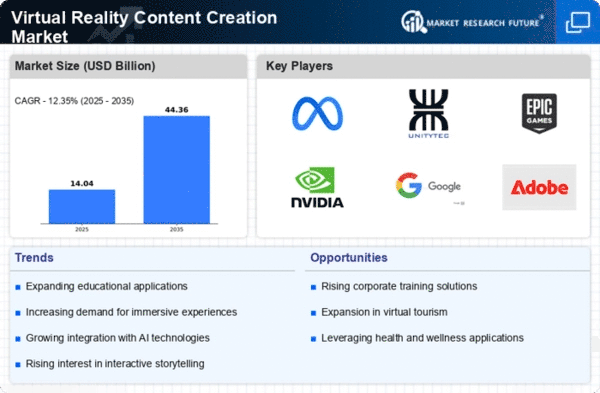
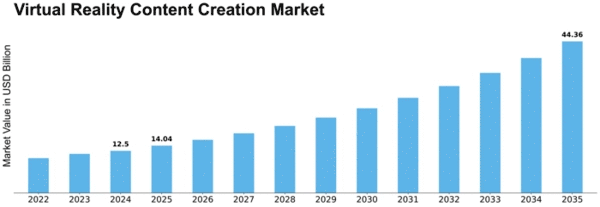
As per MRFR analysis, the Virtual Reality Content Creation Market Size was estimated at 12.5 USD Billion in 2024. The Virtual Reality Content Creation industry is projected to grow from 13.84 USD Billion in 2025 to 44.36 USD Billion by 2035, exhibiting a compound annual growth rate (CAGR) of 12.35 during the forecast period 2025 - 2035.

Key Market Trends & Highlights

The Virtual Reality Content Creation Market is experiencing robust growth driven by technological advancements and increasing demand for immersive experiences.

  • The market is witnessing increased accessibility of tools, enabling a broader range of creators to engage in VR content development.
  • North America remains the largest market, while the Asia-Pacific region is emerging as the fastest-growing area for VR content creation.
  • The gaming segment continues to dominate the market, whereas educational institutions are rapidly adopting VR for innovative learning experiences.
  • Advancements in technology and the growing demand for immersive experiences are key drivers propelling market expansion.

Market Size & Forecast

2024 Market Size 12.5 (USD Billion)
2035 Market Size 44.36 (USD Billion)
CAGR (2025 - 2035) 12.35%
Largest Regional Market Share in 2024 North America

Major Players

<p>Meta Platforms (US), Unity Technologies (US), Epic Games (US), Adobe Inc (US), NVIDIA Corporation (US), Autodesk Inc (US), Google LLC (US), Microsoft Corporation (US), Sony Interactive Entertainment (JP)</p>

Market Trends

The Virtual Reality Content Creation Market is currently experiencing a transformative phase, characterized by rapid advancements in technology and an increasing demand for immersive experiences across various sectors. This market encompasses a wide array of applications, including gaming, education, healthcare, and real estate, each leveraging virtual reality to enhance user engagement and interaction. As creators and developers explore innovative tools and platforms, the potential for unique storytelling and experiential learning expands, suggesting a promising future for content creators. Furthermore, the integration of artificial intelligence and machine learning into content creation processes appears to streamline workflows, enabling more efficient production and customization of virtual environments. In December 2025, the market seems poised for further growth, driven by the rising popularity of virtual reality headsets and the proliferation of high-speed internet access. As more consumers embrace these technologies, the demand for high-quality content is likely to surge, prompting creators to refine their skills and adapt to evolving consumer preferences. Additionally, collaborations between technology companies and content creators may foster a more vibrant ecosystem, encouraging innovation and experimentation. Overall, the Virtual Reality Content Creation Market indicates a dynamic landscape, where creativity and technology converge to redefine how audiences experience digital content.

Increased Accessibility of Tools

The availability of user-friendly software and hardware is expanding opportunities for creators in the Virtual Reality Content Creation Market. As tools become more accessible, individuals and small teams can produce high-quality content without the need for extensive resources or technical expertise. This democratization of content creation is likely to lead to a surge in diverse and innovative projects.

Focus on Educational Applications

There is a growing emphasis on utilizing virtual reality for educational purposes within the Virtual Reality Content Creation Market. Institutions are increasingly adopting immersive learning experiences to enhance engagement and retention among students. This trend suggests a shift towards experiential learning, where users can interact with content in a more meaningful way.

Integration of Social Experiences

The Virtual Reality Content Creation Market is witnessing a trend towards creating social experiences that allow users to connect and interact within virtual environments. This focus on community-building and shared experiences indicates a potential shift in how content is consumed, moving from solitary experiences to collaborative and social interactions.

Virtual Reality Content Creation Market Market Drivers

Market Growth Projections

The Global Virtual Reality Content Creation Market Industry is poised for substantial growth, with projections indicating a market size of 12.5 USD Billion in 2024 and an anticipated increase to 45 USD Billion by 2035. This growth trajectory suggests a robust compound annual growth rate (CAGR) of 12.35% from 2025 to 2035. Such figures reflect the increasing investment in VR technologies and content creation, driven by consumer demand and industry adoption across various sectors. As the market evolves, it is expected to attract new players and foster innovation, further enhancing the diversity and quality of VR content available.

Growth of E-Learning Platforms

The Global Virtual Reality Content Creation Market Industry benefits from the expansion of e-learning platforms that incorporate VR technology. Educational institutions and training organizations are increasingly adopting VR to create interactive learning environments that enhance student engagement and retention. For instance, VR simulations allow learners to practice real-world scenarios in a safe setting, which is particularly valuable in fields such as aviation and medicine. As e-learning continues to evolve, the integration of VR is likely to become more prevalent, contributing to the market's growth and attracting investments in content creation tailored for educational purposes.

Technological Advancements in VR

The Global Virtual Reality Content Creation Market Industry is propelled by rapid technological advancements in virtual reality hardware and software. Innovations such as improved graphics processing units, enhanced motion tracking, and more immersive audio systems contribute to the creation of high-quality content. For instance, the introduction of 8K resolution displays and advanced haptic feedback systems allows creators to produce more engaging experiences. As a result, the market is projected to reach 12.5 USD Billion in 2024, indicating a growing demand for sophisticated VR content that meets the expectations of consumers and businesses alike.

Supportive Government Initiatives

Government initiatives aimed at promoting technological innovation play a crucial role in the Global Virtual Reality Content Creation Market Industry. Various countries are investing in VR research and development, recognizing its potential to drive economic growth and enhance competitiveness. For example, funding programs and grants for VR startups encourage the development of new content and applications. These initiatives not only support the growth of the industry but also foster collaboration between academia and industry, leading to the creation of cutting-edge VR solutions. This supportive environment is likely to accelerate market expansion and innovation in the coming years.

Increasing Adoption Across Industries

The Global Virtual Reality Content Creation Market Industry experiences significant growth due to the increasing adoption of VR technology across various sectors. Industries such as education, healthcare, and real estate are leveraging VR for training, simulations, and virtual tours. For example, medical institutions utilize VR for surgical training, enhancing the skills of future surgeons. This trend is likely to expand as organizations recognize the potential of VR to improve efficiency and engagement. The market is expected to grow at a CAGR of 12.35% from 2025 to 2035, reflecting the sustained interest in VR applications across diverse fields.

Rising Demand for Immersive Experiences

Consumer demand for immersive experiences drives the Global Virtual Reality Content Creation Market Industry forward. As audiences seek more engaging and interactive content, creators are compelled to innovate and enhance their offerings. This trend is particularly evident in the gaming and entertainment sectors, where VR provides unique experiences that traditional media cannot match. The market's growth is indicative of this shift, with projections suggesting it will reach 45 USD Billion by 2035. This increasing demand for immersive content encourages developers to explore new storytelling techniques and interactive formats, further enriching the VR landscape.

Market Segment Insights

By Application: Gaming (Largest) vs. Education (Fastest-Growing)

<p>In the Virtual Reality Content Creation Market, the application segments exhibit diverse market shares. Gaming remains the largest segment, driven by an increasing number of gamers and the demand for immersive gaming experiences. This segment is characterized by high consumer engagement, with numerous VR gaming titles being produced, catering to various demographics. Following gaming, education is emerging as a significant player, capitalizing on the increasing integration of VR in learning environments, enhancing interactive learning experiences. Education is witnessing a rapid rise in its market share, bolstered by institutions adopting VR for training and educational enhancements. This segment's growth is stimulated by advancements in technology that enable realistic simulations and participatory learning. Meanwhile, healthcare and real estate applications are also gaining traction, but they do not yet match the growth rate of education, which is poised to become a fundamental tool in classrooms and training centers worldwide.</p>

<p>Gaming: Dominant vs. Education: Emerging</p>

<p>The gaming segment of the Virtual Reality Content Creation Market stands as the dominant force, appealing to consumers seeking immersive experiences. With advancements in technology and a growing user base, gaming titles are now more sophisticated, offering rich visual experiences and interactive gameplay. This segment is characterized by extensive investment, with established entertainment companies dedicating resources to virtual reality development. On the other hand, the education sector represents an emerging opportunity, leveraging VR to create engaging learning environments. It enables experiential learning through immersive simulations and virtual field trips, enhancing retention and understanding. As educators recognize the benefits of VR in supporting varied learning styles, this segment is set to expand rapidly in the coming years.</p>

By End Use: Healthcare Providers (Largest) vs. Educational Institutions (Fastest-Growing)

<p>In the Virtual Reality Content Creation Market, Healthcare Providers currently hold the largest share, driven by the increasing adoption of VR for surgical training, patient rehabilitation, and virtual consultations. This segment benefits from the high user engagement and effective simulations that VR offers, making it an attractive option for healthcare professionals seeking innovative training programs. On the other hand, Educational Institutions are emerging as a fastest-growing segment, leveraging VR technology to enhance learning experiences and improve student engagement. Educational content tailored for different subjects using immersive VR experiences is rapidly transforming traditional teaching methodologies and attracting significant attention. The growth in the Healthcare Providers segment is largely fueled by technological advancements in VR solutions that allow for cost-effective and safe training environments. Coupled with the ongoing demand for virtual health services post-pandemic, this segment seems poised for sustained growth. Conversely, Educational Institutions are adopting VR to provide interactive and experiential learning, catering to the needs of modern learners. Enhanced educational outcomes with VR tools indicate a strong potential for growth, especially as institutions increasingly realize the value of immersive learning experiences in improving knowledge retention and skills acquisition.</p>

<p>Healthcare Providers (Dominant) vs. Educational Institutions (Emerging)</p>

<p>The Healthcare Providers segment serves as a dominant force in the Virtual Reality Content Creation Market, leveraging advanced simulations for medical training and patient care scenarios. Hospitals and medical schools are integrating VR experiences to facilitate complex surgical training and therapeutic interventions, thus ensuring practitioners receive hands-on experiences without the risks associated with real-life procedures. In contrast, Educational Institutions, classified as an emerging segment, utilize VR to revolutionize the learning environment. They create immersive educational content that brands the current curriculum more engaging and effective. Institutions are increasingly aware of the advantages of utilizing VR tools for skills training and interactive learning, which enhances student engagement and fosters an environment of exploration, critical thinking, and real-world application of knowledge.</p>

By Technology: Content Creation Tools (Largest) vs. Software Development (Fastest-Growing)

<p>In the Virtual Reality Content Creation Market, 'Content Creation Tools' hold the largest share, driven by the increasing demand for interactive and immersive experiences in various sectors, including gaming, education, and training. As creators seek advanced tools to enhance storytelling and user engagement, this segment is expected to maintain its prominent position. Meanwhile, 'Software Development' is emerging as the fastest-growing segment, fueled by innovations in VR programming and the integration of AI technologies. The rising need for customized applications is propelling software development to new heights.</p>

<p>Technology: Content Creation Tools (Dominant) vs. Software Development (Emerging)</p>

<p>Content Creation Tools are pivotal in the Virtual Reality Content Creation Market, providing users with essential resources to create captivating VR experiences. This segment includes software for 3D modeling, animation, and interactive design, enabling creators to produce high-quality content efficiently. In contrast, Software Development is rapidly becoming an emerging segment as it focuses on creating tailored applications to meet specific needs. With the demand for specialized VR solutions intensifying, software development is leveraging cutting-edge technologies such as AI and machine learning, thus enhancing the VR ecosystem. The collaboration between content creation and software development is set to fuel innovation and expand market opportunities.</p>

Get more detailed insights about Virtual Reality Content Creation Market Research Report - Global Forecast till 2035

Regional Insights

North America : Innovation Hub for VR

North America dominates the Virtual Reality Content Creation Market, holding a significant share of 6.25 in 2024. The region's growth is driven by rapid technological advancements, increasing demand for immersive experiences, and supportive regulatory frameworks. Major investments in VR technologies by both private and public sectors further catalyze market expansion, making it a key player in the global landscape. The competitive landscape is robust, with leading companies such as Meta Platforms, Unity Technologies, and Epic Games spearheading innovation. The presence of major tech hubs in the US fosters collaboration and development, while the increasing adoption of VR in sectors like gaming, education, and healthcare enhances market potential. This dynamic environment positions North America as a leader in the VR content creation space.

Key Players and Competitive Insights

The Virtual Reality Content Creation Market is currently characterized by a dynamic competitive landscape, driven by rapid technological advancements and increasing demand for immersive experiences across various sectors. Major players such as Meta Platforms (US), Unity Technologies (US), and Epic Games (US) are at the forefront, each adopting distinct strategies to enhance their market positioning. Meta Platforms (US) continues to focus on innovation in social VR experiences, while Unity Technologies (US) emphasizes its real-time 3D development platform, catering to a diverse range of industries. Epic Games (US), with its Unreal Engine, is strategically positioned to dominate the gaming and entertainment sectors, leveraging high-fidelity graphics and user engagement. Collectively, these strategies contribute to a competitive environment that is increasingly centered around technological prowess and user experience.

In terms of business tactics, companies are increasingly localizing their operations and optimizing supply chains to enhance efficiency and responsiveness to market demands. The competitive structure of the market appears moderately fragmented, with a mix of established players and emerging startups. This fragmentation allows for innovation and niche offerings, while the collective influence of key players drives overall market growth and sets industry standards.

In November 2025, Meta Platforms (US) announced a significant partnership with a leading educational institution to develop VR-based learning modules. This strategic move is likely to enhance Meta's presence in the educational sector, aligning with the growing trend of immersive learning experiences. By integrating VR into educational curricula, Meta aims to create engaging learning environments that could redefine traditional educational methodologies.

In October 2025, Unity Technologies (US) launched a new suite of tools aimed at simplifying the VR content creation process for developers. This initiative is indicative of Unity's commitment to fostering innovation and accessibility within the VR ecosystem. By streamlining development workflows, Unity is likely to attract a broader range of creators, thereby expanding its user base and reinforcing its market leadership.

In September 2025, Epic Games (US) unveiled a new initiative focused on sustainability in VR content creation, emphasizing eco-friendly practices in its development processes. This strategic focus not only aligns with global sustainability trends but also positions Epic as a responsible leader in the industry. By prioritizing sustainable practices, Epic Games may enhance its brand reputation and appeal to environmentally conscious consumers.

As of December 2025, the competitive trends within the Virtual Reality Content Creation Market are increasingly shaped by digitalization, AI integration, and sustainability. Strategic alliances are becoming more prevalent, as companies recognize the value of collaboration in driving innovation and expanding market reach. Looking ahead, competitive differentiation is expected to evolve, with a notable shift from price-based competition to a focus on technological innovation, user experience, and supply chain reliability. This transition suggests that companies that prioritize these aspects will likely emerge as leaders in the evolving landscape.

Key Companies in the Virtual Reality Content Creation Market market include

Industry Developments

  • Q2 2024: Meta launches new VR content creation tools for Horizon Worlds Meta announced the release of advanced content creation tools for its Horizon Worlds platform, enabling creators to build more immersive virtual reality experiences and interactive environments.
  • Q2 2024: Sony unveils PlayStation VR2 Creator Suite for developers Sony introduced the PlayStation VR2 Creator Suite, a set of software tools designed to help developers and content creators produce high-quality VR experiences for the PlayStation VR2 ecosystem.
  • Q2 2024: Epic Games partners with Unreal Engine to expand VR content creation capabilities Epic Games announced a strategic partnership with Unreal Engine to enhance VR content creation, focusing on new features for real-time collaboration and photorealistic rendering in virtual environments.
  • Q3 2024: Unity Technologies acquires VR content studio Polyarc Unity Technologies completed the acquisition of Polyarc, a leading VR content studio, to strengthen its portfolio and accelerate the development of immersive virtual reality experiences.
  • Q3 2024: Meta announces $150 million investment in VR content creator fund Meta revealed a $150 million investment to support independent VR content creators, aiming to boost innovation and diversity in virtual reality experiences across its platforms.
  • Q3 2024: Sony Interactive Entertainment opens new VR content studio in Tokyo Sony Interactive Entertainment inaugurated a dedicated VR content studio in Tokyo, focusing on the development of original virtual reality games and interactive experiences for global audiences.
  • Q4 2024: Roblox launches VR content creation platform for user-generated worlds Roblox introduced a new VR content creation platform, allowing users to design, publish, and monetize immersive virtual worlds within the Roblox ecosystem.
  • Q4 2024: Apple partners with Pixar to develop VR storytelling tools for Vision Pro Apple announced a partnership with Pixar to co-develop VR storytelling tools tailored for the Vision Pro headset, aiming to empower creators to produce cinematic virtual reality experiences.
  • Q1 2025: Google launches VR content creation suite for YouTube creators Google rolled out a VR content creation suite for YouTube creators, providing new editing and publishing tools to facilitate the production of immersive 360-degree videos.
  • Q1 2025: ByteDance invests $80 million in VR content startup Dreamscape ByteDance made an $80 million investment in Dreamscape, a VR content startup, to accelerate the development of interactive virtual reality experiences for global markets.
  • Q2 2025: Meta acquires VR animation studio Quill for undisclosed sum Meta completed the acquisition of Quill, a VR animation studio, to expand its capabilities in immersive storytelling and virtual reality content production.
  • Q2 2025: Sony signs partnership with Autodesk to integrate VR content creation tools Sony announced a partnership with Autodesk to integrate advanced VR content creation tools into its development ecosystem, aiming to streamline workflows for professional creators.

Key Players

Global Virtual Reality Content Creation Market is characterized by the presence of several regional and local providers. Some of the key players in the market are:

    • Blippar
    • 360 Labs
    • Matterport
    • Koncept VR
    • SubVRsive
    • Panedia Pty Ltd.
    • WeMakeVR
    • VIAR (Viar360)
    • Pixvana Inc.
    • Scapic

Future Outlook

Virtual Reality Content Creation Market Future Outlook

<p>The Virtual Reality Content Creation Market is projected to grow at a 12.35% CAGR from 2024 to 2035, driven by technological advancements, increased demand for immersive experiences, and expanding applications across industries.</p>

New opportunities lie in:

  • <p>Development of VR content creation platforms for educational institutions.</p>
  • <p>Partnerships with gaming companies to create exclusive VR experiences.</p>
  • <p>Investment in AI-driven tools for automated content generation.</p>

<p>By 2035, the market is expected to be robust, reflecting substantial growth and innovation.</p>

Market Segmentation

Virtual Reality Content Creation Market End Use Outlook

  • Individual Users
  • Educational Institutions
  • Healthcare Providers
  • Real Estate Developers
  • Corporate Training

Virtual Reality Content Creation Market Technology Outlook

  • Software Development
  • Hardware Integration
  • Content Creation Tools
  • User Interface Design
  • Simulation Technology

Virtual Reality Content Creation Market Application Outlook

  • Gaming
  • Education
  • Healthcare
  • Real Estate
  • Entertainment

Report Scope

MARKET SIZE 202412.5(USD Billion)
MARKET SIZE 202513.84(USD Billion)
MARKET SIZE 203544.36(USD Billion)
COMPOUND ANNUAL GROWTH RATE (CAGR)12.35% (2024 - 2035)
REPORT COVERAGERevenue Forecast, Competitive Landscape, Growth Factors, and Trends
BASE YEAR2024
Market Forecast Period2025 - 2035
Historical Data2019 - 2024
Market Forecast UnitsUSD Billion
Key Companies ProfiledMeta Platforms (US), Unity Technologies (US), Epic Games (US), Adobe Inc (US), NVIDIA Corporation (US), Autodesk Inc (US), Google LLC (US), Microsoft Corporation (US), Sony Interactive Entertainment (JP)
Segments CoveredApplication, End Use, Technology
Key Market OpportunitiesIntegration of artificial intelligence in Virtual Reality Content Creation Market enhances user engagement and content personalization.
Key Market DynamicsRising demand for immersive experiences drives innovation and competition in the Virtual Reality Content Creation Market.
Countries CoveredNorth America, Europe, APAC, South America, MEA

FAQs

What are the drivers rousing overall virtual reality content creation market progress in the coming period?

The importance placed on customer experience marketing strategies is predicted to garner a favourable expansion momentum.

What income capacity is projected from the virtual reality content creation market’s businesses in the years ahead?

Intensifying growth momentum is estimated to be seen in the market through the forecast period.

What CAGR prospective is anticipated for the virtual reality content creation market in the forthcoming period?

A CAGR of 76.5% is appraised to guide the market in the forecast period.

Who are the momentous contenders operational in the virtual reality content creation market?

Matterport, Koncept VR, SubVRsive, 360 Labs and Panedia Pty Ltd. are some of the top firms in the global market.

Which region is topmost in the global virtual reality content creation market in the forecast period?

The accessibility to well-developed I.T. infrastructure is estimated to reinforce the North American regions top position in the market.

  1. EXECUTIVE SUMMARY
    1. MARKET ATTRACTIVENESS
      1. GLOBAL VIRTUAL REALITY CONTENT CREATION MARKET, BY CONTENT-TYPE
      2. GLOBAL VIRTUAL REALITY CONTENT CREATION MARKET, BY COMPONENT
    2. ANALYSIS
  2. GLOBAL VIRTUAL REALITY CONTENT CREATION MARKET, BY END-USER
  3. GLOBAL VIRTUAL
  4. REALITY CONTENT CREATION MARKET, BY REGION
  5. MARKET INTRODUCTION
    1. DEFINITION
    2. SCOPE OF THE STUDY
    3. MARKET STRUCTURE
  6. RESEARCH
    1. METHODOLOGY
    2. RESEARCH PROCESS
    3. PRIMARY RESEARCH
    4. SECONDARY
    5. MARKET SIZE ESTIMATION
    6. FORECAST MODEL
    7. LIST
  7. OF ASSUMPTIONS
  8. MARKET DYNAMICS
    1. INTRODUCTION
    2. DRIVERS
      1. GROWING DEMAND FOR HEAD-MOUNTED DISPLAY (HMDS) IN THE GAMING AND ENTERTAINMENT
      2. AVAILABILITY OF AFFORDABLE VIRTUAL REALITY DEVICES
      3. LACK OF AWARENESS REGARDING THE ADVANTAGES OF USING VIRTUAL
    3. SECTOR
    4. RESTRAINTS
    5. REALITY DEVICES
    6. OPPORTUNITIES
      1. PENETRATION OF HMDS IN HEALTHCARE
    7. AND ARCHITECTURAL APPLICATIONS
  9. MARKET FACTOR ANALYSIS
    1. VALUE CHAIN
  10. ANALYSIS/SUPPLY CHAIN ANALYSIS
    1. PORTER’S FIVE FORCES MODEL
      1. BARGAINING POWER OF BUYERS
      2. THREAT OF SUBSTITUTES
      3. INTENSITY OF
    2. BARGAINING POWER OF SUPPLIERS
    3. THREAT OF NEW ENTRANTS
    4. RIVALRY
  11. GLOBAL VIRTUAL REALITY CONTENT CREATION MARKET SIZE ESTIMATION &
    1. FORECAST, BY CONTENT TYPE
    2. INTRODUCTION
    3. VIDEOS
    4. 360-DEGREE
    5. PHOTOS
    6. GAMES
  12. GLOBAL VIRTUAL REALITY CONTENT CREATION MARKET SIZE
    1. ESTIMATION & FORECAST, BY COMPONENT
    2. INTRODUCTION
    3. SOFTWARE
    4. SERVICES
  13. GLOBAL VIRTUAL REALITY CONTENT CREATION MARKET SIZE ESTIMATION
    1. & FORECAST, BY END-USER
    2. INTRODUCTION
    3. REAL ESTATE
    4. TRAVEL AND HOSPITALITY
    5. MEDIA AND ENTERTAINMENT
    6. HEALTHCARE
    7. GAMING
    8. AUTOMOTIVE
    9. OTHERS
  14. GLOBAL VIRTUAL
  15. REALITY CONTENT CREATION MARKET SIZE ESTIMATION & FORECAST, BY REGION
    1. INTRODUCTION
    2. NORTH AMERICA
      1. MARKET ESTIMATES & FORECAST,
      2. MARKET ESTIMATES & FORECAST, BY CONTENT
      3. MARKET ESTIMATES & FORECAST, BY COMPONENT,
      4. MARKET ESTIMATES & FORECAST, BY END-USER, 2020–2027
      5. US
    3. BY COUNTRY, 2020–2027
    4. TYPE, 2020–2027
  16. MARKET ESTIMATES & FORECAST, BY COMPONENT, 2020–2027
    1. ESTIMATES & FORECAST, BY END-USER, 2020–2027
  17. MARKET
  18. CANADA
  19. MARKET ESTIMATES & FORECAST, BY CONTENT TYPE, 2020–2027
  20. MARKET ESTIMATES & FORECAST, BY TYPE, 2020–2027
    1. & FORECAST, BY COMPONENT, 2020–2027
    2. FORECAST, BY END-USER, 2020–2027
    3. & FORECAST, BY CONTENT TYPE, 2020–2027
    4. & FORECAST, BY TYPE, 2020–2027
    5. BY COMPONENT, 2020–2027
    6. END-USER, 2020–2027
    7. BY COUNTRY, 2020–2027
    8. TYPE, 2020–2027
  21. MARKET ESTIMATES
  22. MARKET ESTIMATES &
  23. MEXICO
  24. MARKET ESTIMATES
  25. MARKET ESTIMATES
  26. MARKET ESTIMATES & FORECAST,
  27. MARKET ESTIMATES & FORECAST, BY
    1. EUROPE
      1. MARKET ESTIMATES & FORECAST,
      2. MARKET ESTIMATES & FORECAST, BY CONTENT
      3. MARKET ESTIMATES & FORECAST, BY COMPONENT,
      4. MARKET ESTIMATES & FORECAST, BY END-USER, 2020–2027
      5. GERMANY
  28. MARKET ESTIMATES & FORECAST, BY END-USER, 2020–2027
  29. UK
  30. MARKET ESTIMATES & FORECAST, BY CONTENT TYPE, 2020–2027
  31. MARKET ESTIMATES & FORECAST, BY TYPE, 2020–2027
  32. MARKET ESTIMATES & FORECAST, BY COMPONENT, 2020–2027
    1. ESTIMATES & FORECAST, BY END-USER, 2020–2027
  33. MARKET
  34. FRANCE
  35. MARKET ESTIMATES & FORECAST, BY CONTENT TYPE, 2020–2027
  36. MARKET ESTIMATES & FORECAST, BY TYPE, 2020–2027
    1. & FORECAST, BY COMPONENT, 2020–2027
    2. FORECAST, BY END-USER, 2020–2027
    3. ESTIMATES & FORECAST, BY CONTENT TYPE, 2020–2027
    4. ESTIMATES & FORECAST, BY TYPE, 2020–2027
    5. & FORECAST, BY COMPONENT, 2020–2027
    6. FORECAST, BY END-USER, 2020–2027
  37. MARKET ESTIMATES
  38. MARKET ESTIMATES &
  39. GERMANY
  40. MARKET
  41. MARKET
  42. MARKET ESTIMATES
  43. MARKET ESTIMATES &
  44. REST OF EUROPE
  45. MARKET ESTIMATES & FORECAST, BY CONTENT TYPE, 2020–2027
  46. MARKET ESTIMATES & FORECAST, BY TYPE, 2020–2027
    1. & FORECAST, BY COMPONENT, 2020–2027
    2. FORECAST, BY END-USER, 2020–2027
    3. ESTIMATES & FORECAST, BY COUNTRY, 2020–2027
    4. & FORECAST, BY CONTENT TYPE, 2020–2027
    5. FORECAST, BY COMPONENT, 2020–2027
    6. BY END-USER, 2020–2027
    7. FORECAST, BY CONTENT TYPE, 2020–2027
    8. FORECAST, BY TYPE, 2020–2027
    9. BY COMPONENT, 2020–2027
    10. END-USER, 2020–2027
    11. FORECAST, BY CONTENT TYPE, 2020–2027
    12. FORECAST, BY TYPE, 2020–2027
    13. BY COMPONENT, 2020–2027
    14. END-USER, 2020–2027
    15. FORECAST, BY CONTENT TYPE, 2020–2027
    16. FORECAST, BY TYPE, 2020–2027
    17. BY COMPONENT, 2020–2027
    18. END-USER, 2020–2027
    19. ESTIMATES & FORECAST, BY CONTENT TYPE, 2020–2027
    20. ESTIMATES & FORECAST, BY TYPE, 2020–2027
    21. & FORECAST, BY COMPONENT, 2020–2027
    22. FORECAST, BY END-USER, 2020–2027
  47. MARKET ESTIMATES
  48. MARKET ESTIMATES &
    1. ASIA PACIFIC
      1. MARKET
      2. MARKET ESTIMATES
      3. MARKET ESTIMATES &
      4. MARKET ESTIMATES & FORECAST,
      5. CHINA
      6. INDIA
      7. JAPAN
      8. REST OF ASIA PACIFIC
    2. MIDDLE EAST AND AFRICA
  49. MARKET ESTIMATES & FORECAST, BY COUNTRY, 2020–2027
    1. ESTIMATES & FORECAST, BY CONTENT TYPE, 2020–2027
    2. & FORECAST, BY COMPONENT, 2020–2027
    3. FORECAST, BY END-USER, 2020–2027
    4. ESTIMATES & FORECAST, BY COUNTRY, 2020–2027
    5. & FORECAST, BY CONTENT TYPE, 2020–2027
    6. FORECAST, BY COMPONENT, 2020–2027
    7. BY END-USER, 2020–2027
  50. MARKET
  51. MARKET ESTIMATES
  52. MARKET ESTIMATES &
    1. SOUTH AMERICA
      1. MARKET
      2. MARKET ESTIMATES
      3. MARKET ESTIMATES &
      4. MARKET ESTIMATES & FORECAST,
  53. COMPETITIVE LANDSCAPE
    1. INTRODUCTION
    2. COMPETITIVE ANALYSIS
    3. MARKET SHARE ANALYSIS
    4. MAJOR GROWTH
  54. STRATEGY IN THE GLOBAL VIRTUAL REALITY CONTENT CREATION MARKET
    1. COMPETITIVE
    2. BENCHMARKING
    3. KEY DEVELOPMENTS & GROWTH STRATEGIES
      1. NEW
      2. MERGER & ACQUISITION
    4. PRODUCT LAUNCH/SERVICE MODEL
    5. JOINT VENTURES
  55. COMPANY PROFILES
    1. 360 LABS
      1. COMPANY
      2. FINANCIAL OVERVIEW
      3. PRODUCT OFFERED
      4. SWOT ANALYSIS
      5. KEY STRATEGIES
      6. COMPANY OVERVIEW
      7. FINANCIAL OVERVIEW
      8. KEY DEVELOPMENTS
      9. SWOT ANALYSIS
    2. OVERVIEW
    3. KEY DEVELOPMENTS
    4. BLIPPAR
    5. PRODUCT OFFERED
    6. KEY STRATEGIES
    7. KONCEPT VR
      1. COMPANY OVERVIEW
      2. PRODUCT OFFERED
      3. KEY DEVELOPMENTS
      4. SWOT ANALYSIS
      5. KEY STRATEGIES
    8. FINANCIAL OVERVIEW
    9. MATTERPORT, INC.
      1. COMPANY OVERVIEW
      2. FINANCIAL OVERVIEW
      3. PRODUCT
      4. KEY DEVELOPMENTS
      5. SWOT ANALYSIS
      6. KEY
    10. OFFERED
    11. STRATEGIES
    12. PANEDIA PTY LTD
      1. COMPANY OVERVIEW
      2. PRODUCT OFFERED
      3. KEY DEVELOPMENTS
      4. SWOT ANALYSIS
      5. KEY STRATEGIES
    13. FINANCIAL OVERVIEW
    14. PIXVANA INC.
      1. FINANCIAL OVERVIEW
      2. PRODUCT OFFERED
      3. KEY DEVELOPMENTS
      4. SWOT ANALYSIS
      5. KEY STRATEGIES
    15. COMPANY OVERVIEW
    16. SCAPIC
      1. COMPANY OVERVIEW
      2. FINANCIAL OVERVIEW
      3. PRODUCT OFFERED
      4. KEY DEVELOPMENTS
      5. SWOT ANALYSIS
      6. KEY STRATEGIES
    17. SUBVRSIVE
      1. COMPANY OVERVIEW
      2. PRODUCT OFFERED
      3. KEY DEVELOPMENTS
      4. SWOT ANALYSIS
      5. KEY STRATEGIES
    18. FINANCIAL OVERVIEW
    19. VIAR
      1. FINANCIAL OVERVIEW
      2. PRODUCT OFFERED
      3. KEY DEVELOPMENTS
      4. SWOT ANALYSIS
      5. KEY STRATEGIES
    20. COMPANY OVERVIEW
    21. WEMAKEVR
      1. COMPANY OVERVIEW
      2. FINANCIAL OVERVIEW
      3. PRODUCT OFFERED
      4. KEY DEVELOPMENTS
      5. SWOT ANALYSIS
      6. KEY STRATEGIES
  56. APPENDIX
    1. REFERENCES
    2. RELATED
    3. REPORTS
    4. LIST OF ABBREVIATION
    5. NOTE:
    6. THIS TABLE OF CONTENT
    7. IS TENTATIVE AND SUBJECT TO CHANGE AS THE RESEARCH PROGRESSES.
    8.  PLEASE NOTE:
    9. THE FINANCIAL DETAILS OF THE COMPANY CANNOT BE PROVIDED IF THE INFORMATION IS NOT
    10. AVAILABLE IN THE PUBLIC DOMAIN AND OR FROM RELIABLE SOURCES.

Virtual Reality Content Creation Market Segmentation

Market Segmentation Overview

  • Detailed segmentation data will be available in the full report
  • Comprehensive analysis by multiple parameters
  • Regional and country-level breakdowns
  • Market size forecasts by segment
Infographic

Free Sample Request

Kindly complete the form below to receive a free sample of this Report

Get Free Sample

Customer Strories

Compare Licence

×
Features License Type
Single User Multiuser License Enterprise User
Price $4,950 $5,950 $7,250
Maximum User Access Limit 1 User Upto 10 Users Unrestricted Access Throughout the Organization
Free Customization
Direct Access to Analyst
Deliverable Format
Platform Access
Discount on Next Purchase 10% 15% 15%
Printable Versions