×
Request Free Sample ×

Kindly complete the form below to receive a free sample of this Report

* Please use a valid business email

Leading companies partner with us for data-driven Insights

clients tt-cursor
Hero Background
English
Chinese
French
Japanese
Korean
German
Spanish

Virtual Reality Content Creation Market Analysis

ID: MRFR/ICT/8074-HCR
111 Pages
Aarti Dhapte
October 2025

Virtual Reality Content Creation Market Research Report Information By Content Type (Videos, 360-degree photos and Games), By Component ( Software and Services), By End User ( Real estate, Travel & Hospitality, Media & Entertainment, Healthcare, Gaming, Automotive and Others), By Region (North America, Europe, Asia-Pacific, Middle East & Africa, South America) - Forecast till 2035

Share:
Download PDF ×

We do not share your information with anyone. However, we may send you emails based on your report interest from time to time. You may contact us at any time to opt-out.

Virtual Reality Content Creation Market Infographic
×
Virtual Reality Content Creation Market Infographic Full View
Purchase Options

Market Analysis

In-depth Analysis of Virtual Reality Content Creation Market Industry Landscape

One of the key drivers pushing the market is the fast advancement of VR equipment and programming innovations. Advancements in VR headsets, movement controllers, and haptic criticism frameworks have improved the vivid experience for clients as well as prodded content makers to push the limits of what is conceivable. This consistent innovative advancement has prompted a developing interest for top caliber, drawing in VR content across different ventures, including gaming, diversion, schooling, medical care, and endeavor. Customer interest for vivid encounters has been a vital figure molding the market elements. As VR equipment turns out to be more open and reasonable, a more extensive segment is entering the VR space, powering the requirement for different and convincing content. Gaming, specifically, has been a significant driver of VR content creation, with designers endeavoring to convey vivid and intelligent gaming encounters that influence the extraordinary capacities of virtual reality. In addition, the market elements are impacted by the ascent of social VR stages and applications. Virtual spaces for social communication, virtual occasions, and cooperative work areas are acquiring fame, setting out new open doors for content makers. The interest for social VR encounters has prompted the advancement of content that cultivates commitment, correspondence, and shared encounters inside virtual conditions. Besides, joint efforts and organizations are turning out to be progressively pervasive in the VR content creation landscape. Cross-industry coordinated efforts between innovation organizations, content makers, and dissemination stages are cultivating the advancement of pivotal encounters. These organizations speed up development as well as empower a more consistent combination of equipment and programming, improving the general client experience.

Author
Aarti Dhapte
Team Lead - Research

She holds an experience of about 6+ years in Market Research and Business Consulting, working under the spectrum of Information Communication Technology, Telecommunications and Semiconductor domains. Aarti conceptualizes and implements a scalable business strategy and provides strategic leadership to the clients. Her expertise lies in market estimation, competitive intelligence, pipeline analysis, customer assessment, etc.

Leave a Comment

FAQs

What are the drivers rousing overall virtual reality content creation market progress in the coming period?

The importance placed on customer experience marketing strategies is predicted to garner a favourable expansion momentum.

What income capacity is projected from the virtual reality content creation market’s businesses in the years ahead?

Intensifying growth momentum is estimated to be seen in the market through the forecast period.

What CAGR prospective is anticipated for the virtual reality content creation market in the forthcoming period?

A CAGR of 76.5% is appraised to guide the market in the forecast period.

Who are the momentous contenders operational in the virtual reality content creation market?

Matterport, Koncept VR, SubVRsive, 360 Labs and Panedia Pty Ltd. are some of the top firms in the global market.

Which region is topmost in the global virtual reality content creation market in the forecast period?

The accessibility to well-developed I.T. infrastructure is estimated to reinforce the North American regions top position in the market.

Market Summary

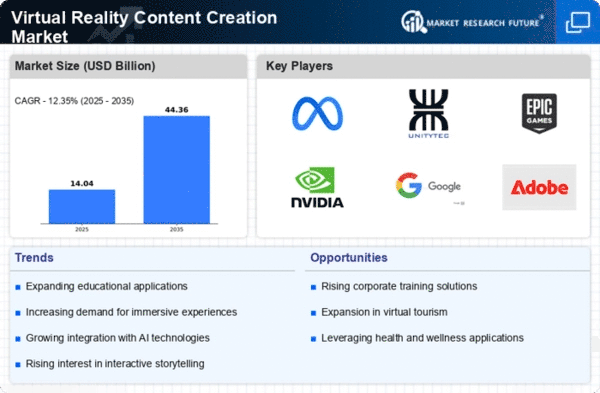
As per MRFR analysis, the Virtual Reality Content Creation Market Size was estimated at 12.5 USD Billion in 2024. The Virtual Reality Content Creation industry is projected to grow from 13.84 USD Billion in 2025 to 44.36 USD Billion by 2035, exhibiting a compound annual growth rate (CAGR) of 12.35 during the forecast period 2025 - 2035.

Key Market Trends & Highlights

The Virtual Reality Content Creation Market is experiencing robust growth driven by technological advancements and increasing consumer demand.

  • The rise of interactive storytelling is reshaping content creation, particularly in the gaming segment, which remains the largest market.
  • Integration of AI in content development is enhancing creativity and efficiency, appealing to individual creators and educational institutions alike.
  • Cross-platform compatibility is becoming essential as users seek seamless experiences across various devices, especially in North America.
  • Increased demand for immersive experiences and the expansion of VR hardware and software are key drivers propelling growth in both the gaming and education segments.

Market Size & Forecast

2024 Market Size 12.5 (USD Billion)
2035 Market Size 44.36 (USD Billion)
CAGR (2025 - 2035) 12.35%
Largest Regional Market Share in 2024 North America

Major Players

Meta Platforms (US), Unity Technologies (US), Epic Games (US), NVIDIA Corporation (US), Google LLC (US), Adobe Inc. (US), Autodesk Inc. (US), Sony Interactive Entertainment (JP), Microsoft Corporation (US)

Market Trends

The Virtual Reality Content Creation Market is currently experiencing a transformative phase, characterized by rapid advancements in technology and an increasing demand for immersive experiences across various sectors. This market encompasses a wide array of applications, including gaming, education, healthcare, and real estate, each leveraging virtual reality to enhance user engagement and interaction. As creators and developers continue to innovate, the potential for unique storytelling and experiential learning expands, suggesting a promising future for this industry. Furthermore, the integration of artificial intelligence and machine learning into content creation processes appears to streamline production, allowing for more personalized and adaptive experiences. In December 2025, the landscape of the Virtual Reality Content Creation Market is marked by a growing emphasis on accessibility and inclusivity. Developers are increasingly focused on creating content that caters to diverse audiences, ensuring that virtual experiences are available to individuals with varying abilities and backgrounds. This shift not only broadens the market's reach but also fosters a more inclusive environment for users. As the industry evolves, collaboration among creators, technologists, and stakeholders will likely play a crucial role in shaping the future of virtual reality content, driving innovation and expanding its applications across different fields.

Rise of Interactive Storytelling

The trend towards interactive storytelling in the Virtual Reality Content Creation Market is gaining momentum. Creators are increasingly designing narratives that allow users to influence the storyline through their choices, enhancing engagement and emotional connection. This approach not only enriches the user experience but also encourages repeat interactions, as individuals are drawn to explore different outcomes.

Integration of AI in Content Development

The incorporation of artificial intelligence into the Virtual Reality Content Creation Market is transforming how content is developed. AI tools are being utilized to automate various aspects of production, from animation to user experience design. This integration not only accelerates the creation process but also enables the generation of personalized content tailored to individual preferences.

Focus on Cross-Platform Compatibility

There is a growing emphasis on cross-platform compatibility within the Virtual Reality Content Creation Market. Developers are striving to create content that can be accessed across multiple devices, including VR headsets, smartphones, and computers. This trend aims to enhance user accessibility and broaden the audience base, ensuring that immersive experiences are available to a wider demographic.

Virtual Reality Content Creation Market Market Drivers

Market Growth Projections

The Global Virtual Reality Content Creation Market Industry is poised for substantial growth, with projections indicating a market size of 12.5 USD Billion in 2024 and an anticipated increase to 45 USD Billion by 2035. This growth trajectory suggests a robust compound annual growth rate (CAGR) of 12.35% from 2025 to 2035. Such figures reflect the increasing investment in VR technologies and content creation, driven by consumer demand and industry adoption across various sectors. As the market evolves, it is expected to attract new players and foster innovation, further enhancing the diversity and quality of VR content available.

Growth of E-Learning Platforms

The Global Virtual Reality Content Creation Market Industry benefits from the expansion of e-learning platforms that incorporate VR technology. Educational institutions and training organizations are increasingly adopting VR to create interactive learning environments that enhance student engagement and retention. For instance, VR simulations allow learners to practice real-world scenarios in a safe setting, which is particularly valuable in fields such as aviation and medicine. As e-learning continues to evolve, the integration of VR is likely to become more prevalent, contributing to the market's growth and attracting investments in content creation tailored for educational purposes.

Technological Advancements in VR

The Global Virtual Reality Content Creation Market Industry is propelled by rapid technological advancements in virtual reality hardware and software. Innovations such as improved graphics processing units, enhanced motion tracking, and more immersive audio systems contribute to the creation of high-quality content. For instance, the introduction of 8K resolution displays and advanced haptic feedback systems allows creators to produce more engaging experiences. As a result, the market is projected to reach 12.5 USD Billion in 2024, indicating a growing demand for sophisticated VR content that meets the expectations of consumers and businesses alike.

Supportive Government Initiatives

Government initiatives aimed at promoting technological innovation play a crucial role in the Global Virtual Reality Content Creation Market Industry. Various countries are investing in VR research and development, recognizing its potential to drive economic growth and enhance competitiveness. For example, funding programs and grants for VR startups encourage the development of new content and applications. These initiatives not only support the growth of the industry but also foster collaboration between academia and industry, leading to the creation of cutting-edge VR solutions. This supportive environment is likely to accelerate market expansion and innovation in the coming years.

Increasing Adoption Across Industries

The Global Virtual Reality Content Creation Market Industry experiences significant growth due to the increasing adoption of VR technology across various sectors. Industries such as education, healthcare, and real estate are leveraging VR for training, simulations, and virtual tours. For example, medical institutions utilize VR for surgical training, enhancing the skills of future surgeons. This trend is likely to expand as organizations recognize the potential of VR to improve efficiency and engagement. The market is expected to grow at a CAGR of 12.35% from 2025 to 2035, reflecting the sustained interest in VR applications across diverse fields.

Rising Demand for Immersive Experiences

Consumer demand for immersive experiences drives the Global Virtual Reality Content Creation Market Industry forward. As audiences seek more engaging and interactive content, creators are compelled to innovate and enhance their offerings. This trend is particularly evident in the gaming and entertainment sectors, where VR provides unique experiences that traditional media cannot match. The market's growth is indicative of this shift, with projections suggesting it will reach 45 USD Billion by 2035. This increasing demand for immersive content encourages developers to explore new storytelling techniques and interactive formats, further enriching the VR landscape.


Market Segment Insights

By Application: Gaming (Largest) vs. Education (Fastest-Growing)

The Virtual Reality Content Creation Market is experiencing diverse applications with the gaming sector emerging as the largest player, capturing a significant portion of the market share. Gaming not only draws from a substantial consumer base, but it also tends to attract high levels of investment and innovation, fostering further growth in this area. Other sectors such as education, healthcare, real estate, and entertainment are also gaining traction, albeit at varying speeds.

Gaming (Dominant) vs. Education (Emerging)

Gaming stands as the dominant application within the Virtual Reality Content Creation Market, fueled by advancements in technology and an increasing demand for immersive experiences. This segment thrives on interactive entertainment formats, appealing to both enthusiasts and casual players alike. Meanwhile, education is recognized as an emerging application that is revolutionizing traditional learning methods, utilizing VR for immersive simulations and engaging storytelling. The demand for remote learning solutions and experiential training drives this segment's rapid rise, attracting educational institutions eager to enhance curricula with innovative virtual experiences.

By End Use: Individual Creators (Largest) vs. Educational Institutions (Fastest-Growing)

The Virtual Reality Content Creation Market is largely dominated by Individual Creators, who significantly contribute to the innovative content produced in this space. Their accessibility to advanced VR tools allows for high creativity and a diverse array of projects. Meanwhile, Educational Institutions are emerging as a fast-growing segment, leveraging VR as a transformative teaching tool, enriching the learning experience with interactive and immersive content. Growth trends are primarily driven by technological advancements and increasing accessibility of VR tools. Individual Creators benefit from the growing demand for personalized content, while Educational Institutions are rapidly adopting VR solutions to enhance engagement and improve educational outcomes. The synergy between these segments fosters a dynamic environment, pushing the boundaries of virtual content creation.

Individual Creators (Dominant) vs. Educational Institutions (Emerging)

Individual Creators dominate the Virtual Reality Content Creation Market by harnessing their unique capabilities to produce bespoke, innovative content. They operate primarily as freelancers or hobbyists, utilizing affordable VR tools to create engaging experiences for entertainment, art, and personal projects. Conversely, Educational Institutions, as an emerging segment, are increasingly integrating VR into their curricula. These institutions view VR as a means to provide students with immersive learning experiences, enhancing knowledge retention and engagement. As a result, they are investing in advanced VR content creation tools to foster an interactive classroom environment. The distinctive approaches of both segments contribute to the overall growth and evolution of the VR content creation ecosystem.

By Technology: Software Tools (Largest) vs. Hardware Devices (Fastest-Growing)

The Virtual Reality Content Creation Market showcases a diverse array of technologies with notable distinctions in market share. Software tools hold the largest share, driven by their critical role in content development, offering creators a rich suite of applications and functionalities. Meanwhile, hardware devices, although currently smaller in share, are emerging rapidly, driven by technological advancements and increasing consumer demand for immersive experiences.

Technology: Software Tools (Dominant) vs. Hardware Devices (Emerging)

Software tools in this segment are characterized by their comprehensive capabilities to create, edit, and enhance virtual reality experiences, making them the dominant technology in the market. These tools enable creators to design intricate virtual environments and interactions, facilitating both professional and casual content development. In contrast, hardware devices, including VR headsets and motion tracking systems, are witnessing exponential growth, fueled by continuous innovation and an expanding user base seeking high-quality immersive experiences. Both segments complement each other, with software depending on robust hardware to deliver compelling content.

By Content Type: 360-Degree Videos (Largest) vs. Interactive Experiences (Fastest-Growing)

In the Virtual Reality Content Creation Market, 360-Degree Videos lead the segment with the largest market share, appealing to both consumers and enterprises for their immersive storytelling capabilities. Following closely, Interactive Experiences are gaining traction, offering users more engaging and participatory options. Virtual Tours and Simulation Training also play significant roles, although their shares are comparatively smaller among these content types.

360-Degree Videos (Dominant) vs. Interactive Experiences (Emerging)

360-Degree Videos serve as the dominant force in VR content, allowing users to experience environments in an all-encompassing manner, which greatly enhances entertainment and educational applications. Meanwhile, Interactive Experiences represent an emerging segment characterized by their ability to involve the audience directly, driving user engagement and participation. As technology advances, these interactive offerings become more sophisticated, incorporating gamification elements and user-generated content, thereby attracting a wider audience. The blend of these two types showcases the diversity of the VR content landscape. While 360-Degree Videos provide passive immersion, Interactive Experiences pave the way for active involvement, capturing the interest of younger demographics and industries seeking innovative training solutions.

By Distribution Channel: Online Platforms (Largest) vs. Direct Sales (Fastest-Growing)

In the Virtual Reality Content Creation Market, the distribution channel landscape is primarily dominated by online platforms, which provide extensive reach and accessibility to creators and consumers alike. Direct sales also play a significant role but are not as broadly utilized as online platforms. Partnerships and reseller networks complement these channels, allowing for a variety of content delivery mechanisms that cater to diverse audience needs.

Online Platforms (Dominant) vs. Direct Sales (Emerging)

Online platforms represent the dominant distribution channel in the Virtual Reality Content Creation Market, offering robust ecosystems for content creators with user-friendly interfaces and wide customer reach. These platforms often feature tools that facilitate the easy upload and sharing of VR content, making them essential for creators looking to maximize their audience. On the other hand, direct sales channels are emerging rapidly, allowing creators to engage directly with their customers, enhancing brand loyalty and providing unique content experiences. While still growing, direct sales are leveraging the increasing demand for personalized content, indicating a promising future for creators choosing this route.

Get more detailed insights about Virtual Reality Content Creation Market Research Report - Global Forecast till 2035

Regional Insights

North America : Innovation Hub for VR

North America dominates the Virtual Reality Content Creation Market, holding a significant share of 6.25 in 2024. The region's growth is driven by rapid technological advancements, increasing investments in VR technologies, and a robust demand for immersive experiences across various sectors, including gaming, education, and healthcare. Regulatory support and funding initiatives from government bodies further catalyze market expansion, making it a fertile ground for innovation. The competitive landscape in North America is characterized by the presence of major players such as Meta Platforms, Unity Technologies, and Epic Games. These companies are at the forefront of VR content creation, leveraging cutting-edge technologies to enhance user experiences. The U.S. remains a key player, with significant contributions from Canada and Mexico, fostering a collaborative environment for VR development and deployment. The region's focus on research and development ensures a continuous pipeline of innovative solutions.

Europe : Emerging Powerhouse in VR

Europe is rapidly emerging as a significant player in the Virtual Reality Content Creation Market, with a market size of 3.75 in 2024. The region benefits from a strong emphasis on digital transformation and innovation, supported by various EU initiatives aimed at fostering technological advancements. Increased consumer interest in VR applications across entertainment, training, and tourism sectors drives demand, while regulatory frameworks promote safe and effective VR usage. Leading countries such as Germany, the UK, and France are at the forefront of this growth, hosting numerous VR startups and established companies. The competitive landscape is vibrant, with key players like Sony Interactive Entertainment and Autodesk Inc. making substantial investments in VR technologies. The European market is characterized by collaboration between tech firms and educational institutions, enhancing the development of VR content and applications. "The European Commission is committed to supporting the digital economy, including immersive technologies like VR," European Commission.

Asia-Pacific : Growing Market Potential

The Asia-Pacific region is witnessing a burgeoning interest in the Virtual Reality Content Creation Market, with a market size of 2.5 in 2024. Factors such as increasing smartphone penetration, advancements in VR hardware, and a growing gaming culture are driving demand. Governments in countries like China and Japan are also investing in VR technologies, creating a favorable regulatory environment that encourages innovation and adoption across various sectors, including education and healthcare. Key players in the region include major companies like Sony Interactive Entertainment and local startups that are rapidly developing VR content. Countries such as China, Japan, and South Korea are leading the charge, with significant investments in VR research and development. The competitive landscape is evolving, with collaborations between tech firms and educational institutions to enhance VR content creation and distribution. The region's focus on immersive experiences positions it as a critical player in The Virtual Reality Content Creation.

Middle East and Africa : Emerging Frontier for VR

The Middle East and Africa region is in the nascent stages of developing its Virtual Reality Content Creation Market, with a market size of 0.75 in 2024. The growth is primarily driven by increasing interest in digital technologies and a rising demand for immersive experiences in sectors such as entertainment and education. Governments are beginning to recognize the potential of VR, leading to initiatives aimed at fostering technological adoption and innovation in the region. Countries like the UAE and South Africa are taking the lead in VR development, with investments in infrastructure and technology. The competitive landscape is gradually evolving, with local startups emerging alongside international players. The region's unique cultural and social dynamics present opportunities for tailored VR content creation, making it an exciting frontier for market expansion. "The UAE is committed to becoming a global hub for technology and innovation, including VR," UAE Government.

Key Players and Competitive Insights

The Virtual Reality Content Creation Market is currently characterized by a dynamic competitive landscape, driven by rapid technological advancements and increasing demand for immersive experiences across various sectors. Key players such as Meta Platforms (US), Unity Technologies (US), and Epic Games (US) are at the forefront, each adopting distinct strategies to enhance their market positioning. Meta Platforms (US) continues to focus on innovation in social VR experiences, while Unity Technologies (US) emphasizes its development tools for creators, fostering a robust ecosystem for content generation. Epic Games (US), with its Unreal Engine, is strategically positioned to cater to high-end gaming and cinematic experiences, thereby shaping the competitive environment through a blend of creativity and technology.In terms of business tactics, companies are increasingly localizing their operations and optimizing supply chains to enhance efficiency and responsiveness to market demands. The competitive structure of the market appears moderately fragmented, with a mix of established players and emerging startups. This fragmentation allows for diverse offerings and innovation, as key players leverage their strengths to influence market dynamics collectively.

In November Meta Platforms (US) announced a partnership with several educational institutions to integrate VR into their curricula, aiming to enhance learning experiences through immersive technology. This strategic move not only positions Meta as a leader in educational content creation but also expands its user base by tapping into the academic sector, potentially increasing long-term engagement with younger audiences.

In October Unity Technologies (US) launched a new suite of tools aimed at simplifying the VR content creation process for developers. This initiative is significant as it lowers the barrier to entry for new creators, fostering a more inclusive environment for innovation. By streamlining development workflows, Unity is likely to attract a broader range of content creators, thereby enhancing its competitive edge in the market.

In September Epic Games (US) unveiled a major update to its Unreal Engine, incorporating advanced AI capabilities that allow for more realistic character interactions in VR environments. This enhancement is crucial as it not only improves user experience but also positions Epic as a pioneer in integrating AI with VR, potentially setting new standards for content quality and interactivity in the industry.

As of December the competitive trends in the Virtual Reality Content Creation Market are increasingly defined by digitalization, sustainability, and AI integration. Strategic alliances among key players are shaping the landscape, fostering innovation and collaboration. Looking ahead, competitive differentiation is likely to evolve from traditional price-based competition to a focus on technological innovation, enhanced user experiences, and supply chain reliability. This shift underscores the importance of adaptability and forward-thinking strategies in maintaining a competitive advantage.

Key Companies in the Virtual Reality Content Creation Market include

Industry Developments

  • Q2 2024: Meta launches new VR content creation tools for Horizon Worlds Meta announced the release of advanced content creation tools for its Horizon Worlds platform, enabling creators to build more immersive virtual reality experiences and interactive environments.
  • Q2 2024: Sony unveils PlayStation VR2 Creator Suite for developers Sony introduced the PlayStation VR2 Creator Suite, a set of software tools designed to help developers and content creators produce high-quality VR experiences for the PlayStation VR2 ecosystem.
  • Q2 2024: Epic Games partners with Unreal Engine to expand VR content creation capabilities Epic Games announced a strategic partnership with Unreal Engine to enhance VR content creation, focusing on new features for real-time collaboration and photorealistic rendering in virtual environments.
  • Q3 2024: Unity Technologies acquires VR content studio Polyarc Unity Technologies completed the acquisition of Polyarc, a leading VR content studio, to strengthen its portfolio and accelerate the development of immersive virtual reality experiences.
  • Q3 2024: Meta announces $150 million investment in VR content creator fund Meta revealed a $150 million investment to support independent VR content creators, aiming to boost innovation and diversity in virtual reality experiences across its platforms.
  • Q3 2024: Sony Interactive Entertainment opens new VR content studio in Tokyo Sony Interactive Entertainment inaugurated a dedicated VR content studio in Tokyo, focusing on the development of original virtual reality games and interactive experiences for global audiences.
  • Q4 2024: Roblox launches VR content creation platform for user-generated worlds Roblox introduced a new VR content creation platform, allowing users to design, publish, and monetize immersive virtual worlds within the Roblox ecosystem.
  • Q4 2024: Apple partners with Pixar to develop VR storytelling tools for Vision Pro Apple announced a partnership with Pixar to co-develop VR storytelling tools tailored for the Vision Pro headset, aiming to empower creators to produce cinematic virtual reality experiences.
  • Q1 2025: Google launches VR content creation suite for YouTube creators Google rolled out a VR content creation suite for YouTube creators, providing new editing and publishing tools to facilitate the production of immersive 360-degree videos.
  • Q1 2025: ByteDance invests $80 million in VR content startup Dreamscape ByteDance made an $80 million investment in Dreamscape, a VR content startup, to accelerate the development of interactive virtual reality experiences for global markets.
  • Q2 2025: Meta acquires VR animation studio Quill for undisclosed sum Meta completed the acquisition of Quill, a VR animation studio, to expand its capabilities in immersive storytelling and virtual reality content production.
  • Q2 2025: Sony signs partnership with Autodesk to integrate VR content creation tools Sony announced a partnership with Autodesk to integrate advanced VR content creation tools into its development ecosystem, aiming to streamline workflows for professional creators.

Key Players

Global Virtual Reality Content Creation Market is characterized by the presence of several regional and local providers. Some of the key players in the market are:

    • Blippar
    • 360 Labs
    • Matterport
    • Koncept VR
    • SubVRsive
    • Panedia Pty Ltd.
    • WeMakeVR
    • VIAR (Viar360)
    • Pixvana Inc.
    • Scapic

Future Outlook

Virtual Reality Content Creation Market Future Outlook

The Virtual Reality Content Creation Market is projected to grow at a 12.35% CAGR from 2024 to 2035, driven by technological advancements, increased demand for immersive experiences, and expanding applications across industries.

New opportunities lie in:

  • Development of VR content creation platforms for educational institutions.
  • Partnerships with gaming companies to create exclusive VR experiences.
  • Investment in AI-driven tools for automated content generation.

By 2035, the market is expected to be robust, driven by innovation and diverse applications.

Market Segmentation

Virtual Reality Content Creation Market End Use Outlook

  • Individual Creators
  • Small Enterprises
  • Large Enterprises
  • Educational Institutions

Virtual Reality Content Creation Market Technology Outlook

  • Software Tools
  • Hardware Devices
  • Content Platforms
  • Development Frameworks

Virtual Reality Content Creation Market Application Outlook

  • Gaming
  • Education
  • Healthcare
  • Real Estate
  • Entertainment

Virtual Reality Content Creation Market Content Type Outlook

  • 360-Degree Videos
  • Interactive Experiences
  • Virtual Tours
  • Simulation Training

Virtual Reality Content Creation Market Distribution Channel Outlook

  • Direct Sales
  • Online Platforms
  • Partnerships
  • Reseller Networks

Report Scope

MARKET SIZE 202412.5(USD Billion)
MARKET SIZE 202513.84(USD Billion)
MARKET SIZE 203544.36(USD Billion)
COMPOUND ANNUAL GROWTH RATE (CAGR)12.35% (2025 - 2035)
REPORT COVERAGERevenue Forecast, Competitive Landscape, Growth Factors, and Trends
BASE YEAR2024
Market Forecast Period2025 - 2035
Historical Data2019 - 2024
Market Forecast UnitsUSD Billion
Key Companies ProfiledMeta Platforms (US), Unity Technologies (US), Epic Games (US), NVIDIA Corporation (US), Google LLC (US), Adobe Inc. (US), Autodesk Inc. (US), Sony Interactive Entertainment (JP), Microsoft Corporation (US)
Segments CoveredApplication, End Use, Technology, Content Type, Distribution Channel
Key Market OpportunitiesIntegration of artificial intelligence in Virtual Reality Content Creation Market enhances user engagement and content personalization.
Key Market DynamicsRising demand for immersive experiences drives innovation and competition in the Virtual Reality Content Creation Market.
Countries CoveredNorth America, Europe, APAC, South America, MEA

FAQs

What are the drivers rousing overall virtual reality content creation market progress in the coming period?

The importance placed on customer experience marketing strategies is predicted to garner a favourable expansion momentum.

What income capacity is projected from the virtual reality content creation market’s businesses in the years ahead?

Intensifying growth momentum is estimated to be seen in the market through the forecast period.

What CAGR prospective is anticipated for the virtual reality content creation market in the forthcoming period?

A CAGR of 76.5% is appraised to guide the market in the forecast period.

Who are the momentous contenders operational in the virtual reality content creation market?

Matterport, Koncept VR, SubVRsive, 360 Labs and Panedia Pty Ltd. are some of the top firms in the global market.

Which region is topmost in the global virtual reality content creation market in the forecast period?

The accessibility to well-developed I.T. infrastructure is estimated to reinforce the North American regions top position in the market.

  1. SECTION I: EXECUTIVE SUMMARY AND KEY HIGHLIGHTS
    1. | 1.1 EXECUTIVE SUMMARY
  2. SECTION II: SCOPING, METHODOLOGY AND MARKET STRUCTURE
    1. | 2.1 MARKET INTRODUCTION
    2. | 2.2 RESEARCH METHODOLOGY
  3. SECTION III: QUALITATIVE ANALYSIS
    1. | 3.1 MARKET DYNAMICS
    2. | 3.2 MARKET FACTOR ANALYSIS
  4. SECTION IV: QUANTITATIVE ANALYSIS
    1. | 4.1 Information and Communications Technology, BY Application (USD Billion)
    2. | 4.2 Information and Communications Technology, BY End Use (USD Billion)
    3. | 4.3 Information and Communications Technology, BY Technology (USD Billion)
    4. | 4.4 Information and Communications Technology, BY Content Type (USD Billion)
    5. | 4.5 Information and Communications Technology, BY Distribution Channel (USD Billion)
    6. | 4.6 Information and Communications Technology, BY Region (USD Billion)
  5. SECTION V: COMPETITIVE ANALYSIS
    1. | 5.1 Competitive Landscape
    2. | 5.2 Company Profiles
    3. | 5.3 Appendix

Virtual Reality Content Creation Market Segmentation

Market Segmentation Overview

  • Detailed segmentation data will be available in the full report
  • Comprehensive analysis by multiple parameters
  • Regional and country-level breakdowns
  • Market size forecasts by segment
Infographic

Free Sample Request

Kindly complete the form below to receive a free sample of this Report

Get Free Sample

Customer Strories

Compare Licence

×
Features License Type
Single User Multiuser License Enterprise User
Price $4,950 $5,950 $7,250
Maximum User Access Limit 1 User Upto 10 Users Unrestricted Access Throughout the Organization
Free Customization
Direct Access to Analyst
Deliverable Format
Platform Access
Discount on Next Purchase 10% 15% 15%
Printable Versions