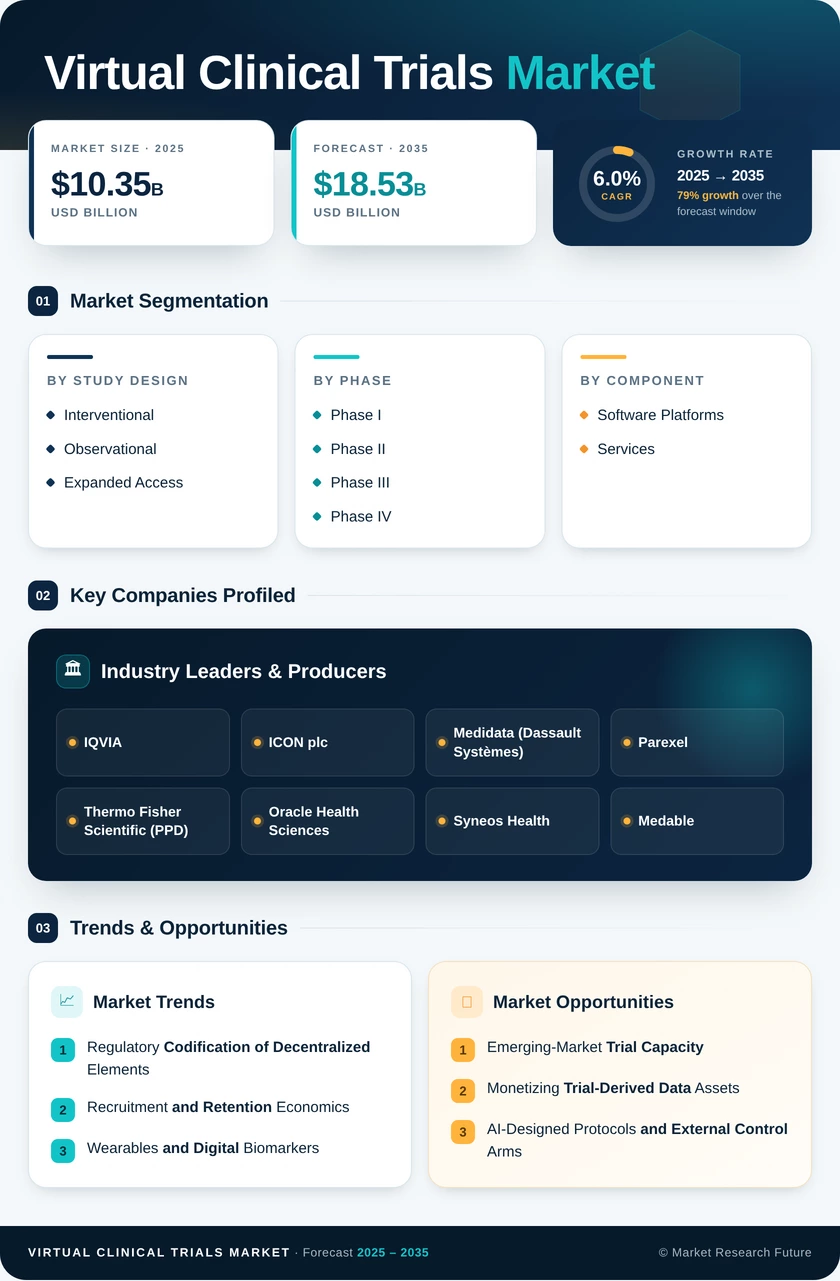
Segmentation Quick Reference
| Dimension | Sub-Segments | Dominant Segment | Fastest Growing Segment |
|---|
| By Study Design | Interventional, Observational, Expanded Access | Interventional (72.4% share) | Observational (8.2% CAGR) |
| By Phase | Phase I, Phase II, Phase III, Phase IV | Phase III (45.4% share) | Phase I (9.3% CAGR) |
| By Component | Software Platforms, Services | Software Platforms (64.6% share) | Services (7.8% CAGR) |
| By Delivery Mode | Web-Based, Cloud-Based, On-Premise | Web-Based (51.1% share) | Cloud-Based (7.7% CAGR) |
| By End-User | Pharmaceutical & Biopharma Companies, Medical-Device Manufacturers, Contract Research Organizations (CROs), Academic & Research Institutes | Pharmaceutical & Biopharma Companies (54.9% share) | Medical-Device Manufacturers (7.8% CAGR) |
| By Indication | Oncology, Cardiovascular Diseases, Neurology, Endocrine & Metabolic, Rare-Disease / Orphan, Other Indications | Oncology (35.4% share) | Neurology (9.9% CAGR) |
| By Region | North America, Europe, Asia-Pacific, South America, Middle East & Africa | North America (44.2% share) | Asia-Pacific (8.1% CAGR) |
Market Segmentation Overview
| Sub-Segment | Key Trend |
|---|
| Interventional | Remote dosing oversight, eDiaries and home nursing visits |
| Observational | Passive data capture for registries and post-marketing studies |
| Expanded Access | Remote safety monitoring for compassionate-use patients |
Interventional studies lag because approval dossiers still require controlled dosing and adjudicated safety data, which sponsors now collect partly at home. Observational studies grow fastest as regulators accept real-world outcomes captured passively through connected devices. Expanded Access remains small, but benefits from remote monitoring that lets treating physicians manage patients without trial-site infrastructure.
| Sub-Segment | Key Trend |
|---|
| Phase I | Home telemetry and virtual safety reviews in dose escalation |
| Phase II | Selective hybrid designs balancing remote and site endpoints |
| Phase III | Wide geographic reach to cut screen failure and attrition |
| Phase IV | Long-term safety follow-up through remote check-ins |
Phase III leads because its large, dispersed cohorts and long follow-up periods gain most from remote retention tools. Phase I grows fastest as biotechs use home telemetry to compress dose-escalation timelines. Phase II and Phase IV adopt remote elements where endpoints permit, with Phase IV leaning on low-touch follow-up for safety commitments.
| Sub-Segment | Key Trend |
|---|
| Software Platforms | Unified suites replacing point solutions; Part 11 validation |
| Services | Outsourced logistics, home nursing and regulatory liaison |
Software Platforms lead because every remote study depends on validated systems for data capture, randomization and telehealth visits, and audit requirements discourage switching. Services grow faster as sponsors buy turnkey execution, including courier kits, home nurses and protocol design, rather than coordinating multiple vendors themselves.
| Sub-Segment | Key Trend |
|---|
| Web-Based | Browser access with minimal patient training |
| Cloud-Based | Real-time analytics and scalable storage for sensor and video data |
| On-Premise | Retained for data sovereignty and legacy integrations |
Web-Based delivery leads because browser access removes app installation and device barriers for patients and site staff. Cloud-Based deployments grow fastest as sensor streams, imaging and video visits demand elastic storage and live dashboards. On-Premise systems hold on where local hosting rules apply, though regional cloud nodes are eroding that rationale.
| Sub-Segment | Key Trend |
|---|
| Pharmaceutical & Biopharma Companies | Enterprise platform standardization across portfolios |
| Medical-Device Manufacturers | Wearable-enabled endpoints in pivotal studies |
| Contract Research Organizations (CROs) | Bundled technology and delivery contracts |
| Academic & Research Institutes | Grant-funded hybrid and pragmatic trials |
Pharmaceutical & Biopharma Companies lead on pipeline scale and recruitment pressure across oncology and infectious-disease programs. Medical-Device Manufacturers grow fastest because their products often generate the trial data directly, making remote collection a natural fit. Contract Research Organizations (CROs) capture value by packaging platforms with delivery, while Academic & Research Institutes expand through shared, grant-supported infrastructure.
| Sub-Segment | Key Trend |
|---|
| Oncology | Home nursing and electronic symptom reporting during treatment |
| Cardiovascular Diseases | Wearable ECG and blood pressure monitoring |
| Neurology | Continuous motor and cognitive digital biomarkers |
| Endocrine & Metabolic | Continuous glucose sensor integration |
| Rare-Disease / Orphan | Remote access for geographically scattered patients |
| Other Indications | Dermatology photo capture and respiratory spirometry at home |
Oncology leads because reducing travel during intensive treatment cycles directly improves retention, and home nursing networks now support complex regimens. Neurology grows fastest as digital biomarkers capture motor and cognitive change continuously rather than at quarterly clinic visits. Cardiovascular Diseases and Endocrine & Metabolic studies follow closely, enabled by mature consumer-grade sensors, while Rare-Disease / Orphan programs rely on remote designs to reach patients spread across countries.


 Noah Malgeri
Co-Founder

 Peter Groot koerkamp
Account and Business Manager

 Younghwan Choi
Senior Retail Manager

 Mark Irwin
Management Consultant

 Akif Moroglu
Strategy & Business Development Director

 Guilherme Gomes Martins
Product Management Director

 Joseph Aguayo
Sales Operations & Pricing Manager

 La Terria Dodd
Program Support Specialist

 Rob Kooiker
Group Product Manager HVAC & Fire Protection GMA