×
Request Free Sample ×

Kindly complete the form below to receive a free sample of this Report

* Please use a valid business email

Leading companies partner with us for data-driven Insights

clients tt-cursor
Hero Background
English
Chinese
French
Japanese
Korean
German
Spanish

Veterinary Imaging Market Trends

ID: MRFR/HC/2143-CR
200 Pages
Rahul Gotadki
April 2025

Veterinary Imaging Market Research Report: Size, Share, Trend Analysis By Imaging Modality (X-ray, Ultrasound, Magnetic Resonance Imaging, Computed Tomography, Endoscopy), By Animal Type (Companion Animals, Livestock, Wild Animals, Research Animals), By End Users (Veterinary Clinics, Animal Hospitals, Research Institutions, Diagnostic Laboratories), By Applications (Oncology, Cardiology, Orthopedics, Neurology, Emergency and Critical Care) and By Regional (North America, Europe, South America, Asia Pacific, Middle East and Africa) - Growth Outlook & Industry Forecast 2025 To 2035

Share:
Download PDF ×

We do not share your information with anyone. However, we may send you emails based on your report interest from time to time. You may contact us at any time to opt-out.

Veterinary Imaging Market Infographic
Purchase Options

Market Trends

Key Emerging Trends in the Veterinary Imaging Market

The veterinary imaging industry is showing signs of the growing importance of cutting-edge demonstrative developments in veterinary consideration. In veterinary imaging, computerized radiography and ultrasound are growing. Advanced radiography provides high-quality images and rapid, accurate results. Ultrasound technology allows vets to examine internal structures and identify abnormalities in pets without discomfort. Computerized and ultrasound technologies represent a commitment to veterinary precision and efficacy.

Additionally, portable veterinary imaging devices are becoming more popular. These devices enable veterinarians to do imaging studies in the field or at the point of treatment, reducing the need to transport animals to imaging centers. In horse and big animal healthcare, on-site imaging is essential for convenient and persuasive diagnosis and treatment.

The veterinary imaging industry is also seeing a surge in the development of advanced imaging methods including CT and X-ray. Veterinarians can better visualize internal designs with point-by-point cross-sectional images. While traditionally associated with human medicine, CT and X-ray in veterinary imaging must provide full and high-level symptomatic capacities for animals.

Artificial intelligence in veterinary imaging is also gaining attention. Man-made intelligence can help veterinarians interpret complicated imaging data through image analysis, design recognition, and demonstrative navigation. This pattern matches the wider use of artificial intelligence in medicine and shows veterinary practice's potential for analytic precision and expertise.

Another important trend is veterinary telemedicine and remote imaging. Telemedicine allows veterinarians to communicate, exchange imagery, and offer master instruction remotely. This pattern increases veterinary ability accessibility, especially in districts with few veterinary administrations, improving comprehension and results.

Additionally, the veterinary imaging industry is emphasizing intuitive imaging configurations. Manufacturers are proposing imaging frameworks with better interface points and work process changes to make imaging assessment easier for veterinary specialists. This design respects the varied skill levels of veterinarian clients and aims to simplify imaging developments.


Author
Rahul Gotadki
Assistant Manager

He holds an experience of about 7+ years in Market Research and Business Consulting, working under the spectrum of Life Sciences and Healthcare domains. Rahul conceptualizes and implements a scalable business strategy and provides strategic leadership to the clients. His expertise lies in market estimation, competitive intelligence, pipeline analysis, customer assessment, etc. In addition to the above, his other responsibility includes strategic tracking of high growth markets & advising clients on the potential areas of focus they could direct their business initiatives

Leave a Comment

FAQs

What is the projected growth of the Veterinary Imaging market?

The Veterinary Imaging market is the expected increase in total market value of 4.82 USD billion over a defined forecast period 2025–2035. It is driven by factors such as demand trends, technological advances, regulatory changes, and geographic expansion.

What is the size of the Veterinary Imaging market?

Veterinary Imaging market size was valued at approximately 2.19 billion USD in 2024. This figure will reach 4.82 billion USD covering all regions (America, Europe, Asia, MEA and ROW), focusing its segments / services / distribution channels till 2035.

What is the CAGR of the Veterinary Imaging market?

Veterinary Imaging market is expected to grow at a CAGR of 7.42% between 2025 and 2035.

How much will the Veterinary Imaging market be worth by 2035?

Veterinary Imaging market is expected to be worth of 4.82 billion USD, reflecting growth driven by usage, technology and global demands by the end of 2035.

How will the Veterinary Imaging market perform over the next 10 years?

Over the next 10 years the Veterinary Imaging market is expected to shift from usd billion 2.19 to 4.82 billion USD, led by adoption of advanced tech, demographic trends, regulatory approvals, with potential headwinds from 2025 to 2035.

Which region is projected to hold the largest market share in the Global Veterinary Imaging Market by 2024?

North America is projected to hold the largest market share in the Global Veterinary Imaging Market, valued at 1.0 billion USD in 2024.

What will be the market size for Ultrasound in the Global Veterinary Imaging Market by 2035?

The market size for Ultrasound in the Global Veterinary Imaging Market is expected to reach 0.969 billion USD by 2035.

Who are the key players in the Global Veterinary Imaging Market?

Key players in the Global Veterinary Imaging Market include Heska Corporation, Idexx Laboratories, and GE Healthcare among others.

How will the market size for Magnetic Resonance Imaging change from 2024 to 2035?

The market size for Magnetic Resonance Imaging is expected to grow from 0.348 billion USD in 2024 to 0.692 billion USD in 2035.

What is the anticipated market value for Europe in the Global Veterinary Imaging Market by 2035?

The anticipated market value for Europe in the Global Veterinary Imaging Market is projected to be 1.2 billion USD by 2035.

Market Summary

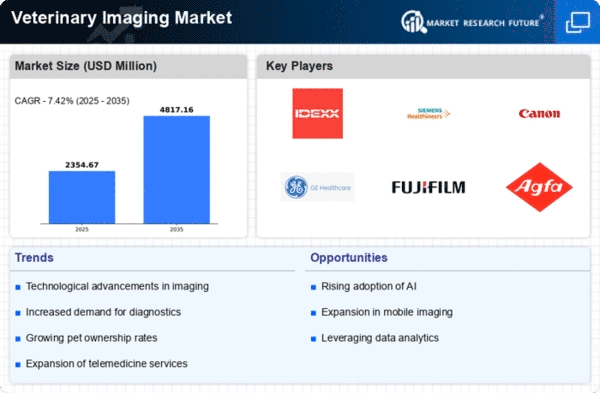
As per MRFR analysis, the Veterinary Imaging Market Size was estimated at 2192.02 USD Million in 2024. The Veterinary Imaging industry is projected to grow from 2354.67 USD Million in 2025 to 4817.16 USD Million by 2035, exhibiting a compound annual growth rate (CAGR) of 7.42 during the forecast period 2025 - 2035.

Key Market Trends & Highlights

The Veterinary Imaging Market is experiencing robust growth driven by technological advancements and increasing pet ownership.

  • Technological advancements in imaging equipment are enhancing diagnostic capabilities in veterinary practices.
  • North America remains the largest market, while the Asia-Pacific region is emerging as the fastest-growing area for veterinary imaging.
  • Radiology continues to dominate the market, whereas ultrasound is witnessing the fastest growth among imaging modalities.
  • The rising demand for diagnostic imaging and the expansion of veterinary practices are key drivers propelling market growth.

Market Size & Forecast

2024 Market Size 2192.02 (USD Million)
2035 Market Size 4817.16 (USD Million)
CAGR (2025 - 2035) 7.42%
Largest Regional Market Share in 2024 North America

Major Players

Idexx Laboratories (US), Siemens Healthineers (DE), Canon Medical Systems (JP), GE Healthcare (US), Fujifilm Holdings Corporation (JP), Agfa-Gevaert Group (BE), Esaote S.p.A. (IT), Mindray Medical International Limited (CN), VetRay (US)

Market Trends

The Veterinary Imaging Market is currently experiencing a notable evolution, driven by advancements in technology and an increasing emphasis on animal health. The integration of sophisticated imaging modalities, such as MRI, CT scans, and ultrasound, is enhancing diagnostic capabilities, allowing veterinarians to detect conditions with greater precision. This trend is further supported by a growing awareness among pet owners regarding the importance of preventive care and early diagnosis, which is likely to propel demand for advanced imaging services. Additionally, the rise in pet ownership and the increasing expenditure on veterinary care are contributing to the expansion of this market. Moreover, the Veterinary Imaging Market appears to be influenced by the ongoing development of telemedicine and remote diagnostics. These innovations facilitate access to specialized imaging services, particularly in rural or underserved areas. As veterinary practices adopt digital solutions, the efficiency of imaging processes is likely to improve, leading to better patient outcomes. The market's trajectory suggests a promising future, characterized by continuous technological advancements and a commitment to enhancing animal welfare through improved diagnostic tools.

Technological Advancements

The Veterinary Imaging Market is witnessing rapid technological advancements that enhance diagnostic accuracy. Innovations in imaging modalities, such as high-resolution ultrasound and digital radiography, are becoming more prevalent. These technologies enable veterinarians to obtain clearer images, facilitating better assessments of animal health.

Increased Pet Ownership

The rise in pet ownership globally is significantly impacting the Veterinary Imaging Market. As more individuals adopt pets, the demand for veterinary services, including imaging, is likely to increase. This trend reflects a growing commitment to animal care and health, driving the need for advanced diagnostic tools.

Telemedicine Integration

The integration of telemedicine into veterinary practices is reshaping the Veterinary Imaging Market. Remote consultations and digital imaging services are becoming more common, allowing veterinarians to provide specialized care without geographical limitations. This shift may enhance access to imaging services, particularly in rural areas.

Veterinary Imaging Market Market Drivers

Market Growth Projections

The Global Veterinary Imaging Market Industry is projected to grow significantly, with estimates indicating a market size of 2.3 USD Billion in 2024 and a potential increase to 4.5 USD Billion by 2035. This growth trajectory suggests a robust demand for imaging technologies driven by advancements in veterinary medicine and increasing pet ownership. The anticipated compound annual growth rate of 6.29% from 2025 to 2035 reflects the ongoing evolution of veterinary practices and the integration of innovative imaging solutions. These projections highlight the dynamic nature of the market and the potential for continued investment in veterinary imaging technologies.

Growing Demand for Preventive Veterinary Care

The Global Veterinary Imaging Market Industry is witnessing an increasing demand for preventive veterinary care, which emphasizes early diagnosis and treatment of health issues in animals. Pet owners are becoming more proactive about their pets' health, leading to a higher utilization of imaging services for routine check-ups and screenings. This trend is particularly evident in urban areas where access to veterinary services is more prevalent. The focus on preventive care not only improves animal health outcomes but also drives the growth of the imaging market, as veterinarians seek advanced tools to facilitate early detection of diseases.

Technological Advancements in Imaging Techniques

The Global Veterinary Imaging Market Industry is experiencing a surge in technological advancements, particularly in imaging modalities such as MRI, CT, and ultrasound. These innovations enhance diagnostic accuracy and efficiency, leading to better patient outcomes. For instance, the introduction of portable ultrasound devices allows for on-site diagnostics, which is particularly beneficial in rural areas. As a result, the market is projected to reach 2.3 USD Billion in 2024, with a growing emphasis on integrating artificial intelligence to improve image analysis. This trend indicates a shift towards more sophisticated imaging solutions that cater to the evolving needs of veterinary professionals.

Expansion of Veterinary Practices and Specialty Clinics

The Global Veterinary Imaging Market Industry is further propelled by the expansion of veterinary practices and the establishment of specialty clinics that offer advanced imaging services. As veterinary medicine evolves, more clinics are integrating imaging technologies to provide comprehensive care. This trend is particularly pronounced in urban centers, where competition among veterinary practices encourages the adoption of cutting-edge technologies. The proliferation of specialty clinics that focus on specific animal health issues also contributes to the demand for advanced imaging solutions. This expansion is likely to enhance the overall market landscape, fostering innovation and improving service delivery.

Regulatory Support and Standards for Veterinary Imaging

The Global Veterinary Imaging Market Industry benefits from regulatory support and the establishment of standards that promote the adoption of advanced imaging technologies. Government agencies and veterinary associations are actively working to create guidelines that ensure the safety and efficacy of imaging procedures. This regulatory framework not only fosters innovation but also instills confidence among veterinary practitioners and pet owners. As a result, the market is likely to see sustained growth, with a compound annual growth rate of 6.29% projected from 2025 to 2035. This supportive environment encourages investment in new imaging technologies and enhances overall veterinary care.

Increasing Pet Ownership and Animal Healthcare Expenditure

The Global Veterinary Imaging Market Industry is significantly influenced by the rising trend of pet ownership and the corresponding increase in animal healthcare expenditure. As more households adopt pets, the demand for advanced veterinary services, including imaging, escalates. In many regions, pet owners are willing to invest in high-quality healthcare, which includes diagnostic imaging. This growing consumer behavior is expected to contribute to the market's expansion, with projections indicating a growth to 4.5 USD Billion by 2035. The increasing awareness of pet health and wellness further drives the need for advanced imaging technologies in veterinary practices.

Market Segment Insights

By Application: Radiology (Largest) vs. Ultrasound (Fastest-Growing)

In the Veterinary Imaging Market, Radiology remains the largest segment, reflecting its well-established position due to its wide range of diagnostic capabilities. This segment encompasses X-rays and other imaging modalities that offer quick and accurate assessments of various conditions, appealing to veterinary practices of all sizes. Ultrasound follows closely as a rapidly growing segment, gaining traction among veterinarians for its non-invasive nature and real-time imaging capabilities. The continual advancements in technology have further enabled Ultrasound to carve a significant place in diagnostics. As the market progresses, the demand for advanced imaging solutions is propelling both Radiology and Ultrasound towards innovation and efficacy. Factors such as increased pet ownership, along with the rising importance of preventive care, are driving the growth of these imaging techniques. Additionally, the enhanced training and education of veterinary professionals in utilizing these imaging tools are contributing to their expanded adoption, thereby increasing the overall market potential for veterinary imaging applications.

Radiology (Dominant) vs. Endoscopy (Emerging)

Radiology stands as the dominant force in the Veterinary Imaging Market, leveraging its long-standing history and reliability in diagnosing various conditions through imaging techniques such as X-rays. It is widely recognized for its effectiveness in detecting fractures, tumors, and other health issues in pets. On the other hand, Endoscopy represents an emerging trend in veterinary diagnostics, offering minimally invasive procedures that can enhance visual assessment of internal organs. This technology resonates well with veterinary practices focusing on precision and minimal discomfort for animals. As veterinary professionals continue to adapt to new technologies, Endoscopy is expected to see increased adoption, potentially providing complementary advantages to the established practices of Radiology.

By End Use: Veterinary Clinics (Largest) vs. Research Institutions (Fastest-Growing)

In the Veterinary Imaging Market, the distribution of market share among end users reveals that Veterinary Clinics hold the largest share, attributed to their widespread adoption of imaging technologies for routine and emergency care. Following closely, Animal Hospitals also contribute significantly, catering to both small and large animals, enhancing their diagnostic capabilities through advanced imaging solutions. However, Research Institutions are emerging as a fast-growing segment, fueled by increasing investments in veterinary research and development.

Veterinary Clinics (Dominant) vs. Research Institutions (Emerging)

Veterinary Clinics represent the dominant force in the Veterinary Imaging Market, leveraging advanced imaging technology to provide comprehensive diagnostics and treatment plans for pets and livestock. These clinics typically utilize a variety of imaging modalities, including ultrasound, radiography, and MRI, to meet the veterinary care demands of their clients. Conversely, Research Institutions are positioned as the emerging segment, focusing on the application of veterinary imaging for research purposes, including disease studies and innovative treatment development. This segment is propelled by a surge in funding and collaborative initiatives aimed at enhancing animal health, thus fostering technological advancements that could revolutionize veterinary diagnostics.

By Animal Type: Companion Animals (Largest) vs. Livestock (Fastest-Growing)

In the Veterinary Imaging Market, Companion Animals constitute the largest segment, driven by the increasing pet ownership and the rising awareness among pet owners regarding health check-ups and preventive care. This segment benefits from a wide range of imaging technologies, catering to various health issues, thus commanding a notable share. Livestock imaging, on the other hand, is rapidly gaining ground as farmers and veterinarians adopt advanced diagnostic tools to enhance herd health management and productivity, thus reflecting a growing need for these services in farm operations.

Companion Animals (Dominant) vs. Livestock (Emerging)

The Companion Animals segment remains dominant in the Veterinary Imaging Market due to a shift towards preventive veterinary care, coupled with advancements in imaging technologies such as ultrasounds and MRIs tailored specifically for pets. This segment engages a broad audience of pet owners who are increasingly willing to invest in health monitoring for their animals. The Livestock segment, however, is emerging as a significant player, driven by the rising demand for high-quality food products and initiatives to improve livestock health through technology-driven solutions. This segment emphasizes the importance of accurate imaging to ensure the well-being and productivity of livestock, thus shaping up to be a crucial area of growth.

By Technology: Digital Radiography (Largest) vs. MRI Technology (Fastest-Growing)

In the Veterinary Imaging Market, Digital Radiography holds the largest market share, attributed to its widespread adoption across veterinary practices due to the efficiency and speed of digital imaging. Computed Radiography follows, providing a transitional technology for facilities moving from traditional film-based methods. Ultrasound Technology also holds a significant presence, being favored for its real-time imaging capability, especially in soft tissue evaluations, while MRI Technology, despite being a smaller segment, is rapidly gaining traction due to its advanced imaging capabilities that cater to complex diagnoses.

Digital Radiography (Dominant) vs. MRI Technology (Emerging)

Digital Radiography is the dominant force in the Veterinary Imaging Market, characterized by its ability to deliver high-quality images instantly, thus enhancing workflow in veterinary clinics. With its ease of use and lower operational costs, it outperforms older imaging technologies. Meanwhile, MRI Technology, although an emerging segment, is becoming increasingly vital for detailed anatomical studies. It is highly regarded in specialty practices focusing on neurological and orthopedic conditions. As awareness and technology evolve, MRI’s capacity for superior imaging will likely position it as a go-to option for complex veterinary diagnostics.

By Product Type: Imaging Equipment (Largest) vs. Software Solutions (Fastest-Growing)

In the Veterinary Imaging Market, Imaging Equipment remains the largest segment, capturing a significant share of the overall market. This segment includes modalities such as X-rays, ultrasound, and MRI devices that are critical for accurate diagnosis and treatment in veterinary medicine. Software Solutions, while smaller in market share, are rapidly gaining traction as they enable enhanced imaging capabilities and streamline workflow processes in veterinary practices, reflecting the increasing reliance on advanced technology in diagnostics. The growth trends in this segment are driven by the ongoing advancements in imaging technologies, which improve the accuracy and efficiency of veterinary care. Moreover, the increasing demand for veterinary care and the need for faster diagnostics are propelling the growth of Software Solutions. As practices look to integrate more technology into their workflows, the Software Solutions segment is emerging as a key player in transforming veterinary imaging capabilities, fostering innovation in practice management and diagnostics.

Imaging Equipment (Dominant) vs. Consumables (Emerging)

Imaging Equipment is currently the dominant force in the Veterinary Imaging Market, noted for its essential role in diagnosis and treatment across various species. This segment includes high-end modalities such as ultrasound machines, digital radiography, and MRI systems. These tools not only enhance the accuracy of clinical assessments but also improve patient outcomes significantly. On the other hand, the Consumables segment is an emerging market player that includes items like imaging agents, contrast media, and ultrasound gels. While this segment may not be as large, it is critical for the functioning of imaging equipment, and its growth is being spurred by an increase in imaging procedures. As the veterinary imaging field becomes more technologically advanced, the demand for high-quality consumables that complement these sophisticated tools is set to rise, creating a dynamic interplay between these two segments.

Get more detailed insights about Veterinary Imaging Market Research Report-Forecast to 2035

Regional Insights

North America : Market Leader in Veterinary Imaging

North America is poised to maintain its leadership in the veterinary imaging market, holding a significant share of 1095.0M in 2024. The region's growth is driven by increasing pet ownership, advancements in imaging technologies, and a rising demand for accurate diagnostics. Regulatory support for veterinary practices and the integration of telemedicine are further catalyzing market expansion. The competitive landscape is robust, with key players like Idexx Laboratories and GE Healthcare leading the charge. The U.S. is the primary market, benefiting from high healthcare spending and a strong focus on animal welfare. The presence of established companies fosters innovation, ensuring that North America remains at the forefront of veterinary imaging advancements.

Europe : Emerging Veterinary Imaging Hub

Europe is emerging as a significant player in the veterinary imaging market, with a market size of €650.0M. The region's growth is fueled by increasing awareness of animal health, advancements in imaging technologies, and supportive regulatory frameworks. The European Union's initiatives to enhance veterinary care standards are also contributing to market expansion. Leading countries such as Germany, France, and the UK are at the forefront, with a competitive landscape featuring major players like Siemens Healthineers and Canon Medical Systems. The presence of innovative startups and established firms fosters a dynamic environment, ensuring that Europe remains competitive in The Veterinary Imaging.

Asia-Pacific : Rapidly Growing Veterinary Market

Asia-Pacific is witnessing rapid growth in the veterinary imaging market, with a market size of $350.0M. The region's expansion is driven by increasing pet ownership, rising disposable incomes, and a growing awareness of animal health. Regulatory bodies are also promoting better veterinary practices, which is enhancing the demand for advanced imaging solutions. Countries like China, Japan, and Australia are leading the market, supported by a mix of local and international players such as Mindray Medical and Fujifilm Holdings. The competitive landscape is evolving, with a focus on innovation and technology adoption, positioning Asia-Pacific as a key player in the global veterinary imaging sector.

Middle East and Africa : Emerging Veterinary Imaging Frontier

The Middle East and Africa region is an emerging frontier in the veterinary imaging market, with a market size of $97.02M. Growth is driven by increasing pet ownership, rising awareness of animal health, and improvements in veterinary infrastructure. Regulatory support for animal welfare is also enhancing the demand for advanced imaging technologies. Countries like South Africa and the UAE are leading the market, with a growing number of veterinary clinics adopting advanced imaging solutions. The competitive landscape is characterized by a mix of local and international players, creating opportunities for growth and innovation in the veterinary imaging sector.

Key Players and Competitive Insights

The Veterinary Imaging Market is currently characterized by a dynamic competitive landscape, driven by technological advancements and an increasing demand for high-quality diagnostic imaging in veterinary practices. Key players such as Idexx Laboratories (US), Siemens Healthineers (DE), and Canon Medical Systems (JP) are strategically positioned to leverage innovation and expand their market presence. Idexx Laboratories (US) focuses on enhancing its imaging solutions through continuous research and development, while Siemens Healthineers (DE) emphasizes partnerships with veterinary clinics to integrate advanced imaging technologies into their workflows. Canon Medical Systems (JP) is also investing in digital transformation initiatives to improve imaging efficiency and accuracy, collectively shaping a competitive environment that prioritizes technological superiority and customer-centric solutions.The market structure appears moderately fragmented, with several players vying for market share through various business tactics. Companies are increasingly localizing manufacturing to reduce costs and optimize supply chains, which enhances their competitive edge. This localized approach not only improves responsiveness to market demands but also fosters innovation tailored to regional needs. The collective influence of these key players is significant, as they drive advancements in imaging technologies and set industry standards that smaller competitors often follow.

In November Idexx Laboratories (US) announced the launch of a new imaging software platform designed to enhance diagnostic capabilities for veterinarians. This strategic move is likely to strengthen Idexx's position in the market by providing practitioners with advanced tools that improve diagnostic accuracy and workflow efficiency. The introduction of this platform reflects a broader trend towards integrating software solutions with imaging technologies, which could redefine veterinary diagnostics.

In October Siemens Healthineers (DE) expanded its partnership with a leading veterinary hospital network to implement AI-driven imaging solutions. This collaboration is expected to enhance diagnostic precision and streamline operations within the network. By leveraging AI, Siemens Healthineers aims to position itself at the forefront of veterinary imaging innovation, potentially setting new benchmarks for diagnostic capabilities in the industry.

In September Canon Medical Systems (JP) unveiled a new line of portable ultrasound devices specifically designed for veterinary use. This product launch is indicative of Canon's commitment to addressing the unique needs of veterinary practitioners, particularly in emergency and field settings. The portability of these devices may enhance accessibility to advanced imaging technologies, thereby expanding Canon's market reach and reinforcing its competitive stance.

As of December the Veterinary Imaging Market is witnessing a shift towards digitalization, sustainability, and AI integration, which are defining current competitive trends. Strategic alliances among key players are increasingly shaping the landscape, fostering innovation and enhancing service offerings. The competitive differentiation is likely to evolve from traditional price-based competition to a focus on technological innovation, reliability in supply chains, and the ability to deliver superior diagnostic solutions. This transition suggests that companies prioritizing R&D and strategic partnerships will be better positioned to thrive in the evolving market.

Key Companies in the Veterinary Imaging Market include

Industry Developments

The Global Veterinary Imaging Market has recently witnessed significant developments, particularly with the increasing adoption of advanced imaging technologies such as MRI, CT scans, and digital radiography among veterinary clinics and animal hospitals. Heska Corporation, Scil Animal Care Company, and Idexx Laboratories have reported notable growth, emphasizing the need for enhanced diagnostic services in veterinary medicine. In September 2023, Canon Medical Systems announced its commitment to expanding its veterinary imaging product line, aiming to meet the growing demand for high-quality imaging solutions.

In terms of mergers and acquisitions, Carestream Health finalized its acquisition of a leading veterinary imaging software company in October 2023 to strengthen its product offerings. Additionally, during the past two to three years, various collaborations such as GE Healthcare joining forces with Boehringer Ingelheim were noted to improve animal health diagnostics and research methodologies. The market has seen a surge in investments directed towards Research and Development to support innovative imaging technologies, which is paving the way for better healthcare options for animals globally.

This trend reflects a broader commitment within the veterinary sector to leverage cutting-edge imaging modalities for improved animal care.

Future Outlook

Veterinary Imaging Market Future Outlook

The Veterinary Imaging Market is projected to grow at a 7.42% CAGR from 2025 to 2035, driven by technological advancements, increasing pet ownership, and rising demand for diagnostic imaging.

New opportunities lie in:

  • Development of portable imaging devices for remote veterinary practices.
  • Integration of AI algorithms for enhanced diagnostic accuracy.
  • Expansion of telemedicine platforms incorporating imaging services.

By 2035, the Veterinary Imaging Market is expected to be robust, reflecting substantial growth and innovation.

Market Segmentation

Veterinary Imaging Market End Use Outlook

  • Veterinary Clinics
  • Animal Hospitals
  • Research Institutions
  • Diagnostic Laboratories

Veterinary Imaging Market Technology Outlook

  • Digital Radiography
  • Computed Radiography
  • Ultrasound Technology
  • MRI Technology

Veterinary Imaging Market Animal Type Outlook

  • Companion Animals
  • Livestock
  • Equine
  • Exotic Animals

Veterinary Imaging Market Application Outlook

  • Radiology
  • Ultrasound
  • Computed Tomography
  • Magnetic Resonance Imaging
  • Endoscopy

Veterinary Imaging Market Product Type Outlook

  • Imaging Equipment
  • Software Solutions
  • Consumables

Report Scope

MARKET SIZE 20242192.02(USD Million)
MARKET SIZE 20252354.67(USD Million)
MARKET SIZE 20354817.16(USD Million)
COMPOUND ANNUAL GROWTH RATE (CAGR)7.42% (2025 - 2035)
REPORT COVERAGERevenue Forecast, Competitive Landscape, Growth Factors, and Trends
BASE YEAR2024
Market Forecast Period2025 - 2035
Historical Data2019 - 2024
Market Forecast UnitsUSD Million
Key Companies ProfiledIdexx Laboratories (US), Siemens Healthineers (DE), Canon Medical Systems (JP), GE Healthcare (US), Fujifilm Holdings Corporation (JP), Agfa-Gevaert Group (BE), Esaote S.p.A. (IT), Mindray Medical International Limited (CN), VetRay (US)
Segments CoveredApplication, End Use, Animal Type, Technology, Product Type
Key Market OpportunitiesIntegration of artificial intelligence in Veterinary Imaging Market enhances diagnostic accuracy and operational efficiency.
Key Market DynamicsTechnological advancements in imaging modalities drive competitive dynamics and enhance diagnostic capabilities in veterinary practices.
Countries CoveredNorth America, Europe, APAC, South America, MEA

FAQs

What is the projected growth of the Veterinary Imaging market?

The Veterinary Imaging market is the expected increase in total market value of 4.82 USD billion over a defined forecast period 2025–2035. It is driven by factors such as demand trends, technological advances, regulatory changes, and geographic expansion.

What is the size of the Veterinary Imaging market?

Veterinary Imaging market size was valued at approximately 2.19 billion USD in 2024. This figure will reach 4.82 billion USD covering all regions (America, Europe, Asia, MEA and ROW), focusing its segments / services / distribution channels till 2035.

What is the CAGR of the Veterinary Imaging market?

Veterinary Imaging market is expected to grow at a CAGR of 7.42% between 2025 and 2035.

How much will the Veterinary Imaging market be worth by 2035?

Veterinary Imaging market is expected to be worth of 4.82 billion USD, reflecting growth driven by usage, technology and global demands by the end of 2035.

How will the Veterinary Imaging market perform over the next 10 years?

Over the next 10 years the Veterinary Imaging market is expected to shift from usd billion 2.19 to 4.82 billion USD, led by adoption of advanced tech, demographic trends, regulatory approvals, with potential headwinds from 2025 to 2035.

Which region is projected to hold the largest market share in the Global Veterinary Imaging Market by 2024?

North America is projected to hold the largest market share in the Global Veterinary Imaging Market, valued at 1.0 billion USD in 2024.

What will be the market size for Ultrasound in the Global Veterinary Imaging Market by 2035?

The market size for Ultrasound in the Global Veterinary Imaging Market is expected to reach 0.969 billion USD by 2035.

Who are the key players in the Global Veterinary Imaging Market?

Key players in the Global Veterinary Imaging Market include Heska Corporation, Idexx Laboratories, and GE Healthcare among others.

How will the market size for Magnetic Resonance Imaging change from 2024 to 2035?

The market size for Magnetic Resonance Imaging is expected to grow from 0.348 billion USD in 2024 to 0.692 billion USD in 2035.

What is the anticipated market value for Europe in the Global Veterinary Imaging Market by 2035?

The anticipated market value for Europe in the Global Veterinary Imaging Market is projected to be 1.2 billion USD by 2035.

  1. SECTION I: EXECUTIVE SUMMARY AND KEY HIGHLIGHTS
    1. | 1.1 EXECUTIVE SUMMARY
    2. | 1.1.1 Market Overview
    3. | 1.1.2 Key Findings
    4. | 1.1.3 Market Segmentation
    5. | 1.1.4 Competitive Landscape
    6. | 1.1.5 Challenges and Opportunities
    7. | 1.1.6 Future Outlook
  2. SECTION II: SCOPING, METHODOLOGY AND MARKET STRUCTURE
    1. | 2.1 MARKET INTRODUCTION
    2. | 2.1.1 Definition
    3. | 2.1.2 Scope of the study
    4. |-- 2.1.2.1 Research Objective
    5. |-- 2.1.2.2 Assumption
    6. |-- 2.1.2.3 Limitations
    7. | 2.2 RESEARCH METHODOLOGY
    8. | 2.2.1 Overview
    9. | 2.2.2 Data Mining
    10. | 2.2.3 Secondary Research
    11. | 2.2.4 Primary Research
    12. |-- 2.2.4.1 Primary Interviews and Information Gathering Process
    13. |-- 2.2.4.2 Breakdown of Primary Respondents
    14. | 2.2.5 Forecasting Model
    15. | 2.2.6 Market Size Estimation
    16. |-- 2.2.6.1 Bottom-Up Approach
    17. |-- 2.2.6.2 Top-Down Approach
    18. | 2.2.7 Data Triangulation
    19. | 2.2.8 Validation
  3. SECTION III: QUALITATIVE ANALYSIS
    1. | 3.1 MARKET DYNAMICS
    2. | 3.1.1 Overview
    3. | 3.1.2 Drivers
    4. | 3.1.3 Restraints
    5. | 3.1.4 Opportunities
    6. | 3.2 MARKET FACTOR ANALYSIS
    7. | 3.2.1 Value chain Analysis
    8. | 3.2.2 Porter's Five Forces Analysis
    9. |-- 3.2.2.1 Bargaining Power of Suppliers
    10. |-- 3.2.2.2 Bargaining Power of Buyers
    11. |-- 3.2.2.3 Threat of New Entrants
    12. |-- 3.2.2.4 Threat of Substitutes
    13. |-- 3.2.2.5 Intensity of Rivalry
    14. | 3.2.3 COVID-19 Impact Analysis
    15. |-- 3.2.3.1 Market Impact Analysis
    16. |-- 3.2.3.2 Regional Impact
    17. |-- 3.2.3.3 Opportunity and Threat Analysis
  4. SECTION IV: QUANTITATIVE ANALYSIS
    1. | 4.1 Healthcare, BY Application (USD Million)
    2. | 4.1.1 Radiology
    3. | 4.1.2 Ultrasound
    4. | 4.1.3 Computed Tomography
    5. | 4.1.4 Magnetic Resonance Imaging
    6. | 4.1.5 Endoscopy
    7. | 4.2 Healthcare, BY End Use (USD Million)
    8. | 4.2.1 Veterinary Clinics
    9. | 4.2.2 Animal Hospitals
    10. | 4.2.3 Research Institutions
    11. | 4.2.4 Diagnostic Laboratories
    12. | 4.3 Healthcare, BY Animal Type (USD Million)
    13. | 4.3.1 Companion Animals
    14. | 4.3.2 Livestock
    15. | 4.3.3 Equine
    16. | 4.3.4 Exotic Animals
    17. | 4.4 Healthcare, BY Technology (USD Million)
    18. | 4.4.1 Digital Radiography
    19. | 4.4.2 Computed Radiography
    20. | 4.4.3 Ultrasound Technology
    21. | 4.4.4 MRI Technology
    22. | 4.5 Healthcare, BY Product Type (USD Million)
    23. | 4.5.1 Imaging Equipment
    24. | 4.5.2 Software Solutions
    25. | 4.5.3 Consumables
    26. | 4.6 Healthcare, BY Region (USD Million)
    27. | 4.6.1 North America
    28. |-- 4.6.1.1 US
    29. |-- 4.6.1.2 Canada
    30. | 4.6.2 Europe
    31. |-- 4.6.2.1 Germany
    32. |-- 4.6.2.2 UK
    33. |-- 4.6.2.3 France
    34. |-- 4.6.2.4 Russia
    35. |-- 4.6.2.5 Italy
    36. |-- 4.6.2.6 Spain
    37. |-- 4.6.2.7 Rest of Europe
    38. | 4.6.3 APAC
    39. |-- 4.6.3.1 China
    40. |-- 4.6.3.2 India
    41. |-- 4.6.3.3 Japan
    42. |-- 4.6.3.4 South Korea
    43. |-- 4.6.3.5 Malaysia
    44. |-- 4.6.3.6 Thailand
    45. |-- 4.6.3.7 Indonesia
    46. |-- 4.6.3.8 Rest of APAC
    47. | 4.6.4 South America
    48. |-- 4.6.4.1 Brazil
    49. |-- 4.6.4.2 Mexico
    50. |-- 4.6.4.3 Argentina
    51. |-- 4.6.4.4 Rest of South America
    52. | 4.6.5 MEA
    53. |-- 4.6.5.1 GCC Countries
    54. |-- 4.6.5.2 South Africa
    55. |-- 4.6.5.3 Rest of MEA
  5. SECTION V: COMPETITIVE ANALYSIS
    1. | 5.1 Competitive Landscape
    2. | 5.1.1 Overview
    3. | 5.1.2 Competitive Analysis
    4. | 5.1.3 Market share Analysis
    5. | 5.1.4 Major Growth Strategy in the Healthcare
    6. | 5.1.5 Competitive Benchmarking
    7. | 5.1.6 Leading Players in Terms of Number of Developments in the Healthcare
    8. | 5.1.7 Key developments and growth strategies
    9. |-- 5.1.7.1 New Product Launch/Service Deployment
    10. |-- 5.1.7.2 Merger & Acquisitions
    11. |-- 5.1.7.3 Joint Ventures
    12. | 5.1.8 Major Players Financial Matrix
    13. |-- 5.1.8.1 Sales and Operating Income
    14. |-- 5.1.8.2 Major Players R&D Expenditure. 2023
    15. | 5.2 Company Profiles
    16. | 5.2.1 Idexx Laboratories (US)
    17. |-- 5.2.1.1 Financial Overview
    18. |-- 5.2.1.2 Products Offered
    19. |-- 5.2.1.3 Key Developments
    20. |-- 5.2.1.4 SWOT Analysis
    21. |-- 5.2.1.5 Key Strategies
    22. | 5.2.2 Siemens Healthineers (DE)
    23. |-- 5.2.2.1 Financial Overview
    24. |-- 5.2.2.2 Products Offered
    25. |-- 5.2.2.3 Key Developments
    26. |-- 5.2.2.4 SWOT Analysis
    27. |-- 5.2.2.5 Key Strategies
    28. | 5.2.3 Canon Medical Systems (JP)
    29. |-- 5.2.3.1 Financial Overview
    30. |-- 5.2.3.2 Products Offered
    31. |-- 5.2.3.3 Key Developments
    32. |-- 5.2.3.4 SWOT Analysis
    33. |-- 5.2.3.5 Key Strategies
    34. | 5.2.4 GE Healthcare (US)
    35. |-- 5.2.4.1 Financial Overview
    36. |-- 5.2.4.2 Products Offered
    37. |-- 5.2.4.3 Key Developments
    38. |-- 5.2.4.4 SWOT Analysis
    39. |-- 5.2.4.5 Key Strategies
    40. | 5.2.5 Fujifilm Holdings Corporation (JP)
    41. |-- 5.2.5.1 Financial Overview
    42. |-- 5.2.5.2 Products Offered
    43. |-- 5.2.5.3 Key Developments
    44. |-- 5.2.5.4 SWOT Analysis
    45. |-- 5.2.5.5 Key Strategies
    46. | 5.2.6 Agfa-Gevaert Group (BE)
    47. |-- 5.2.6.1 Financial Overview
    48. |-- 5.2.6.2 Products Offered
    49. |-- 5.2.6.3 Key Developments
    50. |-- 5.2.6.4 SWOT Analysis
    51. |-- 5.2.6.5 Key Strategies
    52. | 5.2.7 Esaote S.p.A. (IT)
    53. |-- 5.2.7.1 Financial Overview
    54. |-- 5.2.7.2 Products Offered
    55. |-- 5.2.7.3 Key Developments
    56. |-- 5.2.7.4 SWOT Analysis
    57. |-- 5.2.7.5 Key Strategies
    58. | 5.2.8 Mindray Medical International Limited (CN)
    59. |-- 5.2.8.1 Financial Overview
    60. |-- 5.2.8.2 Products Offered
    61. |-- 5.2.8.3 Key Developments
    62. |-- 5.2.8.4 SWOT Analysis
    63. |-- 5.2.8.5 Key Strategies
    64. | 5.2.9 VetRay (US)
    65. |-- 5.2.9.1 Financial Overview
    66. |-- 5.2.9.2 Products Offered
    67. |-- 5.2.9.3 Key Developments
    68. |-- 5.2.9.4 SWOT Analysis
    69. |-- 5.2.9.5 Key Strategies
    70. | 5.3 Appendix
    71. | 5.3.1 References
    72. | 5.3.2 Related Reports

Healthcare Market Segmentation

Healthcare By Application (USD Million, 2025-2035)

  • Radiology
  • Ultrasound
  • Computed Tomography
  • Magnetic Resonance Imaging
  • Endoscopy

Healthcare By End Use (USD Million, 2025-2035)

  • Veterinary Clinics
  • Animal Hospitals
  • Research Institutions
  • Diagnostic Laboratories

Healthcare By Animal Type (USD Million, 2025-2035)

  • Companion Animals
  • Livestock
  • Equine
  • Exotic Animals

Healthcare By Technology (USD Million, 2025-2035)

  • Digital Radiography
  • Computed Radiography
  • Ultrasound Technology
  • MRI Technology

Healthcare By Product Type (USD Million, 2025-2035)

  • Imaging Equipment
  • Software Solutions
  • Consumables
Infographic

Free Sample Request

Kindly complete the form below to receive a free sample of this Report

Get Free Sample

Customer Strories

Compare Licence

×
Features License Type
Single User Multiuser License Enterprise User
Price $4,950 $5,950 $7,250
Maximum User Access Limit 1 User Upto 10 Users Unrestricted Access Throughout the Organization
Free Customization
Direct Access to Analyst
Deliverable Format
Platform Access
Discount on Next Purchase 10% 15% 15%
Printable Versions