Veterinary Diagnostics Market

ID: MRFR/LS/20131-HCR
128 Pages
Nidhi Mandole
Last Updated: June 22, 2026
Veterinary Diagnostics Market Research Report: Size, Share, Trend Analysis By Product (Consumables, Reagents & Kits and Instruments & Devices), By Species (Cattle, Canine, Feline, Caprine, Equine, Ovine, Porcine, Avian, and Others), By Testing Type (Analytical Services, Diagnostic Imaging, Bacteriology, Pathology, Molecular Diagnostics, Immunoassays, Parasitology, Serology, and Virology), By Disease Type (Infectious Diseases, Non-Infectious Diseases, Hereditary, Congenital and Acquired Diseases, General Ailments, and Structural & Functional Diseases), By End-Use (Laboratories, Veterinary Hospitals & Clinics, Point-Of-Care/In-House Testing, and Research Institutes & Universities) And By Region (North America, Europe, Asia-Pacific, And Rest Of The World) - Growth Outlook & Industry Forecast 2025 To 2035
Download PDF ×

We do not share your information with anyone. However, we may send you emails based on your report interest from time to time. You may contact us at any time to opt-out.

Veterinary Diagnostics Market

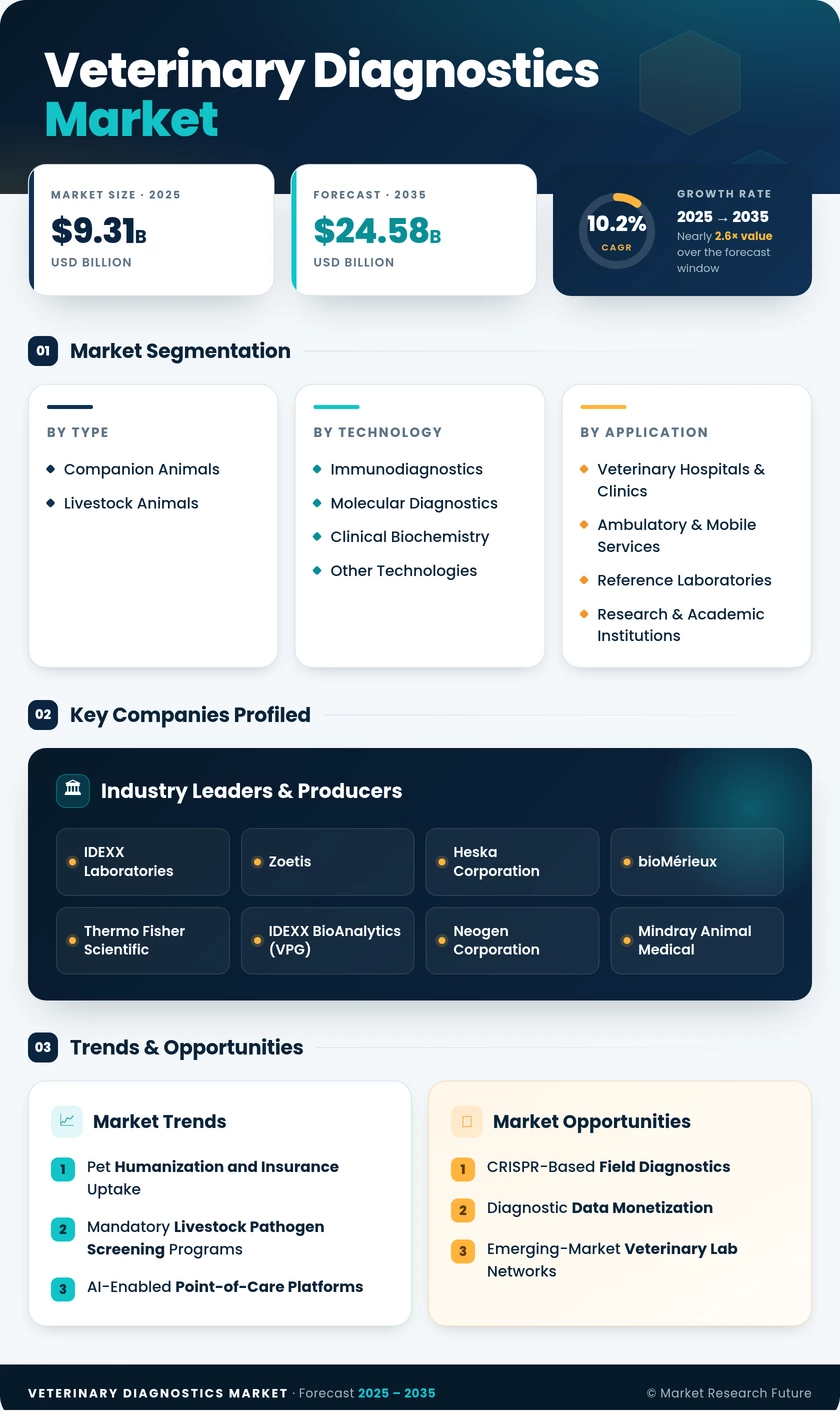
Market Size

Forecast Period2026-2035
CAGR (2026-2035)10.2%
2025 Market SizeUSD 9.31 Billion
2035 Market SizeUSD 24.58 Billion

Key Players

IDEXX Laboratories
Zoetis
Heska Corporation
bioMérieux
Thermo Fisher Scientific
IDEXX BioAnalytics
Opportunities
  • CRISPR-Based Field Diagnostics
  • Diagnostic Data Monetization
  • Emerging-Market Veterinary Lab Networks
  1. 1 Market Overview |
    1. 1.1 Study Assumptions & Market Definition |
    2. 1.2 Scope of the Study |
    3. 1.3 Research Methodology
  2. 2 Market Summary & Key Takeaways
  3. 3 Market Dynamics |
    1. 3.1 Market Drivers Analysis | |
      1. 3.1.1 Pet Humanization & Insurance Uptake | |
      2. 3.1.2 Mandatory Livestock Pathogen Screening Programs | |
      3. 3.1.3 AI-Enabled Point-of-Care Platforms | |
      4. 3.1.4 Multiplex Molecular Panel Development | |
      5. 3.1.5 Rising Disposable Income in Emerging Markets | |
      6. 3.1.6 Reference-Lab Consolidation & Throughput Gains | |
      7. 3.1.7 Telemedicine-Linked Remote Diagnostics |
    2. 3.2 Market Restraints Analysis | |
      1. 3.2.1 High Instrument Capital Costs | |
      2. 3.2.2 Shortage of Trained Veterinary Technicians | |
      3. 3.2.3 Fragmented Regulatory Approval Pathways | |
      4. 3.2.4 Cold-Chain and Reagent Stability Challenges | |
      5. 3.2.5 Data Privacy and Interoperability Gaps |
    3. 3.3 Market Opportunity Analysis | |
      1. 3.3.1 CRISPR-Based Field Diagnostics | |
      2. 3.3.2 Diagnostic Data Monetization | |
      3. 3.3.3 Emerging-Market Veterinary Lab Networks | |
      4. 3.3.4 Telehealth-Integrated Point-of-Care Testing | |
      5. 3.3.5 Aquaculture and Exotic-Species Diagnostics |
    4. 3.4 Industry Value Chain Analysis |
    5. 3.5 Porter's Five Forces Analysis
  4. 4 Global Veterinary Diagnostics Market Size & Forecast (2021–2035) |
    1. 4.1 Historical Market Size (2021–2025) |
    2. 4.2 Current & Forecast Market Size (2026–2035) |
    3. 4.3 Market Size by Revenue (USD Billion) |
    4. 4.4 Year-over-Year Growth Analysis
  5. 5 Segmentation Analysis |
    1. 5.1 By Product Type | |
      1. 5.1.1 Kits & Reagents | |
      2. 5.1.2 Instruments | |
      3. 5.1.3 Software & Services |
    2. 5.2 By Technology | |
      1. 5.2.1 Immunodiagnostics | |
      2. 5.2.2 Molecular Diagnostics | |
      3. 5.2.3 Clinical Biochemistry | |
      4. 5.2.4 Other Technologies |
    3. 5.3 By Animal Type | |
      1. 5.3.1 Companion Animals | |
      2. 5.3.2 Livestock Animals |
    4. 5.4 By End User | |
      1. 5.4.1 Veterinary Hospitals & Clinics | |
      2. 5.4.2 Ambulatory & Mobile Services | |
      3. 5.4.3 Reference Laboratories | |
      4. 5.4.4 Research & Academic Institutions
  6. 6 Regional Analysis |
    1. 6.1 North America | |
      1. 6.1.1 United States | |
      2. 6.1.2 Canada | |
      3. 6.1.3 Mexico |
    2. 6.2 Europe | |
      1. 6.2.1 Germany | |
      2. 6.2.2 United Kingdom | |
      3. 6.2.3 France | |
      4. 6.2.4 Italy | |
      5. 6.2.5 Spain | |
      6. 6.2.6 Nordic Countries | |
      7. 6.2.7 Russia | |
      8. 6.2.8 Rest of Europe |
    3. 6.3 Asia-Pacific | |
      1. 6.3.1 China | |
      2. 6.3.2 India | |
      3. 6.3.3 Japan | |
      4. 6.3.4 South Korea | |
      5. 6.3.5 ASEAN | |
      6. 6.3.6 Rest of Asia-Pacific |
    4. 6.4 South America | |
      1. 6.4.1 Brazil | |
      2. 6.4.2 Argentina | |
      3. 6.4.3 Rest of South America |
    5. 6.5 Middle East & Africa | |
      1. 6.5.1 Saudi Arabia | |
      2. 6.5.2 UAE | |
      3. 6.5.3 South Africa | |
      4. 6.5.4 Egypt | |
      5. 6.5.5 Rest of MEA
  7. 7 Competitive Landscape |
    1. 7.1 Market Share Analysis (2025) |
    2. 7.2 Competitive Benchmarking Matrix |
    3. 7.3 Company Profiles | |
      1. 7.3.1 IDEXX Laboratories | |
      2. 7.3.2 Zoetis | |
      3. 7.3.3 Heska Corporation | |
      4. 7.3.4 bioMérieux | |
      5. 7.3.5 Thermo Fisher Scientific | |
      6. 7.3.6 IDEXX BioAnalytics (VPG) | |
      7. 7.3.7 Neogen Corporation | |
      8. 7.3.8 Mindray Animal Medical | |
      9. 7.3.9 Randox Laboratories | |
      10. 7.3.10 Fujifilm VET Systems
  8. 8 Future Outlook & Strategic Recommendations (2026–2035) |
    1. 8.1 AI-Powered Autonomous Diagnostic Workflows |
    2. 8.2 Platform Economics and Razor-Razorblade Evolution |
    3. 8.3 One Health Integration and Zoonotic Surveillance |
    4. 8.4 Sustainability and Green Chemistry in Reagent Manufacturing
  9. 9 Recent Developments & News
  10. 10 Frequently Asked Questions (FAQs)
  11. 11 Report Scope & Methodology |
    1. 11.1 Study Period & Base Year |
    2. 11.2 Data Sources & Citations |
    3. 11.3 Abbreviations
  12. 12 LIST OF TABLES |
  13. TABLE 1 Global Veterinary Diagnostics Market Size & Forecast, by Revenue (USD Billion), 2021–2035 |
  14. TABLE 2 Global Veterinary Diagnostics Market – Year-over-Year Growth Analysis, 2021–2035 |
  15. TABLE 3 Global Veterinary Diagnostics Market – Driver Impact Analysis |
  16. TABLE 4 Global Veterinary Diagnostics Market – Restraint Impact Analysis |
  17. TABLE 5 Global Veterinary Diagnostics Market Size, by Product Type, 2021–2035 (USD Billion) |
  18. TABLE 6 Global Veterinary Diagnostics Market Size, by Technology, 2021–2035 (USD Billion) |
  19. TABLE 7 Global Veterinary Diagnostics Market Size, by Animal Type, 2021–2035 (USD Billion) |
  20. TABLE 8 Global Veterinary Diagnostics Market Size, by End User, 2021–2035 (USD Billion) |
  21. TABLE 9 Global Veterinary Diagnostics Market Size, by Region, 2021–2035 (USD Billion) |
  22. TABLE 10 North America Veterinary Diagnostics Market Size, by Country, 2021–2035 (USD Billion) |
  23. TABLE 11 Europe Veterinary Diagnostics Market Size, by Country, 2021–2035 (USD Billion) |
  24. TABLE 12 Asia-Pacific Veterinary Diagnostics Market Size, by Country, 2021–2035 (USD Billion) |
  25. TABLE 13 South America Veterinary Diagnostics Market Size, by Country, 2021–2035 (USD Billion) |
  26. TABLE 14 Middle East & Africa Veterinary Diagnostics Market Size, by Country, 2021–2035 (USD Billion) |
  27. TABLE 15 Competitive Benchmarking Matrix – Global Veterinary Diagnostics Market, 2025 |
  28. TABLE 16 Company Profiles – Key Players, Global Veterinary Diagnostics Market |
  29. TABLE 17 Recent Developments & Strategic Announcements, 2023–2025 |
  30. TABLE 18 North America Veterinary Diagnostics Market Size, by Product Type, 2021–2035 (USD Billion) |
  31. TABLE 19 North America Veterinary Diagnostics Market Size, by Technology, 2021–2035 (USD Billion) |
  32. TABLE 20 North America Veterinary Diagnostics Market Size, by Animal Type, 2021–2035 (USD Billion) |
  33. TABLE 21 North America Veterinary Diagnostics Market Size, by End User, 2021–2035 (USD Billion) |
  34. TABLE 22 Europe Veterinary Diagnostics Market Size, by Product Type, 2021–2035 (USD Billion) |
  35. TABLE 23 Europe Veterinary Diagnostics Market Size, by Technology, 2021–2035 (USD Billion) |
  36. TABLE 24 Europe Veterinary Diagnostics Market Size, by Animal Type, 2021–2035 (USD Billion) |
  37. TABLE 25 Europe Veterinary Diagnostics Market Size, by End User, 2021–2035 (USD Billion) |
  38. TABLE 26 Asia-Pacific Veterinary Diagnostics Market Size, by Product Type, 2021–2035 (USD Billion) |
  39. TABLE 27 Asia-Pacific Veterinary Diagnostics Market Size, by Technology, 2021–2035 (USD Billion) |
  40. TABLE 28 Asia-Pacific Veterinary Diagnostics Market Size, by Animal Type, 2021–2035 (USD Billion) |
  41. TABLE 29 Asia-Pacific Veterinary Diagnostics Market Size, by End User, 2021–2035 (USD Billion) |
  42. TABLE 30 South America Veterinary Diagnostics Market Size, by Product Type, 2021–2035 (USD Billion) |
  43. TABLE 31 South America Veterinary Diagnostics Market Size, by Technology, 2021–2035 (USD Billion) |
  44. TABLE 32 South America Veterinary Diagnostics Market Size, by Animal Type, 2021–2035 (USD Billion) |
  45. TABLE 33 South America Veterinary Diagnostics Market Size, by End User, 2021–2035 (USD Billion) |
  46. TABLE 34 Middle East & Africa Veterinary Diagnostics Market Size, by Product Type, 2021–2035 (USD Billion) |
  47. TABLE 35 Middle East & Africa Veterinary Diagnostics Market Size, by Technology, 2021–2035 (USD Billion) |
  48. TABLE 36 Middle East & Africa Veterinary Diagnostics Market Size, by Animal Type, 2021–2035 (USD Billion) |
  49. TABLE 37 Middle East & Africa Veterinary Diagnostics Market Size, by End User, 2021–2035 (USD Billion) |
  50. TABLE 38 Report Scope & Methodology Summary |
  51. TABLE 39 Detailed Sources and Citations
  52. 13 LIST OF FIGURES |
  53. FIGURE 1 Global Veterinary Diagnostics Market Dynamics (Drivers, Restraints, Opportunities) |
  54. FIGURE 2 Industry Value Chain Analysis — Veterinary Diagnostics Market |
  55. FIGURE 3 Porter's Five Forces Analysis — Veterinary Diagnostics Market |
  56. FIGURE 4 Global Veterinary Diagnostics Market Size Trend & Forecast (USD Billion), 2021–2035 |
  57. FIGURE 5 Global Veterinary Diagnostics Market Share, by Product Type (2025) |
  58. FIGURE 6 Global Veterinary Diagnostics Market Share, by Technology (2025) |
  59. FIGURE 7 Global Veterinary Diagnostics Market Share, by Animal Type (2025) |
  60. FIGURE 8 Global Veterinary Diagnostics Market Share, by End User (2025) |
  61. FIGURE 9 Global Veterinary Diagnostics Market Share, by Region (2025) |
  62. FIGURE 10 North America Veterinary Diagnostics Market Size, by Country (2025) |
  63. FIGURE 11 Europe Veterinary Diagnostics Market Size, by Country (2025) |
  64. FIGURE 12 Asia-Pacific Veterinary Diagnostics Market Size, by Country (2025) |
  65. FIGURE 13 South America Veterinary Diagnostics Market Size, by Country (2025) |
  66. FIGURE 14 Middle East & Africa Veterinary Diagnostics Market Size, by Country (2025) |
  67. FIGURE 15 Competitive Landscape — Market Share of Top 5 Players (2025) |
  68. FIGURE 16 Year-over-Year Growth Rate Analysis (%), 2021–2035

Segmentation Quick Reference

DimensionSub-SegmentsDominant SegmentFastest Growing Segment
Product TypeKits & Reagents, Instruments, Software & ServicesKits & ReagentsSoftware & Services
TechnologyImmunodiagnostics, Molecular Diagnostics, Clinical Biochemistry, Other TechnologiesImmunodiagnosticsMolecular Diagnostics
Animal TypeCompanion Animals, Livestock AnimalsCompanion AnimalsLivestock Animals
End UserVeterinary Hospitals & Clinics, Ambulatory & Mobile Services, Reference Laboratories, Research & Academic InstitutionsVeterinary Hospitals & ClinicsAmbulatory & Mobile Services
GeographyNorth America, Europe, Asia-Pacific, South America, Middle East & AfricaNorth AmericaAsia-Pacific


Market Segmentation Overview

By Product Type

Sub-SegmentKey Trend
Kits & ReagentsShift toward lyophilized, ambient-stable rapid-test cassettes reducing cold-chain dependency
InstrumentsMiniaturization enabling handheld analyzers for ambulatory veterinary settings
Software & ServicesCloud-based LIMS platforms integrating AI-powered result interpretation and telehealth connectivity


Kits and reagents remain the revenue backbone of the veterinary diagnostics industry as every instrument placement creates a recurring consumable annuity stream. Software and services are gaining momentum as practices digitize workflows and seek data-driven insights from aggregated diagnostic records.

By Technology

Sub-SegmentKey Trend
ImmunodiagnosticsExpansion of multiplex lateral-flow panels for simultaneous multi-pathogen screening
Molecular DiagnosticsFalling per-reaction PCR costs enabling routine adoption in general practice
Clinical BiochemistryIntegration of chemistry and hematology on single-platform benchtop analyzers
Other TechnologiesGrowing adoption of digital cytology and AI-assisted parasitology screening


Immunodiagnostics dominate through widespread ELISA and rapid-test infrastructure. Molecular diagnostics are closing the gap as multiplexed PCR and isothermal amplification technologies make high-sensitivity pathogen detection economically viable outside reference-laboratory settings.

By Animal Type

Sub-SegmentKey Trend
Companion AnimalsPreventive wellness panels becoming standard of care in annual pet health visits
Livestock AnimalsGovernment-mandated surveillance programs converting outbreak-response testing to routine compliance screening


Companion animals generate the majority of diagnostic revenue owing to premium willingness-to-pay and insurance-driven utilization. Livestock diagnostics are the faster-growing segment as regulatory mandates for disease surveillance expand across major producing regions.

By End User

Sub-SegmentKey Trend
Veterinary Hospitals & ClinicsIn-house diagnostic suites becoming profit centers with rapid-result turnaround
Ambulatory & Mobile ServicesPortable point-of-care devices enabling field-level diagnostics in farm and rural settings
Reference LaboratoriesConsolidation toward mega-labs with automated high-throughput molecular and chemistry lines
Research & Academic InstitutionsGrowing demand for specialized assays supporting clinical trials and zoonotic surveillance


Veterinary hospitals and clinics remain the primary diagnostic consumption channel. Ambulatory services represent the fastest-growing end-user segment as handheld analyzer technology matures and telemedicine-linked workflows expand geographic reach.