
Request Free Sample ×

Kindly complete the form below to receive a free sample of this Report

* Please use a valid business email

Leading companies partner with us for data-driven Insights

clients tt-cursor
Hero Background
English
Chinese
French
Japanese
Korean
German
Spanish

Vector Control Market Analysis

ID: MRFR/Agri/7121-HCR
90 Pages
Snehal Singh
Last Updated: April 06, 2026

Vector Control Market Size, Share, Industry Trend & Analysis Research Report By Application (Residential, Commercial, Industrial, Agricultural, Public Health), By Type (Insecticides, Larvicides, Repellents, Fumigants, Biological Control Agents), By Control Method (Chemical Control, Biological Control, Mechanical Control, Environmental Control), By Target Vector (Mosquitoes, Rodents, Flies, Termites, Ticks) andBy Regional (North America, Europe, South America, Asia-Pacific, Middle East and Africa)- Forecast to 2035.

Share:
Download PDF ×

We do not share your information with anyone. However, we may send you emails based on your report interest from time to time. You may contact us at any time to opt-out.

Vector Control Market Infographic
Purchase Options

Market Analysis

In-depth Analysis of Vector Control Market Industry Landscape

vector control market analyis revolve around the prevention and management of vector-borne diseases, which are illnesses transmitted to humans and animals by vectors such as mosquitoes, ticks, fleas, and flies. This market is influenced by a myriad of factors ranging from environmental conditions and public health policies to technological advancements and socioeconomic factors.

One of the primary drivers of the vector control market is the prevalence and spread of vector-borne diseases. Factors such as climate change, urbanization, and international travel contribute to the expansion of vector habitats and the emergence of new disease threats. As a result, there is a growing demand for effective vector control measures to prevent outbreaks and mitigate the public health burden associated with diseases such as malaria, dengue fever, Zika virus, and Lyme disease.

Technological innovation plays a crucial role in shaping the vector control market. Advancements in insecticides, larvicides, repellents, traps, and biological control agents have led to the development of more targeted, environmentally friendly, and cost-effective solutions for vector management. For example, the use of genetically modified mosquitoes to control mosquito populations or the deployment of drones for aerial spraying of insecticides represent innovative approaches to vector control that are gaining traction in the industry.

Government policies and public health initiatives also influence the vector control market. National and local governments implement regulations and allocate funding for vector control programs aimed at reducing the incidence of vector-borne diseases and protecting public health. These policies may include surveillance and monitoring efforts, community education campaigns, and vector control interventions such as insecticide spraying or the distribution of bed nets and insect repellents in at-risk areas.

Moreover, socioeconomic factors play a significant role in shaping the demand for vector control products and services. Poverty, inadequate housing, lack of access to clean water and sanitation, and limited healthcare infrastructure contribute to the burden of vector-borne diseases in many parts of the world. As a result, there is often a greater need for vector control interventions in low- and middle-income countries where these socioeconomic challenges are more prevalent.

Globalization and trade also impact the vector control market by facilitating the spread of vectors and vector-borne diseases across borders. International travel and trade can introduce invasive species of mosquitoes, ticks, and other vectors to new regions, increasing the risk of disease transmission and posing challenges for vector control efforts. Additionally, the emergence of drug-resistant strains of pathogens and insecticide-resistant populations of vectors underscores the importance of international collaboration and coordinated efforts to address these global health threats.

Supply chain dynamics are another important aspect of the vector control market, with manufacturers, distributors, governments, non-governmental organizations (NGOs), and healthcare providers all playing key roles in the delivery of vector control products and services. Supply chain disruptions, such as natural disasters, political instability, or pandemics, can impact the availability and distribution of vector control resources, affecting the effectiveness of disease prevention and control efforts.

In conclusion, the market dynamics of the vector control market are shaped by a complex interplay of environmental, technological, regulatory, socioeconomic, and global factors. Understanding these dynamics is essential for stakeholders within the vector control industry to develop and implement effective strategies for disease prevention and control. By addressing the root causes of vector-borne diseases and leveraging innovative approaches to vector control, we can work towards reducing the global burden of these preventable and treatable illnesses.


Author
Author Profile
Snehal Singh
Manager - Research

High acumen in analyzing complex macro & micro markets with more than 6 years of work experience in the field of market research. By implementing her analytical skills in forecasting and estimation into market research reports, she has expertise in Packaging, Construction, and Equipment domains. She handles a team size of 20-25 resources and ensures smooth running of the projects, associated marketing activities, and client servicing.

Leave a Comment

FAQs

What is the current valuation of the Vector Control Market as of 2024?

<p>The Vector Control Market was valued at 13.84 USD Billion in 2024.</p>

What is the projected market valuation for the Vector Control Market in 2035?

<p>The market is projected to reach 22.97 USD Billion by 2035.</p>

What is the expected CAGR for the Vector Control Market during the forecast period 2025 - 2035?

<p>The expected CAGR for the Vector Control Market during 2025 - 2035 is 4.71%.</p>

Which application segment is anticipated to show the highest growth in the Vector Control Market?

<p>The Agricultural application segment is expected to grow from 3.12 USD Billion in 2024 to 5.19 USD Billion by 2035.</p>

What are the leading companies in the Vector Control Market?

<p>Key players include BASF SE, Bayer AG, Syngenta AG, and FMC Corporation.</p>

How does the market for insecticides compare to other types in the Vector Control Market?

<p>Insecticides are projected to grow from 5.0 USD Billion in 2024 to 8.5 USD Billion by 2035, indicating strong demand.</p>

What is the valuation of the Public Health segment in the Vector Control Market?

<p>The Public Health segment was valued at 4.48 USD Billion in 2024 and is expected to reach 7.35 USD Billion by 2035.</p>

Which target vector is expected to dominate the market in the coming years?

<p>Mosquitoes are projected to remain the dominant target vector, growing from 5.52 USD Billion in 2024 to 9.25 USD Billion by 2035.</p>

What control method is anticipated to see the most growth in the Vector Control Market?

<p>The Chemical Control method is expected to increase from 5.52 USD Billion in 2024 to 9.25 USD Billion by 2035.</p>

How does the market for biological control agents compare to other control methods?

Biological Control Agents are projected to grow from 2.34 USD Billion in 2024 to 3.97 USD Billion by 2035, reflecting a growing interest in sustainable practices.

Market Summary

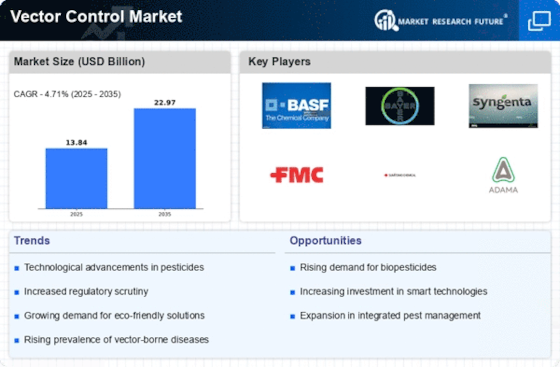
As per Market Research Future analysis, the Vector Control Market Size was estimated at 13.84 USD Billion in 2024. The Vector Control industry is projected to grow from 14.49 USD Billion in 2025 to 22.97 USD Billion by 2035, exhibiting a compound annual growth rate (CAGR) of 4.71% during the forecast period 2025 - 2035

Key Market Trends & Highlights

The Vector Control Market is experiencing dynamic growth driven by technological advancements and increasing public awareness.

  • Technological advancements in vector control are reshaping the market landscape, particularly in North America. The Asia-Pacific region is emerging as the fastest-growing market, driven by rising incidences of vector-borne diseases. The residential segment remains the largest, while the agricultural segment is witnessing rapid growth due to innovative pest management strategies. Key market drivers include regulatory support and public awareness initiatives, which are crucial in addressing the rising incidence of vector-borne diseases.

Market Size & Forecast

2024 Market Size 13.84 (USD Billion)
2035 Market Size 22.97 (USD Billion)
CAGR (2025 - 2035) 4.71%
Largest Regional Market Share in 2024 North America

Major Players

BASF SE (DE), Bayer AG (DE), <a href="https://www.syngenta.com/">Syngenta AG (CH)</a>, FMC Corporation (US), <a href="https://www.sumitomo-chem.co.jp/">Sumitomo Chemical Co., Ltd. (JP)</a>, ADAMA Agricultural Solutions Ltd. (IL), Rentokil Initial plc (GB), Ecolab Inc. (US), Terminix Global Holdings, Inc. (US)

Market Trends

The Vector Control Market is currently experiencing a dynamic evolution, driven by a confluence of factors that include increasing urbanization, climate change, and heightened awareness of vector-borne diseases. As populations migrate to urban areas, the risk of disease transmission escalates, prompting governments and organizations to invest in innovative control measures. Furthermore, the impact of climate change on vector habitats is becoming increasingly evident, leading to shifts in the distribution of disease-carrying organisms. This necessitates a proactive approach to vector management, which is reflected in the growing demand for advanced technologies and integrated pest management strategies. In addition, the Vector Control Market is witnessing a surge in research and development efforts aimed at creating more effective and sustainable solutions. Stakeholders are focusing on environmentally friendly products and methods that minimize harm to non-target species while maximizing efficacy against vectors. The integration of digital technologies, such as data analytics and remote sensing, is also gaining traction, enabling more precise targeting of interventions. As the landscape of vector control continues to evolve, collaboration among public health agencies, private sector entities, and research institutions appears essential for addressing the multifaceted challenges posed by vector-borne diseases.

Technological Advancements in Vector Control Market

The Vector Control Market is increasingly influenced by technological innovations that enhance the effectiveness of control measures. New methodologies, such as genetic modification and biocontrol agents, are being explored to provide sustainable solutions. These advancements may lead to more targeted interventions, reducing reliance on traditional chemical pesticides.

Increased Focus on Integrated Pest Management

There is a growing emphasis on integrated pest management (IPM) strategies within the Vector Control Market. This approach combines biological, cultural, and chemical methods to manage vector populations more sustainably. By promoting a holistic view of pest control, stakeholders aim to reduce environmental impact while improving public health outcomes.

Rising Public Awareness and Education

Public awareness regarding vector-borne diseases is on the rise, influencing the Vector Control Market significantly. Educational campaigns and community engagement initiatives are fostering a better understanding of prevention strategies. This heightened awareness is likely to drive demand for effective vector control solutions, as communities seek to protect themselves from potential outbreaks.

Vector Control Market Market Drivers

Investment in Research and Development

The Vector Control Market is witnessing a significant increase in investment in research and development (R&D) aimed at discovering novel vector control solutions. As the threat of vector-borne diseases continues to evolve, there is a pressing need for innovative approaches that can effectively address emerging challenges. Funding from both public and private sectors is being directed towards the development of new insecticides, biological control agents, and integrated pest management strategies. This focus on R&D is expected to yield breakthroughs that enhance the effectiveness and sustainability of vector control measures. Moreover, collaborations between academic institutions, research organizations, and industry players are likely to foster innovation within the Vector Control Market, ultimately leading to improved health outcomes and reduced disease transmission.

Regulatory Support and Policy Frameworks

The Vector Control Market is significantly influenced by regulatory support and the establishment of robust policy frameworks aimed at vector-borne disease management. Governments and health organizations are increasingly recognizing the importance of vector control in public health, leading to the implementation of policies that promote research, funding, and the adoption of innovative control measures. For example, initiatives such as the WHO's Global Vector Control Market Response emphasize the need for coordinated efforts in vector management. This regulatory backing not only fosters investment in the Vector Control Market but also encourages collaboration among stakeholders, including public health agencies, private sector players, and non-governmental organizations. As a result, the market is expected to expand, with an increasing number of countries adopting comprehensive vector control strategies.

Rising Incidence of Vector-Borne Diseases

The Vector Control Market is propelled by the rising incidence of vector-borne diseases, which poses a significant public health challenge. Diseases such as malaria, dengue fever, and Zika virus continue to affect millions worldwide, necessitating effective vector control measures. According to recent estimates, vector-borne diseases account for over 700,000 deaths annually, underscoring the urgent need for enhanced control strategies. This alarming trend is likely to drive investments in the Vector Control Market, as governments and health organizations seek to mitigate the impact of these diseases. The increasing burden of vector-borne diseases is expected to stimulate demand for innovative solutions, including insecticides, repellents, and biological control methods, thereby contributing to the market's growth trajectory.

Public Awareness and Education Initiatives

The Vector Control Market is benefiting from heightened public awareness and education initiatives aimed at combating vector-borne diseases. As communities become more informed about the risks associated with vectors, there is a growing demand for effective control measures. Educational campaigns, often spearheaded by health organizations and NGOs, are crucial in promoting preventive practices, such as the use of insect repellents and the elimination of standing water. This increased awareness not only empowers individuals to take action but also encourages governments to allocate resources towards vector control programs. Consequently, the Vector Control Market is likely to see a rise in the adoption of various control methods, as informed communities actively participate in vector management efforts.

Technological Innovations in Vector Control

The Vector Control Market is experiencing a surge in technological innovations that enhance the efficacy of vector management strategies. Advanced tools such as drones, remote sensing, and GIS technology are being integrated into vector control programs, allowing for precise targeting and monitoring of vector populations. For instance, the use of genetically modified organisms (GMOs) and biocontrol agents is gaining traction, potentially reducing reliance on chemical pesticides. The market is projected to grow at a compound annual growth rate (CAGR) of approximately 5.2% from 2025 to 2030, driven by these technological advancements. Furthermore, the development of smart traps and automated systems for surveillance is likely to improve operational efficiency, thereby contributing to the overall growth of the Vector Control Market.

Market Segment Insights

By Application: Residential (Largest) vs. Agricultural (Fastest-Growing)

<p>The Vector Control Market showcases a diverse application landscape with varying market shares among its major segments. The Residential segment commands the largest share, driven by increasing awareness among homeowners about pest-related health risks. In contrast, the Agricultural segment is emerging rapidly, reflecting the growing demand for effective pest management solutions to ensure crop protection and yield maximization. Other segments like Commercial and Public Health are also notable but lag behind in overall share, indicating a more focused approach in specific applications rather than widespread adoption.</p>

<p>Residential (Dominant) vs. Agricultural (Emerging)</p>

<p>The Residential application segment remains dominant in the Vector Control Market, primarily due to heightened consumer awareness about pest-related illnesses and the importance of maintaining pest-free living environments. This segment encompasses a wide range of solutions such as insecticides, traps, and preventive measures that cater to individual households. Conversely, the Agricultural segment is considered emerging and is gaining traction owing to the pressing need for sustainable pest control solutions in farming practices. Farmers are increasingly adopting innovative vector control technologies to safeguard crops from pests that can decimate yields. This shift is propelled by regulatory changes favoring environmentally friendly pest control methods, making the agricultural sector a dynamic area for growth.</p>

By Type: Insecticides (Largest) vs. Biocontrol Agents (Fastest-Growing)

<p>In the Vector Control Market, the distribution of market share among the various types reveals that insecticides hold a significant portion, making them the largest segment. The effectiveness and widespread application in controlling mosquito populations make insecticides the go-to solution in vector management. Other segments like repellents, larvicides, fumigants, and biological control agents also contribute to the market, but their shares are comparatively smaller. Examining growth trends, biological control agents are emerging as the fastest-growing segment in recent years. This increase can be attributed to rising environmental awareness and the shift towards sustainable practices in pest control. The popularity of biologically-based solutions is driven by their reduced toxicity and ability to target specific pests, which align with global initiatives aiming for more eco-friendly approaches in vector control.</p>

<p>Insecticides: Dominant vs. Biological Control Agents: Emerging</p>

<p>Insecticides remain the dominant force in the Vector Control Market due to their proven effectiveness in eradicating vector populations, particularly in disease-prone areas. They are often used in various formulations, catering to different environments and pest challenges. The reliance on chemical solutions for immediate results has fostered a strong market presence. On the flip side, biological control agents are rapidly gaining traction as an emerging alternative. They utilize natural predators or pathogens to manage pest populations, presenting a sustainable approach to vector management. As regulations tighten around chemical usage, the biological control segment is positioning itself as a viable option for long-term vector control solutions, promoting biodiversity while reducing chemical dependency.</p>

By Control Method: Chemical Control (Largest) vs. Biological Control (Fastest-Growing)

<p>In the Vector Control Market, the segment distribution reveals that Chemical Control commands the largest share, primarily due to its widespread acceptance and effectiveness in rapidly reducing vector populations. Biological Control, while currently smaller in market share, is gaining traction as an eco-friendly alternative, appealing to increasingly conscientious consumers and regulators. Mechanical Control and Environmental Control follow, contributing niche solutions that focus on sustainability and integrated pest management strategies.</p>

<p>Chemical Control (Dominant) vs. Biological Control (Emerging)</p>

<p>Chemical Control remains the dominant method in the Vector Control Market, characterized by its use of pesticides that effectively eliminate pests with rapid action. This segment caters to various industries, including agriculture and public health, where immediate results are critical. On the other hand, Biological Control is emerging as a sustainable alternative that utilizes natural predators or pathogens to keep vector populations in check. This method is recognized for its long-term effectiveness and minimal environmental impact, driven by growing regulations against chemicals and increasing consumer preference for greener options. As the market evolves, the juxtaposition of these two methods reflects a broader trend towards integrating traditional practices with innovative biological solutions.</p>

By Target Vector: Mosquitoes (Largest) vs. Ticks (Fastest-Growing)

<p>In the Vector Control Market, mosquitoes dominate the target vector segment, accounting for a significant portion of the market share due to their widespread prevalence and public health impact. Rodents and flies follow as notable contributors, while termites and ticks represent smaller yet important segments. The substantial focus on mosquito control initiatives and various control methods enhances the segment's market presence, making it the largest within the target vector classification. Growth trends indicate that while mosquitoes remain the leading challenge in vector control, ticks have emerged as a fast-growing segment. This surge is primarily due to increased awareness of tick-borne diseases and an expanded understanding of their impact on health. Additionally, innovations and new technologies targeting ticks are driving rapid advancements in this area, catching the attention of stakeholders in the vector control landscape.</p>

<p>Mosquitoes (Dominant) vs. Flies (Emerging)</p>

<p>The mosquito segment is established as a dominant force in the Vector Control Market due to continued investments in research and development, alongside governmental and organizational efforts for public health management. Their significant role in transmitting diseases like malaria and dengue has propelled innovations in control methodologies, making them a priority for many countries. In contrast, flies are emerging as a critical segment, particularly in urban areas where sanitation issues amplify their breeding. The increased presence of food safety regulations and hygiene awareness is boosting demand for effective fly control solutions, making it a key focus area for both consumers and manufacturers.</p>

Vector Control Market Target Vector Insights  

Vector Control Market Target Vector Insights  

The  Vector Control Market was valued at 13.22 billion USD in 2023 and continues to evolve, driven by the rising concerns regarding vector-borne diseases and pest-related damages. The Target Vector segment plays a critical role in this market, encompassing various categories such as mosquitoes, rodents, flies, termites, and ticks. Among these, mosquitoes are particularly significant, given their association with diseases like malaria and dengue, which substantially impact public health. Rodents also dominate the market due to their potential to cause severe quality issues in food products and health risks.

Flies, while less prominent, still present challenges in maintaining hygiene across domestic and commercial environments. Termites hold a critical significance in the construction industry by compromising structural integrity and leading to expensive repairs, while ticks are increasingly recognized for their role in transmitting Lyme disease. The  Vector Control Market data showcases a consistent trend of growth influenced by innovations in pest management strategies, regulatory frameworks, and increasing awareness of vector control. Despite growth opportunities, challenges include resistance to pesticides and environmental concerns associated with chemical usage.

Get more detailed insights about Vector Control Market Research Report - Global Forecast till 2035

Regional Insights

North America : Market Leader in Vector Control Market

North America is the largest market for vector control, holding approximately 40% of the global share. The region's growth is driven by increasing awareness of vector-borne diseases and stringent regulatory frameworks promoting effective pest management solutions. The demand for innovative and eco-friendly products is also on the rise, supported by government initiatives aimed at public health and safety. The United States and Canada are the leading countries in this market, with significant contributions from key players like BASF SE, Bayer AG, and Ecolab Inc. The competitive landscape is characterized by a mix of established companies and emerging startups focusing on sustainable practices. The presence of advanced research and development facilities further enhances the region's market position.

Europe : Regulatory-Driven Market Growth

Europe is the second-largest market for vector control, accounting for approximately 30% of the global share. The region's growth is significantly influenced by stringent regulations aimed at reducing chemical usage and promoting environmentally friendly solutions. The European Union's directives on pesticide use and public health initiatives are key drivers of demand for innovative vector control products. Leading countries in this market include Germany, France, and the United Kingdom, where companies like Bayer AG and Syngenta AG are prominent. The competitive landscape is marked by a strong emphasis on research and development, with firms investing in sustainable technologies. The presence of regulatory bodies ensures compliance and fosters innovation in vector control solutions.

Asia-Pacific : Emerging Market Potential

Asia-Pacific is witnessing rapid growth in the vector control market, holding approximately 25% of the global share. The region's expansion is driven by increasing urbanization, rising population density, and a surge in vector-borne diseases. Governments are implementing various initiatives to enhance public health, which is catalyzing demand for effective vector control solutions. Countries like China, India, and Japan are at the forefront of this market, with significant contributions from companies such as Sumitomo Chemical Co., Ltd. and FMC Corporation. The competitive landscape is evolving, with both multinational corporations and local players vying for market share. The focus on innovative and cost-effective solutions is shaping the future of vector control in this region.

Middle East and Africa : Untapped Market Opportunities

The Middle East and Africa represent an emerging market for vector control, accounting for approximately 5% of the global share. The region's growth is driven by increasing awareness of vector-borne diseases and the need for effective pest management solutions. Government initiatives aimed at improving public health and sanitation are also contributing to market expansion. Leading countries in this region include South Africa and Nigeria, where local companies and international players are establishing a presence. The competitive landscape is characterized by a mix of established firms and new entrants focusing on innovative solutions. The potential for growth in this market is significant, driven by rising urbanization and health awareness among the population.

Key Players and Competitive Insights

The  Vector Control Market has witnessed a significant evolution in recent years, driven by an increasing awareness of the health risks associated with vector-borne diseases, such as malaria, dengue, and Zika virus. This market is characterized by a diverse range of products and services aimed at controlling various vectors, including mosquitoes, ticks, and rodents. Several factors, including technological advancements, regulatory frameworks, and the rising adoption of integrated pest management strategies, influence competitive dynamics in this market. Companies in this space are continually innovating to offer effective and sustainable solutions that cater to the diverse needs of both residential and commercial customers. As competition intensifies, players are exploring strategic partnerships and collaborations to enhance their market reach and improve their service offerings. ADAMA Agricultural Solutions has established a notable presence in the  Vector Control Market due to its commitment to providing innovative and effective solutions in vector management. The company is known for its comprehensive portfolio that addresses various pest control needs, emphasizing agricultural and non-agricultural applications. ADAMA Agricultural Solutions leverages its strong research and development capabilities to create products that meet stringent regulatory requirements while ensuring efficacy against vectors. With a strong focus on sustainability, the company aims to reduce the environmental impact of vector control. Additionally, ADAMA's extensive  distribution network enables it to effectively penetrate diverse markets, providing tailored solutions that consider local pest challenges and economic conditions, thereby enhancing its competitive edge in the market. Rentokil Initial stands out as a key player in the  Vector Control Market, offering specialized services aimed at managing and controlling vector populations. The company's extensive expertise in pest control and management has allowed it to develop a comprehensive suite of solutions that encompass all aspects of vector management, from prevention and monitoring to extermination and ongoing control measures. Rentokil Initial is recognized for its innovative approaches and technology-driven solutions, which enhance the effectiveness of vector control strategies while ensuring compliance with evolving regulations. The company's commitment to customer service and its ability to provide customized solutions make it a preferred choice among various sectors, including residential, commercial, and agricultural. Through continuous investment in training and technology, Rentokil Initial maintains a competitive advantage, positioning itself as a trusted partner in the fight against vector-borne diseases.

Key Companies in the Vector Control Market include

Industry Developments

The  Vector Control Market has witnessed significant developments, particularly with companies like ADAMA Agricultural Solutions and Rentokil Initial expanding their portfolio through innovative solutions aimed at combating vector-borne diseases. Mosquito Shield is enhancing its product offerings with advanced mosquito control technologies. Sumitomo Chemical and Ecolab are also focusing on developing eco-friendly pest management products, aligning with sustainability trends. Syngenta and FMC Corporation are investing in research and development to create more effective insecticides.

In terms of mergers and acquisitions, BASF recently acquired a segment of Bayer's crop protection business, enhancing its capabilities in vector control solutions. Additionally, Verily Life Sciences has been engaged in partnerships to leverage technology in vector control initiatives, showcasing a shift toward innovation in the market. The growth in the market valuation of companies, such as Corteva Agriscience and Insect Shield, reflects an increasing demand for effective vector control solutions amid rising  health concerns.

This escalating market growth indicates a robust trend toward enhancing public health through integrated pest management practices, thereby impacting the overall landscape of the  Vector Control Market.


Future Outlook

Vector Control Market Future Outlook

The Vector Control Market is projected to grow at a 4.71% CAGR from 2025 to 2035, driven by increasing urbanization, climate change, and rising vector-borne diseases.

New opportunities lie in:

  • <p>Development of smart insect traps utilizing IoT technology. Expansion of <a href="https://www.marketresearchfuture.com/reports/biopesticides-market-5098" target="_blank" rel="noopener">biopesticides</a> for sustainable vector management. Investment in drone technology for aerial vector surveillance.</p>

By 2035, the Vector Control Market is expected to be robust, driven by innovative solutions and heightened demand.

Market Segmentation

Vector Control Market Type Outlook

  • Insecticides
  • Larvicides
  • Repellents
  • Fumigants
  • Biological Control Agents

Vector Control Market Application Outlook

  • Residential
  • Commercial
  • Industrial
  • Agricultural
  • Public Health

Vector Control Market Target Vector Outlook

  • Mosquitoes
  • Rodents
  • Flies
  • Termites
  • Ticks

Vector Control Market Control Method Outlook

  • Chemical Control
  • Biological Control
  • Mechanical Control
  • Environmental Control

Report Scope

MARKET SIZE 2024 13.84(USD Billion)
MARKET SIZE 2025 14.49(USD Billion)
MARKET SIZE 2035 22.97(USD Billion)
COMPOUND ANNUAL GROWTH RATE (CAGR) 4.71% (2025 - 2035)
REPORT COVERAGE Revenue Forecast, Competitive Landscape, Growth Factors, and Trends
BASE YEAR 2024
Market Forecast Period 2025 - 2035
Historical Data 2019 - 2024
Market Forecast Units USD Billion
Key Companies Profiled BASF SE (DE), Bayer AG (DE), Syngenta AG (CH), FMC Corporation (US), Sumitomo Chemical Co., Ltd. (JP), ADAMA Agricultural Solutions Ltd. (IL), Rentokil Initial plc (GB), Ecolab Inc. (US), Terminix Global Holdings, Inc. (US)
Segments Covered Application, Type, Control Method, Target Vector, Regional
Key Market Opportunities Integration of advanced biocontrol methods and smart technologies in the Vector Control Market.
Key Market Dynamics Rising regulatory pressures and technological advancements drive innovation in vector control solutions and strategies.
Countries Covered North America, Europe, APAC, South America, MEA

FAQs

What is the current valuation of the Vector Control Market as of 2024?

<p>The Vector Control Market was valued at 13.84 USD Billion in 2024.</p>

What is the projected market valuation for the Vector Control Market in 2035?

<p>The market is projected to reach 22.97 USD Billion by 2035.</p>

What is the expected CAGR for the Vector Control Market during the forecast period 2025 - 2035?

<p>The expected CAGR for the Vector Control Market during 2025 - 2035 is 4.71%.</p>

Which application segment is anticipated to show the highest growth in the Vector Control Market?

<p>The Agricultural application segment is expected to grow from 3.12 USD Billion in 2024 to 5.19 USD Billion by 2035.</p>

What are the leading companies in the Vector Control Market?

<p>Key players include BASF SE, Bayer AG, Syngenta AG, and FMC Corporation.</p>

How does the market for insecticides compare to other types in the Vector Control Market?

<p>Insecticides are projected to grow from 5.0 USD Billion in 2024 to 8.5 USD Billion by 2035, indicating strong demand.</p>

What is the valuation of the Public Health segment in the Vector Control Market?

<p>The Public Health segment was valued at 4.48 USD Billion in 2024 and is expected to reach 7.35 USD Billion by 2035.</p>

Which target vector is expected to dominate the market in the coming years?

<p>Mosquitoes are projected to remain the dominant target vector, growing from 5.52 USD Billion in 2024 to 9.25 USD Billion by 2035.</p>

What control method is anticipated to see the most growth in the Vector Control Market?

<p>The Chemical Control method is expected to increase from 5.52 USD Billion in 2024 to 9.25 USD Billion by 2035.</p>

How does the market for biological control agents compare to other control methods?

Biological Control Agents are projected to grow from 2.34 USD Billion in 2024 to 3.97 USD Billion by 2035, reflecting a growing interest in sustainable practices.

  1. SECTION I: EXECUTIVE SUMMARY AND KEY HIGHLIGHTS
    1. | 1.1 EXECUTIVE SUMMARY
    2. | | 1.1.1 Market Overview
    3. | | 1.1.2 Key Findings
    4. | | 1.1.3 Market Segmentation
    5. | | 1.1.4 Competitive Landscape
    6. | | 1.1.5 Challenges and Opportunities
    7. | | 1.1.6 Future Outlook
  2. SECTION II: SCOPING, METHODOLOGY AND MARKET STRUCTURE
    1. | 2.1 MARKET INTRODUCTION
    2. | | 2.1.1 Definition
    3. | | 2.1.2 Scope of the study
    4. | | | 2.1.2.1 Research Objective
    5. | | | 2.1.2.2 Assumption
    6. | | | 2.1.2.3 Limitations
    7. | 2.2 RESEARCH METHODOLOGY
    8. | | 2.2.1 Overview
    9. | | 2.2.2 Data Mining
    10. | | 2.2.3 Secondary Research
    11. | | 2.2.4 Primary Research
    12. | | | 2.2.4.1 Primary Interviews and Information Gathering Process
    13. | | | 2.2.4.2 Breakdown of Primary Respondents
    14. | | 2.2.5 Forecasting Model
    15. | | 2.2.6 Market Size Estimation
    16. | | | 2.2.6.1 Bottom-Up Approach
    17. | | | 2.2.6.2 Top-Down Approach
    18. | | 2.2.7 Data Triangulation
    19. | | 2.2.8 Validation
  3. SECTION III: QUALITATIVE ANALYSIS
    1. | 3.1 MARKET DYNAMICS
    2. | | 3.1.1 Overview
    3. | | 3.1.2 Drivers
    4. | | 3.1.3 Restraints
    5. | | 3.1.4 Opportunities
    6. | 3.2 MARKET FACTOR ANALYSIS
    7. | | 3.2.1 Value chain Analysis
    8. | | 3.2.2 Porter's Five Forces Analysis
    9. | | | 3.2.2.1 Bargaining Power of Suppliers
    10. | | | 3.2.2.2 Bargaining Power of Buyers
    11. | | | 3.2.2.3 Threat of New Entrants
    12. | | | 3.2.2.4 Threat of Substitutes
    13. | | | 3.2.2.5 Intensity of Rivalry
    14. | | 3.2.3 COVID-19 Impact Analysis
    15. | | | 3.2.3.1 Market Impact Analysis
    16. | | | 3.2.3.2 Regional Impact
    17. | | | 3.2.3.3 Opportunity and Threat Analysis
  4. SECTION IV: QUANTITATIVE ANALYSIS
    1. | 4.1 Industrial Automation & Equipment, BY Application (USD Billion)
    2. | | 4.1.1 Residential
    3. | | 4.1.2 Commercial
    4. | | 4.1.3 Industrial
    5. | | 4.1.4 Agricultural
    6. | | 4.1.5 Public Health
    7. | 4.2 Industrial Automation & Equipment, BY Type (USD Billion)
    8. | | 4.2.1 Insecticides
    9. | | 4.2.2 Larvicides
    10. | | 4.2.3 Repellents
    11. | | 4.2.4 Fumigants
    12. | | 4.2.5 Biological Control Agents
    13. | 4.3 Industrial Automation & Equipment, BY Control Method (USD Billion)
    14. | | 4.3.1 Chemical Control
    15. | | 4.3.2 Biological Control
    16. | | 4.3.3 Mechanical Control
    17. | | 4.3.4 Environmental Control
    18. | 4.4 Industrial Automation & Equipment, BY Target Vector (USD Billion)
    19. | | 4.4.1 Mosquitoes
    20. | | 4.4.2 Rodents
    21. | | 4.4.3 Flies
    22. | | 4.4.4 Termites
    23. | | 4.4.5 Ticks
    24. | 4.5 Industrial Automation & Equipment, BY Region (USD Billion)
    25. | | 4.5.1 North America
    26. | | | 4.5.1.1 US
    27. | | | 4.5.1.2 Canada
    28. | | 4.5.2 Europe
    29. | | | 4.5.2.1 Germany
    30. | | | 4.5.2.2 UK
    31. | | | 4.5.2.3 France
    32. | | | 4.5.2.4 Russia
    33. | | | 4.5.2.5 Italy
    34. | | | 4.5.2.6 Spain
    35. | | | 4.5.2.7 Rest of Europe
    36. | | 4.5.3 APAC
    37. | | | 4.5.3.1 China
    38. | | | 4.5.3.2 India
    39. | | | 4.5.3.3 Japan
    40. | | | 4.5.3.4 South Korea
    41. | | | 4.5.3.5 Malaysia
    42. | | | 4.5.3.6 Thailand
    43. | | | 4.5.3.7 Indonesia
    44. | | | 4.5.3.8 Rest of APAC
    45. | | 4.5.4 South America
    46. | | | 4.5.4.1 Brazil
    47. | | | 4.5.4.2 Mexico
    48. | | | 4.5.4.3 Argentina
    49. | | | 4.5.4.4 Rest of South America
    50. | | 4.5.5 MEA
    51. | | | 4.5.5.1 GCC Countries
    52. | | | 4.5.5.2 South Africa
    53. | | | 4.5.5.3 Rest of MEA
  5. SECTION V: COMPETITIVE ANALYSIS
    1. | 5.1 Competitive Landscape
    2. | | 5.1.1 Overview
    3. | | 5.1.2 Competitive Analysis
    4. | | 5.1.3 Market share Analysis
    5. | | 5.1.4 Major Growth Strategy in the Industrial Automation & Equipment
    6. | | 5.1.5 Competitive Benchmarking
    7. | | 5.1.6 Leading Players in Terms of Number of Developments in the Industrial Automation & Equipment
    8. | | 5.1.7 Key developments and growth strategies
    9. | | | 5.1.7.1 New Product Launch/Service Deployment
    10. | | | 5.1.7.2 Merger & Acquisitions
    11. | | | 5.1.7.3 Joint Ventures
    12. | | 5.1.8 Major Players Financial Matrix
    13. | | | 5.1.8.1 Sales and Operating Income
    14. | | | 5.1.8.2 Major Players R&D Expenditure. 2023
    15. | 5.2 Company Profiles
    16. | | 5.2.1 BASF SE (DE)
    17. | | | 5.2.1.1 Financial Overview
    18. | | | 5.2.1.2 Products Offered
    19. | | | 5.2.1.3 Key Developments
    20. | | | 5.2.1.4 SWOT Analysis
    21. | | | 5.2.1.5 Key Strategies
    22. | | 5.2.2 Bayer AG (DE)
    23. | | | 5.2.2.1 Financial Overview
    24. | | | 5.2.2.2 Products Offered
    25. | | | 5.2.2.3 Key Developments
    26. | | | 5.2.2.4 SWOT Analysis
    27. | | | 5.2.2.5 Key Strategies
    28. | | 5.2.3 Syngenta AG (CH)
    29. | | | 5.2.3.1 Financial Overview
    30. | | | 5.2.3.2 Products Offered
    31. | | | 5.2.3.3 Key Developments
    32. | | | 5.2.3.4 SWOT Analysis
    33. | | | 5.2.3.5 Key Strategies
    34. | | 5.2.4 FMC Corporation (US)
    35. | | | 5.2.4.1 Financial Overview
    36. | | | 5.2.4.2 Products Offered
    37. | | | 5.2.4.3 Key Developments
    38. | | | 5.2.4.4 SWOT Analysis
    39. | | | 5.2.4.5 Key Strategies
    40. | | 5.2.5 Sumitomo Chemical Co., Ltd. (JP)
    41. | | | 5.2.5.1 Financial Overview
    42. | | | 5.2.5.2 Products Offered
    43. | | | 5.2.5.3 Key Developments
    44. | | | 5.2.5.4 SWOT Analysis
    45. | | | 5.2.5.5 Key Strategies
    46. | | 5.2.6 ADAMA Agricultural Solutions Ltd. (IL)
    47. | | | 5.2.6.1 Financial Overview
    48. | | | 5.2.6.2 Products Offered
    49. | | | 5.2.6.3 Key Developments
    50. | | | 5.2.6.4 SWOT Analysis
    51. | | | 5.2.6.5 Key Strategies
    52. | | 5.2.7 Rentokil Initial plc (GB)
    53. | | | 5.2.7.1 Financial Overview
    54. | | | 5.2.7.2 Products Offered
    55. | | | 5.2.7.3 Key Developments
    56. | | | 5.2.7.4 SWOT Analysis
    57. | | | 5.2.7.5 Key Strategies
    58. | | 5.2.8 Ecolab Inc. (US)
    59. | | | 5.2.8.1 Financial Overview
    60. | | | 5.2.8.2 Products Offered
    61. | | | 5.2.8.3 Key Developments
    62. | | | 5.2.8.4 SWOT Analysis
    63. | | | 5.2.8.5 Key Strategies
    64. | | 5.2.9 Terminix Global Holdings, Inc. (US)
    65. | | | 5.2.9.1 Financial Overview
    66. | | | 5.2.9.2 Products Offered
    67. | | | 5.2.9.3 Key Developments
    68. | | | 5.2.9.4 SWOT Analysis
    69. | | | 5.2.9.5 Key Strategies
    70. | 5.3 Appendix
    71. | | 5.3.1 References
    72. | | 5.3.2 Related Reports
  6. LIST OF FIGURES
    1. | 6.1 MARKET SYNOPSIS
    2. | 6.2 NORTH AMERICA MARKET ANALYSIS
    3. | 6.3 US MARKET ANALYSIS BY APPLICATION
    4. | 6.4 US MARKET ANALYSIS BY TYPE
    5. | 6.5 US MARKET ANALYSIS BY CONTROL METHOD
    6. | 6.6 US MARKET ANALYSIS BY TARGET VECTOR
    7. | 6.7 CANADA MARKET ANALYSIS BY APPLICATION
    8. | 6.8 CANADA MARKET ANALYSIS BY TYPE
    9. | 6.9 CANADA MARKET ANALYSIS BY CONTROL METHOD
    10. | 6.10 CANADA MARKET ANALYSIS BY TARGET VECTOR
    11. | 6.11 EUROPE MARKET ANALYSIS
    12. | 6.12 GERMANY MARKET ANALYSIS BY APPLICATION
    13. | 6.13 GERMANY MARKET ANALYSIS BY TYPE
    14. | 6.14 GERMANY MARKET ANALYSIS BY CONTROL METHOD
    15. | 6.15 GERMANY MARKET ANALYSIS BY TARGET VECTOR
    16. | 6.16 UK MARKET ANALYSIS BY APPLICATION
    17. | 6.17 UK MARKET ANALYSIS BY TYPE
    18. | 6.18 UK MARKET ANALYSIS BY CONTROL METHOD
    19. | 6.19 UK MARKET ANALYSIS BY TARGET VECTOR
    20. | 6.20 FRANCE MARKET ANALYSIS BY APPLICATION
    21. | 6.21 FRANCE MARKET ANALYSIS BY TYPE
    22. | 6.22 FRANCE MARKET ANALYSIS BY CONTROL METHOD
    23. | 6.23 FRANCE MARKET ANALYSIS BY TARGET VECTOR
    24. | 6.24 RUSSIA MARKET ANALYSIS BY APPLICATION
    25. | 6.25 RUSSIA MARKET ANALYSIS BY TYPE
    26. | 6.26 RUSSIA MARKET ANALYSIS BY CONTROL METHOD
    27. | 6.27 RUSSIA MARKET ANALYSIS BY TARGET VECTOR
    28. | 6.28 ITALY MARKET ANALYSIS BY APPLICATION
    29. | 6.29 ITALY MARKET ANALYSIS BY TYPE
    30. | 6.30 ITALY MARKET ANALYSIS BY CONTROL METHOD
    31. | 6.31 ITALY MARKET ANALYSIS BY TARGET VECTOR
    32. | 6.32 SPAIN MARKET ANALYSIS BY APPLICATION
    33. | 6.33 SPAIN MARKET ANALYSIS BY TYPE
    34. | 6.34 SPAIN MARKET ANALYSIS BY CONTROL METHOD
    35. | 6.35 SPAIN MARKET ANALYSIS BY TARGET VECTOR
    36. | 6.36 REST OF EUROPE MARKET ANALYSIS BY APPLICATION
    37. | 6.37 REST OF EUROPE MARKET ANALYSIS BY TYPE
    38. | 6.38 REST OF EUROPE MARKET ANALYSIS BY CONTROL METHOD
    39. | 6.39 REST OF EUROPE MARKET ANALYSIS BY TARGET VECTOR
    40. | 6.40 APAC MARKET ANALYSIS
    41. | 6.41 CHINA MARKET ANALYSIS BY APPLICATION
    42. | 6.42 CHINA MARKET ANALYSIS BY TYPE
    43. | 6.43 CHINA MARKET ANALYSIS BY CONTROL METHOD
    44. | 6.44 CHINA MARKET ANALYSIS BY TARGET VECTOR
    45. | 6.45 INDIA MARKET ANALYSIS BY APPLICATION
    46. | 6.46 INDIA MARKET ANALYSIS BY TYPE
    47. | 6.47 INDIA MARKET ANALYSIS BY CONTROL METHOD
    48. | 6.48 INDIA MARKET ANALYSIS BY TARGET VECTOR
    49. | 6.49 JAPAN MARKET ANALYSIS BY APPLICATION
    50. | 6.50 JAPAN MARKET ANALYSIS BY TYPE
    51. | 6.51 JAPAN MARKET ANALYSIS BY CONTROL METHOD
    52. | 6.52 JAPAN MARKET ANALYSIS BY TARGET VECTOR
    53. | 6.53 SOUTH KOREA MARKET ANALYSIS BY APPLICATION
    54. | 6.54 SOUTH KOREA MARKET ANALYSIS BY TYPE
    55. | 6.55 SOUTH KOREA MARKET ANALYSIS BY CONTROL METHOD
    56. | 6.56 SOUTH KOREA MARKET ANALYSIS BY TARGET VECTOR
    57. | 6.57 MALAYSIA MARKET ANALYSIS BY APPLICATION
    58. | 6.58 MALAYSIA MARKET ANALYSIS BY TYPE
    59. | 6.59 MALAYSIA MARKET ANALYSIS BY CONTROL METHOD
    60. | 6.60 MALAYSIA MARKET ANALYSIS BY TARGET VECTOR
    61. | 6.61 THAILAND MARKET ANALYSIS BY APPLICATION
    62. | 6.62 THAILAND MARKET ANALYSIS BY TYPE
    63. | 6.63 THAILAND MARKET ANALYSIS BY CONTROL METHOD
    64. | 6.64 THAILAND MARKET ANALYSIS BY TARGET VECTOR
    65. | 6.65 INDONESIA MARKET ANALYSIS BY APPLICATION
    66. | 6.66 INDONESIA MARKET ANALYSIS BY TYPE
    67. | 6.67 INDONESIA MARKET ANALYSIS BY CONTROL METHOD
    68. | 6.68 INDONESIA MARKET ANALYSIS BY TARGET VECTOR
    69. | 6.69 REST OF APAC MARKET ANALYSIS BY APPLICATION
    70. | 6.70 REST OF APAC MARKET ANALYSIS BY TYPE
    71. | 6.71 REST OF APAC MARKET ANALYSIS BY CONTROL METHOD
    72. | 6.72 REST OF APAC MARKET ANALYSIS BY TARGET VECTOR
    73. | 6.73 SOUTH AMERICA MARKET ANALYSIS
    74. | 6.74 BRAZIL MARKET ANALYSIS BY APPLICATION
    75. | 6.75 BRAZIL MARKET ANALYSIS BY TYPE
    76. | 6.76 BRAZIL MARKET ANALYSIS BY CONTROL METHOD
    77. | 6.77 BRAZIL MARKET ANALYSIS BY TARGET VECTOR
    78. | 6.78 MEXICO MARKET ANALYSIS BY APPLICATION
    79. | 6.79 MEXICO MARKET ANALYSIS BY TYPE
    80. | 6.80 MEXICO MARKET ANALYSIS BY CONTROL METHOD
    81. | 6.81 MEXICO MARKET ANALYSIS BY TARGET VECTOR
    82. | 6.82 ARGENTINA MARKET ANALYSIS BY APPLICATION
    83. | 6.83 ARGENTINA MARKET ANALYSIS BY TYPE
    84. | 6.84 ARGENTINA MARKET ANALYSIS BY CONTROL METHOD
    85. | 6.85 ARGENTINA MARKET ANALYSIS BY TARGET VECTOR
    86. | 6.86 REST OF SOUTH AMERICA MARKET ANALYSIS BY APPLICATION
    87. | 6.87 REST OF SOUTH AMERICA MARKET ANALYSIS BY TYPE
    88. | 6.88 REST OF SOUTH AMERICA MARKET ANALYSIS BY CONTROL METHOD
    89. | 6.89 REST OF SOUTH AMERICA MARKET ANALYSIS BY TARGET VECTOR
    90. | 6.90 MEA MARKET ANALYSIS
    91. | 6.91 GCC COUNTRIES MARKET ANALYSIS BY APPLICATION
    92. | 6.92 GCC COUNTRIES MARKET ANALYSIS BY TYPE
    93. | 6.93 GCC COUNTRIES MARKET ANALYSIS BY CONTROL METHOD
    94. | 6.94 GCC COUNTRIES MARKET ANALYSIS BY TARGET VECTOR
    95. | 6.95 SOUTH AFRICA MARKET ANALYSIS BY APPLICATION
    96. | 6.96 SOUTH AFRICA MARKET ANALYSIS BY TYPE
    97. | 6.97 SOUTH AFRICA MARKET ANALYSIS BY CONTROL METHOD
    98. | 6.98 SOUTH AFRICA MARKET ANALYSIS BY TARGET VECTOR
    99. | 6.99 REST OF MEA MARKET ANALYSIS BY APPLICATION
    100. | 6.100 REST OF MEA MARKET ANALYSIS BY TYPE
    101. | 6.101 REST OF MEA MARKET ANALYSIS BY CONTROL METHOD
    102. | 6.102 REST OF MEA MARKET ANALYSIS BY TARGET VECTOR
    103. | 6.103 KEY BUYING CRITERIA OF INDUSTRIAL AUTOMATION & EQUIPMENT
    104. | 6.104 RESEARCH PROCESS OF MRFR
    105. | 6.105 DRO ANALYSIS OF INDUSTRIAL AUTOMATION & EQUIPMENT
    106. | 6.106 DRIVERS IMPACT ANALYSIS: INDUSTRIAL AUTOMATION & EQUIPMENT
    107. | 6.107 RESTRAINTS IMPACT ANALYSIS: INDUSTRIAL AUTOMATION & EQUIPMENT
    108. | 6.108 SUPPLY / VALUE CHAIN: INDUSTRIAL AUTOMATION & EQUIPMENT
    109. | 6.109 INDUSTRIAL AUTOMATION & EQUIPMENT, BY APPLICATION, 2024 (% SHARE)
    110. | 6.110 INDUSTRIAL AUTOMATION & EQUIPMENT, BY APPLICATION, 2024 TO 2035 (USD Billion)
    111. | 6.111 INDUSTRIAL AUTOMATION & EQUIPMENT, BY TYPE, 2024 (% SHARE)
    112. | 6.112 INDUSTRIAL AUTOMATION & EQUIPMENT, BY TYPE, 2024 TO 2035 (USD Billion)
    113. | 6.113 INDUSTRIAL AUTOMATION & EQUIPMENT, BY CONTROL METHOD, 2024 (% SHARE)
    114. | 6.114 INDUSTRIAL AUTOMATION & EQUIPMENT, BY CONTROL METHOD, 2024 TO 2035 (USD Billion)
    115. | 6.115 INDUSTRIAL AUTOMATION & EQUIPMENT, BY TARGET VECTOR, 2024 (% SHARE)
    116. | 6.116 INDUSTRIAL AUTOMATION & EQUIPMENT, BY TARGET VECTOR, 2024 TO 2035 (USD Billion)
    117. | 6.117 BENCHMARKING OF MAJOR COMPETITORS
  7. LIST OF TABLES
    1. | 7.1 LIST OF ASSUMPTIONS
    2. | | 7.1.1
    3. | 7.2 North America MARKET SIZE ESTIMATES; FORECAST
    4. | | 7.2.1 BY APPLICATION, 2025-2035 (USD Billion)
    5. | | 7.2.2 BY TYPE, 2025-2035 (USD Billion)
    6. | | 7.2.3 BY CONTROL METHOD, 2025-2035 (USD Billion)
    7. | | 7.2.4 BY TARGET VECTOR, 2025-2035 (USD Billion)
    8. | 7.3 US MARKET SIZE ESTIMATES; FORECAST
    9. | | 7.3.1 BY APPLICATION, 2025-2035 (USD Billion)
    10. | | 7.3.2 BY TYPE, 2025-2035 (USD Billion)
    11. | | 7.3.3 BY CONTROL METHOD, 2025-2035 (USD Billion)
    12. | | 7.3.4 BY TARGET VECTOR, 2025-2035 (USD Billion)
    13. | 7.4 Canada MARKET SIZE ESTIMATES; FORECAST
    14. | | 7.4.1 BY APPLICATION, 2025-2035 (USD Billion)
    15. | | 7.4.2 BY TYPE, 2025-2035 (USD Billion)
    16. | | 7.4.3 BY CONTROL METHOD, 2025-2035 (USD Billion)
    17. | | 7.4.4 BY TARGET VECTOR, 2025-2035 (USD Billion)
    18. | 7.5 Europe MARKET SIZE ESTIMATES; FORECAST
    19. | | 7.5.1 BY APPLICATION, 2025-2035 (USD Billion)
    20. | | 7.5.2 BY TYPE, 2025-2035 (USD Billion)
    21. | | 7.5.3 BY CONTROL METHOD, 2025-2035 (USD Billion)
    22. | | 7.5.4 BY TARGET VECTOR, 2025-2035 (USD Billion)
    23. | 7.6 Germany MARKET SIZE ESTIMATES; FORECAST
    24. | | 7.6.1 BY APPLICATION, 2025-2035 (USD Billion)
    25. | | 7.6.2 BY TYPE, 2025-2035 (USD Billion)
    26. | | 7.6.3 BY CONTROL METHOD, 2025-2035 (USD Billion)
    27. | | 7.6.4 BY TARGET VECTOR, 2025-2035 (USD Billion)
    28. | 7.7 UK MARKET SIZE ESTIMATES; FORECAST
    29. | | 7.7.1 BY APPLICATION, 2025-2035 (USD Billion)
    30. | | 7.7.2 BY TYPE, 2025-2035 (USD Billion)
    31. | | 7.7.3 BY CONTROL METHOD, 2025-2035 (USD Billion)
    32. | | 7.7.4 BY TARGET VECTOR, 2025-2035 (USD Billion)
    33. | 7.8 France MARKET SIZE ESTIMATES; FORECAST
    34. | | 7.8.1 BY APPLICATION, 2025-2035 (USD Billion)
    35. | | 7.8.2 BY TYPE, 2025-2035 (USD Billion)
    36. | | 7.8.3 BY CONTROL METHOD, 2025-2035 (USD Billion)
    37. | | 7.8.4 BY TARGET VECTOR, 2025-2035 (USD Billion)
    38. | 7.9 Russia MARKET SIZE ESTIMATES; FORECAST
    39. | | 7.9.1 BY APPLICATION, 2025-2035 (USD Billion)
    40. | | 7.9.2 BY TYPE, 2025-2035 (USD Billion)
    41. | | 7.9.3 BY CONTROL METHOD, 2025-2035 (USD Billion)
    42. | | 7.9.4 BY TARGET VECTOR, 2025-2035 (USD Billion)
    43. | 7.10 Italy MARKET SIZE ESTIMATES; FORECAST
    44. | | 7.10.1 BY APPLICATION, 2025-2035 (USD Billion)
    45. | | 7.10.2 BY TYPE, 2025-2035 (USD Billion)
    46. | | 7.10.3 BY CONTROL METHOD, 2025-2035 (USD Billion)
    47. | | 7.10.4 BY TARGET VECTOR, 2025-2035 (USD Billion)
    48. | 7.11 Spain MARKET SIZE ESTIMATES; FORECAST
    49. | | 7.11.1 BY APPLICATION, 2025-2035 (USD Billion)
    50. | | 7.11.2 BY TYPE, 2025-2035 (USD Billion)
    51. | | 7.11.3 BY CONTROL METHOD, 2025-2035 (USD Billion)
    52. | | 7.11.4 BY TARGET VECTOR, 2025-2035 (USD Billion)
    53. | 7.12 Rest of Europe MARKET SIZE ESTIMATES; FORECAST
    54. | | 7.12.1 BY APPLICATION, 2025-2035 (USD Billion)
    55. | | 7.12.2 BY TYPE, 2025-2035 (USD Billion)
    56. | | 7.12.3 BY CONTROL METHOD, 2025-2035 (USD Billion)
    57. | | 7.12.4 BY TARGET VECTOR, 2025-2035 (USD Billion)
    58. | 7.13 APAC MARKET SIZE ESTIMATES; FORECAST
    59. | | 7.13.1 BY APPLICATION, 2025-2035 (USD Billion)
    60. | | 7.13.2 BY TYPE, 2025-2035 (USD Billion)
    61. | | 7.13.3 BY CONTROL METHOD, 2025-2035 (USD Billion)
    62. | | 7.13.4 BY TARGET VECTOR, 2025-2035 (USD Billion)
    63. | 7.14 China MARKET SIZE ESTIMATES; FORECAST
    64. | | 7.14.1 BY APPLICATION, 2025-2035 (USD Billion)
    65. | | 7.14.2 BY TYPE, 2025-2035 (USD Billion)
    66. | | 7.14.3 BY CONTROL METHOD, 2025-2035 (USD Billion)
    67. | | 7.14.4 BY TARGET VECTOR, 2025-2035 (USD Billion)
    68. | 7.15 India MARKET SIZE ESTIMATES; FORECAST
    69. | | 7.15.1 BY APPLICATION, 2025-2035 (USD Billion)
    70. | | 7.15.2 BY TYPE, 2025-2035 (USD Billion)
    71. | | 7.15.3 BY CONTROL METHOD, 2025-2035 (USD Billion)
    72. | | 7.15.4 BY TARGET VECTOR, 2025-2035 (USD Billion)
    73. | 7.16 Japan MARKET SIZE ESTIMATES; FORECAST
    74. | | 7.16.1 BY APPLICATION, 2025-2035 (USD Billion)
    75. | | 7.16.2 BY TYPE, 2025-2035 (USD Billion)
    76. | | 7.16.3 BY CONTROL METHOD, 2025-2035 (USD Billion)
    77. | | 7.16.4 BY TARGET VECTOR, 2025-2035 (USD Billion)
    78. | 7.17 South Korea MARKET SIZE ESTIMATES; FORECAST
    79. | | 7.17.1 BY APPLICATION, 2025-2035 (USD Billion)
    80. | | 7.17.2 BY TYPE, 2025-2035 (USD Billion)
    81. | | 7.17.3 BY CONTROL METHOD, 2025-2035 (USD Billion)
    82. | | 7.17.4 BY TARGET VECTOR, 2025-2035 (USD Billion)
    83. | 7.18 Malaysia MARKET SIZE ESTIMATES; FORECAST
    84. | | 7.18.1 BY APPLICATION, 2025-2035 (USD Billion)
    85. | | 7.18.2 BY TYPE, 2025-2035 (USD Billion)
    86. | | 7.18.3 BY CONTROL METHOD, 2025-2035 (USD Billion)
    87. | | 7.18.4 BY TARGET VECTOR, 2025-2035 (USD Billion)
    88. | 7.19 Thailand MARKET SIZE ESTIMATES; FORECAST
    89. | | 7.19.1 BY APPLICATION, 2025-2035 (USD Billion)
    90. | | 7.19.2 BY TYPE, 2025-2035 (USD Billion)
    91. | | 7.19.3 BY CONTROL METHOD, 2025-2035 (USD Billion)
    92. | | 7.19.4 BY TARGET VECTOR, 2025-2035 (USD Billion)
    93. | 7.20 Indonesia MARKET SIZE ESTIMATES; FORECAST
    94. | | 7.20.1 BY APPLICATION, 2025-2035 (USD Billion)
    95. | | 7.20.2 BY TYPE, 2025-2035 (USD Billion)
    96. | | 7.20.3 BY CONTROL METHOD, 2025-2035 (USD Billion)
    97. | | 7.20.4 BY TARGET VECTOR, 2025-2035 (USD Billion)
    98. | 7.21 Rest of APAC MARKET SIZE ESTIMATES; FORECAST
    99. | | 7.21.1 BY APPLICATION, 2025-2035 (USD Billion)
    100. | | 7.21.2 BY TYPE, 2025-2035 (USD Billion)
    101. | | 7.21.3 BY CONTROL METHOD, 2025-2035 (USD Billion)
    102. | | 7.21.4 BY TARGET VECTOR, 2025-2035 (USD Billion)
    103. | 7.22 South America MARKET SIZE ESTIMATES; FORECAST
    104. | | 7.22.1 BY APPLICATION, 2025-2035 (USD Billion)
    105. | | 7.22.2 BY TYPE, 2025-2035 (USD Billion)
    106. | | 7.22.3 BY CONTROL METHOD, 2025-2035 (USD Billion)
    107. | | 7.22.4 BY TARGET VECTOR, 2025-2035 (USD Billion)
    108. | 7.23 Brazil MARKET SIZE ESTIMATES; FORECAST
    109. | | 7.23.1 BY APPLICATION, 2025-2035 (USD Billion)
    110. | | 7.23.2 BY TYPE, 2025-2035 (USD Billion)
    111. | | 7.23.3 BY CONTROL METHOD, 2025-2035 (USD Billion)
    112. | | 7.23.4 BY TARGET VECTOR, 2025-2035 (USD Billion)
    113. | 7.24 Mexico MARKET SIZE ESTIMATES; FORECAST
    114. | | 7.24.1 BY APPLICATION, 2025-2035 (USD Billion)
    115. | | 7.24.2 BY TYPE, 2025-2035 (USD Billion)
    116. | | 7.24.3 BY CONTROL METHOD, 2025-2035 (USD Billion)
    117. | | 7.24.4 BY TARGET VECTOR, 2025-2035 (USD Billion)
    118. | 7.25 Argentina MARKET SIZE ESTIMATES; FORECAST
    119. | | 7.25.1 BY APPLICATION, 2025-2035 (USD Billion)
    120. | | 7.25.2 BY TYPE, 2025-2035 (USD Billion)
    121. | | 7.25.3 BY CONTROL METHOD, 2025-2035 (USD Billion)
    122. | | 7.25.4 BY TARGET VECTOR, 2025-2035 (USD Billion)
    123. | 7.26 Rest of South America MARKET SIZE ESTIMATES; FORECAST
    124. | | 7.26.1 BY APPLICATION, 2025-2035 (USD Billion)
    125. | | 7.26.2 BY TYPE, 2025-2035 (USD Billion)
    126. | | 7.26.3 BY CONTROL METHOD, 2025-2035 (USD Billion)
    127. | | 7.26.4 BY TARGET VECTOR, 2025-2035 (USD Billion)
    128. | 7.27 MEA MARKET SIZE ESTIMATES; FORECAST
    129. | | 7.27.1 BY APPLICATION, 2025-2035 (USD Billion)
    130. | | 7.27.2 BY TYPE, 2025-2035 (USD Billion)
    131. | | 7.27.3 BY CONTROL METHOD, 2025-2035 (USD Billion)
    132. | | 7.27.4 BY TARGET VECTOR, 2025-2035 (USD Billion)
    133. | 7.28 GCC Countries MARKET SIZE ESTIMATES; FORECAST
    134. | | 7.28.1 BY APPLICATION, 2025-2035 (USD Billion)
    135. | | 7.28.2 BY TYPE, 2025-2035 (USD Billion)
    136. | | 7.28.3 BY CONTROL METHOD, 2025-2035 (USD Billion)
    137. | | 7.28.4 BY TARGET VECTOR, 2025-2035 (USD Billion)
    138. | 7.29 South Africa MARKET SIZE ESTIMATES; FORECAST
    139. | | 7.29.1 BY APPLICATION, 2025-2035 (USD Billion)
    140. | | 7.29.2 BY TYPE, 2025-2035 (USD Billion)
    141. | | 7.29.3 BY CONTROL METHOD, 2025-2035 (USD Billion)
    142. | | 7.29.4 BY TARGET VECTOR, 2025-2035 (USD Billion)
    143. | 7.30 Rest of MEA MARKET SIZE ESTIMATES; FORECAST
    144. | | 7.30.1 BY APPLICATION, 2025-2035 (USD Billion)
    145. | | 7.30.2 BY TYPE, 2025-2035 (USD Billion)
    146. | | 7.30.3 BY CONTROL METHOD, 2025-2035 (USD Billion)
    147. | | 7.30.4 BY TARGET VECTOR, 2025-2035 (USD Billion)
    148. | 7.31 PRODUCT LAUNCH/PRODUCT DEVELOPMENT/APPROVAL
    149. | | 7.31.1
    150. | 7.32 ACQUISITION/PARTNERSHIP
    151. | | 7.32.1

Industrial Automation & Equipment Market Segmentation

Industrial Automation & Equipment By Application (USD Billion, 2025-2035)

  • Residential
  • Commercial
  • Industrial
  • Agricultural
  • Public Health

Industrial Automation & Equipment By Type (USD Billion, 2025-2035)

  • Insecticides
  • Larvicides
  • Repellents
  • Fumigants
  • Biological Control Agents

Industrial Automation & Equipment By Control Method (USD Billion, 2025-2035)

  • Chemical Control
  • Biological Control
  • Mechanical Control
  • Environmental Control

Industrial Automation & Equipment By Target Vector (USD Billion, 2025-2035)

  • Mosquitoes
  • Rodents
  • Flies
  • Termites
  • Ticks
Infographic

Free Sample Request

Kindly complete the form below to receive a free sample of this Report

Get Free Sample

Customer Strories

Compare Licence

×
Features License Type
Single User Multiuser License Enterprise User
Price $4,950 $5,950 $7,250
Maximum User Access Limit 1 User Upto 10 Users Unrestricted Access Throughout the Organization
Free Customization
Direct Access to Analyst
Deliverable Format
Platform Access
Discount on Next Purchase 10% 15% 15%
Printable Versions