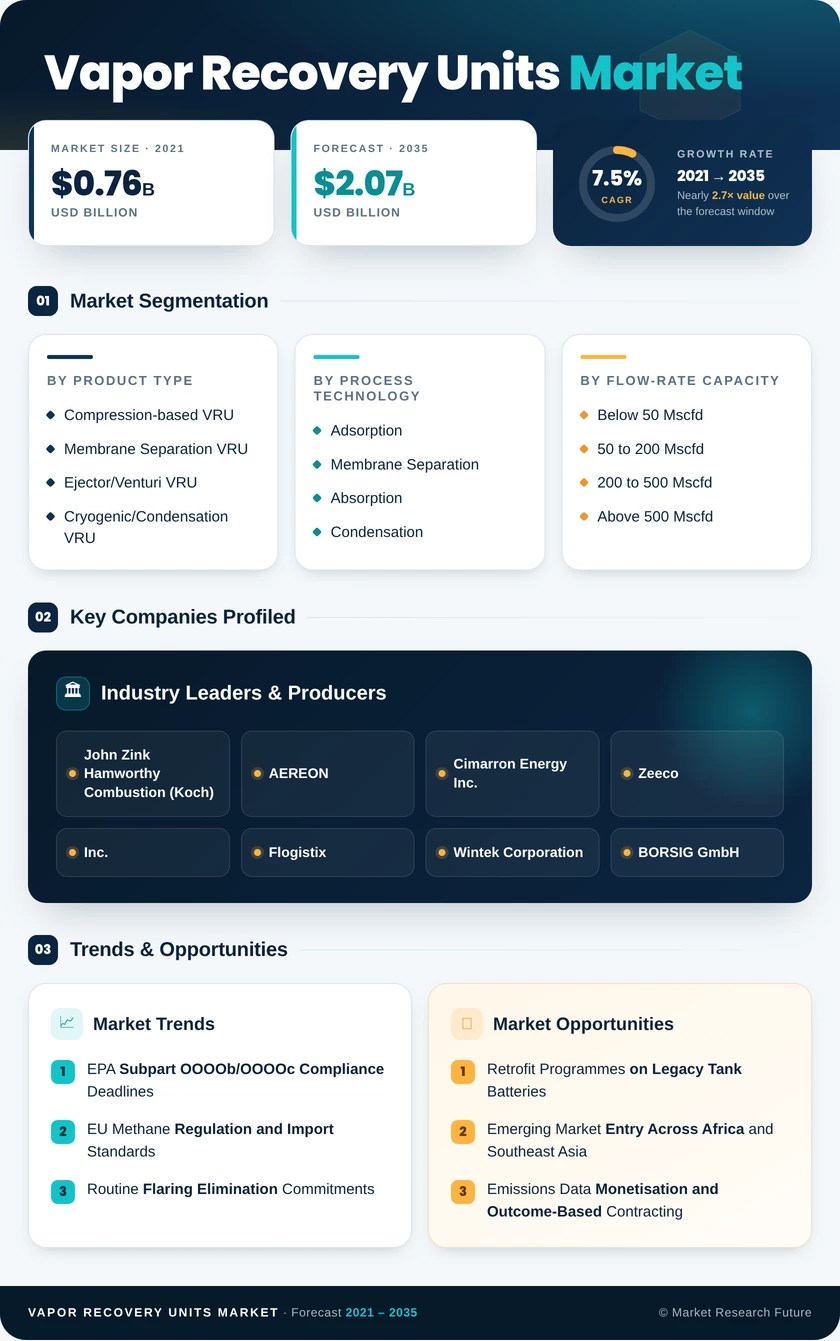
Segmentation Quick Reference
| Dimension | Sub-Segments | Dominant Segment | Fastest Growing Segment |
| By Product Type | Compression-based VRU; Membrane Separation VRU; Ejector/Venturi VRU; Cryogenic/Condensation VRU | Compression-based VRU (42.4% share, 2025) | Membrane Separation VRU (8.9% CAGR, 2026–2035) |
| By Process Technology | Adsorption; Membrane Separation; Absorption; Condensation | Adsorption (38.2% share, 2025) | Membrane Separation (13.0% CAGR, 2026–2035) |
| By Flow-rate Capacity | Below 50 Mscfd; 50 to 200 Mscfd; 200 to 500 Mscfd; Above 500 Mscfd | 50 to 200 Mscfd (35.9% share, 2025) | 200 to 500 Mscfd (7.6% CAGR, 2026–2035) |
| By Installation Site | Onshore; Offshore | Onshore (81.5% share, 2025) | Offshore (8.3% CAGR, 2026–2035) |
| By Application | Storage Tanks; Processing Plants; Loading Racks and Terminals; Flare Gas Recovery | Storage Tanks (35.2% share, 2025) | Flare Gas Recovery (7.9% CAGR, 2026–2035) |
| By End-User | Upstream Oil and Gas; Midstream; Downstream | Upstream Oil and Gas (41.8% share, 2025) | Downstream (8.0% CAGR, 2026–2035) |
| By Region | North America; Europe; Asia-Pacific; South America; Middle East & Africa | North America (37.8% share, 2025) | Asia-Pacific (9.1% CAGR, 2026–2035) |
Market Segmentation Overview
By Product Type
| Sub-Segment | Key Trend |
| Compression-based VRU | Variable-frequency drives and scroll designs narrowing the operating-cost gap |
| Membrane Separation VRU | Higher-permeability polymer modules enabling fuel-free skid-mounted operation |
| Ejector/Venturi VRU | Simplicity favoured at remote low-pressure leases with surplus motive gas |
| Cryogenic/Condensation VRU | Deployment concentrated in NGL-rich plays where liquids revenue funds the cooling cycle |
Compression-based VRU keeps the largest position at 42.4% of 2025 revenue because operators already stock the spares and hold the mechanical competence, and terminal and pipeline duty cycles are well characterised for reciprocating packages. Membrane Separation VRU grows fastest at 8.9% because it removes the prime mover entirely, which matters on congested pads and at sites without reliable three-phase power. The competitive question is life-cycle cost rather than purchase price, and that framing increasingly favours membranes.
By Process Technology
| Sub-Segment | Key Trend |
| Adsorption | Carbon regeneration scheduling optimised through feed-quality monitoring |
| Membrane Separation | Polymer-of-intrinsic-microporosity films lifting throughput per module |
| Absorption | Retained in aromatic and benzene-heavy service where solvent chemistry suits the feed |
| Condensation | Selected where phase-change economics beat chilling alternatives on heavy vapours |
Adsorption leads at 38.2% of 2025 revenue because activated-carbon beds clear the 95% control efficiency threshold with documented margin, which permit engineers value more than marginal energy savings. Membrane Separation climbs fastest at 13.0% by eliminating regeneration downtime, though fouling on wet feed still demands pre-treatment that adds installed cost. Absorption and Condensation hold composition-specific niches rather than competing head-on for mainstream tank duty.
By Flow-rate Capacity
| Sub-Segment | Key Trend |
| Below 50 Mscfd | Modular trailer-mounted designs lowering cost per site on marginal leases |
| 50 to 200 Mscfd | Standardised skid packages matched to multi-well pad decline curves |
| 200 to 500 Mscfd | Central gathering hubs aggregating vapours from satellite locations |
| Above 500 Mscfd | Project-scale units serving LNG pre-treatment and refinery complexes |
The 50 to 200 Mscfd class dominates at 35.9% of 2025 revenue because it corresponds to what a typical multi-well pad actually vents after the first decline year, making it the volume sweet spot for standardised skids. The 200 to 500 Mscfd class grows fastest at 7.6% as gathering architecture centralises and pooled vapour streams drive down cost per recovered Mcf. Below 50 Mscfd remains unit-heavy but margin-thin.
By Installation Site
| Sub-Segment | Key Trend |
| Onshore | Quick tie-ins to existing tank roofs and gathering headers |
| Offshore | Integrated topsides skids combining vapour handling with fuel-gas conditioning |
Onshore holds 81.5% of 2025 revenue because equipment demand scales with well count rather than production volume, and onshore sites vastly outnumber offshore facilities. Offshore grows faster at 8.3% as deepwater sanctions in Brazil and Guyana specify zero-routine-flaring topsides at the design stage. Offshore units also carry far higher unit prices, since stainless housings, explosion-proof drives, and seawater-cooled modules are standard scope there.
By Application
| Sub-Segment | Key Trend |
| Storage Tanks | Continuous pressure monitoring and auto-start blowers becoming standard scope |
| Processing Plants | Consolidation of scattered process vents into a single recovery header |
| Loading Racks and Terminals | Vapour balance systems mandated on truck and marine loading operations |
| Flare Gas Recovery | Carbon pricing and flare penalties shortening payback on capture projects |
Storage Tanks lead at 35.2% of 2025 revenue because federal thresholds target covered vessels first and the emission source is straightforward to quantify for permitting. Flare Gas Recovery grows fastest at 7.9% as carbon fees and flaring penalties convert streams that were uneconomic five years ago into projects clearing a two-year payback in liquids-rich formations. Processing Plants and Loading Racks and Terminals supply steadier, less policy-sensitive baseline demand.
By End-User
| Sub-Segment | Key Trend |
| Upstream Oil and Gas | Fleet-wide standardisation on a single skid design across hundreds of pads |
| Midstream | Larger packages at compression stations and terminals with longer service contracts |
| Downstream | Loading-rack and intermediate-storage retrofits bundled into turnaround scopes |
Upstream Oil and Gas accounts for 41.8% of 2025 revenue, buying the largest number of units but the smallest individual packages, since site count rather than throughput sets demand. Downstream grows fastest at 8.0% as Asian and Middle Eastern refiners retrofit loading racks and intermediate storage to meet tightening VOC limits. Midstream sits between the two, purchasing fewer but larger units with better unit economics and more durable service relationships.


 Noah Malgeri
Co-Founder

 Peter Groot koerkamp
Account and Business Manager

 Younghwan Choi
Senior Retail Manager

 Mark Irwin
Management Consultant

 Akif Moroglu
Strategy & Business Development Director

 Guilherme Gomes Martins
Product Management Director

 Joseph Aguayo
Sales Operations & Pricing Manager

 La Terria Dodd
Program Support Specialist

 Rob Kooiker
Group Product Manager HVAC & Fire Protection GMA