×
Hero Background
English
Chinese
French
Japanese
Korean
German
Spanish

VAE Emulsion Market Share

ID: MRFR/CnM/6245-CR
111 Pages
Priya Nagrale
April 2019

Global VAE Emulsion Market Research Report Information by Type (Ordinary VAE Emulsion, Waterproof VAE Emulsion), by Application (Paints & Coatings, Caulks and Sealants, Re-dispersible Powders, Textiles and Nonwoven, Others), and Region - Forecast till 2035

Share:
Download PDF ×

We do not share your information with anyone. However, we may send you emails based on your report interest from time to time. You may contact us at any time to opt-out.

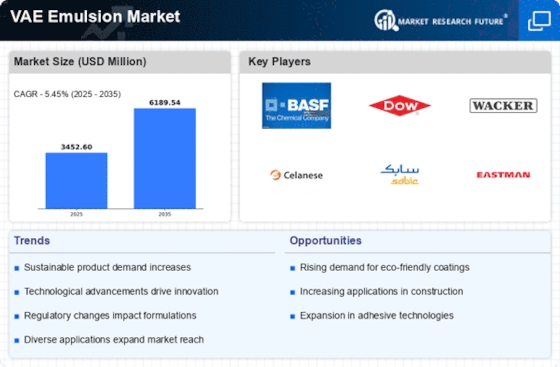
VAE Emulsion Market Infographic
Purchase Options

Market Share

VAE Emulsion Market Share Analysis

Market share positioning strategies in the VAE Emulsion Market are essential for companies aiming to establish a competitive edge and maximize their presence within the industry. Various approaches are employed to secure a significant portion of the market and enhance brand recognition, ultimately driving sales and revenue growth.

Another factor contributing to the growing share of the VAE emulsion market emulsion is the use of VAE emulsion in headliners and trucks with compatible thermoplastic polymers.

One prominent strategy is differentiation, where companies focus on unique features or attributes of their VAE emulsion products to distinguish themselves from competitors. This could involve emphasizing specific performance characteristics such as durability, adhesion, or environmental sustainability. By highlighting these distinguishing factors, companies can attract customers who prioritize these qualities, thereby capturing a segment of the market that values differentiation.

Another effective approach is cost leadership, where companies strive to become the lowest-cost producer in the VAE emulsion market. By optimizing production processes, sourcing materials efficiently, and streamlining operations, companies can offer competitive pricing without compromising on product quality. This strategy appeals to price-sensitive customers and allows companies to gain market share by capturing a larger portion of the customer base.

Furthermore, targeting niche markets can be a successful strategy for companies operating in the VAE emulsion market. Instead of competing directly with larger competitors in the broader market, companies can identify specific segments with unique needs or preferences and tailor their products and marketing efforts accordingly. This targeted approach enables companies to become leaders within niche segments, where they face less competition and can establish strong brand loyalty among customers.

Additionally, strategic alliances and partnerships can play a crucial role in market share positioning within the VAE emulsion market. By collaborating with complementary businesses or forming strategic alliances with key stakeholders, companies can leverage each other's strengths and resources to enhance their market position. Whether through joint ventures, distribution partnerships, or technology licensing agreements, strategic alliances can provide companies with access to new markets, distribution channels, or technological capabilities, thereby increasing their market share and competitive advantage.

Moreover, continuous innovation is essential for companies seeking to maintain or expand their market share in the VAE emulsion market. By investing in research and development, companies can develop new products or improve existing ones to meet evolving customer needs and preferences. Innovation can take various forms, including developing novel formulations, enhancing product performance, or introducing environmentally friendly alternatives. Companies that consistently innovate can stay ahead of competitors, attract new customers, and retain existing ones, thereby solidifying their market share position.

Furthermore, effective marketing and branding strategies are critical for companies aiming to position themselves successfully in the VAE emulsion market. By establishing a strong brand identity and effectively communicating the value proposition of their products, companies can differentiate themselves from competitors and attract customers. This may involve targeted advertising campaigns, engaging social media presence, or strategic partnerships with influencers or industry experts. By building brand awareness and loyalty, companies can increase market share and maintain a competitive edge in the VAE emulsion market.

Author
Priya Nagrale
Senior Research Analyst

With an experience of over five years in market research industry (Chemicals & Materials domain), I gather and analyze market data from diverse sources to produce results, which are then presented back to a client. Also, provide recommendations based on the findings. As a Senior Research Analyst, I perform quality checks (QC) for market estimations, QC for reports, and handle queries and work extensively on client customizations. Also, handle the responsibilities of client proposals, report planning, report finalization, and execution

Leave a Comment

FAQs

What is the current valuation of the VAE Emulsion Market as of 2024?

The VAE Emulsion Market was valued at approximately 3452.6 USD Million in 2024.

What is the projected market valuation for the VAE Emulsion Market in 2035?

The market is projected to reach approximately 6189.54 USD Million by 2035.

What is the expected CAGR for the VAE Emulsion Market during the forecast period 2025 - 2035?

The expected CAGR for the VAE Emulsion Market during the forecast period 2025 - 2035 is 5.45%.

Market Summary

As per MRFR analysis, the VAE Emulsion Market Size was estimated at 3452.6 USD Million in 2024. The VAE Emulsion industry is projected to grow from 3640.77 USD Million in 2025 to 6189.54 USD Million by 2035, exhibiting a compound annual growth rate (CAGR) of 5.45 during the forecast period 2025 - 2035.

Key Market Trends & Highlights

The VAE Emulsion Market is poised for growth driven by sustainability and technological advancements.

  • North America remains the largest market for VAE emulsions, reflecting a strong demand across various applications.
  • Asia-Pacific is emerging as the fastest-growing region, fueled by increasing construction activities and urbanization.
  • The Ordinary segment continues to dominate the market, while the Waterproof segment is experiencing rapid growth due to rising consumer preferences.
  • Key market drivers include sustainability initiatives and technological innovations that enhance product performance and compliance with regulatory standards.

Market Size & Forecast

2024 Market Size 3452.6 (USD Million)
2035 Market Size 6189.54 (USD Million)
CAGR (2025 - 2035) 5.45%
Largest Regional Market Share in 2024 Asia Pacific

Major Players

<p>BASF SE (DE), Dow Inc. (US), Wacker Chemie AG (DE), Celanese Corporation (US), SABIC (SA), Eastman Chemical Company (US), H.B. Fuller Company (US), Kraton Corporation (US), Arkema S.A. (FR)</p>

Market Trends

The VAE Emulsion Market is currently experiencing a notable transformation, driven by various factors that influence demand and supply dynamics. The increasing preference for environmentally friendly products is reshaping the landscape, as consumers and manufacturers alike seek sustainable alternatives. This shift is evident in the growing adoption of VAE emulsions in diverse applications, including paints, adhesives, and coatings, where their eco-friendly properties are highly valued. Furthermore, advancements in technology are enhancing the performance characteristics of these emulsions, making them more appealing to end-users. As a result, the market appears poised for growth, with innovations likely to play a crucial role in shaping future trends. In addition to sustainability, the VAE Emulsion Market is witnessing a rise in demand from emerging economies, where industrialization and urbanization are accelerating. This trend suggests a potential increase in construction activities, which could further drive the need for high-performance emulsions. Moreover, the versatility of VAE emulsions in various formulations allows for customization, catering to specific industry requirements. Overall, the market landscape is evolving, with a focus on sustainability, technological advancements, and regional growth opportunities that may redefine the future of VAE emulsions.

Sustainability Focus

The emphasis on eco-friendly products is reshaping the VAE Emulsion Market. Manufacturers are increasingly prioritizing sustainable practices, leading to a rise in the production of environmentally friendly emulsions. This trend reflects a broader consumer demand for products that minimize environmental impact.

Technological Advancements

Innovations in formulation and production techniques are enhancing the performance of VAE emulsions. These advancements enable manufacturers to create emulsions with improved properties, such as better adhesion and durability, which are crucial for various applications.

Emerging Market Demand

The VAE Emulsion Market is experiencing heightened interest from developing regions. Rapid industrialization and urban growth in these areas are driving the need for high-quality emulsions, particularly in construction and manufacturing sectors.

VAE Emulsion Market Market Drivers

Technological Innovations

Technological advancements are playing a pivotal role in shaping the VAE Emulsion Market. Innovations in formulation chemistry and production processes are enhancing the performance characteristics of VAE emulsions. For instance, the development of advanced polymerization techniques has led to the creation of emulsions with superior adhesion, flexibility, and durability. These improvements are particularly beneficial in applications such as coatings, adhesives, and sealants, where performance is critical. Furthermore, the integration of digital technologies in manufacturing processes is streamlining operations, reducing costs, and improving product quality. As a result, companies that leverage these technological innovations are likely to enhance their market share and meet the evolving demands of consumers. The VAE Emulsion Market is thus positioned for growth, driven by continuous innovation and the quest for higher performance products.

Sustainability Initiatives

The increasing emphasis on sustainability within the VAE Emulsion Market is driving demand for eco-friendly products. Manufacturers are increasingly adopting sustainable practices, such as using renewable resources and minimizing waste. This shift is not merely a trend; it reflects a broader societal movement towards environmental responsibility. As consumers become more environmentally conscious, they are likely to prefer products that align with their values. Consequently, companies that prioritize sustainability may gain a competitive edge. The VAE Emulsion Market is witnessing a rise in formulations that are low in volatile organic compounds (VOCs), which are less harmful to the environment. This trend is expected to continue, as regulatory frameworks increasingly favor sustainable practices, potentially leading to a more robust market presence for eco-friendly VAE emulsions.

Rising Construction Activities

The resurgence of construction activities is significantly influencing the VAE Emulsion Market. As urbanization accelerates, there is a growing need for construction materials that offer durability and aesthetic appeal. VAE emulsions are increasingly utilized in paints, coatings, and adhesives, which are essential components of modern construction projects. According to industry reports, the construction sector is projected to grow at a compound annual growth rate (CAGR) of approximately 5% over the next few years, thereby driving demand for VAE emulsions. This growth is further fueled by government initiatives aimed at infrastructure development, which are likely to create a favorable environment for the VAE Emulsion Market. Consequently, manufacturers are expected to ramp up production to meet the rising demand, positioning themselves strategically within this expanding market.

Regulatory Compliance and Standards

Regulatory compliance is becoming increasingly critical in the VAE Emulsion Market. Governments and regulatory bodies are implementing stringent standards regarding the use of chemicals in various applications, particularly in construction and consumer products. These regulations often focus on reducing harmful substances and promoting safer alternatives. As a result, manufacturers are compelled to innovate and reformulate their products to meet these evolving standards. The VAE Emulsion Market is witnessing a shift towards formulations that comply with these regulations, which may include lower VOC content and enhanced safety profiles. This compliance not only ensures market access but also enhances brand reputation among environmentally conscious consumers. Consequently, companies that proactively adapt to regulatory changes are likely to secure a competitive advantage in the VAE Emulsion Market.

Consumer Preference for High-Performance Products

Consumer preferences are evolving towards high-performance products, which is a key driver for the VAE Emulsion Market. As end-users seek materials that offer enhanced durability, flexibility, and resistance to environmental factors, VAE emulsions are increasingly favored for their superior properties. This trend is particularly evident in sectors such as automotive, construction, and consumer goods, where performance is paramount. Market data indicates that the demand for high-performance coatings and adhesives is expected to rise, potentially leading to a market expansion for VAE emulsions. Manufacturers are responding to this shift by developing specialized formulations that cater to specific application needs, thereby enhancing their product offerings. The VAE Emulsion Market is thus likely to benefit from this growing consumer inclination towards high-quality, performance-driven products.

Market Segment Insights

By Type: Ordinary (Largest) vs. Waterproof (Fastest-Growing)

<p>In the VAE Emulsion Market, the Ordinary segment holds a substantial share, attributed to its wide-ranging applications in construction, paints, and adhesives. This segment benefits from established demand driven by traditional use cases in various industries. The Waterproof segment, while smaller in comparison, is experiencing a significant rise as specialty applications increase, particularly in construction and automotive industries that require enhanced durability and moisture resistance.</p>

<p>Ordinary (Dominant) vs. Waterproof (Emerging)</p>

<p>The Ordinary segment is characterized by its versatility and is predominantly used in paints and coatings, adhesives, and textiles. It serves as the backbone of the VAE Emulsion Market, benefiting from longstanding relationships with manufacturers and steady demand. In contrast, the Waterproof segment is emerging due to the increasing need for advanced, durable solutions that can withstand environmental challenges. This segment is poised for growth as technological advancements and consumer preferences shift towards waterproofing properties, especially in sectors like construction and automotive.</p>

By Application: Paints and Coatings (Largest) vs. Re-dispersible Powders (Fastest-Growing)

<p>In the VAE Emulsion Market, the application segment is primarily dominated by the Paints and Coatings category, which takes the largest share due to its extensive use in decorative and industrial applications. This segment benefits from the ongoing renovation and construction activities across various regions, making it a vital driver of market demand. Following Paints and Coatings, the Re-dispersible Powders segment is emerging rapidly, leveraging its versatility and wide range of applications, particularly in the construction sector.</p>

<p>Paints and Coatings: Dominant vs. Re-dispersible Powders: Emerging</p>

<p>The Paints and Coatings segment is characterized by a substantial demand for high-quality emulsion products that provide exceptional performance and durability in applications. This segment serves a broad spectrum of industries, including automotive, architectural, and industrial sectors, where the quality of finish and longevity are paramount. In contrast, the Re-dispersible Powders segment is rapidly gaining momentum owing to its advantageous properties such as ease of use and suitability for various applications in the construction sector. These powders enhance the workability and adhesion of construction materials, positioning them as a preferred choice for contractors.</p>

Get more detailed insights about VAE Emulsion Market Research Report- Global Forecast 2035

Regional Insights

Key Companies in the VAE Emulsion Market market include

Industry Developments

In Mar 2021

The worldwide specialty materials and chemical company Celanese Corporation has introduced significant facility expansions, novel unit builds, and necessary debottlenecking projects in Asia and Europe. Likely, the company has aimed to achieve its goal by gaining the world's leading vinyl acetate and emulsion polymers producer.

In April 2020

The prominent player Synthomer plc acquired Omnova solutions, a major water-based polymer solutions supplier. It has aimed to strengthen the business working of emulsion and operational capabilities of Synthomer plc worldwide.

Dairen Chemical Corporation, Qore®, and The LYCRA Company merged forces in May 2024 to create a renewable LYCRA® fiber. Consequently, Dairen’s conversion of QIRA® into low-impact PTMEG marks a significant milestone towards sustainable fibre production (DCC)​​ (Lycra).

In May 2024, Dairen Chemical Corporation was given the EcoVadis Gold Medal for its commitment to sustainability​ (DCC).

Celanese announced plans on April 2024 that it would expand VAE emulsions production in Nanjing, China so as to cater to growing market demand​.

Wacker, on March 2024, revealed its new line of VAE emulsions for adhesive and coating high-performance applications, which is based on their continuous innovation and market pull strategies​.


Future Outlook

VAE Emulsion Market Future Outlook

<p>The VAE Emulsion Market is projected to grow at a 5.45% CAGR from 2024 to 2035, driven by increasing demand in construction, automotive, and adhesives sectors.</p>

New opportunities lie in:

  • <p>Expansion into bio-based VAE emulsions for sustainable product lines.</p>
  • <p>Development of customized formulations for niche applications.</p>
  • <p>Investment in advanced manufacturing technologies to enhance production efficiency.</p>

<p>By 2035, the VAE Emulsion Market is expected to solidify its position as a key player in various industries.</p>

Market Segmentation

VAE Emulsion Market Type Outlook

  • Ordinary
  • Waterproof

VAE Emulsion Market Application Outlook

  • Paints and Coatings
  • Textiles and Nonwoven
  • Caulks and Sealants
  • Re-dispersible Powders
  • Others

Report Scope

MARKET SIZE 20243452.6(USD Million)
MARKET SIZE 20253640.77(USD Million)
MARKET SIZE 20356189.54(USD Million)
COMPOUND ANNUAL GROWTH RATE (CAGR)5.45% (2024 - 2035)
REPORT COVERAGERevenue Forecast, Competitive Landscape, Growth Factors, and Trends
BASE YEAR2024
Market Forecast Period2025 - 2035
Historical Data2019 - 2024
Market Forecast UnitsUSD Million
Key Companies ProfiledMarket analysis in progress
Segments CoveredMarket segmentation analysis in progress
Key Market OpportunitiesGrowing demand for eco-friendly coatings drives innovation in the VAE Emulsion Market.
Key Market DynamicsRising demand for eco-friendly coatings drives innovation and competition in the VAE emulsion market.
Countries CoveredNorth America, Europe, APAC, South America, MEA

FAQs

What is the current valuation of the VAE Emulsion Market as of 2024?

The VAE Emulsion Market was valued at approximately 3452.6 USD Million in 2024.

What is the projected market valuation for the VAE Emulsion Market in 2035?

The market is projected to reach approximately 6189.54 USD Million by 2035.

What is the expected CAGR for the VAE Emulsion Market during the forecast period 2025 - 2035?

The expected CAGR for the VAE Emulsion Market during the forecast period 2025 - 2035 is 5.45%.

  1. SECTION I: EXECUTIVE SUMMARY AND KEY HIGHLIGHTS
    1. EXECUTIVE SUMMARY
      1. Market Overview
      2. Key Findings
      3. Market Segmentation
      4. Competitive Landscape
      5. Challenges and Opportunities
      6. Future Outlook
  2. SECTION II: SCOPING, METHODOLOGY AND MARKET STRUCTURE
    1. MARKET INTRODUCTION
      1. Definition
      2. Scope of the study
    2. RESEARCH METHODOLOGY
      1. Overview
      2. Data Mining
      3. Secondary Research
      4. Primary Research
      5. Forecasting Model
      6. Market Size Estimation
      7. Data Triangulation
      8. Validation
  3. SECTION III: QUALITATIVE ANALYSIS
    1. MARKET DYNAMICS
      1. Overview
      2. Drivers
      3. Restraints
      4. Opportunities
    2. MARKET FACTOR ANALYSIS
      1. Value chain Analysis
      2. Porter's Five Forces Analysis
      3. COVID-19 Impact Analysis
  4. SECTION IV: QUANTITATIVE ANALYSIS
    1. Chemicals and Materials, BY Type (USD Million)
      1. Ordinary
      2. Waterproof
    2. Chemicals and Materials, BY Application (USD Million)
      1. Paints and Coatings
      2. Textiles and Nonwoven
      3. Caulks and Sealants
      4. Re-dispersible Powders
      5. Others
    3. Chemicals and Materials, BY Region (USD Million)
      1. North America
      2. Europe
      3. APAC
      4. South America
      5. MEA
  5. SECTION V: COMPETITIVE ANALYSIS
    1. Competitive Landscape
      1. Overview
      2. Competitive Analysis
      3. Market share Analysis
      4. Major Growth Strategy in the Chemicals and Materials
      5. Competitive Benchmarking
      6. Leading Players in Terms of Number of Developments in the Chemicals and Materials
      7. Key developments and growth strategies
      8. Major Players Financial Matrix
    2. Company Profiles
      1. BASF SE (DE)
      2. Dow Inc. (US)
      3. Wacker Chemie AG (DE)
      4. Celanese Corporation (US)
      5. SABIC (SA)
      6. Eastman Chemical Company (US)
      7. H.B. Fuller Company (US)
      8. Kraton Corporation (US)
      9. Arkema S.A. (FR)
    3. Appendix
      1. References
      2. Related Reports
  6. LIST OF FIGURES
    1. MARKET SYNOPSIS
    2. NORTH AMERICA MARKET ANALYSIS
    3. US MARKET ANALYSIS BY TYPE
    4. US MARKET ANALYSIS BY APPLICATION
    5. CANADA MARKET ANALYSIS BY TYPE
    6. CANADA MARKET ANALYSIS BY APPLICATION
    7. EUROPE MARKET ANALYSIS
    8. GERMANY MARKET ANALYSIS BY TYPE
    9. GERMANY MARKET ANALYSIS BY APPLICATION
    10. UK MARKET ANALYSIS BY TYPE
    11. UK MARKET ANALYSIS BY APPLICATION
    12. FRANCE MARKET ANALYSIS BY TYPE
    13. FRANCE MARKET ANALYSIS BY APPLICATION
    14. RUSSIA MARKET ANALYSIS BY TYPE
    15. RUSSIA MARKET ANALYSIS BY APPLICATION
    16. ITALY MARKET ANALYSIS BY TYPE
    17. ITALY MARKET ANALYSIS BY APPLICATION
    18. SPAIN MARKET ANALYSIS BY TYPE
    19. SPAIN MARKET ANALYSIS BY APPLICATION
    20. REST OF EUROPE MARKET ANALYSIS BY TYPE
    21. REST OF EUROPE MARKET ANALYSIS BY APPLICATION
    22. APAC MARKET ANALYSIS
    23. CHINA MARKET ANALYSIS BY TYPE
    24. CHINA MARKET ANALYSIS BY APPLICATION
    25. INDIA MARKET ANALYSIS BY TYPE
    26. INDIA MARKET ANALYSIS BY APPLICATION
    27. JAPAN MARKET ANALYSIS BY TYPE
    28. JAPAN MARKET ANALYSIS BY APPLICATION
    29. SOUTH KOREA MARKET ANALYSIS BY TYPE
    30. SOUTH KOREA MARKET ANALYSIS BY APPLICATION
    31. MALAYSIA MARKET ANALYSIS BY TYPE
    32. MALAYSIA MARKET ANALYSIS BY APPLICATION
    33. THAILAND MARKET ANALYSIS BY TYPE
    34. THAILAND MARKET ANALYSIS BY APPLICATION
    35. INDONESIA MARKET ANALYSIS BY TYPE
    36. INDONESIA MARKET ANALYSIS BY APPLICATION
    37. REST OF APAC MARKET ANALYSIS BY TYPE
    38. REST OF APAC MARKET ANALYSIS BY APPLICATION
    39. SOUTH AMERICA MARKET ANALYSIS
    40. BRAZIL MARKET ANALYSIS BY TYPE
    41. BRAZIL MARKET ANALYSIS BY APPLICATION
    42. MEXICO MARKET ANALYSIS BY TYPE
    43. MEXICO MARKET ANALYSIS BY APPLICATION
    44. ARGENTINA MARKET ANALYSIS BY TYPE
    45. ARGENTINA MARKET ANALYSIS BY APPLICATION
    46. REST OF SOUTH AMERICA MARKET ANALYSIS BY TYPE
    47. REST OF SOUTH AMERICA MARKET ANALYSIS BY APPLICATION
    48. MEA MARKET ANALYSIS
    49. GCC COUNTRIES MARKET ANALYSIS BY TYPE
    50. GCC COUNTRIES MARKET ANALYSIS BY APPLICATION
    51. SOUTH AFRICA MARKET ANALYSIS BY TYPE
    52. SOUTH AFRICA MARKET ANALYSIS BY APPLICATION
    53. REST OF MEA MARKET ANALYSIS BY TYPE
    54. REST OF MEA MARKET ANALYSIS BY APPLICATION
    55. KEY BUYING CRITERIA OF CHEMICALS AND MATERIALS
    56. RESEARCH PROCESS OF MRFR
    57. DRO ANALYSIS OF CHEMICALS AND MATERIALS
    58. DRIVERS IMPACT ANALYSIS: CHEMICALS AND MATERIALS
    59. RESTRAINTS IMPACT ANALYSIS: CHEMICALS AND MATERIALS
    60. SUPPLY / VALUE CHAIN: CHEMICALS AND MATERIALS
    61. CHEMICALS AND MATERIALS, BY TYPE, 2024 (% SHARE)
    62. CHEMICALS AND MATERIALS, BY TYPE, 2024 TO 2035 (USD Million)
    63. CHEMICALS AND MATERIALS, BY APPLICATION, 2024 (% SHARE)
    64. CHEMICALS AND MATERIALS, BY APPLICATION, 2024 TO 2035 (USD Million)
    65. BENCHMARKING OF MAJOR COMPETITORS
  7. LIST OF TABLES
    1. LIST OF ASSUMPTIONS
    2. North America MARKET SIZE ESTIMATES; FORECAST
      1. BY TYPE, 2025-2035 (USD Million)
      2. BY APPLICATION, 2025-2035 (USD Million)
    3. US MARKET SIZE ESTIMATES; FORECAST
      1. BY TYPE, 2025-2035 (USD Million)
      2. BY APPLICATION, 2025-2035 (USD Million)
    4. Canada MARKET SIZE ESTIMATES; FORECAST
      1. BY TYPE, 2025-2035 (USD Million)
      2. BY APPLICATION, 2025-2035 (USD Million)
    5. Europe MARKET SIZE ESTIMATES; FORECAST
      1. BY TYPE, 2025-2035 (USD Million)
      2. BY APPLICATION, 2025-2035 (USD Million)
    6. Germany MARKET SIZE ESTIMATES; FORECAST
      1. BY TYPE, 2025-2035 (USD Million)
      2. BY APPLICATION, 2025-2035 (USD Million)
    7. UK MARKET SIZE ESTIMATES; FORECAST
      1. BY TYPE, 2025-2035 (USD Million)
      2. BY APPLICATION, 2025-2035 (USD Million)
    8. France MARKET SIZE ESTIMATES; FORECAST
      1. BY TYPE, 2025-2035 (USD Million)
      2. BY APPLICATION, 2025-2035 (USD Million)
    9. Russia MARKET SIZE ESTIMATES; FORECAST
      1. BY TYPE, 2025-2035 (USD Million)
      2. BY APPLICATION, 2025-2035 (USD Million)
    10. Italy MARKET SIZE ESTIMATES; FORECAST
      1. BY TYPE, 2025-2035 (USD Million)
      2. BY APPLICATION, 2025-2035 (USD Million)
    11. Spain MARKET SIZE ESTIMATES; FORECAST
      1. BY TYPE, 2025-2035 (USD Million)
      2. BY APPLICATION, 2025-2035 (USD Million)
    12. Rest of Europe MARKET SIZE ESTIMATES; FORECAST
      1. BY TYPE, 2025-2035 (USD Million)
      2. BY APPLICATION, 2025-2035 (USD Million)
    13. APAC MARKET SIZE ESTIMATES; FORECAST
      1. BY TYPE, 2025-2035 (USD Million)
      2. BY APPLICATION, 2025-2035 (USD Million)
    14. China MARKET SIZE ESTIMATES; FORECAST
      1. BY TYPE, 2025-2035 (USD Million)
      2. BY APPLICATION, 2025-2035 (USD Million)
    15. India MARKET SIZE ESTIMATES; FORECAST
      1. BY TYPE, 2025-2035 (USD Million)
      2. BY APPLICATION, 2025-2035 (USD Million)
    16. Japan MARKET SIZE ESTIMATES; FORECAST
      1. BY TYPE, 2025-2035 (USD Million)
      2. BY APPLICATION, 2025-2035 (USD Million)
    17. South Korea MARKET SIZE ESTIMATES; FORECAST
      1. BY TYPE, 2025-2035 (USD Million)
      2. BY APPLICATION, 2025-2035 (USD Million)
    18. Malaysia MARKET SIZE ESTIMATES; FORECAST
      1. BY TYPE, 2025-2035 (USD Million)
      2. BY APPLICATION, 2025-2035 (USD Million)
    19. Thailand MARKET SIZE ESTIMATES; FORECAST
      1. BY TYPE, 2025-2035 (USD Million)
      2. BY APPLICATION, 2025-2035 (USD Million)
    20. Indonesia MARKET SIZE ESTIMATES; FORECAST
      1. BY TYPE, 2025-2035 (USD Million)
      2. BY APPLICATION, 2025-2035 (USD Million)
    21. Rest of APAC MARKET SIZE ESTIMATES; FORECAST
      1. BY TYPE, 2025-2035 (USD Million)
      2. BY APPLICATION, 2025-2035 (USD Million)
    22. South America MARKET SIZE ESTIMATES; FORECAST
      1. BY TYPE, 2025-2035 (USD Million)
      2. BY APPLICATION, 2025-2035 (USD Million)
    23. Brazil MARKET SIZE ESTIMATES; FORECAST
      1. BY TYPE, 2025-2035 (USD Million)
      2. BY APPLICATION, 2025-2035 (USD Million)
    24. Mexico MARKET SIZE ESTIMATES; FORECAST
      1. BY TYPE, 2025-2035 (USD Million)
      2. BY APPLICATION, 2025-2035 (USD Million)
    25. Argentina MARKET SIZE ESTIMATES; FORECAST
      1. BY TYPE, 2025-2035 (USD Million)
      2. BY APPLICATION, 2025-2035 (USD Million)
    26. Rest of South America MARKET SIZE ESTIMATES; FORECAST
      1. BY TYPE, 2025-2035 (USD Million)
      2. BY APPLICATION, 2025-2035 (USD Million)
    27. MEA MARKET SIZE ESTIMATES; FORECAST
      1. BY TYPE, 2025-2035 (USD Million)
      2. BY APPLICATION, 2025-2035 (USD Million)
    28. GCC Countries MARKET SIZE ESTIMATES; FORECAST
      1. BY TYPE, 2025-2035 (USD Million)
      2. BY APPLICATION, 2025-2035 (USD Million)
    29. South Africa MARKET SIZE ESTIMATES; FORECAST
      1. BY TYPE, 2025-2035 (USD Million)
      2. BY APPLICATION, 2025-2035 (USD Million)
    30. Rest of MEA MARKET SIZE ESTIMATES; FORECAST
      1. BY TYPE, 2025-2035 (USD Million)
      2. BY APPLICATION, 2025-2035 (USD Million)
    31. PRODUCT LAUNCH/PRODUCT DEVELOPMENT/APPROVAL
    32. ACQUISITION/PARTNERSHIP

VAE Emulsion Market Segmentation

Market Segmentation Overview

  • Detailed segmentation data will be available in the full report
  • Comprehensive analysis by multiple parameters
  • Regional and country-level breakdowns
  • Market size forecasts by segment
Infographic

Free Sample Request

Kindly complete the form below to receive a free sample of this Report

Get Free Sample

Customer Strories

Compare Licence

×
Features License Type
Single User Multiuser License Enterprise User
Price $4,950 $5,950 $7,250
Maximum User Access Limit 1 User Upto 10 Users Unrestricted Access Throughout the Organization
Free Customization
Direct Access to Analyst
Deliverable Format
Platform Access
Discount on Next Purchase 10% 15% 15%
Printable Versions