
• Cat-intel
  • MedIntelliX
  • Resources
  • About Us
  • Hero Background
    English
    Chinese
    French
    Japanese
    Korean
    German
    Spanish

    Vacuum Sensors Market Analysis

    ID: MRFR/SEM/15654-HCR
    128 Pages
    Aarti Dhapte
    October 2025

    Vacuum Sensors Market Research Report Information By Type (Temperature Sensor, Pressure Sensor, Flow Sensor, and Others), By Application (Transportation, Architecture, Petroleum, Chemical, and Others), And By Region (North America, Europe, Asia-Pacific, And Rest Of The World) –Market Forecast Till 2035

    Share:
    Download PDF ×

    We do not share your information with anyone. However, we may send you emails based on your report interest from time to time. You may contact us at any time to opt-out.

    Vacuum Sensors Market Infographic
    Purchase Options

    Market Analysis

    In-depth Analysis of Vacuum Sensors Market Industry Landscape

    The Vacuum Sensors Market is characterized by dynamic and multifaceted market dynamics that shape its overall landscape. One of the key driving forces is the increasing demand for vacuum sensors across various industries. As technology advances and industries evolve, the need for precise vacuum measurements becomes paramount. Sectors such as semiconductor manufacturing, automotive, aerospace, and healthcare rely on vacuum sensors to maintain optimal operating conditions, contributing to the market's continuous growth.

    Technological advancements play a pivotal role in the market dynamics of vacuum sensors. Ongoing innovations, particularly in sensor technology and manufacturing processes, lead to the development of more efficient and reliable vacuum sensors. The introduction of technologies like Micro-Electro-Mechanical Systems (MEMS) and smart sensors enhances the performance and functionality of vacuum sensors, opening up new applications and expanding the market's potential.

    The global emphasis on energy efficiency and sustainability acts as a significant driver in the market dynamics of vacuum sensors. Industries are increasingly adopting vacuum sensors to optimize energy usage, ensuring that vacuum systems operate at peak efficiency. As environmental consciousness grows, vacuum sensors contribute to reducing energy consumption, aligning with global sustainability goals. This focus on eco-friendly practices influences market dynamics, driving the adoption of vacuum sensor technologies.

    Regulatory standards and compliance requirements are critical factors shaping the vacuum sensors market dynamics. Various industries, especially those in healthcare and aerospace, are subject to stringent regulations to ensure operational safety and precision. Vacuum sensors that meet or exceed these standards gain a competitive advantage, influencing purchasing decisions. Manufacturers in the vacuum sensors market must invest in research and development to stay abreast of evolving regulatory requirements, contributing to the ever-changing dynamics of the market.

    Economic factors also contribute significantly to the market dynamics of vacuum sensors. Global economic conditions, trade policies, and currency fluctuations impact investment decisions across industries. Economic stability fosters increased investments in technologies like vacuum sensors, driving market growth. Conversely, economic uncertainties may lead to cautious spending, affecting the pace of market expansion. Understanding and navigating these economic dynamics are crucial for stakeholders in the vacuum sensors market.

    Competition is a fundamental aspect influencing market dynamics. The vacuum sensors market is characterized by intense competition among key players. Companies continually strive to gain a competitive edge through product innovation, pricing strategies, and market expansion. The competitive landscape fuels advancements in vacuum sensor technologies as companies seek to differentiate themselves and capture a larger market share. This competitive dynamic fosters a continuous cycle of innovation and improvement within the vacuum sensors market.

    Market dynamics are also influenced by the end-users' evolving needs and preferences. As industries demand more sophisticated and specialized vacuum sensor solutions, manufacturers must adapt to changing requirements. Understanding and anticipating end-users' needs are crucial for companies operating in the vacuum sensors market, driving product development and market strategies.

    Supply chain dynamics play a pivotal role in the overall market dynamics of vacuum sensors. The availability of raw materials, manufacturing processes, and distribution networks impact the production and delivery of vacuum sensors. Disruptions in the supply chain, such as shortages or logistical challenges, can influence market dynamics by affecting product availability and pricing.


    Author
    Aarti Dhapte
    Team Lead - Research

    She holds an experience of about 6+ years in Market Research and Business Consulting, working under the spectrum of Information Communication Technology, Telecommunications and Semiconductor domains. Aarti conceptualizes and implements a scalable business strategy and provides strategic leadership to the clients. Her expertise lies in market estimation, competitive intelligence, pipeline analysis, customer assessment, etc.

    Leave a Comment

    FAQs

    How much is the Vacuum Sensors market?

    The Vacuum Sensors Market size was valued at USD 668.35 billion in 2024.

    What is growth rate of the Vacuum Sensors market?

    The global market is foreseen at a CAGR of 6.32% during the forecast period, 2025 to 2035.

    Which region held the biggest market share in the Vacuum Sensors market?

    North America had the biggest share in the global market

    Who are the prime players in the Vacuum Sensors market?

    The prime players in the market are AMETEK Inc., Honeywell International Inc., MKS Instruments, Inc., Pfeiffer Vacuum Technology AG, INFICON Holding AG, Edwards Vacuum, Agilent Technologies, Setra Systems, Vacuubrand, Inc., InvenSense.

    Which type led the Vacuum Sensors market?

    The pressure sensor category dominated the market in 2022.

    Which application had the biggest market share in the Vacuum Sensors market?

    Transportation had the largest share of the global market.

    Market Summary

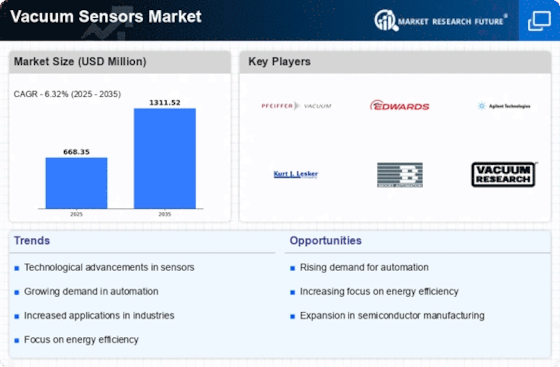
    The Global Vacuum Sensors Market is projected to grow significantly from 668.35 USD Million in 2024 to 1311.52 USD Million by 2035.

    Key Market Trends & Highlights

    Vacuum Sensors Key Trends and Highlights

    • The market is expected to achieve a compound annual growth rate (CAGR) of 6.32 percent from 2025 to 2035.
    • By 2035, the market valuation is anticipated to reach 1311.3 USD Million, indicating robust growth potential.
    • in 2024, the market is valued at 668.35 USD Million, reflecting a strong foundation for future expansion.
    • Growing adoption of vacuum sensors due to increasing automation in various industries is a major market driver.

    Market Size & Forecast

    2024 Market Size 668.35 (USD Million)
    2035 Market Size 1311.52 (USD Million)
    CAGR (2025-2035) 6.32%
    Largest Regional Market Share in 2024 latin_america)

    Major Players

    AMETEK Inc., Honeywell International Inc., MKS Instruments, Inc., Pfeiffer Vacuum Technology AG, INFICON Holding AG, Edwards Vacuum, Agilent Technologies, Setra Systems, Vacuubrand, Inc., InvenSense

    Market Trends

    Growing demand for precision and reliability in industrial processes and automation is driving the market growth

    Market CAGR for vacuum sensors is being driven by the rising demand for precision and reliability in industrial processes and automation. In today's advanced manufacturing landscape, industries such as semiconductor manufacturing, pharmaceuticals, and chemical processing require highly controlled and monitored environments to ensure the quality and efficiency of their processes. Vacuum sensors, being critical components in these settings, play a pivotal role in maintaining specific levels of vacuum with precision.

    In semiconductor manufacturing, for example, the production of microelectronics necessitates extremely controlled vacuum environments to avoid contamination and ensure the quality of the final products. Vacuum sensors enable real-time monitoring and adjustment of vacuum levels, contributing to the precision required in these highly sensitive processes. Similarly, in pharmaceutical and chemical industries, where precise conditions are crucial for the synthesis of drugs and chemicals, vacuum sensors are employed to monitor and control vacuum levels during various stages of production. This not only ensures the reliability of the manufacturing processes but also enhances the safety and quality of the end products.

    In chemical processing, vacuum sensors contribute to the reliability and safety of operations. These sensors help optimize energy consumption, prevent equipment overpressure, and facilitate efficient separation processes by closely monitoring and controlling vacuum levels. As industries strive for sustainability and operational efficiency, the role of vacuum sensors becomes even more pronounced.

    The increasing trend toward automation and the adoption of Industry 4.0 principles further propels the demand for vacuum sensors. These sensors seamlessly integrate into automated systems, providing the necessary feedback for quick and precise adjustments. Real-time monitoring of vacuum conditions enhances the efficiency of industrial processes, reduces the risk of errors, and contributes to overall operational excellence. The expanding adoption of vacuum technology in emerging industries such as semiconductor manufacturing and nanotechnology increasingly rely on vacuum environments for their processes; vacuum sensors play an important role in ensuring the optimal conditions for production.

    The semiconductor industry, in particular, requires precise vacuum control for various processes like deposition and etching during the manufacturing of integrated circuits. The growth of these high-tech industries, coupled with the need for precise vacuum measurement and control, significantly contributes to the increased demand for vacuum sensors, driving market expansion. Thus driving the Vacuum Sensors market revenue.

    Vacuum Sensors Market Segment Insights

    The Global Vacuum Sensors Market is poised for growth as industries increasingly adopt advanced technologies to enhance efficiency and precision in manufacturing processes.

    U.S. Department of Commerce

    Vacuum Sensors Market Market Drivers

    Market Growth Projections

    The Global Vacuum Sensors Market Industry is poised for substantial growth, with projections indicating a market value of 668.4 USD Million in 2024 and an anticipated increase to 1311.3 USD Million by 2035. This growth trajectory reflects a compound annual growth rate (CAGR) of 6.32% from 2025 to 2035. The increasing demand for vacuum sensors across diverse applications, including semiconductor manufacturing, healthcare, and industrial automation, underscores the industry's potential. As technological advancements continue to shape the market landscape, stakeholders are likely to benefit from the expanding opportunities within the vacuum sensors sector.

    Technological Advancements

    The Global Vacuum Sensors Market Industry is experiencing rapid technological advancements that enhance sensor performance and reliability. Innovations in materials and manufacturing processes lead to more accurate and durable sensors, which are crucial in various applications such as semiconductor fabrication and food packaging. For instance, the integration of IoT technology into vacuum sensors allows for real-time monitoring and data analytics, improving operational efficiency. As a result, the market is projected to reach 668.4 USD Million in 2024, reflecting the growing demand for sophisticated vacuum sensing solutions across multiple sectors.

    Expansion of Industrial Automation

    The expansion of industrial automation is a key driver for the Global Vacuum Sensors Market Industry, as automated systems increasingly rely on precise vacuum control for optimal performance. Industries such as food and beverage, pharmaceuticals, and packaging are integrating vacuum sensors into their automated processes to enhance efficiency and product quality. This trend is expected to bolster the market, as companies seek to improve operational efficiency and reduce costs. The ongoing shift towards automation across various sectors suggests a robust demand for vacuum sensors, contributing to the overall growth of the industry.

    Growing Adoption in Healthcare Applications

    The Global Vacuum Sensors Market Industry is witnessing an increased adoption of vacuum sensors in healthcare applications, particularly in medical device manufacturing and laboratory environments. Vacuum sensors ensure the integrity of sterile environments and the proper functioning of various medical devices. The rising focus on healthcare quality and safety standards drives the demand for reliable vacuum sensing solutions. As healthcare technology continues to evolve, the market for vacuum sensors is expected to expand, supporting the overall growth trajectory of the industry, which is projected to experience a CAGR of 6.32% from 2025 to 2035.

    Environmental Regulations and Sustainability

    Increasing environmental regulations and a growing emphasis on sustainability are influencing the Global Vacuum Sensors Market Industry. Industries are compelled to adopt cleaner technologies and processes, which often require precise vacuum control to minimize emissions and waste. Vacuum sensors play a pivotal role in ensuring compliance with these regulations by monitoring and controlling processes effectively. As companies strive to meet sustainability goals, the demand for advanced vacuum sensors is likely to rise, further propelling market growth. This trend aligns with the broader global movement towards environmentally responsible manufacturing practices.

    Rising Demand in Semiconductor Manufacturing

    The semiconductor manufacturing sector significantly drives the Global Vacuum Sensors Market Industry, as vacuum sensors are essential for maintaining the required conditions during production processes. The increasing complexity of semiconductor devices necessitates precise vacuum control, which vacuum sensors provide. With the global semiconductor market projected to grow substantially, the demand for high-quality vacuum sensors is expected to rise correspondingly. This trend is likely to contribute to the market's growth, with forecasts indicating a market value of 1311.3 USD Million by 2035, highlighting the critical role of vacuum sensors in this industry.

    Market Segment Insights

    Vacuum Sensors Type Insights

    The Vacuum Sensors Market segmentation, based on type, includes Temperature Sensors, Pressure Sensors, Flow Sensors, and Others. The pressure sensors segment dominated the market, accounting for the largest market revenue due to their versatility and widespread applications across various industries. These sensors are capable of measuring both positive and negative pressure, making them suitable for a broad range of environments and processes. Their use is prevalent in industries such as automotive, aerospace, healthcare, and industrial automation, where accurate pressure and vacuum measurements are essential for ensuring optimal performance and safety.

    With advancements in technology and increasing demands for precision in various applications, pressure vacuum sensors continue to be a dominant force in the vacuum sensor market. The flow sensor market is the fastest-growing category of vacuum sensors. This is due to the increasing demand for flow sensors in a variety of applications.

    Vacuum Sensors Application Insights

    The Vacuum Sensors Market segmentation, based on application, includes Transportation, Architecture, Petroleum, Chemical, and Others. The transportation category dominates the market due to its integral role in ensuring the optimal performance and safety of various modes of transportation. In automotive applications, vacuum sensors play a critical role in monitoring and controlling engine performance, exhaust systems, and brake assist systems. In aviation, these sensors are essential for maintaining cabin pressure and monitoring the health of aircraft systems. Furthermore, vacuum sensors find extensive use in the railway industry for controlling braking systems and ensuring operational safety.

    The broad spectrum of transportation applications underscores the significance of vacuum sensors in maintaining efficiency, safety, and overall functionality in diverse modes of transportation, contributing to their market dominance. Further, the fastest growing category in the vacuum sensors market is expected to be the Chemical industry due to the increasing demand for vacuum sensors in the chemical industry for process monitoring and control, as well as for leak detection.

    Figure 1: Vacuum Sensors Market, by Application, 2022 & 2032 (USD Billion)

    Source: The Secondary Research, Primary Research, MRFR Database and Analyst Review

    Get more detailed insights about Vacuum Sensors Market Research Report — Global Forecast till 2035

    Regional Insights

    By region, the study gives market insights into the North America, Europe, Asia-Pacific, and the Rest of the World. The North American Vacuum Sensors market area dominates this market due to its robust industrial and manufacturing sectors, which extensively utilize vacuum technology for various applications. The region's leadership in industries, coupled with a strong emphasis on automation and technological advancements, positions North America as a key market for vacuum sensors.

    Further, the major countries studied in the market report are The US, Canada, Germany, France, the UK, Italy, Spain, Japan, China, India, Australia, South Korea, and Brazil.

    Figure 2: VACUUM SENSORS MARKET SHARE BY REGION 2022 (USD Billion)

    VACUUM SENSORS MARKET SHARE BY REGION 2022

    Source: The Secondary Research, Primary Research, MRFR Database and Analyst Review

    Europe's Vacuum Sensors market accounts for the second-largest market share due to the region's advanced manufacturing capabilities, particularly in sectors like automotive, aerospace, and pharmaceuticals. Further, the German Vacuum Sensors market held the largest market share, and the UK Vacuum Sensors market was the fastest-growing market in European region.

    The Asia-Pacific Vacuum Sensors Market is expected to rise at the fastest CAGR from 2023 to 2032. This is due to rapid industrialization, increasing adoption of automation across diverse sectors, and expanding manufacturing activities in the region. Moreover, China’s Vacuum Sensors market held the largest market share, and the Indian Vacuum Sensors market was the fastest-growing market in Asia-Pacific region.

    Key Players and Competitive Insights

    Leading market players are investing heavily in the research and development in order to spread their product lines, which will help the Vacuum Sensors market grow even more. Market players are also undertaking a variety of strategic activities to spread their global footprint, with important market developments including mergers and acquisitions, new product launches, contractual agreements, higher investments, and collaboration with other organizations. To spread and survive in a more competitive and rising market climate, the Vacuum Sensors industry must offer cost-effective items.

    Manufacturing locally to minimize the operational costs is one of the key business tactics used by the manufacturers in the global Vacuum Sensors industry to benefit the clients and increase the market sector. In recent years, the Vacuum Sensors industry has offered some of the most significant advantages to several industries. Major players in the Vacuum Sensors market, including AMETEK Inc., Honeywell International Inc., MKS Instruments, Inc., Pfeiffer Vacuum Technology AG, INFICON Holding AG, Edwards Vacuum, Agilent Technologies, Setra Systems, Vacuubrand, Inc., InvenSense, and others, are trying to increase market demand by investing in research and development operations.

    Honeywell International Inc. is a multinational conglomerate known for its diversified portfolio of technology and manufacturing solutions across various industries. Headquartered in Charlotte, North Carolina, the company operates globally and is recognized for its innovation in aerospace, building technologies, performance materials, and safety solutions. Honeywell has established itself as a leader in providing cutting-edge technologies that enhance efficiency, safety, and sustainability. The company's diverse offerings include aerospace systems, industrial process control technologies, environmental and energy solutions, and home and building automation.

    In October 2023, Honeywell International Inc. (US) acquired Wilbur Instruments Ltd. (UK), a leading manufacturer of vacuum sensors and gauges, for an undisclosed amount. This acquisition is expected to expand Honeywell's portfolio of vacuum measurement solutions and strengthen its presence in the semiconductor and electronics industries.

     Ametek Inc. is a global leading provider of electronic instruments and electromechanical devices, recognized for its diverse range of advanced solutions across various industries. Headquartered in Berwyn, Pennsylvania, the company operates through two distinct business segments: Electronic Instruments Group (EIG) and Electromechanical Group (EMG). Under EIG, Ametek offers a comprehensive portfolio of precision instruments, including analytical instruments, monitoring devices, and testing equipment, catering to sectors such as aerospace, power generation, and process industries. The EMG segment focuses on producing highly engineered electromechanical connectors, motors, and various technical solutions for critical applications in aerospace, defense, and medical markets.

    July 2023, AMETEK, Inc. (US) acquired Granville-Phillips, Inc. (US), a manufacturer of vacuum leak detectors, for an undisclosed amount. This acquisition is expected to expand AMETEK's portfolio of leak detection solutions and strengthen its presence in the semiconductor and electronics industries.

    Key Companies in the Vacuum Sensors Market market include

    Industry Developments

    September 2023: MKS Instruments, Inc. (US) acquired Atotech Ltd. (US), a provider of thin film deposition equipment and services, for $9.75 billion. Atotech's portfolio includes vacuum sensors and gauges, which are expected to complement MKS's existing product offerings.

    June 2023: GE Measurement & Control Solutions (US) acquired Inficon, Inc. (US), a manufacturer of gas and leak detection instruments, for $1.4 billion. Inficon's portfolio includes vacuum sensors and gauges, which are expected to complement GE's existing product offerings.

    August 2023: Pfeiffer Vacuum Technology AG (Germany) acquired Edwards Vacuum Ltd. (UK), a manufacturer of vacuum pumps and sensors, for €1.3 billion. This acquisition is foreseen to create a global leader in the vacuum technology market.

    Vacuum Sensors Market Segmentation

    Vacuum Sensors Type Outlook

      • Temperature Sensor
      • Pressure Sensor
      • Flow sensor
      • Others

    Vacuum Sensors Application Outlook

      • Transportation
      • Architecture
      • Petroleum
      • Others

    Vacuum Sensors Regional Outlook

      • North America
        • US
        • Canada
      • Europe
        • Germany
        • France
        • UK
        • Italy
        • Spain
        • Rest of Europe
      • Asia-Pacific
        • China
        • Japan
        • India
        • Australia
        • South Korea
        • Australia
        • Rest of Asia-Pacific
      • Rest of the World
        • Middle East
        • Africa
        • Latin America

    Future Outlook

    Vacuum Sensors Market Future Outlook

    The Global Vacuum Sensors Market is projected to grow at a 6.30% CAGR from 2025 to 2035, driven by advancements in automation, increasing demand in semiconductor manufacturing, and the rise of renewable energy technologies.

    New opportunities lie in:

    • Develop smart vacuum sensors integrated with IoT for real-time monitoring.
    • Expand product lines to cater to the aerospace and defense sectors.
    • Invest in R&D for miniaturized sensors to enhance portability and efficiency.

    By 2035, the market is expected to exhibit robust growth, reflecting increased adoption across diverse industries.

    Market Segmentation

    Vacuum Sensors Type Outlook

    • Temperature Sensor
    • Pressure Sensor
    • Flow sensor
    • Others

    Vacuum Sensors Regional Outlook

    North America
    • US
    • Canada

    Vacuum Sensors Application Outlook

    • Transportation
    • Architecture
    • Petroleum
    • Others

    Report Scope

    Report Attribute/Metric Details
    Market Size 2024 USD 668.35 Million
    Market Size 2025 USD 710.59 Million
    Market Size 2035 1311.52 (Value (USD Million))
    Compound Annual Growth Rate (CAGR) 6.32% (2025 - 2035)
    Base Year 2024
    Market Forecast Period 2025 - 2035
    Historical Data 2020- 2023
    Market Forecast Units Value (USD Million)
    Report Coverage Revenue Forecast, The Market Competitive Landscape, Growth Factors, and Trends
    Segments Covered Type, Application, and Region
    Geographies Covered North America, Europe, Asia Pacific, and the Rest of the World
    Countries Covered The US, Canada, Germany, France, UK, Italy, Spain, Japan, China, India, Australia, South Korea, and Brazil
    Key Companies Profiled AMETEK Inc., Honeywell International Inc., MKS Instruments, Inc., Pfeiffer Vacuum Technology AG, INFICON Holding AG, Edwards Vacuum, Agilent Technologies, Setra Systems, Vacuubrand, Inc., InvenSense
    Key Market Opportunities ·       Expanding the application of vacuum technology in emerging fields.
    Key Market Dynamics ·       Increased demand for precision and reliability in industrial processes and automation.

    FAQs

    How much is the Vacuum Sensors market?

    The Vacuum Sensors Market size was valued at USD 668.35 billion in 2024.

    What is growth rate of the Vacuum Sensors market?

    The global market is foreseen at a CAGR of 6.32% during the forecast period, 2025 to 2035.

    Which region held the biggest market share in the Vacuum Sensors market?

    North America had the biggest share in the global market

    Who are the prime players in the Vacuum Sensors market?

    The prime players in the market are AMETEK Inc., Honeywell International Inc., MKS Instruments, Inc., Pfeiffer Vacuum Technology AG, INFICON Holding AG, Edwards Vacuum, Agilent Technologies, Setra Systems, Vacuubrand, Inc., InvenSense.

    Which type led the Vacuum Sensors market?

    The pressure sensor category dominated the market in 2022.

    Which application had the biggest market share in the Vacuum Sensors market?

    Transportation had the largest share of the global market.

    1. SECTION I: EXECUTIVE SUMMARY AND KEY HIGHLIGHTS
      1. | 1.1 EXECUTIVE SUMMARY
      2. | | 1.1.1 Market Overview
      3. | | 1.1.2 Key Findings
      4. | | 1.1.3 Market Segmentation
      5. | | 1.1.4 Competitive Landscape
      6. | | 1.1.5 Challenges and Opportunities
      7. | | 1.1.6 Future Outlook
    2. SECTION II: SCOPING, METHODOLOGY AND MARKET STRUCTURE
      1. | 2.1 MARKET INTRODUCTION
      2. | | 2.1.1 Definition
      3. | | 2.1.2 Scope of the study
      4. | | | 2.1.2.1 Research Objective
      5. | | | 2.1.2.2 Assumption
      6. | | | 2.1.2.3 Limitations
      7. | 2.2 RESEARCH METHODOLOGY
      8. | | 2.2.1 Overview
      9. | | 2.2.2 Data Mining
      10. | | 2.2.3 Secondary Research
      11. | | 2.2.4 Primary Research
      12. | | | 2.2.4.1 Primary Interviews and Information Gathering Process
      13. | | | 2.2.4.2 Breakdown of Primary Respondents
      14. | | 2.2.5 Forecasting Model
      15. | | 2.2.6 Market Size Estimation
      16. | | | 2.2.6.1 Bottom-Up Approach
      17. | | | 2.2.6.2 Top-Down Approach
      18. | | 2.2.7 Data Triangulation
      19. | | 2.2.8 Validation
    3. SECTION III: QUALITATIVE ANALYSIS
      1. | 3.1 MARKET DYNAMICS
      2. | | 3.1.1 Overview
      3. | | 3.1.2 Drivers
      4. | | 3.1.3 Restraints
      5. | | 3.1.4 Opportunities
      6. | 3.2 MARKET FACTOR ANALYSIS
      7. | | 3.2.1 Value chain Analysis
      8. | | 3.2.2 Porter's Five Forces Analysis
      9. | | | 3.2.2.1 Bargaining Power of Suppliers
      10. | | | 3.2.2.2 Bargaining Power of Buyers
      11. | | | 3.2.2.3 Threat of New Entrants
      12. | | | 3.2.2.4 Threat of Substitutes
      13. | | | 3.2.2.5 Intensity of Rivalry
      14. | | 3.2.3 COVID-19 Impact Analysis
      15. | | | 3.2.3.1 Market Impact Analysis
      16. | | | 3.2.3.2 Regional Impact
      17. | | | 3.2.3.3 Opportunity and Threat Analysis
    4. SECTION IV: QUANTITATIVE ANALYSIS
      1. | 4.1 Semiconductor & Electronics, BY Type (USD Million)
      2. | | 4.1.1 Temperature Sensors
      3. | | 4.1.2 Pressure Sensors
      4. | | 4.1.3 Flow Sensors
      5. | | 4.1.4 Others
      6. | 4.2 Semiconductor & Electronics, BY Application (USD Million)
      7. | | 4.2.1 Transportation
      8. | | 4.2.2 Architecture
      9. | | 4.2.3 Petroleum
      10. | | 4.2.4 Chemical
      11. | | 4.2.5 Others
      12. | 4.3 Semiconductor & Electronics, BY Region (USD Million)
      13. | | 4.3.1 North America
      14. | | | 4.3.1.1 US
      15. | | | 4.3.1.2 Canada
      16. | | 4.3.2 Europe
      17. | | | 4.3.2.1 Germany
      18. | | | 4.3.2.2 UK
      19. | | | 4.3.2.3 France
      20. | | | 4.3.2.4 Russia
      21. | | | 4.3.2.5 Italy
      22. | | | 4.3.2.6 Spain
      23. | | | 4.3.2.7 Rest of Europe
      24. | | 4.3.3 APAC
      25. | | | 4.3.3.1 China
      26. | | | 4.3.3.2 India
      27. | | | 4.3.3.3 Japan
      28. | | | 4.3.3.4 South Korea
      29. | | | 4.3.3.5 Malaysia
      30. | | | 4.3.3.6 Thailand
      31. | | | 4.3.3.7 Indonesia
      32. | | | 4.3.3.8 Rest of APAC
      33. | | 4.3.4 South America
      34. | | | 4.3.4.1 Brazil
      35. | | | 4.3.4.2 Mexico
      36. | | | 4.3.4.3 Argentina
      37. | | | 4.3.4.4 Rest of South America
      38. | | 4.3.5 MEA
      39. | | | 4.3.5.1 GCC Countries
      40. | | | 4.3.5.2 South Africa
      41. | | | 4.3.5.3 Rest of MEA
    5. SECTION V: COMPETITIVE ANALYSIS
      1. | 5.1 Competitive Landscape
      2. | | 5.1.1 Overview
      3. | | 5.1.2 Competitive Analysis
      4. | | 5.1.3 Market share Analysis
      5. | | 5.1.4 Major Growth Strategy in the Semiconductor & Electronics
      6. | | 5.1.5 Competitive Benchmarking
      7. | | 5.1.6 Leading Players in Terms of Number of Developments in the Semiconductor & Electronics
      8. | | 5.1.7 Key developments and growth strategies
      9. | | | 5.1.7.1 New Product Launch/Service Deployment
      10. | | | 5.1.7.2 Merger & Acquisitions
      11. | | | 5.1.7.3 Joint Ventures
      12. | | 5.1.8 Major Players Financial Matrix
      13. | | | 5.1.8.1 Sales and Operating Income
      14. | | | 5.1.8.2 Major Players R&D Expenditure. 2023
      15. | 5.2 Company Profiles
      16. | | 5.2.1 Pfeiffer Vacuum Technology AG (DE)
      17. | | | 5.2.1.1 Financial Overview
      18. | | | 5.2.1.2 Products Offered
      19. | | | 5.2.1.3 Key Developments
      20. | | | 5.2.1.4 SWOT Analysis
      21. | | | 5.2.1.5 Key Strategies
      22. | | 5.2.2 Edwards Vacuum (UK)
      23. | | | 5.2.2.1 Financial Overview
      24. | | | 5.2.2.2 Products Offered
      25. | | | 5.2.2.3 Key Developments
      26. | | | 5.2.2.4 SWOT Analysis
      27. | | | 5.2.2.5 Key Strategies
      28. | | 5.2.3 MKS Instruments Inc (US)
      29. | | | 5.2.3.1 Financial Overview
      30. | | | 5.2.3.2 Products Offered
      31. | | | 5.2.3.3 Key Developments
      32. | | | 5.2.3.4 SWOT Analysis
      33. | | | 5.2.3.5 Key Strategies
      34. | | 5.2.4 Agilent Technologies Inc (US)
      35. | | | 5.2.4.1 Financial Overview
      36. | | | 5.2.4.2 Products Offered
      37. | | | 5.2.4.3 Key Developments
      38. | | | 5.2.4.4 SWOT Analysis
      39. | | | 5.2.4.5 Key Strategies
      40. | | 5.2.5 Kurt J. Lesker Company (US)
      41. | | | 5.2.5.1 Financial Overview
      42. | | | 5.2.5.2 Products Offered
      43. | | | 5.2.5.3 Key Developments
      44. | | | 5.2.5.4 SWOT Analysis
      45. | | | 5.2.5.5 Key Strategies
      46. | | 5.2.6 Brooks Automation Inc (US)
      47. | | | 5.2.6.1 Financial Overview
      48. | | | 5.2.6.2 Products Offered
      49. | | | 5.2.6.3 Key Developments
      50. | | | 5.2.6.4 SWOT Analysis
      51. | | | 5.2.6.5 Key Strategies
      52. | | 5.2.7 Vacuum Research Corporation (US)
      53. | | | 5.2.7.1 Financial Overview
      54. | | | 5.2.7.2 Products Offered
      55. | | | 5.2.7.3 Key Developments
      56. | | | 5.2.7.4 SWOT Analysis
      57. | | | 5.2.7.5 Key Strategies
      58. | | 5.2.8 Leybold GmbH (DE)
      59. | | | 5.2.8.1 Financial Overview
      60. | | | 5.2.8.2 Products Offered
      61. | | | 5.2.8.3 Key Developments
      62. | | | 5.2.8.4 SWOT Analysis
      63. | | | 5.2.8.5 Key Strategies
      64. | | 5.2.9 Ametek Inc (US)
      65. | | | 5.2.9.1 Financial Overview
      66. | | | 5.2.9.2 Products Offered
      67. | | | 5.2.9.3 Key Developments
      68. | | | 5.2.9.4 SWOT Analysis
      69. | | | 5.2.9.5 Key Strategies
      70. | 5.3 Appendix
      71. | | 5.3.1 References
      72. | | 5.3.2 Related Reports
    6. LIST OF FIGURES
      1. | 6.1 MARKET SYNOPSIS
      2. | 6.2 NORTH AMERICA MARKET ANALYSIS
      3. | 6.3 US MARKET ANALYSIS BY TYPE
      4. | 6.4 US MARKET ANALYSIS BY APPLICATION
      5. | 6.5 CANADA MARKET ANALYSIS BY TYPE
      6. | 6.6 CANADA MARKET ANALYSIS BY APPLICATION
      7. | 6.7 EUROPE MARKET ANALYSIS
      8. | 6.8 GERMANY MARKET ANALYSIS BY TYPE
      9. | 6.9 GERMANY MARKET ANALYSIS BY APPLICATION
      10. | 6.10 UK MARKET ANALYSIS BY TYPE
      11. | 6.11 UK MARKET ANALYSIS BY APPLICATION
      12. | 6.12 FRANCE MARKET ANALYSIS BY TYPE
      13. | 6.13 FRANCE MARKET ANALYSIS BY APPLICATION
      14. | 6.14 RUSSIA MARKET ANALYSIS BY TYPE
      15. | 6.15 RUSSIA MARKET ANALYSIS BY APPLICATION
      16. | 6.16 ITALY MARKET ANALYSIS BY TYPE
      17. | 6.17 ITALY MARKET ANALYSIS BY APPLICATION
      18. | 6.18 SPAIN MARKET ANALYSIS BY TYPE
      19. | 6.19 SPAIN MARKET ANALYSIS BY APPLICATION
      20. | 6.20 REST OF EUROPE MARKET ANALYSIS BY TYPE
      21. | 6.21 REST OF EUROPE MARKET ANALYSIS BY APPLICATION
      22. | 6.22 APAC MARKET ANALYSIS
      23. | 6.23 CHINA MARKET ANALYSIS BY TYPE
      24. | 6.24 CHINA MARKET ANALYSIS BY APPLICATION
      25. | 6.25 INDIA MARKET ANALYSIS BY TYPE
      26. | 6.26 INDIA MARKET ANALYSIS BY APPLICATION
      27. | 6.27 JAPAN MARKET ANALYSIS BY TYPE
      28. | 6.28 JAPAN MARKET ANALYSIS BY APPLICATION
      29. | 6.29 SOUTH KOREA MARKET ANALYSIS BY TYPE
      30. | 6.30 SOUTH KOREA MARKET ANALYSIS BY APPLICATION
      31. | 6.31 MALAYSIA MARKET ANALYSIS BY TYPE
      32. | 6.32 MALAYSIA MARKET ANALYSIS BY APPLICATION
      33. | 6.33 THAILAND MARKET ANALYSIS BY TYPE
      34. | 6.34 THAILAND MARKET ANALYSIS BY APPLICATION
      35. | 6.35 INDONESIA MARKET ANALYSIS BY TYPE
      36. | 6.36 INDONESIA MARKET ANALYSIS BY APPLICATION
      37. | 6.37 REST OF APAC MARKET ANALYSIS BY TYPE
      38. | 6.38 REST OF APAC MARKET ANALYSIS BY APPLICATION
      39. | 6.39 SOUTH AMERICA MARKET ANALYSIS
      40. | 6.40 BRAZIL MARKET ANALYSIS BY TYPE
      41. | 6.41 BRAZIL MARKET ANALYSIS BY APPLICATION
      42. | 6.42 MEXICO MARKET ANALYSIS BY TYPE
      43. | 6.43 MEXICO MARKET ANALYSIS BY APPLICATION
      44. | 6.44 ARGENTINA MARKET ANALYSIS BY TYPE
      45. | 6.45 ARGENTINA MARKET ANALYSIS BY APPLICATION
      46. | 6.46 REST OF SOUTH AMERICA MARKET ANALYSIS BY TYPE
      47. | 6.47 REST OF SOUTH AMERICA MARKET ANALYSIS BY APPLICATION
      48. | 6.48 MEA MARKET ANALYSIS
      49. | 6.49 GCC COUNTRIES MARKET ANALYSIS BY TYPE
      50. | 6.50 GCC COUNTRIES MARKET ANALYSIS BY APPLICATION
      51. | 6.51 SOUTH AFRICA MARKET ANALYSIS BY TYPE
      52. | 6.52 SOUTH AFRICA MARKET ANALYSIS BY APPLICATION
      53. | 6.53 REST OF MEA MARKET ANALYSIS BY TYPE
      54. | 6.54 REST OF MEA MARKET ANALYSIS BY APPLICATION
      55. | 6.55 KEY BUYING CRITERIA OF SEMICONDUCTOR & ELECTRONICS
      56. | 6.56 RESEARCH PROCESS OF MRFR
      57. | 6.57 DRO ANALYSIS OF SEMICONDUCTOR & ELECTRONICS
      58. | 6.58 DRIVERS IMPACT ANALYSIS: SEMICONDUCTOR & ELECTRONICS
      59. | 6.59 RESTRAINTS IMPACT ANALYSIS: SEMICONDUCTOR & ELECTRONICS
      60. | 6.60 SUPPLY / VALUE CHAIN: SEMICONDUCTOR & ELECTRONICS
      61. | 6.61 SEMICONDUCTOR & ELECTRONICS, BY TYPE, 2024 (% SHARE)
      62. | 6.62 SEMICONDUCTOR & ELECTRONICS, BY TYPE, 2024 TO 2035 (USD Million)
      63. | 6.63 SEMICONDUCTOR & ELECTRONICS, BY APPLICATION, 2024 (% SHARE)
      64. | 6.64 SEMICONDUCTOR & ELECTRONICS, BY APPLICATION, 2024 TO 2035 (USD Million)
      65. | 6.65 BENCHMARKING OF MAJOR COMPETITORS
    7. LIST OF TABLES
      1. | 7.1 LIST OF ASSUMPTIONS
      2. | | 7.1.1
      3. | 7.2 North America MARKET SIZE ESTIMATES; FORECAST
      4. | | 7.2.1 BY TYPE, 2025-2035 (USD Million)
      5. | | 7.2.2 BY APPLICATION, 2025-2035 (USD Million)
      6. | 7.3 US MARKET SIZE ESTIMATES; FORECAST
      7. | | 7.3.1 BY TYPE, 2025-2035 (USD Million)
      8. | | 7.3.2 BY APPLICATION, 2025-2035 (USD Million)
      9. | 7.4 Canada MARKET SIZE ESTIMATES; FORECAST
      10. | | 7.4.1 BY TYPE, 2025-2035 (USD Million)
      11. | | 7.4.2 BY APPLICATION, 2025-2035 (USD Million)
      12. | 7.5 Europe MARKET SIZE ESTIMATES; FORECAST
      13. | | 7.5.1 BY TYPE, 2025-2035 (USD Million)
      14. | | 7.5.2 BY APPLICATION, 2025-2035 (USD Million)
      15. | 7.6 Germany MARKET SIZE ESTIMATES; FORECAST
      16. | | 7.6.1 BY TYPE, 2025-2035 (USD Million)
      17. | | 7.6.2 BY APPLICATION, 2025-2035 (USD Million)
      18. | 7.7 UK MARKET SIZE ESTIMATES; FORECAST
      19. | | 7.7.1 BY TYPE, 2025-2035 (USD Million)
      20. | | 7.7.2 BY APPLICATION, 2025-2035 (USD Million)
      21. | 7.8 France MARKET SIZE ESTIMATES; FORECAST
      22. | | 7.8.1 BY TYPE, 2025-2035 (USD Million)
      23. | | 7.8.2 BY APPLICATION, 2025-2035 (USD Million)
      24. | 7.9 Russia MARKET SIZE ESTIMATES; FORECAST
      25. | | 7.9.1 BY TYPE, 2025-2035 (USD Million)
      26. | | 7.9.2 BY APPLICATION, 2025-2035 (USD Million)
      27. | 7.10 Italy MARKET SIZE ESTIMATES; FORECAST
      28. | | 7.10.1 BY TYPE, 2025-2035 (USD Million)
      29. | | 7.10.2 BY APPLICATION, 2025-2035 (USD Million)
      30. | 7.11 Spain MARKET SIZE ESTIMATES; FORECAST
      31. | | 7.11.1 BY TYPE, 2025-2035 (USD Million)
      32. | | 7.11.2 BY APPLICATION, 2025-2035 (USD Million)
      33. | 7.12 Rest of Europe MARKET SIZE ESTIMATES; FORECAST
      34. | | 7.12.1 BY TYPE, 2025-2035 (USD Million)
      35. | | 7.12.2 BY APPLICATION, 2025-2035 (USD Million)
      36. | 7.13 APAC MARKET SIZE ESTIMATES; FORECAST
      37. | | 7.13.1 BY TYPE, 2025-2035 (USD Million)
      38. | | 7.13.2 BY APPLICATION, 2025-2035 (USD Million)
      39. | 7.14 China MARKET SIZE ESTIMATES; FORECAST
      40. | | 7.14.1 BY TYPE, 2025-2035 (USD Million)
      41. | | 7.14.2 BY APPLICATION, 2025-2035 (USD Million)
      42. | 7.15 India MARKET SIZE ESTIMATES; FORECAST
      43. | | 7.15.1 BY TYPE, 2025-2035 (USD Million)
      44. | | 7.15.2 BY APPLICATION, 2025-2035 (USD Million)
      45. | 7.16 Japan MARKET SIZE ESTIMATES; FORECAST
      46. | | 7.16.1 BY TYPE, 2025-2035 (USD Million)
      47. | | 7.16.2 BY APPLICATION, 2025-2035 (USD Million)
      48. | 7.17 South Korea MARKET SIZE ESTIMATES; FORECAST
      49. | | 7.17.1 BY TYPE, 2025-2035 (USD Million)
      50. | | 7.17.2 BY APPLICATION, 2025-2035 (USD Million)
      51. | 7.18 Malaysia MARKET SIZE ESTIMATES; FORECAST
      52. | | 7.18.1 BY TYPE, 2025-2035 (USD Million)
      53. | | 7.18.2 BY APPLICATION, 2025-2035 (USD Million)
      54. | 7.19 Thailand MARKET SIZE ESTIMATES; FORECAST
      55. | | 7.19.1 BY TYPE, 2025-2035 (USD Million)
      56. | | 7.19.2 BY APPLICATION, 2025-2035 (USD Million)
      57. | 7.20 Indonesia MARKET SIZE ESTIMATES; FORECAST
      58. | | 7.20.1 BY TYPE, 2025-2035 (USD Million)
      59. | | 7.20.2 BY APPLICATION, 2025-2035 (USD Million)
      60. | 7.21 Rest of APAC MARKET SIZE ESTIMATES; FORECAST
      61. | | 7.21.1 BY TYPE, 2025-2035 (USD Million)
      62. | | 7.21.2 BY APPLICATION, 2025-2035 (USD Million)
      63. | 7.22 South America MARKET SIZE ESTIMATES; FORECAST
      64. | | 7.22.1 BY TYPE, 2025-2035 (USD Million)
      65. | | 7.22.2 BY APPLICATION, 2025-2035 (USD Million)
      66. | 7.23 Brazil MARKET SIZE ESTIMATES; FORECAST
      67. | | 7.23.1 BY TYPE, 2025-2035 (USD Million)
      68. | | 7.23.2 BY APPLICATION, 2025-2035 (USD Million)
      69. | 7.24 Mexico MARKET SIZE ESTIMATES; FORECAST
      70. | | 7.24.1 BY TYPE, 2025-2035 (USD Million)
      71. | | 7.24.2 BY APPLICATION, 2025-2035 (USD Million)
      72. | 7.25 Argentina MARKET SIZE ESTIMATES; FORECAST
      73. | | 7.25.1 BY TYPE, 2025-2035 (USD Million)
      74. | | 7.25.2 BY APPLICATION, 2025-2035 (USD Million)
      75. | 7.26 Rest of South America MARKET SIZE ESTIMATES; FORECAST
      76. | | 7.26.1 BY TYPE, 2025-2035 (USD Million)
      77. | | 7.26.2 BY APPLICATION, 2025-2035 (USD Million)
      78. | 7.27 MEA MARKET SIZE ESTIMATES; FORECAST
      79. | | 7.27.1 BY TYPE, 2025-2035 (USD Million)
      80. | | 7.27.2 BY APPLICATION, 2025-2035 (USD Million)
      81. | 7.28 GCC Countries MARKET SIZE ESTIMATES; FORECAST
      82. | | 7.28.1 BY TYPE, 2025-2035 (USD Million)
      83. | | 7.28.2 BY APPLICATION, 2025-2035 (USD Million)
      84. | 7.29 South Africa MARKET SIZE ESTIMATES; FORECAST
      85. | | 7.29.1 BY TYPE, 2025-2035 (USD Million)
      86. | | 7.29.2 BY APPLICATION, 2025-2035 (USD Million)
      87. | 7.30 Rest of MEA MARKET SIZE ESTIMATES; FORECAST
      88. | | 7.30.1 BY TYPE, 2025-2035 (USD Million)
      89. | | 7.30.2 BY APPLICATION, 2025-2035 (USD Million)
      90. | 7.31 PRODUCT LAUNCH/PRODUCT DEVELOPMENT/APPROVAL
      91. | | 7.31.1
      92. | 7.32 ACQUISITION/PARTNERSHIP
      93. | | 7.32.1

    Vacuum Sensors Market Segmentation

    Vacuum Sensors Type Outlook (USD Billion, 2020-2034)

    • Temperature Sensor
    • Pressure Sensor
    • Flow sensor
    • Others

    Vacuum Sensors Application Outlook (USD Billion, 2020-2034)

    • Transportation
    • Architecture
    • Petroleum
    • Chemical
    • Others

    Vacuum Sensors Regional Outlook (USD Billion, 2020-2034)

    • North America Outlook (USD Billion, 2020-2034)
      • North America Vacuum Sensors by Type
        • Temperature Sensor
        • Pressure Sensor
        • Flow sensor
        • Others
      • North America Vacuum Sensors by Application
        • Transportation
        • Architecture
        • Petroleum
        • Chemical
        • Others
      • US Outlook (USD Billion, 2020-2034)
      • US Vacuum Sensors by Type
        • Temperature Sensor
        • Pressure Sensor
        • Flow sensor
        • Others
      • US Vacuum Sensors by Application
        • Transportation
        • Architecture
        • Petroleum
        • Chemical
        • Others
      • CANADA Outlook (USD Billion, 2020-2034)
      • CANADA Vacuum Sensors by Type
        • Temperature Sensor
        • Pressure Sensor
        • Flow sensor
        • Others
      • CANADA Vacuum Sensors by Application
        • Transportation
        • Architecture
        • Petroleum
        • Chemical
        • Others
      • Europe Outlook (USD Billion, 2020-2034)
        • Europe Vacuum Sensors by Type
          • Temperature Sensor
          • Pressure Sensor
          • Flow sensor
          • Others
        • Europe Vacuum Sensors by Application
          • Transportation
          • Architecture
          • Petroleum
          • Chemical
          • Others
        • Germany Outlook (USD Billion, 2020-2034)
        • Germany Vacuum Sensors by Type
          • Temperature Sensor
          • Pressure Sensor
          • Flow sensor
          • Others
        • Germany Vacuum Sensors by Application
          • Transportation
          • Architecture
          • Petroleum
          • Chemical
          • Others
        • France Outlook (USD Billion, 2020-2034)
        • France Vacuum Sensors by Type
          • Temperature Sensor
          • Pressure Sensor
          • Flow sensor
          • Others
        • France Vacuum Sensors by Application
          • Transportation
          • Architecture
          • Petroleum
          • Chemical
          • Others
        • UK Outlook (USD Billion, 2020-2034)
        • UK Vacuum Sensors by Type
          • Temperature Sensor
          • Pressure Sensor
          • Flow sensor
          • Others
        • UK Vacuum Sensors by Application
          • Transportation
          • Architecture
          • Petroleum
          • Chemical
          • Others
        • ITALY Outlook (USD Billion, 2020-2034)
        • ITALY Vacuum Sensors by Type
          • Temperature Sensor
          • Pressure Sensor
          • Flow sensor
          • Others
        • ITALY Vacuum Sensors by Application
          • Transportation
          • Architecture
          • Petroleum
          • Chemical
          • Others
        • SPAIN Outlook (USD Billion, 2020-2034)
        • Spain Vacuum Sensors by Type
          • Temperature Sensor
          • Pressure Sensor
          • Flow sensor
          • Others
        • Spain Vacuum Sensors by Application
          • Transportation
          • Architecture
          • Petroleum
          • Chemical
          • Others
        • Rest Of Europe Outlook (USD Billion, 2020-2034)
        • Rest Of Europe Vacuum Sensors by Type
          • Temperature Sensor
          • Pressure Sensor
          • Flow sensor
          • Others
        • REST OF EUROPE Vacuum Sensors by Application
          • Transportation
          • Architecture
          • Petroleum
          • Chemical
          • Others
        • Asia-Pacific Outlook (USD Billion, 2020-2034)
          • Asia-Pacific Vacuum Sensors by Type
            • Temperature Sensor
            • Pressure Sensor
            • Flow sensor
            • Others
          • Asia-Pacific Vacuum Sensors by Application
            • Transportation
            • Architecture
            • Petroleum
            • Chemical
            • Others
          • China Outlook (USD Billion, 2020-2034)
          • China Vacuum Sensors by Type
            • Temperature Sensor
            • Pressure Sensor
            • Flow sensor
            • Others
          • China Vacuum Sensors by Application
            • Transportation
            • Architecture
            • Petroleum
            • Chemical
            • Others
          • Japan Outlook (USD Billion, 2020-2034)
          • Japan Vacuum Sensors by Type
            • Temperature Sensor
            • Pressure Sensor
            • Flow sensor
            • Others
          • Japan Vacuum Sensors by Application
            • Transportation
            • Architecture
            • Petroleum
            • Chemical
            • Others
          • India Outlook (USD Billion, 2020-2034)
          • India Vacuum Sensors by Type
            • Temperature Sensor
            • Pressure Sensor
            • Flow sensor
            • Others
          • India Vacuum Sensors by Application
            • Transportation
            • Architecture
            • Petroleum
            • Chemical
            • Others
          • Australia Outlook (USD Billion, 2020-2034)
          • Australia Vacuum Sensors by Type
            • Temperature Sensor
            • Pressure Sensor
            • Flow sensor
            • Others
          • Australia Vacuum Sensors by Application
            • Transportation
            • Architecture
            • Petroleum
            • Chemical
            • Others
          • Rest of Asia-Pacific Outlook (USD Billion, 2020-2034)
          • Rest of Asia-Pacific Vacuum Sensors by Type
            • Temperature Sensor
            • Pressure Sensor
            • Flow sensor
            • Others
          • Rest of Asia-Pacific Vacuum Sensors by Application
            • Transportation
            • Architecture
            • Petroleum
            • Chemical
            • Others
          • Rest of the World Outlook (USD Billion, 2020-2034)
            • Rest of the World Vacuum Sensors by Type
              • Temperature Sensor
              • Pressure Sensor
              • Flow sensor
              • Others
            • Rest of the World Vacuum Sensors by Application
              • Transportation
              • Architecture
              • Petroleum
              • Chemical
              • Others
            • Middle East Outlook (USD Billion, 2020-2034)
            • Middle East Vacuum Sensors by Type
              • Temperature Sensor
              • Pressure Sensor
              • Flow sensor
              • Others
            • Middle East Vacuum Sensors by Application
              • Transportation
              • Architecture
              • Petroleum
              • Chemical
              • Others
            • Africa Outlook (USD Billion, 2020-2034)
            • Africa Vacuum Sensors by Type
              • Temperature Sensor
              • Pressure Sensor
              • Flow sensor
              • Others
            • Africa Vacuum Sensors by Application
              • Transportation
              • Architecture
              • Petroleum
              • Chemical
              • Others
            • Latin America Outlook (USD Billion, 2020-2034)
            • Latin America Vacuum Sensors by Type
              • Temperature Sensor
              • Pressure Sensor
              • Flow sensor
              • Others
            • Latin America Vacuum Sensors by Application
              • Transportation
              • Architecture
              • Petroleum
              • Chemical
              • Others
    Infographic

    Free Sample Request

    Kindly complete the form below to receive a free sample of this Report

    Get Free Sample

    Customer Strories

    “I am very pleased with how market segments have been defined in a relevant way for my purposes (such as "Portable Freezers & refrigerators" and "last-mile"). In general the report is well structured. Thanks very much for your efforts.”

    Victoria Milne

    Founder
    Case Study
    Chemicals and Materials

    Compare Licence

    ×
    Features License Type
    Single User Multiuser License Enterprise User
    Price $4,950 $5,950 $7,250
    Maximum User Access Limit 1 User Upto 10 Users Unrestricted Access Throughout the Organization
    Free Customization
    Direct Access to Analyst
    Deliverable Format
    Platform Access
    Discount on Next Purchase 10% 15% 15%
    Printable Versions