×
Request Free Sample ×

Kindly complete the form below to receive a free sample of this Report

* Please use a valid business email

Leading companies partner with us for data-driven Insights

clients tt-cursor
Hero Background

US North America Hearing Aid Market

ID: MRFR/HC/17435-HCR
200 Pages
Rahul Gotadki
October 2025

US Hearing Aids Market Research Report By Technology Type (digital hearing aids, analog hearing aids) and By Distribution Channel (retail stores, e-commerce, others)-Forecast to 2035

Share:
Download PDF ×

We do not share your information with anyone. However, we may send you emails based on your report interest from time to time. You may contact us at any time to opt-out.

US North America Hearing Aid Market Infographic
Purchase Options

US North America Hearing Aid Market Summary

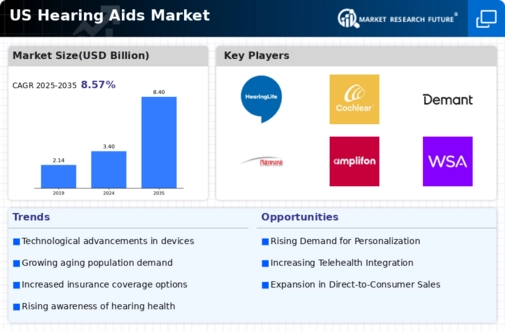
As per analysis, the US north america hearing aid market is projected to grow from USD 3.89 Billion in 2025 to USD 8.2 Billion by 2035, exhibiting a compound annual growth rate (CAGR) of 7.74% during the forecast period (2025 - 2035).

Key Market Trends & Highlights

The US North America hearing aid market is experiencing robust growth driven by technological advancements and demographic shifts.

  • Technological advancements are enhancing the functionality and user experience of hearing aids, making them more appealing to consumers.
  • The increased focus on accessibility is leading to a wider range of products tailored for individuals with varying degrees of hearing loss.
  • Online retail is rising, providing consumers with greater convenience and access to a broader selection of hearing aids.
  • The aging population and rising awareness about hearing health are major drivers propelling market growth.

Market Size & Forecast

2024 Market Size 3.61 (USD Billion)
2035 Market Size 8.2 (USD Billion)
CAGR (2025 - 2035) 7.74%

Major Players

Sonova Holding AG (CH), Demant A/S (DK), WS Audiology A/S (DK), Cochlear Limited (AU), GN Store Nord A/S (DK), Amplifon S.p.A. (IT), Eargo, Inc. (US), Starkey Hearing Technologies (US), Hearing Life (US)

Our Impact
Enabled $4.3B Revenue Impact for Fortune 500 and Leading Multinationals
Partnering with 2000+ Global Organizations Each Year
30K+ Citations by Top-Tier Firms in the Industry

US North America Hearing Aid Market Trends

The US North America hearing aid market is currently experiencing a notable transformation, driven by advancements in technology and an increasing awareness of hearing health. The integration of digital technology into hearing aids has led to devices that are more efficient, user-friendly, and capable of connecting to smartphones and other devices. This trend appears to enhance the overall user experience, making hearing aids more appealing to a broader demographic. Furthermore, the aging population in the United States is contributing to a rising demand for hearing solutions, as age-related hearing loss becomes more prevalent. As a result, manufacturers are focusing on developing innovative products that cater to the specific needs of older adults, thereby expanding their market reach. In addition to technological advancements, there is a growing emphasis on accessibility and affordability within the US North America hearing aid market. Legislative efforts aimed at improving access to hearing healthcare services are gaining momentum, which may lead to increased insurance coverage for hearing aids. This shift could potentially reduce the financial burden on consumers, making hearing aids more attainable for those in need. Moreover, the rise of online retail platforms is changing the way consumers purchase hearing aids, offering more options and competitive pricing. Overall, these trends suggest a dynamic market landscape that is evolving to meet the diverse needs of individuals with hearing impairments.

Technological Advancements

The US North America hearing aid market is witnessing rapid technological advancements, with manufacturers increasingly incorporating features such as Bluetooth connectivity, noise cancellation, and artificial intelligence. These innovations enhance the functionality of hearing aids, allowing users to customize their listening experience and improve sound quality. As technology continues to evolve, it is likely that hearing aids will become even more sophisticated, catering to the unique preferences of users.

Increased Focus on Accessibility

There is a growing emphasis on making hearing aids more accessible to a wider audience in the US North America hearing aid market. Legislative initiatives are being introduced to improve insurance coverage for hearing devices, which may alleviate financial barriers for consumers. This trend indicates a potential shift towards a more inclusive approach to hearing healthcare, ensuring that individuals with hearing loss can obtain the necessary support.

Rise of Online Retail

The emergence of online retail platforms is transforming the purchasing landscape within the US North America hearing aid market. Consumers are increasingly turning to e-commerce for their hearing aid needs, benefiting from a wider selection and competitive pricing. This trend suggests that traditional retail models may need to adapt to meet the changing preferences of consumers, who seek convenience and affordability in their purchasing decisions.

US North America Hearing Aid Market Drivers

Aging Population

The aging population in the United States is a primary driver of the US North America hearing aid market. As the baby boomer generation continues to age, the prevalence of hearing loss is expected to rise significantly. According to the National Institute on Deafness and Other Communication Disorders, approximately 30% of adults aged 65 to 74 experience hearing loss, and this figure increases to 47% for those aged 75 and older. This demographic shift is likely to create a substantial demand for hearing aids, as older adults seek solutions to improve their quality of life. Furthermore, the US North America hearing aid market is poised to benefit from increased awareness and acceptance of hearing aids among older adults, leading to higher adoption rates and market growth.

Rising Disposable Income

Rising disposable income among consumers in the United States is contributing to the growth of the US North America hearing aid market. As economic conditions improve, individuals are more willing to invest in their health and well-being, including hearing aids. The National Association of Insurance Commissioners reports that more people are prioritizing healthcare expenditures, which includes hearing aids. This trend is likely to lead to increased sales in the hearing aid market, as consumers seek high-quality devices that enhance their auditory experience. Furthermore, the US North America hearing aid market may see a shift towards premium products, as consumers with higher disposable incomes are more inclined to purchase advanced hearing aids with enhanced features.

Technological Innovations

Technological innovations play a crucial role in shaping the US North America hearing aid market. Recent advancements in hearing aid technology, such as Bluetooth connectivity, rechargeable batteries, and artificial intelligence, have enhanced the functionality and user experience of these devices. For instance, the integration of AI allows for personalized sound adjustments based on the user's environment, improving overall satisfaction. The market is projected to grow as consumers increasingly seek out these advanced features, with estimates suggesting a compound annual growth rate of around 8% over the next five years. As technology continues to evolve, the US North America hearing aid market is likely to witness a surge in demand for more sophisticated and user-friendly devices.

Increased Awareness and Education

Increased awareness and education regarding hearing health are driving growth in the US North America hearing aid market. Public health campaigns and initiatives aimed at reducing the stigma associated with hearing loss have led to greater acceptance of hearing aids among the population. Organizations such as the American Speech-Language-Hearing Association are actively promoting the importance of early detection and intervention for hearing loss. This heightened awareness is likely to result in more individuals seeking hearing assessments and, consequently, purchasing hearing aids. The US North America hearing aid market stands to benefit from this trend, as more people recognize the importance of addressing hearing loss and the available solutions.

Regulatory Support and Policy Changes

Regulatory support and policy changes are influencing the US North America hearing aid market. Recent legislative efforts, such as the Over-the-Counter Hearing Aid Act, aim to improve access to hearing aids by allowing consumers to purchase them without a prescription. This shift is expected to lower costs and increase accessibility for individuals with mild to moderate hearing loss. As a result, the US North America hearing aid market may experience a surge in sales as more consumers take advantage of these new regulations. Additionally, ongoing discussions about insurance coverage for hearing aids could further enhance market growth by making these devices more affordable for a broader audience.

Market Segment Insights

By Application: Hearing Loss (Largest) vs. Tinnitus Management (Fastest-Growing)

In the US North America hearing aid market, the application segment reflects a diverse distribution among its values. Hearing Loss is the largest segment, representing a significant portion of market share due to the high prevalence of hearing impairment among the aging population. Following this, Tinnitus Management is rapidly gaining traction as awareness and diagnosis of tinnitus increase, driving demand for specialized hearing solutions tailored for this condition. The communication enhancement, music listening, and television listening applications also play essential roles, catering to various consumer needs and preferences, further enriching the market landscape. Growth trends in the application segment indicate a notable shift towards personalized and advanced hearing solutions. Hearing Loss continues to dominate but is increasingly complemented by Tinnitus Management, reflecting a growing recognition of the complexities of auditory health. Additionally, advancements in technology and increased consumer awareness regarding hearing health are bolstering the demand for communication enhancement features. The proliferation of streaming services and demand for audio quality in music and television listening are also contributing positively to the sector's growth, showcasing an evolving market landscape that addresses multifaceted consumer demands.

Hearing Loss (Dominant) vs. Tinnitus Management (Emerging)

Hearing Loss remains the dominant application in the US North America hearing aid market, driven by the extensive prevalence of hearing impairment particularly among older adults. This segment prioritizes effective amplification and clarity, ensuring users can navigate everyday environments seamlessly. On the other hand, Tinnitus Management is emerging as a noteworthy segment, fueled by growing awareness and diagnosis of tinnitus-related issues. This segment focuses on innovative solutions designed to alleviate the perception of ringing or buzzing in the ears, which can significantly impact quality of life. With manufacturers developing more sophisticated technology that combines hearing aid functionality with tinnitus relief features, the Tinnitus Management segment is poised for rapid growth, catering to an increasingly health-conscious consumer base seeking specialized auditory solutions.

By End Use: Geriatric Population (Largest) vs. Adult Population (Fastest-Growing)

In the US North America hearing aid market, the geriatric population holds the largest share, primarily driven by the aging baby boomer demographic. As individuals aged 65 and older increasingly seek solutions to age-related hearing loss, this segment continues to command the majority of the market. Adult populations, while smaller in market share, are rapidly growing. Rising awareness of hearing health and the associated benefits of hearing aids are attracting adults who are experiencing early signs of hearing loss, thus shifting market dynamics.

Geriatric Population (Dominant) vs. Adult Population (Emerging)

The geriatric population represents the dominant force in the US North America hearing aid market due to the high prevalence of hearing loss in older adults. This segment is characterized by a greater willingness to invest in hearing solutions, often motivated by the need for enhanced quality of life and social engagement. On the other hand, the adult population is emerging as a significant segment, driven by younger adults increasingly recognizing the importance of early intervention. This group often seeks modern, discreet hearing aid technologies that fit their active lifestyles, suggesting a shift towards more innovative and connected hearing solutions.

By Technology: Bluetooth Hearing Aids (Largest) vs. Rechargeable Hearing Aids (Fastest-Growing)

In the US North America hearing aid market, Bluetooth Hearing Aids currently hold the largest market share due to their enhanced connectivity features and user-friendly applications. Digital Hearing Aids are also significant players, providing versatility and advanced sound processing capabilities. Analog Hearing Aids, while less popular, still cater to a niche market seeking simplicity and reliability. Smart Hearing Aids, integrating AI features, and Rechargeable Hearing Aids, recognized for convenience and sustainability, are also gaining traction, reshaping the competitive landscape.

Bluetooth Hearing Aids: Dominant vs. Rechargeable Hearing Aids: Emerging

Bluetooth Hearing Aids are dominating the market with their ability to seamlessly connect to smartphones and other devices, offering a level of convenience and functionality that users increasingly demand. They appeal to tech-savvy consumers looking for personalized audio experiences and remote control options. In contrast, Rechargeable Hearing Aids are emerging in popularity, particularly among users seeking ease of use and reduced battery hassle. These devices are designed for extended daily wear and are eco-friendly, contributing to a more sustainable hearing aid solution. Together, these segments illustrate the ongoing technological advancement in hearing aids, addressing diverse consumer needs.

By Distribution Channel: Retail Stores (Largest) vs. Online Sales (Fastest-Growing)

In the US North America hearing aid market, the distribution channels exhibit a varied landscape. Retail stores hold a significant portion of the market share, reflecting their long-standing presence and established consumer trust. Audiology clinics and hospitals also play a crucial role, catering to specific patient needs with personalized services. Meanwhile, pharmacies have been emerging as alternative distribution points, yet account for a smaller share compared to traditional retail outlets. Growing consumer preferences for convenience and accessibility have spurred the rapid rise of online sales. Technological advancements and enhanced digital marketing strategies are driving this segment's growth, appealing particularly to younger demographics increasingly comfortable with e-commerce. As awareness regarding hearing health expands, all channels are adapting to meet evolving consumer expectations and preferences, resulting in dynamic shifts in market positioning across distribution channels.

Retail Stores (Dominant) vs. Online Sales (Emerging)

Retail stores in the US North America hearing aid market are characterized by their stronghold and dominant market presence. They typically offer hands-on experiences, allowing consumers to test products before purchase and receive immediate assistance from trained staff. This direct interaction fosters customer loyalty and trust. In contrast, online sales emerge as a game-changer, providing convenience and often wider product selections at competitive prices. This growing segment is being fueled by advancements in telehealth and online consultations, which enhance consumer confidence in making purchases without physical trials. While retail stores remain central to market dynamics, the shift towards online platforms reflects a significant transformation in consumer shopping behavior, driven by the desire for convenience and accessibility.

By Price Range: Mid Range (Largest) vs. Premium Range (Fastest-Growing)

In the US North America hearing aid market, the price range segment displays a diverse distribution of preferences among consumers. The Mid Range category holds a significant share, capturing the majority of the market due to its balance of quality and affordability. Following closely are the High and Premium Ranges, which cater to a more affluent demographic seeking enhanced features and performance. The Low Range, while essential for budget-conscious buyers, accounts for a smaller portion of the market as consumers increasingly prioritize quality and technological advancements. Growth trends indicate that the Premium Range is emerging as the fastest-growing segment, fueled by advancements in technology and increasing consumer awareness of hearing health. Moreover, enhancements in sound processing, connectivity features, and personalization are driving demand. As the population ages and more individuals experience hearing loss, the inclination towards higher-end audial solutions ensures the Premium Range's prominence in the market. The attractiveness of sophisticated features also plays a crucial role as consumers seek devices facilitating a better quality of life.

Mid Range (Dominant) vs. Premium Range (Emerging)

The Mid Range segment is characterized by hearing aids that offer a blend of advanced features and reasonable pricing, appealing to a broad demographic. These devices typically include essential functionalities, such as directional microphones and noise reduction, making them a popular choice for everyday users. Brands in this segment often capitalize on a strong consumer base, ensuring steady revenue. Conversely, the Premium Range encompasses high-end devices that incorporate the latest technology, such as Bluetooth connectivity, rechargeable batteries, and superior sound quality. Although this segment commands a higher price, its growth is bolstered by a rising trend of health consciousness and an aging population willing to invest in more effective solutions. The appeal of personalized options and exceptional performance solidifies the Premium Range's position as a formidable player in the market.

Get more detailed insights about US North America Hearing Aid Market

Key Players and Competitive Insights

The hearing aid market in the US exhibits a dynamic competitive landscape characterized by rapid technological advancements and evolving consumer preferences. Key growth drivers include an aging population, increased awareness of hearing health, and advancements in digital technology. Major players such as Sonova Holding AG (CH), Demant A/S (DK), and Eargo, Inc. (US) are strategically positioned to leverage these trends. Sonova focuses on innovation through its extensive R&D investments, while Demant emphasizes partnerships to enhance its product offerings. Eargo, on the other hand, is carving a niche with its direct-to-consumer model, which appears to resonate well with younger demographics seeking convenience and accessibility. Collectively, these strategies shape a competitive environment that is increasingly focused on technological differentiation and consumer-centric solutions.

In terms of business tactics, companies are localizing manufacturing and optimizing supply chains to enhance efficiency and responsiveness to market demands. The competitive structure of the market is moderately fragmented, with several players vying for market share. However, the influence of key players is substantial, as they set benchmarks for innovation and customer service, thereby driving overall market growth.

In December 2025, Sonova Holding AG (CH) announced the launch of its latest hearing aid model, which integrates advanced AI capabilities for personalized sound processing. This strategic move is significant as it positions Sonova at the forefront of technological innovation, potentially attracting tech-savvy consumers who prioritize smart features in their hearing aids. The introduction of AI-driven solutions may also enhance user experience, thereby fostering brand loyalty.

In November 2025, Demant A/S (DK) entered a strategic partnership with a leading telehealth provider to offer remote audiology services. This collaboration is likely to expand Demant's reach and improve accessibility for consumers, particularly in underserved areas. By integrating telehealth into its service model, Demant not only enhances its value proposition but also aligns with the growing trend of digital health solutions, which could redefine patient engagement in the hearing aid sector.

In October 2025, Eargo, Inc. (US) secured a $50M investment to further develop its innovative hearing aid technology. This funding is crucial for Eargo as it seeks to enhance its product line and expand its market presence. The investment underscores the confidence investors have in Eargo's direct-to-consumer approach, which may disrupt traditional distribution channels and appeal to a broader audience.

As of January 2026, current trends in the hearing aid market include a pronounced shift towards digitalization, sustainability, and AI integration. Strategic alliances are increasingly shaping the competitive landscape, enabling companies to pool resources and expertise. Looking ahead, competitive differentiation is expected to evolve, with a greater emphasis on innovation and technology rather than price-based competition. Companies that can reliably integrate advanced technologies into their offerings while ensuring supply chain resilience are likely to emerge as leaders in this rapidly changing market.


Key Companies in the US North America Hearing Aid Market include

Industry Developments

The US Hearing Aids Market has seen significant advancements with companies like Hearing Life and Cochlear Limited expanding their product lines and services. In August 2023, Demant announced the launch of its latest hearing aid technology, aiming to enhance user experience through improved connectivity features. Competition remains intense as Amplifon and GN Store Nord continue to innovate, particularly in the realm of digital solutions and telehealth services. A notable acquisition occurred in July 2023, when WS Audiology completed the purchase of a small technology firm to bolster its research capabilities for next-gen hearing devices.

Market growth is underscored by Eargo's recent financial report showing a 30% revenue increase for Q2 2023, reflecting a growing consumer acceptance of advanced hearing solutions. Furthermore, Starkey Hearing Technologies is driving awareness regarding the importance of hearing health through partnerships with key health organizations and initiatives aimed at underserved populations. The current market dynamics highlight changing consumer demands and ongoing technological advancements, shaping the future landscape of hearing aids in the US.

Future Outlook

US North America Hearing Aid Market Future Outlook

The US North America hearing aid market is projected to grow at a 7.74% CAGR from 2025 to 2035, driven by technological advancements, increasing aging population, and rising awareness of hearing health.

New opportunities lie in:

  • Development of telehealth platforms for remote fitting and support
  • Integration of AI-driven features for personalized hearing experiences
  • Expansion into underserved rural markets with mobile hearing clinics

By 2035, the market is expected to be robust, driven by innovation and increased accessibility.

Market Segmentation

US North America Hearing Aid Market End Use Outlook

  • Geriatric Population
  • Adult Population
  • Pediatric Population
  • Veterans
  • Individuals with Disabilities

US North America Hearing Aid Market Technology Outlook

  • Digital Hearing Aids
  • Analog Hearing Aids
  • Bluetooth Hearing Aids
  • Rechargeable Hearing Aids
  • Smart Hearing Aids

US North America Hearing Aid Market Application Outlook

  • Hearing Loss
  • Tinnitus Management
  • Communication Enhancement
  • Music Listening
  • Television Listening

US North America Hearing Aid Market Price Range Outlook

  • Low Range
  • Mid Range
  • High Range
  • Premium Range
  • Luxury Range

US North America Hearing Aid Market Distribution Channel Outlook

  • Retail Stores
  • Online Sales
  • Audiology Clinics
  • Hospitals
  • Pharmacies

Report Scope

MARKET SIZE 20243.61(USD Billion)
MARKET SIZE 20253.89(USD Billion)
MARKET SIZE 20358.2(USD Billion)
COMPOUND ANNUAL GROWTH RATE (CAGR)7.74% (2024 - 2035)
REPORT COVERAGERevenue Forecast, Competitive Landscape, Growth Factors, and Trends
BASE YEAR2024
Market Forecast Period2025 - 2035
Historical Data2019 - 2024
Market Forecast UnitsUSD Billion
Key Companies ProfiledSonova Holding AG (CH), Demant A/S (DK), WS Audiology A/S (DK), Cochlear Limited (AU), GN Store Nord A/S (DK), Amplifon S.p.A. (IT), Eargo, Inc. (US), Starkey Hearing Technologies (US), Hearing Life (US)
Segments CoveredApplication, End Use, Technology, Distribution Channel, Price Range
Key Market OpportunitiesIntegration of advanced digital technologies enhances user experience in the us north america hearing aid market.

Key Market DynamicsTechnological advancements drive innovation in the US hearing aid market, enhancing user experience and accessibility.
Countries CoveredUS
Leave a Comment

FAQs

What is the current valuation of the US North America hearing aid market?

The market valuation was 3.61 USD Billion in 2024.

What is the projected market size for the US North America hearing aid market by 2035?

The projected valuation for 2035 is 8.2 USD Billion.

What is the expected CAGR for the US North America hearing aid market during the forecast period?

The expected CAGR during the 2025 - 2035 forecast period is 7.74%.

Which companies are considered key players in the US North America hearing aid market?

Key players include Sonova Holding AG, Demant A/S, WS Audiology A/S, and Starkey Hearing Technologies.

What are the primary applications driving the US North America hearing aid market?

The primary applications include Hearing Loss, Tinnitus Management, and Communication Enhancement.

How does the geriatric population impact the US North America hearing aid market?

The geriatric population segment was valued at 1.5 to 3.5 USD Billion, indicating substantial demand.

What technological advancements are influencing the US North America hearing aid market?

Technological advancements include Digital, Bluetooth, and Rechargeable Hearing Aids, with Bluetooth projected to reach 2.0 USD Billion.

What distribution channels are most effective for hearing aid sales in the US North America market?

Retail Stores and Audiology Clinics are leading distribution channels, each valued at 1.08 to 2.5 USD Billion.

What price ranges are available in the US North America hearing aid market?

Price ranges include Low, Mid, High, Premium, and Luxury, with Mid Range expected to reach 2.55 USD Billion.

How does the pediatric population contribute to the US North America hearing aid market?

The pediatric population segment was valued at 0.4 to 0.9 USD Billion, reflecting a growing need for specialized solutions.

Download Free Sample

Kindly complete the form below to receive a free sample of this Report

Compare Licence

×
Features License Type
Single User Multiuser License Enterprise User
Price $4,950 $5,950 $7,250
Maximum User Access Limit 1 User Upto 10 Users Unrestricted Access Throughout the Organization
Free Customization
Direct Access to Analyst
Deliverable Format
Platform Access
Discount on Next Purchase 10% 15% 15%
Printable Versions