×
Hero Background
English
Chinese
French
Japanese
Korean
German
Spanish

US Kaolin Market Trends

ID: MRFR/CnM/12429-HCR
128 Pages
Anshula Mandaokar
October 2025

US Kaolin Market Research Report Information By Process (Water-washed, Airfloat, Calcined, Delaminated, and Surface-modified & Unprocessed), By End-use industry (Ceramics & Sanitary Wares, Fiberglass, Paints & Coatings, Rubber, Adhesives & Sealants, Plastics, and Others (Personal Care & Healthcare, and Agriculture)), - Market Forecast Till 2035.

Share:
Download PDF ×

We do not share your information with anyone. However, we may send you emails based on your report interest from time to time. You may contact us at any time to opt-out.

US Kaolin Market Infographic
Purchase Options

Market Trends

Key Emerging Trends in the US Kaolin Market

The US Kaolin Market is currently witnessing several notable trends that reflect the evolving dynamics within the industrial minerals sector. One significant trend is the increasing demand for kaolin in the paper and packaging industry. As a key component in the production of coated paper and packaging materials, kaolin enhances print quality, provides smooth surfaces, and improves ink receptivity. This trend is driven by the expanding e-commerce sector and the growing emphasis on high-quality packaging materials, highlighting kaolin's importance in meeting the evolving needs of the paper and packaging industry.

Moreover, the cosmetics and personal care industry is contributing to the momentum of the US Kaolin Market. Kaolin's natural origin, mild properties, and versatile applications make it a popular ingredient in skincare and cosmetic formulations. It is used in products such as facial masks, powders, and creams for its absorbent and gentle exfoliating properties. This trend aligns with the consumer demand for natural and sustainable ingredients in personal care products, driving the use of kaolin as a preferred choice in cosmetic formulations.

Technological advancements in kaolin processing methods are shaping market trends. Innovations such as advanced beneficiation processes and purification techniques contribute to the production of high-quality kaolin with improved properties. This trend is essential for meeting the stringent specifications of various industries, including ceramics, rubber, and plastics, where kaolin is used as a functional filler and reinforcing agent. The industry's focus on technological advancements reflects the commitment to delivering kaolin products that meet diverse industrial requirements.

The construction and building materials sector is another driving force in the US Kaolin Market. Kaolin is utilized in the production of ceramics, tiles, and various construction materials for its contribution to the improvement of strength, durability, and color properties. With the construction industry experiencing growth and innovation, the demand for kaolin in the manufacturing of construction materials is on the rise. This trend aligns with the industry's pursuit of sustainable and high-performance building solutions.

E-commerce is influencing the distribution channels of kaolin products in the US. The convenience of online platforms for product discovery, comparison, and purchase is reshaping the buying behavior of consumers and businesses. Kaolin manufacturers and distributors are adapting to this trend by enhancing their online presence, providing detailed product information, and offering efficient delivery services. The accessibility of kaolin products through e-commerce platforms contributes to increased market awareness and ease of procurement.

Sustainability considerations are playing a pivotal role in shaping market dynamics in the US Kaolin Market. With an increasing focus on environmentally friendly and responsibly sourced materials, kaolin producers are emphasizing sustainable mining practices and promoting eco-friendly kaolin products. This trend aligns with the broader industry movement towards sustainability and eco-conscious manufacturing, reflecting the commitment to minimizing the environmental impact of kaolin extraction and processing.

Strategic collaborations and partnerships are emerging as trends in the US Kaolin Market. Companies are exploring synergies through joint ventures, alliances, and collaborations to enhance research, development, and commercialization efforts. The collaborative approach allows for the exchange of expertise, resources, and market insights, fostering innovation and ensuring the continuous growth of the kaolin industry.

Regulatory considerations are shaping market dynamics in the US Kaolin Market. Compliance with environmental regulations, safety standards, and product quality specifications is essential for kaolin manufacturers. The industry actively engages with regulatory bodies to ensure that kaolin products meet or exceed the required standards, providing assurances to consumers and end-users about the safety and performance of kaolin applications.

Author
Anshula Mandaokar
Team Lead - Research

Anshula Mandaokar holds an academic degree in Chemical Engineering and has been contributing to the field for more than 5 years. She has expertise in Market Research and Business Consulting and serves as a Team Lead for a reputed Market Research firm under the Chemicals and Materials domain spectrum. She has worked on multiple projects, generating explicit results in a quick turnaround time. Her understanding of data interpretation justifies her role as a leader.

Leave a Comment

FAQs

What is the current valuation of the US Kaolin Market as of 2024?

The US Kaolin Market was valued at approximately 0.6946 USD Billion in 2024.

What is the projected market valuation for the US Kaolin Market in 2035?

The market is projected to reach a valuation of 1.188 USD Billion by 2035.

What is the expected CAGR for the US Kaolin Market during the forecast period 2025 - 2035?

The expected CAGR for the US Kaolin Market during the forecast period 2025 - 2035 is 5.0%.

Which companies are considered key players in the US Kaolin Market?

Key players in the US Kaolin Market include KaMin LLC, Imerys S.A., Thiele Kaolin Company, BASF Corporation, Eagle Materials Inc., Sibelco, Newpark Resources Inc., and Minerals Technologies Inc.

What are the main segments of the US Kaolin Market based on processing methods?

The main segments based on processing methods include Water-washed, Airfloat, Calcined, Delaminated, and Surface-modified & Unprocessed.

What was the valuation of the Water-washed segment in 2024?

The Water-washed segment was valued at approximately 0.2 USD Billion in 2024.

How does the valuation of the Ceramics & Sanitary Wares segment compare to other segments?

The Ceramics & Sanitary Wares segment had a valuation of 0.25 USD Billion in 2024, making it one of the higher-valued segments.

What is the projected growth for the Airfloat segment from 2024 to 2035?

The Airfloat segment is expected to grow from a valuation of 0.15 USD Billion in 2024 to an estimated 0.25 USD Billion by 2035.

What end-use industries are driving demand for kaolin in the US?

End-use industries driving demand include Ceramics & Sanitary Wares, Fiberglass, Paints & Coatings, Rubber, and Plastics.

What is the expected valuation range for the Delaminated segment by 2035?

The Delaminated segment is projected to reach a valuation range of approximately 0.1 to 0.15 USD Billion by 2035.

What will the market value for calcined kaolin be in 2035?

The market value for calcined kaolin is expected to reach 300 million USD by 2035.

What applications drive the growth of the US Kaolin Market?

The US Kaolin Market is driven by applications in ceramics, paper, and plastics.

How much is the delaminated grade of kaolin valued at in 2024?

The delaminated grade of kaolin is valued at 130 million USD in the year 2024.

What is the expected market value for surface treated kaolin in 2035?

Surface treated kaolin is expected to reach a market value of 170 million USD by 2035.

How is the current economic situation affecting the US Kaolin Market?

Current economic factors such as supply chain dynamics and raw material costs are influencing the trends in the US Kaolin Market.

Market Summary

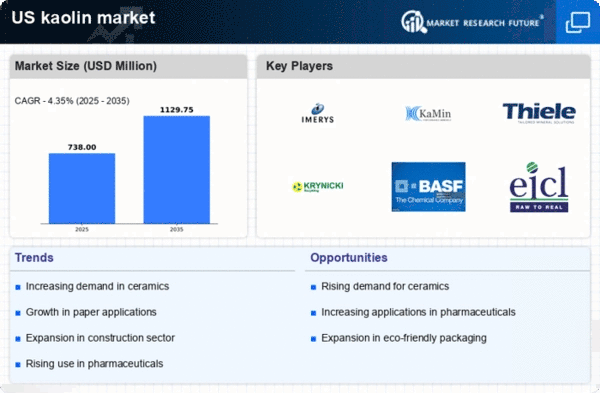
As per Market Research Future analysis, the US kaolin market Size was estimated at 707.24 $ Million in 2024. The US kaolin market is projected to grow from 738.0 $ Million in 2025 to 1129.75 $ Million by 2035, exhibiting a compound annual growth rate (CAGR) of 4.3% during the forecast period 2025 - 2035

Key Market Trends & Highlights

The US kaolin market is experiencing a dynamic shift driven by sustainability and technological advancements.

  • Sustainability initiatives are increasingly influencing production practices within the kaolin market.
  • Technological advancements are enhancing mining efficiency and product quality in the kaolin sector.
  • The construction sector remains the largest segment, while the pharmaceuticals segment is emerging as the fastest-growing area for kaolin applications.

  • Rising demand in the construction sector and growth in the paper and packaging industries are key drivers propelling market expansion.

Market Size & Forecast

2024 Market Size 707.24 (USD Million)
2035 Market Size 1129.75 (USD Million)
CAGR (2025 - 2035) 4.35%

Major Players

<p>Imerys (FR), KaMin LLC (US), Thiele Kaolin Company (US), Sibelco (BE), BASF SE (DE), EICL Limited (IN), China Clay (CN), Bentonite Performance Minerals LLC (US)</p>

Market Trends

The kaolin market is currently experiencing a dynamic phase characterized by evolving demand and innovative applications. This market, primarily driven by the ceramics and paper industries, is witnessing a shift towards higher quality and performance standards. The increasing use of kaolin in various sectors, including construction, paints, and plastics, suggests a diversification of applications that could enhance market growth. Furthermore, environmental regulations are influencing production processes, prompting manufacturers to adopt sustainable practices. This trend may lead to a more eco-friendly approach in the kaolin market, aligning with broader industry movements towards sustainability. In addition, the ongoing advancements in processing technologies appear to be enhancing the quality and efficiency of kaolin production. As companies invest in research and development, the potential for new product formulations and applications increases. This innovation could provide a competitive edge in the market, allowing businesses to meet the specific needs of various end-users. Overall, the kaolin market seems poised for growth, driven by both traditional applications and emerging opportunities in new sectors.

Sustainability Initiatives

There is a noticeable trend towards sustainability within the kaolin market. Manufacturers are increasingly adopting eco-friendly practices to minimize environmental impact. This shift is likely driven by regulatory pressures and consumer demand for greener products, which may lead to innovations in production methods.

Technological Advancements

Technological progress is playing a crucial role in shaping the kaolin market. Enhanced processing techniques are improving product quality and efficiency. This trend suggests that companies investing in technology may gain a competitive advantage, enabling them to cater to diverse customer needs.

Diversification of Applications

The kaolin market is witnessing a diversification of applications beyond traditional uses. Industries such as construction, paints, and plastics are increasingly incorporating kaolin into their products. This trend indicates a potential for market expansion as new sectors recognize the benefits of kaolin.

US Kaolin Market Market Drivers

Growth in Ceramics and Paints

The ceramics and paints sectors are pivotal drivers of the US Kaolin Market, with kaolin being a critical ingredient in the formulation of high-quality products. In 2023, the ceramics industry represented around 25% of kaolin usage, primarily due to its application in porcelain and stoneware. The paints and coatings sector also significantly contributes, as kaolin enhances the durability and finish of paints. The anticipated growth in construction and home improvement projects is expected to bolster demand in these sectors. As consumers increasingly favor high-performance and aesthetically pleasing products, the US Kaolin Market is poised to benefit from this trend, potentially leading to increased production capacities and innovations in kaolin applications.

Rising Demand in Paper Industry

The US Kaolin Market experiences a notable surge in demand from the paper sector, which utilizes kaolin for its desirable properties such as brightness and opacity. In 2023, the paper industry accounted for approximately 30% of the total kaolin consumption in the United States. This trend is likely to continue as manufacturers seek to enhance the quality of their products. Furthermore, the shift towards sustainable practices in paper production may drive the demand for kaolin, as it is a natural mineral that aligns with eco-friendly initiatives. The increasing production of specialty papers, including those used in packaging and printing, further supports the growth of the US Kaolin Market, indicating a robust future for kaolin suppliers in this sector.

Advancements in Mining Technologies

Technological advancements in mining and processing techniques are transforming the US Kaolin Market. Innovations such as automated extraction and advanced processing methods enhance efficiency and reduce operational costs. These improvements not only increase the yield of kaolin but also ensure higher purity levels, which are crucial for various applications. The introduction of environmentally friendly mining practices is also gaining traction, aligning with the industry's shift towards sustainability. As these technologies continue to evolve, they may lead to a more competitive landscape within the US Kaolin Market, enabling companies to meet the growing demand while adhering to regulatory standards and environmental considerations.

Increased Use in Plastics and Rubber

The US Kaolin Market is witnessing a growing trend in the utilization of kaolin in the plastics and rubber industries. Kaolin serves as a filler and reinforcing agent, enhancing the mechanical properties of these materials. In 2023, the plastics sector accounted for approximately 15% of kaolin consumption, driven by the demand for lightweight and durable products. The rubber industry is also increasingly incorporating kaolin to improve the performance of tires and other rubber goods. As the demand for high-quality plastics and rubber products rises, the US Kaolin Market is likely to experience sustained growth, with manufacturers seeking reliable sources of kaolin to meet their production needs.

Regulatory Support for Mining Operations

Regulatory frameworks in the United States are evolving to support the mining operations within the US Kaolin Market. Recent initiatives aimed at streamlining permitting processes and promoting responsible mining practices are likely to enhance operational efficiencies. These regulations not only facilitate easier access to kaolin resources but also encourage sustainable practices among mining companies. As environmental concerns continue to shape industry standards, the US Kaolin Market may benefit from increased investment in sustainable mining technologies. This regulatory support could lead to a more stable supply chain and foster growth opportunities for companies engaged in kaolin production and processing.

Market Segment Insights

By Grade: Hydrous (Largest) vs. Calcined (Fastest-Growing)

<p>In the US kaolin market, the grade segment exhibits a diverse distribution, with Hydrous kaolin leading in market share due to its widespread applications across various industries such as paper, ceramics, and plastics. Calcined kaolin follows but has been gaining traction rapidly over recent years, driven primarily by the growing demand for specialized coatings and fillers. Delaminated and surface-treated kaolins are also notable but hold smaller market shares compared to these leading segments. The growth trends in this segment are largely influenced by advancements in application technology and increasing consumer demand for high-quality materials. Hydrous kaolin remains a staple in various end-use sectors, while the fastest-growing Calcined variant is benefiting from rising investments in infrastructure and innovations in manufacturing processes. Structured and delaminated kaolins, although emerging, are expected to expand steadily as production techniques evolve to meet specific application requirements.</p>

<p>Hydrous (Dominant) vs. Calcined (Emerging)</p>

<p>Hydrous kaolin is recognized as the dominant grade due to its versatile properties and extensive utilization in industries such as paper and paint production, where its natural whiteness and opacity enhance product quality. Its established market position allows it to benefit from steady demand, ensuring reliable revenue streams for producers. Conversely, Calcined kaolin, while still emerging, is gaining rapid market acceptance, particularly for its improved performance characteristics in high-end applications like coatings and plastics. This grade undergoes a heating process that enhances its brightness and reduces plasticity, making it an attractive choice for manufacturers looking for performance enhancements in their products. This dual dynamic of dominance and emergence creates a unique competitive landscape in the US kaolin market.</p>

By Application: Paper (Largest) vs. Ceramics (Fastest-Growing)

<p>In the US kaolin market, the paper segment holds the largest share due to its extensive use in coating and filling applications, ensuring high demand from printing and writing paper manufacturers. Conversely, ceramics have emerged as the fastest-growing segment, driven by their increasing usage in various applications, including tiles, sanitary ware, and pottery. The growth of the paint and coatings sector significantly contributes to the demand for kaolin, as it enhances the performance of these products. Additionally, the rubber and plastics segments are witnessing steady growth due to advances in product formulations and the rising use of kaolin in fiberglass manufacturing, providing overall stability and promising prospects for the market.</p>

<p>Paper (Dominant) vs. Ceramics (Emerging)</p>

<p>The paper segment is dominant in the US kaolin market, characterized by its high volume consumption in several applications such as printing and writing paper. This segment benefits from the demand for high-quality finishes and brightness in paper products. On the other hand, the ceramics segment is emerging rapidly, driven by the increasing use of kaolin in ceramic glazes and bodies, ensuring strength and aesthetics in final products. The versatility of kaolin makes it an essential additive in both segments, with manufacturers continuously exploring innovations to enhance performance and sustainability.</p>

Get more detailed insights about US Kaolin Market Research Report - Forecast 2035

Regional Insights

North America : Leading Market for Kaolin

The North American kaolin market is primarily driven by the increasing demand from the paper, ceramics, and paint industries. The U.S. holds the largest market share at approximately 70%, followed by Canada with around 15%. Regulatory support for sustainable mining practices and environmental compliance is also a significant catalyst for growth. The region's focus on innovation and quality standards further enhances its market position. The competitive landscape in North America is characterized by the presence of key players such as KaMin LLC, Thiele Kaolin Company, and BASF Corporation. These companies are investing in advanced technologies and sustainable practices to maintain their market leadership. The U.S. remains a hub for kaolin production, with a robust supply chain and distribution network, ensuring a steady flow of high-quality kaolin to various industries.

Europe : Emerging Market Opportunities

In Europe, the kaolin market is witnessing growth due to increasing demand for eco-friendly materials in construction and packaging. The region is characterized by a strong regulatory framework promoting sustainable mining practices. Germany and France are the largest markets, holding approximately 25% and 20% market shares, respectively. The European Union's commitment to sustainability and circular economy initiatives is a key driver for market expansion. Leading countries in Europe are focusing on innovation and sustainability, with companies like Imerys S.A. and Sibelco leading the charge. The competitive landscape is evolving, with a shift towards high-quality kaolin products that meet stringent environmental standards. The presence of advanced research facilities in Europe supports the development of new applications for kaolin, enhancing its market potential.

Asia-Pacific : Rapid Industrialization and Growth

The Asia-Pacific region is experiencing rapid industrialization, leading to increased demand for kaolin in various sectors such as ceramics, plastics, and paints. China and India are the largest markets, accounting for approximately 30% and 20% of the market share, respectively. The region's growth is supported by government initiatives aimed at boosting manufacturing and infrastructure development, which are critical for kaolin consumption. The competitive landscape in Asia-Pacific is marked by the presence of both local and international players. Companies like Newpark Resources Inc. and Minerals Technologies Inc. are expanding their operations in the region to capitalize on the growing demand. The focus on quality and innovation is driving companies to invest in research and development, ensuring that they meet the evolving needs of various industries.

Middle East and Africa : Resource-Rich Potential

The Middle East and Africa region is gradually emerging as a potential market for kaolin, driven by increasing industrial activities and infrastructure development. Countries like South Africa and Nigeria are leading the market, holding approximately 15% and 10% of the market share, respectively. The region's growth is supported by investments in mining and processing facilities, as well as government initiatives to promote local production. The competitive landscape is still developing, with several local players entering the market. Companies are focusing on establishing partnerships and collaborations to enhance their market presence. The region's rich mineral resources present significant opportunities for kaolin production, particularly in sectors such as construction and ceramics, which are expected to grow in the coming years.

Key Players and Competitive Insights

The kaolin market exhibits a competitive landscape characterized by a blend of established players and emerging companies, driven by increasing demand across various industries such as ceramics, paper, and plastics. Key growth drivers include the rising need for high-quality kaolin in manufacturing processes and the ongoing innovations in product applications. Major companies like Imerys (FR), KaMin LLC (US), and Thiele Kaolin Company (US) are strategically positioned to leverage their extensive resources and technological capabilities. Imerys (FR) focuses on innovation and sustainability, while KaMin LLC (US) emphasizes regional expansion and customer-centric solutions, collectively shaping a competitive environment that prioritizes quality and service.

The market structure appears moderately fragmented, with several players vying for market share. Key business tactics include localizing manufacturing to reduce costs and optimize supply chains, which enhances responsiveness to customer needs. The collective influence of these companies fosters a dynamic competitive atmosphere, where agility and adaptability are paramount for success.

In October 2025, Imerys (FR) announced a significant investment in a new production facility aimed at enhancing its capacity for high-performance kaolin products. This strategic move is likely to bolster its market position by meeting the growing demand for specialized kaolin applications, particularly in the ceramics and coatings sectors. The investment underscores Imerys' commitment to innovation and sustainability, aligning with industry trends towards environmentally friendly production methods.

In September 2025, KaMin LLC (US) launched a new line of kaolin products specifically designed for the paper industry, which is expected to improve paper quality and reduce production costs. This initiative reflects KaMin's focus on customer-centric solutions and its ability to adapt to market needs. By enhancing product offerings, KaMin positions itself as a leader in the kaolin market, catering to the evolving demands of its clientele.

In August 2025, Thiele Kaolin Company (US) entered into a strategic partnership with a leading technology firm to integrate AI-driven analytics into its supply chain operations. This collaboration aims to optimize production efficiency and reduce lead times, which could significantly enhance Thiele's competitive edge. The integration of advanced technologies indicates a broader trend within the industry towards digital transformation and operational excellence.

As of November 2025, current competitive trends in the kaolin market are increasingly defined by digitalization, sustainability, and the integration of advanced technologies such as AI. Strategic alliances are becoming more prevalent, enabling companies to pool resources and expertise to navigate market challenges effectively. Looking ahead, competitive differentiation is likely to evolve from traditional price-based competition to a focus on innovation, technological advancements, and supply chain reliability, suggesting a transformative shift in how companies position themselves in the market.

Key Companies in the US Kaolin Market market include

Industry Developments

July 2022: Due to rising costs for manufacturing operations worldwide as a result of the current state of the global economy, Thiele Kaolin Company announced a 9% price increase for all product categories. The company has experienced an impact from these cost increases on labor, energy, chemicals, mining, maintenance, and other inputs required to make high-quality products.

November 2021: BASF SE's kaolin mineral business will be acquired by KaMin LLC and CADAM S.A. The Performance Chemicals branch of BASF includes the kaolin minerals industry. The company's kaolin business is considerably strengthened by this.

Future Outlook

US Kaolin Market Future Outlook

<p>The kaolin market is projected to grow at a 4.35% CAGR from 2024 to 2035, driven by increasing demand in ceramics, paper, and plastics.</p>

New opportunities lie in:

  • <p>Expansion into eco-friendly kaolin products for sustainable packaging solutions.</p>
  • <p>Development of advanced kaolin-based composites for the automotive industry.</p>
  • <p>Investment in digital marketing strategies to enhance customer engagement and sales.</p>

<p>By 2035, the kaolin market is expected to achieve robust growth and increased market share.</p>

Market Segmentation

US Kaolin Market Grade Outlook

  • Calcined
  • Hydrous
  • Delaminated
  • Surface Treated
  • Structured

US Kaolin Market Application Outlook

  • Paper
  • Ceramics
  • Paints & Coatings
  • Rubber & Plastics
  • Fiberglass
  • Others

Report Scope

MARKET SIZE 2024707.24(USD Million)
MARKET SIZE 2025738.0(USD Million)
MARKET SIZE 20351129.75(USD Million)
COMPOUND ANNUAL GROWTH RATE (CAGR)4.35% (2024 - 2035)
REPORT COVERAGERevenue Forecast, Competitive Landscape, Growth Factors, and Trends
BASE YEAR2024
Market Forecast Period2025 - 2035
Historical Data2019 - 2024
Market Forecast UnitsUSD Million
Key Companies Profiled["Imerys (FR)", "KaMin LLC (US)", "Thiele Kaolin Company (US)", "Sibelco (BE)", "BASF SE (DE)", "EICL Limited (IN)", "China Clay (CN)", "Bentonite Performance Minerals LLC (US)"]
Segments CoveredGrade, Application
Key Market OpportunitiesGrowing demand for eco-friendly packaging materials presents opportunities in the kaolin market.
Key Market DynamicsRising demand for eco-friendly products drives innovation and competition in the kaolin market.
Countries CoveredUS

FAQs

What is the current valuation of the US Kaolin Market as of 2024?

The US Kaolin Market was valued at approximately 0.6946 USD Billion in 2024.

What is the projected market valuation for the US Kaolin Market in 2035?

The market is projected to reach a valuation of 1.188 USD Billion by 2035.

What is the expected CAGR for the US Kaolin Market during the forecast period 2025 - 2035?

The expected CAGR for the US Kaolin Market during the forecast period 2025 - 2035 is 5.0%.

Which companies are considered key players in the US Kaolin Market?

Key players in the US Kaolin Market include KaMin LLC, Imerys S.A., Thiele Kaolin Company, BASF Corporation, Eagle Materials Inc., Sibelco, Newpark Resources Inc., and Minerals Technologies Inc.

What are the main segments of the US Kaolin Market based on processing methods?

The main segments based on processing methods include Water-washed, Airfloat, Calcined, Delaminated, and Surface-modified & Unprocessed.

What was the valuation of the Water-washed segment in 2024?

The Water-washed segment was valued at approximately 0.2 USD Billion in 2024.

How does the valuation of the Ceramics & Sanitary Wares segment compare to other segments?

The Ceramics & Sanitary Wares segment had a valuation of 0.25 USD Billion in 2024, making it one of the higher-valued segments.

What is the projected growth for the Airfloat segment from 2024 to 2035?

The Airfloat segment is expected to grow from a valuation of 0.15 USD Billion in 2024 to an estimated 0.25 USD Billion by 2035.

What end-use industries are driving demand for kaolin in the US?

End-use industries driving demand include Ceramics & Sanitary Wares, Fiberglass, Paints & Coatings, Rubber, and Plastics.

What is the expected valuation range for the Delaminated segment by 2035?

The Delaminated segment is projected to reach a valuation range of approximately 0.1 to 0.15 USD Billion by 2035.

What will the market value for calcined kaolin be in 2035?

The market value for calcined kaolin is expected to reach 300 million USD by 2035.

What applications drive the growth of the US Kaolin Market?

The US Kaolin Market is driven by applications in ceramics, paper, and plastics.

How much is the delaminated grade of kaolin valued at in 2024?

The delaminated grade of kaolin is valued at 130 million USD in the year 2024.

What is the expected market value for surface treated kaolin in 2035?

Surface treated kaolin is expected to reach a market value of 170 million USD by 2035.

How is the current economic situation affecting the US Kaolin Market?

Current economic factors such as supply chain dynamics and raw material costs are influencing the trends in the US Kaolin Market.

  1. SECTION I: EXECUTIVE SUMMARY AND KEY HIGHLIGHTS
    1. EXECUTIVE SUMMARY
      1. Market Overview
      2. Key Findings
      3. Market Segmentation
      4. Competitive Landscape
      5. Challenges and Opportunities
      6. Future Outlook
  2. SECTION II: SCOPING, METHODOLOGY AND MARKET STRUCTURE
    1. MARKET INTRODUCTION
      1. Definition
      2. Scope of the study
    2. RESEARCH METHODOLOGY
      1. Overview
      2. Data Mining
      3. Secondary Research
      4. Primary Research
      5. Forecasting Model
      6. Market Size Estimation
      7. Data Triangulation
      8. Validation
  3. SECTION III: QUALITATIVE ANALYSIS
    1. MARKET DYNAMICS
      1. Overview
      2. Drivers
      3. Restraints
      4. Opportunities
    2. MARKET FACTOR ANALYSIS
      1. Value chain Analysis
      2. Porter's Five Forces Analysis
      3. COVID-19 Impact Analysis
  4. SECTION IV: QUANTITATIVE ANALYSIS
    1. Chemicals and Materials, BY Process (USD Billion)
      1. Water-washed
      2. Airfloat
      3. Calcined
      4. Delaminated
      5. Surface-modified & Unprocessed
    2. Chemicals and Materials, BY End-use Industry (USD Billion)
      1. Ceramics & Sanitary Wares
      2. Fiberglass
      3. Paints & Coatings
      4. Rubber
      5. Adhesives & Sealants
      6. Plastics
      7. Others (Personal Care & Healthcare, and Agriculture)
    3. Chemicals and Materials, BY Region (USD Billion)
      1. North America
      2. Europe
      3. APAC
      4. South America
      5. MEA
  5. SECTION V: COMPETITIVE ANALYSIS
    1. Competitive Landscape
      1. Overview
      2. Competitive Analysis
      3. Market share Analysis
      4. Major Growth Strategy in the Chemicals and Materials
      5. Competitive Benchmarking
      6. Leading Players in Terms of Number of Developments in the Chemicals and Materials
      7. Key developments and growth strategies
      8. Major Players Financial Matrix
    2. Company Profiles
      1. KaMin LLC (US)
      2. Imerys S.A. (FR)
      3. Thiele Kaolin Company (US)
      4. BASF Corporation (US)
      5. Eagle Materials Inc. (US)
      6. Sibelco (BE)
      7. Newpark Resources Inc. (US)
      8. Minerals Technologies Inc. (US)
    3. Appendix
      1. References
      2. Related Reports
  6. LIST OF FIGURES
    1. MARKET SYNOPSIS
    2. NORTH AMERICA MARKET ANALYSIS
    3. US MARKET ANALYSIS BY PROCESS
    4. US MARKET ANALYSIS BY END-USE INDUSTRY
    5. CANADA MARKET ANALYSIS BY PROCESS
    6. CANADA MARKET ANALYSIS BY END-USE INDUSTRY
    7. EUROPE MARKET ANALYSIS
    8. GERMANY MARKET ANALYSIS BY PROCESS
    9. GERMANY MARKET ANALYSIS BY END-USE INDUSTRY
    10. UK MARKET ANALYSIS BY PROCESS
    11. UK MARKET ANALYSIS BY END-USE INDUSTRY
    12. FRANCE MARKET ANALYSIS BY PROCESS
    13. FRANCE MARKET ANALYSIS BY END-USE INDUSTRY
    14. RUSSIA MARKET ANALYSIS BY PROCESS
    15. RUSSIA MARKET ANALYSIS BY END-USE INDUSTRY
    16. ITALY MARKET ANALYSIS BY PROCESS
    17. ITALY MARKET ANALYSIS BY END-USE INDUSTRY
    18. SPAIN MARKET ANALYSIS BY PROCESS
    19. SPAIN MARKET ANALYSIS BY END-USE INDUSTRY
    20. REST OF EUROPE MARKET ANALYSIS BY PROCESS
    21. REST OF EUROPE MARKET ANALYSIS BY END-USE INDUSTRY
    22. APAC MARKET ANALYSIS
    23. CHINA MARKET ANALYSIS BY PROCESS
    24. CHINA MARKET ANALYSIS BY END-USE INDUSTRY
    25. INDIA MARKET ANALYSIS BY PROCESS
    26. INDIA MARKET ANALYSIS BY END-USE INDUSTRY
    27. JAPAN MARKET ANALYSIS BY PROCESS
    28. JAPAN MARKET ANALYSIS BY END-USE INDUSTRY
    29. SOUTH KOREA MARKET ANALYSIS BY PROCESS
    30. SOUTH KOREA MARKET ANALYSIS BY END-USE INDUSTRY
    31. MALAYSIA MARKET ANALYSIS BY PROCESS
    32. MALAYSIA MARKET ANALYSIS BY END-USE INDUSTRY
    33. THAILAND MARKET ANALYSIS BY PROCESS
    34. THAILAND MARKET ANALYSIS BY END-USE INDUSTRY
    35. INDONESIA MARKET ANALYSIS BY PROCESS
    36. INDONESIA MARKET ANALYSIS BY END-USE INDUSTRY
    37. REST OF APAC MARKET ANALYSIS BY PROCESS
    38. REST OF APAC MARKET ANALYSIS BY END-USE INDUSTRY
    39. SOUTH AMERICA MARKET ANALYSIS
    40. BRAZIL MARKET ANALYSIS BY PROCESS
    41. BRAZIL MARKET ANALYSIS BY END-USE INDUSTRY
    42. MEXICO MARKET ANALYSIS BY PROCESS
    43. MEXICO MARKET ANALYSIS BY END-USE INDUSTRY
    44. ARGENTINA MARKET ANALYSIS BY PROCESS
    45. ARGENTINA MARKET ANALYSIS BY END-USE INDUSTRY
    46. REST OF SOUTH AMERICA MARKET ANALYSIS BY PROCESS
    47. REST OF SOUTH AMERICA MARKET ANALYSIS BY END-USE INDUSTRY
    48. MEA MARKET ANALYSIS
    49. GCC COUNTRIES MARKET ANALYSIS BY PROCESS
    50. GCC COUNTRIES MARKET ANALYSIS BY END-USE INDUSTRY
    51. SOUTH AFRICA MARKET ANALYSIS BY PROCESS
    52. SOUTH AFRICA MARKET ANALYSIS BY END-USE INDUSTRY
    53. REST OF MEA MARKET ANALYSIS BY PROCESS
    54. REST OF MEA MARKET ANALYSIS BY END-USE INDUSTRY
    55. KEY BUYING CRITERIA OF CHEMICALS AND MATERIALS
    56. RESEARCH PROCESS OF MRFR
    57. DRO ANALYSIS OF CHEMICALS AND MATERIALS
    58. DRIVERS IMPACT ANALYSIS: CHEMICALS AND MATERIALS
    59. RESTRAINTS IMPACT ANALYSIS: CHEMICALS AND MATERIALS
    60. SUPPLY / VALUE CHAIN: CHEMICALS AND MATERIALS
    61. CHEMICALS AND MATERIALS, BY PROCESS, 2024 (% SHARE)
    62. CHEMICALS AND MATERIALS, BY PROCESS, 2024 TO 2035 (USD Billion)
    63. CHEMICALS AND MATERIALS, BY END-USE INDUSTRY, 2024 (% SHARE)
    64. CHEMICALS AND MATERIALS, BY END-USE INDUSTRY, 2024 TO 2035 (USD Billion)
    65. BENCHMARKING OF MAJOR COMPETITORS
  7. LIST OF TABLES
    1. LIST OF ASSUMPTIONS
    2. North America MARKET SIZE ESTIMATES; FORECAST
      1. BY PROCESS, 2025-2035 (USD Billion)
      2. BY END-USE INDUSTRY, 2025-2035 (USD Billion)
    3. US MARKET SIZE ESTIMATES; FORECAST
      1. BY PROCESS, 2025-2035 (USD Billion)
      2. BY END-USE INDUSTRY, 2025-2035 (USD Billion)
    4. Canada MARKET SIZE ESTIMATES; FORECAST
      1. BY PROCESS, 2025-2035 (USD Billion)
      2. BY END-USE INDUSTRY, 2025-2035 (USD Billion)
    5. Europe MARKET SIZE ESTIMATES; FORECAST
      1. BY PROCESS, 2025-2035 (USD Billion)
      2. BY END-USE INDUSTRY, 2025-2035 (USD Billion)
    6. Germany MARKET SIZE ESTIMATES; FORECAST
      1. BY PROCESS, 2025-2035 (USD Billion)
      2. BY END-USE INDUSTRY, 2025-2035 (USD Billion)
    7. UK MARKET SIZE ESTIMATES; FORECAST
      1. BY PROCESS, 2025-2035 (USD Billion)
      2. BY END-USE INDUSTRY, 2025-2035 (USD Billion)
    8. France MARKET SIZE ESTIMATES; FORECAST
      1. BY PROCESS, 2025-2035 (USD Billion)
      2. BY END-USE INDUSTRY, 2025-2035 (USD Billion)
    9. Russia MARKET SIZE ESTIMATES; FORECAST
      1. BY PROCESS, 2025-2035 (USD Billion)
      2. BY END-USE INDUSTRY, 2025-2035 (USD Billion)
    10. Italy MARKET SIZE ESTIMATES; FORECAST
      1. BY PROCESS, 2025-2035 (USD Billion)
      2. BY END-USE INDUSTRY, 2025-2035 (USD Billion)
    11. Spain MARKET SIZE ESTIMATES; FORECAST
      1. BY PROCESS, 2025-2035 (USD Billion)
      2. BY END-USE INDUSTRY, 2025-2035 (USD Billion)
    12. Rest of Europe MARKET SIZE ESTIMATES; FORECAST
      1. BY PROCESS, 2025-2035 (USD Billion)
      2. BY END-USE INDUSTRY, 2025-2035 (USD Billion)
    13. APAC MARKET SIZE ESTIMATES; FORECAST
      1. BY PROCESS, 2025-2035 (USD Billion)
      2. BY END-USE INDUSTRY, 2025-2035 (USD Billion)
    14. China MARKET SIZE ESTIMATES; FORECAST
      1. BY PROCESS, 2025-2035 (USD Billion)
      2. BY END-USE INDUSTRY, 2025-2035 (USD Billion)
    15. India MARKET SIZE ESTIMATES; FORECAST
      1. BY PROCESS, 2025-2035 (USD Billion)
      2. BY END-USE INDUSTRY, 2025-2035 (USD Billion)
    16. Japan MARKET SIZE ESTIMATES; FORECAST
      1. BY PROCESS, 2025-2035 (USD Billion)
      2. BY END-USE INDUSTRY, 2025-2035 (USD Billion)
    17. South Korea MARKET SIZE ESTIMATES; FORECAST
      1. BY PROCESS, 2025-2035 (USD Billion)
      2. BY END-USE INDUSTRY, 2025-2035 (USD Billion)
    18. Malaysia MARKET SIZE ESTIMATES; FORECAST
      1. BY PROCESS, 2025-2035 (USD Billion)
      2. BY END-USE INDUSTRY, 2025-2035 (USD Billion)
    19. Thailand MARKET SIZE ESTIMATES; FORECAST
      1. BY PROCESS, 2025-2035 (USD Billion)
      2. BY END-USE INDUSTRY, 2025-2035 (USD Billion)
    20. Indonesia MARKET SIZE ESTIMATES; FORECAST
      1. BY PROCESS, 2025-2035 (USD Billion)
      2. BY END-USE INDUSTRY, 2025-2035 (USD Billion)
    21. Rest of APAC MARKET SIZE ESTIMATES; FORECAST
      1. BY PROCESS, 2025-2035 (USD Billion)
      2. BY END-USE INDUSTRY, 2025-2035 (USD Billion)
    22. South America MARKET SIZE ESTIMATES; FORECAST
      1. BY PROCESS, 2025-2035 (USD Billion)
      2. BY END-USE INDUSTRY, 2025-2035 (USD Billion)
    23. Brazil MARKET SIZE ESTIMATES; FORECAST
      1. BY PROCESS, 2025-2035 (USD Billion)
      2. BY END-USE INDUSTRY, 2025-2035 (USD Billion)
    24. Mexico MARKET SIZE ESTIMATES; FORECAST
      1. BY PROCESS, 2025-2035 (USD Billion)
      2. BY END-USE INDUSTRY, 2025-2035 (USD Billion)
    25. Argentina MARKET SIZE ESTIMATES; FORECAST
      1. BY PROCESS, 2025-2035 (USD Billion)
      2. BY END-USE INDUSTRY, 2025-2035 (USD Billion)
    26. Rest of South America MARKET SIZE ESTIMATES; FORECAST
      1. BY PROCESS, 2025-2035 (USD Billion)
      2. BY END-USE INDUSTRY, 2025-2035 (USD Billion)
    27. MEA MARKET SIZE ESTIMATES; FORECAST
      1. BY PROCESS, 2025-2035 (USD Billion)
      2. BY END-USE INDUSTRY, 2025-2035 (USD Billion)
    28. GCC Countries MARKET SIZE ESTIMATES; FORECAST
      1. BY PROCESS, 2025-2035 (USD Billion)
      2. BY END-USE INDUSTRY, 2025-2035 (USD Billion)
    29. South Africa MARKET SIZE ESTIMATES; FORECAST
      1. BY PROCESS, 2025-2035 (USD Billion)
      2. BY END-USE INDUSTRY, 2025-2035 (USD Billion)
    30. Rest of MEA MARKET SIZE ESTIMATES; FORECAST
      1. BY PROCESS, 2025-2035 (USD Billion)
      2. BY END-USE INDUSTRY, 2025-2035 (USD Billion)
    31. PRODUCT LAUNCH/PRODUCT DEVELOPMENT/APPROVAL
    32. ACQUISITION/PARTNERSHIP

US Kaolin Market Segmentation

Market Segmentation Overview

  • Detailed segmentation data will be available in the full report
  • Comprehensive analysis by multiple parameters
  • Regional and country-level breakdowns
  • Market size forecasts by segment
Infographic

Free Sample Request

Kindly complete the form below to receive a free sample of this Report

Get Free Sample

Customer Strories

Compare Licence

×
Features License Type
Single User Multiuser License Enterprise User
Price $4,950 $5,950 $7,250
Maximum User Access Limit 1 User Upto 10 Users Unrestricted Access Throughout the Organization
Free Customization
Direct Access to Analyst
Deliverable Format
Platform Access
Discount on Next Purchase 10% 15% 15%
Printable Versions