×
Request Free Sample ×

Kindly complete the form below to receive a free sample of this Report

* Please use a valid business email

Leading companies partner with us for data-driven Insights

clients tt-cursor
Hero Background

US Interventional Radiology Market

ID: MRFR/MED/17747-HCR
100 Pages
MRFR Team
February 2026

United States Americas Interventional Radiology Market Research Report to 2032

Share:
Download PDF ×

We do not share your information with anyone. However, we may send you emails based on your report interest from time to time. You may contact us at any time to opt-out.

US Interventional Radiology Market Infographic
Purchase Options

US Interventional Radiology Market Summary

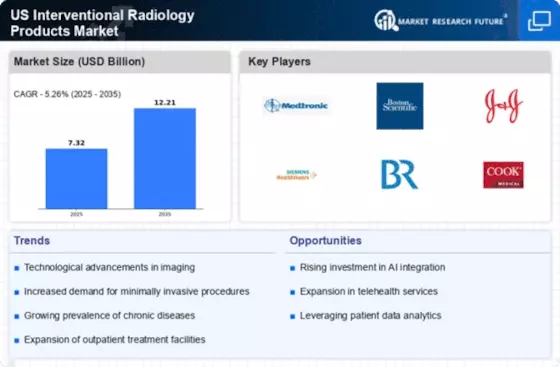
As per analysis, the US Interventional Radiology Products Market is projected to grow from USD 6.95 Billion in 2024 to USD 12.21 Billion by 2035, exhibiting a compound annual growth rate (CAGR) of 5.26% during the forecast period (2025 - 2035).

Key Market Trends & Highlights

The US Interventional Radiology Products Market is poised for growth driven by technological advancements and increasing demand for minimally invasive procedures.

  • Technological advancements are reshaping the landscape of interventional radiology, enhancing procedural efficacy and patient outcomes.
  • The oncology segment remains the largest, reflecting a sustained focus on cancer treatment through innovative interventional techniques.
  • Urology is emerging as the fastest-growing segment, driven by rising awareness and acceptance of minimally invasive options.
  • Key market drivers include the rising prevalence of chronic diseases and increased investment in healthcare infrastructure, fostering a supportive environment for growth.

Market Size & Forecast

2024 Market Size 6.95 (USD Billion)
2035 Market Size 12.21 (USD Billion)
CAGR (2025 - 2035) 5.26%

Major Players

Medtronic (US), Boston Scientific (US), Johnson & Johnson (US), Siemens Healthineers (DE), Bayer (DE), Cook Medical (US), Terumo Corporation (JP), Philips (NL), Stryker Corporation (US)

Our Impact
Enabled $4.3B Revenue Impact for Fortune 500 and Leading Multinationals
Partnering with 2000+ Global Organizations Each Year
30K+ Citations by Top-Tier Firms in the Industry

US Interventional Radiology Market Trends

The US Interventional Radiology Products Market is currently experiencing a dynamic evolution, driven by advancements in technology and an increasing demand for minimally invasive procedures. This market encompasses a wide range of products, including catheters, guidewires, and imaging systems, which are essential for various interventional radiology procedures. The growing prevalence of chronic diseases, coupled with an aging population, appears to be propelling the need for innovative solutions that enhance patient outcomes and reduce recovery times. Furthermore, the integration of artificial intelligence and machine learning into imaging technologies is likely to improve diagnostic accuracy and procedural efficiency, thereby influencing market growth. In addition, regulatory support and funding initiatives from government bodies are fostering an environment conducive to research and development in this sector. The US Interventional Radiology Products Market seems poised for expansion as healthcare providers increasingly adopt advanced technologies to meet the evolving needs of patients. As the landscape continues to shift, stakeholders must remain vigilant to emerging trends and adapt their strategies accordingly to capitalize on the opportunities presented by this vibrant market.

Technological Advancements

The US Interventional Radiology Products Market is witnessing rapid technological advancements, particularly in imaging modalities and device design. Innovations such as three-dimensional imaging and real-time visualization tools are enhancing procedural precision and safety. These developments are likely to facilitate more complex interventions, thereby expanding the scope of interventional radiology.

Increased Demand for Minimally Invasive Procedures

There is a growing preference for minimally invasive procedures among patients and healthcare providers in the US. This trend is driven by the benefits of reduced recovery times, lower risk of complications, and shorter hospital stays. As a result, the demand for interventional radiology products that support these procedures is expected to rise.

Regulatory Support and Funding Initiatives

Government support through regulatory frameworks and funding initiatives is playing a crucial role in the growth of the US Interventional Radiology Products Market. These measures are aimed at promoting innovation and ensuring the availability of advanced medical technologies, which may enhance the overall quality of care in interventional radiology.

US Interventional Radiology Market Drivers

Supportive Regulatory Environment

The US Interventional Radiology Products Market benefits from a supportive regulatory environment that encourages innovation and the introduction of new products. Regulatory bodies such as the Food and Drug Administration (FDA) have streamlined the approval process for medical devices, allowing for quicker access to advanced interventional radiology products. This regulatory support is crucial for manufacturers seeking to bring innovative solutions to market. Additionally, government initiatives aimed at improving healthcare access and quality further bolster the interventional radiology sector. As regulations continue to evolve in favor of technological advancements, the market for interventional radiology products is likely to expand, driven by the introduction of new and improved devices.

Rising Prevalence of Chronic Diseases

The US Interventional Radiology Products Market is experiencing growth due to the increasing prevalence of chronic diseases such as cardiovascular disorders, cancer, and diabetes. According to the Centers for Disease Control and Prevention, chronic diseases account for 7 out of 10 deaths in the United States, leading to a heightened demand for effective treatment options. Interventional radiology offers minimally invasive procedures that are often preferred by patients and healthcare providers alike. This trend is likely to continue as the aging population increases, with projections indicating that by 2030, nearly 20% of the US population will be 65 years or older. Consequently, the demand for interventional radiology products is expected to rise, driving market expansion.

Increased Investment in Healthcare Infrastructure

The US Interventional Radiology Products Market is poised for growth due to increased investment in healthcare infrastructure. Federal and state governments, along with private entities, are allocating substantial funds to enhance healthcare facilities and expand access to advanced medical technologies. The American Hospital Association reports that hospitals are investing billions in upgrading their equipment and facilities, which includes interventional radiology suites. This investment is likely to facilitate the adoption of cutting-edge interventional radiology products, thereby improving patient outcomes and operational efficiency. As healthcare infrastructure continues to evolve, the demand for interventional radiology products is expected to rise, contributing to market growth.

Technological Innovations in Interventional Radiology

Technological advancements play a pivotal role in the US Interventional Radiology Products Market. Innovations such as advanced imaging techniques, robotic-assisted procedures, and enhanced catheter designs are transforming the landscape of interventional radiology. For instance, the integration of artificial intelligence in imaging systems is improving diagnostic accuracy and procedural outcomes. The market for interventional radiology devices is projected to grow significantly, with estimates suggesting a compound annual growth rate of over 6% through 2028. These innovations not only enhance the efficacy of procedures but also reduce recovery times, making them more appealing to both patients and healthcare providers. As technology continues to evolve, it is likely to further propel the growth of the interventional radiology market.

Growing Awareness and Acceptance of Minimally Invasive Procedures

The US Interventional Radiology Products Market is benefiting from a growing awareness and acceptance of minimally invasive procedures among patients and healthcare professionals. As patients become more informed about their treatment options, they increasingly prefer procedures that offer reduced pain, shorter recovery times, and lower risks of complications. This shift in patient preference is supported by healthcare providers who recognize the benefits of interventional radiology techniques. According to a survey conducted by the American College of Radiology, a significant percentage of physicians reported a preference for minimally invasive approaches when treating various conditions. This trend is expected to drive demand for interventional radiology products, as more healthcare facilities adopt these techniques to meet patient expectations.


Market Segment Insights

By Application: Oncology (Largest) vs. Urology (Fastest-Growing)

In the US Interventional Radiology Products Market, Oncology holds the largest share, reflecting the significant demand for innovations in cancer treatment procedures. This segment’s popularity can be attributed to the increasing prevalence of cancer and the rising adoption of minimally invasive procedures. Urology, on the other hand, is emerging rapidly, driven by mounting concerns over urological disorders and efficient treatment options. As healthcare providers increasingly prioritize patient comfort and recovery times, the integration of interventional radiology in this field is gaining traction.

Oncology: Dominant vs. Urology: Emerging

The Oncology segment is characterized by its established dominance in the interventional radiology field, leveraging advanced imaging and targeted therapy techniques. This segment benefits from continual investments in research that expands treatment capabilities for various cancers. Conversely, the Urology segment, while classified as emerging, is witnessing significant advancements in technologies such as image-guided therapies and minimally invasive surgical options, addressing an increasing incidence of urological diseases. Both segments are critical in expanding treatment horizons, yet the growing patient demand and technological innovations propelling Urology suggest a future where it could rival Oncology in terms of market share.

By Product Type: Catheters (Largest) vs. Embolization Devices (Fastest-Growing)

In the US Interventional Radiology Products Market, Catheters represent the largest segment, holding a significant market share, primarily due to their essential role in a variety of procedures such as angiographies and biopsies. Guidewires and Stents also maintain substantial market shares, though they do not approach the dominance of Catheters. On the other hand, Embolization Devices and Ablation Devices, while smaller in terms of market share, are rapidly gaining traction among healthcare providers as interventional techniques advance and demand for minimally invasive procedures grows.

Catheters (Dominant) vs. Ablation Devices (Emerging)

Catheters stand out as the dominant product type in the Interventional Radiology sector, favored for their versatility, efficacy, and essential use across various treatment modalities. Their widespread application in procedures requiring precision access drives their sustained demand. In contrast, Ablation Devices, recognized as emerging players, are witnessing notable growth due to advances in technology and heightened interest in personalized treatment options. These devices, which target specific tissues for destruction, cater to the rising demand for minimally invasive solutions, demonstrating significant potential to capture a larger market share as clinical adoption increases.

By End User: Hospitals (Largest) vs. Ambulatory Surgical Centers (Fastest-Growing)

In the US Interventional Radiology Products Market, hospitals dominate the end-user segment, capturing the largest share due to their extensive resources and capacity for advanced medical procedures. They benefit from a comprehensive network of specialized staff and access to various interventional radiology technologies, facilitating complex and diverse treatments. In contrast, ambulatory surgical centers (ASCs) are emerging as the fastest-growing segment, reflecting the shift towards outpatient care, cost-effectiveness, and patient preference for minimally invasive procedures. Their growing popularity is attributed to reduced wait times and shorter recovery periods.

Hospitals (Dominant) vs. Ambulatory Surgical Centers (Emerging)

Hospitals represent a dominant force within the interventional radiology landscape, largely due to their critical role in providing a wide range of medical services, including complex procedures that require advanced imaging technologies. They invest significantly in state-of-the-art equipment and specialized training for their medical staff. On the other hand, ambulatory surgical centers are steadily emerging as a viable alternative, emphasizing convenience, lower operational costs, and increased patient satisfaction. These centers offer a more streamlined approach to certain interventional procedures, fostering rapid growth and attracting a patient base that prioritizes efficiency and shorter hospital stays.

Get more detailed insights about US Interventional Radiology Market

Key Players and Competitive Insights

The Interventional Radiology Products Market is characterized by a dynamic competitive landscape, driven by technological advancements and an increasing demand for minimally invasive procedures. Key players such as Medtronic (US), Boston Scientific (US), and Johnson & Johnson (US) are at the forefront, each adopting distinct strategies to enhance their market presence. Medtronic (US) focuses on innovation through the development of advanced imaging technologies, while Boston Scientific (US) emphasizes strategic partnerships to expand its product offerings. Johnson & Johnson (US) is leveraging its extensive research capabilities to introduce novel solutions, thereby shaping the competitive environment through a blend of innovation and collaboration.

In terms of business tactics, companies are increasingly localizing manufacturing to reduce costs and enhance supply chain efficiency. The market appears moderately fragmented, with several players vying for market share. However, the collective influence of major companies like Siemens Healthineers (DE) and Cook Medical (US) is notable, as they contribute to a competitive structure that fosters innovation and responsiveness to market demands.

In December 2025, Medtronic (US) announced the launch of a new catheter designed for enhanced precision in interventional procedures. This strategic move is likely to bolster its product portfolio and reinforce its position as a leader in the market. The introduction of this technology aligns with the growing trend towards precision medicine, indicating Medtronic's commitment to meeting evolving healthcare needs.

In November 2025, Boston Scientific (US) entered into a partnership with a leading AI technology firm to integrate artificial intelligence into its imaging systems. This collaboration is expected to enhance diagnostic accuracy and streamline workflows, reflecting the company's focus on digital transformation. By harnessing AI, Boston Scientific aims to improve patient outcomes and maintain a competitive edge in the rapidly evolving landscape.

In October 2025, Johnson & Johnson (US) completed the acquisition of a startup specializing in advanced imaging solutions. This acquisition is anticipated to accelerate the development of innovative products and expand Johnson & Johnson's capabilities in interventional radiology. The strategic importance of this move lies in its potential to enhance the company's technological prowess and broaden its market reach.

As of January 2026, current trends in the Interventional Radiology Products Market are increasingly defined by digitalization, sustainability, and the integration of AI technologies. Strategic alliances are playing a crucial role in shaping the competitive landscape, enabling companies to leverage complementary strengths. Looking ahead, competitive differentiation is likely to evolve from traditional price-based competition towards a focus on innovation, technological advancements, and supply chain reliability. This shift underscores the importance of adaptability and forward-thinking strategies in navigating the complexities of the market.

Key Companies in the US Interventional Radiology Market include

Future Outlook

US Interventional Radiology Market Future Outlook

The US Interventional Radiology Products Market is projected to grow at a 5.26% CAGR from 2025 to 2035, driven by technological advancements, increasing demand for minimally invasive procedures, and an aging population.

New opportunities lie in:

  • Development of AI-driven imaging solutions for enhanced diagnostic accuracy.
  • Expansion of telehealth services for remote interventional radiology consultations.
  • Investment in biodegradable stents to meet sustainability goals in healthcare.

By 2035, the market is expected to be robust, reflecting substantial growth and innovation.

Market Segmentation

US Interventional Radiology Market End User Outlook

  • Hospitals
  • Ambulatory Surgical Centers
  • Diagnostic Imaging Centers
  • Specialty Clinics

US Interventional Radiology Market Application Outlook

  • Oncology
  • Urology
  • Gastroenterology
  • Cardiology
  • Pulmonology

US Interventional Radiology Market Product Type Outlook

  • Catheters
  • Guidewires
  • Embolization Devices
  • Ablation Devices
  • Stents

Report Scope

MARKET SIZE 20246.95(USD Billion)
MARKET SIZE 20257.35(USD Billion)
MARKET SIZE 203512.21(USD Billion)
COMPOUND ANNUAL GROWTH RATE (CAGR)5.26% (2024 - 2035)
REPORT COVERAGERevenue Forecast, Competitive Landscape, Growth Factors, and Trends
BASE YEAR2024
Market Forecast Period2025 - 2035
Historical Data2019 - 2024
Market Forecast UnitsUSD Billion
Key Companies ProfiledMedtronic (US), Boston Scientific (US), Johnson & Johnson (US), Siemens Healthineers (DE), Bayer (DE), Cook Medical (US), Terumo Corporation (JP), Philips (NL), Stryker Corporation (US)
Segments CoveredApplication, Product Type, End User
Key Market OpportunitiesAdvancements in minimally invasive techniques enhance demand for US Interventional Radiology Products Market.
Key Market DynamicsTechnological advancements and regulatory changes drive growth in the US Interventional Radiology Products Market.
Countries CoveredUS
Leave a Comment

FAQs

What is the current valuation of the US Interventional Radiology Products Market?

The market valuation was 6.95 USD Billion in 2024.

What is the projected market size for the US Interventional Radiology Products Market by 2035?

The market is projected to reach 12.21 USD Billion by 2035.

What is the expected CAGR for the US Interventional Radiology Products Market during the forecast period?

The expected CAGR for the market from 2025 to 2035 is 5.26%.

Which application segment is anticipated to show the highest growth in the market?

The Oncology segment is expected to grow from 1.75 USD Billion in 2024 to 3.1 USD Billion by 2035.

How do the revenues of the Urology segment compare to other application segments?

The Urology segment is projected to increase from 1.2 USD Billion in 2024 to 2.1 USD Billion by 2035.

What are the leading product types in the US Interventional Radiology Products Market?

Key product types include Catheters, Guidewires, and Embolization Devices, with Catheters projected to grow from 1.75 USD Billion to 3.1 USD Billion by 2035.

Which end-user segment is expected to dominate the market by 2035?

Hospitals are anticipated to dominate, growing from 2.78 USD Billion in 2024 to 4.85 USD Billion by 2035.

What role do major companies play in the US Interventional Radiology Products Market?

Companies like Medtronic, Boston Scientific, and Johnson & Johnson are key players driving innovation and market growth.

How does the market for Diagnostic Imaging Centers compare to other end-user segments?

The Diagnostic Imaging Centers segment is projected to grow from 1.04 USD Billion in 2024 to 1.83 USD Billion by 2035.

What is the growth outlook for the Pulmonology application segment?

The Pulmonology segment is expected to increase from 1.5 USD Billion in 2024 to 2.5 USD Billion by 2035.

Download Free Sample

Kindly complete the form below to receive a free sample of this Report

Compare Licence

×
Features License Type
Single User Multiuser License Enterprise User
Price $4,950 $5,950 $7,250
Maximum User Access Limit 1 User Upto 10 Users Unrestricted Access Throughout the Organization
Free Customization
Direct Access to Analyst
Deliverable Format
Platform Access
Discount on Next Purchase 10% 15% 15%
Printable Versions