×
Request Free Sample ×

Kindly complete the form below to receive a free sample of this Report

* Please use a valid business email

Leading companies partner with us for data-driven Insights

clients tt-cursor
Hero Background
English
Chinese
French
Japanese
Korean
German
Spanish

US Ferrochrome Market Analysis

ID: MRFR/CnM/12412-HCR
128 Pages
Chitranshi Jaiswal
February 2026

US Ferrochrome Market Research Report Information By Type (High Carbon, Low Carbon, and Others), By Application (Stainless Steel, Specialty Steel, and Others), - Market Forecast Till 2035.

Share:
Download PDF ×

We do not share your information with anyone. However, we may send you emails based on your report interest from time to time. You may contact us at any time to opt-out.

US Ferrochrome Market Infographic
Purchase Options

Market Analysis

In-depth Analysis of US Ferrochrome Market Industry Landscape

The US ferrochrome market is experiencing dynamic changes influenced by a blend of factors that impact both the supply and demand sides of the industry. Ferrochrome, an essential alloy in the production of stainless steel, plays a critical role in various industrial applications. The market dynamics are shaped by factors such as global economic trends, stainless steel demand, raw material availability, regulatory considerations, and technological advancements.

The global economic landscape significantly influences the market dynamics of ferrochrome in the US. As the demand for stainless steel, a major consumer of ferrochrome, is closely tied to economic growth, fluctuations in economic conditions can impact the market. During periods of economic expansion, there is generally an increased demand for stainless steel in construction, infrastructure projects, and manufacturing, leading to a rise in ferrochrome consumption. Conversely, economic downturns may result in reduced demand for stainless steel, affecting the ferrochrome market.

Stainless steel demand is a key driver shaping the dynamics of the US ferrochrome market. With stainless steel being a fundamental material in various industries, including construction, automotive, and household appliances, the demand for ferrochrome as a key alloying element remains robust. Changes in consumer preferences, construction trends, and infrastructure projects influence the consumption patterns of stainless steel, consequently impacting the ferrochrome market.

Raw material availability and pricing play a crucial role in the ferrochrome market dynamics. Chromite ore, the primary raw material for ferrochrome production, is subject to global supply dynamics and pricing fluctuations. The availability and cost of chromite ore can impact the production costs of ferrochrome, influencing its market pricing and competitiveness. Ferrochrome producers closely monitor raw material trends to ensure a stable and cost-effective supply chain.

Regulatory considerations also contribute to the dynamics of the US ferrochrome market. Environmental regulations and trade policies can impact the production processes and market access for ferrochrome producers. Compliance with environmental standards, particularly in the handling and disposal of by-products, is essential for maintaining operations. Additionally, trade policies and tariffs can influence the international competitiveness of the US ferrochrome industry.

Technological advancements in ferrochrome production contribute to the dynamic nature of the market. Innovations in smelting technologies, energy efficiency, and environmental sustainability are areas of focus for ferrochrome producers. Adopting cleaner and more efficient production methods is not only driven by regulatory requirements but also positions companies to meet the growing demand for environmentally responsible manufacturing practices.

Competition within the market fosters efficiency and innovation in ferrochrome production. Producers are continually seeking ways to enhance production processes, reduce costs, and improve the quality of ferrochrome alloys. The competitive landscape encourages investments in research and development to stay at the forefront of technology, ensuring that producers can meet the evolving needs of stainless steel manufacturers and end-users.

Socio-economic factors, including infrastructure development, urbanization, and industrialization, contribute to the market dynamics of ferrochrome. As countries invest in infrastructure projects, build new urban centers, and experience industrial growth, the demand for stainless steel, and consequently ferrochrome, rises. Economic trends and government policies that support construction and manufacturing activities impact the consumption patterns of ferrochrome.


Author
Chitranshi Jaiswal
Team Lead - Research

Chitranshi is a Team Leader in the Chemicals & Materials (CnM) and Energy & Power (EnP) domains, with 6+ years of experience in market research. She leads and mentors teams to deliver cross-domain projects that equip clients with actionable insights and growth strategies. She is skilled in market estimation, forecasting, competitive benchmarking, and both primary & secondary research, enabling her to turn complex data into decision-ready insights. An engineer and MBA professional, she combines technical expertise with strategic acumen to solve dynamic market challenges. Chitranshi has successfully managed projects that support market entry, investment planning, and competitive positioning, while building strong client relationships. Certified in Advanced Excel & Power BI she leverages data-driven approaches to ensure accuracy, clarity, and impactful outcomes.

Leave a Comment

FAQs

What is the current valuation of the US Ferrochrome Market as of 2024?

<p>The US Ferrochrome Market was valued at 0.5681 USD Billion in 2024.</p>

What is the projected market valuation for the US Ferrochrome Market in 2035?

<p>The projected valuation for the US Ferrochrome Market in 2035 is 0.9924 USD Billion.</p>

What is the expected CAGR for the US Ferrochrome Market during the forecast period 2025 - 2035?

<p>The expected CAGR for the US Ferrochrome Market during the forecast period 2025 - 2035 is 5.2%.</p>

Which companies are considered key players in the US Ferrochrome Market?

<p>Key players in the US Ferrochrome Market include Glencore, Eurasian Resources Group, South32, Ferroglobe, American Pacific Borate and Lithium, Merafe Resources, Tata Steel, and Samancor Chrome.</p>

What are the main segments of the US Ferrochrome Market by type?

<p>The main segments by type in the US Ferrochrome Market are High Carbon, Low Carbon, and Others.</p>

What were the valuations for High Carbon and Low Carbon segments in 2024?

In 2024, the High Carbon segment was valued at 0.34 USD Billion, while the Low Carbon segment was valued at 0.15 USD Billion.

How does the application of stainless steel impact the US Ferrochrome Market?

The stainless steel application segment was valued at 0.34 USD Billion in 2024, indicating its significant role in the US Ferrochrome Market.

What is the projected growth for the Low Carbon segment from 2024 to 2035?

The Low Carbon segment is projected to grow from 0.15 USD Billion in 2024 to 0.30 USD Billion by 2035.

What is the valuation of the Others segment in the US Ferrochrome Market?

The Others segment was valued at 0.0781 USD Billion in 2024 and is expected to reach 0.1724 USD Billion by 2035.

How does the US Ferrochrome Market's growth compare to other segments?

The US Ferrochrome Market's growth appears robust, particularly in the High Carbon and stainless steel segments, which are projected to see substantial increases by 2035.

Market Summary

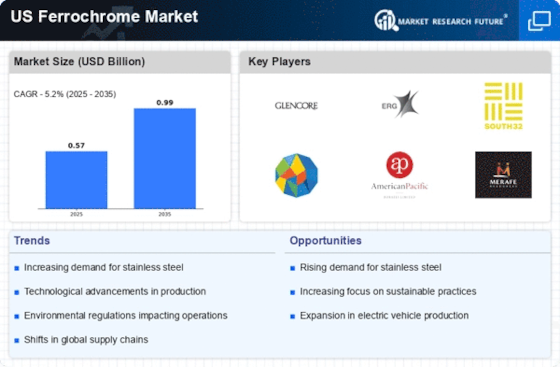
As per Market Research Future analysis, the US Ferrochrome Market Size was estimated at 0.5681 USD Billion in 2024. The Ferrochrome industry is projected to grow from USD 0.5976 Billion in 2025 to USD 0.9924 Billion by 2035, exhibiting a compound annual growth rate (CAGR) of 5.2% during the forecast period 2025 - 2035

Key Market Trends & Highlights

The US Ferrochrome Market is poised for growth driven by rising demand and evolving production practices.

  • The demand for stainless steel continues to rise, bolstering the ferrochrome market in North America.
  • Supply chain reevaluation is influencing procurement strategies, particularly in the Asia-Pacific region.
  • Sustainability initiatives are becoming increasingly critical, shaping production methods and consumer preferences.
  • Rising demand for specialty alloys and infrastructure development initiatives are key drivers propelling market expansion.

Market Size & Forecast

2024 Market Size 0.5681 (USD Billion)
2035 Market Size 0.9924 (USD Billion)
CAGR (2025 - 2035) 5.2%
Largest Regional Market Share in 2024 MEA

Major Players

Glencore (CH), Eurasian Resources Group (KZ), South32 (AU), Ferroglobe (ES), American Pacific Borate and Lithium (US), Merafe Resources (ZA), Tata Steel (IN), Samancor Chrome (ZA)

Market Trends

The US Ferrochrome Market is currently characterized by a complex interplay of factors influencing its dynamics. Demand for ferrochrome, a critical component in stainless steel production, appears to be on an upward trajectory, driven by the growing industrial sector and increasing infrastructure projects. This trend suggests a potential rise in consumption, particularly as manufacturers seek to enhance the quality and durability of their products. Furthermore, the market seems to be experiencing shifts in supply chains, with domestic production facing challenges from international competition. This situation may lead to a reevaluation of sourcing strategies among key players in the industry. In addition, environmental regulations are becoming increasingly stringent, prompting producers to adopt more sustainable practices. This shift could reshape operational methodologies within the US Ferrochrome Market, as companies strive to meet compliance standards while maintaining profitability. The interplay between regulatory pressures and market demands indicates a landscape that is both challenging and ripe for innovation. As stakeholders navigate these complexities, the future of the US Ferrochrome Market may hinge on adaptability and strategic foresight, ensuring resilience in a rapidly evolving environment.

Rising Demand for Stainless Steel

The demand for stainless steel is likely to drive the growth of the US Ferrochrome Market. As industries expand and infrastructure projects increase, the need for high-quality materials becomes paramount. This trend suggests that ferrochrome, being essential for stainless steel production, will see heightened consumption.

Supply Chain Reevaluation

Current market conditions indicate that supply chains are undergoing significant changes. Domestic producers may face challenges from international competitors, prompting a reassessment of sourcing strategies. This reevaluation could lead to shifts in procurement practices among key market players.

Sustainability Initiatives

Environmental regulations are becoming more stringent, compelling producers to adopt sustainable practices. This trend may reshape operational methodologies within the US Ferrochrome Market, as companies strive to balance compliance with profitability while addressing environmental concerns.

US Ferrochrome Market Market Drivers

Rising Demand for Specialty Alloys

The US Ferrochrome Market is experiencing a notable increase in demand for specialty alloys, particularly in the aerospace and automotive sectors. These industries require high-performance materials that can withstand extreme conditions, leading to a surge in ferrochrome consumption. In 2025, the demand for specialty alloys is projected to grow by approximately 5% annually, driven by technological advancements and the need for lightweight materials. This trend suggests that manufacturers are increasingly turning to ferrochrome to enhance the properties of their alloys, thereby bolstering the US Ferrochrome Market. As a result, companies involved in ferrochrome production may find new opportunities for growth and innovation, potentially leading to increased investments in production capabilities.

Increased Focus on Renewable Energy

The US Ferrochrome Market is witnessing a growing emphasis on renewable energy sources, which may drive demand for ferrochrome in the production of energy-efficient technologies. As the transition to renewable energy accelerates, materials that enhance the performance of solar panels, wind turbines, and energy storage systems are becoming increasingly important. Ferrochrome, known for its corrosion resistance and strength, is likely to play a crucial role in these applications. In 2025, the renewable energy sector is projected to expand significantly, potentially leading to a corresponding increase in ferrochrome consumption. This trend suggests that the US Ferrochrome Market could align itself with broader energy goals, fostering growth opportunities.

Regulatory Changes and Trade Policies

The US Ferrochrome Market is currently navigating a complex landscape of regulatory changes and trade policies that could impact market dynamics. Recent shifts in tariffs and trade agreements may influence the cost structure of ferrochrome imports and exports. For instance, any increase in tariffs on imported ferrochrome could lead to higher domestic prices, thereby affecting demand. Conversely, favorable trade agreements may enhance market access for US producers, potentially boosting exports. As the regulatory environment continues to evolve, stakeholders in the US Ferrochrome Market must remain vigilant and adaptable to capitalize on emerging opportunities and mitigate risks associated with changing policies.

Infrastructure Development Initiatives

The US Ferrochrome Market is likely to benefit from ongoing infrastructure development initiatives across the country. With significant investments in transportation, energy, and urban development, the demand for stainless steel and other ferrochrome-containing materials is expected to rise. In 2025, infrastructure spending is anticipated to reach over $1 trillion, which could translate into a substantial increase in ferrochrome consumption. This growth is particularly relevant as stainless steel is a primary material used in construction and infrastructure projects. Consequently, the US Ferrochrome Market may experience heightened activity as manufacturers align their production strategies to meet the increasing demand stemming from these initiatives.

Technological Advancements in Production

Technological advancements in ferrochrome production processes are poised to enhance efficiency and reduce costs within the US Ferrochrome Market. Innovations such as improved smelting techniques and the adoption of automation are likely to streamline operations, potentially increasing output while minimizing environmental impact. In recent years, the industry has seen a shift towards more sustainable practices, which may further attract investment. As production costs decrease, manufacturers could pass on savings to consumers, thereby stimulating demand for ferrochrome in various applications. This trend indicates that the US Ferrochrome Market is evolving, with a focus on both profitability and sustainability.

Market Segment Insights

By Type: High Carbon (Largest) vs. Low Carbon (Fastest-Growing)

<p>Within the US Ferrochrome Market, the distribution of market share among the segment types reveals that High Carbon Ferrochrome holds the largest portion, driven by its extensive application in stainless steel production. On the other hand, Low Carbon Ferrochrome represents a growing segment, appealing to manufacturers seeking lower carbon emissions and better alloy properties. This shift emphasizes the evolving preferences of steel producers towards more environmentally sustainable materials, marking a turning point in the industry dynamics.</p>

<p>Ferrochrome: High Carbon (Dominant) vs. Low Carbon (Emerging)</p>

<p>High Carbon Ferrochrome is the cornerstone of the market, primarily utilized in stainless steel manufacturing due to its suitability in enhancing strength and corrosion resistance. This dominant segment benefits from established relationships with major steel producers who rely on its consistent quality and performance. Conversely, Low Carbon Ferrochrome is emerging rapidly, gaining traction among environmentally conscious manufacturers aiming for greener steel production. Its lower carbon content offers significant advantages in producing high-quality, low-emission alloys, thus meeting the demands of modern regulations and market preferences. As sustainability becomes a priority, the Low Carbon segment is likely to see continued investment and innovation, positioning it as a formidable player in the future.</p>

By Application: Stainless Steel (Largest) vs. Specialty Steel (Fastest-Growing)

<p>In the US Ferrochrome Market, the application of Ferrochrome is primarily dominated by Stainless Steel, which holds the largest share among the segment values. This segment's extensive use in various industries, including automotive, aerospace, and construction, significantly contributes to its market prominence. Specialty Steel also plays a noteworthy role, capturing a growing portion of the market due to its specific applications in high-performance environments.</p>

<p>Stainless Steel (Dominant) vs. Specialty Steel (Emerging)</p>

<p>Stainless Steel serves as the dominant application in the US Ferrochrome Market, leveraging its widespread utilization in everyday products, machinery, and infrastructure due to its corrosion resistance and strength. On the other hand, Specialty Steel is an emerging segment, catering to niche demands in industries requiring unique properties like high strength-to-weight ratios or specific corrosion resilience. The growth of Specialty Steel is driven by innovations and advancements in steel processing methods, leading to increased adoption in sectors such as defense and aerospace, positioning it as an essential area for future developments in the market.</p>

Ferrochrome Country Insights

Over the course of the projection period, the U.S. is expected to grow at a high rate in the ferrochrome market. Stainless steel manufacturing may be negatively impacted by rising pricing due to increased demand from local producers. It is anticipated that this uncertainty would affect the dynamics of the nation's ferrochrome sector. Another element promoting growth is the adoption of favorable policies by a number of countries to boost the production of ferrochrome as a raw material for industrial uses.

Furthermore, the product's extensive use as a catalyst in the chemical industry for the synthesis of methanol, ammonia, and other hydrocarbons is supporting the market's expansion. In addition, the market is expected to increase due to a number of other reasons, such as the fast industrialization, substantial research and development (R&D) activities, and rising investment in infrastructure development projects.

Get more detailed insights about US Ferrochrome Market Research Report - Forecast by 2035

Regional Insights

North America : Market Leader in Ferrochrome

The North American ferrochrome market is primarily driven by the increasing demand from the stainless steel industry, which accounts for a significant portion of ferrochrome consumption. The U.S. holds the largest market share at approximately 60%, followed by Canada at around 25%. Regulatory support for domestic production and environmental compliance initiatives are also key growth catalysts, enhancing the market's stability and attractiveness. Leading players in the North American market include American Pacific Borate and Lithium and Ferroglobe, which are focusing on sustainable practices and technological advancements. The competitive landscape is characterized by a mix of established companies and emerging players, all vying for market share. The presence of these key players, along with favorable government policies, positions North America as a robust market for ferrochrome production and consumption.

Europe : Regulatory Framework and Innovation

Europe's ferrochrome market is significantly influenced by stringent environmental regulations and a strong push towards sustainability. The region is the second-largest market, holding approximately 25% of the global share. Countries like Finland and Sweden are leading in production, driven by their commitment to eco-friendly practices and advanced technologies. The European Union's Green Deal and other regulatory frameworks are pivotal in shaping market dynamics, promoting the use of recycled materials and reducing carbon footprints. Key players such as Glencore and Ferroglobe are actively investing in innovative technologies to enhance production efficiency and sustainability. The competitive landscape is marked by collaborations and partnerships aimed at meeting regulatory standards while ensuring profitability. The focus on sustainable practices not only addresses regulatory requirements but also aligns with consumer preferences, further driving market growth in Europe.

Asia-Pacific : Emerging Markets and Growth Potential

The Asia-Pacific region is witnessing rapid industrialization, significantly boosting the demand for ferrochrome, particularly in countries like China and India. This region holds approximately 15% of the global market share, with China being the largest consumer due to its extensive stainless steel production. The growth is further supported by government initiatives aimed at enhancing infrastructure and manufacturing capabilities, creating a favorable environment for ferrochrome consumption. Competitive dynamics in Asia-Pacific are characterized by a mix of local and international players, including Tata Steel and South32. These companies are focusing on expanding their production capacities and improving operational efficiencies to meet the rising demand. The presence of key players, coupled with favorable government policies, positions the Asia-Pacific region as a significant player in The US Ferrochrome Market, with substantial growth potential in the coming years.

Middle East and Africa : Resource-Rich and Competitive Landscape

The Middle East and Africa region is rich in mineral resources, making it a key player in The US Ferrochrome Market. This region holds approximately 10% of the market share, with South Africa being the dominant producer, accounting for a significant portion of global output. The growth in this region is driven by increasing investments in mining infrastructure and favorable government policies aimed at boosting production and exports. Countries like South Africa and Zimbabwe are home to major players such as Samancor Chrome and Merafe Resources, which are expanding their operations to meet global demand. The competitive landscape is evolving, with a focus on sustainable mining practices and technological advancements. As the region continues to develop its mining capabilities, it is poised to enhance its position in The US Ferrochrome Market, attracting investments and fostering growth.

Key Players and Competitive Insights

Leading market players are investing heavily in research and development in order to expand their product lines, which will help the ferrochrome market, grow even more. Market participants are also undertaking a variety of strategic activities to expand their footprint, with important market developments including new product launches, contractual agreements, mergers and acquisitions, higher investments, and collaboration with other organizations. To expand and survive in a more competitive and rising market climate, ferrochrome industry must offer cost-effective items.
Major players in the ferrochrome market are attempting to increase market demand by investing in research and development operations includes Tata Steel Mining Limited (India), MM Metals USA LLC. (U.S.), Atlantic Equipment Engineers (U.S.), and MBR METALS OÜ (Estonia).

Key Companies in the US Ferrochrome Market include

Industry Developments

May 2022: Ferrochrome Furnaces were purchased by Ironveld. The business will give Ironveld access to its current Rustenburg, South Africa, smelting manufacturing unit as well as the chance to start mining and processing.

November 2019: The creation of Samancor's "Zero Waste" FeCr slag recycling operation at the Ferro Metals factory in Emalahleni, Samancor Chrome, was announced by EESTech. Approximately 650,000 tons of FeCr slag may be processed annually by the FeCr slag recycling plant.

Future Outlook

US Ferrochrome Market Future Outlook

The US Ferrochrome Market is projected to grow at a 5.2% CAGR from 2025 to 2035, driven by increasing stainless steel demand and technological advancements.

New opportunities lie in:

  • Expansion into renewable energy sector applications
  • Development of high-purity ferrochrome for specialized alloys
  • Investment in automated production technologies for efficiency

By 2035, the market is expected to solidify its position as a key player in the global ferrochrome landscape.

Market Segmentation

US Ferrochrome Market Type Outlook

  • High Carbon
  • Low Carbon
  • Others

US Ferrochrome Market Application Outlook

  • Stainless Steel
  • Specialty Steel
  • Others

Report Scope

MARKET SIZE 2024 0.5681(USD Billion)
MARKET SIZE 2025 0.5976(USD Billion)
MARKET SIZE 2035 0.9924(USD Billion)
COMPOUND ANNUAL GROWTH RATE (CAGR) 5.2% (2025 - 2035)
REPORT COVERAGE Revenue Forecast, Competitive Landscape, Growth Factors, and Trends
BASE YEAR 2024
Market Forecast Period 2025 - 2035
Historical Data 2019 - 2024
Market Forecast Units USD Billion
Key Companies Profiled Glencore (CH), Eurasian Resources Group (KZ), South32 (AU), Ferroglobe (ES), American Pacific Borate and Lithium (US), Merafe Resources (ZA), Tata Steel (IN), Samancor Chrome (ZA)
Segments Covered Type, Application
Key Market Opportunities Increasing demand for stainless steel drives growth in the US Ferrochrome Market.
Key Market Dynamics Rising demand for stainless steel drives competition and innovation in the US Ferrochrome Market.
Countries Covered North America, Europe, APAC, South America, MEA

FAQs

What is the current valuation of the US Ferrochrome Market as of 2024?

<p>The US Ferrochrome Market was valued at 0.5681 USD Billion in 2024.</p>

What is the projected market valuation for the US Ferrochrome Market in 2035?

<p>The projected valuation for the US Ferrochrome Market in 2035 is 0.9924 USD Billion.</p>

What is the expected CAGR for the US Ferrochrome Market during the forecast period 2025 - 2035?

<p>The expected CAGR for the US Ferrochrome Market during the forecast period 2025 - 2035 is 5.2%.</p>

Which companies are considered key players in the US Ferrochrome Market?

<p>Key players in the US Ferrochrome Market include Glencore, Eurasian Resources Group, South32, Ferroglobe, American Pacific Borate and Lithium, Merafe Resources, Tata Steel, and Samancor Chrome.</p>

What are the main segments of the US Ferrochrome Market by type?

<p>The main segments by type in the US Ferrochrome Market are High Carbon, Low Carbon, and Others.</p>

What were the valuations for High Carbon and Low Carbon segments in 2024?

In 2024, the High Carbon segment was valued at 0.34 USD Billion, while the Low Carbon segment was valued at 0.15 USD Billion.

How does the application of stainless steel impact the US Ferrochrome Market?

The stainless steel application segment was valued at 0.34 USD Billion in 2024, indicating its significant role in the US Ferrochrome Market.

What is the projected growth for the Low Carbon segment from 2024 to 2035?

The Low Carbon segment is projected to grow from 0.15 USD Billion in 2024 to 0.30 USD Billion by 2035.

What is the valuation of the Others segment in the US Ferrochrome Market?

The Others segment was valued at 0.0781 USD Billion in 2024 and is expected to reach 0.1724 USD Billion by 2035.

How does the US Ferrochrome Market's growth compare to other segments?

The US Ferrochrome Market's growth appears robust, particularly in the High Carbon and stainless steel segments, which are projected to see substantial increases by 2035.

  1. SECTION I: EXECUTIVE SUMMARY AND KEY HIGHLIGHTS
    1. | 1.1 EXECUTIVE SUMMARY
    2. | | 1.1.1 Market Overview
    3. | | 1.1.2 Key Findings
    4. | | 1.1.3 Market Segmentation
    5. | | 1.1.4 Competitive Landscape
    6. | | 1.1.5 Challenges and Opportunities
    7. | | 1.1.6 Future Outlook
  2. SECTION II: SCOPING, METHODOLOGY AND MARKET STRUCTURE
    1. | 2.1 MARKET INTRODUCTION
    2. | | 2.1.1 Definition
    3. | | 2.1.2 Scope of the study
    4. | | | 2.1.2.1 Research Objective
    5. | | | 2.1.2.2 Assumption
    6. | | | 2.1.2.3 Limitations
    7. | 2.2 RESEARCH METHODOLOGY
    8. | | 2.2.1 Overview
    9. | | 2.2.2 Data Mining
    10. | | 2.2.3 Secondary Research
    11. | | 2.2.4 Primary Research
    12. | | | 2.2.4.1 Primary Interviews and Information Gathering Process
    13. | | | 2.2.4.2 Breakdown of Primary Respondents
    14. | | 2.2.5 Forecasting Model
    15. | | 2.2.6 Market Size Estimation
    16. | | | 2.2.6.1 Bottom-Up Approach
    17. | | | 2.2.6.2 Top-Down Approach
    18. | | 2.2.7 Data Triangulation
    19. | | 2.2.8 Validation
  3. SECTION III: QUALITATIVE ANALYSIS
    1. | 3.1 MARKET DYNAMICS
    2. | | 3.1.1 Overview
    3. | | 3.1.2 Drivers
    4. | | 3.1.3 Restraints
    5. | | 3.1.4 Opportunities
    6. | 3.2 MARKET FACTOR ANALYSIS
    7. | | 3.2.1 Value chain Analysis
    8. | | 3.2.2 Porter's Five Forces Analysis
    9. | | | 3.2.2.1 Bargaining Power of Suppliers
    10. | | | 3.2.2.2 Bargaining Power of Buyers
    11. | | | 3.2.2.3 Threat of New Entrants
    12. | | | 3.2.2.4 Threat of Substitutes
    13. | | | 3.2.2.5 Intensity of Rivalry
    14. | | 3.2.3 COVID-19 Impact Analysis
    15. | | | 3.2.3.1 Market Impact Analysis
    16. | | | 3.2.3.2 Regional Impact
    17. | | | 3.2.3.3 Opportunity and Threat Analysis
  4. SECTION IV: QUANTITATIVE ANALYSIS
    1. | 4.1 Chemicals and Materials, BY Type (USD Billion)
    2. | | 4.1.1 High Carbon
    3. | | 4.1.2 Low Carbon
    4. | | 4.1.3 Others
    5. | 4.2 Chemicals and Materials, BY Application (USD Billion)
    6. | | 4.2.1 Stainless Steel
    7. | | 4.2.2 Specialty Steel
    8. | | 4.2.3 Others
    9. | 4.3 Chemicals and Materials, BY Region (USD Billion)
    10. | | 4.3.1 North America
    11. | | | 4.3.1.1 US
    12. | | | 4.3.1.2 Canada
    13. | | 4.3.2 Europe
    14. | | | 4.3.2.1 Germany
    15. | | | 4.3.2.2 UK
    16. | | | 4.3.2.3 France
    17. | | | 4.3.2.4 Russia
    18. | | | 4.3.2.5 Italy
    19. | | | 4.3.2.6 Spain
    20. | | | 4.3.2.7 Rest of Europe
    21. | | 4.3.3 APAC
    22. | | | 4.3.3.1 China
    23. | | | 4.3.3.2 India
    24. | | | 4.3.3.3 Japan
    25. | | | 4.3.3.4 South Korea
    26. | | | 4.3.3.5 Malaysia
    27. | | | 4.3.3.6 Thailand
    28. | | | 4.3.3.7 Indonesia
    29. | | | 4.3.3.8 Rest of APAC
    30. | | 4.3.4 South America
    31. | | | 4.3.4.1 Brazil
    32. | | | 4.3.4.2 Mexico
    33. | | | 4.3.4.3 Argentina
    34. | | | 4.3.4.4 Rest of South America
    35. | | 4.3.5 MEA
    36. | | | 4.3.5.1 GCC Countries
    37. | | | 4.3.5.2 South Africa
    38. | | | 4.3.5.3 Rest of MEA
  5. SECTION V: COMPETITIVE ANALYSIS
    1. | 5.1 Competitive Landscape
    2. | | 5.1.1 Overview
    3. | | 5.1.2 Competitive Analysis
    4. | | 5.1.3 Market share Analysis
    5. | | 5.1.4 Major Growth Strategy in the Chemicals and Materials
    6. | | 5.1.5 Competitive Benchmarking
    7. | | 5.1.6 Leading Players in Terms of Number of Developments in the Chemicals and Materials
    8. | | 5.1.7 Key developments and growth strategies
    9. | | | 5.1.7.1 New Product Launch/Service Deployment
    10. | | | 5.1.7.2 Merger & Acquisitions
    11. | | | 5.1.7.3 Joint Ventures
    12. | | 5.1.8 Major Players Financial Matrix
    13. | | | 5.1.8.1 Sales and Operating Income
    14. | | | 5.1.8.2 Major Players R&D Expenditure. 2023
    15. | 5.2 Company Profiles
    16. | | 5.2.1 Glencore (CH)
    17. | | | 5.2.1.1 Financial Overview
    18. | | | 5.2.1.2 Products Offered
    19. | | | 5.2.1.3 Key Developments
    20. | | | 5.2.1.4 SWOT Analysis
    21. | | | 5.2.1.5 Key Strategies
    22. | | 5.2.2 Eurasian Resources Group (KZ)
    23. | | | 5.2.2.1 Financial Overview
    24. | | | 5.2.2.2 Products Offered
    25. | | | 5.2.2.3 Key Developments
    26. | | | 5.2.2.4 SWOT Analysis
    27. | | | 5.2.2.5 Key Strategies
    28. | | 5.2.3 South32 (AU)
    29. | | | 5.2.3.1 Financial Overview
    30. | | | 5.2.3.2 Products Offered
    31. | | | 5.2.3.3 Key Developments
    32. | | | 5.2.3.4 SWOT Analysis
    33. | | | 5.2.3.5 Key Strategies
    34. | | 5.2.4 Ferroglobe (ES)
    35. | | | 5.2.4.1 Financial Overview
    36. | | | 5.2.4.2 Products Offered
    37. | | | 5.2.4.3 Key Developments
    38. | | | 5.2.4.4 SWOT Analysis
    39. | | | 5.2.4.5 Key Strategies
    40. | | 5.2.5 American Pacific Borate and Lithium (US)
    41. | | | 5.2.5.1 Financial Overview
    42. | | | 5.2.5.2 Products Offered
    43. | | | 5.2.5.3 Key Developments
    44. | | | 5.2.5.4 SWOT Analysis
    45. | | | 5.2.5.5 Key Strategies
    46. | | 5.2.6 Merafe Resources (ZA)
    47. | | | 5.2.6.1 Financial Overview
    48. | | | 5.2.6.2 Products Offered
    49. | | | 5.2.6.3 Key Developments
    50. | | | 5.2.6.4 SWOT Analysis
    51. | | | 5.2.6.5 Key Strategies
    52. | | 5.2.7 Tata Steel (IN)
    53. | | | 5.2.7.1 Financial Overview
    54. | | | 5.2.7.2 Products Offered
    55. | | | 5.2.7.3 Key Developments
    56. | | | 5.2.7.4 SWOT Analysis
    57. | | | 5.2.7.5 Key Strategies
    58. | | 5.2.8 Samancor Chrome (ZA)
    59. | | | 5.2.8.1 Financial Overview
    60. | | | 5.2.8.2 Products Offered
    61. | | | 5.2.8.3 Key Developments
    62. | | | 5.2.8.4 SWOT Analysis
    63. | | | 5.2.8.5 Key Strategies
    64. | 5.3 Appendix
    65. | | 5.3.1 References
    66. | | 5.3.2 Related Reports
  6. LIST OF FIGURES
    1. | 6.1 MARKET SYNOPSIS
    2. | 6.2 NORTH AMERICA MARKET ANALYSIS
    3. | 6.3 US MARKET ANALYSIS BY TYPE
    4. | 6.4 US MARKET ANALYSIS BY APPLICATION
    5. | 6.5 CANADA MARKET ANALYSIS BY TYPE
    6. | 6.6 CANADA MARKET ANALYSIS BY APPLICATION
    7. | 6.7 EUROPE MARKET ANALYSIS
    8. | 6.8 GERMANY MARKET ANALYSIS BY TYPE
    9. | 6.9 GERMANY MARKET ANALYSIS BY APPLICATION
    10. | 6.10 UK MARKET ANALYSIS BY TYPE
    11. | 6.11 UK MARKET ANALYSIS BY APPLICATION
    12. | 6.12 FRANCE MARKET ANALYSIS BY TYPE
    13. | 6.13 FRANCE MARKET ANALYSIS BY APPLICATION
    14. | 6.14 RUSSIA MARKET ANALYSIS BY TYPE
    15. | 6.15 RUSSIA MARKET ANALYSIS BY APPLICATION
    16. | 6.16 ITALY MARKET ANALYSIS BY TYPE
    17. | 6.17 ITALY MARKET ANALYSIS BY APPLICATION
    18. | 6.18 SPAIN MARKET ANALYSIS BY TYPE
    19. | 6.19 SPAIN MARKET ANALYSIS BY APPLICATION
    20. | 6.20 REST OF EUROPE MARKET ANALYSIS BY TYPE
    21. | 6.21 REST OF EUROPE MARKET ANALYSIS BY APPLICATION
    22. | 6.22 APAC MARKET ANALYSIS
    23. | 6.23 CHINA MARKET ANALYSIS BY TYPE
    24. | 6.24 CHINA MARKET ANALYSIS BY APPLICATION
    25. | 6.25 INDIA MARKET ANALYSIS BY TYPE
    26. | 6.26 INDIA MARKET ANALYSIS BY APPLICATION
    27. | 6.27 JAPAN MARKET ANALYSIS BY TYPE
    28. | 6.28 JAPAN MARKET ANALYSIS BY APPLICATION
    29. | 6.29 SOUTH KOREA MARKET ANALYSIS BY TYPE
    30. | 6.30 SOUTH KOREA MARKET ANALYSIS BY APPLICATION
    31. | 6.31 MALAYSIA MARKET ANALYSIS BY TYPE
    32. | 6.32 MALAYSIA MARKET ANALYSIS BY APPLICATION
    33. | 6.33 THAILAND MARKET ANALYSIS BY TYPE
    34. | 6.34 THAILAND MARKET ANALYSIS BY APPLICATION
    35. | 6.35 INDONESIA MARKET ANALYSIS BY TYPE
    36. | 6.36 INDONESIA MARKET ANALYSIS BY APPLICATION
    37. | 6.37 REST OF APAC MARKET ANALYSIS BY TYPE
    38. | 6.38 REST OF APAC MARKET ANALYSIS BY APPLICATION
    39. | 6.39 SOUTH AMERICA MARKET ANALYSIS
    40. | 6.40 BRAZIL MARKET ANALYSIS BY TYPE
    41. | 6.41 BRAZIL MARKET ANALYSIS BY APPLICATION
    42. | 6.42 MEXICO MARKET ANALYSIS BY TYPE
    43. | 6.43 MEXICO MARKET ANALYSIS BY APPLICATION
    44. | 6.44 ARGENTINA MARKET ANALYSIS BY TYPE
    45. | 6.45 ARGENTINA MARKET ANALYSIS BY APPLICATION
    46. | 6.46 REST OF SOUTH AMERICA MARKET ANALYSIS BY TYPE
    47. | 6.47 REST OF SOUTH AMERICA MARKET ANALYSIS BY APPLICATION
    48. | 6.48 MEA MARKET ANALYSIS
    49. | 6.49 GCC COUNTRIES MARKET ANALYSIS BY TYPE
    50. | 6.50 GCC COUNTRIES MARKET ANALYSIS BY APPLICATION
    51. | 6.51 SOUTH AFRICA MARKET ANALYSIS BY TYPE
    52. | 6.52 SOUTH AFRICA MARKET ANALYSIS BY APPLICATION
    53. | 6.53 REST OF MEA MARKET ANALYSIS BY TYPE
    54. | 6.54 REST OF MEA MARKET ANALYSIS BY APPLICATION
    55. | 6.55 KEY BUYING CRITERIA OF CHEMICALS AND MATERIALS
    56. | 6.56 RESEARCH PROCESS OF MRFR
    57. | 6.57 DRO ANALYSIS OF CHEMICALS AND MATERIALS
    58. | 6.58 DRIVERS IMPACT ANALYSIS: CHEMICALS AND MATERIALS
    59. | 6.59 RESTRAINTS IMPACT ANALYSIS: CHEMICALS AND MATERIALS
    60. | 6.60 SUPPLY / VALUE CHAIN: CHEMICALS AND MATERIALS
    61. | 6.61 CHEMICALS AND MATERIALS, BY TYPE, 2024 (% SHARE)
    62. | 6.62 CHEMICALS AND MATERIALS, BY TYPE, 2024 TO 2035 (USD Billion)
    63. | 6.63 CHEMICALS AND MATERIALS, BY APPLICATION, 2024 (% SHARE)
    64. | 6.64 CHEMICALS AND MATERIALS, BY APPLICATION, 2024 TO 2035 (USD Billion)
    65. | 6.65 BENCHMARKING OF MAJOR COMPETITORS
  7. LIST OF TABLES
    1. | 7.1 LIST OF ASSUMPTIONS
    2. | | 7.1.1
    3. | 7.2 North America MARKET SIZE ESTIMATES; FORECAST
    4. | | 7.2.1 BY TYPE, 2025-2035 (USD Billion)
    5. | | 7.2.2 BY APPLICATION, 2025-2035 (USD Billion)
    6. | 7.3 US MARKET SIZE ESTIMATES; FORECAST
    7. | | 7.3.1 BY TYPE, 2025-2035 (USD Billion)
    8. | | 7.3.2 BY APPLICATION, 2025-2035 (USD Billion)
    9. | 7.4 Canada MARKET SIZE ESTIMATES; FORECAST
    10. | | 7.4.1 BY TYPE, 2025-2035 (USD Billion)
    11. | | 7.4.2 BY APPLICATION, 2025-2035 (USD Billion)
    12. | 7.5 Europe MARKET SIZE ESTIMATES; FORECAST
    13. | | 7.5.1 BY TYPE, 2025-2035 (USD Billion)
    14. | | 7.5.2 BY APPLICATION, 2025-2035 (USD Billion)
    15. | 7.6 Germany MARKET SIZE ESTIMATES; FORECAST
    16. | | 7.6.1 BY TYPE, 2025-2035 (USD Billion)
    17. | | 7.6.2 BY APPLICATION, 2025-2035 (USD Billion)
    18. | 7.7 UK MARKET SIZE ESTIMATES; FORECAST
    19. | | 7.7.1 BY TYPE, 2025-2035 (USD Billion)
    20. | | 7.7.2 BY APPLICATION, 2025-2035 (USD Billion)
    21. | 7.8 France MARKET SIZE ESTIMATES; FORECAST
    22. | | 7.8.1 BY TYPE, 2025-2035 (USD Billion)
    23. | | 7.8.2 BY APPLICATION, 2025-2035 (USD Billion)
    24. | 7.9 Russia MARKET SIZE ESTIMATES; FORECAST
    25. | | 7.9.1 BY TYPE, 2025-2035 (USD Billion)
    26. | | 7.9.2 BY APPLICATION, 2025-2035 (USD Billion)
    27. | 7.10 Italy MARKET SIZE ESTIMATES; FORECAST
    28. | | 7.10.1 BY TYPE, 2025-2035 (USD Billion)
    29. | | 7.10.2 BY APPLICATION, 2025-2035 (USD Billion)
    30. | 7.11 Spain MARKET SIZE ESTIMATES; FORECAST
    31. | | 7.11.1 BY TYPE, 2025-2035 (USD Billion)
    32. | | 7.11.2 BY APPLICATION, 2025-2035 (USD Billion)
    33. | 7.12 Rest of Europe MARKET SIZE ESTIMATES; FORECAST
    34. | | 7.12.1 BY TYPE, 2025-2035 (USD Billion)
    35. | | 7.12.2 BY APPLICATION, 2025-2035 (USD Billion)
    36. | 7.13 APAC MARKET SIZE ESTIMATES; FORECAST
    37. | | 7.13.1 BY TYPE, 2025-2035 (USD Billion)
    38. | | 7.13.2 BY APPLICATION, 2025-2035 (USD Billion)
    39. | 7.14 China MARKET SIZE ESTIMATES; FORECAST
    40. | | 7.14.1 BY TYPE, 2025-2035 (USD Billion)
    41. | | 7.14.2 BY APPLICATION, 2025-2035 (USD Billion)
    42. | 7.15 India MARKET SIZE ESTIMATES; FORECAST
    43. | | 7.15.1 BY TYPE, 2025-2035 (USD Billion)
    44. | | 7.15.2 BY APPLICATION, 2025-2035 (USD Billion)
    45. | 7.16 Japan MARKET SIZE ESTIMATES; FORECAST
    46. | | 7.16.1 BY TYPE, 2025-2035 (USD Billion)
    47. | | 7.16.2 BY APPLICATION, 2025-2035 (USD Billion)
    48. | 7.17 South Korea MARKET SIZE ESTIMATES; FORECAST
    49. | | 7.17.1 BY TYPE, 2025-2035 (USD Billion)
    50. | | 7.17.2 BY APPLICATION, 2025-2035 (USD Billion)
    51. | 7.18 Malaysia MARKET SIZE ESTIMATES; FORECAST
    52. | | 7.18.1 BY TYPE, 2025-2035 (USD Billion)
    53. | | 7.18.2 BY APPLICATION, 2025-2035 (USD Billion)
    54. | 7.19 Thailand MARKET SIZE ESTIMATES; FORECAST
    55. | | 7.19.1 BY TYPE, 2025-2035 (USD Billion)
    56. | | 7.19.2 BY APPLICATION, 2025-2035 (USD Billion)
    57. | 7.20 Indonesia MARKET SIZE ESTIMATES; FORECAST
    58. | | 7.20.1 BY TYPE, 2025-2035 (USD Billion)
    59. | | 7.20.2 BY APPLICATION, 2025-2035 (USD Billion)
    60. | 7.21 Rest of APAC MARKET SIZE ESTIMATES; FORECAST
    61. | | 7.21.1 BY TYPE, 2025-2035 (USD Billion)
    62. | | 7.21.2 BY APPLICATION, 2025-2035 (USD Billion)
    63. | 7.22 South America MARKET SIZE ESTIMATES; FORECAST
    64. | | 7.22.1 BY TYPE, 2025-2035 (USD Billion)
    65. | | 7.22.2 BY APPLICATION, 2025-2035 (USD Billion)
    66. | 7.23 Brazil MARKET SIZE ESTIMATES; FORECAST
    67. | | 7.23.1 BY TYPE, 2025-2035 (USD Billion)
    68. | | 7.23.2 BY APPLICATION, 2025-2035 (USD Billion)
    69. | 7.24 Mexico MARKET SIZE ESTIMATES; FORECAST
    70. | | 7.24.1 BY TYPE, 2025-2035 (USD Billion)
    71. | | 7.24.2 BY APPLICATION, 2025-2035 (USD Billion)
    72. | 7.25 Argentina MARKET SIZE ESTIMATES; FORECAST
    73. | | 7.25.1 BY TYPE, 2025-2035 (USD Billion)
    74. | | 7.25.2 BY APPLICATION, 2025-2035 (USD Billion)
    75. | 7.26 Rest of South America MARKET SIZE ESTIMATES; FORECAST
    76. | | 7.26.1 BY TYPE, 2025-2035 (USD Billion)
    77. | | 7.26.2 BY APPLICATION, 2025-2035 (USD Billion)
    78. | 7.27 MEA MARKET SIZE ESTIMATES; FORECAST
    79. | | 7.27.1 BY TYPE, 2025-2035 (USD Billion)
    80. | | 7.27.2 BY APPLICATION, 2025-2035 (USD Billion)
    81. | 7.28 GCC Countries MARKET SIZE ESTIMATES; FORECAST
    82. | | 7.28.1 BY TYPE, 2025-2035 (USD Billion)
    83. | | 7.28.2 BY APPLICATION, 2025-2035 (USD Billion)
    84. | 7.29 South Africa MARKET SIZE ESTIMATES; FORECAST
    85. | | 7.29.1 BY TYPE, 2025-2035 (USD Billion)
    86. | | 7.29.2 BY APPLICATION, 2025-2035 (USD Billion)
    87. | 7.30 Rest of MEA MARKET SIZE ESTIMATES; FORECAST
    88. | | 7.30.1 BY TYPE, 2025-2035 (USD Billion)
    89. | | 7.30.2 BY APPLICATION, 2025-2035 (USD Billion)
    90. | 7.31 PRODUCT LAUNCH/PRODUCT DEVELOPMENT/APPROVAL
    91. | | 7.31.1
    92. | 7.32 ACQUISITION/PARTNERSHIP
    93. | | 7.32.1

Chemicals and Materials Market Segmentation

Chemicals and Materials By Type (USD Billion, 2025-2035)

  • High Carbon
  • Low Carbon
  • Others

Chemicals and Materials By Application (USD Billion, 2025-2035)

  • Stainless Steel
  • Specialty Steel
  • Others
Infographic

Free Sample Request

Kindly complete the form below to receive a free sample of this Report

Get Free Sample

Customer Strories

Compare Licence

×
Features License Type
Single User Multiuser License Enterprise User
Price $4,950 $5,950 $7,250
Maximum User Access Limit 1 User Upto 10 Users Unrestricted Access Throughout the Organization
Free Customization
Direct Access to Analyst
Deliverable Format
Platform Access
Discount on Next Purchase 10% 15% 15%
Printable Versions