×
Request Free Sample ×

Kindly complete the form below to receive a free sample of this Report

* Please use a valid business email

Leading companies partner with us for data-driven Insights

clients tt-cursor
Hero Background

US Direct Carrier Billing (DCB) Market

ID: MRFR/ICT/44551-HCR
200 Pages
MRFR Team
February 2026

US Direct Carrier Billing (DCB) Market Size, Share and Trends Analysis Report By Type (Limited DCB, Pure DCB, MSISDN Forwarding, Others), By Platform (Android, iOS, Others), By End User (Games and Apps, Video Content and movies, Music, Others) andBy Authentication type (Single Factor Authentication, Two Factor Authentication)- Forecast to 2035

Share:
Download PDF ×

We do not share your information with anyone. However, we may send you emails based on your report interest from time to time. You may contact us at any time to opt-out.

US Direct Carrier Billing (DCB) Market Infographic
Purchase Options

US Direct Carrier Billing (DCB) Market Summary

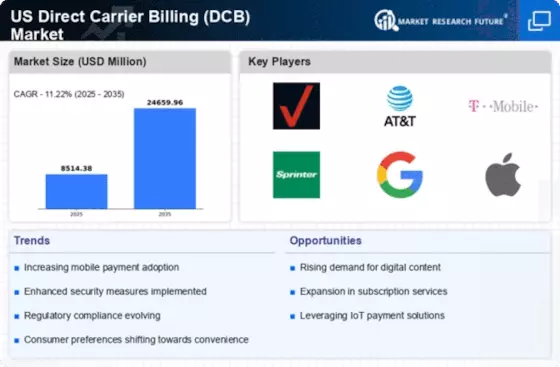
As per MRFR analysis, the US Direct Carrier Billing DCB Market Size was estimated at 7655.44 USD Million in 2024. The US Direct Carrier Billing DCB industry is projected to grow from 8514.4 USD Million in 2025 to 24659.96 USD Million by 2035, exhibiting a compound annual growth rate (CAGR) of 11.22 during the forecast period 2025 - 2035.

Key Market Trends & Highlights

The US direct carrier billing market is experiencing robust growth driven by technological advancements and evolving consumer preferences.

  • Consumer adoption of direct carrier billing is on the rise, particularly among younger demographics who favor seamless payment solutions.
  • Regulatory developments are shaping the landscape, ensuring compliance and fostering trust in direct carrier billing systems.
  • Technological innovations are enhancing the efficiency and security of payment processes, making them more appealing to users.
  • Increased smartphone penetration and evolving consumer payment preferences are key drivers propelling the market forward.

Market Size & Forecast

2024 Market Size 7655.44 (USD Million)
2035 Market Size 24659.96 (USD Million)
CAGR (2025 - 2035) 11.22%

Major Players

Verizon (US), AT&T (US), T-Mobile (US), Sprint (US), Google (US), Apple (US), PayPal (US), Boku (US), Fortumo (US)

Our Impact
Enabled $4.3B Revenue Impact for Fortune 500 and Leading Multinationals
Partnering with 2000+ Global Organizations Each Year
30K+ Citations by Top-Tier Firms in the Industry

US Direct Carrier Billing (DCB) Market Trends

The us direct carrier billing dcb market is currently experiencing a notable evolution, driven by the increasing adoption of mobile payment solutions. This method allows consumers to make purchases directly through their mobile phone bills, thereby simplifying the payment process for digital goods and services. As mobile device usage continues to rise, the convenience offered by direct carrier billing is becoming more appealing to consumers. Furthermore, the integration of this payment method into various platforms, including app stores and online services, appears to enhance its visibility and accessibility. This trend suggests a growing acceptance among consumers who prefer seamless payment experiences without the need for credit cards or bank accounts. In addition, regulatory developments are shaping the landscape of the us direct carrier billing dcb market. Authorities are focusing on consumer protection and transparency, which may lead to more robust frameworks governing how transactions are processed. This regulatory scrutiny could foster trust among users, potentially increasing the adoption of direct carrier billing as a preferred payment method. As the market continues to mature, it seems likely that innovations in technology and payment security will further bolster the appeal of this payment solution, making it a key player in the evolving digital economy.

Increased Consumer Adoption

The us direct carrier billing dcb market is witnessing a rise in consumer adoption, as more individuals seek convenient payment methods for digital content. This trend is likely fueled by the growing reliance on mobile devices for everyday transactions, making direct carrier billing an attractive option for users.

Regulatory Developments

Regulatory changes are influencing the us direct carrier billing dcb market, with a focus on enhancing consumer protection and ensuring transparency in transactions. These developments may lead to increased trust among consumers, potentially driving further adoption of this payment method.

Technological Innovations

Technological advancements are playing a crucial role in the evolution of the us direct carrier billing dcb market. Innovations in payment security and user experience are likely to enhance the appeal of direct carrier billing, positioning it as a competitive option in the digital payment landscape.

US Direct Carrier Billing (DCB) Market Drivers

Increased Smartphone Penetration

The proliferation of smartphones in the United States has been a pivotal driver for the US direct carrier billing DCB market. As of early 2026, approximately 85% of the US population owns a smartphone, facilitating seamless access to digital content and services. This widespread adoption enables consumers to utilize carrier billing as a convenient payment method for apps, games, and subscriptions. The ease of use associated with DCB, particularly for younger demographics who may lack traditional banking options, further propels its growth. Moreover, the integration of DCB into popular platforms such as Google Play and app stores enhances its visibility and accessibility, suggesting a robust trajectory for the US direct carrier billing DCB market in the coming years.

Regulatory Support and Compliance

The regulatory landscape surrounding mobile payments and digital transactions in the United States plays a crucial role in shaping the US direct carrier billing DCB market. Recent legislative efforts have aimed to streamline the compliance process for DCB providers, thereby fostering a more conducive environment for growth. For instance, the Federal Communications Commission (FCC) has implemented guidelines that promote transparency and consumer protection in mobile billing practices. Such regulations not only enhance consumer trust but also encourage service providers to innovate and expand their offerings. As regulatory frameworks continue to evolve, the US direct carrier billing DCB market is likely to experience increased stability and growth opportunities, attracting new entrants and investments.

Partnerships with Content Providers

Strategic partnerships between mobile carriers and content providers are emerging as a significant driver for the US direct carrier billing DCB market. Collaborations with gaming companies, streaming services, and app developers enable carriers to offer bundled services that include DCB as a payment option. This synergy not only enhances the value proposition for consumers but also drives revenue for both parties involved. For example, partnerships with popular gaming platforms have led to increased DCB transactions, as users can easily purchase in-game items without the need for credit cards. Such alliances are likely to proliferate, further solidifying the position of DCB in the US direct carrier billing DCB market and expanding its reach across various consumer segments.

Evolving Consumer Payment Preferences

Consumer preferences in the United States are shifting towards more convenient and secure payment methods, which significantly influences the US direct carrier billing DCB market. Recent surveys indicate that nearly 60% of consumers prefer mobile payments over traditional credit card transactions, primarily due to the perceived security and ease of use. This trend is particularly pronounced among millennials and Gen Z, who are more inclined to utilize mobile wallets and carrier billing options. As digital content consumption continues to rise, the demand for frictionless payment solutions is likely to increase, positioning DCB as a favorable option. The US direct carrier billing DCB market appears well-positioned to capitalize on these evolving preferences, potentially leading to increased adoption rates and revenue growth.

Technological Advancements in Payment Systems

Technological innovations are reshaping the landscape of the US direct carrier billing DCB market, enhancing the efficiency and security of mobile payment systems. The integration of advanced encryption technologies and biometric authentication methods is making DCB transactions more secure, thereby increasing consumer confidence. Additionally, the rise of 5G technology is expected to facilitate faster transaction processing and improve the overall user experience. As mobile networks evolve, the potential for DCB to support a wider array of digital services, including virtual reality and augmented reality applications, becomes increasingly feasible. This technological evolution suggests that the US direct carrier billing DCB market is on the cusp of significant transformation, with the potential to attract a broader audience and drive higher transaction volumes.


Market Segment Insights

By Application: In-App Purchases (Largest) vs. Mobile Payments (Fastest-Growing)

In the US direct carrier billing market, the application segment is led by In-App Purchases, which commands a significant portion of the market share. This is largely due to the increasing digital content consumption and mobile gaming trends, where users prefer seamless payment solutions through their mobile devices. Following closely are Subscription Services, which are continuously gaining traction as consumers opt for subscription models across various platforms, including entertainment and software services. Digital Content Purchases holds a notable position as well, particularly in areas like app downloads and media content, though it has seen slower growth compared to the others.

In-App Purchases (Dominant) vs. Mobile Payments (Emerging)

In-App Purchases dominate the US direct carrier billing market, driven by the proliferation of mobile apps and the gaming industry's growth. Consumers increasingly prefer integrated payment solutions that allow them to enhance their app experiences without redirecting to external payment methods. On the other hand, Mobile Payments are gaining ground as an emerging segment fueled by the adoption of contactless payment systems and the convenience of mobile wallets. As more consumers embrace digital payment options beyond traditional credit cards, the speed of mobile payments is likely to capture market attention, indicating a significant shift in consumer behavior toward seamless transaction experiences.

By End User: Consumers (Largest) vs. Businesses (Fastest-Growing)

In the US Direct Carrier Billing (DCB) market, the 'Consumers' segment represents the largest share, driven by the increasing acceptance of mobile payments for digital goods and services. Consumers account for a substantial portion of transactions, utilizing DCB for ease of purchasing applications, gaming, and subscription services. The convenience of charging purchases directly to mobile accounts makes this segment a cornerstone of the DCB market. On the other hand, the 'Businesses' segment is recognized as the fastest-growing in the DCB landscape. As more businesses adopt mobile payment solutions to enhance customer engagement and streamline billing processes, their reliance on DCB services has surged. This segment's growth is propelled by a shift towards digitalization within various industries and an increasing demand for seamless payment experiences for both companies and their clients.

Consumers (Dominant) vs. Developers (Emerging)

The 'Consumers' segment is dominant in the US Direct Carrier Billing market, leveraging the widespread smartphone adoption and the increasing trend of digital content consumption. This group incorporates a diverse user base, from casual users to tech-savvy individuals who frequently utilize DCB for online transactions. Their preference for mobile payments highlights the significance of convenience and accessibility. Conversely, the 'Developers' segment, though emerging, is gaining traction as more app creators integrate DCB solutions to facilitate user transactions. By bridging the gap between digital services and consumers, developers are increasingly recognizing the value of DCB as a tool for monetizing applications, promoting a seamless user experience.

By Payment Method: Mobile Network Operators (Largest) vs. Third-Party Payment Processors (Fastest-Growing)

The US Direct Carrier Billing (DCB) market is significantly influenced by various payment methods, with Mobile Network Operators (MNOs) commanding the largest share. This segment leverages existing relationships with consumers and offers seamless integration with mobile billing. In contrast, Third-Party Payment Processors are emerging as the fastest-growing segment within the DCB market, driven by their innovative payment solutions and flexibility, appealing particularly to millennial and Gen Z users who demand diverse payment options. The growth trends are largely propelled by increasing smartphone penetration and the rising preference for digital payment solutions. MNOs are focusing on enhancing user experience and expanding their service offerings, while Third-Party Payment Processors are benefitting from the shift towards online platforms and e-commerce growth, offering frictionless payment experiences that cater to younger demographics. These trends reflect the dynamic landscape of the DCB market, where convenience and user experience are key drivers behind the successful adoption of payment methods.

Mobile Network Operators (Dominant) vs. Direct Carrier Billing Services (Emerging)

Mobile Network Operators (MNOs) have established themselves as the dominant players in the US Direct Carrier Billing market, benefiting from their extensive customer bases and robust infrastructure. They offer direct billing services which provide users with simple, secure transactions that are billed directly to their mobile accounts. In contrast, Direct Carrier Billing Services are considered an emerging segment, aiming to enhance the customer experience through improved service offerings and partnerships with content providers. These services cater to niche markets and offer innovative solutions that are not solely reliant on conventional payment methods. As consumer behavior shifts towards more flexibility in payment options, both MNOs and DCB services will need to adapt and evolve to remain competitive in this rapidly growing ecosystem.

By Device Type: Smartphones (Largest) vs. Tablets (Fastest-Growing)

In the US direct carrier billing (DCB) market, smartphones hold a significant share compared to other device types, dominating the landscape due to their widespread adoption and increasing functionality. Tablets, while smaller in market share, are increasingly gaining traction as consumer preferences shift towards larger screens for content consumption and online transactions. Additionally, wearable devices and smart TVs are emerging, contributing to a diversifying market landscape.

Smartphones (Dominant) vs. Tablets (Emerging)

Smartphones remain the dominant device in the US DCB market, driven by their multi-functional use and integration with various applications that facilitate seamless transactions. With the capability to cater to a range of consumer needs from social media to entertainment, smartphones are essential for DCB providers. Conversely, tablets are emerging as an attractive option for users who prefer larger display sizes for enhanced browsing and viewing experiences. Their growth is fueled by their suitability for digital content consumption, appealing particularly to consumers seeking flexibility in payment methods and transaction convenience, thereby making tablets a critical segment to watch in the evolving DCB landscape.

Get more detailed insights about US Direct Carrier Billing (DCB) Market

Key Players and Competitive Insights

The US direct carrier billing (DCB) market is characterized by a dynamic competitive landscape, driven by the increasing adoption of mobile payment solutions and the growing demand for seamless digital transactions. Key players such as Verizon (US), AT&T (US), and T-Mobile (US) are strategically positioned to leverage their extensive customer bases and network infrastructures. Verizon (US) has focused on enhancing its digital payment capabilities through partnerships with fintech companies, while AT&T (US) emphasizes customer experience by integrating DCB into its existing billing systems. T-Mobile (US) appears to be pursuing a strategy of regional expansion, targeting underserved markets to increase its DCB footprint. Collectively, these strategies contribute to a moderately fragmented market structure, where competition is shaped by innovation and customer-centric approaches.

In terms of business tactics, companies are increasingly localizing their services to cater to regional preferences and optimizing their supply chains to enhance efficiency. The competitive structure of the market is moderately fragmented, with several players vying for market share. This fragmentation allows for diverse offerings, yet the collective influence of major players like Verizon (US) and AT&T (US) remains significant, as they set industry standards and drive technological advancements.

In January 2026, Verizon (US) announced a partnership with a leading digital wallet provider to integrate DCB into its payment ecosystem. This strategic move is likely to enhance user convenience and expand Verizon's service offerings, positioning the company as a frontrunner in the DCB space. The integration of DCB with digital wallets may also facilitate faster transactions, appealing to a tech-savvy consumer base.

In December 2025, AT&T (US) launched a new initiative aimed at streamlining the DCB process for app developers. By reducing transaction fees and providing better support, AT&T is likely to attract more developers to its platform, thereby increasing the volume of transactions processed through its DCB system. This initiative reflects AT&T's commitment to fostering innovation and enhancing its competitive edge in the market.

In November 2025, T-Mobile (US) expanded its DCB services to include international transactions, allowing customers to make purchases from global merchants. This strategic expansion not only broadens T-Mobile's market reach but also positions the company to capitalize on the growing trend of cross-border e-commerce. By facilitating international payments, T-Mobile is likely to enhance customer loyalty and drive revenue growth.

As of February 2026, the competitive trends in the DCB market are increasingly defined by digitalization, sustainability, and the integration of artificial intelligence (AI) into payment systems. Strategic alliances among key players are shaping the landscape, fostering innovation and enhancing service delivery. Looking ahead, competitive differentiation is expected to evolve, with a shift from price-based competition to a focus on technological innovation and supply chain reliability. Companies that prioritize these aspects are likely to gain a competitive advantage in the rapidly evolving DCB market.

Key Companies in the US Direct Carrier Billing (DCB) Market include

Industry Developments

Recent developments in the US Direct Carrier Billing (DCB) Market have shown a significant increase in user engagement and monetization strategies. Amazon has expanded its DCB services to further enhance user experiences with digital content. Both Google and Apple are actively promoting their DCB solutions to streamline in-app purchases and subscriptions, impacting overall revenue generation in the market. In June 2023, Boku announced a strategic partnership with major telecom operators to improve DCB capabilities, enhancing transaction efficiency. Meanwhile, Fortumo has focused on providing tailored billing solutions for smaller app developers, ensuring a broader reach in the market. The overall growth in valuation for companies like Xpay and MangoPay highlights an increased acceptance of DCB methods among consumers, fostering a shift towards mobile payments. Major growth trends in the last few years have also included the introduction of enhanced security measures and compliance with regulatory frameworks to address user privacy concerns. The ongoing expansion of partnerships among these entities signifies a competitive landscape, aiming to leverage the potential of DCB in the growing digital payment ecosystem in the US.

Future Outlook

US Direct Carrier Billing (DCB) Market Future Outlook

The US direct carrier billing market is projected to grow at 11.22% CAGR from 2024 to 2035, driven by increased smartphone penetration and digital content consumption.

New opportunities lie in:

  • Integration of DCB with e-commerce platforms for seamless transactions.
  • Development of targeted marketing strategies for digital content providers.
  • Partnerships with app developers to enhance user payment experiences.

By 2035, the market is expected to solidify its position as a key revenue driver in digital payments.

Market Segmentation

US Direct Carrier Billing (DCB) Market End User Outlook

  • Consumers
  • Businesses
  • Developers
  • Content Providers

US Direct Carrier Billing (DCB) Market Application Outlook

  • Mobile Payments
  • Digital Content Purchases
  • In-App Purchases
  • Subscription Services

US Direct Carrier Billing (DCB) Market Device Type Outlook

  • Smartphones
  • Tablets
  • Wearable Devices
  • Smart TVs

US Direct Carrier Billing (DCB) Market Payment Method Outlook

  • Mobile Network Operators
  • Third-Party Payment Processors
  • Direct Carrier Billing Services
  • Mobile Wallets

Report Scope

Report Scope: ,,,,,,,,,,,,,
Report Attribute/Metric Source: Details
MARKET SIZE 2018 6479.42(USD Million)
MARKET SIZE 2024 7205.12(USD Million)
MARKET SIZE 2035 20125.43(USD Million)
COMPOUND ANNUAL GROWTH RATE (CAGR) 9.788% (2025 - 2035)
REPORT COVERAGE Revenue Forecast, Competitive Landscape, Growth Factors, and Trends
BASE YEAR 2024
MARKET FORECAST PERIOD 2025 - 2035
HISTORICAL DATA 2019 - 2024
MARKET FORECAST UNITS USD Million
KEY COMPANIES PROFILED Amazon, Xpay, Clair, CarrierBilling, PayForIt, MangoPay, Google, Vodafone, Zong, Fortumo, Boku, Dpay, Apple
SEGMENTS COVERED Type, Platform, End User, Authentication type
KEY MARKET OPPORTUNITIES Increased smartphone penetration, Expanding digital content consumption, Growth in subscription services, Rising demand for secure payments, Enhanced partnerships with app developers
KEY MARKET DYNAMICS Rapid adoption of mobile payments, Increasing smartphone penetration, Growing e-commerce transactions, Enhanced user convenience and security, Support for digital content monetization
COUNTRIES COVERED US
Author
Author Profile
MRFR Team
MRFR Research Team

Leave a Comment

FAQs

What is the current valuation of the US direct carrier billing market?

<p>As of 2024, the market valuation was 7655.44 USD Million.</p>

What is the projected market size for the US direct carrier billing market by 2035?

<p>The market is expected to reach a valuation of 24659.96 USD Million by 2035.</p>

What is the expected CAGR for the US direct carrier billing market during the forecast period?

<p>The expected CAGR for the market from 2025 to 2035 is 11.22%.</p>

Which companies are considered key players in the US direct carrier billing market?

<p>Key players include Verizon, AT&T, T-Mobile, Sprint, Google, Apple, PayPal, Boku, and Fortumo.</p>

How do mobile payments perform within the US direct carrier billing market?

<p>Mobile payments were valued at 1530.0 USD Million in 2024 and are projected to grow significantly.</p>

What segment had the highest valuation in the US direct carrier billing market in 2024?

<p>In 2024, subscription services had the highest valuation at 3145.44 USD Million.</p>

What is the projected growth for digital content purchases in the US direct carrier billing market?

<p>Digital content purchases are expected to grow from 2040.0 USD Million in 2024 to 6800.0 USD Million by 2035.</p>

Which end user segment is anticipated to dominate the US direct carrier billing market?

<p>Consumers are projected to dominate, with a valuation increase from 3827.72 USD Million in 2024.</p>

What payment method is expected to see substantial growth in the US direct carrier billing market?

<p>Mobile network operators are expected to grow from 2500.0 USD Million in 2024 to 8500.0 USD Million by 2035.</p>

How does the device type segmentation impact the US direct carrier billing market?

<p>Smartphones are projected to lead the device type segment, growing from 4000.0 USD Million in 2024.</p>

Download Free Sample

Kindly complete the form below to receive a free sample of this Report

Compare Licence

×
Features License Type
Single User Multiuser License Enterprise User
Price $4,950 $5,950 $7,250
Maximum User Access Limit 1 User Upto 10 Users Unrestricted Access Throughout the Organization
Free Customization
Direct Access to Analyst
Deliverable Format
Platform Access
Discount on Next Purchase 10% 15% 15%
Printable Versions