
×
  • Cat-intel
  • MedIntelliX
  • Resources
  • About Us
  • Hero Background
    English
    Chinese
    French
    Japanese
    Korean
    German
    Spanish

    US Digital MRO Market Size

    ID: MRFR/A&D/11064-HCR
    128 Pages
    Sejal Akre
    October 2025

    US Digital MRO Market Research Report Information By Technology (AR/VR, 3D Printing, Blockchain, Artificial Intelligence & Big Data Analytics, Robotics, Digital Twin & Simulation, Internet of Things (IoT), and Cloud Computing), By Application (Inspection, Predictive Maintenance, Parts Replacement, Performance Monitoring, Training, Inventory Management, and Mobility), By End User (MROs, ...

    Share:
    Download PDF ×

    We do not share your information with anyone. However, we may send you emails based on your report interest from time to time. You may contact us at any time to opt-out.

    US Digital MRO Market Infographic
    Purchase Options

    Us Digital Mro Size

    US Digital MRO Market Growth Projections and Opportunities

    The global digital Maintenance, Repair, and Operations (MRO) market are poised for substantial growth, primarily driven by increased investments in connected aircraft and the widespread adoption of cutting-edge technologies such as big data, the Internet of Things (IoT), blockchain, and Artificial Intelligence (AI) by MRO providers. This transformative shift within the aviation industry stems from the urgent need for enhanced operational efficiency, cost-effectiveness, and the integration of innovative solutions. Despite the promising outlook, challenges such as the absence of common data standards and the high costs associated with MRO software suites could potentially impede the market's growth. One of the primary catalysts propelling the digital MRO market forward is the escalating investments in connected aircraft. The aviation sector is increasingly recognizing the potential of connected systems in reducing operational costs, enhancing safety, and optimizing aircraft performance. This shift towards connectivity is a strategic response to the demands for real-time data, predictive maintenance, and improved decision-making capabilities in the aviation ecosystem. Moreover, the adoption of advanced technologies such as big data, IoT, blockchain, and AI by MRO providers plays a pivotal role in shaping the trajectory of the digital MRO market. These technologies empower MRO operations with data-driven insights, predictive analytics, and streamlined workflows, contributing to more efficient maintenance processes and reduced downtime. The convergence of these technologies marks a significant step toward a digital future for aircraft maintenance. Furthermore, the high costs associated with procuring new aircraft are steering airlines toward investments in digital MRO. Instead of solely focusing on new acquisitions, airlines increasingly recognize the economic advantages of optimizing the performance and longevity of their existing fleets through digital solutions. This strategic shift is not only cost-effective but also aligns with sustainability goals by maximizing the lifespan of aircraft. Despite the promising growth trajectory, the digital MRO market faces certain challenges. The absence of common data standards poses interoperability issues, hindering seamless collaboration among various stakeholders in the aviation ecosystem. Establishing standardized data protocols is crucial for the effective integration and utilization of digital MRO technologies. Another potential constraint is the high costs associated with MRO software suites. While the adoption of digital technologies promises long-term benefits, the initial investment required for implementing comprehensive MRO solutions can be a deterrent for some industry players. Striking a balance between short-term financial implications and the long-term advantages of digital MRO adoption remains a challenge.The global digital MRO market is anticipated to witness a Compound Annual Growth Rate (CAGR) of 12.04% during the forecast period from 2020 to 2027. In 2019, North America dominated the market with a substantial share of 34.32%, reflecting the region's proactive approach toward technological innovation in the aviation sector. Asia-Pacific and Europe followed closely, contributing shares of 27.07% and 25.23%, respectively. The distributed market share indicates global recognition of the transformative potential of digital MRO across diverse regions.In conclusion, the global digital MRO market stands at the cusp of significant growth, driven by the convergence of connected aircraft, advanced technologies, and the imperative to optimize existing fleets. While challenges like the absence of common data standards and upfront investment costs pose considerations, the overall trajectory is one of innovation, efficiency, and sustained industry evolution. North America's dominance underscores the region's leadership in embracing digital solutions, yet the global distribution of shares signals a widespread acknowledgment of the transformative power of digital MRO across the aviation landscape. As the industry continues to navigate toward a digital future, the skies of growth for the digital MRO market appear promising and expansive.

    US Digital MRO Market Size Graph
    Author
    Sejal Akre
    Senior Research Analyst

    She has over 5 years of rich experience, in market research and consulting providing valuable market insights to client. Hands on expertise in management consulting, and extensive knowledge in domain including ICT, Automotive & Transportation and Aerospace & Defense. She is skilled in Go-to market strategy, industry analysis, market sizing, in depth company profiling, competitive intelligence & benchmarking and value chain amongst others.

    Leave a Comment

    FAQs

    How much is the Digital MRO market?

    The US Digital MRO market size was valued at USD 286.5 million in 2022.

    What is the growth rate of the US Digital MRO market?

    The US market is projected to grow at a CAGR of 13.0% during the forecast period, 2023-2032.

    Who are the key players in the US Digital MRO market?

    The key players in the market are Lufthansa Technik (Germany), The Boeing Company (USA), Airbus (France), IBM corporations (USA), Air France and KLM Engineering (France), ST Aerospace (Asia Pacific and Europe), Hexaware Technologies (India).

    Which Technology led the US Digital MRO market?

    The Artificial Intelligence & Big Data Analytics category dominated the market in 2022.

    Which Application had the largest market share in the US Digital MRO market?

    The Predictive Maintenance segment had the largest share in the US market in 2022.

    What is the expected market size of the US Digital MRO Market by 2035?

    The US Digital MRO Market is projected to be valued at 1340.0 USD Million by the year 2035.

    What was the market size of the US Digital MRO Market in 2024?

    In 2024, the US Digital MRO Market is expected to be valued at 281.75 USD Million.

    What is the expected CAGR for the US Digital MRO Market from 2025 to 2035?

    The expected CAGR for the US Digital MRO Market from 2025 to 2035 is 15.23%.

    What is the market value of Predictive Analysis Technology in the US Digital MRO Market for 2024?

    The Predictive Analysis Technology segment is valued at 70.0 USD Million in the US Digital MRO Market for 2024.

    What will the market size for the Internet of Things (IoT) technology reach by 2035?

    The Internet of Things (IoT) technology segment is expected to reach a market size of 590.0 USD Million by 2035.

    What is the projected market value for AR/VR technology in the US Digital MRO Market by 2035?

    AR/VR technology is projected to attain a market value of 250.0 USD Million by 2035.

    What are the expected growth opportunities in the US Digital MRO Market?

    The US Digital MRO Market presents growth opportunities through advancements in technologies such as Blockchain and IoT.

    What impact does the evolving technological landscape have on the US Digital MRO Market?

    The evolving technological landscape significantly drives innovations in efficiency and service delivery within the US Digital MRO Market.

    What is the market size for 3D Printing technology in the US Digital MRO Market for 2024?

    In 2024, the market size for 3D Printing technology within the US Digital MRO Market is valued at 30.0 USD Million.

    Market Summary

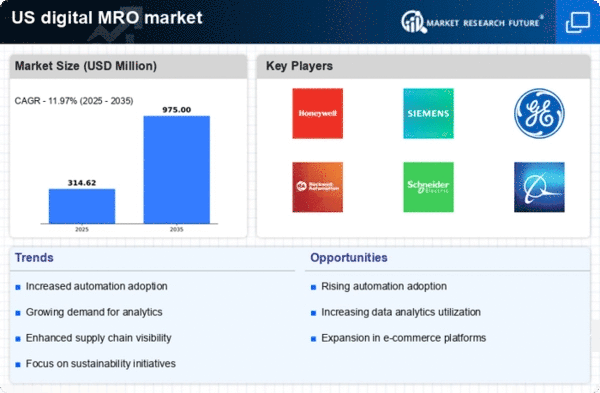
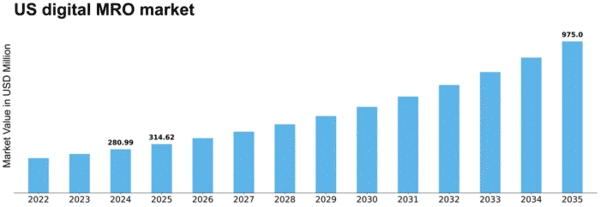
    As per MRFR analysis, the US digital MRO market Size was estimated at 280.99 USD Million in 2024. The US digital mro market is projected to grow from 314.62 USD Million in 2025 to 975.0 USD Million by 2035, exhibiting a compound annual growth rate (CAGR) of 11.97% during the forecast period 2025 - 2035.

    Key Market Trends & Highlights

    The US digital MRO market is experiencing robust growth driven by technological advancements and evolving consumer demands.

    • The largest segment in the US digital MRO market is the IoT solutions segment, which is witnessing increased adoption across various industries.
    • The fastest-growing segment is the data analytics and AI segment, reflecting a shift towards data-driven decision-making.
    • E-commerce platforms are expanding rapidly, contributing to the overall growth of the digital MRO market.
    • Technological advancements in MRO solutions and rising demand for cost efficiency are key drivers propelling market expansion.

    Market Size & Forecast

    2024 Market Size 280.99 (USD Million)
    2035 Market Size 975.0 (USD Million)
    CAGR (2025 - 2035) 11.97%

    Major Players

    <p>Honeywell (US), Siemens (DE), General Electric (US), Rockwell Automation (US), Schneider Electric (FR), Boeing (US), Raytheon Technologies (US), Thales Group (FR), Northrop Grumman (US)</p>

    Market Trends

    The digital MRO market is currently experiencing a transformative phase characterized by the integration of advanced technologies and innovative practices. This evolution is driven by the increasing demand for efficiency and cost-effectiveness in maintenance, repair, and operations. Companies are increasingly adopting digital solutions to streamline their processes, enhance inventory management, and improve overall operational performance. The shift towards automation and data analytics is reshaping traditional practices, allowing organizations to make informed decisions based on real-time data. As a result, the digital mro market is poised for substantial growth, with businesses recognizing the value of digital tools in optimizing their supply chains and reducing downtime. Moreover, the emphasis on sustainability and environmental responsibility is influencing the digital mro market. Organizations are seeking solutions that not only improve efficiency but also minimize their ecological footprint. This trend is prompting the development of eco-friendly products and practices within the sector. The focus on sustainability is likely to drive innovation, as companies strive to meet regulatory requirements and consumer expectations. Overall, the digital mro market is evolving rapidly, with technology and sustainability at the forefront of its development, indicating a promising future for stakeholders involved in this sector.

    Increased Adoption of IoT Solutions

    The integration of Internet of Things (IoT) technology is becoming prevalent in the digital mro market. Companies are leveraging IoT devices to monitor equipment performance and predict maintenance needs. This proactive approach helps in reducing unexpected failures and optimizing resource allocation.

    Growth of E-commerce Platforms

    E-commerce platforms are gaining traction within the digital mro market, facilitating easier access to products and services. This trend allows businesses to streamline procurement processes, enhance supplier relationships, and improve inventory management through online solutions.

    Focus on Data Analytics and AI

    The utilization of data analytics and artificial intelligence is transforming decision-making processes in the digital mro market. Organizations are increasingly relying on data-driven insights to enhance operational efficiency, predict trends, and tailor their offerings to meet customer demands.

    US Digital MRO Market Market Drivers

    Rising Demand for Cost Efficiency

    Cost efficiency remains a critical driver in the digital MRO market. Organizations are increasingly seeking ways to optimize their maintenance budgets while ensuring operational reliability. Digital solutions provide the necessary tools to analyze spending patterns, identify cost-saving opportunities, and streamline procurement processes. By leveraging data analytics, companies can make informed decisions that lead to significant reductions in maintenance costs. In the current landscape, it is estimated that organizations can save up to 20% on MRO expenditures through the adoption of digital solutions. This trend underscores the importance of cost management in the digital mro market, as businesses strive to maintain competitiveness in a challenging economic environment.

    Shift Towards Sustainable Practices

    Sustainability is becoming a pivotal focus within the digital MRO market. Companies are increasingly recognizing the importance of environmentally friendly practices in their operations. Digital solutions enable organizations to monitor and reduce their environmental impact through efficient resource management and waste reduction strategies. By adopting digital tools, businesses can optimize their supply chains, minimize energy consumption, and enhance recycling efforts. This shift towards sustainability is not only driven by regulatory pressures but also by consumer demand for greener practices. As a result, the digital mro market is likely to see a growing emphasis on sustainable solutions, which could reshape operational strategies across various industries.

    Technological Advancements in MRO Solutions

    The digital MRO market is experiencing a surge due to rapid technological advancements. Innovations in cloud computing, artificial intelligence, and machine learning are transforming maintenance, repair, and operations processes. These technologies enable real-time data analysis, predictive maintenance, and enhanced inventory management. As a result, companies can reduce downtime and improve operational efficiency. The integration of IoT devices further enhances these capabilities, allowing for seamless communication between equipment and maintenance systems. In 2025, the digital mro market is projected to reach a valuation of approximately $10 billion, reflecting a compound annual growth rate (CAGR) of around 15%. This growth indicates a strong shift towards digital solutions in the MRO sector, driven by the need for increased efficiency and reduced operational costs.

    Increased Regulatory Compliance Requirements

    The digital MRO market is also influenced by the growing emphasis on regulatory compliance. Industries such as aerospace, automotive, and pharmaceuticals face stringent regulations that mandate rigorous maintenance and operational standards. Digital solutions facilitate compliance by providing comprehensive tracking and reporting capabilities. These tools enable organizations to maintain accurate records of maintenance activities, ensuring adherence to industry regulations. As regulatory bodies continue to tighten standards, the demand for digital mro solutions that support compliance efforts is likely to increase. This trend not only enhances operational integrity but also mitigates risks associated with non-compliance, making it a vital driver in the digital mro market.

    Expansion of E-commerce and Supply Chain Integration

    The expansion of e-commerce is significantly impacting the digital MRO market. As online platforms continue to grow, the need for efficient supply chain management becomes paramount. Digital mro solutions facilitate seamless integration between suppliers and customers, enhancing order fulfillment and inventory management. This integration allows for real-time tracking of MRO supplies, reducing lead times and improving service levels. In 2025, the digital mro market is expected to benefit from this trend, as businesses increasingly rely on digital platforms to streamline their operations. The ability to quickly adapt to changing market demands through digital solutions is likely to drive further growth in the digital mro market.

    Market Segment Insights

    By Technology: Artificial Intelligence (Largest) vs. IoT (Fastest-Growing)

    <p>The market share distribution among the various technologies in the US digital mro market reveals that Artificial Intelligence (AI) holds the largest share due to its widespread integration across various processes. This segment is followed by Robotics and Data Analytics, both of which showcase significant contributions to operational efficiency and decision-making processes in maintenance, repair, and operations. Although still strong, technologies like 3D Printing and Blockchain are gradually capturing attention but remain less dominant compared to their counterparts. Growth trends indicate that the US digital mro market is experiencing a transformative phase driven by digital technologies. The increasing demand for efficiency, reduced downtimes, and enhanced decision-making processes underpin the growth of technologies like IoT, which is currently the fastest-growing segment. Factors such as the expansion of smart factories and the need for predictive maintenance solutions are further propelling the adoption of these technologies, highlighting a remarkable shift towards automation and interconnected systems.</p>

    <p>Technology: AI (Dominant) vs. IoT (Emerging)</p>

    <p>Artificial Intelligence (AI) stands out as the dominant force in the technology segment of the US digital mro market due to its capability to analyze vast amounts of data and provide actionable insights. This technology empowers organizations to enhance operational efficiency and reduce inefficiencies in maintenance processes. Conversely, the Internet of Things (IoT) is emerging rapidly, driven by its ability to connect various devices and systems, thus allowing for real-time monitoring and data collection. While AI enhances decision-making, IoT facilitates immediate feedback and adjustments, making these two technologies complementary in the quest for optimized mro processes. Together, they exemplify how the integration of advanced technologies is shaping the future of maintenance and operational strategies.</p>

    By Application: Predictive Maintenance (Largest) vs. Inspection (Fastest-Growing)

    <p>In the US digital mro market, Predictive Maintenance holds the largest market share among various application segments, primarily due to its ability to enhance operational efficiency and reduce downtime. Following closely, Inspection has emerged as a crucial player, witnessing rapid growth driven by heightened safety standards and regulatory requirements that necessitate regular checks and evaluations of equipment and infrastructure. The growth trends in the application segment are largely influenced by technological advancements such as AI and IoT integration, which facilitate effective predictive maintenance applications. Furthermore, the increasing emphasis on sustainability and cost-effectiveness is driving investments in Inspection and Performance Monitoring solutions, ensuring that businesses can maintain a competitive edge in operational excellence and safety compliance.</p>

    <p>Predictive Maintenance (Dominant) vs. Inspection (Emerging)</p>

    <p>Predictive Maintenance stands out as the dominant application in the US digital mro market, emphasizing reliability and efficiency by utilizing data-driven insights to predict equipment failures before they occur. This proactive approach minimizes costly downtime and optimizes resource allocation. On the other hand, Inspection is an emerging segment, rapidly gaining traction as businesses prioritize regulatory compliance and safety protocols. The increasing integration of advanced technologies in inspections is boosting its appeal, as drones and automated systems are becoming integral to enhancing accuracy and efficiency in monitoring machinery and infrastructure. Both segments reflect a significant shift towards smart maintenance practices, fostering innovation and enhanced operational performance.</p>

    By End User: Airlines (Largest) vs. MRO Providers (Fastest-Growing)

    <p>In the US digital mro market, Airlines hold the largest share, driven by their extensive maintenance, repair, and overhaul needs, which necessitate a strong reliance on digital solutions for efficiency. MRO Providers follow closely, leveraging these digital tools to enhance service delivery in a competitive landscape, ensuring that they meet the high demands of their airline clients. The growth trends in this segment are predominantly influenced by the increasing adoption of digital solutions that optimize maintenance processes. Airlines are focusing on digital transformation to improve operational efficiency and reduce downtime, while MRO Providers are rapidly innovating to offer advanced technological solutions. This dynamic is expected to accelerate growth across both segments, with MRO Providers emerging as key players in the fast-evolving market.</p>

    <p>Airlines (Dominant) vs. MRO Providers (Emerging)</p>

    <p>Airlines are a dominant force in the US digital mro market, characterized by their substantial operational scale and critical need for reliability and efficiency in maintenance. With vast fleets and complex maintenance schedules, they demand robust digital solutions that streamline operations. In contrast, MRO Providers are emerging players that are essential in supporting airlines’ needs. They are increasingly adopting advanced technologies such as predictive maintenance and digital workflows to enhance service offerings. This shift is not only improving their market position but also enabling them to become indispensable partners to airlines in achieving operational excellence and safety compliance.</p>

    Get more detailed insights about US Digital MRO Market Research Report – Forecast till 2035

    Regional Insights

    Key Players and Competitive Insights

    The digital mro market is currently characterized by a dynamic competitive landscape, driven by technological advancements and an increasing emphasis on operational efficiency. Major players such as Honeywell (US), Siemens (DE), and General Electric (US) are at the forefront, each adopting distinct strategies to enhance their market positioning. Honeywell (US) focuses on integrating advanced analytics and IoT solutions into its offerings, thereby enhancing predictive maintenance capabilities. Siemens (DE) emphasizes digital transformation through its MindSphere platform, which connects industrial equipment to the cloud, facilitating real-time data analysis. General Electric (US) is leveraging its extensive experience in industrial IoT to optimize asset performance and reduce downtime, indicating a collective shift towards data-driven decision-making among these key players.

    In terms of business tactics, companies are increasingly localizing manufacturing and optimizing supply chains to enhance responsiveness and reduce costs. The market structure appears moderately fragmented, with a mix of established players and emerging startups. This fragmentation allows for diverse innovations and competitive strategies, as companies strive to differentiate themselves in a crowded marketplace. The influence of key players is substantial, as their strategic initiatives often set industry standards and drive technological advancements.

    In October 2025, Honeywell (US) announced a partnership with a leading aerospace manufacturer to develop a new suite of digital maintenance solutions aimed at improving aircraft reliability and reducing operational costs. This collaboration is strategically significant as it not only expands Honeywell's footprint in the aerospace sector but also reinforces its commitment to innovation in digital maintenance solutions. Similarly, in September 2025, Siemens (DE) launched a new version of its MindSphere platform, which now includes enhanced AI capabilities for predictive maintenance. This upgrade is crucial as it positions Siemens to better serve its clients by providing deeper insights into equipment performance, thereby potentially reducing maintenance costs by up to 20%.

    In August 2025, General Electric (US) unveiled a new digital twin technology that allows for real-time monitoring and simulation of industrial assets. This technology is expected to revolutionize maintenance practices by enabling predictive analytics, which could lead to a 30% reduction in unplanned downtime. Such advancements not only enhance operational efficiency but also align with the growing trend of digitalization in the mro sector. Furthermore, in July 2025, Rockwell Automation (US) expanded its partnership with a major automotive manufacturer to implement smart manufacturing solutions that integrate AI and machine learning into maintenance processes. This strategic move underscores the increasing importance of AI in driving efficiency and innovation within the industry.

    As of November 2025, the competitive trends shaping the digital mro market include a pronounced focus on digitalization, sustainability, and the integration of AI technologies. Strategic alliances are becoming increasingly vital, as companies recognize the need to collaborate in order to leverage complementary strengths and enhance their service offerings. Looking ahead, it is likely that competitive differentiation will evolve, shifting from traditional price-based competition to a focus on innovation, technological advancements, and supply chain reliability. This transition suggests that companies that prioritize these areas will be better positioned to thrive in an increasingly complex and competitive environment.

    Key Companies in the US Digital MRO Market market include

    Industry Developments

    Future Outlook

    US Digital MRO Market Future Outlook

    <p>The digital mro market is projected to grow at 11.97% CAGR from 2024 to 2035, driven by technological advancements, increased automation, and demand for efficiency.</p>

    New opportunities lie in:

    • <p>Integration of AI-driven predictive maintenance solutions</p>
    • <p>Development of cloud-based inventory management systems</p>
    • <p>Expansion of mobile applications for on-the-go procurement</p>

    <p>By 2035, the market is expected to achieve substantial growth, reflecting evolving industry needs.</p>

    Market Segmentation

    US Digital MRO Market End User Outlook

    • Airlines
    • MRO Providers
    • OEMs

    US Digital MRO Market Technology Outlook

    • Predictive Analysis
    • AR/VR
    • 3D Printing
    • Blockchain
    • Internet Of Things (IoT)
    • Artificial Intelligence
    • Data Analytics
    • Robotics
    • Digital Twin

    US Digital MRO Market Application Outlook

    • Predictive Maintenance
    • Inspection
    • Performance Monitoring
    • Part Replacement
    • Mobility & Functionality

    Report Scope

    MARKET SIZE 2024 280.99(USD Million)
    MARKET SIZE 2025 314.62(USD Million)
    MARKET SIZE 2035 975.0(USD Million)
    COMPOUND ANNUAL GROWTH RATE (CAGR) 11.97% (2024 - 2035)
    REPORT COVERAGE Revenue Forecast, Competitive Landscape, Growth Factors, and Trends
    BASE YEAR 2024
    Market Forecast Period 2025 - 2035
    Historical Data 2019 - 2024
    Market Forecast Units USD Million
    Key Companies Profiled Honeywell (US), Siemens (DE), General Electric (US), Rockwell Automation (US), Schneider Electric (FR), Boeing (US), Raytheon Technologies (US), Thales Group (FR), Northrop Grumman (US)
    Segments Covered Technology, Application, End User
    Key Market Opportunities Integration of advanced analytics and artificial intelligence enhances efficiency in the digital mro market.
    Key Market Dynamics Technological advancements drive efficiency and innovation in the digital MRO market, reshaping competitive dynamics.
    Countries Covered US

    FAQs

    How much is the Digital MRO market?

    The US Digital MRO market size was valued at USD 286.5 million in 2022.

    What is the growth rate of the US Digital MRO market?

    The US market is projected to grow at a CAGR of 13.0% during the forecast period, 2023-2032.

    Who are the key players in the US Digital MRO market?

    The key players in the market are Lufthansa Technik (Germany), The Boeing Company (USA), Airbus (France), IBM corporations (USA), Air France and KLM Engineering (France), ST Aerospace (Asia Pacific and Europe), Hexaware Technologies (India).

    Which Technology led the US Digital MRO market?

    The Artificial Intelligence &amp; Big Data Analytics category dominated the market in 2022.

    Which Application had the largest market share in the US Digital MRO market?

    The Predictive Maintenance segment had the largest share in the US market in 2022.

    What is the expected market size of the US Digital MRO Market by 2035?

    The US Digital MRO Market is projected to be valued at 1340.0 USD Million by the year 2035.

    What was the market size of the US Digital MRO Market in 2024?

    In 2024, the US Digital MRO Market is expected to be valued at 281.75 USD Million.

    What is the expected CAGR for the US Digital MRO Market from 2025 to 2035?

    The expected CAGR for the US Digital MRO Market from 2025 to 2035 is 15.23%.

    What is the market value of Predictive Analysis Technology in the US Digital MRO Market for 2024?

    The Predictive Analysis Technology segment is valued at 70.0 USD Million in the US Digital MRO Market for 2024.

    What will the market size for the Internet of Things (IoT) technology reach by 2035?

    The Internet of Things (IoT) technology segment is expected to reach a market size of 590.0 USD Million by 2035.

    What is the projected market value for AR/VR technology in the US Digital MRO Market by 2035?

    AR/VR technology is projected to attain a market value of 250.0 USD Million by 2035.

    What are the expected growth opportunities in the US Digital MRO Market?

    The US Digital MRO Market presents growth opportunities through advancements in technologies such as Blockchain and IoT.

    What impact does the evolving technological landscape have on the US Digital MRO Market?

    The evolving technological landscape significantly drives innovations in efficiency and service delivery within the US Digital MRO Market.

    What is the market size for 3D Printing technology in the US Digital MRO Market for 2024?

    In 2024, the market size for 3D Printing technology within the US Digital MRO Market is valued at 30.0 USD Million.

    1. SECTION I: EXECUTIVE SUMMARY AND KEY HIGHLIGHTS
      1. | 1.1 EXECUTIVE SUMMARY
      2. | | 1.1.1 Market Overview
      3. | | 1.1.2 Key Findings
      4. | | 1.1.3 Market Segmentation
      5. | | 1.1.4 Competitive Landscape
      6. | | 1.1.5 Challenges and Opportunities
      7. | | 1.1.6 Future Outlook
    2. SECTION II: SCOPING, METHODOLOGY AND MARKET STRUCTURE
      1. | 2.1 MARKET INTRODUCTION
      2. | | 2.1.1 Definition
      3. | | 2.1.2 Scope of the study
      4. | | | 2.1.2.1 Research Objective
      5. | | | 2.1.2.2 Assumption
      6. | | | 2.1.2.3 Limitations
      7. | 2.2 RESEARCH METHODOLOGY
      8. | | 2.2.1 Overview
      9. | | 2.2.2 Data Mining
      10. | | 2.2.3 Secondary Research
      11. | | 2.2.4 Primary Research
      12. | | | 2.2.4.1 Primary Interviews and Information Gathering Process
      13. | | | 2.2.4.2 Breakdown of Primary Respondents
      14. | | 2.2.5 Forecasting Model
      15. | | 2.2.6 Market Size Estimation
      16. | | | 2.2.6.1 Bottom-Up Approach
      17. | | | 2.2.6.2 Top-Down Approach
      18. | | 2.2.7 Data Triangulation
      19. | | 2.2.8 Validation
    3. SECTION III: QUALITATIVE ANALYSIS
      1. | 3.1 MARKET DYNAMICS
      2. | | 3.1.1 Overview
      3. | | 3.1.2 Drivers
      4. | | 3.1.3 Restraints
      5. | | 3.1.4 Opportunities
      6. | 3.2 MARKET FACTOR ANALYSIS
      7. | | 3.2.1 Value chain Analysis
      8. | | 3.2.2 Porter's Five Forces Analysis
      9. | | | 3.2.2.1 Bargaining Power of Suppliers
      10. | | | 3.2.2.2 Bargaining Power of Buyers
      11. | | | 3.2.2.3 Threat of New Entrants
      12. | | | 3.2.2.4 Threat of Substitutes
      13. | | | 3.2.2.5 Intensity of Rivalry
      14. | | 3.2.3 COVID-19 Impact Analysis
      15. | | | 3.2.3.1 Market Impact Analysis
      16. | | | 3.2.3.2 Regional Impact
      17. | | | 3.2.3.3 Opportunity and Threat Analysis
    4. SECTION IV: QUANTITATIVE ANALYSIS
      1. | 4.1 Chemicals and Materials, BY Technology (USD Million)
      2. | | 4.1.1 Predictive Analysis
      3. | | 4.1.2 AR/VR
      4. | | 4.1.3 3D Printing
      5. | | 4.1.4 Blockchain
      6. | | 4.1.5 Internet Of Things (IoT)
      7. | | 4.1.6 Artificial Intelligence
      8. | | 4.1.7 Data Analytics
      9. | | 4.1.8 Robotics
      10. | | 4.1.9 Digital Twin
      11. | 4.2 Chemicals and Materials, BY Application (USD Million)
      12. | | 4.2.1 Predictive Maintenance
      13. | | 4.2.2 Inspection
      14. | | 4.2.3 Performance Monitoring
      15. | | 4.2.4 Part Replacement
      16. | | 4.2.5 Mobility & Functionality
      17. | 4.3 Chemicals and Materials, BY End User (USD Million)
      18. | | 4.3.1 Airlines
      19. | | 4.3.2 MRO Providers
      20. | | 4.3.3 OEMs
    5. SECTION V: COMPETITIVE ANALYSIS
      1. | 5.1 Competitive Landscape
      2. | | 5.1.1 Overview
      3. | | 5.1.2 Competitive Analysis
      4. | | 5.1.3 Market share Analysis
      5. | | 5.1.4 Major Growth Strategy in the Chemicals and Materials
      6. | | 5.1.5 Competitive Benchmarking
      7. | | 5.1.6 Leading Players in Terms of Number of Developments in the Chemicals and Materials
      8. | | 5.1.7 Key developments and growth strategies
      9. | | | 5.1.7.1 New Product Launch/Service Deployment
      10. | | | 5.1.7.2 Merger & Acquisitions
      11. | | | 5.1.7.3 Joint Ventures
      12. | | 5.1.8 Major Players Financial Matrix
      13. | | | 5.1.8.1 Sales and Operating Income
      14. | | | 5.1.8.2 Major Players R&D Expenditure. 2023
      15. | 5.2 Company Profiles
      16. | | 5.2.1 Honeywell (US)
      17. | | | 5.2.1.1 Financial Overview
      18. | | | 5.2.1.2 Products Offered
      19. | | | 5.2.1.3 Key Developments
      20. | | | 5.2.1.4 SWOT Analysis
      21. | | | 5.2.1.5 Key Strategies
      22. | | 5.2.2 Siemens (DE)
      23. | | | 5.2.2.1 Financial Overview
      24. | | | 5.2.2.2 Products Offered
      25. | | | 5.2.2.3 Key Developments
      26. | | | 5.2.2.4 SWOT Analysis
      27. | | | 5.2.2.5 Key Strategies
      28. | | 5.2.3 General Electric (US)
      29. | | | 5.2.3.1 Financial Overview
      30. | | | 5.2.3.2 Products Offered
      31. | | | 5.2.3.3 Key Developments
      32. | | | 5.2.3.4 SWOT Analysis
      33. | | | 5.2.3.5 Key Strategies
      34. | | 5.2.4 Rockwell Automation (US)
      35. | | | 5.2.4.1 Financial Overview
      36. | | | 5.2.4.2 Products Offered
      37. | | | 5.2.4.3 Key Developments
      38. | | | 5.2.4.4 SWOT Analysis
      39. | | | 5.2.4.5 Key Strategies
      40. | | 5.2.5 Schneider Electric (FR)
      41. | | | 5.2.5.1 Financial Overview
      42. | | | 5.2.5.2 Products Offered
      43. | | | 5.2.5.3 Key Developments
      44. | | | 5.2.5.4 SWOT Analysis
      45. | | | 5.2.5.5 Key Strategies
      46. | | 5.2.6 Boeing (US)
      47. | | | 5.2.6.1 Financial Overview
      48. | | | 5.2.6.2 Products Offered
      49. | | | 5.2.6.3 Key Developments
      50. | | | 5.2.6.4 SWOT Analysis
      51. | | | 5.2.6.5 Key Strategies
      52. | | 5.2.7 Raytheon Technologies (US)
      53. | | | 5.2.7.1 Financial Overview
      54. | | | 5.2.7.2 Products Offered
      55. | | | 5.2.7.3 Key Developments
      56. | | | 5.2.7.4 SWOT Analysis
      57. | | | 5.2.7.5 Key Strategies
      58. | | 5.2.8 Thales Group (FR)
      59. | | | 5.2.8.1 Financial Overview
      60. | | | 5.2.8.2 Products Offered
      61. | | | 5.2.8.3 Key Developments
      62. | | | 5.2.8.4 SWOT Analysis
      63. | | | 5.2.8.5 Key Strategies
      64. | | 5.2.9 Northrop Grumman (US)
      65. | | | 5.2.9.1 Financial Overview
      66. | | | 5.2.9.2 Products Offered
      67. | | | 5.2.9.3 Key Developments
      68. | | | 5.2.9.4 SWOT Analysis
      69. | | | 5.2.9.5 Key Strategies
      70. | 5.3 Appendix
      71. | | 5.3.1 References
      72. | | 5.3.2 Related Reports
    6. LIST OF FIGURES
      1. | 6.1 MARKET SYNOPSIS
      2. | 6.2 US MARKET ANALYSIS BY TECHNOLOGY
      3. | 6.3 US MARKET ANALYSIS BY APPLICATION
      4. | 6.4 US MARKET ANALYSIS BY END USER
      5. | 6.5 KEY BUYING CRITERIA OF CHEMICALS AND MATERIALS
      6. | 6.6 RESEARCH PROCESS OF MRFR
      7. | 6.7 DRO ANALYSIS OF CHEMICALS AND MATERIALS
      8. | 6.8 DRIVERS IMPACT ANALYSIS: CHEMICALS AND MATERIALS
      9. | 6.9 RESTRAINTS IMPACT ANALYSIS: CHEMICALS AND MATERIALS
      10. | 6.10 SUPPLY / VALUE CHAIN: CHEMICALS AND MATERIALS
      11. | 6.11 CHEMICALS AND MATERIALS, BY TECHNOLOGY, 2024 (% SHARE)
      12. | 6.12 CHEMICALS AND MATERIALS, BY TECHNOLOGY, 2024 TO 2035 (USD Million)
      13. | 6.13 CHEMICALS AND MATERIALS, BY APPLICATION, 2024 (% SHARE)
      14. | 6.14 CHEMICALS AND MATERIALS, BY APPLICATION, 2024 TO 2035 (USD Million)
      15. | 6.15 CHEMICALS AND MATERIALS, BY END USER, 2024 (% SHARE)
      16. | 6.16 CHEMICALS AND MATERIALS, BY END USER, 2024 TO 2035 (USD Million)
      17. | 6.17 BENCHMARKING OF MAJOR COMPETITORS
    7. LIST OF TABLES
      1. | 7.1 LIST OF ASSUMPTIONS
      2. | | 7.1.1
      3. | 7.2 US MARKET SIZE ESTIMATES; FORECAST
      4. | | 7.2.1 BY TECHNOLOGY, 2025-2035 (USD Million)
      5. | | 7.2.2 BY APPLICATION, 2025-2035 (USD Million)
      6. | | 7.2.3 BY END USER, 2025-2035 (USD Million)
      7. | 7.3 PRODUCT LAUNCH/PRODUCT DEVELOPMENT/APPROVAL
      8. | | 7.3.1
      9. | 7.4 ACQUISITION/PARTNERSHIP
      10. | | 7.4.1

    US Digital MRO Market Segmentation

    Market Segmentation Overview

    • Detailed segmentation data will be available in the full report
    • Comprehensive analysis by multiple parameters
    • Regional and country-level breakdowns
    • Market size forecasts by segment
    Infographic

    Free Sample Request

    Kindly complete the form below to receive a free sample of this Report

    Get Free Sample

    Customer Strories

    “I am very pleased with how market segments have been defined in a relevant way for my purposes (such as "Portable Freezers & refrigerators" and "last-mile"). In general the report is well structured. Thanks very much for your efforts.”

    Victoria Milne

    Founder
    Case Study
    Chemicals and Materials

    Compare Licence

    ×
    Features License Type
    Single User Multiuser License Enterprise User
    Price $4,950 $5,950 $7,250
    Maximum User Access Limit 1 User Upto 10 Users Unrestricted Access Throughout the Organization
    Free Customization
    Direct Access to Analyst
    Deliverable Format
    Platform Access
    Discount on Next Purchase 10% 15% 15%
    Printable Versions