×
Request Free Sample ×

Kindly complete the form below to receive a free sample of this Report

Leading companies partner with us for data-driven Insights

clients tt-cursor
Hero Background

US Data Center Structured Cabling Market

ID: MRFR/ICT/11592-HCR
100 Pages
MRFR Team
October 2025

US Data Center Structured Cabling Market Research Report Information ByWire Category (Category 5E,Category 6,Category 6A,Category 7, Others), By Product Type(Copper Wire,Fiber Optic), And By Region (North America, Europe, Asia-Pacific, And Rest Of The World) –Market Forecast Till 2035

Share:
Download PDF ×

We do not share your information with anyone. However, we may send you emails based on your report interest from time to time. You may contact us at any time to opt-out.

US Data Center Structured Cabling Market Infographic
Purchase Options

US Data Center Structured Cabling Market Summary

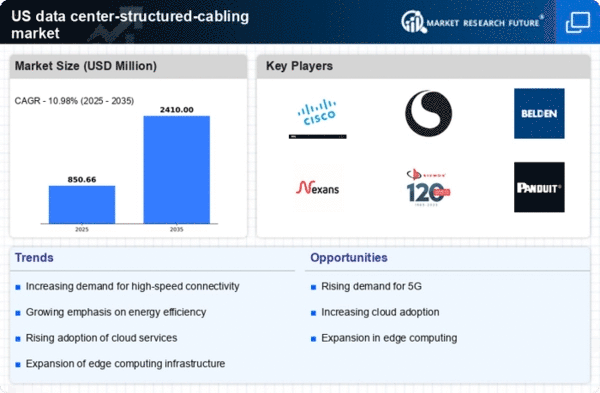
As per MRFR analysis, the US data center-structured-cabling market size was estimated at 766.5 USD Million in 2024. The US data center-structured-cabling market is projected to grow from 850.66 USD Million in 2025 to 2410.0 USD Million by 2035, exhibiting a compound annual growth rate (CAGR) of 10.98% during the forecast period 2025 - 2035.

Key Market Trends & Highlights

The US data center-structured-cabling market is experiencing a transformative shift towards advanced technologies and sustainability.

  • The market is witnessing a notable shift to fiber optics, driven by the demand for higher bandwidth and faster data transmission.
  • Sustainability initiatives are becoming increasingly prevalent, as companies seek to reduce their environmental impact through energy-efficient cabling solutions.
  • Integration with smart technologies is on the rise, enhancing operational efficiency and enabling better data management in data centers.
  • Key market drivers include the rising demand for high-speed connectivity and the expansion of cloud computing services, which are shaping the future of structured cabling.

Market Size & Forecast

2024 Market Size 766.5 (USD Million)
2035 Market Size 2410.0 (USD Million)

Major Players

Cisco Systems (US), CommScope (US), Belden (US), Nexans (FR), Siemon (US), Panduit (US), Leviton (US), TE Connectivity (CH), Corning (US)

US Data Center Structured Cabling Market Trends

The data center-structured-cabling market is currently experiencing a transformative phase, driven by the increasing demand for high-speed connectivity and efficient data management solutions. As organizations continue to expand their digital infrastructure, the need for robust cabling systems becomes paramount. This market is characterized by a shift towards advanced technologies, such as fiber optics, which offer superior performance compared to traditional copper cabling. Additionally, the rise of cloud computing and data-intensive applications is propelling the adoption of innovative cabling solutions that can support higher bandwidth requirements. Moreover, sustainability is emerging as a critical factor influencing purchasing decisions within the data center-structured-cabling market. Companies are increasingly prioritizing eco-friendly materials and energy-efficient designs in their cabling systems. This trend aligns with broader environmental goals and regulatory pressures, prompting manufacturers to innovate and provide solutions that minimize environmental impact. As a result, the market is likely to witness a surge in demand for products that not only enhance performance but also contribute to sustainability efforts. Overall, the data center-structured-cabling market is poised for significant growth, driven by technological advancements and a heightened focus on sustainability.

Shift to Fiber Optics

The transition from copper to fiber optic cabling is becoming increasingly prevalent. Fiber optics provide enhanced speed and bandwidth, making them ideal for modern data centers. This shift is likely to improve overall network performance and reliability.

Sustainability Initiatives

There is a growing emphasis on sustainable practices within the data center-structured-cabling market. Companies are seeking eco-friendly materials and energy-efficient solutions, reflecting a commitment to reducing their carbon footprint.

Integration with Smart Technologies

The integration of smart technologies into cabling systems is gaining traction. This trend suggests that data centers are adopting intelligent solutions that enhance monitoring, management, and operational efficiency.

US Data Center Structured Cabling Market Drivers

Increased Focus on Data Security

With the rise in cyber threats, data security has become a critical concern for organizations, thereby impacting the data center-structured-cabling market. Companies are investing heavily in secure data transmission methods to protect sensitive information. This focus on security is leading to the adoption of advanced cabling solutions that offer enhanced shielding and protection against unauthorized access. The data center-structured-cabling market is responding to this trend by developing products that not only meet performance standards but also comply with stringent security regulations. As a result, the market is likely to see a shift towards more secure cabling options that can withstand potential vulnerabilities.

Regulatory Compliance and Standards

The evolving landscape of regulatory compliance is a significant driver for the data center-structured-cabling market. Organizations are increasingly required to adhere to various standards and regulations concerning data handling and transmission. Compliance with these regulations often necessitates the upgrade of existing cabling systems to meet new performance and safety standards. The data center-structured-cabling market is thus witnessing a demand for products that not only fulfill regulatory requirements but also enhance operational efficiency. This trend is likely to continue as regulations become more stringent, pushing companies to invest in compliant cabling solutions.

Expansion of Cloud Computing Services

The rapid expansion of cloud computing services is significantly influencing the data center-structured-cabling market. As organizations increasingly migrate to cloud-based solutions, the need for robust and efficient cabling systems becomes paramount. The cloud services market is anticipated to grow at a CAGR of around 22% through 2025, necessitating the enhancement of data center infrastructures. This growth drives demand for advanced cabling solutions that can support high data loads and ensure reliable connectivity. Consequently, the data center-structured-cabling market is adapting to these changes by offering innovative cabling technologies that facilitate seamless cloud integration and scalability.

Rising Demand for High-Speed Connectivity

The increasing reliance on high-speed internet and data transfer capabilities is a primary driver for the data center-structured-cabling market. As businesses and consumers demand faster connectivity, data centers are compelled to upgrade their cabling infrastructure. This trend is evidenced by the projected growth of the data center market, which is expected to reach approximately $200 billion by 2026. Enhanced cabling solutions, particularly those utilizing fiber optics, are essential to meet these demands. The data center-structured-cabling market is thus experiencing a surge in investments aimed at improving bandwidth and reducing latency, which are critical for supporting cloud computing and big data applications.

Technological Advancements in Cabling Solutions

Technological advancements are reshaping the data center-structured-cabling market, driving innovation and efficiency. The introduction of new materials and designs, such as high-density cabling and modular systems, is enabling data centers to optimize space and improve performance. These advancements are crucial as data centers strive to manage increasing data volumes and improve energy efficiency. The data center-structured-cabling market is likely to benefit from ongoing research and development efforts aimed at creating more efficient and sustainable cabling solutions. As technology continues to evolve, the market is expected to adapt, offering products that meet the changing needs of data centers.


Market Segment Insights

By Wire Category: Category 6 (Largest) vs. Category 6A (Fastest-Growing)

In the US data center-structured-cabling market, Category 6 emerges as the largest segment, holding a significant share due to its widespread adoption for high-speed networking and compatibility with various applications. Following closely is Category 5E, which, while still relevant, is gradually being overshadowed by the enhanced performance of Category 6 and Category 6A cabling options. Other categories, including Category 7 and 'Others', represent niche segments that cater to specific needs but lack the volume of the leading categories. Growth trends indicate a shift toward higher performance standards in the industry. Category 6A is recognized as the fastest-growing segment, driven by the demand for 10 Gbps network speeds and the increasing number of data center expansions in the US. The trend towards higher bandwidth and lower latency solutions compels users to upgrade their cabling infrastructure, propelling both Category 6A and 7 as strong contenders in the market.

Cabling Types: Category 6 (Dominant) vs. Category 6A (Emerging)

Category 6 cabling is dominant due to its established presence in the US data center-structured-cabling market, providing adequate performance for most current applications with support for 1 Gbps up to 100m and suitable for various network setups. In contrast, Category 6A is emerging as an essential choice for future-proofing data center operations, offering doubled bandwidth capabilities and enhanced alien crosstalk performance. As organizations aim for scalability and efficiency, Category 6A is gaining traction as operators look to meet rising bandwidth demands and accommodate more devices within their networks. The robust characteristics of these categories ensure they are complementary, fueling the market's evolution.

By Product Type: Copper Wire (Largest) vs. Fiber Optic (Fastest-Growing)

In the US data center-structured-cabling market, the Copper Wire segment remains the largest, commanding a significant share due to its established presence in traditional cabling applications. In contrast, the Fiber Optic segment, while smaller in comparison, exhibits rapid growth as businesses increasingly prioritize higher bandwidth and speed. This shift in preference is largely driven by the growing demands for data transmission efficiency across various sectors. The growth trends in this market showcase a strong inclination towards Fiber Optic solutions, which are becoming increasingly preferred for new installations and upgrades. Factors contributing to this trend include the rising need for faster internet speeds, the expansion of cloud services, and the internet of things (IoT) driving demand for robust connectivity solutions. Consequently, while Copper Wire remains dominant, Fiber Optic is positioning itself as a critical player for future deployments.

Copper Wire (Dominant) vs. Fiber Optic (Emerging)

Copper Wire technology has long been favored in the US data center-structured-cabling market due to its reliability and cost-effectiveness for shorter-distance applications. It is primarily used in legacy systems and for standard networking infrastructure, making it a dominant choice among businesses that require proven solutions. On the other hand, Fiber Optic technology is emerging rapidly, distinguished by its ability to transmit data at incredibly high speeds over long distances with minimal loss. This makes it highly suitable for modern data centers that demand agility and performance. As organizations continue to transition towards high-speed networking, Fiber Optic is expected to capture an increasing portion of the market, challenging the long-standing dominance of Copper Wire.

Get more detailed insights about US Data Center Structured Cabling Market

Key Players and Competitive Insights

The data center-structured-cabling market is currently characterized by a dynamic competitive landscape, driven by the increasing demand for high-speed connectivity and the expansion of data centers across the United States. Key players such as Cisco Systems (US), CommScope (US), and Belden (US) are strategically positioned to leverage their technological expertise and extensive product portfolios. Cisco Systems (US) focuses on innovation in network infrastructure, emphasizing the integration of advanced technologies such as AI and machine learning to enhance operational efficiency. Meanwhile, CommScope (US) has been actively pursuing partnerships to expand its market reach, particularly in the realm of 5G and fiber-optic solutions. Belden (US) is concentrating on sustainability initiatives, aiming to reduce its carbon footprint while enhancing product performance, which collectively shapes a competitive environment that prioritizes technological advancement and environmental responsibility.

The business tactics employed by these companies reflect a concerted effort to optimize supply chains and localize manufacturing processes. The market structure appears moderately fragmented, with several players vying for market share while also collaborating on various projects. This collective influence of key players fosters a competitive atmosphere where innovation and strategic partnerships are paramount.

In October 2025, Cisco Systems (US) announced a significant investment in a new research and development facility aimed at accelerating the development of next-generation cabling solutions. This move is expected to enhance their product offerings and solidify their position as a leader in the market. The strategic importance of this investment lies in its potential to drive innovation and respond to the evolving needs of data center operators, particularly in terms of speed and efficiency.

In September 2025, CommScope (US) launched a new line of environmentally friendly cabling products designed to meet the growing demand for sustainable solutions in data centers. This initiative not only aligns with global sustainability trends but also positions CommScope (US) as a forward-thinking player in the market. The introduction of these products is likely to attract environmentally conscious customers and enhance the company's competitive edge.

In August 2025, Belden (US) entered into a strategic partnership with a leading cloud service provider to develop customized cabling solutions tailored for large-scale data centers. This collaboration is significant as it allows Belden (US) to tap into new market segments and leverage the expertise of its partner to deliver innovative solutions. Such partnerships are indicative of a broader trend towards collaboration in the industry, where companies seek to combine strengths to address complex customer needs.

As of November 2025, the competitive trends in the data center-structured-cabling market are increasingly defined by digitalization, sustainability, and the integration of AI technologies. Strategic alliances are becoming more prevalent, shaping the landscape as companies recognize the value of collaboration in driving innovation. Looking ahead, competitive differentiation is likely to evolve from traditional price-based competition to a focus on technological innovation, supply chain reliability, and sustainable practices, reflecting the changing priorities of customers and the market at large.

Key Companies in the US Data Center Structured Cabling Market market include

Future Outlook

US Data Center Structured Cabling Market Future Outlook

The Data Center Structured Cabling Market is projected to grow at a 10.98% CAGR from 2024 to 2035, driven by increasing data traffic and technological advancements.

New opportunities lie in:

  • Development of high-density cabling solutions for enhanced data transfer rates.
  • Integration of smart cabling systems with IoT for real-time monitoring.
  • Expansion of modular cabling systems to support scalable data center designs.

By 2035, the market is expected to achieve robust growth, driven by innovation and increasing demand.

Market Segmentation

US Data Center Structured Cabling Market Product Type Outlook

  • Copper Wire
  • Fiber Optic

US Data Center Structured Cabling Market Wire Category Outlook

  • Category 5E
  • Category 6
  • Category 6A
  • Category 7
  • Others

Report Scope

MARKET SIZE 2024 766.5(USD Million)
MARKET SIZE 2025 850.66(USD Million)
MARKET SIZE 2035 2410.0(USD Million)
COMPOUND ANNUAL GROWTH RATE (CAGR) 10.98% (2024 - 2035)
REPORT COVERAGE Revenue Forecast, Competitive Landscape, Growth Factors, and Trends
BASE YEAR 2024
Market Forecast Period 2025 - 2035
Historical Data 2019 - 2024
Market Forecast Units USD Million
Key Companies Profiled Cisco Systems (US), CommScope (US), Belden (US), Nexans (FR), Siemon (US), Panduit (US), Leviton (US), TE Connectivity (CH), Corning (US)
Segments Covered Wire Category, Product Type
Key Market Opportunities Integration of advanced fiber optic technologies enhances performance in the data center-structured-cabling market.
Key Market Dynamics Rising demand for high-speed connectivity drives innovation in data center-structured cabling solutions and technologies.
Countries Covered US

Leave a Comment

FAQs

What is the projected market size of the US Data Center Structured Cabling Market in 2024?

The US Data Center Structured Cabling Market is expected to be valued at 766.5 million USD in 2024.

How fast is the US Data Center Structured Cabling Market expected to grow by 2035?

By 2035, the market is projected to reach a valuation of 2,350.26 million USD.

What is the expected CAGR for the US Data Center Structured Cabling Market from 2025 to 2035?

The market is anticipated to grow at a CAGR of 10.723% during the forecast period from 2025 to 2035.

Which product type holds the largest market share in the US Data Center Structured Cabling Market?

Copper Wire and Fiber Optic both play significant roles, with Copper Wire valued at 306.5 million USD in 2024 and expected to grow to 950.0 million USD by 2035.

What is the market size for Fiber Optic products in the US Data Center Structured Cabling Market in 2024?

The Fiber Optic segment is expected to be valued at 460.0 million USD in 2024.

Who are the key players in the US Data Center Structured Cabling Market?

Major players include Prysmian Group, Anixter, Belden, Leviton, Rittal, and others.

What growth drivers are influencing the US Data Center Structured Cabling Market?

Growth is driven by increasing data center demand, technological advancements, and a shift toward high-performance networking solutions.

What are the key applications for the US Data Center Structured Cabling Market?

Key applications include telecommunications, data transmission, and network infrastructure management.

How have recent global trends impacted the US Data Center Structured Cabling Market?

Current global trends have accelerated the adoption of structured cabling solutions in response to rising data traffic demands.

What challenges does the US Data Center Structured Cabling Market face?

Challenges include evolving technology standards and the need for continual infrastructure upgrades to keep pace with rapid advancements.

Download Free Sample

Kindly complete the form below to receive a free sample of this Report

Compare Licence

×
Features License Type
Single User Multiuser License Enterprise User
Price $4,950 $5,950 $7,250
Maximum User Access Limit 1 User Upto 10 Users Unrestricted Access Throughout the Organization
Free Customization
Direct Access to Analyst
Deliverable Format
Platform Access
Discount on Next Purchase 10% 15% 15%
Printable Versions