Request Free Sample ×

Kindly complete the form below to receive a free sample of this Report

* Please use a valid business email

Leading companies partner with us for data-driven Insights

clients tt-cursor
Hero Background
English
Chinese
French
Japanese
Korean
German
Spanish

US Antimicrobial Plastics Market Size

ID: MRFR/CnM/12430-HCR
111 Pages
Chitranshi Jaiswal
December 2024

US Antimicrobial Plastics Market Research Report Information By Additive (Inorganic (Silver, Zinc, Copper) and Organic (ОВРА, Triclosan)), By Type (Commodity Plastics (PP, PE, PVC, PS, PMMA, PET, PUR) and Engineering Plastics (ABS, PC, PA, POM, Others)), By Application (Packaging, Medical & Healthcare, Automotive, Building & Construction, Consumer Goods, and Others), - Market Forecast Till 2035

Share:
Download PDF ×

We do not share your information with anyone. However, we may send you emails based on your report interest from time to time. You may contact us at any time to opt-out.

US Antimicrobial Plastics Market Infographic
Purchase Options

Us Antimicrobial Plastics Size

US Antimicrobial Plastics Market Growth Projections and Opportunities

US Antimicrobial Plastics Market Size was valued at USD 7.2 Billion in 2022. The antimicrobial plastics industry is projected to grow from USD 7.79 Billion in 2023 to USD 14.634 Billion by 2032, exhibiting a compound annual growth rate (CAGR) of 8.20%

The US Antimicrobial Plastics Market is influenced by a range of market factors that collectively contribute to its growth and dynamics. A significant driver is the increasing awareness and emphasis on hygiene and infection control, especially in sectors such as healthcare, packaging, and consumer goods. Antimicrobial plastics, infused with agents that inhibit the growth of bacteria and other microorganisms, have gained prominence as a solution to address hygiene concerns. The ongoing global health challenges, including the COVID-19 pandemic, have heightened the demand for antimicrobial plastics as a means to enhance safety and minimize the risk of surface-borne infections in the United States.

Moreover, the healthcare sector's role in driving the adoption of antimicrobial plastics is crucial. Medical devices, hospital surfaces, and packaging for pharmaceuticals are key applications where antimicrobial plastics are extensively used. The need for infection prevention in healthcare settings, combined with the ongoing advancements in medical technology, has led to a growing reliance on antimicrobial plastics to create safer environments for patients and healthcare professionals in the US market.

Technological advancements and innovations in antimicrobial plastic formulations contribute to market dynamics. Continuous research and development efforts aim to improve the effectiveness, durability, and versatility of antimicrobial agents embedded in plastics. Innovations also focus on expanding the range of plastics that can be rendered antimicrobial, allowing for broader applications across various industries. These advancements drive the evolution of antimicrobial plastics in the US market, making them more adaptable to diverse consumer needs and industry requirements.

Consumer preferences for products with enhanced hygiene features influence the antimicrobial plastics market. In the wake of increased health awareness, consumers seek products that offer additional protection against microbial contamination. This has led to the incorporation of antimicrobial plastics in everyday items such as household goods, kitchenware, and personal care items. The consumer-driven demand for products that contribute to a cleaner and safer environment contributes to the widespread adoption of antimicrobial plastics in the US.

Government regulations and standards related to public health and safety impact the antimicrobial plastics market. Regulatory agencies set guidelines and standards for the use of antimicrobial agents in plastics, ensuring their safety and efficacy. Compliance with these regulations is crucial for manufacturers to guarantee the quality and performance of antimicrobial plastics in various applications. The adherence to standards helps build consumer trust and confidence in the antimicrobial products available in the US market.

Market competition and industry collaborations are notable factors shaping the US Antimicrobial Plastics Market. The presence of both established and emerging players in the industry fosters a competitive landscape. Collaboration between antimicrobial plastic manufacturers, research institutions, and end-users contributes to the development of new formulations and applications. Partnerships within the industry supply chain also drive innovation and create synergies that benefit the overall growth of the antimicrobial plastics market.

Global economic conditions and trade dynamics impact the antimicrobial plastics market. As a globally traded commodity, factors such as international trade agreements, tariffs, and geopolitical events can influence the supply chain and market conditions for antimicrobial plastics in the US. Economic stability and trade policies play a role in determining the accessibility and cost competitiveness of antimicrobial plastic materials.

Challenges related to consumer perceptions, environmental sustainability, and potential microbial resistance are factors that the antimicrobial plastics industry addresses. Educating consumers about the benefits and limitations of antimicrobial plastics, ensuring environmentally responsible manufacturing processes, and addressing concerns related to microbial resistance are ongoing challenges. The industry's ability to transparently communicate and address these challenges contributes to the sustainable growth of the antimicrobial plastics market in the United States.
US Antimicrobial Plastics Market Size Graph
Author
Author Profile
Chitranshi Jaiswal
Team Lead - Research

Chitranshi is a Team Leader in the Chemicals & Materials (CnM) and Energy & Power (EnP) domains, with 6+ years of experience in market research. She leads and mentors teams to deliver cross-domain projects that equip clients with actionable insights and growth strategies. She is skilled in market estimation, forecasting, competitive benchmarking, and both primary & secondary research, enabling her to turn complex data into decision-ready insights. An engineer and MBA professional, she combines technical expertise with strategic acumen to solve dynamic market challenges. Chitranshi has successfully managed projects that support market entry, investment planning, and competitive positioning, while building strong client relationships. Certified in Advanced Excel & Power BI she leverages data-driven approaches to ensure accuracy, clarity, and impactful outcomes.

Leave a Comment

FAQs

What is the current valuation of the US antimicrobial plastics market?

<p>The US antimicrobial plastics market was valued at 145.0 USD Million in 2024.</p>

What is the projected market valuation for the US antimicrobial plastics market in 2035?

<p>The market is projected to reach 249.35 USD Million by 2035.</p>

What is the expected CAGR for the US antimicrobial plastics market during the forecast period 2025 - 2035?

<p>The expected CAGR for the market during 2025 - 2035 is 5.05%.</p>

Which companies are considered key players in the US antimicrobial plastics market?

<p>Key players include BASF SE, DuPont de Nemours Inc, Eastman Chemical Company, and others.</p>

What are the main application segments of the US antimicrobial plastics market?

<p>Main application segments include Medical Devices, Food Packaging, Consumer Goods, Textiles, and Electronics.</p>

How did the Food Packaging segment perform in terms of valuation?

<p>The Food Packaging segment was valued between 40.0 and 70.0 USD Million.</p>

What is the valuation range for the Healthcare end-use segment?

<p>The Healthcare end-use segment was valued between 30.0 and 50.0 USD Million.</p>

Which material type is projected to have the highest valuation in the US antimicrobial plastics market?

<p>Polycarbonate is projected to have the highest valuation, ranging from 55.0 to 99.35 USD Million.</p>

What technologies are utilized in the US antimicrobial plastics market?

<p>Technologies include Silver Ion, Copper Ion, Zinc Ion, Biocidal Polymers, and Nanotechnology.</p>

What is the valuation range for the Nanotechnology segment?

<p>The Nanotechnology segment is valued between 35.0 and 64.35 USD Million.</p>

Who are the key players in the US Antimicrobial Plastics Market?

Major players in the US Antimicrobial Plastics Market include Polyone Corporation, Microban International, and BASF.

What amount is the Zinc additive segment expected to reach in 2035?

The Zinc additive segment is expected to reach a value of 100.0 million USD by 2035.

What are the key applications driving growth in the US Antimicrobial Plastics Market?

Key applications driving growth in the market include consumer goods, healthcare, and packaging.

What challenges does the US Antimicrobial Plastics Market face in the coming years?

Challenges in the market include regulatory hurdles and competition from alternative materials.

What impact do emerging trends have on the US Antimicrobial Plastics Market?

Emerging trends like sustainability and increased demand for hygiene products are positively impacting the market.

Market Summary

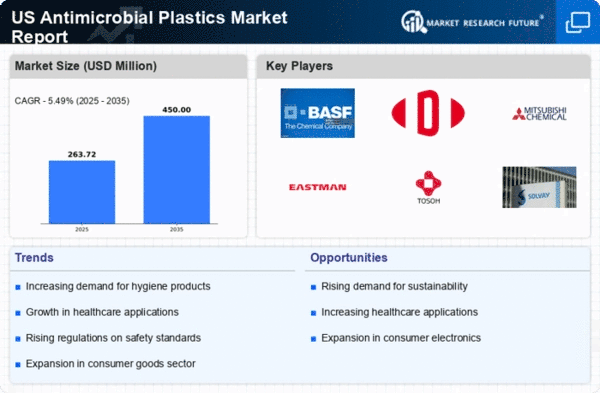
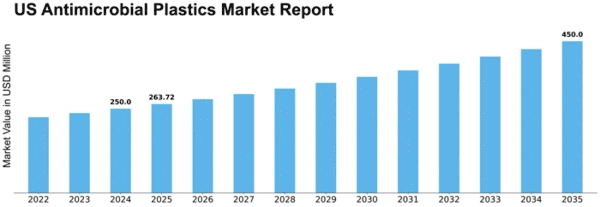
As per Market Research Future analysis, the US antimicrobial plastics market size was estimated at 250.0 USD Million in 2024. The US antimicrobial plastics market is projected to grow from 263.72 USD Million in 2025 to 450.0 USD Million by 2035, exhibiting a compound annual growth rate (CAGR) of 5.4% during the forecast period 2025 - 2035

Key Market Trends & Highlights

The US antimicrobial plastics market is experiencing robust growth driven by increasing demand across various sectors.

  • The healthcare sector emerges as the largest segment, reflecting a heightened focus on hygiene and infection control. Sustainability trends are influencing the market, with eco-friendly solutions gaining traction among consumers and manufacturers. Regulatory support is fostering innovation, as standards for antimicrobial properties become more stringent. Key market drivers include increased awareness of hygiene and rising demand in food packaging, which are shaping consumer preferences.

Market Size & Forecast

2024 Market Size 250.0 (USD Million)
2035 Market Size 450.0 (USD Million)
CAGR (2025 - 2035) 5.49%

Major Players

<p>BASF SE (DE), DuPont de Nemours Inc (US), Mitsubishi Chemical Corporation (JP), Eastman Chemical Company (US), Tosoh Corporation (JP), Solvay SA (BE), Covestro AG (DE), SABIC (SA), LG Chem Ltd (KR)</p>

Market Trends

The antimicrobial plastics market is experiencing notable growth, driven by increasing awareness regarding hygiene and the need for materials that can inhibit microbial growth. This trend is particularly relevant in sectors such as healthcare, food packaging, and consumer goods, where the presence of bacteria and other pathogens poses significant risks. The incorporation of antimicrobial agents into plastics not only enhances their durability but also extends their lifespan, making them more appealing to manufacturers and consumers alike. As a result, the demand for these specialized materials is likely to rise, reflecting a shift towards safer and more sustainable product options. Moreover, advancements in technology are facilitating the development of innovative antimicrobial solutions that are both effective and environmentally friendly. Regulatory bodies are also playing a crucial role in shaping the market landscape by establishing guidelines that promote the use of safer additives in plastic production. This regulatory support, combined with growing consumer preferences for antimicrobial properties in everyday products, suggests a robust future for the antimicrobial plastics market. As industries continue to prioritize health and safety, the integration of these materials into various applications appears to be a strategic move that aligns with broader public health goals.

Rising Demand in Healthcare Sector

The healthcare sector is increasingly adopting antimicrobial plastics due to their ability to reduce infection rates. Hospitals and clinics are utilizing these materials in medical devices, surfaces, and equipment to enhance patient safety and improve hygiene standards.

Sustainability and Eco-Friendly Solutions

There is a growing emphasis on sustainability within the antimicrobial plastics market. Manufacturers are exploring bio-based and biodegradable options that maintain antimicrobial properties while minimizing environmental impact, appealing to eco-conscious consumers.

Regulatory Support and Standards

Regulatory bodies are establishing guidelines that encourage the use of antimicrobial additives in plastics. This support is likely to drive innovation and compliance, ensuring that products meet safety and efficacy standards, thereby boosting market growth.

US Antimicrobial Plastics Market Market Drivers

Increasing Awareness of Hygiene

The U.S. Antimicrobial Plastics Market is experiencing a notable surge in demand driven by heightened awareness of hygiene and cleanliness. Consumers and businesses alike are increasingly prioritizing products that offer antimicrobial properties, particularly in environments such as hospitals, schools, and public spaces. This trend is reflected in market data, which indicates that the antimicrobial plastics segment is projected to grow at a compound annual growth rate of approximately 8% over the next five years. As awareness of the importance of hygiene continues to rise, manufacturers are likely to innovate and expand their product lines to meet consumer expectations, thereby further propelling the U.S. Antimicrobial Plastics Market.

Rising Demand in Consumer Goods

The U.S. Antimicrobial Plastics Market is witnessing a rising demand in the consumer goods sector, where antimicrobial properties are increasingly sought after in everyday products. From kitchenware to personal care items, consumers are becoming more conscious of the materials used in the products they purchase. This shift in consumer behavior is prompting manufacturers to incorporate antimicrobial technologies into their offerings, thereby enhancing product appeal and functionality. Market data indicates that the consumer goods segment is expected to grow steadily, driven by the increasing emphasis on health and wellness. As a result, the U.S. Antimicrobial Plastics Market is likely to benefit from this trend, with manufacturers focusing on innovation to meet evolving consumer preferences.

Regulatory Support and Standards

The U.S. Antimicrobial Plastics Market benefits from a robust framework of regulatory support and standards that promote the use of antimicrobial materials. Government agencies are increasingly recognizing the importance of antimicrobial plastics in various applications, particularly in healthcare and food packaging. This regulatory environment encourages manufacturers to invest in research and development, leading to the introduction of new and improved antimicrobial products. Furthermore, compliance with stringent safety and efficacy standards enhances consumer confidence, which is crucial for market growth. As a result, the U.S. Antimicrobial Plastics Market is likely to see sustained growth as regulations evolve to support innovation and safety.

Growth in the Food Packaging Sector

The U.S. Antimicrobial Plastics Market is significantly influenced by the growth in the food packaging sector, where antimicrobial plastics are increasingly utilized to extend shelf life and enhance food safety. With rising consumer demand for fresh and safe food products, manufacturers are adopting antimicrobial materials to prevent microbial contamination. Market data suggests that the food packaging segment is expected to account for a substantial share of the antimicrobial plastics market, driven by innovations in packaging technologies. This trend not only addresses consumer concerns regarding food safety but also aligns with the broader objectives of reducing food waste, thereby contributing to the overall growth of the U.S. Antimicrobial Plastics Market.

Technological Innovations in Material Science

Technological innovations in material science are playing a pivotal role in shaping the U.S. Antimicrobial Plastics Market. Advances in polymer chemistry and nanotechnology are enabling the development of more effective antimicrobial agents that can be integrated into plastic materials. These innovations not only enhance the performance of antimicrobial plastics but also expand their applications across various industries, including healthcare, consumer goods, and automotive. As manufacturers continue to explore new formulations and processing techniques, the U.S. Antimicrobial Plastics Market is poised for significant growth. The ability to create tailored solutions that meet specific industry needs is likely to drive further adoption of antimicrobial plastics.

Market Segment Insights

By Application: Medical Devices (Largest) vs. Food Packaging (Fastest-Growing)

<p>In the US antimicrobial plastics market, the application segment reveals a diverse distribution among key sectors. Medical devices lead the market, driven by increasing demand for hygiene and safety in healthcare settings. Following this, food packaging is emerging rapidly, with a rise in consumer preferences for safe, hygienic packaging solutions. Other notable applications include consumer goods, textiles, and electronics, all contributing to the sector's growth. Each of these segments plays a vital role in the overall performance of antimicrobial plastics, reflecting their importance in everyday life.</p>

<p>Food Packaging (Dominant) vs. Textiles (Emerging)</p>

<p>In the comparison of Food Packaging and Textiles, Food Packaging continues to dominate the application market for antimicrobial plastics, primarily due to its crucial role in ensuring food safety and extending shelf life. This segment leverages advanced antimicrobial agents to prevent contamination and spoilage, thereby meeting stringent regulatory standards. On the other hand, the Textiles segment is emerging, driven by increasing awareness of hygiene in clothing and upholstery. Innovations in antimicrobial treatments for fabrics are gaining traction, making textiles a potential growth area. Both segments highlight the versatility and necessity of antimicrobial plastics in enhancing product safety and consumer trust.</p>

By End Use: Healthcare (Largest) vs. Food and Beverage (Fastest-Growing)

<p>In the US antimicrobial plastics market, the 'End Use' segment demonstrates significant diversity, with healthcare being the dominant category. This segment accounts for a considerable portion of the market share due to the rising demand for sterile environments and infection prevention in medical facilities. Conversely, the food and beverage industry is emerging rapidly, driven by the need for safety and hygiene in food packaging and storage.</p>

<p>Healthcare: Dominant vs. Food and Beverage: Emerging</p>

<p>The healthcare sector remains the largest consumer of antimicrobial plastics, primarily due to stringent regulations and a focus on patient safety. These plastics are utilized in medical devices, hospital furnishings, and surgical environments which require high levels of contamination control. On the other hand, the food and beverage sector is seen as the fastest-growing area within this market. Here, antimicrobial plastics are increasingly used in food packaging and processing applications due to heightened awareness of foodborne illnesses and the necessity for hygienic standards. Overall, while healthcare remains the hallmark of the segment, the food and beverage sector's rapid development signals a notable shift in consumer priorities regarding safety.</p>

By Material Type: Polypropylene (Largest) vs. Polycarbonate (Fastest-Growing)

<p>In the US antimicrobial plastics market, Polypropylene holds the largest market share due to its widespread usage in various applications, including healthcare and consumer goods. This material is favored for its durability, cost-effectiveness, and excellent barrier properties, making it a popular choice among manufacturers. Polyethylene and Polyvinyl Chloride also feature prominently, catering to specific requirements in the medical, packaging, and construction sectors, thereby maintaining a solid presence in the market.</p>

<p>Polypropylene (Dominant) vs. Polycarbonate (Emerging)</p>

<p>Polypropylene, recognized as the dominant material in the antimicrobial plastics segment, exhibits exceptional strength along with resistance to chemicals and moisture. Its versatility has made it the preferred choice for manufacturers aiming to enhance product longevity and hygiene. In contrast, Polycarbonate is emerging rapidly due to its superior transparency and impact resistance, making it ideal for applications requiring clarity and strength, such as medical devices and safety goggles. The push for lightweight and durable materials in medical and electronic sectors is driving Polycarbonate's growth, as manufacturers adopt advanced materials to meet regulatory and consumer demands.</p>

By Technology: Silver Ion Technology (Largest) vs. Nanotechnology (Fastest-Growing)

<p>In the US antimicrobial plastics market, Silver Ion Technology holds the largest market share, primarily due to its proven effectiveness in inhibiting a broad spectrum of microorganisms. This technology has been widely adopted in various applications, including medical devices, consumer goods, and packaging, leading to its dominance in the segment. Conversely, Nanotechnology is emerging quickly, as it offers innovative solutions with enhanced antimicrobial properties and functionalities. This technology integrates the use of nanoparticles to enhance the performance of plastics, making it appealing for future innovations.</p>

<p>Technology: Silver Ion (Dominant) vs. Nanotechnology (Emerging)</p>

<p>Silver Ion Technology is well-established as a dominant force in the US antimicrobial plastics market, favored for its efficacy and reliability. It is commonly used in healthcare settings due to its ability to kill bacteria and prevent infections on surfaces. Silver ions disperse within the plastic matrix, providing long-lasting antimicrobial protection. In contrast, Nanotechnology represents an emerging trend offering significant potential for growth. It allows for the manipulation of materials at the molecular level to enhance antibacterial properties and overall performance. The versatility of nanomaterials in developing new antimicrobial formulations makes it attractive for industries looking to innovate, particularly in high-demand sectors like healthcare and consumer products.</p>

Get more detailed insights about US Antimicrobial Plastics Market Research Report - Forecast by 2035

Regional Insights

North America : Market Leader in Antimicrobial Plastics

The North American market for antimicrobial plastics is driven by increasing health awareness and stringent regulations regarding hygiene in various sectors, including healthcare and food packaging. The U.S. holds the largest market share at approximately 70%, followed by Canada at around 15%. Regulatory bodies are promoting the use of antimicrobial materials to enhance public health safety, further boosting demand. The competitive landscape is characterized by major players such as DuPont de Nemours Inc and Eastman Chemical Company, which are investing in innovative solutions to meet rising consumer expectations. The presence of established manufacturers and a robust distribution network enhances market accessibility. Additionally, ongoing research and development efforts are expected to introduce advanced antimicrobial technologies, solidifying North America's leadership in this sector.

Europe : Emerging Market with Growth Potential

Europe is witnessing a growing demand for antimicrobial plastics, driven by increasing regulations aimed at improving public health standards. The region is projected to hold a market share of approximately 20%, with Germany and the UK being the largest contributors. Regulatory frameworks, such as the EU Biocidal Products Regulation, are encouraging the adoption of antimicrobial materials in various applications, including medical devices and consumer goods. Leading countries in this market include Germany, the UK, and France, where key players like BASF SE and AkzoNobel N.V. are actively involved in product innovation. The competitive landscape is marked by collaborations between manufacturers and research institutions to develop advanced antimicrobial solutions. This synergy is expected to enhance product offerings and expand market reach across Europe.

Asia-Pacific : Rapidly Growing Antimicrobial Sector

The Asia-Pacific region is rapidly emerging as a significant player in the antimicrobial plastics market, driven by increasing industrialization and urbanization. Countries like China and Japan are leading the market, collectively holding around 15% of the global share. The rising awareness of hygiene and health standards, coupled with government initiatives promoting antimicrobial solutions, is fueling market growth in this region. China is the largest market, with a strong presence of local manufacturers and international players like Mitsubishi Chemical Corporation. The competitive landscape is evolving, with companies focusing on innovation and sustainability to meet consumer demands. As the region continues to develop, the demand for antimicrobial plastics in sectors such as healthcare, packaging, and automotive is expected to rise significantly, further enhancing market dynamics.

Middle East and Africa : Untapped Market with Potential

The Middle East and Africa region presents untapped opportunities in the antimicrobial plastics market, driven by increasing health concerns and a growing demand for hygiene products. The market share in this region is currently around 5%, with countries like South Africa and the UAE leading the way. Government initiatives aimed at improving healthcare infrastructure are expected to catalyze market growth in the coming years. The competitive landscape is still developing, with a mix of local and international players entering the market. Companies are focusing on establishing partnerships and collaborations to enhance their product offerings. As awareness of antimicrobial solutions increases, the demand for these materials in sectors such as healthcare and consumer goods is anticipated to grow, paving the way for future market expansion.

Key Players and Competitive Insights

The antimicrobial plastics market is currently characterized by a dynamic competitive landscape, driven by increasing demand for hygiene and safety across various sectors, including healthcare, food packaging, and consumer goods. Key players such as DuPont de Nemours Inc (US), BASF SE (DE), and Eastman Chemical Company (US) are actively shaping the market through strategic initiatives focused on innovation and sustainability. DuPont, for instance, emphasizes its commitment to developing advanced antimicrobial solutions that enhance product longevity and safety, thereby positioning itself as a leader in this niche. Meanwhile, BASF is leveraging its extensive research capabilities to introduce novel antimicrobial additives, which are expected to bolster its market share and enhance its competitive edge. In terms of business tactics, companies are increasingly localizing manufacturing to reduce lead times and optimize supply chains. This approach appears to be particularly effective in a moderately fragmented market, where the collective influence of key players can significantly impact pricing and availability. The competitive structure is evolving, with larger firms like Covestro AG (DE) and SABIC (SA) focusing on strategic partnerships and collaborations to enhance their product offerings and market reach.

In October Eastman Chemical Company (US) announced a partnership with a leading healthcare provider to develop antimicrobial plastics specifically designed for medical applications. This collaboration is likely to enhance Eastman's reputation in the healthcare sector, as it aligns with the growing demand for safe and effective materials in medical devices. The strategic importance of this partnership lies in its potential to open new revenue streams and solidify Eastman's position as a trusted supplier in a highly regulated industry.

In September DuPont de Nemours Inc (US) launched a new line of antimicrobial plastics that incorporate bio-based materials, reflecting a growing trend towards sustainability. This initiative not only addresses environmental concerns but also meets the increasing consumer demand for eco-friendly products. The introduction of these materials is expected to strengthen DuPont's market presence and appeal to environmentally conscious consumers, thereby enhancing its competitive positioning.

In August BASF SE (DE) expanded its production capacity for antimicrobial additives in North America, responding to the rising demand from various industries. This strategic move is indicative of BASF's commitment to maintaining a robust supply chain and ensuring product availability. By increasing production capacity, BASF is likely to enhance its competitive advantage and better serve its customers in a rapidly evolving market.

As of November the competitive trends in the antimicrobial plastics market are increasingly influenced by digitalization, sustainability, and the integration of advanced technologies such as AI. Strategic alliances are becoming more prevalent, as companies recognize the need to collaborate to innovate and meet evolving consumer demands. The shift from price-based competition to a focus on innovation and technology is evident, suggesting that future competitive differentiation will hinge on the ability to deliver reliable supply chains and cutting-edge solutions.

Key Companies in the US Antimicrobial Plastics Market include

Industry Developments

August 2020: The United States business A. Schulman, which specializes in tailored plastic compounds, was purchased by LyondellBasell Industries N.V. The goal of the acquisition was to increase LyondellBasell's market penetration and product line in the worldwide plastics sector.

Future Outlook

US Antimicrobial Plastics Market Future Outlook

<p>The antimicrobial plastics market is projected to grow at a 5.49% CAGR from 2025 to 2035, fueled by rising demand in healthcare, consumer goods, and food packaging.</p>

New opportunities lie in:

  • <p>Development of antimicrobial coatings for consumer electronics Expansion into biodegradable antimicrobial plastics for sustainable packaging Integration of smart technology in antimicrobial plastic products</p>

<p>By 2035, the market is expected to achieve substantial growth, driven by innovation and diverse applications.</p>

Market Segmentation

US Antimicrobial Plastics Market Type Outlook

  • Commodity Plastics
  • Engineering Plastics
  • Performance Plastics

US Antimicrobial Plastics Market Additive Outlook

  • Silver
  • Zinc
  • Oxybisphenoxarsine

US Antimicrobial Plastics Market Application Outlook

  • Packaging
  • Automotive
  • Healthcare
  • Medical

Report Scope

MARKET SIZE 2024 250.0(USD Million)
MARKET SIZE 2025 263.72(USD Million)
MARKET SIZE 2035 450.0(USD Million)
COMPOUND ANNUAL GROWTH RATE (CAGR) 5.49% (2025 - 2035)
REPORT COVERAGE Revenue Forecast, Competitive Landscape, Growth Factors, and Trends
BASE YEAR 2024
Market Forecast Period 2025 - 2035
Historical Data 2019 - 2024
Market Forecast Units USD Million
Key Companies Profiled BASF SE (DE), DuPont de Nemours Inc (US), Mitsubishi Chemical Corporation (JP), Eastman Chemical Company (US), Tosoh Corporation (JP), Solvay SA (BE), Covestro AG (DE), SABIC (SA), LG Chem Ltd (KR)
Segments Covered Application, Additive, Type
Key Market Opportunities Growing demand for sustainable antimicrobial plastics driven by environmental regulations and consumer preferences.
Key Market Dynamics Rising demand for antimicrobial plastics driven by stringent regulations and heightened consumer awareness of hygiene.
Countries Covered US

FAQs

What is the current valuation of the US antimicrobial plastics market?

<p>The US antimicrobial plastics market was valued at 145.0 USD Million in 2024.</p>

What is the projected market valuation for the US antimicrobial plastics market in 2035?

<p>The market is projected to reach 249.35 USD Million by 2035.</p>

What is the expected CAGR for the US antimicrobial plastics market during the forecast period 2025 - 2035?

<p>The expected CAGR for the market during 2025 - 2035 is 5.05%.</p>

Which companies are considered key players in the US antimicrobial plastics market?

<p>Key players include BASF SE, DuPont de Nemours Inc, Eastman Chemical Company, and others.</p>

What are the main application segments of the US antimicrobial plastics market?

<p>Main application segments include Medical Devices, Food Packaging, Consumer Goods, Textiles, and Electronics.</p>

How did the Food Packaging segment perform in terms of valuation?

<p>The Food Packaging segment was valued between 40.0 and 70.0 USD Million.</p>

What is the valuation range for the Healthcare end-use segment?

<p>The Healthcare end-use segment was valued between 30.0 and 50.0 USD Million.</p>

Which material type is projected to have the highest valuation in the US antimicrobial plastics market?

<p>Polycarbonate is projected to have the highest valuation, ranging from 55.0 to 99.35 USD Million.</p>

What technologies are utilized in the US antimicrobial plastics market?

<p>Technologies include Silver Ion, Copper Ion, Zinc Ion, Biocidal Polymers, and Nanotechnology.</p>

What is the valuation range for the Nanotechnology segment?

<p>The Nanotechnology segment is valued between 35.0 and 64.35 USD Million.</p>

Who are the key players in the US Antimicrobial Plastics Market?

Major players in the US Antimicrobial Plastics Market include Polyone Corporation, Microban International, and BASF.

What amount is the Zinc additive segment expected to reach in 2035?

The Zinc additive segment is expected to reach a value of 100.0 million USD by 2035.

What are the key applications driving growth in the US Antimicrobial Plastics Market?

Key applications driving growth in the market include consumer goods, healthcare, and packaging.

What challenges does the US Antimicrobial Plastics Market face in the coming years?

Challenges in the market include regulatory hurdles and competition from alternative materials.

What impact do emerging trends have on the US Antimicrobial Plastics Market?

Emerging trends like sustainability and increased demand for hygiene products are positively impacting the market.

  1. SECTION I: EXECUTIVE SUMMARY AND KEY HIGHLIGHTS
    1. | 1.1 EXECUTIVE SUMMARY
    2. | | 1.1.1 Market Overview
    3. | | 1.1.2 Key Findings
    4. | | 1.1.3 Market Segmentation
    5. | | 1.1.4 Competitive Landscape
    6. | | 1.1.5 Challenges and Opportunities
    7. | | 1.1.6 Future Outlook
  2. SECTION II: SCOPING, METHODOLOGY AND MARKET STRUCTURE
    1. | 2.1 MARKET INTRODUCTION
    2. | | 2.1.1 Definition
    3. | | 2.1.2 Scope of the study
    4. | | | 2.1.2.1 Research Objective
    5. | | | 2.1.2.2 Assumption
    6. | | | 2.1.2.3 Limitations
    7. | 2.2 RESEARCH METHODOLOGY
    8. | | 2.2.1 Overview
    9. | | 2.2.2 Data Mining
    10. | | 2.2.3 Secondary Research
    11. | | 2.2.4 Primary Research
    12. | | | 2.2.4.1 Primary Interviews and Information Gathering Process
    13. | | | 2.2.4.2 Breakdown of Primary Respondents
    14. | | 2.2.5 Forecasting Model
    15. | | 2.2.6 Market Size Estimation
    16. | | | 2.2.6.1 Bottom-Up Approach
    17. | | | 2.2.6.2 Top-Down Approach
    18. | | 2.2.7 Data Triangulation
    19. | | 2.2.8 Validation
  3. SECTION III: QUALITATIVE ANALYSIS
    1. | 3.1 MARKET DYNAMICS
    2. | | 3.1.1 Overview
    3. | | 3.1.2 Drivers
    4. | | 3.1.3 Restraints
    5. | | 3.1.4 Opportunities
    6. | 3.2 MARKET FACTOR ANALYSIS
    7. | | 3.2.1 Value chain Analysis
    8. | | 3.2.2 Porter's Five Forces Analysis
    9. | | | 3.2.2.1 Bargaining Power of Suppliers
    10. | | | 3.2.2.2 Bargaining Power of Buyers
    11. | | | 3.2.2.3 Threat of New Entrants
    12. | | | 3.2.2.4 Threat of Substitutes
    13. | | | 3.2.2.5 Intensity of Rivalry
    14. | | 3.2.3 COVID-19 Impact Analysis
    15. | | | 3.2.3.1 Market Impact Analysis
    16. | | | 3.2.3.2 Regional Impact
    17. | | | 3.2.3.3 Opportunity and Threat Analysis
  4. SECTION IV: QUANTITATIVE ANALYSIS
    1. | 4.1 Chemicals and Materials, BY Application (USD Million)
    2. | | 4.1.1 Medical Devices
    3. | | 4.1.2 Food Packaging
    4. | | 4.1.3 Consumer Goods
    5. | | 4.1.4 Textiles
    6. | | 4.1.5 Electronics
    7. | 4.2 Chemicals and Materials, BY End Use (USD Million)
    8. | | 4.2.1 Healthcare
    9. | | 4.2.2 Food and Beverage
    10. | | 4.2.3 Automotive
    11. | | 4.2.4 Construction
    12. | | 4.2.5 Household
    13. | 4.3 Chemicals and Materials, BY Material Type (USD Million)
    14. | | 4.3.1 Polypropylene
    15. | | 4.3.2 Polyethylene
    16. | | 4.3.3 Polyvinyl Chloride
    17. | | 4.3.4 Polystyrene
    18. | | 4.3.5 Polycarbonate
    19. | 4.4 Chemicals and Materials, BY Technology (USD Million)
    20. | | 4.4.1 Silver Ion Technology
    21. | | 4.4.2 Copper Ion Technology
    22. | | 4.4.3 Zinc Ion Technology
    23. | | 4.4.4 Biocidal Polymers
    24. | | 4.4.5 Nanotechnology
  5. SECTION V: COMPETITIVE ANALYSIS
    1. | 5.1 Competitive Landscape
    2. | | 5.1.1 Overview
    3. | | 5.1.2 Competitive Analysis
    4. | | 5.1.3 Market share Analysis
    5. | | 5.1.4 Major Growth Strategy in the Chemicals and Materials
    6. | | 5.1.5 Competitive Benchmarking
    7. | | 5.1.6 Leading Players in Terms of Number of Developments in the Chemicals and Materials
    8. | | 5.1.7 Key developments and growth strategies
    9. | | | 5.1.7.1 New Product Launch/Service Deployment
    10. | | | 5.1.7.2 Merger & Acquisitions
    11. | | | 5.1.7.3 Joint Ventures
    12. | | 5.1.8 Major Players Financial Matrix
    13. | | | 5.1.8.1 Sales and Operating Income
    14. | | | 5.1.8.2 Major Players R&D Expenditure. 2023
    15. | 5.2 Company Profiles
    16. | | 5.2.1 BASF SE (DE)
    17. | | | 5.2.1.1 Financial Overview
    18. | | | 5.2.1.2 Products Offered
    19. | | | 5.2.1.3 Key Developments
    20. | | | 5.2.1.4 SWOT Analysis
    21. | | | 5.2.1.5 Key Strategies
    22. | | 5.2.2 DuPont de Nemours Inc (US)
    23. | | | 5.2.2.1 Financial Overview
    24. | | | 5.2.2.2 Products Offered
    25. | | | 5.2.2.3 Key Developments
    26. | | | 5.2.2.4 SWOT Analysis
    27. | | | 5.2.2.5 Key Strategies
    28. | | 5.2.3 Eastman Chemical Company (US)
    29. | | | 5.2.3.1 Financial Overview
    30. | | | 5.2.3.2 Products Offered
    31. | | | 5.2.3.3 Key Developments
    32. | | | 5.2.3.4 SWOT Analysis
    33. | | | 5.2.3.5 Key Strategies
    34. | | 5.2.4 Mitsubishi Chemical Corporation (JP)
    35. | | | 5.2.4.1 Financial Overview
    36. | | | 5.2.4.2 Products Offered
    37. | | | 5.2.4.3 Key Developments
    38. | | | 5.2.4.4 SWOT Analysis
    39. | | | 5.2.4.5 Key Strategies
    40. | | 5.2.5 Solvay SA (BE)
    41. | | | 5.2.5.1 Financial Overview
    42. | | | 5.2.5.2 Products Offered
    43. | | | 5.2.5.3 Key Developments
    44. | | | 5.2.5.4 SWOT Analysis
    45. | | | 5.2.5.5 Key Strategies
    46. | | 5.2.6 Tosoh Corporation (JP)
    47. | | | 5.2.6.1 Financial Overview
    48. | | | 5.2.6.2 Products Offered
    49. | | | 5.2.6.3 Key Developments
    50. | | | 5.2.6.4 SWOT Analysis
    51. | | | 5.2.6.5 Key Strategies
    52. | | 5.2.7 Covestro AG (DE)
    53. | | | 5.2.7.1 Financial Overview
    54. | | | 5.2.7.2 Products Offered
    55. | | | 5.2.7.3 Key Developments
    56. | | | 5.2.7.4 SWOT Analysis
    57. | | | 5.2.7.5 Key Strategies
    58. | | 5.2.8 SABIC (SA)
    59. | | | 5.2.8.1 Financial Overview
    60. | | | 5.2.8.2 Products Offered
    61. | | | 5.2.8.3 Key Developments
    62. | | | 5.2.8.4 SWOT Analysis
    63. | | | 5.2.8.5 Key Strategies
    64. | 5.3 Appendix
    65. | | 5.3.1 References
    66. | | 5.3.2 Related Reports
  6. LIST OF FIGURES
    1. | 6.1 MARKET SYNOPSIS
    2. | 6.2 US MARKET ANALYSIS BY APPLICATION
    3. | 6.3 US MARKET ANALYSIS BY END USE
    4. | 6.4 US MARKET ANALYSIS BY MATERIAL TYPE
    5. | 6.5 US MARKET ANALYSIS BY TECHNOLOGY
    6. | 6.6 KEY BUYING CRITERIA OF CHEMICALS AND MATERIALS
    7. | 6.7 RESEARCH PROCESS OF MRFR
    8. | 6.8 DRO ANALYSIS OF CHEMICALS AND MATERIALS
    9. | 6.9 DRIVERS IMPACT ANALYSIS: CHEMICALS AND MATERIALS
    10. | 6.10 RESTRAINTS IMPACT ANALYSIS: CHEMICALS AND MATERIALS
    11. | 6.11 SUPPLY / VALUE CHAIN: CHEMICALS AND MATERIALS
    12. | 6.12 CHEMICALS AND MATERIALS, BY APPLICATION, 2024 (% SHARE)
    13. | 6.13 CHEMICALS AND MATERIALS, BY APPLICATION, 2024 TO 2035 (USD Million)
    14. | 6.14 CHEMICALS AND MATERIALS, BY END USE, 2024 (% SHARE)
    15. | 6.15 CHEMICALS AND MATERIALS, BY END USE, 2024 TO 2035 (USD Million)
    16. | 6.16 CHEMICALS AND MATERIALS, BY MATERIAL TYPE, 2024 (% SHARE)
    17. | 6.17 CHEMICALS AND MATERIALS, BY MATERIAL TYPE, 2024 TO 2035 (USD Million)
    18. | 6.18 CHEMICALS AND MATERIALS, BY TECHNOLOGY, 2024 (% SHARE)
    19. | 6.19 CHEMICALS AND MATERIALS, BY TECHNOLOGY, 2024 TO 2035 (USD Million)
    20. | 6.20 BENCHMARKING OF MAJOR COMPETITORS
  7. LIST OF TABLES
    1. | 7.1 LIST OF ASSUMPTIONS
    2. | | 7.1.1
    3. | 7.2 US MARKET SIZE ESTIMATES; FORECAST
    4. | | 7.2.1 BY APPLICATION, 2025-2035 (USD Million)
    5. | | 7.2.2 BY END USE, 2025-2035 (USD Million)
    6. | | 7.2.3 BY MATERIAL TYPE, 2025-2035 (USD Million)
    7. | | 7.2.4 BY TECHNOLOGY, 2025-2035 (USD Million)
    8. | 7.3 PRODUCT LAUNCH/PRODUCT DEVELOPMENT/APPROVAL
    9. | | 7.3.1
    10. | 7.4 ACQUISITION/PARTNERSHIP
    11. | | 7.4.1

US Chemicals and Materials Market Segmentation

Chemicals and Materials By Application (USD Million, 2025-2035)

  • Medical Devices
  • Food Packaging
  • Consumer Goods
  • Textiles
  • Electronics

Chemicals and Materials By End Use (USD Million, 2025-2035)

  • Healthcare
  • Food and Beverage
  • Automotive
  • Construction
  • Household

Chemicals and Materials By Material Type (USD Million, 2025-2035)

  • Polypropylene
  • Polyethylene
  • Polyvinyl Chloride
  • Polystyrene
  • Polycarbonate

Chemicals and Materials By Technology (USD Million, 2025-2035)

  • Silver Ion Technology
  • Copper Ion Technology
  • Zinc Ion Technology
  • Biocidal Polymers
  • Nanotechnology
Infographic

Free Sample Request

Kindly complete the form below to receive a free sample of this Report

Get Free Sample

Customer Strories

Compare Licence

×
Features License Type
Single User Multiuser License Enterprise User
Price $4,950 $5,950 $7,250
Maximum User Access Limit 1 User Upto 10 Users Unrestricted Access Throughout the Organization
Free Customization
Direct Access to Analyst
Deliverable Format
Platform Access
Discount on Next Purchase 10% 15% 15%
Printable Versions