×
Request Free Sample ×

Kindly complete the form below to receive a free sample of this Report

* Please use a valid business email

Leading companies partner with us for data-driven Insights

clients tt-cursor
Hero Background

UK Construction Software Market

ID: MRFR/ICT/44228-HCR
200 Pages
Garvit Vyas
October 2025

UK Construction Software Market Research Report: By Type (Project management, Account/Financial Management, Quality Safety, Field Productivity, Others), By Deployment Mode (Cloud, On-premises), By Organization Size (Large Enterprises, Small and Medium Enterprises), and By Application (General Contractors, Building Owners, Architects and Engineers, Sub-Contactors, Specialty contractors) - Forecast to 2035.

Share:
Download PDF ×

We do not share your information with anyone. However, we may send you emails based on your report interest from time to time. You may contact us at any time to opt-out.

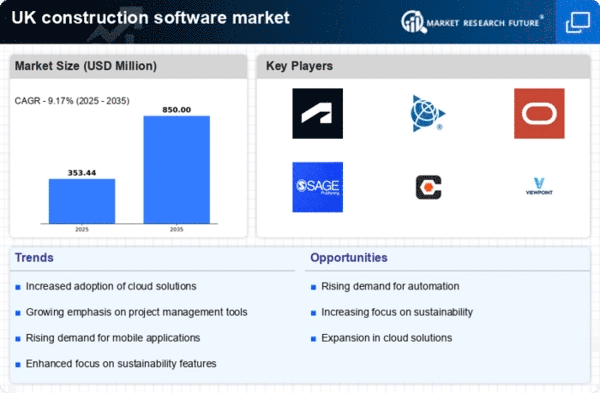
UK Construction Software Market Infographic
Purchase Options

UK Construction Software Market Summary

As per MRFR analysis, the UK construction software market size was estimated at 323.75 USD Million in 2024. The UK construction software market is projected to grow from 353.44 USD Million in 2025 to 850.0 USD Million by 2035, exhibiting a compound annual growth rate (CAGR) of 9.17% during the forecast period 2025 - 2035.

Key Market Trends & Highlights

The UK construction software market is experiencing a transformative shift towards advanced technological solutions and sustainability.

  • The largest segment in the UK construction software market is project management tools, which are witnessing increased adoption due to rising demand.
  • Cloud solutions are becoming increasingly prevalent, indicating a shift towards more flexible and scalable software options.
  • AI and data analytics integration is on the rise, suggesting a trend towards enhanced decision-making capabilities in construction projects.
  • Key market drivers include the rising demand for project management tools and the growing emphasis on regulatory compliance and safety standards.

Market Size & Forecast

2024 Market Size 323.75 (USD Million)
2035 Market Size 850.0 (USD Million)
CAGR (2025 - 2035) 9.17%

Major Players

Autodesk (US), Trimble (US), Oracle (US), Sage (GB), Procore (US), Viewpoint (US), Bluebeam (US), PlanGrid (US), CoConstruct (US)

UK Construction Software Market Trends

The construction software market is currently experiencing a transformative phase. This transformation is driven by advancements in technology and the increasing demand for efficiency within the sector. As construction projects become more complex, stakeholders are seeking innovative solutions that streamline operations, enhance collaboration, and improve project management. The integration of cloud-based platforms and mobile applications is reshaping how teams communicate and share information, leading to more agile workflows. Furthermore, the emphasis on sustainability and regulatory compliance is prompting software developers to incorporate features that address these critical areas, thereby aligning with industry standards and expectations. In addition, the construction software market is witnessing a rise in the adoption of data analytics and artificial intelligence. These technologies enable firms to make informed decisions based on real-time data, ultimately reducing costs and improving project outcomes. As the industry continues to evolve, the focus on user-friendly interfaces and customizable solutions is likely to grow, catering to the diverse needs of various stakeholders. Overall, the construction software market is poised for significant growth, driven by technological advancements and a commitment to enhancing operational efficiency.

Increased Adoption of Cloud Solutions

The construction software market is seeing a marked shift towards cloud-based solutions. This trend allows for enhanced accessibility and collaboration among project teams, regardless of location. Stakeholders can access real-time data and updates, which facilitates better decision-making and project management.

Integration of AI and Data Analytics

The incorporation of artificial intelligence and data analytics is becoming more prevalent within the construction software market. These technologies provide valuable insights that help firms optimize resource allocation, predict project risks, and improve overall efficiency.

Focus on Sustainability Features

There is a growing emphasis on sustainability within the construction software market. Software developers are increasingly integrating features that support environmentally friendly practices, enabling firms to track their carbon footprint and comply with regulatory requirements.

UK Construction Software Market Drivers

Increased Focus on Cost Management

Cost management remains a critical driver in the construction software market, as firms seek to optimize budgets and reduce waste. The UK construction industry is witnessing a shift towards software solutions that offer advanced budgeting and forecasting capabilities. With construction costs rising, companies are leveraging software to gain insights into expenditure patterns and identify cost-saving opportunities. A recent survey revealed that 60% of construction firms in the UK consider cost management software essential for maintaining profitability, highlighting its pivotal role in the construction software market.

Growing Emphasis on Collaboration Tools

Collaboration tools are becoming increasingly vital in the construction software market, as projects often involve multiple stakeholders, including contractors, architects, and clients. The UK construction sector is embracing software that enhances collaboration through shared platforms and communication channels. This trend is reflected in a study showing that 65% of construction professionals believe that effective collaboration tools lead to better project outcomes. As the industry evolves, the demand for software that fosters teamwork and information sharing is likely to grow, further shaping the construction software market.

Regulatory Compliance and Safety Standards

The construction software market is significantly influenced by stringent regulatory compliance and safety standards. These standards are imposed by the UK government. As construction projects become more complex, the need for software that ensures adherence to health and safety regulations is paramount. Companies are investing in software solutions that provide compliance tracking and reporting features, which are essential for avoiding legal repercussions. The market is projected to grow by 15% annually as firms prioritize compliance, indicating a strong correlation between regulatory demands and software adoption in the construction software market.

Rising Demand for Project Management Tools

The construction software market experiences a notable surge in demand for project management tools. This surge is driven by the need for enhanced efficiency and collaboration among stakeholders. In the UK, construction firms are increasingly adopting software solutions that facilitate real-time communication, task tracking, and resource allocation. This trend is underscored by a report indicating that 70% of construction companies in the UK have integrated project management software into their operations. Such tools not only streamline workflows but also contribute to improved project outcomes, thereby reinforcing their importance in the construction software market.

Technological Advancements in Building Information Modeling (BIM)

Technological advancements in Building Information Modeling (BIM) are significantly impacting the construction software market. BIM software enables construction firms to create detailed digital representations of physical structures, facilitating better planning and execution. In the UK, the adoption of BIM is becoming a standard practice, with government initiatives promoting its use in public sector projects. The construction software market is expected to expand by 20%. This expansion is due to more companies recognizing the benefits of BIM, including improved accuracy and reduced project timelines. This recognition is transforming the landscape of construction management.


Market Segment Insights

Construction Software Market Type Insights

The UK Construction Software Market is experiencing significant growth, driven primarily by the diverse requirements of construction professionals across different segments such as Project Management, Account/Financial Management, Quality Safety, Field Productivity, and Others. The Project Management segment, which is of paramount importance, incorporates software solutions that streamline project planning, scheduling, and resource allocation, empowering managers to optimize operations in line with tight project deadlines and budgets.

Following closely, Account/Financial Management software plays a crucial role in ensuring that financial transactions are tracked efficiently, which is essential for managing costs and maximizing profitability in the competitive landscape of the UK construction industry. Quality Safety software is increasingly recognized for its ability to facilitate compliance with stringent regulations and standards, thereby enhancing worker safety and minimizing operational risks, aligning with the UK government's commitment to improving safety standards in construction. Moreover, Field Productivity solutions are pivotal as they enable on-site teams to monitor progress and productivity in real-time, which is vital for effective decision-making and resource management.

This segment harnesses the technological advancements in mobile and cloud-based applications to improve communication and data sharing during projects. Other software solutions cater to niche requirements in the construction sector, addressing specific operational challenges that might arise. With the distinct features and enhancements offered by each of these segments, the UK Construction Software Market is witnessing a dynamic evolution, with stakeholders acknowledging the continuous integration of technology to drive efficiency and innovation in construction projects nationwide. This growth reflects the broader trends of digital transformation within the construction sector, where companies seek to adopt advanced technological solutions to stay competitive.

As the market continues to mature, the responsive nature of software solutions in this industry underscores the potential for advancements that align with contemporary construction practices and regulatory frameworks. The ongoing shift towards automation and data-driven decision-making marks a transformative era for the construction market in the UK, fostering an environment of continuous improvement and adaptation.

Fig 2: UK Construction Software Market Insights

Fig 2: UK Construction Software Market Insights

Source: Primary Research, Secondary Research, Market Research Future Database and Analyst Review

Construction Software Market Deployment Mode Insights

The UK Construction Software Market showcases a diverse Deployment Mode segment that significantly influences industry dynamics and operations. The cloud deployment method is increasingly popular due to its scalability, flexibility, and cost-effectiveness, allowing construction firms to access software applications remotely while reducing the need for extensive on-premises infrastructure. This trend aligns with the broader shift towards digital transformation in the UK construction sector, where innovative solutions drive efficiency and collaboration among stakeholders.

Conversely, on-premises deployment remains a viable option, particularly for organizations prioritizing data security and control, often preferred by larger enterprises that require customized solutions tailored to complex project demands. The growing complexity of construction projects in the UK drives demand for both deployment modes as firms seek to leverage the strengths of each approach. With the construction sector being a key contributor to the UK economy, the continuous evolution in deployment preferences reflects not only technological advancements but also evolving regulatory requirements and industry standards, thereby shaping the future landscape of the UK Construction Software Market.

Construction Software Market Organization Size Insights

The UK Construction Software Market revenue showcases a diverse landscape shaped by organization size, prominently featuring Large Enterprises and Small and Medium Enterprises. Large Enterprises significantly influence market dynamics due to their extensive resources and demand for comprehensive software solutions that enhance project efficiency and risk management. They tend to adopt advanced technologies and integrate software systems that facilitate seamless operations across multiple sites, allowing for greater innovation and scalability. In contrast, Small and Medium Enterprises play a crucial role in the UK construction industry, often characterized by their agility and the ability to quickly adapt to changing market conditions.

These organizations typically focus on specialized software solutions that cater to specific needs, driving the demand for cost-effective and user-friendly tools. The UK government’s initiatives to support SMEs further bolster their position in the market, highlighting the increasing importance of this segment as it strives to enhance productivity and competitiveness. Overall, the segmentation within the UK Construction Software Market indicates that both organization sizes contribute uniquely to market growth, with each facing distinct challenges and opportunities, allowing for dynamic market interactions and advancements in technology adoption.

Construction Software Market Application Insights

The UK Construction Software Market within the Application segment is witnessing steady growth as technology continues to reshape the construction landscape. Key players in this market include General Contractors, Building Owners, Architects and Engineers, Sub-Contractors, and Specialty Contractors, each segment having its unique needs. General Contractors often rely on software solutions for project management, enhancing efficiency and collaboration directly on-site. Building Owners seek tools that facilitate better property management and maintenance scheduling, illustrating the shift toward digital asset management. Architects and Engineers benefit from design and modeling software, allowing them to create accurate blueprints while ensuring compliance with local regulations.

Sub-Contractors are increasingly adopting software that aids in tracking labor and material costs, thus improving profitability. Specialty Contractors dealing with niche areas of construction commonly use tailored software that meets their specific operational needs. The growing trend towards integrated solutions within these applications helps in data sharing and streamlining workflows, thereby enhancing project outcomes significantly. The overall market dynamics indicate a favorable environment for innovation, automation, and productivity across the construction industry in the UK, driven by a collective push towards digital transformation.

Get more detailed insights about UK Construction Software Market

Key Players and Competitive Insights

The construction software market is currently characterized by a dynamic competitive landscape, driven by technological advancements and increasing demand for efficiency in project management. Key players such as Autodesk (US), Trimble (US), and Sage (GB) are strategically positioned to leverage innovation and digital transformation. Autodesk (US) focuses on enhancing its cloud-based solutions, which facilitates collaboration and real-time data access, thereby improving project outcomes. Trimble (US) emphasizes its commitment to integrating advanced technologies like AI and machine learning into its offerings, which enhances predictive analytics and operational efficiency. Sage (GB) is concentrating on expanding its market presence through strategic partnerships, which allows it to offer tailored solutions that meet the specific needs of various construction sectors. Collectively, these strategies contribute to a competitive environment that prioritizes technological integration and customer-centric solutions.

The market structure appears moderately fragmented, with several players vying for market share while also collaborating through partnerships and alliances. Key business tactics include localizing software solutions to cater to regional needs and optimizing supply chains to enhance service delivery. This fragmentation allows for a diverse range of offerings, enabling companies to differentiate themselves based on innovation and customer service rather than solely on price.

In October 2025, Autodesk (US) announced the launch of its new AI-driven project management tool, which aims to streamline workflows and enhance decision-making processes for construction managers. This strategic move is significant as it positions Autodesk at the forefront of the digital transformation trend within the industry, potentially increasing its market share by attracting clients seeking cutting-edge solutions. The integration of AI into project management tools is likely to redefine operational efficiencies and project outcomes.

In September 2025, Trimble (US) expanded its partnership with a leading construction firm to implement its advanced data analytics platform across multiple projects. This collaboration is crucial as it not only showcases Trimble's commitment to enhancing data-driven decision-making but also reinforces its position as a leader in the integration of technology within construction processes. Such partnerships may enhance Trimble's credibility and visibility in the market, potentially leading to further collaborations.

In August 2025, Sage (GB) launched a new suite of cloud-based financial management tools specifically designed for the construction sector. This initiative reflects Sage's strategic focus on addressing the unique financial challenges faced by construction companies. By providing tailored financial solutions, Sage aims to strengthen its competitive edge and foster customer loyalty, which is essential in a market where financial management is increasingly complex.

As of November 2025, the construction software market is witnessing trends that emphasize digitalization, sustainability, and the integration of AI technologies. Strategic alliances are becoming increasingly important, as they enable companies to pool resources and expertise, thereby enhancing their competitive positioning. The shift from price-based competition to a focus on innovation and technology is evident, as companies strive to differentiate themselves through advanced solutions and reliable supply chains. Looking ahead, competitive differentiation is likely to evolve further, with an emphasis on sustainable practices and the ability to adapt to rapidly changing market demands.

Key Companies in the UK Construction Software Market market include

Industry Developments

The UK Construction Software Market has witnessed significant developments recently, particularly with advancements in cloud-based solutions and collaborative platforms. Companies like Procore, Autodesk, and PlanGrid are seeing increased adoption of their tools, driven by the necessity for enhanced project management and real-time data analytics. In August 2023, CMiC announced a partnership with several UK construction firms to bolster digital transformation initiatives, highlighting the shift towards integrated software solutions. Meanwhile, in September 2023, Bluebeam launched a new version of its software tailored for UK markets, focusing on improving mobile performance and user engagement.

Mergers and acquisitions are also notable; Aconex was acquired by Oracle in January 2022 to enhance its cloud capabilities, which aligns with the growing need for cloud infrastructure in the UK construction sector. The market is responding positively, as reflected by an estimated market growth of approximately 10% year-over-year, according to the Construction Industry Training Board in the UK, driven by increased investment in technology solutions to meet regulatory standards and efficiency demands. Companies like Sage and Trimble are adapting by offering innovative solutions aimed at improving workflow efficiency within the construction landscape.

Future Outlook

UK Construction Software Market Future Outlook

The construction software market is projected to grow at a 9.17% CAGR from 2024 to 2035, driven by technological advancements, increased automation, and demand for efficiency.

New opportunities lie in:

  • Integration of AI-driven project management tools
  • Development of mobile applications for real-time site management
  • Expansion of cloud-based collaboration platforms for remote teams

By 2035, the market is expected to be robust, driven by innovation and increased adoption of technology.

Market Segmentation

UK Construction Software Market Type Outlook

  • Project Management
  • Financial Management
  • Quality and Safety
  • Field Productivity
  • Others

UK Construction Software Market Application Outlook

  • General Contractors
  • Building Owners
  • Architects and Engineers
  • Specialty Contractors
  • Sub-Contractors

UK Construction Software Market Deployment Mode Outlook

  • Cloud
  • On-Premise

UK Construction Software Market Organization Size Outlook

  • Large Enterprises
  • Small and Medium-Sized Enterprises (SMEs)

Report Scope

MARKET SIZE 2024 323.75(USD Million)
MARKET SIZE 2025 353.44(USD Million)
MARKET SIZE 2035 850.0(USD Million)
COMPOUND ANNUAL GROWTH RATE (CAGR) 9.17% (2024 - 2035)
REPORT COVERAGE Revenue Forecast, Competitive Landscape, Growth Factors, and Trends
BASE YEAR 2024
Market Forecast Period 2025 - 2035
Historical Data 2019 - 2024
Market Forecast Units USD Million
Key Companies Profiled Autodesk (US), Trimble (US), Oracle (US), Sage (GB), Procore (US), Viewpoint (US), Bluebeam (US), PlanGrid (US), CoConstruct (US)
Segments Covered Type, Deployment Mode, Organization Size, Application
Key Market Opportunities Integration of artificial intelligence and machine learning enhances project management in the construction software market.
Key Market Dynamics Growing demand for integrated solutions drives innovation and competition in the construction software market.
Countries Covered UK

Leave a Comment

FAQs

What is the expected market size of the UK Construction Software Market in 2024?

The UK Construction Software Market is expected to be valued at 277.5 million USD in 2024.

What is the projected market size for the UK Construction Software Market in 2035?

The market is projected to reach 682.5 million USD in 2035.

What is the expected CAGR for the UK Construction Software Market from 2025 to 2035?

The expected CAGR for the market from 2025 to 2035 is 8.525%.

What are the key players in the UK Construction Software Market?

Major players include Viewpoint, Aconex, BuildTools, PlanGrid, Sage, Autodesk, CMiC, Bluebeam, and Procore.

How large is the project management segment of the market in 2024?

The project management segment is valued at 100.0 million USD in 2024.

What is the expected market value for account/financial management software in 2035?

The market value for account/financial management software is expected to reach 160.0 million USD in 2035.

What is the projected value of the quality & safety segment by 2035?

The quality & safety segment is projected to be valued at 90.0 million USD by 2035.

What opportunities for growth exist in the UK Construction Software Market?

The growth can be driven by increasing demand for efficient project management and safety solutions across the construction industry.

What is the expected value of the field productivity segment in 2024?

The field productivity segment is expected to be valued at 35.0 million USD in 2024.

What are the primary growth drivers for the UK Construction Software Market?

Key growth drivers include advancements in technology and increasing investments in construction projects.

Download Free Sample

Kindly complete the form below to receive a free sample of this Report

Compare Licence

×
Features License Type
Single User Multiuser License Enterprise User
Price $4,950 $5,950 $7,250
Maximum User Access Limit 1 User Upto 10 Users Unrestricted Access Throughout the Organization
Free Customization
Direct Access to Analyst
Deliverable Format
Platform Access
Discount on Next Purchase 10% 15% 15%
Printable Versions