Request Free Sample ×

Kindly complete the form below to receive a free sample of this Report

* Please use a valid business email

Leading companies partner with us for data-driven Insights

clients tt-cursor
Hero Background
English
Chinese
French
Japanese
Korean
German
Spanish

U.S. Tile Adhesive Market Analysis

ID: MRFR/CnM/2922-CR
57 Pages
Chitranshi Jaiswal
Last Updated: March 06, 2026

U.S. Tile Adhesive Market Research Report Information By Type (Cementitious Adhesive, Dispersion Adhesive, and Reactive Resin Adhesive), By End User (Residential and Non-Residential), And By Country (The U.S.) –Market Forecast Till 2035

Share:
Download PDF ×

We do not share your information with anyone. However, we may send you emails based on your report interest from time to time. You may contact us at any time to opt-out.

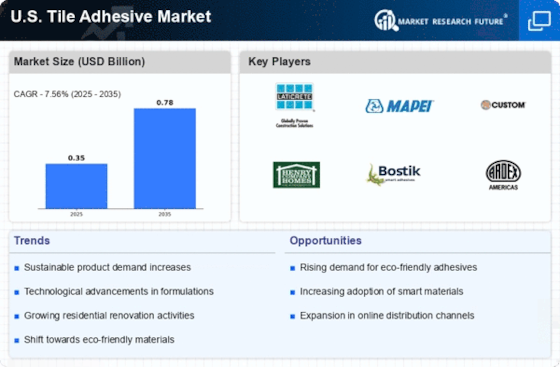
U.S. Tile Adhesive Market Infographic
Purchase Options

Market Analysis

In-depth Analysis of U.S. Tile Adhesive Market Industry Landscape

The escalating growth of the construction industry in developing nations like India, China, Thailand, and Indonesia is poised to significantly impact the demand for tile adhesives. This growth surge can be attributed to multiple factors, including the continuous expansion of residential construction projects, the steady rise in population, and the increased per capita disposable income. These nations are witnessing a notable uptick in residential construction activities driven by population growth and an enhanced standard of living, thereby fostering a substantial demand for tile adhesives.

Moreover, government-led initiatives and investments in commercial construction projects across various developing countries, including Thailand, Indonesia, and Malaysia, are further bolstering the tile adhesive market. Governments in these nations have been channeling substantial investments into infrastructure development, particularly in commercial spaces. For instance, China reported a 4.3% year-on-year increase in infrastructure spending by the government in the initial months of 2019, up from 3.8% in 2018. This robust investment serves as a significant driver, amplifying the demand for construction materials like tile adhesives.

Additionally, India's government allocated a substantial budget of approximately USD 63.2 billion to bolster the infrastructure sector in 2018. This strategic financial allocation indicates a strong commitment to infrastructure development, which is expected to catalyze the growth of the tile adhesive market. The investment in infrastructure across these nations is anticipated to create a conducive environment for the construction industry, further augmenting the demand for tile adhesives as an integral component in building and construction activities.

The projected surge in demand for tile adhesives in these developing economies mirrors the pivotal role these adhesives play in ensuring durable and resilient tile installations across various construction projects. As the construction industry in these nations continues to expand, driven by both residential and commercial developments supported by government initiatives, the market for tile adhesives is poised for sustained growth, offering ample opportunities for manufacturers and suppliers in the construction materials sector.

Author
Author Profile
Chitranshi Jaiswal
Team Lead - Research

Chitranshi is a Team Leader in the Chemicals & Materials (CnM) and Energy & Power (EnP) domains, with 6+ years of experience in market research. She leads and mentors teams to deliver cross-domain projects that equip clients with actionable insights and growth strategies. She is skilled in market estimation, forecasting, competitive benchmarking, and both primary & secondary research, enabling her to turn complex data into decision-ready insights. An engineer and MBA professional, she combines technical expertise with strategic acumen to solve dynamic market challenges. Chitranshi has successfully managed projects that support market entry, investment planning, and competitive positioning, while building strong client relationships. Certified in Advanced Excel & Power BI she leverages data-driven approaches to ensure accuracy, clarity, and impactful outcomes.

Leave a Comment

FAQs

What is the current valuation of the US Tile Adhesive Market?

<p>The US Tile Adhesive Market was valued at 3.52 USD Billion in 2024.</p>

What is the projected market size for the US Tile Adhesive Market by 2035?

<p>The market is projected to reach 12.48 USD Billion by 2035.</p>

What is the expected CAGR for the US Tile Adhesive Market during the forecast period?

<p>The expected CAGR for the US Tile Adhesive Market from 2025 to 2035 is 12.2%.</p>

Which application segments are leading in the US Tile Adhesive Market?

<p>The leading application segments include Flooring, Wall Tiling, and Countertops, with valuations of 3.68, 2.98, and 2.3 USD Billion respectively by 2035.</p>

How does the residential sector perform in the US Tile Adhesive Market?

<p>The residential sector was valued at 1.05 USD Billion in 2024 and is expected to grow to 3.68 USD Billion by 2035.</p>

What are the key product types in the US Tile Adhesive Market?

<p>Key product types include Cement-Based Adhesives, Epoxy Adhesives, and Polyurethane Adhesives, with projected valuations of 6.24, 2.88, and 1.48 USD Billion respectively by 2035.</p>

Which companies are considered key players in the US Tile Adhesive Market?

<p>Key players include Laticrete International Inc, Mapei Corporation, and Bostik Inc, among others.</p>

What is the market outlook for outdoor applications in the US Tile Adhesive Market?

<p>The outdoor applications segment is projected to grow from 0.47 USD Billion in 2024 to 1.67 USD Billion by 2035.</p>

How does the commercial sector compare to the industrial sector in the US Tile Adhesive Market?

<p>The commercial sector is expected to grow from 1.15 USD Billion in 2024 to 4.12 USD Billion by 2035, outperforming the industrial sector, which is projected to grow to 3.06 USD Billion.</p>

What formulation types are prevalent in the US Tile Adhesive Market?

<p>Prevalent formulation types include Ready-to-Use, Powdered, and Liquid, with projected valuations of 3.68, 4.94, and 3.86 USD Billion respectively by 2035.</p>

Market Summary

As per analysis, the US Tile Adhesive Market is projected to grow from USD 3.99 Billion in 2025 to USD 12.48 Billion by 2035, exhibiting a compound annual growth rate (CAGR) of 12.2% during the forecast period (2025 - 2035).

Key Market Trends & Highlights

The US Tile Adhesive Market is poised for growth driven by sustainability and innovation.

  • Sustainability in product development is becoming a central theme in the US Tile Adhesive Market.
  • The flooring segment remains the largest, while wall tiling is emerging as the fastest-growing segment.
  • Residential applications dominate the market, yet commercial projects are witnessing rapid expansion.
  • Rising construction activities and an increased focus on aesthetic appeal are key drivers propelling market growth.

Market Size & Forecast

2024 Market Size 3.52 (USD Billion)
2035 Market Size 12.48 (USD Billion)
CAGR (2025 - 2035) 12.2%

Major Players

<p>Laticrete International Inc (US), Mapei Corporation (US), Bostik Inc (US), Custom Building Products (US), Henry Company (US), Ardex Group (US), Sika Corporation (US), Weber (US), Dunlop Adhesives (US)</p>

Market Trends

The US Tile Adhesive Market is currently experiencing a dynamic phase characterized by evolving consumer preferences and technological advancements. The demand for tile adhesives is driven by the construction and renovation sectors, where the need for durable and efficient bonding solutions is paramount. As residential and commercial projects proliferate, the market appears to be adapting to the increasing emphasis on sustainability and eco-friendly products. Manufacturers are likely focusing on developing adhesives that not only meet performance standards but also align with environmental regulations, thereby appealing to a more conscientious consumer base. Moreover, the rise in DIY home improvement projects has contributed to the growth of the US Tile Adhesive Market. Homeowners are increasingly seeking user-friendly products that facilitate easy application and provide reliable results. This trend suggests a shift towards more accessible solutions, which may encourage greater participation in home renovation activities. As the market evolves, it seems poised to embrace innovations that enhance product performance while addressing the growing demand for sustainable practices in the construction industry.

Sustainability in Product Development

The US Tile Adhesive Market is witnessing a notable shift towards sustainable product offerings. Manufacturers are increasingly prioritizing eco-friendly materials and formulations that minimize environmental impact. This trend aligns with broader consumer preferences for green building practices, suggesting that companies may invest in research and development to create adhesives that comply with stringent environmental regulations.

Growth of DIY Projects

The rise of DIY home improvement initiatives is significantly influencing the US Tile Adhesive Market. As more homeowners engage in renovation projects, there is a growing demand for user-friendly adhesive solutions. This trend indicates that manufacturers might focus on creating products that are easy to apply, thereby appealing to a broader audience and potentially increasing market penetration.

Technological Advancements in Adhesive Formulations

Technological innovation is playing a crucial role in shaping the US Tile Adhesive Market. Advances in adhesive formulations are leading to improved performance characteristics, such as enhanced bonding strength and faster curing times. This trend suggests that manufacturers are likely to continue exploring new technologies to meet the evolving needs of the construction and renovation sectors.

U.S. Tile Adhesive Market Market Drivers

Rising Construction Activities

The US Tile Adhesive Market is experiencing a notable surge due to the increasing construction activities across residential and commercial sectors. According to recent data, the construction industry in the United States is projected to grow at a compound annual growth rate (CAGR) of approximately 5% over the next few years. This growth is driven by urbanization, population growth, and the need for infrastructure development. As new buildings and renovations emerge, the demand for tile adhesives is expected to rise correspondingly. The US Tile Adhesive Market benefits from this trend, as contractors and builders seek high-quality adhesive solutions to ensure durability and performance in their projects. Consequently, the market is likely to witness a robust expansion fueled by these construction activities.

Growth of the Renovation Market

The US Tile Adhesive Market is significantly impacted by the growth of the renovation market, as homeowners increasingly invest in upgrading their living spaces. Data shows that the home renovation market in the United States is expected to reach a value of over 400 billion dollars by 2026. This trend is driven by factors such as rising disposable incomes, changing lifestyles, and the desire for modernized homes. As renovations often involve the installation of new tiles, the demand for tile adhesives is likely to increase. The US Tile Adhesive Market stands to benefit from this trend, as homeowners and contractors seek reliable adhesive solutions to ensure the longevity and aesthetic appeal of their renovations.

Increased Focus on Aesthetic Appeal

The US Tile Adhesive Market is significantly influenced by the growing emphasis on aesthetic appeal in interior and exterior design. Homeowners and designers are increasingly opting for tiles that enhance the visual appeal of spaces, leading to a higher demand for effective tile adhesives. The market data indicates that the demand for decorative tiles has risen, with a corresponding increase in the need for adhesives that can support these products. This trend is particularly evident in urban areas where modern design concepts are prevalent. As a result, manufacturers in the US Tile Adhesive Market are innovating to develop adhesives that not only provide strong bonding but also cater to the aesthetic requirements of contemporary architecture.

Regulatory Support for Sustainable Practices

The US Tile Adhesive Market is benefiting from regulatory support aimed at promoting sustainable practices within the construction sector. Government initiatives and policies are increasingly encouraging the use of eco-friendly materials, including low-VOC (volatile organic compounds) adhesives. This regulatory environment is fostering innovation among manufacturers, who are now focusing on developing sustainable adhesive solutions that meet these standards. Market data suggests that the demand for green building materials is on the rise, with a significant portion of new constructions aiming for LEED certification. Consequently, the US Tile Adhesive Market is likely to see a shift towards more sustainable adhesive products, aligning with broader environmental goals.

Technological Innovations in Adhesive Formulations

The US Tile Adhesive Market is witnessing a wave of technological innovations that are enhancing adhesive formulations. Advances in chemistry and material science are leading to the development of high-performance adhesives that offer superior bonding capabilities, flexibility, and resistance to environmental factors. For instance, the introduction of polymer-modified adhesives has improved the performance of tile installations, making them more durable and reliable. Market data indicates that these innovations are driving growth in the industry, as contractors and builders increasingly prefer advanced adhesive solutions that can withstand the rigors of various applications. As technology continues to evolve, the US Tile Adhesive Market is poised for further advancements that will redefine adhesive performance.

Market Segment Insights

By Application: Flooring (Largest) vs. Wall Tiling (Fastest-Growing)

<p>In the US Tile Adhesive Market, the application segment showcases a diverse range of uses, with flooring leading in market share due to its widespread application in residential and commercial spaces. Wall tiling follows, contributing significantly to overall demand, while countertops and backsplashes also present considerable shares. Outdoor applications, although less dominant, add to the growth potential of the segment, catering to landscaping and outdoor living spaces.</p>

<p>Flooring (Dominant) vs. Wall Tiling (Emerging)</p>

<p>Flooring exhibits a dominant presence in the US Tile Adhesive Market, driven by the growing popularity of tile flooring in various environments, including homes, offices, and retail spaces. This segment benefits from the durability and aesthetic appeal of tile materials. In contrast, wall tiling emerges as an exceptionally fast-growing category, fueled by trends in interior design and remodeling projects. The increased consumer preference for decorative wall applications and innovative tile designs enhances its appeal. Both segments are characterized by a robust demand for high-performance adhesive products that ensure lasting adherence and support a range of installation conditions.</p>

By End Use: Residential (Largest) vs. Commercial (Fastest-Growing)

<p>In the US Tile Adhesive Market, the distribution of market share among end-use segments reveals significant insights. The residential segment dominates the market, driven by increased building and remodeling activities. Homeowners are increasingly investing in high-quality tile solutions, favoring durable and aesthetically pleasing adhesive options. In contrast, the commercial segment is also substantial, driven by the growing demand in hospitality and retail sectors, which has led to an increase in flooring and wall cladding projects. Growth trends within this segment are shaped by evolving consumer preferences and economic incentives. The residential market continues to thrive, supported by home renovation trends and new construction projects. On the other hand, the commercial segment is experiencing rapid growth, thanks to increased construction activities and a rise in commercial real estate investments, which are expected to drive the demand for tile adhesives in flooring and wall applications.</p>

<p>Residential (Dominant) vs. Institutional (Emerging)</p>

<p>The residential segment stands out as the dominant player in the US Tile Adhesive Market, primarily characterized by a strong consumer focus on home improvement and renovation projects. This segment benefits from a growing trend of homeowners prioritizing quality and aesthetics in their tile applications. In contrast, the institutional segment is emerging, driven by ongoing investments in infrastructure, educational facilities, and healthcare projects. Institutional customers tend to seek durable and high-performance adhesive solutions that meet specific regulatory standards. As these sectors grow, demand for specialized tile adhesives that accommodate high traffic and versatility increases, indicating a notable shift in market dynamics.</p>

By Product Type: Cement-Based Adhesives (Largest) vs. Epoxy Adhesives (Fastest-Growing)

<p>The US Tile Adhesive Market is dominated by Cement-Based Adhesives, which hold the largest market share due to their widespread use in various applications ranging from residential to commercial projects. Similarly, Epoxy Adhesives are gaining traction, appealing to niche markets that require superior performance characteristics, such as high adhesion and chemical resistance. Together, these two segments represent a significant portion of the overall market, reflecting trends towards durability and reliability in adhesive solutions.</p>

<p>Cement-Based (Dominant) vs. Epoxy (Emerging)</p>

<p>Cement-Based Adhesives are known for their versatility and robustness, making them the preferred choice in the US Tile Adhesive Market for a wide array of applications. They provide strong adhesion for ceramic, porcelain, and stone tiles, given their excellent performance under varying environmental conditions. On the other hand, Epoxy Adhesives are emerging as a key player due to their exceptional bonding capabilities and resistance to moisture and chemicals. These characteristics make them suitable for specialized applications, particularly in areas like industrial flooring and pool installations, where enhanced performance attributes are crucial.</p>

By Formulation Type: Ready-to-Use (Largest) vs. Powdered (Fastest-Growing)

<p>In the US Tile Adhesive Market, the formulation type segment reveals a significant distribution between Ready-to-Use, Powdered, and Liquid tile adhesives. Ready-to-Use adhesives hold the largest market share, preferred for their convenience and ease of application. Powdered adhesives, while relatively smaller in market share, are witnessing a robust growth trend, driven by a rising demand for versatile and high-performance solutions, especially in commercial constructions. The Liquid formulation, although appealing for certain applications, occupies a niche segment due to its specific use cases. The growth trends in the formulation type segment are influenced by several factors, including evolving consumer preferences towards ready-to-use solutions that offer rapid application and reduced labor costs. Additionally, the Powdered segment is experiencing a surge in demand driven by advancements in product formulations, catering to eco-conscious consumers seeking sustainable and high-performance adhesives. As DIY projects gain popularity, especially post-pandemic, the market for Ready-to-Use and Powdered adhesives is expected to expand significantly.</p>

<p>Formulation Type: Ready-to-Use (Dominant) vs. Powdered (Emerging)</p>

<p>The Ready-to-Use tile adhesive segment dominates the US market due to its unparalleled convenience, allowing for immediate use without the need for mixing. This formulation is favored in both residential and light commercial applications where efficiency is paramount. The Powdered segment, on the other hand, is emerging as a strong competitor, particularly in large-scale and industrial projects where customizable properties and superior bonding strength are required. Powdered adhesives can be tailored for specific environments, offering enhanced performance in varying conditions. Despite Ready-to-Use's dominance, the growing emphasis on sustainable building materials and high-performance standards is paving the way for Powdered adhesives to capture a larger share of the market, making it a noteworthy segment to watch.</p>

Get more detailed insights about U.S. Tile Adhesive Market Research Report- Forecast till 2035

Regional Insights

North America : Market Leader in Tile Adhesives

The North American tile adhesive market is driven by a robust construction sector, increasing renovation activities, and a growing preference for sustainable building materials. The U.S. holds the largest market share at approximately 70%, followed by Canada at around 15%. Regulatory support for green building initiatives further fuels demand, as consumers and builders seek eco-friendly options. Leading players in this region include Laticrete International Inc, Mapei Corporation, and Custom Building Products, which dominate the competitive landscape. The presence of these key players ensures a diverse range of products catering to various applications, from residential to commercial projects. The market is characterized by innovation and a focus on high-performance adhesives, meeting the evolving needs of consumers and contractors alike.

Europe : Emerging Market Dynamics

The European tile adhesive market is witnessing significant growth, driven by increasing construction activities and a rising demand for high-quality flooring solutions. Germany and France are the largest markets, holding approximately 30% and 20% of the market share, respectively. Regulatory frameworks promoting energy efficiency and sustainable construction practices are key catalysts for market expansion. Countries like Italy and the UK are also contributing to the market's growth, with a competitive landscape featuring major players such as Mapei and Sika. The presence of these companies ensures a wide range of innovative products tailored to meet diverse consumer needs. The market is characterized by a shift towards eco-friendly adhesives, aligning with the region's sustainability goals.

Asia-Pacific : Rapid Expansion in Asia-Pacific

The Asia-Pacific tile adhesive market is experiencing rapid growth, driven by urbanization, increasing disposable incomes, and a booming construction industry. China and India are the largest markets, accounting for approximately 40% and 25% of the market share, respectively. Government initiatives to improve infrastructure and housing are significant growth drivers, further enhancing market potential. Countries like Japan and Australia are also witnessing increased demand for tile adhesives, with a competitive landscape featuring key players such as Sika and Ardex. The market is characterized by a focus on innovation and product development, catering to the diverse needs of consumers and contractors. The presence of established companies ensures a steady supply of high-quality adhesive solutions.

Middle East and Africa : Emerging Opportunities in MEA

The Middle East and Africa tile adhesive market is on the rise, driven by rapid urbanization, infrastructure development, and a growing construction sector. The UAE and South Africa are the largest markets, holding approximately 30% and 20% of the market share, respectively. Government investments in infrastructure projects and housing developments are key factors propelling market growth. Countries like Saudi Arabia and Nigeria are also contributing to the market's expansion, with a competitive landscape featuring local and international players. The presence of companies such as Bostik and Dunlop Adhesives ensures a diverse range of products tailored to meet regional demands. The market is characterized by increasing adoption of advanced adhesive technologies, enhancing performance and sustainability.

Key Players and Competitive Insights

The Tile Adhesive Market in the US is characterized by a competitive landscape that is both dynamic and multifaceted. Key growth drivers include the increasing demand for residential and commercial construction, coupled with a heightened focus on sustainable building practices. Major players such as Laticrete International Inc (US), Mapei Corporation (US), and Bostik Inc (US) are strategically positioned to leverage these trends. Laticrete International Inc (US) emphasizes innovation in product development, particularly in eco-friendly adhesives, while Mapei Corporation (US) focuses on expanding its product portfolio through strategic acquisitions. Bostik Inc (US) is enhancing its market presence by investing in digital transformation initiatives, which collectively shape a competitive environment that is increasingly reliant on technological advancements and sustainability initiatives.

In terms of business tactics, companies are localizing manufacturing to reduce lead times and optimize supply chains. The market structure appears moderately fragmented, with several key players holding substantial market shares. This fragmentation allows for a diverse range of products and innovations, yet the collective influence of these major companies drives a competitive atmosphere where differentiation is crucial.

In December 2025, Laticrete International Inc (US) announced the launch of a new line of low-VOC tile adhesives aimed at the environmentally conscious consumer. This strategic move not only aligns with current sustainability trends but also positions Laticrete as a leader in eco-friendly solutions, potentially attracting a broader customer base concerned with environmental impact.

In November 2025, Mapei Corporation (US) completed the acquisition of a regional adhesive manufacturer, which is expected to enhance its distribution capabilities and product offerings in the Midwest. This acquisition signifies Mapei's commitment to expanding its market reach and improving operational efficiencies, thereby strengthening its competitive position in the market.

In October 2025, Bostik Inc (US) launched a digital platform designed to streamline customer interactions and improve service delivery. This initiative reflects a growing trend towards digitalization in the industry, allowing Bostik to enhance customer engagement and operational efficiency, which may lead to increased market share.

As of January 2026, current competitive trends in the Tile Adhesive Market are increasingly defined by digitalization, sustainability, and the integration of advanced technologies such as AI. Strategic alliances among key players are shaping the landscape, fostering innovation and collaboration. The competitive differentiation is likely to evolve from traditional price-based competition to a focus on innovation, technology, and supply chain reliability, as companies seek to meet the demands of a more discerning consumer base.

Key Companies in the U.S. Tile Adhesive Market include

Industry Developments

March 2022: Berger Fosroc Ltd, a collaboration between Berger Paints Bangladesh and Fosroc International Ltd, has established a manufacturing facility in Bangladesh dedicated to construction chemicals. This initiative aims to cater to the increasing local demand for construction chemical materials and solutions.

February 2022: Sika, a leading specialty chemical company, has expanded its operations in Tanzania and Ivory Coast to enhance its supply of construction materials. Sika has established local production facilities in Tanzania for mortars, tile adhesives, and concrete admixtures. This move eliminates the need for long transportation routes, enabling faster and more reliable delivery to customers. Similarly, in Ivory Coast, Sika has extended its site to double production capacities for tile adhesives and repair mortars while increasing warehousing capabilities.

Future Outlook

U.S. Tile Adhesive Market Future Outlook

The US Tile Adhesive Market is projected to grow at a 12.2% CAGR from 2025 to 2035, driven by increasing construction activities and demand for innovative adhesive solutions.

New opportunities lie in:

  • Expansion into eco-friendly adhesive formulations
  • Development of smart adhesive technologies for real-time monitoring
  • Partnerships with construction firms for integrated supply solutions

By 2035, the market is expected to achieve robust growth, positioning itself as a leader in adhesive solutions.

Market Segmentation

U.S. Tile Adhesive Market End Use Outlook

  • Residential
  • Commercial
  • Industrial
  • Institutional

U.S. Tile Adhesive Market Application Outlook

  • Flooring
  • Wall Tiling
  • Countertops
  • Backsplashes
  • Outdoor Applications

U.S. Tile Adhesive Market Product Type Outlook

  • Cement-Based Adhesives
  • Epoxy Adhesives
  • Polyurethane Adhesives
  • Organic Adhesives

U.S. Tile Adhesive Market Formulation Type Outlook

  • Ready-to-Use
  • Powdered
  • Liquid

Report Scope

MARKET SIZE 2024 3.52(USD Billion)
MARKET SIZE 2025 3.99(USD Billion)
MARKET SIZE 2035 12.48(USD Billion)
COMPOUND ANNUAL GROWTH RATE (CAGR) 12.2% (2024 - 2035)
REPORT COVERAGE Revenue Forecast, Competitive Landscape, Growth Factors, and Trends
BASE YEAR 2024
Market Forecast Period 2025 - 2035
Historical Data 2019 - 2024
Market Forecast Units USD Billion
Key Companies Profiled Laticrete International Inc (US), Mapei Corporation (US), Bostik Inc (US), Custom Building Products (US), Henry Company (US), Ardex Group (US), Sika Corporation (US), Weber (US), Dunlop Adhesives (US)
Segments Covered Application, End Use, Product Type, Formulation Type
Key Market Opportunities Growing demand for eco-friendly tile adhesives driven by sustainability trends and regulatory support in the US.
Key Market Dynamics Rising demand for eco-friendly tile adhesives drives innovation and competition in the US market.
Countries Covered US

FAQs

What is the current valuation of the US Tile Adhesive Market?

<p>The US Tile Adhesive Market was valued at 3.52 USD Billion in 2024.</p>

What is the projected market size for the US Tile Adhesive Market by 2035?

<p>The market is projected to reach 12.48 USD Billion by 2035.</p>

What is the expected CAGR for the US Tile Adhesive Market during the forecast period?

<p>The expected CAGR for the US Tile Adhesive Market from 2025 to 2035 is 12.2%.</p>

Which application segments are leading in the US Tile Adhesive Market?

<p>The leading application segments include Flooring, Wall Tiling, and Countertops, with valuations of 3.68, 2.98, and 2.3 USD Billion respectively by 2035.</p>

How does the residential sector perform in the US Tile Adhesive Market?

<p>The residential sector was valued at 1.05 USD Billion in 2024 and is expected to grow to 3.68 USD Billion by 2035.</p>

What are the key product types in the US Tile Adhesive Market?

<p>Key product types include Cement-Based Adhesives, Epoxy Adhesives, and Polyurethane Adhesives, with projected valuations of 6.24, 2.88, and 1.48 USD Billion respectively by 2035.</p>

Which companies are considered key players in the US Tile Adhesive Market?

<p>Key players include Laticrete International Inc, Mapei Corporation, and Bostik Inc, among others.</p>

What is the market outlook for outdoor applications in the US Tile Adhesive Market?

<p>The outdoor applications segment is projected to grow from 0.47 USD Billion in 2024 to 1.67 USD Billion by 2035.</p>

How does the commercial sector compare to the industrial sector in the US Tile Adhesive Market?

<p>The commercial sector is expected to grow from 1.15 USD Billion in 2024 to 4.12 USD Billion by 2035, outperforming the industrial sector, which is projected to grow to 3.06 USD Billion.</p>

What formulation types are prevalent in the US Tile Adhesive Market?

<p>Prevalent formulation types include Ready-to-Use, Powdered, and Liquid, with projected valuations of 3.68, 4.94, and 3.86 USD Billion respectively by 2035.</p>

  1. SECTION I: EXECUTIVE SUMMARY AND KEY HIGHLIGHTS
    1. | 1.1 EXECUTIVE SUMMARY
    2. | | 1.1.1 Market Overview
    3. | | 1.1.2 Key Findings
    4. | | 1.1.3 Market Segmentation
    5. | | 1.1.4 Competitive Landscape
    6. | | 1.1.5 Challenges and Opportunities
    7. | | 1.1.6 Future Outlook
  2. SECTION II: SCOPING, METHODOLOGY AND MARKET STRUCTURE
    1. | 2.1 MARKET INTRODUCTION
    2. | | 2.1.1 Definition
    3. | | 2.1.2 Scope of the study
    4. | | | 2.1.2.1 Research Objective
    5. | | | 2.1.2.2 Assumption
    6. | | | 2.1.2.3 Limitations
    7. | 2.2 RESEARCH METHODOLOGY
    8. | | 2.2.1 Overview
    9. | | 2.2.2 Data Mining
    10. | | 2.2.3 Secondary Research
    11. | | 2.2.4 Primary Research
    12. | | | 2.2.4.1 Primary Interviews and Information Gathering Process
    13. | | | 2.2.4.2 Breakdown of Primary Respondents
    14. | | 2.2.5 Forecasting Model
    15. | | 2.2.6 Market Size Estimation
    16. | | | 2.2.6.1 Bottom-Up Approach
    17. | | | 2.2.6.2 Top-Down Approach
    18. | | 2.2.7 Data Triangulation
    19. | | 2.2.8 Validation
  3. SECTION III: QUALITATIVE ANALYSIS
    1. | 3.1 MARKET DYNAMICS
    2. | | 3.1.1 Overview
    3. | | 3.1.2 Drivers
    4. | | 3.1.3 Restraints
    5. | | 3.1.4 Opportunities
    6. | 3.2 MARKET FACTOR ANALYSIS
    7. | | 3.2.1 Value chain Analysis
    8. | | 3.2.2 Porter's Five Forces Analysis
    9. | | | 3.2.2.1 Bargaining Power of Suppliers
    10. | | | 3.2.2.2 Bargaining Power of Buyers
    11. | | | 3.2.2.3 Threat of New Entrants
    12. | | | 3.2.2.4 Threat of Substitutes
    13. | | | 3.2.2.5 Intensity of Rivalry
    14. | | 3.2.3 COVID-19 Impact Analysis
    15. | | | 3.2.3.1 Market Impact Analysis
    16. | | | 3.2.3.2 Regional Impact
    17. | | | 3.2.3.3 Opportunity and Threat Analysis
  4. SECTION IV: QUANTITATIVE ANALYSIS
    1. | 4.1 Chemicals and Materials, BY Application (USD Billion)
    2. | | 4.1.1 Flooring
    3. | | 4.1.2 Wall Tiling
    4. | | 4.1.3 Countertops
    5. | | 4.1.4 Backsplashes
    6. | | 4.1.5 Outdoor Applications
    7. | 4.2 Chemicals and Materials, BY End Use (USD Billion)
    8. | | 4.2.1 Residential
    9. | | 4.2.2 Commercial
    10. | | 4.2.3 Industrial
    11. | | 4.2.4 Institutional
    12. | 4.3 Chemicals and Materials, BY Product Type (USD Billion)
    13. | | 4.3.1 Cement-Based Adhesives
    14. | | 4.3.2 Epoxy Adhesives
    15. | | 4.3.3 Polyurethane Adhesives
    16. | | 4.3.4 Organic Adhesives
    17. | 4.4 Chemicals and Materials, BY Formulation Type (USD Billion)
    18. | | 4.4.1 Ready-to-Use
    19. | | 4.4.2 Powdered
    20. | | 4.4.3 Liquid
  5. SECTION V: COMPETITIVE ANALYSIS
    1. | 5.1 Competitive Landscape
    2. | | 5.1.1 Overview
    3. | | 5.1.2 Competitive Analysis
    4. | | 5.1.3 Market share Analysis
    5. | | 5.1.4 Major Growth Strategy in the Chemicals and Materials
    6. | | 5.1.5 Competitive Benchmarking
    7. | | 5.1.6 Leading Players in Terms of Number of Developments in the Chemicals and Materials
    8. | | 5.1.7 Key developments and growth strategies
    9. | | | 5.1.7.1 New Product Launch/Service Deployment
    10. | | | 5.1.7.2 Merger & Acquisitions
    11. | | | 5.1.7.3 Joint Ventures
    12. | | 5.1.8 Major Players Financial Matrix
    13. | | | 5.1.8.1 Sales and Operating Income
    14. | | | 5.1.8.2 Major Players R&D Expenditure. 2023
    15. | 5.2 Company Profiles
    16. | | 5.2.1 Laticrete International Inc (US)
    17. | | | 5.2.1.1 Financial Overview
    18. | | | 5.2.1.2 Products Offered
    19. | | | 5.2.1.3 Key Developments
    20. | | | 5.2.1.4 SWOT Analysis
    21. | | | 5.2.1.5 Key Strategies
    22. | | 5.2.2 Mapei Corporation (US)
    23. | | | 5.2.2.1 Financial Overview
    24. | | | 5.2.2.2 Products Offered
    25. | | | 5.2.2.3 Key Developments
    26. | | | 5.2.2.4 SWOT Analysis
    27. | | | 5.2.2.5 Key Strategies
    28. | | 5.2.3 Bostik Inc (US)
    29. | | | 5.2.3.1 Financial Overview
    30. | | | 5.2.3.2 Products Offered
    31. | | | 5.2.3.3 Key Developments
    32. | | | 5.2.3.4 SWOT Analysis
    33. | | | 5.2.3.5 Key Strategies
    34. | | 5.2.4 Custom Building Products (US)
    35. | | | 5.2.4.1 Financial Overview
    36. | | | 5.2.4.2 Products Offered
    37. | | | 5.2.4.3 Key Developments
    38. | | | 5.2.4.4 SWOT Analysis
    39. | | | 5.2.4.5 Key Strategies
    40. | | 5.2.5 Henry Company (US)
    41. | | | 5.2.5.1 Financial Overview
    42. | | | 5.2.5.2 Products Offered
    43. | | | 5.2.5.3 Key Developments
    44. | | | 5.2.5.4 SWOT Analysis
    45. | | | 5.2.5.5 Key Strategies
    46. | | 5.2.6 Ardex Group (US)
    47. | | | 5.2.6.1 Financial Overview
    48. | | | 5.2.6.2 Products Offered
    49. | | | 5.2.6.3 Key Developments
    50. | | | 5.2.6.4 SWOT Analysis
    51. | | | 5.2.6.5 Key Strategies
    52. | | 5.2.7 Sika Corporation (US)
    53. | | | 5.2.7.1 Financial Overview
    54. | | | 5.2.7.2 Products Offered
    55. | | | 5.2.7.3 Key Developments
    56. | | | 5.2.7.4 SWOT Analysis
    57. | | | 5.2.7.5 Key Strategies
    58. | | 5.2.8 Weber (US)
    59. | | | 5.2.8.1 Financial Overview
    60. | | | 5.2.8.2 Products Offered
    61. | | | 5.2.8.3 Key Developments
    62. | | | 5.2.8.4 SWOT Analysis
    63. | | | 5.2.8.5 Key Strategies
    64. | | 5.2.9 Dunlop Adhesives (US)
    65. | | | 5.2.9.1 Financial Overview
    66. | | | 5.2.9.2 Products Offered
    67. | | | 5.2.9.3 Key Developments
    68. | | | 5.2.9.4 SWOT Analysis
    69. | | | 5.2.9.5 Key Strategies
    70. | 5.3 Appendix
    71. | | 5.3.1 References
    72. | | 5.3.2 Related Reports
  6. LIST OF FIGURES
    1. | 6.1 MARKET SYNOPSIS
    2. | 6.2 US MARKET ANALYSIS BY APPLICATION
    3. | 6.3 US MARKET ANALYSIS BY END USE
    4. | 6.4 US MARKET ANALYSIS BY PRODUCT TYPE
    5. | 6.5 US MARKET ANALYSIS BY FORMULATION TYPE
    6. | 6.6 KEY BUYING CRITERIA OF CHEMICALS AND MATERIALS
    7. | 6.7 RESEARCH PROCESS OF MRFR
    8. | 6.8 DRO ANALYSIS OF CHEMICALS AND MATERIALS
    9. | 6.9 DRIVERS IMPACT ANALYSIS: CHEMICALS AND MATERIALS
    10. | 6.10 RESTRAINTS IMPACT ANALYSIS: CHEMICALS AND MATERIALS
    11. | 6.11 SUPPLY / VALUE CHAIN: CHEMICALS AND MATERIALS
    12. | 6.12 CHEMICALS AND MATERIALS, BY APPLICATION, 2024 (% SHARE)
    13. | 6.13 CHEMICALS AND MATERIALS, BY APPLICATION, 2024 TO 2035 (USD Billion)
    14. | 6.14 CHEMICALS AND MATERIALS, BY END USE, 2024 (% SHARE)
    15. | 6.15 CHEMICALS AND MATERIALS, BY END USE, 2024 TO 2035 (USD Billion)
    16. | 6.16 CHEMICALS AND MATERIALS, BY PRODUCT TYPE, 2024 (% SHARE)
    17. | 6.17 CHEMICALS AND MATERIALS, BY PRODUCT TYPE, 2024 TO 2035 (USD Billion)
    18. | 6.18 CHEMICALS AND MATERIALS, BY FORMULATION TYPE, 2024 (% SHARE)
    19. | 6.19 CHEMICALS AND MATERIALS, BY FORMULATION TYPE, 2024 TO 2035 (USD Billion)
    20. | 6.20 BENCHMARKING OF MAJOR COMPETITORS
  7. LIST OF TABLES
    1. | 7.1 LIST OF ASSUMPTIONS
    2. | | 7.1.1
    3. | 7.2 US MARKET SIZE ESTIMATES; FORECAST
    4. | | 7.2.1 BY APPLICATION, 2026-2035 (USD Billion)
    5. | | 7.2.2 BY END USE, 2026-2035 (USD Billion)
    6. | | 7.2.3 BY PRODUCT TYPE, 2026-2035 (USD Billion)
    7. | | 7.2.4 BY FORMULATION TYPE, 2026-2035 (USD Billion)
    8. | 7.3 PRODUCT LAUNCH/PRODUCT DEVELOPMENT/APPROVAL
    9. | | 7.3.1
    10. | 7.4 ACQUISITION/PARTNERSHIP
    11. | | 7.4.1

US Chemicals and Materials Market Segmentation

Chemicals and Materials By Application (USD Billion, 2026-2035)

  • Flooring
  • Wall Tiling
  • Countertops
  • Backsplashes
  • Outdoor Applications

Chemicals and Materials By End Use (USD Billion, 2026-2035)

  • Residential
  • Commercial
  • Industrial
  • Institutional

Chemicals and Materials By Product Type (USD Billion, 2026-2035)

  • Cement-Based Adhesives
  • Epoxy Adhesives
  • Polyurethane Adhesives
  • Organic Adhesives

Chemicals and Materials By Formulation Type (USD Billion, 2026-2035)

  • Ready-to-Use
  • Powdered
  • Liquid
Infographic

Free Sample Request

Kindly complete the form below to receive a free sample of this Report

Get Free Sample

Customer Strories

Compare Licence

×
Features License Type
Single User Multiuser License Enterprise User
Price $4,950 $5,950 $7,250
Maximum User Access Limit 1 User Upto 10 Users Unrestricted Access Throughout the Organization
Free Customization
Direct Access to Analyst
Deliverable Format
Platform Access
Discount on Next Purchase 10% 15% 15%
Printable Versions