
Request Free Sample
×


U.S. Direct Anterior Approach Market Trends
ID: MRFR/HC/4725-CR
100 Pages
Last Updated: January 29, 2026
US Direct Anterior Approach Market Research Report Information By Type (S. Total Hip Replacement by DAA and S. Total Hip Replacement Market for DAA by ASC), And By Region (US) –Market Forecast Till 2035
Author

FAQs
What is the current market valuation of the US Direct Anterior Approach Market?
<p>The market valuation was 441.0 USD Million in 2024.</p>
What is the projected market size for the US Direct Anterior Approach Market by 2035?
<p>The projected valuation for 2035 is 806.05 USD Million.</p>
What is the expected CAGR for the US Direct Anterior Approach Market during the forecast period?
<p>The expected CAGR from 2025 to 2035 is 5.64%.</p>
Which companies are the key players in the US Direct Anterior Approach Market?
<p>Key players include Stryker, DePuy Synthes, Zimmer Biomet, Smith & Nephew, Medtronic, NuVasive, Orthofix, Aesculap, and B. Braun.</p>
What are the primary applications within the US Direct Anterior Approach Market?
<p>Primary applications include Total Hip Replacement, Hip Resurfacing, Revision Hip Surgery, and Fracture Fixation.</p>
How does the market perform across different age demographics?
<p>The market shows varied performance, with Age Group 66-75 projected to generate 132.3 to 238.0 USD Million.</p>
What surgical techniques are utilized in the US Direct Anterior Approach Market?
<p>Utilized techniques include Minimally Invasive Surgery, Traditional Surgery, Robotic-Assisted Surgery, and Computer-Assisted Surgery.</p>
What healthcare settings are involved in the US Direct Anterior Approach Market?
<p>Healthcare settings include Hospitals, Outpatient Surgery Centers, and Ambulatory Surgical Centers.</p>
How does surgeon experience impact the US Direct Anterior Approach Market?
<p>Surgeon experience significantly impacts the market, with Experienced Surgeons projected to generate 220.0 to 400.0 USD Million.</p>
What is the market outlook for the US Direct Anterior Approach Market in the coming years?
<p>The market outlook appears positive, with a projected growth trajectory leading to 806.05 USD Million by 2035.</p>
Market Summary
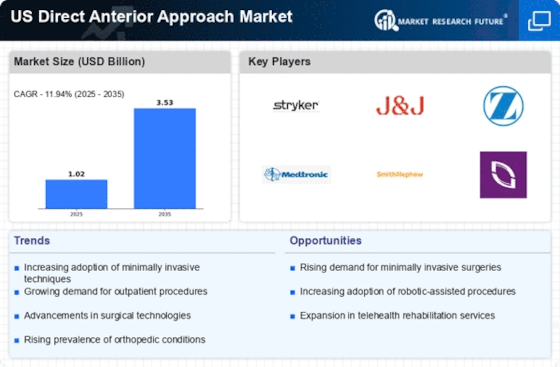
As per analysis, the US Direct Anterior Approach Market is projected to grow from USD 441.0 Million in 2024 to USD 806.05 Million by 2035, exhibiting a compound annual growth rate (CAGR) of 5.64% during the forecast period (2025 - 2035).
Key Market Trends & Highlights
The US Direct Anterior Approach Market is experiencing a robust shift towards minimally invasive surgical techniques driven by technological advancements and patient demand.
- The Total Hip Replacement segment remains the largest contributor to the market, reflecting a steady demand for hip surgeries. The Revision Hip Surgery segment is the fastest-growing, indicating an increasing need for corrective procedures in aging populations. Patients aged 66-75 represent the largest demographic, while those aged 76 and above are emerging as the fastest-growing group in this market. Technological innovations in surgical equipment and rising healthcare expenditure are key drivers propelling market growth.
Market Size & Forecast
| 2024 Market Size | 441.0 (USD Million) |
| 2035 Market Size | 806.05 (USD Million) |
| CAGR (2025 - 2035) | 5.64% |
Major Players
Stryker (US), DePuy Synthes (US),<a href="https://www.zimmerbiomet.com/en/products-and-solutions/specialties/hip.html"> Zimmer Biomet</a> (US), Smith & Nephew (US), Medtronic (US), NuVasive (US), Orthofix (US), Aesculap (US), B. Braun (US)
Market Trends
The US Direct Anterior Approach Market is currently experiencing a notable evolution, driven by advancements in surgical techniques and an increasing preference for minimally invasive procedures. This approach, which allows surgeons to access the hip joint through the front of the body, is gaining traction due to its potential for reduced recovery times and lower complication rates. As healthcare providers and patients alike become more aware of the benefits associated with this method, the market is likely to witness a steady growth trajectory. Furthermore, the integration of innovative technologies, such as robotic-assisted surgery, appears to enhance the precision and effectiveness of the direct anterior approach, thereby attracting more orthopedic surgeons to adopt this technique. In addition to technological advancements, the US Direct Anterior Approach Market is influenced by evolving patient demographics and expectations. An aging population, coupled with a growing emphasis on quality of life, suggests that more individuals are seeking effective solutions for hip-related issues. This trend may lead to an increased demand for procedures utilizing the direct anterior approach, as patients often prefer options that promise quicker recovery and less postoperative discomfort. Overall, the market landscape is characterized by a dynamic interplay of factors that could shape its future, making it essential for stakeholders to remain attuned to emerging trends and innovations.
Technological Advancements in Surgery
The US Direct Anterior Approach Market is witnessing a surge in the adoption of advanced surgical technologies. Innovations such as robotic-assisted systems and enhanced imaging techniques are improving surgical precision and outcomes. These advancements not only facilitate better access to the hip joint but also contribute to reduced recovery times, making the direct anterior approach more appealing to both surgeons and patients.
Growing Patient Demand for Minimally Invasive Procedures
There is a noticeable shift in patient preferences towards minimally invasive surgical options. The direct anterior approach aligns with this trend, as it typically results in less trauma to surrounding tissues and quicker recovery. As patients become more informed about their surgical options, the demand for procedures utilizing this approach is likely to increase, further propelling market growth.
Focus on Enhanced Recovery Protocols
The implementation of enhanced recovery after surgery (ERAS) protocols is becoming increasingly prevalent in the US Direct Anterior Approach Market. These protocols aim to optimize patient outcomes by minimizing pain and promoting faster recovery. By integrating these strategies into the surgical process, healthcare providers can improve patient satisfaction and potentially reduce hospital stays, thereby influencing the overall market dynamics.
U.S. Direct Anterior Approach Market Market Drivers
Rising Healthcare Expenditure
Rising healthcare expenditure in the United States is a significant driver for the US Direct Anterior Approach Market. Increased spending on healthcare services, particularly in orthopedic surgery, reflects a growing recognition of the importance of effective treatment options for hip disorders. According to recent reports, US healthcare spending is projected to reach nearly $6 trillion by 2027, with a substantial portion allocated to surgical interventions. This financial commitment enables hospitals and surgical centers to invest in advanced technologies and training for the direct anterior approach, thereby enhancing the quality of care. As healthcare expenditure continues to rise, the market for direct anterior approaches is likely to benefit from increased resources dedicated to improving surgical practices.
Patient-Centric Healthcare Trends
The US Direct Anterior Approach Market is increasingly influenced by patient-centric healthcare trends. Patients are becoming more informed and actively involved in their treatment decisions, often seeking out minimally invasive options that promise quicker recovery and less discomfort. This shift in patient expectations is driving orthopedic surgeons to adopt the direct anterior approach, which is perceived as a more favorable option compared to traditional methods. Furthermore, healthcare systems are responding to this trend by implementing enhanced recovery protocols that prioritize patient outcomes. As a result, the market is likely to see a continued increase in the adoption of this surgical technique, reflecting the evolving landscape of patient care.
Increasing Prevalence of Hip Disorders
The rising prevalence of hip disorders in the United States is a critical driver for the US Direct Anterior Approach Market. Conditions such as osteoarthritis and hip fractures are becoming more common, particularly among the aging population. According to recent data, approximately 1 in 4 adults over the age of 65 experiences some form of hip-related issue. This demographic shift is prompting healthcare providers to adopt more effective surgical interventions, including the direct anterior approach, which is associated with less postoperative pain and quicker recovery. As the number of hip surgeries continues to rise, the market for direct anterior approaches is expected to expand, reflecting the urgent need for effective treatment options.
Technological Innovations in Surgical Equipment
The US Direct Anterior Approach Market is experiencing a surge in technological innovations, particularly in surgical equipment. Advanced imaging techniques, such as intraoperative fluoroscopy and 3D navigation systems, enhance precision during procedures. These innovations not only improve surgical outcomes but also reduce recovery times, aligning with the growing preference for minimally invasive techniques. The market for surgical instruments is projected to grow significantly, with estimates suggesting a compound annual growth rate (CAGR) of over 5% through 2026. As hospitals and surgical centers invest in state-of-the-art technology, the demand for specialized instruments tailored for the direct anterior approach is likely to increase, further driving market growth.
Regulatory Support for Innovative Surgical Techniques
Regulatory support for innovative surgical techniques plays a pivotal role in the US Direct Anterior Approach Market. The Food and Drug Administration (FDA) has been proactive in streamlining the approval process for new surgical devices and techniques, which encourages the adoption of advanced methods like the direct anterior approach. This regulatory environment fosters innovation and allows for quicker access to cutting-edge technologies that improve surgical outcomes. As more devices receive FDA clearance, healthcare providers are likely to incorporate these innovations into their practices, thereby expanding the market. The supportive regulatory framework is expected to facilitate growth in the direct anterior approach segment, aligning with the broader trend of enhancing surgical efficacy.
Market Segment Insights
By Application: Total Hip Replacement (Largest) vs. Revision Hip Surgery (Fastest-Growing)
<p>In the US Direct Anterior Approach Market, Total Hip Replacement holds the largest share, reflecting its critical role in the orthopedic surgeries performed annually. This segment's dominance is attributed to the increasing prevalence of hip osteoarthritis and other degenerative conditions. On the other hand, Revision Hip Surgery is emerging as a significant focus area, capturing attention due to the aging population and the need for corrective surgeries following initial hip replacements.</p>
<p>Total Hip Replacement (Dominant) vs. Revision Hip Surgery (Emerging)</p>
<p>Total Hip Replacement is the cornerstone of hip surgical interventions, known for its efficacy in alleviating pain and improving patient mobility. As the dominant segment in the US Direct Anterior Approach Market, it represents a robust demand fueled by an aging demographic that increasingly requires hip surgeries. Conversely, Revision Hip Surgery is emerging rapidly due to the necessity of addressing complications from prior surgeries, with advancements in surgical techniques enhancing outcomes. This growth trend signifies a shift in the market, highlighting the need for ongoing monitoring and precision in surgical practices.</p>
By Patient Demographics: Age Group 66-75 (Largest) vs. Age Group 76 and Above (Fastest-Growing)
The US Direct Anterior Approach Market is notably influenced by patient demographics, with the Age Group 66-75 holding the largest market share due to an increasing population within this age bracket. This group is characterized by an active pursuit of minimally invasive surgical options, which aligns well with the advantages offered by the direct anterior approach, fostering growth and preference among surgeons and patients alike. Conversely, the Age Group 76 and Above is emerging as the fastest-growing segment, driven by advancements in surgical techniques and a greater willingness among older patients to undergo orthopedic procedures to enhance their quality of life.
Age Group 66-75 (Dominant) vs. Age Group 76 and Above (Emerging)
The Age Group 66-75 is dominant in the US Direct Anterior Approach Market, primarily due to their overall health status, which allows them to actively seek surgical interventions. This group typically has more resources for healthcare and a stronger motivation to regain mobility and independence through effective treatment options. However, the Age Group 76 and Above is rapidly emerging, as technological advancements in surgery now allow for safer procedures for older patients. This group's demographic trend includes an increasing number of seniors who are willing to undergo surgical options previously considered too risky, thus influencing market dynamics significantly.
By Surgical Technique: Minimally Invasive Surgery (Largest) vs. Robotic-Assisted Surgery (Fastest-Growing)
In the US Direct Anterior Approach Market, Minimally Invasive Surgery leads the segment with significant market share. This approach has gained popularity among surgeons and patients due to its reduced recovery time and minimal scarring. Traditional Surgery, while still relevant, is declining in preference as newer techniques gain traction. Computer-Assisted Surgery, although less prevalent, is showing steady interest as technological advancements improve its reliability.
Minimally Invasive Surgery (Dominant) vs. Traditional Surgery (Emerging)
Minimally Invasive Surgery (MIS) is recognized as the dominant technique in the US Direct Anterior Approach Market, appealing to both medical professionals and patients seeking less invasive options. It offers benefits like quicker recovery times, reduced risk of complications, and less postoperative pain compared to Traditional Surgery, which, despite having a historical foothold, is witnessing a gradual decline. Traditional Surgery is still performed in cases where MIS is not suitable, but the push towards technological advancement is making it less favorable in the current market. As the healthcare landscape evolves, the shift towards MIS is expected to further widen the gap in preferences.
By Healthcare Setting: Hospital (Largest) vs. Outpatient Surgery Center (Fastest-Growing)
In the US Direct Anterior Approach Market, hospitals constitute the largest segment, boasting a significant share of the healthcare setting landscape. Their extensive infrastructure and resources enable them to cater to a high volume of patients, which supports their dominant position in this segment. Outpatient surgery centers, while smaller in terms of market share, are rapidly gaining traction due to their efficiency and patient-centric care, contributing to an evolving competitive dynamic in the market.
Hospital (Dominant) vs. Outpatient Surgery Center (Emerging)
Hospitals are the dominant force in the US Direct Anterior Approach Market, equipped with specialized teams, advanced technologies, and comprehensive post-surgical care. Their established reputation drives patient trust and allows for the handling of complex cases. On the other hand, outpatient surgery centers are emerging as a vital alternative, offering cost-effective and streamlined surgical experiences. They focus on less invasive procedures, attracting patients seeking quicker recovery and lower costs. With advancements in surgical techniques and growing patient awareness, outpatient surgery centers are poised for significant expansion, complementing the traditional hospital setting.
By Surgeon Experience: Experienced Surgeons (Largest) vs. Novice Surgeons (Fastest-Growing)
In the US Direct Anterior Approach Market, the market share distribution among surgeons reveals that Experienced Surgeons dominate the landscape, leveraging their extensive skill set and knowledge in anterior hip approaches to cater to a substantial patient base. This segment stands out as the largest, proving instrumental in shaping best practices and influencing training standards for newcomers in the market. On the other hand, Novice Surgeons represent the fastest-growing group, driven by a surge in training and mentorship programs that focus on this specific surgical approach. As more physicians transition into this modality, the balance of power within the market could shift markedly within coming years.
Surgeon Experience: Experienced Surgeons (Dominant) vs. Novice Surgeons (Emerging)
Experienced Surgeons are characterized by their extensive training and proficiency in the US Direct Anterior Approach, positioning them as the cornerstone of current practice. This group benefits from a wealth of hands-on surgical expertise and a proven track record in achieving favorable patient outcomes. In contrast, Novice Surgeons are emerging rapidly within this sphere, encouraged by technological advancements and comprehensive educational initiatives. This segment is marked by a growing enthusiasm to adopt newer methods under the guidance of seasoned mentors. The dynamic between these two groups reflects contrasting yet symbiotic growth patterns, with experienced surgeons providing stability and novice surgeons injecting vitality and innovation into the field.
Get more detailed insights about US Direct Anterior Approach Market Research Report – Forecast to 2035
Regional Insights
North America : Market Leader in Innovation
The North American market for the Direct Anterior Approach is the largest globally, accounting for approximately 60% of the total market share. Key growth drivers include an aging population, increasing prevalence of orthopedic conditions, and advancements in surgical techniques. Regulatory support from agencies like the FDA has also catalyzed market expansion, ensuring safety and efficacy in new product launches. The United States stands as the leading country, with major players such as Stryker Corporation, DePuy Synthes, and Zimmer Biomet dominating the landscape. The competitive environment is characterized by continuous innovation and strategic partnerships among these companies. The presence of advanced healthcare infrastructure further supports the adoption of new technologies, enhancing patient outcomes and driving market growth.
Europe : Emerging Market with Potential
Europe is witnessing a significant rise in the Direct Anterior Approach market, holding approximately 25% of the global share. Factors contributing to this growth include increasing healthcare expenditure, a rise in orthopedic surgeries, and a focus on minimally invasive techniques. Regulatory frameworks in countries like Germany and France are evolving to support innovative surgical methods, enhancing patient access to advanced treatments. Leading countries in this region include Germany, France, and the UK, where key players like Smith & Nephew and Aesculap Implant Systems are making substantial inroads. The competitive landscape is marked by collaborations and mergers aimed at expanding product portfolios. The presence of well-established healthcare systems facilitates the adoption of new technologies, further driving market growth.
Asia-Pacific : Rapidly Growing Market
The Asia-Pacific region is emerging as a significant player in the Direct Anterior Approach market, accounting for about 10% of the global share. The growth is driven by increasing urbanization, rising disposable incomes, and a growing awareness of advanced surgical options. Countries like China and India are witnessing a surge in orthopedic procedures, supported by favorable government initiatives and investments in healthcare infrastructure. China and Japan are leading the charge, with local and international companies vying for market share. The competitive landscape is characterized by a mix of established players and new entrants, focusing on innovation and affordability. The increasing number of hospitals and surgical centers is further propelling the demand for advanced surgical techniques, enhancing market dynamics.
Middle East and Africa : Untapped Market Potential
The Middle East and Africa region is gradually developing its Direct Anterior Approach market, currently holding around 5% of the global share. The growth is primarily driven by increasing healthcare investments, a rising prevalence of orthopedic conditions, and a growing focus on improving healthcare infrastructure. Countries like South Africa and the UAE are leading the way, with government initiatives aimed at enhancing healthcare access and quality. In this region, the competitive landscape is still evolving, with both local and international players entering the market. Key players are focusing on establishing partnerships and collaborations to expand their reach. The increasing number of healthcare facilities and the demand for advanced surgical techniques are expected to drive future growth in this market.
Key Players and Competitive Insights
The Direct Anterior Approach Market is characterized by a competitive landscape that is increasingly shaped by innovation, strategic partnerships, and a focus on enhancing surgical outcomes. Key players such as Stryker (US), DePuy Synthes (US), and Zimmer Biomet (US) are at the forefront, each adopting distinct strategies to solidify their market positions. Stryker (US) emphasizes technological advancements in surgical instruments, while DePuy Synthes (US) focuses on expanding its product portfolio through strategic acquisitions. Zimmer Biomet (US) appears to be concentrating on regional expansion and enhancing its digital capabilities, which collectively contribute to a dynamic competitive environment.
In terms of business tactics, companies are increasingly localizing manufacturing to reduce lead times and optimize supply chains. The market structure is moderately fragmented, with several players vying for market share. This fragmentation allows for a diverse range of products and innovations, yet the collective influence of major companies like Stryker (US) and DePuy Synthes (US) remains significant, shaping industry standards and practices.
In December 2025, Stryker (US) announced the launch of a new robotic-assisted surgical system designed specifically for anterior hip procedures. This strategic move is likely to enhance surgical precision and improve patient outcomes, positioning Stryker (US) as a leader in the integration of robotics within the Direct Anterior Approach. The introduction of this technology may also serve to attract a broader customer base, including hospitals seeking to modernize their surgical capabilities.
In November 2025, DePuy Synthes (US) completed the acquisition of a smaller firm specializing in advanced imaging technologies. This acquisition is indicative of DePuy Synthes (US)'s commitment to enhancing its product offerings and integrating cutting-edge imaging solutions into its surgical workflows. Such a strategy not only strengthens its competitive edge but also aligns with the growing trend of utilizing advanced imaging in surgical procedures, potentially leading to better surgical outcomes.
In October 2025, Zimmer Biomet (US) launched a new digital platform aimed at streamlining surgical workflows and improving data analytics for orthopedic procedures. This initiative reflects Zimmer Biomet (US)'s focus on digital transformation, which is becoming increasingly vital in the current market landscape. By leveraging data analytics, the company aims to enhance decision-making processes for surgeons, thereby improving overall surgical efficiency and patient care.
As of January 2026, the Direct Anterior Approach Market is witnessing trends that emphasize digitalization, sustainability, and the integration of artificial intelligence (AI) into surgical practices. Strategic alliances among key players are shaping the competitive landscape, fostering innovation and collaboration. The shift from price-based competition to a focus on technological advancements and supply chain reliability is evident. Companies that prioritize innovation and adaptability are likely to thrive, as the market continues to evolve towards more sophisticated and efficient surgical solutions.
Key Companies in the U.S. Direct Anterior Approach Market include





Industry Developments
June 2018 HipGrid NINE, developed by OrthoGrid equipment for outpatient total hip replacement, increases the usefulness of C-arm imaging equipment, which are frequently seen in hospitals and ambulatory surgery centers.
Future Outlook
U.S. Direct Anterior Approach Market Future Outlook
The US Direct Anterior Approach Market is projected to grow at a 5.64% CAGR from 2025 to 2035, driven by technological advancements, increasing patient demand, and enhanced surgical outcomes.
New opportunities lie in:
- <p>Development of advanced surgical training programs for surgeons Integration of AI-driven surgical planning tools Expansion of outpatient surgical centers specializing in anterior approach procedures</p>
By 2035, the market is expected to solidify its position as a leader in orthopedic surgical techniques.
Market Segmentation
U.S. Direct Anterior Approach Market Application Outlook
- Total Hip Replacement
- Hip Resurfacing
- Revision Hip Surgery
- Fracture Fixation
U.S. Direct Anterior Approach Market Healthcare Setting Outlook
- Hospital
- Outpatient Surgery Center
- Ambulatory Surgical Center
U.S. Direct Anterior Approach Market Surgeon Experience Outlook
- Experienced Surgeons
- Intermediate Surgeons
- Novice Surgeons
U.S. Direct Anterior Approach Market Surgical Technique Outlook
- Minimally Invasive Surgery
- Traditional Surgery
- Robotic-Assisted Surgery
- Computer-Assisted Surgery
U.S. Direct Anterior Approach Market Patient Demographics Outlook
- Age Group 50-65
- Age Group 66-75
- Age Group 76 and Above
- Gender
- Body Mass Index
Report Scope
| MARKET SIZE 2024 | 441.0(USD Million) |
| MARKET SIZE 2025 | 467.95(USD Million) |
| MARKET SIZE 2035 | 806.05(USD Million) |
| COMPOUND ANNUAL GROWTH RATE (CAGR) | 5.64% (2024 - 2035) |
| REPORT COVERAGE | Revenue Forecast, Competitive Landscape, Growth Factors, and Trends |
| BASE YEAR | 2024 |
| Market Forecast Period | 2025 - 2035 |
| Historical Data | 2019 - 2024 |
| Market Forecast Units | USD Million |
| Key Companies Profiled | Stryker (US), DePuy Synthes (US), Zimmer Biomet (US), Smith & Nephew (US), Medtronic (US), NuVasive (US), Orthofix (US), Aesculap (US), B. Braun (US) |
| Segments Covered | Application, Patient Demographics, Surgical Technique, Healthcare Setting, Surgeon Experience |
| Key Market Opportunities | Emergence of advanced surgical technologies enhancing efficiency in the US Direct Anterior Approach Market. |
| Key Market Dynamics | Growing adoption of Direct Anterior Approach techniques driven by technological advancements and evolving surgical preferences in the US. |
| Countries Covered | US |
FAQs
What is the current market valuation of the US Direct Anterior Approach Market?
<p>The market valuation was 441.0 USD Million in 2024.</p>
What is the projected market size for the US Direct Anterior Approach Market by 2035?
<p>The projected valuation for 2035 is 806.05 USD Million.</p>
What is the expected CAGR for the US Direct Anterior Approach Market during the forecast period?
<p>The expected CAGR from 2025 to 2035 is 5.64%.</p>
Which companies are the key players in the US Direct Anterior Approach Market?
<p>Key players include Stryker, DePuy Synthes, Zimmer Biomet, Smith & Nephew, Medtronic, NuVasive, Orthofix, Aesculap, and B. Braun.</p>
What are the primary applications within the US Direct Anterior Approach Market?
<p>Primary applications include Total Hip Replacement, Hip Resurfacing, Revision Hip Surgery, and Fracture Fixation.</p>
How does the market perform across different age demographics?
<p>The market shows varied performance, with Age Group 66-75 projected to generate 132.3 to 238.0 USD Million.</p>
What surgical techniques are utilized in the US Direct Anterior Approach Market?
<p>Utilized techniques include Minimally Invasive Surgery, Traditional Surgery, Robotic-Assisted Surgery, and Computer-Assisted Surgery.</p>
What healthcare settings are involved in the US Direct Anterior Approach Market?
<p>Healthcare settings include Hospitals, Outpatient Surgery Centers, and Ambulatory Surgical Centers.</p>
How does surgeon experience impact the US Direct Anterior Approach Market?
<p>Surgeon experience significantly impacts the market, with Experienced Surgeons projected to generate 220.0 to 400.0 USD Million.</p>
What is the market outlook for the US Direct Anterior Approach Market in the coming years?
<p>The market outlook appears positive, with a projected growth trajectory leading to 806.05 USD Million by 2035.</p>
-
SECTION I: EXECUTIVE SUMMARY AND KEY HIGHLIGHTS
- | 1.1 EXECUTIVE SUMMARY
- | | 1.1.1 Market Overview
- | | 1.1.2 Key Findings
- | | 1.1.3 Market Segmentation
- | | 1.1.4 Competitive Landscape
- | | 1.1.5 Challenges and Opportunities
- | | 1.1.6 Future Outlook
-
SECTION II: SCOPING, METHODOLOGY AND MARKET STRUCTURE
- | 2.1 MARKET INTRODUCTION
- | | 2.1.1 Definition
- | | 2.1.2 Scope of the study
- | | | 2.1.2.1 Research Objective
- | | | 2.1.2.2 Assumption
- | | | 2.1.2.3 Limitations
- | 2.2 RESEARCH METHODOLOGY
- | | 2.2.1 Overview
- | | 2.2.2 Data Mining
- | | 2.2.3 Secondary Research
- | | 2.2.4 Primary Research
- | | | 2.2.4.1 Primary Interviews and Information Gathering Process
- | | | 2.2.4.2 Breakdown of Primary Respondents
- | | 2.2.5 Forecasting Model
- | | 2.2.6 Market Size Estimation
- | | | 2.2.6.1 Bottom-Up Approach
- | | | 2.2.6.2 Top-Down Approach
- | | 2.2.7 Data Triangulation
- | | 2.2.8 Validation
-
SECTION III: QUALITATIVE ANALYSIS
- | 3.1 MARKET DYNAMICS
- | | 3.1.1 Overview
- | | 3.1.2 Drivers
- | | 3.1.3 Restraints
- | | 3.1.4 Opportunities
- | 3.2 MARKET FACTOR ANALYSIS
- | | 3.2.1 Value chain Analysis
- | | 3.2.2 Porter's Five Forces Analysis
- | | | 3.2.2.1 Bargaining Power of Suppliers
- | | | 3.2.2.2 Bargaining Power of Buyers
- | | | 3.2.2.3 Threat of New Entrants
- | | | 3.2.2.4 Threat of Substitutes
- | | | 3.2.2.5 Intensity of Rivalry
- | | 3.2.3 COVID-19 Impact Analysis
- | | | 3.2.3.1 Market Impact Analysis
- | | | 3.2.3.2 Regional Impact
- | | | 3.2.3.3 Opportunity and Threat Analysis
-
SECTION IV: QUANTITATIVE ANALYSIS
- | 4.1 Healthcare, BY Application (USD Million)
- | | 4.1.1 Total Hip Replacement
- | | 4.1.2 Hip Resurfacing
- | | 4.1.3 Revision Hip Surgery
- | | 4.1.4 Fracture Fixation
- | 4.2 Healthcare, BY Patient Demographics (USD Million)
- | | 4.2.1 Age Group 50-65
- | | 4.2.2 Age Group 66-75
- | | 4.2.3 Age Group 76 and Above
- | | 4.2.4 Gender
- | | 4.2.5 Body Mass Index
- | 4.3 Healthcare, BY Surgical Technique (USD Million)
- | | 4.3.1 Minimally Invasive Surgery
- | | 4.3.2 Traditional Surgery
- | | 4.3.3 Robotic-Assisted Surgery
- | | 4.3.4 Computer-Assisted Surgery
- | 4.4 Healthcare, BY Healthcare Setting (USD Million)
- | | 4.4.1 Hospital
- | | 4.4.2 Outpatient Surgery Center
- | | 4.4.3 Ambulatory Surgical Center
- | 4.5 Healthcare, BY Surgeon Experience (USD Million)
- | | 4.5.1 Experienced Surgeons
- | | 4.5.2 Intermediate Surgeons
- | | 4.5.3 Novice Surgeons
-
SECTION V: COMPETITIVE ANALYSIS
- | 5.1 Competitive Landscape
- | | 5.1.1 Overview
- | | 5.1.2 Competitive Analysis
- | | 5.1.3 Market share Analysis
- | | 5.1.4 Major Growth Strategy in the Healthcare
- | | 5.1.5 Competitive Benchmarking
- | | 5.1.6 Leading Players in Terms of Number of Developments in the Healthcare
- | | 5.1.7 Key developments and growth strategies
- | | | 5.1.7.1 New Product Launch/Service Deployment
- | | | 5.1.7.2 Merger & Acquisitions
- | | | 5.1.7.3 Joint Ventures
- | | 5.1.8 Major Players Financial Matrix
- | | | 5.1.8.1 Sales and Operating Income
- | | | 5.1.8.2 Major Players R&D Expenditure. 2023
- | 5.2 Company Profiles
- | | 5.2.1 Stryker (US)
- | | | 5.2.1.1 Financial Overview
- | | | 5.2.1.2 Products Offered
- | | | 5.2.1.3 Key Developments
- | | | 5.2.1.4 SWOT Analysis
- | | | 5.2.1.5 Key Strategies
- | | 5.2.2 DePuy Synthes (US)
- | | | 5.2.2.1 Financial Overview
- | | | 5.2.2.2 Products Offered
- | | | 5.2.2.3 Key Developments
- | | | 5.2.2.4 SWOT Analysis
- | | | 5.2.2.5 Key Strategies
- | | 5.2.3 Zimmer Biomet (US)
- | | | 5.2.3.1 Financial Overview
- | | | 5.2.3.2 Products Offered
- | | | 5.2.3.3 Key Developments
- | | | 5.2.3.4 SWOT Analysis
- | | | 5.2.3.5 Key Strategies
- | | 5.2.4 Smith & Nephew (US)
- | | | 5.2.4.1 Financial Overview
- | | | 5.2.4.2 Products Offered
- | | | 5.2.4.3 Key Developments
- | | | 5.2.4.4 SWOT Analysis
- | | | 5.2.4.5 Key Strategies
- | | 5.2.5 Medtronic (US)
- | | | 5.2.5.1 Financial Overview
- | | | 5.2.5.2 Products Offered
- | | | 5.2.5.3 Key Developments
- | | | 5.2.5.4 SWOT Analysis
- | | | 5.2.5.5 Key Strategies
- | | 5.2.6 NuVasive (US)
- | | | 5.2.6.1 Financial Overview
- | | | 5.2.6.2 Products Offered
- | | | 5.2.6.3 Key Developments
- | | | 5.2.6.4 SWOT Analysis
- | | | 5.2.6.5 Key Strategies
- | | 5.2.7 Orthofix (US)
- | | | 5.2.7.1 Financial Overview
- | | | 5.2.7.2 Products Offered
- | | | 5.2.7.3 Key Developments
- | | | 5.2.7.4 SWOT Analysis
- | | | 5.2.7.5 Key Strategies
- | | 5.2.8 Aesculap (US)
- | | | 5.2.8.1 Financial Overview
- | | | 5.2.8.2 Products Offered
- | | | 5.2.8.3 Key Developments
- | | | 5.2.8.4 SWOT Analysis
- | | | 5.2.8.5 Key Strategies
- | | 5.2.9 B. Braun (US)
- | | | 5.2.9.1 Financial Overview
- | | | 5.2.9.2 Products Offered
- | | | 5.2.9.3 Key Developments
- | | | 5.2.9.4 SWOT Analysis
- | | | 5.2.9.5 Key Strategies
- | 5.3 Appendix
- | | 5.3.1 References
- | | 5.3.2 Related Reports
-
LIST OF FIGURES
- | 6.1 MARKET SYNOPSIS
- | 6.2 US MARKET ANALYSIS BY APPLICATION
- | 6.3 US MARKET ANALYSIS BY PATIENT DEMOGRAPHICS
- | 6.4 US MARKET ANALYSIS BY SURGICAL TECHNIQUE
- | 6.5 US MARKET ANALYSIS BY HEALTHCARE SETTING
- | 6.6 US MARKET ANALYSIS BY SURGEON EXPERIENCE
- | 6.7 KEY BUYING CRITERIA OF HEALTHCARE
- | 6.8 RESEARCH PROCESS OF MRFR
- | 6.9 DRO ANALYSIS OF HEALTHCARE
- | 6.10 DRIVERS IMPACT ANALYSIS: HEALTHCARE
- | 6.11 RESTRAINTS IMPACT ANALYSIS: HEALTHCARE
- | 6.12 SUPPLY / VALUE CHAIN: HEALTHCARE
- | 6.13 HEALTHCARE, BY APPLICATION, 2024 (% SHARE)
- | 6.14 HEALTHCARE, BY APPLICATION, 2024 TO 2035 (USD Million)
- | 6.15 HEALTHCARE, BY PATIENT DEMOGRAPHICS, 2024 (% SHARE)
- | 6.16 HEALTHCARE, BY PATIENT DEMOGRAPHICS, 2024 TO 2035 (USD Million)
- | 6.17 HEALTHCARE, BY SURGICAL TECHNIQUE, 2024 (% SHARE)
- | 6.18 HEALTHCARE, BY SURGICAL TECHNIQUE, 2024 TO 2035 (USD Million)
- | 6.19 HEALTHCARE, BY HEALTHCARE SETTING, 2024 (% SHARE)
- | 6.20 HEALTHCARE, BY HEALTHCARE SETTING, 2024 TO 2035 (USD Million)
- | 6.21 HEALTHCARE, BY SURGEON EXPERIENCE, 2024 (% SHARE)
- | 6.22 HEALTHCARE, BY SURGEON EXPERIENCE, 2024 TO 2035 (USD Million)
- | 6.23 BENCHMARKING OF MAJOR COMPETITORS
-
LIST OF TABLES
- | 7.1 LIST OF ASSUMPTIONS
- | | 7.1.1
- | 7.2 US MARKET SIZE ESTIMATES; FORECAST
- | | 7.2.1 BY APPLICATION, 2026-2035 (USD Million)
- | | 7.2.2 BY PATIENT DEMOGRAPHICS, 2026-2035 (USD Million)
- | | 7.2.3 BY SURGICAL TECHNIQUE, 2026-2035 (USD Million)
- | | 7.2.4 BY HEALTHCARE SETTING, 2026-2035 (USD Million)
- | | 7.2.5 BY SURGEON EXPERIENCE, 2026-2035 (USD Million)
- | 7.3 PRODUCT LAUNCH/PRODUCT DEVELOPMENT/APPROVAL
- | | 7.3.1
- | 7.4 ACQUISITION/PARTNERSHIP
- | | 7.4.1
US Healthcare Market Segmentation
Healthcare By Application (USD Million, 2026-2035)
- Total Hip Replacement
- Hip Resurfacing
- Revision Hip Surgery
- Fracture Fixation
Healthcare By Patient Demographics (USD Million, 2026-2035)
- Age Group 50-65
- Age Group 66-75
- Age Group 76 and Above
- Gender
- Body Mass Index
Healthcare By Surgical Technique (USD Million, 2026-2035)
- Minimally Invasive Surgery
- Traditional Surgery
- Robotic-Assisted Surgery
- Computer-Assisted Surgery
Healthcare By Healthcare Setting (USD Million, 2026-2035)
- Hospital
- Outpatient Surgery Center
- Ambulatory Surgical Center
Healthcare By Surgeon Experience (USD Million, 2026-2035)
- Experienced Surgeons
- Intermediate Surgeons
- Novice Surgeons

Free Sample Request
Kindly complete the form below to receive a free sample of this Report
Customer Strories
Customer Stories

“This is really good guys. Excellent work on a tight deadline. I will continue to use you going forward and recommend you to others. Nice job”

Noah Malgeri
Co-Founder

“Thanks. It’s been a pleasure working with you, please use me as reference with any other Intel employees.”

Joseph Aguayo
Sales Operations & Pricing Manager

“Thanks for sending the report it gives us a good global view of the Betaïne market.”

Peter Groot koerkamp
Account and Business Manager

“Thank you, this will be very helpful for OQS.”

La Terria Dodd
Program Support Specialist

“We found the report very insightful! we found your research firm very helpful. I'm sending this email to secure our future business.”

Younghwan Choi
Senior Retail Manager

“I am very pleased with how market segments have been defined in a relevant way for my purposes (such as "Portable Freezers & refrigerators" and "last-mile"). In general the report is well structured. Thanks very much for your efforts.”

Mark Irwin
Management Consultant

“I have been reading the first document or the study, ,the Global HVAC and FP market report 2021 till 2026. Must say, good info! I have not gone in depth at all parts, but got a good indication of the data inside!”

Rob Kooiker
Group Product Manager HVAC & Fire Protection GMA

“We got the report in time, we really thank you for your support in this process. I also thank to all of your team as they did a great job.”

Akif Moroglu
Strategy & Business Development Director

Case Study
Aerospace & Defense
Leave a Comment