×
Request Free Sample ×

Kindly complete the form below to receive a free sample of this Report

* Please use a valid business email

Leading companies partner with us for data-driven Insights

clients tt-cursor
Hero Background
English
Chinese
French
Japanese
Korean
German
Spanish

Tyrosine Hydroxylase Deficiency Market Trends

ID: MRFR/HC/4482-HCR
200 Pages
Rahul Gotadki
February 2026

Tyrosine Hydroxylase Deficiency Market Research Report By Treatment Type (Medication, Dietary Management, Gene Therapy), By Diagnosis Method (Genetic Testing, Clinical Evaluation, Biochemical Analysis), By Patient Age Group (Infants, Children, Adults), By End-user (Hospitals, Clinics, Research Institutes), and By Regional (North America, Europe, South America, Asia Pacific, Middle East and Africa) -Forecast to 2035

Share:
Download PDF ×

We do not share your information with anyone. However, we may send you emails based on your report interest from time to time. You may contact us at any time to opt-out.

Tyrosine Hydroxylase Deficiency Market Infographic
Purchase Options

Market Trends

Key Emerging Trends in the Tyrosine Hydroxylase Deficiency Market

A complex landscape exists in the market trends of Tyrosine Hydroxylase Deficiency (THD) driven by advancements in medical research, better diagnostic capability and an increasing understanding of rare genetic disorders. THD is a rare inherited disorder that affects neurotransmitter synthesis causing difficulties in diagnosis and management. One notable trend is the increased global recognition of THD due to better awareness amongst healthcare providers and improved genetics testing. The increasing awareness plays a part in early detection and intervention which is crucial in what could be considerable neurological consequences of THD. The move towards earlier identification also reflects a broader shift within the field of rare disease research toward addressing unmet needs with an aim to improve patient outcomes.

Among all these, there are developments made in diagnostic tools such as genetic tests and molecular analysis for early diagnostics for THD. Genetic mutations specific for THD make it possible for the doctors to confirm the diagnosis as well as comprehend its underlying genetic basis. This trend towards more accurate diagnostic capabilities ensures prompt intervention and enables targeted treatment strategies for people affected by Tyrosine Hydroxylase Deficiency.

The pharmaceutical industry has shown increased interest on rare diseases leading to the initiation of research activities aimed at addressing THD. The neurochemical imbalances associated with this condition are redressed through therapeutic approaches because THD is a disorder that affects production of neurotransmitters like dopamine. Although treatments specifically for THD may still be at their infancy stages, ongoing studies show potential breakthroughs targeting molecular mechanisms that underlie this condition. This surge highlights need for advancement in treatment options available for patients having rarer genetic ailments like THD.

With reference to Tyrosine Hydroxylase Deficiency, personalized medicine has increasingly influenced market trends by health organizations. Treatment plans are now customized based on individual patient characteristics, including specific gene mutations and symptom severity. This precision medicine aims at increasing its therapeutic efficiency while reducing possible side effects thus making it more patient-centered as well as enhancing management of THD.

Collaborations among healthcare providers, researchers, pharmaceutical companies and patient advocacy groups are influencing the landscape of THD care. The establishment of specialized centers of excellence and research networks ensures a comprehensive and coordinated approach to patient care. These collaborations support the conduct of clinical trials, research initiatives, and sharing knowledge about Tyrosine Hydroxylase Deficiency.

Telemedicine and digital health technologies have become essential aspects of THD care by facilitating remote consultations, genetic counseling as well as providing ongoing support for affected persons including their families. Such implementations enhance accessibility especially for patients residing in geographically distant areas while creating a platform for knowledge exchange among health practitioners involved in rare genetic disorders. Telemedical integration supports wider adoption of digital health applications that provide easy management solutions like in case with rare diseases such as THD.

The potential for gene therapy and emerging treatment modalities is an exciting trend in the THD market. Although gene therapy approaches towards treating THD may still be experimental, there is hope that underlying genetic mutations could be addressed through this mechanism. Continuing studies on gene editing technologies coupled with advances made within the genetic medicine field might lead to radical treatments for Tyrosine Hydroxylase Deficiency at some point in time.


Author
Rahul Gotadki
Research Manager

He holds an experience of about 9+ years in Market Research and Business Consulting, working under the spectrum of Life Sciences and Healthcare domains. Rahul conceptualizes and implements a scalable business strategy and provides strategic leadership to the clients. His expertise lies in market estimation, competitive intelligence, pipeline analysis, customer assessment, etc.

Leave a Comment

FAQs

What is the projected market valuation for the Tyrosine Hydroxylase Deficiency Market in 2035?

<p>The projected market valuation for the Tyrosine Hydroxylase Deficiency Market in 2035 is 1.2 USD Billion.</p>

What was the overall market valuation for the Tyrosine Hydroxylase Deficiency Market in 2024?

<p>The overall market valuation for the Tyrosine Hydroxylase Deficiency Market in 2024 was 0.46 USD Billion.</p>

What is the expected CAGR for the Tyrosine Hydroxylase Deficiency Market during the forecast period 2025 - 2035?

<p>The expected CAGR for the Tyrosine Hydroxylase Deficiency Market during the forecast period 2025 - 2035 is 9.11%.</p>

Which companies are considered key players in the Tyrosine Hydroxylase Deficiency Market?

<p>Key players in the Tyrosine Hydroxylase Deficiency Market include Bristol Myers Squibb, Novartis, Pfizer, Sanofi, Roche, AstraZeneca, Eli Lilly and Company, and Teva Pharmaceutical Industries.</p>

What are the projected valuations for the Treatment Type segment in 2035?

<p>The projected valuations for the Treatment Type segment in 2035 are 0.5 USD Billion for Medication, 0.35 USD Billion for Dietary Management, and 0.35 USD Billion for Gene Therapy.</p>

How does the market for Genetic Testing compare to other Diagnosis Methods in 2035?

<p>In 2035, the market for Genetic Testing is projected to reach 0.35 USD Billion, comparable to Clinical Evaluation, while Biochemical Analysis is expected to reach 0.5 USD Billion.</p>

What is the expected market size for the Adult patient age group by 2035?

<p>The expected market size for the Adult patient age group by 2035 is 0.55 USD Billion.</p>

Which end-users are projected to dominate the Tyrosine Hydroxylase Deficiency Market in 2035?

<p>In 2035, Hospitals are projected to dominate the Tyrosine Hydroxylase Deficiency Market with a valuation of 0.5 USD Billion, followed by Clinics and Research Institutes.</p>

What are the projected valuations for the Children patient age group in 2035?

<p>The projected valuation for the Children patient age group in 2035 is 0.4 USD Billion.</p>

How does the market for Dietary Management compare to other treatment types in 2035?

In 2035, the market for Dietary Management is projected to reach 0.35 USD Billion, which is lower than Medication at 0.5 USD Billion but equal to Gene Therapy.

Market Summary

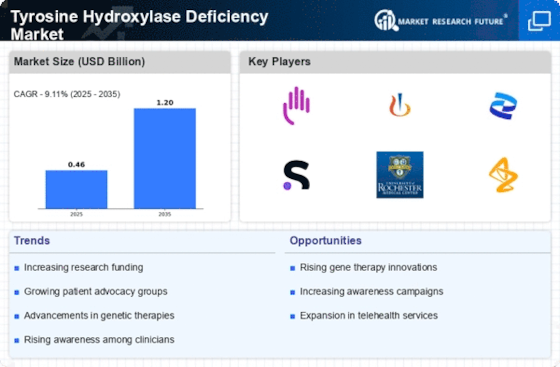
As per Market Research Future analysis, the Tyrosine Hydroxylase Deficiency Market Size was estimated at 0.46 USD Billion in 2024. The Tyrosine Hydroxylase Deficiency industry is projected to grow from USD 0.5019 Billion in 2025 to USD 1.2 Billion by 2035, exhibiting a compound annual growth rate (CAGR) of 9.11% during the forecast period 2025 - 2035

Key Market Trends & Highlights

The Tyrosine Hydroxylase Deficiency Market is experiencing a transformative shift towards personalized medicine and innovative treatment approaches.

  • The rise of personalized medicine is reshaping treatment paradigms in the Tyrosine Hydroxylase Deficiency Market. North America remains the largest market, driven by increasing awareness and advancements in genetic testing. Asia-Pacific is emerging as the fastest-growing region, propelled by collaborative research initiatives and technological advancements. Key market drivers include growing investment in rare disease research and regulatory support for orphan drugs.

Market Size & Forecast

2024 Market Size 0.46 (USD Billion)
2035 Market Size 1.2 (USD Billion)
CAGR (2025 - 2035) 9.11%
Largest Regional Market Share in 2024 North America

Major Players

Bristol Myers Squibb (US), Novartis (CH), <a href="https://www.pfizer.com/products/product-list">Pfizer </a>(US), Sanofi (FR), Roche (CH), AstraZeneca (GB), Eli Lilly and Company (US), Teva Pharmaceutical Industries (IL)

Market Trends

The Tyrosine Hydroxylase Deficiency Market is currently experiencing a notable evolution, driven by advancements in genetic research and increased awareness of rare metabolic disorders. This condition, characterized by a deficiency in the enzyme responsible for converting tyrosine to dopamine, has garnered attention from both healthcare professionals and researchers. As a result, there is a growing emphasis on developing targeted therapies and innovative treatment options. The market landscape appears to be shifting towards personalized medicine, where treatments are tailored to individual genetic profiles, potentially enhancing efficacy and patient outcomes. Moreover, the Tyrosine Hydroxylase Deficiency Market is likely to benefit from collaborative efforts among pharmaceutical companies, academic institutions, and patient advocacy groups. These partnerships may facilitate the sharing of knowledge and resources, ultimately accelerating the development of new therapies. Additionally, the increasing prevalence of genetic testing is expected to play a crucial role in early diagnosis and intervention, which could lead to improved management of the condition. Overall, the market seems poised for growth, with a focus on enhancing the quality of life for affected individuals through innovative solutions and comprehensive care strategies.

Rise of Personalized Medicine

The Tyrosine Hydroxylase Deficiency Market is witnessing a shift towards personalized medicine, where treatments are customized based on individual genetic profiles. This approach may enhance treatment efficacy and improve patient outcomes, as therapies are designed to address specific genetic variations.

Collaborative Research Initiatives

There is an increasing trend of collaboration among pharmaceutical companies, academic institutions, and patient advocacy groups. These partnerships could facilitate knowledge sharing and resource pooling, potentially accelerating the development of new therapies for Tyrosine Hydroxylase Deficiency Market.

Advancements in Genetic Testing

The growing prevalence of genetic testing is likely to impact the Tyrosine Hydroxylase Deficiency Market positively. Early diagnosis through advanced testing methods may lead to timely interventions, improving management strategies and overall patient care.

Tyrosine Hydroxylase Deficiency Market Market Drivers

Collaboration Between Stakeholders

Collaboration among various stakeholders, including academic institutions, pharmaceutical companies, and patient advocacy groups, is becoming increasingly prevalent in the Tyrosine Hydroxylase Deficiency Market. These partnerships are fostering a multidisciplinary approach to research and treatment development. By pooling resources and expertise, stakeholders can accelerate the discovery of new therapies and improve patient access to existing treatments. Collaborative initiatives are also enhancing data sharing and clinical trial participation, which are critical for advancing the understanding of Tyrosine Hydroxylase Deficiency Market. This trend is likely to create a more robust ecosystem for innovation, ultimately benefiting patients and driving growth in the Tyrosine Hydroxylase Deficiency Market.

Regulatory Support for Orphan Drugs

Regulatory bodies are providing enhanced support for the development of orphan drugs, which are essential for treating rare conditions like Tyrosine Hydroxylase Deficiency Market. Initiatives such as expedited review processes and market exclusivity incentives are encouraging pharmaceutical companies to invest in this niche market. The Tyrosine Hydroxylase Deficiency Market stands to benefit significantly from these regulatory frameworks, as they lower the barriers to entry for new treatments. This supportive environment is likely to lead to an increase in the number of therapies available for patients, thereby expanding the market. As regulatory agencies continue to prioritize rare diseases, the Tyrosine Hydroxylase Deficiency Market is expected to flourish.

Increasing Awareness of Rare Diseases

The Tyrosine Hydroxylase Deficiency Market is experiencing a notable increase in awareness regarding rare diseases. This heightened awareness is largely driven by advocacy groups and healthcare professionals who are actively promoting education about Tyrosine Hydroxylase Deficiency Market. As a result, more patients are being diagnosed, which is likely to lead to an increase in demand for treatment options. The prevalence of Tyrosine Hydroxylase Deficiency Market is estimated to be around 1 in 100,000 births, indicating a need for specialized care and therapies. This growing recognition is expected to stimulate research and development efforts, thereby expanding the market for therapeutic interventions in the Tyrosine Hydroxylase Deficiency Market.

Technological Advancements in Treatment

Technological advancements are playing a crucial role in shaping the Tyrosine Hydroxylase Deficiency Market. Innovations in drug formulation and delivery systems are enhancing the efficacy of existing treatments. For instance, the development of enzyme replacement therapies and gene therapies is showing promise in addressing the underlying causes of Tyrosine Hydroxylase Deficiency Market. The market is projected to grow as these advanced therapies become more accessible to patients. Furthermore, the integration of digital health technologies, such as telemedicine and mobile health applications, is facilitating better patient management and follow-up care. This trend is likely to enhance patient outcomes and increase the overall market size in the Tyrosine Hydroxylase Deficiency Market.

Growing Investment in Rare Disease Research

Investment in research and development for rare diseases, including Tyrosine Hydroxylase Deficiency Market, is on the rise. Pharmaceutical companies and research institutions are increasingly allocating resources to explore novel therapeutic approaches. This trend is supported by government incentives and funding programs aimed at fostering innovation in the Tyrosine Hydroxylase Deficiency Market. The global market for rare disease treatments is expected to reach several billion dollars in the coming years, reflecting the lucrative opportunities that exist for stakeholders. As more funding becomes available, it is anticipated that breakthroughs in treatment options will emerge, further propelling the growth of the Tyrosine Hydroxylase Deficiency Market.

Market Segment Insights

By Treatment Type: Medication (Largest) vs. Gene Therapy (Fastest-Growing)

In the Tyrosine Hydroxylase Deficiency Market, the treatment type segment is predominantly characterized by the medication approach, which holds a significant share of the market. This segment focuses on traditional pharmaceutical options that provide symptomatic relief and support to patients suffering from this rare disorder. Dietary management is also a critical component, but its market presence is comparatively smaller. Gene therapy represents an innovative and rapidly expanding facet of treatment modalities, highlighting a shift towards more advanced solutions addressing the root cause of the deficiency.

Medication (Dominant) vs. Gene Therapy (Emerging)

The medication segment remains dominant in the Tyrosine Hydroxylase Deficiency Market, primarily due to its established efficacy and patient familiarity. Medications primarily aim to manage symptoms effectively, offering short-term relief to patients and enhancing their quality of life. Conversely, gene therapy is positioning itself as an emerging and groundbreaking solution, attracting significant interest from both healthcare practitioners and patients. This treatment modality focuses on correcting the underlying genetic defect and shows promise in offering a more definitive solution to the disease. The growing investment in research and clinical trials further fuels the potential for gene therapy, making it a key area of focus in the market.

By Diagnosis Method: Genetic Testing (Largest) vs. Clinical Evaluation (Fastest-Growing)

In the Diagnosis Method segment of the Tyrosine Hydroxylase Deficiency Market, Genetic Testing takes a substantial share due to its high accuracy and ability to identify mutations linked to the disorder. Clinical Evaluation follows, gaining attention as a complementary method, though it does not command as much market share as Genetic Testing. Biochemical Analysis, while important, remains in a supporting role, primarily serving as a secondary diagnostic process. The growth of Genetic Testing is driven by advancements in technology and increased awareness among healthcare providers and patients. Clinical Evaluation is emerging rapidly due to its cost-effectiveness and easier accessibility in clinical settings. As more facilities adopt new diagnostic approaches, the demand for these methods continues to rise, leading to robust market dynamics in this segment.

Genetic Testing (Dominant) vs. Biochemical Analysis (Emerging)

Genetic Testing, as the dominant method in diagnosing Tyrosine Hydroxylase Deficiency Market, offers unparalleled precision in identifying genetic mutations. This approach has revolutionized the diagnostic landscape, enabling early and accurate diagnosis which is critical for effective treatment. In contrast, Biochemical Analysis serves as an emerging method, focusing on analyzing specific biochemical markers associated with the deficiency. While not as widely adopted as Genetic Testing, it is gaining traction due to its utility in confirming diagnoses and monitoring disease progression. Both methods complement each other, with Genetic Testing leading the way in terms of adoption and reliability, while Biochemical Analysis proves beneficial in clinical evaluations where genetic testing may not be accessible.

By Patient Age Group: Infants (Largest) vs. Adults (Fastest-Growing)

The Tyrosine Hydroxylase Deficiency Market reveals a significant distribution among different patient age groups, with infants representing the largest share. This is due to the higher incidence of the deficiency in this population, where early diagnosis and intervention are critical for effective management. Children also hold a noteworthy position within the market, but the growth potential for adults is gaining traction as awareness and diagnosis improve. As treatment options evolve, the focus on adults is expected to increase.

Infants (Dominant) vs. Adults (Emerging)

Infants are currently the dominant segment within the Tyrosine Hydroxylase Deficiency Market due to the critical nature of early management. This age group often faces severe <a href="https://www.marketresearchfuture.com/reports/vasomotor-symptoms-market-9810">symptoms</a>, which necessitates immediate therapeutic interventions. Meanwhile, adults, previously overlooked in treatment strategies, are emerging as a significant segment. Factors contributing to this trend include increased awareness of the condition in older populations, alongside improved diagnostic techniques that allow for better identification of late-onset cases. As treatment options expand, there may be a shift in focus toward adult patients, fostering a more inclusive approach to management.

By End-user: Hospitals (Largest) vs. Clinics (Fastest-Growing)

In the Tyrosine Hydroxylase Deficiency Market, hospitals are the largest end-user segment, commanding a substantial portion of the market share. Their prominence is supported by the wide range of diagnostic and therapeutic services they offer for managing this genetic disorder. Clinics, on the other hand, are emerging as a rapidly growing segment, owing to their accessibility and the increasing preference for outpatient services. As healthcare models evolve, clinics are witnessing a new surge in demand, reflected in their expanding role in the treatment of Tyrosine Hydroxylase Deficiency Market. Growth trends in the Tyrosine Hydroxylase Deficiency Market are being driven by advancements in diagnostic technologies and the rising awareness of the condition among healthcare providers and patients. Hospitals are increasingly investing in specialized services for rare disorders, while clinics are capitalizing on the trend towards personalized healthcare. The growth of research institutes also supports this segment by providing valuable insights and innovations that enhance treatment approaches in clinics, fostering a collaborative healthcare environment that benefits patients.

Hospitals: Dominant vs. Clinics: Emerging

Hospitals hold a dominant position in the Tyrosine Hydroxylase Deficiency Market due to their comprehensive infrastructure, which enables them to deliver specialized treatments, perform extensive diagnostic testing, and support multidisciplinary care. They often serve as central hubs for patient management, coordinating care among various specialists. On the other hand, clinics are emerging swiftly within this market space, as they provide focused and efficient services tailored to the needs of patients with Tyrosine Hydroxylase Deficiency Market. Their ability to deliver treatments in a more personalized and less intimidating environment has attracted a growing patient base. Furthermore, the lower operational costs associated with clinics make them an appealing choice for expanding healthcare access, leading to an increased patient volume. Overall, the dynamic between hospitals and clinics in this market underscores a shift towards more accessible and specialized care delivery.

Get more detailed insights about Tyrosine Hydroxylase Deficiency Market Research Report-Forecast to 2035

Regional Insights

The Tyrosine Hydroxylase Deficiency Market revenue reflected significant regional variations. In 2024, North America led the market with a valuation of 0.18 USD Billion, projected to grow to 0.46 USD Billion by 2035, indicating a strong demand for treatments driven by increasing awareness and improved diagnostic capabilities.

Europe followed with 0.12 USD Billion in 2024 and is expected to reach 0.3 USD Billion by 2035, supported by advanced healthcare infrastructure and Research and Development investments. South America, while smaller in scale, showed potential with a market value of 0.05 USD Billion in 2024, estimated to rise to 0.12 USD Billion by 2035, driven by a growing recognition of metabolic disorders.

The Asia Pacific region accounted for 0.08 USD Billion in the same year, projected to increase to 0.2 USD Billion, emphasizing opportunities related to rising healthcare accessibility and innovation in treatment options.

Lastly, the Middle East and Africa market held 0.03 USD Billion in 2024, expected to grow to 0.09 USD Billion by 2035, reflecting a growing focus on healthcare advancements. Together, these regions highlighted diverse growth drivers and challenges, ultimately shaping the overall trajectory of the Tyrosine Hydroxylase Deficiency Market segmentation.

Source: Primary Research, Secondary Research, MRFR Database and Analyst Review

Key Players and Competitive Insights

The Tyrosine Hydroxylase Deficiency Market is characterized by a complex landscape influenced by various factors, including the growing prevalence of the disorder, advancements in treatment modalities, and increasing patient awareness.As researchers continue to uncover the genetic and biochemical underpinnings of tyrosine hydroxylase deficiency, the market is witnessing a surge in the development of innovative therapeutics aimed at managing the symptoms and improving the quality of life for affected individuals.Competitive insights into this market reveal a dynamic interplay among pharmaceutical players, with each striving to establish a strong foothold through product development, strategic alliances, and enhanced market visibility.Companies are increasingly focused on obtaining regulatory approvals for their novel therapies, enabling them to cater to the evolving needs of patients and caregivers in this specialized healthcare domain.Novartis, recognized as a global leader in pharmaceuticals, has made noteworthy contributions to the Tyrosine Hydroxylase Deficiency Market with its focus on research-driven therapies. The company has developed key products that aim to alleviate the symptoms of this rare disorder, showcasing its commitment to rare disease management.Novartis possesses a formidable market presence both regionally and globally, thanks to its extensive distribution networks and partnerships with healthcare professionals and organizations. Moreover, the company's strengths include its robust financial resources and innovation capabilities, which enable it to pursue strategic mergers and acquisitions that bolster its product offerings.This active engagement in expanding its portfolio through mergers positions Novartis as a formidable contender in the market, potentially providing breakthrough solutions for patients and establishing a lasting impact within the landscape of tyrosine hydroxylase deficiency treatment.

Key Companies in the Tyrosine Hydroxylase Deficiency Market include

Industry Developments

Researchers revealed in June 2024 that three new small-molecule pharmacological chaperones effectively maintain tyrosine hydroxylase activity, even in mutant forms that cause tyrosine hydroxylase deficiency, by stabilizing protein structure or interacting with the catalytic iron of the enzyme. This provides a promising avenue for the development of targeted therapies.

Preclinical research in January 2024 introduced re-moldable textiles in the manner of ExoFabric, but in a biotech context, they were repurposed to THD modeling, allowing for the manipulation of enzyme activity in engineered cellular systems as a drug screening tool.

Dopamine precursor therapy was confirmed as a successful symptomatic treatment in May 2024 when a clinical case study from China revealed that oral L-DOPA delivery in three young patients resulted in a long-lasting improvement in motor function.

Renowned for its emphasis on orphan diseases, PTC Therapeutics officially announced continuing gene therapy work targeting THD using its Bio-e platform in August 2023 with the goal of restoring functional enzyme expression.

Owing to THD's designation as a rare genetic illness, current research initiatives prioritize personalized-medicine techniques, such as omics profiling, to direct these treatment plans, recognizing the significant unmet demand and regulatory obstacles common to orphan diseases.

Future Outlook

Tyrosine Hydroxylase Deficiency Market Future Outlook

The Tyrosine Hydroxylase Deficiency Market is projected to grow at a 9.11% CAGR from 2025 to 2035, driven by advancements in gene therapy, increased awareness, and improved diagnostic techniques.

New opportunities lie in:

  • Development of targeted gene therapies for TH deficiency</p><p>Expansion of telehealth services for patient management</p><p>Creation of specialized dietary supplements for symptom management

By 2035, the market is expected to achieve substantial growth, driven by innovative treatment solutions.

Market Segmentation

Tyrosine Hydroxylase Deficiency Market End-user Outlook

  • Hospitals
  • Clinics
  • Research Institutes

Tyrosine Hydroxylase Deficiency Market Treatment Type Outlook

  • Medication
  • Dietary Management
  • Gene Therapy

Tyrosine Hydroxylase Deficiency Market Diagnosis Method Outlook

  • Genetic Testing
  • Clinical Evaluation
  • Biochemical Analysis

Tyrosine Hydroxylase Deficiency Market Patient Age Group Outlook

  • Infants
  • Children
  • Adults

Report Scope

MARKET SIZE 2024 0.46(USD Billion)
MARKET SIZE 2025 0.5019(USD Billion)
MARKET SIZE 2035 1.2(USD Billion)
COMPOUND ANNUAL GROWTH RATE (CAGR) 9.11% (2025 - 2035)
REPORT COVERAGE Revenue Forecast, Competitive Landscape, Growth Factors, and Trends
BASE YEAR 2024
Market Forecast Period 2025 - 2035
Historical Data 2019 - 2024
Market Forecast Units USD Billion
Key Companies Profiled Bristol Myers Squibb (US), Novartis (CH), Pfizer (US), Sanofi (FR), Roche (CH), AstraZeneca (GB), Eli Lilly and Company (US), Teva Pharmaceutical Industries (IL)
Segments Covered Treatment Type, Diagnosis Method, Patient Age Group, End-user, Regional
Key Market Opportunities Advancements in gene therapy present transformative potential for the Tyrosine Hydroxylase Deficiency Market.
Key Market Dynamics Rising demand for innovative therapies drives competition and research in the Tyrosine Hydroxylase Deficiency market.
Countries Covered North America, Europe, APAC, South America, MEA

FAQs

What is the projected market valuation for the Tyrosine Hydroxylase Deficiency Market in 2035?

<p>The projected market valuation for the Tyrosine Hydroxylase Deficiency Market in 2035 is 1.2 USD Billion.</p>

What was the overall market valuation for the Tyrosine Hydroxylase Deficiency Market in 2024?

<p>The overall market valuation for the Tyrosine Hydroxylase Deficiency Market in 2024 was 0.46 USD Billion.</p>

What is the expected CAGR for the Tyrosine Hydroxylase Deficiency Market during the forecast period 2025 - 2035?

<p>The expected CAGR for the Tyrosine Hydroxylase Deficiency Market during the forecast period 2025 - 2035 is 9.11%.</p>

Which companies are considered key players in the Tyrosine Hydroxylase Deficiency Market?

<p>Key players in the Tyrosine Hydroxylase Deficiency Market include Bristol Myers Squibb, Novartis, Pfizer, Sanofi, Roche, AstraZeneca, Eli Lilly and Company, and Teva Pharmaceutical Industries.</p>

What are the projected valuations for the Treatment Type segment in 2035?

<p>The projected valuations for the Treatment Type segment in 2035 are 0.5 USD Billion for Medication, 0.35 USD Billion for Dietary Management, and 0.35 USD Billion for Gene Therapy.</p>

How does the market for Genetic Testing compare to other Diagnosis Methods in 2035?

<p>In 2035, the market for Genetic Testing is projected to reach 0.35 USD Billion, comparable to Clinical Evaluation, while Biochemical Analysis is expected to reach 0.5 USD Billion.</p>

What is the expected market size for the Adult patient age group by 2035?

<p>The expected market size for the Adult patient age group by 2035 is 0.55 USD Billion.</p>

Which end-users are projected to dominate the Tyrosine Hydroxylase Deficiency Market in 2035?

<p>In 2035, Hospitals are projected to dominate the Tyrosine Hydroxylase Deficiency Market with a valuation of 0.5 USD Billion, followed by Clinics and Research Institutes.</p>

What are the projected valuations for the Children patient age group in 2035?

<p>The projected valuation for the Children patient age group in 2035 is 0.4 USD Billion.</p>

How does the market for Dietary Management compare to other treatment types in 2035?

In 2035, the market for Dietary Management is projected to reach 0.35 USD Billion, which is lower than Medication at 0.5 USD Billion but equal to Gene Therapy.

  1. SECTION I: EXECUTIVE SUMMARY AND KEY HIGHLIGHTS
    1. | 1.1 EXECUTIVE SUMMARY
    2. | | 1.1.1 Market Overview
    3. | | 1.1.2 Key Findings
    4. | | 1.1.3 Market Segmentation
    5. | | 1.1.4 Competitive Landscape
    6. | | 1.1.5 Challenges and Opportunities
    7. | | 1.1.6 Future Outlook
  2. SECTION II: SCOPING, METHODOLOGY AND MARKET STRUCTURE
    1. | 2.1 MARKET INTRODUCTION
    2. | | 2.1.1 Definition
    3. | | 2.1.2 Scope of the study
    4. | | | 2.1.2.1 Research Objective
    5. | | | 2.1.2.2 Assumption
    6. | | | 2.1.2.3 Limitations
    7. | 2.2 RESEARCH METHODOLOGY
    8. | | 2.2.1 Overview
    9. | | 2.2.2 Data Mining
    10. | | 2.2.3 Secondary Research
    11. | | 2.2.4 Primary Research
    12. | | | 2.2.4.1 Primary Interviews and Information Gathering Process
    13. | | | 2.2.4.2 Breakdown of Primary Respondents
    14. | | 2.2.5 Forecasting Model
    15. | | 2.2.6 Market Size Estimation
    16. | | | 2.2.6.1 Bottom-Up Approach
    17. | | | 2.2.6.2 Top-Down Approach
    18. | | 2.2.7 Data Triangulation
    19. | | 2.2.8 Validation
  3. SECTION III: QUALITATIVE ANALYSIS
    1. | 3.1 MARKET DYNAMICS
    2. | | 3.1.1 Overview
    3. | | 3.1.2 Drivers
    4. | | 3.1.3 Restraints
    5. | | 3.1.4 Opportunities
    6. | 3.2 MARKET FACTOR ANALYSIS
    7. | | 3.2.1 Value chain Analysis
    8. | | 3.2.2 Porter's Five Forces Analysis
    9. | | | 3.2.2.1 Bargaining Power of Suppliers
    10. | | | 3.2.2.2 Bargaining Power of Buyers
    11. | | | 3.2.2.3 Threat of New Entrants
    12. | | | 3.2.2.4 Threat of Substitutes
    13. | | | 3.2.2.5 Intensity of Rivalry
    14. | | 3.2.3 COVID-19 Impact Analysis
    15. | | | 3.2.3.1 Market Impact Analysis
    16. | | | 3.2.3.2 Regional Impact
    17. | | | 3.2.3.3 Opportunity and Threat Analysis
  4. SECTION IV: QUANTITATIVE ANALYSIS
    1. | 4.1 Healthcare, BY Treatment Type (USD Billion)
    2. | | 4.1.1 Medication
    3. | | 4.1.2 Dietary Management
    4. | | 4.1.3 Gene Therapy
    5. | 4.2 Healthcare, BY Diagnosis Method (USD Billion)
    6. | | 4.2.1 Genetic Testing
    7. | | 4.2.2 Clinical Evaluation
    8. | | 4.2.3 Biochemical Analysis
    9. | 4.3 Healthcare, BY Patient Age Group (USD Billion)
    10. | | 4.3.1 Infants
    11. | | 4.3.2 Children
    12. | | 4.3.3 Adults
    13. | 4.4 Healthcare, BY End-user (USD Billion)
    14. | | 4.4.1 Hospitals
    15. | | 4.4.2 Clinics
    16. | | 4.4.3 Research Institutes
    17. | 4.5 Healthcare, BY Region (USD Billion)
    18. | | 4.5.1 North America
    19. | | | 4.5.1.1 US
    20. | | | 4.5.1.2 Canada
    21. | | 4.5.2 Europe
    22. | | | 4.5.2.1 Germany
    23. | | | 4.5.2.2 UK
    24. | | | 4.5.2.3 France
    25. | | | 4.5.2.4 Russia
    26. | | | 4.5.2.5 Italy
    27. | | | 4.5.2.6 Spain
    28. | | | 4.5.2.7 Rest of Europe
    29. | | 4.5.3 APAC
    30. | | | 4.5.3.1 China
    31. | | | 4.5.3.2 India
    32. | | | 4.5.3.3 Japan
    33. | | | 4.5.3.4 South Korea
    34. | | | 4.5.3.5 Malaysia
    35. | | | 4.5.3.6 Thailand
    36. | | | 4.5.3.7 Indonesia
    37. | | | 4.5.3.8 Rest of APAC
    38. | | 4.5.4 South America
    39. | | | 4.5.4.1 Brazil
    40. | | | 4.5.4.2 Mexico
    41. | | | 4.5.4.3 Argentina
    42. | | | 4.5.4.4 Rest of South America
    43. | | 4.5.5 MEA
    44. | | | 4.5.5.1 GCC Countries
    45. | | | 4.5.5.2 South Africa
    46. | | | 4.5.5.3 Rest of MEA
  5. SECTION V: COMPETITIVE ANALYSIS
    1. | 5.1 Competitive Landscape
    2. | | 5.1.1 Overview
    3. | | 5.1.2 Competitive Analysis
    4. | | 5.1.3 Market share Analysis
    5. | | 5.1.4 Major Growth Strategy in the Healthcare
    6. | | 5.1.5 Competitive Benchmarking
    7. | | 5.1.6 Leading Players in Terms of Number of Developments in the Healthcare
    8. | | 5.1.7 Key developments and growth strategies
    9. | | | 5.1.7.1 New Product Launch/Service Deployment
    10. | | | 5.1.7.2 Merger & Acquisitions
    11. | | | 5.1.7.3 Joint Ventures
    12. | | 5.1.8 Major Players Financial Matrix
    13. | | | 5.1.8.1 Sales and Operating Income
    14. | | | 5.1.8.2 Major Players R&D Expenditure. 2023
    15. | 5.2 Company Profiles
    16. | | 5.2.1 Bristol Myers Squibb (US)
    17. | | | 5.2.1.1 Financial Overview
    18. | | | 5.2.1.2 Products Offered
    19. | | | 5.2.1.3 Key Developments
    20. | | | 5.2.1.4 SWOT Analysis
    21. | | | 5.2.1.5 Key Strategies
    22. | | 5.2.2 Novartis (CH)
    23. | | | 5.2.2.1 Financial Overview
    24. | | | 5.2.2.2 Products Offered
    25. | | | 5.2.2.3 Key Developments
    26. | | | 5.2.2.4 SWOT Analysis
    27. | | | 5.2.2.5 Key Strategies
    28. | | 5.2.3 Pfizer (US)
    29. | | | 5.2.3.1 Financial Overview
    30. | | | 5.2.3.2 Products Offered
    31. | | | 5.2.3.3 Key Developments
    32. | | | 5.2.3.4 SWOT Analysis
    33. | | | 5.2.3.5 Key Strategies
    34. | | 5.2.4 Sanofi (FR)
    35. | | | 5.2.4.1 Financial Overview
    36. | | | 5.2.4.2 Products Offered
    37. | | | 5.2.4.3 Key Developments
    38. | | | 5.2.4.4 SWOT Analysis
    39. | | | 5.2.4.5 Key Strategies
    40. | | 5.2.5 Roche (CH)
    41. | | | 5.2.5.1 Financial Overview
    42. | | | 5.2.5.2 Products Offered
    43. | | | 5.2.5.3 Key Developments
    44. | | | 5.2.5.4 SWOT Analysis
    45. | | | 5.2.5.5 Key Strategies
    46. | | 5.2.6 AstraZeneca (GB)
    47. | | | 5.2.6.1 Financial Overview
    48. | | | 5.2.6.2 Products Offered
    49. | | | 5.2.6.3 Key Developments
    50. | | | 5.2.6.4 SWOT Analysis
    51. | | | 5.2.6.5 Key Strategies
    52. | | 5.2.7 Eli Lilly and Company (US)
    53. | | | 5.2.7.1 Financial Overview
    54. | | | 5.2.7.2 Products Offered
    55. | | | 5.2.7.3 Key Developments
    56. | | | 5.2.7.4 SWOT Analysis
    57. | | | 5.2.7.5 Key Strategies
    58. | | 5.2.8 Teva Pharmaceutical Industries (IL)
    59. | | | 5.2.8.1 Financial Overview
    60. | | | 5.2.8.2 Products Offered
    61. | | | 5.2.8.3 Key Developments
    62. | | | 5.2.8.4 SWOT Analysis
    63. | | | 5.2.8.5 Key Strategies
    64. | 5.3 Appendix
    65. | | 5.3.1 References
    66. | | 5.3.2 Related Reports
  6. LIST OF FIGURES
    1. | 6.1 MARKET SYNOPSIS
    2. | 6.2 NORTH AMERICA MARKET ANALYSIS
    3. | 6.3 US MARKET ANALYSIS BY TREATMENT TYPE
    4. | 6.4 US MARKET ANALYSIS BY DIAGNOSIS METHOD
    5. | 6.5 US MARKET ANALYSIS BY PATIENT AGE GROUP
    6. | 6.6 US MARKET ANALYSIS BY END-USER
    7. | 6.7 CANADA MARKET ANALYSIS BY TREATMENT TYPE
    8. | 6.8 CANADA MARKET ANALYSIS BY DIAGNOSIS METHOD
    9. | 6.9 CANADA MARKET ANALYSIS BY PATIENT AGE GROUP
    10. | 6.10 CANADA MARKET ANALYSIS BY END-USER
    11. | 6.11 EUROPE MARKET ANALYSIS
    12. | 6.12 GERMANY MARKET ANALYSIS BY TREATMENT TYPE
    13. | 6.13 GERMANY MARKET ANALYSIS BY DIAGNOSIS METHOD
    14. | 6.14 GERMANY MARKET ANALYSIS BY PATIENT AGE GROUP
    15. | 6.15 GERMANY MARKET ANALYSIS BY END-USER
    16. | 6.16 UK MARKET ANALYSIS BY TREATMENT TYPE
    17. | 6.17 UK MARKET ANALYSIS BY DIAGNOSIS METHOD
    18. | 6.18 UK MARKET ANALYSIS BY PATIENT AGE GROUP
    19. | 6.19 UK MARKET ANALYSIS BY END-USER
    20. | 6.20 FRANCE MARKET ANALYSIS BY TREATMENT TYPE
    21. | 6.21 FRANCE MARKET ANALYSIS BY DIAGNOSIS METHOD
    22. | 6.22 FRANCE MARKET ANALYSIS BY PATIENT AGE GROUP
    23. | 6.23 FRANCE MARKET ANALYSIS BY END-USER
    24. | 6.24 RUSSIA MARKET ANALYSIS BY TREATMENT TYPE
    25. | 6.25 RUSSIA MARKET ANALYSIS BY DIAGNOSIS METHOD
    26. | 6.26 RUSSIA MARKET ANALYSIS BY PATIENT AGE GROUP
    27. | 6.27 RUSSIA MARKET ANALYSIS BY END-USER
    28. | 6.28 ITALY MARKET ANALYSIS BY TREATMENT TYPE
    29. | 6.29 ITALY MARKET ANALYSIS BY DIAGNOSIS METHOD
    30. | 6.30 ITALY MARKET ANALYSIS BY PATIENT AGE GROUP
    31. | 6.31 ITALY MARKET ANALYSIS BY END-USER
    32. | 6.32 SPAIN MARKET ANALYSIS BY TREATMENT TYPE
    33. | 6.33 SPAIN MARKET ANALYSIS BY DIAGNOSIS METHOD
    34. | 6.34 SPAIN MARKET ANALYSIS BY PATIENT AGE GROUP
    35. | 6.35 SPAIN MARKET ANALYSIS BY END-USER
    36. | 6.36 REST OF EUROPE MARKET ANALYSIS BY TREATMENT TYPE
    37. | 6.37 REST OF EUROPE MARKET ANALYSIS BY DIAGNOSIS METHOD
    38. | 6.38 REST OF EUROPE MARKET ANALYSIS BY PATIENT AGE GROUP
    39. | 6.39 REST OF EUROPE MARKET ANALYSIS BY END-USER
    40. | 6.40 APAC MARKET ANALYSIS
    41. | 6.41 CHINA MARKET ANALYSIS BY TREATMENT TYPE
    42. | 6.42 CHINA MARKET ANALYSIS BY DIAGNOSIS METHOD
    43. | 6.43 CHINA MARKET ANALYSIS BY PATIENT AGE GROUP
    44. | 6.44 CHINA MARKET ANALYSIS BY END-USER
    45. | 6.45 INDIA MARKET ANALYSIS BY TREATMENT TYPE
    46. | 6.46 INDIA MARKET ANALYSIS BY DIAGNOSIS METHOD
    47. | 6.47 INDIA MARKET ANALYSIS BY PATIENT AGE GROUP
    48. | 6.48 INDIA MARKET ANALYSIS BY END-USER
    49. | 6.49 JAPAN MARKET ANALYSIS BY TREATMENT TYPE
    50. | 6.50 JAPAN MARKET ANALYSIS BY DIAGNOSIS METHOD
    51. | 6.51 JAPAN MARKET ANALYSIS BY PATIENT AGE GROUP
    52. | 6.52 JAPAN MARKET ANALYSIS BY END-USER
    53. | 6.53 SOUTH KOREA MARKET ANALYSIS BY TREATMENT TYPE
    54. | 6.54 SOUTH KOREA MARKET ANALYSIS BY DIAGNOSIS METHOD
    55. | 6.55 SOUTH KOREA MARKET ANALYSIS BY PATIENT AGE GROUP
    56. | 6.56 SOUTH KOREA MARKET ANALYSIS BY END-USER
    57. | 6.57 MALAYSIA MARKET ANALYSIS BY TREATMENT TYPE
    58. | 6.58 MALAYSIA MARKET ANALYSIS BY DIAGNOSIS METHOD
    59. | 6.59 MALAYSIA MARKET ANALYSIS BY PATIENT AGE GROUP
    60. | 6.60 MALAYSIA MARKET ANALYSIS BY END-USER
    61. | 6.61 THAILAND MARKET ANALYSIS BY TREATMENT TYPE
    62. | 6.62 THAILAND MARKET ANALYSIS BY DIAGNOSIS METHOD
    63. | 6.63 THAILAND MARKET ANALYSIS BY PATIENT AGE GROUP
    64. | 6.64 THAILAND MARKET ANALYSIS BY END-USER
    65. | 6.65 INDONESIA MARKET ANALYSIS BY TREATMENT TYPE
    66. | 6.66 INDONESIA MARKET ANALYSIS BY DIAGNOSIS METHOD
    67. | 6.67 INDONESIA MARKET ANALYSIS BY PATIENT AGE GROUP
    68. | 6.68 INDONESIA MARKET ANALYSIS BY END-USER
    69. | 6.69 REST OF APAC MARKET ANALYSIS BY TREATMENT TYPE
    70. | 6.70 REST OF APAC MARKET ANALYSIS BY DIAGNOSIS METHOD
    71. | 6.71 REST OF APAC MARKET ANALYSIS BY PATIENT AGE GROUP
    72. | 6.72 REST OF APAC MARKET ANALYSIS BY END-USER
    73. | 6.73 SOUTH AMERICA MARKET ANALYSIS
    74. | 6.74 BRAZIL MARKET ANALYSIS BY TREATMENT TYPE
    75. | 6.75 BRAZIL MARKET ANALYSIS BY DIAGNOSIS METHOD
    76. | 6.76 BRAZIL MARKET ANALYSIS BY PATIENT AGE GROUP
    77. | 6.77 BRAZIL MARKET ANALYSIS BY END-USER
    78. | 6.78 MEXICO MARKET ANALYSIS BY TREATMENT TYPE
    79. | 6.79 MEXICO MARKET ANALYSIS BY DIAGNOSIS METHOD
    80. | 6.80 MEXICO MARKET ANALYSIS BY PATIENT AGE GROUP
    81. | 6.81 MEXICO MARKET ANALYSIS BY END-USER
    82. | 6.82 ARGENTINA MARKET ANALYSIS BY TREATMENT TYPE
    83. | 6.83 ARGENTINA MARKET ANALYSIS BY DIAGNOSIS METHOD
    84. | 6.84 ARGENTINA MARKET ANALYSIS BY PATIENT AGE GROUP
    85. | 6.85 ARGENTINA MARKET ANALYSIS BY END-USER
    86. | 6.86 REST OF SOUTH AMERICA MARKET ANALYSIS BY TREATMENT TYPE
    87. | 6.87 REST OF SOUTH AMERICA MARKET ANALYSIS BY DIAGNOSIS METHOD
    88. | 6.88 REST OF SOUTH AMERICA MARKET ANALYSIS BY PATIENT AGE GROUP
    89. | 6.89 REST OF SOUTH AMERICA MARKET ANALYSIS BY END-USER
    90. | 6.90 MEA MARKET ANALYSIS
    91. | 6.91 GCC COUNTRIES MARKET ANALYSIS BY TREATMENT TYPE
    92. | 6.92 GCC COUNTRIES MARKET ANALYSIS BY DIAGNOSIS METHOD
    93. | 6.93 GCC COUNTRIES MARKET ANALYSIS BY PATIENT AGE GROUP
    94. | 6.94 GCC COUNTRIES MARKET ANALYSIS BY END-USER
    95. | 6.95 SOUTH AFRICA MARKET ANALYSIS BY TREATMENT TYPE
    96. | 6.96 SOUTH AFRICA MARKET ANALYSIS BY DIAGNOSIS METHOD
    97. | 6.97 SOUTH AFRICA MARKET ANALYSIS BY PATIENT AGE GROUP
    98. | 6.98 SOUTH AFRICA MARKET ANALYSIS BY END-USER
    99. | 6.99 REST OF MEA MARKET ANALYSIS BY TREATMENT TYPE
    100. | 6.100 REST OF MEA MARKET ANALYSIS BY DIAGNOSIS METHOD
    101. | 6.101 REST OF MEA MARKET ANALYSIS BY PATIENT AGE GROUP
    102. | 6.102 REST OF MEA MARKET ANALYSIS BY END-USER
    103. | 6.103 KEY BUYING CRITERIA OF HEALTHCARE
    104. | 6.104 RESEARCH PROCESS OF MRFR
    105. | 6.105 DRO ANALYSIS OF HEALTHCARE
    106. | 6.106 DRIVERS IMPACT ANALYSIS: HEALTHCARE
    107. | 6.107 RESTRAINTS IMPACT ANALYSIS: HEALTHCARE
    108. | 6.108 SUPPLY / VALUE CHAIN: HEALTHCARE
    109. | 6.109 HEALTHCARE, BY TREATMENT TYPE, 2024 (% SHARE)
    110. | 6.110 HEALTHCARE, BY TREATMENT TYPE, 2024 TO 2035 (USD Billion)
    111. | 6.111 HEALTHCARE, BY DIAGNOSIS METHOD, 2024 (% SHARE)
    112. | 6.112 HEALTHCARE, BY DIAGNOSIS METHOD, 2024 TO 2035 (USD Billion)
    113. | 6.113 HEALTHCARE, BY PATIENT AGE GROUP, 2024 (% SHARE)
    114. | 6.114 HEALTHCARE, BY PATIENT AGE GROUP, 2024 TO 2035 (USD Billion)
    115. | 6.115 HEALTHCARE, BY END-USER, 2024 (% SHARE)
    116. | 6.116 HEALTHCARE, BY END-USER, 2024 TO 2035 (USD Billion)
    117. | 6.117 BENCHMARKING OF MAJOR COMPETITORS
  7. LIST OF TABLES
    1. | 7.1 LIST OF ASSUMPTIONS
    2. | | 7.1.1
    3. | 7.2 North America MARKET SIZE ESTIMATES; FORECAST
    4. | | 7.2.1 BY TREATMENT TYPE, 2025-2035 (USD Billion)
    5. | | 7.2.2 BY DIAGNOSIS METHOD, 2025-2035 (USD Billion)
    6. | | 7.2.3 BY PATIENT AGE GROUP, 2025-2035 (USD Billion)
    7. | | 7.2.4 BY END-USER, 2025-2035 (USD Billion)
    8. | 7.3 US MARKET SIZE ESTIMATES; FORECAST
    9. | | 7.3.1 BY TREATMENT TYPE, 2025-2035 (USD Billion)
    10. | | 7.3.2 BY DIAGNOSIS METHOD, 2025-2035 (USD Billion)
    11. | | 7.3.3 BY PATIENT AGE GROUP, 2025-2035 (USD Billion)
    12. | | 7.3.4 BY END-USER, 2025-2035 (USD Billion)
    13. | 7.4 Canada MARKET SIZE ESTIMATES; FORECAST
    14. | | 7.4.1 BY TREATMENT TYPE, 2025-2035 (USD Billion)
    15. | | 7.4.2 BY DIAGNOSIS METHOD, 2025-2035 (USD Billion)
    16. | | 7.4.3 BY PATIENT AGE GROUP, 2025-2035 (USD Billion)
    17. | | 7.4.4 BY END-USER, 2025-2035 (USD Billion)
    18. | 7.5 Europe MARKET SIZE ESTIMATES; FORECAST
    19. | | 7.5.1 BY TREATMENT TYPE, 2025-2035 (USD Billion)
    20. | | 7.5.2 BY DIAGNOSIS METHOD, 2025-2035 (USD Billion)
    21. | | 7.5.3 BY PATIENT AGE GROUP, 2025-2035 (USD Billion)
    22. | | 7.5.4 BY END-USER, 2025-2035 (USD Billion)
    23. | 7.6 Germany MARKET SIZE ESTIMATES; FORECAST
    24. | | 7.6.1 BY TREATMENT TYPE, 2025-2035 (USD Billion)
    25. | | 7.6.2 BY DIAGNOSIS METHOD, 2025-2035 (USD Billion)
    26. | | 7.6.3 BY PATIENT AGE GROUP, 2025-2035 (USD Billion)
    27. | | 7.6.4 BY END-USER, 2025-2035 (USD Billion)
    28. | 7.7 UK MARKET SIZE ESTIMATES; FORECAST
    29. | | 7.7.1 BY TREATMENT TYPE, 2025-2035 (USD Billion)
    30. | | 7.7.2 BY DIAGNOSIS METHOD, 2025-2035 (USD Billion)
    31. | | 7.7.3 BY PATIENT AGE GROUP, 2025-2035 (USD Billion)
    32. | | 7.7.4 BY END-USER, 2025-2035 (USD Billion)
    33. | 7.8 France MARKET SIZE ESTIMATES; FORECAST
    34. | | 7.8.1 BY TREATMENT TYPE, 2025-2035 (USD Billion)
    35. | | 7.8.2 BY DIAGNOSIS METHOD, 2025-2035 (USD Billion)
    36. | | 7.8.3 BY PATIENT AGE GROUP, 2025-2035 (USD Billion)
    37. | | 7.8.4 BY END-USER, 2025-2035 (USD Billion)
    38. | 7.9 Russia MARKET SIZE ESTIMATES; FORECAST
    39. | | 7.9.1 BY TREATMENT TYPE, 2025-2035 (USD Billion)
    40. | | 7.9.2 BY DIAGNOSIS METHOD, 2025-2035 (USD Billion)
    41. | | 7.9.3 BY PATIENT AGE GROUP, 2025-2035 (USD Billion)
    42. | | 7.9.4 BY END-USER, 2025-2035 (USD Billion)
    43. | 7.10 Italy MARKET SIZE ESTIMATES; FORECAST
    44. | | 7.10.1 BY TREATMENT TYPE, 2025-2035 (USD Billion)
    45. | | 7.10.2 BY DIAGNOSIS METHOD, 2025-2035 (USD Billion)
    46. | | 7.10.3 BY PATIENT AGE GROUP, 2025-2035 (USD Billion)
    47. | | 7.10.4 BY END-USER, 2025-2035 (USD Billion)
    48. | 7.11 Spain MARKET SIZE ESTIMATES; FORECAST
    49. | | 7.11.1 BY TREATMENT TYPE, 2025-2035 (USD Billion)
    50. | | 7.11.2 BY DIAGNOSIS METHOD, 2025-2035 (USD Billion)
    51. | | 7.11.3 BY PATIENT AGE GROUP, 2025-2035 (USD Billion)
    52. | | 7.11.4 BY END-USER, 2025-2035 (USD Billion)
    53. | 7.12 Rest of Europe MARKET SIZE ESTIMATES; FORECAST
    54. | | 7.12.1 BY TREATMENT TYPE, 2025-2035 (USD Billion)
    55. | | 7.12.2 BY DIAGNOSIS METHOD, 2025-2035 (USD Billion)
    56. | | 7.12.3 BY PATIENT AGE GROUP, 2025-2035 (USD Billion)
    57. | | 7.12.4 BY END-USER, 2025-2035 (USD Billion)
    58. | 7.13 APAC MARKET SIZE ESTIMATES; FORECAST
    59. | | 7.13.1 BY TREATMENT TYPE, 2025-2035 (USD Billion)
    60. | | 7.13.2 BY DIAGNOSIS METHOD, 2025-2035 (USD Billion)
    61. | | 7.13.3 BY PATIENT AGE GROUP, 2025-2035 (USD Billion)
    62. | | 7.13.4 BY END-USER, 2025-2035 (USD Billion)
    63. | 7.14 China MARKET SIZE ESTIMATES; FORECAST
    64. | | 7.14.1 BY TREATMENT TYPE, 2025-2035 (USD Billion)
    65. | | 7.14.2 BY DIAGNOSIS METHOD, 2025-2035 (USD Billion)
    66. | | 7.14.3 BY PATIENT AGE GROUP, 2025-2035 (USD Billion)
    67. | | 7.14.4 BY END-USER, 2025-2035 (USD Billion)
    68. | 7.15 India MARKET SIZE ESTIMATES; FORECAST
    69. | | 7.15.1 BY TREATMENT TYPE, 2025-2035 (USD Billion)
    70. | | 7.15.2 BY DIAGNOSIS METHOD, 2025-2035 (USD Billion)
    71. | | 7.15.3 BY PATIENT AGE GROUP, 2025-2035 (USD Billion)
    72. | | 7.15.4 BY END-USER, 2025-2035 (USD Billion)
    73. | 7.16 Japan MARKET SIZE ESTIMATES; FORECAST
    74. | | 7.16.1 BY TREATMENT TYPE, 2025-2035 (USD Billion)
    75. | | 7.16.2 BY DIAGNOSIS METHOD, 2025-2035 (USD Billion)
    76. | | 7.16.3 BY PATIENT AGE GROUP, 2025-2035 (USD Billion)
    77. | | 7.16.4 BY END-USER, 2025-2035 (USD Billion)
    78. | 7.17 South Korea MARKET SIZE ESTIMATES; FORECAST
    79. | | 7.17.1 BY TREATMENT TYPE, 2025-2035 (USD Billion)
    80. | | 7.17.2 BY DIAGNOSIS METHOD, 2025-2035 (USD Billion)
    81. | | 7.17.3 BY PATIENT AGE GROUP, 2025-2035 (USD Billion)
    82. | | 7.17.4 BY END-USER, 2025-2035 (USD Billion)
    83. | 7.18 Malaysia MARKET SIZE ESTIMATES; FORECAST
    84. | | 7.18.1 BY TREATMENT TYPE, 2025-2035 (USD Billion)
    85. | | 7.18.2 BY DIAGNOSIS METHOD, 2025-2035 (USD Billion)
    86. | | 7.18.3 BY PATIENT AGE GROUP, 2025-2035 (USD Billion)
    87. | | 7.18.4 BY END-USER, 2025-2035 (USD Billion)
    88. | 7.19 Thailand MARKET SIZE ESTIMATES; FORECAST
    89. | | 7.19.1 BY TREATMENT TYPE, 2025-2035 (USD Billion)
    90. | | 7.19.2 BY DIAGNOSIS METHOD, 2025-2035 (USD Billion)
    91. | | 7.19.3 BY PATIENT AGE GROUP, 2025-2035 (USD Billion)
    92. | | 7.19.4 BY END-USER, 2025-2035 (USD Billion)
    93. | 7.20 Indonesia MARKET SIZE ESTIMATES; FORECAST
    94. | | 7.20.1 BY TREATMENT TYPE, 2025-2035 (USD Billion)
    95. | | 7.20.2 BY DIAGNOSIS METHOD, 2025-2035 (USD Billion)
    96. | | 7.20.3 BY PATIENT AGE GROUP, 2025-2035 (USD Billion)
    97. | | 7.20.4 BY END-USER, 2025-2035 (USD Billion)
    98. | 7.21 Rest of APAC MARKET SIZE ESTIMATES; FORECAST
    99. | | 7.21.1 BY TREATMENT TYPE, 2025-2035 (USD Billion)
    100. | | 7.21.2 BY DIAGNOSIS METHOD, 2025-2035 (USD Billion)
    101. | | 7.21.3 BY PATIENT AGE GROUP, 2025-2035 (USD Billion)
    102. | | 7.21.4 BY END-USER, 2025-2035 (USD Billion)
    103. | 7.22 South America MARKET SIZE ESTIMATES; FORECAST
    104. | | 7.22.1 BY TREATMENT TYPE, 2025-2035 (USD Billion)
    105. | | 7.22.2 BY DIAGNOSIS METHOD, 2025-2035 (USD Billion)
    106. | | 7.22.3 BY PATIENT AGE GROUP, 2025-2035 (USD Billion)
    107. | | 7.22.4 BY END-USER, 2025-2035 (USD Billion)
    108. | 7.23 Brazil MARKET SIZE ESTIMATES; FORECAST
    109. | | 7.23.1 BY TREATMENT TYPE, 2025-2035 (USD Billion)
    110. | | 7.23.2 BY DIAGNOSIS METHOD, 2025-2035 (USD Billion)
    111. | | 7.23.3 BY PATIENT AGE GROUP, 2025-2035 (USD Billion)
    112. | | 7.23.4 BY END-USER, 2025-2035 (USD Billion)
    113. | 7.24 Mexico MARKET SIZE ESTIMATES; FORECAST
    114. | | 7.24.1 BY TREATMENT TYPE, 2025-2035 (USD Billion)
    115. | | 7.24.2 BY DIAGNOSIS METHOD, 2025-2035 (USD Billion)
    116. | | 7.24.3 BY PATIENT AGE GROUP, 2025-2035 (USD Billion)
    117. | | 7.24.4 BY END-USER, 2025-2035 (USD Billion)
    118. | 7.25 Argentina MARKET SIZE ESTIMATES; FORECAST
    119. | | 7.25.1 BY TREATMENT TYPE, 2025-2035 (USD Billion)
    120. | | 7.25.2 BY DIAGNOSIS METHOD, 2025-2035 (USD Billion)
    121. | | 7.25.3 BY PATIENT AGE GROUP, 2025-2035 (USD Billion)
    122. | | 7.25.4 BY END-USER, 2025-2035 (USD Billion)
    123. | 7.26 Rest of South America MARKET SIZE ESTIMATES; FORECAST
    124. | | 7.26.1 BY TREATMENT TYPE, 2025-2035 (USD Billion)
    125. | | 7.26.2 BY DIAGNOSIS METHOD, 2025-2035 (USD Billion)
    126. | | 7.26.3 BY PATIENT AGE GROUP, 2025-2035 (USD Billion)
    127. | | 7.26.4 BY END-USER, 2025-2035 (USD Billion)
    128. | 7.27 MEA MARKET SIZE ESTIMATES; FORECAST
    129. | | 7.27.1 BY TREATMENT TYPE, 2025-2035 (USD Billion)
    130. | | 7.27.2 BY DIAGNOSIS METHOD, 2025-2035 (USD Billion)
    131. | | 7.27.3 BY PATIENT AGE GROUP, 2025-2035 (USD Billion)
    132. | | 7.27.4 BY END-USER, 2025-2035 (USD Billion)
    133. | 7.28 GCC Countries MARKET SIZE ESTIMATES; FORECAST
    134. | | 7.28.1 BY TREATMENT TYPE, 2025-2035 (USD Billion)
    135. | | 7.28.2 BY DIAGNOSIS METHOD, 2025-2035 (USD Billion)
    136. | | 7.28.3 BY PATIENT AGE GROUP, 2025-2035 (USD Billion)
    137. | | 7.28.4 BY END-USER, 2025-2035 (USD Billion)
    138. | 7.29 South Africa MARKET SIZE ESTIMATES; FORECAST
    139. | | 7.29.1 BY TREATMENT TYPE, 2025-2035 (USD Billion)
    140. | | 7.29.2 BY DIAGNOSIS METHOD, 2025-2035 (USD Billion)
    141. | | 7.29.3 BY PATIENT AGE GROUP, 2025-2035 (USD Billion)
    142. | | 7.29.4 BY END-USER, 2025-2035 (USD Billion)
    143. | 7.30 Rest of MEA MARKET SIZE ESTIMATES; FORECAST
    144. | | 7.30.1 BY TREATMENT TYPE, 2025-2035 (USD Billion)
    145. | | 7.30.2 BY DIAGNOSIS METHOD, 2025-2035 (USD Billion)
    146. | | 7.30.3 BY PATIENT AGE GROUP, 2025-2035 (USD Billion)
    147. | | 7.30.4 BY END-USER, 2025-2035 (USD Billion)
    148. | 7.31 PRODUCT LAUNCH/PRODUCT DEVELOPMENT/APPROVAL
    149. | | 7.31.1
    150. | 7.32 ACQUISITION/PARTNERSHIP
    151. | | 7.32.1

Healthcare Market Segmentation

Healthcare By Treatment Type (USD Billion, 2025-2035)

  • Medication
  • Dietary Management
  • Gene Therapy

Healthcare By Diagnosis Method (USD Billion, 2025-2035)

  • Genetic Testing
  • Clinical Evaluation
  • Biochemical Analysis

Healthcare By Patient Age Group (USD Billion, 2025-2035)

  • Infants
  • Children
  • Adults

Healthcare By End-user (USD Billion, 2025-2035)

  • Hospitals
  • Clinics
  • Research Institutes
Infographic

Free Sample Request

Kindly complete the form below to receive a free sample of this Report

Get Free Sample

Customer Strories

Compare Licence

×
Features License Type
Single User Multiuser License Enterprise User
Price $4,950 $5,950 $7,250
Maximum User Access Limit 1 User Upto 10 Users Unrestricted Access Throughout the Organization
Free Customization
Direct Access to Analyst
Deliverable Format
Platform Access
Discount on Next Purchase 10% 15% 15%
Printable Versions