Request Free Sample ×

Kindly complete the form below to receive a free sample of this Report

* Please use a valid business email

Leading companies partner with us for data-driven Insights

clients tt-cursor
Hero Background
English
Chinese
French
Japanese
Korean
German
Spanish

Turpentine Market Analysis

ID: MRFR/CnM/17347-HCR
128 Pages
Anshula Mandaokar
March 2026

Turpentine Market Research Report Information By Application (Cosmetics, Fragrance, Food, Paints & Coatings and Others), And By Region (North America, Europe, Asia-Pacific, And Rest Of The World) –Market Forecast Till 2035

Share:
Download PDF ×

We do not share your information with anyone. However, we may send you emails based on your report interest from time to time. You may contact us at any time to opt-out.

Turpentine Market Infographic
Purchase Options

Market Analysis

In-depth Analysis of Turpentine Market Industry Landscape

The turpentine market is subject to various dynamics that shape its demand, supply, and overall growth trajectory. Market dynamics in this industry are influenced by factors such as changes in raw material availability, technological advancements, evolving end-user preferences, regulatory policies, and competitive pressures. Turpentine, derived primarily from pine trees, is widely used in various applications such as paints, varnishes, adhesives, fragrances, and solvents, making its market dynamics closely tied to the performance of these industries.

One of the primary drivers of market dynamics in the turpentine industry is the availability and pricing of raw materials, particularly pine resin. Turpentine production heavily relies on the extraction of resin from pine trees, which can be affected by factors such as weather conditions, disease outbreaks, and forestry management practices. Any disruptions in the supply of pine resin can lead to fluctuations in turpentine production, impacting market prices and supply chain stability. Moreover, increasing demand for sustainable and environmentally friendly sourcing practices has prompted companies to explore alternative sources of raw materials, such as plantation-grown pine trees, to mitigate supply risks and meet consumer expectations.

Technological advancements also play a significant role in shaping the dynamics of the turpentine market. Innovations in extraction methods, purification processes, and product formulation have led to improvements in product quality, efficiency, and cost-effectiveness. For example, the development of advanced distillation techniques and solvent recovery systems has enabled manufacturers to enhance the yield and purity of turpentine while reducing energy consumption and waste generation. Additionally, the emergence of biorefinery technologies has opened up new opportunities for the utilization of pine biomass to produce a wide range of value-added products, including bio-based chemicals and renewable fuels, thereby diversifying the revenue streams of industry players and driving market growth.

Furthermore, regulatory policies and standards have a significant impact on the dynamics of the turpentine market. Environmental regulations aimed at reducing emissions, promoting sustainable forestry practices, and ensuring worker safety can influence production processes, product labeling, and market access. Compliance with these regulations is not only essential for maintaining legal and ethical standards but also for safeguarding the reputation and market competitiveness of companies operating in the turpentine industry. Moreover, government initiatives and incentives to promote the use of bio-based materials and support the development of renewable energy sources can create opportunities for market expansion and innovation in the turpentine sector.

Market dynamics in the turpentine industry are also influenced by changing consumer preferences and market trends. Increasing awareness of environmental issues, health concerns, and the shift towards eco-friendly and natural products have led to growing demand for bio-based solvents and renewable chemicals derived from sustainable sources such as pine trees. Manufacturers are responding to these trends by introducing eco-friendly turpentine formulations, promoting sustainable sourcing practices, and emphasizing the environmental benefits of their products to attract environmentally conscious consumers and gain a competitive edge in the market.

Moreover, competitive pressures and market consolidation are shaping the dynamics of the turpentine industry. The market is characterized by the presence of numerous small and large players competing for market share through product differentiation, pricing strategies, and market expansion efforts. Mergers, acquisitions, and strategic partnerships are common in the industry as companies seek to strengthen their market position, enhance their product portfolios, and achieve economies of scale. Additionally, globalization and international trade play a significant role in the turpentine market, with companies expanding their operations across regions to access new markets, resources, and growth opportunities.

Author
Author Profile
Anshula Mandaokar
Team Lead - Research

Anshula Mandaokar holds an academic degree in Chemical Engineering and has been contributing to the field for more than 5 years. She has expertise in Market Research and Business Consulting and serves as a Team Lead for a reputed Market Research firm under the Chemicals and Materials domain spectrum. She has worked on multiple projects, generating explicit results in a quick turnaround time. Her understanding of data interpretation justifies her role as a leader.

Leave a Comment

FAQs

What is the projected market valuation of the Turpentine Market by 2035?

<p>The projected market valuation of the Turpentine Market is 1.231 USD Billion by 2035.</p>

What was the market valuation of the Turpentine Market in 2024?

<p>The overall market valuation of the Turpentine Market was 0.6759 USD Billion in 2024.</p>

What is the expected CAGR for the Turpentine Market during the forecast period 2025 - 2035?

<p>The expected CAGR for the Turpentine Market during the forecast period 2025 - 2035 is 5.6%.</p>

Which companies are considered key players in the Turpentine Market?

<p>Key players in the Turpentine Market include Georgia-Pacific LLC, Kraton Corporation, and Eastman Chemical Company, among others.</p>

What segment of the Turpentine Market had the highest valuation in 2024?

<p>In 2024, the Paints & Coatings segment had the highest valuation at 0.225 USD Billion.</p>

What is the projected growth for the Fragrance segment in the Turpentine Market by 2035?

The Fragrance segment is projected to grow from 0.175 USD Billion in 2024 to 0.325 USD Billion by 2035.

How does the Food segment's valuation compare to other segments in 2024?

In 2024, the Food segment's valuation was 0.085 USD Billion, which is lower than the Paints &amp; Coatings and Fragrance segments.

What is the expected market trend for the Turpentine Market in the coming years?

The Turpentine Market is expected to experience steady growth, with a projected valuation increase to 1.231 USD Billion by 2035.

Which segment is anticipated to show the least growth in the Turpentine Market?

The Others segment, with a valuation of 0.055 USD Billion in 2024, is anticipated to show the least growth compared to other segments.

What factors might influence the growth of the Turpentine Market in the forecast period?

Factors influencing the growth of the Turpentine Market may include increased demand in applications such as cosmetics and paints, driven by key players like Kraton Corporation and Georgia-Pacific LLC.

Market Summary

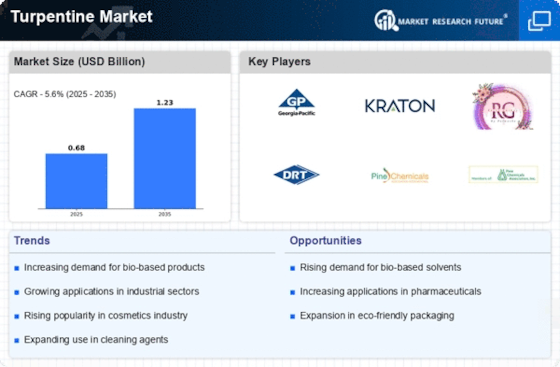
As per Market Research Future analysis, the Turpentine Market Size was estimated at 0.6759 USD Billion in 2024. The Turpentine industry is projected to grow from USD 0.7137 Billion in 2025 to USD 1.231 Billion by 2035, exhibiting a compound annual growth rate (CAGR) of 5.6% during the forecast period 2025 - 2035

Key Market Trends & Highlights

The Turpentine Market is currently experiencing a shift towards sustainability and diversification in applications.

  • The North American region remains the largest market for turpentine, driven by robust demand in various industries.
  • Asia-Pacific is emerging as the fastest-growing region, reflecting increasing investments in natural products.
  • The fragrance segment continues to dominate the market, while the cosmetics segment is witnessing rapid growth.
  • Rising demand in paint and coatings, along with technological advancements in extraction processes, are key drivers of market expansion.

Market Size & Forecast

2024 Market Size 0.6759 (USD Billion)
2035 Market Size 1.231 (USD Billion)
CAGR (2025 - 2035) 5.6%
Largest Regional Market Share in 2024 North America

Major Players

Georgia-Pacific LLC (US), Kraton Corporation (US), Resin & Pitch (US), DRT (FR), Wuzhou Pine Chemicals (CN), Sundar Chemicals (IN), Pine Chemical Group (US), Eastman Chemical Company (US), Forestar Group (US)

Market Trends

The Turpentine Market is currently experiencing a dynamic phase characterized by evolving consumer preferences and increasing applications across various industries. The demand for natural and sustainable products is driving interest in turpentine, particularly in sectors such as paints, coatings, and adhesives. As environmental concerns gain prominence, manufacturers are exploring eco-friendly alternatives, which may enhance the appeal of turpentine derived from pine trees. This shift towards sustainability appears to be influencing production methods and sourcing strategies, potentially reshaping the market landscape. Moreover, the Turpentine Market is witnessing a notable expansion in the use of turpentine in the fragrance and flavoring industries. The unique properties of turpentine make it a valuable ingredient in the formulation of perfumes and food products. This diversification of applications suggests a broader acceptance of turpentine in consumer goods, which could lead to increased market penetration. As the industry adapts to these trends, stakeholders may need to remain vigilant regarding regulatory changes and consumer expectations, which could further impact market dynamics in the near future.

Sustainability Focus

The emphasis on sustainable practices is reshaping the Turpentine Market. Companies are increasingly prioritizing eco-friendly sourcing and production methods, responding to consumer demand for natural products. This trend may lead to innovations in extraction techniques and the development of alternative applications.

Diversification of Applications

Turpentine Market is finding new uses beyond traditional sectors. Its incorporation into the fragrance and flavoring industries highlights a growing acceptance of this natural product in consumer goods. This diversification could enhance market growth and broaden the customer base.

Regulatory Influences

The Turpentine Market is subject to evolving regulations that may impact production and distribution. Stakeholders must navigate these changes carefully, as compliance with environmental standards and safety regulations could shape market strategies and operational practices.

Turpentine Market Market Drivers

Rising Demand in Paint and Coatings

The Turpentine Market is experiencing a notable increase in demand from the paint and coatings sector. This growth is primarily driven by the rising preference for natural and eco-friendly products among consumers. Turpentine Market, derived from pine trees, serves as a solvent and thinner in various paint formulations, making it a preferred choice for manufacturers aiming to meet sustainability standards. According to recent data, the paint and coatings segment accounts for approximately 30% of the total turpentine consumption, indicating a robust market potential. As environmental regulations tighten, the shift towards bio-based solvents is likely to further bolster the demand for turpentine, positioning it as a key player in the evolving landscape of the coatings industry.

Growth in Adhesives and Sealants Applications

The Turpentine Market is witnessing a surge in demand from the adhesives and sealants sector. Turpentine Market is recognized for its excellent solvent properties, making it an ideal component in various adhesive formulations. The increasing construction and automotive industries are driving the need for high-performance adhesives, which often incorporate turpentine as a key ingredient. Recent statistics indicate that the adhesives segment represents approximately 25% of the total turpentine consumption. As construction activities ramp up and the automotive sector evolves, the reliance on turpentine-based adhesives is likely to increase, thereby contributing to the overall growth of the turpentine market. This trend underscores the versatility of turpentine in meeting the diverse needs of modern manufacturing.

Expansion in the Fragrance and Flavor Industry

The Turpentine Market is significantly influenced by its applications in the fragrance and flavor sector. Turpentine Market is utilized as a raw material in the production of various aromatic compounds, which are essential for perfumes and food flavorings. The increasing consumer inclination towards natural fragrances and flavors is propelling the demand for turpentine-derived products. Recent market analysis suggests that the fragrance segment alone constitutes around 20% of the overall turpentine market. As brands strive to create unique and appealing scents, the reliance on turpentine is expected to grow, thereby enhancing its market presence. This trend indicates a promising future for the turpentine market, particularly as consumers continue to seek authenticity in their fragrance and flavor choices.

Increasing Regulatory Support for Natural Products

The Turpentine Market is positively impacted by increasing regulatory support for natural products. Governments and regulatory bodies are promoting the use of bio-based materials as part of broader sustainability initiatives. This regulatory environment encourages manufacturers to adopt turpentine as a viable alternative to synthetic chemicals in various applications, including paints, coatings, and personal care products. Recent policy shifts indicate a growing recognition of the environmental benefits associated with natural solvents like turpentine. As regulations become more favorable, the market for turpentine is likely to expand, providing opportunities for growth and innovation. This supportive regulatory framework is expected to enhance the competitive position of turpentine in the market, fostering a shift towards more sustainable practices.

Technological Advancements in Extraction Processes

The Turpentine Market is benefiting from technological advancements in extraction processes. Innovations in distillation and extraction techniques are enhancing the efficiency and yield of turpentine production. These advancements not only reduce production costs but also improve the quality of the final product, making turpentine more competitive against synthetic alternatives. As manufacturers adopt these new technologies, the overall supply chain for turpentine is expected to become more streamlined, potentially leading to lower prices for consumers. Furthermore, improved extraction methods may also contribute to sustainability efforts by minimizing waste and maximizing resource utilization. This evolution in production technology is likely to play a crucial role in shaping the future landscape of the turpentine market.

Market Segment Insights

By Application: Fragrance (Largest) vs. Cosmetics (Fastest-Growing)

<p>In the Turpentine Market, the application segments reveal a diverse distribution, with fragrances commanding the largest share. As a well-established component in various perfume formulations, turpentine is integral to the scent industry, capitalizing on its robust demand from consumers. Meanwhile, the cosmetic sector, though smaller in share, is quickly gaining traction due to increasing consumer preferences for natural and organic ingredients. This shift is notable as brands aim to enhance their product lines with eco-friendly options infused with turpentine, enhancing its market visibility and adoption. Growth trends within the Turpentine Market application segment are shaped significantly by evolving consumer preferences. The fragrance sector seeks innovative blends driven by luxury branding, while the cosmetics sector is propelled by a rush towards sustainable and organic beauty products. Factors such as rising consumer awareness around the environmental impact of synthetic ingredients and the pursuit of wellness-centric products are driving these trends, making the market ripe for both established and emerging players alike.</p>

<p>Fragrance: Established (Dominant) vs. Cosmetics: Innovative (Emerging)</p>

<p>The fragrance segment holds a dominant position in the Turpentine Market, owing to its long-standing incorporation in fine fragrances and personal care products. Established brands utilize turpentine for its solvent properties and scent quality, making it a valued ingredient for perfumers. In contrast, the cosmetic segment, while emerging, is innovating rapidly, focusing on clean beauty trends. Brands in cosmetics are increasingly formulating products that feature turpentine, promoting its natural origins and therapeutic benefits. This shift caters to a growing demographic that champions sustainability and wellness in their cosmetic choices, thus enhancing the appeal of turpentine in cosmetic applications.</p>

Get more detailed insights about Turpentine Market Research Report - Global Forecast 2035

Regional Insights

North America : Market Leader in Turpentine Market

North America is the largest market for turpentine, accounting for approximately 45% of the global share. The region's growth is driven by the increasing demand for natural solvents in various industries, including paints, coatings, and adhesives. Regulatory support for sustainable products further enhances market potential, with initiatives promoting the use of bio-based chemicals. The U.S. is the primary contributor, followed by Canada, which is witnessing a rise in production capacity. The competitive landscape in North America is robust, featuring key players such as Georgia-Pacific LLC, Kraton Corporation, and Eastman Chemical Company. These companies leverage advanced technologies and sustainable practices to maintain their market positions. The presence of established distribution networks and a strong focus on R&D are pivotal in driving innovation and meeting the growing consumer demand for eco-friendly products. The market is expected to continue its upward trajectory as more industries shift towards sustainable solutions.

Europe : Emerging Market Dynamics

Europe is witnessing a significant transformation in the turpentine market, holding approximately 30% of the global share. The region's growth is fueled by stringent regulations promoting the use of renewable resources and eco-friendly products. Countries like Germany and France are leading the charge, with increasing investments in bio-based chemicals and sustainable manufacturing practices. The European Union's Green Deal further catalyzes this shift, encouraging industries to adopt greener alternatives. Leading countries in Europe include France, which hosts major players like DRT, and Germany, known for its innovative approaches in chemical production. The competitive landscape is characterized by a mix of established companies and emerging startups focusing on sustainability. The presence of organizations advocating for environmental standards enhances market growth, making Europe a key player in The Turpentine Market. The region's commitment to sustainability is expected to drive further advancements in the sector.

Asia-Pacific : Rapidly Growing Market

Asia-Pacific is rapidly emerging as a significant player in the turpentine market, accounting for about 20% of the global share. The region's growth is driven by increasing industrialization and rising demand for natural solvents in various applications, including personal care and pharmaceuticals. Countries like China and India are at the forefront, with expanding production capacities and favorable government policies supporting the chemical industry. The region is also witnessing a shift towards sustainable practices, aligning with global trends. China is the largest market in the region, with companies like Wuzhou Pine Chemicals leading the way. India is also making strides, with local players such as Sundar Chemicals gaining traction. The competitive landscape is evolving, with both domestic and international companies vying for market share. The increasing focus on eco-friendly products and compliance with international standards is expected to further boost the turpentine market in Asia-Pacific, making it a key area for future growth.

Middle East and Africa : Emerging Opportunities

The Middle East and Africa region is gradually emerging in the turpentine market, holding approximately 5% of the global share. The growth is primarily driven by increasing industrial activities and a rising demand for natural solvents in various sectors, including construction and automotive. Countries like South Africa and the UAE are witnessing a surge in production and consumption, supported by government initiatives aimed at boosting local manufacturing and reducing dependency on imports. In this region, the competitive landscape is still developing, with local players beginning to establish their presence. The market is characterized by a mix of traditional and modern practices, with a growing emphasis on sustainability. As the region continues to invest in infrastructure and industrial capabilities, the turpentine market is expected to expand, presenting new opportunities for both local and international players looking to enter this emerging market.

Key Players and Competitive Insights

Leading players in the Turpentine Market are actively engaged in strategic initiatives to strengthen their market positions. This includes investments in research and development for new applications, product innovation, and other market developments. Companies are focusing on expanding their geographical presence, forming partnerships, and mergers to enhance their market reach. The competitive landscape is characterized by a commitment to environmental sustainability, product diversification, and addressing evolving consumer preferences for bio-based and eco-friendly solutions, contributing to the overall growth and competitiveness in the Turpentine Market.
Manufacturing locally to minimize operational costs is one of the key business tactics used by manufacturers in the Turpentine industry to benefit clients and increase the market sector. In recent years, the Turpentine industry has offered some of the most significant advantages to cosmetics. Major players in the Turpentine Market, including Dujodwala Resins and Terpenes Limited, Arakawa Chemical Industries, Ltd., Mentha & Allied Products Pvt.
Ltd., Lawter Inc., Harting SpA, International Flavors & Fragrances Inc. (IFF), Symrise AG, DRT (Dérivés Résiniques et Terpéniques), Georgia-Pacific Chemicals LLC and Kraton Corporation and others, are attempting to increase market demand by investing in research and development operations.
Kraton Corporation is a key player in the Turpentine Market, recognized for its innovative solutions in specialty chemicals. Leveraging a diverse portfolio, Kraton produces high-quality Turpentine Market derivatives for applications in adhesives, coatings, and fragrance formulations. The company's commitment to sustainability and bio-based solutions aligns with the evolving preferences of industries seeking eco-friendly raw materials. Kraton Corporation's business strategy emphasizes research and development, fostering continuous innovation in the Turpentine Market.
With a presence and a focus on meeting the diverse needs of its customers, Kraton remains a prominent contributor to the growth and development of the Turpentine industry, catering to various sectors through its advanced chemical solutions.
Mentha & Allied Products Pvt. Ltd. holds a significant position in the Turpentine Market, specializing in the production of Turpentine Market and its derivatives. Renowned for its expertise in mint and pine-based products, the company plays a key role in the fragrance, flavor, and chemical industries. With a commitment to quality, sustainability, and innovation, Mentha & Allied Products Pvt. Ltd. has established itself as a reliable supplier of Turpentine Market, catering to diverse applications such as adhesives, paints, and coatings.
The company's customer-centric approach, combined with a presence, positions it as a leading player contributing to the growth and dynamics of the Turpentine Market.

Key Companies in the Turpentine Market include

Industry Developments

May 2022: Weyerhaeuser Company successfully concluded the purchase of 80,800 acres of premium timberlands, featuring diverse pine trees in North and South Carolina. The acquisition, valued at approximately USD 265 million, was facilitated through collaboration with a fund managed by Campbell Global.

May 2022: Kraton Corporation, a prominent producer of sustainable biobased products sourced from pine wood pulping co-products, has partnered with Tree-Nation for a collaborative initiative. The joint effort aims to plant thousands of pine trees throughout 2022, underscoring Kraton's ongoing commitment to sustainability, environmental responsibility, and the mitigation of its carbon footprint.

Future Outlook

Turpentine Market Future Outlook

The Turpentine Market is projected to grow at a 5.6% CAGR from 2025 to 2035, driven by increasing demand in the paint and coatings industry, and sustainable sourcing practices.

New opportunities lie in:

  • Expansion into bio-based turpentine products
  • Development of advanced extraction technologies
  • Strategic partnerships with eco-friendly packaging companies

By 2035, the Turpentine Market is expected to achieve robust growth, positioning itself as a leader in sustainable chemical solutions.

Market Segmentation

Turpentine Market Application Outlook

  • Cosmetics
  • Fragrance
  • Food
  • Paints & Coatings
  • Others

Report Scope

MARKET SIZE 2024 0.6759(USD Billion)
MARKET SIZE 2025 0.7137(USD Billion)
MARKET SIZE 2035 1.231(USD Billion)
COMPOUND ANNUAL GROWTH RATE (CAGR) 5.6% (2025 - 2035)
REPORT COVERAGE Revenue Forecast, Competitive Landscape, Growth Factors, and Trends
BASE YEAR 2024
Market Forecast Period 2025 - 2035
Historical Data 2019 - 2024
Market Forecast Units USD Billion
Key Companies Profiled Georgia-Pacific LLC (US), Kraton Corporation (US), Resin & Pitch (US), DRT (FR), Wuzhou Pine Chemicals (CN), Sundar Chemicals (IN), Pine Chemical Group (US), Eastman Chemical Company (US), Forestar Group (US)
Segments Covered Application, Region
Key Market Opportunities Growing demand for bio-based solvents in the Turpentine Market presents significant growth opportunities.

Key Market Dynamics Rising demand for natural solvents drives innovation and competition in the turpentine market, influencing supply chain dynamics.
Countries Covered North America, Europe, APAC, South America, MEA

FAQs

What is the projected market valuation of the Turpentine Market by 2035?

<p>The projected market valuation of the Turpentine Market is 1.231 USD Billion by 2035.</p>

What was the market valuation of the Turpentine Market in 2024?

<p>The overall market valuation of the Turpentine Market was 0.6759 USD Billion in 2024.</p>

What is the expected CAGR for the Turpentine Market during the forecast period 2025 - 2035?

<p>The expected CAGR for the Turpentine Market during the forecast period 2025 - 2035 is 5.6%.</p>

Which companies are considered key players in the Turpentine Market?

<p>Key players in the Turpentine Market include Georgia-Pacific LLC, Kraton Corporation, and Eastman Chemical Company, among others.</p>

What segment of the Turpentine Market had the highest valuation in 2024?

<p>In 2024, the Paints & Coatings segment had the highest valuation at 0.225 USD Billion.</p>

What is the projected growth for the Fragrance segment in the Turpentine Market by 2035?

The Fragrance segment is projected to grow from 0.175 USD Billion in 2024 to 0.325 USD Billion by 2035.

How does the Food segment's valuation compare to other segments in 2024?

In 2024, the Food segment's valuation was 0.085 USD Billion, which is lower than the Paints &amp; Coatings and Fragrance segments.

What is the expected market trend for the Turpentine Market in the coming years?

The Turpentine Market is expected to experience steady growth, with a projected valuation increase to 1.231 USD Billion by 2035.

Which segment is anticipated to show the least growth in the Turpentine Market?

The Others segment, with a valuation of 0.055 USD Billion in 2024, is anticipated to show the least growth compared to other segments.

What factors might influence the growth of the Turpentine Market in the forecast period?

Factors influencing the growth of the Turpentine Market may include increased demand in applications such as cosmetics and paints, driven by key players like Kraton Corporation and Georgia-Pacific LLC.

  1. SECTION I: EXECUTIVE SUMMARY AND KEY HIGHLIGHTS
    1. | 1.1 EXECUTIVE SUMMARY
    2. | | 1.1.1 Market Overview
    3. | | 1.1.2 Key Findings
    4. | | 1.1.3 Market Segmentation
    5. | | 1.1.4 Competitive Landscape
    6. | | 1.1.5 Challenges and Opportunities
    7. | | 1.1.6 Future Outlook
  2. SECTION II: SCOPING, METHODOLOGY AND MARKET STRUCTURE
    1. | 2.1 MARKET INTRODUCTION
    2. | | 2.1.1 Definition
    3. | | 2.1.2 Scope of the study
    4. | | | 2.1.2.1 Research Objective
    5. | | | 2.1.2.2 Assumption
    6. | | | 2.1.2.3 Limitations
    7. | 2.2 RESEARCH METHODOLOGY
    8. | | 2.2.1 Overview
    9. | | 2.2.2 Data Mining
    10. | | 2.2.3 Secondary Research
    11. | | 2.2.4 Primary Research
    12. | | | 2.2.4.1 Primary Interviews and Information Gathering Process
    13. | | | 2.2.4.2 Breakdown of Primary Respondents
    14. | | 2.2.5 Forecasting Model
    15. | | 2.2.6 Market Size Estimation
    16. | | | 2.2.6.1 Bottom-Up Approach
    17. | | | 2.2.6.2 Top-Down Approach
    18. | | 2.2.7 Data Triangulation
    19. | | 2.2.8 Validation
  3. SECTION III: QUALITATIVE ANALYSIS
    1. | 3.1 MARKET DYNAMICS
    2. | | 3.1.1 Overview
    3. | | 3.1.2 Drivers
    4. | | 3.1.3 Restraints
    5. | | 3.1.4 Opportunities
    6. | 3.2 MARKET FACTOR ANALYSIS
    7. | | 3.2.1 Value chain Analysis
    8. | | 3.2.2 Porter's Five Forces Analysis
    9. | | | 3.2.2.1 Bargaining Power of Suppliers
    10. | | | 3.2.2.2 Bargaining Power of Buyers
    11. | | | 3.2.2.3 Threat of New Entrants
    12. | | | 3.2.2.4 Threat of Substitutes
    13. | | | 3.2.2.5 Intensity of Rivalry
    14. | | 3.2.3 COVID-19 Impact Analysis
    15. | | | 3.2.3.1 Market Impact Analysis
    16. | | | 3.2.3.2 Regional Impact
    17. | | | 3.2.3.3 Opportunity and Threat Analysis
  4. SECTION IV: QUANTITATIVE ANALYSIS
    1. | 4.1 Chemicals and Materials, BY Application (USD Billion)
    2. | | 4.1.1 Cosmetics
    3. | | 4.1.2 Fragrance
    4. | | 4.1.3 Food
    5. | | 4.1.4 Paints & Coatings
    6. | | 4.1.5 Others
    7. | 4.2 Chemicals and Materials, BY Region (USD Billion)
    8. | | 4.2.1 North America
    9. | | | 4.2.1.1 US
    10. | | | 4.2.1.2 Canada
    11. | | 4.2.2 Europe
    12. | | | 4.2.2.1 Germany
    13. | | | 4.2.2.2 UK
    14. | | | 4.2.2.3 France
    15. | | | 4.2.2.4 Russia
    16. | | | 4.2.2.5 Italy
    17. | | | 4.2.2.6 Spain
    18. | | | 4.2.2.7 Rest of Europe
    19. | | 4.2.3 APAC
    20. | | | 4.2.3.1 China
    21. | | | 4.2.3.2 India
    22. | | | 4.2.3.3 Japan
    23. | | | 4.2.3.4 South Korea
    24. | | | 4.2.3.5 Malaysia
    25. | | | 4.2.3.6 Thailand
    26. | | | 4.2.3.7 Indonesia
    27. | | | 4.2.3.8 Rest of APAC
    28. | | 4.2.4 South America
    29. | | | 4.2.4.1 Brazil
    30. | | | 4.2.4.2 Mexico
    31. | | | 4.2.4.3 Argentina
    32. | | | 4.2.4.4 Rest of South America
    33. | | 4.2.5 MEA
    34. | | | 4.2.5.1 GCC Countries
    35. | | | 4.2.5.2 South Africa
    36. | | | 4.2.5.3 Rest of MEA
  5. SECTION V: COMPETITIVE ANALYSIS
    1. | 5.1 Competitive Landscape
    2. | | 5.1.1 Overview
    3. | | 5.1.2 Competitive Analysis
    4. | | 5.1.3 Market share Analysis
    5. | | 5.1.4 Major Growth Strategy in the Chemicals and Materials
    6. | | 5.1.5 Competitive Benchmarking
    7. | | 5.1.6 Leading Players in Terms of Number of Developments in the Chemicals and Materials
    8. | | 5.1.7 Key developments and growth strategies
    9. | | | 5.1.7.1 New Product Launch/Service Deployment
    10. | | | 5.1.7.2 Merger & Acquisitions
    11. | | | 5.1.7.3 Joint Ventures
    12. | | 5.1.8 Major Players Financial Matrix
    13. | | | 5.1.8.1 Sales and Operating Income
    14. | | | 5.1.8.2 Major Players R&D Expenditure. 2023
    15. | 5.2 Company Profiles
    16. | | 5.2.1 Georgia-Pacific LLC (US)
    17. | | | 5.2.1.1 Financial Overview
    18. | | | 5.2.1.2 Products Offered
    19. | | | 5.2.1.3 Key Developments
    20. | | | 5.2.1.4 SWOT Analysis
    21. | | | 5.2.1.5 Key Strategies
    22. | | 5.2.2 Kraton Corporation (US)
    23. | | | 5.2.2.1 Financial Overview
    24. | | | 5.2.2.2 Products Offered
    25. | | | 5.2.2.3 Key Developments
    26. | | | 5.2.2.4 SWOT Analysis
    27. | | | 5.2.2.5 Key Strategies
    28. | | 5.2.3 Resin & Pitch (US)
    29. | | | 5.2.3.1 Financial Overview
    30. | | | 5.2.3.2 Products Offered
    31. | | | 5.2.3.3 Key Developments
    32. | | | 5.2.3.4 SWOT Analysis
    33. | | | 5.2.3.5 Key Strategies
    34. | | 5.2.4 DRT (FR)
    35. | | | 5.2.4.1 Financial Overview
    36. | | | 5.2.4.2 Products Offered
    37. | | | 5.2.4.3 Key Developments
    38. | | | 5.2.4.4 SWOT Analysis
    39. | | | 5.2.4.5 Key Strategies
    40. | | 5.2.5 Wuzhou Pine Chemicals (CN)
    41. | | | 5.2.5.1 Financial Overview
    42. | | | 5.2.5.2 Products Offered
    43. | | | 5.2.5.3 Key Developments
    44. | | | 5.2.5.4 SWOT Analysis
    45. | | | 5.2.5.5 Key Strategies
    46. | | 5.2.6 Sundar Chemicals (IN)
    47. | | | 5.2.6.1 Financial Overview
    48. | | | 5.2.6.2 Products Offered
    49. | | | 5.2.6.3 Key Developments
    50. | | | 5.2.6.4 SWOT Analysis
    51. | | | 5.2.6.5 Key Strategies
    52. | | 5.2.7 Pine Chemical Group (US)
    53. | | | 5.2.7.1 Financial Overview
    54. | | | 5.2.7.2 Products Offered
    55. | | | 5.2.7.3 Key Developments
    56. | | | 5.2.7.4 SWOT Analysis
    57. | | | 5.2.7.5 Key Strategies
    58. | | 5.2.8 Eastman Chemical Company (US)
    59. | | | 5.2.8.1 Financial Overview
    60. | | | 5.2.8.2 Products Offered
    61. | | | 5.2.8.3 Key Developments
    62. | | | 5.2.8.4 SWOT Analysis
    63. | | | 5.2.8.5 Key Strategies
    64. | | 5.2.9 Forestar Group (US)
    65. | | | 5.2.9.1 Financial Overview
    66. | | | 5.2.9.2 Products Offered
    67. | | | 5.2.9.3 Key Developments
    68. | | | 5.2.9.4 SWOT Analysis
    69. | | | 5.2.9.5 Key Strategies
    70. | 5.3 Appendix
    71. | | 5.3.1 References
    72. | | 5.3.2 Related Reports
  6. LIST OF FIGURES
    1. | 6.1 MARKET SYNOPSIS
    2. | 6.2 NORTH AMERICA MARKET ANALYSIS
    3. | 6.3 US MARKET ANALYSIS BY APPLICATION
    4. | 6.4 CANADA MARKET ANALYSIS BY APPLICATION
    5. | 6.5 EUROPE MARKET ANALYSIS
    6. | 6.6 GERMANY MARKET ANALYSIS BY APPLICATION
    7. | 6.7 UK MARKET ANALYSIS BY APPLICATION
    8. | 6.8 FRANCE MARKET ANALYSIS BY APPLICATION
    9. | 6.9 RUSSIA MARKET ANALYSIS BY APPLICATION
    10. | 6.10 ITALY MARKET ANALYSIS BY APPLICATION
    11. | 6.11 SPAIN MARKET ANALYSIS BY APPLICATION
    12. | 6.12 REST OF EUROPE MARKET ANALYSIS BY APPLICATION
    13. | 6.13 APAC MARKET ANALYSIS
    14. | 6.14 CHINA MARKET ANALYSIS BY APPLICATION
    15. | 6.15 INDIA MARKET ANALYSIS BY APPLICATION
    16. | 6.16 JAPAN MARKET ANALYSIS BY APPLICATION
    17. | 6.17 SOUTH KOREA MARKET ANALYSIS BY APPLICATION
    18. | 6.18 MALAYSIA MARKET ANALYSIS BY APPLICATION
    19. | 6.19 THAILAND MARKET ANALYSIS BY APPLICATION
    20. | 6.20 INDONESIA MARKET ANALYSIS BY APPLICATION
    21. | 6.21 REST OF APAC MARKET ANALYSIS BY APPLICATION
    22. | 6.22 SOUTH AMERICA MARKET ANALYSIS
    23. | 6.23 BRAZIL MARKET ANALYSIS BY APPLICATION
    24. | 6.24 MEXICO MARKET ANALYSIS BY APPLICATION
    25. | 6.25 ARGENTINA MARKET ANALYSIS BY APPLICATION
    26. | 6.26 REST OF SOUTH AMERICA MARKET ANALYSIS BY APPLICATION
    27. | 6.27 MEA MARKET ANALYSIS
    28. | 6.28 GCC COUNTRIES MARKET ANALYSIS BY APPLICATION
    29. | 6.29 SOUTH AFRICA MARKET ANALYSIS BY APPLICATION
    30. | 6.30 REST OF MEA MARKET ANALYSIS BY APPLICATION
    31. | 6.31 KEY BUYING CRITERIA OF CHEMICALS AND MATERIALS
    32. | 6.32 RESEARCH PROCESS OF MRFR
    33. | 6.33 DRO ANALYSIS OF CHEMICALS AND MATERIALS
    34. | 6.34 DRIVERS IMPACT ANALYSIS: CHEMICALS AND MATERIALS
    35. | 6.35 RESTRAINTS IMPACT ANALYSIS: CHEMICALS AND MATERIALS
    36. | 6.36 SUPPLY / VALUE CHAIN: CHEMICALS AND MATERIALS
    37. | 6.37 CHEMICALS AND MATERIALS, BY APPLICATION, 2024 (% SHARE)
    38. | 6.38 CHEMICALS AND MATERIALS, BY APPLICATION, 2024 TO 2035 (USD Billion)
    39. | 6.39 BENCHMARKING OF MAJOR COMPETITORS
  7. LIST OF TABLES
    1. | 7.1 LIST OF ASSUMPTIONS
    2. | | 7.1.1
    3. | 7.2 North America MARKET SIZE ESTIMATES; FORECAST
    4. | | 7.2.1 BY APPLICATION, 2025-2035 (USD Billion)
    5. | 7.3 US MARKET SIZE ESTIMATES; FORECAST
    6. | | 7.3.1 BY APPLICATION, 2025-2035 (USD Billion)
    7. | 7.4 Canada MARKET SIZE ESTIMATES; FORECAST
    8. | | 7.4.1 BY APPLICATION, 2025-2035 (USD Billion)
    9. | 7.5 Europe MARKET SIZE ESTIMATES; FORECAST
    10. | | 7.5.1 BY APPLICATION, 2025-2035 (USD Billion)
    11. | 7.6 Germany MARKET SIZE ESTIMATES; FORECAST
    12. | | 7.6.1 BY APPLICATION, 2025-2035 (USD Billion)
    13. | 7.7 UK MARKET SIZE ESTIMATES; FORECAST
    14. | | 7.7.1 BY APPLICATION, 2025-2035 (USD Billion)
    15. | 7.8 France MARKET SIZE ESTIMATES; FORECAST
    16. | | 7.8.1 BY APPLICATION, 2025-2035 (USD Billion)
    17. | 7.9 Russia MARKET SIZE ESTIMATES; FORECAST
    18. | | 7.9.1 BY APPLICATION, 2025-2035 (USD Billion)
    19. | 7.10 Italy MARKET SIZE ESTIMATES; FORECAST
    20. | | 7.10.1 BY APPLICATION, 2025-2035 (USD Billion)
    21. | 7.11 Spain MARKET SIZE ESTIMATES; FORECAST
    22. | | 7.11.1 BY APPLICATION, 2025-2035 (USD Billion)
    23. | 7.12 Rest of Europe MARKET SIZE ESTIMATES; FORECAST
    24. | | 7.12.1 BY APPLICATION, 2025-2035 (USD Billion)
    25. | 7.13 APAC MARKET SIZE ESTIMATES; FORECAST
    26. | | 7.13.1 BY APPLICATION, 2025-2035 (USD Billion)
    27. | 7.14 China MARKET SIZE ESTIMATES; FORECAST
    28. | | 7.14.1 BY APPLICATION, 2025-2035 (USD Billion)
    29. | 7.15 India MARKET SIZE ESTIMATES; FORECAST
    30. | | 7.15.1 BY APPLICATION, 2025-2035 (USD Billion)
    31. | 7.16 Japan MARKET SIZE ESTIMATES; FORECAST
    32. | | 7.16.1 BY APPLICATION, 2025-2035 (USD Billion)
    33. | 7.17 South Korea MARKET SIZE ESTIMATES; FORECAST
    34. | | 7.17.1 BY APPLICATION, 2025-2035 (USD Billion)
    35. | 7.18 Malaysia MARKET SIZE ESTIMATES; FORECAST
    36. | | 7.18.1 BY APPLICATION, 2025-2035 (USD Billion)
    37. | 7.19 Thailand MARKET SIZE ESTIMATES; FORECAST
    38. | | 7.19.1 BY APPLICATION, 2025-2035 (USD Billion)
    39. | 7.20 Indonesia MARKET SIZE ESTIMATES; FORECAST
    40. | | 7.20.1 BY APPLICATION, 2025-2035 (USD Billion)
    41. | 7.21 Rest of APAC MARKET SIZE ESTIMATES; FORECAST
    42. | | 7.21.1 BY APPLICATION, 2025-2035 (USD Billion)
    43. | 7.22 South America MARKET SIZE ESTIMATES; FORECAST
    44. | | 7.22.1 BY APPLICATION, 2025-2035 (USD Billion)
    45. | 7.23 Brazil MARKET SIZE ESTIMATES; FORECAST
    46. | | 7.23.1 BY APPLICATION, 2025-2035 (USD Billion)
    47. | 7.24 Mexico MARKET SIZE ESTIMATES; FORECAST
    48. | | 7.24.1 BY APPLICATION, 2025-2035 (USD Billion)
    49. | 7.25 Argentina MARKET SIZE ESTIMATES; FORECAST
    50. | | 7.25.1 BY APPLICATION, 2025-2035 (USD Billion)
    51. | 7.26 Rest of South America MARKET SIZE ESTIMATES; FORECAST
    52. | | 7.26.1 BY APPLICATION, 2025-2035 (USD Billion)
    53. | 7.27 MEA MARKET SIZE ESTIMATES; FORECAST
    54. | | 7.27.1 BY APPLICATION, 2025-2035 (USD Billion)
    55. | 7.28 GCC Countries MARKET SIZE ESTIMATES; FORECAST
    56. | | 7.28.1 BY APPLICATION, 2025-2035 (USD Billion)
    57. | 7.29 South Africa MARKET SIZE ESTIMATES; FORECAST
    58. | | 7.29.1 BY APPLICATION, 2025-2035 (USD Billion)
    59. | 7.30 Rest of MEA MARKET SIZE ESTIMATES; FORECAST
    60. | | 7.30.1 BY APPLICATION, 2025-2035 (USD Billion)
    61. | 7.31 PRODUCT LAUNCH/PRODUCT DEVELOPMENT/APPROVAL
    62. | | 7.31.1
    63. | 7.32 ACQUISITION/PARTNERSHIP
    64. | | 7.32.1

Chemicals and Materials Market Segmentation

Chemicals and Materials By Application (USD Billion, 2025-2035)

  • Cosmetics
  • Fragrance
  • Food
  • Paints & Coatings
  • Others
Infographic

Free Sample Request

Kindly complete the form below to receive a free sample of this Report

Get Free Sample

Customer Strories

Compare Licence

×
Features License Type
Single User Multiuser License Enterprise User
Price $4,950 $5,950 $7,250
Maximum User Access Limit 1 User Upto 10 Users Unrestricted Access Throughout the Organization
Free Customization
Direct Access to Analyst
Deliverable Format
Platform Access
Discount on Next Purchase 10% 15% 15%
Printable Versions