
Request Free Sample ×

Kindly complete the form below to receive a free sample of this Report

* Please use a valid business email

Leading companies partner with us for data-driven Insights

clients tt-cursor
Hero Background
English
Chinese
French
Japanese
Korean
German
Spanish

Turboexpander Market Share

ID: MRFR/EnP/4996-HCR
111 Pages
Priya Nagrale
April 2026

Turboexpander Market Research Report Information by Loading Device (Compressor, Generator and Oil Break), Application (Hydrocarbon, and Air Separation, Others), End-use (Oil & Gas, Manufacturing, and Power Generation) and Regions – Global Industry Size, Share, Growth, Trends and Forecast To 2035

Share:
Download PDF ×

We do not share your information with anyone. However, we may send you emails based on your report interest from time to time. You may contact us at any time to opt-out.

Turboexpander Market Infographic
Purchase Options

Market Share

Turboexpander Market Share Analysis

In the unique scene of the Turboexpander Market, organizations send different pieces of the pie situating methodologies to acquire an upper hand and lay out major areas of strength for a. One predominant methodology is separation, where organizations accentuate extraordinary elements and mechanical progressions in their turboexpander items. By offering unmistakable benefits, for example, upgraded productivity or lower support costs, organizations look to cut out a specialty for themselves on the lookout. This methodology draws in clients searching for particular arrangements as well as makes an apparent worth that can legitimize premium evaluating.

Cost leadership, in which businesses strive to become the low-cost provider in the turboexpander market, is another important strategy. This approach includes improving creation processes, smoothing out supply chains, and utilizing economies of scale to offer cutthroat costs. Cost leadership is especially effective in markets where customers place a high value on affordability over additional features and are price sensitive. Organizations utilizing this technique mean to catch a bigger portion of the overall industry by speaking to a wide client base.

Makers of turboexpanders utilize market division as an essential device to target explicit client bunches in view of their particular prerequisites and inclinations. Organizations can make their items and promoting messages more interesting to a great many clients by fitting them to explicit socioeconomics. For example, an organization might foster turboexpanders explicitly intended for applications in the oil and gas industry, focusing on clients with explicit prerequisites in this area. This designated approach permits organizations to assign assets proficiently and fortify their traction in specific business sectors.

Key organizations and coordinated efforts assume a vital part in extending piece of the pie for turboexpander makers. By shaping coalitions with correlative organizations or going into key coordinated efforts with central participants in related ventures, organizations can get to new business sectors and client portions. These organizations might include joint endeavors, permitting arrangements, or innovation sharing plans, empowering organizations to use each other's assets and assets to acquire an upper hand.

Moreover, development is a foundation of piece of the pie situating in the turboexpander business. Organizations put resources into innovative work to present state of the art advancements and plan enhancements that put their items aside. Whether it's improving energy productivity, expanding functional dependability, or diminishing ecological effect, development draws in clients looking for cutting edge arrangements. This procedure assists organizations with acquiring an upper hand as well as positions them as industry pioneers, driving piece of the pie development.

Successful showcasing and marking procedures are fundamental for turboexpander makers to impart their incentive and fabricate a positive brand picture. By putting resources into solid marking, organizations can make client dedication and impact buying choices. This requires building a reputation for dependability and customer satisfaction in addition to delivering a message that is both clear and persuasive about the advantages of their turboexpander products.

All in all, the turboexpander market is exceptionally cutthroat, and organizations utilize different techniques to situate themselves for progress. Whether through separation, cost administration, market division, vital organizations, development, or successful showcasing, every procedure assumes a significant part in catching and growing piece of the pie. As the business keeps on advancing, turboexpander makers should adjust and refine their procedures to remain ahead in this unique commercial center.


Author
Author Profile
Priya Nagrale
Senior Research Analyst

With an experience of over five years in market research industry (Chemicals & Materials domain), I gather and analyze market data from diverse sources to produce results, which are then presented back to a client. Also, provide recommendations based on the findings. As a Senior Research Analyst, I perform quality checks (QC) for market estimations, QC for reports, and handle queries and work extensively on client customizations. Also, handle the responsibilities of client proposals, report planning, report finalization, and execution

Leave a Comment

FAQs

What is the current valuation of the Turboexpander Market?

<p>As of 2024, the Turboexpander Market was valued at 1032.28 USD Million.</p>

What is the projected market valuation for the Turboexpander Market in 2035?

<p>The Turboexpander Market is projected to reach a valuation of 1491.16 USD Million by 2035.</p>

What is the expected CAGR for the Turboexpander Market during the forecast period 2025 - 2035?

<p>The expected CAGR for the Turboexpander Market during the forecast period 2025 - 2035 is 3.4%.</p>

Which companies are considered key players in the Turboexpander Market?

<p>Key players in the Turboexpander Market include Air Products and Chemicals Inc, Siemens AG, General Electric Company, and Honeywell International Inc.</p>

What are the main segments of the Turboexpander Market?

<p>The main segments of the Turboexpander Market include Loading Device Type, Application, and End-Use Industry.</p>

What was the market valuation for the Compressor segment in 2024?

In 2024, the market valuation for the Compressor segment was between 400.0 and 550.0 USD Million.

How much is the Oil and Gas segment projected to be worth in 2035?

The Oil and Gas segment is projected to be valued between 400.0 and 550.0 USD Million by 2035.

What applications are driving growth in the Turboexpander Market?

Applications driving growth in the Turboexpander Market include Hydrocarbon, Air Separation, and Generation of Energy from Waste Gases.

What was the valuation range for the Generator segment in 2024?

The Generator segment had a valuation range of 300.0 to 450.0 USD Million in 2024.

Which end-use industry is expected to contribute significantly to the Turboexpander Market?

The Power Generation end-use industry is expected to contribute significantly, with a projected valuation between 350.0 and 500.0 USD Million.

Market Summary

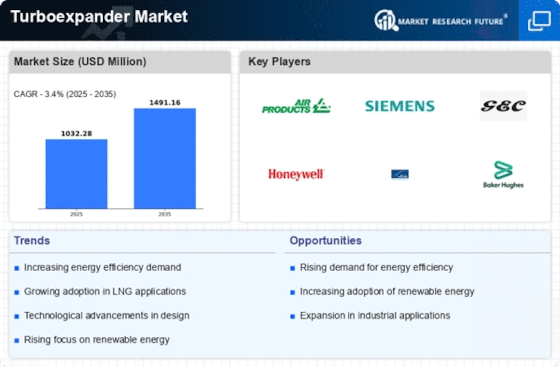
As per Market Research Future analysis, the Turboexpander Market Size was estimated at 1032.28 USD Million in 2024. The Turboexpander industry is projected to grow from 1067.38 USD Million in 2025 to 1491.16 USD Million by 2035, exhibiting a compound annual growth rate (CAGR) of 3% during the forecast period 2025 - 2035

Key Market Trends & Highlights

The Turboexpander Market is poised for growth driven by technological advancements and sustainability initiatives.

  • Technological advancements are enhancing the efficiency and performance of turboexpanders across various applications. North America remains the largest market, while the Asia-Pacific region is experiencing rapid growth due to increasing industrialization. The compressor segment holds the largest market share, whereas the generator segment is emerging as the fastest-growing category. The rising demand for energy efficiency and regulatory support for energy recovery technologies are key drivers propelling market expansion.

Market Size & Forecast

2024 Market Size 1032.28 (USD Million)
2035 Market Size 1491.16 (USD Million)
CAGR (2025 - 2035) 3.4%
Largest Regional Market Share in 2024 Asia Pacific

Major Players

<a href="https://www.airproducts.com/company/news-center/2018/08/0822-air-products-acquires-bhge-rotoflow-turboexpander-business">Air Products and Chemicals Inc</a> (US), Siemens AG (DE), General Electric Company (US), Honeywell International Inc (US), Linde plc (IE), <a href="https://www.bakerhughes.com/expanders/turboexpander-compressors">Baker Hughes Company</a> (US), Atlas Copco AB (SE), Mitsubishi Heavy Industries Ltd (JP), Cryostar SAS (FR)

Market Trends

The global Turboexpander Market is currently experiencing a dynamic evolution, driven by advancements in technology and increasing demand for energy efficiency across various industries. Turboexpanders, which are integral components in processes such as natural gas liquefaction and power generation, are gaining traction due to their ability to enhance energy recovery and reduce operational costs. A comprehensive turboexpander market analysis indicates that the integration of active magnetic bearings and advanced materials is significantly enhancing the efficiency of the global turboexpander market for cryogenic applications.

As industries strive to meet stringent environmental regulations, the adoption of turboexpanders appears to be a strategic move towards sustainable practices. Furthermore, the growing emphasis on renewable energy sources is likely to bolster the market, as turboexpanders can play a pivotal role in optimizing energy conversion processes. In addition to technological advancements, the Turboexpander Market is influenced by the rising need for efficient cooling systems in industrial applications. The integration of turboexpanders in refrigeration and air conditioning systems suggests a shift towards more sustainable cooling solutions.

Moreover, the increasing focus on reducing greenhouse gas emissions may further propel the market, as turboexpanders contribute to lower emissions through enhanced efficiency. Overall, the Turboexpander Market seems poised for growth, driven by innovation and a collective push towards energy sustainability.

Technological Advancements

The Turboexpander Market trend highlights rapid technological innovations that enhance performance and efficiency. New designs and materials are being developed to improve the reliability and lifespan of turboexpanders, making them more appealing to industries seeking cost-effective solutions.

Sustainability Initiatives

There is a growing trend towards sustainability within the Turboexpander Market, as companies increasingly prioritize energy-efficient technologies. This shift is driven by regulatory pressures and consumer demand for environmentally friendly practices, leading to a rise in the adoption of turboexpanders.

Expansion in Emerging Markets

Emerging markets are showing a notable increase in the demand for turboexpanders, as industrialization and urbanization accelerate. This trend indicates a potential for growth in regions where energy efficiency is becoming a critical focus for development.

Turboexpander Market Market Drivers

Rising Adoption in Renewable Energy

The Turboexpander Market is witnessing a growing adoption of turboexpanders in renewable energy applications. As the world shifts towards cleaner energy sources, turboexpanders are increasingly utilized in geothermal and biomass energy systems. These systems require efficient energy conversion processes, where turboexpanders excel. Market data indicates that the renewable energy sector is expected to expand rapidly, creating new opportunities for turboexpander manufacturers. This trend suggests that the integration of turboexpanders in renewable energy projects could significantly enhance energy recovery and overall system efficiency, thereby bolstering the market.

Expansion of Natural Gas Infrastructure

The Turboexpander Market is closely linked to the expansion of natural gas infrastructure worldwide. As countries invest in natural gas pipelines and processing facilities, the demand for turboexpanders is likely to increase. Turboexpanders are critical in natural gas processing, where they help in cooling and liquefying gas for transportation. Recent statistics indicate that the natural gas market is projected to grow, driven by the need for cleaner energy sources. This expansion presents a significant opportunity for turboexpander manufacturers to cater to the growing needs of the natural gas sector, thereby enhancing market prospects.

Increasing Demand for Energy Efficiency

The Turboexpander Market is experiencing a notable surge in demand for energy-efficient solutions. Industries are increasingly focusing on reducing operational costs and minimizing energy consumption. Turboexpanders, known for their ability to convert excess energy into usable power, are becoming essential in various applications, including natural gas processing and power generation. According to recent data, the energy efficiency market is projected to grow significantly, with turboexpanders playing a crucial role in achieving these targets. This trend is likely to drive investments in turboexpander technology, as companies seek to enhance their sustainability profiles while maintaining profitability.

Technological Innovations in Turboexpander Design

The Turboexpander Market is benefiting from continuous technological innovations that enhance the performance and efficiency of turboexpanders. Recent advancements in materials and design methodologies have led to the development of more compact and efficient units. These innovations not only improve energy recovery rates but also reduce maintenance costs, making turboexpanders more attractive to end-users. Market analysis shows that companies investing in research and development are likely to gain a competitive edge, as they can offer superior products that meet the evolving demands of various industries. This trend is expected to drive growth in the turboexpander market.

Regulatory Support for Energy Recovery Technologies

The Turboexpander Market is positively influenced by regulatory support for energy recovery technologies. Governments are increasingly implementing policies that promote energy efficiency and the use of advanced technologies in industrial processes. This regulatory environment encourages industries to adopt turboexpanders as a means to recover energy and reduce emissions. Market data suggests that regions with stringent energy regulations are likely to see a higher adoption rate of turboexpanders. This trend indicates that regulatory frameworks could play a pivotal role in shaping the future of the turboexpander market, driving growth and innovation.

Market Segment Insights

By Loading Device Type: Compressor (Largest) vs. Generator (Fastest-Growing)

In the Turboexpander Market, the 'Loading Device Type' segment is primarily dominated by Compressors, accounting for a significant market share due to their extensive application in various industries. Generators follow closely, capturing attention as they are characterized by their promising growth trends. Oil Brakes, although present, remain a smaller player in this segment, illustrating a diverse distribution among the loading device types and highlighting the leading position of compressors. Looking ahead, growth trends indicate that while Compressors maintain their leadership, Generators are emerging as the fastest-growing type in the Turboexpander Market. This surge is driven by increasing demand for energy-efficient solutions and advancements in technology, which enhance their performance. Furthermore, growing industrial applications and the trend towards optimizing energy consumption have bolstered the adoption of Generators, ensuring a bright future for this segment alongside the established Compressor.

Compressor (Dominant) vs. Generator (Emerging)

Compressors have long held the dominant position in the Turboexpander Market, primarily due to their efficiency and reliability in energy conversion processes. They are widely utilized across various sectors, including <a href="https://www.marketresearchfuture.com/reports/oil-gas-projects-market-16161">oil and gas</a>, aerospace, and chemical processing, underscoring their pivotal role in industrial applications. On the other hand, Generators are regarded as the emerging segment, experiencing rapid growth fueled by the shift towards sustainable energy solutions. Their ability to deliver high energy output while minimizing environmental impact serves as a key differentiator. The evolving technological landscape also supports Generators, with innovations that enhance their operational efficiency and scalability, making them increasingly appealing for new installations and upgrades in existing systems.

By Application: Hydrocarbon (Largest) vs. Air Separation (Fastest-Growing)

The Turboexpander Market showcases diverse application segments including Hydrocarbon, Air Separation, Generation of Energy from Waste Gases, and Others. Among these, the Hydrocarbon segment accounts for a significant share due to its widespread utilization in oil and gas processes, where turboexpanders aid in effective energy recovery. Meanwhile, the Air Separation segment is rapidly gaining traction, driven by increasing demands in the industrial gas sector for oxygen and nitrogen production, contributing to its fast growth in market presence.

Hydrocarbon (Dominant) vs. Air Separation (Emerging)

The Hydrocarbon application is the most dominant segment in the Turboexpander Market, owing to its critical role in facilitating energy recovery during the processing of natural gas and other hydrocarbons. Turboexpanders in this segment optimize energy efficiency, leading to reduced operational costs for energy-intensive processes. Conversely, the Air Separation segment is emerging as a crucial player, propelled by technological advancements and heightened demand for cryogenic liquefaction processes. This segment's expansion is supported by innovations aimed at enhancing the efficiency and scalability of air separation systems, thus positioning itself as a key growth area within the market.

By End-Use Industry: Oil and Gas (Largest) vs. Power Generation (Fastest-Growing)

In the Turboexpander Market, the distribution of market share among the end-use industries reveals that the Oil and Gas sector holds the largest portion, driven by significant demand for efficient resource extraction and processing technologies. The Manufacturing industry, while substantial, is gradually losing ground to the more dynamic Power Generation segment, which demonstrates an increasing share due to a global shift towards renewable energy and the need for efficient energy conversion methods.

Oil and Gas (Dominant) vs. Power Generation (Emerging)

The Oil and Gas segment remains dominant in the Turboexpander Market, primarily due to its longstanding reliance on turboexpanders for processes like natural gas extraction and liquefaction. This segment benefits from substantial investments in exploration and production technologies. Conversely, the Power Generation segment is emerging rapidly, fueled by a growing emphasis on sustainable energy sources. Turboexpanders utilized in this sector are enhancing energy efficiency in systems such as Combined Cycle Gas Turbines (CCGT) and other renewable energy applications, reflecting a shift in industry dynamics towards cleaner energy solutions.

Get more detailed insights about Turboexpander Market Size, Growth, Trends, Report 2035

Regional Insights

North America : Innovation and Demand Surge

North America is the largest market for turboexpanders, holding approximately 45% of the global market share. The region's growth is driven by increasing demand for energy-efficient technologies and stringent environmental regulations promoting cleaner energy solutions. The presence of major players like General Electric and Honeywell further fuels market expansion, supported by government incentives for renewable energy projects. The United States leads the market, followed by Canada, which is witnessing a rise in natural gas processing and power generation applications. The competitive landscape is characterized by significant investments in R&D and technological advancements. Key players are focusing on enhancing efficiency and reliability, positioning themselves to meet the growing demand in various industrial sectors.

Europe : Sustainable Energy Focus

The Europe Turboexpander Market is experiencing steady growth driven by stringent decarbonization policies and emerging turboexpander market trends, such as the deployment of modular systems for hydrogen liquefaction and waste heat recovery. This region is the second-largest market for turboexpanders, accounting for around 30% of the global share. Initiatives like the Green Deal and various funding programs are catalyzing investments in energy-efficient technologies, including turboexpanders. Leading countries such as Germany, France, and the UK are at the forefront of this market, with significant contributions from companies like Siemens and Linde. The competitive landscape is marked by collaborations between industry players and research institutions to innovate and enhance product offerings. The focus on renewable energy sources and energy recovery systems is expected to drive further growth in the coming years.

Asia-Pacific : Emerging Market Potential

Asia-Pacific is witnessing rapid growth in the turboexpander market, holding approximately 20% of the global share. The region's industrialization, particularly in countries like China and India, is a significant driver of demand. Government initiatives promoting energy efficiency and the adoption of cleaner technologies are further catalyzing market growth. The increasing focus on natural gas and renewable energy sources is also contributing to the rising demand for turboexpanders. China is the largest market in the region, followed by India and Japan. The competitive landscape is evolving, with both local and international players vying for market share. Companies are investing in advanced technologies to enhance performance and efficiency, positioning themselves to capitalize on the growing industrial and energy sectors in the region.

Middle East and Africa : Resource-Rich Opportunities

The Middle East and Africa region is emerging as a significant player in the turboexpander market, accounting for about 5% of the global share. The growth is primarily driven by the region's vast natural resources and increasing investments in energy infrastructure. Countries like Saudi Arabia and the UAE are focusing on diversifying their energy portfolios, which includes the adoption of turboexpanders for enhanced efficiency in oil and gas operations. The competitive landscape is characterized by a mix of local and international companies, with key players like Baker Hughes and Mitsubishi Heavy Industries establishing a strong presence. The region's focus on sustainable energy solutions and technological advancements is expected to drive further growth, making it an attractive market for investments in the coming years.

Key Players and Competitive Insights

The Turboexpander Market is currently characterized by a dynamic competitive landscape, driven by increasing demand for energy efficiency and sustainable solutions across various industries. Key players such as Air Products and Chemicals Inc (US), Siemens AG (DE), and General Electric Company (US) are strategically positioning themselves through innovation and technological advancements. These companies are focusing on enhancing their product offerings and expanding their market reach, which collectively shapes a competitive environment that is both robust and evolving.

In terms of business tactics, companies are increasingly localizing manufacturing and optimizing supply chains to enhance operational efficiency. The market appears moderately fragmented, with several key players exerting significant influence. This structure allows for a diverse range of offerings, catering to various customer needs while fostering competition that drives innovation and efficiency.

In August 2025, Siemens AG (DE) announced the launch of a new line of turboexpanders designed specifically for the renewable energy sector. This strategic move underscores Siemens' commitment to sustainability and positions the company to capitalize on the growing demand for clean energy solutions. By aligning its product development with market trends, Siemens is likely to enhance its competitive edge in the Turboexpander Market.

In September 2025, General Electric Company (US) entered into a partnership with a leading energy provider to develop advanced turboexpander technology aimed at improving efficiency in natural gas processing. This collaboration not only strengthens GE's position in the market but also highlights the importance of strategic alliances in driving innovation and meeting customer demands for more efficient energy solutions.

In July 2025, Air Products and Chemicals Inc (US) completed the acquisition of a smaller firm specializing in cryogenic technology, which is expected to enhance its capabilities in the turboexpander segment. This acquisition reflects a broader trend of consolidation within the industry, as companies seek to bolster their technological expertise and expand their product portfolios to remain competitive.

As of October 2025, the Turboexpander Market is witnessing significant trends such as digitalization, sustainability, and the integration of artificial intelligence in operational processes. Strategic alliances are increasingly shaping the competitive landscape, enabling companies to leverage shared resources and expertise. Looking ahead, it is anticipated that competitive differentiation will evolve, with a shift from price-based competition to a focus on innovation, advanced technology, and supply chain reliability, thereby redefining the parameters of success in the Turboexpander Market.

Key Companies in the Turboexpander Market include

Industry Developments

Future Outlook

Turboexpander Market Future Outlook

The Turboexpander Market is projected to grow at a 3.4% CAGR from 2025 to 2035, driven by increasing demand for energy efficiency and advancements in technology.

New opportunities lie in:

  • <p>Development of high-efficiency turboexpanders for renewable energy applications. Integration of IoT technology for real-time performance monitoring. Expansion into emerging markets with tailored solutions for local industries.</p>

Turboexpander Market analysis reveals that By 2035, the Turboexpander Market is expected to achieve robust growth, reflecting evolving energy demands.

Market Segmentation

Turboexpander Market Application Outlook

  • Hydrocarbon
  • Air Separation
  • Generation of Energy from Waste Gases
  • Others

Turboexpander Market End-Use Industry Outlook

  • Oil and Gas
  • Power Generation
  • Manufacturing

Turboexpander Market Loading Device Type Outlook

  • Compressor
  • Generator
  • Oil Brake

Report Scope

MARKET SIZE 2024 1032.28(USD Million)
MARKET SIZE 2025 1067.38(USD Million)
MARKET SIZE 2035 1491.16(USD Million)
COMPOUND ANNUAL GROWTH RATE (CAGR) 3.4% (2025 - 2035)
REPORT COVERAGE Revenue Forecast, Competitive Landscape, Growth Factors, and Trends
BASE YEAR 2024
Market Forecast Period 2025 - 2035
Historical Data 2019 - 2024
Market Forecast Units USD Million
Key Companies Profiled Air Products and Chemicals Inc (US), Siemens AG (DE), General Electric Company (US), Honeywell International Inc (US), Linde plc (IE), Baker Hughes Company (US), Atlas Copco AB (SE), Mitsubishi Heavy Industries Ltd (JP), Cryostar SAS (FR)
Segments Covered Loading Device
Key Market Opportunities Integration of advanced materials enhances efficiency in the Turboexpander Market.
Key Market Dynamics Rising demand for energy efficiency drives innovation and competition in the turboexpander market.
Countries Covered North America, Europe, APAC, South America, MEA

FAQs

What is the current valuation of the Turboexpander Market?

<p>As of 2024, the Turboexpander Market was valued at 1032.28 USD Million.</p>

What is the projected market valuation for the Turboexpander Market in 2035?

<p>The Turboexpander Market is projected to reach a valuation of 1491.16 USD Million by 2035.</p>

What is the expected CAGR for the Turboexpander Market during the forecast period 2025 - 2035?

<p>The expected CAGR for the Turboexpander Market during the forecast period 2025 - 2035 is 3.4%.</p>

Which companies are considered key players in the Turboexpander Market?

<p>Key players in the Turboexpander Market include Air Products and Chemicals Inc, Siemens AG, General Electric Company, and Honeywell International Inc.</p>

What are the main segments of the Turboexpander Market?

<p>The main segments of the Turboexpander Market include Loading Device Type, Application, and End-Use Industry.</p>

What was the market valuation for the Compressor segment in 2024?

In 2024, the market valuation for the Compressor segment was between 400.0 and 550.0 USD Million.

How much is the Oil and Gas segment projected to be worth in 2035?

The Oil and Gas segment is projected to be valued between 400.0 and 550.0 USD Million by 2035.

What applications are driving growth in the Turboexpander Market?

Applications driving growth in the Turboexpander Market include Hydrocarbon, Air Separation, and Generation of Energy from Waste Gases.

What was the valuation range for the Generator segment in 2024?

The Generator segment had a valuation range of 300.0 to 450.0 USD Million in 2024.

Which end-use industry is expected to contribute significantly to the Turboexpander Market?

The Power Generation end-use industry is expected to contribute significantly, with a projected valuation between 350.0 and 500.0 USD Million.

  1. SECTION I: EXECUTIVE SUMMARY AND KEY HIGHLIGHTS
    1. | 1.1 EXECUTIVE SUMMARY
    2. | | 1.1.1 Market Overview
    3. | | 1.1.2 Key Findings
    4. | | 1.1.3 Market Segmentation
    5. | | 1.1.4 Competitive Landscape
    6. | | 1.1.5 Challenges and Opportunities
    7. | | 1.1.6 Future Outlook
  2. SECTION II: SCOPING, METHODOLOGY AND MARKET STRUCTURE
    1. | 2.1 MARKET INTRODUCTION
    2. | | 2.1.1 Definition
    3. | | 2.1.2 Scope of the study
    4. | | | 2.1.2.1 Research Objective
    5. | | | 2.1.2.2 Assumption
    6. | | | 2.1.2.3 Limitations
    7. | 2.2 RESEARCH METHODOLOGY
    8. | | 2.2.1 Overview
    9. | | 2.2.2 Data Mining
    10. | | 2.2.3 Secondary Research
    11. | | 2.2.4 Primary Research
    12. | | | 2.2.4.1 Primary Interviews and Information Gathering Process
    13. | | | 2.2.4.2 Breakdown of Primary Respondents
    14. | | 2.2.5 Forecasting Model
    15. | | 2.2.6 Market Size Estimation
    16. | | | 2.2.6.1 Bottom-Up Approach
    17. | | | 2.2.6.2 Top-Down Approach
    18. | | 2.2.7 Data Triangulation
    19. | | 2.2.8 Validation
  3. SECTION III: QUALITATIVE ANALYSIS
    1. | 3.1 MARKET DYNAMICS
    2. | | 3.1.1 Overview
    3. | | 3.1.2 Drivers
    4. | | 3.1.3 Restraints
    5. | | 3.1.4 Opportunities
    6. | 3.2 MARKET FACTOR ANALYSIS
    7. | | 3.2.1 Value chain Analysis
    8. | | 3.2.2 Porter's Five Forces Analysis
    9. | | | 3.2.2.1 Bargaining Power of Suppliers
    10. | | | 3.2.2.2 Bargaining Power of Buyers
    11. | | | 3.2.2.3 Threat of New Entrants
    12. | | | 3.2.2.4 Threat of Substitutes
    13. | | | 3.2.2.5 Intensity of Rivalry
    14. | | 3.2.3 COVID-19 Impact Analysis
    15. | | | 3.2.3.1 Market Impact Analysis
    16. | | | 3.2.3.2 Regional Impact
    17. | | | 3.2.3.3 Opportunity and Threat Analysis
  4. SECTION IV: QUANTITATIVE ANALYSIS
    1. | 4.1 Energy & Power, BY Loading Device Type (USD Million)
    2. | | 4.1.1 Compressor
    3. | | 4.1.2 Generator
    4. | | 4.1.3 Oil Brake
    5. | 4.2 Energy & Power, BY Application (USD Million)
    6. | | 4.2.1 Hydrocarbon
    7. | | 4.2.2 Air Separation
    8. | | 4.2.3 Generation of Energy from Waste Gases
    9. | | 4.2.4 Others
    10. | 4.3 Energy & Power, BY End-Use Industry (USD Million)
    11. | | 4.3.1 Oil and Gas
    12. | | 4.3.2 Power Generation
    13. | | 4.3.3 Manufacturing
    14. | 4.4 Energy & Power, BY Region (USD Million)
    15. | | 4.4.1 North America
    16. | | | 4.4.1.1 US
    17. | | | 4.4.1.2 Canada
    18. | | 4.4.2 Europe
    19. | | | 4.4.2.1 Germany
    20. | | | 4.4.2.2 UK
    21. | | | 4.4.2.3 France
    22. | | | 4.4.2.4 Russia
    23. | | | 4.4.2.5 Italy
    24. | | | 4.4.2.6 Spain
    25. | | | 4.4.2.7 Rest of Europe
    26. | | 4.4.3 APAC
    27. | | | 4.4.3.1 China
    28. | | | 4.4.3.2 India
    29. | | | 4.4.3.3 Japan
    30. | | | 4.4.3.4 South Korea
    31. | | | 4.4.3.5 Malaysia
    32. | | | 4.4.3.6 Thailand
    33. | | | 4.4.3.7 Indonesia
    34. | | | 4.4.3.8 Rest of APAC
    35. | | 4.4.4 South America
    36. | | | 4.4.4.1 Brazil
    37. | | | 4.4.4.2 Mexico
    38. | | | 4.4.4.3 Argentina
    39. | | | 4.4.4.4 Rest of South America
    40. | | 4.4.5 MEA
    41. | | | 4.4.5.1 GCC Countries
    42. | | | 4.4.5.2 South Africa
    43. | | | 4.4.5.3 Rest of MEA
  5. SECTION V: COMPETITIVE ANALYSIS
    1. | 5.1 Competitive Landscape
    2. | | 5.1.1 Overview
    3. | | 5.1.2 Competitive Analysis
    4. | | 5.1.3 Market share Analysis
    5. | | 5.1.4 Major Growth Strategy in the Energy & Power
    6. | | 5.1.5 Competitive Benchmarking
    7. | | 5.1.6 Leading Players in Terms of Number of Developments in the Energy & Power
    8. | | 5.1.7 Key developments and growth strategies
    9. | | | 5.1.7.1 New Product Launch/Service Deployment
    10. | | | 5.1.7.2 Merger & Acquisitions
    11. | | | 5.1.7.3 Joint Ventures
    12. | | 5.1.8 Major Players Financial Matrix
    13. | | | 5.1.8.1 Sales and Operating Income
    14. | | | 5.1.8.2 Major Players R&D Expenditure. 2023
    15. | 5.2 Company Profiles
    16. | | 5.2.1 Air Products and Chemicals Inc (US)
    17. | | | 5.2.1.1 Financial Overview
    18. | | | 5.2.1.2 Products Offered
    19. | | | 5.2.1.3 Key Developments
    20. | | | 5.2.1.4 SWOT Analysis
    21. | | | 5.2.1.5 Key Strategies
    22. | | 5.2.2 Siemens AG (DE)
    23. | | | 5.2.2.1 Financial Overview
    24. | | | 5.2.2.2 Products Offered
    25. | | | 5.2.2.3 Key Developments
    26. | | | 5.2.2.4 SWOT Analysis
    27. | | | 5.2.2.5 Key Strategies
    28. | | 5.2.3 General Electric Company (US)
    29. | | | 5.2.3.1 Financial Overview
    30. | | | 5.2.3.2 Products Offered
    31. | | | 5.2.3.3 Key Developments
    32. | | | 5.2.3.4 SWOT Analysis
    33. | | | 5.2.3.5 Key Strategies
    34. | | 5.2.4 Honeywell International Inc (US)
    35. | | | 5.2.4.1 Financial Overview
    36. | | | 5.2.4.2 Products Offered
    37. | | | 5.2.4.3 Key Developments
    38. | | | 5.2.4.4 SWOT Analysis
    39. | | | 5.2.4.5 Key Strategies
    40. | | 5.2.5 Linde plc (IE)
    41. | | | 5.2.5.1 Financial Overview
    42. | | | 5.2.5.2 Products Offered
    43. | | | 5.2.5.3 Key Developments
    44. | | | 5.2.5.4 SWOT Analysis
    45. | | | 5.2.5.5 Key Strategies
    46. | | 5.2.6 Baker Hughes Company (US)
    47. | | | 5.2.6.1 Financial Overview
    48. | | | 5.2.6.2 Products Offered
    49. | | | 5.2.6.3 Key Developments
    50. | | | 5.2.6.4 SWOT Analysis
    51. | | | 5.2.6.5 Key Strategies
    52. | | 5.2.7 Atlas Copco AB (SE)
    53. | | | 5.2.7.1 Financial Overview
    54. | | | 5.2.7.2 Products Offered
    55. | | | 5.2.7.3 Key Developments
    56. | | | 5.2.7.4 SWOT Analysis
    57. | | | 5.2.7.5 Key Strategies
    58. | | 5.2.8 Mitsubishi Heavy Industries Ltd (JP)
    59. | | | 5.2.8.1 Financial Overview
    60. | | | 5.2.8.2 Products Offered
    61. | | | 5.2.8.3 Key Developments
    62. | | | 5.2.8.4 SWOT Analysis
    63. | | | 5.2.8.5 Key Strategies
    64. | | 5.2.9 Cryostar SAS (FR)
    65. | | | 5.2.9.1 Financial Overview
    66. | | | 5.2.9.2 Products Offered
    67. | | | 5.2.9.3 Key Developments
    68. | | | 5.2.9.4 SWOT Analysis
    69. | | | 5.2.9.5 Key Strategies
    70. | 5.3 Appendix
    71. | | 5.3.1 References
    72. | | 5.3.2 Related Reports
  6. LIST OF FIGURES
    1. | 6.1 MARKET SYNOPSIS
    2. | 6.2 NORTH AMERICA MARKET ANALYSIS
    3. | 6.3 US MARKET ANALYSIS BY LOADING DEVICE TYPE
    4. | 6.4 US MARKET ANALYSIS BY APPLICATION
    5. | 6.5 US MARKET ANALYSIS BY END-USE INDUSTRY
    6. | 6.6 CANADA MARKET ANALYSIS BY LOADING DEVICE TYPE
    7. | 6.7 CANADA MARKET ANALYSIS BY APPLICATION
    8. | 6.8 CANADA MARKET ANALYSIS BY END-USE INDUSTRY
    9. | 6.9 EUROPE MARKET ANALYSIS
    10. | 6.10 GERMANY MARKET ANALYSIS BY LOADING DEVICE TYPE
    11. | 6.11 GERMANY MARKET ANALYSIS BY APPLICATION
    12. | 6.12 GERMANY MARKET ANALYSIS BY END-USE INDUSTRY
    13. | 6.13 UK MARKET ANALYSIS BY LOADING DEVICE TYPE
    14. | 6.14 UK MARKET ANALYSIS BY APPLICATION
    15. | 6.15 UK MARKET ANALYSIS BY END-USE INDUSTRY
    16. | 6.16 FRANCE MARKET ANALYSIS BY LOADING DEVICE TYPE
    17. | 6.17 FRANCE MARKET ANALYSIS BY APPLICATION
    18. | 6.18 FRANCE MARKET ANALYSIS BY END-USE INDUSTRY
    19. | 6.19 RUSSIA MARKET ANALYSIS BY LOADING DEVICE TYPE
    20. | 6.20 RUSSIA MARKET ANALYSIS BY APPLICATION
    21. | 6.21 RUSSIA MARKET ANALYSIS BY END-USE INDUSTRY
    22. | 6.22 ITALY MARKET ANALYSIS BY LOADING DEVICE TYPE
    23. | 6.23 ITALY MARKET ANALYSIS BY APPLICATION
    24. | 6.24 ITALY MARKET ANALYSIS BY END-USE INDUSTRY
    25. | 6.25 SPAIN MARKET ANALYSIS BY LOADING DEVICE TYPE
    26. | 6.26 SPAIN MARKET ANALYSIS BY APPLICATION
    27. | 6.27 SPAIN MARKET ANALYSIS BY END-USE INDUSTRY
    28. | 6.28 REST OF EUROPE MARKET ANALYSIS BY LOADING DEVICE TYPE
    29. | 6.29 REST OF EUROPE MARKET ANALYSIS BY APPLICATION
    30. | 6.30 REST OF EUROPE MARKET ANALYSIS BY END-USE INDUSTRY
    31. | 6.31 APAC MARKET ANALYSIS
    32. | 6.32 CHINA MARKET ANALYSIS BY LOADING DEVICE TYPE
    33. | 6.33 CHINA MARKET ANALYSIS BY APPLICATION
    34. | 6.34 CHINA MARKET ANALYSIS BY END-USE INDUSTRY
    35. | 6.35 INDIA MARKET ANALYSIS BY LOADING DEVICE TYPE
    36. | 6.36 INDIA MARKET ANALYSIS BY APPLICATION
    37. | 6.37 INDIA MARKET ANALYSIS BY END-USE INDUSTRY
    38. | 6.38 JAPAN MARKET ANALYSIS BY LOADING DEVICE TYPE
    39. | 6.39 JAPAN MARKET ANALYSIS BY APPLICATION
    40. | 6.40 JAPAN MARKET ANALYSIS BY END-USE INDUSTRY
    41. | 6.41 SOUTH KOREA MARKET ANALYSIS BY LOADING DEVICE TYPE
    42. | 6.42 SOUTH KOREA MARKET ANALYSIS BY APPLICATION
    43. | 6.43 SOUTH KOREA MARKET ANALYSIS BY END-USE INDUSTRY
    44. | 6.44 MALAYSIA MARKET ANALYSIS BY LOADING DEVICE TYPE
    45. | 6.45 MALAYSIA MARKET ANALYSIS BY APPLICATION
    46. | 6.46 MALAYSIA MARKET ANALYSIS BY END-USE INDUSTRY
    47. | 6.47 THAILAND MARKET ANALYSIS BY LOADING DEVICE TYPE
    48. | 6.48 THAILAND MARKET ANALYSIS BY APPLICATION
    49. | 6.49 THAILAND MARKET ANALYSIS BY END-USE INDUSTRY
    50. | 6.50 INDONESIA MARKET ANALYSIS BY LOADING DEVICE TYPE
    51. | 6.51 INDONESIA MARKET ANALYSIS BY APPLICATION
    52. | 6.52 INDONESIA MARKET ANALYSIS BY END-USE INDUSTRY
    53. | 6.53 REST OF APAC MARKET ANALYSIS BY LOADING DEVICE TYPE
    54. | 6.54 REST OF APAC MARKET ANALYSIS BY APPLICATION
    55. | 6.55 REST OF APAC MARKET ANALYSIS BY END-USE INDUSTRY
    56. | 6.56 SOUTH AMERICA MARKET ANALYSIS
    57. | 6.57 BRAZIL MARKET ANALYSIS BY LOADING DEVICE TYPE
    58. | 6.58 BRAZIL MARKET ANALYSIS BY APPLICATION
    59. | 6.59 BRAZIL MARKET ANALYSIS BY END-USE INDUSTRY
    60. | 6.60 MEXICO MARKET ANALYSIS BY LOADING DEVICE TYPE
    61. | 6.61 MEXICO MARKET ANALYSIS BY APPLICATION
    62. | 6.62 MEXICO MARKET ANALYSIS BY END-USE INDUSTRY
    63. | 6.63 ARGENTINA MARKET ANALYSIS BY LOADING DEVICE TYPE
    64. | 6.64 ARGENTINA MARKET ANALYSIS BY APPLICATION
    65. | 6.65 ARGENTINA MARKET ANALYSIS BY END-USE INDUSTRY
    66. | 6.66 REST OF SOUTH AMERICA MARKET ANALYSIS BY LOADING DEVICE TYPE
    67. | 6.67 REST OF SOUTH AMERICA MARKET ANALYSIS BY APPLICATION
    68. | 6.68 REST OF SOUTH AMERICA MARKET ANALYSIS BY END-USE INDUSTRY
    69. | 6.69 MEA MARKET ANALYSIS
    70. | 6.70 GCC COUNTRIES MARKET ANALYSIS BY LOADING DEVICE TYPE
    71. | 6.71 GCC COUNTRIES MARKET ANALYSIS BY APPLICATION
    72. | 6.72 GCC COUNTRIES MARKET ANALYSIS BY END-USE INDUSTRY
    73. | 6.73 SOUTH AFRICA MARKET ANALYSIS BY LOADING DEVICE TYPE
    74. | 6.74 SOUTH AFRICA MARKET ANALYSIS BY APPLICATION
    75. | 6.75 SOUTH AFRICA MARKET ANALYSIS BY END-USE INDUSTRY
    76. | 6.76 REST OF MEA MARKET ANALYSIS BY LOADING DEVICE TYPE
    77. | 6.77 REST OF MEA MARKET ANALYSIS BY APPLICATION
    78. | 6.78 REST OF MEA MARKET ANALYSIS BY END-USE INDUSTRY
    79. | 6.79 KEY BUYING CRITERIA OF ENERGY & POWER
    80. | 6.80 RESEARCH PROCESS OF MRFR
    81. | 6.81 DRO ANALYSIS OF ENERGY & POWER
    82. | 6.82 DRIVERS IMPACT ANALYSIS: ENERGY & POWER
    83. | 6.83 RESTRAINTS IMPACT ANALYSIS: ENERGY & POWER
    84. | 6.84 SUPPLY / VALUE CHAIN: ENERGY & POWER
    85. | 6.85 ENERGY & POWER, BY LOADING DEVICE TYPE, 2024 (% SHARE)
    86. | 6.86 ENERGY & POWER, BY LOADING DEVICE TYPE, 2024 TO 2035 (USD Million)
    87. | 6.87 ENERGY & POWER, BY APPLICATION, 2024 (% SHARE)
    88. | 6.88 ENERGY & POWER, BY APPLICATION, 2024 TO 2035 (USD Million)
    89. | 6.89 ENERGY & POWER, BY END-USE INDUSTRY, 2024 (% SHARE)
    90. | 6.90 ENERGY & POWER, BY END-USE INDUSTRY, 2024 TO 2035 (USD Million)
    91. | 6.91 BENCHMARKING OF MAJOR COMPETITORS
  7. LIST OF TABLES
    1. | 7.1 LIST OF ASSUMPTIONS
    2. | | 7.1.1
    3. | 7.2 North America MARKET SIZE ESTIMATES; FORECAST
    4. | | 7.2.1 BY LOADING DEVICE TYPE, 2025-2035 (USD Million)
    5. | | 7.2.2 BY APPLICATION, 2025-2035 (USD Million)
    6. | | 7.2.3 BY END-USE INDUSTRY, 2025-2035 (USD Million)
    7. | 7.3 US MARKET SIZE ESTIMATES; FORECAST
    8. | | 7.3.1 BY LOADING DEVICE TYPE, 2025-2035 (USD Million)
    9. | | 7.3.2 BY APPLICATION, 2025-2035 (USD Million)
    10. | | 7.3.3 BY END-USE INDUSTRY, 2025-2035 (USD Million)
    11. | 7.4 Canada MARKET SIZE ESTIMATES; FORECAST
    12. | | 7.4.1 BY LOADING DEVICE TYPE, 2025-2035 (USD Million)
    13. | | 7.4.2 BY APPLICATION, 2025-2035 (USD Million)
    14. | | 7.4.3 BY END-USE INDUSTRY, 2025-2035 (USD Million)
    15. | 7.5 Europe MARKET SIZE ESTIMATES; FORECAST
    16. | | 7.5.1 BY LOADING DEVICE TYPE, 2025-2035 (USD Million)
    17. | | 7.5.2 BY APPLICATION, 2025-2035 (USD Million)
    18. | | 7.5.3 BY END-USE INDUSTRY, 2025-2035 (USD Million)
    19. | 7.6 Germany MARKET SIZE ESTIMATES; FORECAST
    20. | | 7.6.1 BY LOADING DEVICE TYPE, 2025-2035 (USD Million)
    21. | | 7.6.2 BY APPLICATION, 2025-2035 (USD Million)
    22. | | 7.6.3 BY END-USE INDUSTRY, 2025-2035 (USD Million)
    23. | 7.7 UK MARKET SIZE ESTIMATES; FORECAST
    24. | | 7.7.1 BY LOADING DEVICE TYPE, 2025-2035 (USD Million)
    25. | | 7.7.2 BY APPLICATION, 2025-2035 (USD Million)
    26. | | 7.7.3 BY END-USE INDUSTRY, 2025-2035 (USD Million)
    27. | 7.8 France MARKET SIZE ESTIMATES; FORECAST
    28. | | 7.8.1 BY LOADING DEVICE TYPE, 2025-2035 (USD Million)
    29. | | 7.8.2 BY APPLICATION, 2025-2035 (USD Million)
    30. | | 7.8.3 BY END-USE INDUSTRY, 2025-2035 (USD Million)
    31. | 7.9 Russia MARKET SIZE ESTIMATES; FORECAST
    32. | | 7.9.1 BY LOADING DEVICE TYPE, 2025-2035 (USD Million)
    33. | | 7.9.2 BY APPLICATION, 2025-2035 (USD Million)
    34. | | 7.9.3 BY END-USE INDUSTRY, 2025-2035 (USD Million)
    35. | 7.10 Italy MARKET SIZE ESTIMATES; FORECAST
    36. | | 7.10.1 BY LOADING DEVICE TYPE, 2025-2035 (USD Million)
    37. | | 7.10.2 BY APPLICATION, 2025-2035 (USD Million)
    38. | | 7.10.3 BY END-USE INDUSTRY, 2025-2035 (USD Million)
    39. | 7.11 Spain MARKET SIZE ESTIMATES; FORECAST
    40. | | 7.11.1 BY LOADING DEVICE TYPE, 2025-2035 (USD Million)
    41. | | 7.11.2 BY APPLICATION, 2025-2035 (USD Million)
    42. | | 7.11.3 BY END-USE INDUSTRY, 2025-2035 (USD Million)
    43. | 7.12 Rest of Europe MARKET SIZE ESTIMATES; FORECAST
    44. | | 7.12.1 BY LOADING DEVICE TYPE, 2025-2035 (USD Million)
    45. | | 7.12.2 BY APPLICATION, 2025-2035 (USD Million)
    46. | | 7.12.3 BY END-USE INDUSTRY, 2025-2035 (USD Million)
    47. | 7.13 APAC MARKET SIZE ESTIMATES; FORECAST
    48. | | 7.13.1 BY LOADING DEVICE TYPE, 2025-2035 (USD Million)
    49. | | 7.13.2 BY APPLICATION, 2025-2035 (USD Million)
    50. | | 7.13.3 BY END-USE INDUSTRY, 2025-2035 (USD Million)
    51. | 7.14 China MARKET SIZE ESTIMATES; FORECAST
    52. | | 7.14.1 BY LOADING DEVICE TYPE, 2025-2035 (USD Million)
    53. | | 7.14.2 BY APPLICATION, 2025-2035 (USD Million)
    54. | | 7.14.3 BY END-USE INDUSTRY, 2025-2035 (USD Million)
    55. | 7.15 India MARKET SIZE ESTIMATES; FORECAST
    56. | | 7.15.1 BY LOADING DEVICE TYPE, 2025-2035 (USD Million)
    57. | | 7.15.2 BY APPLICATION, 2025-2035 (USD Million)
    58. | | 7.15.3 BY END-USE INDUSTRY, 2025-2035 (USD Million)
    59. | 7.16 Japan MARKET SIZE ESTIMATES; FORECAST
    60. | | 7.16.1 BY LOADING DEVICE TYPE, 2025-2035 (USD Million)
    61. | | 7.16.2 BY APPLICATION, 2025-2035 (USD Million)
    62. | | 7.16.3 BY END-USE INDUSTRY, 2025-2035 (USD Million)
    63. | 7.17 South Korea MARKET SIZE ESTIMATES; FORECAST
    64. | | 7.17.1 BY LOADING DEVICE TYPE, 2025-2035 (USD Million)
    65. | | 7.17.2 BY APPLICATION, 2025-2035 (USD Million)
    66. | | 7.17.3 BY END-USE INDUSTRY, 2025-2035 (USD Million)
    67. | 7.18 Malaysia MARKET SIZE ESTIMATES; FORECAST
    68. | | 7.18.1 BY LOADING DEVICE TYPE, 2025-2035 (USD Million)
    69. | | 7.18.2 BY APPLICATION, 2025-2035 (USD Million)
    70. | | 7.18.3 BY END-USE INDUSTRY, 2025-2035 (USD Million)
    71. | 7.19 Thailand MARKET SIZE ESTIMATES; FORECAST
    72. | | 7.19.1 BY LOADING DEVICE TYPE, 2025-2035 (USD Million)
    73. | | 7.19.2 BY APPLICATION, 2025-2035 (USD Million)
    74. | | 7.19.3 BY END-USE INDUSTRY, 2025-2035 (USD Million)
    75. | 7.20 Indonesia MARKET SIZE ESTIMATES; FORECAST
    76. | | 7.20.1 BY LOADING DEVICE TYPE, 2025-2035 (USD Million)
    77. | | 7.20.2 BY APPLICATION, 2025-2035 (USD Million)
    78. | | 7.20.3 BY END-USE INDUSTRY, 2025-2035 (USD Million)
    79. | 7.21 Rest of APAC MARKET SIZE ESTIMATES; FORECAST
    80. | | 7.21.1 BY LOADING DEVICE TYPE, 2025-2035 (USD Million)
    81. | | 7.21.2 BY APPLICATION, 2025-2035 (USD Million)
    82. | | 7.21.3 BY END-USE INDUSTRY, 2025-2035 (USD Million)
    83. | 7.22 South America MARKET SIZE ESTIMATES; FORECAST
    84. | | 7.22.1 BY LOADING DEVICE TYPE, 2025-2035 (USD Million)
    85. | | 7.22.2 BY APPLICATION, 2025-2035 (USD Million)
    86. | | 7.22.3 BY END-USE INDUSTRY, 2025-2035 (USD Million)
    87. | 7.23 Brazil MARKET SIZE ESTIMATES; FORECAST
    88. | | 7.23.1 BY LOADING DEVICE TYPE, 2025-2035 (USD Million)
    89. | | 7.23.2 BY APPLICATION, 2025-2035 (USD Million)
    90. | | 7.23.3 BY END-USE INDUSTRY, 2025-2035 (USD Million)
    91. | 7.24 Mexico MARKET SIZE ESTIMATES; FORECAST
    92. | | 7.24.1 BY LOADING DEVICE TYPE, 2025-2035 (USD Million)
    93. | | 7.24.2 BY APPLICATION, 2025-2035 (USD Million)
    94. | | 7.24.3 BY END-USE INDUSTRY, 2025-2035 (USD Million)
    95. | 7.25 Argentina MARKET SIZE ESTIMATES; FORECAST
    96. | | 7.25.1 BY LOADING DEVICE TYPE, 2025-2035 (USD Million)
    97. | | 7.25.2 BY APPLICATION, 2025-2035 (USD Million)
    98. | | 7.25.3 BY END-USE INDUSTRY, 2025-2035 (USD Million)
    99. | 7.26 Rest of South America MARKET SIZE ESTIMATES; FORECAST
    100. | | 7.26.1 BY LOADING DEVICE TYPE, 2025-2035 (USD Million)
    101. | | 7.26.2 BY APPLICATION, 2025-2035 (USD Million)
    102. | | 7.26.3 BY END-USE INDUSTRY, 2025-2035 (USD Million)
    103. | 7.27 MEA MARKET SIZE ESTIMATES; FORECAST
    104. | | 7.27.1 BY LOADING DEVICE TYPE, 2025-2035 (USD Million)
    105. | | 7.27.2 BY APPLICATION, 2025-2035 (USD Million)
    106. | | 7.27.3 BY END-USE INDUSTRY, 2025-2035 (USD Million)
    107. | 7.28 GCC Countries MARKET SIZE ESTIMATES; FORECAST
    108. | | 7.28.1 BY LOADING DEVICE TYPE, 2025-2035 (USD Million)
    109. | | 7.28.2 BY APPLICATION, 2025-2035 (USD Million)
    110. | | 7.28.3 BY END-USE INDUSTRY, 2025-2035 (USD Million)
    111. | 7.29 South Africa MARKET SIZE ESTIMATES; FORECAST
    112. | | 7.29.1 BY LOADING DEVICE TYPE, 2025-2035 (USD Million)
    113. | | 7.29.2 BY APPLICATION, 2025-2035 (USD Million)
    114. | | 7.29.3 BY END-USE INDUSTRY, 2025-2035 (USD Million)
    115. | 7.30 Rest of MEA MARKET SIZE ESTIMATES; FORECAST
    116. | | 7.30.1 BY LOADING DEVICE TYPE, 2025-2035 (USD Million)
    117. | | 7.30.2 BY APPLICATION, 2025-2035 (USD Million)
    118. | | 7.30.3 BY END-USE INDUSTRY, 2025-2035 (USD Million)
    119. | 7.31 PRODUCT LAUNCH/PRODUCT DEVELOPMENT/APPROVAL
    120. | | 7.31.1
    121. | 7.32 ACQUISITION/PARTNERSHIP
    122. | | 7.32.1

Energy & Power Market Segmentation

Energy & Power By Loading Device Type (USD Million, 2025-2035)

  • Compressor
  • Generator
  • Oil Brake

Energy & Power By Application (USD Million, 2025-2035)

  • Hydrocarbon
  • Air Separation
  • Generation of Energy from Waste Gases
  • Others

Energy & Power By End-Use Industry (USD Million, 2025-2035)

  • Oil and Gas
  • Power Generation
  • Manufacturing
Infographic

Free Sample Request

Kindly complete the form below to receive a free sample of this Report

Get Free Sample

Customer Strories

Compare Licence

×
Features License Type
Single User Multiuser License Enterprise User
Price $4,950 $5,950 $7,250
Maximum User Access Limit 1 User Upto 10 Users Unrestricted Access Throughout the Organization
Free Customization
Direct Access to Analyst
Deliverable Format
Platform Access
Discount on Next Purchase 10% 15% 15%
Printable Versions
%>