×
Request Free Sample ×

Kindly complete the form below to receive a free sample of this Report

* Please use a valid business email

Leading companies partner with us for data-driven Insights

clients tt-cursor
Hero Background
English
Chinese
French
Japanese
Korean
German
Spanish

Trivalent Chromium Finishing Market Trends

ID: MRFR/CnM/5999-CR
149 Pages
Anshula Mandaokar
February 2019

Trivalent Chromium Finishing Market Research Report by Type (Plating, Passivation, Conversion Coatings), by Application (Hydraulics & Heavy Machinery, Oil & Gas, Automotive, Aerospace, Others), and Region - Global Forecast till 2035

Share:
Download PDF ×

We do not share your information with anyone. However, we may send you emails based on your report interest from time to time. You may contact us at any time to opt-out.

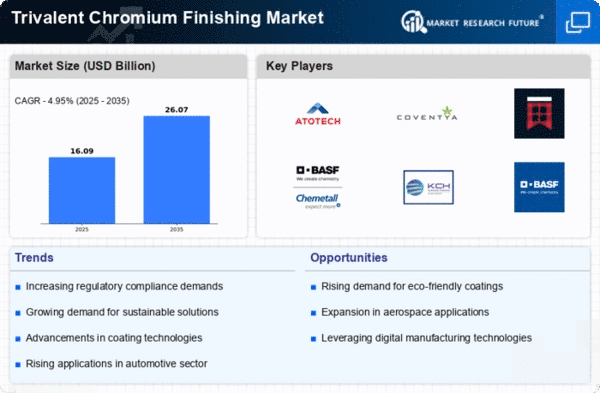
Trivalent Chromium Finishing Market Infographic
Purchase Options

Market Trends

Key Emerging Trends in the Trivalent Chromium Finishing Market

Hexavalent chromium plating, once a staple in protective coatings for applications in automotive, aerospace, and industrial sectors, has encountered significant restrictions in recent years. Regulatory bodies such as the Occupational Safety and Health Administration (OSHA) and the Environmental Protection Agency (EPA) have imposed stringent guidelines due to the inherent dangers associated with hexavalent chromium, prompting a reevaluation of its usage.

Hexavalent chromium ions, a key component in traditional plating solutions, are notorious for their high toxicity. Prolonged exposure to hexavalent chromium can lead to severe health hazards, including skin ulcers and the dissolution of mucous membranes. The US government has classified hexavalent chromium as a carcinogenic agent to humans, underlining the gravity of its health risks.

One of the primary concerns with hexavalent chromium plating lies in its inefficiency during the electroplating process. The low efficiency results in the creation of mist, which, when released into the air, poses significant health risks. The mist carries minute amounts of hexavalent chromium compounds, contributing to a hazardous work environment. Workers exposed to this mist may experience skin irritation and respiratory issues, further emphasizing the urgent need for alternative, safer plating methods.

In addition to the direct health risks, hexavalent chromium plating generates hazardous byproducts during the electroplating process. Substances such as lead chromates and barium sulfate, identified as hazardous wastes, contribute to environmental concerns. The disposal and management of these byproducts pose challenges, necessitating a shift toward more sustainable and eco-friendly plating alternatives. Recognizing the environmental and health hazards posed by hexavalent chromium plating, there has been a growing global push towards adopting safer alternatives. The need for innovation in coating technologies has become imperative, with an emphasis on developing protective coatings that can match or surpass the performance of hexavalent chromium while mitigating the associated risks.

Several industries have responded proactively to these challenges by exploring and investing in alternative coating methods. The goal is to replace hexavalent chromium with coatings that are not only effective but also environmentally friendly and safe for workers. Advancements in plating technologies, such as trivalent chromium plating, have gained traction as promising alternatives. Trivalent chromium offers a safer option, with reduced toxicity compared to hexavalent chromium, and has become a focus of research and development in the quest for sustainable plating solutions.

Furthermore, the shift towards greener technologies aligns with the broader global commitment to sustainability. Companies are increasingly adopting environmentally conscious practices, recognizing that responsible manufacturing includes minimizing the environmental impact of production processes and the materials used.

In conclusion, the era of hexavalent chromium plating is witnessing a transformative shift due to increased awareness of its health and environmental risks. Regulatory restrictions, coupled with the recognition of its hazardous nature, have prompted industries to explore safer and more sustainable alternatives. The pursuit of innovative coating technologies, such as trivalent chromium plating, reflects a collective effort to address these concerns while maintaining the high standards of protection required in automotive, aerospace, and industrial applications. The evolution away from hexavalent chromium marks a significant step towards safer workplaces, reduced environmental impact, and a more sustainable future for the industries relying on protective coatings.


Author
Anshula Mandaokar
Team Lead - Research

Anshula Mandaokar holds an academic degree in Chemical Engineering and has been contributing to the field for more than 5 years. She has expertise in Market Research and Business Consulting and serves as a Team Lead for a reputed Market Research firm under the Chemicals and Materials domain spectrum. She has worked on multiple projects, generating explicit results in a quick turnaround time. Her understanding of data interpretation justifies her role as a leader.

Leave a Comment

FAQs

What is the projected market valuation of the Trivalent Chromium Finishing Market by 2035?

<p>The projected market valuation for the Trivalent Chromium Finishing Market is 26.07 USD Billion by 2035.</p>

What was the market valuation of the Trivalent Chromium Finishing Market in 2024?

<p>The overall market valuation of the Trivalent Chromium Finishing Market was 15.33 USD Billion in 2024.</p>

What is the expected CAGR for the Trivalent Chromium Finishing Market during the forecast period 2025 - 2035?

<p>The expected CAGR for the Trivalent Chromium Finishing Market during the forecast period 2025 - 2035 is 4.95%.</p>

Which application segment is projected to have the highest valuation in the Trivalent Chromium Finishing Market?

<p>The Electronics application segment is projected to reach a valuation of 6.0 USD Billion by 2035.</p>

What are the key players in the Trivalent Chromium Finishing Market?

<p>Key players in the Trivalent Chromium Finishing Market include Atotech, Coventya, MacDermid Enthone, BASF, and Chemetall.</p>

How does the Functional Coating segment perform in terms of market valuation?

The Functional Coating segment is expected to achieve a valuation of 6.5 USD Billion by 2035.

What is the projected valuation for the Automotive application segment by 2035?

The Automotive application segment is projected to reach a valuation of 5.0 USD Billion by 2035.

Which substrate material is anticipated to dominate the market by 2035?

Steel is anticipated to dominate the market with a projected valuation of 8.0 USD Billion by 2035.

What is the expected market size for the OEM market type by 2035?

The OEM market type is expected to reach a valuation of 5.0 USD Billion by 2035.

What is the projected valuation for the Electroplating process type by 2035?

The Electroplating process type is projected to achieve a valuation of 8.0 USD Billion by 2035.

Market Summary

As per MRFR analysis, the Trivalent Chromium Finishing Market Size was estimated at 15.33 USD Billion in 2024. The Trivalent Chromium Finishing industry is projected to grow from 16.09 USD Billion in 2025 to 26.07 USD Billion by 2035, exhibiting a compound annual growth rate (CAGR) of 4.95% during the forecast period 2025 - 2035.

Key Market Trends & Highlights

The Trivalent Chromium Finishing Market is poised for growth driven by sustainability and technological advancements.

  • The market is increasingly influenced by a strong focus on sustainability, particularly in North America. Technological advancements are enhancing the efficiency and effectiveness of trivalent chromium processes, especially in the automotive sector. Asia-Pacific is emerging as the fastest-growing region, driven by rising demand in the aerospace segment. Key market drivers include sustainability initiatives and consumer preferences for quality and durability, propelling growth across various segments.

Market Size & Forecast

2024 Market Size 15.33 (USD Billion)
2035 Market Size 26.07 (USD Billion)
CAGR (2025 - 2035) 4.95%
Largest Regional Market Share in 2024 Asia-Pacific

Major Players

Atotech (DE), Coventya (FR), MacDermid Enthone (US), Chemetall (DE), KCH Services (US), BASF (DE), Elementis (GB), Hawkins (US), Nippon Paint (JP)

Market Trends

The Trivalent Chromium Finishing Market is currently experiencing a notable shift towards environmentally friendly practices. This transition is largely driven by increasing regulatory pressures and a growing awareness of the environmental impact associated with traditional hexavalent chromium processes. As industries seek to comply with stringent regulations, the adoption of trivalent chromium finishing technologies appears to be gaining momentum. This method not only offers a safer alternative but also provides comparable performance characteristics, making it an attractive option for manufacturers across various sectors.

In terms of trivalent chromium finishing market trends, technological innovation is playing a critical role in shaping future growth . Companies are investing in research and development to enhance the efficiency and effectiveness of trivalent chromium processes. This focus on innovation may lead to improved product offerings, which could further stimulate market growth. Additionally, the increasing application of trivalent chromium in automotive, aerospace, and electronics industries suggests a broadening scope for this finishing technique. As these sectors continue to evolve, the Trivalent Chromium Finishing Market is poised for significant developments in the coming years.

Sustainability Focus

The emphasis on sustainable practices is reshaping the Trivalent Chromium Finishing Market. Companies are prioritizing eco-friendly alternatives to traditional finishing methods, driven by regulatory requirements and consumer preferences for greener products.

Technological Advancements

Innovations in coating technologies are enhancing the performance of trivalent chromium finishes. These advancements are likely to improve durability and efficiency, making trivalent chromium a more attractive option for various industries.

Regulatory Compliance

Stricter regulations regarding hazardous materials are influencing the Trivalent Chromium Finishing Market. As industries seek to comply with these regulations, the demand for safer, less toxic finishing solutions is expected to rise.

Trivalent Chromium Finishing Market Market Drivers

Market Growth Projections

The Global Trivalent Chromium Finishing Market Industry is poised for substantial growth, with projections indicating a market value of 290.7 USD Billion in 2024 and an anticipated increase to 551.3 USD Billion by 2035. This growth trajectory suggests a compound annual growth rate of 5.99% from 2025 to 2035, reflecting the increasing adoption of trivalent chromium technologies across various sectors. The market's expansion is likely driven by factors such as regulatory support, technological advancements, and rising consumer demand for sustainable and high-quality finishing solutions. These projections underscore the industry's potential as it adapts to evolving market dynamics.

Rising Automotive Production and Sales

The resurgence of the automotive sector significantly influences the Global Trivalent Chromium Finishing Market Industry. With global automotive production projected to increase, the demand for durable and aesthetically pleasing components rises correspondingly. Trivalent chromium finishing offers excellent corrosion resistance, making it an attractive choice for automotive manufacturers. As the market evolves, the value is expected to reach 551.3 USD Billion by 2035, driven by the need for high-performance coatings in vehicles. This trend indicates a shift towards more sustainable and efficient finishing solutions, aligning with the industry's broader goals of reducing environmental impact.

Growing Demand for Eco-Friendly Coatings

The increasing emphasis on environmental sustainability drives the Global Trivalent Chromium Finishing Market Industry. As industries seek alternatives to hexavalent chromium, which poses significant health risks, trivalent chromium emerges as a safer option. This shift is particularly evident in sectors such as automotive and aerospace, where regulatory pressures and consumer preferences favor eco-friendly solutions. The market's value is projected to reach 290.7 USD Billion in 2024, reflecting a robust demand for sustainable finishing processes. Companies adopting trivalent chromium technologies not only comply with regulations but also enhance their brand image, appealing to environmentally conscious consumers.

Regulatory Support for Sustainable Practices

Government regulations promoting sustainable manufacturing practices bolster the Global Trivalent Chromium Finishing Market Industry. Many countries are implementing stricter environmental standards, encouraging industries to transition from harmful substances like hexavalent chromium to safer alternatives. This regulatory landscape not only fosters innovation but also incentivizes companies to adopt trivalent chromium technologies. As a result, manufacturers are likely to invest in research and development to enhance their finishing processes. The growing alignment between regulatory frameworks and market demands suggests a favorable environment for the expansion of trivalent chromium finishing solutions.

Technological Advancements in Finishing Processes

Innovations in trivalent chromium finishing technologies contribute to the expansion of the Global Trivalent Chromium Finishing Market Industry. Advanced techniques, such as electroplating and chemical vapor deposition, improve the efficiency and quality of coatings. These advancements enable manufacturers to achieve superior corrosion resistance and aesthetic appeal, which are crucial in competitive markets. As industries increasingly prioritize product longevity and performance, the adoption of these technologies is likely to accelerate. The anticipated compound annual growth rate of 5.99% from 2025 to 2035 underscores the potential for growth driven by technological enhancements in finishing processes.

Increased Focus on Product Aesthetics and Durability

The growing consumer preference for high-quality, aesthetically pleasing products drives the Global Trivalent Chromium Finishing Market Industry. Industries such as electronics, jewelry, and consumer goods increasingly prioritize surface finishes that enhance both appearance and durability. Trivalent chromium finishing provides a unique combination of visual appeal and protective qualities, making it a preferred choice for manufacturers. As consumer expectations evolve, companies are likely to invest in advanced finishing technologies to meet these demands. This trend indicates a potential for sustained growth in the market, as manufacturers strive to deliver products that align with consumer desires for both beauty and longevity.

Market Segment Insights

By Application: Automotive (Largest) vs. Aerospace (Fastest-Growing)

In the Trivalent Chromium Finishing Market, the application segment is led predominantly by the automotive sector, which holds the largest share due to its extensive need for corrosion-resistant coatings that enhance vehicle durability and aesthetics. Following it, the aerospace industry is rapidly emerging as a significant player, driven by increasing demand for lightweight materials and protective finishes that align with stringent regulatory standards for sustainability and safety. Growth trends in this segment are shaped by technological advancements and environmental considerations. The automotive sector continues to expand with innovations in electric vehicles, necessitating advanced finishing solutions, while the aerospace sector is witnessing a surge in new aircraft projects, pushing the demand for high-performance finishing solutions. Increased investment in aerospace R&amp;D also prompts growth, making it one of the fastest-growing applications in the market.

Automotive (Dominant) vs. Aerospace (Emerging)

The automotive sector is characterized by its substantial consumption of trivalent chromium finishing, primarily due to its need for high-quality surface finishes that improve corrosion resistance and enhance the overall appearance of vehicles. As manufacturers shift towards sustainability, the automotive industry is increasingly adopting trivalent chromium finishes as eco-friendly alternatives to hexavalent chromium. Conversely, the aerospace sector, while still in the emerging phase, shows promise with a rapid increase in demand for lightweight and durable materials. This sector requires aftermarket services and advanced finishes that meet rigorous safety standards. As aerospace technologies evolve, the demand for innovative finishes will surge, positioning it as a critical area for growth in the broader trivalent chromium finishing market.

By End Use: Corrosion Resistance (Largest) vs. Function Coating (Fastest-Growing)

<p>The end use segment in the Trivalent Chromium Finishing Market is primarily characterized by its distribution across various applications such as decorative coating, functional coating, corrosion resistance, wear resistance, and electrical conductivity. Among these, corrosion resistance dominates the market share, reflecting its critical role in enhancing the durability of products in harsh environments. Functional coating, while currently smaller in comparison, showcases a rapidly growing demand as industries focus on optimizing surface properties for performance improvements.</p>

<p>Corrosion Resistance (Dominant) vs. Functional Coating (Emerging)</p>

<p>Corrosion resistance is a dominant segment within the market, largely attributed to its essential function in protecting substrates from environmental degradation, thereby extending the lifespan of products in sectors such as automotive, aerospace, and construction. On the other hand, functional coating represents an emerging segment, gaining traction due to its versatility in offering added benefits such as conductivity and wear resistance. This segment is particularly appealing to industries seeking innovative solutions for enhanced performance and sustainability. As end-user industries pursue advanced materials, the demand for functional coating is set to escalate, reshaping the competitive landscape.</p>

By Process Type: Electroplating (Largest) vs. Anodizing (Fastest-Growing)

<p>In the Trivalent Chromium Finishing Market, the process type segmentation reveals a diverse landscape characterized by Electroplating, which holds the largest market share among the various techniques. Other significant methods include Electroless Plating and Surface Treatment, each contributing notably to the overall market. Anodizing, while smaller in share, is quickly gaining traction, propelled by its unique properties and applications in various industries, evidencing the shifting dynamics within this segment. Growth trends indicate that Anodizing is becoming a key focus due to increasing demand for corrosion-resistant coatings and aesthetic finishes in automotive and aerospace sectors. As environmental regulations influence manufacturing processes, technologies that utilize trivalent chromium in Anodizing are emerging as a preferred choice, making this segment not only a growing trend but also a viable alternative to traditional methods.</p>

<p>Electroplating (Dominant) vs. Electroless Plating (Emerging)</p>

<p>Electroplating has established itself as the dominant force in the Trivalent Chromium Finishing Market due to its proven effectiveness in depositing a pure layer of chromium onto substrates, providing excellent corrosion resistance and aesthetic appeal. It is commonly employed in a myriad of applications, particularly in the automotive and consumer electronics industries. However, Electroless Plating is gaining recognition as an emerging method, offering advantages such as uniform coating on complex geometries and the ability to control the thickness more accurately. With advancements in technique and formulation, Electroless Plating presents a valuable alternative that aligns with sustainability goals and regulatory requirements, positioning it as a noteworthy contender in the future of the trivalent chromium market.</p>

By Substrate Material: Steel (Largest) vs. Aluminum (Fastest-Growing)

In the Trivalent Chromium Finishing Market, the substrate material segment is predominantly driven by steel, which holds the largest market share among the various materials used. This is largely due to steel's extensive applications across multiple sectors, especially in automotive and construction, where durability and corrosion resistance are highly valued. Following steel, aluminum is also gaining significant traction due to its lightweight nature and versatility, making it particularly attractive in the aerospace and transportation industries.

Steel (Dominant) vs. Aluminum (Emerging)

Steel continues to dominate the Trivalent Chromium Finishing Market due to its unparalleled strength and resistance to corrosion, making it the preferred choice for industries seeking reliability and long-lasting materials. On the other hand, aluminum is emerging as a prominent competitor, experiencing rapid growth driven by its lightweight properties and excellent finishing quality. Manufacturers are increasingly adopting trivalent chromium finishing for aluminum to enhance aesthetic appeal while maintaining compliance with environmental regulations. As industries transition towards more sustainable practices, the role of aluminum in this market is expected to expand, reflecting a shift in consumer preferences towards lighter and more efficient materials.

By Market Type: OEM (Largest) vs. Aftermarket (Fastest-Growing)

<p>In the Trivalent Chromium Finishing Market, the distribution of market share among different types showcases the OEM segment as the leading player, capturing the largest portion of the market. This dominance is primarily due to the increasing demand for high-quality finishings in new manufacturing processes across several industries, including automotive and aerospace. Following behind, the aftermarket segment is gaining traction because of the rising trend in repair and maintenance activities, indicating that end-users are investing more in enhancing the durability and lifespan of existing products. Growth trends in the Trivalent Chromium Finishing Market are heavily influenced by environmental regulations promoting eco-friendly solutions, with trivalent chromium alternatives becoming more preferred over hexavalent chromium. The OEM segment benefits from this shift as manufacturers prioritize compliance with sustainability standards. As for the aftermarket segment, its rapid growth is driven by an increasing customer focus on upgrading and refurbishing equipment, thereby enhancing product performance while minimizing waste. This indicates a favorable outlook for both segments moving forward, with OEM retaining its leadership and aftermarket emerging strongly.</p>

<p>OEM (Dominant) vs. Aftermarket (Emerging)</p>

<p>The OEM segment in the Trivalent Chromium Finishing Market is characterized by its robust application in manufacturing processes, where the quality of the finish is critical for product performance and aesthetics. As the dominant market player, OEM facilitates innovations in surface finishing, ensuring compliance with stringent industry regulations. On the other hand, the aftermarket segment has been rapidly emerging, driven by a significant rise in maintenance and repair operations. This segment focuses on enhancing the longevity and resilience of finished products, appealing to a growing base of environmentally-conscious customers who prefer refurbishing over new purchases. Together, these two segments represent a dynamic interplay in the market, with OEM setting standards and aftermarket responding swiftly to evolving consumer needs.</p>

Get more detailed insights about Trivalent Chromium Finishing Market Research Report – Global Forecast till 2035

Regional Insights

North America : Stable Growth Environment

The North American trivalent chromium finishing market is projected to reach $3.0 billion by December 2025, driven by stringent environmental regulations and a growing demand for sustainable finishing solutions. The automotive and aerospace sectors are key growth drivers, as manufacturers increasingly seek eco-friendly alternatives to hexavalent chromium. Regulatory support for green technologies further enhances market potential, positioning North America as a leader in sustainable practices. The United States dominates the North American market, accounting for a significant share due to its advanced manufacturing capabilities and strong presence of key players like MacDermid Enthone and KCH Services. Canada also contributes to market growth, focusing on sustainable practices in manufacturing. The competitive landscape is characterized by innovation and collaboration among leading companies, ensuring a robust supply chain and technological advancements.

Europe : Innovation and Sustainability Focus

Europe's trivalent chromium finishing market is expected to reach $4.0 billion by December 2025, fueled by a strong emphasis on sustainability and innovation. The region is witnessing a shift towards eco-friendly alternatives, driven by EU regulations aimed at reducing hazardous substances in manufacturing processes. This regulatory landscape is a significant catalyst for growth, as companies adapt to meet stringent environmental standards and consumer demand for greener products. Germany and France are leading the charge in Europe, with major players like Atotech and Coventya spearheading advancements in trivalent chromium technologies. The competitive environment is marked by collaboration between industry leaders and research institutions, fostering innovation. The presence of a well-established supply chain and a focus on R&D further enhance Europe's position as a hub for sustainable finishing solutions.

Asia-Pacific : Emerging Market Leader

The Asia-Pacific region is projected to dominate the trivalent chromium finishing market, reaching $7.5 billion by December 2025. This growth is driven by rapid industrialization, increasing automotive production, and a rising demand for high-quality finishing solutions. Countries like China and India are at the forefront, with significant investments in manufacturing and infrastructure, further propelling market expansion. Regulatory support for sustainable practices is also gaining momentum, enhancing the appeal of trivalent chromium technologies. China is the largest market in the region, supported by a robust manufacturing base and a growing automotive sector. India follows closely, with increasing investments in infrastructure and manufacturing capabilities. The competitive landscape features key players like Nippon Paint and Elementis, who are actively innovating to meet the diverse needs of the market. The region's focus on sustainability and quality positions it as a leader in The Trivalent Chromium Finishing.

Middle East and Africa : Emerging Opportunities Ahead

The Middle East and Africa (MEA) trivalent chromium finishing market is expected to reach $0.83 billion by December 2025, driven by increasing industrial activities and a growing focus on sustainable manufacturing practices. The region is witnessing a gradual shift towards eco-friendly solutions, supported by government initiatives aimed at promoting green technologies. This trend is expected to catalyze market growth, as industries seek to comply with emerging regulations and consumer preferences for sustainable products. Countries like South Africa and the UAE are leading the market in the MEA region, with investments in manufacturing and infrastructure development. The competitive landscape is evolving, with local and international players vying for market share. Key players are increasingly focusing on innovation and sustainability to capture the growing demand for trivalent chromium finishing solutions, positioning the region for future growth.

Key Players and Competitive Insights

The Trivalent Chromium Finishing Market is currently characterized by a competitive landscape that is both dynamic and multifaceted. Key growth drivers include increasing regulatory pressures for environmentally friendly processes, alongside a rising demand for high-performance coatings across various industries. Major players such as Atotech (DE), Coventya (FR), and MacDermid Enthone (US) are strategically positioned to leverage these trends. Atotech (DE) focuses on innovation in sustainable technologies, while Coventya (FR) emphasizes regional expansion and partnerships to enhance its market presence. MacDermid Enthone (US) is actively pursuing digital transformation initiatives, which collectively shape a competitive environment that is increasingly oriented towards sustainability and technological advancement.In terms of business tactics, companies are localizing manufacturing to reduce lead times and optimize supply chains, which is particularly crucial in a moderately fragmented market. The collective influence of these key players is significant, as they not only drive innovation but also set industry standards that smaller competitors must follow. This competitive structure allows for a diverse range of offerings, catering to various customer needs while fostering a collaborative atmosphere among industry leaders.
In November Atotech (DE) announced the launch of a new line of trivalent chromium plating solutions designed to meet stringent environmental regulations. This strategic move is pivotal as it positions Atotech (DE) as a leader in sustainable finishing technologies, potentially capturing a larger market share by appealing to environmentally conscious customers. The introduction of these solutions is expected to enhance their competitive edge, particularly in regions with strict environmental compliance requirements.
In October Coventya (FR) expanded its operations in Asia by establishing a new manufacturing facility in Vietnam. This expansion is significant as it not only increases Coventya's production capacity but also allows for better service delivery to the growing Asian market. The strategic location is likely to reduce shipping costs and lead times, thereby enhancing customer satisfaction and solidifying Coventya's position in the region.
In September MacDermid Enthone (US) entered into a strategic partnership with a leading technology firm to integrate AI-driven solutions into its manufacturing processes. This collaboration is indicative of a broader trend towards digitalization within the industry. By leveraging AI, MacDermid Enthone (US) aims to enhance operational efficiency and product quality, which could lead to a significant competitive advantage in the market.
As of December current competitive trends are heavily influenced by digitalization, sustainability, and the integration of advanced technologies such as AI. Strategic alliances are increasingly shaping the landscape, allowing companies to pool resources and expertise to innovate more effectively. The shift from price-based competition to a focus on innovation, technology, and supply chain reliability is evident. Moving forward, competitive differentiation will likely hinge on the ability to adapt to these trends, with companies that prioritize sustainable practices and technological advancements poised to lead the market.

Key Companies in the Trivalent Chromium Finishing Market include

Industry Developments

The United States market for trivalent chromium finishing was calculated at USD 44.07 million in 2016 and it is anticipated to register a compound annual growth rate (CAGR) of 5.4% from 2017 to 2025. And the rising environmental concerns with regard to hexavalent chrome are aimed to drive the demand for trivalent chrome in the country. According to a study, we consider the proper blend of accurate, reliable, and relevant data as of major importance. The data analysts are adept in the exactly interpreting data and gaining the correct information.

Factors, that are taking forward the trivalent chromium finishing market growth include strict rules, regulations and orders, but the thermal spray coating as an alternative to plating can hamper the market growth.

Intended Audience:

    • Trivalent chromium finishing manufacturers
    • Trivalent chromium finishing service providers
    • Traders and distributors of trivalent chromium finishing
    • Production process industries
    • Potential investors
    • Raw material suppliers
    • Nationalized laboratory

Future Outlook

Trivalent Chromium Finishing Market Future Outlook

The Trivalent Chromium Finishing Market is projected to grow at a 4.95% CAGR from 2025 to 2035, driven by increasing environmental regulations and demand for sustainable solutions.

New opportunities lie in:

  • <p>Development of eco-friendly trivalent chromium formulations Expansion into emerging markets with tailored solutions Integration of advanced automation in finishing processes</p>

By 2035, the market is expected to solidify its position as a leader in sustainable finishing technologies.

Market Segmentation

Trivalent Chromium Finishing Market End Use Outlook

  • Decorative Coating
  • Functional Coating
  • Corrosion Resistance
  • Wear Resistance
  • Electrical Conductivity

Trivalent Chromium Finishing Market Application Outlook

  • Automotive
  • Aerospace
  • Electronics
  • Medical
  • Industrial

Trivalent Chromium Finishing Market Market Type Outlook

  • Original Equipment Manufacturer
  • Aftermarket
  • Replacement Parts
  • Custom Solutions

Trivalent Chromium Finishing Market Process Type Outlook

  • Electroplating
  • Electroless Plating
  • Anodizing
  • Surface Treatment
  • Coating

Trivalent Chromium Finishing Market Substrate Material Outlook

  • Steel
  • Aluminum
  • Copper
  • Plastic
  • Zinc

Report Scope

MARKET SIZE 2024 15.33(USD Billion)
MARKET SIZE 2025 16.09(USD Billion)
MARKET SIZE 2035 26.07(USD Billion)
COMPOUND ANNUAL GROWTH RATE (CAGR) 4.95% (2025 - 2035)
REPORT COVERAGE Revenue Forecast, Competitive Landscape, Growth Factors, and Trends
BASE YEAR 2024
Market Forecast Period 2025 - 2035
Historical Data 2019 - 2024
Market Forecast Units USD Billion
Key Companies Profiled Atotech (DE), Coventya (FR), MacDermid Enthone (US), Chemetall (DE), KCH Services (US), BASF (DE), Elementis (GB), Hawkins (US), Nippon Paint (JP)
Segments Covered Application, End Use, Process Type, Substrate Material, Market Type
Key Market Opportunities Growing demand for environmentally friendly coatings drives innovation in the Trivalent Chromium Finishing Market.
Key Market Dynamics Rising regulatory pressures drive demand for environmentally friendly trivalent chromium finishing solutions in various industries.
Countries Covered North America, Europe, APAC, South America, MEA

FAQs

What is the projected market valuation of the Trivalent Chromium Finishing Market by 2035?

<p>The projected market valuation for the Trivalent Chromium Finishing Market is 26.07 USD Billion by 2035.</p>

What was the market valuation of the Trivalent Chromium Finishing Market in 2024?

<p>The overall market valuation of the Trivalent Chromium Finishing Market was 15.33 USD Billion in 2024.</p>

What is the expected CAGR for the Trivalent Chromium Finishing Market during the forecast period 2025 - 2035?

<p>The expected CAGR for the Trivalent Chromium Finishing Market during the forecast period 2025 - 2035 is 4.95%.</p>

Which application segment is projected to have the highest valuation in the Trivalent Chromium Finishing Market?

<p>The Electronics application segment is projected to reach a valuation of 6.0 USD Billion by 2035.</p>

What are the key players in the Trivalent Chromium Finishing Market?

<p>Key players in the Trivalent Chromium Finishing Market include Atotech, Coventya, MacDermid Enthone, BASF, and Chemetall.</p>

How does the Functional Coating segment perform in terms of market valuation?

The Functional Coating segment is expected to achieve a valuation of 6.5 USD Billion by 2035.

What is the projected valuation for the Automotive application segment by 2035?

The Automotive application segment is projected to reach a valuation of 5.0 USD Billion by 2035.

Which substrate material is anticipated to dominate the market by 2035?

Steel is anticipated to dominate the market with a projected valuation of 8.0 USD Billion by 2035.

What is the expected market size for the OEM market type by 2035?

The OEM market type is expected to reach a valuation of 5.0 USD Billion by 2035.

What is the projected valuation for the Electroplating process type by 2035?

The Electroplating process type is projected to achieve a valuation of 8.0 USD Billion by 2035.

  1. SECTION I: EXECUTIVE SUMMARY AND KEY HIGHLIGHTS
    1. | 1.1 EXECUTIVE SUMMARY
    2. | | 1.1.1 Market Overview
    3. | | 1.1.2 Key Findings
    4. | | 1.1.3 Market Segmentation
    5. | | 1.1.4 Competitive Landscape
    6. | | 1.1.5 Challenges and Opportunities
    7. | | 1.1.6 Future Outlook
  2. SECTION II: SCOPING, METHODOLOGY AND MARKET STRUCTURE
    1. | 2.1 MARKET INTRODUCTION
    2. | | 2.1.1 Definition
    3. | | 2.1.2 Scope of the study
    4. | | | 2.1.2.1 Research Objective
    5. | | | 2.1.2.2 Assumption
    6. | | | 2.1.2.3 Limitations
    7. | 2.2 RESEARCH METHODOLOGY
    8. | | 2.2.1 Overview
    9. | | 2.2.2 Data Mining
    10. | | 2.2.3 Secondary Research
    11. | | 2.2.4 Primary Research
    12. | | | 2.2.4.1 Primary Interviews and Information Gathering Process
    13. | | | 2.2.4.2 Breakdown of Primary Respondents
    14. | | 2.2.5 Forecasting Model
    15. | | 2.2.6 Market Size Estimation
    16. | | | 2.2.6.1 Bottom-Up Approach
    17. | | | 2.2.6.2 Top-Down Approach
    18. | | 2.2.7 Data Triangulation
    19. | | 2.2.8 Validation
  3. SECTION III: QUALITATIVE ANALYSIS
    1. | 3.1 MARKET DYNAMICS
    2. | | 3.1.1 Overview
    3. | | 3.1.2 Drivers
    4. | | 3.1.3 Restraints
    5. | | 3.1.4 Opportunities
    6. | 3.2 MARKET FACTOR ANALYSIS
    7. | | 3.2.1 Value chain Analysis
    8. | | 3.2.2 Porter's Five Forces Analysis
    9. | | | 3.2.2.1 Bargaining Power of Suppliers
    10. | | | 3.2.2.2 Bargaining Power of Buyers
    11. | | | 3.2.2.3 Threat of New Entrants
    12. | | | 3.2.2.4 Threat of Substitutes
    13. | | | 3.2.2.5 Intensity of Rivalry
    14. | | 3.2.3 COVID-19 Impact Analysis
    15. | | | 3.2.3.1 Market Impact Analysis
    16. | | | 3.2.3.2 Regional Impact
    17. | | | 3.2.3.3 Opportunity and Threat Analysis
  4. SECTION IV: QUANTITATIVE ANALYSIS
    1. | 4.1 Chemicals and Materials, BY Application (USD Billion)
    2. | | 4.1.1 Automotive
    3. | | 4.1.2 Aerospace
    4. | | 4.1.3 Electronics
    5. | | 4.1.4 Medical
    6. | | 4.1.5 Industrial
    7. | 4.2 Chemicals and Materials, BY End Use (USD Billion)
    8. | | 4.2.1 Decorative Coating
    9. | | 4.2.2 Functional Coating
    10. | | 4.2.3 Corrosion Resistance
    11. | | 4.2.4 Wear Resistance
    12. | | 4.2.5 Electrical Conductivity
    13. | 4.3 Chemicals and Materials, BY Process Type (USD Billion)
    14. | | 4.3.1 Electroplating
    15. | | 4.3.2 Electroless Plating
    16. | | 4.3.3 Anodizing
    17. | | 4.3.4 Surface Treatment
    18. | | 4.3.5 Coating
    19. | 4.4 Chemicals and Materials, BY Substrate Material (USD Billion)
    20. | | 4.4.1 Steel
    21. | | 4.4.2 Aluminum
    22. | | 4.4.3 Copper
    23. | | 4.4.4 Plastic
    24. | | 4.4.5 Zinc
    25. | 4.5 Chemicals and Materials, BY Market Type (USD Billion)
    26. | | 4.5.1 OEM
    27. | | 4.5.2 Aftermarket
    28. | | 4.5.3 Replacement
    29. | | 4.5.4 Maintenance
    30. | | 4.5.5 Repair
    31. | 4.6 Chemicals and Materials, BY Region (USD Billion)
    32. | | 4.6.1 North America
    33. | | | 4.6.1.1 US
    34. | | | 4.6.1.2 Canada
    35. | | 4.6.2 Europe
    36. | | | 4.6.2.1 Germany
    37. | | | 4.6.2.2 UK
    38. | | | 4.6.2.3 France
    39. | | | 4.6.2.4 Russia
    40. | | | 4.6.2.5 Italy
    41. | | | 4.6.2.6 Spain
    42. | | | 4.6.2.7 Rest of Europe
    43. | | 4.6.3 APAC
    44. | | | 4.6.3.1 China
    45. | | | 4.6.3.2 India
    46. | | | 4.6.3.3 Japan
    47. | | | 4.6.3.4 South Korea
    48. | | | 4.6.3.5 Malaysia
    49. | | | 4.6.3.6 Thailand
    50. | | | 4.6.3.7 Indonesia
    51. | | | 4.6.3.8 Rest of APAC
    52. | | 4.6.4 South America
    53. | | | 4.6.4.1 Brazil
    54. | | | 4.6.4.2 Mexico
    55. | | | 4.6.4.3 Argentina
    56. | | | 4.6.4.4 Rest of South America
    57. | | 4.6.5 MEA
    58. | | | 4.6.5.1 GCC Countries
    59. | | | 4.6.5.2 South Africa
    60. | | | 4.6.5.3 Rest of MEA
  5. SECTION V: COMPETITIVE ANALYSIS
    1. | 5.1 Competitive Landscape
    2. | | 5.1.1 Overview
    3. | | 5.1.2 Competitive Analysis
    4. | | 5.1.3 Market share Analysis
    5. | | 5.1.4 Major Growth Strategy in the Chemicals and Materials
    6. | | 5.1.5 Competitive Benchmarking
    7. | | 5.1.6 Leading Players in Terms of Number of Developments in the Chemicals and Materials
    8. | | 5.1.7 Key developments and growth strategies
    9. | | | 5.1.7.1 New Product Launch/Service Deployment
    10. | | | 5.1.7.2 Merger & Acquisitions
    11. | | | 5.1.7.3 Joint Ventures
    12. | | 5.1.8 Major Players Financial Matrix
    13. | | | 5.1.8.1 Sales and Operating Income
    14. | | | 5.1.8.2 Major Players R&D Expenditure. 2023
    15. | 5.2 Company Profiles
    16. | | 5.2.1 Atotech (DE)
    17. | | | 5.2.1.1 Financial Overview
    18. | | | 5.2.1.2 Products Offered
    19. | | | 5.2.1.3 Key Developments
    20. | | | 5.2.1.4 SWOT Analysis
    21. | | | 5.2.1.5 Key Strategies
    22. | | 5.2.2 Coventya (FR)
    23. | | | 5.2.2.1 Financial Overview
    24. | | | 5.2.2.2 Products Offered
    25. | | | 5.2.2.3 Key Developments
    26. | | | 5.2.2.4 SWOT Analysis
    27. | | | 5.2.2.5 Key Strategies
    28. | | 5.2.3 MacDermid Enthone (US)
    29. | | | 5.2.3.1 Financial Overview
    30. | | | 5.2.3.2 Products Offered
    31. | | | 5.2.3.3 Key Developments
    32. | | | 5.2.3.4 SWOT Analysis
    33. | | | 5.2.3.5 Key Strategies
    34. | | 5.2.4 BASF (DE)
    35. | | | 5.2.4.1 Financial Overview
    36. | | | 5.2.4.2 Products Offered
    37. | | | 5.2.4.3 Key Developments
    38. | | | 5.2.4.4 SWOT Analysis
    39. | | | 5.2.4.5 Key Strategies
    40. | | 5.2.5 Chemetall (DE)
    41. | | | 5.2.5.1 Financial Overview
    42. | | | 5.2.5.2 Products Offered
    43. | | | 5.2.5.3 Key Developments
    44. | | | 5.2.5.4 SWOT Analysis
    45. | | | 5.2.5.5 Key Strategies
    46. | | 5.2.6 KCH Services (US)
    47. | | | 5.2.6.1 Financial Overview
    48. | | | 5.2.6.2 Products Offered
    49. | | | 5.2.6.3 Key Developments
    50. | | | 5.2.6.4 SWOT Analysis
    51. | | | 5.2.6.5 Key Strategies
    52. | | 5.2.7 Hawkins (US)
    53. | | | 5.2.7.1 Financial Overview
    54. | | | 5.2.7.2 Products Offered
    55. | | | 5.2.7.3 Key Developments
    56. | | | 5.2.7.4 SWOT Analysis
    57. | | | 5.2.7.5 Key Strategies
    58. | | 5.2.8 Nippon Paint (JP)
    59. | | | 5.2.8.1 Financial Overview
    60. | | | 5.2.8.2 Products Offered
    61. | | | 5.2.8.3 Key Developments
    62. | | | 5.2.8.4 SWOT Analysis
    63. | | | 5.2.8.5 Key Strategies
    64. | | 5.2.9 Tib Chemicals (DE)
    65. | | | 5.2.9.1 Financial Overview
    66. | | | 5.2.9.2 Products Offered
    67. | | | 5.2.9.3 Key Developments
    68. | | | 5.2.9.4 SWOT Analysis
    69. | | | 5.2.9.5 Key Strategies
    70. | 5.3 Appendix
    71. | | 5.3.1 References
    72. | | 5.3.2 Related Reports
  6. LIST OF FIGURES
    1. | 6.1 MARKET SYNOPSIS
    2. | 6.2 NORTH AMERICA MARKET ANALYSIS
    3. | 6.3 US MARKET ANALYSIS BY APPLICATION
    4. | 6.4 US MARKET ANALYSIS BY END USE
    5. | 6.5 US MARKET ANALYSIS BY PROCESS TYPE
    6. | 6.6 US MARKET ANALYSIS BY SUBSTRATE MATERIAL
    7. | 6.7 US MARKET ANALYSIS BY MARKET TYPE
    8. | 6.8 CANADA MARKET ANALYSIS BY APPLICATION
    9. | 6.9 CANADA MARKET ANALYSIS BY END USE
    10. | 6.10 CANADA MARKET ANALYSIS BY PROCESS TYPE
    11. | 6.11 CANADA MARKET ANALYSIS BY SUBSTRATE MATERIAL
    12. | 6.12 CANADA MARKET ANALYSIS BY MARKET TYPE
    13. | 6.13 EUROPE MARKET ANALYSIS
    14. | 6.14 GERMANY MARKET ANALYSIS BY APPLICATION
    15. | 6.15 GERMANY MARKET ANALYSIS BY END USE
    16. | 6.16 GERMANY MARKET ANALYSIS BY PROCESS TYPE
    17. | 6.17 GERMANY MARKET ANALYSIS BY SUBSTRATE MATERIAL
    18. | 6.18 GERMANY MARKET ANALYSIS BY MARKET TYPE
    19. | 6.19 UK MARKET ANALYSIS BY APPLICATION
    20. | 6.20 UK MARKET ANALYSIS BY END USE
    21. | 6.21 UK MARKET ANALYSIS BY PROCESS TYPE
    22. | 6.22 UK MARKET ANALYSIS BY SUBSTRATE MATERIAL
    23. | 6.23 UK MARKET ANALYSIS BY MARKET TYPE
    24. | 6.24 FRANCE MARKET ANALYSIS BY APPLICATION
    25. | 6.25 FRANCE MARKET ANALYSIS BY END USE
    26. | 6.26 FRANCE MARKET ANALYSIS BY PROCESS TYPE
    27. | 6.27 FRANCE MARKET ANALYSIS BY SUBSTRATE MATERIAL
    28. | 6.28 FRANCE MARKET ANALYSIS BY MARKET TYPE
    29. | 6.29 RUSSIA MARKET ANALYSIS BY APPLICATION
    30. | 6.30 RUSSIA MARKET ANALYSIS BY END USE
    31. | 6.31 RUSSIA MARKET ANALYSIS BY PROCESS TYPE
    32. | 6.32 RUSSIA MARKET ANALYSIS BY SUBSTRATE MATERIAL
    33. | 6.33 RUSSIA MARKET ANALYSIS BY MARKET TYPE
    34. | 6.34 ITALY MARKET ANALYSIS BY APPLICATION
    35. | 6.35 ITALY MARKET ANALYSIS BY END USE
    36. | 6.36 ITALY MARKET ANALYSIS BY PROCESS TYPE
    37. | 6.37 ITALY MARKET ANALYSIS BY SUBSTRATE MATERIAL
    38. | 6.38 ITALY MARKET ANALYSIS BY MARKET TYPE
    39. | 6.39 SPAIN MARKET ANALYSIS BY APPLICATION
    40. | 6.40 SPAIN MARKET ANALYSIS BY END USE
    41. | 6.41 SPAIN MARKET ANALYSIS BY PROCESS TYPE
    42. | 6.42 SPAIN MARKET ANALYSIS BY SUBSTRATE MATERIAL
    43. | 6.43 SPAIN MARKET ANALYSIS BY MARKET TYPE
    44. | 6.44 REST OF EUROPE MARKET ANALYSIS BY APPLICATION
    45. | 6.45 REST OF EUROPE MARKET ANALYSIS BY END USE
    46. | 6.46 REST OF EUROPE MARKET ANALYSIS BY PROCESS TYPE
    47. | 6.47 REST OF EUROPE MARKET ANALYSIS BY SUBSTRATE MATERIAL
    48. | 6.48 REST OF EUROPE MARKET ANALYSIS BY MARKET TYPE
    49. | 6.49 APAC MARKET ANALYSIS
    50. | 6.50 CHINA MARKET ANALYSIS BY APPLICATION
    51. | 6.51 CHINA MARKET ANALYSIS BY END USE
    52. | 6.52 CHINA MARKET ANALYSIS BY PROCESS TYPE
    53. | 6.53 CHINA MARKET ANALYSIS BY SUBSTRATE MATERIAL
    54. | 6.54 CHINA MARKET ANALYSIS BY MARKET TYPE
    55. | 6.55 INDIA MARKET ANALYSIS BY APPLICATION
    56. | 6.56 INDIA MARKET ANALYSIS BY END USE
    57. | 6.57 INDIA MARKET ANALYSIS BY PROCESS TYPE
    58. | 6.58 INDIA MARKET ANALYSIS BY SUBSTRATE MATERIAL
    59. | 6.59 INDIA MARKET ANALYSIS BY MARKET TYPE
    60. | 6.60 JAPAN MARKET ANALYSIS BY APPLICATION
    61. | 6.61 JAPAN MARKET ANALYSIS BY END USE
    62. | 6.62 JAPAN MARKET ANALYSIS BY PROCESS TYPE
    63. | 6.63 JAPAN MARKET ANALYSIS BY SUBSTRATE MATERIAL
    64. | 6.64 JAPAN MARKET ANALYSIS BY MARKET TYPE
    65. | 6.65 SOUTH KOREA MARKET ANALYSIS BY APPLICATION
    66. | 6.66 SOUTH KOREA MARKET ANALYSIS BY END USE
    67. | 6.67 SOUTH KOREA MARKET ANALYSIS BY PROCESS TYPE
    68. | 6.68 SOUTH KOREA MARKET ANALYSIS BY SUBSTRATE MATERIAL
    69. | 6.69 SOUTH KOREA MARKET ANALYSIS BY MARKET TYPE
    70. | 6.70 MALAYSIA MARKET ANALYSIS BY APPLICATION
    71. | 6.71 MALAYSIA MARKET ANALYSIS BY END USE
    72. | 6.72 MALAYSIA MARKET ANALYSIS BY PROCESS TYPE
    73. | 6.73 MALAYSIA MARKET ANALYSIS BY SUBSTRATE MATERIAL
    74. | 6.74 MALAYSIA MARKET ANALYSIS BY MARKET TYPE
    75. | 6.75 THAILAND MARKET ANALYSIS BY APPLICATION
    76. | 6.76 THAILAND MARKET ANALYSIS BY END USE
    77. | 6.77 THAILAND MARKET ANALYSIS BY PROCESS TYPE
    78. | 6.78 THAILAND MARKET ANALYSIS BY SUBSTRATE MATERIAL
    79. | 6.79 THAILAND MARKET ANALYSIS BY MARKET TYPE
    80. | 6.80 INDONESIA MARKET ANALYSIS BY APPLICATION
    81. | 6.81 INDONESIA MARKET ANALYSIS BY END USE
    82. | 6.82 INDONESIA MARKET ANALYSIS BY PROCESS TYPE
    83. | 6.83 INDONESIA MARKET ANALYSIS BY SUBSTRATE MATERIAL
    84. | 6.84 INDONESIA MARKET ANALYSIS BY MARKET TYPE
    85. | 6.85 REST OF APAC MARKET ANALYSIS BY APPLICATION
    86. | 6.86 REST OF APAC MARKET ANALYSIS BY END USE
    87. | 6.87 REST OF APAC MARKET ANALYSIS BY PROCESS TYPE
    88. | 6.88 REST OF APAC MARKET ANALYSIS BY SUBSTRATE MATERIAL
    89. | 6.89 REST OF APAC MARKET ANALYSIS BY MARKET TYPE
    90. | 6.90 SOUTH AMERICA MARKET ANALYSIS
    91. | 6.91 BRAZIL MARKET ANALYSIS BY APPLICATION
    92. | 6.92 BRAZIL MARKET ANALYSIS BY END USE
    93. | 6.93 BRAZIL MARKET ANALYSIS BY PROCESS TYPE
    94. | 6.94 BRAZIL MARKET ANALYSIS BY SUBSTRATE MATERIAL
    95. | 6.95 BRAZIL MARKET ANALYSIS BY MARKET TYPE
    96. | 6.96 MEXICO MARKET ANALYSIS BY APPLICATION
    97. | 6.97 MEXICO MARKET ANALYSIS BY END USE
    98. | 6.98 MEXICO MARKET ANALYSIS BY PROCESS TYPE
    99. | 6.99 MEXICO MARKET ANALYSIS BY SUBSTRATE MATERIAL
    100. | 6.100 MEXICO MARKET ANALYSIS BY MARKET TYPE
    101. | 6.101 ARGENTINA MARKET ANALYSIS BY APPLICATION
    102. | 6.102 ARGENTINA MARKET ANALYSIS BY END USE
    103. | 6.103 ARGENTINA MARKET ANALYSIS BY PROCESS TYPE
    104. | 6.104 ARGENTINA MARKET ANALYSIS BY SUBSTRATE MATERIAL
    105. | 6.105 ARGENTINA MARKET ANALYSIS BY MARKET TYPE
    106. | 6.106 REST OF SOUTH AMERICA MARKET ANALYSIS BY APPLICATION
    107. | 6.107 REST OF SOUTH AMERICA MARKET ANALYSIS BY END USE
    108. | 6.108 REST OF SOUTH AMERICA MARKET ANALYSIS BY PROCESS TYPE
    109. | 6.109 REST OF SOUTH AMERICA MARKET ANALYSIS BY SUBSTRATE MATERIAL
    110. | 6.110 REST OF SOUTH AMERICA MARKET ANALYSIS BY MARKET TYPE
    111. | 6.111 MEA MARKET ANALYSIS
    112. | 6.112 GCC COUNTRIES MARKET ANALYSIS BY APPLICATION
    113. | 6.113 GCC COUNTRIES MARKET ANALYSIS BY END USE
    114. | 6.114 GCC COUNTRIES MARKET ANALYSIS BY PROCESS TYPE
    115. | 6.115 GCC COUNTRIES MARKET ANALYSIS BY SUBSTRATE MATERIAL
    116. | 6.116 GCC COUNTRIES MARKET ANALYSIS BY MARKET TYPE
    117. | 6.117 SOUTH AFRICA MARKET ANALYSIS BY APPLICATION
    118. | 6.118 SOUTH AFRICA MARKET ANALYSIS BY END USE
    119. | 6.119 SOUTH AFRICA MARKET ANALYSIS BY PROCESS TYPE
    120. | 6.120 SOUTH AFRICA MARKET ANALYSIS BY SUBSTRATE MATERIAL
    121. | 6.121 SOUTH AFRICA MARKET ANALYSIS BY MARKET TYPE
    122. | 6.122 REST OF MEA MARKET ANALYSIS BY APPLICATION
    123. | 6.123 REST OF MEA MARKET ANALYSIS BY END USE
    124. | 6.124 REST OF MEA MARKET ANALYSIS BY PROCESS TYPE
    125. | 6.125 REST OF MEA MARKET ANALYSIS BY SUBSTRATE MATERIAL
    126. | 6.126 REST OF MEA MARKET ANALYSIS BY MARKET TYPE
    127. | 6.127 KEY BUYING CRITERIA OF CHEMICALS AND MATERIALS
    128. | 6.128 RESEARCH PROCESS OF MRFR
    129. | 6.129 DRO ANALYSIS OF CHEMICALS AND MATERIALS
    130. | 6.130 DRIVERS IMPACT ANALYSIS: CHEMICALS AND MATERIALS
    131. | 6.131 RESTRAINTS IMPACT ANALYSIS: CHEMICALS AND MATERIALS
    132. | 6.132 SUPPLY / VALUE CHAIN: CHEMICALS AND MATERIALS
    133. | 6.133 CHEMICALS AND MATERIALS, BY APPLICATION, 2024 (% SHARE)
    134. | 6.134 CHEMICALS AND MATERIALS, BY APPLICATION, 2024 TO 2035 (USD Billion)
    135. | 6.135 CHEMICALS AND MATERIALS, BY END USE, 2024 (% SHARE)
    136. | 6.136 CHEMICALS AND MATERIALS, BY END USE, 2024 TO 2035 (USD Billion)
    137. | 6.137 CHEMICALS AND MATERIALS, BY PROCESS TYPE, 2024 (% SHARE)
    138. | 6.138 CHEMICALS AND MATERIALS, BY PROCESS TYPE, 2024 TO 2035 (USD Billion)
    139. | 6.139 CHEMICALS AND MATERIALS, BY SUBSTRATE MATERIAL, 2024 (% SHARE)
    140. | 6.140 CHEMICALS AND MATERIALS, BY SUBSTRATE MATERIAL, 2024 TO 2035 (USD Billion)
    141. | 6.141 CHEMICALS AND MATERIALS, BY MARKET TYPE, 2024 (% SHARE)
    142. | 6.142 CHEMICALS AND MATERIALS, BY MARKET TYPE, 2024 TO 2035 (USD Billion)
    143. | 6.143 BENCHMARKING OF MAJOR COMPETITORS
  7. LIST OF TABLES
    1. | 7.1 LIST OF ASSUMPTIONS
    2. | | 7.1.1
    3. | 7.2 North America MARKET SIZE ESTIMATES; FORECAST
    4. | | 7.2.1 BY APPLICATION, 2025-2035 (USD Billion)
    5. | | 7.2.2 BY END USE, 2025-2035 (USD Billion)
    6. | | 7.2.3 BY PROCESS TYPE, 2025-2035 (USD Billion)
    7. | | 7.2.4 BY SUBSTRATE MATERIAL, 2025-2035 (USD Billion)
    8. | | 7.2.5 BY MARKET TYPE, 2025-2035 (USD Billion)
    9. | 7.3 US MARKET SIZE ESTIMATES; FORECAST
    10. | | 7.3.1 BY APPLICATION, 2025-2035 (USD Billion)
    11. | | 7.3.2 BY END USE, 2025-2035 (USD Billion)
    12. | | 7.3.3 BY PROCESS TYPE, 2025-2035 (USD Billion)
    13. | | 7.3.4 BY SUBSTRATE MATERIAL, 2025-2035 (USD Billion)
    14. | | 7.3.5 BY MARKET TYPE, 2025-2035 (USD Billion)
    15. | 7.4 Canada MARKET SIZE ESTIMATES; FORECAST
    16. | | 7.4.1 BY APPLICATION, 2025-2035 (USD Billion)
    17. | | 7.4.2 BY END USE, 2025-2035 (USD Billion)
    18. | | 7.4.3 BY PROCESS TYPE, 2025-2035 (USD Billion)
    19. | | 7.4.4 BY SUBSTRATE MATERIAL, 2025-2035 (USD Billion)
    20. | | 7.4.5 BY MARKET TYPE, 2025-2035 (USD Billion)
    21. | 7.5 Europe MARKET SIZE ESTIMATES; FORECAST
    22. | | 7.5.1 BY APPLICATION, 2025-2035 (USD Billion)
    23. | | 7.5.2 BY END USE, 2025-2035 (USD Billion)
    24. | | 7.5.3 BY PROCESS TYPE, 2025-2035 (USD Billion)
    25. | | 7.5.4 BY SUBSTRATE MATERIAL, 2025-2035 (USD Billion)
    26. | | 7.5.5 BY MARKET TYPE, 2025-2035 (USD Billion)
    27. | 7.6 Germany MARKET SIZE ESTIMATES; FORECAST
    28. | | 7.6.1 BY APPLICATION, 2025-2035 (USD Billion)
    29. | | 7.6.2 BY END USE, 2025-2035 (USD Billion)
    30. | | 7.6.3 BY PROCESS TYPE, 2025-2035 (USD Billion)
    31. | | 7.6.4 BY SUBSTRATE MATERIAL, 2025-2035 (USD Billion)
    32. | | 7.6.5 BY MARKET TYPE, 2025-2035 (USD Billion)
    33. | 7.7 UK MARKET SIZE ESTIMATES; FORECAST
    34. | | 7.7.1 BY APPLICATION, 2025-2035 (USD Billion)
    35. | | 7.7.2 BY END USE, 2025-2035 (USD Billion)
    36. | | 7.7.3 BY PROCESS TYPE, 2025-2035 (USD Billion)
    37. | | 7.7.4 BY SUBSTRATE MATERIAL, 2025-2035 (USD Billion)
    38. | | 7.7.5 BY MARKET TYPE, 2025-2035 (USD Billion)
    39. | 7.8 France MARKET SIZE ESTIMATES; FORECAST
    40. | | 7.8.1 BY APPLICATION, 2025-2035 (USD Billion)
    41. | | 7.8.2 BY END USE, 2025-2035 (USD Billion)
    42. | | 7.8.3 BY PROCESS TYPE, 2025-2035 (USD Billion)
    43. | | 7.8.4 BY SUBSTRATE MATERIAL, 2025-2035 (USD Billion)
    44. | | 7.8.5 BY MARKET TYPE, 2025-2035 (USD Billion)
    45. | 7.9 Russia MARKET SIZE ESTIMATES; FORECAST
    46. | | 7.9.1 BY APPLICATION, 2025-2035 (USD Billion)
    47. | | 7.9.2 BY END USE, 2025-2035 (USD Billion)
    48. | | 7.9.3 BY PROCESS TYPE, 2025-2035 (USD Billion)
    49. | | 7.9.4 BY SUBSTRATE MATERIAL, 2025-2035 (USD Billion)
    50. | | 7.9.5 BY MARKET TYPE, 2025-2035 (USD Billion)
    51. | 7.10 Italy MARKET SIZE ESTIMATES; FORECAST
    52. | | 7.10.1 BY APPLICATION, 2025-2035 (USD Billion)
    53. | | 7.10.2 BY END USE, 2025-2035 (USD Billion)
    54. | | 7.10.3 BY PROCESS TYPE, 2025-2035 (USD Billion)
    55. | | 7.10.4 BY SUBSTRATE MATERIAL, 2025-2035 (USD Billion)
    56. | | 7.10.5 BY MARKET TYPE, 2025-2035 (USD Billion)
    57. | 7.11 Spain MARKET SIZE ESTIMATES; FORECAST
    58. | | 7.11.1 BY APPLICATION, 2025-2035 (USD Billion)
    59. | | 7.11.2 BY END USE, 2025-2035 (USD Billion)
    60. | | 7.11.3 BY PROCESS TYPE, 2025-2035 (USD Billion)
    61. | | 7.11.4 BY SUBSTRATE MATERIAL, 2025-2035 (USD Billion)
    62. | | 7.11.5 BY MARKET TYPE, 2025-2035 (USD Billion)
    63. | 7.12 Rest of Europe MARKET SIZE ESTIMATES; FORECAST
    64. | | 7.12.1 BY APPLICATION, 2025-2035 (USD Billion)
    65. | | 7.12.2 BY END USE, 2025-2035 (USD Billion)
    66. | | 7.12.3 BY PROCESS TYPE, 2025-2035 (USD Billion)
    67. | | 7.12.4 BY SUBSTRATE MATERIAL, 2025-2035 (USD Billion)
    68. | | 7.12.5 BY MARKET TYPE, 2025-2035 (USD Billion)
    69. | 7.13 APAC MARKET SIZE ESTIMATES; FORECAST
    70. | | 7.13.1 BY APPLICATION, 2025-2035 (USD Billion)
    71. | | 7.13.2 BY END USE, 2025-2035 (USD Billion)
    72. | | 7.13.3 BY PROCESS TYPE, 2025-2035 (USD Billion)
    73. | | 7.13.4 BY SUBSTRATE MATERIAL, 2025-2035 (USD Billion)
    74. | | 7.13.5 BY MARKET TYPE, 2025-2035 (USD Billion)
    75. | 7.14 China MARKET SIZE ESTIMATES; FORECAST
    76. | | 7.14.1 BY APPLICATION, 2025-2035 (USD Billion)
    77. | | 7.14.2 BY END USE, 2025-2035 (USD Billion)
    78. | | 7.14.3 BY PROCESS TYPE, 2025-2035 (USD Billion)
    79. | | 7.14.4 BY SUBSTRATE MATERIAL, 2025-2035 (USD Billion)
    80. | | 7.14.5 BY MARKET TYPE, 2025-2035 (USD Billion)
    81. | 7.15 India MARKET SIZE ESTIMATES; FORECAST
    82. | | 7.15.1 BY APPLICATION, 2025-2035 (USD Billion)
    83. | | 7.15.2 BY END USE, 2025-2035 (USD Billion)
    84. | | 7.15.3 BY PROCESS TYPE, 2025-2035 (USD Billion)
    85. | | 7.15.4 BY SUBSTRATE MATERIAL, 2025-2035 (USD Billion)
    86. | | 7.15.5 BY MARKET TYPE, 2025-2035 (USD Billion)
    87. | 7.16 Japan MARKET SIZE ESTIMATES; FORECAST
    88. | | 7.16.1 BY APPLICATION, 2025-2035 (USD Billion)
    89. | | 7.16.2 BY END USE, 2025-2035 (USD Billion)
    90. | | 7.16.3 BY PROCESS TYPE, 2025-2035 (USD Billion)
    91. | | 7.16.4 BY SUBSTRATE MATERIAL, 2025-2035 (USD Billion)
    92. | | 7.16.5 BY MARKET TYPE, 2025-2035 (USD Billion)
    93. | 7.17 South Korea MARKET SIZE ESTIMATES; FORECAST
    94. | | 7.17.1 BY APPLICATION, 2025-2035 (USD Billion)
    95. | | 7.17.2 BY END USE, 2025-2035 (USD Billion)
    96. | | 7.17.3 BY PROCESS TYPE, 2025-2035 (USD Billion)
    97. | | 7.17.4 BY SUBSTRATE MATERIAL, 2025-2035 (USD Billion)
    98. | | 7.17.5 BY MARKET TYPE, 2025-2035 (USD Billion)
    99. | 7.18 Malaysia MARKET SIZE ESTIMATES; FORECAST
    100. | | 7.18.1 BY APPLICATION, 2025-2035 (USD Billion)
    101. | | 7.18.2 BY END USE, 2025-2035 (USD Billion)
    102. | | 7.18.3 BY PROCESS TYPE, 2025-2035 (USD Billion)
    103. | | 7.18.4 BY SUBSTRATE MATERIAL, 2025-2035 (USD Billion)
    104. | | 7.18.5 BY MARKET TYPE, 2025-2035 (USD Billion)
    105. | 7.19 Thailand MARKET SIZE ESTIMATES; FORECAST
    106. | | 7.19.1 BY APPLICATION, 2025-2035 (USD Billion)
    107. | | 7.19.2 BY END USE, 2025-2035 (USD Billion)
    108. | | 7.19.3 BY PROCESS TYPE, 2025-2035 (USD Billion)
    109. | | 7.19.4 BY SUBSTRATE MATERIAL, 2025-2035 (USD Billion)
    110. | | 7.19.5 BY MARKET TYPE, 2025-2035 (USD Billion)
    111. | 7.20 Indonesia MARKET SIZE ESTIMATES; FORECAST
    112. | | 7.20.1 BY APPLICATION, 2025-2035 (USD Billion)
    113. | | 7.20.2 BY END USE, 2025-2035 (USD Billion)
    114. | | 7.20.3 BY PROCESS TYPE, 2025-2035 (USD Billion)
    115. | | 7.20.4 BY SUBSTRATE MATERIAL, 2025-2035 (USD Billion)
    116. | | 7.20.5 BY MARKET TYPE, 2025-2035 (USD Billion)
    117. | 7.21 Rest of APAC MARKET SIZE ESTIMATES; FORECAST
    118. | | 7.21.1 BY APPLICATION, 2025-2035 (USD Billion)
    119. | | 7.21.2 BY END USE, 2025-2035 (USD Billion)
    120. | | 7.21.3 BY PROCESS TYPE, 2025-2035 (USD Billion)
    121. | | 7.21.4 BY SUBSTRATE MATERIAL, 2025-2035 (USD Billion)
    122. | | 7.21.5 BY MARKET TYPE, 2025-2035 (USD Billion)
    123. | 7.22 South America MARKET SIZE ESTIMATES; FORECAST
    124. | | 7.22.1 BY APPLICATION, 2025-2035 (USD Billion)
    125. | | 7.22.2 BY END USE, 2025-2035 (USD Billion)
    126. | | 7.22.3 BY PROCESS TYPE, 2025-2035 (USD Billion)
    127. | | 7.22.4 BY SUBSTRATE MATERIAL, 2025-2035 (USD Billion)
    128. | | 7.22.5 BY MARKET TYPE, 2025-2035 (USD Billion)
    129. | 7.23 Brazil MARKET SIZE ESTIMATES; FORECAST
    130. | | 7.23.1 BY APPLICATION, 2025-2035 (USD Billion)
    131. | | 7.23.2 BY END USE, 2025-2035 (USD Billion)
    132. | | 7.23.3 BY PROCESS TYPE, 2025-2035 (USD Billion)
    133. | | 7.23.4 BY SUBSTRATE MATERIAL, 2025-2035 (USD Billion)
    134. | | 7.23.5 BY MARKET TYPE, 2025-2035 (USD Billion)
    135. | 7.24 Mexico MARKET SIZE ESTIMATES; FORECAST
    136. | | 7.24.1 BY APPLICATION, 2025-2035 (USD Billion)
    137. | | 7.24.2 BY END USE, 2025-2035 (USD Billion)
    138. | | 7.24.3 BY PROCESS TYPE, 2025-2035 (USD Billion)
    139. | | 7.24.4 BY SUBSTRATE MATERIAL, 2025-2035 (USD Billion)
    140. | | 7.24.5 BY MARKET TYPE, 2025-2035 (USD Billion)
    141. | 7.25 Argentina MARKET SIZE ESTIMATES; FORECAST
    142. | | 7.25.1 BY APPLICATION, 2025-2035 (USD Billion)
    143. | | 7.25.2 BY END USE, 2025-2035 (USD Billion)
    144. | | 7.25.3 BY PROCESS TYPE, 2025-2035 (USD Billion)
    145. | | 7.25.4 BY SUBSTRATE MATERIAL, 2025-2035 (USD Billion)
    146. | | 7.25.5 BY MARKET TYPE, 2025-2035 (USD Billion)
    147. | 7.26 Rest of South America MARKET SIZE ESTIMATES; FORECAST
    148. | | 7.26.1 BY APPLICATION, 2025-2035 (USD Billion)
    149. | | 7.26.2 BY END USE, 2025-2035 (USD Billion)
    150. | | 7.26.3 BY PROCESS TYPE, 2025-2035 (USD Billion)
    151. | | 7.26.4 BY SUBSTRATE MATERIAL, 2025-2035 (USD Billion)
    152. | | 7.26.5 BY MARKET TYPE, 2025-2035 (USD Billion)
    153. | 7.27 MEA MARKET SIZE ESTIMATES; FORECAST
    154. | | 7.27.1 BY APPLICATION, 2025-2035 (USD Billion)
    155. | | 7.27.2 BY END USE, 2025-2035 (USD Billion)
    156. | | 7.27.3 BY PROCESS TYPE, 2025-2035 (USD Billion)
    157. | | 7.27.4 BY SUBSTRATE MATERIAL, 2025-2035 (USD Billion)
    158. | | 7.27.5 BY MARKET TYPE, 2025-2035 (USD Billion)
    159. | 7.28 GCC Countries MARKET SIZE ESTIMATES; FORECAST
    160. | | 7.28.1 BY APPLICATION, 2025-2035 (USD Billion)
    161. | | 7.28.2 BY END USE, 2025-2035 (USD Billion)
    162. | | 7.28.3 BY PROCESS TYPE, 2025-2035 (USD Billion)
    163. | | 7.28.4 BY SUBSTRATE MATERIAL, 2025-2035 (USD Billion)
    164. | | 7.28.5 BY MARKET TYPE, 2025-2035 (USD Billion)
    165. | 7.29 South Africa MARKET SIZE ESTIMATES; FORECAST
    166. | | 7.29.1 BY APPLICATION, 2025-2035 (USD Billion)
    167. | | 7.29.2 BY END USE, 2025-2035 (USD Billion)
    168. | | 7.29.3 BY PROCESS TYPE, 2025-2035 (USD Billion)
    169. | | 7.29.4 BY SUBSTRATE MATERIAL, 2025-2035 (USD Billion)
    170. | | 7.29.5 BY MARKET TYPE, 2025-2035 (USD Billion)
    171. | 7.30 Rest of MEA MARKET SIZE ESTIMATES; FORECAST
    172. | | 7.30.1 BY APPLICATION, 2025-2035 (USD Billion)
    173. | | 7.30.2 BY END USE, 2025-2035 (USD Billion)
    174. | | 7.30.3 BY PROCESS TYPE, 2025-2035 (USD Billion)
    175. | | 7.30.4 BY SUBSTRATE MATERIAL, 2025-2035 (USD Billion)
    176. | | 7.30.5 BY MARKET TYPE, 2025-2035 (USD Billion)
    177. | 7.31 PRODUCT LAUNCH/PRODUCT DEVELOPMENT/APPROVAL
    178. | | 7.31.1
    179. | 7.32 ACQUISITION/PARTNERSHIP
    180. | | 7.32.1

Chemicals and Materials Market Segmentation

Chemicals and Materials By Application (USD Billion, 2025-2035)

  • Automotive
  • Aerospace
  • Electronics
  • Medical
  • Industrial

Chemicals and Materials By End Use (USD Billion, 2025-2035)

  • Decorative Coating
  • Functional Coating
  • Corrosion Resistance
  • Wear Resistance
  • Electrical Conductivity

Chemicals and Materials By Process Type (USD Billion, 2025-2035)

  • Electroplating
  • Electroless Plating
  • Anodizing
  • Surface Treatment
  • Coating

Chemicals and Materials By Substrate Material (USD Billion, 2025-2035)

  • Steel
  • Aluminum
  • Copper
  • Plastic
  • Zinc

Chemicals and Materials By Market Type (USD Billion, 2025-2035)

  • OEM
  • Aftermarket
  • Replacement
  • Maintenance
  • Repair
Infographic

Free Sample Request

Kindly complete the form below to receive a free sample of this Report

Get Free Sample

Customer Strories

Compare Licence

×
Features License Type
Single User Multiuser License Enterprise User
Price $4,950 $5,950 $7,250
Maximum User Access Limit 1 User Upto 10 Users Unrestricted Access Throughout the Organization
Free Customization
Direct Access to Analyst
Deliverable Format
Platform Access
Discount on Next Purchase 10% 15% 15%
Printable Versions