Request Free Sample ×

Kindly complete the form below to receive a free sample of this Report

* Please use a valid business email

Leading companies partner with us for data-driven Insights

clients tt-cursor
Hero Background
English
Chinese
French
Japanese
Korean
German
Spanish

Trash Bags Market Share

ID: MRFR/PCM/10520-CR
317 Pages
Pradeep Nandi
Last Updated: March 31, 2026

Trash Bags Market Size, Share & Industry Analysis Research Report Information by Product Type (Drawstring Trash Bags, Star-Sealed Trash Bags, Flat-Sealed Trash Bags, T-Shirt Bags, Twist Tie Bags), by Material Type (High-Density Polyethylene (HDPE), Low-Density Polyethylene (LDPE), Linear Low-Density Polyethylene (LLDPE), Biodegradable Polyethylene), by Capacity (Small, Medium, Large), by Distribution Channel (Supermarkets & Hypermarkets, Convenience Stores, Online Retail, Specialty Stores), by End-Use Industry (Residential, Commercial, Industrial) and Region (North America, Europe, Asia-Pacific, Latin America, Africa) - Forecast till 2035

Share:
Download PDF ×

We do not share your information with anyone. However, we may send you emails based on your report interest from time to time. You may contact us at any time to opt-out.

Trash Bags Market Infographic
Purchase Options

Market Share

Trash Bags Market Share Analysis

Companies want to get a bigger part of the market, so they add new products and make existing ones more advanced. Offering many trash bag sizes, materials, and features, like drawstrings and scented options, appeals to a wide range of customers, which increases your market presence. Different companies set themselves apart by making trash bags that are recyclable and good for the environment. Environmentally friendly labels on these items attract customers who care about the environment and grow the market share. Forming smart partnerships with store chains is part of a joint market positioning strategy. To get more visible shelf space and better product exposure, trash bag companies form smart partnerships with big-box stores. Retailers can grow their businesses by forming strategic relationships. Standard tactics include private marking and contract production. Manufacturers of trash bags work with stores or other businesses to make private-label goods. This lets them reach more customers and customers across multiple markets by offering a variety of brands. Targeting the business and industry areas with custom solutions is a smart move. Companies that sell trash bags make their goods to fit the needs of businesses. For example, bigger bags are made for commercial trash. In high-volume businesses, this specialization makes companies more competitive and helps them get a bigger part of the market. Stressing strength and longevity, trash bags are reliable choices for heavy-duty trash. Offering trash bags with strengthened ends or stronger materials attracts customers seeking tough and long-lasting solutions, creating a market niche. Adopting smart price models is important. Businesses that make trash bags use selling methods that balance cost and quality. Offering different price points and deal options can help businesses draw a bigger range of customers and boost their market competitiveness. Effective online presence is important in today's world. Electronic commerce platforms help trash bag businesses reach more people, make money from the ease of shopping online, and compete with other market players in the digital world. To make strong names and run successful marketing efforts, you need to be exposed to the market. Plastic bag makers spend money on branding that emphasizes product features, quality, and environmental efforts. Using good marketing techniques helps people recognize and choose brands. Producers of trash bags place themselves by focusing on making things easier for customers. Users will have a better experience if you offer features like drawstrings that are easy to close, scented options, and color-coded bags. Offering features that make things easier for customers makes them loyal to the company and helps it gain market share. Collaborative methods include taking part in environmental projects. Utilizing recovered materials and encouraging proper dumping methods are some of the eco-friendly actions that trash bag companies take. Conscious attempts to be environmentally friendly are in line with what people want and help a brand's image. Research and development spending on new materials is very important. For better efficiency, longevity, and sustainability, trash bag makers try out new materials. The ability to stay ahead of important technological advances helps to set your products apart from others and gives you an edge over your competitors.


Author
Author Profile
Pradeep Nandi
Senior Research Analyst

I have a bachelor's degree in mechanical engineering and an MBA. I have more than two years of expertise in the retail, food, and beverage, chemical, and material industries, and hence have developed a sound cross-domain expertise. A firm believer in lifelong learning and sharing of knowledge. Having a proclivity for hatching ideas and trying to absorb as much information as possible in a short amount of time. Introducing corporates to the data and insight, which enables them to move from probability to possibility, has been my key areas of interest. 

Leave a Comment

FAQs

What is the current valuation of the Trash Bags Market in 2024?

<p>The Trash Bags Market was valued at 14.16 USD Billion in 2024.</p>

What is the projected market valuation for the Trash Bags Market by 2035?

The market is projected to reach 33.71 USD Billion by 2035.

What is the expected CAGR for the Trash Bags Market during the forecast period 2025 - 2035?

The expected CAGR for the Trash Bags Market during the forecast period 2025 - 2035 is 8.2%.

Which product type segment is expected to show significant growth in the Trash Bags Market?

The Drawstring Trash Bags segment is anticipated to grow from 2.83 USD Billion in 2024 to 6.56 USD Billion by 2035.

How does the market for biodegradable polyethylene trash bags compare to other materials?

The biodegradable polyethylene segment is projected to grow from 3.66 USD Billion in 2024 to 8.71 USD Billion by 2035.

What distribution channel is expected to dominate the Trash Bags Market?

Supermarkets &amp; Hypermarkets are expected to dominate, growing from 5.66 USD Billion in 2024 to 13.12 USD Billion by 2035.

Which end-use industry is projected to have the highest market share in 2035?

The Residential end-use industry is projected to grow from 5.66 USD Billion in 2024 to 13.25 USD Billion by 2035.

Who are the key players in the Trash Bags Market?

Key players include The Clorox Company, Reynolds Consumer Products LLC, and Berry Global Inc.

What is the expected growth for the medium capacity trash bags segment?

The medium capacity trash bags segment is expected to grow from 5.65 USD Billion in 2024 to 13.14 USD Billion by 2035.

How does the market for online retail compare to other distribution channels?

The online retail segment is projected to grow from 3.39 USD Billion in 2024 to 7.83 USD Billion by 2035.

Market Summary

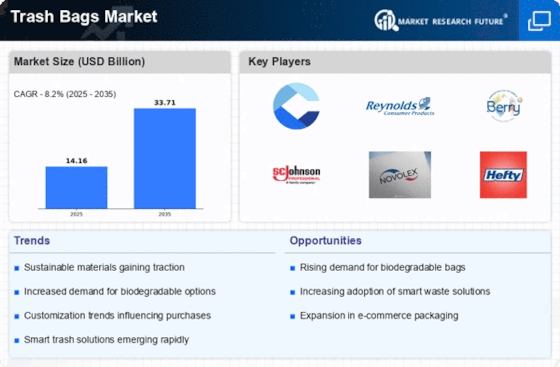
As per Market Research Future analysis, the Trash Bags Market Size was estimated at 14.16 USD Billion in 2024. The Trash Bags industry is projected to grow from 15.33 USD Billion in 2025 to 33.71 USD Billion by 2035, exhibiting a compound annual growth rate (CAGR) of 8.2% during the forecast period 2025 - 2035

Key Market Trends & Highlights

The Trash Bags Market is experiencing a shift towards sustainability and innovation, driven by changing consumer preferences and regulatory pressures.

  • Sustainable materials adoption is becoming increasingly prevalent, particularly in North America, as consumers demand eco-friendly options. Product innovation and functionality are key trends, with manufacturers focusing on enhancing the performance of drawstring trash bags, which remain the largest segment. Specialized product segmentation is evident, with t-shirt bags emerging as the fastest-growing category in the Asia-Pacific region. Rising environmental awareness and urbanization are major drivers, influencing the demand for biodegradable polyethylene and innovative waste management solutions.

Market Size & Forecast

2024 Market Size 14.16 (USD Billion)
2035 Market Size 33.71 (USD Billion)
CAGR (2025 - 2035) 8.2%
Largest Regional Market Share in 2024 Asia Pacific

Major Players

The Clorox Company (US), Reynolds Consumer Products LLC (US), Berry Global Inc. (US), SC Johnson Professional (US), Novolex Holdings, LLC (US), Hefty (US), Ecovessel (US), Kirkland Signature (US), Glad (US)

Market Trends

The Trash Bags Market is currently experiencing a dynamic evolution, driven by various factors including environmental concerns and consumer preferences. As sustainability becomes a focal point for many industries, manufacturers are increasingly exploring biodegradable and compostable materials for trash bags. This shift not only aligns with global efforts to reduce plastic waste but also caters to a growing demographic of eco-conscious consumers. Furthermore, innovations in product design and functionality are emerging, with features such as odor control and enhanced durability gaining traction. These developments suggest a market that is adapting to meet the diverse needs of its users while addressing pressing environmental issues. In addition to sustainability, the Trash Bags Market is witnessing a rise in demand for specialized products tailored to specific applications. For instance, heavy-duty bags for industrial use and smaller, more convenient options for household purposes are becoming more prevalent. This segmentation indicates a nuanced understanding of consumer requirements, as different settings necessitate varying levels of strength and capacity. Overall, the Trash Bags Market appears poised for continued growth, driven by innovation and a commitment to sustainability, while also catering to the specific needs of diverse consumer segments.

Sustainable Materials Adoption

The Trash Bags Market is increasingly leaning towards the use of sustainable materials. Manufacturers are exploring biodegradable and compostable options, reflecting a broader commitment to environmental responsibility. This trend aligns with consumer preferences for eco-friendly products, suggesting a shift in production practices.

Product Innovation and Functionality

Innovation within the Trash Bags Market is evident as companies introduce products with enhanced features. Options such as odor control, puncture resistance, and varying sizes cater to specific consumer needs. This focus on functionality indicates a response to diverse market demands.

Specialized Product Segmentation

The market is witnessing a trend towards specialized trash bags designed for particular applications. Heavy-duty bags for industrial use and smaller bags for household tasks are becoming more common. This segmentation highlights an understanding of varying consumer requirements across different environments.

Trash Bags Market Market Drivers

Rising Environmental Awareness

The increasing awareness regarding environmental issues appears to be a pivotal driver in the Trash bags Market. Consumers are becoming more conscious of their ecological footprint, leading to a growing demand for eco-friendly trash bags. This trend is reflected in the rising sales of biodegradable and compostable options, which are projected to account for a significant share of the market. As more individuals and businesses seek sustainable alternatives, manufacturers are compelled to innovate and expand their product lines. The shift towards environmentally responsible products not only caters to consumer preferences but also aligns with regulatory pressures aimed at reducing plastic waste. Consequently, this heightened environmental consciousness is likely to shape the future landscape of the Trash Bags Market.

Urbanization and Population Growth

Urbanization and population growth are driving forces in the Trash Bags Market. As urban areas expand, the demand for waste management solutions intensifies. The United Nations projects that by 2050, nearly 68% of the world’s population will reside in urban areas, which could lead to increased waste generation. This demographic shift necessitates efficient waste disposal methods, thereby boosting the demand for trash bags. Furthermore, with rising disposable incomes, consumers are more inclined to purchase higher-quality trash bags that offer better durability and functionality. This trend indicates a potential increase in market value, as urban centers require more sophisticated waste management solutions to handle the growing volume of refuse.

E-commerce Growth and Online Retailing

The rapid growth of e-commerce and online retailing is reshaping the Trash Bags Market. With more consumers opting for online shopping, the demand for packaging and waste disposal products, including trash bags, is on the rise. E-commerce platforms provide convenience and accessibility, allowing consumers to purchase trash bags in bulk, which may lead to increased sales volumes. Additionally, online retailers often offer a wider variety of products, including specialized trash bags for different applications, catering to diverse consumer needs. This trend suggests that the Trash Bags Market could experience significant growth as e-commerce continues to expand, providing opportunities for manufacturers to reach a broader audience.

Technological Advancements in Manufacturing

Technological advancements in manufacturing processes are playing a crucial role in the Trash Bags Market. Innovations such as improved polymer technology and automated production techniques are enhancing the efficiency and quality of trash bag production. These advancements allow manufacturers to produce stronger, more durable bags while potentially reducing costs. Moreover, the integration of smart technologies in production lines may lead to more sustainable practices, such as minimizing waste during manufacturing. As technology continues to evolve, it is likely that the Trash Bags Market will witness a transformation in product offerings, with an emphasis on quality, sustainability, and cost-effectiveness.

Regulatory Compliance and Waste Management Policies

Regulatory compliance and waste management policies are increasingly influencing the Trash Bags Market. Governments worldwide are implementing stricter regulations regarding waste disposal and recycling, which necessitates the use of specific types of trash bags. For instance, many regions are mandating the use of biodegradable or recyclable materials in waste management practices. This regulatory landscape compels manufacturers to adapt their product offerings to meet compliance standards, potentially leading to innovation in materials and designs. As municipalities enforce these regulations, the demand for compliant trash bags is likely to rise, thereby shaping the market dynamics and encouraging sustainable practices within the Trash Bags Market.

Market Segment Insights

By Product Type: Drawstring Trash Bags (Largest) vs. T-Shirt Bags (Fastest-Growing)

<p>The Trash Bags Market is diverse, with several product types competing for consumer preference. Drawstring trash bags hold the largest share, favored for their convenience and reliability. Their design allows for easy sealing and carrying, making them a staple in households and commercial settings. In contrast, T-shirt bags have witnessed rapid growth due to their affordability and lightweight nature, making them popular for various waste disposal needs. They are particularly appealing in urban environments where convenience is paramount. As eco-friendly alternatives gain traction, the market dynamics are shifting, pushing T-shirt bags further into the limelight.</p>

<p>Drawstring Trash Bags (Dominant) vs. T-Shirt Bags (Emerging)</p>

<p>Drawstring trash bags are recognized for their practicality and robust design, making them the preferred choice for consumers looking for a reliable waste management solution. Their ability to close securely and carry easily sets them apart in performance and user experience. On the other hand, T-shirt bags, while considered emerging, are gaining popularity due to their cost-effectiveness and versatility in various applications, such as retail and grocery shopping. These lightweight bags are increasingly adopted in convenience-driven markets, offering an appealing solution for quick waste disposal. As environmental concerns grow, both types are expected to evolve, with manufacturers focusing on sustainable materials to enhance their market positioning.</p>

By Material Type: Low-Density Polyethylene (LDPE) (Largest) vs. Biodegradable Polyethylene (Fastest-Growing)

In the Trash Bags Market, the material type segment showcases a diverse distribution among various bag options. <a href="https://www.marketresearchfuture.com/reports/low-density-polyethylene-market-7374">Low-Density Polyethylene</a> (LDPE) holds the largest share, becoming the go-to choice for households and businesses alike due to its flexibility and durability. High-Density Polyethylene (HDPE) also plays a vital role but lags behind LDPE in popularity. Meanwhile, <a href="https://www.marketresearchfuture.com/reports/linear-low-density-polyethylenes-market-6040">Linear Low-Density Polyethylene</a> (LLDPE) is carving out its niche with enhanced strength and stretch properties, gaining traction among specific consumer demographics.

Low-Density Polyethylene (LDPE) (Dominant) vs. Biodegradable Polyethylene (Emerging)

Low-Density Polyethylene (LDPE) is recognized for its excellent tensile strength and puncture resistance, making it the dominant force in the Trash Bags Market. Its lightweight nature and versatility contribute to its widespread use across various sectors, including residential and commercial applications. On the other hand, Biodegradable Polyethylene is emerging as a compelling alternative, driven by increasing environmental awareness among consumers. This segment appeals to eco-conscious buyers looking for sustainable solutions, prompting manufacturers to innovate and expand product lines to meet this growing demand. As sustainability takes center stage, the market for biodegradable products is expected to witness significant growth.

By Capacity: Large (Largest) vs. Small (Fastest-Growing)

In the Trash Bags Market, the capacity segment displays a diverse distribution in market share among the small, medium, and large categories. Large trash bags dominate this segment due to their utility for heavy-duty waste disposal in both residential and commercial settings. Meanwhile, small trash bags are gaining momentum, particularly in urban areas, as they cater to the rising need for convenient and compact waste solutions in households and offices that require frequent disposal without taking up excessive space.

Capacity: Large (Dominant) vs. Small (Emerging)

The large capacity trash bags are predominantly used in construction, landscaping, and other industrial applications, making them a staple in the market. Their strong hold on the market can be attributed to their robustness and ability to handle substantial waste loads. Conversely, small trash bags are increasingly becoming the choice for eco-conscious consumers seeking convenient solutions for daily waste. With a focus on ease of use and sustainability, small bags are catering to a growing demographic that prefers efficient disposal systems, thus positioning them as a burgeoning segment with significant growth potential.

By Distribution Channel: Supermarkets & Hypermarkets (Largest) vs. Online Retail (Fastest-Growing)

In the Trash Bags Market, the distribution of market share among segments reveals that Supermarkets and Hypermarkets hold the largest share, attributed to their wide reach and consumer accessibility. <a href="https://www.marketresearchfuture.com/reports/convenience-stores-market-22842" target="_blank" rel="noopener">convenience stores</a> and Specialty Stores follow. Online Retail, however, is rapidly gaining traction, appealing to the convenience-seeking consumer and benefiting from the digital shift in shopping habits. This growth across different channels showcases the diverse purchasing preferences of consumers in the Trash Bags Market, enabling retailers to craft targeted strategies.

Supermarkets &amp; Hypermarkets: Dominant vs. Online Retail: Emerging

Supermarkets and Hypermarkets establish a dominant position in the Trash Bags Market, primarily due to their expansive physical presence and the ability to offer a comprehensive range of products. They cater to a broad customer base and often leverage promotions and displays to encourage bulk purchases. In contrast, Online Retail is an emerging segment that has surged ahead, particularly amid the rise of e-commerce, providing a convenient shopping experience with home delivery. This channel attracts tech-savvy consumers who appreciate the ease of ordering trash bags online, thus creating a competitive landscape for traditional retail formats.

By End-Use Industry: Residential (Largest) vs. Commercial (Fastest-Growing)

The Trash Bags Market is primarily divided into three end-use segments: Residential, Commercial, and Industrial. Among these, the Residential segment holds the largest share as it encompasses a wide range of consumers using trash bags for everyday waste disposal. The Commercial segment is notable for its rapid growth, spurred by the increasing demand from businesses looking for environmentally friendly waste management solutions. The recent trend towards sustainability in consumer choices further solidifies the Residential segment's dominance while pushing Commercial applications to expand rapidly.

Residential (Dominant) vs. Commercial (Emerging)

The Residential segment is recognized as the dominant player in the Trash Bags Market, characterized by a diverse range of products catering to consumers' evolving waste disposal needs. This segment benefits from a broad customer base that relies on trash bags for regular household waste, recycling, and yard cleanup. The rising awareness of eco-friendly bags is also influencing consumer preferences. Conversely, the Commercial segment is emerging significantly, focusing on businesses that require specialized trash bags for various applications, including food waste, industrial cleaning, and office waste. The demand for stronger, more sustainable options is driving innovation and expansion in this segment, positioning it as a key player in the future growth of the market.

Get more detailed insights about Trash Bags Market Research Report – Forecast Till 2035

Regional Insights

North America : Market Leader in Trash Bags Market

North America dominates the trash bags market, accounting for approximately 45% of the global share. The region's growth is driven by increasing consumer awareness regarding waste management and sustainability. Regulatory initiatives aimed at reducing plastic waste further catalyze demand for eco-friendly alternatives. The U.S. is the largest market, followed by Canada, which holds around 15% of the market share. The competitive landscape is characterized by major players such as The Clorox Company, Reynolds Consumer Products, and Berry Global. These companies are focusing on innovation and sustainability, introducing biodegradable and recyclable options to meet consumer demand. The presence of established brands ensures a robust distribution network, enhancing market penetration across various retail channels.

Europe : Emerging Eco-Friendly Trends

Europe is witnessing a significant shift towards sustainable trash bag solutions, holding approximately 30% of the global market share. The region's growth is propelled by stringent regulations aimed at reducing plastic waste and promoting recycling. Countries like Germany and France are leading the charge, with Germany holding the largest share at around 12%. The European Union's directives on single-use plastics are key drivers of this trend. Leading countries in the European market include Germany, France, and the UK, with a competitive landscape featuring companies like Novolex and SC Johnson Professional. The focus on eco-friendly products is reshaping the market, as consumers increasingly prefer biodegradable options. This shift is supported by government initiatives that encourage sustainable practices among manufacturers and consumers alike.

Asia-Pacific : Rapid Growth and Urbanization

Asia-Pacific is rapidly emerging as a significant player in the trash bags market, accounting for approximately 20% of the global share. The region's growth is driven by urbanization, increasing disposable incomes, and a growing focus on waste management solutions. Countries like China and India are the largest markets, with China holding around 10% of the market share. The rising population and urban development are key factors fueling demand. The competitive landscape is evolving, with local manufacturers gaining traction alongside global players. Companies like Hefty and Ecovessel are expanding their presence in the region. The increasing awareness of environmental issues is prompting consumers to seek sustainable options, leading to a rise in biodegradable and compostable trash bags. This trend is supported by government initiatives promoting waste reduction and recycling.

Middle East and Africa : Untapped Market Potential

The Middle East and Africa region is gradually emerging in the trash bags market, holding approximately 5% of the global share. The growth is primarily driven by rapid urbanization, increasing population, and a rising awareness of waste management practices. Countries like South Africa and the UAE are leading the market, with South Africa accounting for about 3% of the share. The region's potential is significant, as waste management infrastructure continues to develop. The competitive landscape is characterized by a mix of local and international players. Companies are increasingly focusing on introducing innovative products tailored to regional needs. The presence of key players like Kirkland Signature and Glad is enhancing market dynamics. As governments implement stricter waste management regulations, the demand for efficient trash bag solutions is expected to rise, paving the way for future growth.

Key Players and Competitive Insights

The Trash Bags Market is currently characterized by a dynamic competitive landscape, driven by increasing consumer demand for sustainable and innovative waste management solutions. Key players such as The Clorox Company (US), Reynolds Consumer Products LLC (US), and Berry Global Inc. (US) are strategically positioning themselves through a combination of product innovation, sustainability initiatives, and regional expansion. These companies are not only focusing on enhancing their product offerings but are also investing in eco-friendly materials and technologies, which collectively shape a competitive environment that increasingly prioritizes environmental responsibility alongside performance.In terms of business tactics, companies are localizing manufacturing to reduce costs and improve supply chain efficiency. The market appears moderately fragmented, with several players vying for market share. However, the collective influence of major companies like SC Johnson Professional (US) and Novolex Holdings, LLC (US) is notable, as they leverage their extensive distribution networks and brand recognition to maintain a competitive edge.
In August The Clorox Company (US) announced a new line of biodegradable trash bags, which aligns with the growing consumer preference for sustainable products. This strategic move not only enhances their product portfolio but also positions the company as a leader in eco-friendly waste management solutions. The introduction of these bags is likely to attract environmentally conscious consumers, thereby expanding their market share in a competitive landscape increasingly focused on sustainability.Similarly, in September 2025, Reynolds Consumer Products LLC (US) launched a partnership with a leading recycling technology firm to develop advanced recycling processes for their trash bags. This collaboration is significant as it underscores the company's commitment to circular economy principles, potentially reducing waste and enhancing the recyclability of their products. Such initiatives may strengthen their brand reputation and appeal to a broader audience concerned with environmental impact.Moreover, in July 2025, Berry Global Inc. (US) expanded its manufacturing capabilities by investing in a new facility dedicated to producing high-performance trash bags made from recycled materials. This strategic investment not only enhances their production capacity but also aligns with the increasing regulatory pressures for sustainable manufacturing practices. By focusing on recycled content, Berry The Trash Bags Market, appealing to both consumers and regulatory bodies.
As of October the Trash Bags Market is witnessing trends that emphasize digitalization, sustainability, and the integration of artificial intelligence in production processes. Strategic alliances among key players are shaping the competitive landscape, fostering innovation and efficiency. The shift from price-based competition to a focus on technological advancement and supply chain reliability is evident, suggesting that future competitive differentiation will hinge on the ability to innovate and respond to evolving consumer preferences.

Key Companies in the Trash Bags Market include

Industry Developments

  • Q2 2024: Berry Global Group, Inc. Announces Opening of New Recycling Facility in Indiana Berry Global Group, a major producer of trash bags and flexible packaging, opened a new state-of-the-art recycling facility in Indiana to increase the use of recycled content in its trash bag products.
  • Q2 2024: Reynolds Consumer Products Appoints Michael Graham as Chief Financial Officer Reynolds Consumer Products, a leading manufacturer of trash bags under the Hefty brand, announced the appointment of Michael Graham as its new Chief Financial Officer, effective May 2024.
  • Q2 2024: Novolex Launches New Line of Compostable Trash Bags Market Novolex, a prominent packaging and trash bag manufacturer, launched a new line of compostable trash bags designed for both residential and commercial use, expanding its sustainable product portfolio.
  • Q1 2024: Glad Partners with TerraCycle to Launch National Recycling Program for Trash Bags Market Glad, a major trash bag brand, announced a partnership with TerraCycle to launch a nationwide recycling program, allowing consumers to recycle used trash bags at participating locations.
  • Q3 2024: Inteplast Group Expands Trash Bag Production with New Facility in Texas Inteplast Group, a significant player in the trash bags market, opened a new manufacturing facility in Texas to increase production capacity and meet growing demand in North America.
  • Q2 2024: Heritage Bag Company Receives EPA Approval for Recycled Content Trash Bags Market Heritage Bag Company announced it received approval from the U.S. Environmental Protection Agency (EPA) for its new line of trash bags made with 60% post-consumer recycled content.
  • Q1 2024: Aluf Plastics Announces $20 Million Investment to Expand Trash Bag Manufacturing Aluf Plastics, a U.S.-based trash bag manufacturer, announced a $20 million investment to expand its manufacturing operations and increase output of both traditional and eco-friendly trash bags.
  • Q2 2024: Poly-America Launches Heavy-Duty Contractor Trash Bags Market Poly-America, a leading producer of trash bags, launched a new line of heavy-duty contractor trash bags targeting the construction and industrial sectors.
  • Q3 2024: Novolex Acquires EcoSafe Zero Waste to Expand Sustainable Trash Bag Offerings Novolex announced the acquisition of EcoSafe Zero Waste, a company specializing in compostable and biodegradable trash bags, to strengthen its position in the sustainable waste management sector.
  • Q1 2025: Reynolds Consumer Products Announces $50 Million Expansion of Hefty Trash Bag Plant Reynolds Consumer Products announced a $50 million expansion of its Hefty trash bag manufacturing plant in Illinois to boost production capacity and support new product lines.
  • Q2 2025: Berry Global Secures Multi-Year Contract to Supply Trash Bags Market to Major U.S. Retailer Berry Global announced it secured a multi-year contract to supply private label trash bags to a major U.S. retail chain, strengthening its presence in the retail sector.
  • Q2 2025: Inteplast Group Launches Biodegradable Trash Bags Market for Commercial Markets Inteplast Group launched a new line of biodegradable trash bags aimed at commercial customers, expanding its sustainable product offerings.

Trash Bags Market Segmentation

Trash Bags Market by Product Type Outlook

  • Drawstring Trash Bags Market
  • Star-Sealed Trash Bags Market
  • Flat-Sealed Trash Bags Market
  • T-Shirt Bags
  • Twist Tie Bags

Trash Bags Market by Material Type Outlook

  • High-Density Polyethylene (HDPE)
  • Low-Density Polyethylene (LDPE)
  • Linear Low-Density Polyethylene (LLDPE)
  • Biodegradable Polyethylene

Trash Bags Market by Capacity Outlook

  • Small
  • Medium
  • Large

Trash Bags Market by Distribution Channel Outlook

  • Supermarkets & Hypermarkets
  • Convenience Stores
  • Online Retail
  • Specialty Stores

Trash Bags Market by End-Use Industry Outlook

  • Residential
  • Commercial
  • Industrial

Trash Bags Market Regional Outlook

  • North America
    • US
    • Canada
    • Mexico
  • Europe
    • Russia
    • Germany
    • United Kingdom (Uk)
    • France
    • Italy
    • Spain
    • Switzerland
    • Belgium
    • Czech Republic
    • Portugal
    • Rest of Europe
  • Asia-Pacific
    • India
    • Japan
    • South Korea
    • Malaysia
    • Thailand
    • Indonesia
    • Rest Of Asia-Pacific
  • Latin America (Latam)
    • Brazil
    • Colombia
    • Argentina
    • Peru
    • Venezuela
    • Chile
    • Panama
    • Rest Of Latam
  • Africa
    • Nigeria
    • Ethiopia
    • Egypt
    • Democratic Republic of the Congo (DRC)
    • Tanzania
    • South Africa
    • Morocco
    • Algeria
    • Tunisia
    • Rest Of Africa

Future Outlook

Trash Bags Market Future Outlook

The Trash Bags Market is projected to grow at an 8.2% CAGR from 2025 to 2035, driven by increasing urbanization, environmental regulations, and demand for sustainable products.

New opportunities lie in:

  • <p>Development of biodegradable trash bags for eco-conscious consumers. Expansion into smart waste management solutions integrating IoT technology. Partnerships with municipalities for large-scale waste collection contracts.</p>

By 2035, the Trash Bags Market is expected to achieve substantial growth, reflecting evolving consumer preferences and technological advancements.

Market Segmentation

Trash Bags Market Capacity Outlook

  • Small
  • Medium
  • Large

Trash Bags Market Product Type Outlook

  • Drawstring Trash Bags
  • Star-Sealed Trash Bags
  • Flat-Sealed Trash Bags
  • T-Shirt Bags
  • Twist Tie Bags

Trash Bags Market Material Type Outlook

  • High-Density Polyethylene (HDPE)
  • Low-Density Polyethylene (LDPE)
  • Linear Low-Density Polyethylene (LLDPE)
  • Biodegradable Polyethylene

Trash Bags Market End-Use Industry Outlook

  • Residential
  • Commercial
  • Industrial

Trash Bags Market Distribution Channel Outlook

  • Supermarkets & Hypermarkets
  • Convenience Stores
  • Online Retail
  • Specialty Stores

Report Scope

MARKET SIZE 2024 14.16(USD Billion)
MARKET SIZE 2025 15.33(USD Billion)
MARKET SIZE 2035 33.71(USD Billion)
COMPOUND ANNUAL GROWTH RATE (CAGR) 8.2% (2025 - 2035)
REPORT COVERAGE Revenue Forecast, Competitive Landscape, Growth Factors, and Trends
BASE YEAR 2024
Market Forecast Period 2025 - 2035
Historical Data 2019 - 2024
Market Forecast Units USD Billion
Key Companies Profiled The Clorox Company (US), Reynolds Consumer Products LLC (US), Berry Global Inc. (US), SC Johnson Professional (US), Novolex Holdings, LLC (US), Hefty (US), Ecovessel (US), Kirkland Signature (US), Glad (US)
Segments Covered Product Type, Material Type, Capacity, Distribution Channel, End-Use Industry
Key Market Opportunities Growing demand for eco-friendly materials in the Trash Bags Market presents significant innovation opportunities.
Key Market Dynamics Rising consumer preference for eco-friendly trash bags drives innovation and competition among manufacturers.
Countries Covered North America, Europe, APAC, South America, MEA

FAQs

What is the current valuation of the Trash Bags Market in 2024?

<p>The Trash Bags Market was valued at 14.16 USD Billion in 2024.</p>

What is the projected market valuation for the Trash Bags Market by 2035?

The market is projected to reach 33.71 USD Billion by 2035.

What is the expected CAGR for the Trash Bags Market during the forecast period 2025 - 2035?

The expected CAGR for the Trash Bags Market during the forecast period 2025 - 2035 is 8.2%.

Which product type segment is expected to show significant growth in the Trash Bags Market?

The Drawstring Trash Bags segment is anticipated to grow from 2.83 USD Billion in 2024 to 6.56 USD Billion by 2035.

How does the market for biodegradable polyethylene trash bags compare to other materials?

The biodegradable polyethylene segment is projected to grow from 3.66 USD Billion in 2024 to 8.71 USD Billion by 2035.

What distribution channel is expected to dominate the Trash Bags Market?

Supermarkets &amp; Hypermarkets are expected to dominate, growing from 5.66 USD Billion in 2024 to 13.12 USD Billion by 2035.

Which end-use industry is projected to have the highest market share in 2035?

The Residential end-use industry is projected to grow from 5.66 USD Billion in 2024 to 13.25 USD Billion by 2035.

Who are the key players in the Trash Bags Market?

Key players include The Clorox Company, Reynolds Consumer Products LLC, and Berry Global Inc.

What is the expected growth for the medium capacity trash bags segment?

The medium capacity trash bags segment is expected to grow from 5.65 USD Billion in 2024 to 13.14 USD Billion by 2035.

How does the market for online retail compare to other distribution channels?

The online retail segment is projected to grow from 3.39 USD Billion in 2024 to 7.83 USD Billion by 2035.

  1. SECTION I: EXECUTIVE SUMMARY AND KEY HIGHLIGHTS
    1. | 1.1 EXECUTIVE SUMMARY
    2. | | 1.1.1 Market Overview
    3. | | 1.1.2 Key Findings
    4. | | 1.1.3 Market Segmentation
    5. | | 1.1.4 Competitive Landscape
    6. | | 1.1.5 Challenges and Opportunities
    7. | | 1.1.6 Future Outlook
  2. SECTION II: SCOPING, METHODOLOGY AND MARKET STRUCTURE
    1. | 2.1 MARKET INTRODUCTION
    2. | | 2.1.1 Definition
    3. | | 2.1.2 Scope of the study
    4. | | | 2.1.2.1 Research Objective
    5. | | | 2.1.2.2 Assumption
    6. | | | 2.1.2.3 Limitations
    7. | 2.2 RESEARCH METHODOLOGY
    8. | | 2.2.1 Overview
    9. | | 2.2.2 Data Mining
    10. | | 2.2.3 Secondary Research
    11. | | 2.2.4 Primary Research
    12. | | | 2.2.4.1 Primary Interviews and Information Gathering Process
    13. | | | 2.2.4.2 Breakdown of Primary Respondents
    14. | | 2.2.5 Forecasting Model
    15. | | 2.2.6 Market Size Estimation
    16. | | | 2.2.6.1 Bottom-Up Approach
    17. | | | 2.2.6.2 Top-Down Approach
    18. | | 2.2.7 Data Triangulation
    19. | | 2.2.8 Validation
  3. SECTION III: QUALITATIVE ANALYSIS
    1. | 3.1 MARKET DYNAMICS
    2. | | 3.1.1 Overview
    3. | | 3.1.2 Drivers
    4. | | 3.1.3 Restraints
    5. | | 3.1.4 Opportunities
    6. | 3.2 MARKET FACTOR ANALYSIS
    7. | | 3.2.1 Value chain Analysis
    8. | | 3.2.2 Porter's Five Forces Analysis
    9. | | | 3.2.2.1 Bargaining Power of Suppliers
    10. | | | 3.2.2.2 Bargaining Power of Buyers
    11. | | | 3.2.2.3 Threat of New Entrants
    12. | | | 3.2.2.4 Threat of Substitutes
    13. | | | 3.2.2.5 Intensity of Rivalry
    14. | | 3.2.3 COVID-19 Impact Analysis
    15. | | | 3.2.3.1 Market Impact Analysis
    16. | | | 3.2.3.2 Regional Impact
    17. | | | 3.2.3.3 Opportunity and Threat Analysis
  4. SECTION IV: QUANTITATIVE ANALYSIS
    1. | 4.1 Packaging & Transport, BY Product Type (USD Billion)
    2. | | 4.1.1 Drawstring Trash Bags
    3. | | 4.1.2 Star-Sealed Trash Bags
    4. | | 4.1.3 Flat-Sealed Trash Bags
    5. | | 4.1.4 T-Shirt Bags
    6. | | 4.1.5 Twist Tie Bags
    7. | 4.2 Packaging & Transport, BY Material Type (USD Billion)
    8. | | 4.2.1 High-Density Polyethylene (HDPE)
    9. | | 4.2.2 Low-Density Polyethylene (LDPE)
    10. | | 4.2.3 Linear Low-Density Polyethylene (LLDPE)
    11. | | 4.2.4 Biodegradable Polyethylene
    12. | 4.3 Packaging & Transport, BY Capacity (USD Billion)
    13. | | 4.3.1 Small
    14. | | 4.3.2 Medium
    15. | | 4.3.3 Large
    16. | 4.4 Packaging & Transport, BY Distribution Channel (USD Billion)
    17. | | 4.4.1 Supermarkets & Hypermarkets
    18. | | 4.4.2 Convenience Stores
    19. | | 4.4.3 Online Retail
    20. | | 4.4.4 Specialty Stores
    21. | 4.5 Packaging & Transport, BY End-Use Industry (USD Billion)
    22. | | 4.5.1 Residential
    23. | | 4.5.2 Commercial
    24. | | 4.5.3 Industrial
    25. | 4.6 Packaging & Transport, BY Region (USD Billion)
    26. | | 4.6.1 North America
    27. | | | 4.6.1.1 US
    28. | | | 4.6.1.2 Canada
    29. | | 4.6.2 Europe
    30. | | | 4.6.2.1 Germany
    31. | | | 4.6.2.2 UK
    32. | | | 4.6.2.3 France
    33. | | | 4.6.2.4 Russia
    34. | | | 4.6.2.5 Italy
    35. | | | 4.6.2.6 Spain
    36. | | | 4.6.2.7 Rest of Europe
    37. | | 4.6.3 APAC
    38. | | | 4.6.3.1 China
    39. | | | 4.6.3.2 India
    40. | | | 4.6.3.3 Japan
    41. | | | 4.6.3.4 South Korea
    42. | | | 4.6.3.5 Malaysia
    43. | | | 4.6.3.6 Thailand
    44. | | | 4.6.3.7 Indonesia
    45. | | | 4.6.3.8 Rest of APAC
    46. | | 4.6.4 South America
    47. | | | 4.6.4.1 Brazil
    48. | | | 4.6.4.2 Mexico
    49. | | | 4.6.4.3 Argentina
    50. | | | 4.6.4.4 Rest of South America
    51. | | 4.6.5 MEA
    52. | | | 4.6.5.1 GCC Countries
    53. | | | 4.6.5.2 South Africa
    54. | | | 4.6.5.3 Rest of MEA
  5. SECTION V: COMPETITIVE ANALYSIS
    1. | 5.1 Competitive Landscape
    2. | | 5.1.1 Overview
    3. | | 5.1.2 Competitive Analysis
    4. | | 5.1.3 Market share Analysis
    5. | | 5.1.4 Major Growth Strategy in the Packaging & Transport
    6. | | 5.1.5 Competitive Benchmarking
    7. | | 5.1.6 Leading Players in Terms of Number of Developments in the Packaging & Transport
    8. | | 5.1.7 Key developments and growth strategies
    9. | | | 5.1.7.1 New Product Launch/Service Deployment
    10. | | | 5.1.7.2 Merger & Acquisitions
    11. | | | 5.1.7.3 Joint Ventures
    12. | | 5.1.8 Major Players Financial Matrix
    13. | | | 5.1.8.1 Sales and Operating Income
    14. | | | 5.1.8.2 Major Players R&D Expenditure. 2023
    15. | 5.2 Company Profiles
    16. | | 5.2.1 The Clorox Company (US)
    17. | | | 5.2.1.1 Financial Overview
    18. | | | 5.2.1.2 Products Offered
    19. | | | 5.2.1.3 Key Developments
    20. | | | 5.2.1.4 SWOT Analysis
    21. | | | 5.2.1.5 Key Strategies
    22. | | 5.2.2 Reynolds Consumer Products LLC (US)
    23. | | | 5.2.2.1 Financial Overview
    24. | | | 5.2.2.2 Products Offered
    25. | | | 5.2.2.3 Key Developments
    26. | | | 5.2.2.4 SWOT Analysis
    27. | | | 5.2.2.5 Key Strategies
    28. | | 5.2.3 Berry Global Inc. (US)
    29. | | | 5.2.3.1 Financial Overview
    30. | | | 5.2.3.2 Products Offered
    31. | | | 5.2.3.3 Key Developments
    32. | | | 5.2.3.4 SWOT Analysis
    33. | | | 5.2.3.5 Key Strategies
    34. | | 5.2.4 SC Johnson Professional (US)
    35. | | | 5.2.4.1 Financial Overview
    36. | | | 5.2.4.2 Products Offered
    37. | | | 5.2.4.3 Key Developments
    38. | | | 5.2.4.4 SWOT Analysis
    39. | | | 5.2.4.5 Key Strategies
    40. | | 5.2.5 Novolex Holdings, LLC (US)
    41. | | | 5.2.5.1 Financial Overview
    42. | | | 5.2.5.2 Products Offered
    43. | | | 5.2.5.3 Key Developments
    44. | | | 5.2.5.4 SWOT Analysis
    45. | | | 5.2.5.5 Key Strategies
    46. | | 5.2.6 Hefty (US)
    47. | | | 5.2.6.1 Financial Overview
    48. | | | 5.2.6.2 Products Offered
    49. | | | 5.2.6.3 Key Developments
    50. | | | 5.2.6.4 SWOT Analysis
    51. | | | 5.2.6.5 Key Strategies
    52. | | 5.2.7 Ecovessel (US)
    53. | | | 5.2.7.1 Financial Overview
    54. | | | 5.2.7.2 Products Offered
    55. | | | 5.2.7.3 Key Developments
    56. | | | 5.2.7.4 SWOT Analysis
    57. | | | 5.2.7.5 Key Strategies
    58. | | 5.2.8 Kirkland Signature (US)
    59. | | | 5.2.8.1 Financial Overview
    60. | | | 5.2.8.2 Products Offered
    61. | | | 5.2.8.3 Key Developments
    62. | | | 5.2.8.4 SWOT Analysis
    63. | | | 5.2.8.5 Key Strategies
    64. | | 5.2.9 Glad (US)
    65. | | | 5.2.9.1 Financial Overview
    66. | | | 5.2.9.2 Products Offered
    67. | | | 5.2.9.3 Key Developments
    68. | | | 5.2.9.4 SWOT Analysis
    69. | | | 5.2.9.5 Key Strategies
    70. | 5.3 Appendix
    71. | | 5.3.1 References
    72. | | 5.3.2 Related Reports
  6. LIST OF FIGURES
    1. | 6.1 MARKET SYNOPSIS
    2. | 6.2 NORTH AMERICA MARKET ANALYSIS
    3. | 6.3 US MARKET ANALYSIS BY PRODUCT TYPE
    4. | 6.4 US MARKET ANALYSIS BY MATERIAL TYPE
    5. | 6.5 US MARKET ANALYSIS BY CAPACITY
    6. | 6.6 US MARKET ANALYSIS BY DISTRIBUTION CHANNEL
    7. | 6.7 US MARKET ANALYSIS BY END-USE INDUSTRY
    8. | 6.8 CANADA MARKET ANALYSIS BY PRODUCT TYPE
    9. | 6.9 CANADA MARKET ANALYSIS BY MATERIAL TYPE
    10. | 6.10 CANADA MARKET ANALYSIS BY CAPACITY
    11. | 6.11 CANADA MARKET ANALYSIS BY DISTRIBUTION CHANNEL
    12. | 6.12 CANADA MARKET ANALYSIS BY END-USE INDUSTRY
    13. | 6.13 EUROPE MARKET ANALYSIS
    14. | 6.14 GERMANY MARKET ANALYSIS BY PRODUCT TYPE
    15. | 6.15 GERMANY MARKET ANALYSIS BY MATERIAL TYPE
    16. | 6.16 GERMANY MARKET ANALYSIS BY CAPACITY
    17. | 6.17 GERMANY MARKET ANALYSIS BY DISTRIBUTION CHANNEL
    18. | 6.18 GERMANY MARKET ANALYSIS BY END-USE INDUSTRY
    19. | 6.19 UK MARKET ANALYSIS BY PRODUCT TYPE
    20. | 6.20 UK MARKET ANALYSIS BY MATERIAL TYPE
    21. | 6.21 UK MARKET ANALYSIS BY CAPACITY
    22. | 6.22 UK MARKET ANALYSIS BY DISTRIBUTION CHANNEL
    23. | 6.23 UK MARKET ANALYSIS BY END-USE INDUSTRY
    24. | 6.24 FRANCE MARKET ANALYSIS BY PRODUCT TYPE
    25. | 6.25 FRANCE MARKET ANALYSIS BY MATERIAL TYPE
    26. | 6.26 FRANCE MARKET ANALYSIS BY CAPACITY
    27. | 6.27 FRANCE MARKET ANALYSIS BY DISTRIBUTION CHANNEL
    28. | 6.28 FRANCE MARKET ANALYSIS BY END-USE INDUSTRY
    29. | 6.29 RUSSIA MARKET ANALYSIS BY PRODUCT TYPE
    30. | 6.30 RUSSIA MARKET ANALYSIS BY MATERIAL TYPE
    31. | 6.31 RUSSIA MARKET ANALYSIS BY CAPACITY
    32. | 6.32 RUSSIA MARKET ANALYSIS BY DISTRIBUTION CHANNEL
    33. | 6.33 RUSSIA MARKET ANALYSIS BY END-USE INDUSTRY
    34. | 6.34 ITALY MARKET ANALYSIS BY PRODUCT TYPE
    35. | 6.35 ITALY MARKET ANALYSIS BY MATERIAL TYPE
    36. | 6.36 ITALY MARKET ANALYSIS BY CAPACITY
    37. | 6.37 ITALY MARKET ANALYSIS BY DISTRIBUTION CHANNEL
    38. | 6.38 ITALY MARKET ANALYSIS BY END-USE INDUSTRY
    39. | 6.39 SPAIN MARKET ANALYSIS BY PRODUCT TYPE
    40. | 6.40 SPAIN MARKET ANALYSIS BY MATERIAL TYPE
    41. | 6.41 SPAIN MARKET ANALYSIS BY CAPACITY
    42. | 6.42 SPAIN MARKET ANALYSIS BY DISTRIBUTION CHANNEL
    43. | 6.43 SPAIN MARKET ANALYSIS BY END-USE INDUSTRY
    44. | 6.44 REST OF EUROPE MARKET ANALYSIS BY PRODUCT TYPE
    45. | 6.45 REST OF EUROPE MARKET ANALYSIS BY MATERIAL TYPE
    46. | 6.46 REST OF EUROPE MARKET ANALYSIS BY CAPACITY
    47. | 6.47 REST OF EUROPE MARKET ANALYSIS BY DISTRIBUTION CHANNEL
    48. | 6.48 REST OF EUROPE MARKET ANALYSIS BY END-USE INDUSTRY
    49. | 6.49 APAC MARKET ANALYSIS
    50. | 6.50 CHINA MARKET ANALYSIS BY PRODUCT TYPE
    51. | 6.51 CHINA MARKET ANALYSIS BY MATERIAL TYPE
    52. | 6.52 CHINA MARKET ANALYSIS BY CAPACITY
    53. | 6.53 CHINA MARKET ANALYSIS BY DISTRIBUTION CHANNEL
    54. | 6.54 CHINA MARKET ANALYSIS BY END-USE INDUSTRY
    55. | 6.55 INDIA MARKET ANALYSIS BY PRODUCT TYPE
    56. | 6.56 INDIA MARKET ANALYSIS BY MATERIAL TYPE
    57. | 6.57 INDIA MARKET ANALYSIS BY CAPACITY
    58. | 6.58 INDIA MARKET ANALYSIS BY DISTRIBUTION CHANNEL
    59. | 6.59 INDIA MARKET ANALYSIS BY END-USE INDUSTRY
    60. | 6.60 JAPAN MARKET ANALYSIS BY PRODUCT TYPE
    61. | 6.61 JAPAN MARKET ANALYSIS BY MATERIAL TYPE
    62. | 6.62 JAPAN MARKET ANALYSIS BY CAPACITY
    63. | 6.63 JAPAN MARKET ANALYSIS BY DISTRIBUTION CHANNEL
    64. | 6.64 JAPAN MARKET ANALYSIS BY END-USE INDUSTRY
    65. | 6.65 SOUTH KOREA MARKET ANALYSIS BY PRODUCT TYPE
    66. | 6.66 SOUTH KOREA MARKET ANALYSIS BY MATERIAL TYPE
    67. | 6.67 SOUTH KOREA MARKET ANALYSIS BY CAPACITY
    68. | 6.68 SOUTH KOREA MARKET ANALYSIS BY DISTRIBUTION CHANNEL
    69. | 6.69 SOUTH KOREA MARKET ANALYSIS BY END-USE INDUSTRY
    70. | 6.70 MALAYSIA MARKET ANALYSIS BY PRODUCT TYPE
    71. | 6.71 MALAYSIA MARKET ANALYSIS BY MATERIAL TYPE
    72. | 6.72 MALAYSIA MARKET ANALYSIS BY CAPACITY
    73. | 6.73 MALAYSIA MARKET ANALYSIS BY DISTRIBUTION CHANNEL
    74. | 6.74 MALAYSIA MARKET ANALYSIS BY END-USE INDUSTRY
    75. | 6.75 THAILAND MARKET ANALYSIS BY PRODUCT TYPE
    76. | 6.76 THAILAND MARKET ANALYSIS BY MATERIAL TYPE
    77. | 6.77 THAILAND MARKET ANALYSIS BY CAPACITY
    78. | 6.78 THAILAND MARKET ANALYSIS BY DISTRIBUTION CHANNEL
    79. | 6.79 THAILAND MARKET ANALYSIS BY END-USE INDUSTRY
    80. | 6.80 INDONESIA MARKET ANALYSIS BY PRODUCT TYPE
    81. | 6.81 INDONESIA MARKET ANALYSIS BY MATERIAL TYPE
    82. | 6.82 INDONESIA MARKET ANALYSIS BY CAPACITY
    83. | 6.83 INDONESIA MARKET ANALYSIS BY DISTRIBUTION CHANNEL
    84. | 6.84 INDONESIA MARKET ANALYSIS BY END-USE INDUSTRY
    85. | 6.85 REST OF APAC MARKET ANALYSIS BY PRODUCT TYPE
    86. | 6.86 REST OF APAC MARKET ANALYSIS BY MATERIAL TYPE
    87. | 6.87 REST OF APAC MARKET ANALYSIS BY CAPACITY
    88. | 6.88 REST OF APAC MARKET ANALYSIS BY DISTRIBUTION CHANNEL
    89. | 6.89 REST OF APAC MARKET ANALYSIS BY END-USE INDUSTRY
    90. | 6.90 SOUTH AMERICA MARKET ANALYSIS
    91. | 6.91 BRAZIL MARKET ANALYSIS BY PRODUCT TYPE
    92. | 6.92 BRAZIL MARKET ANALYSIS BY MATERIAL TYPE
    93. | 6.93 BRAZIL MARKET ANALYSIS BY CAPACITY
    94. | 6.94 BRAZIL MARKET ANALYSIS BY DISTRIBUTION CHANNEL
    95. | 6.95 BRAZIL MARKET ANALYSIS BY END-USE INDUSTRY
    96. | 6.96 MEXICO MARKET ANALYSIS BY PRODUCT TYPE
    97. | 6.97 MEXICO MARKET ANALYSIS BY MATERIAL TYPE
    98. | 6.98 MEXICO MARKET ANALYSIS BY CAPACITY
    99. | 6.99 MEXICO MARKET ANALYSIS BY DISTRIBUTION CHANNEL
    100. | 6.100 MEXICO MARKET ANALYSIS BY END-USE INDUSTRY
    101. | 6.101 ARGENTINA MARKET ANALYSIS BY PRODUCT TYPE
    102. | 6.102 ARGENTINA MARKET ANALYSIS BY MATERIAL TYPE
    103. | 6.103 ARGENTINA MARKET ANALYSIS BY CAPACITY
    104. | 6.104 ARGENTINA MARKET ANALYSIS BY DISTRIBUTION CHANNEL
    105. | 6.105 ARGENTINA MARKET ANALYSIS BY END-USE INDUSTRY
    106. | 6.106 REST OF SOUTH AMERICA MARKET ANALYSIS BY PRODUCT TYPE
    107. | 6.107 REST OF SOUTH AMERICA MARKET ANALYSIS BY MATERIAL TYPE
    108. | 6.108 REST OF SOUTH AMERICA MARKET ANALYSIS BY CAPACITY
    109. | 6.109 REST OF SOUTH AMERICA MARKET ANALYSIS BY DISTRIBUTION CHANNEL
    110. | 6.110 REST OF SOUTH AMERICA MARKET ANALYSIS BY END-USE INDUSTRY
    111. | 6.111 MEA MARKET ANALYSIS
    112. | 6.112 GCC COUNTRIES MARKET ANALYSIS BY PRODUCT TYPE
    113. | 6.113 GCC COUNTRIES MARKET ANALYSIS BY MATERIAL TYPE
    114. | 6.114 GCC COUNTRIES MARKET ANALYSIS BY CAPACITY
    115. | 6.115 GCC COUNTRIES MARKET ANALYSIS BY DISTRIBUTION CHANNEL
    116. | 6.116 GCC COUNTRIES MARKET ANALYSIS BY END-USE INDUSTRY
    117. | 6.117 SOUTH AFRICA MARKET ANALYSIS BY PRODUCT TYPE
    118. | 6.118 SOUTH AFRICA MARKET ANALYSIS BY MATERIAL TYPE
    119. | 6.119 SOUTH AFRICA MARKET ANALYSIS BY CAPACITY
    120. | 6.120 SOUTH AFRICA MARKET ANALYSIS BY DISTRIBUTION CHANNEL
    121. | 6.121 SOUTH AFRICA MARKET ANALYSIS BY END-USE INDUSTRY
    122. | 6.122 REST OF MEA MARKET ANALYSIS BY PRODUCT TYPE
    123. | 6.123 REST OF MEA MARKET ANALYSIS BY MATERIAL TYPE
    124. | 6.124 REST OF MEA MARKET ANALYSIS BY CAPACITY
    125. | 6.125 REST OF MEA MARKET ANALYSIS BY DISTRIBUTION CHANNEL
    126. | 6.126 REST OF MEA MARKET ANALYSIS BY END-USE INDUSTRY
    127. | 6.127 KEY BUYING CRITERIA OF PACKAGING & TRANSPORT
    128. | 6.128 RESEARCH PROCESS OF MRFR
    129. | 6.129 DRO ANALYSIS OF PACKAGING & TRANSPORT
    130. | 6.130 DRIVERS IMPACT ANALYSIS: PACKAGING & TRANSPORT
    131. | 6.131 RESTRAINTS IMPACT ANALYSIS: PACKAGING & TRANSPORT
    132. | 6.132 SUPPLY / VALUE CHAIN: PACKAGING & TRANSPORT
    133. | 6.133 PACKAGING & TRANSPORT, BY PRODUCT TYPE, 2024 (% SHARE)
    134. | 6.134 PACKAGING & TRANSPORT, BY PRODUCT TYPE, 2024 TO 2035 (USD Billion)
    135. | 6.135 PACKAGING & TRANSPORT, BY MATERIAL TYPE, 2024 (% SHARE)
    136. | 6.136 PACKAGING & TRANSPORT, BY MATERIAL TYPE, 2024 TO 2035 (USD Billion)
    137. | 6.137 PACKAGING & TRANSPORT, BY CAPACITY, 2024 (% SHARE)
    138. | 6.138 PACKAGING & TRANSPORT, BY CAPACITY, 2024 TO 2035 (USD Billion)
    139. | 6.139 PACKAGING & TRANSPORT, BY DISTRIBUTION CHANNEL, 2024 (% SHARE)
    140. | 6.140 PACKAGING & TRANSPORT, BY DISTRIBUTION CHANNEL, 2024 TO 2035 (USD Billion)
    141. | 6.141 PACKAGING & TRANSPORT, BY END-USE INDUSTRY, 2024 (% SHARE)
    142. | 6.142 PACKAGING & TRANSPORT, BY END-USE INDUSTRY, 2024 TO 2035 (USD Billion)
    143. | 6.143 BENCHMARKING OF MAJOR COMPETITORS
  7. LIST OF TABLES
    1. | 7.1 LIST OF ASSUMPTIONS
    2. | | 7.1.1
    3. | 7.2 North America MARKET SIZE ESTIMATES; FORECAST
    4. | | 7.2.1 BY PRODUCT TYPE, 2025-2035 (USD Billion)
    5. | | 7.2.2 BY MATERIAL TYPE, 2025-2035 (USD Billion)
    6. | | 7.2.3 BY CAPACITY, 2025-2035 (USD Billion)
    7. | | 7.2.4 BY DISTRIBUTION CHANNEL, 2025-2035 (USD Billion)
    8. | | 7.2.5 BY END-USE INDUSTRY, 2025-2035 (USD Billion)
    9. | 7.3 US MARKET SIZE ESTIMATES; FORECAST
    10. | | 7.3.1 BY PRODUCT TYPE, 2025-2035 (USD Billion)
    11. | | 7.3.2 BY MATERIAL TYPE, 2025-2035 (USD Billion)
    12. | | 7.3.3 BY CAPACITY, 2025-2035 (USD Billion)
    13. | | 7.3.4 BY DISTRIBUTION CHANNEL, 2025-2035 (USD Billion)
    14. | | 7.3.5 BY END-USE INDUSTRY, 2025-2035 (USD Billion)
    15. | 7.4 Canada MARKET SIZE ESTIMATES; FORECAST
    16. | | 7.4.1 BY PRODUCT TYPE, 2025-2035 (USD Billion)
    17. | | 7.4.2 BY MATERIAL TYPE, 2025-2035 (USD Billion)
    18. | | 7.4.3 BY CAPACITY, 2025-2035 (USD Billion)
    19. | | 7.4.4 BY DISTRIBUTION CHANNEL, 2025-2035 (USD Billion)
    20. | | 7.4.5 BY END-USE INDUSTRY, 2025-2035 (USD Billion)
    21. | 7.5 Europe MARKET SIZE ESTIMATES; FORECAST
    22. | | 7.5.1 BY PRODUCT TYPE, 2025-2035 (USD Billion)
    23. | | 7.5.2 BY MATERIAL TYPE, 2025-2035 (USD Billion)
    24. | | 7.5.3 BY CAPACITY, 2025-2035 (USD Billion)
    25. | | 7.5.4 BY DISTRIBUTION CHANNEL, 2025-2035 (USD Billion)
    26. | | 7.5.5 BY END-USE INDUSTRY, 2025-2035 (USD Billion)
    27. | 7.6 Germany MARKET SIZE ESTIMATES; FORECAST
    28. | | 7.6.1 BY PRODUCT TYPE, 2025-2035 (USD Billion)
    29. | | 7.6.2 BY MATERIAL TYPE, 2025-2035 (USD Billion)
    30. | | 7.6.3 BY CAPACITY, 2025-2035 (USD Billion)
    31. | | 7.6.4 BY DISTRIBUTION CHANNEL, 2025-2035 (USD Billion)
    32. | | 7.6.5 BY END-USE INDUSTRY, 2025-2035 (USD Billion)
    33. | 7.7 UK MARKET SIZE ESTIMATES; FORECAST
    34. | | 7.7.1 BY PRODUCT TYPE, 2025-2035 (USD Billion)
    35. | | 7.7.2 BY MATERIAL TYPE, 2025-2035 (USD Billion)
    36. | | 7.7.3 BY CAPACITY, 2025-2035 (USD Billion)
    37. | | 7.7.4 BY DISTRIBUTION CHANNEL, 2025-2035 (USD Billion)
    38. | | 7.7.5 BY END-USE INDUSTRY, 2025-2035 (USD Billion)
    39. | 7.8 France MARKET SIZE ESTIMATES; FORECAST
    40. | | 7.8.1 BY PRODUCT TYPE, 2025-2035 (USD Billion)
    41. | | 7.8.2 BY MATERIAL TYPE, 2025-2035 (USD Billion)
    42. | | 7.8.3 BY CAPACITY, 2025-2035 (USD Billion)
    43. | | 7.8.4 BY DISTRIBUTION CHANNEL, 2025-2035 (USD Billion)
    44. | | 7.8.5 BY END-USE INDUSTRY, 2025-2035 (USD Billion)
    45. | 7.9 Russia MARKET SIZE ESTIMATES; FORECAST
    46. | | 7.9.1 BY PRODUCT TYPE, 2025-2035 (USD Billion)
    47. | | 7.9.2 BY MATERIAL TYPE, 2025-2035 (USD Billion)
    48. | | 7.9.3 BY CAPACITY, 2025-2035 (USD Billion)
    49. | | 7.9.4 BY DISTRIBUTION CHANNEL, 2025-2035 (USD Billion)
    50. | | 7.9.5 BY END-USE INDUSTRY, 2025-2035 (USD Billion)
    51. | 7.10 Italy MARKET SIZE ESTIMATES; FORECAST
    52. | | 7.10.1 BY PRODUCT TYPE, 2025-2035 (USD Billion)
    53. | | 7.10.2 BY MATERIAL TYPE, 2025-2035 (USD Billion)
    54. | | 7.10.3 BY CAPACITY, 2025-2035 (USD Billion)
    55. | | 7.10.4 BY DISTRIBUTION CHANNEL, 2025-2035 (USD Billion)
    56. | | 7.10.5 BY END-USE INDUSTRY, 2025-2035 (USD Billion)
    57. | 7.11 Spain MARKET SIZE ESTIMATES; FORECAST
    58. | | 7.11.1 BY PRODUCT TYPE, 2025-2035 (USD Billion)
    59. | | 7.11.2 BY MATERIAL TYPE, 2025-2035 (USD Billion)
    60. | | 7.11.3 BY CAPACITY, 2025-2035 (USD Billion)
    61. | | 7.11.4 BY DISTRIBUTION CHANNEL, 2025-2035 (USD Billion)
    62. | | 7.11.5 BY END-USE INDUSTRY, 2025-2035 (USD Billion)
    63. | 7.12 Rest of Europe MARKET SIZE ESTIMATES; FORECAST
    64. | | 7.12.1 BY PRODUCT TYPE, 2025-2035 (USD Billion)
    65. | | 7.12.2 BY MATERIAL TYPE, 2025-2035 (USD Billion)
    66. | | 7.12.3 BY CAPACITY, 2025-2035 (USD Billion)
    67. | | 7.12.4 BY DISTRIBUTION CHANNEL, 2025-2035 (USD Billion)
    68. | | 7.12.5 BY END-USE INDUSTRY, 2025-2035 (USD Billion)
    69. | 7.13 APAC MARKET SIZE ESTIMATES; FORECAST
    70. | | 7.13.1 BY PRODUCT TYPE, 2025-2035 (USD Billion)
    71. | | 7.13.2 BY MATERIAL TYPE, 2025-2035 (USD Billion)
    72. | | 7.13.3 BY CAPACITY, 2025-2035 (USD Billion)
    73. | | 7.13.4 BY DISTRIBUTION CHANNEL, 2025-2035 (USD Billion)
    74. | | 7.13.5 BY END-USE INDUSTRY, 2025-2035 (USD Billion)
    75. | 7.14 China MARKET SIZE ESTIMATES; FORECAST
    76. | | 7.14.1 BY PRODUCT TYPE, 2025-2035 (USD Billion)
    77. | | 7.14.2 BY MATERIAL TYPE, 2025-2035 (USD Billion)
    78. | | 7.14.3 BY CAPACITY, 2025-2035 (USD Billion)
    79. | | 7.14.4 BY DISTRIBUTION CHANNEL, 2025-2035 (USD Billion)
    80. | | 7.14.5 BY END-USE INDUSTRY, 2025-2035 (USD Billion)
    81. | 7.15 India MARKET SIZE ESTIMATES; FORECAST
    82. | | 7.15.1 BY PRODUCT TYPE, 2025-2035 (USD Billion)
    83. | | 7.15.2 BY MATERIAL TYPE, 2025-2035 (USD Billion)
    84. | | 7.15.3 BY CAPACITY, 2025-2035 (USD Billion)
    85. | | 7.15.4 BY DISTRIBUTION CHANNEL, 2025-2035 (USD Billion)
    86. | | 7.15.5 BY END-USE INDUSTRY, 2025-2035 (USD Billion)
    87. | 7.16 Japan MARKET SIZE ESTIMATES; FORECAST
    88. | | 7.16.1 BY PRODUCT TYPE, 2025-2035 (USD Billion)
    89. | | 7.16.2 BY MATERIAL TYPE, 2025-2035 (USD Billion)
    90. | | 7.16.3 BY CAPACITY, 2025-2035 (USD Billion)
    91. | | 7.16.4 BY DISTRIBUTION CHANNEL, 2025-2035 (USD Billion)
    92. | | 7.16.5 BY END-USE INDUSTRY, 2025-2035 (USD Billion)
    93. | 7.17 South Korea MARKET SIZE ESTIMATES; FORECAST
    94. | | 7.17.1 BY PRODUCT TYPE, 2025-2035 (USD Billion)
    95. | | 7.17.2 BY MATERIAL TYPE, 2025-2035 (USD Billion)
    96. | | 7.17.3 BY CAPACITY, 2025-2035 (USD Billion)
    97. | | 7.17.4 BY DISTRIBUTION CHANNEL, 2025-2035 (USD Billion)
    98. | | 7.17.5 BY END-USE INDUSTRY, 2025-2035 (USD Billion)
    99. | 7.18 Malaysia MARKET SIZE ESTIMATES; FORECAST
    100. | | 7.18.1 BY PRODUCT TYPE, 2025-2035 (USD Billion)
    101. | | 7.18.2 BY MATERIAL TYPE, 2025-2035 (USD Billion)
    102. | | 7.18.3 BY CAPACITY, 2025-2035 (USD Billion)
    103. | | 7.18.4 BY DISTRIBUTION CHANNEL, 2025-2035 (USD Billion)
    104. | | 7.18.5 BY END-USE INDUSTRY, 2025-2035 (USD Billion)
    105. | 7.19 Thailand MARKET SIZE ESTIMATES; FORECAST
    106. | | 7.19.1 BY PRODUCT TYPE, 2025-2035 (USD Billion)
    107. | | 7.19.2 BY MATERIAL TYPE, 2025-2035 (USD Billion)
    108. | | 7.19.3 BY CAPACITY, 2025-2035 (USD Billion)
    109. | | 7.19.4 BY DISTRIBUTION CHANNEL, 2025-2035 (USD Billion)
    110. | | 7.19.5 BY END-USE INDUSTRY, 2025-2035 (USD Billion)
    111. | 7.20 Indonesia MARKET SIZE ESTIMATES; FORECAST
    112. | | 7.20.1 BY PRODUCT TYPE, 2025-2035 (USD Billion)
    113. | | 7.20.2 BY MATERIAL TYPE, 2025-2035 (USD Billion)
    114. | | 7.20.3 BY CAPACITY, 2025-2035 (USD Billion)
    115. | | 7.20.4 BY DISTRIBUTION CHANNEL, 2025-2035 (USD Billion)
    116. | | 7.20.5 BY END-USE INDUSTRY, 2025-2035 (USD Billion)
    117. | 7.21 Rest of APAC MARKET SIZE ESTIMATES; FORECAST
    118. | | 7.21.1 BY PRODUCT TYPE, 2025-2035 (USD Billion)
    119. | | 7.21.2 BY MATERIAL TYPE, 2025-2035 (USD Billion)
    120. | | 7.21.3 BY CAPACITY, 2025-2035 (USD Billion)
    121. | | 7.21.4 BY DISTRIBUTION CHANNEL, 2025-2035 (USD Billion)
    122. | | 7.21.5 BY END-USE INDUSTRY, 2025-2035 (USD Billion)
    123. | 7.22 South America MARKET SIZE ESTIMATES; FORECAST
    124. | | 7.22.1 BY PRODUCT TYPE, 2025-2035 (USD Billion)
    125. | | 7.22.2 BY MATERIAL TYPE, 2025-2035 (USD Billion)
    126. | | 7.22.3 BY CAPACITY, 2025-2035 (USD Billion)
    127. | | 7.22.4 BY DISTRIBUTION CHANNEL, 2025-2035 (USD Billion)
    128. | | 7.22.5 BY END-USE INDUSTRY, 2025-2035 (USD Billion)
    129. | 7.23 Brazil MARKET SIZE ESTIMATES; FORECAST
    130. | | 7.23.1 BY PRODUCT TYPE, 2025-2035 (USD Billion)
    131. | | 7.23.2 BY MATERIAL TYPE, 2025-2035 (USD Billion)
    132. | | 7.23.3 BY CAPACITY, 2025-2035 (USD Billion)
    133. | | 7.23.4 BY DISTRIBUTION CHANNEL, 2025-2035 (USD Billion)
    134. | | 7.23.5 BY END-USE INDUSTRY, 2025-2035 (USD Billion)
    135. | 7.24 Mexico MARKET SIZE ESTIMATES; FORECAST
    136. | | 7.24.1 BY PRODUCT TYPE, 2025-2035 (USD Billion)
    137. | | 7.24.2 BY MATERIAL TYPE, 2025-2035 (USD Billion)
    138. | | 7.24.3 BY CAPACITY, 2025-2035 (USD Billion)
    139. | | 7.24.4 BY DISTRIBUTION CHANNEL, 2025-2035 (USD Billion)
    140. | | 7.24.5 BY END-USE INDUSTRY, 2025-2035 (USD Billion)
    141. | 7.25 Argentina MARKET SIZE ESTIMATES; FORECAST
    142. | | 7.25.1 BY PRODUCT TYPE, 2025-2035 (USD Billion)
    143. | | 7.25.2 BY MATERIAL TYPE, 2025-2035 (USD Billion)
    144. | | 7.25.3 BY CAPACITY, 2025-2035 (USD Billion)
    145. | | 7.25.4 BY DISTRIBUTION CHANNEL, 2025-2035 (USD Billion)
    146. | | 7.25.5 BY END-USE INDUSTRY, 2025-2035 (USD Billion)
    147. | 7.26 Rest of South America MARKET SIZE ESTIMATES; FORECAST
    148. | | 7.26.1 BY PRODUCT TYPE, 2025-2035 (USD Billion)
    149. | | 7.26.2 BY MATERIAL TYPE, 2025-2035 (USD Billion)
    150. | | 7.26.3 BY CAPACITY, 2025-2035 (USD Billion)
    151. | | 7.26.4 BY DISTRIBUTION CHANNEL, 2025-2035 (USD Billion)
    152. | | 7.26.5 BY END-USE INDUSTRY, 2025-2035 (USD Billion)
    153. | 7.27 MEA MARKET SIZE ESTIMATES; FORECAST
    154. | | 7.27.1 BY PRODUCT TYPE, 2025-2035 (USD Billion)
    155. | | 7.27.2 BY MATERIAL TYPE, 2025-2035 (USD Billion)
    156. | | 7.27.3 BY CAPACITY, 2025-2035 (USD Billion)
    157. | | 7.27.4 BY DISTRIBUTION CHANNEL, 2025-2035 (USD Billion)
    158. | | 7.27.5 BY END-USE INDUSTRY, 2025-2035 (USD Billion)
    159. | 7.28 GCC Countries MARKET SIZE ESTIMATES; FORECAST
    160. | | 7.28.1 BY PRODUCT TYPE, 2025-2035 (USD Billion)
    161. | | 7.28.2 BY MATERIAL TYPE, 2025-2035 (USD Billion)
    162. | | 7.28.3 BY CAPACITY, 2025-2035 (USD Billion)
    163. | | 7.28.4 BY DISTRIBUTION CHANNEL, 2025-2035 (USD Billion)
    164. | | 7.28.5 BY END-USE INDUSTRY, 2025-2035 (USD Billion)
    165. | 7.29 South Africa MARKET SIZE ESTIMATES; FORECAST
    166. | | 7.29.1 BY PRODUCT TYPE, 2025-2035 (USD Billion)
    167. | | 7.29.2 BY MATERIAL TYPE, 2025-2035 (USD Billion)
    168. | | 7.29.3 BY CAPACITY, 2025-2035 (USD Billion)
    169. | | 7.29.4 BY DISTRIBUTION CHANNEL, 2025-2035 (USD Billion)
    170. | | 7.29.5 BY END-USE INDUSTRY, 2025-2035 (USD Billion)
    171. | 7.30 Rest of MEA MARKET SIZE ESTIMATES; FORECAST
    172. | | 7.30.1 BY PRODUCT TYPE, 2025-2035 (USD Billion)
    173. | | 7.30.2 BY MATERIAL TYPE, 2025-2035 (USD Billion)
    174. | | 7.30.3 BY CAPACITY, 2025-2035 (USD Billion)
    175. | | 7.30.4 BY DISTRIBUTION CHANNEL, 2025-2035 (USD Billion)
    176. | | 7.30.5 BY END-USE INDUSTRY, 2025-2035 (USD Billion)
    177. | 7.31 PRODUCT LAUNCH/PRODUCT DEVELOPMENT/APPROVAL
    178. | | 7.31.1
    179. | 7.32 ACQUISITION/PARTNERSHIP
    180. | | 7.32.1

Packaging & Transport Market Segmentation

Packaging & Transport By Product Type (USD Billion, 2025-2035)

  • Drawstring Trash Bags
  • Star-Sealed Trash Bags
  • Flat-Sealed Trash Bags
  • T-Shirt Bags
  • Twist Tie Bags

Packaging & Transport By Material Type (USD Billion, 2025-2035)

  • High-Density Polyethylene (HDPE)
  • Low-Density Polyethylene (LDPE)
  • Linear Low-Density Polyethylene (LLDPE)
  • Biodegradable Polyethylene

Packaging & Transport By Capacity (USD Billion, 2025-2035)

  • Small
  • Medium
  • Large

Packaging & Transport By Distribution Channel (USD Billion, 2025-2035)

  • Supermarkets & Hypermarkets
  • Convenience Stores
  • Online Retail
  • Specialty Stores

Packaging & Transport By End-Use Industry (USD Billion, 2025-2035)

  • Residential
  • Commercial
  • Industrial
Infographic

Free Sample Request

Kindly complete the form below to receive a free sample of this Report

Get Free Sample

Customer Strories

Compare Licence

×
Features License Type
Single User Multiuser License Enterprise User
Price $4,950 $5,950 $7,250
Maximum User Access Limit 1 User Upto 10 Users Unrestricted Access Throughout the Organization
Free Customization
Direct Access to Analyst
Deliverable Format
Platform Access
Discount on Next Purchase 10% 15% 15%
Printable Versions