
Request Free Sample ×

Kindly complete the form below to receive a free sample of this Report

* Please use a valid business email

Leading companies partner with us for data-driven Insights

clients tt-cursor
Hero Background
English
Chinese
French
Japanese
Korean
German
Spanish

Tourist Bus Market Analysis

ID: MRFR/AT/14611-HCR
128 Pages
Shubham Munde
March 2026

Tourist Bus Market Research Report Information By Product Type (Electric Bus, And Petrol And Diesel), By Seating Capacity (32 Seater, 20 Seater, 40 Seater, And Other), By Application (Scheduled Bus Transport, Intercity, School Transport, Tourism, Private Purposes, And Others), And By Region (North America, Europe, Asia-Pacific, And Rest Of The World) –Market Forecast Till 2035

Share:
Download PDF ×

We do not share your information with anyone. However, we may send you emails based on your report interest from time to time. You may contact us at any time to opt-out.

Tourist Bus Market Infographic
Purchase Options

Market Analysis

In-depth Analysis of Tourist Bus Market Industry Landscape

The global tourist bus market is set to reach US$ 75.1 BN by 2032, at a 7.80% CAGR between years 2023-2032. The market dynamics in the tourist bus sector are influenced by many factors, which illustrate numerous correlations between travel demand characteristics, regulatory aspects technical features and competitor’s demands towards content providers. Continuous growth in the tourism industry is one of some significant factors that are driving this market. With global travelling becoming more and more accessible, there is a sharp increase in the demand for convenient travel facilities to accommodate large groups of tourists. The trends are subject to significant changes considering the growth of interest towards group travel, organized excursions, and discovery of various destinations. Technology is a key factor in influencing the market dynamics of tour buses. The inclusion of innovative aspects such as GPS navigation, enjoyment frameworks and environment-friendly propulsion innovations develops the all travel background what’s more runs. The ongoing innovations in bus design, safety measures and functions of connectivity find their reflection within this trend for modernization & a demand to the means that lead operators as well as passengers towards success. The economic factor and the general state of affairs in travel-and tourism influence the tourist bus market dynamics. The fact that bustravel is affordable and cost effective makes it more appealing to tour operators as well the traveler. The dynamics are driven by economic concerns which include fuel rates, cost of operation and financial healths from travel agencies. Development in the market also includes, such as trends which are focused on sustainable travel and experiential vacations. It is important to mention that regulatory frameworks and safety standards also have an influence on the trends of tourist bus market. The regulations on safety requirements, emissions standards as well as licensing conditions guide bus produces and drivers towards the implementation of technologies and practices that ensure passengers’ health. The relationships are affected due to the constant demand for an increase in safety elements, vehicle maintenance process and adherence provisions helping maintain operators’ as well as passenger’s trust. Consumer preferences and travel trends are important contributing factors to the dynamics of Contemporary tourist bus market. This is because the demand for personalised travel experiences and immersive entertainment modifies what features are available in tourist buses. The preferences are influenced by the increased demand for comfort options, entertainment, and additional services such as connectivity to address modern travelers’ requirements. The development of sectoral tourism, such as cultural tours and adventure traveling, or eco-tourism, only extends the varieties of needs for tourist buses that is specialization.


Author
Author Profile
Shubham Munde
Team Lead - Research

Shubham brings over 7 years of expertise in Market Intelligence and Strategic Consulting, with a strong focus on the Automotive, Aerospace, and Defense sectors. Backed by a solid foundation in semiconductors, electronics, and software, he has successfully delivered high-impact syndicated and custom research on a global scale. His core strengths include market sizing, forecasting, competitive intelligence, consumer insights, and supply chain mapping. Widely recognized for developing scalable growth strategies, Shubham empowers clients to navigate complex markets and achieve a lasting competitive edge. Trusted by start-ups and Fortune 500 companies alike, he consistently converts challenges into strategic opportunities that drive sustainable growth.

Leave a Comment

FAQs

What is the current valuation of the Tourist Bus Market?

<p>The Tourist Bus Market was valued at 44.39 USD Billion in 2024.</p>

What is the projected market size for the Tourist Bus Market by 2035?

<p>The market is projected to reach 101.42 USD Billion by 2035.</p>

What is the expected CAGR for the Tourist Bus Market during the forecast period?

<p>The expected CAGR for the Tourist Bus Market from 2025 to 2035 is 7.8%.</p>

Which companies are considered key players in the Tourist Bus Market?

<p>Key players include Greyhound Lines Inc, FlixMobility GmbH, and National Geographic Expeditions, among others.</p>

What are the main types of buses in the Tourist Bus Market?

<p>The main types include Electric Buses and Petrol and Diesel Buses, with valuations of 5.0 to 20.0 USD Billion and 39.39 to 81.42 USD Billion, respectively.</p>

How does seating capacity affect the Tourist Bus Market?

<p>Seating capacity segments range from 20-seater to 40-seater buses, with valuations from 6.66 to 35.0 USD Billion.</p>

What applications are driving growth in the Tourist Bus Market?

<p>Applications such as tourism and intercity transport are driving growth, with tourism valued at 15.0 to 30.0 USD Billion.</p>

What is the valuation range for scheduled bus transport in the Tourist Bus Market?

<p>Scheduled bus transport is valued between 8.88 and 20.0 USD Billion.</p>

How does the market for private purposes compare to other applications?

<p>The market for private purposes is valued at 3.0 to 10.0 USD Billion, indicating a smaller segment compared to tourism.</p>

What trends are influencing the Tourist Bus Market in 2025?

<p>Trends include a shift towards electric buses and increased demand for intercity and tourism applications.</p>

Market Summary

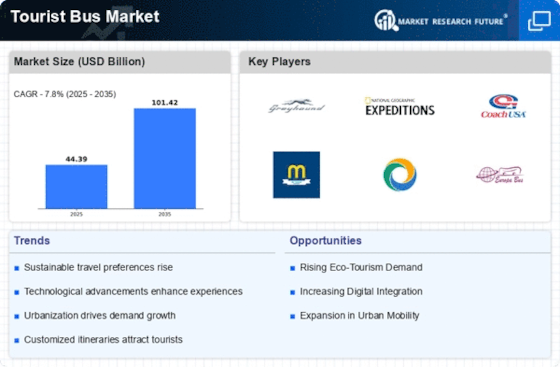
As per Market Research Future analysis, the Tourist Bus Market Size was estimated at 44.39 USD Billion in 2024. The Tourist Bus industry is projected to grow from 47.85 USD Billion in 2025 to 101.42 USD Billion by 2035, exhibiting a compound annual growth rate (CAGR) of 7.8% during the forecast period 2025 - 2035.

Key Market Trends & Highlights

The Tourist Bus Market is experiencing a transformative shift towards sustainability and technological integration.

  • North America remains the largest market for tourist buses, driven by a robust tourism sector and infrastructure. The Asia-Pacific region is emerging as the fastest-growing market, fueled by increasing travel activities and urbanization. Electric buses dominate the market, while petrol and diesel buses are witnessing rapid growth due to evolving consumer preferences. Rising demand for eco-friendly travel and government support for public transport initiatives are key drivers shaping the market.

Market Size & Forecast

2024 Market Size 44.39 (USD Billion)
2035 Market Size 101.42 (USD Billion)
CAGR (2025 - 2035) 7.8%
Largest Regional Market Share in 2024 North America

Major Players

Greyhound Lines Inc (US), FlixMobility GmbH (DE), National Geographic Expeditions (US), Coach USA (US), Megabus (US), Stagecoach Group (GB), Europabus (FR), Alsa (ES), FirstGroup plc (GB)

Market Trends

The Tourist Bus Market is currently experiencing a dynamic evolution, driven by various factors that influence consumer preferences and operational efficiencies. The increasing demand for sustainable travel options appears to be reshaping the landscape, as more travelers seek eco-friendly transportation solutions.

This shift is likely prompting operators to invest in greener technologies, such as electric and hybrid buses, which may enhance their appeal to environmentally conscious tourists. Furthermore, the integration of advanced technologies, including real-time tracking and mobile booking systems, seems to be enhancing the overall customer experience, making travel more convenient and accessible. In addition to sustainability and technology, the Tourist Bus Market is also witnessing a growing trend towards personalized travel experiences.

Operators are increasingly offering tailored itineraries that cater to specific interests, such as culinary tours or cultural excursions. This focus on customization may attract a broader range of customers, as travelers seek unique and memorable experiences. Overall, the Tourist Bus Market appears poised for continued growth, with evolving consumer demands and technological advancements shaping its future.

Sustainability Initiatives

The Tourist Bus Market is increasingly focusing on sustainability, with operators adopting eco-friendly practices. This trend includes the use of electric and hybrid buses, which may reduce carbon footprints and appeal to environmentally conscious travelers.

Technological Integration

Advancements in technology are transforming the Tourist Bus Market, as operators implement real-time tracking and mobile booking systems. These innovations enhance customer convenience and streamline operations, potentially improving overall service quality.

Personalized Travel Experiences

There is a noticeable shift towards personalized travel offerings within the Tourist Bus Market. Operators are crafting tailored itineraries that cater to specific interests, which may attract a diverse clientele seeking unique experiences.

Tourist Bus Market Market Drivers

Rising Demand for Eco-Friendly Travel

The Tourist Bus Market is experiencing a notable shift towards eco-friendly travel options. As environmental awareness increases, consumers are increasingly seeking sustainable transportation alternatives. This trend is reflected in the growing number of companies adopting electric and hybrid buses, which not only reduce carbon emissions but also appeal to environmentally conscious travelers. According to recent data, the market for electric buses is projected to grow significantly, indicating a strong preference for greener travel solutions. This shift towards sustainability is likely to drive innovation within the Tourist Bus Market, as operators strive to meet the evolving expectations of their clientele.

Growth of Tourism and Travel Activities

The Tourist Bus Market is poised for growth, driven by the increasing number of travel activities and tourism initiatives worldwide. As more destinations promote tourism, the demand for organized travel solutions, including bus tours, is likely to rise. Recent statistics indicate that international tourist arrivals have been steadily increasing, which correlates with a heightened need for efficient transportation options. This growth in tourism not only boosts the Tourist Bus Market but also encourages operators to diversify their offerings, catering to various traveler preferences and enhancing the overall travel experience.

Emergence of Personalized Travel Services

The Tourist Bus Market is witnessing a trend towards personalized travel experiences. As travelers seek unique and tailored itineraries, bus operators are adapting their services to meet these demands. Customizable tour packages, flexible scheduling, and specialized routes are becoming increasingly popular. This shift towards personalization is likely to enhance customer satisfaction and loyalty, as travelers appreciate the opportunity to create their own experiences. Moreover, the integration of customer feedback into service offerings may further refine the Tourist Bus Market, allowing operators to better align with consumer expectations.

Technological Advancements in Fleet Management

Technological integration is transforming the Tourist Bus Market, particularly in fleet management. Advanced technologies such as GPS tracking, real-time data analytics, and automated scheduling systems are enhancing operational efficiency. These innovations allow bus operators to optimize routes, reduce fuel consumption, and improve customer service. The implementation of smart technologies is expected to increase the overall reliability of services, thereby attracting more tourists. Furthermore, the rise of mobile applications for booking and customer engagement is reshaping how travelers interact with bus services, suggesting a potential increase in market share for tech-savvy operators.

Government Support for Public Transport Initiatives

Government initiatives aimed at enhancing public transport systems are significantly impacting the Tourist Bus Market. Many governments are investing in infrastructure improvements and subsidies for public transport, including bus services. This support not only facilitates the growth of the Tourist Bus Market but also encourages the adoption of modern, efficient buses. Additionally, policies promoting tourism development often include provisions for improving transportation options, thereby increasing accessibility for tourists. Such government backing is likely to create a more favorable environment for bus operators, fostering growth and innovation within the industry.

Market Segment Insights

By Type: Electric Bus (Largest) vs. Petrol and Diesel (Fastest-Growing)

<p>In the Tourist Bus Market, the market share distribution reveals a pronounced preference for Electric Buses, which have captured a significant portion of the overall market. This dominance stems from a growing awareness of environmental concerns and regulations mandating the transition to greener alternatives. Petrol and Diesel buses, while still holding their place, find themselves facing increased competition as the urgency for sustainable travel options pushes consumer preferences toward more eco-friendly choices.</p>

<p>Electric Bus (Dominant) vs. Petrol and Diesel (Emerging)</p>

<p>The Electric Bus segment is characterized by its commitment to sustainability, offering zero-emission vehicles that cater to the environmentally conscious traveler. This segment has seen substantial investments in infrastructure, including charging stations and technological advancements, making electric buses a preferred choice for both operators and passengers. On the other hand, Petrol and Diesel buses, traditionally dominant in many markets, are now considered an emerging segment with a declining trend due to rising fuel costs and stringent emissions norms. While they continue to serve a vast network, their growth is increasingly challenged by advancing electric technologies and changing consumer attitudes towards more sustainable travel options.</p>

By Seating Capacity: 40 Seater (Largest) vs. 32 Seater (Fastest-Growing)

<p>The Tourist Bus Market is segmented by seating capacity, with the 40-seater buses dominating the market due to their flexibility in catering to larger groups. This segment captures a significant share as they are the preferred choice for many travel agencies and tour operators who prioritize maximizing passenger capacity. On the other hand, 32-seater buses, while slightly smaller, are experiencing rapid growth as they cater to niche markets focusing on smaller tourist groups or special events. They provide a balance between capacity and comfort, appealing to a different segment of travelers. In terms of growth trends, the 32-seater buses are emerging as the fastest-growing segments within this market, driven by an increase in personalized travel experiences and smaller tour groups. Factors such as changing consumer preferences, a rising demand for comfortable travel experiences, and targeted marketing strategies are propelling this segment's growth. The increased affordability and flexibility associated with smaller buses also contribute to their ascending trend in the market, compelling operators to invest in expanding their fleets of 32-seater buses to meet evolving customer demands.</p>

<p>40 Seater (Dominant) vs. 32 Seater (Emerging)</p>

<p>The 40-seater segment has established itself as a dominant force in the Tourist Bus Market mainly due to its ability to accommodate larger groups efficiently. This capacity not only optimizes operational costs per passenger but also appeals to travel agencies aiming to maximize profits while offering group tours. The 32-seater buses, regarded as an emerging segment, have gained traction for their versatility, positioning them well for specialized tours and events that require a more intimate setting. As tourism becomes increasingly focused on personalized experiences, the 32-seater buses are well-suited to cater to this demand, maintaining comfort while still providing adequate space. Travel preferences are shifting towards smaller groups, thus elevating the importance and market presence of both 40-seater and 32-seater buses in the competitive landscape of tourism.</p>

By Application: Tourism (Largest) vs. Scheduled Bus Transport (Fastest-Growing)

<p>In the Tourist Bus Market, the distribution of market share among application segments shows tourism as the largest contributor, followed closely by scheduled bus transport. The segments of intercity and school transport also play significant roles, although their shares are comparatively smaller. Private purposes and others account for a modest portion, indicating diversified utilization of tourist buses across various applications.</p>

<p>Tourism (Dominant) vs. Scheduled Bus Transport (Emerging)</p>

<p>Tourism remains a dominant segment in the Tourist Bus Market, driven by increasing global travel and the demand for group excursions. This segment attracts a broad range of customers from leisure travelers to corporate groups. On the other hand, scheduled bus transport is emerging rapidly as a key player, catering to the needs of commuters with regular routes that provide convenience. The shift in consumer preferences towards more reliable and organized travel options is propelling the growth of this segment, making it essential for providers to enhance service quality and frequency.</p>

Get more detailed insights about Tourist Bus Market Research Report — Global Forecast till 2035

Regional Insights

North America : Tourism Growth Engine

The North American tourist bus market is driven by increasing domestic and international tourism, with a focus on eco-friendly travel options. The U.S. holds the largest market share at approximately 70%, followed by Canada at 15%. Regulatory support for sustainable transport initiatives is also a key driver, enhancing the appeal of bus travel as a viable alternative to personal vehicles. Leading players like Greyhound Lines Inc and Megabus dominate the landscape, offering extensive routes across major cities. The competitive environment is characterized by a mix of established companies and emerging startups, all vying for a share of the growing market. The presence of National Geographic Expeditions further enriches the offerings, catering to niche tourism segments that prioritize unique travel experiences.

Europe : Diverse Market Dynamics

Europe's tourist bus market is characterized by a diverse range of services catering to both local and international tourists. The region is witnessing a surge in demand for eco-friendly travel options, with countries like Germany and France leading the market, holding approximately 30% and 25% shares respectively. Regulatory frameworks promoting sustainable tourism are pivotal in shaping market dynamics, encouraging investments in greener bus fleets. Key players such as FlixMobility GmbH and Stagecoach Group are at the forefront, offering extensive networks across the continent. The competitive landscape is marked by collaborations and partnerships aimed at enhancing service quality and customer experience. Additionally, the presence of local operators like Alsa and Europabus enriches the market, providing tailored services that cater to regional preferences.

Asia-Pacific : Emerging Market Potential

The Asia-Pacific tourist bus market is rapidly expanding, driven by increasing disposable incomes and a growing middle class eager to explore domestic and international destinations. Countries like China and India are leading this growth, with market shares of approximately 35% and 20% respectively. Government initiatives aimed at improving infrastructure and promoting tourism are significant catalysts for this growth, enhancing accessibility to various tourist attractions. The competitive landscape features a mix of local and international players, with companies like National Geographic Expeditions and Coach USA expanding their reach. The presence of regional operators is also notable, as they cater to specific tourist needs and preferences. This dynamic environment is fostering innovation and service diversification, making the market increasingly attractive to investors.

Middle East and Africa : Untapped Tourism Potential

The Middle East and Africa region is witnessing a gradual rise in the tourist bus market, driven by increasing investments in tourism infrastructure and a growing interest in regional travel experiences. Countries like South Africa and the UAE are at the forefront, holding approximately 30% and 25% of the market share respectively. Regulatory support for tourism development is crucial, as governments aim to diversify their economies and attract more visitors through improved transport options. The competitive landscape is evolving, with both local and international players entering the market. Companies like FirstGroup plc and Stagecoach Group are expanding their operations, while local operators are focusing on unique travel experiences that highlight cultural heritage. This combination of global and local players is enhancing service offerings and catering to the diverse needs of tourists in the region.

Key Players and Competitive Insights

Leading market players are putting a lot of money on R&D to expand their product lines, which will help the tourist bus industry, grow even more. Additionally, market players are engaging in a range of calculated initiatives to increase their worldwide presence, with important market developments involving the introduction of new products, contracts, M&A transactions, increased investment, and cooperation with other enterprises. To grow and endure in an increasingly cutthroat and dynamic market, Tourist Bus industry must provide reasonably priced goods.

One of the main business strategies employed by manufacturers is to manufacture locally in order to reduce operating expenses in the global Tourist Bus industry to help customers and expand the market segment. In recent years, the Tourist Bus industry has provided some of the biggest benefits to medicine. Major players in the Tourist Bus Market, including Volvo, Tata Motors, Ashok Leyland, Xiamen King Long United, Hengzhou Yutong Bus, Daimler AG, and Traton, and others, are engaging in research and development activities in an effort to boost market demand.

Volvo Group (Swedish): Volvokoncernen; officially Aktiebolaget Volvo, shortened to AB Volvo, stylized as VOLVO), is based in Gothenburg. In addition to producing, distributing, and selling trucks, buses, and construction equipment, Volvo also provides financial services and drive systems for the maritime and industrial industries. Together with its subsidiary Volvo Trucks, it ranked as the second-largest heavy-duty truck manufacturer in the world in 2016.

In September Volvo Buses introduced its new range of worldwide electromobility products.

Volvo Buses, therefore, provides a solid foundation for stable and prosperous public transportation offices in urban regions across the globe with the introduction of the Volvo BZL Electric skeleton.

Tata Motors Limited is an Indian multinational automotive corporation with its headquarters located in Mumbai. The company manufactures buses, vans, lorries, and vehicles. Tata Daewoo in South Korea and Jaguar Land Rover in Britain are examples of subsidiaries. Tata Motors has joint ventures with Stellantis, which manufactures auto parts for Fiat Chrysler and Tata-branded cars, and Hitachi (Tata Hitachi Construction Machinery).

In July Tata revealed its intentions to construct one of the biggest electric vehicle battery factories in Europe in the UK.

Key Companies in the Tourist Bus Market include

Industry Developments

December 2019: Volvo and Isuzu have announced a strategic partnership on commercial vehicles. As per the agreement, Volvo was going to sell Isuzu UD Trucks.

March 2021: Volvo has directed its attention toward the advancement of electric buses. They have expanded the selection of environmentally friendly transportation options by releasing a number of electric bus models with increased range and charging capacities.

July 2022: Tata Motors has been a major player in the development of networked and autonomous buses. Innovative technology such as IoT and artificial intelligence have been integrated into their buses to enhance passenger security, efficiency, and comfort.

Future Outlook

Tourist Bus Market Future Outlook

The Tourist Bus Market is projected to grow at a 7.8% CAGR from 2025 to 2035, driven by increasing travel demand, urbanization, and eco-friendly transportation initiatives.

New opportunities lie in:

  • Integration of smart ticketing systems for enhanced customer experience.
  • Development of eco-friendly buses to meet sustainability goals.
  • Expansion of digital marketing strategies targeting niche tourist segments.

By 2035, the market is expected to be robust, reflecting substantial growth and innovation.

Market Segmentation

Tourist Bus Market Type Outlook

  • Electric Bus
  • Petrol and Diesel

Tourist Bus Market Application Outlook

  • Scheduled bus transport
  • Intercity
  • School transport
  • Tourism
  • Private purposes
  • Others

Tourist Bus Market Seating Capacity Outlook

  • 32 seater
  • 20 seater
  • 40 seater
  • Other

Report Scope

MARKET SIZE 2024 44.39(USD Billion)
MARKET SIZE 2025 47.85(USD Billion)
MARKET SIZE 2035 101.42(USD Billion)
COMPOUND ANNUAL GROWTH RATE (CAGR) 7.8% (2025 - 2035)
REPORT COVERAGE Revenue Forecast, Competitive Landscape, Growth Factors, and Trends
BASE YEAR 2024
Market Forecast Period 2025 - 2035
Historical Data 2019 - 2024
Market Forecast Units USD Billion
Key Companies Profiled Greyhound Lines Inc (US), FlixMobility GmbH (DE), National Geographic Expeditions (US), Coach USA (US), Megabus (US), Stagecoach Group (GB), Europabus (FR), Alsa (ES), FirstGroup plc (GB)
Segments Covered Product Type, Seating Capacity, Application, Region
Key Market Opportunities Integration of electric and autonomous vehicles in the Tourist Bus Market enhances sustainability and operational efficiency.
Key Market Dynamics Rising consumer preference for eco-friendly travel options drives innovation in the tourist bus market.
Countries Covered North America, Europe, APAC, South America, MEA

FAQs

What is the current valuation of the Tourist Bus Market?

<p>The Tourist Bus Market was valued at 44.39 USD Billion in 2024.</p>

What is the projected market size for the Tourist Bus Market by 2035?

<p>The market is projected to reach 101.42 USD Billion by 2035.</p>

What is the expected CAGR for the Tourist Bus Market during the forecast period?

<p>The expected CAGR for the Tourist Bus Market from 2025 to 2035 is 7.8%.</p>

Which companies are considered key players in the Tourist Bus Market?

<p>Key players include Greyhound Lines Inc, FlixMobility GmbH, and National Geographic Expeditions, among others.</p>

What are the main types of buses in the Tourist Bus Market?

<p>The main types include Electric Buses and Petrol and Diesel Buses, with valuations of 5.0 to 20.0 USD Billion and 39.39 to 81.42 USD Billion, respectively.</p>

How does seating capacity affect the Tourist Bus Market?

<p>Seating capacity segments range from 20-seater to 40-seater buses, with valuations from 6.66 to 35.0 USD Billion.</p>

What applications are driving growth in the Tourist Bus Market?

<p>Applications such as tourism and intercity transport are driving growth, with tourism valued at 15.0 to 30.0 USD Billion.</p>

What is the valuation range for scheduled bus transport in the Tourist Bus Market?

<p>Scheduled bus transport is valued between 8.88 and 20.0 USD Billion.</p>

How does the market for private purposes compare to other applications?

<p>The market for private purposes is valued at 3.0 to 10.0 USD Billion, indicating a smaller segment compared to tourism.</p>

What trends are influencing the Tourist Bus Market in 2025?

<p>Trends include a shift towards electric buses and increased demand for intercity and tourism applications.</p>

  1. SECTION I: EXECUTIVE SUMMARY AND KEY HIGHLIGHTS
    1. | 1.1 EXECUTIVE SUMMARY
    2. | | 1.1.1 Market Overview
    3. | | 1.1.2 Key Findings
    4. | | 1.1.3 Market Segmentation
    5. | | 1.1.4 Competitive Landscape
    6. | | 1.1.5 Challenges and Opportunities
    7. | | 1.1.6 Future Outlook
  2. SECTION II: SCOPING, METHODOLOGY AND MARKET STRUCTURE
    1. | 2.1 MARKET INTRODUCTION
    2. | | 2.1.1 Definition
    3. | | 2.1.2 Scope of the study
    4. | | | 2.1.2.1 Research Objective
    5. | | | 2.1.2.2 Assumption
    6. | | | 2.1.2.3 Limitations
    7. | 2.2 RESEARCH METHODOLOGY
    8. | | 2.2.1 Overview
    9. | | 2.2.2 Data Mining
    10. | | 2.2.3 Secondary Research
    11. | | 2.2.4 Primary Research
    12. | | | 2.2.4.1 Primary Interviews and Information Gathering Process
    13. | | | 2.2.4.2 Breakdown of Primary Respondents
    14. | | 2.2.5 Forecasting Model
    15. | | 2.2.6 Market Size Estimation
    16. | | | 2.2.6.1 Bottom-Up Approach
    17. | | | 2.2.6.2 Top-Down Approach
    18. | | 2.2.7 Data Triangulation
    19. | | 2.2.8 Validation
  3. SECTION III: QUALITATIVE ANALYSIS
    1. | 3.1 MARKET DYNAMICS
    2. | | 3.1.1 Overview
    3. | | 3.1.2 Drivers
    4. | | 3.1.3 Restraints
    5. | | 3.1.4 Opportunities
    6. | 3.2 MARKET FACTOR ANALYSIS
    7. | | 3.2.1 Value chain Analysis
    8. | | 3.2.2 Porter's Five Forces Analysis
    9. | | | 3.2.2.1 Bargaining Power of Suppliers
    10. | | | 3.2.2.2 Bargaining Power of Buyers
    11. | | | 3.2.2.3 Threat of New Entrants
    12. | | | 3.2.2.4 Threat of Substitutes
    13. | | | 3.2.2.5 Intensity of Rivalry
    14. | | 3.2.3 COVID-19 Impact Analysis
    15. | | | 3.2.3.1 Market Impact Analysis
    16. | | | 3.2.3.2 Regional Impact
    17. | | | 3.2.3.3 Opportunity and Threat Analysis
  4. SECTION IV: QUANTITATIVE ANALYSIS
    1. | 4.1 Automobile, BY Type (USD Billion)
    2. | | 4.1.1 Electric Bus
    3. | | 4.1.2 Petrol and Diesel
    4. | 4.2 Automobile, BY Seating Capacity (USD Billion)
    5. | | 4.2.1 32 seater
    6. | | 4.2.2 20 seater
    7. | | 4.2.3 40 seater
    8. | | 4.2.4 Other
    9. | 4.3 Automobile, BY Application (USD Billion)
    10. | | 4.3.1 Scheduled bus transport
    11. | | 4.3.2 Intercity
    12. | | 4.3.3 School transport
    13. | | 4.3.4 Tourism
    14. | | 4.3.5 Private purposes
    15. | | 4.3.6 Others
    16. | 4.4 Automobile, BY Region (USD Billion)
    17. | | 4.4.1 North America
    18. | | | 4.4.1.1 US
    19. | | | 4.4.1.2 Canada
    20. | | 4.4.2 Europe
    21. | | | 4.4.2.1 Germany
    22. | | | 4.4.2.2 UK
    23. | | | 4.4.2.3 France
    24. | | | 4.4.2.4 Russia
    25. | | | 4.4.2.5 Italy
    26. | | | 4.4.2.6 Spain
    27. | | | 4.4.2.7 Rest of Europe
    28. | | 4.4.3 APAC
    29. | | | 4.4.3.1 China
    30. | | | 4.4.3.2 India
    31. | | | 4.4.3.3 Japan
    32. | | | 4.4.3.4 South Korea
    33. | | | 4.4.3.5 Malaysia
    34. | | | 4.4.3.6 Thailand
    35. | | | 4.4.3.7 Indonesia
    36. | | | 4.4.3.8 Rest of APAC
    37. | | 4.4.4 South America
    38. | | | 4.4.4.1 Brazil
    39. | | | 4.4.4.2 Mexico
    40. | | | 4.4.4.3 Argentina
    41. | | | 4.4.4.4 Rest of South America
    42. | | 4.4.5 MEA
    43. | | | 4.4.5.1 GCC Countries
    44. | | | 4.4.5.2 South Africa
    45. | | | 4.4.5.3 Rest of MEA
  5. SECTION V: COMPETITIVE ANALYSIS
    1. | 5.1 Competitive Landscape
    2. | | 5.1.1 Overview
    3. | | 5.1.2 Competitive Analysis
    4. | | 5.1.3 Market share Analysis
    5. | | 5.1.4 Major Growth Strategy in the Automobile
    6. | | 5.1.5 Competitive Benchmarking
    7. | | 5.1.6 Leading Players in Terms of Number of Developments in the Automobile
    8. | | 5.1.7 Key developments and growth strategies
    9. | | | 5.1.7.1 New Product Launch/Service Deployment
    10. | | | 5.1.7.2 Merger & Acquisitions
    11. | | | 5.1.7.3 Joint Ventures
    12. | | 5.1.8 Major Players Financial Matrix
    13. | | | 5.1.8.1 Sales and Operating Income
    14. | | | 5.1.8.2 Major Players R&D Expenditure. 2023
    15. | 5.2 Company Profiles
    16. | | 5.2.1 Greyhound Lines Inc (US)
    17. | | | 5.2.1.1 Financial Overview
    18. | | | 5.2.1.2 Products Offered
    19. | | | 5.2.1.3 Key Developments
    20. | | | 5.2.1.4 SWOT Analysis
    21. | | | 5.2.1.5 Key Strategies
    22. | | 5.2.2 FlixMobility GmbH (DE)
    23. | | | 5.2.2.1 Financial Overview
    24. | | | 5.2.2.2 Products Offered
    25. | | | 5.2.2.3 Key Developments
    26. | | | 5.2.2.4 SWOT Analysis
    27. | | | 5.2.2.5 Key Strategies
    28. | | 5.2.3 National Geographic Expeditions (US)
    29. | | | 5.2.3.1 Financial Overview
    30. | | | 5.2.3.2 Products Offered
    31. | | | 5.2.3.3 Key Developments
    32. | | | 5.2.3.4 SWOT Analysis
    33. | | | 5.2.3.5 Key Strategies
    34. | | 5.2.4 Coach USA (US)
    35. | | | 5.2.4.1 Financial Overview
    36. | | | 5.2.4.2 Products Offered
    37. | | | 5.2.4.3 Key Developments
    38. | | | 5.2.4.4 SWOT Analysis
    39. | | | 5.2.4.5 Key Strategies
    40. | | 5.2.5 Megabus (US)
    41. | | | 5.2.5.1 Financial Overview
    42. | | | 5.2.5.2 Products Offered
    43. | | | 5.2.5.3 Key Developments
    44. | | | 5.2.5.4 SWOT Analysis
    45. | | | 5.2.5.5 Key Strategies
    46. | | 5.2.6 Stagecoach Group (GB)
    47. | | | 5.2.6.1 Financial Overview
    48. | | | 5.2.6.2 Products Offered
    49. | | | 5.2.6.3 Key Developments
    50. | | | 5.2.6.4 SWOT Analysis
    51. | | | 5.2.6.5 Key Strategies
    52. | | 5.2.7 Europabus (FR)
    53. | | | 5.2.7.1 Financial Overview
    54. | | | 5.2.7.2 Products Offered
    55. | | | 5.2.7.3 Key Developments
    56. | | | 5.2.7.4 SWOT Analysis
    57. | | | 5.2.7.5 Key Strategies
    58. | | 5.2.8 Alsa (ES)
    59. | | | 5.2.8.1 Financial Overview
    60. | | | 5.2.8.2 Products Offered
    61. | | | 5.2.8.3 Key Developments
    62. | | | 5.2.8.4 SWOT Analysis
    63. | | | 5.2.8.5 Key Strategies
    64. | | 5.2.9 FirstGroup plc (GB)
    65. | | | 5.2.9.1 Financial Overview
    66. | | | 5.2.9.2 Products Offered
    67. | | | 5.2.9.3 Key Developments
    68. | | | 5.2.9.4 SWOT Analysis
    69. | | | 5.2.9.5 Key Strategies
    70. | 5.3 Appendix
    71. | | 5.3.1 References
    72. | | 5.3.2 Related Reports
  6. LIST OF FIGURES
    1. | 6.1 MARKET SYNOPSIS
    2. | 6.2 NORTH AMERICA MARKET ANALYSIS
    3. | 6.3 US MARKET ANALYSIS BY TYPE
    4. | 6.4 US MARKET ANALYSIS BY SEATING CAPACITY
    5. | 6.5 US MARKET ANALYSIS BY APPLICATION
    6. | 6.6 CANADA MARKET ANALYSIS BY TYPE
    7. | 6.7 CANADA MARKET ANALYSIS BY SEATING CAPACITY
    8. | 6.8 CANADA MARKET ANALYSIS BY APPLICATION
    9. | 6.9 EUROPE MARKET ANALYSIS
    10. | 6.10 GERMANY MARKET ANALYSIS BY TYPE
    11. | 6.11 GERMANY MARKET ANALYSIS BY SEATING CAPACITY
    12. | 6.12 GERMANY MARKET ANALYSIS BY APPLICATION
    13. | 6.13 UK MARKET ANALYSIS BY TYPE
    14. | 6.14 UK MARKET ANALYSIS BY SEATING CAPACITY
    15. | 6.15 UK MARKET ANALYSIS BY APPLICATION
    16. | 6.16 FRANCE MARKET ANALYSIS BY TYPE
    17. | 6.17 FRANCE MARKET ANALYSIS BY SEATING CAPACITY
    18. | 6.18 FRANCE MARKET ANALYSIS BY APPLICATION
    19. | 6.19 RUSSIA MARKET ANALYSIS BY TYPE
    20. | 6.20 RUSSIA MARKET ANALYSIS BY SEATING CAPACITY
    21. | 6.21 RUSSIA MARKET ANALYSIS BY APPLICATION
    22. | 6.22 ITALY MARKET ANALYSIS BY TYPE
    23. | 6.23 ITALY MARKET ANALYSIS BY SEATING CAPACITY
    24. | 6.24 ITALY MARKET ANALYSIS BY APPLICATION
    25. | 6.25 SPAIN MARKET ANALYSIS BY TYPE
    26. | 6.26 SPAIN MARKET ANALYSIS BY SEATING CAPACITY
    27. | 6.27 SPAIN MARKET ANALYSIS BY APPLICATION
    28. | 6.28 REST OF EUROPE MARKET ANALYSIS BY TYPE
    29. | 6.29 REST OF EUROPE MARKET ANALYSIS BY SEATING CAPACITY
    30. | 6.30 REST OF EUROPE MARKET ANALYSIS BY APPLICATION
    31. | 6.31 APAC MARKET ANALYSIS
    32. | 6.32 CHINA MARKET ANALYSIS BY TYPE
    33. | 6.33 CHINA MARKET ANALYSIS BY SEATING CAPACITY
    34. | 6.34 CHINA MARKET ANALYSIS BY APPLICATION
    35. | 6.35 INDIA MARKET ANALYSIS BY TYPE
    36. | 6.36 INDIA MARKET ANALYSIS BY SEATING CAPACITY
    37. | 6.37 INDIA MARKET ANALYSIS BY APPLICATION
    38. | 6.38 JAPAN MARKET ANALYSIS BY TYPE
    39. | 6.39 JAPAN MARKET ANALYSIS BY SEATING CAPACITY
    40. | 6.40 JAPAN MARKET ANALYSIS BY APPLICATION
    41. | 6.41 SOUTH KOREA MARKET ANALYSIS BY TYPE
    42. | 6.42 SOUTH KOREA MARKET ANALYSIS BY SEATING CAPACITY
    43. | 6.43 SOUTH KOREA MARKET ANALYSIS BY APPLICATION
    44. | 6.44 MALAYSIA MARKET ANALYSIS BY TYPE
    45. | 6.45 MALAYSIA MARKET ANALYSIS BY SEATING CAPACITY
    46. | 6.46 MALAYSIA MARKET ANALYSIS BY APPLICATION
    47. | 6.47 THAILAND MARKET ANALYSIS BY TYPE
    48. | 6.48 THAILAND MARKET ANALYSIS BY SEATING CAPACITY
    49. | 6.49 THAILAND MARKET ANALYSIS BY APPLICATION
    50. | 6.50 INDONESIA MARKET ANALYSIS BY TYPE
    51. | 6.51 INDONESIA MARKET ANALYSIS BY SEATING CAPACITY
    52. | 6.52 INDONESIA MARKET ANALYSIS BY APPLICATION
    53. | 6.53 REST OF APAC MARKET ANALYSIS BY TYPE
    54. | 6.54 REST OF APAC MARKET ANALYSIS BY SEATING CAPACITY
    55. | 6.55 REST OF APAC MARKET ANALYSIS BY APPLICATION
    56. | 6.56 SOUTH AMERICA MARKET ANALYSIS
    57. | 6.57 BRAZIL MARKET ANALYSIS BY TYPE
    58. | 6.58 BRAZIL MARKET ANALYSIS BY SEATING CAPACITY
    59. | 6.59 BRAZIL MARKET ANALYSIS BY APPLICATION
    60. | 6.60 MEXICO MARKET ANALYSIS BY TYPE
    61. | 6.61 MEXICO MARKET ANALYSIS BY SEATING CAPACITY
    62. | 6.62 MEXICO MARKET ANALYSIS BY APPLICATION
    63. | 6.63 ARGENTINA MARKET ANALYSIS BY TYPE
    64. | 6.64 ARGENTINA MARKET ANALYSIS BY SEATING CAPACITY
    65. | 6.65 ARGENTINA MARKET ANALYSIS BY APPLICATION
    66. | 6.66 REST OF SOUTH AMERICA MARKET ANALYSIS BY TYPE
    67. | 6.67 REST OF SOUTH AMERICA MARKET ANALYSIS BY SEATING CAPACITY
    68. | 6.68 REST OF SOUTH AMERICA MARKET ANALYSIS BY APPLICATION
    69. | 6.69 MEA MARKET ANALYSIS
    70. | 6.70 GCC COUNTRIES MARKET ANALYSIS BY TYPE
    71. | 6.71 GCC COUNTRIES MARKET ANALYSIS BY SEATING CAPACITY
    72. | 6.72 GCC COUNTRIES MARKET ANALYSIS BY APPLICATION
    73. | 6.73 SOUTH AFRICA MARKET ANALYSIS BY TYPE
    74. | 6.74 SOUTH AFRICA MARKET ANALYSIS BY SEATING CAPACITY
    75. | 6.75 SOUTH AFRICA MARKET ANALYSIS BY APPLICATION
    76. | 6.76 REST OF MEA MARKET ANALYSIS BY TYPE
    77. | 6.77 REST OF MEA MARKET ANALYSIS BY SEATING CAPACITY
    78. | 6.78 REST OF MEA MARKET ANALYSIS BY APPLICATION
    79. | 6.79 KEY BUYING CRITERIA OF AUTOMOBILE
    80. | 6.80 RESEARCH PROCESS OF MRFR
    81. | 6.81 DRO ANALYSIS OF AUTOMOBILE
    82. | 6.82 DRIVERS IMPACT ANALYSIS: AUTOMOBILE
    83. | 6.83 RESTRAINTS IMPACT ANALYSIS: AUTOMOBILE
    84. | 6.84 SUPPLY / VALUE CHAIN: AUTOMOBILE
    85. | 6.85 AUTOMOBILE, BY TYPE, 2024 (% SHARE)
    86. | 6.86 AUTOMOBILE, BY TYPE, 2024 TO 2035 (USD Billion)
    87. | 6.87 AUTOMOBILE, BY SEATING CAPACITY, 2024 (% SHARE)
    88. | 6.88 AUTOMOBILE, BY SEATING CAPACITY, 2024 TO 2035 (USD Billion)
    89. | 6.89 AUTOMOBILE, BY APPLICATION, 2024 (% SHARE)
    90. | 6.90 AUTOMOBILE, BY APPLICATION, 2024 TO 2035 (USD Billion)
    91. | 6.91 BENCHMARKING OF MAJOR COMPETITORS
  7. LIST OF TABLES
    1. | 7.1 LIST OF ASSUMPTIONS
    2. | | 7.1.1
    3. | 7.2 North America MARKET SIZE ESTIMATES; FORECAST
    4. | | 7.2.1 BY TYPE, 2025-2035 (USD Billion)
    5. | | 7.2.2 BY SEATING CAPACITY, 2025-2035 (USD Billion)
    6. | | 7.2.3 BY APPLICATION, 2025-2035 (USD Billion)
    7. | 7.3 US MARKET SIZE ESTIMATES; FORECAST
    8. | | 7.3.1 BY TYPE, 2025-2035 (USD Billion)
    9. | | 7.3.2 BY SEATING CAPACITY, 2025-2035 (USD Billion)
    10. | | 7.3.3 BY APPLICATION, 2025-2035 (USD Billion)
    11. | 7.4 Canada MARKET SIZE ESTIMATES; FORECAST
    12. | | 7.4.1 BY TYPE, 2025-2035 (USD Billion)
    13. | | 7.4.2 BY SEATING CAPACITY, 2025-2035 (USD Billion)
    14. | | 7.4.3 BY APPLICATION, 2025-2035 (USD Billion)
    15. | 7.5 Europe MARKET SIZE ESTIMATES; FORECAST
    16. | | 7.5.1 BY TYPE, 2025-2035 (USD Billion)
    17. | | 7.5.2 BY SEATING CAPACITY, 2025-2035 (USD Billion)
    18. | | 7.5.3 BY APPLICATION, 2025-2035 (USD Billion)
    19. | 7.6 Germany MARKET SIZE ESTIMATES; FORECAST
    20. | | 7.6.1 BY TYPE, 2025-2035 (USD Billion)
    21. | | 7.6.2 BY SEATING CAPACITY, 2025-2035 (USD Billion)
    22. | | 7.6.3 BY APPLICATION, 2025-2035 (USD Billion)
    23. | 7.7 UK MARKET SIZE ESTIMATES; FORECAST
    24. | | 7.7.1 BY TYPE, 2025-2035 (USD Billion)
    25. | | 7.7.2 BY SEATING CAPACITY, 2025-2035 (USD Billion)
    26. | | 7.7.3 BY APPLICATION, 2025-2035 (USD Billion)
    27. | 7.8 France MARKET SIZE ESTIMATES; FORECAST
    28. | | 7.8.1 BY TYPE, 2025-2035 (USD Billion)
    29. | | 7.8.2 BY SEATING CAPACITY, 2025-2035 (USD Billion)
    30. | | 7.8.3 BY APPLICATION, 2025-2035 (USD Billion)
    31. | 7.9 Russia MARKET SIZE ESTIMATES; FORECAST
    32. | | 7.9.1 BY TYPE, 2025-2035 (USD Billion)
    33. | | 7.9.2 BY SEATING CAPACITY, 2025-2035 (USD Billion)
    34. | | 7.9.3 BY APPLICATION, 2025-2035 (USD Billion)
    35. | 7.10 Italy MARKET SIZE ESTIMATES; FORECAST
    36. | | 7.10.1 BY TYPE, 2025-2035 (USD Billion)
    37. | | 7.10.2 BY SEATING CAPACITY, 2025-2035 (USD Billion)
    38. | | 7.10.3 BY APPLICATION, 2025-2035 (USD Billion)
    39. | 7.11 Spain MARKET SIZE ESTIMATES; FORECAST
    40. | | 7.11.1 BY TYPE, 2025-2035 (USD Billion)
    41. | | 7.11.2 BY SEATING CAPACITY, 2025-2035 (USD Billion)
    42. | | 7.11.3 BY APPLICATION, 2025-2035 (USD Billion)
    43. | 7.12 Rest of Europe MARKET SIZE ESTIMATES; FORECAST
    44. | | 7.12.1 BY TYPE, 2025-2035 (USD Billion)
    45. | | 7.12.2 BY SEATING CAPACITY, 2025-2035 (USD Billion)
    46. | | 7.12.3 BY APPLICATION, 2025-2035 (USD Billion)
    47. | 7.13 APAC MARKET SIZE ESTIMATES; FORECAST
    48. | | 7.13.1 BY TYPE, 2025-2035 (USD Billion)
    49. | | 7.13.2 BY SEATING CAPACITY, 2025-2035 (USD Billion)
    50. | | 7.13.3 BY APPLICATION, 2025-2035 (USD Billion)
    51. | 7.14 China MARKET SIZE ESTIMATES; FORECAST
    52. | | 7.14.1 BY TYPE, 2025-2035 (USD Billion)
    53. | | 7.14.2 BY SEATING CAPACITY, 2025-2035 (USD Billion)
    54. | | 7.14.3 BY APPLICATION, 2025-2035 (USD Billion)
    55. | 7.15 India MARKET SIZE ESTIMATES; FORECAST
    56. | | 7.15.1 BY TYPE, 2025-2035 (USD Billion)
    57. | | 7.15.2 BY SEATING CAPACITY, 2025-2035 (USD Billion)
    58. | | 7.15.3 BY APPLICATION, 2025-2035 (USD Billion)
    59. | 7.16 Japan MARKET SIZE ESTIMATES; FORECAST
    60. | | 7.16.1 BY TYPE, 2025-2035 (USD Billion)
    61. | | 7.16.2 BY SEATING CAPACITY, 2025-2035 (USD Billion)
    62. | | 7.16.3 BY APPLICATION, 2025-2035 (USD Billion)
    63. | 7.17 South Korea MARKET SIZE ESTIMATES; FORECAST
    64. | | 7.17.1 BY TYPE, 2025-2035 (USD Billion)
    65. | | 7.17.2 BY SEATING CAPACITY, 2025-2035 (USD Billion)
    66. | | 7.17.3 BY APPLICATION, 2025-2035 (USD Billion)
    67. | 7.18 Malaysia MARKET SIZE ESTIMATES; FORECAST
    68. | | 7.18.1 BY TYPE, 2025-2035 (USD Billion)
    69. | | 7.18.2 BY SEATING CAPACITY, 2025-2035 (USD Billion)
    70. | | 7.18.3 BY APPLICATION, 2025-2035 (USD Billion)
    71. | 7.19 Thailand MARKET SIZE ESTIMATES; FORECAST
    72. | | 7.19.1 BY TYPE, 2025-2035 (USD Billion)
    73. | | 7.19.2 BY SEATING CAPACITY, 2025-2035 (USD Billion)
    74. | | 7.19.3 BY APPLICATION, 2025-2035 (USD Billion)
    75. | 7.20 Indonesia MARKET SIZE ESTIMATES; FORECAST
    76. | | 7.20.1 BY TYPE, 2025-2035 (USD Billion)
    77. | | 7.20.2 BY SEATING CAPACITY, 2025-2035 (USD Billion)
    78. | | 7.20.3 BY APPLICATION, 2025-2035 (USD Billion)
    79. | 7.21 Rest of APAC MARKET SIZE ESTIMATES; FORECAST
    80. | | 7.21.1 BY TYPE, 2025-2035 (USD Billion)
    81. | | 7.21.2 BY SEATING CAPACITY, 2025-2035 (USD Billion)
    82. | | 7.21.3 BY APPLICATION, 2025-2035 (USD Billion)
    83. | 7.22 South America MARKET SIZE ESTIMATES; FORECAST
    84. | | 7.22.1 BY TYPE, 2025-2035 (USD Billion)
    85. | | 7.22.2 BY SEATING CAPACITY, 2025-2035 (USD Billion)
    86. | | 7.22.3 BY APPLICATION, 2025-2035 (USD Billion)
    87. | 7.23 Brazil MARKET SIZE ESTIMATES; FORECAST
    88. | | 7.23.1 BY TYPE, 2025-2035 (USD Billion)
    89. | | 7.23.2 BY SEATING CAPACITY, 2025-2035 (USD Billion)
    90. | | 7.23.3 BY APPLICATION, 2025-2035 (USD Billion)
    91. | 7.24 Mexico MARKET SIZE ESTIMATES; FORECAST
    92. | | 7.24.1 BY TYPE, 2025-2035 (USD Billion)
    93. | | 7.24.2 BY SEATING CAPACITY, 2025-2035 (USD Billion)
    94. | | 7.24.3 BY APPLICATION, 2025-2035 (USD Billion)
    95. | 7.25 Argentina MARKET SIZE ESTIMATES; FORECAST
    96. | | 7.25.1 BY TYPE, 2025-2035 (USD Billion)
    97. | | 7.25.2 BY SEATING CAPACITY, 2025-2035 (USD Billion)
    98. | | 7.25.3 BY APPLICATION, 2025-2035 (USD Billion)
    99. | 7.26 Rest of South America MARKET SIZE ESTIMATES; FORECAST
    100. | | 7.26.1 BY TYPE, 2025-2035 (USD Billion)
    101. | | 7.26.2 BY SEATING CAPACITY, 2025-2035 (USD Billion)
    102. | | 7.26.3 BY APPLICATION, 2025-2035 (USD Billion)
    103. | 7.27 MEA MARKET SIZE ESTIMATES; FORECAST
    104. | | 7.27.1 BY TYPE, 2025-2035 (USD Billion)
    105. | | 7.27.2 BY SEATING CAPACITY, 2025-2035 (USD Billion)
    106. | | 7.27.3 BY APPLICATION, 2025-2035 (USD Billion)
    107. | 7.28 GCC Countries MARKET SIZE ESTIMATES; FORECAST
    108. | | 7.28.1 BY TYPE, 2025-2035 (USD Billion)
    109. | | 7.28.2 BY SEATING CAPACITY, 2025-2035 (USD Billion)
    110. | | 7.28.3 BY APPLICATION, 2025-2035 (USD Billion)
    111. | 7.29 South Africa MARKET SIZE ESTIMATES; FORECAST
    112. | | 7.29.1 BY TYPE, 2025-2035 (USD Billion)
    113. | | 7.29.2 BY SEATING CAPACITY, 2025-2035 (USD Billion)
    114. | | 7.29.3 BY APPLICATION, 2025-2035 (USD Billion)
    115. | 7.30 Rest of MEA MARKET SIZE ESTIMATES; FORECAST
    116. | | 7.30.1 BY TYPE, 2025-2035 (USD Billion)
    117. | | 7.30.2 BY SEATING CAPACITY, 2025-2035 (USD Billion)
    118. | | 7.30.3 BY APPLICATION, 2025-2035 (USD Billion)
    119. | 7.31 PRODUCT LAUNCH/PRODUCT DEVELOPMENT/APPROVAL
    120. | | 7.31.1
    121. | 7.32 ACQUISITION/PARTNERSHIP
    122. | | 7.32.1

Automobile Market Segmentation

Automobile By Type (USD Billion, 2025-2035)

  • Electric Bus
  • Petrol and Diesel

Automobile By Seating Capacity (USD Billion, 2025-2035)

  • 32 seater
  • 20 seater
  • 40 seater
  • Other

Automobile By Application (USD Billion, 2025-2035)

  • Scheduled bus transport
  • Intercity
  • School transport
  • Tourism
  • Private purposes
  • Others
Infographic

Free Sample Request

Kindly complete the form below to receive a free sample of this Report

Get Free Sample

Customer Strories

Compare Licence

×
Features License Type
Single User Multiuser License Enterprise User
Price $4,950 $5,950 $7,250
Maximum User Access Limit 1 User Upto 10 Users Unrestricted Access Throughout the Organization
Free Customization
Direct Access to Analyst
Deliverable Format
Platform Access
Discount on Next Purchase 10% 15% 15%
Printable Versions