
Request Free Sample ×

Kindly complete the form below to receive a free sample of this Report

* Please use a valid business email

Leading companies partner with us for data-driven Insights

clients tt-cursor
Hero Background
English
Chinese
French
Japanese
Korean
German
Spanish

Tomato Seeds Market Analysis

ID: MRFR/Agri/6726-HCR
90 Pages
Snehal Singh
Last Updated: April 06, 2026

Tomato Seeds Market Size, Share, Industry Trend & Analysis Research Report By Type (Hybrid Seeds, Open-Pollinated Seeds, Heirloom Seeds), By Application (Field Cultivation, Greenhouse Cultivation, Container Gardening), By Seed Treatment (Conventional Seeds, Organic Seeds, Treated Seeds), By Growth Habit (Determinate, Indeterminate, Semi-Determinate) andBy Regional (North America, Europe, South America, Asia-Pacific, Middle East and Africa)- Forecast to 2032

Share:
Download PDF ×

We do not share your information with anyone. However, we may send you emails based on your report interest from time to time. You may contact us at any time to opt-out.

Tomato Seeds Market Infographic
Purchase Options

Market Analysis

In-depth Analysis of Tomato Seeds Market Industry Landscape

The size and growth of the tomato seeds market are influenced by several key market factors that reflect the dynamics of the agricultural industry, technological advancements, consumer preferences, and global market trends.

One significant factor driving the market size of tomato seeds is the increasing demand for tomatoes as a staple food and as a key ingredient in various cuisines worldwide. Tomatoes are versatile and widely used in salads, sauces, soups, and other culinary applications, making them a staple in diets across the globe. As the global population continues to grow and dietary patterns evolve, there is a rising demand for tomatoes, driving the need for high-quality seeds that can produce disease-resistant, high-yielding tomato plants.

Moreover, the growing trend towards healthier eating habits and the increasing awareness of the nutritional benefits of tomatoes are driving the demand for specific types of tomato varieties. Consumers are increasingly seeking tomatoes that are rich in vitamins, antioxidants, and other beneficial nutrients. This trend is fueling the development and commercialization of specialty tomato varieties with enhanced nutritional profiles, such as heirloom tomatoes, cherry tomatoes, and high-lycopene tomatoes. As a result, there is a growing demand for tomato seeds that can produce these specialty varieties, driving market growth.

Furthermore, advancements in seed breeding and biotechnology are driving innovation in the tomato seeds market, enabling the development of new and improved tomato varieties with desirable traits such as disease resistance, high yield potential, and improved shelf life. Plant breeders are leveraging advanced breeding techniques, such as marker-assisted selection and genetic engineering, to accelerate the development of superior tomato varieties that meet the evolving needs of growers, processors, and consumers. These technological advancements are expanding the range of options available to tomato growers and driving market growth by providing solutions to key challenges such as disease pressure, climate variability, and market demands.

Additionally, climate change and environmental concerns are shaping the market for tomato seeds, driving the demand for tomato varieties that are adapted to changing climatic conditions and sustainable farming practices. Climate variability, including extreme weather events, droughts, and temperature fluctuations, can impact tomato production by affecting yields, quality, and susceptibility to pests and diseases. As a result, there is a growing need for tomato seeds that are bred for resilience and adaptability to withstand environmental stressors and minimize the environmental impact of tomato cultivation. Sustainable farming practices, such as integrated pest management, organic production methods, and water-efficient irrigation techniques, are also driving the demand for tomato seeds that support environmentally friendly agriculture.

Moreover, globalization and the expansion of international trade are influencing the tomato seeds market by creating opportunities for seed companies to access new markets and expand their customer base. The increasing demand for tomatoes in emerging markets, coupled with growing urbanization and changing dietary habits, is driving the need for high-quality tomato seeds that can produce marketable tomatoes with desirable attributes such as flavor, color, and shelf life. As a result, seed companies are investing in research and development to develop tomato varieties that are well-suited to the specific growing conditions and market preferences of different regions around the world.

Furthermore, regulatory factors, such as intellectual property rights, plant breeder's rights, and phytosanitary regulations, also influence the tomato seeds market by governing the protection, distribution, and trade of tomato seeds. Intellectual property rights, including patents and plant variety protection, incentivize investment in seed research and development by granting breeders exclusive rights to commercialize new tomato varieties. Plant breeder's rights provide legal protection for plant breeders' intellectual property and enable them to recoup their investment through royalties and licensing fees. Phytosanitary regulations govern the movement of tomato seeds across borders to prevent the spread of pests and diseases, ensuring the biosecurity of tomato production systems.


Author
Author Profile
Snehal Singh
Manager - Research

High acumen in analyzing complex macro & micro markets with more than 6 years of work experience in the field of market research. By implementing her analytical skills in forecasting and estimation into market research reports, she has expertise in Packaging, Construction, and Equipment domains. She handles a team size of 20-25 resources and ensures smooth running of the projects, associated marketing activities, and client servicing.

Leave a Comment

FAQs

What is the projected market valuation of the Tomato Seeds Market by 2035?

<p>The Tomato Seeds Market is projected to reach a valuation of 6.921 USD Billion by 2035.</p>

What was the market valuation of the Tomato Seeds Market in 2024?

<p>In 2024, the Tomato Seeds Market was valued at 4.388 USD Billion.</p>

What is the expected CAGR for the Tomato Seeds Market during the forecast period 2025 - 2035?

<p>The expected CAGR for the Tomato Seeds Market during the forecast period 2025 - 2035 is 4.23%.</p>

Which companies are considered key players in the Tomato Seeds Market?

<p>Key players in the Tomato Seeds Market include Bayer Crop Science, Syngenta, Monsanto, and Dow AgroSciences.</p>

What are the different types of tomato seeds available in the market?

<p>The Tomato Seeds Market includes Hybrid Seeds, Open-Pollinated Seeds, and Heirloom Seeds.</p>

How much revenue is generated from Hybrid Seeds in the Tomato Seeds Market?

<p>Revenue from Hybrid Seeds was approximately 1.5 USD Billion in 2024 and is projected to reach 2.4 USD Billion by 2035.</p>

What is the market size for greenhouse cultivation of tomato seeds?

<p>The market size for greenhouse cultivation of tomato seeds was 1.8 USD Billion in 2024 and is expected to grow to 2.8 USD Billion by 2035.</p>

What segment of tomato seeds is expected to generate the highest revenue growth?

<p>Indeterminate tomato seeds are expected to generate the highest revenue growth, increasing from 2.0 USD Billion in 2024 to 3.2 USD Billion by 2035.</p>

What is the revenue projection for organic seeds in the Tomato Seeds Market?

<p>The revenue from organic seeds is projected to grow from 1.2 USD Billion in 2024 to 2.0 USD Billion by 2035.</p>

How does the revenue from treated seeds compare to other seed treatments?

<p>Revenue from treated seeds was 1.688 USD Billion in 2024 and is projected to increase to 2.521 USD Billion by 2035, indicating strong growth.</p>

Market Summary

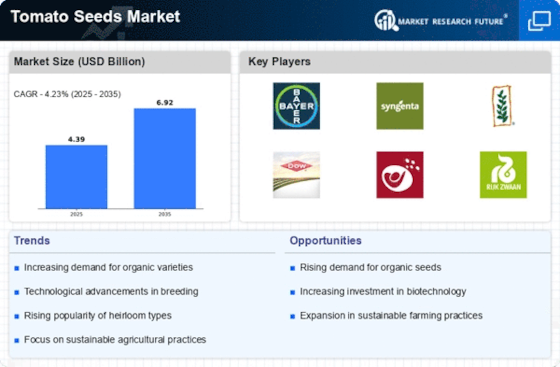
As per Market Research Future analysis, the Tomato Seeds Market Size was estimated at 4.388 USD Billion in 2024. The Tomato Seeds industry is projected to grow from 4.574 USD Billion in 2025 to 6.921 USD Billion by 2035, exhibiting a compound annual growth rate (CAGR) of 4.23% during the forecast period 2025 - 2035

Key Market Trends & Highlights

The Tomato Seeds Market is experiencing a dynamic shift towards sustainability and innovation.

  • The rise of organic farming is reshaping consumer preferences in North America, the largest market for tomato seeds. Hybrid seeds dominate the market, while open-pollinated seeds are witnessing rapid growth, particularly in Asia-Pacific. Technological integration in seed development is enhancing yield and disease resistance across various cultivation methods. Increasing demand for fresh produce and the growing popularity of home gardening are driving market expansion, especially in developing regions.

Market Size & Forecast

2024 Market Size 4.388 (USD Billion)
2035 Market Size 6.921 (USD Billion)
CAGR (2025 - 2035) 4.23%
Largest Regional Market Share in 2024 Asia Pacific

Major Players

<a href="https://agrar.bayer.de/">Bayer Crop Science (DE)</a>, Syngenta (CH), Monsanto (US), Dow AgroSciences (US), <a href="https://www.limagrain.com/">Limagrain (FR)</a>, Rijk Zwaan (NL), East-West Seed (TH), Sakata Seed Corporation (JP), Bejo Zaden (NL)

Market Trends

The Tomato Seeds Market is currently experiencing a dynamic phase characterized by evolving consumer preferences and agricultural practices. As the demand for organic produce continues to rise, growers are increasingly seeking high-quality seeds that align with sustainable farming methods. This shift appears to be driven by a growing awareness of health and environmental issues, prompting farmers to adopt practices that minimize chemical usage. Furthermore, advancements in biotechnology are likely enhancing seed varieties, making them more resilient to pests and diseases, which could lead to higher yields and improved crop quality. In addition, the Tomato Seeds Market is witnessing a surge in hybrid seed adoption. These hybrids are often favored for their superior traits, such as enhanced flavor, longer shelf life, and better adaptability to various climatic conditions. This trend suggests that growers are prioritizing not only productivity but also the overall quality of their produce. As the market evolves, it seems that the integration of technology in seed development and distribution will play a crucial role in shaping future growth, potentially leading to more efficient supply chains and improved access for farmers worldwide.

Rise of Organic Farming

The Tomato Seeds Market is increasingly influenced by the rise of organic farming practices. As consumers become more health-conscious, there is a growing preference for organic produce, prompting farmers to seek seeds that support sustainable cultivation methods.

Adoption of Hybrid Varieties

Hybrid tomato seeds are gaining traction due to their desirable characteristics, such as improved disease resistance and enhanced flavor. This trend indicates a shift towards prioritizing quality alongside yield, as growers aim to meet consumer demands.

Technological Integration in Seed Development

The integration of technology in the Tomato Seeds Market is transforming seed development and distribution. Innovations in biotechnology are likely leading to the creation of more resilient seed varieties, which may enhance productivity and sustainability.

Tomato Seeds Market Market Drivers

Increasing Demand for Fresh Produce

The rising consumer preference for fresh and organic produce is a key driver in the Tomato Seeds Market. As health consciousness grows, consumers are increasingly seeking out fresh vegetables, including tomatoes, which are staples in many diets. This trend is reflected in the increasing acreage dedicated to tomato cultivation, with reports indicating a rise in production levels. The demand for high-quality seeds that can yield better produce is also on the rise, prompting seed companies to innovate and develop superior varieties. Consequently, this shift towards fresh produce is likely to bolster the Tomato Seeds Market, as farmers seek to meet consumer expectations and enhance their crop yields.

Growing Popularity of Home Gardening

The trend of home gardening is gaining momentum, significantly impacting the Tomato Seeds Market. As more individuals engage in gardening for leisure and self-sufficiency, the demand for tomato seeds is likely to increase. This trend is particularly pronounced among urban dwellers who seek to grow their own food in limited spaces. Retailers are responding by offering a variety of tomato seed options tailored for home gardeners, including compact and disease-resistant varieties. This shift not only supports the Tomato Seeds Market but also encourages sustainable practices and local food production, aligning with broader environmental goals.

Sustainability and Environmental Concerns

Sustainability is becoming a central theme in agriculture, influencing the Tomato Seeds Market. As consumers and producers alike become more aware of environmental issues, there is a growing demand for seeds that support sustainable farming practices. This includes seeds that require fewer chemical inputs and are more resilient to climate variations. The market is witnessing an increase in the development of organic and environmentally friendly seed varieties, which align with consumer preferences for sustainable products. This shift towards sustainability is expected to drive innovation and growth within the Tomato Seeds Market, as stakeholders seek to balance productivity with environmental stewardship.

Technological Advancements in Agriculture

Technological innovations are transforming the Tomato Seeds Market, enhancing seed development and agricultural practices. The integration of biotechnology, such as genetic modification and molecular breeding, allows for the creation of tomato seeds that are more resilient to diseases and environmental stresses. This is particularly relevant as climate change poses challenges to traditional farming methods. Furthermore, precision agriculture technologies, including drones and soil sensors, enable farmers to optimize their planting strategies and improve yield efficiency. As these technologies become more accessible, they are expected to drive growth in the Tomato Seeds Market, as farmers adopt advanced methods to increase productivity and sustainability.

Expansion of Agricultural Practices in Developing Regions

The expansion of agricultural practices in developing regions is a notable driver for the Tomato Seeds Market. As economies grow and agricultural sectors modernize, there is an increasing focus on improving crop yields and food security. Governments and organizations are investing in agricultural development programs that promote the use of quality seeds, including tomato seeds. Reports indicate that regions with previously low agricultural output are beginning to adopt improved farming techniques and seed varieties, which could lead to a surge in tomato production. This trend is likely to create new opportunities within the Tomato Seeds Market, as demand for high-quality seeds rises.

Market Segment Insights

By Type: Hybrid Seeds (Largest) vs. Open-Pollinated Seeds (Fastest-Growing)

The Tomato Seeds Market is segmented into Hybrid Seeds, Open-Pollinated Seeds, and Heirloom Seeds, with Hybrid Seeds dominating the market share. This dominance stems from their advantageous traits such as higher yield, disease resistance, and adaptability to various climatic conditions. Hybrid Seeds are favored by many commercial growers looking for efficient crop production, leading to their significant market presence. In contrast, Open-Pollinated Seeds are witnessing rapid growth due to increasing consumer preference for organic gardening and sustainable practices. This segment is appealing to home gardeners and small-scale farmers who appreciate the ability to save seeds from year to year. The growing trend towards self-sufficiency and environmental consciousness drives the demand for Open-Pollinated Seeds, positioning them as a vital player in the evolving market landscape.

Hybrid Seeds (Dominant) vs. Heirloom Seeds (Emerging)

Hybrid Seeds are recognized as the dominant force in the Tomato Seeds Market due to their superior performance traits, such as increased resistance to pests and diseases and enhanced yields. They are developed through controlled pollination techniques that ensure consistency in crop quality, making them highly desirable for commercial applications. In contrast, Heirloom Seeds, often considered an emerging trend, are known for their rich flavors and genetic diversity. They appeal primarily to niche markets, such as organic growers and culinary enthusiasts, who value traditional varieties. While Heirloom Seeds represent a smaller share of the market, their popularity is growing as consumers seek organic and heritage options, showcasing a shift towards more sustainable agricultural practices.

By Application: Field Cultivation (Largest) vs. Greenhouse Cultivation (Fastest-Growing)

The Tomato Seeds Market exhibits a diverse application landscape, led predominantly by field cultivation, which commands the largest market share. This segment is favored for its high yield capabilities and cost-effectiveness, making it the primary choice among farmers looking to maximize production. In contrast, greenhouse cultivation has shown significant growth, attributed to an increasing interest in urban agriculture and controlled-environment farming practices. This segment is particularly appealing as it allows for year-round production, catering to growing consumer demand for fresh tomatoes irrespective of seasonal constraints.

Field Cultivation (Dominant) vs. Greenhouse Cultivation (Emerging)

Field cultivation remains the dominant application method for tomato seeds, favored by large-scale farmers for its efficiency and scalability. This approach allows for extensive land use and is particularly suited for traditional farming practices. Conversely, greenhouse cultivation is emerging rapidly due to advancements in agricultural technology and rising consumer preference for organic produce. Greenhouses provide a controlled environment that not only enhances yield but also reduces the risk of pest and disease interference. This dual characteristic allows farmers to cater to niche markets while maintaining productivity, positioning greenhouse cultivation as a vital part of the future tomato seeds landscape.

By Seed Treatment: Conventional Seeds (Largest) vs. Treated Seeds (Fastest-Growing)

In the Tomato Seeds Market, the seed treatment segment is predominantly led by Conventional Seeds, capturing the majority market share. These seeds are favored for their reliability and effectiveness in various cultivation conditions, making them the go-to choice for many farmers globally. Treated Seeds, however, are rapidly gaining traction, driven by a growing awareness of sustainable agricultural practices and the need for enhanced disease resistance and crop yield. This growth reflects a shift in farmer preferences towards more advanced seed technologies.

Conventional Seeds (Dominant) vs. Treated Seeds (Emerging)

Conventional Seeds exhibit a strong dominance in the Tomato Seeds Market due to their established performance and availability. These seeds are commonly used in various agricultural practices and are associated with traditional farming methods. In contrast, Treated Seeds are emerging as a significant player, as they offer enhanced protection against pests and diseases. They are treated with various <a href="https://www.marketresearchfuture.com/reports/biocontrol-market-24867" target="_blank" rel="noopener">biocontrol</a> agents and <a href="https://www.marketresearchfuture.com/reports/fungicides-market-4832" target="_blank" rel="noopener">fungicides</a> to improve seedling vigor and survival rates. The increasing consumer preference for safer food products and the rising concerns over pest resistance are propelling the use of Treated Seeds, positioning them as a cornerstone of modern sustainable farming.

By Growth Habit: Indeterminate (Largest) vs. Determinate (Fastest-Growing)

In the Tomato Seeds Market, the growth habit segment is primarily dominated by indeterminate varieties, which hold a significant share among growers due to their continuous growth pattern and higher yield potential. These varieties can produce fruit over a longer harvest period, making them favored for both commercial and home gardening purposes. Conversely, determinate varieties are gaining traction as they offer earlier harvests and require less maintenance, making them appealing for growers looking for a more manageable option.

Determinate (Dominant) vs. Indeterminate (Emerging)

Determinate tomato seeds are characterized by their bushy growth habit, producing a set amount of fruit within a specific timeframe. Their compact nature makes them ideal for smaller gardens and urban settings, providing convenience for growers. This segment is popular among commercial liners and home gardeners who prefer predictable yields. On the other hand, indeterminate seeds are esteemed for their vigorous growth and prolonged fruiting period. They are often favored in larger farms as they can continuously produce over the growing season, catering to markets seeking fresh tomatoes for extended periods. Together, these growth habits reflect the diverse needs of consumers and growers within the Tomato Seeds Market.

Get more detailed insights about Tomato Seeds Market Research Report - Global Forecast till 2035

Regional Insights

The Regional analysis of the  Tomato Seeds Market reveals significant valuations across various areas, contributing to the overall performance. In 2023, North America holds a revenue of 1.06 USD Billion, showcasing its strong demand and innovations in agricultural practices. Europe follows closely with a value of 1.2 USD Billion, driven by advanced technologies and high consumption rates. The APAC region, valued at 1.24 USD Billion, demonstrates a growing market potential due to increasing population and food security concerns.

South America, with a valuation of 0.7 USD Billion, presents opportunities related to agricultural development and export capabilities, while the MEA region, at 0.01 USD Billion, is still emerging but has potential growth avenues.

The Tomato Seeds Market trends indicate that North America, Europe, and APAC dominate the market, collectively representing the majority holding due to their established agricultural infrastructures and progressive adoption of seed technologies, while the growth in South America and MEA hints at the evolving dynamics of the  Tomato Seeds Market. The diverse conditions across regions highlight a blend of growth drivers, such as technological advancements, coupled with challenges like climatic variations impacting crop yields.

Source Primary Research, Secondary Research, Market Research Future Database and Analyst Review

Key Players and Competitive Insights

The  Tomato Seeds Market has seen significant growth and transformation in recent years, driven by increasing consumer demand for fresh produce, healthy food options, and innovations in agricultural practices. This market is characterized by intense competition among various players, each vying to capture market share through superior product offerings, advanced seed genetics, and robust distribution networks. The rising popularity of hybrid and genetically modified seeds has further intensified competitive dynamics as firms aim to enhance yields, resistance to diseases, and adaptability to diverse climate conditions. Understanding the competitive landscape is crucial for stakeholders, as it informs strategic decisions and fosters collaboration in research and development to meet evolving market needs. Dow AgroSciences has established a strong presence in the  Tomato Seeds Market thanks to its diverse portfolio of seed products designed for various growing conditions. The company's research and development capabilities are highlighted by its focus on breeding high-quality seeds that are both resilient and productive. Dow AgroSciences benefits from its integrated approach to agriculture, which combines crop protection and seed technology, enabling it to provide comprehensive solutions to farmers. Their commitment to innovation and sustainable farming practices enhances their competitive edge, fostering customer loyalty among growers seeking reliable and high-yielding tomato varieties. Additionally, their extensive distribution network ensures that their products are widely accessible, further solidifying their position in the market. Monsanto has been a significant player in the  Tomato Seeds Market, renowned for its advancements in biotechnology and seed innovation. The company places a considerable emphasis on research and development, focusing on creating genetically modified and hybrid seed varieties that offer improved resistance to pests and diseases while maintaining high yield potential. Monsanto's robust intellectual property portfolio allows it to protect its innovative solutions, fostering a competitive advantage in a crowded marketplace. The company's strong relationships with agricultural producers underscore its reputation as a trusted partner, facilitating access to cutting-edge agricultural technologies. With a commitment to sustainability and food security, Monsanto continues to adapt its offerings to address the challenges faced by tomato growers ly, ensuring its relevance and competitiveness in the market.

Key Companies in the Tomato Seeds Market include

Industry Developments

Recent developments in the  Tomato Seeds Market have highlighted significant activity among leading companies including Dow AgroSciences, Monsanto, LongPing HighTech, Limagrain, Syngenta, EastWest Seed, Seminis Vegetable Seeds, Sakata Seed Corporation, Rijk Zwaan, Hazera Seeds, Vilmorin & Cie, Bayer CropScience, Bejo Zaden, and Takii & Co. A notable growth trend is evident, with many firms increasing their market valuations as demand for hybrid and genetically modified tomato seeds surges due to rising agricultural practices and food security initiatives. Additionally, mergers and acquisitions have been prominent; specific companies are aligning strategically to enhance their product portfolios and market reach.

The consolidation among firms like Bayer CropScience and Monsanto has led to greater innovation in seed technologies, fostering competitive advantages. In parallel, advancements in biotechnology are contributing to the development of pest-resistant varieties, thus addressing challenges linked to climate change and sustainability. As these companies navigate a dynamic regulatory landscape, the continued emphasis on R&D coupled with strategic partnerships is reshaping the market and impacting overall growth trajectories.

  •  

Future Outlook

Tomato Seeds Market Future Outlook

The Tomato Seeds Market is projected to grow at a 4.23% CAGR from 2025 to 2035, driven by increasing demand for sustainable agriculture and innovative seed technologies. The future of the Tomato Seeds Market is defined by the transition toward climate-resilient hybrids and precision genomic breeding. Driven by the surge in protected cultivation and food security needs, the market is prioritizing ToBRFV-resistant varieties and CRISPR-enhanced traits for superior shelf-life and nutrition.

New opportunities lie in:

  • <p>Development of disease-resistant seed varieties for emerging markets. Expansion of e-commerce platforms for direct-to-consumer sales. Investment in precision agriculture technologies to enhance yield efficiency.</p>

By 2035, the Tomato Seeds Market is expected to achieve robust growth, reflecting evolving agricultural practices and consumer preferences.

Market Segmentation

Tomato Seeds Market Type Outlook

  • Hybrid Seeds
  • Open-Pollinated Seeds
  • Heirloom Seeds

Tomato Seeds Market Application Outlook

  • Field Cultivation
  • Greenhouse Cultivation
  • Container Gardening

Tomato Seeds Market Growth Habit Outlook

  • Determinate
  • Indeterminate
  • Semi-Determinate

Tomato Seeds Market Seed Treatment Outlook

  • Conventional Seeds
  • Organic Seeds
  • Treated Seeds

Report Scope

MARKET SIZE 2024 4.388(USD Billion)
MARKET SIZE 2025 4.574(USD Billion)
MARKET SIZE 2035 6.921(USD Billion)
COMPOUND ANNUAL GROWTH RATE (CAGR) 4.23% (2025 - 2035)
REPORT COVERAGE Revenue Forecast, Competitive Landscape, Growth Factors, and Trends
BASE YEAR 2024
Market Forecast Period 2025 - 2035
Historical Data 2019 - 2024
Market Forecast Units USD Billion
Key Companies Profiled Bayer Crop Science (DE), Syngenta (CH), Monsanto (US), Dow AgroSciences (US), Limagrain (FR), Rijk Zwaan (NL), East-West Seed (TH), Sakata Seed Corporation (JP), Bejo Zaden (NL)
Segments Covered Type, Application, Seed Treatment, Growth Habit, Regional
Key Market Opportunities Growing demand for disease-resistant and high-yield tomato seed varieties presents significant opportunities in the Tomato Seeds Market.
Key Market Dynamics Rising demand for disease-resistant varieties drives innovation and competition in the tomato seeds market.
Countries Covered North America, Europe, APAC, South America, MEA

FAQs

What is the projected market valuation of the Tomato Seeds Market by 2035?

<p>The Tomato Seeds Market is projected to reach a valuation of 6.921 USD Billion by 2035.</p>

What was the market valuation of the Tomato Seeds Market in 2024?

<p>In 2024, the Tomato Seeds Market was valued at 4.388 USD Billion.</p>

What is the expected CAGR for the Tomato Seeds Market during the forecast period 2025 - 2035?

<p>The expected CAGR for the Tomato Seeds Market during the forecast period 2025 - 2035 is 4.23%.</p>

Which companies are considered key players in the Tomato Seeds Market?

<p>Key players in the Tomato Seeds Market include Bayer Crop Science, Syngenta, Monsanto, and Dow AgroSciences.</p>

What are the different types of tomato seeds available in the market?

<p>The Tomato Seeds Market includes Hybrid Seeds, Open-Pollinated Seeds, and Heirloom Seeds.</p>

How much revenue is generated from Hybrid Seeds in the Tomato Seeds Market?

<p>Revenue from Hybrid Seeds was approximately 1.5 USD Billion in 2024 and is projected to reach 2.4 USD Billion by 2035.</p>

What is the market size for greenhouse cultivation of tomato seeds?

<p>The market size for greenhouse cultivation of tomato seeds was 1.8 USD Billion in 2024 and is expected to grow to 2.8 USD Billion by 2035.</p>

What segment of tomato seeds is expected to generate the highest revenue growth?

<p>Indeterminate tomato seeds are expected to generate the highest revenue growth, increasing from 2.0 USD Billion in 2024 to 3.2 USD Billion by 2035.</p>

What is the revenue projection for organic seeds in the Tomato Seeds Market?

<p>The revenue from organic seeds is projected to grow from 1.2 USD Billion in 2024 to 2.0 USD Billion by 2035.</p>

How does the revenue from treated seeds compare to other seed treatments?

<p>Revenue from treated seeds was 1.688 USD Billion in 2024 and is projected to increase to 2.521 USD Billion by 2035, indicating strong growth.</p>

  1. SECTION I: EXECUTIVE SUMMARY AND KEY HIGHLIGHTS
    1. | 1.1 EXECUTIVE SUMMARY
    2. | | 1.1.1 Market Overview
    3. | | 1.1.2 Key Findings
    4. | | 1.1.3 Market Segmentation
    5. | | 1.1.4 Competitive Landscape
    6. | | 1.1.5 Challenges and Opportunities
    7. | | 1.1.6 Future Outlook
  2. SECTION II: SCOPING, METHODOLOGY AND MARKET STRUCTURE
    1. | 2.1 MARKET INTRODUCTION
    2. | | 2.1.1 Definition
    3. | | 2.1.2 Scope of the study
    4. | | | 2.1.2.1 Research Objective
    5. | | | 2.1.2.2 Assumption
    6. | | | 2.1.2.3 Limitations
    7. | 2.2 RESEARCH METHODOLOGY
    8. | | 2.2.1 Overview
    9. | | 2.2.2 Data Mining
    10. | | 2.2.3 Secondary Research
    11. | | 2.2.4 Primary Research
    12. | | | 2.2.4.1 Primary Interviews and Information Gathering Process
    13. | | | 2.2.4.2 Breakdown of Primary Respondents
    14. | | 2.2.5 Forecasting Model
    15. | | 2.2.6 Market Size Estimation
    16. | | | 2.2.6.1 Bottom-Up Approach
    17. | | | 2.2.6.2 Top-Down Approach
    18. | | 2.2.7 Data Triangulation
    19. | | 2.2.8 Validation
  3. SECTION III: QUALITATIVE ANALYSIS
    1. | 3.1 MARKET DYNAMICS
    2. | | 3.1.1 Overview
    3. | | 3.1.2 Drivers
    4. | | 3.1.3 Restraints
    5. | | 3.1.4 Opportunities
    6. | 3.2 MARKET FACTOR ANALYSIS
    7. | | 3.2.1 Value chain Analysis
    8. | | 3.2.2 Porter's Five Forces Analysis
    9. | | | 3.2.2.1 Bargaining Power of Suppliers
    10. | | | 3.2.2.2 Bargaining Power of Buyers
    11. | | | 3.2.2.3 Threat of New Entrants
    12. | | | 3.2.2.4 Threat of Substitutes
    13. | | | 3.2.2.5 Intensity of Rivalry
    14. | | 3.2.3 COVID-19 Impact Analysis
    15. | | | 3.2.3.1 Market Impact Analysis
    16. | | | 3.2.3.2 Regional Impact
    17. | | | 3.2.3.3 Opportunity and Threat Analysis
  4. SECTION IV: QUANTITATIVE ANALYSIS
    1. | 4.1 Construction, BY Type (USD Billion)
    2. | | 4.1.1 Hybrid Seeds
    3. | | 4.1.2 Open-Pollinated Seeds
    4. | | 4.1.3 Heirloom Seeds
    5. | 4.2 Construction, BY Application (USD Billion)
    6. | | 4.2.1 Field Cultivation
    7. | | 4.2.2 Greenhouse Cultivation
    8. | | 4.2.3 Container Gardening
    9. | 4.3 Construction, BY Seed Treatment (USD Billion)
    10. | | 4.3.1 Conventional Seeds
    11. | | 4.3.2 Organic Seeds
    12. | | 4.3.3 Treated Seeds
    13. | 4.4 Construction, BY Growth Habit (USD Billion)
    14. | | 4.4.1 Determinate
    15. | | 4.4.2 Indeterminate
    16. | | 4.4.3 Semi-Determinate
    17. | 4.5 Construction, BY Region (USD Billion)
    18. | | 4.5.1 North America
    19. | | | 4.5.1.1 US
    20. | | | 4.5.1.2 Canada
    21. | | 4.5.2 Europe
    22. | | | 4.5.2.1 Germany
    23. | | | 4.5.2.2 UK
    24. | | | 4.5.2.3 France
    25. | | | 4.5.2.4 Russia
    26. | | | 4.5.2.5 Italy
    27. | | | 4.5.2.6 Spain
    28. | | | 4.5.2.7 Rest of Europe
    29. | | 4.5.3 APAC
    30. | | | 4.5.3.1 China
    31. | | | 4.5.3.2 India
    32. | | | 4.5.3.3 Japan
    33. | | | 4.5.3.4 South Korea
    34. | | | 4.5.3.5 Malaysia
    35. | | | 4.5.3.6 Thailand
    36. | | | 4.5.3.7 Indonesia
    37. | | | 4.5.3.8 Rest of APAC
    38. | | 4.5.4 South America
    39. | | | 4.5.4.1 Brazil
    40. | | | 4.5.4.2 Mexico
    41. | | | 4.5.4.3 Argentina
    42. | | | 4.5.4.4 Rest of South America
    43. | | 4.5.5 MEA
    44. | | | 4.5.5.1 GCC Countries
    45. | | | 4.5.5.2 South Africa
    46. | | | 4.5.5.3 Rest of MEA
  5. SECTION V: COMPETITIVE ANALYSIS
    1. | 5.1 Competitive Landscape
    2. | | 5.1.1 Overview
    3. | | 5.1.2 Competitive Analysis
    4. | | 5.1.3 Market share Analysis
    5. | | 5.1.4 Major Growth Strategy in the Construction
    6. | | 5.1.5 Competitive Benchmarking
    7. | | 5.1.6 Leading Players in Terms of Number of Developments in the Construction
    8. | | 5.1.7 Key developments and growth strategies
    9. | | | 5.1.7.1 New Product Launch/Service Deployment
    10. | | | 5.1.7.2 Merger & Acquisitions
    11. | | | 5.1.7.3 Joint Ventures
    12. | | 5.1.8 Major Players Financial Matrix
    13. | | | 5.1.8.1 Sales and Operating Income
    14. | | | 5.1.8.2 Major Players R&D Expenditure. 2023
    15. | 5.2 Company Profiles
    16. | | 5.2.1 Bayer Crop Science (DE)
    17. | | | 5.2.1.1 Financial Overview
    18. | | | 5.2.1.2 Products Offered
    19. | | | 5.2.1.3 Key Developments
    20. | | | 5.2.1.4 SWOT Analysis
    21. | | | 5.2.1.5 Key Strategies
    22. | | 5.2.2 Syngenta (CH)
    23. | | | 5.2.2.1 Financial Overview
    24. | | | 5.2.2.2 Products Offered
    25. | | | 5.2.2.3 Key Developments
    26. | | | 5.2.2.4 SWOT Analysis
    27. | | | 5.2.2.5 Key Strategies
    28. | | 5.2.3 Monsanto (US)
    29. | | | 5.2.3.1 Financial Overview
    30. | | | 5.2.3.2 Products Offered
    31. | | | 5.2.3.3 Key Developments
    32. | | | 5.2.3.4 SWOT Analysis
    33. | | | 5.2.3.5 Key Strategies
    34. | | 5.2.4 Dow AgroSciences (US)
    35. | | | 5.2.4.1 Financial Overview
    36. | | | 5.2.4.2 Products Offered
    37. | | | 5.2.4.3 Key Developments
    38. | | | 5.2.4.4 SWOT Analysis
    39. | | | 5.2.4.5 Key Strategies
    40. | | 5.2.5 Limagrain (FR)
    41. | | | 5.2.5.1 Financial Overview
    42. | | | 5.2.5.2 Products Offered
    43. | | | 5.2.5.3 Key Developments
    44. | | | 5.2.5.4 SWOT Analysis
    45. | | | 5.2.5.5 Key Strategies
    46. | | 5.2.6 Rijk Zwaan (NL)
    47. | | | 5.2.6.1 Financial Overview
    48. | | | 5.2.6.2 Products Offered
    49. | | | 5.2.6.3 Key Developments
    50. | | | 5.2.6.4 SWOT Analysis
    51. | | | 5.2.6.5 Key Strategies
    52. | | 5.2.7 East-West Seed (TH)
    53. | | | 5.2.7.1 Financial Overview
    54. | | | 5.2.7.2 Products Offered
    55. | | | 5.2.7.3 Key Developments
    56. | | | 5.2.7.4 SWOT Analysis
    57. | | | 5.2.7.5 Key Strategies
    58. | | 5.2.8 Sakata Seed Corporation (JP)
    59. | | | 5.2.8.1 Financial Overview
    60. | | | 5.2.8.2 Products Offered
    61. | | | 5.2.8.3 Key Developments
    62. | | | 5.2.8.4 SWOT Analysis
    63. | | | 5.2.8.5 Key Strategies
    64. | | 5.2.9 Bejo Zaden (NL)
    65. | | | 5.2.9.1 Financial Overview
    66. | | | 5.2.9.2 Products Offered
    67. | | | 5.2.9.3 Key Developments
    68. | | | 5.2.9.4 SWOT Analysis
    69. | | | 5.2.9.5 Key Strategies
    70. | 5.3 Appendix
    71. | | 5.3.1 References
    72. | | 5.3.2 Related Reports
  6. LIST OF FIGURES
    1. | 6.1 MARKET SYNOPSIS
    2. | 6.2 NORTH AMERICA MARKET ANALYSIS
    3. | 6.3 US MARKET ANALYSIS BY TYPE
    4. | 6.4 US MARKET ANALYSIS BY APPLICATION
    5. | 6.5 US MARKET ANALYSIS BY SEED TREATMENT
    6. | 6.6 US MARKET ANALYSIS BY GROWTH HABIT
    7. | 6.7 CANADA MARKET ANALYSIS BY TYPE
    8. | 6.8 CANADA MARKET ANALYSIS BY APPLICATION
    9. | 6.9 CANADA MARKET ANALYSIS BY SEED TREATMENT
    10. | 6.10 CANADA MARKET ANALYSIS BY GROWTH HABIT
    11. | 6.11 EUROPE MARKET ANALYSIS
    12. | 6.12 GERMANY MARKET ANALYSIS BY TYPE
    13. | 6.13 GERMANY MARKET ANALYSIS BY APPLICATION
    14. | 6.14 GERMANY MARKET ANALYSIS BY SEED TREATMENT
    15. | 6.15 GERMANY MARKET ANALYSIS BY GROWTH HABIT
    16. | 6.16 UK MARKET ANALYSIS BY TYPE
    17. | 6.17 UK MARKET ANALYSIS BY APPLICATION
    18. | 6.18 UK MARKET ANALYSIS BY SEED TREATMENT
    19. | 6.19 UK MARKET ANALYSIS BY GROWTH HABIT
    20. | 6.20 FRANCE MARKET ANALYSIS BY TYPE
    21. | 6.21 FRANCE MARKET ANALYSIS BY APPLICATION
    22. | 6.22 FRANCE MARKET ANALYSIS BY SEED TREATMENT
    23. | 6.23 FRANCE MARKET ANALYSIS BY GROWTH HABIT
    24. | 6.24 RUSSIA MARKET ANALYSIS BY TYPE
    25. | 6.25 RUSSIA MARKET ANALYSIS BY APPLICATION
    26. | 6.26 RUSSIA MARKET ANALYSIS BY SEED TREATMENT
    27. | 6.27 RUSSIA MARKET ANALYSIS BY GROWTH HABIT
    28. | 6.28 ITALY MARKET ANALYSIS BY TYPE
    29. | 6.29 ITALY MARKET ANALYSIS BY APPLICATION
    30. | 6.30 ITALY MARKET ANALYSIS BY SEED TREATMENT
    31. | 6.31 ITALY MARKET ANALYSIS BY GROWTH HABIT
    32. | 6.32 SPAIN MARKET ANALYSIS BY TYPE
    33. | 6.33 SPAIN MARKET ANALYSIS BY APPLICATION
    34. | 6.34 SPAIN MARKET ANALYSIS BY SEED TREATMENT
    35. | 6.35 SPAIN MARKET ANALYSIS BY GROWTH HABIT
    36. | 6.36 REST OF EUROPE MARKET ANALYSIS BY TYPE
    37. | 6.37 REST OF EUROPE MARKET ANALYSIS BY APPLICATION
    38. | 6.38 REST OF EUROPE MARKET ANALYSIS BY SEED TREATMENT
    39. | 6.39 REST OF EUROPE MARKET ANALYSIS BY GROWTH HABIT
    40. | 6.40 APAC MARKET ANALYSIS
    41. | 6.41 CHINA MARKET ANALYSIS BY TYPE
    42. | 6.42 CHINA MARKET ANALYSIS BY APPLICATION
    43. | 6.43 CHINA MARKET ANALYSIS BY SEED TREATMENT
    44. | 6.44 CHINA MARKET ANALYSIS BY GROWTH HABIT
    45. | 6.45 INDIA MARKET ANALYSIS BY TYPE
    46. | 6.46 INDIA MARKET ANALYSIS BY APPLICATION
    47. | 6.47 INDIA MARKET ANALYSIS BY SEED TREATMENT
    48. | 6.48 INDIA MARKET ANALYSIS BY GROWTH HABIT
    49. | 6.49 JAPAN MARKET ANALYSIS BY TYPE
    50. | 6.50 JAPAN MARKET ANALYSIS BY APPLICATION
    51. | 6.51 JAPAN MARKET ANALYSIS BY SEED TREATMENT
    52. | 6.52 JAPAN MARKET ANALYSIS BY GROWTH HABIT
    53. | 6.53 SOUTH KOREA MARKET ANALYSIS BY TYPE
    54. | 6.54 SOUTH KOREA MARKET ANALYSIS BY APPLICATION
    55. | 6.55 SOUTH KOREA MARKET ANALYSIS BY SEED TREATMENT
    56. | 6.56 SOUTH KOREA MARKET ANALYSIS BY GROWTH HABIT
    57. | 6.57 MALAYSIA MARKET ANALYSIS BY TYPE
    58. | 6.58 MALAYSIA MARKET ANALYSIS BY APPLICATION
    59. | 6.59 MALAYSIA MARKET ANALYSIS BY SEED TREATMENT
    60. | 6.60 MALAYSIA MARKET ANALYSIS BY GROWTH HABIT
    61. | 6.61 THAILAND MARKET ANALYSIS BY TYPE
    62. | 6.62 THAILAND MARKET ANALYSIS BY APPLICATION
    63. | 6.63 THAILAND MARKET ANALYSIS BY SEED TREATMENT
    64. | 6.64 THAILAND MARKET ANALYSIS BY GROWTH HABIT
    65. | 6.65 INDONESIA MARKET ANALYSIS BY TYPE
    66. | 6.66 INDONESIA MARKET ANALYSIS BY APPLICATION
    67. | 6.67 INDONESIA MARKET ANALYSIS BY SEED TREATMENT
    68. | 6.68 INDONESIA MARKET ANALYSIS BY GROWTH HABIT
    69. | 6.69 REST OF APAC MARKET ANALYSIS BY TYPE
    70. | 6.70 REST OF APAC MARKET ANALYSIS BY APPLICATION
    71. | 6.71 REST OF APAC MARKET ANALYSIS BY SEED TREATMENT
    72. | 6.72 REST OF APAC MARKET ANALYSIS BY GROWTH HABIT
    73. | 6.73 SOUTH AMERICA MARKET ANALYSIS
    74. | 6.74 BRAZIL MARKET ANALYSIS BY TYPE
    75. | 6.75 BRAZIL MARKET ANALYSIS BY APPLICATION
    76. | 6.76 BRAZIL MARKET ANALYSIS BY SEED TREATMENT
    77. | 6.77 BRAZIL MARKET ANALYSIS BY GROWTH HABIT
    78. | 6.78 MEXICO MARKET ANALYSIS BY TYPE
    79. | 6.79 MEXICO MARKET ANALYSIS BY APPLICATION
    80. | 6.80 MEXICO MARKET ANALYSIS BY SEED TREATMENT
    81. | 6.81 MEXICO MARKET ANALYSIS BY GROWTH HABIT
    82. | 6.82 ARGENTINA MARKET ANALYSIS BY TYPE
    83. | 6.83 ARGENTINA MARKET ANALYSIS BY APPLICATION
    84. | 6.84 ARGENTINA MARKET ANALYSIS BY SEED TREATMENT
    85. | 6.85 ARGENTINA MARKET ANALYSIS BY GROWTH HABIT
    86. | 6.86 REST OF SOUTH AMERICA MARKET ANALYSIS BY TYPE
    87. | 6.87 REST OF SOUTH AMERICA MARKET ANALYSIS BY APPLICATION
    88. | 6.88 REST OF SOUTH AMERICA MARKET ANALYSIS BY SEED TREATMENT
    89. | 6.89 REST OF SOUTH AMERICA MARKET ANALYSIS BY GROWTH HABIT
    90. | 6.90 MEA MARKET ANALYSIS
    91. | 6.91 GCC COUNTRIES MARKET ANALYSIS BY TYPE
    92. | 6.92 GCC COUNTRIES MARKET ANALYSIS BY APPLICATION
    93. | 6.93 GCC COUNTRIES MARKET ANALYSIS BY SEED TREATMENT
    94. | 6.94 GCC COUNTRIES MARKET ANALYSIS BY GROWTH HABIT
    95. | 6.95 SOUTH AFRICA MARKET ANALYSIS BY TYPE
    96. | 6.96 SOUTH AFRICA MARKET ANALYSIS BY APPLICATION
    97. | 6.97 SOUTH AFRICA MARKET ANALYSIS BY SEED TREATMENT
    98. | 6.98 SOUTH AFRICA MARKET ANALYSIS BY GROWTH HABIT
    99. | 6.99 REST OF MEA MARKET ANALYSIS BY TYPE
    100. | 6.100 REST OF MEA MARKET ANALYSIS BY APPLICATION
    101. | 6.101 REST OF MEA MARKET ANALYSIS BY SEED TREATMENT
    102. | 6.102 REST OF MEA MARKET ANALYSIS BY GROWTH HABIT
    103. | 6.103 KEY BUYING CRITERIA OF CONSTRUCTION
    104. | 6.104 RESEARCH PROCESS OF MRFR
    105. | 6.105 DRO ANALYSIS OF CONSTRUCTION
    106. | 6.106 DRIVERS IMPACT ANALYSIS: CONSTRUCTION
    107. | 6.107 RESTRAINTS IMPACT ANALYSIS: CONSTRUCTION
    108. | 6.108 SUPPLY / VALUE CHAIN: CONSTRUCTION
    109. | 6.109 CONSTRUCTION, BY TYPE, 2024 (% SHARE)
    110. | 6.110 CONSTRUCTION, BY TYPE, 2024 TO 2035 (USD Billion)
    111. | 6.111 CONSTRUCTION, BY APPLICATION, 2024 (% SHARE)
    112. | 6.112 CONSTRUCTION, BY APPLICATION, 2024 TO 2035 (USD Billion)
    113. | 6.113 CONSTRUCTION, BY SEED TREATMENT, 2024 (% SHARE)
    114. | 6.114 CONSTRUCTION, BY SEED TREATMENT, 2024 TO 2035 (USD Billion)
    115. | 6.115 CONSTRUCTION, BY GROWTH HABIT, 2024 (% SHARE)
    116. | 6.116 CONSTRUCTION, BY GROWTH HABIT, 2024 TO 2035 (USD Billion)
    117. | 6.117 BENCHMARKING OF MAJOR COMPETITORS
  7. LIST OF TABLES
    1. | 7.1 LIST OF ASSUMPTIONS
    2. | | 7.1.1
    3. | 7.2 North America MARKET SIZE ESTIMATES; FORECAST
    4. | | 7.2.1 BY TYPE, 2025-2035 (USD Billion)
    5. | | 7.2.2 BY APPLICATION, 2025-2035 (USD Billion)
    6. | | 7.2.3 BY SEED TREATMENT, 2025-2035 (USD Billion)
    7. | | 7.2.4 BY GROWTH HABIT, 2025-2035 (USD Billion)
    8. | 7.3 US MARKET SIZE ESTIMATES; FORECAST
    9. | | 7.3.1 BY TYPE, 2025-2035 (USD Billion)
    10. | | 7.3.2 BY APPLICATION, 2025-2035 (USD Billion)
    11. | | 7.3.3 BY SEED TREATMENT, 2025-2035 (USD Billion)
    12. | | 7.3.4 BY GROWTH HABIT, 2025-2035 (USD Billion)
    13. | 7.4 Canada MARKET SIZE ESTIMATES; FORECAST
    14. | | 7.4.1 BY TYPE, 2025-2035 (USD Billion)
    15. | | 7.4.2 BY APPLICATION, 2025-2035 (USD Billion)
    16. | | 7.4.3 BY SEED TREATMENT, 2025-2035 (USD Billion)
    17. | | 7.4.4 BY GROWTH HABIT, 2025-2035 (USD Billion)
    18. | 7.5 Europe MARKET SIZE ESTIMATES; FORECAST
    19. | | 7.5.1 BY TYPE, 2025-2035 (USD Billion)
    20. | | 7.5.2 BY APPLICATION, 2025-2035 (USD Billion)
    21. | | 7.5.3 BY SEED TREATMENT, 2025-2035 (USD Billion)
    22. | | 7.5.4 BY GROWTH HABIT, 2025-2035 (USD Billion)
    23. | 7.6 Germany MARKET SIZE ESTIMATES; FORECAST
    24. | | 7.6.1 BY TYPE, 2025-2035 (USD Billion)
    25. | | 7.6.2 BY APPLICATION, 2025-2035 (USD Billion)
    26. | | 7.6.3 BY SEED TREATMENT, 2025-2035 (USD Billion)
    27. | | 7.6.4 BY GROWTH HABIT, 2025-2035 (USD Billion)
    28. | 7.7 UK MARKET SIZE ESTIMATES; FORECAST
    29. | | 7.7.1 BY TYPE, 2025-2035 (USD Billion)
    30. | | 7.7.2 BY APPLICATION, 2025-2035 (USD Billion)
    31. | | 7.7.3 BY SEED TREATMENT, 2025-2035 (USD Billion)
    32. | | 7.7.4 BY GROWTH HABIT, 2025-2035 (USD Billion)
    33. | 7.8 France MARKET SIZE ESTIMATES; FORECAST
    34. | | 7.8.1 BY TYPE, 2025-2035 (USD Billion)
    35. | | 7.8.2 BY APPLICATION, 2025-2035 (USD Billion)
    36. | | 7.8.3 BY SEED TREATMENT, 2025-2035 (USD Billion)
    37. | | 7.8.4 BY GROWTH HABIT, 2025-2035 (USD Billion)
    38. | 7.9 Russia MARKET SIZE ESTIMATES; FORECAST
    39. | | 7.9.1 BY TYPE, 2025-2035 (USD Billion)
    40. | | 7.9.2 BY APPLICATION, 2025-2035 (USD Billion)
    41. | | 7.9.3 BY SEED TREATMENT, 2025-2035 (USD Billion)
    42. | | 7.9.4 BY GROWTH HABIT, 2025-2035 (USD Billion)
    43. | 7.10 Italy MARKET SIZE ESTIMATES; FORECAST
    44. | | 7.10.1 BY TYPE, 2025-2035 (USD Billion)
    45. | | 7.10.2 BY APPLICATION, 2025-2035 (USD Billion)
    46. | | 7.10.3 BY SEED TREATMENT, 2025-2035 (USD Billion)
    47. | | 7.10.4 BY GROWTH HABIT, 2025-2035 (USD Billion)
    48. | 7.11 Spain MARKET SIZE ESTIMATES; FORECAST
    49. | | 7.11.1 BY TYPE, 2025-2035 (USD Billion)
    50. | | 7.11.2 BY APPLICATION, 2025-2035 (USD Billion)
    51. | | 7.11.3 BY SEED TREATMENT, 2025-2035 (USD Billion)
    52. | | 7.11.4 BY GROWTH HABIT, 2025-2035 (USD Billion)
    53. | 7.12 Rest of Europe MARKET SIZE ESTIMATES; FORECAST
    54. | | 7.12.1 BY TYPE, 2025-2035 (USD Billion)
    55. | | 7.12.2 BY APPLICATION, 2025-2035 (USD Billion)
    56. | | 7.12.3 BY SEED TREATMENT, 2025-2035 (USD Billion)
    57. | | 7.12.4 BY GROWTH HABIT, 2025-2035 (USD Billion)
    58. | 7.13 APAC MARKET SIZE ESTIMATES; FORECAST
    59. | | 7.13.1 BY TYPE, 2025-2035 (USD Billion)
    60. | | 7.13.2 BY APPLICATION, 2025-2035 (USD Billion)
    61. | | 7.13.3 BY SEED TREATMENT, 2025-2035 (USD Billion)
    62. | | 7.13.4 BY GROWTH HABIT, 2025-2035 (USD Billion)
    63. | 7.14 China MARKET SIZE ESTIMATES; FORECAST
    64. | | 7.14.1 BY TYPE, 2025-2035 (USD Billion)
    65. | | 7.14.2 BY APPLICATION, 2025-2035 (USD Billion)
    66. | | 7.14.3 BY SEED TREATMENT, 2025-2035 (USD Billion)
    67. | | 7.14.4 BY GROWTH HABIT, 2025-2035 (USD Billion)
    68. | 7.15 India MARKET SIZE ESTIMATES; FORECAST
    69. | | 7.15.1 BY TYPE, 2025-2035 (USD Billion)
    70. | | 7.15.2 BY APPLICATION, 2025-2035 (USD Billion)
    71. | | 7.15.3 BY SEED TREATMENT, 2025-2035 (USD Billion)
    72. | | 7.15.4 BY GROWTH HABIT, 2025-2035 (USD Billion)
    73. | 7.16 Japan MARKET SIZE ESTIMATES; FORECAST
    74. | | 7.16.1 BY TYPE, 2025-2035 (USD Billion)
    75. | | 7.16.2 BY APPLICATION, 2025-2035 (USD Billion)
    76. | | 7.16.3 BY SEED TREATMENT, 2025-2035 (USD Billion)
    77. | | 7.16.4 BY GROWTH HABIT, 2025-2035 (USD Billion)
    78. | 7.17 South Korea MARKET SIZE ESTIMATES; FORECAST
    79. | | 7.17.1 BY TYPE, 2025-2035 (USD Billion)
    80. | | 7.17.2 BY APPLICATION, 2025-2035 (USD Billion)
    81. | | 7.17.3 BY SEED TREATMENT, 2025-2035 (USD Billion)
    82. | | 7.17.4 BY GROWTH HABIT, 2025-2035 (USD Billion)
    83. | 7.18 Malaysia MARKET SIZE ESTIMATES; FORECAST
    84. | | 7.18.1 BY TYPE, 2025-2035 (USD Billion)
    85. | | 7.18.2 BY APPLICATION, 2025-2035 (USD Billion)
    86. | | 7.18.3 BY SEED TREATMENT, 2025-2035 (USD Billion)
    87. | | 7.18.4 BY GROWTH HABIT, 2025-2035 (USD Billion)
    88. | 7.19 Thailand MARKET SIZE ESTIMATES; FORECAST
    89. | | 7.19.1 BY TYPE, 2025-2035 (USD Billion)
    90. | | 7.19.2 BY APPLICATION, 2025-2035 (USD Billion)
    91. | | 7.19.3 BY SEED TREATMENT, 2025-2035 (USD Billion)
    92. | | 7.19.4 BY GROWTH HABIT, 2025-2035 (USD Billion)
    93. | 7.20 Indonesia MARKET SIZE ESTIMATES; FORECAST
    94. | | 7.20.1 BY TYPE, 2025-2035 (USD Billion)
    95. | | 7.20.2 BY APPLICATION, 2025-2035 (USD Billion)
    96. | | 7.20.3 BY SEED TREATMENT, 2025-2035 (USD Billion)
    97. | | 7.20.4 BY GROWTH HABIT, 2025-2035 (USD Billion)
    98. | 7.21 Rest of APAC MARKET SIZE ESTIMATES; FORECAST
    99. | | 7.21.1 BY TYPE, 2025-2035 (USD Billion)
    100. | | 7.21.2 BY APPLICATION, 2025-2035 (USD Billion)
    101. | | 7.21.3 BY SEED TREATMENT, 2025-2035 (USD Billion)
    102. | | 7.21.4 BY GROWTH HABIT, 2025-2035 (USD Billion)
    103. | 7.22 South America MARKET SIZE ESTIMATES; FORECAST
    104. | | 7.22.1 BY TYPE, 2025-2035 (USD Billion)
    105. | | 7.22.2 BY APPLICATION, 2025-2035 (USD Billion)
    106. | | 7.22.3 BY SEED TREATMENT, 2025-2035 (USD Billion)
    107. | | 7.22.4 BY GROWTH HABIT, 2025-2035 (USD Billion)
    108. | 7.23 Brazil MARKET SIZE ESTIMATES; FORECAST
    109. | | 7.23.1 BY TYPE, 2025-2035 (USD Billion)
    110. | | 7.23.2 BY APPLICATION, 2025-2035 (USD Billion)
    111. | | 7.23.3 BY SEED TREATMENT, 2025-2035 (USD Billion)
    112. | | 7.23.4 BY GROWTH HABIT, 2025-2035 (USD Billion)
    113. | 7.24 Mexico MARKET SIZE ESTIMATES; FORECAST
    114. | | 7.24.1 BY TYPE, 2025-2035 (USD Billion)
    115. | | 7.24.2 BY APPLICATION, 2025-2035 (USD Billion)
    116. | | 7.24.3 BY SEED TREATMENT, 2025-2035 (USD Billion)
    117. | | 7.24.4 BY GROWTH HABIT, 2025-2035 (USD Billion)
    118. | 7.25 Argentina MARKET SIZE ESTIMATES; FORECAST
    119. | | 7.25.1 BY TYPE, 2025-2035 (USD Billion)
    120. | | 7.25.2 BY APPLICATION, 2025-2035 (USD Billion)
    121. | | 7.25.3 BY SEED TREATMENT, 2025-2035 (USD Billion)
    122. | | 7.25.4 BY GROWTH HABIT, 2025-2035 (USD Billion)
    123. | 7.26 Rest of South America MARKET SIZE ESTIMATES; FORECAST
    124. | | 7.26.1 BY TYPE, 2025-2035 (USD Billion)
    125. | | 7.26.2 BY APPLICATION, 2025-2035 (USD Billion)
    126. | | 7.26.3 BY SEED TREATMENT, 2025-2035 (USD Billion)
    127. | | 7.26.4 BY GROWTH HABIT, 2025-2035 (USD Billion)
    128. | 7.27 MEA MARKET SIZE ESTIMATES; FORECAST
    129. | | 7.27.1 BY TYPE, 2025-2035 (USD Billion)
    130. | | 7.27.2 BY APPLICATION, 2025-2035 (USD Billion)
    131. | | 7.27.3 BY SEED TREATMENT, 2025-2035 (USD Billion)
    132. | | 7.27.4 BY GROWTH HABIT, 2025-2035 (USD Billion)
    133. | 7.28 GCC Countries MARKET SIZE ESTIMATES; FORECAST
    134. | | 7.28.1 BY TYPE, 2025-2035 (USD Billion)
    135. | | 7.28.2 BY APPLICATION, 2025-2035 (USD Billion)
    136. | | 7.28.3 BY SEED TREATMENT, 2025-2035 (USD Billion)
    137. | | 7.28.4 BY GROWTH HABIT, 2025-2035 (USD Billion)
    138. | 7.29 South Africa MARKET SIZE ESTIMATES; FORECAST
    139. | | 7.29.1 BY TYPE, 2025-2035 (USD Billion)
    140. | | 7.29.2 BY APPLICATION, 2025-2035 (USD Billion)
    141. | | 7.29.3 BY SEED TREATMENT, 2025-2035 (USD Billion)
    142. | | 7.29.4 BY GROWTH HABIT, 2025-2035 (USD Billion)
    143. | 7.30 Rest of MEA MARKET SIZE ESTIMATES; FORECAST
    144. | | 7.30.1 BY TYPE, 2025-2035 (USD Billion)
    145. | | 7.30.2 BY APPLICATION, 2025-2035 (USD Billion)
    146. | | 7.30.3 BY SEED TREATMENT, 2025-2035 (USD Billion)
    147. | | 7.30.4 BY GROWTH HABIT, 2025-2035 (USD Billion)
    148. | 7.31 PRODUCT LAUNCH/PRODUCT DEVELOPMENT/APPROVAL
    149. | | 7.31.1
    150. | 7.32 ACQUISITION/PARTNERSHIP
    151. | | 7.32.1

Construction Market Segmentation

Construction By Type (USD Billion, 2025-2035)

  • Hybrid Seeds
  • Open-Pollinated Seeds
  • Heirloom Seeds

Construction By Application (USD Billion, 2025-2035)

  • Field Cultivation
  • Greenhouse Cultivation
  • Container Gardening

Construction By Seed Treatment (USD Billion, 2025-2035)

  • Conventional Seeds
  • Organic Seeds
  • Treated Seeds

Construction By Growth Habit (USD Billion, 2025-2035)

  • Determinate
  • Indeterminate
  • Semi-Determinate
Infographic

Free Sample Request

Kindly complete the form below to receive a free sample of this Report

Get Free Sample

Customer Strories

Compare Licence

×
Features License Type
Single User Multiuser License Enterprise User
Price $4,950 $5,950 $7,250
Maximum User Access Limit 1 User Upto 10 Users Unrestricted Access Throughout the Organization
Free Customization
Direct Access to Analyst
Deliverable Format
Platform Access
Discount on Next Purchase 10% 15% 15%
Printable Versions