×
Request Free Sample ×

Kindly complete the form below to receive a free sample of this Report

* Please use a valid business email

Leading companies partner with us for data-driven Insights

clients tt-cursor
Hero Background
English
Chinese
French
Japanese
Korean
German
Spanish

Tobacco Packaging Market Size

ID: MRFR/PCM/0784-HCR
111 Pages
Snehal Singh
October 2025

Tobacco Packaging Market Research Report: By Packaging Type (Rigid Packaging, Flexible Packaging, Labeling), By Material (Plastic, Paper, Metal, Glass), By End Use (Cigarettes, Cigars, Roll-Your-Own, Smokeless Tobacco), By Process (Printing, Lamination, Coating, Die-Cutting) and  By Regional (North America, Europe, South America, Asia Pacific, Middle East and Africa)  - Forecast to 2035.

Share:
Download PDF ×

We do not share your information with anyone. However, we may send you emails based on your report interest from time to time. You may contact us at any time to opt-out.

Tobacco Packaging Market Infographic
×
Tobacco Packaging Market Infographic Full View
Purchase Options

Tobacco Packaging Size

Tobacco Packaging Market Growth Projections and Opportunities

Many factors affect the tobacco packaging market's dynamics and growth. Tobacco usage patterns worldwide affect packaging solution demand. The packaging market must adjust to shifting smoking behaviors as some regions see a fall and others constant or increase. Government regulations and anti-smoking initiatives also affect the tobacco sector, requiring producers to use more sustainable and health-friendly packaging.

The tobacco packaging market is shaped by consumer preferences. Target demographics determine design, material, and functionality trends.This shift toward greener choices has led tobacco packaging producers to experiment with recyclable materials.

Health authorities worldwide enforce strict laws that shape the tobacco packaging market. Graphic health warnings, plain packaging, and marketing and advertising limits are becoming government priorities. These restrictions require tobacco packaging producers to use standardized designs and health warnings. Companies engage in complying and innovative packaging solutions to traverse the difficult regulatory environment, affecting the market.

Technology also shapes the tobacco packaging sector. The industry has adopted smart packaging technologies including track-and-trace systems to improve product security and combat illegal trading. Innovations in printing technology enable detailed, high-quality packaging designs, boosting brand distinction and consumer appeal. To meet demand for unique and engaging product presentation, manufacturers have adopted digital printing technology to create bespoke and eye-catching packaging.

Global economic factors and trade dynamics affect tobacco package manufacture and distribution. Currency exchange rates, trade tariffs, and geopolitical conflicts affect manufacturing prices and raw material availability. Since tobacco is a worldwide commodity, international trade agreements and legislation can affect the supply chain and packaging needs.

Key players' strategies influence the tobacco packaging market's competitive landscape. Mergers, acquisitions, and collaborations affect market concentration, whereas innovations and R&D boost competitiveness. To satisfy tobacco makers' diversified needs, tobacco packaging companies offer pouches, cartons, and new dispensing techniques.

Tobacco Packaging Market Size Graph
Author
Snehal Singh
Assistant Manager - Research

High acumen in analyzing complex macro & micro markets with more than 6 years of work experience in the field of market research. By implementing her analytical skills in forecasting and estimation into market research reports, she has expertise in Packaging, Construction, and Equipment domains. She handles a team size of 20-25 resources and ensures smooth running of the projects, associated marketing activities, and client servicing.

Leave a Comment

FAQs

What is the expected market size of the Global Tobacco Packaging Market in 2024?

The Global Tobacco Packaging Market is expected to be valued at 30.24 USD Billion in 2024.

What is the projected market growth rate for the Global Tobacco Packaging Market from 2025 to 2035?

Tobacco Packaging Market is projected to register a CAGR of 16.26% from 2025-2035

Which region is projected to have the largest market share in the Global Tobacco Packaging Market by 2035?

North America is projected to have the largest market share at 13.5 USD Billion by 2035.

What are the expected market values for flexible packaging in the Global Tobacco Packaging Market by 2035?

The market value for flexible packaging is expected to reach 17.0 USD Billion by 2035.

Who are the key players in the Global Tobacco Packaging Market?

Key players include Bemis Company, Amcor, Japan Tobacco International, Philip Morris International, and British American Tobacco.

What is the anticipated market size for Europe in the Global Tobacco Packaging Market by 2035?

Europe is anticipated to have a market size of 11.0 USD Billion by 2035.

What is the market value for labeling in the Global Tobacco Packaging Market for the year 2024?

The market value for labeling is estimated to be 6.24 USD Billion in 2024.

What opportunities exist in the Global Tobacco Packaging Market in the coming years?

Emerging trends and innovations in sustainable packaging present significant opportunities in the Global Tobacco Packaging Market.

What is the projected market size for South America in the Global Tobacco Packaging Market by 2035?

The market size for South America is expected to reach 4.0 USD Billion by 2035.

Market Summary

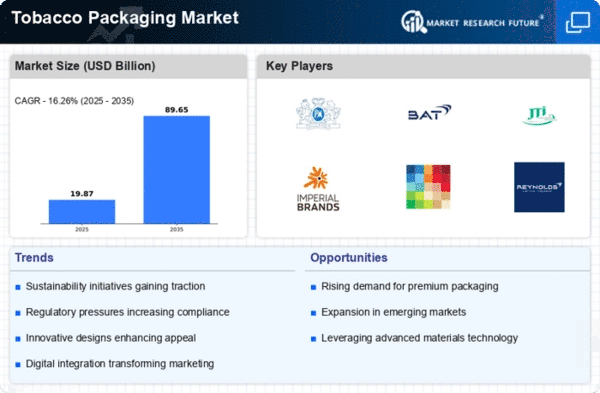
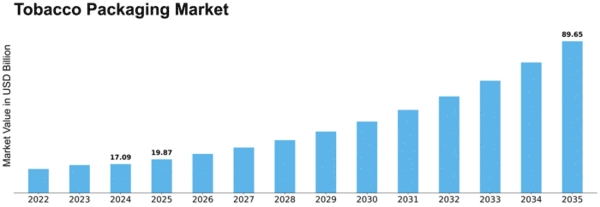
As per MRFR analysis, the Tobacco Packaging Market Size was estimated at 17.09 USD Billion in 2024. The Tobacco Packaging industry is projected to grow from 19.87 USD Billion in 2025 to 89.65 USD Billion by 2035, exhibiting a compound annual growth rate (CAGR) of 16.26 during the forecast period 2025 - 2035.

Key Market Trends & Highlights

The Tobacco Packaging Market is experiencing a shift towards sustainability and regulatory compliance, driven by evolving consumer preferences.

  • North America remains the largest market for tobacco packaging, reflecting established consumer habits and preferences.
  • The Asia-Pacific region is identified as the fastest-growing market, indicating a surge in demand for innovative packaging solutions.
  • Cigarettes continue to dominate the market as the largest segment, while smokeless tobacco is emerging as the fastest-growing segment.
  • Sustainability initiatives and regulatory compliance are key drivers influencing the market's evolution, shaping packaging strategies across regions.

Market Size & Forecast

2024 Market Size 17.09 (USD Billion)
2035 Market Size 89.65 (USD Billion)
CAGR (2025 - 2035) 16.26%
Largest Regional Market Share in 2024 North America

Major Players

Philip Morris International (US), British American Tobacco (GB), Japan Tobacco International (JP), Imperial Brands (GB), Altria Group (US), Reynolds American (US), Swedish Match (SE), Dunhill (GB), Kraft Heinz (US)

Market Trends

The Tobacco Packaging Market is currently experiencing a dynamic evolution, driven by various factors including regulatory changes, consumer preferences, and technological advancements. As governments worldwide implement stricter packaging regulations aimed at reducing tobacco consumption, manufacturers are compelled to innovate their packaging solutions. This shift not only addresses compliance but also enhances brand visibility and consumer engagement. Furthermore, the growing emphasis on sustainability is prompting companies to explore eco-friendly materials and practices, which may reshape the competitive landscape of the market. In addition to regulatory influences, consumer behavior is shifting towards more personalized and aesthetically appealing packaging. This trend suggests that brands are increasingly focusing on design elements that resonate with their target audience. The integration of smart packaging technologies, such as QR codes and augmented reality features, is also gaining traction, potentially offering consumers interactive experiences. Overall, the Tobacco Packaging Market appears poised for transformation, with a blend of compliance, innovation, and consumer-centric strategies driving its future trajectory.

Sustainability Initiatives

The Tobacco Packaging Market is witnessing a notable shift towards sustainable practices. Companies are increasingly adopting eco-friendly materials and reducing plastic usage in their packaging. This trend reflects a broader societal push for environmental responsibility, as consumers become more conscious of their choices. Brands that prioritize sustainability may enhance their reputation and appeal to a growing demographic that values eco-conscious products.

Regulatory Compliance

Regulatory frameworks surrounding tobacco packaging are becoming more stringent. Governments are implementing measures that mandate specific labeling, health warnings, and standardized packaging. This trend compels manufacturers to adapt their packaging strategies to ensure compliance while maintaining brand identity. The focus on regulatory adherence may lead to innovations in packaging design and materials.

Technological Integration

The integration of technology into packaging solutions is emerging as a significant trend within the Tobacco Packaging Market. Smart packaging features, such as QR codes and augmented reality, are being utilized to engage consumers and provide additional product information. This technological advancement not only enhances the consumer experience but also allows brands to differentiate themselves in a competitive market.

Tobacco Packaging Market Market Drivers

Market Growth Projections

The Global Tobacco Packaging Market Industry is poised for growth, with projections indicating a market value of 30.2 USD Billion in 2024 and an anticipated increase to 38.5 USD Billion by 2035. This growth trajectory suggests a compound annual growth rate of 2.22% from 2025 to 2035. Factors contributing to this growth include regulatory compliance, sustainability initiatives, and technological advancements. As the industry adapts to these dynamics, it is likely to witness increased investment in innovative packaging solutions that cater to evolving consumer preferences and regulatory demands.

Changing Consumer Preferences

Changing consumer preferences are a significant driver in the Global Tobacco Packaging Market Industry. There is a noticeable shift towards premium and differentiated products, with consumers seeking unique packaging that reflects their personal identity and lifestyle. This trend is evident in the rise of limited edition packaging and collaborations with artists. Such strategies not only enhance brand loyalty but also attract new customers. As the market adapts to these evolving preferences, it is expected to maintain a steady growth trajectory, contributing to the overall market value projected at 30.2 USD Billion in 2024.

Globalization and Market Expansion

Globalization plays a crucial role in the Global Tobacco Packaging Market Industry. As companies expand their reach into emerging markets, they encounter diverse consumer preferences and regulatory environments. This necessitates tailored packaging solutions that resonate with local cultures while adhering to international standards. For instance, brands entering Asian markets often modify their packaging to align with regional tastes and preferences. This strategic approach not only facilitates market entry but also enhances brand visibility. The industry's expansion efforts are anticipated to drive growth, with projections indicating a market value of 38.5 USD Billion by 2035.

Technological Advancements in Packaging

Technological advancements are reshaping the Global Tobacco Packaging Market Industry. Innovations such as smart packaging, which incorporates QR codes and augmented reality, enhance consumer engagement and provide information on product authenticity. These technologies are particularly appealing to younger demographics who value transparency and interactivity. Furthermore, automation in packaging processes improves efficiency and reduces costs for manufacturers. As the industry embraces these technologies, it is likely to experience a compound annual growth rate of 2.22% from 2025 to 2035, reflecting the positive impact of technological integration.

Sustainability and Eco-Friendly Packaging

Sustainability is becoming a pivotal driver in the Global Tobacco Packaging Market Industry. As consumers become more environmentally conscious, tobacco companies are exploring eco-friendly packaging solutions. This shift includes the use of biodegradable materials and recyclable packaging designs. For example, some brands are now utilizing plant-based inks and sustainable paper sources. This trend not only aligns with consumer preferences but also addresses regulatory pressures regarding environmental impact. The market's growth trajectory suggests a potential increase to 38.5 USD Billion by 2035, indicating a robust demand for sustainable packaging options.

Regulatory Compliance and Packaging Innovations

The Global Tobacco Packaging Market Industry is increasingly influenced by stringent regulations aimed at reducing tobacco consumption. Governments worldwide are implementing packaging requirements that mandate graphic health warnings and plain packaging. For instance, Australia has led the way with its plain packaging laws, which have been adopted by several countries. This regulatory landscape compels manufacturers to innovate in packaging design while ensuring compliance. As a result, the market is projected to reach 30.2 USD Billion in 2024, reflecting the industry's adaptation to these evolving regulations.

Market Segment Insights

By Application: Cigarettes (Largest) vs. Smokeless Tobacco (Fastest-Growing)

In the Tobacco Packaging Market, cigarettes hold the largest share, commanding significant attention from manufacturers due to their enduring popularity. The market is characterized by a diverse range of packaging solutions tailored to maintain product freshness while enhancing consumer appeal. Following cigarettes, cigars and smokeless tobacco products present notable shares, each appealing to distinct consumer demographics and preferences. This segmentation allows for targeted marketing strategies and specialized packaging innovations to emerge, driving competitiveness in the market. Despite cigarettes being the dominant segment, smokeless tobacco is rapidly gaining traction, reflecting changing consumer preferences and a shift towards products perceived as less harmful. The growth of smokeless tobacco can be attributed to heightened awareness of health concerns associated with traditional smoking and increasing interest in alternatives that are deemed less harmful. Innovations in packaging designs that emphasize convenience and aesthetics further support this trend, positioning smokeless tobacco as a compelling choice among younger consumers.

Cigarettes: Dominant vs. Smokeless Tobacco: Emerging

Cigarettes, traditionally the cornerstone of the tobacco market, are recognized for their strong brand loyalty and extensive distribution channels. The segment is heavily invested in maintaining market share through innovative packaging that emphasizes safety, quality, and branding. On the other hand, smokeless tobacco represents an emerging segment with rapidly evolving consumer preferences. As health trends continue to influence tobacco consumption, smokeless tobacco is experiencing increased acceptance. Packaging solutions for this segment focus on discreetness and portability, appealing to a newer generation of consumers seeking both convenience and flavor variety. The contrast between these segments highlights the dynamic nature of the tobacco packaging landscape, where established products coexist with innovative alternatives, reflecting broader shifts in consumer behavior.

By Material Type: Plastic (Largest) vs. Paper (Fastest-Growing)

In the Tobacco Packaging Market, plastics dominate the material type segment, offering significant advantages in flexibility, barrier properties, and lightweight characteristics, allowing manufacturers to enhance convenience and usability. Meanwhile, paper holds a notable position as the fastest-growing segment, driven by increasing environmental concerns and a shift toward sustainable packaging practices among consumers. As companies turn to eco-friendly materials, paper packaging is gaining traction, reflecting a broader trend toward sustainability in the tobacco industry.

Material: Plastic (Dominant) vs. Paper (Emerging)

Plastic packaging remains the dominant material type in the Tobacco Packaging Market due to its excellent barrier properties, lightweight nature, and cost-effectiveness, which appeal to both manufacturers and consumers. However, the paper segment is rapidly emerging, propelled by a growing desire for sustainable and biodegradable options in the industry. Paper packaging appeals to environmentally-conscious consumers and brands looking to reduce their carbon footprint. This shift not only reflects changing consumer preferences but also encourages innovation in packaging designs, as manufacturers aim to blend aesthetic appeal with eco-friendly materials, underscoring a significant transformation in how tobacco products are packaged.

By Closure Type: Flip Top (Largest) vs. Slide Open (Fastest-Growing)

In the Tobacco Packaging Market, the closure type segment exhibits a diverse distribution of preferences among consumers. The Flip Top closure remains the most prevalent choice, favored for its convenience and ease of use, holding a significant portion of the market share. In contrast, the Slide Open closure type has been gaining traction rapidly, appealing particularly to younger demographics who appreciate innovative and user-friendly designs. This shift reflects the evolving consumer preferences that favor functionality alongside traditional designs.

Closure Type: Flip Top (Dominant) vs. Slide Open (Emerging)

The Flip Top closure type is well-established in the Tobacco Packaging Market, catering to consumers' desire for practical and accessible packaging solutions. Its design allows for quick access to tobacco products, making it a staple among various brands. On the other hand, the Slide Open closure is emerging as a competitor by introducing a novel approach to packaging that enhances user experience. This closure type resonates particularly with the modern consumer, who values creativity and ease of interaction with product packaging. The growing interest in Slide Open closures reflects a broader trend towards innovation in tobacco packaging, emphasizing the need for brands to adapt to changing consumer expectations.

By Design Type: Printed (Largest) vs. Laminated (Fastest-Growing)

In the Tobacco Packaging Market, the 'Design Type' segment is carved into several key categories, including Printed, Embossed, Laminated, and Coated. Of these, Printed is currently the largest design type, holding a significant share due to its popularity in branding and visual appeal. Laminated packaging is emerging as a strong contender, experiencing rapid growth as manufacturers seek enhanced protection and moisture resistance for tobacco products. The demand for innovative designs that attract consumer attention fuels this distribution among design types.

Printed (Dominant) vs. Laminated (Emerging)

Printed packaging dominates the Tobacco Packaging Market, effectively capturing consumer interest with vibrant visuals and branding that resonate with target audiences. Its ability to convey information and stimulate customer engagement makes it the preferred choice for many brands. On the other hand, Laminated packaging represents the emerging trend, driven by the need for superior protection of contents and a longer shelf life. Its growing preference stems from consumers' increasing awareness of product quality and sustainability, leading to a noticeable shift in packaging strategies. The versatility of Laminated materials allows for creative designs while ensuring compliance with regulatory standards.

By End Use: Retail (Largest) vs. Online Sales (Fastest-Growing)

In the Tobacco Packaging Market, the segment distribution is characterized by three primary end uses: Retail, Wholesale, and Online Sales. Among these, the Retail segment holds the largest market share, benefiting from established consumer purchasing patterns and widespread access to tobacco products. Retail outlets serve as the primary channel for consumers, providing a range of products and immediate availability, thus dominating the market dynamics. Meanwhile, the Online Sales segment, while smaller in comparison, is emerging as a formidable player, driven by the increasing shift towards digital shopping and convenience.

Retail (Dominant) vs. Online Sales (Emerging)

The Retail segment is predominantly characterized by traditional brick-and-mortar stores, which have long been the cornerstone of tobacco sales, fostering brand loyalty and trust among consumers. Retail locations often provide a comprehensive selection of tobacco packaging solutions designed to meet customer preferences, making it a dominant force in the market. On the other hand, Online Sales, while considered emerging, are rapidly gaining traction due to the rise of e-commerce and preferences for discreet shopping experiences. This segment offers consumers a wider variety of packaging choices and often features direct-to-consumer shipping options, appealing particularly to younger demographics who prefer online purchasing.

Get more detailed insights about Tobacco Packaging Market Research Report – Forecast to 2035

Regional Insights

North America : Market Leader in Tobacco Packaging

North America continues to lead the Tobacco Packaging Market, holding a significant share of 6.83 in 2024. The region's growth is driven by increasing consumer demand for innovative packaging solutions and stringent regulations aimed at reducing tobacco consumption. The presence of major players like Philip Morris International and Altria Group further fuels market expansion, as they invest in sustainable packaging technologies and compliance with evolving regulations. The competitive landscape in North America is characterized by a few dominant companies, including British American Tobacco and Reynolds American. These firms are focusing on product differentiation and sustainability to capture market share. The U.S. remains the largest market, supported by a robust distribution network and a growing trend towards premium packaging. As regulations tighten, companies are adapting their strategies to meet compliance while maintaining profitability.

Europe : Regulatory Challenges and Innovations

Europe's Tobacco Packaging Market, valued at 5.12, is shaped by stringent regulations and a growing emphasis on health awareness. The EU's Tobacco Products Directive mandates specific packaging requirements, including graphic health warnings, which drive innovation in packaging design. This regulatory environment is a key growth driver, pushing companies to develop compliant yet appealing packaging solutions that resonate with consumers. Leading countries in this region include the UK, Germany, and France, where major players like British American Tobacco and Imperial Brands are actively competing. The market is characterized by a mix of traditional and innovative packaging solutions, with a notable shift towards eco-friendly materials. As companies navigate regulatory challenges, they are also exploring new technologies to enhance consumer engagement and brand loyalty.

Asia-Pacific : Emerging Markets and Growth Potential

The Asia-Pacific region, with a market size of 4.0, is witnessing rapid growth in the Tobacco Packaging Market, driven by increasing tobacco consumption and urbanization. Countries like Japan and China are leading this trend, with a growing middle class that demands premium packaging options. Regulatory frameworks are evolving, but the region still presents significant opportunities for market expansion, particularly in developing economies where tobacco use remains prevalent. Key players such as Japan Tobacco International and Swedish Match are strategically positioning themselves to capitalize on this growth. The competitive landscape is diverse, with both multinational corporations and local firms vying for market share. As consumer preferences shift towards more sophisticated packaging, companies are investing in innovative designs and sustainable materials to meet demand and regulatory requirements.

Middle East and Africa : Untapped Potential in Tobacco Sector

The Middle East and Africa (MEA) region, with a market size of 1.14, presents untapped potential in the Tobacco Packaging Market. The growth is driven by increasing tobacco consumption and a young population that is becoming more brand-conscious. Regulatory frameworks are still developing, which allows for flexibility in packaging solutions, although health concerns are beginning to influence market dynamics. Countries like South Africa and Egypt are at the forefront of this market, with local and international players such as Imperial Brands and British American Tobacco actively participating. The competitive landscape is evolving, with companies focusing on innovative packaging designs that cater to local preferences. As the market matures, there is a growing emphasis on sustainability and compliance with emerging regulations, which will shape future growth.

Key Players and Competitive Insights

The Tobacco Packaging Market is currently characterized by a dynamic competitive landscape, driven by evolving consumer preferences and regulatory pressures. Major players such as Philip Morris International (US), British American Tobacco (GB), and Japan Tobacco International (JP) are actively reshaping their strategies to adapt to these changes. Philip Morris International (US) has been focusing on innovation, particularly in developing sustainable packaging solutions that align with its commitment to reducing environmental impact. British American Tobacco (GB) appears to be pursuing a strategy of regional expansion, enhancing its presence in emerging markets, while Japan Tobacco International (JP) is concentrating on digital transformation to streamline operations and improve customer engagement. Collectively, these strategies indicate a shift towards sustainability and technological integration, which is likely to intensify competition in the market.In terms of business tactics, companies are increasingly localizing manufacturing to reduce costs and enhance supply chain efficiency. The market structure is moderately fragmented, with several key players exerting considerable influence. This fragmentation allows for niche players to emerge, yet the dominance of established companies like Altria Group (US) and Reynolds American (US) ensures that competition remains robust. The collective influence of these key players shapes market dynamics, as they leverage their resources to optimize operations and respond to regulatory changes.

In November Philip Morris International (US) announced a partnership with a leading sustainable materials company to develop biodegradable packaging solutions. This strategic move underscores the company's commitment to sustainability and positions it favorably in a market increasingly focused on environmental responsibility. The collaboration is expected to enhance Philip Morris's product appeal among environmentally conscious consumers, potentially leading to increased market share.

In October British American Tobacco (GB) launched a new line of premium tobacco products packaged in recyclable materials. This initiative not only aligns with global sustainability trends but also caters to the growing demand for eco-friendly products. By adopting this approach, British American Tobacco aims to differentiate itself in a competitive market, appealing to consumers who prioritize sustainability in their purchasing decisions.

In September Japan Tobacco International (JP) unveiled a digital platform designed to enhance customer interaction and streamline the purchasing process. This platform is expected to leverage AI technology to provide personalized recommendations, thereby improving customer satisfaction and loyalty. The introduction of such digital solutions indicates a broader trend towards integrating technology into traditional markets, which may redefine consumer engagement strategies.

As of December the Tobacco Packaging Market is witnessing significant trends such as digitalization, sustainability, and AI integration. Strategic alliances are increasingly shaping the competitive landscape, as companies collaborate to enhance their technological capabilities and sustainability efforts. Looking ahead, competitive differentiation is likely to evolve from traditional price-based competition to a focus on innovation, technology, and supply chain reliability. This shift suggests that companies that prioritize sustainable practices and technological advancements will be better positioned to thrive in an increasingly competitive environment.

Key Companies in the Tobacco Packaging Market include

Industry Developments

  • Q4 2024: Binhao (Guangzhou) Packaging Materials Co., Ltd. launches new line of Heat‑Not‑Burn (HNB) tobacco packaging materials in China Binhao (Guangzhou) Packaging Materials Co., Ltd. announced the launch of a new line of Heat‑Not‑Burn (HNB) tobacco packaging materials, including acetate filter rods, aluminum foil cigarette paper, plug wrap paper, tipping paper, and cardboard boxes, targeting the growing HNB segment in China.

Future Outlook

Tobacco Packaging Market Future Outlook

The Tobacco Packaging Market is projected to grow at a 16.26% CAGR from 2024 to 2035, driven by innovation in sustainable materials and regulatory changes.

New opportunities lie in:

  • Development of biodegradable packaging solutions to meet sustainability demands.
  • Integration of smart packaging technologies for enhanced consumer engagement.
  • Expansion into emerging markets with tailored packaging designs.

By 2035, the market is expected to achieve substantial growth, driven by innovation and strategic adaptations.

Market Segmentation

Tobacco Packaging Market End Use Outlook

  • Retail
  • Wholesale
  • Online Sales

Tobacco Packaging Market Application Outlook

  • Cigarettes
  • Cigars
  • Pipes
  • Smokeless Tobacco

Tobacco Packaging Market Design Type Outlook

  • Printed
  • Embossed
  • Laminated
  • Coated

Tobacco Packaging Market Closure Type Outlook

  • Flip Top
  • Slide Open
  • Screw Cap
  • Seal

Tobacco Packaging Market Material Type Outlook

  • Plastic
  • Paper
  • Metal
  • Glass

Report Scope

MARKET SIZE 202417.09(USD Billion)
MARKET SIZE 202519.87(USD Billion)
MARKET SIZE 203589.65(USD Billion)
COMPOUND ANNUAL GROWTH RATE (CAGR)16.26% (2025 - 2035)
REPORT COVERAGERevenue Forecast, Competitive Landscape, Growth Factors, and Trends
BASE YEAR2024
Market Forecast Period2025 - 2035
Historical Data2019 - 2024
Market Forecast UnitsUSD Billion
Key Companies ProfiledPhilip Morris International (US), British American Tobacco (GB), Japan Tobacco International (JP), Imperial Brands (GB), Altria Group (US), Reynolds American (US), Swedish Match (SE), Dunhill (GB), Kraft Heinz (US)
Segments CoveredApplication, Material Type, Closure Type, Design Type, End Use
Key Market OpportunitiesAdoption of sustainable materials in Tobacco Packaging Market driven by regulatory changes and consumer preferences.
Key Market DynamicsEvolving regulatory frameworks and consumer preferences drive innovation in sustainable tobacco packaging solutions.
Countries CoveredNorth America, Europe, APAC, South America, MEA

FAQs

What is the expected market size of the Global Tobacco Packaging Market in 2024?

The Global Tobacco Packaging Market is expected to be valued at 30.24 USD Billion in 2024.

What is the projected market growth rate for the Global Tobacco Packaging Market from 2025 to 2035?

Tobacco Packaging Market is projected to register a CAGR of 16.26% from 2025-2035

Which region is projected to have the largest market share in the Global Tobacco Packaging Market by 2035?

North America is projected to have the largest market share at 13.5 USD Billion by 2035.

What are the expected market values for flexible packaging in the Global Tobacco Packaging Market by 2035?

The market value for flexible packaging is expected to reach 17.0 USD Billion by 2035.

Who are the key players in the Global Tobacco Packaging Market?

Key players include Bemis Company, Amcor, Japan Tobacco International, Philip Morris International, and British American Tobacco.

What is the anticipated market size for Europe in the Global Tobacco Packaging Market by 2035?

Europe is anticipated to have a market size of 11.0 USD Billion by 2035.

What is the market value for labeling in the Global Tobacco Packaging Market for the year 2024?

The market value for labeling is estimated to be 6.24 USD Billion in 2024.

What opportunities exist in the Global Tobacco Packaging Market in the coming years?

Emerging trends and innovations in sustainable packaging present significant opportunities in the Global Tobacco Packaging Market.

What is the projected market size for South America in the Global Tobacco Packaging Market by 2035?

The market size for South America is expected to reach 4.0 USD Billion by 2035.

  1. SECTION I: EXECUTIVE SUMMARY AND KEY HIGHLIGHTS
    1. | 1.1 EXECUTIVE SUMMARY
  2. SECTION II: SCOPING, METHODOLOGY AND MARKET STRUCTURE
    1. | 2.1 MARKET INTRODUCTION
    2. | 2.2 RESEARCH METHODOLOGY
  3. SECTION III: QUALITATIVE ANALYSIS
    1. | 3.1 MARKET DYNAMICS
    2. | 3.2 MARKET FACTOR ANALYSIS
  4. SECTION IV: QUANTITATIVE ANALYSIS
    1. | 4.1 Packaging & Transport, BY Application (USD Billion)
    2. | 4.2 Packaging & Transport, BY Material Type (USD Billion)
    3. | 4.3 Packaging & Transport, BY Closure Type (USD Billion)
    4. | 4.4 Packaging & Transport, BY Design Type (USD Billion)
    5. | 4.5 Packaging & Transport, BY End Use (USD Billion)
    6. | 4.6 Packaging & Transport, BY Region (USD Billion)
  5. SECTION V: COMPETITIVE ANALYSIS
    1. | 5.1 Competitive Landscape
    2. | 5.2 Company Profiles
    3. | 5.3 Appendix

Tobacco Packaging Market Segmentation

Market Segmentation Overview

  • Detailed segmentation data will be available in the full report
  • Comprehensive analysis by multiple parameters
  • Regional and country-level breakdowns
  • Market size forecasts by segment
Infographic

Free Sample Request

Kindly complete the form below to receive a free sample of this Report

Get Free Sample

Customer Strories

Compare Licence

×
Features License Type
Single User Multiuser License Enterprise User
Price $4,950 $5,950 $7,250
Maximum User Access Limit 1 User Upto 10 Users Unrestricted Access Throughout the Organization
Free Customization
Direct Access to Analyst
Deliverable Format
Platform Access
Discount on Next Purchase 10% 15% 15%
Printable Versions