
Request Free Sample ×

Kindly complete the form below to receive a free sample of this Report

* Please use a valid business email

Leading companies partner with us for data-driven Insights

clients tt-cursor
Hero Background
English
Chinese
French
Japanese
Korean
German
Spanish

Tire Changing Machines Market Trends

ID: MRFR/AT/11179-HCR
128 Pages
Shubham Munde
Last Updated: April 06, 2026

Tire Changing Machines Market Research Report Information By Machine Type (Manual, Semi-Automatic and Fully Automatic), By Vehicle Type (Passenger Cars, Light Commercial Vehicles, Heavy-Duty Vehicles and Motorcycles), By End User (Automotive Service Centers, Vehicle Dealerships, Commercial Fleets and Repair Shops) And By Region (North America, Europe, Asia-Pacific, And Rest Of The World) –Market Forecast Till 2035

Share:
Download PDF ×

We do not share your information with anyone. However, we may send you emails based on your report interest from time to time. You may contact us at any time to opt-out.

Tire Changing Machines Market Infographic
Purchase Options

Market Trends

Key Emerging Trends in the Tire Changing Machines Market

The market trends for tire-changing machines have experienced notable shifts in recent years, influenced by advancements in technology, changing automotive landscapes, and a growing emphasis on efficiency and safety in tire maintenance. One prominent trend in the tire-changing machine market is the integration of automation and smart technologies. Manufacturers are incorporating features such as touch-screen interfaces, automatic positioning systems, and sensors to enhance the precision and speed of tire-changing processes. These advancements not only reduce the manual effort required but also contribute to a more streamlined and user-friendly experience for automotive service providers.

The increasing complexity of modern vehicle tires has led to a demand for tire-changing machines capable of handling a diverse range of tire sizes and types. As vehicles evolve with innovations like run-flat tires and low-profile designs, tire-changing machines need to adapt accordingly. Manufacturers are responding to this trend by developing versatile machines equipped with adjustable clamps, advanced bead-breaking mechanisms, and customizable settings to accommodate various tire specifications. This flexibility ensures that automotive service centers can efficiently address the changing demands of the market.

Another significant trend in the tire-changing machine market is the focus on ergonomics and user-friendly designs. Recognizing the importance of operator comfort and safety, manufacturers are incorporating features such as ergonomic controls, easy-to-use interfaces, and automated lifting systems. These design elements not only enhance the efficiency of tire-changing processes but also contribute to a safer working environment, reducing the risk of injuries and improving overall workplace productivity.

Environmental sustainability is emerging as a key consideration in the tire-changing machine market. Manufacturers are exploring eco-friendly materials, energy-efficient technologies, and recycling initiatives to minimize the environmental impact of their products. Additionally, there is a growing interest in developing tire-changing machines that optimize the use of resources, such as lubricants and consumables, to align with global sustainability goals and promote environmentally conscious practices within the automotive service industry.

The tire-changing machine market is witnessing a rise in demand for mobile and compact solutions. Automotive service providers, including mobile tire service operators and garages with limited space, seek portable and space-saving tire-changing machines that offer the flexibility to operate in various settings. Compact machines equipped with advanced features provide a practical solution for on-the-go tire services, catering to the evolving needs of both professional service providers and individual car owners.

Integration with digital platforms and connectivity is becoming increasingly prevalent in the tire-changing machine market. Manufacturers are developing machines that can be connected to diagnostic tools, software applications, and cloud-based platforms. This connectivity enables real-time monitoring, remote diagnostics, and data analysis, facilitating predictive maintenance and enhancing the overall efficiency of tire service operations. The digital integration also allows service providers to access machine performance data, track usage patterns, and optimize maintenance schedules for improved operational efficiency.

Government regulations and industry standards are influencing market trends in the tire-changing machine sector. As safety and environmental concerns take center stage, manufacturers are aligning their products with regulatory requirements and industry standards. This includes the development of tire-changing machines that comply with safety protocols, emissions standards, and energy efficiency regulations, ensuring that the equipment meets the necessary criteria for use in automotive service facilities.

The market trends for tire-changing machines reflect a dynamic landscape shaped by technological innovations, changing automotive dynamics, and a growing emphasis on sustainability and efficiency. From the integration of automation and smart technologies to a focus on user-friendly designs, environmental sustainability, and digital connectivity, tire-changing machines are evolving to meet the diverse needs of the automotive service industry. As the industry continues to advance, tire-changing machines are likely to play a pivotal role in enhancing the efficiency, safety, and environmental responsibility of tire maintenance processes across the automotive sector.


Author
Author Profile
Shubham Munde
Team Lead - Research

Shubham brings over 7 years of expertise in Market Intelligence and Strategic Consulting, with a strong focus on the Automotive, Aerospace, and Defense sectors. Backed by a solid foundation in semiconductors, electronics, and software, he has successfully delivered high-impact syndicated and custom research on a global scale. His core strengths include market sizing, forecasting, competitive intelligence, consumer insights, and supply chain mapping. Widely recognized for developing scalable growth strategies, Shubham empowers clients to navigate complex markets and achieve a lasting competitive edge. Trusted by start-ups and Fortune 500 companies alike, he consistently converts challenges into strategic opportunities that drive sustainable growth.

Leave a Comment

FAQs

What is the projected market valuation for the Tire Changing Machines Market in 2035?

<p>The projected market valuation for the Tire Changing Machines Market in 2035 is 0.9231 USD Billion.</p>

What was the overall market valuation for the Tire Changing Machines Market in 2024?

<p>The overall market valuation for the Tire Changing Machines Market in 2024 was 0.5628 USD Billion.</p>

What is the expected CAGR for the Tire Changing Machines Market from 2025 to 2035?

<p>The expected CAGR for the Tire Changing Machines Market during the forecast period 2025 - 2035 is 4.6%.</p>

Which company is a key player in the Tire Changing Machines Market?

<p>Key players in the Tire Changing Machines Market include Hofmann, Hunter Engineering, and Snap-on.</p>

What are the segment valuations for Fully Automatic tire changing machines?

<p>The segment valuation for Fully Automatic tire changing machines was 0.225 USD Billion in 2024 and is projected to reach 0.3861 USD Billion by 2035.</p>

How do the valuations for Passenger Cars compare to Light Commercial Vehicles in the Tire Changing Machines Market?

<p>In 2024, the valuation for Passenger Cars was 0.2251 USD Billion, while for Light Commercial Vehicles, it was 0.1126 USD Billion.</p>

What is the market valuation for Automotive Service Centers in 2024?

The market valuation for Automotive Service Centers in 2024 was 0.2251 USD Billion.

What is the projected growth for Semi-Automatic tire changing machines from 2024 to 2035?

The valuation for Semi-Automatic tire changing machines is expected to grow from 0.2252 USD Billion in 2024 to 0.358 USD Billion by 2035.

Which end user segment is expected to show growth in the Tire Changing Machines Market?

The Automotive Service Centers segment is expected to show growth, with a valuation increase from 0.2251 USD Billion in 2024 to 0.367 USD Billion by 2035.

What was the valuation for Heavy-Duty Vehicles in the Tire Changing Machines Market in 2024?

The valuation for Heavy-Duty Vehicles in the Tire Changing Machines Market was 0.1126 USD Billion in 2024.

Market Summary

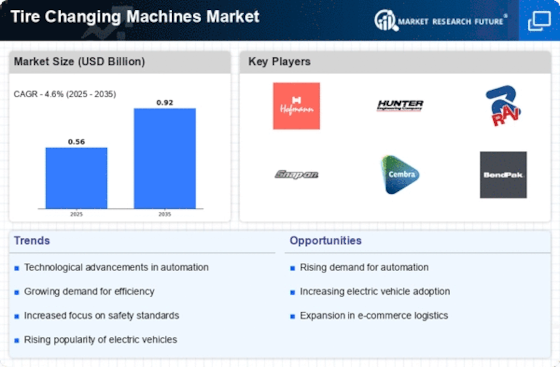
As per Market Research Future analysis, the Tire Changing Machines Market Size was estimated at 0.5628 USD Billion in 2024. The Tire Changing Machines industry is projected to grow from USD 0.5887 Billion in 2025 to USD 0.9231 Billion by 2035, exhibiting a compound annual growth rate (CAGR) of 4.6% during the forecast period 2025 - 2035

Key Market Trends & Highlights

The Tire Changing Machines Market is experiencing robust growth driven by technological advancements and increasing vehicle ownership.

  • Technological advancements are reshaping the Tire Changing Machines Market, enhancing efficiency and user experience. North America remains the largest market, while the Asia-Pacific region is recognized as the fastest-growing area for tire changing solutions. Fully automatic tire changing machines dominate the market, whereas manual machines are witnessing the fastest growth due to their cost-effectiveness. Rising vehicle ownership rates and the growing popularity of electric vehicles are key drivers propelling market expansion.

Market Size & Forecast

2024 Market Size 0.5628 (USD Billion)
2035 Market Size 0.9231 (USD Billion)
CAGR (2025 - 2035) 4.6%
Largest Regional Market Share in 2024 North America

Major Players

Hofmann (DE), Hunter Engineering (US), Ravaglioli (IT), Snap-on (US), Cemb (IT), BendPak (US), SICE (IT), Teco (IT), Corghi (IT)

Market Trends

The Tire Changing Machines Market is currently experiencing a notable evolution, driven by advancements in technology and increasing demand for efficient automotive services. As vehicles become more complex, the need for specialized equipment that can handle various tire types and sizes is becoming increasingly apparent. This market appears to be influenced by a growing emphasis on automation and user-friendly designs, which may enhance operational efficiency and reduce labor costs. Furthermore, the rise in electric vehicles is likely to create new opportunities for tire changing solutions that cater to unique specifications and requirements. In addition to technological advancements, the Tire Changing Machines Market is also shaped by changing consumer preferences and the expansion of the automotive service industry. As more consumers seek quick and reliable tire services, businesses are compelled to invest in modern tire changing equipment that can meet these expectations. This trend suggests a shift towards more versatile machines that can accommodate a wider range of tire sizes and types, potentially leading to increased market competition. Overall, the Tire Changing Machines Market appears poised for growth, with various factors indicating a dynamic landscape that could evolve in the coming years.

Technological Advancements

The Tire Changing Machines Market is witnessing a surge in technological innovations, particularly in automation and smart features. These advancements are designed to enhance efficiency and precision, allowing for quicker tire changes and reduced manual labor.

Growing Demand for Electric Vehicles

As the automotive industry shifts towards electric vehicles, the Tire Changing Machines Market is adapting to meet the specific needs of these vehicles. This trend indicates a potential for new machine designs that cater to the unique requirements of electric vehicle tires.

Increased Focus on User Experience

There is a noticeable trend towards creating user-friendly tire changing machines that simplify operations for technicians. This focus on user experience may lead to the development of machines that are easier to operate and maintain, thereby attracting more businesses.

Tire Changing Machines Market Market Drivers

Rising Vehicle Ownership Rates

The Tire Changing Machines Market is significantly influenced by the rising rates of vehicle ownership across various regions. As more individuals acquire vehicles, the demand for tire maintenance services, including tire changing, is expected to increase. Recent statistics indicate that vehicle ownership has surged by approximately 15% over the past five years, leading to a higher volume of tire-related services. This trend is particularly evident in urban areas where the number of service stations is also on the rise. Consequently, tire changing machine manufacturers are likely to see a boost in demand for their products as service providers seek to enhance their operational capabilities. This growing vehicle ownership trend is poised to be a key driver in the expansion of the Tire Changing Machines Market.

Increased Focus on Safety Standards

The Tire Changing Machines Market is also being propelled by an increased focus on safety standards within the automotive service sector. Regulatory bodies are implementing stricter guidelines regarding tire maintenance and safety, which necessitates the use of advanced tire changing equipment. Service centers are now required to adhere to these regulations to ensure the safety of their operations and customers. As a result, there is a growing demand for high-quality tire changing machines that meet these safety standards. Data suggests that compliance with safety regulations can reduce workplace accidents by up to 40%, prompting service providers to invest in better equipment. This heightened emphasis on safety is likely to drive the growth of the Tire Changing Machines Market as businesses strive to meet regulatory requirements.

Expansion of Automotive Service Centers

The Tire Changing Machines Market is benefiting from the expansion of automotive service centers, which are increasingly offering comprehensive tire services. As consumer preferences shift towards one-stop service solutions, more service centers are incorporating tire changing capabilities into their offerings. This trend is supported by data indicating that the number of automotive service centers has increased by 20% in the last three years. Consequently, the demand for efficient and reliable tire changing machines is on the rise, as these centers seek to enhance their service portfolios. The expansion of service centers not only increases the market for tire changing machines but also encourages manufacturers to innovate and improve their product lines to meet the evolving needs of these businesses. This dynamic is likely to play a crucial role in shaping the future of the Tire Changing Machines Market.

Growing Popularity of Electric Vehicles

The Tire Changing Machines Market is witnessing a shift in demand patterns due to the growing popularity of electric vehicles (EVs). As the market for EVs expands, there is a corresponding need for specialized tire changing equipment that can accommodate the unique specifications of electric vehicles. Recent reports indicate that the sales of electric vehicles have increased by over 25% annually, prompting tire service providers to adapt their offerings. This shift necessitates the development of tire changing machines that can handle the specific requirements of EV tires, which often differ from traditional tires. As manufacturers respond to this trend by innovating their product lines, the Tire Changing Machines Market is likely to experience significant growth driven by the evolving landscape of the automotive sector.

Technological Advancements in Tire Changing Machines

The Tire Changing Machines Market is experiencing a notable transformation due to rapid technological advancements. Innovations such as automated tire changers and advanced diagnostic systems are enhancing efficiency and precision in tire changing processes. These machines are increasingly equipped with features like touch-screen interfaces and integrated software that streamline operations. According to recent data, the adoption of automated systems has led to a 30% reduction in labor costs for tire service centers. Furthermore, the integration of artificial intelligence in tire changing machines is expected to improve accuracy in tire fitting, thereby reducing the risk of damage. As these technologies continue to evolve, they are likely to attract more businesses to invest in modern tire changing solutions, thereby driving growth in the Tire Changing Machines Market.

Market Segment Insights

By Machine Type: Fully Automatic (Largest) vs. Manual (Fastest-Growing)

<p>In the Tire Changing Machines Market, the distribution of machine types reveals that Fully Automatic machines hold the majority market share due to their efficiency and precision in operations. Semi-Automatic machines follow, catering to users looking for a balance between control and automation. Manual tire changing machines, once the standard, now represent a smaller portion of the market as users increasingly gravitate towards automated solutions.</p>

<p>Machine Type: Fully Automatic (Dominant) vs. Manual (Emerging)</p>

<p>Fully Automatic tire changing machines are characterized by advanced technology that minimizes human intervention, thus offering higher productivity and reduced labor costs. They appeal particularly to commercial service providers who prioritize speed and consistency. On the other hand, Manual machines are seeing a resurgence as many small businesses and individual users appreciate their lower initial investment and simplicity. While they require more physical effort, they provide flexibility in operations. This segment's growth can be attributed to a growing interest in DIY automotive services and cost sensitivity among various user segments.</p>

By Vehicle Type: Passenger Cars (Largest) vs. Heavy-Duty Vehicles (Fastest-Growing)

<p>In the Tire Changing Machines Market, the segmentation by vehicle type reveals a diversified distribution, with <a href="https://www.marketresearchfuture.com/reports/passenger-cars-market-42133" target="_blank" title="passenger cars">Passenger Cars</a> holding the largest share. This segment has consistently catered to the demands of individual consumers and repair shops, leading to a significant portion of the market. In contrast, the Heavy-Duty Vehicles segment is noted for its rapid expansion, driven by the increasing number of <a href="https://www.marketresearchfuture.com/reports/freight-and-logistics-market-8698" target="_blank" title="freight and logistics">freight and logistics</a> operations that require swift tire changing solutions to minimize downtime.</p>

<p>Passenger Cars (Dominant) vs. Heavy-Duty Vehicles (Emerging)</p>

<p>The Passenger Cars segment is characterized by its broad application in personal and fleet vehicles, leading to a substantial demand for tire changing machines that can handle varying tire sizes and specifications. This segment caters to both residential and commercial users, driving innovation in accessibility and ease of use. On the other hand, the Heavy-Duty Vehicles segment has emerged as a vital focus area, motivated by the rise in e-commerce and transport activities, necessitating specialized tire changing solutions that are robust and efficient. As businesses seek to maintain operational efficiency, the demand for machinery that can accommodate larger tires and heavier vehicles is on the rise, offering growth potential for manufacturers.</p>

By End User: Automotive Service Centers (Largest) vs. Commercial Fleets (Fastest-Growing)

<p>The Tire Changing Machines Market is significantly driven by the presence of Automotive Service Centers, which hold the largest share among various end users. These centers cater to a high volume of vehicle maintenance demands, leading to increased investment in efficient tire changing equipment. Following closely are Vehicle Dealerships and Repair Shops, which also contribute considerably, though to a lesser extent. Commercial Fleets are emerging as a notable segment, capitalizing on the increasing need for efficient tire management solutions to enhance operational efficiency. In terms of growth trends, Commercial Fleets are poised for rapid expansion, driven by the rise in logistics and transportation services, which necessitate effective tire maintenance to ensure vehicle uptime. Moreover, the focus on electric vehicle support within Automotive Service Centers fuel ongoing demand for advanced tire changing machines. As vehicle technology evolves, center owners are increasingly adopting automated systems, creating a competitive edge that elevates their market position further. These trends signify a promising outlook for the tire changing machines tailored for these end user segments.</p>

<p>Automotive Service Centers (Dominant) vs. Repair Shops (Emerging)</p>

<p>Automotive Service Centers have firmly established themselves as the dominant force in the Tire Changing Machines Market. They typically operate on a larger scale, offering a wide array of automotive services, which increases their reliance on advanced tire changing machines to cater to numerous customers efficiently. Their ability to invest in state-of-the-art equipment ensures they stay ahead in service quality and speed, accommodating various vehicle types, including electric and hybrid models. In contrast, Repair Shops, while smaller and often more focused on specific services, are emerging as significant players as they adapt to the growing demand for tire maintenance. Many are upgrading their equipment to include modern tire changing technology, seeing this as essential to improving service offerings and capturing a larger share of the market.</p>

Get more detailed insights about Tire Changing Machines Market Research Report—Global Forecast till 2035

Regional Insights

North America : Market Leader in Innovation

North America is the largest market for tire changing machines, holding approximately 40% of the global market share. The region's growth is driven by increasing vehicle ownership, advancements in automotive technology, and a growing emphasis on vehicle maintenance. Regulatory support for automotive safety standards further propels demand for efficient tire changing solutions. The U.S. and Canada are the primary contributors to this market, with a robust infrastructure supporting automotive services. The competitive landscape in North America is characterized by the presence of key players such as Hunter Engineering and Snap-on, which dominate the market with innovative products. The region also sees a growing trend towards automation and digital solutions in tire changing processes. As vehicle technology evolves, the demand for advanced tire changing machines is expected to rise, ensuring that North America remains at the forefront of this market.

Europe : Emerging Market with Regulations

Europe is witnessing significant growth in the tire changing machines market, accounting for approximately 30% of the global share. The region's growth is fueled by stringent regulations on vehicle safety and environmental standards, which drive demand for efficient tire maintenance solutions. Countries like Germany and Italy are leading the market, supported by a strong automotive industry and increasing consumer awareness regarding vehicle upkeep. The competitive landscape in Europe features key players such as Hofmann and Ravaglioli, which are known for their innovative tire changing solutions. The market is also characterized by a trend towards sustainability, with manufacturers focusing on eco-friendly technologies. As the automotive sector continues to evolve, the demand for advanced tire changing machines is expected to grow, positioning Europe as a key player in this market.

Asia-Pacific : Rapid Growth and Expansion

Asia-Pacific is rapidly emerging as a significant player in the tire changing machines market, holding around 25% of the global market share. The region's growth is driven by increasing vehicle production, rising disposable incomes, and a growing automotive aftermarket. Countries like China and India are at the forefront, with expanding automotive industries and a rising demand for efficient tire changing solutions to support their growing vehicle fleets. The competitive landscape in Asia-Pacific is becoming increasingly dynamic, with both local and international players vying for market share. Key manufacturers such as Cemb and BendPak are establishing a strong presence in the region. The market is also witnessing a shift towards automation and smart technologies, which are expected to enhance operational efficiency in tire changing processes. As the automotive sector continues to grow, the demand for advanced tire changing machines is set to rise significantly.

Middle East and Africa : Untapped Market Potential

The Middle East and Africa region is gradually emerging in the tire changing machines market, currently holding about 5% of the global market share. The growth is primarily driven by increasing vehicle ownership and a burgeoning automotive service sector. Countries like South Africa and the UAE are leading the way, with rising investments in automotive infrastructure and services, creating a favorable environment for tire changing machine manufacturers. The competitive landscape in this region is still developing, with opportunities for both local and international players. Key manufacturers are beginning to explore this market, recognizing the potential for growth. As the automotive industry expands, the demand for efficient tire changing solutions is expected to increase, making the Middle East and Africa a promising market for future investments.

Key Players and Competitive Insights

Leading market players are investing heavily in the research and development in order to expand their product lines, which will help the Tire Changing Machines Market grow even more. Market players are also undertaking a variety of strategic activities to spread their global footprint, with important market developments including mergers and acquisitions, new product launches, contractual agreements, higher investments, and collaboration with other organizations. To spread and survive in a more competitive and rising market climate, the Tire Changing Machines industry must offer cost-effective items.Manufacturing locally to minimize the operational costs is one of the key business tactics used by the manufacturers in the global Tire Changing Machines industry to benefit the clients and increase the market sector. In recent years, the Tire Changing Machines industry has offered some of the most significant advantages to automotive industries.Major players in the Tire Changing Machines Market, including Hunter Engineering Company, Coats Tire Equipment, Snap-On Incorporated, Bosch Automotive Service Solutions, Beissbarth GmbH, Hennessey Industries, NEXION SpA, Coburg Equipment Private Limited, RAVAmerica, Hoffmann Megaplan, and others, are trying to increase market demand by investing in the research and development operations.Snap-on Incorporated is an American company that designs, manufactures, and markets high-end tools and the equipment for professional use in various industries, with a focus on automotive repair. Founded in 1920, Snap-on is renowned for its innovative hand tools, power tools, tool storage solutions, and diagnostic equipment, serving professionals such as mechanics, technicians, and industrial workers. The company has a strong global presence and is known for its commitment to quality and precision in its products. Snap-on's products are often considered premium, targeting professionals who require reliable and durable tools for their work.The company operates in multiple segments, including the Snap-on Tools Group, Industrial, and Repair Systems and Information Group, offering a comprehensive range of products and services to its customers.
In October  Snap-on Incorporated announced that it had acquired Hofmann Megaplan, a leading manufacturer of tire changing machines and wheel balancers. This acquisition is expected to strengthen Snap-on's position in the global tire service equipment market.Coats is a well-known company that specializes in manufacturing tire-related equipment, including tire changers, wheel balancers, and other automotive service equipment. Coats has a long history in the industry and is recognized for its innovation and quality in providing solutions for tire and wheel service needs. However, for the most current and specific information about Coats Tire Equipment Company, I recommend checking their official website or contacting them directly for the latest updates on their products, services, and corporate developments.
In July  Coats Tire Equipment announced that it had acquired Coats Tire Canada, a leading distributor of tire changing machines and other tire service equipment in Canada. This acquisition is expected to expand Coats Tire Equipment's reach into the Canadian market.

Key Companies in the Tire Changing Machines Market include

Industry Developments

May 2023: Hunter Engineering Company announced that it had acquired Nussbaum Reifenmontagemaschinen GmbH, a leading manufacturer of tire changing machines and wheel balancers in Europe. This acquisition is expected to strengthen Hunter Engineering Company's position in the European tire service equipment market.

May 2023: Hofmann Megaplan announced a partnership with Mahle, a leading manufacturer of automotive parts and components. The partnership will focus on the development of new tire changing machines and other automotive equipment.

July 2023: Beissbarth announced a partnership with Continental, a leading manufacturer of tires and automotive parts. The partnership will focus on the development of new tire-changing machines for the automotive aftermarket.

Future Outlook

Tire Changing Machines Market Future Outlook

The Tire Changing Machines Market is projected to grow at a 4.6% CAGR from 2025 to 2035, driven by technological advancements, increasing vehicle ownership, and demand for efficient service solutions.

New opportunities lie in:

  • <p>Integration of AI-driven diagnostics for enhanced service efficiency. Expansion into emerging markets with tailored product offerings. Development of mobile tire changing units for on-site services.</p>

By 2035, the market is expected to be robust, reflecting sustained growth and innovation.

Market Segmentation

Tire Changing Machines Market End User Outlook

  • Automotive Service Centers
  • Vehicle Dealerships
  • Commercial Fleets
  • Repair Shops

Tire Changing Machines Market Machine Type Outlook

  • Manual
  • Semi-Automatic
  • Fully Automatic

Tire Changing Machines Market Vehicle Type Outlook

  • Passenger Cars
  • Light Commercial Vehicles
  • Heavy-Duty Vehicles
  • Motorcycles

Report Scope

MARKET SIZE 2024 0.5628(USD Billion)
MARKET SIZE 2025 0.5887(USD Billion)
MARKET SIZE 2035 0.9231(USD Billion)
COMPOUND ANNUAL GROWTH RATE (CAGR) 4.6% (2025 - 2035)
REPORT COVERAGE Revenue Forecast, Competitive Landscape, Growth Factors, and Trends
BASE YEAR 2024
Market Forecast Period 2025 - 2035
Historical Data 2019 - 2024
Market Forecast Units USD Billion
Key Companies Profiled Hofmann (DE), Hunter Engineering (US), Ravaglioli (IT), Snap-on (US), Cemb (IT), BendPak (US), SICE (IT), Teco (IT), Corghi (IT)
Segments Covered Machine Type, Vehicle Type, End User, Region
Key Market Opportunities Integration of automation and smart technology enhances efficiency in the Tire Changing Machines Market.
Key Market Dynamics Technological advancements and automation drive efficiency in the Tire Changing Machines market, reshaping competitive dynamics.
Countries Covered North America, Europe, APAC, South America, MEA

FAQs

What is the projected market valuation for the Tire Changing Machines Market in 2035?

<p>The projected market valuation for the Tire Changing Machines Market in 2035 is 0.9231 USD Billion.</p>

What was the overall market valuation for the Tire Changing Machines Market in 2024?

<p>The overall market valuation for the Tire Changing Machines Market in 2024 was 0.5628 USD Billion.</p>

What is the expected CAGR for the Tire Changing Machines Market from 2025 to 2035?

<p>The expected CAGR for the Tire Changing Machines Market during the forecast period 2025 - 2035 is 4.6%.</p>

Which company is a key player in the Tire Changing Machines Market?

<p>Key players in the Tire Changing Machines Market include Hofmann, Hunter Engineering, and Snap-on.</p>

What are the segment valuations for Fully Automatic tire changing machines?

<p>The segment valuation for Fully Automatic tire changing machines was 0.225 USD Billion in 2024 and is projected to reach 0.3861 USD Billion by 2035.</p>

How do the valuations for Passenger Cars compare to Light Commercial Vehicles in the Tire Changing Machines Market?

<p>In 2024, the valuation for Passenger Cars was 0.2251 USD Billion, while for Light Commercial Vehicles, it was 0.1126 USD Billion.</p>

What is the market valuation for Automotive Service Centers in 2024?

The market valuation for Automotive Service Centers in 2024 was 0.2251 USD Billion.

What is the projected growth for Semi-Automatic tire changing machines from 2024 to 2035?

The valuation for Semi-Automatic tire changing machines is expected to grow from 0.2252 USD Billion in 2024 to 0.358 USD Billion by 2035.

Which end user segment is expected to show growth in the Tire Changing Machines Market?

The Automotive Service Centers segment is expected to show growth, with a valuation increase from 0.2251 USD Billion in 2024 to 0.367 USD Billion by 2035.

What was the valuation for Heavy-Duty Vehicles in the Tire Changing Machines Market in 2024?

The valuation for Heavy-Duty Vehicles in the Tire Changing Machines Market was 0.1126 USD Billion in 2024.

  1. SECTION I: EXECUTIVE SUMMARY AND KEY HIGHLIGHTS
    1. | 1.1 EXECUTIVE SUMMARY
    2. | | 1.1.1 Market Overview
    3. | | 1.1.2 Key Findings
    4. | | 1.1.3 Market Segmentation
    5. | | 1.1.4 Competitive Landscape
    6. | | 1.1.5 Challenges and Opportunities
    7. | | 1.1.6 Future Outlook
  2. SECTION II: SCOPING, METHODOLOGY AND MARKET STRUCTURE
    1. | 2.1 MARKET INTRODUCTION
    2. | | 2.1.1 Definition
    3. | | 2.1.2 Scope of the study
    4. | | | 2.1.2.1 Research Objective
    5. | | | 2.1.2.2 Assumption
    6. | | | 2.1.2.3 Limitations
    7. | 2.2 RESEARCH METHODOLOGY
    8. | | 2.2.1 Overview
    9. | | 2.2.2 Data Mining
    10. | | 2.2.3 Secondary Research
    11. | | 2.2.4 Primary Research
    12. | | | 2.2.4.1 Primary Interviews and Information Gathering Process
    13. | | | 2.2.4.2 Breakdown of Primary Respondents
    14. | | 2.2.5 Forecasting Model
    15. | | 2.2.6 Market Size Estimation
    16. | | | 2.2.6.1 Bottom-Up Approach
    17. | | | 2.2.6.2 Top-Down Approach
    18. | | 2.2.7 Data Triangulation
    19. | | 2.2.8 Validation
  3. SECTION III: QUALITATIVE ANALYSIS
    1. | 3.1 MARKET DYNAMICS
    2. | | 3.1.1 Overview
    3. | | 3.1.2 Drivers
    4. | | 3.1.3 Restraints
    5. | | 3.1.4 Opportunities
    6. | 3.2 MARKET FACTOR ANALYSIS
    7. | | 3.2.1 Value chain Analysis
    8. | | 3.2.2 Porter's Five Forces Analysis
    9. | | | 3.2.2.1 Bargaining Power of Suppliers
    10. | | | 3.2.2.2 Bargaining Power of Buyers
    11. | | | 3.2.2.3 Threat of New Entrants
    12. | | | 3.2.2.4 Threat of Substitutes
    13. | | | 3.2.2.5 Intensity of Rivalry
    14. | | 3.2.3 COVID-19 Impact Analysis
    15. | | | 3.2.3.1 Market Impact Analysis
    16. | | | 3.2.3.2 Regional Impact
    17. | | | 3.2.3.3 Opportunity and Threat Analysis
  4. SECTION IV: QUANTITATIVE ANALYSIS
    1. | 4.1 Automobile, BY Machine Type (USD Billion)
    2. | | 4.1.1 Manual
    3. | | 4.1.2 Semi-Automatic
    4. | | 4.1.3 Fully Automatic
    5. | 4.2 Automobile, BY Vehicle Type (USD Billion)
    6. | | 4.2.1 Passenger Cars
    7. | | 4.2.2 Light Commercial Vehicles
    8. | | 4.2.3 Heavy-Duty Vehicles
    9. | | 4.2.4 Motorcycles
    10. | 4.3 Automobile, BY End User (USD Billion)
    11. | | 4.3.1 Automotive Service Centers
    12. | | 4.3.2 Vehicle Dealerships
    13. | | 4.3.3 Commercial Fleets
    14. | | 4.3.4 Repair Shops
    15. | 4.4 Automobile, BY Region (USD Billion)
    16. | | 4.4.1 North America
    17. | | | 4.4.1.1 US
    18. | | | 4.4.1.2 Canada
    19. | | 4.4.2 Europe
    20. | | | 4.4.2.1 Germany
    21. | | | 4.4.2.2 UK
    22. | | | 4.4.2.3 France
    23. | | | 4.4.2.4 Russia
    24. | | | 4.4.2.5 Italy
    25. | | | 4.4.2.6 Spain
    26. | | | 4.4.2.7 Rest of Europe
    27. | | 4.4.3 APAC
    28. | | | 4.4.3.1 China
    29. | | | 4.4.3.2 India
    30. | | | 4.4.3.3 Japan
    31. | | | 4.4.3.4 South Korea
    32. | | | 4.4.3.5 Malaysia
    33. | | | 4.4.3.6 Thailand
    34. | | | 4.4.3.7 Indonesia
    35. | | | 4.4.3.8 Rest of APAC
    36. | | 4.4.4 South America
    37. | | | 4.4.4.1 Brazil
    38. | | | 4.4.4.2 Mexico
    39. | | | 4.4.4.3 Argentina
    40. | | | 4.4.4.4 Rest of South America
    41. | | 4.4.5 MEA
    42. | | | 4.4.5.1 GCC Countries
    43. | | | 4.4.5.2 South Africa
    44. | | | 4.4.5.3 Rest of MEA
  5. SECTION V: COMPETITIVE ANALYSIS
    1. | 5.1 Competitive Landscape
    2. | | 5.1.1 Overview
    3. | | 5.1.2 Competitive Analysis
    4. | | 5.1.3 Market share Analysis
    5. | | 5.1.4 Major Growth Strategy in the Automobile
    6. | | 5.1.5 Competitive Benchmarking
    7. | | 5.1.6 Leading Players in Terms of Number of Developments in the Automobile
    8. | | 5.1.7 Key developments and growth strategies
    9. | | | 5.1.7.1 New Product Launch/Service Deployment
    10. | | | 5.1.7.2 Merger & Acquisitions
    11. | | | 5.1.7.3 Joint Ventures
    12. | | 5.1.8 Major Players Financial Matrix
    13. | | | 5.1.8.1 Sales and Operating Income
    14. | | | 5.1.8.2 Major Players R&D Expenditure. 2023
    15. | 5.2 Company Profiles
    16. | | 5.2.1 Hofmann (DE)
    17. | | | 5.2.1.1 Financial Overview
    18. | | | 5.2.1.2 Products Offered
    19. | | | 5.2.1.3 Key Developments
    20. | | | 5.2.1.4 SWOT Analysis
    21. | | | 5.2.1.5 Key Strategies
    22. | | 5.2.2 Hunter Engineering (US)
    23. | | | 5.2.2.1 Financial Overview
    24. | | | 5.2.2.2 Products Offered
    25. | | | 5.2.2.3 Key Developments
    26. | | | 5.2.2.4 SWOT Analysis
    27. | | | 5.2.2.5 Key Strategies
    28. | | 5.2.3 Ravaglioli (IT)
    29. | | | 5.2.3.1 Financial Overview
    30. | | | 5.2.3.2 Products Offered
    31. | | | 5.2.3.3 Key Developments
    32. | | | 5.2.3.4 SWOT Analysis
    33. | | | 5.2.3.5 Key Strategies
    34. | | 5.2.4 Snap-on (US)
    35. | | | 5.2.4.1 Financial Overview
    36. | | | 5.2.4.2 Products Offered
    37. | | | 5.2.4.3 Key Developments
    38. | | | 5.2.4.4 SWOT Analysis
    39. | | | 5.2.4.5 Key Strategies
    40. | | 5.2.5 Cemb (IT)
    41. | | | 5.2.5.1 Financial Overview
    42. | | | 5.2.5.2 Products Offered
    43. | | | 5.2.5.3 Key Developments
    44. | | | 5.2.5.4 SWOT Analysis
    45. | | | 5.2.5.5 Key Strategies
    46. | | 5.2.6 BendPak (US)
    47. | | | 5.2.6.1 Financial Overview
    48. | | | 5.2.6.2 Products Offered
    49. | | | 5.2.6.3 Key Developments
    50. | | | 5.2.6.4 SWOT Analysis
    51. | | | 5.2.6.5 Key Strategies
    52. | | 5.2.7 SICE (IT)
    53. | | | 5.2.7.1 Financial Overview
    54. | | | 5.2.7.2 Products Offered
    55. | | | 5.2.7.3 Key Developments
    56. | | | 5.2.7.4 SWOT Analysis
    57. | | | 5.2.7.5 Key Strategies
    58. | | 5.2.8 Teco (IT)
    59. | | | 5.2.8.1 Financial Overview
    60. | | | 5.2.8.2 Products Offered
    61. | | | 5.2.8.3 Key Developments
    62. | | | 5.2.8.4 SWOT Analysis
    63. | | | 5.2.8.5 Key Strategies
    64. | | 5.2.9 Corghi (IT)
    65. | | | 5.2.9.1 Financial Overview
    66. | | | 5.2.9.2 Products Offered
    67. | | | 5.2.9.3 Key Developments
    68. | | | 5.2.9.4 SWOT Analysis
    69. | | | 5.2.9.5 Key Strategies
    70. | 5.3 Appendix
    71. | | 5.3.1 References
    72. | | 5.3.2 Related Reports
  6. LIST OF FIGURES
    1. | 6.1 MARKET SYNOPSIS
    2. | 6.2 NORTH AMERICA MARKET ANALYSIS
    3. | 6.3 US MARKET ANALYSIS BY MACHINE TYPE
    4. | 6.4 US MARKET ANALYSIS BY VEHICLE TYPE
    5. | 6.5 US MARKET ANALYSIS BY END USER
    6. | 6.6 CANADA MARKET ANALYSIS BY MACHINE TYPE
    7. | 6.7 CANADA MARKET ANALYSIS BY VEHICLE TYPE
    8. | 6.8 CANADA MARKET ANALYSIS BY END USER
    9. | 6.9 EUROPE MARKET ANALYSIS
    10. | 6.10 GERMANY MARKET ANALYSIS BY MACHINE TYPE
    11. | 6.11 GERMANY MARKET ANALYSIS BY VEHICLE TYPE
    12. | 6.12 GERMANY MARKET ANALYSIS BY END USER
    13. | 6.13 UK MARKET ANALYSIS BY MACHINE TYPE
    14. | 6.14 UK MARKET ANALYSIS BY VEHICLE TYPE
    15. | 6.15 UK MARKET ANALYSIS BY END USER
    16. | 6.16 FRANCE MARKET ANALYSIS BY MACHINE TYPE
    17. | 6.17 FRANCE MARKET ANALYSIS BY VEHICLE TYPE
    18. | 6.18 FRANCE MARKET ANALYSIS BY END USER
    19. | 6.19 RUSSIA MARKET ANALYSIS BY MACHINE TYPE
    20. | 6.20 RUSSIA MARKET ANALYSIS BY VEHICLE TYPE
    21. | 6.21 RUSSIA MARKET ANALYSIS BY END USER
    22. | 6.22 ITALY MARKET ANALYSIS BY MACHINE TYPE
    23. | 6.23 ITALY MARKET ANALYSIS BY VEHICLE TYPE
    24. | 6.24 ITALY MARKET ANALYSIS BY END USER
    25. | 6.25 SPAIN MARKET ANALYSIS BY MACHINE TYPE
    26. | 6.26 SPAIN MARKET ANALYSIS BY VEHICLE TYPE
    27. | 6.27 SPAIN MARKET ANALYSIS BY END USER
    28. | 6.28 REST OF EUROPE MARKET ANALYSIS BY MACHINE TYPE
    29. | 6.29 REST OF EUROPE MARKET ANALYSIS BY VEHICLE TYPE
    30. | 6.30 REST OF EUROPE MARKET ANALYSIS BY END USER
    31. | 6.31 APAC MARKET ANALYSIS
    32. | 6.32 CHINA MARKET ANALYSIS BY MACHINE TYPE
    33. | 6.33 CHINA MARKET ANALYSIS BY VEHICLE TYPE
    34. | 6.34 CHINA MARKET ANALYSIS BY END USER
    35. | 6.35 INDIA MARKET ANALYSIS BY MACHINE TYPE
    36. | 6.36 INDIA MARKET ANALYSIS BY VEHICLE TYPE
    37. | 6.37 INDIA MARKET ANALYSIS BY END USER
    38. | 6.38 JAPAN MARKET ANALYSIS BY MACHINE TYPE
    39. | 6.39 JAPAN MARKET ANALYSIS BY VEHICLE TYPE
    40. | 6.40 JAPAN MARKET ANALYSIS BY END USER
    41. | 6.41 SOUTH KOREA MARKET ANALYSIS BY MACHINE TYPE
    42. | 6.42 SOUTH KOREA MARKET ANALYSIS BY VEHICLE TYPE
    43. | 6.43 SOUTH KOREA MARKET ANALYSIS BY END USER
    44. | 6.44 MALAYSIA MARKET ANALYSIS BY MACHINE TYPE
    45. | 6.45 MALAYSIA MARKET ANALYSIS BY VEHICLE TYPE
    46. | 6.46 MALAYSIA MARKET ANALYSIS BY END USER
    47. | 6.47 THAILAND MARKET ANALYSIS BY MACHINE TYPE
    48. | 6.48 THAILAND MARKET ANALYSIS BY VEHICLE TYPE
    49. | 6.49 THAILAND MARKET ANALYSIS BY END USER
    50. | 6.50 INDONESIA MARKET ANALYSIS BY MACHINE TYPE
    51. | 6.51 INDONESIA MARKET ANALYSIS BY VEHICLE TYPE
    52. | 6.52 INDONESIA MARKET ANALYSIS BY END USER
    53. | 6.53 REST OF APAC MARKET ANALYSIS BY MACHINE TYPE
    54. | 6.54 REST OF APAC MARKET ANALYSIS BY VEHICLE TYPE
    55. | 6.55 REST OF APAC MARKET ANALYSIS BY END USER
    56. | 6.56 SOUTH AMERICA MARKET ANALYSIS
    57. | 6.57 BRAZIL MARKET ANALYSIS BY MACHINE TYPE
    58. | 6.58 BRAZIL MARKET ANALYSIS BY VEHICLE TYPE
    59. | 6.59 BRAZIL MARKET ANALYSIS BY END USER
    60. | 6.60 MEXICO MARKET ANALYSIS BY MACHINE TYPE
    61. | 6.61 MEXICO MARKET ANALYSIS BY VEHICLE TYPE
    62. | 6.62 MEXICO MARKET ANALYSIS BY END USER
    63. | 6.63 ARGENTINA MARKET ANALYSIS BY MACHINE TYPE
    64. | 6.64 ARGENTINA MARKET ANALYSIS BY VEHICLE TYPE
    65. | 6.65 ARGENTINA MARKET ANALYSIS BY END USER
    66. | 6.66 REST OF SOUTH AMERICA MARKET ANALYSIS BY MACHINE TYPE
    67. | 6.67 REST OF SOUTH AMERICA MARKET ANALYSIS BY VEHICLE TYPE
    68. | 6.68 REST OF SOUTH AMERICA MARKET ANALYSIS BY END USER
    69. | 6.69 MEA MARKET ANALYSIS
    70. | 6.70 GCC COUNTRIES MARKET ANALYSIS BY MACHINE TYPE
    71. | 6.71 GCC COUNTRIES MARKET ANALYSIS BY VEHICLE TYPE
    72. | 6.72 GCC COUNTRIES MARKET ANALYSIS BY END USER
    73. | 6.73 SOUTH AFRICA MARKET ANALYSIS BY MACHINE TYPE
    74. | 6.74 SOUTH AFRICA MARKET ANALYSIS BY VEHICLE TYPE
    75. | 6.75 SOUTH AFRICA MARKET ANALYSIS BY END USER
    76. | 6.76 REST OF MEA MARKET ANALYSIS BY MACHINE TYPE
    77. | 6.77 REST OF MEA MARKET ANALYSIS BY VEHICLE TYPE
    78. | 6.78 REST OF MEA MARKET ANALYSIS BY END USER
    79. | 6.79 KEY BUYING CRITERIA OF AUTOMOBILE
    80. | 6.80 RESEARCH PROCESS OF MRFR
    81. | 6.81 DRO ANALYSIS OF AUTOMOBILE
    82. | 6.82 DRIVERS IMPACT ANALYSIS: AUTOMOBILE
    83. | 6.83 RESTRAINTS IMPACT ANALYSIS: AUTOMOBILE
    84. | 6.84 SUPPLY / VALUE CHAIN: AUTOMOBILE
    85. | 6.85 AUTOMOBILE, BY MACHINE TYPE, 2024 (% SHARE)
    86. | 6.86 AUTOMOBILE, BY MACHINE TYPE, 2024 TO 2035 (USD Billion)
    87. | 6.87 AUTOMOBILE, BY VEHICLE TYPE, 2024 (% SHARE)
    88. | 6.88 AUTOMOBILE, BY VEHICLE TYPE, 2024 TO 2035 (USD Billion)
    89. | 6.89 AUTOMOBILE, BY END USER, 2024 (% SHARE)
    90. | 6.90 AUTOMOBILE, BY END USER, 2024 TO 2035 (USD Billion)
    91. | 6.91 BENCHMARKING OF MAJOR COMPETITORS
  7. LIST OF TABLES
    1. | 7.1 LIST OF ASSUMPTIONS
    2. | | 7.1.1
    3. | 7.2 North America MARKET SIZE ESTIMATES; FORECAST
    4. | | 7.2.1 BY MACHINE TYPE, 2025-2035 (USD Billion)
    5. | | 7.2.2 BY VEHICLE TYPE, 2025-2035 (USD Billion)
    6. | | 7.2.3 BY END USER, 2025-2035 (USD Billion)
    7. | 7.3 US MARKET SIZE ESTIMATES; FORECAST
    8. | | 7.3.1 BY MACHINE TYPE, 2025-2035 (USD Billion)
    9. | | 7.3.2 BY VEHICLE TYPE, 2025-2035 (USD Billion)
    10. | | 7.3.3 BY END USER, 2025-2035 (USD Billion)
    11. | 7.4 Canada MARKET SIZE ESTIMATES; FORECAST
    12. | | 7.4.1 BY MACHINE TYPE, 2025-2035 (USD Billion)
    13. | | 7.4.2 BY VEHICLE TYPE, 2025-2035 (USD Billion)
    14. | | 7.4.3 BY END USER, 2025-2035 (USD Billion)
    15. | 7.5 Europe MARKET SIZE ESTIMATES; FORECAST
    16. | | 7.5.1 BY MACHINE TYPE, 2025-2035 (USD Billion)
    17. | | 7.5.2 BY VEHICLE TYPE, 2025-2035 (USD Billion)
    18. | | 7.5.3 BY END USER, 2025-2035 (USD Billion)
    19. | 7.6 Germany MARKET SIZE ESTIMATES; FORECAST
    20. | | 7.6.1 BY MACHINE TYPE, 2025-2035 (USD Billion)
    21. | | 7.6.2 BY VEHICLE TYPE, 2025-2035 (USD Billion)
    22. | | 7.6.3 BY END USER, 2025-2035 (USD Billion)
    23. | 7.7 UK MARKET SIZE ESTIMATES; FORECAST
    24. | | 7.7.1 BY MACHINE TYPE, 2025-2035 (USD Billion)
    25. | | 7.7.2 BY VEHICLE TYPE, 2025-2035 (USD Billion)
    26. | | 7.7.3 BY END USER, 2025-2035 (USD Billion)
    27. | 7.8 France MARKET SIZE ESTIMATES; FORECAST
    28. | | 7.8.1 BY MACHINE TYPE, 2025-2035 (USD Billion)
    29. | | 7.8.2 BY VEHICLE TYPE, 2025-2035 (USD Billion)
    30. | | 7.8.3 BY END USER, 2025-2035 (USD Billion)
    31. | 7.9 Russia MARKET SIZE ESTIMATES; FORECAST
    32. | | 7.9.1 BY MACHINE TYPE, 2025-2035 (USD Billion)
    33. | | 7.9.2 BY VEHICLE TYPE, 2025-2035 (USD Billion)
    34. | | 7.9.3 BY END USER, 2025-2035 (USD Billion)
    35. | 7.10 Italy MARKET SIZE ESTIMATES; FORECAST
    36. | | 7.10.1 BY MACHINE TYPE, 2025-2035 (USD Billion)
    37. | | 7.10.2 BY VEHICLE TYPE, 2025-2035 (USD Billion)
    38. | | 7.10.3 BY END USER, 2025-2035 (USD Billion)
    39. | 7.11 Spain MARKET SIZE ESTIMATES; FORECAST
    40. | | 7.11.1 BY MACHINE TYPE, 2025-2035 (USD Billion)
    41. | | 7.11.2 BY VEHICLE TYPE, 2025-2035 (USD Billion)
    42. | | 7.11.3 BY END USER, 2025-2035 (USD Billion)
    43. | 7.12 Rest of Europe MARKET SIZE ESTIMATES; FORECAST
    44. | | 7.12.1 BY MACHINE TYPE, 2025-2035 (USD Billion)
    45. | | 7.12.2 BY VEHICLE TYPE, 2025-2035 (USD Billion)
    46. | | 7.12.3 BY END USER, 2025-2035 (USD Billion)
    47. | 7.13 APAC MARKET SIZE ESTIMATES; FORECAST
    48. | | 7.13.1 BY MACHINE TYPE, 2025-2035 (USD Billion)
    49. | | 7.13.2 BY VEHICLE TYPE, 2025-2035 (USD Billion)
    50. | | 7.13.3 BY END USER, 2025-2035 (USD Billion)
    51. | 7.14 China MARKET SIZE ESTIMATES; FORECAST
    52. | | 7.14.1 BY MACHINE TYPE, 2025-2035 (USD Billion)
    53. | | 7.14.2 BY VEHICLE TYPE, 2025-2035 (USD Billion)
    54. | | 7.14.3 BY END USER, 2025-2035 (USD Billion)
    55. | 7.15 India MARKET SIZE ESTIMATES; FORECAST
    56. | | 7.15.1 BY MACHINE TYPE, 2025-2035 (USD Billion)
    57. | | 7.15.2 BY VEHICLE TYPE, 2025-2035 (USD Billion)
    58. | | 7.15.3 BY END USER, 2025-2035 (USD Billion)
    59. | 7.16 Japan MARKET SIZE ESTIMATES; FORECAST
    60. | | 7.16.1 BY MACHINE TYPE, 2025-2035 (USD Billion)
    61. | | 7.16.2 BY VEHICLE TYPE, 2025-2035 (USD Billion)
    62. | | 7.16.3 BY END USER, 2025-2035 (USD Billion)
    63. | 7.17 South Korea MARKET SIZE ESTIMATES; FORECAST
    64. | | 7.17.1 BY MACHINE TYPE, 2025-2035 (USD Billion)
    65. | | 7.17.2 BY VEHICLE TYPE, 2025-2035 (USD Billion)
    66. | | 7.17.3 BY END USER, 2025-2035 (USD Billion)
    67. | 7.18 Malaysia MARKET SIZE ESTIMATES; FORECAST
    68. | | 7.18.1 BY MACHINE TYPE, 2025-2035 (USD Billion)
    69. | | 7.18.2 BY VEHICLE TYPE, 2025-2035 (USD Billion)
    70. | | 7.18.3 BY END USER, 2025-2035 (USD Billion)
    71. | 7.19 Thailand MARKET SIZE ESTIMATES; FORECAST
    72. | | 7.19.1 BY MACHINE TYPE, 2025-2035 (USD Billion)
    73. | | 7.19.2 BY VEHICLE TYPE, 2025-2035 (USD Billion)
    74. | | 7.19.3 BY END USER, 2025-2035 (USD Billion)
    75. | 7.20 Indonesia MARKET SIZE ESTIMATES; FORECAST
    76. | | 7.20.1 BY MACHINE TYPE, 2025-2035 (USD Billion)
    77. | | 7.20.2 BY VEHICLE TYPE, 2025-2035 (USD Billion)
    78. | | 7.20.3 BY END USER, 2025-2035 (USD Billion)
    79. | 7.21 Rest of APAC MARKET SIZE ESTIMATES; FORECAST
    80. | | 7.21.1 BY MACHINE TYPE, 2025-2035 (USD Billion)
    81. | | 7.21.2 BY VEHICLE TYPE, 2025-2035 (USD Billion)
    82. | | 7.21.3 BY END USER, 2025-2035 (USD Billion)
    83. | 7.22 South America MARKET SIZE ESTIMATES; FORECAST
    84. | | 7.22.1 BY MACHINE TYPE, 2025-2035 (USD Billion)
    85. | | 7.22.2 BY VEHICLE TYPE, 2025-2035 (USD Billion)
    86. | | 7.22.3 BY END USER, 2025-2035 (USD Billion)
    87. | 7.23 Brazil MARKET SIZE ESTIMATES; FORECAST
    88. | | 7.23.1 BY MACHINE TYPE, 2025-2035 (USD Billion)
    89. | | 7.23.2 BY VEHICLE TYPE, 2025-2035 (USD Billion)
    90. | | 7.23.3 BY END USER, 2025-2035 (USD Billion)
    91. | 7.24 Mexico MARKET SIZE ESTIMATES; FORECAST
    92. | | 7.24.1 BY MACHINE TYPE, 2025-2035 (USD Billion)
    93. | | 7.24.2 BY VEHICLE TYPE, 2025-2035 (USD Billion)
    94. | | 7.24.3 BY END USER, 2025-2035 (USD Billion)
    95. | 7.25 Argentina MARKET SIZE ESTIMATES; FORECAST
    96. | | 7.25.1 BY MACHINE TYPE, 2025-2035 (USD Billion)
    97. | | 7.25.2 BY VEHICLE TYPE, 2025-2035 (USD Billion)
    98. | | 7.25.3 BY END USER, 2025-2035 (USD Billion)
    99. | 7.26 Rest of South America MARKET SIZE ESTIMATES; FORECAST
    100. | | 7.26.1 BY MACHINE TYPE, 2025-2035 (USD Billion)
    101. | | 7.26.2 BY VEHICLE TYPE, 2025-2035 (USD Billion)
    102. | | 7.26.3 BY END USER, 2025-2035 (USD Billion)
    103. | 7.27 MEA MARKET SIZE ESTIMATES; FORECAST
    104. | | 7.27.1 BY MACHINE TYPE, 2025-2035 (USD Billion)
    105. | | 7.27.2 BY VEHICLE TYPE, 2025-2035 (USD Billion)
    106. | | 7.27.3 BY END USER, 2025-2035 (USD Billion)
    107. | 7.28 GCC Countries MARKET SIZE ESTIMATES; FORECAST
    108. | | 7.28.1 BY MACHINE TYPE, 2025-2035 (USD Billion)
    109. | | 7.28.2 BY VEHICLE TYPE, 2025-2035 (USD Billion)
    110. | | 7.28.3 BY END USER, 2025-2035 (USD Billion)
    111. | 7.29 South Africa MARKET SIZE ESTIMATES; FORECAST
    112. | | 7.29.1 BY MACHINE TYPE, 2025-2035 (USD Billion)
    113. | | 7.29.2 BY VEHICLE TYPE, 2025-2035 (USD Billion)
    114. | | 7.29.3 BY END USER, 2025-2035 (USD Billion)
    115. | 7.30 Rest of MEA MARKET SIZE ESTIMATES; FORECAST
    116. | | 7.30.1 BY MACHINE TYPE, 2025-2035 (USD Billion)
    117. | | 7.30.2 BY VEHICLE TYPE, 2025-2035 (USD Billion)
    118. | | 7.30.3 BY END USER, 2025-2035 (USD Billion)
    119. | 7.31 PRODUCT LAUNCH/PRODUCT DEVELOPMENT/APPROVAL
    120. | | 7.31.1
    121. | 7.32 ACQUISITION/PARTNERSHIP
    122. | | 7.32.1

Automobile Market Segmentation

Automobile By Machine Type (USD Billion, 2025-2035)

  • Manual
  • Semi-Automatic
  • Fully Automatic

Automobile By Vehicle Type (USD Billion, 2025-2035)

  • Passenger Cars
  • Light Commercial Vehicles
  • Heavy-Duty Vehicles
  • Motorcycles

Automobile By End User (USD Billion, 2025-2035)

  • Automotive Service Centers
  • Vehicle Dealerships
  • Commercial Fleets
  • Repair Shops
Infographic

Free Sample Request

Kindly complete the form below to receive a free sample of this Report

Get Free Sample

Customer Strories

Compare Licence

×
Features License Type
Single User Multiuser License Enterprise User
Price $4,950 $5,950 $7,250
Maximum User Access Limit 1 User Upto 10 Users Unrestricted Access Throughout the Organization
Free Customization
Direct Access to Analyst
Deliverable Format
Platform Access
Discount on Next Purchase 10% 15% 15%
Printable Versions