Request Free Sample ×

Kindly complete the form below to receive a free sample of this Report

* Please use a valid business email

Leading companies partner with us for data-driven Insights

clients tt-cursor
Hero Background
English
Chinese
French
Japanese
Korean
German
Spanish

Tinea Versicolor Treatment Market Share

ID: MRFR/Pharma/2591-HCR
83 Pages
Satyendra Maurya
Last Updated: April 06, 2026

Tinea Versicolor Treatment Market information, by diagnosis (wood lamp (black light) examination, microscopy using potassium hydroxide, and others), Treatment (antifungal shampoos, antifungal creams, and others), End user- global forecast till 2035

Share:
Download PDF ×

We do not share your information with anyone. However, we may send you emails based on your report interest from time to time. You may contact us at any time to opt-out.

Tinea Versicolor Treatment Market Infographic
Purchase Options

Market Share

Tinea Versicolor Treatment Market Share Analysis

Market share positioning strategies are very important in shaping the competitive landscape and affecting the success of different actors in the industry, within this dynamic landscape of Tinea Versicolor Treatment Market. Due to a yeast-like fungus causing tinea versicolor, which is a common skin condition; it has created more demand for effective treatment thus resulting into an upsurge of market activities. In order to gain a portion of the market, companies in this field employ various methods such as product differentiation and pricing and distribution tactics.

One strategy that seems to be common is product innovation and differentiation. The pharmaceutical companies spend heavily on research and development to come up with new effective treatments for Tinea Versicolor. Therefore, by giving innovative solutions that have enhanced efficacy or unique formulations; they will stand out in the crowded market hence capturing the attention of health care providers and consumers at large thereby earning their loyalty. They can also command premium prices through these innovations establishing a strong market position based on perceived value of their products.

Pricing strategies are another important factor that should be considered while discussing market share positioning within Tinea Versicolor Treatment Market. To get more customers many enterprises choose competitive pricing by positioning their products as affordable alternatives. Some other companies may go for premium pricing strategy where they put emphasis on quality and efficacy of their treatments so as to attract high end clients who require more sophisticated products. It is crucial for firms to strike balance between price and perceived value because it determines both profitability and market share. Furthermore strategic partnerships with either healthcare providers or insurance companies can facilitate wider customer reach through alignment with affordability as well as reimbursement considerations.

Distribution channels form another key aspect of market share positioning strategies. Effective and extensive distribution networks are vital to ensuring timely availability of Tinea Versicolor treatments at health facilities and among end-users. Businesses may join established pharmaceutical distributors or retail chains through partnership for increased market access purposes. Moreover selective pharmacies or online platforms create opportunities for widening accessibility and meeting different consumer preferences.

Lastly, marketing and promotional activities also contribute to market share positioning. Product benefits, clinical outcomes and safety profiles need to be effectively communicated via various channels such as medical conferences, digital platforms and traditional media for awareness creation and building brand equity. In addition, strong relationships with healthcare professionals e.g. dermatologists or GPs can play an important role towards gaining endorsements or referrals hence further affecting the market share.

For purposes of marketing and sales in line with changing customer tastes, firms may resort to the use of digital technologies. This allows direct interaction between companies and clients thereby promoting product education as well as getting customer feedback through different online platforms like websites, social media networks as well as e-commerce channels. Consequently, integration of digital marketing into their strategies gives these organizations competitive advantage over other market players thereby increasing their overall market shares in a way that expands their target groups beyond geographical boundaries.”


Author
Author Profile
Satyendra Maurya
Research Analyst

An accomplished research analyst with high proficiency in market forecasting, data visualization, competitive benchmarking, and others. He holds a pronounced track record in research and consulting projects for sectors such as life sciences, medical devices, and healthcare IT. His capabilities in qualitative and quantitative analysis have resulted in positive client outcomes. Working on niche market trends, opportunities, sales, and forecasted value is part of his skill set.

Leave a Comment

FAQs

What is the projected market valuation for the Tinea Versicolor Treatment Market in 2035?

<p>The projected market valuation for the Tinea Versicolor Treatment Market in 2035 is 3.92 USD Million.</p>

What was the overall market valuation for the Tinea Versicolor Treatment Market in 2024?

<p>The overall market valuation for the Tinea Versicolor Treatment Market in 2024 was 2.02 USD Million.</p>

What is the expected CAGR for the Tinea Versicolor Treatment Market during the forecast period 2025 - 2035?

<p>The expected CAGR for the Tinea Versicolor Treatment Market during the forecast period 2025 - 2035 is 6.14%.</p>

Which companies are considered key players in the Tinea Versicolor Treatment Market?

<p>Key players in the Tinea Versicolor Treatment Market include Johnson & Johnson, Bayer AG, GlaxoSmithKline, Novartis AG, Pfizer Inc., Sanofi S.A., AbbVie Inc., Mylan N.V., and Teva Pharmaceutical Industries Ltd.</p>

What treatment types are included in the Tinea Versicolor Treatment Market segments?

<p>The treatment types in the Tinea Versicolor Treatment Market segments include Topical Antifungal, Oral Antifungal, Combination Therapy, and Phototherapy.</p>

What was the valuation for Topical Antifungal treatments in 2024?

The valuation for Topical Antifungal treatments in 2024 was 0.81 USD Million.

How do the valuations for different formulations of Tinea Versicolor treatments compare?

In 2024, Creams were valued at 0.6 USD Million, Gels at 0.5 USD Million, Lotions at 0.42 USD Million, and Tablets at 0.5 USD Million.

What demographic segments are targeted in the Tinea Versicolor Treatment Market?

The demographic segments targeted in the Tinea Versicolor Treatment Market include Adults, Children, and the Elderly.

What distribution channels are utilized for Tinea Versicolor treatments?

Distribution channels for Tinea Versicolor treatments include Pharmacies, Online Retail, and Hospitals.

What is the projected growth trend for the Tinea Versicolor Treatment Market?

The Tinea Versicolor Treatment Market is expected to experience growth, with a projected valuation of 3.92 USD Million by 2035.

Market Summary

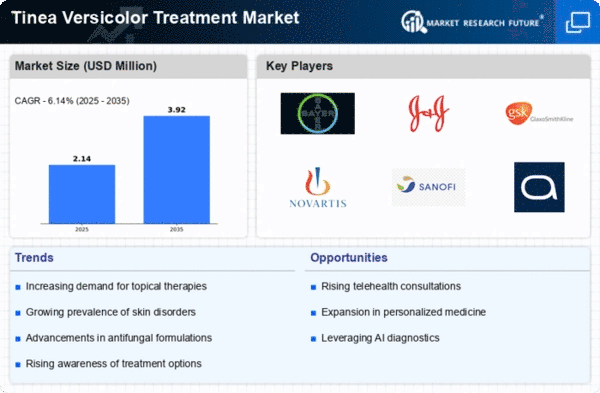
As per MRFR analysis, the Tinea Versicolor Treatment Size was estimated at 2.02 USD Million in 2024. The Tinea Versicolor Treatment industry is projected to grow from 2.17 in 2025 to 3.92 by 2035, exhibiting a compound annual growth rate (CAGR) of 6.14% during the forecast period 2025 - 2035.

Key Market Trends & Highlights

The Tinea Versicolor Treatment Market is experiencing a dynamic shift towards personalized and natural treatment options.

  • Rising awareness and education about skin disorders are driving consumer engagement in North America.
  • The Asia-Pacific region is emerging as the fastest-growing market, reflecting a shift towards innovative treatment solutions.
  • Topical antifungal treatments remain the largest segment, while combination therapies are gaining traction as the fastest-growing option.
  • Increasing incidence of skin disorders and advancements in treatment technologies are key drivers propelling market growth.

Market Size & Forecast

2024 Market Size 2.02 (USD Million)
2035 Market Size 3.92 (USD Million)
CAGR (2025 - 2035) 6.14%
Largest Regional Market Share in 2024 North America

Major Players

Bayer AG (DE), Johnson & Johnson (US), GlaxoSmithKline plc (GB), Novartis AG (CH), Sanofi S.A. (FR), AbbVie Inc. (US), Mylan N.V. (US), Teva Pharmaceutical Industries Ltd. (IL)

Market Trends

The Tinea Versicolor Treatment Market is currently experiencing a notable evolution, driven by a combination of increasing awareness regarding skin conditions and advancements in therapeutic options. As individuals become more informed about the implications of Tinea Versicolor, a fungal skin disorder, the demand for effective treatments appears to be on the rise. This market encompasses a variety of treatment modalities, including topical antifungals, oral medications, and innovative therapies that target the underlying causes of the condition. Furthermore, the growing inclination towards natural and holistic remedies may influence consumer preferences, potentially reshaping the landscape of available treatments. In addition to the rising awareness, the Tinea Versicolor Treatment Market is also witnessing a shift towards personalized medicine. Healthcare providers are increasingly recognizing the importance of tailoring treatments to individual patient needs, which may enhance treatment efficacy and patient satisfaction. This trend suggests a move away from one-size-fits-all approaches, as practitioners seek to optimize outcomes through customized therapeutic strategies. Overall, the Tinea Versicolor Treatment Market appears poised for growth, with evolving consumer preferences and advancements in treatment options likely to play pivotal roles in its future development.

Rising Awareness and Education

There is a growing emphasis on educating the public about Tinea Versicolor, leading to increased recognition of symptoms and treatment options. This trend is likely to drive demand for effective therapies as individuals seek solutions for their skin conditions.

Shift Towards Natural Remedies

Consumers are increasingly gravitating towards natural and holistic treatment options for Tinea Versicolor. This shift may influence product development and marketing strategies, as companies respond to the demand for safer, plant-based alternatives.

Personalized Treatment Approaches

Healthcare providers are beginning to adopt personalized treatment strategies for Tinea Versicolor, focusing on individual patient characteristics. This trend suggests a move towards more tailored therapies, potentially improving treatment outcomes and patient satisfaction.

Tinea Versicolor Treatment Market Market Drivers

Advancements in Treatment Options

Innovations in treatment modalities significantly influence the Global Tinea Versicolor Treatment Market Industry. New antifungal agents, topical therapies, and combination treatments are emerging, enhancing efficacy and patient compliance. For example, the introduction of novel formulations that improve skin penetration and reduce side effects has gained traction among healthcare providers. These advancements not only offer better outcomes but also cater to diverse patient needs, thereby expanding the market. The anticipated growth trajectory suggests that by 2035, the market could reach 581.7 USD Million, reflecting the impact of these innovations.

Increased Awareness and Education

Growing awareness regarding skin health and the importance of early treatment for conditions like Tinea Versicolor plays a crucial role in the Global Tinea Versicolor Treatment Market Industry. Educational campaigns by health organizations and dermatology associations aim to inform the public about symptoms and available treatments. This heightened awareness encourages individuals to seek medical advice sooner, leading to increased demand for effective therapies. As a result, the market is likely to experience a compound annual growth rate of 8.9% from 2025 to 2035, indicating a robust response to educational initiatives.

Rising Prevalence of Skin Disorders

The increasing incidence of skin disorders, particularly Tinea Versicolor, drives the Global Tinea Versicolor Treatment Market Industry. Factors such as urbanization, changing lifestyles, and environmental influences contribute to this rise. For instance, the prevalence of Tinea Versicolor is notably higher in tropical and subtropical regions, where humidity levels favor fungal growth. This trend is expected to escalate, with the market projected to reach 227.8 USD Million in 2024. As awareness of skin conditions grows, more individuals seek effective treatments, further propelling market expansion.

Regulatory Support and Market Accessibility

Supportive regulatory frameworks and improved market accessibility are pivotal for the Global Tinea Versicolor Treatment Market Industry. Governments and health authorities are increasingly recognizing the need for effective dermatological treatments, leading to streamlined approval processes for new therapies. This regulatory support facilitates quicker market entry for innovative products, enhancing competition and consumer choice. Furthermore, initiatives aimed at improving healthcare infrastructure in underserved regions may expand access to treatments, thereby fostering market growth. The combination of these factors is likely to create a favorable environment for sustained industry development.

Rising Disposable Income and Healthcare Spending

The increase in disposable income and healthcare expenditure in various regions contributes to the growth of the Global Tinea Versicolor Treatment Market Industry. As individuals gain more financial resources, they are more inclined to invest in healthcare services and dermatological treatments. This trend is particularly evident in emerging economies, where rising living standards correlate with increased spending on health and wellness. Consequently, the market is expected to benefit from this economic shift, with projections indicating substantial growth in the coming years, driven by consumer willingness to pay for effective treatments.

Market Segment Insights

By Treatment Type: Topical Antifungal (Largest) vs. Combination Therapy (Fastest-Growing)

In the Tinea Versicolor Treatment Market, the distribution of market share among treatment types showcases a diverse approach to managing this skin condition. Topical antifungals lead the market due to their ease of use and local application, accounting for the largest share. Oral antifungals follow as a significant option, providing oral systemic treatment. Combination therapy, though previously less favored, is catching up rapidly, recognized for its synergistic effects in managing recurrent cases, while phototherapy maintains a niche for cases resistant to pharmacological treatments.

Topical Antifungal (Dominant) vs. Combination Therapy (Emerging)

Topical antifungals are the dominant modality in the Tinea Versicolor Treatment Market, primarily due to their direct application, minimizing systemic exposure and side effects. This class includes creams, lotions, and shampoos, highly favored for mild to moderate cases. On the other hand, combination therapy is emerging as a compelling treatment strategy. This approach integrates multiple methods, combining topical treatments with oral agents or phototherapy, enhancing efficacy, especially in stubborn cases that do not respond to monotherapy. As physicians increasingly recognize the need for adaptive strategies in treatment plans, the demand for combination therapies is expected to grow, making it an essential area of focus for market participants.

By Formulation: Cream (Largest) vs. Gel (Fastest-Growing)

The Tinea Versicolor Treatment Market showcases diverse formulation options for effective treatment, with creams leading in market share due to their ease of application and efficacy. Creams are preferred by many due to their familiar consistency and ability to provide prolonged skin contact, making them a trusted choice for consumers seeking relief. On the other hand, gels are quickly gaining traction, appealing to younger demographics and those who prefer lightweight textures, thereby increasing their market presence significantly.

Cream (Dominant) vs. Gel (Emerging)

Cream formulations are the dominant choice in the Tinea Versicolor Treatment Market, valued for their therapeutic benefits and user-friendly application. They are particularly favored because they often contain proven <a href="https://www.marketresearchfuture.com/reports/active-ingredients-market-10702" target="_blank" title="active ingredients">active ingredients</a> that enhance skin absorption and mitigate fungal growth. In contrast, gel formulations are emerging as a preferred option, especially among consumers seeking rapid absorption and a non-greasy feel. The lightweight nature of gels, coupled with innovative formulations, has positioned them as an appealing alternative, with endorsements from dermatologists further propelling their adoption.

By Patient Demographics: Adults (Largest) vs. Elderly (Fastest-Growing)

In the Tinea Versicolor Treatment Market, the adult demographic holds the largest share, driven by lifestyle factors and prevalence rates. Adults typically experience higher exposure to factors that trigger Tinea Versicolor, such as humidity and sweat, leading to a greater demand for effective treatment options. Conversely, the elderly demographic is showing rapid growth in treatment uptake, as awareness about skin ailments increases with age and the healthcare system becomes more proactive in managing skin conditions in older populations.

Adults (Dominant) vs. Elderly (Emerging)

The adult segment remains a dominant force in the Tinea Versicolor Treatment Market due to its larger population base and susceptibility to the condition. Treatments tailored for adults often focus on both cosmetic and medicinal solutions, appealing to consumers’ desire for effective results. On the other hand, the elderly demographic is emerging as a significant player, necessitating specialized products designed to cater to their unique skin characteristics and sensitivities. With an aging population, marketers are increasingly recognizing the need for educational campaigns and product innovations tailored for older adults, including gentle formulations that mitigate skin irritation.

By Distribution Channel: Pharmacies (Largest) vs. Online Retail (Fastest-Growing)

In the Tinea Versicolor Treatment Market, pharmacies stand out as the largest distribution channel, leveraging their established presence and trust among consumers. They provide patients easy access to a range of topical and oral treatments, enhancing the adoption of available therapies. Online retail is making significant inroads thanks to its convenience and accessibility, offering an extensive selection of goods that pharmacies might not stock, thus appealing to a tech-savvy demographic.

Pharmacies (Dominant) vs. Online Retail (Emerging)

Pharmacies play a dominant role in the distribution of Tinea Versicolor treatments, primarily due to their tangible presence and the ability to provide face-to-face consultations which build patient trust. They often have a consistent supply of medications and can provide guidance on usage. In contrast, online retail is emerging rapidly, driven by the increasing consumer preference for home delivery and the ability to compare various treatment options conveniently. This segment attracts a younger audience who prefer a discreet shopping experience, fueling its growth and contributing to changing distribution dynamics within the market.

Get more detailed insights about Tinea Versicolor Treatment Market Research Report - Forecast till 2035

Regional Insights

North America : Market Leader in Treatments

North America is poised to maintain its leadership in the Tinea Versicolor treatment market, holding a significant market share of 1.01 billion. The region's growth is driven by increasing awareness of skin conditions, advancements in treatment options, and a robust healthcare infrastructure. Regulatory support for dermatological treatments further enhances market dynamics, fostering innovation and accessibility for patients. The United States stands out as the primary market, with key players like Johnson & Johnson and AbbVie Inc. leading the charge. The competitive landscape is characterized by a mix of established pharmaceutical giants and emerging biotech firms, all vying for market share. The presence of these companies ensures a steady supply of effective treatments, catering to the growing demand for Tinea Versicolor solutions.

Europe : Emerging Market Potential

Europe is witnessing a growing demand for Tinea Versicolor treatments, with a market size of €0.6 billion. Factors such as rising skin disorders, increased healthcare spending, and a focus on dermatological research are driving this growth. Regulatory bodies are actively promoting innovative therapies, which is expected to further boost market expansion in the coming years. Leading countries in this region include Germany, France, and the UK, where companies like GlaxoSmithKline and Sanofi S.A. are making significant contributions. The competitive landscape is evolving, with both established firms and new entrants focusing on developing effective treatments. This dynamic environment is likely to enhance patient access to Tinea Versicolor therapies across Europe.

Asia-Pacific : Rapidly Growing Market

The Asia-Pacific region is emerging as a significant player in the Tinea Versicolor treatment market, with a market size of $0.3 billion. Factors such as increasing urbanization, changing lifestyles, and rising awareness of skin health are driving demand. Additionally, government initiatives aimed at improving healthcare access are expected to catalyze market growth in this region. Countries like India and China are at the forefront, with a growing number of local and international players entering the market. Companies such as Teva Pharmaceutical Industries and Mylan N.V. are expanding their presence, contributing to a competitive landscape that is becoming increasingly diverse. This growth trajectory indicates a promising future for Tinea Versicolor treatments in the Asia-Pacific region.

Middle East and Africa : Untapped Market Opportunities

The Middle East and Africa region represents an untapped market for Tinea Versicolor treatments, with a market size of $0.11 billion. The growth in this region is driven by increasing awareness of dermatological conditions and a rising demand for effective treatments. Regulatory frameworks are gradually evolving to support the introduction of new therapies, which is expected to enhance market dynamics. Countries like South Africa and the UAE are leading the way, with a growing number of healthcare facilities and increasing investment in dermatological care. The competitive landscape is still developing, with both local and international companies exploring opportunities. This region holds significant potential for growth as awareness and access to Tinea Versicolor treatments improve.

Key Players and Competitive Insights

The Tinea Versicolor Treatment Market is characterized by a competitive landscape that is increasingly shaped by innovation, strategic partnerships, and a focus on patient-centric solutions. Key players such as Bayer AG (DE), Johnson & Johnson (US), and AbbVie Inc. (US) are actively engaged in enhancing their product offerings and expanding their market reach. Bayer AG (DE) has positioned itself as a leader in dermatological treatments, emphasizing research and development to introduce novel antifungal agents. Meanwhile, Johnson & Johnson (US) has adopted a strategy of digital transformation, leveraging telemedicine to improve patient access to treatment options. AbbVie Inc. (US) is focusing on strategic acquisitions to bolster its portfolio, particularly in the dermatology sector, which collectively influences the competitive dynamics of the market.The business tactics employed by these companies include localizing manufacturing and optimizing supply chains to enhance efficiency and reduce costs. The market structure appears moderately fragmented, with several players vying for market share. However, the collective influence of these key players is significant, as they drive innovation and set industry standards, thereby shaping the overall competitive environment.

In November Bayer AG (DE) announced the launch of a new topical treatment specifically designed for Tinea Versicolor, which is expected to enhance patient compliance due to its ease of use. This strategic move underscores Bayer's commitment to addressing unmet medical needs and reinforces its position as a frontrunner in the dermatological space. The introduction of this product may potentially reshape treatment protocols and improve patient outcomes.

In October Johnson & Johnson (US) expanded its telehealth services to include consultations for skin conditions, including Tinea Versicolor. This initiative not only broadens access to care but also aligns with the growing trend of digital health solutions. By integrating telemedicine into its service offerings, Johnson & Johnson is likely to enhance patient engagement and streamline treatment pathways, which could lead to increased market penetration.

In September AbbVie Inc. (US) completed the acquisition of a biotech firm specializing in innovative antifungal therapies. This acquisition is strategically significant as it allows AbbVie to diversify its product pipeline and strengthen its foothold in the dermatology market. The integration of advanced antifungal technologies may provide AbbVie with a competitive edge, enabling it to offer more effective treatment options for Tinea Versicolor.

As of December the competitive trends in the Tinea Versicolor Treatment Market are increasingly defined by digitalization, sustainability, and the integration of artificial intelligence (AI) in treatment protocols. Strategic alliances among key players are shaping the landscape, fostering innovation and enhancing product development. The shift from price-based competition to a focus on technological advancements and supply chain reliability is evident. Moving forward, competitive differentiation is likely to evolve, with companies prioritizing innovative solutions and patient-centric approaches to maintain their market positions.

Key Companies in the Tinea Versicolor Treatment Market include

Industry Developments

Future Outlook

Tinea Versicolor Treatment Market Future Outlook

The Tinea Versicolor Treatment Market is projected to grow at a 6.14% CAGR from 2025 to 2035, driven by increasing awareness, innovative treatment options, and rising incidence rates.

New opportunities lie in:

  • Development of targeted topical formulations for diverse skin types.
  • Expansion of <a href="https://www.marketresearchfuture.com/reports/telehealth-service-market-43509" target="_blank" title="telehealth service">telehealth services</a> for remote consultations and prescriptions.
  • Investment in educational campaigns to raise awareness about prevention and treatment.

By 2035, the Tinea Versicolor Treatment Market is expected to achieve substantial growth and innovation.

Market Segmentation

Tinea Versicolor Treatment Market Formulation Outlook

  • Cream
  • Gel
  • Lotion
  • Tablet
  • Solution

Tinea Versicolor Treatment Market Treatment Type Outlook

  • Topical Antifungal
  • Oral Antifungal
  • Combination Therapy
  • Phototherapy

Tinea Versicolor Treatment Market Distribution Channel Outlook

  • Pharmacies
  • Online Retail
  • Hospitals
  • Clinics

Tinea Versicolor Treatment Market Patient Demographics Outlook

  • Adults
  • Children
  • Elderly
  • Pregnant Women

Report Scope

MARKET SIZE 2024 2.02(USD Million)
MARKET SIZE 2025 2.17(USD Million)
MARKET SIZE 2035 3.92(USD Million)
COMPOUND ANNUAL GROWTH RATE (CAGR) 6.14% (2025 - 2035)
REPORT COVERAGE Revenue Forecast, Competitive Landscape, Growth Factors, and Trends
BASE YEAR 2024
Market Forecast Period 2025 - 2035
Historical Data 2019 - 2024
Market Forecast Units USD Million
Key Companies Profiled Bayer AG (DE), Johnson & Johnson (US), GlaxoSmithKline plc (GB), Novartis AG (CH), Sanofi S.A. (FR), AbbVie Inc. (US), Mylan N.V. (US), Teva Pharmaceutical Industries Ltd. (IL)
Segments Covered Treatment Type, Formulation, Patient Demographics, Distribution Channel
Key Market Opportunities Emergence of novel antifungal agents enhances treatment options in the Tinea Versicolor Treatment Market.
Key Market Dynamics Rising consumer awareness and preference for topical treatments drive innovation in the Tinea Versicolor Treatment Market.
Countries Covered North America, Europe, APAC, South America, MEA

FAQs

What is the projected market valuation for the Tinea Versicolor Treatment Market in 2035?

<p>The projected market valuation for the Tinea Versicolor Treatment Market in 2035 is 3.92 USD Million.</p>

What was the overall market valuation for the Tinea Versicolor Treatment Market in 2024?

<p>The overall market valuation for the Tinea Versicolor Treatment Market in 2024 was 2.02 USD Million.</p>

What is the expected CAGR for the Tinea Versicolor Treatment Market during the forecast period 2025 - 2035?

<p>The expected CAGR for the Tinea Versicolor Treatment Market during the forecast period 2025 - 2035 is 6.14%.</p>

Which companies are considered key players in the Tinea Versicolor Treatment Market?

<p>Key players in the Tinea Versicolor Treatment Market include Johnson & Johnson, Bayer AG, GlaxoSmithKline, Novartis AG, Pfizer Inc., Sanofi S.A., AbbVie Inc., Mylan N.V., and Teva Pharmaceutical Industries Ltd.</p>

What treatment types are included in the Tinea Versicolor Treatment Market segments?

<p>The treatment types in the Tinea Versicolor Treatment Market segments include Topical Antifungal, Oral Antifungal, Combination Therapy, and Phototherapy.</p>

What was the valuation for Topical Antifungal treatments in 2024?

The valuation for Topical Antifungal treatments in 2024 was 0.81 USD Million.

How do the valuations for different formulations of Tinea Versicolor treatments compare?

In 2024, Creams were valued at 0.6 USD Million, Gels at 0.5 USD Million, Lotions at 0.42 USD Million, and Tablets at 0.5 USD Million.

What demographic segments are targeted in the Tinea Versicolor Treatment Market?

The demographic segments targeted in the Tinea Versicolor Treatment Market include Adults, Children, and the Elderly.

What distribution channels are utilized for Tinea Versicolor treatments?

Distribution channels for Tinea Versicolor treatments include Pharmacies, Online Retail, and Hospitals.

What is the projected growth trend for the Tinea Versicolor Treatment Market?

The Tinea Versicolor Treatment Market is expected to experience growth, with a projected valuation of 3.92 USD Million by 2035.

  1. SECTION I: EXECUTIVE SUMMARY AND KEY HIGHLIGHTS
    1. | 1.1 EXECUTIVE SUMMARY
    2. | | 1.1.1 Market Overview
    3. | | 1.1.2 Key Findings
    4. | | 1.1.3 Market Segmentation
    5. | | 1.1.4 Competitive Landscape
    6. | | 1.1.5 Challenges and Opportunities
    7. | | 1.1.6 Future Outlook
  2. SECTION II: SCOPING, METHODOLOGY AND MARKET STRUCTURE
    1. | 2.1 MARKET INTRODUCTION
    2. | | 2.1.1 Definition
    3. | | 2.1.2 Scope of the study
    4. | | | 2.1.2.1 Research Objective
    5. | | | 2.1.2.2 Assumption
    6. | | | 2.1.2.3 Limitations
    7. | 2.2 RESEARCH METHODOLOGY
    8. | | 2.2.1 Overview
    9. | | 2.2.2 Data Mining
    10. | | 2.2.3 Secondary Research
    11. | | 2.2.4 Primary Research
    12. | | | 2.2.4.1 Primary Interviews and Information Gathering Process
    13. | | | 2.2.4.2 Breakdown of Primary Respondents
    14. | | 2.2.5 Forecasting Model
    15. | | 2.2.6 Market Size Estimation
    16. | | | 2.2.6.1 Bottom-Up Approach
    17. | | | 2.2.6.2 Top-Down Approach
    18. | | 2.2.7 Data Triangulation
    19. | | 2.2.8 Validation
  3. SECTION III: QUALITATIVE ANALYSIS
    1. | 3.1 MARKET DYNAMICS
    2. | | 3.1.1 Overview
    3. | | 3.1.2 Drivers
    4. | | 3.1.3 Restraints
    5. | | 3.1.4 Opportunities
    6. | 3.2 MARKET FACTOR ANALYSIS
    7. | | 3.2.1 Value chain Analysis
    8. | | 3.2.2 Porter's Five Forces Analysis
    9. | | | 3.2.2.1 Bargaining Power of Suppliers
    10. | | | 3.2.2.2 Bargaining Power of Buyers
    11. | | | 3.2.2.3 Threat of New Entrants
    12. | | | 3.2.2.4 Threat of Substitutes
    13. | | | 3.2.2.5 Intensity of Rivalry
    14. | | 3.2.3 COVID-19 Impact Analysis
    15. | | | 3.2.3.1 Market Impact Analysis
    16. | | | 3.2.3.2 Regional Impact
    17. | | | 3.2.3.3 Opportunity and Threat Analysis
  4. SECTION IV: QUANTITATIVE ANALYSIS
    1. | 4.1 Healthcare, BY Treatment Type (USD Million)
    2. | | 4.1.1 Topical Antifungal
    3. | | 4.1.2 Oral Antifungal
    4. | | 4.1.3 Combination Therapy
    5. | | 4.1.4 Phototherapy
    6. | 4.2 Healthcare, BY Formulation (USD Million)
    7. | | 4.2.1 Cream
    8. | | 4.2.2 Gel
    9. | | 4.2.3 Lotion
    10. | | 4.2.4 Tablet
    11. | 4.3 Healthcare, BY Patient Demographics (USD Million)
    12. | | 4.3.1 Adults
    13. | | 4.3.2 Children
    14. | | 4.3.3 Elderly
    15. | 4.4 Healthcare, BY Distribution Channel (USD Million)
    16. | | 4.4.1 Pharmacies
    17. | | 4.4.2 Online Retail
    18. | | 4.4.3 Hospitals
    19. | 4.5 Healthcare, BY Region (USD Million)
    20. | | 4.5.1 North America
    21. | | | 4.5.1.1 US
    22. | | | 4.5.1.2 Canada
    23. | | 4.5.2 Europe
    24. | | | 4.5.2.1 Germany
    25. | | | 4.5.2.2 UK
    26. | | | 4.5.2.3 France
    27. | | | 4.5.2.4 Russia
    28. | | | 4.5.2.5 Italy
    29. | | | 4.5.2.6 Spain
    30. | | | 4.5.2.7 Rest of Europe
    31. | | 4.5.3 APAC
    32. | | | 4.5.3.1 China
    33. | | | 4.5.3.2 India
    34. | | | 4.5.3.3 Japan
    35. | | | 4.5.3.4 South Korea
    36. | | | 4.5.3.5 Malaysia
    37. | | | 4.5.3.6 Thailand
    38. | | | 4.5.3.7 Indonesia
    39. | | | 4.5.3.8 Rest of APAC
    40. | | 4.5.4 South America
    41. | | | 4.5.4.1 Brazil
    42. | | | 4.5.4.2 Mexico
    43. | | | 4.5.4.3 Argentina
    44. | | | 4.5.4.4 Rest of South America
    45. | | 4.5.5 MEA
    46. | | | 4.5.5.1 GCC Countries
    47. | | | 4.5.5.2 South Africa
    48. | | | 4.5.5.3 Rest of MEA
  5. SECTION V: COMPETITIVE ANALYSIS
    1. | 5.1 Competitive Landscape
    2. | | 5.1.1 Overview
    3. | | 5.1.2 Competitive Analysis
    4. | | 5.1.3 Market share Analysis
    5. | | 5.1.4 Major Growth Strategy in the Healthcare
    6. | | 5.1.5 Competitive Benchmarking
    7. | | 5.1.6 Leading Players in Terms of Number of Developments in the Healthcare
    8. | | 5.1.7 Key developments and growth strategies
    9. | | | 5.1.7.1 New Product Launch/Service Deployment
    10. | | | 5.1.7.2 Merger & Acquisitions
    11. | | | 5.1.7.3 Joint Ventures
    12. | | 5.1.8 Major Players Financial Matrix
    13. | | | 5.1.8.1 Sales and Operating Income
    14. | | | 5.1.8.2 Major Players R&D Expenditure. 2023
    15. | 5.2 Company Profiles
    16. | | 5.2.1 Johnson & Johnson (US)
    17. | | | 5.2.1.1 Financial Overview
    18. | | | 5.2.1.2 Products Offered
    19. | | | 5.2.1.3 Key Developments
    20. | | | 5.2.1.4 SWOT Analysis
    21. | | | 5.2.1.5 Key Strategies
    22. | | 5.2.2 Bayer AG (DE)
    23. | | | 5.2.2.1 Financial Overview
    24. | | | 5.2.2.2 Products Offered
    25. | | | 5.2.2.3 Key Developments
    26. | | | 5.2.2.4 SWOT Analysis
    27. | | | 5.2.2.5 Key Strategies
    28. | | 5.2.3 GlaxoSmithKline (GB)
    29. | | | 5.2.3.1 Financial Overview
    30. | | | 5.2.3.2 Products Offered
    31. | | | 5.2.3.3 Key Developments
    32. | | | 5.2.3.4 SWOT Analysis
    33. | | | 5.2.3.5 Key Strategies
    34. | | 5.2.4 Novartis AG (CH)
    35. | | | 5.2.4.1 Financial Overview
    36. | | | 5.2.4.2 Products Offered
    37. | | | 5.2.4.3 Key Developments
    38. | | | 5.2.4.4 SWOT Analysis
    39. | | | 5.2.4.5 Key Strategies
    40. | | 5.2.5 Pfizer Inc. (US)
    41. | | | 5.2.5.1 Financial Overview
    42. | | | 5.2.5.2 Products Offered
    43. | | | 5.2.5.3 Key Developments
    44. | | | 5.2.5.4 SWOT Analysis
    45. | | | 5.2.5.5 Key Strategies
    46. | | 5.2.6 Sanofi S.A. (FR)
    47. | | | 5.2.6.1 Financial Overview
    48. | | | 5.2.6.2 Products Offered
    49. | | | 5.2.6.3 Key Developments
    50. | | | 5.2.6.4 SWOT Analysis
    51. | | | 5.2.6.5 Key Strategies
    52. | | 5.2.7 AbbVie Inc. (US)
    53. | | | 5.2.7.1 Financial Overview
    54. | | | 5.2.7.2 Products Offered
    55. | | | 5.2.7.3 Key Developments
    56. | | | 5.2.7.4 SWOT Analysis
    57. | | | 5.2.7.5 Key Strategies
    58. | | 5.2.8 Mylan N.V. (US)
    59. | | | 5.2.8.1 Financial Overview
    60. | | | 5.2.8.2 Products Offered
    61. | | | 5.2.8.3 Key Developments
    62. | | | 5.2.8.4 SWOT Analysis
    63. | | | 5.2.8.5 Key Strategies
    64. | | 5.2.9 Teva Pharmaceutical Industries Ltd. (IL)
    65. | | | 5.2.9.1 Financial Overview
    66. | | | 5.2.9.2 Products Offered
    67. | | | 5.2.9.3 Key Developments
    68. | | | 5.2.9.4 SWOT Analysis
    69. | | | 5.2.9.5 Key Strategies
    70. | 5.3 Appendix
    71. | | 5.3.1 References
    72. | | 5.3.2 Related Reports
  6. LIST OF FIGURES
    1. | 6.1 MARKET SYNOPSIS
    2. | 6.2 NORTH AMERICA MARKET ANALYSIS
    3. | 6.3 US MARKET ANALYSIS BY TREATMENT TYPE
    4. | 6.4 US MARKET ANALYSIS BY FORMULATION
    5. | 6.5 US MARKET ANALYSIS BY PATIENT DEMOGRAPHICS
    6. | 6.6 US MARKET ANALYSIS BY DISTRIBUTION CHANNEL
    7. | 6.7 CANADA MARKET ANALYSIS BY TREATMENT TYPE
    8. | 6.8 CANADA MARKET ANALYSIS BY FORMULATION
    9. | 6.9 CANADA MARKET ANALYSIS BY PATIENT DEMOGRAPHICS
    10. | 6.10 CANADA MARKET ANALYSIS BY DISTRIBUTION CHANNEL
    11. | 6.11 EUROPE MARKET ANALYSIS
    12. | 6.12 GERMANY MARKET ANALYSIS BY TREATMENT TYPE
    13. | 6.13 GERMANY MARKET ANALYSIS BY FORMULATION
    14. | 6.14 GERMANY MARKET ANALYSIS BY PATIENT DEMOGRAPHICS
    15. | 6.15 GERMANY MARKET ANALYSIS BY DISTRIBUTION CHANNEL
    16. | 6.16 UK MARKET ANALYSIS BY TREATMENT TYPE
    17. | 6.17 UK MARKET ANALYSIS BY FORMULATION
    18. | 6.18 UK MARKET ANALYSIS BY PATIENT DEMOGRAPHICS
    19. | 6.19 UK MARKET ANALYSIS BY DISTRIBUTION CHANNEL
    20. | 6.20 FRANCE MARKET ANALYSIS BY TREATMENT TYPE
    21. | 6.21 FRANCE MARKET ANALYSIS BY FORMULATION
    22. | 6.22 FRANCE MARKET ANALYSIS BY PATIENT DEMOGRAPHICS
    23. | 6.23 FRANCE MARKET ANALYSIS BY DISTRIBUTION CHANNEL
    24. | 6.24 RUSSIA MARKET ANALYSIS BY TREATMENT TYPE
    25. | 6.25 RUSSIA MARKET ANALYSIS BY FORMULATION
    26. | 6.26 RUSSIA MARKET ANALYSIS BY PATIENT DEMOGRAPHICS
    27. | 6.27 RUSSIA MARKET ANALYSIS BY DISTRIBUTION CHANNEL
    28. | 6.28 ITALY MARKET ANALYSIS BY TREATMENT TYPE
    29. | 6.29 ITALY MARKET ANALYSIS BY FORMULATION
    30. | 6.30 ITALY MARKET ANALYSIS BY PATIENT DEMOGRAPHICS
    31. | 6.31 ITALY MARKET ANALYSIS BY DISTRIBUTION CHANNEL
    32. | 6.32 SPAIN MARKET ANALYSIS BY TREATMENT TYPE
    33. | 6.33 SPAIN MARKET ANALYSIS BY FORMULATION
    34. | 6.34 SPAIN MARKET ANALYSIS BY PATIENT DEMOGRAPHICS
    35. | 6.35 SPAIN MARKET ANALYSIS BY DISTRIBUTION CHANNEL
    36. | 6.36 REST OF EUROPE MARKET ANALYSIS BY TREATMENT TYPE
    37. | 6.37 REST OF EUROPE MARKET ANALYSIS BY FORMULATION
    38. | 6.38 REST OF EUROPE MARKET ANALYSIS BY PATIENT DEMOGRAPHICS
    39. | 6.39 REST OF EUROPE MARKET ANALYSIS BY DISTRIBUTION CHANNEL
    40. | 6.40 APAC MARKET ANALYSIS
    41. | 6.41 CHINA MARKET ANALYSIS BY TREATMENT TYPE
    42. | 6.42 CHINA MARKET ANALYSIS BY FORMULATION
    43. | 6.43 CHINA MARKET ANALYSIS BY PATIENT DEMOGRAPHICS
    44. | 6.44 CHINA MARKET ANALYSIS BY DISTRIBUTION CHANNEL
    45. | 6.45 INDIA MARKET ANALYSIS BY TREATMENT TYPE
    46. | 6.46 INDIA MARKET ANALYSIS BY FORMULATION
    47. | 6.47 INDIA MARKET ANALYSIS BY PATIENT DEMOGRAPHICS
    48. | 6.48 INDIA MARKET ANALYSIS BY DISTRIBUTION CHANNEL
    49. | 6.49 JAPAN MARKET ANALYSIS BY TREATMENT TYPE
    50. | 6.50 JAPAN MARKET ANALYSIS BY FORMULATION
    51. | 6.51 JAPAN MARKET ANALYSIS BY PATIENT DEMOGRAPHICS
    52. | 6.52 JAPAN MARKET ANALYSIS BY DISTRIBUTION CHANNEL
    53. | 6.53 SOUTH KOREA MARKET ANALYSIS BY TREATMENT TYPE
    54. | 6.54 SOUTH KOREA MARKET ANALYSIS BY FORMULATION
    55. | 6.55 SOUTH KOREA MARKET ANALYSIS BY PATIENT DEMOGRAPHICS
    56. | 6.56 SOUTH KOREA MARKET ANALYSIS BY DISTRIBUTION CHANNEL
    57. | 6.57 MALAYSIA MARKET ANALYSIS BY TREATMENT TYPE
    58. | 6.58 MALAYSIA MARKET ANALYSIS BY FORMULATION
    59. | 6.59 MALAYSIA MARKET ANALYSIS BY PATIENT DEMOGRAPHICS
    60. | 6.60 MALAYSIA MARKET ANALYSIS BY DISTRIBUTION CHANNEL
    61. | 6.61 THAILAND MARKET ANALYSIS BY TREATMENT TYPE
    62. | 6.62 THAILAND MARKET ANALYSIS BY FORMULATION
    63. | 6.63 THAILAND MARKET ANALYSIS BY PATIENT DEMOGRAPHICS
    64. | 6.64 THAILAND MARKET ANALYSIS BY DISTRIBUTION CHANNEL
    65. | 6.65 INDONESIA MARKET ANALYSIS BY TREATMENT TYPE
    66. | 6.66 INDONESIA MARKET ANALYSIS BY FORMULATION
    67. | 6.67 INDONESIA MARKET ANALYSIS BY PATIENT DEMOGRAPHICS
    68. | 6.68 INDONESIA MARKET ANALYSIS BY DISTRIBUTION CHANNEL
    69. | 6.69 REST OF APAC MARKET ANALYSIS BY TREATMENT TYPE
    70. | 6.70 REST OF APAC MARKET ANALYSIS BY FORMULATION
    71. | 6.71 REST OF APAC MARKET ANALYSIS BY PATIENT DEMOGRAPHICS
    72. | 6.72 REST OF APAC MARKET ANALYSIS BY DISTRIBUTION CHANNEL
    73. | 6.73 SOUTH AMERICA MARKET ANALYSIS
    74. | 6.74 BRAZIL MARKET ANALYSIS BY TREATMENT TYPE
    75. | 6.75 BRAZIL MARKET ANALYSIS BY FORMULATION
    76. | 6.76 BRAZIL MARKET ANALYSIS BY PATIENT DEMOGRAPHICS
    77. | 6.77 BRAZIL MARKET ANALYSIS BY DISTRIBUTION CHANNEL
    78. | 6.78 MEXICO MARKET ANALYSIS BY TREATMENT TYPE
    79. | 6.79 MEXICO MARKET ANALYSIS BY FORMULATION
    80. | 6.80 MEXICO MARKET ANALYSIS BY PATIENT DEMOGRAPHICS
    81. | 6.81 MEXICO MARKET ANALYSIS BY DISTRIBUTION CHANNEL
    82. | 6.82 ARGENTINA MARKET ANALYSIS BY TREATMENT TYPE
    83. | 6.83 ARGENTINA MARKET ANALYSIS BY FORMULATION
    84. | 6.84 ARGENTINA MARKET ANALYSIS BY PATIENT DEMOGRAPHICS
    85. | 6.85 ARGENTINA MARKET ANALYSIS BY DISTRIBUTION CHANNEL
    86. | 6.86 REST OF SOUTH AMERICA MARKET ANALYSIS BY TREATMENT TYPE
    87. | 6.87 REST OF SOUTH AMERICA MARKET ANALYSIS BY FORMULATION
    88. | 6.88 REST OF SOUTH AMERICA MARKET ANALYSIS BY PATIENT DEMOGRAPHICS
    89. | 6.89 REST OF SOUTH AMERICA MARKET ANALYSIS BY DISTRIBUTION CHANNEL
    90. | 6.90 MEA MARKET ANALYSIS
    91. | 6.91 GCC COUNTRIES MARKET ANALYSIS BY TREATMENT TYPE
    92. | 6.92 GCC COUNTRIES MARKET ANALYSIS BY FORMULATION
    93. | 6.93 GCC COUNTRIES MARKET ANALYSIS BY PATIENT DEMOGRAPHICS
    94. | 6.94 GCC COUNTRIES MARKET ANALYSIS BY DISTRIBUTION CHANNEL
    95. | 6.95 SOUTH AFRICA MARKET ANALYSIS BY TREATMENT TYPE
    96. | 6.96 SOUTH AFRICA MARKET ANALYSIS BY FORMULATION
    97. | 6.97 SOUTH AFRICA MARKET ANALYSIS BY PATIENT DEMOGRAPHICS
    98. | 6.98 SOUTH AFRICA MARKET ANALYSIS BY DISTRIBUTION CHANNEL
    99. | 6.99 REST OF MEA MARKET ANALYSIS BY TREATMENT TYPE
    100. | 6.100 REST OF MEA MARKET ANALYSIS BY FORMULATION
    101. | 6.101 REST OF MEA MARKET ANALYSIS BY PATIENT DEMOGRAPHICS
    102. | 6.102 REST OF MEA MARKET ANALYSIS BY DISTRIBUTION CHANNEL
    103. | 6.103 KEY BUYING CRITERIA OF HEALTHCARE
    104. | 6.104 RESEARCH PROCESS OF MRFR
    105. | 6.105 DRO ANALYSIS OF HEALTHCARE
    106. | 6.106 DRIVERS IMPACT ANALYSIS: HEALTHCARE
    107. | 6.107 RESTRAINTS IMPACT ANALYSIS: HEALTHCARE
    108. | 6.108 SUPPLY / VALUE CHAIN: HEALTHCARE
    109. | 6.109 HEALTHCARE, BY TREATMENT TYPE, 2024 (% SHARE)
    110. | 6.110 HEALTHCARE, BY TREATMENT TYPE, 2024 TO 2035 (USD Million)
    111. | 6.111 HEALTHCARE, BY FORMULATION, 2024 (% SHARE)
    112. | 6.112 HEALTHCARE, BY FORMULATION, 2024 TO 2035 (USD Million)
    113. | 6.113 HEALTHCARE, BY PATIENT DEMOGRAPHICS, 2024 (% SHARE)
    114. | 6.114 HEALTHCARE, BY PATIENT DEMOGRAPHICS, 2024 TO 2035 (USD Million)
    115. | 6.115 HEALTHCARE, BY DISTRIBUTION CHANNEL, 2024 (% SHARE)
    116. | 6.116 HEALTHCARE, BY DISTRIBUTION CHANNEL, 2024 TO 2035 (USD Million)
    117. | 6.117 BENCHMARKING OF MAJOR COMPETITORS
  7. LIST OF TABLES
    1. | 7.1 LIST OF ASSUMPTIONS
    2. | | 7.1.1
    3. | 7.2 North America MARKET SIZE ESTIMATES; FORECAST
    4. | | 7.2.1 BY TREATMENT TYPE, 2025-2035 (USD Million)
    5. | | 7.2.2 BY FORMULATION, 2025-2035 (USD Million)
    6. | | 7.2.3 BY PATIENT DEMOGRAPHICS, 2025-2035 (USD Million)
    7. | | 7.2.4 BY DISTRIBUTION CHANNEL, 2025-2035 (USD Million)
    8. | 7.3 US MARKET SIZE ESTIMATES; FORECAST
    9. | | 7.3.1 BY TREATMENT TYPE, 2025-2035 (USD Million)
    10. | | 7.3.2 BY FORMULATION, 2025-2035 (USD Million)
    11. | | 7.3.3 BY PATIENT DEMOGRAPHICS, 2025-2035 (USD Million)
    12. | | 7.3.4 BY DISTRIBUTION CHANNEL, 2025-2035 (USD Million)
    13. | 7.4 Canada MARKET SIZE ESTIMATES; FORECAST
    14. | | 7.4.1 BY TREATMENT TYPE, 2025-2035 (USD Million)
    15. | | 7.4.2 BY FORMULATION, 2025-2035 (USD Million)
    16. | | 7.4.3 BY PATIENT DEMOGRAPHICS, 2025-2035 (USD Million)
    17. | | 7.4.4 BY DISTRIBUTION CHANNEL, 2025-2035 (USD Million)
    18. | 7.5 Europe MARKET SIZE ESTIMATES; FORECAST
    19. | | 7.5.1 BY TREATMENT TYPE, 2025-2035 (USD Million)
    20. | | 7.5.2 BY FORMULATION, 2025-2035 (USD Million)
    21. | | 7.5.3 BY PATIENT DEMOGRAPHICS, 2025-2035 (USD Million)
    22. | | 7.5.4 BY DISTRIBUTION CHANNEL, 2025-2035 (USD Million)
    23. | 7.6 Germany MARKET SIZE ESTIMATES; FORECAST
    24. | | 7.6.1 BY TREATMENT TYPE, 2025-2035 (USD Million)
    25. | | 7.6.2 BY FORMULATION, 2025-2035 (USD Million)
    26. | | 7.6.3 BY PATIENT DEMOGRAPHICS, 2025-2035 (USD Million)
    27. | | 7.6.4 BY DISTRIBUTION CHANNEL, 2025-2035 (USD Million)
    28. | 7.7 UK MARKET SIZE ESTIMATES; FORECAST
    29. | | 7.7.1 BY TREATMENT TYPE, 2025-2035 (USD Million)
    30. | | 7.7.2 BY FORMULATION, 2025-2035 (USD Million)
    31. | | 7.7.3 BY PATIENT DEMOGRAPHICS, 2025-2035 (USD Million)
    32. | | 7.7.4 BY DISTRIBUTION CHANNEL, 2025-2035 (USD Million)
    33. | 7.8 France MARKET SIZE ESTIMATES; FORECAST
    34. | | 7.8.1 BY TREATMENT TYPE, 2025-2035 (USD Million)
    35. | | 7.8.2 BY FORMULATION, 2025-2035 (USD Million)
    36. | | 7.8.3 BY PATIENT DEMOGRAPHICS, 2025-2035 (USD Million)
    37. | | 7.8.4 BY DISTRIBUTION CHANNEL, 2025-2035 (USD Million)
    38. | 7.9 Russia MARKET SIZE ESTIMATES; FORECAST
    39. | | 7.9.1 BY TREATMENT TYPE, 2025-2035 (USD Million)
    40. | | 7.9.2 BY FORMULATION, 2025-2035 (USD Million)
    41. | | 7.9.3 BY PATIENT DEMOGRAPHICS, 2025-2035 (USD Million)
    42. | | 7.9.4 BY DISTRIBUTION CHANNEL, 2025-2035 (USD Million)
    43. | 7.10 Italy MARKET SIZE ESTIMATES; FORECAST
    44. | | 7.10.1 BY TREATMENT TYPE, 2025-2035 (USD Million)
    45. | | 7.10.2 BY FORMULATION, 2025-2035 (USD Million)
    46. | | 7.10.3 BY PATIENT DEMOGRAPHICS, 2025-2035 (USD Million)
    47. | | 7.10.4 BY DISTRIBUTION CHANNEL, 2025-2035 (USD Million)
    48. | 7.11 Spain MARKET SIZE ESTIMATES; FORECAST
    49. | | 7.11.1 BY TREATMENT TYPE, 2025-2035 (USD Million)
    50. | | 7.11.2 BY FORMULATION, 2025-2035 (USD Million)
    51. | | 7.11.3 BY PATIENT DEMOGRAPHICS, 2025-2035 (USD Million)
    52. | | 7.11.4 BY DISTRIBUTION CHANNEL, 2025-2035 (USD Million)
    53. | 7.12 Rest of Europe MARKET SIZE ESTIMATES; FORECAST
    54. | | 7.12.1 BY TREATMENT TYPE, 2025-2035 (USD Million)
    55. | | 7.12.2 BY FORMULATION, 2025-2035 (USD Million)
    56. | | 7.12.3 BY PATIENT DEMOGRAPHICS, 2025-2035 (USD Million)
    57. | | 7.12.4 BY DISTRIBUTION CHANNEL, 2025-2035 (USD Million)
    58. | 7.13 APAC MARKET SIZE ESTIMATES; FORECAST
    59. | | 7.13.1 BY TREATMENT TYPE, 2025-2035 (USD Million)
    60. | | 7.13.2 BY FORMULATION, 2025-2035 (USD Million)
    61. | | 7.13.3 BY PATIENT DEMOGRAPHICS, 2025-2035 (USD Million)
    62. | | 7.13.4 BY DISTRIBUTION CHANNEL, 2025-2035 (USD Million)
    63. | 7.14 China MARKET SIZE ESTIMATES; FORECAST
    64. | | 7.14.1 BY TREATMENT TYPE, 2025-2035 (USD Million)
    65. | | 7.14.2 BY FORMULATION, 2025-2035 (USD Million)
    66. | | 7.14.3 BY PATIENT DEMOGRAPHICS, 2025-2035 (USD Million)
    67. | | 7.14.4 BY DISTRIBUTION CHANNEL, 2025-2035 (USD Million)
    68. | 7.15 India MARKET SIZE ESTIMATES; FORECAST
    69. | | 7.15.1 BY TREATMENT TYPE, 2025-2035 (USD Million)
    70. | | 7.15.2 BY FORMULATION, 2025-2035 (USD Million)
    71. | | 7.15.3 BY PATIENT DEMOGRAPHICS, 2025-2035 (USD Million)
    72. | | 7.15.4 BY DISTRIBUTION CHANNEL, 2025-2035 (USD Million)
    73. | 7.16 Japan MARKET SIZE ESTIMATES; FORECAST
    74. | | 7.16.1 BY TREATMENT TYPE, 2025-2035 (USD Million)
    75. | | 7.16.2 BY FORMULATION, 2025-2035 (USD Million)
    76. | | 7.16.3 BY PATIENT DEMOGRAPHICS, 2025-2035 (USD Million)
    77. | | 7.16.4 BY DISTRIBUTION CHANNEL, 2025-2035 (USD Million)
    78. | 7.17 South Korea MARKET SIZE ESTIMATES; FORECAST
    79. | | 7.17.1 BY TREATMENT TYPE, 2025-2035 (USD Million)
    80. | | 7.17.2 BY FORMULATION, 2025-2035 (USD Million)
    81. | | 7.17.3 BY PATIENT DEMOGRAPHICS, 2025-2035 (USD Million)
    82. | | 7.17.4 BY DISTRIBUTION CHANNEL, 2025-2035 (USD Million)
    83. | 7.18 Malaysia MARKET SIZE ESTIMATES; FORECAST
    84. | | 7.18.1 BY TREATMENT TYPE, 2025-2035 (USD Million)
    85. | | 7.18.2 BY FORMULATION, 2025-2035 (USD Million)
    86. | | 7.18.3 BY PATIENT DEMOGRAPHICS, 2025-2035 (USD Million)
    87. | | 7.18.4 BY DISTRIBUTION CHANNEL, 2025-2035 (USD Million)
    88. | 7.19 Thailand MARKET SIZE ESTIMATES; FORECAST
    89. | | 7.19.1 BY TREATMENT TYPE, 2025-2035 (USD Million)
    90. | | 7.19.2 BY FORMULATION, 2025-2035 (USD Million)
    91. | | 7.19.3 BY PATIENT DEMOGRAPHICS, 2025-2035 (USD Million)
    92. | | 7.19.4 BY DISTRIBUTION CHANNEL, 2025-2035 (USD Million)
    93. | 7.20 Indonesia MARKET SIZE ESTIMATES; FORECAST
    94. | | 7.20.1 BY TREATMENT TYPE, 2025-2035 (USD Million)
    95. | | 7.20.2 BY FORMULATION, 2025-2035 (USD Million)
    96. | | 7.20.3 BY PATIENT DEMOGRAPHICS, 2025-2035 (USD Million)
    97. | | 7.20.4 BY DISTRIBUTION CHANNEL, 2025-2035 (USD Million)
    98. | 7.21 Rest of APAC MARKET SIZE ESTIMATES; FORECAST
    99. | | 7.21.1 BY TREATMENT TYPE, 2025-2035 (USD Million)
    100. | | 7.21.2 BY FORMULATION, 2025-2035 (USD Million)
    101. | | 7.21.3 BY PATIENT DEMOGRAPHICS, 2025-2035 (USD Million)
    102. | | 7.21.4 BY DISTRIBUTION CHANNEL, 2025-2035 (USD Million)
    103. | 7.22 South America MARKET SIZE ESTIMATES; FORECAST
    104. | | 7.22.1 BY TREATMENT TYPE, 2025-2035 (USD Million)
    105. | | 7.22.2 BY FORMULATION, 2025-2035 (USD Million)
    106. | | 7.22.3 BY PATIENT DEMOGRAPHICS, 2025-2035 (USD Million)
    107. | | 7.22.4 BY DISTRIBUTION CHANNEL, 2025-2035 (USD Million)
    108. | 7.23 Brazil MARKET SIZE ESTIMATES; FORECAST
    109. | | 7.23.1 BY TREATMENT TYPE, 2025-2035 (USD Million)
    110. | | 7.23.2 BY FORMULATION, 2025-2035 (USD Million)
    111. | | 7.23.3 BY PATIENT DEMOGRAPHICS, 2025-2035 (USD Million)
    112. | | 7.23.4 BY DISTRIBUTION CHANNEL, 2025-2035 (USD Million)
    113. | 7.24 Mexico MARKET SIZE ESTIMATES; FORECAST
    114. | | 7.24.1 BY TREATMENT TYPE, 2025-2035 (USD Million)
    115. | | 7.24.2 BY FORMULATION, 2025-2035 (USD Million)
    116. | | 7.24.3 BY PATIENT DEMOGRAPHICS, 2025-2035 (USD Million)
    117. | | 7.24.4 BY DISTRIBUTION CHANNEL, 2025-2035 (USD Million)
    118. | 7.25 Argentina MARKET SIZE ESTIMATES; FORECAST
    119. | | 7.25.1 BY TREATMENT TYPE, 2025-2035 (USD Million)
    120. | | 7.25.2 BY FORMULATION, 2025-2035 (USD Million)
    121. | | 7.25.3 BY PATIENT DEMOGRAPHICS, 2025-2035 (USD Million)
    122. | | 7.25.4 BY DISTRIBUTION CHANNEL, 2025-2035 (USD Million)
    123. | 7.26 Rest of South America MARKET SIZE ESTIMATES; FORECAST
    124. | | 7.26.1 BY TREATMENT TYPE, 2025-2035 (USD Million)
    125. | | 7.26.2 BY FORMULATION, 2025-2035 (USD Million)
    126. | | 7.26.3 BY PATIENT DEMOGRAPHICS, 2025-2035 (USD Million)
    127. | | 7.26.4 BY DISTRIBUTION CHANNEL, 2025-2035 (USD Million)
    128. | 7.27 MEA MARKET SIZE ESTIMATES; FORECAST
    129. | | 7.27.1 BY TREATMENT TYPE, 2025-2035 (USD Million)
    130. | | 7.27.2 BY FORMULATION, 2025-2035 (USD Million)
    131. | | 7.27.3 BY PATIENT DEMOGRAPHICS, 2025-2035 (USD Million)
    132. | | 7.27.4 BY DISTRIBUTION CHANNEL, 2025-2035 (USD Million)
    133. | 7.28 GCC Countries MARKET SIZE ESTIMATES; FORECAST
    134. | | 7.28.1 BY TREATMENT TYPE, 2025-2035 (USD Million)
    135. | | 7.28.2 BY FORMULATION, 2025-2035 (USD Million)
    136. | | 7.28.3 BY PATIENT DEMOGRAPHICS, 2025-2035 (USD Million)
    137. | | 7.28.4 BY DISTRIBUTION CHANNEL, 2025-2035 (USD Million)
    138. | 7.29 South Africa MARKET SIZE ESTIMATES; FORECAST
    139. | | 7.29.1 BY TREATMENT TYPE, 2025-2035 (USD Million)
    140. | | 7.29.2 BY FORMULATION, 2025-2035 (USD Million)
    141. | | 7.29.3 BY PATIENT DEMOGRAPHICS, 2025-2035 (USD Million)
    142. | | 7.29.4 BY DISTRIBUTION CHANNEL, 2025-2035 (USD Million)
    143. | 7.30 Rest of MEA MARKET SIZE ESTIMATES; FORECAST
    144. | | 7.30.1 BY TREATMENT TYPE, 2025-2035 (USD Million)
    145. | | 7.30.2 BY FORMULATION, 2025-2035 (USD Million)
    146. | | 7.30.3 BY PATIENT DEMOGRAPHICS, 2025-2035 (USD Million)
    147. | | 7.30.4 BY DISTRIBUTION CHANNEL, 2025-2035 (USD Million)
    148. | 7.31 PRODUCT LAUNCH/PRODUCT DEVELOPMENT/APPROVAL
    149. | | 7.31.1
    150. | 7.32 ACQUISITION/PARTNERSHIP
    151. | | 7.32.1

Healthcare Market Segmentation

Healthcare By Treatment Type (USD Million, 2025-2035)

  • Topical Antifungal
  • Oral Antifungal
  • Combination Therapy
  • Phototherapy

Healthcare By Formulation (USD Million, 2025-2035)

  • Cream
  • Gel
  • Lotion
  • Tablet

Healthcare By Patient Demographics (USD Million, 2025-2035)

  • Adults
  • Children
  • Elderly

Healthcare By Distribution Channel (USD Million, 2025-2035)

  • Pharmacies
  • Online Retail
  • Hospitals
Infographic

Free Sample Request

Kindly complete the form below to receive a free sample of this Report

Get Free Sample

Customer Strories

Compare Licence

×
Features License Type
Single User Multiuser License Enterprise User
Price $4,950 $5,950 $7,250
Maximum User Access Limit 1 User Upto 10 Users Unrestricted Access Throughout the Organization
Free Customization
Direct Access to Analyst
Deliverable Format
Platform Access
Discount on Next Purchase 10% 15% 15%
Printable Versions