×
Request Free Sample ×

Kindly complete the form below to receive a free sample of this Report

* Please use a valid business email

Leading companies partner with us for data-driven Insights

clients tt-cursor
Hero Background
English
Chinese
French
Japanese
Korean
German
Spanish

Tile Market Trends

ID: MRFR/PCM/10039-HCR
111 Pages
Snehal Singh
February 2026

Tile Market Research Report: By Material Type (Ceramic, Porcelain, Natural Stone, Glass, Vinyl), By End-use (Residential, Commercial, Industrial, Institutional), By Product Type (Wall Tiles, Floor Tiles, Outdoor Tiles, Mosaic Tiles), By Distribution Channel (Online, Offline, Direct Sales), and By Regional : Global Opportunity Analysis and Industry Forecast, 2025 - 2035

Share:
Download PDF ×

We do not share your information with anyone. However, we may send you emails based on your report interest from time to time. You may contact us at any time to opt-out.

Tile Market Infographic
Purchase Options

Market Trends

Key Emerging Trends in the Tile Market

The Tile Market at the moment point out certain patterns that portrays how the areas of building, interior design, and the overall decor industry are changing. Similarly to ceramic tiles, tile, one of the most dynamic and versatile flooring materials nowadays that is also available in different sizes, colors and textures has numerous applications from residential, to commercial and industrial ones. It is a well-known fact that a strong component of the market is large-format tiles' expanding popularity. These large formats, which are sometimes bigger than the standard size, are commonly chosen for their straight linear looks which align with modern design. Ranch-sized format tiles are commonly oriented in residential areas like kitchens and bathrooms, and are also widely applied in commercial projects thereby giving it an appealing and homogeneous finish.

Besides, the supply of tiles is gladly meeting with the growing need for the environmental-friendly and sustainable alternatives. The increasing interest in sustainable living and ecological awareness is making mainstream the consumer’s tendency to prefer tiles made of recycled materials, or manufactured in energy-efficient ways, and also certified to have a minor environmental impact. The consistency with the broader trend toward sustainability of buildings emphasizes the use of eco-friendly materials in the building projects.

Besides that, the demands of the tiles market are reflected in the development of digital printers, which makes possible the manufacture of tiles with complicated patterns, including realistic looking images. Digital printing is a method of reproducing images of the highest quality mimicking materials like wood, stone and marble in the natural look. This trend has extensive coverage of patterns and color of tiles opening wide possibilities for designs that meet the aesthetic needs of all tastes and increase the visual power of interior and exterior spaces.

Besides, there is a development of demand in tiles market of antibacterial and antimicrobial tiles. Those are made in a way to inhibit the growth of bacteria as well as other microorganisms. Such a hygienic design fulfills the necessary requirements for the places with changing hygienic conditions, including hospitals, kitchens, and bathrooms. This development flows from the renewed awareness of health and sanitation parameters in building design, a trend especially evident in the post-COVID-19 period.

Creating the market trends for tiles, government regulations and standards concerning material building, the safety and environment are incorporated. The regulatory authorities countries nationwide are exacting regulations to guarantee the safety, quality, and sustainability of the tiles in the construction industry. These regulations must be complied with since during this process manufacturers are being made sure to meet market demands, keep safety of the product intact and contribute to sustainable and responsible construction business.

Author
Snehal Singh
Assistant Manager - Research

High acumen in analyzing complex macro & micro markets with more than 6 years of work experience in the field of market research. By implementing her analytical skills in forecasting and estimation into market research reports, she has expertise in Packaging, Construction, and Equipment domains. She handles a team size of 20-25 resources and ensures smooth running of the projects, associated marketing activities, and client servicing.

Leave a Comment

FAQs

What is the current valuation of The Global Tile as of 2024?

<p>The Global Tile was valued at 265.21 USD Billion in 2024.</p>

What is the projected market size for The Global Tile in 2035?

<p>The market is projected to reach 587.72 USD Billion by 2035.</p>

What is the expected CAGR for The Global Tile during the forecast period 2025 - 2035?

<p>The expected CAGR for The Global Tile during 2025 - 2035 is 7.5%.</p>

Which material type segment holds the largest market share in 2024?

<p>In 2024, the Ceramic segment held the largest market share, valued at 80.0 USD Billion.</p>

How does the valuation of the Porcelain segment compare to that of the Natural Stone segment in 2024?

<p>In 2024, the Porcelain segment was valued at 70.0 USD Billion, while the Natural Stone segment was valued at 50.0 USD Billion.</p>

What are the projected valuations for the Residential and Commercial end-use segments by 2035?

<p>By 2035, the Residential segment is projected to reach 239.0 USD Billion, while the Commercial segment is expected to reach 175.0 USD Billion.</p>

Which product type segment is anticipated to grow the most by 2035?

<p>The Floor Tiles segment, valued at 85.0 USD Billion in 2024, is anticipated to grow significantly, potentially reaching 200.0 USD Billion by 2035.</p>

What distribution channel is expected to dominate The Global Tile in 2035?

<p>The Offline distribution channel, valued at 159.57 USD Billion in 2024, is expected to dominate the market, potentially reaching 350.0 USD Billion by 2035.</p>

Who are the key players in The Global Tile?

<p>Key players in The Global Tile include Mohawk Industries, Ceramiche Ricchetti, Roca Group, Grupo Lamosa, and Porcelanosa.</p>

What is the projected growth trend for The Global Tile from 2025 to 2035?

<p>The Global Tile is expected to experience a robust growth trend, driven by a CAGR of 7.5% from 2025 to 2035.</p>

Market Summary

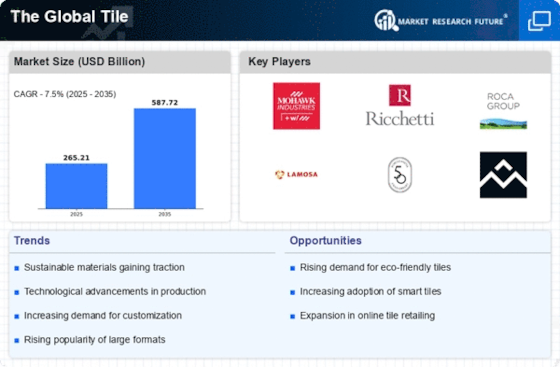
As per Market Research Future analysis, The Tile Market Size was estimated at 265.21 USD Billion in 2024. The tile industry is projected to grow from 285.1 USD Billion in 2025 to 587.72 USD Billion by 2035, exhibiting a compound annual growth rate (CAGR) of 7.5% during the forecast period 2025 - 2035

Key Market Trends & Highlights

The Global Tile Market is experiencing a dynamic shift towards sustainability and customization, driven by technological advancements and rising construction activities.

  • The North American region remains the largest market for tiles, characterized by a strong demand for aesthetic appeal in residential applications. Asia-Pacific is emerging as the fastest-growing region, with increasing investments in infrastructure and urban development. Ceramic tiles dominate the market as the largest segment, while porcelain tiles are witnessing rapid growth due to their durability and design versatility. Rising construction activities and an increased focus on sustainability are key drivers propelling the market forward.

Market Size & Forecast

2024 Market Size 265.21 (USD Billion)
2035 Market Size 587.72 (USD Billion)
CAGR (2025 - 2035) 7.5%
Largest Regional Market Share in 2024 Europe

Major Players

Mohawk Industries, Ceramiche Ricchetti, Grupo Lamosa, Porcelanosa, Marazzi Group, Daltile, Crossville, Somany Ceramics, Kajaria Ceramics, SCG Ceramics

Market Trends

The Global Tile Market is currently experiencing a dynamic evolution, driven by various factors that influence consumer preferences and technological advancements. The demand for tiles is expanding across residential and commercial sectors, as they are increasingly recognized for their aesthetic appeal and durability. Innovations in manufacturing processes, such as the introduction of eco-friendly materials and advanced printing techniques, are reshaping the landscape of tile production. Furthermore, the growing emphasis on sustainable building practices is prompting manufacturers to explore environmentally responsible options, which may enhance their market positioning. In addition to sustainability, The Global Tile Market is witnessing a shift towards customization and personalization. Consumers are seeking unique designs that reflect their individual tastes, leading to a rise in bespoke tile solutions. This trend is complemented by the increasing popularity of online platforms that facilitate the selection and purchase of tiles, providing customers with a broader range of choices. As the market continues to evolve, it appears poised for further growth, with potential opportunities emerging in various regions and segments, driven by changing consumer behaviors and preferences.

Sustainability Focus

The emphasis on eco-friendly materials and sustainable practices is becoming a defining characteristic of The Global Tile Market. Manufacturers are increasingly adopting green technologies and sourcing materials that minimize environmental impact, appealing to environmentally conscious consumers.

Customization and Personalization

There is a notable trend towards customized tile solutions, as consumers seek products that reflect their personal style. This shift is supported by advancements in technology that allow for unique designs and patterns, catering to individual preferences.

Digital Transformation

The rise of e-commerce platforms is transforming the way tiles are marketed and sold. Consumers now have access to a wider array of options online, enabling them to make informed decisions and enhancing the overall shopping experience.

Tile Market Market Drivers

Rising Construction Activities

The increasing pace of construction activities across various regions appears to be a primary driver for The Global Tile Industry. As urbanization accelerates, the demand for residential and commercial buildings rises, leading to a heightened need for tiles. In 2025, the construction sector is projected to grow at a rate of approximately 5.5% annually, which could significantly boost tile consumption. Furthermore, government initiatives aimed at infrastructure development are likely to enhance market opportunities. The Global Tile Industry is expected to benefit from this trend, as tiles are essential for flooring, wall coverings, and decorative elements in new constructions. This surge in construction activities not only stimulates demand but also encourages innovation in tile designs and materials, thereby expanding the market landscape.

Increased Focus on Sustainability

An increased focus on sustainability is emerging as a significant driver for makret tile. Consumers are becoming more environmentally conscious, leading to a demand for eco-friendly tiles made from recycled materials or sustainable sources. In 2025, it is anticipated that the market for sustainable tiles will grow substantially, as manufacturers respond to this trend by developing products that minimize environmental impact. This shift towards sustainability not only aligns with efforts to reduce carbon footprints but also appeals to a growing segment of eco-conscious consumers. The Tile Industry is likely to see a rise in the adoption of sustainable practices, which could enhance brand loyalty and attract new customers who prioritize environmental responsibility.

Growing Demand for Aesthetic Appeal

The growing consumer preference for aesthetic appeal in interior and exterior design is a notable driver for The Global Tile Industry. As homeowners and designers increasingly prioritize aesthetics, the demand for decorative tiles has surged. In 2025, the market for decorative tiles is projected to witness a growth rate of around 6%, indicating a robust trend towards visually appealing products. This shift is particularly evident in the residential sector, where tiles are used to create unique and personalized spaces. The Global Tile Industry is responding to this demand by offering a diverse range of colors, patterns, and textures, allowing consumers to express their individuality through design. This focus on aesthetics not only enhances the appeal of spaces but also contributes to the overall growth of the market.

Expansion of Retail and E-commerce Channels

The expansion of retail and e-commerce channels is likely to significantly influence The Global Tile Industry. As consumers increasingly turn to online platforms for their purchasing needs, the accessibility of tiles has improved dramatically. In 2025, it is projected that online sales of tiles will account for a considerable portion of the market, driven by the convenience and variety offered by e-commerce. Retailers are also enhancing their physical stores to provide immersive experiences, showcasing the latest tile designs and technologies. This dual approach not only caters to diverse consumer preferences but also broadens the reach of The Global Tile Industry. The integration of digital tools in retail strategies is expected to facilitate informed purchasing decisions, further propelling market growth.

Technological Advancements in Manufacturing

Technological advancements in tile manufacturing processes are likely to play a crucial role in shaping The Global Tile Industry. Innovations such as digital printing and automated production lines enhance efficiency and reduce costs, making high-quality tiles more accessible. The introduction of eco-friendly materials and sustainable production techniques is also gaining traction, aligning with consumer preferences for environmentally responsible products. In 2025, it is estimated that the market for digitally printed tiles will account for a significant share, reflecting a shift towards customization and unique designs. These advancements not only improve product quality but also expand the range of options available to consumers, thereby driving growth in The Global Tile Industry.

Market Segment Insights

By Material Type: Ceramic (Largest) vs. Porcelain (Fastest-Growing)

<p>The Global Tile exhibits a diverse distribution of material types, with Ceramic tiles leading the segment due to their affordability and wide-ranging applications across residential and commercial spaces. Following Ceramic, Porcelain tiles are gaining traction, favored for their durability and resistance to moisture, making them a popular choice for high-moisture areas and outdoor applications. Other segments like Natural Stone, Glass, and Vinyl also contribute to the market, but they hold smaller shares compared to these dominant categories. In terms of growth trends, Porcelain tiles are emerging as the fastest-growing segment, driven by increasing consumer preferences for materials that offer aesthetic appeal without compromising on functionality. The demand for eco-friendly and sustainable tile options is also influencing growth in segments such as Natural Stone and Glass. Key drivers include the rising renovation activities and a shift towards premium interior designs, propelling the demand for high-quality tiles in various applications.</p>

<p>Ceramic (Dominant) vs. Vinyl (Emerging)</p>

<p>In The Global Tile, Ceramic tiles remain the dominant choice due to their excellent balance of cost, versatility, and ease of installation. They are widely used in various settings, from homes to commercial spaces, and are available in a multitude of designs, colors, and finishes. On the other hand, Vinyl tiles are an emerging segment that has gained popularity thanks to their affordability and ease of maintenance. With advancements in design technology, vinyl now mimics more expensive materials like wood and stone, appealing to budget-conscious consumers seeking stylish options. The growing trend of DIY home improvement projects has further boosted the appeal of vinyl tiles, positioning them as a viable alternative to traditional materials.</p>

By End-use: Residential (Largest) vs. Commercial (Fastest-Growing)

<p>The Global Tile is characterized by a diverse distribution of end-use segments, with the residential segment commanding the largest share. This segment continues to thrive, driven by rising construction activities and remodeling projects in residential properties. Following closely, the commercial segment shows significant potential for growth, fueled by urbanization and increasing investments in commercial infrastructures such as offices, retail spaces, and hospitality. Understanding these dynamics is crucial for stakeholders seeking to leverage growth opportunities in the tile industry.</p>

<p>Residential (Dominant) vs. Commercial (Emerging)</p>

<p>The residential segment remains the dominant force in The Global Tile, characterized by a steady demand driven by home renovations and new constructions. This segment is marked by a preference for aesthetic appeal, durability, and ease of maintenance among homeowners. In contrast, the commercial segment is emerging rapidly, driven by factors such as the surge in urban development and the need for sustainable materials in commercial spaces. This segment focuses more on functionality, performance, and compliance with design standards, making it crucial for manufacturers to innovate and cater to the specific needs of various commercial sectors.</p>

By Product Type: Wall Tiles (Largest) vs. Mosaic Tiles (Fastest-Growing)

<p>In The Global Tile, Wall Tiles hold the largest share due to their aesthetic appeal and versatility for interior decorating. They are preferred in residential and commercial applications, leading to a significant market presence. Meanwhile, Floor Tiles contribute to a substantial portion of the market as well, with their durability and design variety making them a favored choice for various spaces.</p>

<p>Floor Tiles (Dominant) vs. Outdoor Tiles (Emerging)</p>

<p>Floor Tiles are considered dominant in The Global Tile, primarily due to their extensive application in both residential and commercial settings. They feature various materials, styles, and finishes, catering to diverse consumer preferences. Meanwhile, Outdoor Tiles are emerging as a noteworthy segment; though smaller in market share, they are gaining traction due to rising outdoor living trends. Their durability against weather conditions and potential for aesthetic enhancements in landscaping projects position them as a growing choice among consumers.</p>

By Distribution Channel: Online (Largest) vs. Offline (Fastest-Growing)

<p>In The Global Tile, the distribution of tiles through various channels showcases a competitive landscape. The online channel has established itself as the largest in terms of market share, largely driven by the increasing preference for e-commerce among consumers. Meanwhile, the offline distribution channel, which includes physical retail stores and showrooms, continues to maintain a significant presence, appealing primarily to customers who prefer to see and touch products before purchasing. Recent growth trends indicate that while online sales dominate the current landscape, the offline segment is witnessing rapid growth. This surge can be attributed to improvements in brick-and-mortar stores that enhance customer experience, such as personalized services and interactive displays. Additionally, the rise of hybrid shopping experiences, where customers Industry expert's online before visiting an offline store, supports this growth trajectory for offline sales.</p>

<p>Online (Dominant) vs. Offline (Emerging)</p>

<p>The online distribution channel in The Global Tile has emerged as a dominant force, offering convenience and accessibility to consumers looking for tile products. This segment caters to a tech-savvy demographic that values the ability to browse, compare, and purchase tiles from the comfort of their homes. On the other hand, the offline channel is evolving as an emerging segment, focused on enriching the in-store experience through improved customer service and product displays. The offline market strives to attract customers who prefer personal interactions and tactile experiences. Both segments play crucial roles in the overall market strategy, with online serving as the primary sales driver and offline providing essential support through enhanced customer engagement.</p>

Get more detailed insights about Tile Market Research Report - Global Forecast to 2035

Regional Insights

North America : Market Leader in Innovation

North America is witnessing robust growth in the tile market, driven by increasing construction activities and a rising preference for sustainable materials. The region holds approximately 35% of the global market share, making it the largest market. Regulatory support for green building initiatives and energy-efficient materials further catalyzes demand. The trend towards home renovations and commercial upgrades is also contributing to this growth. The United States is the leading country in this region, with significant contributions from key players like Mohawk Industries and Daltile. The competitive landscape is characterized by innovation in design and technology, with companies focusing on eco-friendly products. Canada follows as the second-largest market, emphasizing sustainable practices and modern aesthetics in tile applications. The presence of established brands enhances market dynamics, fostering healthy competition.

Europe : Diverse Market with Tradition

Europe's tile market is characterized by a blend of tradition and innovation, holding around 30% of the global market share, making it the second-largest region. The demand is driven by a strong focus on sustainability and eco-friendly materials, supported by stringent regulations on construction practices. Countries like Italy and Spain are at the forefront, with a growing trend towards high-quality, design-oriented tiles that cater to both residential and commercial sectors. Italy leads the market, home to renowned manufacturers like Ceramiche Ricchetti and Marazzi Group, while Spain follows closely with significant contributions from Roca Group and Porcelanosa. The competitive landscape is marked by a strong emphasis on design and technology, with companies investing in R&D to meet evolving consumer preferences. The European market is also witnessing collaborations among manufacturers to enhance product offerings and sustainability initiatives.

Asia-Pacific : Emerging Market with Potential

The Asia-Pacific region is emerging as a powerhouse in The Global Tile Market, holding approximately 25% of the market share. The growth is fueled by rapid urbanization, increasing disposable incomes, and a booming construction sector. Countries like India and China are leading this growth, with government initiatives aimed at improving infrastructure and housing. The demand for tiles is also being driven by a shift towards modern aesthetics and functionality in residential and commercial spaces. India is witnessing significant growth, with key players like Somany Ceramics and Kajaria Ceramics leading the market. The competitive landscape is evolving, with local manufacturers focusing on innovation and affordability to capture market share. China, while facing challenges in overcapacity, remains a significant player due to its vast production capabilities. The region's market dynamics are characterized by a mix of traditional craftsmanship and modern technology, catering to diverse consumer needs.

Middle East and Africa : Resource-Rich with Growth Potential

The Middle East and Africa region is experiencing a gradual expansion in the tile market, holding about 10% of the global market share. The growth is primarily driven by increasing construction activities, particularly in the Gulf Cooperation Council (GCC) countries, where infrastructure development is a priority. The demand for tiles is also supported by a growing middle class and urbanization trends, leading to higher investments in residential and commercial projects. Countries like the UAE and South Africa are at the forefront of this growth, with a competitive landscape that includes both local and international players. The presence of companies like Grupo Lamosa enhances market dynamics, as they bring innovative products to meet regional demands. The market is characterized by a focus on luxury and high-quality tiles, catering to the affluent consumer segment, while also addressing the needs of budget-conscious buyers.

Key Players and Competitive Insights

The Tile Market is characterized by a dynamic competitive landscape where innovation, consumer preferences, and technological advancements play crucial roles in shaping market trends. As the demand for aesthetically pleasing and durable flooring options continues to rise, various players within the industry are vying for market share through the introduction of new products and sustainable practices. Competition in this sector is not limited to price but also includes quality, design, and functionality. Manufacturers are employing advanced technologies to enhance production processes while developing diverse tile varieties to meet the evolving needs of consumers and commercial spaces alike. The market is influenced by a myriad of factors such as economic conditions, emerging trends in home renovation, and the growth of the construction sector, leading to a constantly shifting competitive environment. Ceramica Senia has established a significant presence within the Tile Market through its robust product offerings and commitment to quality. The company is recognized for its high-quality ceramic tile and porcelain tiles, which cater to both residential and commercial segments. Ceramica Senia distinguishes itself with its innovative designs and sustainable manufacturing practices, allowing it to meet the growing consumer demand for eco-friendly solutions. The brand’s strengths lie in its ability to adapt to market changes quickly and create tiles that merge functionality with aesthetics, thus appealing to a broad customer base. This adaptability, coupled with a focus on customer satisfaction, has enabled Ceramica Senia to build a loyal clientele and maintain a competitive edge in a crowded marketplace. Mohawk Industries boasts a comprehensive portfolio within the Tile Market, offering a wide range of key products such as ceramic, porcelain, and luxury vinyl tiles market. As a well-established player in the industry, it has a strong market presence based on its extensive distribution network and strategic partnerships. Mohawk Industries emphasizes innovation and quality, continuously investing in research and development to enhance its product line and introduce advanced technologies. In recent years, the company has engaged in several mergers and acquisitions, allowing it to expand its market reach and diversify its offerings, which contributes effectively to its competitive positioning. Its strengths in brand recognition, product variety, and customer engagement initiatives position Mohawk Industries as a formidable competitor in the tile landscape, supporting its sustained growth and responsiveness to market demands.

Key Companies in the Tile Market include

Industry Developments

  • Q3 2024: Transom Capital Group Acquires Virginia Tile Market Company Transom Capital Group, a private equity firm, announced the acquisition of Virginia Tile Market Company, a specialty distributor of tile and decorative surfaces with 19 showrooms across 12 states. The deal creates a national flooring and tile products distributor by combining Virginia Tile Market with Galleher.
  • Q1 2025: Raimondi S.p.A. acquires its US distributor and opens its own subsidiary in the USA Raimondi S.p.A., an Italian manufacturer of professional tools for ceramic tile installation, completed the acquisition of its US distributor Donnelly Distribution Inc. and established Raimondi USA Corp. in Sussex, Wisconsin, to expand its presence in the North American market.
  • Q4 2024: Dulcet Tile Market, Inc. Accelerates 2024 Revenue Growth, Boutique Showrooms and Plans for Expansion in 2025 Dulcet Tile Market, Inc. reported accelerated revenue growth in 2024 and announced plans for further expansion in 2025, focusing on exclusive distribution through boutique showrooms specializing in artisan and luxury tile products.
  • Q3 2025: Artivo Surfaces Acquires Walker Zanger & Anthology Artivo Surfaces announced a definitive agreement to acquire the Walker Zanger and Anthology brands from Mosaic Companies, further expanding its portfolio and geographic reach in the premium surfaces sector.
  • Q3 2025: Generational Group Advises Tile Market and Carpet World, Inc. in its Sale to Individual Buyers Tile Market and Carpet World, Inc., a family-owned flooring store in Port Charlotte, Florida, was acquired by individual buyers in a transaction that closed on July 10, 2025.

Future Outlook

Tile Market Future Outlook

The Tile Market is projected to grow at a 7.5% CAGR from 2025 to 2035, driven by urbanization, technological advancements, and increasing consumer preferences for sustainable materials.

New opportunities lie in:

  • <p>Expansion into smart tile technology for enhanced user experience. Development of eco-friendly tile products to meet sustainability demands. Investment in automated manufacturing processes to reduce costs and increase efficiency.</p>

By 2035, The Global Tile Market is expected to achieve robust growth, driven by innovation and sustainability.

Market Segmentation

Tile Market End-use Outlook

  • Residential
  • Commercial
  • Industrial
  • Institutional

Tile Market Product Type Outlook

  • Wall Tiles
  • Floor Tiles
  • Outdoor Tiles
  • Mosaic Tiles

Tile Market Material Type Outlook

  • Ceramic
  • Porcelain
  • Natural Stone
  • Glass
  • Vinyl

Tile Market Distribution Channel Outlook

  • Online
  • Offline
  • Direct Sales

Report Scope

MARKET SIZE 2024 265.21(USD Billion)
MARKET SIZE 2025 285.1(USD Billion)
MARKET SIZE 2035 587.72(USD Billion)
COMPOUND ANNUAL GROWTH RATE (CAGR) 7.5% (2025 - 2035)
REPORT COVERAGE Revenue Forecast, Competitive Landscape, Growth Factors, and Trends
BASE YEAR 2024
Market Forecast Period 2025 - 2035
Historical Data 2019 - 2024
Market Forecast Units USD Billion
Key Companies Profiled Mohawk Industries, Ceramiche Ricchetti, Grupo Lamosa, Porcelanosa, Marazzi Group, Daltile, Crossville, Somany Ceramics, Kajaria Ceramics, SCG Ceramics
Segments Covered Material Type, End-use, Product Type, Distribution Channel, Regional : Global Opportunity Analysis and Industry Forecast, 2025 - 2035
Key Market Opportunities Integration of sustainable materials and smart technologies in The Global Tile presents significant growth opportunities.
Key Market Dynamics Rising demand for sustainable materials drives innovation and competition in the tile industry.
Countries Covered North America, Europe, APAC, South America, MEA

FAQs

What is the current valuation of The Global Tile as of 2024?

<p>The Global Tile was valued at 265.21 USD Billion in 2024.</p>

What is the projected market size for The Global Tile in 2035?

<p>The market is projected to reach 587.72 USD Billion by 2035.</p>

What is the expected CAGR for The Global Tile during the forecast period 2025 - 2035?

<p>The expected CAGR for The Global Tile during 2025 - 2035 is 7.5%.</p>

Which material type segment holds the largest market share in 2024?

<p>In 2024, the Ceramic segment held the largest market share, valued at 80.0 USD Billion.</p>

How does the valuation of the Porcelain segment compare to that of the Natural Stone segment in 2024?

<p>In 2024, the Porcelain segment was valued at 70.0 USD Billion, while the Natural Stone segment was valued at 50.0 USD Billion.</p>

What are the projected valuations for the Residential and Commercial end-use segments by 2035?

<p>By 2035, the Residential segment is projected to reach 239.0 USD Billion, while the Commercial segment is expected to reach 175.0 USD Billion.</p>

Which product type segment is anticipated to grow the most by 2035?

<p>The Floor Tiles segment, valued at 85.0 USD Billion in 2024, is anticipated to grow significantly, potentially reaching 200.0 USD Billion by 2035.</p>

What distribution channel is expected to dominate The Global Tile in 2035?

<p>The Offline distribution channel, valued at 159.57 USD Billion in 2024, is expected to dominate the market, potentially reaching 350.0 USD Billion by 2035.</p>

Who are the key players in The Global Tile?

<p>Key players in The Global Tile include Mohawk Industries, Ceramiche Ricchetti, Roca Group, Grupo Lamosa, and Porcelanosa.</p>

What is the projected growth trend for The Global Tile from 2025 to 2035?

<p>The Global Tile is expected to experience a robust growth trend, driven by a CAGR of 7.5% from 2025 to 2035.</p>

  1. SECTION I: EXECUTIVE SUMMARY AND KEY HIGHLIGHTS
    1. | 1.1 EXECUTIVE SUMMARY
    2. | | 1.1.1 Market Overview
    3. | | 1.1.2 Key Findings
    4. | | 1.1.3 Market Segmentation
    5. | | 1.1.4 Competitive Landscape
    6. | | 1.1.5 Challenges and Opportunities
    7. | | 1.1.6 Future Outlook
  2. SECTION II: SCOPING, METHODOLOGY AND MARKET STRUCTURE
    1. | 2.1 MARKET INTRODUCTION
    2. | | 2.1.1 Definition
    3. | | 2.1.2 Scope of the study
    4. | | | 2.1.2.1 Research Objective
    5. | | | 2.1.2.2 Assumption
    6. | | | 2.1.2.3 Limitations
    7. | 2.2 RESEARCH METHODOLOGY
    8. | | 2.2.1 Overview
    9. | | 2.2.2 Data Mining
    10. | | 2.2.3 Secondary Research
    11. | | 2.2.4 Primary Research
    12. | | | 2.2.4.1 Primary Interviews and Information Gathering Process
    13. | | | 2.2.4.2 Breakdown of Primary Respondents
    14. | | 2.2.5 Forecasting Model
    15. | | 2.2.6 Market Size Estimation
    16. | | | 2.2.6.1 Bottom-Up Approach
    17. | | | 2.2.6.2 Top-Down Approach
    18. | | 2.2.7 Data Triangulation
    19. | | 2.2.8 Validation
  3. SECTION III: QUALITATIVE ANALYSIS
    1. | 3.1 MARKET DYNAMICS
    2. | | 3.1.1 Overview
    3. | | 3.1.2 Drivers
    4. | | 3.1.3 Restraints
    5. | | 3.1.4 Opportunities
    6. | 3.2 MARKET FACTOR ANALYSIS
    7. | | 3.2.1 Value chain Analysis
    8. | | 3.2.2 Porter's Five Forces Analysis
    9. | | | 3.2.2.1 Bargaining Power of Suppliers
    10. | | | 3.2.2.2 Bargaining Power of Buyers
    11. | | | 3.2.2.3 Threat of New Entrants
    12. | | | 3.2.2.4 Threat of Substitutes
    13. | | | 3.2.2.5 Intensity of Rivalry
    14. | | 3.2.3 COVID-19 Impact Analysis
    15. | | | 3.2.3.1 Market Impact Analysis
    16. | | | 3.2.3.2 Regional Impact
    17. | | | 3.2.3.3 Opportunity and Threat Analysis
  4. SECTION IV: QUANTITATIVE ANALYSIS
    1. | 4.1 Packaging & Transport, BY Material Type (USD Billion)
    2. | | 4.1.1 Ceramic
    3. | | 4.1.2 Porcelain
    4. | | 4.1.3 Natural Stone
    5. | | 4.1.4 Glass
    6. | | 4.1.5 Vinyl
    7. | 4.2 Packaging & Transport, BY End-use (USD Billion)
    8. | | 4.2.1 Residential
    9. | | 4.2.2 Commercial
    10. | | 4.2.3 Industrial
    11. | | 4.2.4 Institutional
    12. | 4.3 Packaging & Transport, BY Product Type (USD Billion)
    13. | | 4.3.1 Wall Tiles
    14. | | 4.3.2 Floor Tiles
    15. | | 4.3.3 Outdoor Tiles
    16. | | 4.3.4 Mosaic Tiles
    17. | 4.4 Packaging & Transport, BY Distribution Channel (USD Billion)
    18. | | 4.4.1 Online
    19. | | 4.4.2 Offline
    20. | | 4.4.3 Direct Sales
    21. | 4.5 Packaging & Transport, BY Region (USD Billion)
    22. | | 4.5.1 North America
    23. | | | 4.5.1.1 US
    24. | | | 4.5.1.2 Canada
    25. | | 4.5.2 Europe
    26. | | | 4.5.2.1 Germany
    27. | | | 4.5.2.2 UK
    28. | | | 4.5.2.3 France
    29. | | | 4.5.2.4 Russia
    30. | | | 4.5.2.5 Italy
    31. | | | 4.5.2.6 Spain
    32. | | | 4.5.2.7 Rest of Europe
    33. | | 4.5.3 APAC
    34. | | | 4.5.3.1 China
    35. | | | 4.5.3.2 India
    36. | | | 4.5.3.3 Japan
    37. | | | 4.5.3.4 South Korea
    38. | | | 4.5.3.5 Malaysia
    39. | | | 4.5.3.6 Thailand
    40. | | | 4.5.3.7 Indonesia
    41. | | | 4.5.3.8 Rest of APAC
    42. | | 4.5.4 South America
    43. | | | 4.5.4.1 Brazil
    44. | | | 4.5.4.2 Mexico
    45. | | | 4.5.4.3 Argentina
    46. | | | 4.5.4.4 Rest of South America
    47. | | 4.5.5 MEA
    48. | | | 4.5.5.1 GCC Countries
    49. | | | 4.5.5.2 South Africa
    50. | | | 4.5.5.3 Rest of MEA
  5. SECTION V: COMPETITIVE ANALYSIS
    1. | 5.1 Competitive Landscape
    2. | | 5.1.1 Overview
    3. | | 5.1.2 Competitive Analysis
    4. | | 5.1.3 Market share Analysis
    5. | | 5.1.4 Major Growth Strategy in the Packaging & Transport
    6. | | 5.1.5 Competitive Benchmarking
    7. | | 5.1.6 Leading Players in Terms of Number of Developments in the Packaging & Transport
    8. | | 5.1.7 Key developments and growth strategies
    9. | | | 5.1.7.1 New Product Launch/Service Deployment
    10. | | | 5.1.7.2 Merger & Acquisitions
    11. | | | 5.1.7.3 Joint Ventures
    12. | | 5.1.8 Major Players Financial Matrix
    13. | | | 5.1.8.1 Sales and Operating Income
    14. | | | 5.1.8.2 Major Players R&D Expenditure. 2023
    15. | 5.2 Company Profiles
    16. | | 5.2.1 Mohawk Industries (US)
    17. | | | 5.2.1.1 Financial Overview
    18. | | | 5.2.1.2 Products Offered
    19. | | | 5.2.1.3 Key Developments
    20. | | | 5.2.1.4 SWOT Analysis
    21. | | | 5.2.1.5 Key Strategies
    22. | | 5.2.2 Ceramiche Ricchetti (IT)
    23. | | | 5.2.2.1 Financial Overview
    24. | | | 5.2.2.2 Products Offered
    25. | | | 5.2.2.3 Key Developments
    26. | | | 5.2.2.4 SWOT Analysis
    27. | | | 5.2.2.5 Key Strategies
    28. | | 5.2.3 Roca Group (ES)
    29. | | | 5.2.3.1 Financial Overview
    30. | | | 5.2.3.2 Products Offered
    31. | | | 5.2.3.3 Key Developments
    32. | | | 5.2.3.4 SWOT Analysis
    33. | | | 5.2.3.5 Key Strategies
    34. | | 5.2.4 Grupo Lamosa (MX)
    35. | | | 5.2.4.1 Financial Overview
    36. | | | 5.2.4.2 Products Offered
    37. | | | 5.2.4.3 Key Developments
    38. | | | 5.2.4.4 SWOT Analysis
    39. | | | 5.2.4.5 Key Strategies
    40. | | 5.2.5 Porcelanosa (ES)
    41. | | | 5.2.5.1 Financial Overview
    42. | | | 5.2.5.2 Products Offered
    43. | | | 5.2.5.3 Key Developments
    44. | | | 5.2.5.4 SWOT Analysis
    45. | | | 5.2.5.5 Key Strategies
    46. | | 5.2.6 Marazzi Group (IT)
    47. | | | 5.2.6.1 Financial Overview
    48. | | | 5.2.6.2 Products Offered
    49. | | | 5.2.6.3 Key Developments
    50. | | | 5.2.6.4 SWOT Analysis
    51. | | | 5.2.6.5 Key Strategies
    52. | | 5.2.7 Daltile (US)
    53. | | | 5.2.7.1 Financial Overview
    54. | | | 5.2.7.2 Products Offered
    55. | | | 5.2.7.3 Key Developments
    56. | | | 5.2.7.4 SWOT Analysis
    57. | | | 5.2.7.5 Key Strategies
    58. | | 5.2.8 Crossville (US)
    59. | | | 5.2.8.1 Financial Overview
    60. | | | 5.2.8.2 Products Offered
    61. | | | 5.2.8.3 Key Developments
    62. | | | 5.2.8.4 SWOT Analysis
    63. | | | 5.2.8.5 Key Strategies
    64. | | 5.2.9 Somany Ceramics (IN)
    65. | | | 5.2.9.1 Financial Overview
    66. | | | 5.2.9.2 Products Offered
    67. | | | 5.2.9.3 Key Developments
    68. | | | 5.2.9.4 SWOT Analysis
    69. | | | 5.2.9.5 Key Strategies
    70. | | 5.2.10 Kajaria Ceramics (IN)
    71. | | | 5.2.10.1 Financial Overview
    72. | | | 5.2.10.2 Products Offered
    73. | | | 5.2.10.3 Key Developments
    74. | | | 5.2.10.4 SWOT Analysis
    75. | | | 5.2.10.5 Key Strategies
    76. | 5.3 Appendix
    77. | | 5.3.1 References
    78. | | 5.3.2 Related Reports
  6. LIST OF FIGURES
    1. | 6.1 MARKET SYNOPSIS
    2. | 6.2 NORTH AMERICA MARKET ANALYSIS
    3. | 6.3 US MARKET ANALYSIS BY MATERIAL TYPE
    4. | 6.4 US MARKET ANALYSIS BY END-USE
    5. | 6.5 US MARKET ANALYSIS BY PRODUCT TYPE
    6. | 6.6 US MARKET ANALYSIS BY DISTRIBUTION CHANNEL
    7. | 6.7 CANADA MARKET ANALYSIS BY MATERIAL TYPE
    8. | 6.8 CANADA MARKET ANALYSIS BY END-USE
    9. | 6.9 CANADA MARKET ANALYSIS BY PRODUCT TYPE
    10. | 6.10 CANADA MARKET ANALYSIS BY DISTRIBUTION CHANNEL
    11. | 6.11 EUROPE MARKET ANALYSIS
    12. | 6.12 GERMANY MARKET ANALYSIS BY MATERIAL TYPE
    13. | 6.13 GERMANY MARKET ANALYSIS BY END-USE
    14. | 6.14 GERMANY MARKET ANALYSIS BY PRODUCT TYPE
    15. | 6.15 GERMANY MARKET ANALYSIS BY DISTRIBUTION CHANNEL
    16. | 6.16 UK MARKET ANALYSIS BY MATERIAL TYPE
    17. | 6.17 UK MARKET ANALYSIS BY END-USE
    18. | 6.18 UK MARKET ANALYSIS BY PRODUCT TYPE
    19. | 6.19 UK MARKET ANALYSIS BY DISTRIBUTION CHANNEL
    20. | 6.20 FRANCE MARKET ANALYSIS BY MATERIAL TYPE
    21. | 6.21 FRANCE MARKET ANALYSIS BY END-USE
    22. | 6.22 FRANCE MARKET ANALYSIS BY PRODUCT TYPE
    23. | 6.23 FRANCE MARKET ANALYSIS BY DISTRIBUTION CHANNEL
    24. | 6.24 RUSSIA MARKET ANALYSIS BY MATERIAL TYPE
    25. | 6.25 RUSSIA MARKET ANALYSIS BY END-USE
    26. | 6.26 RUSSIA MARKET ANALYSIS BY PRODUCT TYPE
    27. | 6.27 RUSSIA MARKET ANALYSIS BY DISTRIBUTION CHANNEL
    28. | 6.28 ITALY MARKET ANALYSIS BY MATERIAL TYPE
    29. | 6.29 ITALY MARKET ANALYSIS BY END-USE
    30. | 6.30 ITALY MARKET ANALYSIS BY PRODUCT TYPE
    31. | 6.31 ITALY MARKET ANALYSIS BY DISTRIBUTION CHANNEL
    32. | 6.32 SPAIN MARKET ANALYSIS BY MATERIAL TYPE
    33. | 6.33 SPAIN MARKET ANALYSIS BY END-USE
    34. | 6.34 SPAIN MARKET ANALYSIS BY PRODUCT TYPE
    35. | 6.35 SPAIN MARKET ANALYSIS BY DISTRIBUTION CHANNEL
    36. | 6.36 REST OF EUROPE MARKET ANALYSIS BY MATERIAL TYPE
    37. | 6.37 REST OF EUROPE MARKET ANALYSIS BY END-USE
    38. | 6.38 REST OF EUROPE MARKET ANALYSIS BY PRODUCT TYPE
    39. | 6.39 REST OF EUROPE MARKET ANALYSIS BY DISTRIBUTION CHANNEL
    40. | 6.40 APAC MARKET ANALYSIS
    41. | 6.41 CHINA MARKET ANALYSIS BY MATERIAL TYPE
    42. | 6.42 CHINA MARKET ANALYSIS BY END-USE
    43. | 6.43 CHINA MARKET ANALYSIS BY PRODUCT TYPE
    44. | 6.44 CHINA MARKET ANALYSIS BY DISTRIBUTION CHANNEL
    45. | 6.45 INDIA MARKET ANALYSIS BY MATERIAL TYPE
    46. | 6.46 INDIA MARKET ANALYSIS BY END-USE
    47. | 6.47 INDIA MARKET ANALYSIS BY PRODUCT TYPE
    48. | 6.48 INDIA MARKET ANALYSIS BY DISTRIBUTION CHANNEL
    49. | 6.49 JAPAN MARKET ANALYSIS BY MATERIAL TYPE
    50. | 6.50 JAPAN MARKET ANALYSIS BY END-USE
    51. | 6.51 JAPAN MARKET ANALYSIS BY PRODUCT TYPE
    52. | 6.52 JAPAN MARKET ANALYSIS BY DISTRIBUTION CHANNEL
    53. | 6.53 SOUTH KOREA MARKET ANALYSIS BY MATERIAL TYPE
    54. | 6.54 SOUTH KOREA MARKET ANALYSIS BY END-USE
    55. | 6.55 SOUTH KOREA MARKET ANALYSIS BY PRODUCT TYPE
    56. | 6.56 SOUTH KOREA MARKET ANALYSIS BY DISTRIBUTION CHANNEL
    57. | 6.57 MALAYSIA MARKET ANALYSIS BY MATERIAL TYPE
    58. | 6.58 MALAYSIA MARKET ANALYSIS BY END-USE
    59. | 6.59 MALAYSIA MARKET ANALYSIS BY PRODUCT TYPE
    60. | 6.60 MALAYSIA MARKET ANALYSIS BY DISTRIBUTION CHANNEL
    61. | 6.61 THAILAND MARKET ANALYSIS BY MATERIAL TYPE
    62. | 6.62 THAILAND MARKET ANALYSIS BY END-USE
    63. | 6.63 THAILAND MARKET ANALYSIS BY PRODUCT TYPE
    64. | 6.64 THAILAND MARKET ANALYSIS BY DISTRIBUTION CHANNEL
    65. | 6.65 INDONESIA MARKET ANALYSIS BY MATERIAL TYPE
    66. | 6.66 INDONESIA MARKET ANALYSIS BY END-USE
    67. | 6.67 INDONESIA MARKET ANALYSIS BY PRODUCT TYPE
    68. | 6.68 INDONESIA MARKET ANALYSIS BY DISTRIBUTION CHANNEL
    69. | 6.69 REST OF APAC MARKET ANALYSIS BY MATERIAL TYPE
    70. | 6.70 REST OF APAC MARKET ANALYSIS BY END-USE
    71. | 6.71 REST OF APAC MARKET ANALYSIS BY PRODUCT TYPE
    72. | 6.72 REST OF APAC MARKET ANALYSIS BY DISTRIBUTION CHANNEL
    73. | 6.73 SOUTH AMERICA MARKET ANALYSIS
    74. | 6.74 BRAZIL MARKET ANALYSIS BY MATERIAL TYPE
    75. | 6.75 BRAZIL MARKET ANALYSIS BY END-USE
    76. | 6.76 BRAZIL MARKET ANALYSIS BY PRODUCT TYPE
    77. | 6.77 BRAZIL MARKET ANALYSIS BY DISTRIBUTION CHANNEL
    78. | 6.78 MEXICO MARKET ANALYSIS BY MATERIAL TYPE
    79. | 6.79 MEXICO MARKET ANALYSIS BY END-USE
    80. | 6.80 MEXICO MARKET ANALYSIS BY PRODUCT TYPE
    81. | 6.81 MEXICO MARKET ANALYSIS BY DISTRIBUTION CHANNEL
    82. | 6.82 ARGENTINA MARKET ANALYSIS BY MATERIAL TYPE
    83. | 6.83 ARGENTINA MARKET ANALYSIS BY END-USE
    84. | 6.84 ARGENTINA MARKET ANALYSIS BY PRODUCT TYPE
    85. | 6.85 ARGENTINA MARKET ANALYSIS BY DISTRIBUTION CHANNEL
    86. | 6.86 REST OF SOUTH AMERICA MARKET ANALYSIS BY MATERIAL TYPE
    87. | 6.87 REST OF SOUTH AMERICA MARKET ANALYSIS BY END-USE
    88. | 6.88 REST OF SOUTH AMERICA MARKET ANALYSIS BY PRODUCT TYPE
    89. | 6.89 REST OF SOUTH AMERICA MARKET ANALYSIS BY DISTRIBUTION CHANNEL
    90. | 6.90 MEA MARKET ANALYSIS
    91. | 6.91 GCC COUNTRIES MARKET ANALYSIS BY MATERIAL TYPE
    92. | 6.92 GCC COUNTRIES MARKET ANALYSIS BY END-USE
    93. | 6.93 GCC COUNTRIES MARKET ANALYSIS BY PRODUCT TYPE
    94. | 6.94 GCC COUNTRIES MARKET ANALYSIS BY DISTRIBUTION CHANNEL
    95. | 6.95 SOUTH AFRICA MARKET ANALYSIS BY MATERIAL TYPE
    96. | 6.96 SOUTH AFRICA MARKET ANALYSIS BY END-USE
    97. | 6.97 SOUTH AFRICA MARKET ANALYSIS BY PRODUCT TYPE
    98. | 6.98 SOUTH AFRICA MARKET ANALYSIS BY DISTRIBUTION CHANNEL
    99. | 6.99 REST OF MEA MARKET ANALYSIS BY MATERIAL TYPE
    100. | 6.100 REST OF MEA MARKET ANALYSIS BY END-USE
    101. | 6.101 REST OF MEA MARKET ANALYSIS BY PRODUCT TYPE
    102. | 6.102 REST OF MEA MARKET ANALYSIS BY DISTRIBUTION CHANNEL
    103. | 6.103 KEY BUYING CRITERIA OF PACKAGING & TRANSPORT
    104. | 6.104 RESEARCH PROCESS OF MRFR
    105. | 6.105 DRO ANALYSIS OF PACKAGING & TRANSPORT
    106. | 6.106 DRIVERS IMPACT ANALYSIS: PACKAGING & TRANSPORT
    107. | 6.107 RESTRAINTS IMPACT ANALYSIS: PACKAGING & TRANSPORT
    108. | 6.108 SUPPLY / VALUE CHAIN: PACKAGING & TRANSPORT
    109. | 6.109 PACKAGING & TRANSPORT, BY MATERIAL TYPE, 2024 (% SHARE)
    110. | 6.110 PACKAGING & TRANSPORT, BY MATERIAL TYPE, 2024 TO 2035 (USD Billion)
    111. | 6.111 PACKAGING & TRANSPORT, BY END-USE, 2024 (% SHARE)
    112. | 6.112 PACKAGING & TRANSPORT, BY END-USE, 2024 TO 2035 (USD Billion)
    113. | 6.113 PACKAGING & TRANSPORT, BY PRODUCT TYPE, 2024 (% SHARE)
    114. | 6.114 PACKAGING & TRANSPORT, BY PRODUCT TYPE, 2024 TO 2035 (USD Billion)
    115. | 6.115 PACKAGING & TRANSPORT, BY DISTRIBUTION CHANNEL, 2024 (% SHARE)
    116. | 6.116 PACKAGING & TRANSPORT, BY DISTRIBUTION CHANNEL, 2024 TO 2035 (USD Billion)
    117. | 6.117 BENCHMARKING OF MAJOR COMPETITORS
  7. LIST OF TABLES
    1. | 7.1 LIST OF ASSUMPTIONS
    2. | | 7.1.1
    3. | 7.2 North America MARKET SIZE ESTIMATES; FORECAST
    4. | | 7.2.1 BY MATERIAL TYPE, 2025-2035 (USD Billion)
    5. | | 7.2.2 BY END-USE, 2025-2035 (USD Billion)
    6. | | 7.2.3 BY PRODUCT TYPE, 2025-2035 (USD Billion)
    7. | | 7.2.4 BY DISTRIBUTION CHANNEL, 2025-2035 (USD Billion)
    8. | 7.3 US MARKET SIZE ESTIMATES; FORECAST
    9. | | 7.3.1 BY MATERIAL TYPE, 2025-2035 (USD Billion)
    10. | | 7.3.2 BY END-USE, 2025-2035 (USD Billion)
    11. | | 7.3.3 BY PRODUCT TYPE, 2025-2035 (USD Billion)
    12. | | 7.3.4 BY DISTRIBUTION CHANNEL, 2025-2035 (USD Billion)
    13. | 7.4 Canada MARKET SIZE ESTIMATES; FORECAST
    14. | | 7.4.1 BY MATERIAL TYPE, 2025-2035 (USD Billion)
    15. | | 7.4.2 BY END-USE, 2025-2035 (USD Billion)
    16. | | 7.4.3 BY PRODUCT TYPE, 2025-2035 (USD Billion)
    17. | | 7.4.4 BY DISTRIBUTION CHANNEL, 2025-2035 (USD Billion)
    18. | 7.5 Europe MARKET SIZE ESTIMATES; FORECAST
    19. | | 7.5.1 BY MATERIAL TYPE, 2025-2035 (USD Billion)
    20. | | 7.5.2 BY END-USE, 2025-2035 (USD Billion)
    21. | | 7.5.3 BY PRODUCT TYPE, 2025-2035 (USD Billion)
    22. | | 7.5.4 BY DISTRIBUTION CHANNEL, 2025-2035 (USD Billion)
    23. | 7.6 Germany MARKET SIZE ESTIMATES; FORECAST
    24. | | 7.6.1 BY MATERIAL TYPE, 2025-2035 (USD Billion)
    25. | | 7.6.2 BY END-USE, 2025-2035 (USD Billion)
    26. | | 7.6.3 BY PRODUCT TYPE, 2025-2035 (USD Billion)
    27. | | 7.6.4 BY DISTRIBUTION CHANNEL, 2025-2035 (USD Billion)
    28. | 7.7 UK MARKET SIZE ESTIMATES; FORECAST
    29. | | 7.7.1 BY MATERIAL TYPE, 2025-2035 (USD Billion)
    30. | | 7.7.2 BY END-USE, 2025-2035 (USD Billion)
    31. | | 7.7.3 BY PRODUCT TYPE, 2025-2035 (USD Billion)
    32. | | 7.7.4 BY DISTRIBUTION CHANNEL, 2025-2035 (USD Billion)
    33. | 7.8 France MARKET SIZE ESTIMATES; FORECAST
    34. | | 7.8.1 BY MATERIAL TYPE, 2025-2035 (USD Billion)
    35. | | 7.8.2 BY END-USE, 2025-2035 (USD Billion)
    36. | | 7.8.3 BY PRODUCT TYPE, 2025-2035 (USD Billion)
    37. | | 7.8.4 BY DISTRIBUTION CHANNEL, 2025-2035 (USD Billion)
    38. | 7.9 Russia MARKET SIZE ESTIMATES; FORECAST
    39. | | 7.9.1 BY MATERIAL TYPE, 2025-2035 (USD Billion)
    40. | | 7.9.2 BY END-USE, 2025-2035 (USD Billion)
    41. | | 7.9.3 BY PRODUCT TYPE, 2025-2035 (USD Billion)
    42. | | 7.9.4 BY DISTRIBUTION CHANNEL, 2025-2035 (USD Billion)
    43. | 7.10 Italy MARKET SIZE ESTIMATES; FORECAST
    44. | | 7.10.1 BY MATERIAL TYPE, 2025-2035 (USD Billion)
    45. | | 7.10.2 BY END-USE, 2025-2035 (USD Billion)
    46. | | 7.10.3 BY PRODUCT TYPE, 2025-2035 (USD Billion)
    47. | | 7.10.4 BY DISTRIBUTION CHANNEL, 2025-2035 (USD Billion)
    48. | 7.11 Spain MARKET SIZE ESTIMATES; FORECAST
    49. | | 7.11.1 BY MATERIAL TYPE, 2025-2035 (USD Billion)
    50. | | 7.11.2 BY END-USE, 2025-2035 (USD Billion)
    51. | | 7.11.3 BY PRODUCT TYPE, 2025-2035 (USD Billion)
    52. | | 7.11.4 BY DISTRIBUTION CHANNEL, 2025-2035 (USD Billion)
    53. | 7.12 Rest of Europe MARKET SIZE ESTIMATES; FORECAST
    54. | | 7.12.1 BY MATERIAL TYPE, 2025-2035 (USD Billion)
    55. | | 7.12.2 BY END-USE, 2025-2035 (USD Billion)
    56. | | 7.12.3 BY PRODUCT TYPE, 2025-2035 (USD Billion)
    57. | | 7.12.4 BY DISTRIBUTION CHANNEL, 2025-2035 (USD Billion)
    58. | 7.13 APAC MARKET SIZE ESTIMATES; FORECAST
    59. | | 7.13.1 BY MATERIAL TYPE, 2025-2035 (USD Billion)
    60. | | 7.13.2 BY END-USE, 2025-2035 (USD Billion)
    61. | | 7.13.3 BY PRODUCT TYPE, 2025-2035 (USD Billion)
    62. | | 7.13.4 BY DISTRIBUTION CHANNEL, 2025-2035 (USD Billion)
    63. | 7.14 China MARKET SIZE ESTIMATES; FORECAST
    64. | | 7.14.1 BY MATERIAL TYPE, 2025-2035 (USD Billion)
    65. | | 7.14.2 BY END-USE, 2025-2035 (USD Billion)
    66. | | 7.14.3 BY PRODUCT TYPE, 2025-2035 (USD Billion)
    67. | | 7.14.4 BY DISTRIBUTION CHANNEL, 2025-2035 (USD Billion)
    68. | 7.15 India MARKET SIZE ESTIMATES; FORECAST
    69. | | 7.15.1 BY MATERIAL TYPE, 2025-2035 (USD Billion)
    70. | | 7.15.2 BY END-USE, 2025-2035 (USD Billion)
    71. | | 7.15.3 BY PRODUCT TYPE, 2025-2035 (USD Billion)
    72. | | 7.15.4 BY DISTRIBUTION CHANNEL, 2025-2035 (USD Billion)
    73. | 7.16 Japan MARKET SIZE ESTIMATES; FORECAST
    74. | | 7.16.1 BY MATERIAL TYPE, 2025-2035 (USD Billion)
    75. | | 7.16.2 BY END-USE, 2025-2035 (USD Billion)
    76. | | 7.16.3 BY PRODUCT TYPE, 2025-2035 (USD Billion)
    77. | | 7.16.4 BY DISTRIBUTION CHANNEL, 2025-2035 (USD Billion)
    78. | 7.17 South Korea MARKET SIZE ESTIMATES; FORECAST
    79. | | 7.17.1 BY MATERIAL TYPE, 2025-2035 (USD Billion)
    80. | | 7.17.2 BY END-USE, 2025-2035 (USD Billion)
    81. | | 7.17.3 BY PRODUCT TYPE, 2025-2035 (USD Billion)
    82. | | 7.17.4 BY DISTRIBUTION CHANNEL, 2025-2035 (USD Billion)
    83. | 7.18 Malaysia MARKET SIZE ESTIMATES; FORECAST
    84. | | 7.18.1 BY MATERIAL TYPE, 2025-2035 (USD Billion)
    85. | | 7.18.2 BY END-USE, 2025-2035 (USD Billion)
    86. | | 7.18.3 BY PRODUCT TYPE, 2025-2035 (USD Billion)
    87. | | 7.18.4 BY DISTRIBUTION CHANNEL, 2025-2035 (USD Billion)
    88. | 7.19 Thailand MARKET SIZE ESTIMATES; FORECAST
    89. | | 7.19.1 BY MATERIAL TYPE, 2025-2035 (USD Billion)
    90. | | 7.19.2 BY END-USE, 2025-2035 (USD Billion)
    91. | | 7.19.3 BY PRODUCT TYPE, 2025-2035 (USD Billion)
    92. | | 7.19.4 BY DISTRIBUTION CHANNEL, 2025-2035 (USD Billion)
    93. | 7.20 Indonesia MARKET SIZE ESTIMATES; FORECAST
    94. | | 7.20.1 BY MATERIAL TYPE, 2025-2035 (USD Billion)
    95. | | 7.20.2 BY END-USE, 2025-2035 (USD Billion)
    96. | | 7.20.3 BY PRODUCT TYPE, 2025-2035 (USD Billion)
    97. | | 7.20.4 BY DISTRIBUTION CHANNEL, 2025-2035 (USD Billion)
    98. | 7.21 Rest of APAC MARKET SIZE ESTIMATES; FORECAST
    99. | | 7.21.1 BY MATERIAL TYPE, 2025-2035 (USD Billion)
    100. | | 7.21.2 BY END-USE, 2025-2035 (USD Billion)
    101. | | 7.21.3 BY PRODUCT TYPE, 2025-2035 (USD Billion)
    102. | | 7.21.4 BY DISTRIBUTION CHANNEL, 2025-2035 (USD Billion)
    103. | 7.22 South America MARKET SIZE ESTIMATES; FORECAST
    104. | | 7.22.1 BY MATERIAL TYPE, 2025-2035 (USD Billion)
    105. | | 7.22.2 BY END-USE, 2025-2035 (USD Billion)
    106. | | 7.22.3 BY PRODUCT TYPE, 2025-2035 (USD Billion)
    107. | | 7.22.4 BY DISTRIBUTION CHANNEL, 2025-2035 (USD Billion)
    108. | 7.23 Brazil MARKET SIZE ESTIMATES; FORECAST
    109. | | 7.23.1 BY MATERIAL TYPE, 2025-2035 (USD Billion)
    110. | | 7.23.2 BY END-USE, 2025-2035 (USD Billion)
    111. | | 7.23.3 BY PRODUCT TYPE, 2025-2035 (USD Billion)
    112. | | 7.23.4 BY DISTRIBUTION CHANNEL, 2025-2035 (USD Billion)
    113. | 7.24 Mexico MARKET SIZE ESTIMATES; FORECAST
    114. | | 7.24.1 BY MATERIAL TYPE, 2025-2035 (USD Billion)
    115. | | 7.24.2 BY END-USE, 2025-2035 (USD Billion)
    116. | | 7.24.3 BY PRODUCT TYPE, 2025-2035 (USD Billion)
    117. | | 7.24.4 BY DISTRIBUTION CHANNEL, 2025-2035 (USD Billion)
    118. | 7.25 Argentina MARKET SIZE ESTIMATES; FORECAST
    119. | | 7.25.1 BY MATERIAL TYPE, 2025-2035 (USD Billion)
    120. | | 7.25.2 BY END-USE, 2025-2035 (USD Billion)
    121. | | 7.25.3 BY PRODUCT TYPE, 2025-2035 (USD Billion)
    122. | | 7.25.4 BY DISTRIBUTION CHANNEL, 2025-2035 (USD Billion)
    123. | 7.26 Rest of South America MARKET SIZE ESTIMATES; FORECAST
    124. | | 7.26.1 BY MATERIAL TYPE, 2025-2035 (USD Billion)
    125. | | 7.26.2 BY END-USE, 2025-2035 (USD Billion)
    126. | | 7.26.3 BY PRODUCT TYPE, 2025-2035 (USD Billion)
    127. | | 7.26.4 BY DISTRIBUTION CHANNEL, 2025-2035 (USD Billion)
    128. | 7.27 MEA MARKET SIZE ESTIMATES; FORECAST
    129. | | 7.27.1 BY MATERIAL TYPE, 2025-2035 (USD Billion)
    130. | | 7.27.2 BY END-USE, 2025-2035 (USD Billion)
    131. | | 7.27.3 BY PRODUCT TYPE, 2025-2035 (USD Billion)
    132. | | 7.27.4 BY DISTRIBUTION CHANNEL, 2025-2035 (USD Billion)
    133. | 7.28 GCC Countries MARKET SIZE ESTIMATES; FORECAST
    134. | | 7.28.1 BY MATERIAL TYPE, 2025-2035 (USD Billion)
    135. | | 7.28.2 BY END-USE, 2025-2035 (USD Billion)
    136. | | 7.28.3 BY PRODUCT TYPE, 2025-2035 (USD Billion)
    137. | | 7.28.4 BY DISTRIBUTION CHANNEL, 2025-2035 (USD Billion)
    138. | 7.29 South Africa MARKET SIZE ESTIMATES; FORECAST
    139. | | 7.29.1 BY MATERIAL TYPE, 2025-2035 (USD Billion)
    140. | | 7.29.2 BY END-USE, 2025-2035 (USD Billion)
    141. | | 7.29.3 BY PRODUCT TYPE, 2025-2035 (USD Billion)
    142. | | 7.29.4 BY DISTRIBUTION CHANNEL, 2025-2035 (USD Billion)
    143. | 7.30 Rest of MEA MARKET SIZE ESTIMATES; FORECAST
    144. | | 7.30.1 BY MATERIAL TYPE, 2025-2035 (USD Billion)
    145. | | 7.30.2 BY END-USE, 2025-2035 (USD Billion)
    146. | | 7.30.3 BY PRODUCT TYPE, 2025-2035 (USD Billion)
    147. | | 7.30.4 BY DISTRIBUTION CHANNEL, 2025-2035 (USD Billion)
    148. | 7.31 PRODUCT LAUNCH/PRODUCT DEVELOPMENT/APPROVAL
    149. | | 7.31.1
    150. | 7.32 ACQUISITION/PARTNERSHIP
    151. | | 7.32.1

Packaging & Transport Market Segmentation

Packaging & Transport By Material Type (USD Billion, 2025-2035)

  • Ceramic
  • Porcelain
  • Natural Stone
  • Glass
  • Vinyl

Packaging & Transport By End-use (USD Billion, 2025-2035)

  • Residential
  • Commercial
  • Industrial
  • Institutional

Packaging & Transport By Product Type (USD Billion, 2025-2035)

  • Wall Tiles
  • Floor Tiles
  • Outdoor Tiles
  • Mosaic Tiles

Packaging & Transport By Distribution Channel (USD Billion, 2025-2035)

  • Online
  • Offline
  • Direct Sales
Infographic

Free Sample Request

Kindly complete the form below to receive a free sample of this Report

Get Free Sample

Customer Strories

Compare Licence

×
Features License Type
Single User Multiuser License Enterprise User
Price $4,950 $5,950 $7,250
Maximum User Access Limit 1 User Upto 10 Users Unrestricted Access Throughout the Organization
Free Customization
Direct Access to Analyst
Deliverable Format
Platform Access
Discount on Next Purchase 10% 15% 15%
Printable Versions