×
Request Free Sample ×

Kindly complete the form below to receive a free sample of this Report

* Please use a valid business email

Leading companies partner with us for data-driven Insights

clients tt-cursor
Hero Background

The Global Mobility and Expatriate Services Market

ID: MRFR//66435-CR
200 Pages
MRFR Team
December 2025

Share:
Download PDF ×

We do not share your information with anyone. However, we may send you emails based on your report interest from time to time. You may contact us at any time to opt-out.

The Global Mobility and Expatriate Services Market Infographic
Purchase Options

The Global Mobility and Expatriate Services Market Summary

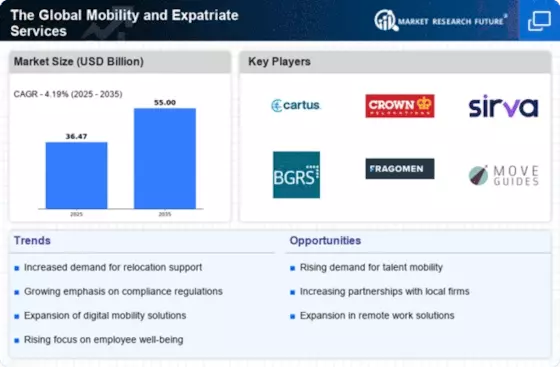
As per MRFR analysis, The Global Mobility and Expatriate Services was estimated at 35.0 USD Billion in 2024. The Global Mobility and Expatriate Services industry is projected to grow from 36.47 USD Billion in 2025 to 55.0 USD Billion by 2035, exhibiting a compound annual growth rate (CAGR) of 4.19 during the forecast period 2025 - 2035.

Key Market Trends & Highlights

The Global Mobility and Expatriate Services is experiencing a dynamic shift towards enhanced talent mobility and technological integration.

  • North America remains the largest market for global mobility services, driven by a robust demand for skilled labor.
  • The Asia-Pacific region is emerging as the fastest-growing area, reflecting a surge in multinational corporations expanding their operations.
  • Relocation services continue to dominate the market, while assignment management is rapidly gaining traction as organizations prioritize employee experience.
  • Key market drivers include the rising demand for skilled labor and the increasing emphasis on compliance and risk management in mobility solutions.

Market Size & Forecast

2024 Market Size 35.0 (USD Billion)
2035 Market Size 55.0 (USD Billion)
CAGR (2025 - 2035) 4.19%

Major Players

Cartus (US), Crown Relocations (US), SIRVA (US), BGRS (US), Fragomen (US), Move Guides (GB), Global Mobility Solutions (US), Altair Global (US), InterNations (DE)

Our Impact
Enabled $4.3B Revenue Impact for Fortune 500 and Leading Multinationals
Partnering with 2000+ Global Organizations Each Year
30K+ Citations by Top-Tier Firms in the Industry

The Global Mobility and Expatriate Services Market Trends

The Global Mobility and Expatriate Services is currently experiencing a transformative phase, driven by the increasing globalization of businesses and the need for talent mobility across borders. Organizations are recognizing the value of deploying skilled professionals to international locations, which enhances their competitive edge. This trend appears to be fueled by the desire for diverse perspectives and innovative solutions that expatriates can bring to local markets. Furthermore, the rise of remote work arrangements has introduced new dynamics, allowing companies to consider a broader range of talent without geographical constraints. In addition, the market is witnessing a growing emphasis on compliance and risk management. As regulations governing international assignments become more complex, organizations are investing in services that ensure adherence to local laws and regulations. This focus on compliance not only mitigates risks but also enhances the overall experience for expatriates. Moreover, the integration of technology in mobility services is likely to streamline processes, making it easier for companies to manage their global workforce effectively. Overall, The Global Mobility and Expatriate Services is evolving to meet the demands of a more interconnected world, where flexibility and adaptability are paramount.

Increased Focus on Talent Mobility

Organizations are prioritizing the movement of skilled professionals across borders to enhance their competitive advantage. This trend reflects a growing recognition of the benefits that diverse perspectives and experiences can bring to local markets.

Emphasis on Compliance and Risk Management

As international regulations become more intricate, companies are investing in services that ensure adherence to local laws. This focus on compliance not only reduces risks but also improves the expatriate experience.

Integration of Technology in Mobility Services

The adoption of technology is streamlining processes within The Global Mobility and Expatriate Services. This integration facilitates better management of global workforces, enhancing efficiency and effectiveness.

Market Segment Insights

By Service Type: Relocation Services (Largest) vs. Assignment Management (Fastest-Growing)

In The Global Mobility and Expatriate Services, the distribution of market share across various service types reveals that Relocation Services hold the largest segment in terms of demand, driven by the continuous need for organizations to support employee relocations. Following closely is Assignment Management, which is beginning to capture attention due to increasing complexities around international assignments. Other segments, such as Immigration Services and Tax Services, play niche roles but are essential in supporting expatriates navigating cross-border regulations and compliance. The growth trends within the service types indicate a strong upward trajectory for Assignment Management as businesses become more focused on optimizing their expatriate programs. This segment benefits from technological advancements aimed at enhancing employee experience and efficiency. Additionally, the rising focus on strategic consulting highlights the importance of integrated solutions that address the myriad challenges faced by expatriates. Organizations are increasingly investing in comprehensive services to improve retention and satisfaction rates among globally mobile employees.

Relocation Services (Dominant) vs. Immigration Services (Emerging)

The Relocation Services segment stands out as the dominant force in The Global Mobility and Expatriate Services. This service encompasses a broad range of offerings that assist in the logistics and coordination of relocating employees, which is critical as companies expand globally. Relocation Services are characterized by personalized support addressing practical aspects such as housing, schooling, and cultural acclimatization. In contrast, Immigration Services, while an emerging segment, are becoming increasingly important as firms navigate the intricate web of visa regulations and compliance issues across different countries. This segment is characterized by specialized knowledge and expertise to facilitate smooth transitions for expatriates but faces challenges due to changing immigration laws and policies. The interplay between these segments is crucial for organizations aiming to provide comprehensive support to their globally mobile workforce.

By Client Type: Corporations (Largest) vs. Government Agencies (Fastest-Growing)

In The Global Mobility and Expatriate Services, corporations hold a significant market share, leveraging global mobility services to enhance talent management and operational efficiency. This segment accounts for a substantial portion of the market as organizations seek to attract and retain top talent in various regions. Government agencies, though smaller in market share, are rapidly increasing their involvement, driven by the need for effective management of international assignments and expatriate personnel.

Corporations: Dominant vs. Government Agencies: Emerging

Corporations are the dominant players in The Global Mobility and Expatriate Services, utilizing these services to streamline international operations and enhance employee satisfaction. They are increasingly adopting technology-driven solutions to optimize relocations and manage their expatriate workforce efficiently. On the other hand, government agencies are emerging as significant players in this space, driven by globalization and the need to manage an increasingly mobile workforce. Emerging trends indicate a growing focus on compliance, sustainability, and supportive policies for expatriates, highlighting the necessity of effective mobility strategies in the public sector.

By Mobility Type: Short-Term Assignments (Largest) vs. Long-Term Assignments (Fastest-Growing)

In The Global Mobility and Expatriate Services, the distribution of market share among various mobility types shows that Short-Term Assignments currently dominate the landscape, appealing to companies that need flexibility in relocating employees. This segment caters to businesses requiring quick deployment of talent, often for urgent projects or temporary roles. Meanwhile, Long-Term Assignments have emerged as the fastest-growing segment, driven by globalization and the increasing importance of international experience in workforce development. The growth of Long-Term Assignments can be attributed to several factors, including the expanding needs of multinational corporations for talent in key markets and a focus on retaining employees through enriching international experiences. Additionally, this mobility type is seen as vital for fostering cultural integration and organizational effectiveness, further propelling its demand in the market. The trends suggest a shift towards longer engagements, which may redefine traditional expatriate management strategies.

Short-Term Assignments (Dominant) vs. Permanent Transfers (Emerging)

Short-Term Assignments have established themselves as a dominant force in The Global Mobility and Expatriate Services, characterized by their flexibility and adaptability to various business needs. These assignments generally last from a few weeks to a couple of years, allowing organizations to deploy talent rapidly in response to market demands. They cater primarily to skilled professionals and are often associated with specific projects, seasonal needs, or training requirements. In contrast, Permanent Transfers represent an emerging segment, reflecting a strategic approach towards long-term human capital development. Companies increasingly recognize the value of permanent relocation as a means of securing talent for critical roles internationally, often leading to smoother transitions in global operations. The growing acceptance of permanent assignments suggests a trend towards deepening employee engagement and sustaining business continuity.

By Industry: Information Technology (Largest) vs. Healthcare (Fastest-Growing)

In The Global Mobility and Expatriate Services, the Information Technology sector holds a significant market share, reflecting its critical role in facilitating global workforce mobility. This industry benefits from the increasing demand for skilled tech professionals across borders, leading to a robust expatriate market. Conversely, the Healthcare segment is emerging rapidly, driven by the global demand for healthcare professionals and the need for specialized skills in different regions. This has resulted in a dynamic shift towards more flexible expatriate services tailored to healthcare providers and organizations. As the market evolves, IT continues to dominate due to ongoing digital transformations and an evolving technology landscape. Meanwhile, the healthcare sector is experiencing accelerated growth fueled by aging populations and a heightened emphasis on health services globally. Factors such as telemedicine expansion and international collaboration in health research are increasing the demand for mobility solutions specific to healthcare professionals, making this segment increasingly vibrant and responsive to market needs.

Information Technology: Leading (Dominant) vs. Healthcare: Predominant (Emerging)

The Information Technology sector is characterized by its dominance in The Global Mobility and Expatriate Services, providing a wide array of expatriate assistance tailored to tech professionals. This includes relocation services, visa management, and compliance solutions that are essential for tech companies operating in multiple jurisdictions. The sector's strength lies in its adaptability to emerging trends like remote work and cross-border project collaborations, which necessitate efficient mobility services. On the other hand, the Healthcare segment is experiencing rapid growth, classified as emerging due to the increasing need for healthcare professionals internationally. With a focus on nurses, surgeons, and specialized medical personnel, healthcare mobility services are becoming crucial in addressing global health challenges, ensuring that institutions can access the necessary skilled labor while optimizing their expatriate programs.

Get more detailed insights about The Global Mobility and Expatriate Services Market

Regional Insights

North America : Market Leader in Mobility Services

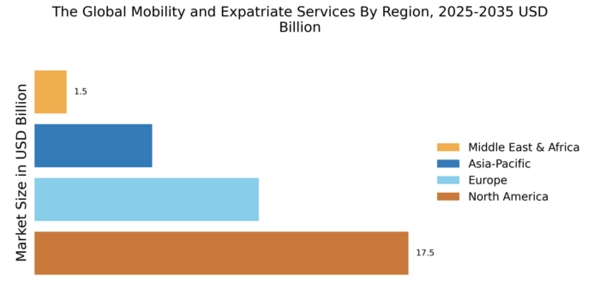
North America continues to lead The Global Mobility and Expatriate Services, holding a significant market share of 17.5 in 2024. The region's growth is driven by increasing globalization, a rise in cross-border employment, and supportive regulatory frameworks that facilitate international assignments. Companies are increasingly investing in mobility solutions to enhance employee satisfaction and retention, further fueling demand for these services. The competitive landscape in North America is robust, featuring key players such as Cartus, SIRVA, and Fragomen. These companies are leveraging technology to streamline processes and improve service delivery. The U.S. remains the largest market, with Canada also showing strong growth potential. The presence of established firms and innovative startups contributes to a dynamic environment, ensuring that North America remains at the forefront of global mobility solutions.

Europe : Emerging Mobility Hub

Europe's The Global Mobility and Expatriate Services is valued at 10.5, reflecting a growing demand for mobility solutions across the continent. Factors such as increased intra-European migration, evolving labor laws, and a focus on talent retention are driving this growth. Regulatory changes aimed at simplifying cross-border employment are also acting as catalysts, making it easier for companies to deploy talent across borders. Leading countries in this region include Germany, the UK, and France, which are home to many multinational corporations. The competitive landscape features established players like Move Guides and InterNations, who are adapting to the changing needs of businesses and expatriates. The presence of diverse cultures and languages in Europe further enhances the demand for tailored mobility services, positioning the region as a key player in the global market.

Asia-Pacific : Rapidly Growing Market

The Asia-Pacific region, with a market size of 5.5, is witnessing rapid growth in The Global Mobility and Expatriate Services. This growth is driven by increasing foreign investments, a burgeoning expatriate population, and a rising demand for skilled labor across borders. Countries in this region are also implementing policies to attract global talent, further enhancing the market's potential. Regulatory frameworks are evolving to support international assignments, making it easier for companies to navigate the complexities of mobility. Key players in the Asia-Pacific market include Global Mobility Solutions and Altair Global, who are focusing on providing customized solutions to meet the diverse needs of businesses. Countries like China, India, and Australia are leading the charge, with significant investments in mobility services. The competitive landscape is becoming increasingly dynamic, as companies strive to differentiate themselves through innovative offerings and superior customer service.

Middle East and Africa : Emerging Market Potential

The Middle East and Africa region, with a market size of 1.5, presents emerging opportunities in The Global Mobility and Expatriate Services. The growth is fueled by increasing expatriate populations, economic diversification efforts, and a focus on attracting foreign talent. Countries in this region are implementing policies to enhance workforce mobility, which is crucial for economic development and competitiveness. The regulatory environment is gradually improving, making it easier for companies to manage international assignments. Leading countries in this region include the UAE and South Africa, which are becoming hubs for expatriates. The competitive landscape is characterized by a mix of local and international players, with companies adapting their services to meet the unique needs of the region. As the market matures, there is a growing emphasis on technology-driven solutions to streamline mobility processes and enhance the overall experience for expatriates.


The Global Mobility and Expatriate Services Market Regional Image

Key Players and Competitive Insights

The Global Mobility and Expatriate Services is currently characterized by a dynamic competitive landscape, driven by increasing globalization and the need for businesses to manage their workforce across borders effectively. Key players such as Cartus (US), SIRVA (US), and Fragomen (US) are strategically positioned to leverage their extensive networks and expertise in relocation services. Cartus (US) focuses on enhancing its digital platforms to streamline the relocation process, while SIRVA (US) emphasizes operational efficiency through technology integration. Fragomen (US) is noted for its legal expertise in immigration services, which is increasingly vital as regulatory environments evolve. Collectively, these strategies indicate a shift towards more integrated and technology-driven solutions in the market.In terms of business tactics, companies are increasingly localizing their services to better cater to regional needs, optimizing supply chains to enhance service delivery. The market appears moderately fragmented, with a mix of large multinational firms and smaller specialized providers. This structure allows for a diverse range of services, although the influence of major players like SIRVA (US) and Cartus (US) is significant, as they set benchmarks for service quality and innovation.

In November Cartus (US) announced a partnership with a leading technology firm to develop an AI-driven platform aimed at improving the user experience for expatriates. This strategic move is likely to enhance their service offerings by providing personalized relocation solutions, thereby increasing customer satisfaction and retention. The integration of AI into their operations may also streamline processes, reducing costs and improving efficiency.

In October SIRVA (US) expanded its global footprint by acquiring a regional relocation service provider in Asia. This acquisition is strategically important as it allows SIRVA (US) to tap into emerging markets and enhance its service capabilities in a region that is witnessing significant expatriate movement. Such expansions are indicative of a broader trend where companies seek to consolidate their market presence through strategic acquisitions.

In September Fragomen (US) launched a new compliance tool designed to assist companies in navigating complex immigration regulations across multiple jurisdictions. This initiative underscores the growing importance of compliance in the expatriate services sector, as businesses face increasing scrutiny regarding their immigration practices. By providing such tools, Fragomen (US) positions itself as a leader in legal compliance, which is crucial for companies operating internationally.

As of December the competitive trends in The Global Mobility and Expatriate Services are increasingly defined by digitalization, sustainability, and the integration of AI technologies. Strategic alliances are becoming more prevalent, as companies recognize the need to collaborate to enhance service offerings and operational efficiencies. Looking ahead, competitive differentiation is likely to evolve from traditional price-based competition to a focus on innovation, technology integration, and supply chain reliability, suggesting a transformative shift in how companies approach global mobility.

Key Companies in the The Global Mobility and Expatriate Services Market include

Future Outlook

The Global Mobility and Expatriate Services Market Future Outlook

The Global Mobility and Expatriate Services is projected to grow at a 4.19% CAGR from 2025 to 2035, driven by globalization, technological advancements, and evolving workforce dynamics.

New opportunities lie in:

  • Development of AI-driven relocation management platforms.
  • Expansion of global talent acquisition services.
  • Integration of compliance automation tools for expatriate management.

By 2035, the market is expected to be robust, reflecting substantial growth and innovation.

Market Segmentation

The Global Mobility and Expatriate Services Market Industry Outlook

  • Information Technology
  • Healthcare
  • Manufacturing
  • Finance
  • Education

The Global Mobility and Expatriate Services Market Client Type Outlook

  • Corporations
  • Government Agencies
  • Non-Governmental Organizations
  • Educational Institutions
  • Individuals

The Global Mobility and Expatriate Services Market Service Type Outlook

  • Relocation Services
  • Assignment Management
  • Immigration Services
  • Tax Services
  • Consulting Services

The Global Mobility and Expatriate Services Market Mobility Type Outlook

  • Short-Term Assignments
  • Long-Term Assignments
  • Permanent Transfers
  • Commuter Assignments
  • Virtual Assignments

Report Scope

MARKET SIZE 202435.0(USD Billion)
MARKET SIZE 202536.47(USD Billion)
MARKET SIZE 203555.0(USD Billion)
COMPOUND ANNUAL GROWTH RATE (CAGR)4.19% (2025 - 2035)
REPORT COVERAGERevenue Forecast, Competitive Landscape, Growth Factors, and Trends
BASE YEAR2024
Market Forecast Period2025 - 2035
Historical Data2019 - 2024
Market Forecast UnitsUSD Billion
Key Companies ProfiledCartus (US), Crown Relocations (US), SIRVA (US), BGRS (US), Fragomen (US), Move Guides (GB), Global Mobility Solutions (US), Altair Global (US), InterNations (DE)
Segments CoveredService Type, Client Type, Mobility Type, Industry
Key Market OpportunitiesIntegration of digital platforms enhances efficiency in The Global Mobility and Expatriate Services operations.
Key Market DynamicsRising demand for flexible relocation solutions drives innovation in expatriate services and competitive market dynamics.
Countries CoveredNorth America, Europe, APAC, South America, MEA
Leave a Comment
Download Free Sample

Kindly complete the form below to receive a free sample of this Report

Compare Licence

×
Features License Type
Single User Multiuser License Enterprise User
Price $4,950 $5,950 $7,250
Maximum User Access Limit 1 User Upto 10 Users Unrestricted Access Throughout the Organization
Free Customization
Direct Access to Analyst
Deliverable Format
Platform Access
Discount on Next Purchase 10% 15% 15%
Printable Versions