×
Hero Background
English
Chinese
French
Japanese
Korean
German
Spanish

Texture Paints Market Trends

ID: MRFR/CnM/4706-HCR
100 Pages
Chitranshi Jaiswal
October 2025

Texture Paints Market Research Report Information by Product Type (premixed, self-mixing paints, smooth textured paint), Additives (sand, quartz), Substrate Type (interior, exterior), Application (residential, non-residential), and Regions – Forecast till 2035

Share:
Download PDF ×

We do not share your information with anyone. However, we may send you emails based on your report interest from time to time. You may contact us at any time to opt-out.

Texture Paints Market Infographic
Purchase Options

Market Trends

Key Emerging Trends in the Texture Paints Market

Market trends in texture paints reflect the evolving preferences, innovations, and shifts within the paint industry, driven by various factors influencing consumer choices and industry practices. One prominent trend is the increasing demand for textured finishes in both residential and commercial settings. Consumers are seeking unique and visually appealing surfaces, spurring the popularity of texture paints that offer tactile and dimensional effects. This trend aligns with the desire for personalized spaces, allowing individuals to express their style through textured wall finishes, contributing to the steady growth of texture paint sales.

Moreover, sustainability has emerged as a significant trend shaping the texture paint market. There is a rising emphasis on eco-friendly paint formulations, with consumers opting for texture paints made from low-VOC (Volatile Organic Compounds) or zero-VOC materials and other environmentally responsible components. This trend stems from increased awareness of environmental impact and a growing preference for products that promote healthier indoor air quality, influencing manufacturers to develop and promote sustainable texture paint options.

Another notable trend is the convergence of technology and design in texture paints. Advancements in paint technology have led to the introduction of innovative textures, finishes, and application methods. Textured paint formulations that offer enhanced durability, easier application, and unique aesthetic effects are gaining traction among consumers. Additionally, the integration of digital tools and software allowing for virtual simulations of textured finishes aids consumers in visualizing and selecting the desired texture paint for their spaces.

Furthermore, customization and personalization have become key trends driving the texture paint market. Consumers are increasingly seeking bespoke solutions, and paint manufacturers are responding by offering a wide array of textures, colors, and finishes. Customizable texture paint options allow consumers to create distinctive looks and cater to individual preferences, aligning with the demand for personalized interior and exterior design solutions.

In line with the trend of convenience and ease of use, texture paints that are DIY-friendly have gained popularity. Consumers, particularly homeowners, are opting for texture paints that can be easily applied without professional assistance. Paint manufacturers have responded by developing user-friendly texture paint products that simplify the application process, appealing to consumers seeking hassle-free home improvement solutions.

Moreover, the trend of textured feature walls or accent surfaces has gained momentum in interior design. Rather than applying texture paints uniformly across entire spaces, consumers are using texture paints strategically to create focal points or accentuate specific areas within rooms. This trend allows for creativity and versatility in design, driving the demand for texture paints used for highlighting architectural features or creating visual interest.

Additionally, the integration of textures beyond traditional walls into other surfaces, such as ceilings, furniture, and exteriors, is a rising trend. Texture paints are being utilized to add depth and character to various surfaces, expanding their application beyond conventional walls. This trend reflects the versatility of texture paints and their potential to transform diverse elements within living spaces.

Author
Chitranshi Jaiswal
Research Analyst Level I

In her 3 years of experience in the market research field, she has handled critical cross-domain projects. She has an in-depth knowledge of market estimation & analysis, problem-solving, primary as well as secondary research, and team management.She holds an engineering degree and is an MBA professional from a well-known university, capable of evaluating the market and competitive conditions. An exceptional strategist with excellent communication skills and a passion for delivering cutting-edge & practical insights for the market. Proficient in multi-tasking, and can successfully deal with competing demands, while maintaining complete confidentiality. Generated business through active client and project development, networking, and high-quality responses. Her knowledge and skills have helped in making solid business decisions, securing funding from investors, and avoiding business failures.

Leave a Comment

FAQs

What is the current valuation of the Texture Paints Market as of 2024?

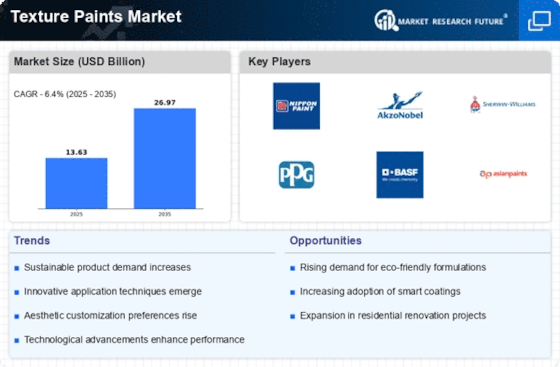
The Texture Paints Market was valued at 13.63 USD Billion in 2024.

What is the projected market size for the Texture Paints Market by 2035?

The market is projected to reach 26.97 USD Billion by 2035.

What is the expected CAGR for the Texture Paints Market during the forecast period 2025 - 2035?

The expected CAGR for the Texture Paints Market during 2025 - 2035 is 6.4%.

Which product type segment is anticipated to show significant growth in the Texture Paints Market?

The premixed texture paints segment is expected to grow from 4.09 USD Billion in 2024 to 8.18 USD Billion by 2035.

What are the key additives contributing to the Texture Paints Market?

Quartz and sand are key additives, with quartz projected to grow from 3.41 USD Billion in 2024 to 6.82 USD Billion by 2035.

Market Summary

As per MRFR analysis, the Texture Paints Market Size was estimated at 13.63 USD Billion in 2024. The Texture Paints industry is projected to grow from 14.5 in 2025 to 26.97 by 2035, exhibiting a compound annual growth rate (CAGR) of 6.4 during the forecast period 2025 - 2035.

Key Market Trends & Highlights

The Texture Paints Market is experiencing a dynamic shift driven by sustainability and technological advancements.

  • North America remains the largest market for texture paints, reflecting a robust demand for innovative wall finishes. Asia-Pacific is emerging as the fastest-growing region, propelled by increasing urbanization and a burgeoning middle class. Premixed texture paints dominate the market, while self-mixing paints are rapidly gaining traction due to their convenience. The market is significantly driven by a focus on sustainability and the expansion of DIY culture, which encourages consumer engagement.

Market Size & Forecast

2024 Market Size 13.63 (USD Billion)
2035 Market Size 26.97 (USD Billion)
CAGR (2025 - 2035) 6.4%
Largest Regional Market Share in 2024 Asia Pacific

Major Players

<p>Nippon Paint (JP), AkzoNobel (NL), Sherwin-Williams (US), PPG Industries (US), BASF (DE), Asian Paints (IN), DuluxGroup (AU), Kansai Paint (JP), RPM International (US)</p>

Market Trends

The Texture Paints Market is currently experiencing a dynamic evolution, driven by a confluence of aesthetic preferences and functional requirements. As consumers increasingly seek personalized and unique interior and exterior designs, the demand for texture paints has surged. This market segment appears to be influenced by a growing inclination towards eco-friendly and sustainable products, as manufacturers respond to environmental concerns by developing low-VOC and water-based formulations. Additionally, the rise of DIY culture has empowered consumers to engage in home improvement projects, further propelling the adoption of texture paints. Moreover, the Texture Paints Market seems to be characterized by a diversification of product offerings, with innovations in texture and finish options. This trend indicates a shift towards more creative applications, as designers and homeowners alike explore various textures to enhance visual appeal. The integration of advanced technologies in paint formulation and application techniques may also play a pivotal role in shaping market dynamics. As the industry continues to adapt to changing consumer preferences and technological advancements, the Texture Paints Market is poised for sustained growth and transformation.

Sustainability Focus

The Texture Paints Market is increasingly leaning towards sustainable practices, with manufacturers prioritizing eco-friendly formulations. This trend reflects a broader societal shift towards environmental consciousness, as consumers demand products that minimize ecological impact.

DIY Culture Expansion

The rise of the DIY movement has significantly influenced the Texture Paints Market. Homeowners are more inclined to undertake personal projects, leading to a heightened interest in texture paints that allow for creative expression and customization.

Technological Advancements

Innovations in paint technology are reshaping the Texture Paints Market. Enhanced application techniques and improved formulations are enabling more diverse textures and finishes, catering to evolving consumer tastes and preferences.

Texture Paints Market Market Drivers

Urbanization Trends

Urbanization trends are significantly impacting the Texture Paints Market. As urban areas expand, there is a growing need for residential and commercial buildings, which in turn drives the demand for decorative and protective coatings. The construction sector is increasingly adopting texture paints for their aesthetic qualities and durability. Market data indicates that urban areas are projected to see a population increase of over 20% in the next decade, leading to heightened construction activities. This surge in urban development is likely to create substantial opportunities for texture paint manufacturers, as builders and architects seek innovative solutions to enhance the visual appeal of structures. Consequently, the Texture Paints Market is expected to benefit from these urbanization trends.

Sustainability Focus

The increasing emphasis on sustainability within the Texture Paints Market is driving demand for eco-friendly products. Consumers are becoming more aware of the environmental impact of their choices, leading to a preference for paints that are low in volatile organic compounds (VOCs) and made from natural materials. This shift is not merely a trend but appears to be a fundamental change in consumer behavior. As a result, manufacturers are investing in research and development to create sustainable texture paints that meet these demands. The market for eco-friendly texture paints is projected to grow significantly, with estimates suggesting a compound annual growth rate (CAGR) of over 5% in the coming years. This focus on sustainability is likely to reshape the competitive landscape of the Texture Paints Market.

DIY Culture Expansion

The rise of the do-it-yourself (DIY) culture is significantly influencing the Texture Paints Market. As more individuals engage in home improvement projects, the demand for user-friendly texture paints is increasing. This trend is particularly evident among younger consumers who seek to personalize their living spaces. The availability of instructional content online has empowered consumers to undertake painting projects themselves, thereby boosting sales in the texture paints segment. Market data indicates that the DIY segment accounts for a substantial portion of the overall texture paints market, with estimates suggesting it could represent nearly 40% of total sales. This expansion of DIY culture is likely to continue driving innovation and product development within the Texture Paints Market.

Rising Disposable Income

Rising disposable income levels are contributing to the growth of the Texture Paints Market. As consumers experience an increase in their purchasing power, they are more inclined to invest in home improvement and renovation projects. This trend is particularly pronounced in emerging economies, where a burgeoning middle class is seeking to enhance their living environments. Market Research Future indicates that regions with rising disposable incomes are witnessing a surge in demand for premium texture paints, which offer superior quality and aesthetic appeal. This shift towards higher-end products is likely to drive competition among manufacturers, prompting them to innovate and diversify their product offerings. As a result, the Texture Paints Market is poised for growth as consumer spending on home decor continues to rise.

Technological Advancements

Technological advancements are playing a crucial role in shaping the Texture Paints Market. Innovations in paint formulation and application techniques are enhancing the performance and aesthetic appeal of texture paints. For instance, the introduction of advanced spray technologies allows for smoother application and better coverage, which is appealing to both professional painters and DIY enthusiasts. Additionally, the development of smart paints that can change color or texture in response to environmental conditions is gaining traction. Market analysis suggests that the adoption of these technologies could lead to a significant increase in market share for companies that invest in research and development. As a result, the Texture Paints Market is likely to witness a surge in demand for technologically advanced products.

Market Segment Insights

By Product Type: Premixed Texture Paints Market (Largest) vs. Self-Mixing Paints (Fastest-Growing)

<p>In the Texture Paints Market, the segment distribution showcases premixed texture paints as the largest segment, dominating the market with their convenience and ready-to-use nature. Self-mixing paints are emerging as a significant trend among DIY enthusiasts, capturing a notable share due to their versatility, user-friendliness, and the customization options they offer. Smooth textured paint and other variants hold smaller shares, indicating a specialized demand that primarily caters to niche markets. The growth trends in this segment are closely tied to evolving consumer preferences, where the demand for sustainability and ease of application drives the shift towards self-mixing paints. Additionally, innovations in formulations and a rising trend in home improvement projects are fueling the popularity of both premixed and self-mixing options. As consumers increasingly seek aesthetically pleasing and functional solutions, the market is witnessing a dynamic evolution, with self-mixing paints gaining momentum.</p>

<p>Premixed Texture Paints Market (Dominant) vs. Self-Mixing Paints (Emerging)</p>

<p>Premixed texture paints have firmly established themselves as a dominant force in the Texture Paints Market, appealing to both professional contractors and DIY homeowners with their hassle-free application and consistent finish. These products are favored for their time-saving attributes, as they require no additional mixing, allowing for quicker turnover in projects. On the other side, self-mixing paints are positioned as an emerging choice that resonates with a growing segment of consumers who enjoy customizing their painting solutions. These products cater to users looking for an interactive experience, contributing to their rapid growth as they offer the flexibility to adjust textures and finishes per user preference. Together, these segments reflect a diverse market landscape that balances convenience with personalization.</p>

By Additives: Sand (Largest) vs. Quartz (Fastest-Growing)

<p>In the Texture Paints Market, the additives segment showcases a diverse distribution where sand remains the largest contributor, emphasizing its longstanding traditional use in various painting applications. Following closely, quartz is emerging rapidly, bolstered by trends favoring eco-friendliness and texture variety. Household items and other texture additives also play significant roles, though they occupy smaller shares of the market, reflecting niche applications and innovative formulations that appeal to specific consumer segments. Growth trends indicate a robust demand for texture paints augmented with sand and quartz additives, driven by the rising <a href="https://www.marketresearchfuture.com/reports/construction-market-16065">construction</a> sector and the growing consumer preference for customized finishes. Manufacturers are increasingly focusing on these additives to create unique textures that enhance aesthetic appeal while meeting performance standards. This trend aligns with sustainability goals, as greener formulations continue to gain traction within the industry.</p>

<p>Sand (Dominant) vs. Quartz (Emerging)</p>

<p>Sand additives in texture paints are recognized for their excellent texture and durability, making them a dominant choice for various applications, from residential to commercial projects. The natural properties of sand not only improve the paint's finish but also enhance its performance against harsh environmental conditions. Conversely, <a href="https://www.marketresearchfuture.com/reports/quartz-market-18835">quartz</a>, while still a developing segment, is rapidly gaining popularity due to its chemical resistance and ability to provide a high-end aesthetic. As consumers seek out innovative and visually appealing paint products, quartz is positioned as an emerging choice that offers both resilience and a modern look, appealing particularly to the luxury segment of the texture paint market.</p>

By Substrate Type: Interior (Largest) vs. Exterior Walls (Fastest-Growing)

<p>Within the Texture Paints Market, the substrate type distribution reveals that interior paints for walls, ceilings, and <a href="https://www.marketresearchfuture.com/reports/flooring-market-2527">floorings</a> dominate the market. This segment accounts for a significant portion of the overall demand due to the ongoing trends in home improvement and renovation, where aesthetics and functionality are key considerations. Meanwhile, the segment focusing on exterior walls is swiftly gaining traction, driven by the growing emphasis on curb appeal and protective paint solutions that withstand environmental challenges, thereby capturing a considerable share of the market.</p>

<p>Interior (Dominant) vs. Exterior Walls (Emerging)</p>

<p>The interior substrate segment stands as the dominant force in the Texture Paints Market, characterized by a wide array of options catering to different design preferences and practical needs. Factors such as the increasing popularity of textured finishes among homeowners and interior designers solidify its strong market position. In contrast, the exterior walls segment is emerging rapidly as consumers seek durable and aesthetically pleasing solutions for outdoor spaces. This segment is notably influenced by trends such as sustainable building practices and the need for paints that offer long-lasting protection against weather-related deterioration, appealing to a growing market of environmentally conscious consumers.</p>

By Application: Residential (Largest) vs. Non-Residential (Fastest-Growing)

<p>In the Texture Paints Market, the residential segment holds the largest share, driven by ongoing home improvement projects and the steady demand for aesthetic upgrades in living spaces. This segment benefits from a trend towards personalized home designs, leading to higher consumption of texture paints that offer diverse finishes and textures suitable for different styles and preferences. Conversely, the non-residential segment is recognized as the fastest-growing area within this market. Factors contributing to this growth include increased commercial construction activities and rising investments in infrastructural developments. Businesses emphasize unique aesthetics and durability in their premises, driving demand for innovative texture paint solutions that meet various functional and design requirements.</p>

<p>Application: Residential (Dominant) vs. Non-Residential (Emerging)</p>

<p>The residential application segment in the Texture Paints Market is characterized by its wide-ranging use in households, with consumers increasingly seeking products that elevate their home's visual appeal and reflect personal taste. This segment features a diverse array of finish options, catering to different design themes and preferences. On the other hand, the non-residential segment is emerging quickly due to a surge in commercial projects and a focus on creating professional environments that attract customers. The use of high-quality texture paints in offices, retail spaces, and institutional facilities highlights the growing need for aesthetic and functional enhancements. Both segments are vital to the overall growth of the texture paints market, showcasing unique dynamics and varying consumer requirements.</p>

Get more detailed insights about Texture Paints Market Research Report – Forecast to 2035

Regional Insights

Key Companies in the Texture Paints Market market include

Industry Developments

In Mar 2021, a well-known grey cement company JK Cement Ltd., announced its entry into the paint sector, adding yet another color to the texture paint industry's pallet. The company's board of directors authorized the company's plan to enter the paint business during a meeting this evening. JK Cement is expected to enter the paint business through a wholly-owned subsidiary.

The board has also approved a five-year investment of Rs 600 crore in the paint sector. PPG Industries announced in February 2022 that it has reached an agreement to buy Arsonsisi, a Texture Paints Market company situated in Milan, Italy's powder coatings division.

Intended Audience

  • Texture paints manufacturers
  • Traders and distributors of texture paints
  • Research and development institutes
  • Interior Texture Paint
  • Potential investors
  • Raw material suppliers
  • Nationalized laboratory

Future Outlook

Texture Paints Market Future Outlook

<p>The Texture Paints Market is projected to grow at a 6.4% CAGR from 2024 to 2035, driven by urbanization, eco-friendly products, and innovative application techniques.</p>

New opportunities lie in:

  • <p>Expansion into eco-friendly texture paint lines</p><p>Development of smart texture paint technologies</p><p>Partnerships with construction firms for bulk supply agreements</p>

<p>By 2035, the Texture Paints Market is expected to achieve robust growth and increased market share.</p>

Market Segmentation

Texture Paints Market Additives Outlook

  • sand
  • quartz
  • household items
  • other texture additives

Texture Paints Market Application Outlook

  • residential
  • non-residential

Texture Paints Market Product Type Outlook

  • premixed texture paints
  • self-mixing paints
  • smooth textured paint
  • others

Texture Paints Market Substrate Type Outlook

  • interior (walls
  • ceilings
  • floorings)
  • exterior walls

Report Scope

MARKET SIZE 202413.63(USD Billion)
MARKET SIZE 202514.5(USD Billion)
MARKET SIZE 203526.97(USD Billion)
COMPOUND ANNUAL GROWTH RATE (CAGR)6.4% (2024 - 2035)
REPORT COVERAGERevenue Forecast, Competitive Landscape, Growth Factors, and Trends
BASE YEAR2024
Market Forecast Period2025 - 2035
Historical Data2019 - 2024
Market Forecast UnitsUSD Billion
Key Companies ProfiledMarket analysis in progress
Segments CoveredMarket segmentation analysis in progress
Key Market OpportunitiesGrowing demand for eco-friendly and innovative texture paints presents significant opportunities in the Texture Paints Market.
Key Market DynamicsRising consumer preference for eco-friendly texture paints drives innovation and competition among manufacturers.
Countries CoveredNorth America, Europe, APAC, South America, MEA

FAQs

What is the current valuation of the Texture Paints Market as of 2024?

The Texture Paints Market was valued at 13.63 USD Billion in 2024.

What is the projected market size for the Texture Paints Market by 2035?

The market is projected to reach 26.97 USD Billion by 2035.

What is the expected CAGR for the Texture Paints Market during the forecast period 2025 - 2035?

The expected CAGR for the Texture Paints Market during 2025 - 2035 is 6.4%.

Which product type segment is anticipated to show significant growth in the Texture Paints Market?

The premixed texture paints segment is expected to grow from 4.09 USD Billion in 2024 to 8.18 USD Billion by 2035.

What are the key additives contributing to the Texture Paints Market?

Quartz and sand are key additives, with quartz projected to grow from 3.41 USD Billion in 2024 to 6.82 USD Billion by 2035.

  1. SECTION I: EXECUTIVE SUMMARY AND KEY HIGHLIGHTS
    1. EXECUTIVE SUMMARY
      1. Market Overview
      2. Key Findings
      3. Market Segmentation
      4. Competitive Landscape
      5. Challenges and Opportunities
      6. Future Outlook 2
  2. SECTION II: SCOPING, METHODOLOGY AND MARKET STRUCTURE
    1. MARKET INTRODUCTION
      1. Definition
      2. Scope of the study
    2. RESEARCH METHODOLOGY
      1. Overview
      2. Data Mining
      3. Secondary Research
      4. Primary Research
      5. Forecasting Model
      6. Market Size Estimation
      7. Data Triangulation
      8. Validation 3
  3. SECTION III: QUALITATIVE ANALYSIS
    1. MARKET DYNAMICS
      1. Overview
      2. Drivers
      3. Restraints
      4. Opportunities
    2. MARKET FACTOR ANALYSIS
      1. Value chain Analysis
      2. Porter's Five Forces Analysis
      3. COVID-19 Impact Analysis
  4. SECTION IV: QUANTITATIVE ANALYSIS
    1. Chemicals and Materials, BY Product Type (USD Billion)
      1. premixed texture paints
      2. self-mixing paints
      3. smooth textured paint
      4. others
    2. Chemicals and Materials, BY Additives (USD Billion)
      1. sand
      2. quartz
      3. household items
      4. other texture additives
    3. Chemicals and Materials, BY Substrate Type (USD Billion)
      1. interior (walls, ceilings, floorings)
      2. exterior walls
    4. Chemicals and Materials, BY Application (USD Billion)
      1. residential
      2. non-residential
    5. Chemicals and Materials, BY Region (USD Billion)
      1. North America
      2. Europe
      3. APAC
      4. South America
      5. MEA
  5. SECTION V: COMPETITIVE ANALYSIS
    1. Competitive Landscape
      1. Overview
      2. Competitive Analysis
      3. Market share Analysis
      4. Major Growth Strategy in the Chemicals and Materials
      5. Competitive Benchmarking
      6. Leading Players in Terms of Number of Developments in the Chemicals and Materials
      7. Key developments and growth strategies
      8. Major Players Financial Matrix
    2. Company Profiles
      1. Nippon Paint (JP)
      2. AkzoNobel (NL)
      3. Sherwin-Williams (US)
      4. PPG Industries (US)
      5. BASF (DE)
      6. Asian Paints (IN)
      7. DuluxGroup (AU)
      8. Kansai Paint (JP)
      9. RPM International (US)
    3. Appendix
      1. References
      2. Related Reports 6 LIST OF FIGURES
    4. MARKET SYNOPSIS
    5. NORTH AMERICA MARKET ANALYSIS
    6. US MARKET ANALYSIS BY PRODUCT TYPE
    7. US MARKET ANALYSIS BY ADDITIVES
    8. US MARKET ANALYSIS BY SUBSTRATE TYPE
    9. US MARKET ANALYSIS BY APPLICATION
    10. CANADA MARKET ANALYSIS BY PRODUCT TYPE
    11. CANADA MARKET ANALYSIS BY ADDITIVES
    12. CANADA MARKET ANALYSIS BY SUBSTRATE TYPE
    13. CANADA MARKET ANALYSIS BY APPLICATION
    14. EUROPE MARKET ANALYSIS
    15. GERMANY MARKET ANALYSIS BY PRODUCT TYPE
    16. GERMANY MARKET ANALYSIS BY ADDITIVES
    17. GERMANY MARKET ANALYSIS BY SUBSTRATE TYPE
    18. GERMANY MARKET ANALYSIS BY APPLICATION
    19. UK MARKET ANALYSIS BY PRODUCT TYPE
    20. UK MARKET ANALYSIS BY ADDITIVES
    21. UK MARKET ANALYSIS BY SUBSTRATE TYPE
    22. UK MARKET ANALYSIS BY APPLICATION
    23. FRANCE MARKET ANALYSIS BY PRODUCT TYPE
    24. FRANCE MARKET ANALYSIS BY ADDITIVES
    25. FRANCE MARKET ANALYSIS BY SUBSTRATE TYPE
    26. FRANCE MARKET ANALYSIS BY APPLICATION
    27. RUSSIA MARKET ANALYSIS BY PRODUCT TYPE
    28. RUSSIA MARKET ANALYSIS BY ADDITIVES
    29. RUSSIA MARKET ANALYSIS BY SUBSTRATE TYPE
    30. RUSSIA MARKET ANALYSIS BY APPLICATION
    31. ITALY MARKET ANALYSIS BY PRODUCT TYPE
    32. ITALY MARKET ANALYSIS BY ADDITIVES
    33. ITALY MARKET ANALYSIS BY SUBSTRATE TYPE
    34. ITALY MARKET ANALYSIS BY APPLICATION
    35. SPAIN MARKET ANALYSIS BY PRODUCT TYPE
    36. SPAIN MARKET ANALYSIS BY ADDITIVES
    37. SPAIN MARKET ANALYSIS BY SUBSTRATE TYPE
    38. SPAIN MARKET ANALYSIS BY APPLICATION
    39. REST OF EUROPE MARKET ANALYSIS BY PRODUCT TYPE
    40. REST OF EUROPE MARKET ANALYSIS BY ADDITIVES
    41. REST OF EUROPE MARKET ANALYSIS BY SUBSTRATE TYPE
    42. REST OF EUROPE MARKET ANALYSIS BY APPLICATION
    43. APAC MARKET ANALYSIS
    44. CHINA MARKET ANALYSIS BY PRODUCT TYPE
    45. CHINA MARKET ANALYSIS BY ADDITIVES
    46. CHINA MARKET ANALYSIS BY SUBSTRATE TYPE
    47. CHINA MARKET ANALYSIS BY APPLICATION
    48. INDIA MARKET ANALYSIS BY PRODUCT TYPE
    49. INDIA MARKET ANALYSIS BY ADDITIVES
    50. INDIA MARKET ANALYSIS BY SUBSTRATE TYPE
    51. INDIA MARKET ANALYSIS BY APPLICATION
    52. JAPAN MARKET ANALYSIS BY PRODUCT TYPE
    53. JAPAN MARKET ANALYSIS BY ADDITIVES
    54. JAPAN MARKET ANALYSIS BY SUBSTRATE TYPE
    55. JAPAN MARKET ANALYSIS BY APPLICATION
    56. SOUTH KOREA MARKET ANALYSIS BY PRODUCT TYPE
    57. SOUTH KOREA MARKET ANALYSIS BY ADDITIVES
    58. SOUTH KOREA MARKET ANALYSIS BY SUBSTRATE TYPE
    59. SOUTH KOREA MARKET ANALYSIS BY APPLICATION
    60. MALAYSIA MARKET ANALYSIS BY PRODUCT TYPE
    61. MALAYSIA MARKET ANALYSIS BY ADDITIVES
    62. MALAYSIA MARKET ANALYSIS BY SUBSTRATE TYPE
    63. MALAYSIA MARKET ANALYSIS BY APPLICATION
    64. THAILAND MARKET ANALYSIS BY PRODUCT TYPE
    65. THAILAND MARKET ANALYSIS BY ADDITIVES
    66. THAILAND MARKET ANALYSIS BY SUBSTRATE TYPE
    67. THAILAND MARKET ANALYSIS BY APPLICATION
    68. INDONESIA MARKET ANALYSIS BY PRODUCT TYPE
    69. INDONESIA MARKET ANALYSIS BY ADDITIVES
    70. INDONESIA MARKET ANALYSIS BY SUBSTRATE TYPE
    71. INDONESIA MARKET ANALYSIS BY APPLICATION
    72. REST OF APAC MARKET ANALYSIS BY PRODUCT TYPE
    73. REST OF APAC MARKET ANALYSIS BY ADDITIVES
    74. REST OF APAC MARKET ANALYSIS BY SUBSTRATE TYPE
    75. REST OF APAC MARKET ANALYSIS BY APPLICATION
    76. SOUTH AMERICA MARKET ANALYSIS
    77. BRAZIL MARKET ANALYSIS BY PRODUCT TYPE
    78. BRAZIL MARKET ANALYSIS BY ADDITIVES
    79. BRAZIL MARKET ANALYSIS BY SUBSTRATE TYPE
    80. BRAZIL MARKET ANALYSIS BY APPLICATION
    81. MEXICO MARKET ANALYSIS BY PRODUCT TYPE
    82. MEXICO MARKET ANALYSIS BY ADDITIVES
    83. MEXICO MARKET ANALYSIS BY SUBSTRATE TYPE
    84. MEXICO MARKET ANALYSIS BY APPLICATION
    85. ARGENTINA MARKET ANALYSIS BY PRODUCT TYPE
    86. ARGENTINA MARKET ANALYSIS BY ADDITIVES
    87. ARGENTINA MARKET ANALYSIS BY SUBSTRATE TYPE
    88. ARGENTINA MARKET ANALYSIS BY APPLICATION
    89. REST OF SOUTH AMERICA MARKET ANALYSIS BY PRODUCT TYPE
    90. REST OF SOUTH AMERICA MARKET ANALYSIS BY ADDITIVES
    91. REST OF SOUTH AMERICA MARKET ANALYSIS BY SUBSTRATE TYPE
    92. REST OF SOUTH AMERICA MARKET ANALYSIS BY APPLICATION
    93. MEA MARKET ANALYSIS
    94. GCC COUNTRIES MARKET ANALYSIS BY PRODUCT TYPE
    95. GCC COUNTRIES MARKET ANALYSIS BY ADDITIVES
    96. GCC COUNTRIES MARKET ANALYSIS BY SUBSTRATE TYPE
    97. GCC COUNTRIES MARKET ANALYSIS BY APPLICATION
    98. SOUTH AFRICA MARKET ANALYSIS BY PRODUCT TYPE
    99. SOUTH AFRICA MARKET ANALYSIS BY ADDITIVES
    100. SOUTH AFRICA MARKET ANALYSIS BY SUBSTRATE TYPE
    101. SOUTH AFRICA MARKET ANALYSIS BY APPLICATION
    102. REST OF MEA MARKET ANALYSIS BY PRODUCT TYPE
    103. REST OF MEA MARKET ANALYSIS BY ADDITIVES
    104. REST OF MEA MARKET ANALYSIS BY SUBSTRATE TYPE
    105. REST OF MEA MARKET ANALYSIS BY APPLICATION
    106. KEY BUYING CRITERIA OF CHEMICALS AND MATERIALS
    107. RESEARCH PROCESS OF MRFR
    108. DRO ANALYSIS OF CHEMICALS AND MATERIALS
    109. DRIVERS IMPACT ANALYSIS: CHEMICALS AND MATERIALS
    110. RESTRAINTS IMPACT ANALYSIS: CHEMICALS AND MATERIALS
    111. SUPPLY / VALUE CHAIN: CHEMICALS AND MATERIALS
    112. CHEMICALS AND MATERIALS, BY PRODUCT TYPE, 2024 (% SHARE)
    113. CHEMICALS AND MATERIALS, BY PRODUCT TYPE, 2024 TO 2035 (USD Billion)
    114. CHEMICALS AND MATERIALS, BY ADDITIVES, 2024 (% SHARE)
    115. CHEMICALS AND MATERIALS, BY ADDITIVES, 2024 TO 2035 (USD Billion)
    116. CHEMICALS AND MATERIALS, BY SUBSTRATE TYPE, 2024 (% SHARE)
    117. CHEMICALS AND MATERIALS, BY SUBSTRATE TYPE, 2024 TO 2035 (USD Billion)
    118. CHEMICALS AND MATERIALS, BY APPLICATION, 2024 (% SHARE)
    119. CHEMICALS AND MATERIALS, BY APPLICATION, 2024 TO 2035 (USD Billion)
    120. BENCHMARKING OF MAJOR COMPETITORS 7 LIST OF TABLES
    121. LIST OF ASSUMPTIONS
    122. North America MARKET SIZE ESTIMATES; FORECAST
      1. BY PRODUCT TYPE, 2025-2035 (USD Billion)
      2. BY ADDITIVES, 2025-2035 (USD Billion)
      3. BY SUBSTRATE TYPE, 2025-2035 (USD Billion)
      4. BY APPLICATION, 2025-2035 (USD Billion)
    123. US MARKET SIZE ESTIMATES; FORECAST
      1. BY PRODUCT TYPE, 2025-2035 (USD Billion)
      2. BY ADDITIVES, 2025-2035 (USD Billion)
      3. BY SUBSTRATE TYPE, 2025-2035 (USD Billion)
      4. BY APPLICATION, 2025-2035 (USD Billion)
    124. Canada MARKET SIZE ESTIMATES; FORECAST
      1. BY PRODUCT TYPE, 2025-2035 (USD Billion)
      2. BY ADDITIVES, 2025-2035 (USD Billion)
      3. BY SUBSTRATE TYPE, 2025-2035 (USD Billion)
      4. BY APPLICATION, 2025-2035 (USD Billion)
    125. Europe MARKET SIZE ESTIMATES; FORECAST
      1. BY PRODUCT TYPE, 2025-2035 (USD Billion)
      2. BY ADDITIVES, 2025-2035 (USD Billion)
      3. BY SUBSTRATE TYPE, 2025-2035 (USD Billion)
      4. BY APPLICATION, 2025-2035 (USD Billion)
    126. Germany MARKET SIZE ESTIMATES; FORECAST
      1. BY PRODUCT TYPE, 2025-2035 (USD Billion)
      2. BY ADDITIVES, 2025-2035 (USD Billion)
      3. BY SUBSTRATE TYPE, 2025-2035 (USD Billion)
      4. BY APPLICATION, 2025-2035 (USD Billion)
    127. UK MARKET SIZE ESTIMATES; FORECAST
      1. BY PRODUCT TYPE, 2025-2035 (USD Billion)
      2. BY ADDITIVES, 2025-2035 (USD Billion)
      3. BY SUBSTRATE TYPE, 2025-2035 (USD Billion)
      4. BY APPLICATION, 2025-2035 (USD Billion)
    128. France MARKET SIZE ESTIMATES; FORECAST
      1. BY PRODUCT TYPE, 2025-2035 (USD Billion)
      2. BY ADDITIVES, 2025-2035 (USD Billion)
      3. BY SUBSTRATE TYPE, 2025-2035 (USD Billion)
      4. BY APPLICATION, 2025-2035 (USD Billion)
    129. Russia MARKET SIZE ESTIMATES; FORECAST
      1. BY PRODUCT TYPE, 2025-2035 (USD Billion)
      2. BY ADDITIVES, 2025-2035 (USD Billion)
      3. BY SUBSTRATE TYPE, 2025-2035 (USD Billion)
      4. BY APPLICATION, 2025-2035 (USD Billion)
    130. Italy MARKET SIZE ESTIMATES; FORECAST
      1. BY PRODUCT TYPE, 2025-2035 (USD Billion)
      2. BY ADDITIVES, 2025-2035 (USD Billion)
      3. BY SUBSTRATE TYPE, 2025-2035 (USD Billion)
      4. BY APPLICATION, 2025-2035 (USD Billion)
    131. Spain MARKET SIZE ESTIMATES; FORECAST
      1. BY PRODUCT TYPE, 2025-2035 (USD Billion)
      2. BY ADDITIVES, 2025-2035 (USD Billion)
      3. BY SUBSTRATE TYPE, 2025-2035 (USD Billion)
      4. BY APPLICATION, 2025-2035 (USD Billion)
    132. Rest of Europe MARKET SIZE ESTIMATES; FORECAST
      1. BY PRODUCT TYPE, 2025-2035 (USD Billion)
      2. BY ADDITIVES, 2025-2035 (USD Billion)
      3. BY SUBSTRATE TYPE, 2025-2035 (USD Billion)
      4. BY APPLICATION, 2025-2035 (USD Billion)
    133. APAC MARKET SIZE ESTIMATES; FORECAST
      1. BY PRODUCT TYPE, 2025-2035 (USD Billion)
      2. BY ADDITIVES, 2025-2035 (USD Billion)
      3. BY SUBSTRATE TYPE, 2025-2035 (USD Billion)
      4. BY APPLICATION, 2025-2035 (USD Billion)
    134. China MARKET SIZE ESTIMATES; FORECAST
      1. BY PRODUCT TYPE, 2025-2035 (USD Billion)
      2. BY ADDITIVES, 2025-2035 (USD Billion)
      3. BY SUBSTRATE TYPE, 2025-2035 (USD Billion)
      4. BY APPLICATION, 2025-2035 (USD Billion)
    135. India MARKET SIZE ESTIMATES; FORECAST
      1. BY PRODUCT TYPE, 2025-2035 (USD Billion)
      2. BY ADDITIVES, 2025-2035 (USD Billion)
      3. BY SUBSTRATE TYPE, 2025-2035 (USD Billion)
      4. BY APPLICATION, 2025-2035 (USD Billion)
    136. Japan MARKET SIZE ESTIMATES; FORECAST
      1. BY PRODUCT TYPE, 2025-2035 (USD Billion)
      2. BY ADDITIVES, 2025-2035 (USD Billion)
      3. BY SUBSTRATE TYPE, 2025-2035 (USD Billion)
      4. BY APPLICATION, 2025-2035 (USD Billion)
    137. South Korea MARKET SIZE ESTIMATES; FORECAST
      1. BY PRODUCT TYPE, 2025-2035 (USD Billion)
      2. BY ADDITIVES, 2025-2035 (USD Billion)
      3. BY SUBSTRATE TYPE, 2025-2035 (USD Billion)
      4. BY APPLICATION, 2025-2035 (USD Billion)
    138. Malaysia MARKET SIZE ESTIMATES; FORECAST
      1. BY PRODUCT TYPE, 2025-2035 (USD Billion)
      2. BY ADDITIVES, 2025-2035 (USD Billion)
      3. BY SUBSTRATE TYPE, 2025-2035 (USD Billion)
      4. BY APPLICATION, 2025-2035 (USD Billion)
    139. Thailand MARKET SIZE ESTIMATES; FORECAST
      1. BY PRODUCT TYPE, 2025-2035 (USD Billion)
      2. BY ADDITIVES, 2025-2035 (USD Billion)
      3. BY SUBSTRATE TYPE, 2025-2035 (USD Billion)
      4. BY APPLICATION, 2025-2035 (USD Billion)
    140. Indonesia MARKET SIZE ESTIMATES; FORECAST
      1. BY PRODUCT TYPE, 2025-2035 (USD Billion)
      2. BY ADDITIVES, 2025-2035 (USD Billion)
      3. BY SUBSTRATE TYPE, 2025-2035 (USD Billion)
      4. BY APPLICATION, 2025-2035 (USD Billion)
    141. Rest of APAC MARKET SIZE ESTIMATES; FORECAST
      1. BY PRODUCT TYPE, 2025-2035 (USD Billion)
      2. BY ADDITIVES, 2025-2035 (USD Billion)
      3. BY SUBSTRATE TYPE, 2025-2035 (USD Billion)
      4. BY APPLICATION, 2025-2035 (USD Billion)
    142. South America MARKET SIZE ESTIMATES; FORECAST
      1. BY PRODUCT TYPE, 2025-2035 (USD Billion)
      2. BY ADDITIVES, 2025-2035 (USD Billion)
      3. BY SUBSTRATE TYPE, 2025-2035 (USD Billion)
      4. BY APPLICATION, 2025-2035 (USD Billion)
    143. Brazil MARKET SIZE ESTIMATES; FORECAST
      1. BY PRODUCT TYPE, 2025-2035 (USD Billion)
      2. BY ADDITIVES, 2025-2035 (USD Billion)
      3. BY SUBSTRATE TYPE, 2025-2035 (USD Billion)
      4. BY APPLICATION, 2025-2035 (USD Billion)
    144. Mexico MARKET SIZE ESTIMATES; FORECAST
      1. BY PRODUCT TYPE, 2025-2035 (USD Billion)
      2. BY ADDITIVES, 2025-2035 (USD Billion)
      3. BY SUBSTRATE TYPE, 2025-2035 (USD Billion)
      4. BY APPLICATION, 2025-2035 (USD Billion)
    145. Argentina MARKET SIZE ESTIMATES; FORECAST
      1. BY PRODUCT TYPE, 2025-2035 (USD Billion)
      2. BY ADDITIVES, 2025-2035 (USD Billion)
      3. BY SUBSTRATE TYPE, 2025-2035 (USD Billion)
      4. BY APPLICATION, 2025-2035 (USD Billion)
    146. Rest of South America MARKET SIZE ESTIMATES; FORECAST
      1. BY PRODUCT TYPE, 2025-2035 (USD Billion)
      2. BY ADDITIVES, 2025-2035 (USD Billion)
      3. BY SUBSTRATE TYPE, 2025-2035 (USD Billion)
      4. BY APPLICATION, 2025-2035 (USD Billion)
    147. MEA MARKET SIZE ESTIMATES; FORECAST
      1. BY PRODUCT TYPE, 2025-2035 (USD Billion)
      2. BY ADDITIVES, 2025-2035 (USD Billion)
      3. BY SUBSTRATE TYPE, 2025-2035 (USD Billion)
      4. BY APPLICATION, 2025-2035 (USD Billion)
    148. GCC Countries MARKET SIZE ESTIMATES; FORECAST
      1. BY PRODUCT TYPE, 2025-2035 (USD Billion)
      2. BY ADDITIVES, 2025-2035 (USD Billion)
      3. BY SUBSTRATE TYPE, 2025-2035 (USD Billion)
      4. BY APPLICATION, 2025-2035 (USD Billion)
    149. South Africa MARKET SIZE ESTIMATES; FORECAST
      1. BY PRODUCT TYPE, 2025-2035 (USD Billion)
      2. BY ADDITIVES, 2025-2035 (USD Billion)
      3. BY SUBSTRATE TYPE, 2025-2035 (USD Billion)
      4. BY APPLICATION, 2025-2035 (USD Billion)
    150. Rest of MEA MARKET SIZE ESTIMATES; FORECAST
      1. BY PRODUCT TYPE, 2025-2035 (USD Billion)
      2. BY ADDITIVES, 2025-2035 (USD Billion)
      3. BY SUBSTRATE TYPE, 2025-2035 (USD Billion)
      4. BY APPLICATION, 2025-2035 (USD Billion)
    151. PRODUCT LAUNCH/PRODUCT DEVELOPMENT/APPROVAL
    152. ACQUISITION/PARTNERSHIP

Texture Paints Market Segmentation

Market Segmentation Overview

  • Detailed segmentation data will be available in the full report
  • Comprehensive analysis by multiple parameters
  • Regional and country-level breakdowns
  • Market size forecasts by segment
Infographic

Free Sample Request

Kindly complete the form below to receive a free sample of this Report

Get Free Sample

Customer Strories

Compare Licence

×
Features License Type
Single User Multiuser License Enterprise User
Price $4,950 $5,950 $7,250
Maximum User Access Limit 1 User Upto 10 Users Unrestricted Access Throughout the Organization
Free Customization
Direct Access to Analyst
Deliverable Format
Platform Access
Discount on Next Purchase 10% 15% 15%
Printable Versions