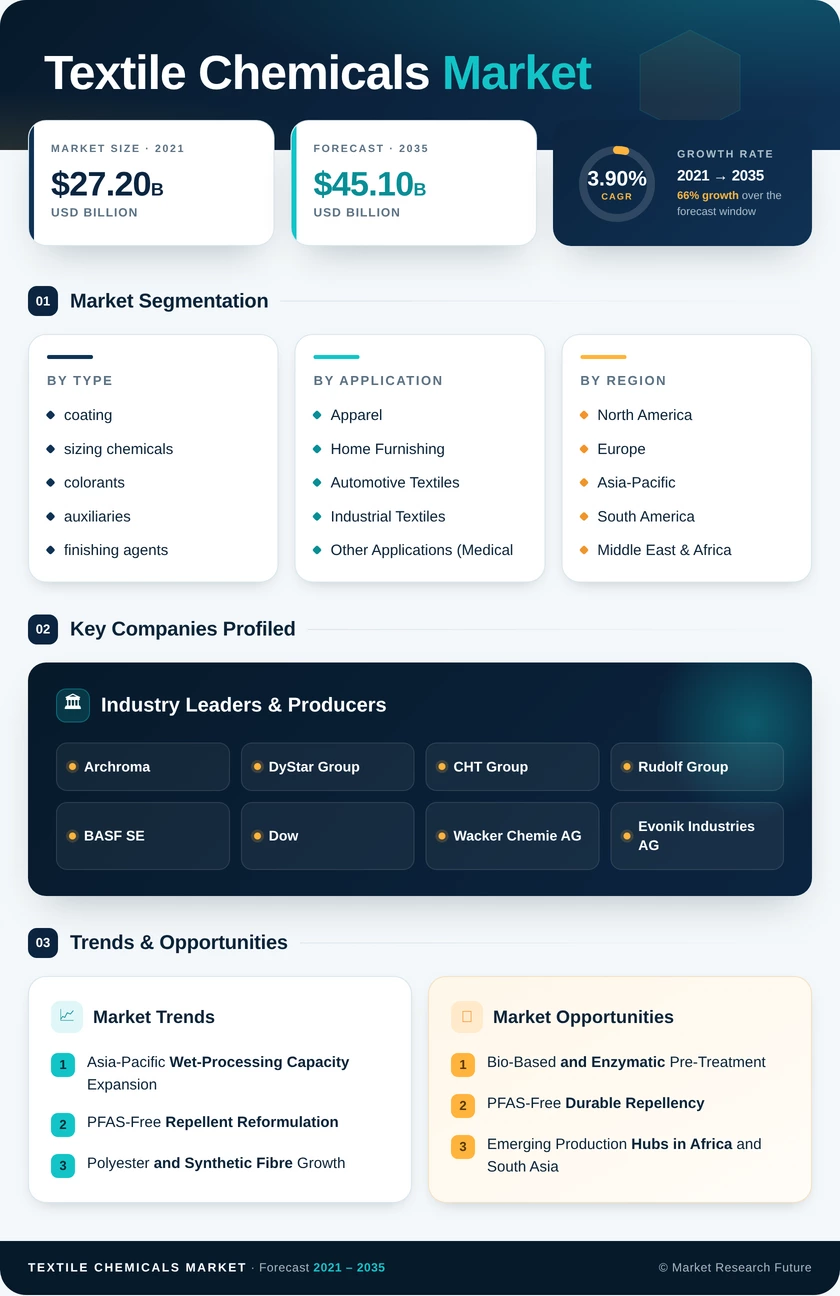
Segmentation Quick Reference
| Dimension | Sub-Segments | Dominant Segment | Fastest Growing Segment |
|---|
| By Type | coating and sizing chemicals; colorants and auxiliaries; finishing agents; de-sizing agents; other types | coating and sizing chemicals (29.6% share) | finishing agents (4.4% CAGR) |
| By Application | Apparel; Home Furnishing; Automotive Textiles; Industrial Textiles; Other Applications (Medical and Hygiene Textiles, Sports Textiles, etc.) | Apparel (55.7% share) | Industrial Textiles (4.2% CAGR) |
| By Region | North America; Europe; Asia-Pacific; South America; Middle East & Africa | Asia-Pacific (57.6% share) | Asia-Pacific (4.5% CAGR) |
Market Segmentation Overview
| Sub-Segment | Key Trend |
|---|
| coating and sizing chemicals | Low-add-on sizes and recyclable PVA alternatives for high-speed weaving |
| colorants and auxiliaries | Low-salt reactive and high-exhaustion disperse dyes for effluent compliance |
| finishing agents | Silicone-polymer hybrids replacing fluorinated repellents |
| de-sizing agents | Amylase enzymes displacing oxidative and caustic desizing |
| other types | Bio-scouring and multifunctional process aids |
Coating and sizing chemicals hold the lead because warp sizing is a non-negotiable step on every weaving line, giving the segment demand that tracks fabric output rather than fashion cycles. Finishing agents grow fastest as PFAS bans in California and France force brands to requalify repellent recipes with silicone and dendrimer systems that carry higher add-on rates. De-sizing agents are smaller but changing rapidly, with enzymatic grades winning on effluent load in mills facing discharge limits.
| Sub-Segment | Key Trend |
|---|
| Apparel | Multifunctional single-bath finishes for performance and athleisure lines |
| Home Furnishing | Easy-clean and stain-resistant upholstery chemistry |
| Automotive Textiles | Durable, low-emission interior coatings for electric vehicles |
| Industrial Textiles | Flame-retardant, low-smoke and filtration finishes |
| Other Applications (Medical and Hygiene Textiles, Sports Textiles, etc.) | Antimicrobial and moisture-management treatments |
Apparel leads because high-volume production in China, Bangladesh and Vietnam consumes the bulk of dyes and softeners, even as margin pressure pushes mills toward higher-efficiency auxiliaries. Industrial Textiles grow fastest since flame-retardancy and filtration specifications raise chemical value per square metre well above garment fabrics. Automotive Textiles and Home Furnishing add steady, specification-driven demand, while Medical and Hygiene Textiles benefit from antimicrobial requirements.


 Noah Malgeri
Co-Founder

 Peter Groot koerkamp
Account and Business Manager

 Younghwan Choi
Senior Retail Manager

 Mark Irwin
Management Consultant

 Akif Moroglu
Strategy & Business Development Director

 Guilherme Gomes Martins
Product Management Director

 Joseph Aguayo
Sales Operations & Pricing Manager

 La Terria Dodd
Program Support Specialist

 Rob Kooiker
Group Product Manager HVAC & Fire Protection GMA