×
Hero Background
English
Chinese
French
Japanese
Korean
German
Spanish

Telerehabilitation Market Analysis

ID: MRFR/HC/10186-HCR
128 Pages
Kinjoll Dey
October 2025

Telerehabilitation Market Research Report Information By Component (Hardware and Software), By Services (Clinical Assessment and Clinical Therapy), By Therapy (Physical Therapy, Occupational Therapy and Others), By Application (Cardiovascular, Orthopedic, Neurology, Pediatric and Others), And By Region (North America, Europe, Asia-Pacific, And Rest Of The World) –Market Forecast Till 2035

Share:
Download PDF ×

We do not share your information with anyone. However, we may send you emails based on your report interest from time to time. You may contact us at any time to opt-out.

Telerehabilitation Market Infographic
Purchase Options

Market Analysis

In-depth Analysis of Telerehabilitation Market Industry Landscape

The Telerehabilitation Market experiences the impact of many interconnected elements that come together to dictate its dynamic and the growth pattern as it moves forward. One of the leading causes of this market growth is the increasing use of telehealth solutions which are in great demand in the healthcare field. The principles of person-centeredness, clinical effectiveness, cost-effectiveness, and public health are vital when utilizing telemedicine for rehabilitation purposes because they address the rehabilitation requirements of people who have suffered from injuries, surgeries or are managing chronic conditions. Convenience, accessibility and low cost of telemedicine in addition to the demands for virtual healthcare is another factor responsible for its continuous spread.

The position of technology in the advancements system is of vital importance for the development of the telerehabilitation field. Telecommunication, wearable device and sensor technologies are evolving every day and thus the enhancement of remote rehabilitation solutions. On one hand, VR and AR integration inside telerehabilitation platforms provides a more immersive experience and enables interactivity for patients leading to higher engagement and commitment to rehab programs.

Regulatory issues are essential things to consider while tapping into the undertaking of the telerehabilitation market. Regulates and the policies governing the telehealth services cut across the way the telerehabilitation solutions are implemented and the way the solutions are scalable. With time as telehealth regulations modify to adapt the specific features of tele rehabilitation especially privacy and security issues, the market changes that change the level of adoption as well as competition in the market takes place.

The economy is one of the factors affecting the marketplace for telemedicine. Economic growth and stability bring investments into the healthcare technologies that builds the capability of constant availability of telerehabilitation services. However, on temporary economic recessions, health care spending priorities might be changed and would have an influence on the market dynamics. Recording the economic benefits of tele-rehabilitation and even potential reduction of healthcare cost become the next steps for decision making of healthcare, especially in areas where economic factors are the driving forces.

One of the most crucial items in healthcare technology providers and telemedicine companies is high competition. Interfering competition is a source of innovation, and this is realized when companies are on their toes to develop user-friendly tele-rehabilitation platforms, carpeting service delivery, and establishing partnerships with healthcare providers. The formation of a partnership with rehabilitation professionals, for example, physical therapist and occupational therapist, is an element that also helps the competitiveness of the field of telerehabilitation, as companies try to provide integrated and unique solutions. Effective marketing, integration into healthcare systems and the telehealth services distinction, are probably the major success factors in this tough business environment.

Consumer preferences, i.e. the preferences of healthcare providers, patients, as well as rehabilitation professionals, impact how the telerehabilitation market looks like. Healthcare providers want to an telerehabilitation solution which connects effortlessly within their clinical processes and electro health records. Many patients are happy with the convenient user interfaces, personalized treatment methodologies, and being able to receive care from the comfort of their homes.


Author
Kinjoll Dey
Research Analyst Level I

He is an extremely curious individual currently working in Healthcare and Medical Devices Domain. Kinjoll is comfortably versed in data centric research backed by healthcare educational background. He leverages extensive data mining and analytics tools such as Primary and Secondary Research, Statistical Analysis, Machine Learning, Data Modelling. His key role also involves Technical Sales Support, Client Interaction and Project management within the Healthcare team. Lastly, he showcases extensive affinity towards learning new skills and remain fascinated in implementing them.

Leave a Comment

FAQs

What is the current valuation of the Telerehabilitation Market as of 2024?

The Telerehabilitation Market was valued at 5.1 USD Billion in 2024.

What is the projected market size for the Telerehabilitation Market in 2035?

The market is projected to reach 25.86 USD Billion by 2035.

What is the expected CAGR for the Telerehabilitation Market during the forecast period 2025 - 2035?

The expected CAGR for the Telerehabilitation Market during 2025 - 2035 is 15.9%.

Which companies are considered key players in the Telerehabilitation Market?

Key players in the market include Teladoc Health, Doxy.me, Physitrack, MediSprout, Rehab My Patient, SimplePractice, Kareo, and Hinge Health.

What are the main components of the Telerehabilitation Market?

The main components include hardware, valued at 1.53 to 7.93 USD Billion, and software, valued at 3.57 to 17.93 USD Billion.

What services are offered within the Telerehabilitation Market?

Services include clinical assessment, valued at 1.5 to 7.5 USD Billion, and clinical therapy, valued at 3.6 to 18.36 USD Billion.

Market Summary

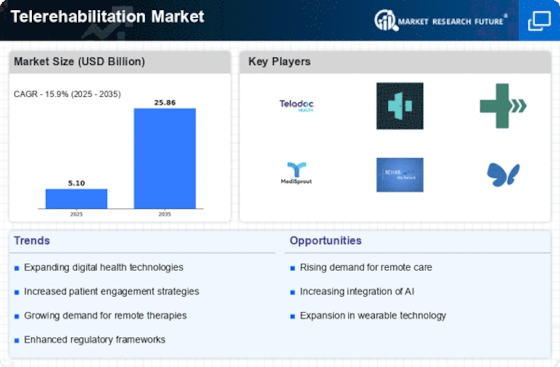
As per MRFR analysis, the Telerehabilitation Market Size was estimated at 5.1 USD Billion in 2024. The Telerehabilitation industry is projected to grow from 5.911 USD Billion in 2025 to 25.86 USD Billion by 2035, exhibiting a compound annual growth rate (CAGR) of 15.9 during the forecast period 2025 - 2035.

Key Market Trends & Highlights

The Telerehabilitation Market is experiencing robust growth driven by technological advancements and increasing demand for remote healthcare services.

  • The market is witnessing increased adoption of wearable technology, enhancing patient engagement and monitoring.
  • Integration of artificial intelligence is transforming telerehabilitation by personalizing treatment plans and improving outcomes.
  • North America remains the largest market, while Asia-Pacific is emerging as the fastest-growing region in telerehabilitation.
  • Rising demand for remote healthcare services and regulatory support for telehealth initiatives are key drivers propelling market expansion.

Market Size & Forecast

2024 Market Size 5.1 (USD Billion)
2035 Market Size 25.86 (USD Billion)
CAGR (2025 - 2035) 15.9%
Largest Regional Market Share in 2024 North America

Major Players

<p>Teladoc Health (US), Doxy.me (US), Physitrack (GB), MediSprout (US), Rehab My Patient (GB), SimplePractice (US), Kareo (US), Hinge Health (US)</p>

Market Trends

The Telerehabilitation Market is currently experiencing a notable transformation, driven by advancements in technology and a growing recognition of the benefits of remote healthcare services. This market encompasses a range of services that facilitate rehabilitation through digital platforms, allowing patients to receive care from the comfort of their homes. As healthcare systems evolve, the integration of telehealth solutions into rehabilitation practices appears to enhance patient engagement and adherence to treatment plans. Furthermore, the increasing prevalence of chronic conditions necessitates innovative approaches to rehabilitation, which the Telerehabilitation Market is poised to address effectively. In addition, the Telerehabilitation Market seems to be influenced by a shift in patient preferences towards more flexible and accessible healthcare options. Patients are increasingly seeking solutions that fit their lifestyles, and telerehabilitation offers a viable alternative to traditional in-person visits. This trend is likely to continue as healthcare providers recognize the potential for improved outcomes and cost savings associated with remote rehabilitation services. As the market develops, it may also witness the emergence of new technologies and methodologies that further enhance the delivery of care, ultimately benefiting both patients and providers alike.

Increased Adoption of Wearable Technology

The Telerehabilitation Market is witnessing a rise in the use of wearable devices that monitor patient progress in real-time. These technologies enable healthcare professionals to track vital signs and rehabilitation metrics, fostering a more personalized approach to care. As patients engage with these devices, they may experience heightened motivation and accountability in their recovery journey.

Integration of Artificial Intelligence

Artificial intelligence is becoming increasingly prevalent within the Telerehabilitation Market, offering innovative solutions for patient assessment and treatment planning. AI-driven platforms can analyze patient data to provide tailored rehabilitation programs, potentially improving outcomes. This integration may streamline processes and enhance the overall efficiency of rehabilitation services.

Focus on Mental Health Rehabilitation

There is a growing emphasis on mental health within the Telerehabilitation Market, as providers recognize the importance of addressing psychological well-being alongside physical recovery. Teletherapy and virtual support groups are gaining traction, allowing individuals to access mental health resources conveniently. This trend indicates a holistic approach to rehabilitation, acknowledging the interconnectedness of physical and mental health.

Telerehabilitation Market Market Drivers

Increased Focus on Cost-Effectiveness

The Telerehabilitation Market is witnessing an increased focus on cost-effectiveness as healthcare providers seek to optimize resources. Telerehabilitation Market offers a more economical alternative to traditional rehabilitation methods, reducing travel costs and time for both patients and providers. Studies indicate that telerehabilitation can lower overall healthcare expenses by up to 30%, making it an attractive option for budget-conscious patients and healthcare systems. This cost-effectiveness is particularly appealing in the context of rising healthcare expenditures, prompting a shift towards more sustainable rehabilitation solutions. As healthcare organizations strive to enhance efficiency while maintaining quality care, the emphasis on cost-effective rehabilitation options is likely to drive the growth of the Telerehabilitation Market. This trend may also encourage the adoption of telerehabilitation services among underserved populations, further expanding the market.

Growing Awareness of Rehabilitation Needs

Growing awareness of rehabilitation needs is significantly influencing the Telerehabilitation Market. As the population ages and the prevalence of chronic conditions rises, there is an increasing recognition of the importance of rehabilitation services. Patients and healthcare providers alike are becoming more informed about the benefits of timely and effective rehabilitation, which can lead to improved health outcomes. This heightened awareness is likely to drive demand for telerehabilitation services, as patients seek convenient and accessible options for their rehabilitation needs. Furthermore, educational initiatives aimed at promoting the value of rehabilitation are expected to contribute to market growth. As awareness continues to expand, the Telerehabilitation Market is poised to benefit from a larger patient base seeking innovative rehabilitation solutions.

Rising Demand for Remote Healthcare Services

The Telerehabilitation Market is experiencing a notable increase in demand for remote healthcare services. This trend is driven by a growing preference for convenience and accessibility among patients. As healthcare systems evolve, patients are seeking alternatives to traditional in-person visits, particularly for rehabilitation services. According to recent data, the telehealth market is projected to reach a valuation of approximately 250 billion dollars by 2027, indicating a robust growth trajectory. This shift towards remote care is likely to enhance the adoption of telerehabilitation services, as patients recognize the benefits of receiving care from the comfort of their homes. Furthermore, the integration of telehealth into standard practice is expected to streamline rehabilitation processes, making them more efficient and patient-centered. Consequently, the rising demand for remote healthcare services is a significant driver of growth within the Telerehabilitation Market.

Regulatory Support for Telehealth Initiatives

Regulatory support for telehealth initiatives is emerging as a crucial driver for the Telerehabilitation Market. Governments and regulatory bodies are increasingly recognizing the value of telehealth in enhancing healthcare access and quality. Recent policy changes have facilitated the reimbursement of telerehabilitation services, encouraging healthcare providers to adopt these innovative solutions. This regulatory backing is likely to foster a more favorable environment for the growth of the telerehabilitation sector. As policies evolve to support telehealth, the market is expected to expand, with more providers offering telerehabilitation services as part of their care continuum. The alignment of regulatory frameworks with the needs of patients and providers may further enhance the credibility and acceptance of telerehabilitation, solidifying its role in the broader healthcare landscape.

Technological Advancements in Communication Tools

Technological advancements in communication tools are playing a pivotal role in shaping the Telerehabilitation Market. Innovations in video conferencing, mobile applications, and wearable devices are enhancing the delivery of rehabilitation services. These tools facilitate real-time interaction between healthcare providers and patients, allowing for personalized treatment plans and continuous monitoring of progress. The market for telecommunication technologies is anticipated to grow substantially, with estimates suggesting a compound annual growth rate of over 15% in the coming years. This growth is likely to bolster the capabilities of telerehabilitation platforms, making them more user-friendly and effective. As technology continues to evolve, the potential for improved patient engagement and adherence to rehabilitation protocols increases, thereby driving the expansion of the Telerehabilitation Market.

Market Segment Insights

By Component: Software (Largest) vs. Hardware (Fastest-Growing)

<p>In the Telerehabilitation Market, the software component holds the largest market share, driven by the increasing demand for remote patient monitoring and digital health solutions. Its widespread adoption among healthcare providers facilitates effective telehealth interventions, making it a crucial player in the market. Conversely, the hardware segment, which includes devices like wearable sensors and rehabilitation tools, is emerging as the fastest-growing category. This growth is spurred by technological advancements and the increasing prevalence of chronic diseases that necessitate rehabilitation services remotely. The growth trends in these components reveal an exciting landscape for the Telerehabilitation Market. The software sector is benefiting from continuous innovation and the integration of artificial intelligence in therapy applications, enhancing user experience and engagement. Meanwhile, the hardware segment is experiencing rapid advancements in device functionality and connectivity, making remote rehabilitation more accessible. This trend is expected to accelerate as both segments strive to offer comprehensive and integrated solutions for patients, ensuring that rehabilitation can occur effectively outside traditional clinical settings.</p>

<p>Software (Dominant) vs. Hardware (Emerging)</p>

<p>In the Telerehabilitation Market, software solutions are dominant due to their essential role in facilitating remote therapies, managing patient data, and streamlining communication between healthcare providers and patients. The software segment encompasses applications for virtual consultations, exercise regimens, and progress tracking, all of which enhance the rehabilitation experience. On the other hand, the hardware segment, while currently emerging, plays a critical role in providing the necessary tools for effective telerehabilitation. This includes various electronic devices, such as mobile health apps, rehabilitation robots, and wearable technologies, designed to monitor patient activities and engagement. The synergy between software and hardware is pivotal. As technology evolves, the hardware segment is likely to gain traction, driving innovation in remote therapeutic interventions.</p>

By Services: Clinical Assessment (Largest) vs. Clinical Therapy (Fastest-Growing)

<p>The Telerehabilitation Market showcases a distinct distribution in its services segment. Clinical Assessment stands out as the largest contributor, driving adoption through its pivotal role in remote diagnosis and patient monitoring. Clinical Therapy, on the other hand, while smaller in market share, has gained traction due to its innovative approaches to delivering therapeutic services, especially in the wake of increasing demand for remote care solutions. The growth trends in the Telerehabilitation Market are significantly influenced by the rising prevalence of chronic diseases and the aging population. Clinical Therapy is emerging as a fast-growing segment, driven by technological advancements that enhance patient engagement and therapy outcomes. The push for more accessible healthcare solutions is also propelling both segments, with telehealth's acceptance catalyzing their development.</p>

<p>Clinical Assessment (Dominant) vs. Clinical Therapy (Emerging)</p>

<p>Clinical Assessment and Clinical Therapy are two pivotal segments within the Telerehabilitation Market. Clinical Assessment is recognized for its dominance, reflecting its critical role in patient initial evaluations and ongoing monitoring that facilitate timely interventions. It is characterized by its comprehensive nature, utilizing various digital tools to capture accurate health metrics and enrich patient data. Conversely, Clinical Therapy represents an emerging paradigm, leveraging advancements in technology to deliver real-time therapy sessions that personalize patient experiences. This segment thrives on the increasing integration of virtual reality, interactive platforms, and tailored rehabilitation plans, making it a compelling option for both healthcare providers and patients seeking effective remote therapy alternatives.</p>

By Therapy: Physical Therapy (Largest) vs. Occupational Therapy (Fastest-Growing)

<p>The Telerehabilitation Market is notably driven by the physical therapy segment, which holds a significant market share in comparison to occupational therapy and other therapeutic modalities. Physical therapy benefits from longstanding acceptance and a strong foundation in conventional healthcare practices, thereby attracting a larger patient base seeking telerehabilitation solutions. Conversely, occupational therapy is rapidly gaining traction among providers and patients alike, illustrating a shift towards holistic approaches that focus on enhancing day-to-day living skills and rehabilitation from disabilities.</p>

<p>Physical Therapy (Dominant) vs. Occupational Therapy (Emerging)</p>

<p>Physical therapy stands as the dominant force within the telerehabilitation market, leveraging advanced technology to provide remote rehabilitation services that are both convenient and effective for patients recovering from injuries or surgeries. This segment is characterized by tailored exercise programs and consistent patient engagement via digital platforms. On the other hand, occupational therapy is emerging as a vibrant segment, focusing on enabling individuals to perform daily activities more effectively through customized therapeutic strategies. Its growth is propelled by increasing awareness of mental health and functional independence, making it an appealing option for a diverse demographic seeking recovery support.</p>

By Application: Orthopedic (Largest) vs. Neurology (Fastest-Growing)

<p>The Telerehabilitation Market showcases a diverse range of applications, with Orthopedic services holding a significant share. This segment benefits from a growing patient population seeking remote therapy options post-surgery or injury. Neurology stands out as a fast-emerging sector, driven by increasing awareness of neurological conditions and the demand for accessible rehabilitation solutions. Both segments are gaining traction, yet Orthopedic remains the largest contributor to market volume. Growth trends in telerehabilitation for these applications are primarily propelled by advances in technology, provider acceptance, and patient preference for convenience. The demand for Orthopedic telerehabilitation is driven by the rise in musculoskeletal disorders, while the Neurology sector experiences rapid expansion due to increased diagnosis rates of conditions such as stroke and multiple sclerosis. These trends indicate a robust potential for future growth across the applications.</p>

<p>Orthopedic (Dominant) vs. Neurology (Emerging)</p>

<p>Orthopedic telerehabilitation is a dominant force in the market, primarily due to its established presence and the need for effective post-operative care. Patients recovering from surgeries like knee or hip replacements benefit from tailored remote therapy programs designed to enhance mobility and minimize discomfort. Conversely, the Neurology segment is emerging rapidly, fueled by innovative digital solutions that provide personalized care for patients with neurological impairments. By offering specialized rehabilitation programs through telehealth platforms, this segment addresses the growing demand for remote therapy options. Both segments leverage advanced technologies, enhancing patient engagement and improving overall rehabilitation outcomes.</p>

Get more detailed insights about Telerehabilitation Market Research Report—Global Forecast till 2035

Regional Insights

North America : Telehealth Leader

North America is the largest market for telerehabilitation, accounting for approximately 45% of the global share. The region's growth is driven by increasing demand for remote healthcare services, advancements in telecommunication technologies, and supportive regulatory frameworks. The COVID-19 pandemic has accelerated the adoption of telehealth solutions, making it a critical component of healthcare delivery. The U.S. leads this market, followed by Canada, which holds around 15% of the market share. The competitive landscape in North America is robust, featuring key players such as Teladoc Health, Doxy.me, and Hinge Health. These companies are leveraging innovative technologies to enhance patient engagement and improve outcomes. The presence of a well-established healthcare infrastructure and a high level of investment in digital health solutions further bolster the region's position. As telehealth regulations evolve, the market is expected to expand significantly in the coming years.

Europe : Emerging Market Dynamics

Europe is witnessing a significant rise in the telerehabilitation market, holding approximately 30% of the global share. The growth is fueled by increasing healthcare costs, a growing elderly population, and a shift towards patient-centered care. Countries like Germany and the UK are leading this trend, with Germany holding about 12% of the market share. Regulatory support, such as the EU's Digital Health Strategy, is also a catalyst for market expansion, promoting the integration of digital health solutions across member states. The competitive landscape in Europe is characterized by a mix of established players and innovative startups. Key companies like Physitrack and MediSprout are making strides in providing comprehensive telerehabilitation solutions. The presence of diverse healthcare systems across countries presents both challenges and opportunities for market players. As regulations continue to evolve, the market is expected to see increased collaboration between healthcare providers and technology firms.

Asia-Pacific : Rapid Growth Potential

Asia-Pacific is rapidly emerging as a significant player in the telerehabilitation market, accounting for approximately 20% of the global share. The region's growth is driven by increasing smartphone penetration, rising healthcare expenditure, and a growing awareness of telehealth benefits. Countries like China and India are at the forefront, with China holding around 10% of the market share. Government initiatives aimed at enhancing digital health infrastructure are further propelling market growth, making telehealth services more accessible to the population. The competitive landscape in Asia-Pacific is diverse, with a mix of local and international players. Companies are increasingly focusing on developing user-friendly platforms to cater to the unique needs of patients in the region. The presence of key players, along with a growing number of startups, is fostering innovation in telerehabilitation solutions. As the region continues to embrace digital health, the market is poised for substantial growth in the coming years.

Middle East and Africa : Untapped Market Opportunities

The Middle East and Africa region is gradually recognizing the potential of telerehabilitation, currently holding about 5% of the global market share. The growth is driven by increasing internet connectivity, a rising prevalence of chronic diseases, and a growing emphasis on healthcare accessibility. Countries like South Africa and the UAE are leading the charge, with South Africa holding approximately 3% of the market share. Government initiatives aimed at improving healthcare infrastructure are expected to further boost the adoption of telerehabilitation services in the region. The competitive landscape in the Middle East and Africa is still developing, with a mix of local startups and international players entering the market. Key players are focusing on creating tailored solutions to meet the specific needs of the region's diverse population. As awareness of telerehabilitation grows, the market is likely to see increased investment and innovation, paving the way for future growth.

Key Players and Competitive Insights

The Telerehabilitation Market is currently characterized by a dynamic competitive landscape, driven by technological advancements and an increasing demand for remote healthcare solutions. Key players such as Teladoc Health (US), Doxy.me (US), and Hinge Health (US) are at the forefront, each adopting distinct strategies to enhance their market positioning. Teladoc Health (US) focuses on comprehensive telehealth services, integrating mental health and chronic condition management, while Doxy.me (US) emphasizes user-friendly, HIPAA-compliant telemedicine solutions tailored for healthcare providers. Hinge Health (US) is innovating in musculoskeletal care, leveraging digital therapeutics to improve patient outcomes. Collectively, these strategies foster a competitive environment that prioritizes patient-centric solutions and technological integration.

In terms of business tactics, companies are increasingly localizing their services to cater to regional healthcare needs, optimizing their supply chains to ensure efficient service delivery. The market appears moderately fragmented, with a mix of established players and emerging startups. This fragmentation allows for diverse offerings, yet the collective influence of major players like Teladoc Health (US) and Hinge Health (US) shapes market trends and consumer expectations.

In August 2025, Teladoc Health (US) announced a strategic partnership with a leading health insurance provider to enhance its telehealth offerings. This collaboration aims to integrate telehealth services into the insurance provider's existing framework, potentially increasing accessibility for patients and streamlining care delivery. Such partnerships are crucial as they not only expand market reach but also enhance service integration, thereby improving patient engagement and satisfaction.

In September 2025, Hinge Health (US) launched a new digital platform designed to provide personalized musculoskeletal care. This platform utilizes AI-driven analytics to tailor treatment plans to individual patient needs, which could significantly improve adherence and outcomes. The introduction of such innovative solutions indicates a shift towards more personalized healthcare, positioning Hinge Health (US) as a leader in the digital therapeutics space.

Doxy.me (US) has also made strides in October 2025 by introducing a new feature that allows for seamless integration with electronic health records (EHR). This enhancement is likely to streamline workflows for healthcare providers, making telehealth services more efficient and user-friendly. The ability to integrate with existing EHR systems may provide Doxy.me (US) with a competitive edge, as it addresses a critical pain point for many healthcare professionals.

As of October 2025, the Telerehabilitation Market is witnessing trends such as increased digitalization, the integration of AI technologies, and a growing emphasis on sustainability. Strategic alliances are becoming increasingly important, as they enable companies to leverage each other's strengths and expand their service offerings. Looking ahead, competitive differentiation is expected to evolve, with a shift from price-based competition to a focus on innovation, technological advancements, and reliable supply chains. This transition may redefine how companies position themselves in the market, emphasizing the importance of delivering high-quality, patient-centered care.

Key Companies in the Telerehabilitation Market market include

Industry Developments

  • Q2 2024: Jintronix Announces Strategic Partnership with Philips to Expand Telerehabilitation Market Solutions Jintronix, a digital rehabilitation platform provider, announced a strategic partnership with Philips to integrate its telerehabilitation software into Philips' remote patient monitoring ecosystem, aiming to enhance access to virtual physical therapy for post-acute care patients.
  • Q1 2024: Hinge Health Raises $300 Million in Series E Funding to Expand Digital Musculoskeletal Care Hinge Health, a digital health company specializing in musculoskeletal telerehabilitation, secured $300 million in Series E funding to accelerate product development and expand its virtual physical therapy offerings.
  • Q2 2024: Sword Health Launches New AI-Powered Telerehabilitation Market Platform for Neurological Recovery Sword Health introduced a new AI-driven telerehabilitation platform designed to support neurological recovery, providing real-time feedback and personalized therapy plans for patients recovering from stroke and other neurological conditions.
  • Q1 2025: Neuro Rehab VR Secures $15 Million Series B Funding to Scale Virtual Reality Telerehabilitation Market Neuro Rehab VR, a company developing virtual reality-based telerehabilitation tools, raised $15 million in Series B funding to expand its product portfolio and increase adoption among rehabilitation clinics.
  • Q2 2024: Philips Receives FDA Clearance for Remote Physical Therapy Monitoring Solution Philips announced it received FDA clearance for its remote physical therapy monitoring solution, enabling healthcare providers to track patient progress and deliver telerehabilitation services more effectively.
  • Q1 2024: American Well Launches New Telerehabilitation Market Service for Post-Surgical Patients American Well Corporation launched a new telerehabilitation service targeting post-surgical patients, offering virtual physical therapy sessions and remote monitoring to improve recovery outcomes.
  • Q2 2025: Teladoc Health Appoints New Chief Medical Officer to Lead Telerehabilitation Market Expansion Teladoc Health announced the appointment of Dr. Jane Smith as Chief Medical Officer, with a mandate to oversee the expansion of the company's telerehabilitation services and clinical programs.
  • Q1 2025: Neorehab Partners with Mayo Clinic to Pilot Remote Speech Therapy Platform Neorehab, a provider of digital speech therapy solutions, entered into a partnership with Mayo Clinic to pilot its remote speech therapy platform for patients with neurological disorders.
  • Q2 2024: Care Innovations Launches Home-Based Telerehabilitation Market Platform for Cardiac Patients Care Innovations launched a new home-based telerehabilitation platform designed for cardiac patients, enabling remote monitoring and personalized exercise programs to support recovery.
  • Q1 2024: Included Health Acquires Digital Physical Therapy Startup to Expand Telerehabilitation Market Offerings Included Health acquired a digital physical therapy startup to broaden its telerehabilitation services, integrating virtual musculoskeletal care into its existing telehealth platform.
  • Q2 2025: Cisco Systems Unveils Secure Telehealth Infrastructure for Telerehabilitation Market Providers Cisco Systems launched a new secure telehealth infrastructure tailored for telerehabilitation providers, focusing on data privacy and seamless integration with electronic health records.
  • Q1 2025: Humanus Corporation Opens New Telerehabilitation Market Center in Chicago Humanus Corporation opened a new telerehabilitation center in Chicago, offering virtual physical, occupational, and speech therapy services to patients across the Midwest.

Future Outlook

Telerehabilitation Market Future Outlook

<p>The Telerehabilitation Market is projected to grow at a 15.9% CAGR from 2024 to 2035, driven by technological advancements, increasing demand for remote healthcare, and enhanced patient engagement.</p>

New opportunities lie in:

  • <p>Development of AI-driven rehabilitation platforms for personalized therapy.</p>
  • <p>Expansion of telehealth partnerships with insurance providers for broader coverage.</p>
  • <p>Integration of wearable technology for real-time patient monitoring and feedback.</p>

<p>By 2035, the Telerehabilitation Market is expected to be a robust sector, reflecting substantial growth and innovation.</p>

Market Segmentation

Telerehabilitation Market Therapy Outlook

  • Physical Therapy
  • Occupational Therapy
  • Others

Telerehabilitation Market Services Outlook

  • Clinical Assessment
  • Clinical Therapy

Telerehabilitation Market Component Outlook

  • Hardware
  • Software

Telerehabilitation Market Application Outlook

  • Cardiovascular
  • Orthopedic
  • Neurology
  • Pediatric
  • Others

Report Scope

MARKET SIZE 20245.1(USD Billion)
MARKET SIZE 20255.911(USD Billion)
MARKET SIZE 203525.86(USD Billion)
COMPOUND ANNUAL GROWTH RATE (CAGR)15.9% (2024 - 2035)
REPORT COVERAGERevenue Forecast, Competitive Landscape, Growth Factors, and Trends
BASE YEAR2024
Market Forecast Period2025 - 2035
Historical Data2019 - 2024
Market Forecast UnitsUSD Billion
Key Companies ProfiledMarket analysis in progress
Segments CoveredMarket segmentation analysis in progress
Key Market OpportunitiesIntegration of artificial intelligence in Telerehabilitation Market enhances personalized patient care and outcomes.
Key Market DynamicsRising demand for remote patient monitoring drives innovation and competition in the telerehabilitation market.
Countries CoveredNorth America, Europe, APAC, South America, MEA

FAQs

What is the current valuation of the Telerehabilitation Market as of 2024?

The Telerehabilitation Market was valued at 5.1 USD Billion in 2024.

What is the projected market size for the Telerehabilitation Market in 2035?

The market is projected to reach 25.86 USD Billion by 2035.

What is the expected CAGR for the Telerehabilitation Market during the forecast period 2025 - 2035?

The expected CAGR for the Telerehabilitation Market during 2025 - 2035 is 15.9%.

Which companies are considered key players in the Telerehabilitation Market?

Key players in the market include Teladoc Health, Doxy.me, Physitrack, MediSprout, Rehab My Patient, SimplePractice, Kareo, and Hinge Health.

What are the main components of the Telerehabilitation Market?

The main components include hardware, valued at 1.53 to 7.93 USD Billion, and software, valued at 3.57 to 17.93 USD Billion.

What services are offered within the Telerehabilitation Market?

Services include clinical assessment, valued at 1.5 to 7.5 USD Billion, and clinical therapy, valued at 3.6 to 18.36 USD Billion.

  1. SECTION I: EXECUTIVE SUMMARY AND KEY HIGHLIGHTS
    1. EXECUTIVE SUMMARY
      1. Market Overview
      2. Key Findings
      3. Market Segmentation
      4. Competitive Landscape
      5. Challenges and Opportunities
      6. Future Outlook
  2. SECTION II: SCOPING, METHODOLOGY AND MARKET STRUCTURE
    1. MARKET INTRODUCTION
      1. Definition
      2. Scope of the study
    2. RESEARCH METHODOLOGY
      1. Overview
      2. Data Mining
      3. Secondary Research
      4. Primary Research
      5. Forecasting Model
      6. Market Size Estimation
      7. Data Triangulation
      8. Validation
  3. SECTION III: QUALITATIVE ANALYSIS
    1. MARKET DYNAMICS
      1. Overview
      2. Drivers
      3. Restraints
      4. Opportunities
    2. MARKET FACTOR ANALYSIS
      1. Value chain Analysis
      2. Porter's Five Forces Analysis
      3. COVID-19 Impact Analysis
  4. SECTION IV: QUANTITATIVE ANALYSIS
    1. Healthcare, BY Component (USD Billion)
      1. Hardware
      2. Software
    2. Healthcare, BY Services (USD Billion)
      1. Clinical Assessment
      2. Clinical Therapy
    3. Healthcare, BY Therapy (USD Billion)
      1. Physical Therapy
      2. Occupational Therapy
      3. Others
    4. Healthcare, BY Application (USD Billion)
      1. Cardiovascular
      2. Orthopedic
      3. Neurology
      4. Pediatric
      5. Others
    5. Healthcare, BY Region (USD Billion)
      1. North America
      2. Europe
      3. APAC
      4. South America
      5. MEA
  5. SECTION V: COMPETITIVE ANALYSIS
    1. Competitive Landscape
      1. Overview
      2. Competitive Analysis
      3. Market share Analysis
      4. Major Growth Strategy in the Healthcare
      5. Competitive Benchmarking
      6. Leading Players in Terms of Number of Developments in the Healthcare
      7. Key developments and growth strategies
      8. Major Players Financial Matrix
    2. Company Profiles
      1. Teladoc Health (US)
      2. Doxy.me (US)
      3. Physitrack (GB)
      4. MediSprout (US)
      5. Rehab My Patient (GB)
      6. SimplePractice (US)
      7. Kareo (US)
      8. Hinge Health (US)
    3. Appendix
      1. References
      2. Related Reports
  6. LIST OF FIGURES
    1. MARKET SYNOPSIS
    2. NORTH AMERICA MARKET ANALYSIS
    3. US MARKET ANALYSIS BY COMPONENT
    4. US MARKET ANALYSIS BY SERVICES
    5. US MARKET ANALYSIS BY THERAPY
    6. US MARKET ANALYSIS BY APPLICATION
    7. CANADA MARKET ANALYSIS BY COMPONENT
    8. CANADA MARKET ANALYSIS BY SERVICES
    9. CANADA MARKET ANALYSIS BY THERAPY
    10. CANADA MARKET ANALYSIS BY APPLICATION
    11. EUROPE MARKET ANALYSIS
    12. GERMANY MARKET ANALYSIS BY COMPONENT
    13. GERMANY MARKET ANALYSIS BY SERVICES
    14. GERMANY MARKET ANALYSIS BY THERAPY
    15. GERMANY MARKET ANALYSIS BY APPLICATION
    16. UK MARKET ANALYSIS BY COMPONENT
    17. UK MARKET ANALYSIS BY SERVICES
    18. UK MARKET ANALYSIS BY THERAPY
    19. UK MARKET ANALYSIS BY APPLICATION
    20. FRANCE MARKET ANALYSIS BY COMPONENT
    21. FRANCE MARKET ANALYSIS BY SERVICES
    22. FRANCE MARKET ANALYSIS BY THERAPY
    23. FRANCE MARKET ANALYSIS BY APPLICATION
    24. RUSSIA MARKET ANALYSIS BY COMPONENT
    25. RUSSIA MARKET ANALYSIS BY SERVICES
    26. RUSSIA MARKET ANALYSIS BY THERAPY
    27. RUSSIA MARKET ANALYSIS BY APPLICATION
    28. ITALY MARKET ANALYSIS BY COMPONENT
    29. ITALY MARKET ANALYSIS BY SERVICES
    30. ITALY MARKET ANALYSIS BY THERAPY
    31. ITALY MARKET ANALYSIS BY APPLICATION
    32. SPAIN MARKET ANALYSIS BY COMPONENT
    33. SPAIN MARKET ANALYSIS BY SERVICES
    34. SPAIN MARKET ANALYSIS BY THERAPY
    35. SPAIN MARKET ANALYSIS BY APPLICATION
    36. REST OF EUROPE MARKET ANALYSIS BY COMPONENT
    37. REST OF EUROPE MARKET ANALYSIS BY SERVICES
    38. REST OF EUROPE MARKET ANALYSIS BY THERAPY
    39. REST OF EUROPE MARKET ANALYSIS BY APPLICATION
    40. APAC MARKET ANALYSIS
    41. CHINA MARKET ANALYSIS BY COMPONENT
    42. CHINA MARKET ANALYSIS BY SERVICES
    43. CHINA MARKET ANALYSIS BY THERAPY
    44. CHINA MARKET ANALYSIS BY APPLICATION
    45. INDIA MARKET ANALYSIS BY COMPONENT
    46. INDIA MARKET ANALYSIS BY SERVICES
    47. INDIA MARKET ANALYSIS BY THERAPY
    48. INDIA MARKET ANALYSIS BY APPLICATION
    49. JAPAN MARKET ANALYSIS BY COMPONENT
    50. JAPAN MARKET ANALYSIS BY SERVICES
    51. JAPAN MARKET ANALYSIS BY THERAPY
    52. JAPAN MARKET ANALYSIS BY APPLICATION
    53. SOUTH KOREA MARKET ANALYSIS BY COMPONENT
    54. SOUTH KOREA MARKET ANALYSIS BY SERVICES
    55. SOUTH KOREA MARKET ANALYSIS BY THERAPY
    56. SOUTH KOREA MARKET ANALYSIS BY APPLICATION
    57. MALAYSIA MARKET ANALYSIS BY COMPONENT
    58. MALAYSIA MARKET ANALYSIS BY SERVICES
    59. MALAYSIA MARKET ANALYSIS BY THERAPY
    60. MALAYSIA MARKET ANALYSIS BY APPLICATION
    61. THAILAND MARKET ANALYSIS BY COMPONENT
    62. THAILAND MARKET ANALYSIS BY SERVICES
    63. THAILAND MARKET ANALYSIS BY THERAPY
    64. THAILAND MARKET ANALYSIS BY APPLICATION
    65. INDONESIA MARKET ANALYSIS BY COMPONENT
    66. INDONESIA MARKET ANALYSIS BY SERVICES
    67. INDONESIA MARKET ANALYSIS BY THERAPY
    68. INDONESIA MARKET ANALYSIS BY APPLICATION
    69. REST OF APAC MARKET ANALYSIS BY COMPONENT
    70. REST OF APAC MARKET ANALYSIS BY SERVICES
    71. REST OF APAC MARKET ANALYSIS BY THERAPY
    72. REST OF APAC MARKET ANALYSIS BY APPLICATION
    73. SOUTH AMERICA MARKET ANALYSIS
    74. BRAZIL MARKET ANALYSIS BY COMPONENT
    75. BRAZIL MARKET ANALYSIS BY SERVICES
    76. BRAZIL MARKET ANALYSIS BY THERAPY
    77. BRAZIL MARKET ANALYSIS BY APPLICATION
    78. MEXICO MARKET ANALYSIS BY COMPONENT
    79. MEXICO MARKET ANALYSIS BY SERVICES
    80. MEXICO MARKET ANALYSIS BY THERAPY
    81. MEXICO MARKET ANALYSIS BY APPLICATION
    82. ARGENTINA MARKET ANALYSIS BY COMPONENT
    83. ARGENTINA MARKET ANALYSIS BY SERVICES
    84. ARGENTINA MARKET ANALYSIS BY THERAPY
    85. ARGENTINA MARKET ANALYSIS BY APPLICATION
    86. REST OF SOUTH AMERICA MARKET ANALYSIS BY COMPONENT
    87. REST OF SOUTH AMERICA MARKET ANALYSIS BY SERVICES
    88. REST OF SOUTH AMERICA MARKET ANALYSIS BY THERAPY
    89. REST OF SOUTH AMERICA MARKET ANALYSIS BY APPLICATION
    90. MEA MARKET ANALYSIS
    91. GCC COUNTRIES MARKET ANALYSIS BY COMPONENT
    92. GCC COUNTRIES MARKET ANALYSIS BY SERVICES
    93. GCC COUNTRIES MARKET ANALYSIS BY THERAPY
    94. GCC COUNTRIES MARKET ANALYSIS BY APPLICATION
    95. SOUTH AFRICA MARKET ANALYSIS BY COMPONENT
    96. SOUTH AFRICA MARKET ANALYSIS BY SERVICES
    97. SOUTH AFRICA MARKET ANALYSIS BY THERAPY
    98. SOUTH AFRICA MARKET ANALYSIS BY APPLICATION
    99. REST OF MEA MARKET ANALYSIS BY COMPONENT
    100. REST OF MEA MARKET ANALYSIS BY SERVICES
    101. REST OF MEA MARKET ANALYSIS BY THERAPY
    102. REST OF MEA MARKET ANALYSIS BY APPLICATION
    103. KEY BUYING CRITERIA OF HEALTHCARE
    104. RESEARCH PROCESS OF MRFR
    105. DRO ANALYSIS OF HEALTHCARE
    106. DRIVERS IMPACT ANALYSIS: HEALTHCARE
    107. RESTRAINTS IMPACT ANALYSIS: HEALTHCARE
    108. SUPPLY / VALUE CHAIN: HEALTHCARE
    109. HEALTHCARE, BY COMPONENT, 2024 (% SHARE)
    110. HEALTHCARE, BY COMPONENT, 2024 TO 2035 (USD Billion)
    111. HEALTHCARE, BY SERVICES, 2024 (% SHARE)
    112. HEALTHCARE, BY SERVICES, 2024 TO 2035 (USD Billion)
    113. HEALTHCARE, BY THERAPY, 2024 (% SHARE)
    114. HEALTHCARE, BY THERAPY, 2024 TO 2035 (USD Billion)
    115. HEALTHCARE, BY APPLICATION, 2024 (% SHARE)
    116. HEALTHCARE, BY APPLICATION, 2024 TO 2035 (USD Billion)
    117. BENCHMARKING OF MAJOR COMPETITORS
  7. LIST OF TABLES
    1. LIST OF ASSUMPTIONS
    2. North America MARKET SIZE ESTIMATES; FORECAST
      1. BY COMPONENT, 2025-2035 (USD Billion)
      2. BY SERVICES, 2025-2035 (USD Billion)
      3. BY THERAPY, 2025-2035 (USD Billion)
      4. BY APPLICATION, 2025-2035 (USD Billion)
    3. US MARKET SIZE ESTIMATES; FORECAST
      1. BY COMPONENT, 2025-2035 (USD Billion)
      2. BY SERVICES, 2025-2035 (USD Billion)
      3. BY THERAPY, 2025-2035 (USD Billion)
      4. BY APPLICATION, 2025-2035 (USD Billion)
    4. Canada MARKET SIZE ESTIMATES; FORECAST
      1. BY COMPONENT, 2025-2035 (USD Billion)
      2. BY SERVICES, 2025-2035 (USD Billion)
      3. BY THERAPY, 2025-2035 (USD Billion)
      4. BY APPLICATION, 2025-2035 (USD Billion)
    5. Europe MARKET SIZE ESTIMATES; FORECAST
      1. BY COMPONENT, 2025-2035 (USD Billion)
      2. BY SERVICES, 2025-2035 (USD Billion)
      3. BY THERAPY, 2025-2035 (USD Billion)
      4. BY APPLICATION, 2025-2035 (USD Billion)
    6. Germany MARKET SIZE ESTIMATES; FORECAST
      1. BY COMPONENT, 2025-2035 (USD Billion)
      2. BY SERVICES, 2025-2035 (USD Billion)
      3. BY THERAPY, 2025-2035 (USD Billion)
      4. BY APPLICATION, 2025-2035 (USD Billion)
    7. UK MARKET SIZE ESTIMATES; FORECAST
      1. BY COMPONENT, 2025-2035 (USD Billion)
      2. BY SERVICES, 2025-2035 (USD Billion)
      3. BY THERAPY, 2025-2035 (USD Billion)
      4. BY APPLICATION, 2025-2035 (USD Billion)
    8. France MARKET SIZE ESTIMATES; FORECAST
      1. BY COMPONENT, 2025-2035 (USD Billion)
      2. BY SERVICES, 2025-2035 (USD Billion)
      3. BY THERAPY, 2025-2035 (USD Billion)
      4. BY APPLICATION, 2025-2035 (USD Billion)
    9. Russia MARKET SIZE ESTIMATES; FORECAST
      1. BY COMPONENT, 2025-2035 (USD Billion)
      2. BY SERVICES, 2025-2035 (USD Billion)
      3. BY THERAPY, 2025-2035 (USD Billion)
      4. BY APPLICATION, 2025-2035 (USD Billion)
    10. Italy MARKET SIZE ESTIMATES; FORECAST
      1. BY COMPONENT, 2025-2035 (USD Billion)
      2. BY SERVICES, 2025-2035 (USD Billion)
      3. BY THERAPY, 2025-2035 (USD Billion)
      4. BY APPLICATION, 2025-2035 (USD Billion)
    11. Spain MARKET SIZE ESTIMATES; FORECAST
      1. BY COMPONENT, 2025-2035 (USD Billion)
      2. BY SERVICES, 2025-2035 (USD Billion)
      3. BY THERAPY, 2025-2035 (USD Billion)
      4. BY APPLICATION, 2025-2035 (USD Billion)
    12. Rest of Europe MARKET SIZE ESTIMATES; FORECAST
      1. BY COMPONENT, 2025-2035 (USD Billion)
      2. BY SERVICES, 2025-2035 (USD Billion)
      3. BY THERAPY, 2025-2035 (USD Billion)
      4. BY APPLICATION, 2025-2035 (USD Billion)
    13. APAC MARKET SIZE ESTIMATES; FORECAST
      1. BY COMPONENT, 2025-2035 (USD Billion)
      2. BY SERVICES, 2025-2035 (USD Billion)
      3. BY THERAPY, 2025-2035 (USD Billion)
      4. BY APPLICATION, 2025-2035 (USD Billion)
    14. China MARKET SIZE ESTIMATES; FORECAST
      1. BY COMPONENT, 2025-2035 (USD Billion)
      2. BY SERVICES, 2025-2035 (USD Billion)
      3. BY THERAPY, 2025-2035 (USD Billion)
      4. BY APPLICATION, 2025-2035 (USD Billion)
    15. India MARKET SIZE ESTIMATES; FORECAST
      1. BY COMPONENT, 2025-2035 (USD Billion)
      2. BY SERVICES, 2025-2035 (USD Billion)
      3. BY THERAPY, 2025-2035 (USD Billion)
      4. BY APPLICATION, 2025-2035 (USD Billion)
    16. Japan MARKET SIZE ESTIMATES; FORECAST
      1. BY COMPONENT, 2025-2035 (USD Billion)
      2. BY SERVICES, 2025-2035 (USD Billion)
      3. BY THERAPY, 2025-2035 (USD Billion)
      4. BY APPLICATION, 2025-2035 (USD Billion)
    17. South Korea MARKET SIZE ESTIMATES; FORECAST
      1. BY COMPONENT, 2025-2035 (USD Billion)
      2. BY SERVICES, 2025-2035 (USD Billion)
      3. BY THERAPY, 2025-2035 (USD Billion)
      4. BY APPLICATION, 2025-2035 (USD Billion)
    18. Malaysia MARKET SIZE ESTIMATES; FORECAST
      1. BY COMPONENT, 2025-2035 (USD Billion)
      2. BY SERVICES, 2025-2035 (USD Billion)
      3. BY THERAPY, 2025-2035 (USD Billion)
      4. BY APPLICATION, 2025-2035 (USD Billion)
    19. Thailand MARKET SIZE ESTIMATES; FORECAST
      1. BY COMPONENT, 2025-2035 (USD Billion)
      2. BY SERVICES, 2025-2035 (USD Billion)
      3. BY THERAPY, 2025-2035 (USD Billion)
      4. BY APPLICATION, 2025-2035 (USD Billion)
    20. Indonesia MARKET SIZE ESTIMATES; FORECAST
      1. BY COMPONENT, 2025-2035 (USD Billion)
      2. BY SERVICES, 2025-2035 (USD Billion)
      3. BY THERAPY, 2025-2035 (USD Billion)
      4. BY APPLICATION, 2025-2035 (USD Billion)
    21. Rest of APAC MARKET SIZE ESTIMATES; FORECAST
      1. BY COMPONENT, 2025-2035 (USD Billion)
      2. BY SERVICES, 2025-2035 (USD Billion)
      3. BY THERAPY, 2025-2035 (USD Billion)
      4. BY APPLICATION, 2025-2035 (USD Billion)
    22. South America MARKET SIZE ESTIMATES; FORECAST
      1. BY COMPONENT, 2025-2035 (USD Billion)
      2. BY SERVICES, 2025-2035 (USD Billion)
      3. BY THERAPY, 2025-2035 (USD Billion)
      4. BY APPLICATION, 2025-2035 (USD Billion)
    23. Brazil MARKET SIZE ESTIMATES; FORECAST
      1. BY COMPONENT, 2025-2035 (USD Billion)
      2. BY SERVICES, 2025-2035 (USD Billion)
      3. BY THERAPY, 2025-2035 (USD Billion)
      4. BY APPLICATION, 2025-2035 (USD Billion)
    24. Mexico MARKET SIZE ESTIMATES; FORECAST
      1. BY COMPONENT, 2025-2035 (USD Billion)
      2. BY SERVICES, 2025-2035 (USD Billion)
      3. BY THERAPY, 2025-2035 (USD Billion)
      4. BY APPLICATION, 2025-2035 (USD Billion)
    25. Argentina MARKET SIZE ESTIMATES; FORECAST
      1. BY COMPONENT, 2025-2035 (USD Billion)
      2. BY SERVICES, 2025-2035 (USD Billion)
      3. BY THERAPY, 2025-2035 (USD Billion)
      4. BY APPLICATION, 2025-2035 (USD Billion)
    26. Rest of South America MARKET SIZE ESTIMATES; FORECAST
      1. BY COMPONENT, 2025-2035 (USD Billion)
      2. BY SERVICES, 2025-2035 (USD Billion)
      3. BY THERAPY, 2025-2035 (USD Billion)
      4. BY APPLICATION, 2025-2035 (USD Billion)
    27. MEA MARKET SIZE ESTIMATES; FORECAST
      1. BY COMPONENT, 2025-2035 (USD Billion)
      2. BY SERVICES, 2025-2035 (USD Billion)
      3. BY THERAPY, 2025-2035 (USD Billion)
      4. BY APPLICATION, 2025-2035 (USD Billion)
    28. GCC Countries MARKET SIZE ESTIMATES; FORECAST
      1. BY COMPONENT, 2025-2035 (USD Billion)
      2. BY SERVICES, 2025-2035 (USD Billion)
      3. BY THERAPY, 2025-2035 (USD Billion)
      4. BY APPLICATION, 2025-2035 (USD Billion)
    29. South Africa MARKET SIZE ESTIMATES; FORECAST
      1. BY COMPONENT, 2025-2035 (USD Billion)
      2. BY SERVICES, 2025-2035 (USD Billion)
      3. BY THERAPY, 2025-2035 (USD Billion)
      4. BY APPLICATION, 2025-2035 (USD Billion)
    30. Rest of MEA MARKET SIZE ESTIMATES; FORECAST
      1. BY COMPONENT, 2025-2035 (USD Billion)
      2. BY SERVICES, 2025-2035 (USD Billion)
      3. BY THERAPY, 2025-2035 (USD Billion)
      4. BY APPLICATION, 2025-2035 (USD Billion)
    31. PRODUCT LAUNCH/PRODUCT DEVELOPMENT/APPROVAL
    32. ACQUISITION/PARTNERSHIP


Telerehabilitation Market Segmentation

Telerehabilitation Component Outlook (USD Billion, 2018-2032)

  • Hardware
  • Software

Telerehabilitation Services Outlook (USD Billion, 2018-2032)

  • Clinical Assessment
  • Clinical Therapy

Telerehabilitation Therapy Outlook (USD Billion, 2018-2032)

  • Physical Therapy
  • Occupational Therapy
  • Others

Telerehabilitation Application Outlook (USD Billion, 2018-2032)

  • Cardiovascular
  • Orthopedic
  • Neurology
  • Pediatric
  • Others

Telerehabilitation Regional Outlook (USD Billion, 2018-2032)

  • North America Outlook (USD Billion, 2018-2032)

    • North America Telerehabilitation by Component
      • Hardware
      • Software
    • North America Telerehabilitation by Services
      • Clinical Assessment
      • Clinical Therapy
    • North America Telerehabilitation by Therapy
      • Physical Therapy
      • Occupational Therapy
      • Others
    • North America Telerehabilitation by Application
      • Cardiovascular
      • Orthopedic
      • Neurology
      • Pediatric
      • Others
    • US Outlook (USD Billion, 2018-2032)

    • US Telerehabilitation by Component
      • Hardware
      • Software
    • US Telerehabilitation by Services
      • Clinical Assessment
      • Clinical Therapy
    • US Telerehabilitation by Therapy
      • Physical Therapy
      • Occupational Therapy
      • Others
    • US Telerehabilitation by Application
      • Cardiovascular
      • Orthopedic
      • Neurology
      • Pediatric
      • Others
    • CANADA Outlook (USD Billion, 2018-2032)

    • CANADA Telerehabilitation by Component
      • Hardware
      • Software
    • CANADA Telerehabilitation by Services
      • Clinical Assessment
      • Clinical Therapy
    • CANADA Telerehabilitation by Therapy
      • Physical Therapy
      • Occupational Therapy
      • Others
    • CANADA Telerehabilitation by Application
      • Cardiovascular
      • Orthopedic
      • Neurology
      • Pediatric
      • Others
  • Europe Outlook (USD Billion, 2018-2032)

    • Europe Telerehabilitation by Component
      • Hardware
      • Software
    • Europe Telerehabilitation by Services
      • Clinical Assessment
      • Clinical Therapy
    • Europe Telerehabilitation by Therapy
      • Physical Therapy
      • Occupational Therapy
      • Others
    • Europe Telerehabilitation by Application
      • Cardiovascular
      • Orthopedic
      • Neurology
      • Pediatric
      • Others
    • Germany Outlook (USD Billion, 2018-2032)

    • Germany Telerehabilitation by Component
      • Hardware
      • Software
    • Germany Telerehabilitation by Services
      • Clinical Assessment
      • Clinical Therapy
    • Germany Telerehabilitation by Therapy
      • Physical Therapy
      • Occupational Therapy
      • Others
    • Germany Telerehabilitation by Application
      • Cardiovascular
      • Orthopedic
      • Neurology
      • Pediatric
      • Others
    • France Outlook (USD Billion, 2018-2032)

    • France Telerehabilitation by Component
      • Hardware
      • Software
    • France Telerehabilitation by Services
      • Clinical Assessment
      • Clinical Therapy
    • France Telerehabilitation by Therapy
      • Physical Therapy
      • Occupational Therapy
      • Others
    • France Telerehabilitation by Application
      • Cardiovascular
      • Orthopedic
      • Neurology
      • Pediatric
      • Others
    • UK Outlook (USD Billion, 2018-2032)

    • UK Telerehabilitation by Component
      • Hardware
      • Software
    • UK Telerehabilitation by Services
      • Clinical Assessment
      • Clinical Therapy
    • UK Telerehabilitation by Therapy
      • Physical Therapy
      • Occupational Therapy
      • Others
    • UK Telerehabilitation by Application
      • Cardiovascular
      • Orthopedic
      • Neurology
      • Pediatric
      • Others
    • ITALY Outlook (USD Billion, 2018-2032)

    • ITALY Telerehabilitation by Component
      • Hardware
      • Software
    • ITALY Telerehabilitation by Services
      • Clinical Assessment
      • Clinical Therapy
    • ITALY Telerehabilitation by Therapy
      • Physical Therapy
      • Occupational Therapy
      • Others
    • ITALY Telerehabilitation by Application
      • Cardiovascular
      • Orthopedic
      • Neurology
      • Pediatric
      • Others
    • SPAIN Outlook (USD Billion, 2018-2032)

    • Spain Telerehabilitation by Component
      • Hardware
      • Software
    • Spain Telerehabilitation by Services
      • Clinical Assessment
      • Clinical Therapy
    • Spain Telerehabilitation by Therapy
      • Physical Therapy
      • Occupational Therapy
      • Others
    • Spain Telerehabilitation by Application
      • Cardiovascular
      • Orthopedic
      • Neurology
      • Pediatric
      • Others
    • Rest Of Europe Outlook (USD Billion, 2018-2032)

    • Rest Of Europe Telerehabilitation by Component
      • Hardware
      • Software
    • REST OF EUROPE Telerehabilitation by Services
      • Clinical Assessment
      • Clinical Therapy
    • REST OF EUROPE Telerehabilitation by Therapy
      • Physical Therapy
      • Occupational Therapy
      • Others
    • REST OF EUROPE Telerehabilitation by Application
      • Cardiovascular
      • Orthopedic
      • Neurology
      • Pediatric
      • Others
  • Asia-Pacific Outlook (USD Billion, 2018-2032)

    • Asia-Pacific Telerehabilitation by Component
      • Hardware
      • Software
    • Asia-Pacific Telerehabilitation by Services
      • Clinical Assessment
      • Clinical Therapy
    • Asia-Pacific Telerehabilitation by Therapy
      • Physical Therapy
      • Occupational Therapy
      • Others
    • Asia-Pacific Telerehabilitation by Application
      • Cardiovascular
      • Orthopedic
      • Neurology
      • Pediatric
      • Others
    • China Outlook (USD Billion, 2018-2032)

    • China Telerehabilitation by Component
      • Hardware
      • Software
    • China Telerehabilitation by Services
      • Clinical Assessment
      • Clinical Therapy
    • China Telerehabilitation by Therapy
      • Physical Therapy
      • Occupational Therapy
      • Others
    • China Telerehabilitation by Application
      • Cardiovascular
      • Orthopedic
      • Neurology
      • Pediatric
      • Others
    • Japan Outlook (USD Billion, 2018-2032)

    • Japan Telerehabilitation by Component
      • Hardware
      • Software
    • Japan Telerehabilitation by Services
      • Clinical Assessment
      • Clinical Therapy
    • Japan Telerehabilitation by Therapy
      • Physical Therapy
      • Occupational Therapy
      • Others
    • Japan Telerehabilitation by Application
      • Cardiovascular
      • Orthopedic
      • Neurology
      • Pediatric
      • Others
    • India Outlook (USD Billion, 2018-2032)

    • India Telerehabilitation by Component
      • Hardware
      • Software
    • India Telerehabilitation by Services
      • Clinical Assessment
      • Clinical Therapy
    • India Telerehabilitation by Therapy
      • Physical Therapy
      • Occupational Therapy
      • Others
    • India Telerehabilitation by Application
      • Cardiovascular
      • Orthopedic
      • Neurology
      • Pediatric
      • Others
    • Australia Outlook (USD Billion, 2018-2032)

    • Australia Telerehabilitation by Component
      • Hardware
      • Software
    • Australia Telerehabilitation by Services
      • Clinical Assessment
      • Clinical Therapy
    • Australia Telerehabilitation by Therapy
      • Physical Therapy
      • Occupational Therapy
      • Others
    • Australia Telerehabilitation by Application
      • Cardiovascular
      • Orthopedic
      • Neurology
      • Pediatric
      • Others
    • Rest of Asia-Pacific Outlook (USD Billion, 2018-2032)

    • Rest of Asia-Pacific Telerehabilitation by Component
      • Hardware
      • Software
    • Rest of Asia-Pacific Telerehabilitation by Services
      • Clinical Assessment
      • Clinical Therapy
    • Rest of Asia-Pacific Telerehabilitation by Therapy
      • Physical Therapy
      • Occupational Therapy
      • Others
    • Rest of Asia-Pacific Telerehabilitation by Application
      • Cardiovascular
      • Orthopedic
      • Neurology
      • Pediatric
      • Others
  • Rest of the World Outlook (USD Billion, 2018-2032)

    • Rest of the World Telerehabilitation by Component
      • Hardware
      • Software
    • Rest of the World Telerehabilitation by Services
      • Clinical Assessment
      • Clinical Therapy
    • Rest of the World Telerehabilitation by Therapy
      • Physical Therapy
      • Occupational Therapy
      • Others
    • Rest of the World Telerehabilitation by Application
      • Cardiovascular
      • Orthopedic
      • Neurology
      • Pediatric
      • Others
    • Middle East Outlook (USD Billion, 2018-2032)

    • Middle East Telerehabilitation by Component
      • Hardware
      • Software
    • Middle East Telerehabilitation by Services
      • Clinical Assessment
      • Clinical Therapy
    • Middle East Telerehabilitation by Therapy
      • Physical Therapy
      • Occupational Therapy
      • Others
    • Middle East Telerehabilitation by Application
      • Cardiovascular
      • Orthopedic
      • Neurology
      • Pediatric
      • Others
    • Africa Outlook (USD Billion, 2018-2032)

    • Africa Telerehabilitation by Component
      • Hardware
      • Software
    • Africa Telerehabilitation by Services
      • Clinical Assessment
      • Clinical Therapy
    • Africa Telerehabilitation by Therapy
      • Physical Therapy
      • Occupational Therapy
      • Others
    • Africa Telerehabilitation by Application
      • Cardiovascular
      • Orthopedic
      • Neurology
      • Pediatric
      • Others
    • Latin America Outlook (USD Billion, 2018-2032)

    • Latin America Telerehabilitation by Component
      • Hardware
      • Software
    • Latin America Telerehabilitation by Services
      • Clinical Assessment
      • Clinical Therapy
    • Latin America Telerehabilitation by Therapy
      • Physical Therapy
      • Occupational Therapy
      • Others
    • Latin America Telerehabilitation by Application
      • Cardiovascular
      • Orthopedic
      • Neurology
      • Pediatric
      • Others


Infographic

Free Sample Request

Kindly complete the form below to receive a free sample of this Report

Get Free Sample

Customer Strories

Compare Licence

×
Features License Type
Single User Multiuser License Enterprise User
Price $4,950 $5,950 $7,250
Maximum User Access Limit 1 User Upto 10 Users Unrestricted Access Throughout the Organization
Free Customization
Direct Access to Analyst
Deliverable Format
Platform Access
Discount on Next Purchase 10% 15% 15%
Printable Versions