
Request Free Sample ×

Kindly complete the form below to receive a free sample of this Report

* Please use a valid business email

Leading companies partner with us for data-driven Insights

clients tt-cursor
Hero Background
English
Chinese
French
Japanese
Korean
German
Spanish

Technical Illustration Software Market Trends

ID: MRFR/ICT/8077-HCR
141 Pages
Ankit Gupta
March 2026

Technical Illustration Software Market Research Report By Application (Engineering, Manufacturing, Medical, Academic, Marketing), By Deployment Mode (On-Premise, Cloud-Based), By End User (Small and Medium Enterprises, Large Enterprises, Freelancers), By Features (3D Rendering, Vector Graphics, Animation, Color Management), By Industry Vertical (Aerospace, Automotive, Healthcare, Education, Consumer Goods) and By Regional (North America, Europe, South America, Asia Pacific, Middle East and Africa) - Forecast to 2035

Share:
Download PDF ×

We do not share your information with anyone. However, we may send you emails based on your report interest from time to time. You may contact us at any time to opt-out.

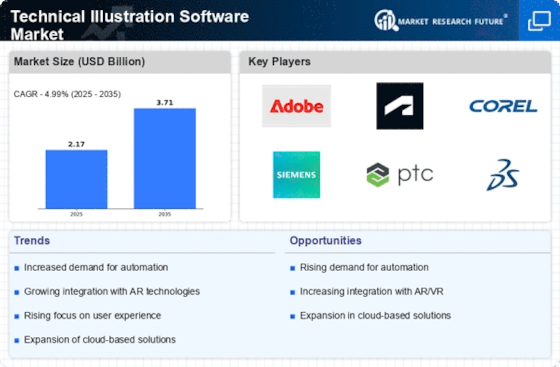
Technical Illustration Software Market Infographic
Purchase Options

Market Trends

Key Emerging Trends in the Technical Illustration Software Market

The market for technical illustration software has seen huge patterns and improvements lately, mirroring the developing interest for cutting edge apparatuses in different enterprises. One noticeable pattern is the rising reception of 3D illustration capacities inside technical illustration software. As ventures like assembling, designing, and engineering make progress toward additional practical and definite perceptions, 3D illustrations give a strong arrangement. This pattern is driven by the requirement for upgraded correspondence of complicated thoughts and plans, permitting experts to actually pass on data more.

Another much more important market trend is integration of AI (AI – ML) and digital reasoning (artificial intelligence) in technical pictorial software. With the introduction of computer based intelligence driven tools, new technique has snowballed into production and it has now become easy to create digital drawings. Such advances are considered as automated recognition of patterns, forms, and designs that facilitate the image making process and reduce the number of time spent and efforts put in it. This pattern is particularly worth to experts who have to draw technical sketches that they might do fast, but not reducing on precision.

The market also observes a shifting towards cloud-based technical illustration software packages. The distributed computing enables clients to manage such illustrations and access from various locations with many people cooperative, sharing work. This pathway is in accordance with wider progress towards cloud adoption by other businesses that allowed they need for flexibility and fluidity of software solutions.

Also, individuals consider customization and personalization as a must in the technical illustration software market. Clients want software arrangements that can be personalized for their specific needs and operations, which increases functionality of the whole system. This resemblance is being addressed by merchants by having more adjustable attributes and straightforward interfaces, ensuring that specialists would have the option to enhance from software services matching their particular needs.

Similarly, the market is also witnessing a surge in the use of technical drawing software which seems to become dominant in developping businesses such as AR and VR. As AR and VR technologies are will be widely established, this leads to greater demand for higher quality, detailed images to improve user experience. Given the prevalence of such vivid advancements, technical illustration programming plays a vital role in creating visual content for them and enhancing communication between the virtual dimension and reality. Moreover, maintainability and natural contemplations are affecting the technical illustration software market. Businesses are progressively centered around making eco-accommodating items and cycles, and this is reflected in the interest for software that upholds maintainable plan and illustration rehearses. Subsequently, technical illustration software merchants are integrating highlights that assist clients with advancing their plans for ecological effect, adding to the more extensive manageability objectives of ventures.


Author
Author Profile
Ankit Gupta
Team Lead - Research

Ankit Gupta is a seasoned market intelligence and strategic research professional with over six plus years of experience in the ICT and Semiconductor industries. With academic roots in Telecom, Marketing, and Electronics, he blends technical insight with business strategy. Ankit has led 200+ projects, including work for Fortune 500 clients like Microsoft and Rio Tinto, covering market sizing, tech forecasting, and go-to-market strategies. Known for bridging engineering and enterprise decision-making, his insights support growth, innovation, and investment planning across diverse technology markets.

Leave a Comment

FAQs

What is the current valuation of the Technical Illustration Software Market?

<p>The market valuation was 2.173 USD Billion in 2024.</p>

What is the projected market size for the Technical Illustration Software Market by 2035?

<p>The market is projected to reach 3.713 USD Billion by 2035.</p>

What is the expected CAGR for the Technical Illustration Software Market during the forecast period?

<p>The expected CAGR for the market from 2025 to 2035 is 4.99%.</p>

Which companies are considered key players in the Technical Illustration Software Market?

<p>Key players include Adobe, Autodesk, Corel, Siemens, PTC, Dassault Systemes, SolidWorks, TechSmith, and Ashampoo.</p>

What are the primary application segments within the Technical Illustration Software Market?

<p>The primary application segments include Engineering, Manufacturing, Medical, Academic, and Marketing.</p>

How does the market size for cloud-based deployment compare to on-premise deployment?

<p>In 2024, cloud-based deployment was valued at 1.306 USD Billion, while on-premise deployment was valued at 0.867 USD Billion.</p>

What is the market size for small and medium enterprises in the Technical Illustration Software Market?

<p>The market size for small and medium enterprises was 0.65 USD Billion in 2024 and is projected to reach 1.1 USD Billion by 2035.</p>

Which industry verticals are driving growth in the Technical Illustration Software Market?

<p>Key industry verticals include Aerospace, Automotive, Healthcare, Education, and Consumer Goods.</p>

What features are most valued in Technical Illustration Software?

<p>Valued features include 3D Rendering, Vector Graphics, Animation, and Color Management.</p>

What is the projected growth for the manufacturing segment of the Technical Illustration Software Market?

<p>The manufacturing segment is expected to grow from 0.55 USD Billion in 2024 to 0.9 USD Billion by 2035.</p>

Market Summary

As per Market Research Future analysis, the Technical Illustration Software Market Size was estimated at 2.173 USD Billion in 2024. The Technical Illustration Software industry is projected to grow from 2.282 USD Billion in 2025 to 3.713 USD Billion by 2035, exhibiting a compound annual growth rate (CAGR) of 4.99% during the forecast period 2025 - 2035

Key Market Trends & Highlights

The Technical Illustration Software Market is experiencing robust growth driven by technological advancements and increasing demand for visual communication.

  • User-centric design is becoming increasingly prevalent, enhancing user experience and engagement.
  • Cloud integration is transforming the market, facilitating collaboration and accessibility across various platforms.
  • The engineering segment remains the largest, while the medical segment is witnessing the fastest growth due to rising healthcare needs.
  • Rising demand for visual communication and advancements in software technology are key drivers propelling market expansion.

Market Size & Forecast

2024 Market Size 2.173 (USD Billion)
2035 Market Size 3.713 (USD Billion)
CAGR (2025 - 2035) 4.99%
Largest Regional Market Share in 2024 North America

Major Players

Adobe (US), Autodesk (US), Corel (CA), Siemens (DE), PTC (US), Dassault Systemes (FR), SolidWorks (US), TechSmith (US), Ashampoo (DE)

Market Trends

The Technical Illustration Software Market is currently experiencing a dynamic evolution, driven by advancements in technology and the increasing demand for high-quality visual communication across various industries. As organizations recognize the value of precise and engaging illustrations, the market appears to be expanding, with a growing emphasis on user-friendly interfaces and integration capabilities. This trend suggests that software developers are focusing on enhancing the overall user experience, making it easier for professionals to create detailed illustrations that meet specific project requirements. Furthermore, the rise of remote work and digital collaboration tools has likely contributed to the demand for versatile software solutions that facilitate seamless communication and sharing of technical illustrations. In addition, the Technical Illustration Software Market seems to be influenced by the increasing adoption of cloud-based solutions. These platforms offer flexibility and accessibility, allowing users to work from various locations while ensuring that their illustrations are easily shareable and updatable. As industries such as engineering, manufacturing, and education continue to evolve, the need for innovative illustration tools that can adapt to changing workflows and enhance productivity is becoming more pronounced. Overall, the market appears poised for continued growth, driven by technological advancements and the ongoing quest for improved visual communication in technical fields.

User-Centric Design

The focus on user-centric design is becoming increasingly prominent in the Technical Illustration Software Market. Developers are prioritizing intuitive interfaces and streamlined workflows, which enable users to create illustrations more efficiently. This trend indicates a shift towards understanding user needs and preferences, ultimately enhancing the overall experience.

Cloud Integration

Cloud integration is emerging as a key trend within the Technical Illustration Software Market. The adoption of cloud-based solutions allows for greater flexibility and collaboration among users. This shift suggests that professionals can access their work from various devices, facilitating real-time updates and sharing.

Cross-Industry Applications

The Technical Illustration Software Market is witnessing a rise in cross-industry applications. As various sectors, including engineering, healthcare, and education, recognize the importance of effective visual communication, the demand for versatile illustration tools is likely to increase. This trend highlights the software's adaptability to meet diverse industry needs.

Technical Illustration Software Market Market Drivers

Advancements in Software Technology

Technological advancements play a pivotal role in shaping the Technical Illustration Software Market. Innovations in software capabilities, such as improved rendering techniques and enhanced user interfaces, contribute to a more efficient design process. The integration of artificial intelligence and machine learning into illustration software allows for automated features that streamline workflows, thereby increasing productivity. Furthermore, the introduction of 3D modeling and augmented reality functionalities enhances the user experience, making it easier for professionals to create and manipulate illustrations. As these technologies continue to evolve, they are likely to attract a broader user base, further propelling market growth.

Rising Demand for Visual Communication

The Technical Illustration Software Market experiences a notable surge in demand for visual communication tools. As businesses increasingly recognize the importance of clear and effective visual representation, the need for sophisticated technical illustrations grows. This trend is particularly evident in sectors such as engineering, manufacturing, and healthcare, where precise illustrations are crucial for conveying complex information. According to recent data, the market is projected to expand at a compound annual growth rate (CAGR) of approximately 8% over the next five years. This growth is driven by the necessity for enhanced documentation and training materials, which rely heavily on technical illustrations to facilitate understanding and retention of information.

Expansion of Remote Work and Collaboration

The shift towards remote work has significantly impacted the Technical Illustration Software Market. As teams become more distributed, the need for collaborative tools that facilitate remote design and illustration becomes paramount. Software that allows for real-time collaboration and sharing of technical illustrations is increasingly sought after. This trend is further supported by the rise of cloud-based solutions, which enable seamless access to illustration tools from various locations. The market is likely to benefit from this shift, as organizations prioritize tools that enhance communication and collaboration among remote teams, thereby driving demand for technical illustration software.

Increased Adoption in Education and Training

The Technical Illustration Software Market is witnessing increased adoption within educational institutions and training programs. As educational methodologies evolve, there is a growing emphasis on visual learning tools that aid in the comprehension of complex subjects. Technical illustrations serve as effective pedagogical resources, particularly in fields such as engineering, architecture, and design. Institutions are increasingly incorporating these tools into their curricula to enhance student engagement and understanding. This trend is supported by data indicating that educational spending on technology is expected to rise, thereby providing a favorable environment for the growth of technical illustration software.

Growing Importance of Compliance and Standards

The Technical Illustration Software Market is influenced by the growing importance of compliance and industry standards. Many sectors, including manufacturing and pharmaceuticals, require adherence to strict regulatory guidelines that necessitate accurate technical documentation. As companies strive to meet these compliance requirements, the demand for high-quality technical illustrations that accurately represent products and processes increases. This trend is expected to drive market growth, as organizations invest in software solutions that ensure their illustrations meet industry standards. The emphasis on compliance not only enhances product safety but also fosters consumer trust, further solidifying the role of technical illustration software in various industries.

Market Segment Insights

By Application: Engineering (Largest) vs. Medical (Fastest-Growing)

<p>The Technical Illustration Software Market comprises several key application segments, with Engineering holding the largest share due to the extensive demand for precise and detailed illustrations in design and technical documentation. This application is pivotal in bridging the gap between concepts and manufacturing, thus solidifying its dominance. In contrast, Medical applications are rapidly gaining momentum, attributed to advancements in healthcare technology and the increasing necessity for clear visual communication in <a href="https://www.marketresearchfuture.com/reports/medical-education-market-24494" target="_blank" title="medical education">medical education</a> and surgical procedures.</p>

<p>Engineering (Dominant) vs. Medical (Emerging)</p>

<p>Engineering applications dominate the Technical Illustration Software Market, primarily due to their essential role in product design and development processes. These tools facilitate the creation of intricate diagrams, which are crucial for engineers and designers to visualize and communicate complex ideas accurately. Conversely, the Medical sector has emerged as a rapidly growing application, driven by the increasing use of advanced imaging technologies and the need for effective patient education materials. Medical illustrations enhance understanding in critical fields such as surgery, anatomy, and patient care, reflecting a shift towards visual learning in healthcare.</p>

By Deployment Mode: Cloud-Based (Largest) vs. On-Premise (Fastest-Growing)

<p>In the Technical Illustration Software Market, the deployment mode segment showcases distinct preferences among users. Cloud-Based solutions currently lead the market, appealing to businesses with the flexibility, scalability, and ease of access that modern organizations require. On the other hand, On-Premise solutions, while historically significant, have seen a resurgence in interest as companies prioritize data security and control. As more enterprises recognize the importance of having software that integrates with existing systems, On-Premise solutions are increasingly capturing market attention.</p>

<p>Deployment Mode: Cloud-Based (Dominant) vs. On-Premise (Emerging)</p>

<p>Cloud-Based technical illustration software has emerged as the dominant choice for many organizations due to its user-friendly features and accessibility from anywhere with an internet connection. This mode supports real-time collaboration and seamless updates, catering to a mobile and remote workforce. In contrast, On-Premise solutions are positioning themselves as an emerging alternative, particularly favored by industries that require rigorous data privacy and compliance standards. These systems tend to offer more customization and integration with legacy software, thus appealing to traditional businesses that prioritize data control and security.</p>

By End User: Small and Medium Enterprises (Largest) vs. Freelancers (Fastest-Growing)

<p>The Technical Illustration Software Market is witnessing a significant division in market share across the end-user segments. Small and medium enterprises (SMEs) account for the largest percentage of usage, catering to a range of industries that require technical illustrations to support product design, engineering documentation, and marketing materials. In contrast, large enterprises utilize these software solutions for specialized and complex illustration needs, albeit with a smaller share compared to SMEs. Freelancers have emerged as a dynamic segment, using technical illustration software for project-based work in various fields, thus reflecting a growing number of individual users entering the market. The growth of the Technical Illustration Software Market within these segments is driven by several factors. Small and medium enterprises are increasingly adopting digital tools to enhance productivity and streamline processes, leading to a higher demand for formal illustration software. Freelancers are experiencing rapid growth due to the gig economy's expansion, requiring flexible and powerful illustration tools to meet diverse client needs. Consequently, software providers are adjusting their feature sets and pricing models to attract these segments, positioning themselves to capitalize on changing user demands in the market.</p>

<p>Small and Medium Enterprises (Dominant) vs. Freelancers (Emerging)</p>

<p>Small and Medium Enterprises (SMEs) represent the dominant user base in the Technical Illustration Software Market, as they leverage these tools to create precise and effective technical illustrations that are crucial to their operations. SMEs benefit from tailored software solutions that cater to their specific needs, often at competitive pricing, making these tools accessible and valuable. These enterprises rely on strong customer support and regular updates to enhance their existing capabilities. On the other hand, Freelancers are an emerging force, carving out a niche within the market by using flexible, scalable software solutions that can adjust to various client specifications and project requirements. The demand for customizable tools and user-friendly interfaces has risen among freelancers, fostering innovation in software offerings to meet their increasing needs.</p>

By Features: 3D Rendering (Largest) vs. Animation (Fastest-Growing)

<p>The Technical Illustration Software Market is characterized by a diverse distribution of features, most notably 3D Rendering, Vector Graphics, Animation, and Color Management. Among these, 3D Rendering remains the most prominent segment, capturing a significant share of the market. In contrast, Animation has emerged as the fastest-growing feature, appealing to a broad range of industries that require dynamic illustrations, enhancing its demand in recent years. Growth in this segment is primarily driven by advances in technology that facilitate high-quality rendering and animation capabilities. As digital content consumption increases, the need for more interactive and visually appealing illustrations is surging. Businesses seek to leverage animations for marketing and training, thereby propelling the Animation feature upward, while 3D Rendering continues to be essential for creating comprehensive visual narratives.</p>

<p>3D Rendering (Dominant) vs. Animation (Emerging)</p>

<p>3D Rendering stands as the dominant feature in the Technical Illustration Software Market, known for its ability to produce lifelike, three-dimensional images that enhance the clarity and detail of technical documents. This feature caters to various industries, including engineering, architecture, and product design. Its market strength derives from ongoing developments in graphic rendering technologies that enable high-resolution, realistic visualizations. Conversely, Animation is emerging as a vital component, appealing to sectors that prioritize dynamic presentation and storytelling. The growing demand for animated content, especially in digital marketing and e-learning, showcases its increasing importance. Companies are investing in animation capabilities to create more engaging user experiences, thereby affirming Animation’s rising position in the market.</p>

By Industry Vertical: Aerospace (Largest) vs. Automotive (Fastest-Growing)

<p>In the Technical Illustration Software Market, the Aerospace sector holds the largest market share due to its stringent regulatory requirements and the need for precise technical documentation. This sector utilizes advanced illustrations for various applications including maintenance manuals and training materials, which are crucial for safety and compliance. On the other hand, the Automotive sector is rapidly gaining ground, driven by the increasing complexity of vehicle designs and the rising demand for enhanced communication of product specifications and assembly processes.</p>

<p>Aerospace: Technical Illustrations (Dominant) vs. Automotive: 3D Visualization (Emerging)</p>

<p>The Aerospace sector in the Technical Illustration Software Market is characterized by its need for high-fidelity diagrams and illustrations to meet rigorous safety standards. This segment is dominant due to its requirement for detailed representations for complex systems such as avionics and mechanical components. Conversely, the Automotive sector is emerging as a significant player in technical illustrations, utilizing 3D visualization technologies that enhance design processes and facilitate collaboration across teams. This sector is increasingly investing in technical illustration tools to improve efficiency and accuracy in capturing and communicating intricate vehicle specifications.</p>

Get more detailed insights about Technical Illustration Software Market Research Report - Global Forecast till 2035

Regional Insights

North America : Innovation and Market Leadership

North America is the largest market for technical illustration software, holding approximately 45% of the global share. The region's growth is driven by advancements in technology, increasing demand for high-quality visual content, and a strong presence of key players like Adobe and Autodesk. Regulatory support for digital transformation further catalyzes market expansion, making it a hub for innovation. The United States leads the market, followed by Canada, which is experiencing a surge in demand for technical illustration tools across various sectors, including manufacturing and education. The competitive landscape is characterized by major players such as PTC and TechSmith, who are continuously innovating to meet the evolving needs of users. The presence of these companies fosters a robust ecosystem for technical illustration software development.

Europe : Emerging Market with Growth Potential

Europe is the second-largest market for technical illustration software, accounting for approximately 30% of the global market share. The region's growth is fueled by increasing investments in technology and a rising trend towards digitalization across industries. Regulatory frameworks promoting innovation and sustainability also play a crucial role in driving demand for advanced illustration tools. Leading countries in this region include Germany, France, and the UK, where companies like Siemens and Dassault Systemes are prominent. The competitive landscape is vibrant, with a mix of established players and emerging startups. The presence of these key players enhances the market's dynamism, as they continuously adapt to changing consumer needs and technological advancements.

Asia-Pacific : Rapid Growth and Adoption

Asia-Pacific is witnessing rapid growth in the technical illustration software market, holding about 20% of the global share. The region's expansion is driven by increasing industrialization, a growing emphasis on digital content creation, and rising investments in technology. Countries like China and India are at the forefront, with supportive government initiatives promoting digital skills and innovation. China is the largest market in the region, followed by India, where the demand for technical illustration tools is surging across sectors such as manufacturing and education. The competitive landscape is evolving, with both local and international players vying for market share. Companies like Corel and Autodesk are expanding their presence, catering to the diverse needs of users in this dynamic market.

Middle East and Africa : Emerging Opportunities and Challenges

The Middle East and Africa (MEA) region is gradually emerging in the technical illustration software market, holding around 5% of the global share. Growth is driven by increasing digitalization efforts, investments in infrastructure, and a rising demand for high-quality visual content across various sectors. However, challenges such as limited access to technology and varying levels of digital literacy persist. Leading countries in this region include South Africa and the UAE, where there is a growing interest in adopting advanced illustration tools. The competitive landscape is still developing, with a mix of local and international players. Companies are focusing on building partnerships and enhancing their offerings to cater to the unique needs of the MEA market, paving the way for future growth.

Key Players and Competitive Insights

The Technical Illustration Software Market is characterized by a diverse range of providers that cater to various industries, including engineering, manufacturing, and telecommunication. This market's competitiveness is driven by the increasing demand for precise technical drawings and illustrations, which are crucial for product documentation, user manuals, and assembly guides. The rise in technological advancements further complements the demand for innovative illustration tools that enhance visualization and communication. Key market players are continuously innovating their product offerings to remain competitive, focusing on user-friendly interfaces, integration capabilities, and support for emerging technologies such as augmented and virtual reality.
The rise of remote work and collaborative environments has propelled the growth of cloud-based solutions, leading to a competitive landscape where flexibility and accessibility increasingly influence customer choices. Cacoo stands out in the Technical Illustration Software Market due to its unique strengths, particularly in its user-friendly interface and cloud-based collaboration features. The platform allows multiple users to work simultaneously on projects, enhancing workflow efficiency and team collaboration. Cacoo's extensive template library and pre-made assets offer users the flexibility to create detailed illustrations quickly, which is especially beneficial for industries requiring speed in documentation.
Additionally, its seamless integration with other productivity tools further enhances its appeal, allowing teams to streamline their processes without disrupting existing workflows. By emphasizing collaboration and ease of use, Cacoo has positioned itself as a valuable asset for organizations that prioritize teamwork and efficiency in technical illustration. Siemens holds a notable position in the Technical Illustration Software Market, leveraging its extensive experience and technological expertise. With a focus on innovation, Siemens delivers advanced solutions that cater to the demands of complex engineering and manufacturing environments. Its software is designed to support detailed technical documentation while ensuring compliance with industry standards.
Siemens repeatedly invests in research and development to enhance its tools, integrating cutting-edge technologies such as simulation and virtual reality functionalities to improve visualization. Moreover, its strong global presence allows Siemens to cater to a wide range of industries, offering tailored solutions that meet the specific needs of diverse markets. This strategic positioning within the competitive landscape highlights Siemens' capabilities in providing comprehensive and reliable technical illustration solutions, solidifying its role as a key player in the industry.

Key Companies in the Technical Illustration Software Market include

Industry Developments

Recent developments in the Technical Illustration Software Market have shown a notable increase in demand for advanced digital tools as businesses seek to create more intricate and detailed illustrations. Companies such as Cacoo, Siemens, Dassault Systemes, and PTC have been focusing on enhancing their offerings to meet these needs, emphasizing collaboration and user engagement in their software solutions. Furthermore, TechSmith, Lucidchart, and Canva are leveraging cloud technologies to improve accessibility, allowing users to work seamlessly across devices.

In terms of market consolidation, several recent mergers and acquisitions have been highlighted, with key players like SolidWorks and Adobe continuously expanding their portfolios through strategic partnerships to capture a larger market share. The growth in market valuation is significantly impacting innovation, prompting companies like Autodesk and Corel to invest in R&D for next-generation features. Additionally, the rise of remote work has propelled the usage of online technical illustration tools, influencing how organizations view and deploy these technologies. These current affairs indicate a vibrant and competitive landscape for technical illustration software as it adapts to evolving market trends.

Future Outlook

Technical Illustration Software Market Future Outlook

The Technical Illustration Software Market is projected to grow at a 4.99% CAGR from 2025 to 2035, driven by advancements in technology and increasing demand for <a href="https://www.marketresearchfuture.com/reports/visual-communication-market-34348" target="_blank" title="visual communication">visual communication</a>.

New opportunities lie in:

  • Integration of AI-driven automation tools for enhanced illustration efficiency.
  • Development of cloud-based platforms for collaborative technical illustration.
  • Expansion into emerging markets with tailored software solutions.

By 2035, the market is expected to solidify its position as a vital component of technical communication.

Market Segmentation

Technical Illustration Software Market End User Outlook

  • Small and Medium Enterprises
  • Large Enterprises
  • Freelancers

Technical Illustration Software Market Features Outlook

  • 3D Rendering
  • Vector Graphics
  • Animation
  • Color Management

Technical Illustration Software Market Application Outlook

  • Engineering
  • Manufacturing
  • Medical
  • Academic
  • Marketing

Technical Illustration Software Market Deployment Mode Outlook

  • On-Premise
  • Cloud-Based

Technical Illustration Software Market Industry Vertical Outlook

  • Aerospace
  • Automotive
  • Healthcare
  • Education
  • Consumer Goods

Report Scope

MARKET SIZE 2024 2.173(USD Billion)
MARKET SIZE 2025 2.282(USD Billion)
MARKET SIZE 2035 3.713(USD Billion)
COMPOUND ANNUAL GROWTH RATE (CAGR) 4.99% (2025 - 2035)
REPORT COVERAGE Revenue Forecast, Competitive Landscape, Growth Factors, and Trends
BASE YEAR 2024
Market Forecast Period 2025 - 2035
Historical Data 2019 - 2024
Market Forecast Units USD Billion
Key Companies Profiled Adobe (US), Autodesk (US), Corel (CA), Siemens (DE), PTC (US), Dassault Systemes (FR), SolidWorks (US), TechSmith (US), Ashampoo (DE)
Segments Covered Application, Deployment Mode, End User, Features, Industry Vertical, Regional
Key Market Opportunities Integration of artificial intelligence enhances efficiency in the Technical Illustration Software Market.
Key Market Dynamics Rising demand for advanced visualization tools drives innovation and competition in the Technical Illustration Software market.
Countries Covered North America, Europe, APAC, South America, MEA

FAQs

What is the current valuation of the Technical Illustration Software Market?

<p>The market valuation was 2.173 USD Billion in 2024.</p>

What is the projected market size for the Technical Illustration Software Market by 2035?

<p>The market is projected to reach 3.713 USD Billion by 2035.</p>

What is the expected CAGR for the Technical Illustration Software Market during the forecast period?

<p>The expected CAGR for the market from 2025 to 2035 is 4.99%.</p>

Which companies are considered key players in the Technical Illustration Software Market?

<p>Key players include Adobe, Autodesk, Corel, Siemens, PTC, Dassault Systemes, SolidWorks, TechSmith, and Ashampoo.</p>

What are the primary application segments within the Technical Illustration Software Market?

<p>The primary application segments include Engineering, Manufacturing, Medical, Academic, and Marketing.</p>

How does the market size for cloud-based deployment compare to on-premise deployment?

<p>In 2024, cloud-based deployment was valued at 1.306 USD Billion, while on-premise deployment was valued at 0.867 USD Billion.</p>

What is the market size for small and medium enterprises in the Technical Illustration Software Market?

<p>The market size for small and medium enterprises was 0.65 USD Billion in 2024 and is projected to reach 1.1 USD Billion by 2035.</p>

Which industry verticals are driving growth in the Technical Illustration Software Market?

<p>Key industry verticals include Aerospace, Automotive, Healthcare, Education, and Consumer Goods.</p>

What features are most valued in Technical Illustration Software?

<p>Valued features include 3D Rendering, Vector Graphics, Animation, and Color Management.</p>

What is the projected growth for the manufacturing segment of the Technical Illustration Software Market?

<p>The manufacturing segment is expected to grow from 0.55 USD Billion in 2024 to 0.9 USD Billion by 2035.</p>

  1. SECTION I: EXECUTIVE SUMMARY AND KEY HIGHLIGHTS
    1. | 1.1 EXECUTIVE SUMMARY
    2. | | 1.1.1 Market Overview
    3. | | 1.1.2 Key Findings
    4. | | 1.1.3 Market Segmentation
    5. | | 1.1.4 Competitive Landscape
    6. | | 1.1.5 Challenges and Opportunities
    7. | | 1.1.6 Future Outlook
  2. SECTION II: SCOPING, METHODOLOGY AND MARKET STRUCTURE
    1. | 2.1 MARKET INTRODUCTION
    2. | | 2.1.1 Definition
    3. | | 2.1.2 Scope of the study
    4. | | | 2.1.2.1 Research Objective
    5. | | | 2.1.2.2 Assumption
    6. | | | 2.1.2.3 Limitations
    7. | 2.2 RESEARCH METHODOLOGY
    8. | | 2.2.1 Overview
    9. | | 2.2.2 Data Mining
    10. | | 2.2.3 Secondary Research
    11. | | 2.2.4 Primary Research
    12. | | | 2.2.4.1 Primary Interviews and Information Gathering Process
    13. | | | 2.2.4.2 Breakdown of Primary Respondents
    14. | | 2.2.5 Forecasting Model
    15. | | 2.2.6 Market Size Estimation
    16. | | | 2.2.6.1 Bottom-Up Approach
    17. | | | 2.2.6.2 Top-Down Approach
    18. | | 2.2.7 Data Triangulation
    19. | | 2.2.8 Validation
  3. SECTION III: QUALITATIVE ANALYSIS
    1. | 3.1 MARKET DYNAMICS
    2. | | 3.1.1 Overview
    3. | | 3.1.2 Drivers
    4. | | 3.1.3 Restraints
    5. | | 3.1.4 Opportunities
    6. | 3.2 MARKET FACTOR ANALYSIS
    7. | | 3.2.1 Value chain Analysis
    8. | | 3.2.2 Porter's Five Forces Analysis
    9. | | | 3.2.2.1 Bargaining Power of Suppliers
    10. | | | 3.2.2.2 Bargaining Power of Buyers
    11. | | | 3.2.2.3 Threat of New Entrants
    12. | | | 3.2.2.4 Threat of Substitutes
    13. | | | 3.2.2.5 Intensity of Rivalry
    14. | | 3.2.3 COVID-19 Impact Analysis
    15. | | | 3.2.3.1 Market Impact Analysis
    16. | | | 3.2.3.2 Regional Impact
    17. | | | 3.2.3.3 Opportunity and Threat Analysis
  4. SECTION IV: QUANTITATIVE ANALYSIS
    1. | 4.1 Information and Communications Technology, BY Application (USD Billion)
    2. | | 4.1.1 Engineering
    3. | | 4.1.2 Manufacturing
    4. | | 4.1.3 Medical
    5. | | 4.1.4 Academic
    6. | | 4.1.5 Marketing
    7. | 4.2 Information and Communications Technology, BY Deployment Mode (USD Billion)
    8. | | 4.2.1 On-Premise
    9. | | 4.2.2 Cloud-Based
    10. | 4.3 Information and Communications Technology, BY End User (USD Billion)
    11. | | 4.3.1 Small and Medium Enterprises
    12. | | 4.3.2 Large Enterprises
    13. | | 4.3.3 Freelancers
    14. | 4.4 Information and Communications Technology, BY Features (USD Billion)
    15. | | 4.4.1 3D Rendering
    16. | | 4.4.2 Vector Graphics
    17. | | 4.4.3 Animation
    18. | | 4.4.4 Color Management
    19. | 4.5 Information and Communications Technology, BY Industry Vertical (USD Billion)
    20. | | 4.5.1 Aerospace
    21. | | 4.5.2 Automotive
    22. | | 4.5.3 Healthcare
    23. | | 4.5.4 Education
    24. | | 4.5.5 Consumer Goods
    25. | 4.6 Information and Communications Technology, BY Region (USD Billion)
    26. | | 4.6.1 North America
    27. | | | 4.6.1.1 US
    28. | | | 4.6.1.2 Canada
    29. | | 4.6.2 Europe
    30. | | | 4.6.2.1 Germany
    31. | | | 4.6.2.2 UK
    32. | | | 4.6.2.3 France
    33. | | | 4.6.2.4 Russia
    34. | | | 4.6.2.5 Italy
    35. | | | 4.6.2.6 Spain
    36. | | | 4.6.2.7 Rest of Europe
    37. | | 4.6.3 APAC
    38. | | | 4.6.3.1 China
    39. | | | 4.6.3.2 India
    40. | | | 4.6.3.3 Japan
    41. | | | 4.6.3.4 South Korea
    42. | | | 4.6.3.5 Malaysia
    43. | | | 4.6.3.6 Thailand
    44. | | | 4.6.3.7 Indonesia
    45. | | | 4.6.3.8 Rest of APAC
    46. | | 4.6.4 South America
    47. | | | 4.6.4.1 Brazil
    48. | | | 4.6.4.2 Mexico
    49. | | | 4.6.4.3 Argentina
    50. | | | 4.6.4.4 Rest of South America
    51. | | 4.6.5 MEA
    52. | | | 4.6.5.1 GCC Countries
    53. | | | 4.6.5.2 South Africa
    54. | | | 4.6.5.3 Rest of MEA
  5. SECTION V: COMPETITIVE ANALYSIS
    1. | 5.1 Competitive Landscape
    2. | | 5.1.1 Overview
    3. | | 5.1.2 Competitive Analysis
    4. | | 5.1.3 Market share Analysis
    5. | | 5.1.4 Major Growth Strategy in the Information and Communications Technology
    6. | | 5.1.5 Competitive Benchmarking
    7. | | 5.1.6 Leading Players in Terms of Number of Developments in the Information and Communications Technology
    8. | | 5.1.7 Key developments and growth strategies
    9. | | | 5.1.7.1 New Product Launch/Service Deployment
    10. | | | 5.1.7.2 Merger & Acquisitions
    11. | | | 5.1.7.3 Joint Ventures
    12. | | 5.1.8 Major Players Financial Matrix
    13. | | | 5.1.8.1 Sales and Operating Income
    14. | | | 5.1.8.2 Major Players R&D Expenditure. 2023
    15. | 5.2 Company Profiles
    16. | | 5.2.1 Adobe (US)
    17. | | | 5.2.1.1 Financial Overview
    18. | | | 5.2.1.2 Products Offered
    19. | | | 5.2.1.3 Key Developments
    20. | | | 5.2.1.4 SWOT Analysis
    21. | | | 5.2.1.5 Key Strategies
    22. | | 5.2.2 Autodesk (US)
    23. | | | 5.2.2.1 Financial Overview
    24. | | | 5.2.2.2 Products Offered
    25. | | | 5.2.2.3 Key Developments
    26. | | | 5.2.2.4 SWOT Analysis
    27. | | | 5.2.2.5 Key Strategies
    28. | | 5.2.3 Corel (CA)
    29. | | | 5.2.3.1 Financial Overview
    30. | | | 5.2.3.2 Products Offered
    31. | | | 5.2.3.3 Key Developments
    32. | | | 5.2.3.4 SWOT Analysis
    33. | | | 5.2.3.5 Key Strategies
    34. | | 5.2.4 Siemens (DE)
    35. | | | 5.2.4.1 Financial Overview
    36. | | | 5.2.4.2 Products Offered
    37. | | | 5.2.4.3 Key Developments
    38. | | | 5.2.4.4 SWOT Analysis
    39. | | | 5.2.4.5 Key Strategies
    40. | | 5.2.5 PTC (US)
    41. | | | 5.2.5.1 Financial Overview
    42. | | | 5.2.5.2 Products Offered
    43. | | | 5.2.5.3 Key Developments
    44. | | | 5.2.5.4 SWOT Analysis
    45. | | | 5.2.5.5 Key Strategies
    46. | | 5.2.6 Dassault Systemes (FR)
    47. | | | 5.2.6.1 Financial Overview
    48. | | | 5.2.6.2 Products Offered
    49. | | | 5.2.6.3 Key Developments
    50. | | | 5.2.6.4 SWOT Analysis
    51. | | | 5.2.6.5 Key Strategies
    52. | | 5.2.7 SolidWorks (US)
    53. | | | 5.2.7.1 Financial Overview
    54. | | | 5.2.7.2 Products Offered
    55. | | | 5.2.7.3 Key Developments
    56. | | | 5.2.7.4 SWOT Analysis
    57. | | | 5.2.7.5 Key Strategies
    58. | | 5.2.8 TechSmith (US)
    59. | | | 5.2.8.1 Financial Overview
    60. | | | 5.2.8.2 Products Offered
    61. | | | 5.2.8.3 Key Developments
    62. | | | 5.2.8.4 SWOT Analysis
    63. | | | 5.2.8.5 Key Strategies
    64. | | 5.2.9 Ashampoo (DE)
    65. | | | 5.2.9.1 Financial Overview
    66. | | | 5.2.9.2 Products Offered
    67. | | | 5.2.9.3 Key Developments
    68. | | | 5.2.9.4 SWOT Analysis
    69. | | | 5.2.9.5 Key Strategies
    70. | 5.3 Appendix
    71. | | 5.3.1 References
    72. | | 5.3.2 Related Reports
  6. LIST OF FIGURES
    1. | 6.1 MARKET SYNOPSIS
    2. | 6.2 NORTH AMERICA MARKET ANALYSIS
    3. | 6.3 US MARKET ANALYSIS BY APPLICATION
    4. | 6.4 US MARKET ANALYSIS BY DEPLOYMENT MODE
    5. | 6.5 US MARKET ANALYSIS BY END USER
    6. | 6.6 US MARKET ANALYSIS BY FEATURES
    7. | 6.7 US MARKET ANALYSIS BY INDUSTRY VERTICAL
    8. | 6.8 CANADA MARKET ANALYSIS BY APPLICATION
    9. | 6.9 CANADA MARKET ANALYSIS BY DEPLOYMENT MODE
    10. | 6.10 CANADA MARKET ANALYSIS BY END USER
    11. | 6.11 CANADA MARKET ANALYSIS BY FEATURES
    12. | 6.12 CANADA MARKET ANALYSIS BY INDUSTRY VERTICAL
    13. | 6.13 EUROPE MARKET ANALYSIS
    14. | 6.14 GERMANY MARKET ANALYSIS BY APPLICATION
    15. | 6.15 GERMANY MARKET ANALYSIS BY DEPLOYMENT MODE
    16. | 6.16 GERMANY MARKET ANALYSIS BY END USER
    17. | 6.17 GERMANY MARKET ANALYSIS BY FEATURES
    18. | 6.18 GERMANY MARKET ANALYSIS BY INDUSTRY VERTICAL
    19. | 6.19 UK MARKET ANALYSIS BY APPLICATION
    20. | 6.20 UK MARKET ANALYSIS BY DEPLOYMENT MODE
    21. | 6.21 UK MARKET ANALYSIS BY END USER
    22. | 6.22 UK MARKET ANALYSIS BY FEATURES
    23. | 6.23 UK MARKET ANALYSIS BY INDUSTRY VERTICAL
    24. | 6.24 FRANCE MARKET ANALYSIS BY APPLICATION
    25. | 6.25 FRANCE MARKET ANALYSIS BY DEPLOYMENT MODE
    26. | 6.26 FRANCE MARKET ANALYSIS BY END USER
    27. | 6.27 FRANCE MARKET ANALYSIS BY FEATURES
    28. | 6.28 FRANCE MARKET ANALYSIS BY INDUSTRY VERTICAL
    29. | 6.29 RUSSIA MARKET ANALYSIS BY APPLICATION
    30. | 6.30 RUSSIA MARKET ANALYSIS BY DEPLOYMENT MODE
    31. | 6.31 RUSSIA MARKET ANALYSIS BY END USER
    32. | 6.32 RUSSIA MARKET ANALYSIS BY FEATURES
    33. | 6.33 RUSSIA MARKET ANALYSIS BY INDUSTRY VERTICAL
    34. | 6.34 ITALY MARKET ANALYSIS BY APPLICATION
    35. | 6.35 ITALY MARKET ANALYSIS BY DEPLOYMENT MODE
    36. | 6.36 ITALY MARKET ANALYSIS BY END USER
    37. | 6.37 ITALY MARKET ANALYSIS BY FEATURES
    38. | 6.38 ITALY MARKET ANALYSIS BY INDUSTRY VERTICAL
    39. | 6.39 SPAIN MARKET ANALYSIS BY APPLICATION
    40. | 6.40 SPAIN MARKET ANALYSIS BY DEPLOYMENT MODE
    41. | 6.41 SPAIN MARKET ANALYSIS BY END USER
    42. | 6.42 SPAIN MARKET ANALYSIS BY FEATURES
    43. | 6.43 SPAIN MARKET ANALYSIS BY INDUSTRY VERTICAL
    44. | 6.44 REST OF EUROPE MARKET ANALYSIS BY APPLICATION
    45. | 6.45 REST OF EUROPE MARKET ANALYSIS BY DEPLOYMENT MODE
    46. | 6.46 REST OF EUROPE MARKET ANALYSIS BY END USER
    47. | 6.47 REST OF EUROPE MARKET ANALYSIS BY FEATURES
    48. | 6.48 REST OF EUROPE MARKET ANALYSIS BY INDUSTRY VERTICAL
    49. | 6.49 APAC MARKET ANALYSIS
    50. | 6.50 CHINA MARKET ANALYSIS BY APPLICATION
    51. | 6.51 CHINA MARKET ANALYSIS BY DEPLOYMENT MODE
    52. | 6.52 CHINA MARKET ANALYSIS BY END USER
    53. | 6.53 CHINA MARKET ANALYSIS BY FEATURES
    54. | 6.54 CHINA MARKET ANALYSIS BY INDUSTRY VERTICAL
    55. | 6.55 INDIA MARKET ANALYSIS BY APPLICATION
    56. | 6.56 INDIA MARKET ANALYSIS BY DEPLOYMENT MODE
    57. | 6.57 INDIA MARKET ANALYSIS BY END USER
    58. | 6.58 INDIA MARKET ANALYSIS BY FEATURES
    59. | 6.59 INDIA MARKET ANALYSIS BY INDUSTRY VERTICAL
    60. | 6.60 JAPAN MARKET ANALYSIS BY APPLICATION
    61. | 6.61 JAPAN MARKET ANALYSIS BY DEPLOYMENT MODE
    62. | 6.62 JAPAN MARKET ANALYSIS BY END USER
    63. | 6.63 JAPAN MARKET ANALYSIS BY FEATURES
    64. | 6.64 JAPAN MARKET ANALYSIS BY INDUSTRY VERTICAL
    65. | 6.65 SOUTH KOREA MARKET ANALYSIS BY APPLICATION
    66. | 6.66 SOUTH KOREA MARKET ANALYSIS BY DEPLOYMENT MODE
    67. | 6.67 SOUTH KOREA MARKET ANALYSIS BY END USER
    68. | 6.68 SOUTH KOREA MARKET ANALYSIS BY FEATURES
    69. | 6.69 SOUTH KOREA MARKET ANALYSIS BY INDUSTRY VERTICAL
    70. | 6.70 MALAYSIA MARKET ANALYSIS BY APPLICATION
    71. | 6.71 MALAYSIA MARKET ANALYSIS BY DEPLOYMENT MODE
    72. | 6.72 MALAYSIA MARKET ANALYSIS BY END USER
    73. | 6.73 MALAYSIA MARKET ANALYSIS BY FEATURES
    74. | 6.74 MALAYSIA MARKET ANALYSIS BY INDUSTRY VERTICAL
    75. | 6.75 THAILAND MARKET ANALYSIS BY APPLICATION
    76. | 6.76 THAILAND MARKET ANALYSIS BY DEPLOYMENT MODE
    77. | 6.77 THAILAND MARKET ANALYSIS BY END USER
    78. | 6.78 THAILAND MARKET ANALYSIS BY FEATURES
    79. | 6.79 THAILAND MARKET ANALYSIS BY INDUSTRY VERTICAL
    80. | 6.80 INDONESIA MARKET ANALYSIS BY APPLICATION
    81. | 6.81 INDONESIA MARKET ANALYSIS BY DEPLOYMENT MODE
    82. | 6.82 INDONESIA MARKET ANALYSIS BY END USER
    83. | 6.83 INDONESIA MARKET ANALYSIS BY FEATURES
    84. | 6.84 INDONESIA MARKET ANALYSIS BY INDUSTRY VERTICAL
    85. | 6.85 REST OF APAC MARKET ANALYSIS BY APPLICATION
    86. | 6.86 REST OF APAC MARKET ANALYSIS BY DEPLOYMENT MODE
    87. | 6.87 REST OF APAC MARKET ANALYSIS BY END USER
    88. | 6.88 REST OF APAC MARKET ANALYSIS BY FEATURES
    89. | 6.89 REST OF APAC MARKET ANALYSIS BY INDUSTRY VERTICAL
    90. | 6.90 SOUTH AMERICA MARKET ANALYSIS
    91. | 6.91 BRAZIL MARKET ANALYSIS BY APPLICATION
    92. | 6.92 BRAZIL MARKET ANALYSIS BY DEPLOYMENT MODE
    93. | 6.93 BRAZIL MARKET ANALYSIS BY END USER
    94. | 6.94 BRAZIL MARKET ANALYSIS BY FEATURES
    95. | 6.95 BRAZIL MARKET ANALYSIS BY INDUSTRY VERTICAL
    96. | 6.96 MEXICO MARKET ANALYSIS BY APPLICATION
    97. | 6.97 MEXICO MARKET ANALYSIS BY DEPLOYMENT MODE
    98. | 6.98 MEXICO MARKET ANALYSIS BY END USER
    99. | 6.99 MEXICO MARKET ANALYSIS BY FEATURES
    100. | 6.100 MEXICO MARKET ANALYSIS BY INDUSTRY VERTICAL
    101. | 6.101 ARGENTINA MARKET ANALYSIS BY APPLICATION
    102. | 6.102 ARGENTINA MARKET ANALYSIS BY DEPLOYMENT MODE
    103. | 6.103 ARGENTINA MARKET ANALYSIS BY END USER
    104. | 6.104 ARGENTINA MARKET ANALYSIS BY FEATURES
    105. | 6.105 ARGENTINA MARKET ANALYSIS BY INDUSTRY VERTICAL
    106. | 6.106 REST OF SOUTH AMERICA MARKET ANALYSIS BY APPLICATION
    107. | 6.107 REST OF SOUTH AMERICA MARKET ANALYSIS BY DEPLOYMENT MODE
    108. | 6.108 REST OF SOUTH AMERICA MARKET ANALYSIS BY END USER
    109. | 6.109 REST OF SOUTH AMERICA MARKET ANALYSIS BY FEATURES
    110. | 6.110 REST OF SOUTH AMERICA MARKET ANALYSIS BY INDUSTRY VERTICAL
    111. | 6.111 MEA MARKET ANALYSIS
    112. | 6.112 GCC COUNTRIES MARKET ANALYSIS BY APPLICATION
    113. | 6.113 GCC COUNTRIES MARKET ANALYSIS BY DEPLOYMENT MODE
    114. | 6.114 GCC COUNTRIES MARKET ANALYSIS BY END USER
    115. | 6.115 GCC COUNTRIES MARKET ANALYSIS BY FEATURES
    116. | 6.116 GCC COUNTRIES MARKET ANALYSIS BY INDUSTRY VERTICAL
    117. | 6.117 SOUTH AFRICA MARKET ANALYSIS BY APPLICATION
    118. | 6.118 SOUTH AFRICA MARKET ANALYSIS BY DEPLOYMENT MODE
    119. | 6.119 SOUTH AFRICA MARKET ANALYSIS BY END USER
    120. | 6.120 SOUTH AFRICA MARKET ANALYSIS BY FEATURES
    121. | 6.121 SOUTH AFRICA MARKET ANALYSIS BY INDUSTRY VERTICAL
    122. | 6.122 REST OF MEA MARKET ANALYSIS BY APPLICATION
    123. | 6.123 REST OF MEA MARKET ANALYSIS BY DEPLOYMENT MODE
    124. | 6.124 REST OF MEA MARKET ANALYSIS BY END USER
    125. | 6.125 REST OF MEA MARKET ANALYSIS BY FEATURES
    126. | 6.126 REST OF MEA MARKET ANALYSIS BY INDUSTRY VERTICAL
    127. | 6.127 KEY BUYING CRITERIA OF INFORMATION AND COMMUNICATIONS TECHNOLOGY
    128. | 6.128 RESEARCH PROCESS OF MRFR
    129. | 6.129 DRO ANALYSIS OF INFORMATION AND COMMUNICATIONS TECHNOLOGY
    130. | 6.130 DRIVERS IMPACT ANALYSIS: INFORMATION AND COMMUNICATIONS TECHNOLOGY
    131. | 6.131 RESTRAINTS IMPACT ANALYSIS: INFORMATION AND COMMUNICATIONS TECHNOLOGY
    132. | 6.132 SUPPLY / VALUE CHAIN: INFORMATION AND COMMUNICATIONS TECHNOLOGY
    133. | 6.133 INFORMATION AND COMMUNICATIONS TECHNOLOGY, BY APPLICATION, 2024 (% SHARE)
    134. | 6.134 INFORMATION AND COMMUNICATIONS TECHNOLOGY, BY APPLICATION, 2024 TO 2035 (USD Billion)
    135. | 6.135 INFORMATION AND COMMUNICATIONS TECHNOLOGY, BY DEPLOYMENT MODE, 2024 (% SHARE)
    136. | 6.136 INFORMATION AND COMMUNICATIONS TECHNOLOGY, BY DEPLOYMENT MODE, 2024 TO 2035 (USD Billion)
    137. | 6.137 INFORMATION AND COMMUNICATIONS TECHNOLOGY, BY END USER, 2024 (% SHARE)
    138. | 6.138 INFORMATION AND COMMUNICATIONS TECHNOLOGY, BY END USER, 2024 TO 2035 (USD Billion)
    139. | 6.139 INFORMATION AND COMMUNICATIONS TECHNOLOGY, BY FEATURES, 2024 (% SHARE)
    140. | 6.140 INFORMATION AND COMMUNICATIONS TECHNOLOGY, BY FEATURES, 2024 TO 2035 (USD Billion)
    141. | 6.141 INFORMATION AND COMMUNICATIONS TECHNOLOGY, BY INDUSTRY VERTICAL, 2024 (% SHARE)
    142. | 6.142 INFORMATION AND COMMUNICATIONS TECHNOLOGY, BY INDUSTRY VERTICAL, 2024 TO 2035 (USD Billion)
    143. | 6.143 BENCHMARKING OF MAJOR COMPETITORS
  7. LIST OF TABLES
    1. | 7.1 LIST OF ASSUMPTIONS
    2. | | 7.1.1
    3. | 7.2 North America MARKET SIZE ESTIMATES; FORECAST
    4. | | 7.2.1 BY APPLICATION, 2025-2035 (USD Billion)
    5. | | 7.2.2 BY DEPLOYMENT MODE, 2025-2035 (USD Billion)
    6. | | 7.2.3 BY END USER, 2025-2035 (USD Billion)
    7. | | 7.2.4 BY FEATURES, 2025-2035 (USD Billion)
    8. | | 7.2.5 BY INDUSTRY VERTICAL, 2025-2035 (USD Billion)
    9. | 7.3 US MARKET SIZE ESTIMATES; FORECAST
    10. | | 7.3.1 BY APPLICATION, 2025-2035 (USD Billion)
    11. | | 7.3.2 BY DEPLOYMENT MODE, 2025-2035 (USD Billion)
    12. | | 7.3.3 BY END USER, 2025-2035 (USD Billion)
    13. | | 7.3.4 BY FEATURES, 2025-2035 (USD Billion)
    14. | | 7.3.5 BY INDUSTRY VERTICAL, 2025-2035 (USD Billion)
    15. | 7.4 Canada MARKET SIZE ESTIMATES; FORECAST
    16. | | 7.4.1 BY APPLICATION, 2025-2035 (USD Billion)
    17. | | 7.4.2 BY DEPLOYMENT MODE, 2025-2035 (USD Billion)
    18. | | 7.4.3 BY END USER, 2025-2035 (USD Billion)
    19. | | 7.4.4 BY FEATURES, 2025-2035 (USD Billion)
    20. | | 7.4.5 BY INDUSTRY VERTICAL, 2025-2035 (USD Billion)
    21. | 7.5 Europe MARKET SIZE ESTIMATES; FORECAST
    22. | | 7.5.1 BY APPLICATION, 2025-2035 (USD Billion)
    23. | | 7.5.2 BY DEPLOYMENT MODE, 2025-2035 (USD Billion)
    24. | | 7.5.3 BY END USER, 2025-2035 (USD Billion)
    25. | | 7.5.4 BY FEATURES, 2025-2035 (USD Billion)
    26. | | 7.5.5 BY INDUSTRY VERTICAL, 2025-2035 (USD Billion)
    27. | 7.6 Germany MARKET SIZE ESTIMATES; FORECAST
    28. | | 7.6.1 BY APPLICATION, 2025-2035 (USD Billion)
    29. | | 7.6.2 BY DEPLOYMENT MODE, 2025-2035 (USD Billion)
    30. | | 7.6.3 BY END USER, 2025-2035 (USD Billion)
    31. | | 7.6.4 BY FEATURES, 2025-2035 (USD Billion)
    32. | | 7.6.5 BY INDUSTRY VERTICAL, 2025-2035 (USD Billion)
    33. | 7.7 UK MARKET SIZE ESTIMATES; FORECAST
    34. | | 7.7.1 BY APPLICATION, 2025-2035 (USD Billion)
    35. | | 7.7.2 BY DEPLOYMENT MODE, 2025-2035 (USD Billion)
    36. | | 7.7.3 BY END USER, 2025-2035 (USD Billion)
    37. | | 7.7.4 BY FEATURES, 2025-2035 (USD Billion)
    38. | | 7.7.5 BY INDUSTRY VERTICAL, 2025-2035 (USD Billion)
    39. | 7.8 France MARKET SIZE ESTIMATES; FORECAST
    40. | | 7.8.1 BY APPLICATION, 2025-2035 (USD Billion)
    41. | | 7.8.2 BY DEPLOYMENT MODE, 2025-2035 (USD Billion)
    42. | | 7.8.3 BY END USER, 2025-2035 (USD Billion)
    43. | | 7.8.4 BY FEATURES, 2025-2035 (USD Billion)
    44. | | 7.8.5 BY INDUSTRY VERTICAL, 2025-2035 (USD Billion)
    45. | 7.9 Russia MARKET SIZE ESTIMATES; FORECAST
    46. | | 7.9.1 BY APPLICATION, 2025-2035 (USD Billion)
    47. | | 7.9.2 BY DEPLOYMENT MODE, 2025-2035 (USD Billion)
    48. | | 7.9.3 BY END USER, 2025-2035 (USD Billion)
    49. | | 7.9.4 BY FEATURES, 2025-2035 (USD Billion)
    50. | | 7.9.5 BY INDUSTRY VERTICAL, 2025-2035 (USD Billion)
    51. | 7.10 Italy MARKET SIZE ESTIMATES; FORECAST
    52. | | 7.10.1 BY APPLICATION, 2025-2035 (USD Billion)
    53. | | 7.10.2 BY DEPLOYMENT MODE, 2025-2035 (USD Billion)
    54. | | 7.10.3 BY END USER, 2025-2035 (USD Billion)
    55. | | 7.10.4 BY FEATURES, 2025-2035 (USD Billion)
    56. | | 7.10.5 BY INDUSTRY VERTICAL, 2025-2035 (USD Billion)
    57. | 7.11 Spain MARKET SIZE ESTIMATES; FORECAST
    58. | | 7.11.1 BY APPLICATION, 2025-2035 (USD Billion)
    59. | | 7.11.2 BY DEPLOYMENT MODE, 2025-2035 (USD Billion)
    60. | | 7.11.3 BY END USER, 2025-2035 (USD Billion)
    61. | | 7.11.4 BY FEATURES, 2025-2035 (USD Billion)
    62. | | 7.11.5 BY INDUSTRY VERTICAL, 2025-2035 (USD Billion)
    63. | 7.12 Rest of Europe MARKET SIZE ESTIMATES; FORECAST
    64. | | 7.12.1 BY APPLICATION, 2025-2035 (USD Billion)
    65. | | 7.12.2 BY DEPLOYMENT MODE, 2025-2035 (USD Billion)
    66. | | 7.12.3 BY END USER, 2025-2035 (USD Billion)
    67. | | 7.12.4 BY FEATURES, 2025-2035 (USD Billion)
    68. | | 7.12.5 BY INDUSTRY VERTICAL, 2025-2035 (USD Billion)
    69. | 7.13 APAC MARKET SIZE ESTIMATES; FORECAST
    70. | | 7.13.1 BY APPLICATION, 2025-2035 (USD Billion)
    71. | | 7.13.2 BY DEPLOYMENT MODE, 2025-2035 (USD Billion)
    72. | | 7.13.3 BY END USER, 2025-2035 (USD Billion)
    73. | | 7.13.4 BY FEATURES, 2025-2035 (USD Billion)
    74. | | 7.13.5 BY INDUSTRY VERTICAL, 2025-2035 (USD Billion)
    75. | 7.14 China MARKET SIZE ESTIMATES; FORECAST
    76. | | 7.14.1 BY APPLICATION, 2025-2035 (USD Billion)
    77. | | 7.14.2 BY DEPLOYMENT MODE, 2025-2035 (USD Billion)
    78. | | 7.14.3 BY END USER, 2025-2035 (USD Billion)
    79. | | 7.14.4 BY FEATURES, 2025-2035 (USD Billion)
    80. | | 7.14.5 BY INDUSTRY VERTICAL, 2025-2035 (USD Billion)
    81. | 7.15 India MARKET SIZE ESTIMATES; FORECAST
    82. | | 7.15.1 BY APPLICATION, 2025-2035 (USD Billion)
    83. | | 7.15.2 BY DEPLOYMENT MODE, 2025-2035 (USD Billion)
    84. | | 7.15.3 BY END USER, 2025-2035 (USD Billion)
    85. | | 7.15.4 BY FEATURES, 2025-2035 (USD Billion)
    86. | | 7.15.5 BY INDUSTRY VERTICAL, 2025-2035 (USD Billion)
    87. | 7.16 Japan MARKET SIZE ESTIMATES; FORECAST
    88. | | 7.16.1 BY APPLICATION, 2025-2035 (USD Billion)
    89. | | 7.16.2 BY DEPLOYMENT MODE, 2025-2035 (USD Billion)
    90. | | 7.16.3 BY END USER, 2025-2035 (USD Billion)
    91. | | 7.16.4 BY FEATURES, 2025-2035 (USD Billion)
    92. | | 7.16.5 BY INDUSTRY VERTICAL, 2025-2035 (USD Billion)
    93. | 7.17 South Korea MARKET SIZE ESTIMATES; FORECAST
    94. | | 7.17.1 BY APPLICATION, 2025-2035 (USD Billion)
    95. | | 7.17.2 BY DEPLOYMENT MODE, 2025-2035 (USD Billion)
    96. | | 7.17.3 BY END USER, 2025-2035 (USD Billion)
    97. | | 7.17.4 BY FEATURES, 2025-2035 (USD Billion)
    98. | | 7.17.5 BY INDUSTRY VERTICAL, 2025-2035 (USD Billion)
    99. | 7.18 Malaysia MARKET SIZE ESTIMATES; FORECAST
    100. | | 7.18.1 BY APPLICATION, 2025-2035 (USD Billion)
    101. | | 7.18.2 BY DEPLOYMENT MODE, 2025-2035 (USD Billion)
    102. | | 7.18.3 BY END USER, 2025-2035 (USD Billion)
    103. | | 7.18.4 BY FEATURES, 2025-2035 (USD Billion)
    104. | | 7.18.5 BY INDUSTRY VERTICAL, 2025-2035 (USD Billion)
    105. | 7.19 Thailand MARKET SIZE ESTIMATES; FORECAST
    106. | | 7.19.1 BY APPLICATION, 2025-2035 (USD Billion)
    107. | | 7.19.2 BY DEPLOYMENT MODE, 2025-2035 (USD Billion)
    108. | | 7.19.3 BY END USER, 2025-2035 (USD Billion)
    109. | | 7.19.4 BY FEATURES, 2025-2035 (USD Billion)
    110. | | 7.19.5 BY INDUSTRY VERTICAL, 2025-2035 (USD Billion)
    111. | 7.20 Indonesia MARKET SIZE ESTIMATES; FORECAST
    112. | | 7.20.1 BY APPLICATION, 2025-2035 (USD Billion)
    113. | | 7.20.2 BY DEPLOYMENT MODE, 2025-2035 (USD Billion)
    114. | | 7.20.3 BY END USER, 2025-2035 (USD Billion)
    115. | | 7.20.4 BY FEATURES, 2025-2035 (USD Billion)
    116. | | 7.20.5 BY INDUSTRY VERTICAL, 2025-2035 (USD Billion)
    117. | 7.21 Rest of APAC MARKET SIZE ESTIMATES; FORECAST
    118. | | 7.21.1 BY APPLICATION, 2025-2035 (USD Billion)
    119. | | 7.21.2 BY DEPLOYMENT MODE, 2025-2035 (USD Billion)
    120. | | 7.21.3 BY END USER, 2025-2035 (USD Billion)
    121. | | 7.21.4 BY FEATURES, 2025-2035 (USD Billion)
    122. | | 7.21.5 BY INDUSTRY VERTICAL, 2025-2035 (USD Billion)
    123. | 7.22 South America MARKET SIZE ESTIMATES; FORECAST
    124. | | 7.22.1 BY APPLICATION, 2025-2035 (USD Billion)
    125. | | 7.22.2 BY DEPLOYMENT MODE, 2025-2035 (USD Billion)
    126. | | 7.22.3 BY END USER, 2025-2035 (USD Billion)
    127. | | 7.22.4 BY FEATURES, 2025-2035 (USD Billion)
    128. | | 7.22.5 BY INDUSTRY VERTICAL, 2025-2035 (USD Billion)
    129. | 7.23 Brazil MARKET SIZE ESTIMATES; FORECAST
    130. | | 7.23.1 BY APPLICATION, 2025-2035 (USD Billion)
    131. | | 7.23.2 BY DEPLOYMENT MODE, 2025-2035 (USD Billion)
    132. | | 7.23.3 BY END USER, 2025-2035 (USD Billion)
    133. | | 7.23.4 BY FEATURES, 2025-2035 (USD Billion)
    134. | | 7.23.5 BY INDUSTRY VERTICAL, 2025-2035 (USD Billion)
    135. | 7.24 Mexico MARKET SIZE ESTIMATES; FORECAST
    136. | | 7.24.1 BY APPLICATION, 2025-2035 (USD Billion)
    137. | | 7.24.2 BY DEPLOYMENT MODE, 2025-2035 (USD Billion)
    138. | | 7.24.3 BY END USER, 2025-2035 (USD Billion)
    139. | | 7.24.4 BY FEATURES, 2025-2035 (USD Billion)
    140. | | 7.24.5 BY INDUSTRY VERTICAL, 2025-2035 (USD Billion)
    141. | 7.25 Argentina MARKET SIZE ESTIMATES; FORECAST
    142. | | 7.25.1 BY APPLICATION, 2025-2035 (USD Billion)
    143. | | 7.25.2 BY DEPLOYMENT MODE, 2025-2035 (USD Billion)
    144. | | 7.25.3 BY END USER, 2025-2035 (USD Billion)
    145. | | 7.25.4 BY FEATURES, 2025-2035 (USD Billion)
    146. | | 7.25.5 BY INDUSTRY VERTICAL, 2025-2035 (USD Billion)
    147. | 7.26 Rest of South America MARKET SIZE ESTIMATES; FORECAST
    148. | | 7.26.1 BY APPLICATION, 2025-2035 (USD Billion)
    149. | | 7.26.2 BY DEPLOYMENT MODE, 2025-2035 (USD Billion)
    150. | | 7.26.3 BY END USER, 2025-2035 (USD Billion)
    151. | | 7.26.4 BY FEATURES, 2025-2035 (USD Billion)
    152. | | 7.26.5 BY INDUSTRY VERTICAL, 2025-2035 (USD Billion)
    153. | 7.27 MEA MARKET SIZE ESTIMATES; FORECAST
    154. | | 7.27.1 BY APPLICATION, 2025-2035 (USD Billion)
    155. | | 7.27.2 BY DEPLOYMENT MODE, 2025-2035 (USD Billion)
    156. | | 7.27.3 BY END USER, 2025-2035 (USD Billion)
    157. | | 7.27.4 BY FEATURES, 2025-2035 (USD Billion)
    158. | | 7.27.5 BY INDUSTRY VERTICAL, 2025-2035 (USD Billion)
    159. | 7.28 GCC Countries MARKET SIZE ESTIMATES; FORECAST
    160. | | 7.28.1 BY APPLICATION, 2025-2035 (USD Billion)
    161. | | 7.28.2 BY DEPLOYMENT MODE, 2025-2035 (USD Billion)
    162. | | 7.28.3 BY END USER, 2025-2035 (USD Billion)
    163. | | 7.28.4 BY FEATURES, 2025-2035 (USD Billion)
    164. | | 7.28.5 BY INDUSTRY VERTICAL, 2025-2035 (USD Billion)
    165. | 7.29 South Africa MARKET SIZE ESTIMATES; FORECAST
    166. | | 7.29.1 BY APPLICATION, 2025-2035 (USD Billion)
    167. | | 7.29.2 BY DEPLOYMENT MODE, 2025-2035 (USD Billion)
    168. | | 7.29.3 BY END USER, 2025-2035 (USD Billion)
    169. | | 7.29.4 BY FEATURES, 2025-2035 (USD Billion)
    170. | | 7.29.5 BY INDUSTRY VERTICAL, 2025-2035 (USD Billion)
    171. | 7.30 Rest of MEA MARKET SIZE ESTIMATES; FORECAST
    172. | | 7.30.1 BY APPLICATION, 2025-2035 (USD Billion)
    173. | | 7.30.2 BY DEPLOYMENT MODE, 2025-2035 (USD Billion)
    174. | | 7.30.3 BY END USER, 2025-2035 (USD Billion)
    175. | | 7.30.4 BY FEATURES, 2025-2035 (USD Billion)
    176. | | 7.30.5 BY INDUSTRY VERTICAL, 2025-2035 (USD Billion)
    177. | 7.31 PRODUCT LAUNCH/PRODUCT DEVELOPMENT/APPROVAL
    178. | | 7.31.1
    179. | 7.32 ACQUISITION/PARTNERSHIP
    180. | | 7.32.1

Information and Communications Technology Market Segmentation

Information and Communications Technology By Application (USD Billion, 2025-2035)

  • Engineering
  • Manufacturing
  • Medical
  • Academic
  • Marketing

Information and Communications Technology By Deployment Mode (USD Billion, 2025-2035)

  • On-Premise
  • Cloud-Based

Information and Communications Technology By End User (USD Billion, 2025-2035)

  • Small and Medium Enterprises
  • Large Enterprises
  • Freelancers

Information and Communications Technology By Features (USD Billion, 2025-2035)

  • 3D Rendering
  • Vector Graphics
  • Animation
  • Color Management

Information and Communications Technology By Industry Vertical (USD Billion, 2025-2035)

  • Aerospace
  • Automotive
  • Healthcare
  • Education
  • Consumer Goods
Infographic

Free Sample Request

Kindly complete the form below to receive a free sample of this Report

Get Free Sample

Customer Strories

Compare Licence

×
Features License Type
Single User Multiuser License Enterprise User
Price $4,950 $5,950 $7,250
Maximum User Access Limit 1 User Upto 10 Users Unrestricted Access Throughout the Organization
Free Customization
Direct Access to Analyst
Deliverable Format
Platform Access
Discount on Next Purchase 10% 15% 15%
Printable Versions