Request Free Sample ×

Kindly complete the form below to receive a free sample of this Report

* Please use a valid business email

Leading companies partner with us for data-driven Insights

clients tt-cursor
Hero Background
English
Chinese
French
Japanese
Korean
German
Spanish

Tea Infuser Market Trends

ID: MRFR/CG/2134-HCR
128 Pages
Varsha More
March 2026

Tea Infuser Market Size, Share, Industry Trend & Analysis Research Report By Type (Mesh Infuser, Silicone Infuser, Stainless Steel Infuser, Ceramic Infuser), By Material (Stainless Steel, Plastic, Silicone, Ceramic), By Distribution Channel (Online Retail, Supermarkets, Specialty Stores, Department Stores), By End Use (Household, Commercial, Events) and By Regional (North America, Europe, South America, Asia Pacific, Middle East and Africa)- Forecast to 2035

Share:
Download PDF ×

We do not share your information with anyone. However, we may send you emails based on your report interest from time to time. You may contact us at any time to opt-out.

Tea Infuser Market Infographic
Purchase Options

Market Trends

Key Emerging Trends in the Tea Infuser Market

In the beverage accessories industry, the Tea Infuser industry uses several techniques to gain market share and satisfy customers who want elegant and convenient tea brewing solutions. A key tactic is design innovation. Companies highlight distinctive, user-friendly tea infusers with mesh balls, baskets, imaginative forms, and materials. Brands become go-to alternatives for customers wishing to enrich their tea-drinking experience by providing a variety of tea varietals and brewing preferences.

Due to the expanding popularity of green tea, especially in emerging countries, and rising disposable wealth, Europe has the second-largest tea infuser market. The UK tea infuser market was Europe's fastest-growing, while Germany had the largest market share.

Tea Infuser Market share positioning depends on pricing strategies. To fit customer budgets, companies typically price tea infusers differently. Premium tea infusers with stainless steel construction, elaborate patterns, or multi-functionality cost more and reflect quality and performance. At the same time, cheaper choices target budget-conscious customers without sacrificing brewing quality. Companies seeking wide customer appeal must balance price and perceived value.

Trust and brand image are crucial in the Tea Infuser Market. Brewing accessories are commonly bought from trusted companies. Companies establish and maintain a favorable brand image via marketing, clear material quality information, and durable, easy-to-use tea infusers. BPA-free materials, dishwasher safety, and eco-friendly procedures build customer confidence in tea infuser brands.

Innovation in materials, functionality, and package design drives Tea Infuser Market share. Tea infusers with collapsible designs for portability, silicone grips for heat resistance, or built-in timers for precision brewing set companies apart. Designing for ease of use, cleanliness, and tea leaf compatibility helps manufacturers compete. Continuous research and improvement keep tea infusers appealing.

The Tea Infuser Market emphasizes inclusivity. Recognizing the different tea-drinking habits, interests, and lifestyle concerns of customers, firms are broadening their product ranges to accommodate to a wide audience. Tea infusers for loose-leaf, herbal, and blooming teas are available. An inclusion strategy connects with customers wanting brewing equipment that may fit their individual tea tastes, adding to brand loyalty.

Sustainability has been a key Tea Infuser Market positioning strategy. Companies are adopting recyclable or biodegradable materials, ethical sourcing, and reducing their production footprint. This approach connects with the rising need for sustainable consumer choices, portraying businesses as socially responsible solutions for individuals concerned about the ecological impact of their beverage accessories.

Strategic alliances boost market share. Tea infuser businesses work with tea experts, food and beverage influencers, and retailers to build credibility and appeal. Partnerships with online platforms, kitchenware shops, and involvement in food and beverage events lead to greater brand recognition, making tea infusers more accessible to a larger audience. Tea and lifestyle influencer collaborations boost market reach and customer engagement.

E-commerce and digital marketing influence Tea Infuser Market share. Online platforms allow companies to promote their tea infuser collections, educate consumers about tea kinds and brewing methods, and reach a worldwide audience. Social media advertising, influencer partnerships, and tea culture material raise brand recognition and engage with customers. An easy online buying experience boosts consumer happiness and brand loyalty.


Author
Author Profile
Varsha More
Senior Research Analyst

Experienced business professional with a demonstrated history of working in the CFnB industry. Skilled in market research, and market estimation. Strong professional with a Masters focused in marketing management.

Leave a Comment

FAQs

What is the current valuation of the Tea Infuser Market as of 2024?

<p>The Tea Infuser Market was valued at 1.2 USD Billion in 2024.</p>

What is the projected market size for the Tea Infuser Market in 2035?

The market is projected to reach 1.854 USD Billion by 2035.

What is the expected CAGR for the Tea Infuser Market during the forecast period 2025 - 2035?

The expected CAGR for the Tea Infuser Market during 2025 - 2035 is 4.03%.

Which type of tea infuser is expected to generate the highest revenue in 2025?

In 2025, the Stainless Steel Infuser is anticipated to generate the highest revenue, with a valuation of 0.72 USD Billion.

How do online retail channels perform in the Tea Infuser Market?

Online retail channels are projected to generate 0.73 USD Billion in 2025, indicating strong consumer preference for e-commerce.

What are the leading materials used in tea infusers, and how do they compare in market value?

Stainless Steel infusers lead the market with a valuation of 0.73 USD Billion, followed by Plastic at 0.36 USD Billion in 2025.

Which companies are considered key players in the Tea Infuser Market?

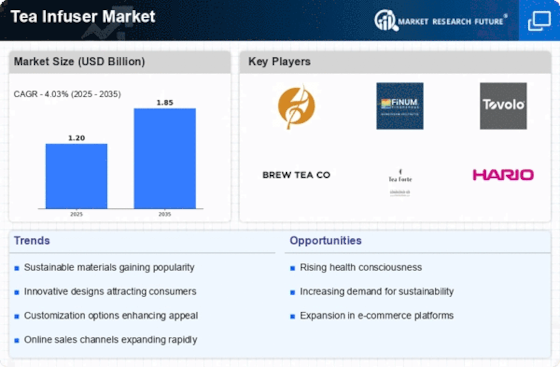
Key players in the Tea Infuser Market include Adagio Teas, Finum, Tovolo, and Tea Forte, among others.

What segment is expected to dominate the end-use category in the Tea Infuser Market?

The Household segment is expected to dominate the end-use category, projected to reach 1.1 USD Billion in 2025.

How does the performance of ceramic infusers compare to other types in 2025?

Ceramic infusers are projected to generate 0.18 USD Billion in 2025, which is lower than other types like Stainless Steel and Mesh infusers.

What distribution channels are anticipated to be most effective for tea infuser sales?

Supermarkets and online retail are anticipated to be the most effective distribution channels, with projected revenues of 0.54 USD Billion and 0.73 USD Billion respectively in 2025.

Market Summary

As per Market Research Future analysis, the Tea Infuser Market Size was estimated at 1.2 USD Billion in 2024. The Tea Infuser industry is projected to grow from USD 1.248 Billion in 2025 to USD 1.854 Billion by 2035, exhibiting a compound annual growth rate (CAGR) of 4.03% during the forecast period 2025 - 2035

Key Market Trends & Highlights

The Tea Infuser Market is experiencing a dynamic shift towards health-conscious and sustainable consumption patterns.

  • North America remains the largest market for tea infusers, driven by a growing appreciation for premium tea varieties.
  • The Asia-Pacific region is the fastest-growing market, reflecting an increasing tea culture and innovative product designs.
  • Mesh infusers dominate the market, while silicone infusers are rapidly gaining popularity due to their versatility and ease of use.
  • Rising demand for premium tea and increased awareness of health benefits are key drivers propelling market growth.

Market Size & Forecast

2024 Market Size 1.2 (USD Billion)
2035 Market Size 1.854 (USD Billion)
CAGR (2025 - 2035) 4.03%
Largest Regional Market Share in 2024 North America

Major Players

Adagio Teas (US), Finum (DE), Tovolo (US), Brew Tea Company (GB), Tea Forte (US), Hario (JP), Cuisinart (US), Zojirushi (JP), Bodum (DK)

Market Trends

The Tea Infuser Market is currently experiencing a notable evolution, driven by shifting consumer preferences towards healthier beverage options. As individuals increasingly seek to incorporate natural ingredients into their diets, the demand for tea infusers has surged. This trend is further supported by a growing awareness of the benefits associated with loose-leaf tea, which is perceived as a more flavorful and aromatic alternative to pre-packaged tea bags. Consequently, manufacturers are innovating their product lines to cater to this rising interest, introducing a variety of designs and materials that enhance the brewing experience. Moreover, sustainability has emerged as a pivotal factor influencing purchasing decisions within the Tea Infuser Market. Consumers are becoming more conscious of their environmental impact, prompting a shift towards eco-friendly materials and reusable products. This inclination towards sustainability is likely to shape future product development, as brands strive to align with consumer values. As the market continues to evolve, it appears that the intersection of health consciousness and environmental responsibility will play a crucial role in defining the trajectory of the Tea Infuser Market.

Health-Conscious Consumption

The Tea Infuser Market is witnessing a shift towards health-oriented choices, as consumers increasingly favor natural and organic products. This trend reflects a broader movement towards wellness, with individuals seeking beverages that offer health benefits, such as antioxidants and reduced caffeine levels.

Sustainability Focus

A growing emphasis on sustainability is evident within the Tea Infuser Market. Consumers are gravitating towards products made from eco-friendly materials, which aligns with their desire to minimize environmental impact. This trend is prompting manufacturers to innovate and offer reusable and biodegradable options.

Diverse Product Offerings

The Tea Infuser Market is characterized by a diversification of product designs and functionalities. Manufacturers are introducing a range of infusers that cater to various brewing preferences, including portable options for on-the-go consumers and aesthetically pleasing designs that enhance the overall tea experience.

Tea Infuser Market Market Drivers

Growth of Tea Culture

The Tea Infuser Market is benefiting from the burgeoning tea culture across various regions. As tea drinking becomes more ingrained in social practices and daily routines, the demand for tea infusers is likely to rise. This cultural shift is evident in the increasing number of tea houses and specialty shops that promote tea as a lifestyle choice. Furthermore, the rise of social media platforms has facilitated the sharing of tea-related content, further popularizing the use of tea infusers. The market data suggests that regions with a strong tea culture are witnessing a surge in sales of tea infusers, indicating a robust connection between cultural practices and market growth.

Innovations in Product Design

The Tea Infuser Market is witnessing a wave of innovations in product design, which is enhancing consumer experience. Manufacturers are introducing a variety of designs, materials, and functionalities to cater to diverse consumer preferences. For instance, silicone and stainless steel infusers are gaining popularity due to their durability and ease of use. Additionally, the integration of features such as built-in timers and adjustable brewing strengths is appealing to tech-savvy consumers. Market analysis indicates that innovative designs are likely to attract a broader audience, thereby expanding the customer base within the Tea Infuser Market. This trend suggests that companies focusing on design innovation may gain a competitive edge.

Rising Demand for Premium Tea

The Tea Infuser Market is experiencing a notable increase in demand for premium and specialty teas. Consumers are increasingly seeking high-quality tea options, which often require the use of infusers for optimal brewing. This trend is supported by data indicating that the specialty tea segment has been growing at a compound annual growth rate of approximately 10%. As consumers become more discerning about their tea choices, the need for effective brewing tools, such as tea infusers, becomes paramount. This shift towards premium tea consumption is likely to drive innovation and diversification within the Tea Infuser Market, as manufacturers strive to meet the evolving preferences of tea enthusiasts.

Increased Awareness of Health Benefits

The Tea Infuser Market is experiencing growth driven by heightened awareness of the health benefits associated with tea consumption. As consumers become more health-conscious, they are turning to tea as a natural alternative to sugary beverages. Research indicates that tea is rich in antioxidants and can contribute to overall well-being, which is influencing purchasing decisions. This trend is particularly evident among younger demographics who are actively seeking healthier lifestyle choices. Consequently, the demand for tea infusers is likely to rise as consumers look for convenient ways to prepare their favorite brews. The correlation between health awareness and tea consumption is expected to bolster the Tea Infuser Market.

Sustainability and Eco-Friendly Products

The Tea Infuser Market is increasingly influenced by the demand for sustainable and eco-friendly products. Consumers are becoming more environmentally conscious, prompting a shift towards products that minimize ecological impact. This trend is reflected in the growing popularity of reusable tea infusers made from sustainable materials. Market data suggests that eco-friendly products are gaining traction, with a significant portion of consumers willing to pay a premium for sustainable options. As manufacturers respond to this demand by developing environmentally friendly tea infusers, the market is likely to see a rise in sales. This focus on sustainability is expected to shape the future of the Tea Infuser Market.

Market Segment Insights

By Type: Mesh Infuser (Largest) vs. Silicone Infuser (Fastest-Growing)

<p>The Tea Infuser Market exhibits a diverse range of products segmented by type, with Mesh Infusers holding the largest market share. This classic choice for tea enthusiasts is favored for its affordability and general effectiveness in steeping loose leaf tea. Conversely, Silicone Infusers are quickly gaining traction amongst consumers seeking durability, versatility, and vibrant designs, making them the fastest-growing segment in the market.</p>

<p>Mesh Infuser (Dominant) vs. Silicone Infuser (Emerging)</p>

<p>Mesh Infusers are well-established, known for their fine mesh that allows optimal extraction of flavors while preventing tea leaves from escaping into the beverage. Their popularity stems from their ease of use and cleaning, making them a staple in many households. On the other hand, Silicone Infusers are emerging as a trendy alternative, appealing particularly to younger demographics. Their flexibility and unique designs not only enhance brewing convenience but also add a playful aspect to tea preparation. Both segments complement each other, with Mesh Infusers serving those who value tradition and Silicone Infusers attracting consumers looking for modern and fun tea experiences.</p>

By Material: Stainless Steel (Largest) vs. Silicone (Fastest-Growing)

<p>In the Tea Infuser Market, the material segment showcases a diverse range of options catering to different consumer preferences. Currently, stainless steel holds the largest market share due to its durability, aesthetic appeal, and superior heat retention properties. In contrast, silicone is emerging rapidly, driven by its flexibility, ease of cleaning, and vibrant colors, making it particularly appealing to a younger demographic seeking convenient and functional kitchen tools. The growth trends for the material segment of tea infusers indicate a shift towards lightweight and user-friendly options, with consumers increasingly opting for materials that offer both practicality and style. The rising health consciousness among consumers also bolsters the demand for stainless steel infusers that are non-toxic and efficient. As sustainability becomes a focal point, eco-friendly materials like silicone are gaining traction, contributing to a dynamic market landscape enriched by innovation in user experience and design.</p>

<p>Material: Stainless Steel (Dominant) vs. Silicone (Emerging)</p>

<p>Stainless steel is the dominant material in the tea infuser market, renowned for its exceptional durability and heat resistance. It appeals to a broad audience due to its classic look and resistance to rust and corrosion, making it a long-lasting choice for tea enthusiasts. Moreover, stainless steel infusers are often designed with fine mesh, allowing for optimal brewing while preventing tea leaves from escaping into the beverage. On the other hand, silicone stands out as an emerging choice, particularly among a younger demographic. Known for its vibrant colors and playful designs, silicone infusers are lightweight and easy to handle, enhancing the tea-making experience. They also present an eco-friendly alternative, being reusable and dishwasher-safe, thus aligning with the sustainability trends that are increasingly influencing consumer preferences in the kitchenware market.</p>

By Distribution Channel: Online Retail (Largest) vs. Supermarkets (Fastest-Growing)

<p>The distribution of the tea infuser market indicates a significant preference for online retail, which claims the largest share. This channel benefits from the convenience it offers consumers, allowing for a wide range of products to be accessed from the comfort of their homes. Online platforms frequently provide detailed product descriptions and customer reviews, enhancing the buying experience and leading to higher conversion rates. In contrast, supermarkets represent a fast-growing segment, appealing to consumers seeking immediate purchases without the waiting time associated with online orders. As consumers increasingly return to in-person shopping, supermarkets are capitalizing on trends in convenience and instant gratification.</p>

<p>Online Retail (Dominant) vs. Supermarkets (Emerging)</p>

<p>Online retail has established itself as the dominant distribution channel for tea infusers, primarily due to its extensive reach and the ability to offer a broad selection of brands and products. The flexibility of shopping from home and the capacity for price comparison have made online platforms a preferred choice for tech-savvy consumers. Meanwhile, supermarkets are emerging as an important channel driven by consumer habits that favor instant access to products. The physical presence of supermarkets allows for instant gratification, catering to those who prefer to examine products before purchase. As both channels grow, the competition focuses on improving customer experience, whether through online convenience or enhanced in-store displays.</p>

By End Use: Household (Largest) vs. Commercial (Fastest-Growing)

<p>In the Tea Infuser Market, the 'End Use' segment showcases a diverse distribution of market shares among households, commercial establishments, and event usages. Households represent the largest segment, driven by the rising trend of tea consumption among consumers who value convenience and quality in their tea brewing methods. The commercial segment is experiencing notable growth, as cafes and restaurants are increasingly adopting tea infusers to enhance their beverage offerings, catering to the evolving preferences of consumers for gourmet experiences.</p>

<p>Household (Dominant) vs. Commercial (Emerging)</p>

<p>The household end use segment is characterized by a stable demand for tea infusers as families seek efficient and flavorful brewing options. These products are often seen as essential kitchen tools, contributing to their dominance in the market. In contrast, the commercial segment is rapidly emerging, spurred by the growing number of tea-focused businesses and cafes that cater to health-conscious patrons. The surge in customization and the variety of tea options available through infusers are driving this segment's growth, indicating its potential to capture a significant share of the market in the coming years.</p>

Get more detailed insights about Tea Infuser Market Research Report - Global Forecast till 2035

Regional Insights

North America : Market Leader in Innovation

North America is the largest market for tea infusers, holding approximately 40% of the global market share. The region's growth is driven by increasing health consciousness among consumers, leading to a surge in tea consumption. Regulatory support for health and wellness products further catalyzes this trend, with initiatives promoting natural and organic products. The demand for innovative and user-friendly tea infusers is also on the rise, reflecting changing consumer preferences. The United States and Canada are the leading countries in this market, with key players like Adagio Teas, Tovolo, and Cuisinart dominating the landscape. The competitive environment is characterized by a mix of established brands and emerging startups, all vying for market share. The presence of major retailers and e-commerce platforms enhances product accessibility, further fueling market growth.

Europe : Emerging Market with Growth Potential

Europe is witnessing significant growth in the tea infuser market, accounting for approximately 30% of the global share. The increasing trend of tea consumption, particularly among younger demographics, is a key driver. Regulatory frameworks promoting sustainable and eco-friendly products are also influencing consumer choices, leading to a rise in demand for innovative tea infusers. Countries like Germany and the UK are at the forefront of this growth, showcasing a robust market potential. Germany and the United Kingdom are the leading countries in this region, with key players such as Finum and Brew Tea Company making substantial contributions. The competitive landscape is marked by a blend of local artisans and international brands, fostering innovation and variety. The presence of health-conscious consumers is pushing brands to develop products that align with wellness trends, enhancing market dynamics.

Asia-Pacific : Rapid Growth in Tea Consumption

Asia-Pacific is emerging as a significant player in the tea infuser market, holding around 25% of the global market share. The region's growth is primarily driven by the rising popularity of tea among younger consumers and the increasing availability of diverse tea varieties. Countries like Japan and China are leading this trend, supported by cultural practices that favor tea consumption. Regulatory initiatives promoting health and wellness are also contributing to market expansion. Japan and China are the dominant countries in this market, with key players like Hario and Zojirushi leading the charge. The competitive landscape is characterized by a mix of traditional and modern brands, catering to a wide range of consumer preferences. The growing trend of premium tea products is pushing brands to innovate, enhancing the overall market appeal and driving sales.

Middle East and Africa : Untapped Market with Potential

The Middle East and Africa region is an emerging market for tea infusers, currently holding about 5% of the global market share. The growth is driven by increasing tea consumption, particularly in countries like South Africa and Egypt, where tea is a staple beverage. The region's regulatory environment is gradually evolving to support health and wellness initiatives, which is expected to boost demand for tea infusers in the coming years. South Africa and Egypt are the leading countries in this market, with a growing number of local and international brands entering the space. The competitive landscape is still developing, with opportunities for innovation and product differentiation. As consumer awareness about the benefits of tea rises, the market for tea infusers is poised for significant growth, attracting both established players and new entrants.

Key Players and Competitive Insights

The Global Tea Infuser Market has witnessed significant growth due to the rising popularity of tea as a beverage, driven by a growing health consciousness among consumers. As tea consumption continues to rise globally, the demand for innovative and high-quality tea infusers has surged. In this competitive landscape, numerous players have emerged, offering a diverse range of products that appeal to various consumer preferences and lifestyles. Factors such as product design, material quality, ease of use, and sustainability are instrumental in shaping consumer choices within this market.Key players are strategically positioning themselves by enhancing their product offerings and adopting marketing strategies that resonate with targeted demographics, further intensifying competition. Teavana has carved a notable presence in the Global Tea Infuser Market, characterized by its commitment to quality and innovation. Known for its premium tea blends and stylish tea accessories, Teavana offers a range of tea infusers that appeal to a discerning audience. The brand's strengths lie in its ability to create a distinct and immersive tea experience for customers, effectively combining taste, aroma, and aesthetics.Additionally, Teavana leverages its retail presence to offer personalized customer interactions, further enhancing brand loyalty and awareness. The integration of digital platforms has also allowed Teavana to reach a broader audience, thus solidifying its position in the market. The brand's emphasis on quality and customer engagement stands as a hallmark of its competitive edge in the increasingly competitive tea infuser landscape. Finum has emerged as a formidable player in the Global Tea Infuser Market, known for its innovative designs and high-quality products.The company specializes in creating a variety of tea infusers that cater to the needs of tea enthusiasts, providing efficient brewing solutions. Finum’s strengths include a strong focus on functionality and durability, frequently introducing new products that align with evolving consumer preferences. Their offerings often incorporate eco-friendly materials, resonating well with the environmentally conscious consumer. In recent years, Finum has expanded its market presence through strategic partnerships and collaborations, enhancing its distribution capabilities while introducing new innovations to their product line.This proactive approach, coupled with a commitment to quality and sustainability, positions Finum favorably within the global market, allowing the company to maintain a competitive edge amid growing market dynamics.

Key Companies in the Tea Infuser Market include

Industry Developments

Recent developments in the Global Tea Infuser Market reveal a growing consumer demand for innovative and eco-friendly products. Companies like Teavana and Brew Tea Co have recently enhanced their product lines to include sustainable materials. In September 2023, Finum announced a new range of tea infusers targeting environmentally conscious consumers, driving interest and sales in that segment. Additionally, major players such as Bodum and Breville are focusing on advanced functionality and design, catering to both casual tea drinkers and enthusiasts.

Despite the competitive landscape, some mergers have influenced the market landscape; for example, Tupperware's acquisition of a smaller tea infuser startup earlier this year bolstered its position in this niche. Current valuations have seen companies like Adagio Teas and Tealyra reflecting substantial growth, attributed to rising health consciousness and the trend toward gourmet tea consumption. Over the past two years, the focus on quality and convenience has reshaped consumer preferences and retailers have adapted to this by expanding their offerings. Initiatives promoting tea's health benefits continue to drive the growth of the market, positioning companies favorably for future opportunities.

Future Outlook

Tea Infuser Market Future Outlook

The Tea Infuser Market is projected to grow at a 4.03% CAGR from 2025 to 2035, driven by increasing health consciousness and innovative product designs.

New opportunities lie in:

  • Expansion into eco-friendly materials for infusers
  • Development of smart tea infusers with app integration
  • Partnerships with health and wellness brands for co-marketing initiatives

By 2035, the market is expected to be robust, reflecting evolving consumer preferences and innovative product offerings.

Market Segmentation

Tea Infuser Market Type Outlook

  • Mesh Infuser
  • Silicone Infuser
  • Stainless Steel Infuser
  • Ceramic Infuser

Tea Infuser Market End Use Outlook

  • Household
  • Commercial
  • Events

Tea Infuser Market Material Outlook

  • Stainless Steel
  • Plastic
  • Silicone
  • Ceramic

Tea Infuser Market Distribution Channel Outlook

  • Online Retail
  • Supermarkets
  • Specialty Stores
  • Department Stores

Report Scope

MARKET SIZE 2024 1.2(USD Billion)
MARKET SIZE 2025 1.248(USD Billion)
MARKET SIZE 2035 1.854(USD Billion)
COMPOUND ANNUAL GROWTH RATE (CAGR) 4.03% (2025 - 2035)
REPORT COVERAGE Revenue Forecast, Competitive Landscape, Growth Factors, and Trends
BASE YEAR 2024
Market Forecast Period 2025 - 2035
Historical Data 2019 - 2024
Market Forecast Units USD Billion
Key Companies Profiled Adagio Teas (US), Finum (DE), Tovolo (US), Brew Tea Company (GB), Tea Forte (US), Hario (JP), Cuisinart (US), Zojirushi (JP), Bodum (DK)
Segments Covered Type, Material, Distribution Channel, End Use, Regional
Key Market Opportunities Growing consumer preference for sustainable materials in the Tea Infuser Market presents significant innovation opportunities.
Key Market Dynamics Rising consumer preference for sustainable materials drives innovation and competition in the tea infuser market.
Countries Covered North America, Europe, APAC, South America, MEA

FAQs

What is the current valuation of the Tea Infuser Market as of 2024?

<p>The Tea Infuser Market was valued at 1.2 USD Billion in 2024.</p>

What is the projected market size for the Tea Infuser Market in 2035?

The market is projected to reach 1.854 USD Billion by 2035.

What is the expected CAGR for the Tea Infuser Market during the forecast period 2025 - 2035?

The expected CAGR for the Tea Infuser Market during 2025 - 2035 is 4.03%.

Which type of tea infuser is expected to generate the highest revenue in 2025?

In 2025, the Stainless Steel Infuser is anticipated to generate the highest revenue, with a valuation of 0.72 USD Billion.

How do online retail channels perform in the Tea Infuser Market?

Online retail channels are projected to generate 0.73 USD Billion in 2025, indicating strong consumer preference for e-commerce.

What are the leading materials used in tea infusers, and how do they compare in market value?

Stainless Steel infusers lead the market with a valuation of 0.73 USD Billion, followed by Plastic at 0.36 USD Billion in 2025.

Which companies are considered key players in the Tea Infuser Market?

Key players in the Tea Infuser Market include Adagio Teas, Finum, Tovolo, and Tea Forte, among others.

What segment is expected to dominate the end-use category in the Tea Infuser Market?

The Household segment is expected to dominate the end-use category, projected to reach 1.1 USD Billion in 2025.

How does the performance of ceramic infusers compare to other types in 2025?

Ceramic infusers are projected to generate 0.18 USD Billion in 2025, which is lower than other types like Stainless Steel and Mesh infusers.

What distribution channels are anticipated to be most effective for tea infuser sales?

Supermarkets and online retail are anticipated to be the most effective distribution channels, with projected revenues of 0.54 USD Billion and 0.73 USD Billion respectively in 2025.

  1. SECTION I: EXECUTIVE SUMMARY AND KEY HIGHLIGHTS
    1. | 1.1 EXECUTIVE SUMMARY
    2. | | 1.1.1 Market Overview
    3. | | 1.1.2 Key Findings
    4. | | 1.1.3 Market Segmentation
    5. | | 1.1.4 Competitive Landscape
    6. | | 1.1.5 Challenges and Opportunities
    7. | | 1.1.6 Future Outlook
  2. SECTION II: SCOPING, METHODOLOGY AND MARKET STRUCTURE
    1. | 2.1 MARKET INTRODUCTION
    2. | | 2.1.1 Definition
    3. | | 2.1.2 Scope of the study
    4. | | | 2.1.2.1 Research Objective
    5. | | | 2.1.2.2 Assumption
    6. | | | 2.1.2.3 Limitations
    7. | 2.2 RESEARCH METHODOLOGY
    8. | | 2.2.1 Overview
    9. | | 2.2.2 Data Mining
    10. | | 2.2.3 Secondary Research
    11. | | 2.2.4 Primary Research
    12. | | | 2.2.4.1 Primary Interviews and Information Gathering Process
    13. | | | 2.2.4.2 Breakdown of Primary Respondents
    14. | | 2.2.5 Forecasting Model
    15. | | 2.2.6 Market Size Estimation
    16. | | | 2.2.6.1 Bottom-Up Approach
    17. | | | 2.2.6.2 Top-Down Approach
    18. | | 2.2.7 Data Triangulation
    19. | | 2.2.8 Validation
  3. SECTION III: QUALITATIVE ANALYSIS
    1. | 3.1 MARKET DYNAMICS
    2. | | 3.1.1 Overview
    3. | | 3.1.2 Drivers
    4. | | 3.1.3 Restraints
    5. | | 3.1.4 Opportunities
    6. | 3.2 MARKET FACTOR ANALYSIS
    7. | | 3.2.1 Value chain Analysis
    8. | | 3.2.2 Porter's Five Forces Analysis
    9. | | | 3.2.2.1 Bargaining Power of Suppliers
    10. | | | 3.2.2.2 Bargaining Power of Buyers
    11. | | | 3.2.2.3 Threat of New Entrants
    12. | | | 3.2.2.4 Threat of Substitutes
    13. | | | 3.2.2.5 Intensity of Rivalry
    14. | | 3.2.3 COVID-19 Impact Analysis
    15. | | | 3.2.3.1 Market Impact Analysis
    16. | | | 3.2.3.2 Regional Impact
    17. | | | 3.2.3.3 Opportunity and Threat Analysis
  4. SECTION IV: QUANTITATIVE ANALYSIS
    1. | 4.1 Consumer and Retail, BY Type (USD Billion)
    2. | | 4.1.1 Mesh Infuser
    3. | | 4.1.2 Silicone Infuser
    4. | | 4.1.3 Stainless Steel Infuser
    5. | | 4.1.4 Ceramic Infuser
    6. | 4.2 Consumer and Retail, BY Material (USD Billion)
    7. | | 4.2.1 Stainless Steel
    8. | | 4.2.2 Plastic
    9. | | 4.2.3 Silicone
    10. | | 4.2.4 Ceramic
    11. | 4.3 Consumer and Retail, BY Distribution Channel (USD Billion)
    12. | | 4.3.1 Online Retail
    13. | | 4.3.2 Supermarkets
    14. | | 4.3.3 Specialty Stores
    15. | | 4.3.4 Department Stores
    16. | 4.4 Consumer and Retail, BY End Use (USD Billion)
    17. | | 4.4.1 Household
    18. | | 4.4.2 Commercial
    19. | | 4.4.3 Events
    20. | 4.5 Consumer and Retail, BY Region (USD Billion)
    21. | | 4.5.1 North America
    22. | | | 4.5.1.1 US
    23. | | | 4.5.1.2 Canada
    24. | | 4.5.2 Europe
    25. | | | 4.5.2.1 Germany
    26. | | | 4.5.2.2 UK
    27. | | | 4.5.2.3 France
    28. | | | 4.5.2.4 Russia
    29. | | | 4.5.2.5 Italy
    30. | | | 4.5.2.6 Spain
    31. | | | 4.5.2.7 Rest of Europe
    32. | | 4.5.3 APAC
    33. | | | 4.5.3.1 China
    34. | | | 4.5.3.2 India
    35. | | | 4.5.3.3 Japan
    36. | | | 4.5.3.4 South Korea
    37. | | | 4.5.3.5 Malaysia
    38. | | | 4.5.3.6 Thailand
    39. | | | 4.5.3.7 Indonesia
    40. | | | 4.5.3.8 Rest of APAC
    41. | | 4.5.4 South America
    42. | | | 4.5.4.1 Brazil
    43. | | | 4.5.4.2 Mexico
    44. | | | 4.5.4.3 Argentina
    45. | | | 4.5.4.4 Rest of South America
    46. | | 4.5.5 MEA
    47. | | | 4.5.5.1 GCC Countries
    48. | | | 4.5.5.2 South Africa
    49. | | | 4.5.5.3 Rest of MEA
  5. SECTION V: COMPETITIVE ANALYSIS
    1. | 5.1 Competitive Landscape
    2. | | 5.1.1 Overview
    3. | | 5.1.2 Competitive Analysis
    4. | | 5.1.3 Market share Analysis
    5. | | 5.1.4 Major Growth Strategy in the Consumer and Retail
    6. | | 5.1.5 Competitive Benchmarking
    7. | | 5.1.6 Leading Players in Terms of Number of Developments in the Consumer and Retail
    8. | | 5.1.7 Key developments and growth strategies
    9. | | | 5.1.7.1 New Product Launch/Service Deployment
    10. | | | 5.1.7.2 Merger & Acquisitions
    11. | | | 5.1.7.3 Joint Ventures
    12. | | 5.1.8 Major Players Financial Matrix
    13. | | | 5.1.8.1 Sales and Operating Income
    14. | | | 5.1.8.2 Major Players R&D Expenditure. 2023
    15. | 5.2 Company Profiles
    16. | | 5.2.1 Adagio Teas (US)
    17. | | | 5.2.1.1 Financial Overview
    18. | | | 5.2.1.2 Products Offered
    19. | | | 5.2.1.3 Key Developments
    20. | | | 5.2.1.4 SWOT Analysis
    21. | | | 5.2.1.5 Key Strategies
    22. | | 5.2.2 Finum (DE)
    23. | | | 5.2.2.1 Financial Overview
    24. | | | 5.2.2.2 Products Offered
    25. | | | 5.2.2.3 Key Developments
    26. | | | 5.2.2.4 SWOT Analysis
    27. | | | 5.2.2.5 Key Strategies
    28. | | 5.2.3 Tovolo (US)
    29. | | | 5.2.3.1 Financial Overview
    30. | | | 5.2.3.2 Products Offered
    31. | | | 5.2.3.3 Key Developments
    32. | | | 5.2.3.4 SWOT Analysis
    33. | | | 5.2.3.5 Key Strategies
    34. | | 5.2.4 Brew Tea Company (GB)
    35. | | | 5.2.4.1 Financial Overview
    36. | | | 5.2.4.2 Products Offered
    37. | | | 5.2.4.3 Key Developments
    38. | | | 5.2.4.4 SWOT Analysis
    39. | | | 5.2.4.5 Key Strategies
    40. | | 5.2.5 Tea Forte (US)
    41. | | | 5.2.5.1 Financial Overview
    42. | | | 5.2.5.2 Products Offered
    43. | | | 5.2.5.3 Key Developments
    44. | | | 5.2.5.4 SWOT Analysis
    45. | | | 5.2.5.5 Key Strategies
    46. | | 5.2.6 Hario (JP)
    47. | | | 5.2.6.1 Financial Overview
    48. | | | 5.2.6.2 Products Offered
    49. | | | 5.2.6.3 Key Developments
    50. | | | 5.2.6.4 SWOT Analysis
    51. | | | 5.2.6.5 Key Strategies
    52. | | 5.2.7 Cuisinart (US)
    53. | | | 5.2.7.1 Financial Overview
    54. | | | 5.2.7.2 Products Offered
    55. | | | 5.2.7.3 Key Developments
    56. | | | 5.2.7.4 SWOT Analysis
    57. | | | 5.2.7.5 Key Strategies
    58. | | 5.2.8 Zojirushi (JP)
    59. | | | 5.2.8.1 Financial Overview
    60. | | | 5.2.8.2 Products Offered
    61. | | | 5.2.8.3 Key Developments
    62. | | | 5.2.8.4 SWOT Analysis
    63. | | | 5.2.8.5 Key Strategies
    64. | | 5.2.9 Bodum (DK)
    65. | | | 5.2.9.1 Financial Overview
    66. | | | 5.2.9.2 Products Offered
    67. | | | 5.2.9.3 Key Developments
    68. | | | 5.2.9.4 SWOT Analysis
    69. | | | 5.2.9.5 Key Strategies
    70. | 5.3 Appendix
    71. | | 5.3.1 References
    72. | | 5.3.2 Related Reports
  6. LIST OF FIGURES
    1. | 6.1 MARKET SYNOPSIS
    2. | 6.2 NORTH AMERICA MARKET ANALYSIS
    3. | 6.3 US MARKET ANALYSIS BY TYPE
    4. | 6.4 US MARKET ANALYSIS BY MATERIAL
    5. | 6.5 US MARKET ANALYSIS BY DISTRIBUTION CHANNEL
    6. | 6.6 US MARKET ANALYSIS BY END USE
    7. | 6.7 CANADA MARKET ANALYSIS BY TYPE
    8. | 6.8 CANADA MARKET ANALYSIS BY MATERIAL
    9. | 6.9 CANADA MARKET ANALYSIS BY DISTRIBUTION CHANNEL
    10. | 6.10 CANADA MARKET ANALYSIS BY END USE
    11. | 6.11 EUROPE MARKET ANALYSIS
    12. | 6.12 GERMANY MARKET ANALYSIS BY TYPE
    13. | 6.13 GERMANY MARKET ANALYSIS BY MATERIAL
    14. | 6.14 GERMANY MARKET ANALYSIS BY DISTRIBUTION CHANNEL
    15. | 6.15 GERMANY MARKET ANALYSIS BY END USE
    16. | 6.16 UK MARKET ANALYSIS BY TYPE
    17. | 6.17 UK MARKET ANALYSIS BY MATERIAL
    18. | 6.18 UK MARKET ANALYSIS BY DISTRIBUTION CHANNEL
    19. | 6.19 UK MARKET ANALYSIS BY END USE
    20. | 6.20 FRANCE MARKET ANALYSIS BY TYPE
    21. | 6.21 FRANCE MARKET ANALYSIS BY MATERIAL
    22. | 6.22 FRANCE MARKET ANALYSIS BY DISTRIBUTION CHANNEL
    23. | 6.23 FRANCE MARKET ANALYSIS BY END USE
    24. | 6.24 RUSSIA MARKET ANALYSIS BY TYPE
    25. | 6.25 RUSSIA MARKET ANALYSIS BY MATERIAL
    26. | 6.26 RUSSIA MARKET ANALYSIS BY DISTRIBUTION CHANNEL
    27. | 6.27 RUSSIA MARKET ANALYSIS BY END USE
    28. | 6.28 ITALY MARKET ANALYSIS BY TYPE
    29. | 6.29 ITALY MARKET ANALYSIS BY MATERIAL
    30. | 6.30 ITALY MARKET ANALYSIS BY DISTRIBUTION CHANNEL
    31. | 6.31 ITALY MARKET ANALYSIS BY END USE
    32. | 6.32 SPAIN MARKET ANALYSIS BY TYPE
    33. | 6.33 SPAIN MARKET ANALYSIS BY MATERIAL
    34. | 6.34 SPAIN MARKET ANALYSIS BY DISTRIBUTION CHANNEL
    35. | 6.35 SPAIN MARKET ANALYSIS BY END USE
    36. | 6.36 REST OF EUROPE MARKET ANALYSIS BY TYPE
    37. | 6.37 REST OF EUROPE MARKET ANALYSIS BY MATERIAL
    38. | 6.38 REST OF EUROPE MARKET ANALYSIS BY DISTRIBUTION CHANNEL
    39. | 6.39 REST OF EUROPE MARKET ANALYSIS BY END USE
    40. | 6.40 APAC MARKET ANALYSIS
    41. | 6.41 CHINA MARKET ANALYSIS BY TYPE
    42. | 6.42 CHINA MARKET ANALYSIS BY MATERIAL
    43. | 6.43 CHINA MARKET ANALYSIS BY DISTRIBUTION CHANNEL
    44. | 6.44 CHINA MARKET ANALYSIS BY END USE
    45. | 6.45 INDIA MARKET ANALYSIS BY TYPE
    46. | 6.46 INDIA MARKET ANALYSIS BY MATERIAL
    47. | 6.47 INDIA MARKET ANALYSIS BY DISTRIBUTION CHANNEL
    48. | 6.48 INDIA MARKET ANALYSIS BY END USE
    49. | 6.49 JAPAN MARKET ANALYSIS BY TYPE
    50. | 6.50 JAPAN MARKET ANALYSIS BY MATERIAL
    51. | 6.51 JAPAN MARKET ANALYSIS BY DISTRIBUTION CHANNEL
    52. | 6.52 JAPAN MARKET ANALYSIS BY END USE
    53. | 6.53 SOUTH KOREA MARKET ANALYSIS BY TYPE
    54. | 6.54 SOUTH KOREA MARKET ANALYSIS BY MATERIAL
    55. | 6.55 SOUTH KOREA MARKET ANALYSIS BY DISTRIBUTION CHANNEL
    56. | 6.56 SOUTH KOREA MARKET ANALYSIS BY END USE
    57. | 6.57 MALAYSIA MARKET ANALYSIS BY TYPE
    58. | 6.58 MALAYSIA MARKET ANALYSIS BY MATERIAL
    59. | 6.59 MALAYSIA MARKET ANALYSIS BY DISTRIBUTION CHANNEL
    60. | 6.60 MALAYSIA MARKET ANALYSIS BY END USE
    61. | 6.61 THAILAND MARKET ANALYSIS BY TYPE
    62. | 6.62 THAILAND MARKET ANALYSIS BY MATERIAL
    63. | 6.63 THAILAND MARKET ANALYSIS BY DISTRIBUTION CHANNEL
    64. | 6.64 THAILAND MARKET ANALYSIS BY END USE
    65. | 6.65 INDONESIA MARKET ANALYSIS BY TYPE
    66. | 6.66 INDONESIA MARKET ANALYSIS BY MATERIAL
    67. | 6.67 INDONESIA MARKET ANALYSIS BY DISTRIBUTION CHANNEL
    68. | 6.68 INDONESIA MARKET ANALYSIS BY END USE
    69. | 6.69 REST OF APAC MARKET ANALYSIS BY TYPE
    70. | 6.70 REST OF APAC MARKET ANALYSIS BY MATERIAL
    71. | 6.71 REST OF APAC MARKET ANALYSIS BY DISTRIBUTION CHANNEL
    72. | 6.72 REST OF APAC MARKET ANALYSIS BY END USE
    73. | 6.73 SOUTH AMERICA MARKET ANALYSIS
    74. | 6.74 BRAZIL MARKET ANALYSIS BY TYPE
    75. | 6.75 BRAZIL MARKET ANALYSIS BY MATERIAL
    76. | 6.76 BRAZIL MARKET ANALYSIS BY DISTRIBUTION CHANNEL
    77. | 6.77 BRAZIL MARKET ANALYSIS BY END USE
    78. | 6.78 MEXICO MARKET ANALYSIS BY TYPE
    79. | 6.79 MEXICO MARKET ANALYSIS BY MATERIAL
    80. | 6.80 MEXICO MARKET ANALYSIS BY DISTRIBUTION CHANNEL
    81. | 6.81 MEXICO MARKET ANALYSIS BY END USE
    82. | 6.82 ARGENTINA MARKET ANALYSIS BY TYPE
    83. | 6.83 ARGENTINA MARKET ANALYSIS BY MATERIAL
    84. | 6.84 ARGENTINA MARKET ANALYSIS BY DISTRIBUTION CHANNEL
    85. | 6.85 ARGENTINA MARKET ANALYSIS BY END USE
    86. | 6.86 REST OF SOUTH AMERICA MARKET ANALYSIS BY TYPE
    87. | 6.87 REST OF SOUTH AMERICA MARKET ANALYSIS BY MATERIAL
    88. | 6.88 REST OF SOUTH AMERICA MARKET ANALYSIS BY DISTRIBUTION CHANNEL
    89. | 6.89 REST OF SOUTH AMERICA MARKET ANALYSIS BY END USE
    90. | 6.90 MEA MARKET ANALYSIS
    91. | 6.91 GCC COUNTRIES MARKET ANALYSIS BY TYPE
    92. | 6.92 GCC COUNTRIES MARKET ANALYSIS BY MATERIAL
    93. | 6.93 GCC COUNTRIES MARKET ANALYSIS BY DISTRIBUTION CHANNEL
    94. | 6.94 GCC COUNTRIES MARKET ANALYSIS BY END USE
    95. | 6.95 SOUTH AFRICA MARKET ANALYSIS BY TYPE
    96. | 6.96 SOUTH AFRICA MARKET ANALYSIS BY MATERIAL
    97. | 6.97 SOUTH AFRICA MARKET ANALYSIS BY DISTRIBUTION CHANNEL
    98. | 6.98 SOUTH AFRICA MARKET ANALYSIS BY END USE
    99. | 6.99 REST OF MEA MARKET ANALYSIS BY TYPE
    100. | 6.100 REST OF MEA MARKET ANALYSIS BY MATERIAL
    101. | 6.101 REST OF MEA MARKET ANALYSIS BY DISTRIBUTION CHANNEL
    102. | 6.102 REST OF MEA MARKET ANALYSIS BY END USE
    103. | 6.103 KEY BUYING CRITERIA OF CONSUMER AND RETAIL
    104. | 6.104 RESEARCH PROCESS OF MRFR
    105. | 6.105 DRO ANALYSIS OF CONSUMER AND RETAIL
    106. | 6.106 DRIVERS IMPACT ANALYSIS: CONSUMER AND RETAIL
    107. | 6.107 RESTRAINTS IMPACT ANALYSIS: CONSUMER AND RETAIL
    108. | 6.108 SUPPLY / VALUE CHAIN: CONSUMER AND RETAIL
    109. | 6.109 CONSUMER AND RETAIL, BY TYPE, 2024 (% SHARE)
    110. | 6.110 CONSUMER AND RETAIL, BY TYPE, 2024 TO 2035 (USD Billion)
    111. | 6.111 CONSUMER AND RETAIL, BY MATERIAL, 2024 (% SHARE)
    112. | 6.112 CONSUMER AND RETAIL, BY MATERIAL, 2024 TO 2035 (USD Billion)
    113. | 6.113 CONSUMER AND RETAIL, BY DISTRIBUTION CHANNEL, 2024 (% SHARE)
    114. | 6.114 CONSUMER AND RETAIL, BY DISTRIBUTION CHANNEL, 2024 TO 2035 (USD Billion)
    115. | 6.115 CONSUMER AND RETAIL, BY END USE, 2024 (% SHARE)
    116. | 6.116 CONSUMER AND RETAIL, BY END USE, 2024 TO 2035 (USD Billion)
    117. | 6.117 BENCHMARKING OF MAJOR COMPETITORS
  7. LIST OF TABLES
    1. | 7.1 LIST OF ASSUMPTIONS
    2. | | 7.1.1
    3. | 7.2 North America MARKET SIZE ESTIMATES; FORECAST
    4. | | 7.2.1 BY TYPE, 2025-2035 (USD Billion)
    5. | | 7.2.2 BY MATERIAL, 2025-2035 (USD Billion)
    6. | | 7.2.3 BY DISTRIBUTION CHANNEL, 2025-2035 (USD Billion)
    7. | | 7.2.4 BY END USE, 2025-2035 (USD Billion)
    8. | 7.3 US MARKET SIZE ESTIMATES; FORECAST
    9. | | 7.3.1 BY TYPE, 2025-2035 (USD Billion)
    10. | | 7.3.2 BY MATERIAL, 2025-2035 (USD Billion)
    11. | | 7.3.3 BY DISTRIBUTION CHANNEL, 2025-2035 (USD Billion)
    12. | | 7.3.4 BY END USE, 2025-2035 (USD Billion)
    13. | 7.4 Canada MARKET SIZE ESTIMATES; FORECAST
    14. | | 7.4.1 BY TYPE, 2025-2035 (USD Billion)
    15. | | 7.4.2 BY MATERIAL, 2025-2035 (USD Billion)
    16. | | 7.4.3 BY DISTRIBUTION CHANNEL, 2025-2035 (USD Billion)
    17. | | 7.4.4 BY END USE, 2025-2035 (USD Billion)
    18. | 7.5 Europe MARKET SIZE ESTIMATES; FORECAST
    19. | | 7.5.1 BY TYPE, 2025-2035 (USD Billion)
    20. | | 7.5.2 BY MATERIAL, 2025-2035 (USD Billion)
    21. | | 7.5.3 BY DISTRIBUTION CHANNEL, 2025-2035 (USD Billion)
    22. | | 7.5.4 BY END USE, 2025-2035 (USD Billion)
    23. | 7.6 Germany MARKET SIZE ESTIMATES; FORECAST
    24. | | 7.6.1 BY TYPE, 2025-2035 (USD Billion)
    25. | | 7.6.2 BY MATERIAL, 2025-2035 (USD Billion)
    26. | | 7.6.3 BY DISTRIBUTION CHANNEL, 2025-2035 (USD Billion)
    27. | | 7.6.4 BY END USE, 2025-2035 (USD Billion)
    28. | 7.7 UK MARKET SIZE ESTIMATES; FORECAST
    29. | | 7.7.1 BY TYPE, 2025-2035 (USD Billion)
    30. | | 7.7.2 BY MATERIAL, 2025-2035 (USD Billion)
    31. | | 7.7.3 BY DISTRIBUTION CHANNEL, 2025-2035 (USD Billion)
    32. | | 7.7.4 BY END USE, 2025-2035 (USD Billion)
    33. | 7.8 France MARKET SIZE ESTIMATES; FORECAST
    34. | | 7.8.1 BY TYPE, 2025-2035 (USD Billion)
    35. | | 7.8.2 BY MATERIAL, 2025-2035 (USD Billion)
    36. | | 7.8.3 BY DISTRIBUTION CHANNEL, 2025-2035 (USD Billion)
    37. | | 7.8.4 BY END USE, 2025-2035 (USD Billion)
    38. | 7.9 Russia MARKET SIZE ESTIMATES; FORECAST
    39. | | 7.9.1 BY TYPE, 2025-2035 (USD Billion)
    40. | | 7.9.2 BY MATERIAL, 2025-2035 (USD Billion)
    41. | | 7.9.3 BY DISTRIBUTION CHANNEL, 2025-2035 (USD Billion)
    42. | | 7.9.4 BY END USE, 2025-2035 (USD Billion)
    43. | 7.10 Italy MARKET SIZE ESTIMATES; FORECAST
    44. | | 7.10.1 BY TYPE, 2025-2035 (USD Billion)
    45. | | 7.10.2 BY MATERIAL, 2025-2035 (USD Billion)
    46. | | 7.10.3 BY DISTRIBUTION CHANNEL, 2025-2035 (USD Billion)
    47. | | 7.10.4 BY END USE, 2025-2035 (USD Billion)
    48. | 7.11 Spain MARKET SIZE ESTIMATES; FORECAST
    49. | | 7.11.1 BY TYPE, 2025-2035 (USD Billion)
    50. | | 7.11.2 BY MATERIAL, 2025-2035 (USD Billion)
    51. | | 7.11.3 BY DISTRIBUTION CHANNEL, 2025-2035 (USD Billion)
    52. | | 7.11.4 BY END USE, 2025-2035 (USD Billion)
    53. | 7.12 Rest of Europe MARKET SIZE ESTIMATES; FORECAST
    54. | | 7.12.1 BY TYPE, 2025-2035 (USD Billion)
    55. | | 7.12.2 BY MATERIAL, 2025-2035 (USD Billion)
    56. | | 7.12.3 BY DISTRIBUTION CHANNEL, 2025-2035 (USD Billion)
    57. | | 7.12.4 BY END USE, 2025-2035 (USD Billion)
    58. | 7.13 APAC MARKET SIZE ESTIMATES; FORECAST
    59. | | 7.13.1 BY TYPE, 2025-2035 (USD Billion)
    60. | | 7.13.2 BY MATERIAL, 2025-2035 (USD Billion)
    61. | | 7.13.3 BY DISTRIBUTION CHANNEL, 2025-2035 (USD Billion)
    62. | | 7.13.4 BY END USE, 2025-2035 (USD Billion)
    63. | 7.14 China MARKET SIZE ESTIMATES; FORECAST
    64. | | 7.14.1 BY TYPE, 2025-2035 (USD Billion)
    65. | | 7.14.2 BY MATERIAL, 2025-2035 (USD Billion)
    66. | | 7.14.3 BY DISTRIBUTION CHANNEL, 2025-2035 (USD Billion)
    67. | | 7.14.4 BY END USE, 2025-2035 (USD Billion)
    68. | 7.15 India MARKET SIZE ESTIMATES; FORECAST
    69. | | 7.15.1 BY TYPE, 2025-2035 (USD Billion)
    70. | | 7.15.2 BY MATERIAL, 2025-2035 (USD Billion)
    71. | | 7.15.3 BY DISTRIBUTION CHANNEL, 2025-2035 (USD Billion)
    72. | | 7.15.4 BY END USE, 2025-2035 (USD Billion)
    73. | 7.16 Japan MARKET SIZE ESTIMATES; FORECAST
    74. | | 7.16.1 BY TYPE, 2025-2035 (USD Billion)
    75. | | 7.16.2 BY MATERIAL, 2025-2035 (USD Billion)
    76. | | 7.16.3 BY DISTRIBUTION CHANNEL, 2025-2035 (USD Billion)
    77. | | 7.16.4 BY END USE, 2025-2035 (USD Billion)
    78. | 7.17 South Korea MARKET SIZE ESTIMATES; FORECAST
    79. | | 7.17.1 BY TYPE, 2025-2035 (USD Billion)
    80. | | 7.17.2 BY MATERIAL, 2025-2035 (USD Billion)
    81. | | 7.17.3 BY DISTRIBUTION CHANNEL, 2025-2035 (USD Billion)
    82. | | 7.17.4 BY END USE, 2025-2035 (USD Billion)
    83. | 7.18 Malaysia MARKET SIZE ESTIMATES; FORECAST
    84. | | 7.18.1 BY TYPE, 2025-2035 (USD Billion)
    85. | | 7.18.2 BY MATERIAL, 2025-2035 (USD Billion)
    86. | | 7.18.3 BY DISTRIBUTION CHANNEL, 2025-2035 (USD Billion)
    87. | | 7.18.4 BY END USE, 2025-2035 (USD Billion)
    88. | 7.19 Thailand MARKET SIZE ESTIMATES; FORECAST
    89. | | 7.19.1 BY TYPE, 2025-2035 (USD Billion)
    90. | | 7.19.2 BY MATERIAL, 2025-2035 (USD Billion)
    91. | | 7.19.3 BY DISTRIBUTION CHANNEL, 2025-2035 (USD Billion)
    92. | | 7.19.4 BY END USE, 2025-2035 (USD Billion)
    93. | 7.20 Indonesia MARKET SIZE ESTIMATES; FORECAST
    94. | | 7.20.1 BY TYPE, 2025-2035 (USD Billion)
    95. | | 7.20.2 BY MATERIAL, 2025-2035 (USD Billion)
    96. | | 7.20.3 BY DISTRIBUTION CHANNEL, 2025-2035 (USD Billion)
    97. | | 7.20.4 BY END USE, 2025-2035 (USD Billion)
    98. | 7.21 Rest of APAC MARKET SIZE ESTIMATES; FORECAST
    99. | | 7.21.1 BY TYPE, 2025-2035 (USD Billion)
    100. | | 7.21.2 BY MATERIAL, 2025-2035 (USD Billion)
    101. | | 7.21.3 BY DISTRIBUTION CHANNEL, 2025-2035 (USD Billion)
    102. | | 7.21.4 BY END USE, 2025-2035 (USD Billion)
    103. | 7.22 South America MARKET SIZE ESTIMATES; FORECAST
    104. | | 7.22.1 BY TYPE, 2025-2035 (USD Billion)
    105. | | 7.22.2 BY MATERIAL, 2025-2035 (USD Billion)
    106. | | 7.22.3 BY DISTRIBUTION CHANNEL, 2025-2035 (USD Billion)
    107. | | 7.22.4 BY END USE, 2025-2035 (USD Billion)
    108. | 7.23 Brazil MARKET SIZE ESTIMATES; FORECAST
    109. | | 7.23.1 BY TYPE, 2025-2035 (USD Billion)
    110. | | 7.23.2 BY MATERIAL, 2025-2035 (USD Billion)
    111. | | 7.23.3 BY DISTRIBUTION CHANNEL, 2025-2035 (USD Billion)
    112. | | 7.23.4 BY END USE, 2025-2035 (USD Billion)
    113. | 7.24 Mexico MARKET SIZE ESTIMATES; FORECAST
    114. | | 7.24.1 BY TYPE, 2025-2035 (USD Billion)
    115. | | 7.24.2 BY MATERIAL, 2025-2035 (USD Billion)
    116. | | 7.24.3 BY DISTRIBUTION CHANNEL, 2025-2035 (USD Billion)
    117. | | 7.24.4 BY END USE, 2025-2035 (USD Billion)
    118. | 7.25 Argentina MARKET SIZE ESTIMATES; FORECAST
    119. | | 7.25.1 BY TYPE, 2025-2035 (USD Billion)
    120. | | 7.25.2 BY MATERIAL, 2025-2035 (USD Billion)
    121. | | 7.25.3 BY DISTRIBUTION CHANNEL, 2025-2035 (USD Billion)
    122. | | 7.25.4 BY END USE, 2025-2035 (USD Billion)
    123. | 7.26 Rest of South America MARKET SIZE ESTIMATES; FORECAST
    124. | | 7.26.1 BY TYPE, 2025-2035 (USD Billion)
    125. | | 7.26.2 BY MATERIAL, 2025-2035 (USD Billion)
    126. | | 7.26.3 BY DISTRIBUTION CHANNEL, 2025-2035 (USD Billion)
    127. | | 7.26.4 BY END USE, 2025-2035 (USD Billion)
    128. | 7.27 MEA MARKET SIZE ESTIMATES; FORECAST
    129. | | 7.27.1 BY TYPE, 2025-2035 (USD Billion)
    130. | | 7.27.2 BY MATERIAL, 2025-2035 (USD Billion)
    131. | | 7.27.3 BY DISTRIBUTION CHANNEL, 2025-2035 (USD Billion)
    132. | | 7.27.4 BY END USE, 2025-2035 (USD Billion)
    133. | 7.28 GCC Countries MARKET SIZE ESTIMATES; FORECAST
    134. | | 7.28.1 BY TYPE, 2025-2035 (USD Billion)
    135. | | 7.28.2 BY MATERIAL, 2025-2035 (USD Billion)
    136. | | 7.28.3 BY DISTRIBUTION CHANNEL, 2025-2035 (USD Billion)
    137. | | 7.28.4 BY END USE, 2025-2035 (USD Billion)
    138. | 7.29 South Africa MARKET SIZE ESTIMATES; FORECAST
    139. | | 7.29.1 BY TYPE, 2025-2035 (USD Billion)
    140. | | 7.29.2 BY MATERIAL, 2025-2035 (USD Billion)
    141. | | 7.29.3 BY DISTRIBUTION CHANNEL, 2025-2035 (USD Billion)
    142. | | 7.29.4 BY END USE, 2025-2035 (USD Billion)
    143. | 7.30 Rest of MEA MARKET SIZE ESTIMATES; FORECAST
    144. | | 7.30.1 BY TYPE, 2025-2035 (USD Billion)
    145. | | 7.30.2 BY MATERIAL, 2025-2035 (USD Billion)
    146. | | 7.30.3 BY DISTRIBUTION CHANNEL, 2025-2035 (USD Billion)
    147. | | 7.30.4 BY END USE, 2025-2035 (USD Billion)
    148. | 7.31 PRODUCT LAUNCH/PRODUCT DEVELOPMENT/APPROVAL
    149. | | 7.31.1
    150. | 7.32 ACQUISITION/PARTNERSHIP
    151. | | 7.32.1

Consumer and Retail Market Segmentation

Consumer and Retail By Type (USD Billion, 2025-2035)

  • Mesh Infuser
  • Silicone Infuser
  • Stainless Steel Infuser
  • Ceramic Infuser

Consumer and Retail By Material (USD Billion, 2025-2035)

  • Stainless Steel
  • Plastic
  • Silicone
  • Ceramic

Consumer and Retail By Distribution Channel (USD Billion, 2025-2035)

  • Online Retail
  • Supermarkets
  • Specialty Stores
  • Department Stores

Consumer and Retail By End Use (USD Billion, 2025-2035)

  • Household
  • Commercial
  • Events
Infographic

Free Sample Request

Kindly complete the form below to receive a free sample of this Report

Get Free Sample

Customer Strories

Compare Licence

×
Features License Type
Single User Multiuser License Enterprise User
Price $4,950 $5,950 $7,250
Maximum User Access Limit 1 User Upto 10 Users Unrestricted Access Throughout the Organization
Free Customization
Direct Access to Analyst
Deliverable Format
Platform Access
Discount on Next Purchase 10% 15% 15%
Printable Versions