×
  • Cat-intel
  • MedIntelliX
  • Resources
  • About Us
  • Hero Background
    English
    Chinese
    French
    Japanese
    Korean
    German
    Spanish

    Targeted Liposomes Drug Delivery Market Analysis

    ID: MRFR/Pharma/7284-HCR
    90 Pages
    Kinjoll Dey
    October 2025

    Targeted Liposomes Drug Delivery Market By Type (Liposomal Doxorubicin, Liposomal Paclitaxel, Liposomal Amphotericin B and others), Application (Fungal Infection Therapy, Cancer Therapy, and others) and Region (Americas, Europe, Asia-Pacific, and the Middle East & Africa) - Forecast to 2035

    Share:
    Download PDF ×

    We do not share your information with anyone. However, we may send you emails based on your report interest from time to time. You may contact us at any time to opt-out.

    Targeted Liposomes Drug Delivery Market Infographic
    Purchase Options

    Market Analysis

    In-depth Analysis of Targeted Liposomes Drug Delivery Market Industry Landscape

    Due to need for effective and tailored drug delivery methods, the targeted liposomes drug delivery market is growing. The pharmaceutical industry is interested in liposomes, lipid-based vesicles that carry medicinal substances and target particular cells or organs. Personalized medicine relies on targeted liposomes for customized therapy. Understanding individual medication reactions drives the need for customized drug delivery methods that improve effectiveness and reduce adverse effects, driving market dynamics. Nanotechnology has transformed medicine delivery, and tailored liposomes are leading the way. Drug encapsulation, stability, and controlled release are being improved in liposomal formulations via continual research and development, increasing therapeutic effects. Cancer therapy accounts for most of the targeted liposome medication delivery industry. Liposomes may accumulate in tumor tissues via passive or active targeting, making them a potential technique for delivering anticancer medications directly to cancer cells without harming healthy tissues. Rising rates of chronic illnesses including cardiovascular and neurological problems affect market dynamics beyond cancer. Targeted liposomes may distribute medications to afflicted locations, improving therapeutic results and lowering systemic adverse effects. Pharmaceutical, research, and technology businesses are collaborating more in the market. These partnerships attempt to use liposomal drug delivery knowledge to create unique, economically viable pharmaceuticals. Developing and selling targeted liposomal medication delivery systems is regulated. Regulatory approvals affect market dynamics, with firms aiming to achieve safety and effectiveness requirements for market access and product uptake. Targeted liposomes have potential drug loading, stability, and scalability, but they still face hurdles. Market competitors must overcome these formulation challenges to produce dependable and consistent goods and broaden market acceptability. Targeted liposome demand is rising worldwide, affecting market dynamics. With rising healthcare infrastructure expenditures and understanding of sophisticated medication delivery technologies, emerging nations are becoming industry leaders. Technology like imaging and diagnostic tools in liposomal formulations is changing the industry. These developments help create theranostic platforms, which enable simultaneous diagnosis and therapy, a growing healthcare trend. Market dynamics are evolving toward patient-centricity and treatment experience improvement. Targeted liposomes allow medication distribution to be customized, making treatments more accurate and effective while reducing side effects. Targeted liposome drug delivery is developing due to research, technical advances, and disease mechanism knowledge. Collaborations, regulatory compliance, and medication formulation advances will shape the industry as it develops. Finally, the targeted liposomes medication delivery industry is promising and might change medicine.


    Author
    Kinjoll Dey
    Research Analyst Level I

    He is an extremely curious individual currently working in Healthcare and Medical Devices Domain. Kinjoll is comfortably versed in data centric research backed by healthcare educational background. He leverages extensive data mining and analytics tools such as Primary and Secondary Research, Statistical Analysis, Machine Learning, Data Modelling. His key role also involves Technical Sales Support, Client Interaction and Project management within the Healthcare team. Lastly, he showcases extensive affinity towards learning new skills and remain fascinated in implementing them.

    Leave a Comment

    FAQs

    What is the estimated market value of the global targeted liposomes drug delivery market?

    Global targeted liposomes drug delivery market is expected to record a substantial market valuation of USD 4.92 Billion by 2032.

    What is the projected growth rate of the global targeted liposomes drug delivery market?

    Global targeted liposomes drug delivery market is projected to register a moderate 7.97% CAGR in the forecast period.

    Which type segment is expected to witness the highest growth?

    The Liposomal Doxorubicin segment is touted to observe substantial demand over the review period.

    What is the application segment of the global targeted liposomes drug delivery market expected to witness the highest growth?

    The fungal infection therapy segment is slated to mature as the fastest-growing segment.

    Who are the significant players operative in the global targeted liposomes drug delivery market?

    A few eminent market players functioning in the global targeted liposomes drug delivery market are Baxter (US), Lonza (Switzerland), Evonik (Germany), among others.

    Market Summary

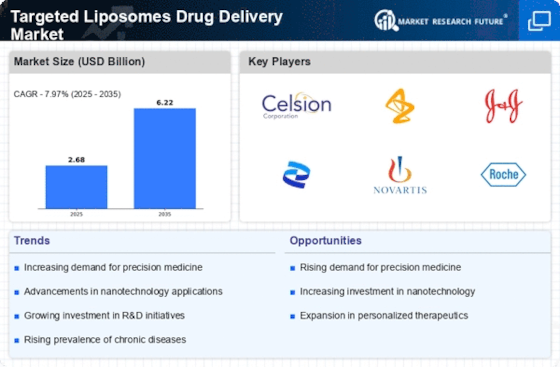
    As per MRFR analysis, the Targeted Liposomes Drug Delivery Market was estimated at 2.678 USD Billion in 2024. The Targeted Liposomes Drug Delivery industry is projected to grow from 2.891 USD Billion in 2025 to 6.224 USD Billion by 2035, exhibiting a compound annual growth rate (CAGR) of 7.97 during the forecast period 2025 - 2035.

    Key Market Trends & Highlights

    The Targeted Liposomes Drug Delivery Market is poised for substantial growth driven by technological advancements and increasing demand for personalized medicine.

    • North America remains the largest market for targeted liposomes, driven by robust pharmaceutical R&D and regulatory support.
    • The Asia-Pacific region is emerging as the fastest-growing market, fueled by rising healthcare investments and increasing disease prevalence.
    • Liposomal Doxorubicin continues to dominate the market, while Liposomal Paclitaxel is experiencing rapid growth due to its application in cancer therapy.
    • Key market drivers include the rising prevalence of chronic diseases and the growing demand for personalized medicine, which are shaping the future of drug delivery systems.

    Market Size & Forecast

    2024 Market Size 2.678 (USD Billion)
    2035 Market Size 6.224 (USD Billion)
    CAGR (2025 - 2035) 7.97%
    Largest Regional Market Share in 2024 Americas

    Major Players

    <p>Celsion Corporation (US), AstraZeneca (GB), Johnson & Johnson (US), Pfizer Inc. (US), Novartis AG (CH), Roche Holding AG (CH), Bristol-Myers Squibb Company (US), Merck & Co., Inc. (US), Amgen Inc. (US)</p>

    Market Trends

    The Targeted Liposomes Drug Delivery Market is currently experiencing a transformative phase, characterized by advancements in nanotechnology and a growing emphasis on precision medicine. This market appears to be driven by the increasing demand for effective therapeutic solutions that minimize side effects while maximizing drug efficacy. The integration of targeted delivery systems into existing treatment protocols suggests a shift towards more personalized healthcare approaches. Furthermore, the rising prevalence of chronic diseases necessitates innovative drug delivery methods, which may enhance patient compliance and overall treatment outcomes. In addition, the ongoing research and development efforts in the pharmaceutical sector indicate a robust pipeline of novel liposomal formulations. These formulations are likely to address various therapeutic areas, including oncology, infectious diseases, and autoimmune disorders. The collaboration between academic institutions and industry players seems to foster an environment conducive to innovation, potentially leading to breakthroughs in drug delivery technologies. As the market evolves, regulatory frameworks are also adapting to accommodate these advancements, which may further stimulate growth and investment in the Targeted Liposomes Drug Delivery Market.

    Advancements in Nanotechnology

    Recent innovations in nanotechnology are reshaping the landscape of the Targeted Liposomes Drug Delivery Market. These advancements enable the development of liposomes with enhanced stability and specificity, which may improve the targeting of drugs to diseased tissues while reducing off-target effects.

    Focus on Personalized Medicine

    The increasing emphasis on personalized medicine is influencing the Targeted Liposomes Drug Delivery Market. Tailoring drug delivery systems to individual patient profiles could lead to improved therapeutic outcomes and reduced adverse effects, aligning with the broader trend towards customized healthcare solutions.

    Collaborative Research Initiatives

    Collaborative efforts between academic institutions and pharmaceutical companies are becoming more prevalent in the Targeted Liposomes Drug Delivery Market. These partnerships may accelerate the development of innovative liposomal formulations, fostering a culture of shared knowledge and resources that could drive market growth.

    Targeted Liposomes Drug Delivery Market Market Drivers

    Rising Prevalence of Chronic Diseases

    The increasing incidence of chronic diseases such as cancer, diabetes, and cardiovascular disorders is a primary driver for the Targeted Liposomes Drug Delivery Market. As these conditions require advanced therapeutic strategies, the demand for targeted drug delivery systems is surging. According to recent estimates, chronic diseases account for approximately 70% of all deaths worldwide, necessitating innovative treatment modalities. Targeted liposomes offer the potential to enhance drug efficacy while minimizing side effects, making them an attractive option for healthcare providers. This trend is likely to propel investments in research and development, further expanding the market for targeted liposomes.

    Growing Demand for Personalized Medicine

    The shift towards personalized medicine is reshaping the landscape of the Targeted Liposomes Drug Delivery Market. As healthcare moves towards tailored therapies, the need for drug delivery systems that can adapt to individual patient profiles is becoming increasingly apparent. Targeted liposomes can be engineered to deliver drugs based on specific biomarkers, enhancing treatment efficacy. This trend is supported by the rising number of clinical trials focusing on personalized therapies, which have seen a significant increase in recent years. The market is projected to witness a robust growth trajectory as healthcare providers seek to implement more individualized treatment approaches.

    Increased Investment in Pharmaceutical R&D

    The pharmaceutical industry's heightened investment in research and development is a crucial driver for the Targeted Liposomes Drug Delivery Market. With a focus on developing innovative therapies, companies are allocating substantial resources to explore the potential of liposomal drug delivery systems. Recent reports indicate that global pharmaceutical R&D spending has reached unprecedented levels, with billions of dollars directed towards novel drug formulations. This influx of capital is likely to accelerate the development of targeted liposomes, as companies aim to bring more effective treatments to market. The competitive landscape is expected to intensify as firms strive to leverage these advancements.

    Technological Advancements in Drug Delivery Systems

    Technological innovations in drug delivery systems are significantly influencing the Targeted Liposomes Drug Delivery Market. The development of novel liposomal formulations and the integration of nanotechnology have enhanced the precision of drug delivery. For instance, the use of stimuli-responsive liposomes allows for controlled release of therapeutics, which is particularly beneficial in treating complex diseases. Market data suggests that the liposomal drug delivery segment is expected to grow at a compound annual growth rate (CAGR) of over 10% in the coming years. These advancements not only improve therapeutic outcomes but also attract substantial investments from pharmaceutical companies.

    Regulatory Support for Advanced Drug Delivery Technologies

    Regulatory bodies are increasingly recognizing the importance of advanced drug delivery technologies, which is positively impacting the Targeted Liposomes Drug Delivery Market. Initiatives aimed at expediting the approval process for innovative therapies are encouraging pharmaceutical companies to invest in liposomal formulations. Recent regulatory frameworks have been established to facilitate the development of targeted drug delivery systems, thereby enhancing patient access to cutting-edge treatments. This supportive environment is likely to foster innovation and drive market growth, as companies seek to navigate the regulatory landscape effectively while bringing new liposomal products to market.

    Market Segment Insights

    By Type: Liposomal Doxorubicin (Largest) vs. Liposomal Paclitaxel (Fastest-Growing)

    <p>In the Targeted Liposomes Drug Delivery Market, Liposomal Doxorubicin emerges as the largest segment, holding a significant market share due to its established efficacy in treating various cancers. This segment exploits the liposomal drug delivery mechanism to enhance the therapeutic index of Doxorubicin, offering reduced side effects while maximizing anti-tumor activity. Conversely, Liposomal Paclitaxel is rapidly gaining traction as the fastest-growing segment, driven primarily by an increase in cancer cases and the rising preference for targeted therapies that improve patient outcomes without the extensive side effects seen with traditional chemotherapies. The growth trends for Liposomal Paclitaxel highlight its growing acceptance, particularly in breast and ovarian cancer treatments. The ongoing clinical trials and research focus on optimizing formulation strategies to enhance drug delivery further bolster its market position. Moreover, increased investments in biotechnology and pharmaceutical R&D are fueling innovation and expansion within this sector, making targeted liposomal therapies highly attractive in the contemporary healthcare landscape.</p>

    <p>Liposomal Doxorubicin (Dominant) vs. Liposomal Amphotericin B (Emerging)</p>

    <p>Liposomal Doxorubicin dominates the market as a well-established therapy, particularly for cancer treatment, owing to its proven effectiveness in reducing adverse effects typically associated with conventional Doxorubicin. As a result, it has a strong foothold in oncology, appealing to both healthcare providers and patients seeking efficient yet tolerable treatment options. In contrast, Liposomal Amphotericin B is an emerging segment, primarily utilized in antifungal therapies. It offers significant benefits in reducing nephrotoxicity, a common side effect associated with traditional formulations. As the medical community continues to prioritize safer drug delivery methods, Liposomal Amphotericin B positions itself as a valuable alternative, particularly for immunocompromised patients, thus capturing a growing share of the targeted liposomes market.</p>

    By Application: Cancer Therapy (Largest) vs. Fungal Infection Therapy (Fastest-Growing)

    <p>The Targeted Liposomes Drug Delivery Market showcases a diverse application segment, with Cancer Therapy leading the charge as the largest contributor to market share. This segment's dominance is attributed to the rising incidence of various cancers and the increasing demand for effective therapeutics that minimize side effects. Fungal Infection Therapy, while currently smaller in market share, is rapidly gaining traction as a significant area of focus due to the rising prevalence of fungal infections and the growing interest in advanced drug delivery systems that enhance therapeutic efficacy.</p>

    <p>Application: Cancer Therapy (Dominant) vs. Fungal Infection Therapy (Emerging)</p>

    <p>Cancer Therapy has established itself as a dominant application in the Targeted Liposomes Drug Delivery Market due to its critical role in developing innovative treatment options that improve patient outcomes. This segment is characterized by its robust research and development activities aimed at formulating liposome-based therapies that can selectively target tumor cells, thereby reducing systemic toxicity. In contrast, Fungal Infection Therapy is emerging as a key player, driven by an increased understanding of fungal pathogenesis and improved formulation technologies. This segment focuses on the development of liposomal formulations that provide targeted delivery of antifungal agents, enhancing their effectiveness and minimizing resistance issues. Together, these segments represent the forefront of innovation in targeted liposome drug delivery.</p>

    Get more detailed insights about Targeted Liposomes Drug Delivery Market Research Report - Global Forecast till 2035

    Regional Insights

    Key Companies in the Targeted Liposomes Drug Delivery Market market include

    Industry Developments

    October 2023: Nanobiotix announces the launch of its new NBTXR3 targeted liposome drug delivery system. NBTXR3 is designed to deliver the drug doxorubicin to cancer cells more effectively, while reducing the side effects of chemotherapy. NBTXR3 targeted liposome drug delivery systemOpens in a new windowStealth BioTherapeutics announces the launch of its new TriSpiration™ targeted liposome drug delivery system. TriSpiration™ is designed to deliver multiple drugs to cancer cells simultaneously, which can improve the efficacy of cancer treatment. TriSpiration™ targeted liposome drug delivery systemOpens in a new windowAvidity Biosciences announces the launch of its new ARC-101 targeted liposome drug delivery system.

    ARC-101 is designed to deliver the drug doxorubicin to cancer cells more effectively, while also delivering a second drug that inhibits tumor resistance. 

    September 2023: The FDA approves Nanobiotix's NBTXR3 targeted liposome drug delivery system for the treatment of soft tissue sarcoma. This is the first FDA-approved targeted liposome drug delivery system for the treatment of cancer. The European Medicines Agency (EMA) grants orphan drug designation to Stealth BioTherapeutics' TriSpiration™ targeted liposome drug delivery system for the treatment of triple-negative breast cancer. This designation gives Stealth BioTherapeutics access to funding and support from the EMA to accelerate the development of TriSpiration™.

    Avidity Biosciences announces that it has raised $100 million in Series A funding to support the development of its ARC-101 targeted liposome drug delivery system. This funding will help Avidity Biosciences to advance ARC-101 into clinical trials.

    Future Outlook

    Targeted Liposomes Drug Delivery Market Future Outlook

    <p>The Targeted Liposomes Drug Delivery Market is projected to grow at a 7.97% CAGR from 2024 to 2035, driven by advancements in nanotechnology, increasing demand for personalized medicine, and rising investments in drug delivery systems.</p>

    New opportunities lie in:

    • <p>Development of multifunctional liposome formulations for combination therapies.</p>
    • <p>Expansion into emerging markets with tailored drug delivery solutions.</p>
    • <p>Partnerships with biotech firms for innovative liposome-based therapeutics.</p>

    <p>By 2035, the market is expected to solidify its position as a leader in drug delivery innovations.</p>

    Market Segmentation

    Targeted Liposomes Drug Delivery Market Type Outlook

    • Liposomal Doxorubicin
    • Liposomal Paclitaxel
    • Liposomal Amphotericin B
    • Others

    Targeted Liposomes Drug Delivery Market Application Outlook

    • Fungal Infection Therapy
    • Cancer Therapy (Tumor Therapy)
    • Others

    Report Scope

    MARKET SIZE 20242.678(USD Billion)
    MARKET SIZE 20252.891(USD Billion)
    MARKET SIZE 20356.224(USD Billion)
    COMPOUND ANNUAL GROWTH RATE (CAGR)7.97% (2024 - 2035)
    REPORT COVERAGERevenue Forecast, Competitive Landscape, Growth Factors, and Trends
    BASE YEAR2024
    Market Forecast Period2025 - 2035
    Historical Data2019 - 2024
    Market Forecast UnitsUSD Billion
    Key Companies ProfiledMarket analysis in progress
    Segments CoveredMarket segmentation analysis in progress
    Key Market OpportunitiesAdvancements in nanotechnology enhance precision in the Targeted Liposomes Drug Delivery Market.
    Key Market DynamicsRising demand for precision medicine drives innovation in targeted liposomes for enhanced drug delivery efficacy.
    Countries CoveredNorth America, Europe, APAC, South America, MEA

    FAQs

    What is the estimated market value of the global targeted liposomes drug delivery market?

    Global targeted liposomes drug delivery market is expected to record a substantial market valuation of USD 4.92 Billion by 2032.

    What is the projected growth rate of the global targeted liposomes drug delivery market?

    Global targeted liposomes drug delivery market is projected to register a moderate 7.97% CAGR in the forecast period.

    Which type segment is expected to witness the highest growth?

    The Liposomal Doxorubicin segment is touted to observe substantial demand over the review period.

    What is the application segment of the global targeted liposomes drug delivery market expected to witness the highest growth?

    The fungal infection therapy segment is slated to mature as the fastest-growing segment.

    Who are the significant players operative in the global targeted liposomes drug delivery market?

    A few eminent market players functioning in the global targeted liposomes drug delivery market are Baxter (US), Lonza (Switzerland), Evonik (Germany), among others.

    1. SECTION I: EXECUTIVE SUMMARY AND KEY HIGHLIGHTS
      1. | 1.1 EXECUTIVE SUMMARY
      2. | | 1.1.1 Market Overview
      3. | | 1.1.2 Key Findings
      4. | | 1.1.3 Market Segmentation
      5. | | 1.1.4 Competitive Landscape
      6. | | 1.1.5 Challenges and Opportunities
      7. | | 1.1.6 Future Outlook
    2. SECTION II: SCOPING, METHODOLOGY AND MARKET STRUCTURE
      1. | 2.1 MARKET INTRODUCTION
      2. | | 2.1.1 Definition
      3. | | 2.1.2 Scope of the study
      4. | | | 2.1.2.1 Research Objective
      5. | | | 2.1.2.2 Assumption
      6. | | | 2.1.2.3 Limitations
      7. | 2.2 RESEARCH METHODOLOGY
      8. | | 2.2.1 Overview
      9. | | 2.2.2 Data Mining
      10. | | 2.2.3 Secondary Research
      11. | | 2.2.4 Primary Research
      12. | | | 2.2.4.1 Primary Interviews and Information Gathering Process
      13. | | | 2.2.4.2 Breakdown of Primary Respondents
      14. | | 2.2.5 Forecasting Model
      15. | | 2.2.6 Market Size Estimation
      16. | | | 2.2.6.1 Bottom-Up Approach
      17. | | | 2.2.6.2 Top-Down Approach
      18. | | 2.2.7 Data Triangulation
      19. | | 2.2.8 Validation
    3. SECTION III: QUALITATIVE ANALYSIS
      1. | 3.1 MARKET DYNAMICS
      2. | | 3.1.1 Overview
      3. | | 3.1.2 Drivers
      4. | | 3.1.3 Restraints
      5. | | 3.1.4 Opportunities
      6. | 3.2 MARKET FACTOR ANALYSIS
      7. | | 3.2.1 Value chain Analysis
      8. | | 3.2.2 Porter's Five Forces Analysis
      9. | | | 3.2.2.1 Bargaining Power of Suppliers
      10. | | | 3.2.2.2 Bargaining Power of Buyers
      11. | | | 3.2.2.3 Threat of New Entrants
      12. | | | 3.2.2.4 Threat of Substitutes
      13. | | | 3.2.2.5 Intensity of Rivalry
      14. | | 3.2.3 COVID-19 Impact Analysis
      15. | | | 3.2.3.1 Market Impact Analysis
      16. | | | 3.2.3.2 Regional Impact
      17. | | | 3.2.3.3 Opportunity and Threat Analysis
    4. SECTION IV: QUANTITATIVE ANALYSIS
      1. | 4.1 Healthcare, BY Type (USD Billion)
      2. | | 4.1.1 Liposomal Doxorubicin
      3. | | 4.1.2 Liposomal Paclitaxel
      4. | | 4.1.3 Liposomal Amphotericin B
      5. | | 4.1.4 Others
      6. | 4.2 Healthcare, BY Application (USD Billion)
      7. | | 4.2.1 Fungal Infection Therapy
      8. | | 4.2.2 Cancer Therapy (Tumor Therapy)
      9. | | 4.2.3 Others
      10. | 4.3 Healthcare, BY Region (USD Billion)
      11. | | 4.3.1 North America
      12. | | | 4.3.1.1 US
      13. | | | 4.3.1.2 Canada
      14. | | 4.3.2 Europe
      15. | | | 4.3.2.1 Germany
      16. | | | 4.3.2.2 UK
      17. | | | 4.3.2.3 France
      18. | | | 4.3.2.4 Russia
      19. | | | 4.3.2.5 Italy
      20. | | | 4.3.2.6 Spain
      21. | | | 4.3.2.7 Rest of Europe
      22. | | 4.3.3 APAC
      23. | | | 4.3.3.1 China
      24. | | | 4.3.3.2 India
      25. | | | 4.3.3.3 Japan
      26. | | | 4.3.3.4 South Korea
      27. | | | 4.3.3.5 Malaysia
      28. | | | 4.3.3.6 Thailand
      29. | | | 4.3.3.7 Indonesia
      30. | | | 4.3.3.8 Rest of APAC
      31. | | 4.3.4 South America
      32. | | | 4.3.4.1 Brazil
      33. | | | 4.3.4.2 Mexico
      34. | | | 4.3.4.3 Argentina
      35. | | | 4.3.4.4 Rest of South America
      36. | | 4.3.5 MEA
      37. | | | 4.3.5.1 GCC Countries
      38. | | | 4.3.5.2 South Africa
      39. | | | 4.3.5.3 Rest of MEA
    5. SECTION V: COMPETITIVE ANALYSIS
      1. | 5.1 Competitive Landscape
      2. | | 5.1.1 Overview
      3. | | 5.1.2 Competitive Analysis
      4. | | 5.1.3 Market share Analysis
      5. | | 5.1.4 Major Growth Strategy in the Healthcare
      6. | | 5.1.5 Competitive Benchmarking
      7. | | 5.1.6 Leading Players in Terms of Number of Developments in the Healthcare
      8. | | 5.1.7 Key developments and growth strategies
      9. | | | 5.1.7.1 New Product Launch/Service Deployment
      10. | | | 5.1.7.2 Merger & Acquisitions
      11. | | | 5.1.7.3 Joint Ventures
      12. | | 5.1.8 Major Players Financial Matrix
      13. | | | 5.1.8.1 Sales and Operating Income
      14. | | | 5.1.8.2 Major Players R&D Expenditure. 2023
      15. | 5.2 Company Profiles
      16. | | 5.2.1 Celsion Corporation (US)
      17. | | | 5.2.1.1 Financial Overview
      18. | | | 5.2.1.2 Products Offered
      19. | | | 5.2.1.3 Key Developments
      20. | | | 5.2.1.4 SWOT Analysis
      21. | | | 5.2.1.5 Key Strategies
      22. | | 5.2.2 AstraZeneca (GB)
      23. | | | 5.2.2.1 Financial Overview
      24. | | | 5.2.2.2 Products Offered
      25. | | | 5.2.2.3 Key Developments
      26. | | | 5.2.2.4 SWOT Analysis
      27. | | | 5.2.2.5 Key Strategies
      28. | | 5.2.3 Johnson & Johnson (US)
      29. | | | 5.2.3.1 Financial Overview
      30. | | | 5.2.3.2 Products Offered
      31. | | | 5.2.3.3 Key Developments
      32. | | | 5.2.3.4 SWOT Analysis
      33. | | | 5.2.3.5 Key Strategies
      34. | | 5.2.4 Pfizer Inc. (US)
      35. | | | 5.2.4.1 Financial Overview
      36. | | | 5.2.4.2 Products Offered
      37. | | | 5.2.4.3 Key Developments
      38. | | | 5.2.4.4 SWOT Analysis
      39. | | | 5.2.4.5 Key Strategies
      40. | | 5.2.5 Novartis AG (CH)
      41. | | | 5.2.5.1 Financial Overview
      42. | | | 5.2.5.2 Products Offered
      43. | | | 5.2.5.3 Key Developments
      44. | | | 5.2.5.4 SWOT Analysis
      45. | | | 5.2.5.5 Key Strategies
      46. | | 5.2.6 Roche Holding AG (CH)
      47. | | | 5.2.6.1 Financial Overview
      48. | | | 5.2.6.2 Products Offered
      49. | | | 5.2.6.3 Key Developments
      50. | | | 5.2.6.4 SWOT Analysis
      51. | | | 5.2.6.5 Key Strategies
      52. | | 5.2.7 Bristol-Myers Squibb Company (US)
      53. | | | 5.2.7.1 Financial Overview
      54. | | | 5.2.7.2 Products Offered
      55. | | | 5.2.7.3 Key Developments
      56. | | | 5.2.7.4 SWOT Analysis
      57. | | | 5.2.7.5 Key Strategies
      58. | | 5.2.8 Merck & Co., Inc. (US)
      59. | | | 5.2.8.1 Financial Overview
      60. | | | 5.2.8.2 Products Offered
      61. | | | 5.2.8.3 Key Developments
      62. | | | 5.2.8.4 SWOT Analysis
      63. | | | 5.2.8.5 Key Strategies
      64. | | 5.2.9 Amgen Inc. (US)
      65. | | | 5.2.9.1 Financial Overview
      66. | | | 5.2.9.2 Products Offered
      67. | | | 5.2.9.3 Key Developments
      68. | | | 5.2.9.4 SWOT Analysis
      69. | | | 5.2.9.5 Key Strategies
      70. | 5.3 Appendix
      71. | | 5.3.1 References
      72. | | 5.3.2 Related Reports
    6. LIST OF FIGURES
      1. | 6.1 MARKET SYNOPSIS
      2. | 6.2 NORTH AMERICA MARKET ANALYSIS
      3. | 6.3 US MARKET ANALYSIS BY TYPE
      4. | 6.4 US MARKET ANALYSIS BY APPLICATION
      5. | 6.5 CANADA MARKET ANALYSIS BY TYPE
      6. | 6.6 CANADA MARKET ANALYSIS BY APPLICATION
      7. | 6.7 EUROPE MARKET ANALYSIS
      8. | 6.8 GERMANY MARKET ANALYSIS BY TYPE
      9. | 6.9 GERMANY MARKET ANALYSIS BY APPLICATION
      10. | 6.10 UK MARKET ANALYSIS BY TYPE
      11. | 6.11 UK MARKET ANALYSIS BY APPLICATION
      12. | 6.12 FRANCE MARKET ANALYSIS BY TYPE
      13. | 6.13 FRANCE MARKET ANALYSIS BY APPLICATION
      14. | 6.14 RUSSIA MARKET ANALYSIS BY TYPE
      15. | 6.15 RUSSIA MARKET ANALYSIS BY APPLICATION
      16. | 6.16 ITALY MARKET ANALYSIS BY TYPE
      17. | 6.17 ITALY MARKET ANALYSIS BY APPLICATION
      18. | 6.18 SPAIN MARKET ANALYSIS BY TYPE
      19. | 6.19 SPAIN MARKET ANALYSIS BY APPLICATION
      20. | 6.20 REST OF EUROPE MARKET ANALYSIS BY TYPE
      21. | 6.21 REST OF EUROPE MARKET ANALYSIS BY APPLICATION
      22. | 6.22 APAC MARKET ANALYSIS
      23. | 6.23 CHINA MARKET ANALYSIS BY TYPE
      24. | 6.24 CHINA MARKET ANALYSIS BY APPLICATION
      25. | 6.25 INDIA MARKET ANALYSIS BY TYPE
      26. | 6.26 INDIA MARKET ANALYSIS BY APPLICATION
      27. | 6.27 JAPAN MARKET ANALYSIS BY TYPE
      28. | 6.28 JAPAN MARKET ANALYSIS BY APPLICATION
      29. | 6.29 SOUTH KOREA MARKET ANALYSIS BY TYPE
      30. | 6.30 SOUTH KOREA MARKET ANALYSIS BY APPLICATION
      31. | 6.31 MALAYSIA MARKET ANALYSIS BY TYPE
      32. | 6.32 MALAYSIA MARKET ANALYSIS BY APPLICATION
      33. | 6.33 THAILAND MARKET ANALYSIS BY TYPE
      34. | 6.34 THAILAND MARKET ANALYSIS BY APPLICATION
      35. | 6.35 INDONESIA MARKET ANALYSIS BY TYPE
      36. | 6.36 INDONESIA MARKET ANALYSIS BY APPLICATION
      37. | 6.37 REST OF APAC MARKET ANALYSIS BY TYPE
      38. | 6.38 REST OF APAC MARKET ANALYSIS BY APPLICATION
      39. | 6.39 SOUTH AMERICA MARKET ANALYSIS
      40. | 6.40 BRAZIL MARKET ANALYSIS BY TYPE
      41. | 6.41 BRAZIL MARKET ANALYSIS BY APPLICATION
      42. | 6.42 MEXICO MARKET ANALYSIS BY TYPE
      43. | 6.43 MEXICO MARKET ANALYSIS BY APPLICATION
      44. | 6.44 ARGENTINA MARKET ANALYSIS BY TYPE
      45. | 6.45 ARGENTINA MARKET ANALYSIS BY APPLICATION
      46. | 6.46 REST OF SOUTH AMERICA MARKET ANALYSIS BY TYPE
      47. | 6.47 REST OF SOUTH AMERICA MARKET ANALYSIS BY APPLICATION
      48. | 6.48 MEA MARKET ANALYSIS
      49. | 6.49 GCC COUNTRIES MARKET ANALYSIS BY TYPE
      50. | 6.50 GCC COUNTRIES MARKET ANALYSIS BY APPLICATION
      51. | 6.51 SOUTH AFRICA MARKET ANALYSIS BY TYPE
      52. | 6.52 SOUTH AFRICA MARKET ANALYSIS BY APPLICATION
      53. | 6.53 REST OF MEA MARKET ANALYSIS BY TYPE
      54. | 6.54 REST OF MEA MARKET ANALYSIS BY APPLICATION
      55. | 6.55 KEY BUYING CRITERIA OF HEALTHCARE
      56. | 6.56 RESEARCH PROCESS OF MRFR
      57. | 6.57 DRO ANALYSIS OF HEALTHCARE
      58. | 6.58 DRIVERS IMPACT ANALYSIS: HEALTHCARE
      59. | 6.59 RESTRAINTS IMPACT ANALYSIS: HEALTHCARE
      60. | 6.60 SUPPLY / VALUE CHAIN: HEALTHCARE
      61. | 6.61 HEALTHCARE, BY TYPE, 2024 (% SHARE)
      62. | 6.62 HEALTHCARE, BY TYPE, 2024 TO 2035 (USD Billion)
      63. | 6.63 HEALTHCARE, BY APPLICATION, 2024 (% SHARE)
      64. | 6.64 HEALTHCARE, BY APPLICATION, 2024 TO 2035 (USD Billion)
      65. | 6.65 BENCHMARKING OF MAJOR COMPETITORS
    7. LIST OF TABLES
      1. | 7.1 LIST OF ASSUMPTIONS
      2. | | 7.1.1
      3. | 7.2 North America MARKET SIZE ESTIMATES; FORECAST
      4. | | 7.2.1 BY TYPE, 2025-2035 (USD Billion)
      5. | | 7.2.2 BY APPLICATION, 2025-2035 (USD Billion)
      6. | 7.3 US MARKET SIZE ESTIMATES; FORECAST
      7. | | 7.3.1 BY TYPE, 2025-2035 (USD Billion)
      8. | | 7.3.2 BY APPLICATION, 2025-2035 (USD Billion)
      9. | 7.4 Canada MARKET SIZE ESTIMATES; FORECAST
      10. | | 7.4.1 BY TYPE, 2025-2035 (USD Billion)
      11. | | 7.4.2 BY APPLICATION, 2025-2035 (USD Billion)
      12. | 7.5 Europe MARKET SIZE ESTIMATES; FORECAST
      13. | | 7.5.1 BY TYPE, 2025-2035 (USD Billion)
      14. | | 7.5.2 BY APPLICATION, 2025-2035 (USD Billion)
      15. | 7.6 Germany MARKET SIZE ESTIMATES; FORECAST
      16. | | 7.6.1 BY TYPE, 2025-2035 (USD Billion)
      17. | | 7.6.2 BY APPLICATION, 2025-2035 (USD Billion)
      18. | 7.7 UK MARKET SIZE ESTIMATES; FORECAST
      19. | | 7.7.1 BY TYPE, 2025-2035 (USD Billion)
      20. | | 7.7.2 BY APPLICATION, 2025-2035 (USD Billion)
      21. | 7.8 France MARKET SIZE ESTIMATES; FORECAST
      22. | | 7.8.1 BY TYPE, 2025-2035 (USD Billion)
      23. | | 7.8.2 BY APPLICATION, 2025-2035 (USD Billion)
      24. | 7.9 Russia MARKET SIZE ESTIMATES; FORECAST
      25. | | 7.9.1 BY TYPE, 2025-2035 (USD Billion)
      26. | | 7.9.2 BY APPLICATION, 2025-2035 (USD Billion)
      27. | 7.10 Italy MARKET SIZE ESTIMATES; FORECAST
      28. | | 7.10.1 BY TYPE, 2025-2035 (USD Billion)
      29. | | 7.10.2 BY APPLICATION, 2025-2035 (USD Billion)
      30. | 7.11 Spain MARKET SIZE ESTIMATES; FORECAST
      31. | | 7.11.1 BY TYPE, 2025-2035 (USD Billion)
      32. | | 7.11.2 BY APPLICATION, 2025-2035 (USD Billion)
      33. | 7.12 Rest of Europe MARKET SIZE ESTIMATES; FORECAST
      34. | | 7.12.1 BY TYPE, 2025-2035 (USD Billion)
      35. | | 7.12.2 BY APPLICATION, 2025-2035 (USD Billion)
      36. | 7.13 APAC MARKET SIZE ESTIMATES; FORECAST
      37. | | 7.13.1 BY TYPE, 2025-2035 (USD Billion)
      38. | | 7.13.2 BY APPLICATION, 2025-2035 (USD Billion)
      39. | 7.14 China MARKET SIZE ESTIMATES; FORECAST
      40. | | 7.14.1 BY TYPE, 2025-2035 (USD Billion)
      41. | | 7.14.2 BY APPLICATION, 2025-2035 (USD Billion)
      42. | 7.15 India MARKET SIZE ESTIMATES; FORECAST
      43. | | 7.15.1 BY TYPE, 2025-2035 (USD Billion)
      44. | | 7.15.2 BY APPLICATION, 2025-2035 (USD Billion)
      45. | 7.16 Japan MARKET SIZE ESTIMATES; FORECAST
      46. | | 7.16.1 BY TYPE, 2025-2035 (USD Billion)
      47. | | 7.16.2 BY APPLICATION, 2025-2035 (USD Billion)
      48. | 7.17 South Korea MARKET SIZE ESTIMATES; FORECAST
      49. | | 7.17.1 BY TYPE, 2025-2035 (USD Billion)
      50. | | 7.17.2 BY APPLICATION, 2025-2035 (USD Billion)
      51. | 7.18 Malaysia MARKET SIZE ESTIMATES; FORECAST
      52. | | 7.18.1 BY TYPE, 2025-2035 (USD Billion)
      53. | | 7.18.2 BY APPLICATION, 2025-2035 (USD Billion)
      54. | 7.19 Thailand MARKET SIZE ESTIMATES; FORECAST
      55. | | 7.19.1 BY TYPE, 2025-2035 (USD Billion)
      56. | | 7.19.2 BY APPLICATION, 2025-2035 (USD Billion)
      57. | 7.20 Indonesia MARKET SIZE ESTIMATES; FORECAST
      58. | | 7.20.1 BY TYPE, 2025-2035 (USD Billion)
      59. | | 7.20.2 BY APPLICATION, 2025-2035 (USD Billion)
      60. | 7.21 Rest of APAC MARKET SIZE ESTIMATES; FORECAST
      61. | | 7.21.1 BY TYPE, 2025-2035 (USD Billion)
      62. | | 7.21.2 BY APPLICATION, 2025-2035 (USD Billion)
      63. | 7.22 South America MARKET SIZE ESTIMATES; FORECAST
      64. | | 7.22.1 BY TYPE, 2025-2035 (USD Billion)
      65. | | 7.22.2 BY APPLICATION, 2025-2035 (USD Billion)
      66. | 7.23 Brazil MARKET SIZE ESTIMATES; FORECAST
      67. | | 7.23.1 BY TYPE, 2025-2035 (USD Billion)
      68. | | 7.23.2 BY APPLICATION, 2025-2035 (USD Billion)
      69. | 7.24 Mexico MARKET SIZE ESTIMATES; FORECAST
      70. | | 7.24.1 BY TYPE, 2025-2035 (USD Billion)
      71. | | 7.24.2 BY APPLICATION, 2025-2035 (USD Billion)
      72. | 7.25 Argentina MARKET SIZE ESTIMATES; FORECAST
      73. | | 7.25.1 BY TYPE, 2025-2035 (USD Billion)
      74. | | 7.25.2 BY APPLICATION, 2025-2035 (USD Billion)
      75. | 7.26 Rest of South America MARKET SIZE ESTIMATES; FORECAST
      76. | | 7.26.1 BY TYPE, 2025-2035 (USD Billion)
      77. | | 7.26.2 BY APPLICATION, 2025-2035 (USD Billion)
      78. | 7.27 MEA MARKET SIZE ESTIMATES; FORECAST
      79. | | 7.27.1 BY TYPE, 2025-2035 (USD Billion)
      80. | | 7.27.2 BY APPLICATION, 2025-2035 (USD Billion)
      81. | 7.28 GCC Countries MARKET SIZE ESTIMATES; FORECAST
      82. | | 7.28.1 BY TYPE, 2025-2035 (USD Billion)
      83. | | 7.28.2 BY APPLICATION, 2025-2035 (USD Billion)
      84. | 7.29 South Africa MARKET SIZE ESTIMATES; FORECAST
      85. | | 7.29.1 BY TYPE, 2025-2035 (USD Billion)
      86. | | 7.29.2 BY APPLICATION, 2025-2035 (USD Billion)
      87. | 7.30 Rest of MEA MARKET SIZE ESTIMATES; FORECAST
      88. | | 7.30.1 BY TYPE, 2025-2035 (USD Billion)
      89. | | 7.30.2 BY APPLICATION, 2025-2035 (USD Billion)
      90. | 7.31 PRODUCT LAUNCH/PRODUCT DEVELOPMENT/APPROVAL
      91. | | 7.31.1
      92. | 7.32 ACQUISITION/PARTNERSHIP
      93. | | 7.32.1

    Targeted Liposomes Drug Delivery Market Segmentation

    Market Segmentation Overview

    • Detailed segmentation data will be available in the full report
    • Comprehensive analysis by multiple parameters
    • Regional and country-level breakdowns
    • Market size forecasts by segment
    Infographic

    Free Sample Request

    Kindly complete the form below to receive a free sample of this Report

    Get Free Sample

    Customer Strories

    “I am very pleased with how market segments have been defined in a relevant way for my purposes (such as "Portable Freezers & refrigerators" and "last-mile"). In general the report is well structured. Thanks very much for your efforts.”

    Victoria Milne

    Founder
    Case Study
    Chemicals and Materials

    Compare Licence

    ×
    Features License Type
    Single User Multiuser License Enterprise User
    Price $4,950 $5,950 $7,250
    Maximum User Access Limit 1 User Upto 10 Users Unrestricted Access Throughout the Organization
    Free Customization
    Direct Access to Analyst
    Deliverable Format
    Platform Access
    Discount on Next Purchase 10% 15% 15%
    Printable Versions