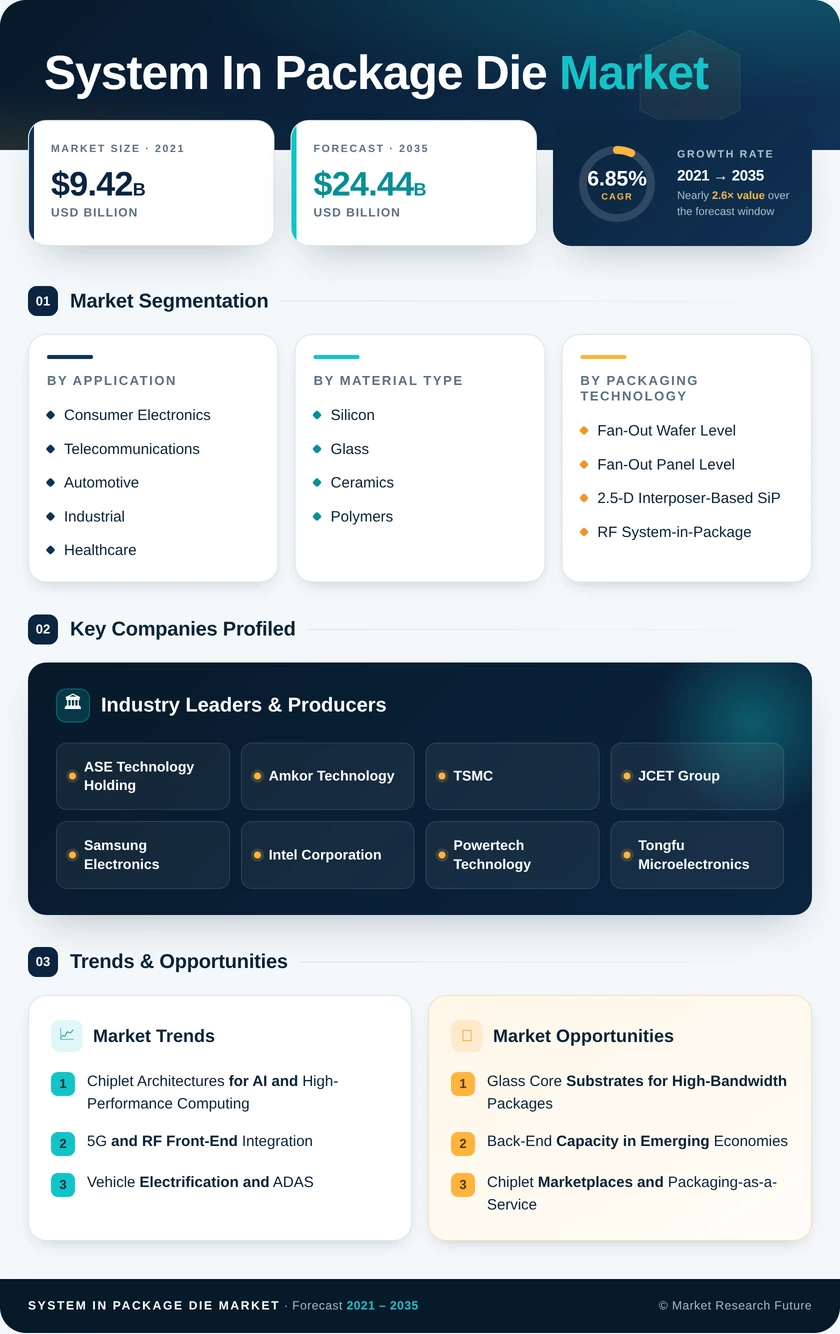
Segmentation Quick Reference
| Dimension | Sub-Segments | Dominant Segment | Fastest Growing Segment |
|---|
| By Application | Consumer Electronics, Telecommunications, Automotive, Industrial, Healthcare, Other Applications | Consumer Electronics (50.2% share) | Automotive (12.3% CAGR) |
| By Material Type | Silicon, Glass, Ceramics, Polymers | Silicon (79.6% share) | Glass (10.5% CAGR) |
| By Packaging Technology | Fan-Out Wafer Level, Fan-Out Panel Level, 2.5-D Interposer-Based SiP, RF System-in-Package | Fan-Out Wafer Level (43.1% share) | Fan-Out Panel Level (12.9% CAGR) |
| By End-Use Device | Smartphones, Tablets, Wearables, Other Devices | Smartphones (43.2% share) | Wearables (15.2% CAGR) |
| By Region | North America, Europe, Asia-Pacific, South America, Middle East & Africa | North America (36.4% share) | South America (8.9% CAGR) |
Market Segmentation Overview
| Sub-Segment | Key Trend |
|---|
| Consumer Electronics | Tighter RF and power integration in handsets, tablets and AR glasses |
| Telecommunications | Laminate RF modules for massive-MIMO radios |
| Automotive | Zonal controllers replacing distributed ECUs |
| Industrial | Edge-AI gateways in harsh environments |
| Healthcare | Hermetic ceramic packages for implantables |
| Other Applications | Aerospace and defence modules |
Consumer Electronics leads because smartphones and tablets still ship in the highest volumes and depend on compact RF and power-management packages. Automotive grows fastest as zonal architectures move several ECU functions into qualified multi-die controllers with long platform lives. Healthcare adds smaller but higher-margin demand for biocompatible, hermetically sealed modules.
| Sub-Segment | Key Trend |
|---|
| Silicon | Mature TSV processes and stable thermal expansion matching |
| Glass | Panel-scale interposers for HBM-heavy server packages |
| Ceramics | Hermetic builds for under-hood and radar uses |
| Polymers | Flexible low-cost routing for wearables |
Silicon leads because its supply chain and TSV processes are proven, keeping risk low for handset and tablet programs. Glass grows fastest because its flatness and low dielectric loss support the 112 Gbps signaling that large AI packages need. Ceramics and Polymers serve distinct reliability and cost tiers rather than competing directly with silicon.
| Sub-Segment | Key Trend |
|---|
| Fan-Out Wafer Level | Mature tooling with predictable yields |
| Fan-Out Panel Level | 510 mm panels increasing die output per substrate |
| 2.5-D Interposer-Based SiP | Terabyte-class bandwidth for AI accelerators |
| RF System-in-Package | Default format for sub-6 GHz and mmWave modules |
Fan-Out Wafer Level leads because established equipment and yields suit mid-range smartphones. Fan-Out Panel Level grows fastest as rectangular panels deliver several times the usable area of a 300 mm wafer, lowering cost per die once yields mature. 2.5-D Interposer-Based SiP carries the highest unit value, while RF System-in-Package remains essential for radio front ends.
| Sub-Segment | Key Trend |
|---|
| Smartphones | Ultrathin stacks for sub-7 mm flagships |
| Tablets | Backside memory integration that frees battery volume |
| Wearables | Always-on sensing and on-device AI in about 30 mm² |
| Other Devices | Custom high-reliability builds for vehicles, industry and implants |
Smartphones lead because flagship OEMs cannot reach their thickness targets without stacking RF, processors and charging ICs in one package. Wearables grow fastest because health bands, earbuds and AR glasses must fit radios, sensors and AI accelerators into very small footprints. Other Devices adds custom builds that favour suppliers with automotive and medical qualifications.


 Noah Malgeri
Co-Founder

 Peter Groot koerkamp
Account and Business Manager

 Younghwan Choi
Senior Retail Manager

 Mark Irwin
Management Consultant

 Akif Moroglu
Strategy & Business Development Director

 Guilherme Gomes Martins
Product Management Director

 Joseph Aguayo
Sales Operations & Pricing Manager

 La Terria Dodd
Program Support Specialist

 Rob Kooiker
Group Product Manager HVAC & Fire Protection GMA