×
Hero Background
English
Chinese
French
Japanese
Korean
German
Spanish

Syringomyelia Market Share

ID: MRFR/MED/3802-HCR
85 Pages
Rahul Gotadki
October 2025

Syringomyelia Market Research By Type (Congenital, And Acquired), Diagnosis (CT Scan, MRI), Treatment (Monitoring, Chiari Surgery, Draining The Syrinx, Expansive Duraplasty, Surgical Removal of Cyst, Medication), End User – Forecast Till 2035

Share:
Download PDF ×

We do not share your information with anyone. However, we may send you emails based on your report interest from time to time. You may contact us at any time to opt-out.

Syringomyelia Market Infographic
Purchase Options

Market Share

Syringomyelia Market Share Analysis

The Syringomyelia market, committed to addressing the uncommon neurological condition including liquid filled cysts inside the spinal cord, poses remarkable challenges and opportunities for companies in the medical services sector. In this specialty market, effective market share positioning strategies are critical for offering specialized treatments and support to patients. Successful market positioning begins with an itemized analysis of the demographics affected by syringomyelia. Companies must understand factors such as age, genetic predispositions, and fundamental conditions to tailor their products and therapies to meet the specific needs of this generally small community. Staying at the forefront of the Syringomyelia market requires continuous development in treatment approaches. Companies should invest in research and advancement to make progressed surgical techniques, clinical devices, and drug interventions that offer effective management and worked on personal satisfaction for individuals with syringomyelia. Tailoring marketing strategies to effectively speak with both medical care professionals and patients is essential in the Syringomyelia market. Using various channels, including clinical conferences, computerized platforms, and informative materials, helps pass on the advantages of specific treatments and support services, separating the organization's offerings in a specialized market. Offering comprehensive post-treatment support services is significant for patient satisfaction and long-term success. Companies should give resources, restoration programs, and progressing support to assist individuals in dealing with the challenges associated with syringomyelia and enhancing their general prosperity. Staying informed about industry trends and monitoring the serious landscape is essential for adjusting market positioning strategies. Standard assessments of competitors' activities, arising treatment modalities, and developing research in syringomyelia empower companies to pursue informed choices, stay major, and keep a main position in this unique and specialized market.


Author
Rahul Gotadki
Assistant Manager

He holds an experience of about 7+ years in Market Research and Business Consulting, working under the spectrum of Life Sciences and Healthcare domains. Rahul conceptualizes and implements a scalable business strategy and provides strategic leadership to the clients. His expertise lies in market estimation, competitive intelligence, pipeline analysis, customer assessment, etc. In addition to the above, his other responsibility includes strategic tracking of high growth markets & advising clients on the potential areas of focus they could direct their business initiatives

Leave a Comment

FAQs

What is the current valuation of the Syringomyelia Market as of 2024?

The Syringomyelia Market was valued at 0.2184 USD Billion in 2024.

What is the projected market size for the Syringomyelia Market in 2035?

The market is projected to reach 0.575 USD Billion by 2035.

What is the expected CAGR for the Syringomyelia Market during the forecast period 2025 - 2035?

The expected CAGR for the Syringomyelia Market during 2025 - 2035 is 9.2%.

Which companies are considered key players in the Syringomyelia Market?

Key players in the market include AstraZeneca, Novartis, Roche, Pfizer, and Bristol-Myers Squibb.

What are the main segments of the Syringomyelia Market?

The main segments include Type, Diagnosis, Treatment, and End User.

Market Summary

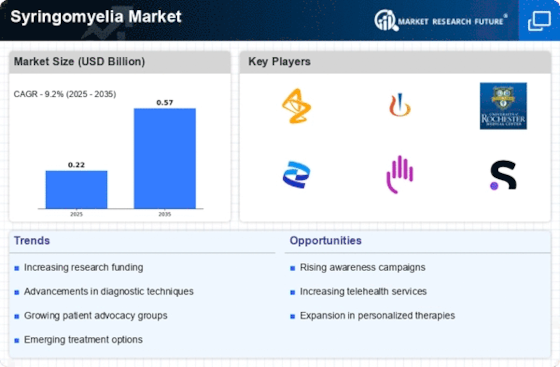
As per Market Research Future analysis, the Syringomyelia Market Size was estimated at 0.2184 USD Billion in 2024. The Syringomyelia industry is projected to grow from USD 0.2385 Billion in 2025 to USD 0.575 Billion by 2035, exhibiting a compound annual growth rate (CAGR) of 9.2% during the forecast period 2025 - 2035

Key Market Trends & Highlights

The Syringomyelia Market is poised for growth driven by advancements in diagnostics and treatment.

  • North America remains the largest market for Syringomyelia Market, driven by increased healthcare expenditure and advanced medical infrastructure.
  • The Asia-Pacific region is emerging as the fastest-growing market, fueled by rising awareness and improving healthcare access.
  • Congenital Syringomyelia Market represents the largest segment, while Acquired Syringomyelia Market is witnessing the fastest growth due to evolving diagnostic capabilities.
  • Key market drivers include increasing awareness of Syringomyelia Market and advancements in treatment modalities, which are enhancing patient outcomes.

Market Size & Forecast

2024 Market Size 0.2184 (USD Billion)
2035 Market Size 0.575 (USD Billion)
CAGR (2025 - 2035) 9.2%
Largest Regional Market Share in 2024 Americas

Major Players

<p>AstraZeneca (GB), Novartis (CH), Roche (CH), Pfizer (US), Bristol-Myers Squibb (US), Sanofi (FR), Merck & Co. (US), Teva Pharmaceutical Industries (IL), Amgen (US)</p>

Market Trends

The Syringomyelia Market is currently experiencing a notable evolution, driven by advancements in medical technology and increased awareness of the condition. Syringomyelia Market, characterized by the formation of fluid-filled cavities within the spinal cord, necessitates a multifaceted approach to treatment. As healthcare providers enhance diagnostic capabilities, the demand for effective therapeutic options appears to rise. This trend is further supported by ongoing research efforts aimed at understanding the underlying mechanisms of the disease, which may lead to innovative treatment modalities. Moreover, the growing emphasis on personalized medicine is likely to shape the future landscape of the Syringomyelia Market. Tailored therapies that consider individual patient profiles could enhance treatment efficacy and improve patient outcomes. Additionally, collaborations between pharmaceutical companies and research institutions may foster the development of novel drugs and interventions. As the market continues to evolve, stakeholders must remain vigilant to emerging trends and adapt strategies accordingly, ensuring that they meet the needs of patients and healthcare providers alike.

Advancements in Diagnostic Techniques

Recent improvements in imaging technologies, such as MRI, have significantly enhanced the ability to diagnose syringomyelia. These advancements facilitate earlier detection and more accurate assessments of the condition, which may lead to timely interventions and better patient outcomes.

Focus on Personalized Treatment Approaches

The Syringomyelia Market is increasingly leaning towards personalized medicine, where treatment plans are tailored to individual patient characteristics. This shift aims to optimize therapeutic efficacy and minimize adverse effects, potentially transforming the management of the condition.

Collaborative Research Initiatives

There is a growing trend of partnerships between pharmaceutical companies and academic institutions to advance research in syringomyelia. These collaborations may accelerate the development of innovative therapies and enhance understanding of the disease, ultimately benefiting patient care.

Syringomyelia Market Market Drivers

Government Initiatives and Funding

Government initiatives aimed at improving healthcare access and funding for rare diseases are crucial drivers for the Syringomyelia Market. Various health authorities are increasingly recognizing the need for dedicated resources to address conditions like syringomyelia, which often receive limited attention. Recent policy changes have led to increased funding for research and development, as well as support for patient advocacy groups. This financial backing is likely to enhance the availability of treatment options and improve patient outcomes. As governments prioritize healthcare for rare diseases, the Syringomyelia Market stands to benefit from enhanced visibility and resource allocation, potentially leading to accelerated market growth.

Advancements in Treatment Modalities

Innovations in treatment modalities represent a significant driver for the Syringomyelia Market. Recent developments in surgical techniques, such as minimally invasive procedures, have improved patient outcomes and reduced recovery times. Additionally, the introduction of novel pharmacological therapies has expanded the treatment landscape, offering new hope to patients. According to recent data, the market for syringomyelia treatments is projected to grow at a compound annual growth rate of approximately 5% over the next several years. This growth is indicative of the increasing investment in research and development aimed at enhancing treatment efficacy. As healthcare providers adopt these advancements, the Syringomyelia Market is poised for substantial expansion.

Increasing Awareness of Syringomyelia

The rising awareness surrounding syringomyelia is a pivotal driver for the Syringomyelia Market. As educational campaigns and advocacy groups proliferate, more individuals are becoming cognizant of the symptoms and implications of this condition. This heightened awareness is likely to lead to earlier diagnoses and increased demand for treatment options. In recent years, the number of diagnosed cases has shown a notable increase, suggesting that more patients are seeking medical assistance. Consequently, healthcare providers are prompted to enhance their offerings, thereby expanding the Syringomyelia Market. Furthermore, the integration of social media platforms in awareness campaigns has proven effective in reaching broader audiences, which may further stimulate market growth.

Technological Integration in Healthcare

The integration of advanced technologies in healthcare is transforming the Syringomyelia Market. Innovations such as telemedicine, artificial intelligence, and electronic health records are streamlining patient management and improving access to care. Telemedicine, in particular, has gained traction, allowing patients to consult specialists remotely, which is especially beneficial for those in underserved areas. Furthermore, the use of AI in diagnostic processes is enhancing the accuracy of syringomyelia diagnoses, leading to timely interventions. As these technologies continue to evolve, they are likely to reshape the landscape of the Syringomyelia Market, fostering greater efficiency and patient engagement.

Rising Incidence of Related Neurological Disorders

The increasing incidence of neurological disorders that are associated with syringomyelia is a notable driver for the Syringomyelia Market. Conditions such as Chiari malformation and spinal cord injuries often co-occur with syringomyelia, leading to a higher demand for comprehensive treatment solutions. Recent epidemiological studies indicate that the prevalence of these related disorders is on the rise, which may contribute to a growing patient population requiring specialized care. This trend suggests that healthcare systems will need to adapt and expand their services to accommodate the needs of these patients, thereby fostering growth within the Syringomyelia Market. The interconnectedness of these conditions underscores the importance of integrated treatment approaches.

Market Segment Insights

By Type: Congenital Syringomyelia (Largest) vs. Acquired Syringomyelia (Fastest-Growing)

<p>The Syringomyelia Market is characterized by a substantial division between its two primary types: Congenital and Acquired Syringomyelia. Congenital Syringomyelia, resulting from developmental anomalies, currently holds the largest market share due to its persistence and established recognition in clinical practice. In contrast, Acquired Syringomyelia, often linked to conditions like trauma or tumors, is not as prevalent but is gaining traction as awareness and diagnosis improve, leading to its rapid growth in the market.</p>

<p>Syringomyelia Type: Congenital (Dominant) vs. Acquired (Emerging)</p>

<p>Congenital Syringomyelia is characterized by its origins stemming from spinal cord developmental disorders, which establish a significant and enduring presence in the market. This type is often diagnosed during childhood or early adulthood, making early interventions crucial. In contrast, Acquired Syringomyelia represents an emerging segment, with growth driven by increasing instances of spinal injuries and the rising diagnosis of related conditions. As healthcare providers become more aware of the symptoms and treatment options for Acquired Syringomyelia, its market share is expected to expand, position it as a vital focus for both researchers and clinicians.</p>

By Diagnosis: Magnetic Resonance Imaging (MRI) (Largest) vs. Computerized Tomography (CT) Scan (Fastest-Growing)

<p>In the Syringomyelia Market, Magnetic Resonance Imaging (MRI) holds the largest share, significantly outpacing other diagnostic modalities, including Computerized Tomography (CT) scans. MRI is widely preferred due to its ability to provide detailed images of the spinal cord and adjacent tissues, making it the go-to choice for diagnosis. In contrast, CT scans, while effective, have a smaller market share as they generally offer less detailed imagery for Syringomyelia conditions. Other diagnostic methods are also in use, but they comprise a minor segment of the overall market.</p>

<p>MRI (Dominant) vs. CT Scan (Emerging)</p>

<p>MRI remains the dominant diagnostic tool in the Syringomyelia Market due to its superior imaging capabilities and non-invasive nature. It allows clinicians to visualize cysts in the spinal cord, which are characteristic of Syringomyelia. Though CT scans offer faster imaging results, they are seen as an emerging method, primarily used in specific scenarios or for initial assessments. With continuous advancements in imaging technology, CT scans are set to increase their footprint in the diagnosis of Syringomyelia, yet MRI is likely to retain its status as the primary diagnostic approach.</p>

By Treatment: Surgical Care (Largest) vs. Medication (Fastest-Growing)

<p>In the Syringomyelia market, the treatment segment is primarily divided into Monitoring, Surgical Care, and Medication. Among these, Surgical Care remains the largest segment, capturing a significant share due to its critical role in alleviating symptoms and addressing structural changes within the spinal cord. Monitoring plays an essential role in ongoing patient assessment, yet it does not command the same market presence as Surgical Care. Medication, while currently a smaller segment, is gaining traction due to innovations and advancements in pharmaceutical therapies.</p>

<p>Medication (Emerging) vs. Monitoring (Dominant)</p>

<p>In the evolving landscape of the Syringomyelia market, Medication is emerging as an increasingly pivotal segment. It is characterized by a growing array of pharmaceutical options aimed at managing symptoms and improving quality of life. With advancements in drug formulation and delivery, this segment is witnessing rapid development and interest from both healthcare providers and patients. In contrast, Monitoring remains a dominant force, playing a crucial role in patient management through regular assessments and evaluations. While Monitoring is essential for tracking disease progression, it currently lacks the innovative breakthroughs seen in Medication, positioning it as a stable, yet less dynamic segment.</p>

By End User: Hospitals (Largest) vs. Clinics (Fastest-Growing)

<p>The Syringomyelia Market showcases a diverse range of end users, with hospitals commanding the majority share due to their comprehensive facilities and expertise in treating complex neurological disorders. Clinics and diagnostic centers follow, catering to outpatient services and specialized diagnostics, respectively. Pharmacies and drug stores play a crucial role in the distribution of medications but occupy a smaller portion of the market due to the nature of treatment for syringomyelia, which often requires clinical intervention. Growth trends indicate that while hospitals retain their dominant position, clinics are emerging as the fastest-growing segment. Factors driving this growth include increased awareness of syringomyelia, advancements in diagnostic techniques, and a shift towards outpatient care. The rising prevalence of neurological conditions further fuels the demand for specialized clinic services, positioning them as a pivotal player in the market's evolution.</p>

<p>Hospitals (Dominant) vs. Clinics (Emerging)</p>

<p>Hospitals are regarded as the dominant end user in the Syringomyelia Market, primarily due to their capacity to offer comprehensive treatment options including surgical interventions and multidisciplinary care. They are equipped with specialized staff and advanced technologies to manage syringomyelia's complexities effectively. On the other hand, clinics are emerging as a vital component, appealing to patients seeking less invasive and more accessible treatment options. Their growth is bolstered by a robust focus on patient-centered care and the ability to provide timely diagnostic assessments. As the incidence of syringomyelia rises, both hospitals and clinics are adapting to meet the specific needs of patients, indicating a symbiotic relationship between these segments in addressing this neurological condition.</p>

Get more detailed insights about Syringomyelia Market Research Report - Forecast till 2035

Regional Insights

North America : Leading Market for Syringomyelia Market

North America is the largest market for syringomyelia, accounting for approximately 55% of the global market share. The region's growth is driven by advanced healthcare infrastructure, increasing awareness of neurological disorders, and significant investments in research and development. Regulatory support from agencies like the FDA further catalyzes market expansion, ensuring timely access to innovative therapies. The United States is the primary contributor, with a robust presence of key players such as Pfizer, Merck & Co., and Amgen. Canada also plays a significant role, focusing on improving treatment options and patient care. The competitive landscape is characterized by collaborations and partnerships among pharmaceutical companies, enhancing the availability of effective treatments for syringomyelia.

Europe : Emerging Market with Growth Potential

Europe is witnessing a growing demand for syringomyelia treatments, holding approximately 30% of the global market share. The region benefits from a strong regulatory framework and initiatives aimed at improving healthcare access. Countries like Germany and France are leading the market, driven by increasing investments in healthcare and rising awareness of neurological conditions. The European Medicines Agency (EMA) plays a crucial role in facilitating the approval of new therapies, further boosting market growth. Germany stands out as a key player, with numerous clinical trials and research initiatives focused on syringomyelia. France and the UK also contribute significantly, with a competitive landscape featuring major pharmaceutical companies like Novartis and Roche. The collaboration between public and private sectors enhances the development of innovative treatment options, positioning Europe as a vital market for syringomyelia therapies.

Asia-Pacific : Rapidly Growing Healthcare Sector

The Asia-Pacific region is emerging as a significant player in the syringomyelia market, accounting for about 10% of the global share. The growth is fueled by increasing healthcare expenditure, rising awareness of neurological disorders, and improving access to advanced medical technologies. Countries like Japan and Australia are at the forefront, supported by favorable government policies and initiatives aimed at enhancing healthcare infrastructure. Japan leads the market with a strong focus on research and development, while Australia is making strides in patient care and treatment accessibility. The competitive landscape includes both local and international players, with companies like Teva Pharmaceutical Industries and AstraZeneca actively involved in the market. The region's potential for growth is substantial, driven by ongoing advancements in medical research and technology.

Middle East and Africa : Emerging Market with Challenges

The Middle East and Africa represent a nascent market for syringomyelia, holding approximately 5% of the global market share. The region faces challenges such as limited healthcare infrastructure and varying levels of awareness regarding neurological disorders. However, increasing investments in healthcare and initiatives to improve access to treatments are driving gradual growth. Countries like South Africa and the UAE are making efforts to enhance healthcare services and patient support. South Africa is emerging as a key player, with initiatives aimed at improving diagnosis and treatment options for syringomyelia. The competitive landscape is still developing, with a focus on collaboration between local and international pharmaceutical companies. As awareness grows and healthcare systems improve, the potential for market expansion in this region is promising.

Key Companies in the Syringomyelia Market market include

Industry Developments

Future Outlook

Syringomyelia Market Future Outlook

<p>The Syringomyelia Market is projected to grow at a 9.2% CAGR from 2024 to 2035, driven by advancements in treatment options, increased awareness, and improved diagnostic technologies.</p>

New opportunities lie in:

  • <p>Development of targeted therapies for pain management in syringomyelia patients.</p>
  • <p>Expansion of telehealth services for remote patient monitoring and consultations.</p>
  • <p>Investment in AI-driven diagnostic tools to enhance early detection and treatment planning.</p>

<p>By 2035, the Syringomyelia Market is expected to achieve substantial growth, reflecting evolving treatment paradigms and increased patient engagement.</p>

Market Segmentation

Syringomyelia Market Type Outlook

  • Congenital Syringomyelia
  • Acquired Syringomyelia

Syringomyelia Market End User Outlook

  • Hospitals
  • Clinics
  • Diagnostic Centers
  • Drug Stores
  • Pharmacies
  • Others

Syringomyelia Market Diagnosis Outlook

  • Magnetic Resonance Imaging (MRI)
  • Computerized Tomography (CT) Scan
  • Others

Syringomyelia Market Treatment Outlook

  • Monitoring
  • Surgical Care
  • Medication

Report Scope

MARKET SIZE 20240.2184(USD Billion)
MARKET SIZE 20250.2385(USD Billion)
MARKET SIZE 20350.575(USD Billion)
COMPOUND ANNUAL GROWTH RATE (CAGR)9.2% (2024 - 2035)
REPORT COVERAGERevenue Forecast, Competitive Landscape, Growth Factors, and Trends
BASE YEAR2024
Market Forecast Period2025 - 2035
Historical Data2019 - 2024
Market Forecast UnitsUSD Billion
Key Companies ProfiledAstraZeneca (GB), Novartis (CH), Roche (CH), Pfizer (US), Bristol-Myers Squibb (US), Sanofi (FR), Merck & Co. (US), Teva Pharmaceutical Industries (IL), Amgen (US)
Segments CoveredType
Key Market OpportunitiesAdvancements in minimally invasive surgical techniques enhance treatment options in the Syringomyelia Market.
Key Market DynamicsRising demand for innovative treatment options drives competitive forces in the Syringomyelia Market.
Countries CoveredNorth America, Europe, APAC, South America, MEA

FAQs

What is the current valuation of the Syringomyelia Market as of 2024?

The Syringomyelia Market was valued at 0.2184 USD Billion in 2024.

What is the projected market size for the Syringomyelia Market in 2035?

The market is projected to reach 0.575 USD Billion by 2035.

What is the expected CAGR for the Syringomyelia Market during the forecast period 2025 - 2035?

The expected CAGR for the Syringomyelia Market during 2025 - 2035 is 9.2%.

Which companies are considered key players in the Syringomyelia Market?

Key players in the market include AstraZeneca, Novartis, Roche, Pfizer, and Bristol-Myers Squibb.

What are the main segments of the Syringomyelia Market?

The main segments include Type, Diagnosis, Treatment, and End User.

  1. SECTION I: EXECUTIVE SUMMARY AND KEY HIGHLIGHTS
    1. EXECUTIVE SUMMARY
      1. Market Overview
      2. Key Findings
      3. Market Segmentation
      4. Competitive Landscape
      5. Challenges and Opportunities
      6. Future Outlook
  2. SECTION II: SCOPING, METHODOLOGY AND MARKET STRUCTURE
    1. MARKET INTRODUCTION
      1. Definition
      2. Scope of the study
    2. RESEARCH METHODOLOGY
      1. Overview
      2. Data Mining
      3. Secondary Research
      4. Primary Research
      5. Forecasting Model
      6. Market Size Estimation
      7. Data Triangulation
      8. Validation
  3. SECTION III: QUALITATIVE ANALYSIS
    1. MARKET DYNAMICS
      1. Overview
      2. Drivers
      3. Restraints
      4. Opportunities
    2. MARKET FACTOR ANALYSIS
      1. Value chain Analysis
      2. Porter's Five Forces Analysis
      3. COVID-19 Impact Analysis
  4. SECTION IV: QUANTITATIVE ANALYSIS
    1. Healthcare, BY Type (USD Billion)
      1. Congenital Syringomyelia
      2. Acquired Syringomyelia
    2. Healthcare, BY Diagnosis (USD Billion)
      1. Magnetic Resonance Imaging (MRI)
      2. Computerized Tomography (CT) Scan
      3. Others
    3. Healthcare, BY Treatment (USD Billion)
      1. Monitoring
      2. Surgical Care
      3. Medication
    4. Healthcare, BY End User (USD Billion)
      1. Hospitals
      2. Clinics
      3. Diagnostic Centers
      4. Drug Stores
      5. Pharmacies
      6. Others
    5. Healthcare, BY Region (USD Billion)
      1. North America
      2. Europe
      3. APAC
      4. South America
      5. MEA
  5. SECTION V: COMPETITIVE ANALYSIS
    1. Competitive Landscape
      1. Overview
      2. Competitive Analysis
      3. Market share Analysis
      4. Major Growth Strategy in the Healthcare
      5. Competitive Benchmarking
      6. Leading Players in Terms of Number of Developments in the Healthcare
      7. Key developments and growth strategies
      8. Major Players Financial Matrix
    2. Company Profiles
      1. AstraZeneca (GB)
      2. Novartis (CH)
      3. Roche (CH)
      4. Pfizer (US)
      5. Bristol-Myers Squibb (US)
      6. Sanofi (FR)
      7. Merck & Co. (US)
      8. Teva Pharmaceutical Industries (IL)
      9. Amgen (US)
    3. Appendix
      1. References
      2. Related Reports
  6. LIST OF FIGURES
    1. MARKET SYNOPSIS
    2. NORTH AMERICA MARKET ANALYSIS
    3. US MARKET ANALYSIS BY TYPE
    4. US MARKET ANALYSIS BY DIAGNOSIS
    5. US MARKET ANALYSIS BY TREATMENT
    6. US MARKET ANALYSIS BY END USER
    7. CANADA MARKET ANALYSIS BY TYPE
    8. CANADA MARKET ANALYSIS BY DIAGNOSIS
    9. CANADA MARKET ANALYSIS BY TREATMENT
    10. CANADA MARKET ANALYSIS BY END USER
    11. EUROPE MARKET ANALYSIS
    12. GERMANY MARKET ANALYSIS BY TYPE
    13. GERMANY MARKET ANALYSIS BY DIAGNOSIS
    14. GERMANY MARKET ANALYSIS BY TREATMENT
    15. GERMANY MARKET ANALYSIS BY END USER
    16. UK MARKET ANALYSIS BY TYPE
    17. UK MARKET ANALYSIS BY DIAGNOSIS
    18. UK MARKET ANALYSIS BY TREATMENT
    19. UK MARKET ANALYSIS BY END USER
    20. FRANCE MARKET ANALYSIS BY TYPE
    21. FRANCE MARKET ANALYSIS BY DIAGNOSIS
    22. FRANCE MARKET ANALYSIS BY TREATMENT
    23. FRANCE MARKET ANALYSIS BY END USER
    24. RUSSIA MARKET ANALYSIS BY TYPE
    25. RUSSIA MARKET ANALYSIS BY DIAGNOSIS
    26. RUSSIA MARKET ANALYSIS BY TREATMENT
    27. RUSSIA MARKET ANALYSIS BY END USER
    28. ITALY MARKET ANALYSIS BY TYPE
    29. ITALY MARKET ANALYSIS BY DIAGNOSIS
    30. ITALY MARKET ANALYSIS BY TREATMENT
    31. ITALY MARKET ANALYSIS BY END USER
    32. SPAIN MARKET ANALYSIS BY TYPE
    33. SPAIN MARKET ANALYSIS BY DIAGNOSIS
    34. SPAIN MARKET ANALYSIS BY TREATMENT
    35. SPAIN MARKET ANALYSIS BY END USER
    36. REST OF EUROPE MARKET ANALYSIS BY TYPE
    37. REST OF EUROPE MARKET ANALYSIS BY DIAGNOSIS
    38. REST OF EUROPE MARKET ANALYSIS BY TREATMENT
    39. REST OF EUROPE MARKET ANALYSIS BY END USER
    40. APAC MARKET ANALYSIS
    41. CHINA MARKET ANALYSIS BY TYPE
    42. CHINA MARKET ANALYSIS BY DIAGNOSIS
    43. CHINA MARKET ANALYSIS BY TREATMENT
    44. CHINA MARKET ANALYSIS BY END USER
    45. INDIA MARKET ANALYSIS BY TYPE
    46. INDIA MARKET ANALYSIS BY DIAGNOSIS
    47. INDIA MARKET ANALYSIS BY TREATMENT
    48. INDIA MARKET ANALYSIS BY END USER
    49. JAPAN MARKET ANALYSIS BY TYPE
    50. JAPAN MARKET ANALYSIS BY DIAGNOSIS
    51. JAPAN MARKET ANALYSIS BY TREATMENT
    52. JAPAN MARKET ANALYSIS BY END USER
    53. SOUTH KOREA MARKET ANALYSIS BY TYPE
    54. SOUTH KOREA MARKET ANALYSIS BY DIAGNOSIS
    55. SOUTH KOREA MARKET ANALYSIS BY TREATMENT
    56. SOUTH KOREA MARKET ANALYSIS BY END USER
    57. MALAYSIA MARKET ANALYSIS BY TYPE
    58. MALAYSIA MARKET ANALYSIS BY DIAGNOSIS
    59. MALAYSIA MARKET ANALYSIS BY TREATMENT
    60. MALAYSIA MARKET ANALYSIS BY END USER
    61. THAILAND MARKET ANALYSIS BY TYPE
    62. THAILAND MARKET ANALYSIS BY DIAGNOSIS
    63. THAILAND MARKET ANALYSIS BY TREATMENT
    64. THAILAND MARKET ANALYSIS BY END USER
    65. INDONESIA MARKET ANALYSIS BY TYPE
    66. INDONESIA MARKET ANALYSIS BY DIAGNOSIS
    67. INDONESIA MARKET ANALYSIS BY TREATMENT
    68. INDONESIA MARKET ANALYSIS BY END USER
    69. REST OF APAC MARKET ANALYSIS BY TYPE
    70. REST OF APAC MARKET ANALYSIS BY DIAGNOSIS
    71. REST OF APAC MARKET ANALYSIS BY TREATMENT
    72. REST OF APAC MARKET ANALYSIS BY END USER
    73. SOUTH AMERICA MARKET ANALYSIS
    74. BRAZIL MARKET ANALYSIS BY TYPE
    75. BRAZIL MARKET ANALYSIS BY DIAGNOSIS
    76. BRAZIL MARKET ANALYSIS BY TREATMENT
    77. BRAZIL MARKET ANALYSIS BY END USER
    78. MEXICO MARKET ANALYSIS BY TYPE
    79. MEXICO MARKET ANALYSIS BY DIAGNOSIS
    80. MEXICO MARKET ANALYSIS BY TREATMENT
    81. MEXICO MARKET ANALYSIS BY END USER
    82. ARGENTINA MARKET ANALYSIS BY TYPE
    83. ARGENTINA MARKET ANALYSIS BY DIAGNOSIS
    84. ARGENTINA MARKET ANALYSIS BY TREATMENT
    85. ARGENTINA MARKET ANALYSIS BY END USER
    86. REST OF SOUTH AMERICA MARKET ANALYSIS BY TYPE
    87. REST OF SOUTH AMERICA MARKET ANALYSIS BY DIAGNOSIS
    88. REST OF SOUTH AMERICA MARKET ANALYSIS BY TREATMENT
    89. REST OF SOUTH AMERICA MARKET ANALYSIS BY END USER
    90. MEA MARKET ANALYSIS
    91. GCC COUNTRIES MARKET ANALYSIS BY TYPE
    92. GCC COUNTRIES MARKET ANALYSIS BY DIAGNOSIS
    93. GCC COUNTRIES MARKET ANALYSIS BY TREATMENT
    94. GCC COUNTRIES MARKET ANALYSIS BY END USER
    95. SOUTH AFRICA MARKET ANALYSIS BY TYPE
    96. SOUTH AFRICA MARKET ANALYSIS BY DIAGNOSIS
    97. SOUTH AFRICA MARKET ANALYSIS BY TREATMENT
    98. SOUTH AFRICA MARKET ANALYSIS BY END USER
    99. REST OF MEA MARKET ANALYSIS BY TYPE
    100. REST OF MEA MARKET ANALYSIS BY DIAGNOSIS
    101. REST OF MEA MARKET ANALYSIS BY TREATMENT
    102. REST OF MEA MARKET ANALYSIS BY END USER
    103. KEY BUYING CRITERIA OF HEALTHCARE
    104. RESEARCH PROCESS OF MRFR
    105. DRO ANALYSIS OF HEALTHCARE
    106. DRIVERS IMPACT ANALYSIS: HEALTHCARE
    107. RESTRAINTS IMPACT ANALYSIS: HEALTHCARE
    108. SUPPLY / VALUE CHAIN: HEALTHCARE
    109. HEALTHCARE, BY TYPE, 2024 (% SHARE)
    110. HEALTHCARE, BY TYPE, 2024 TO 2035 (USD Billion)
    111. HEALTHCARE, BY DIAGNOSIS, 2024 (% SHARE)
    112. HEALTHCARE, BY DIAGNOSIS, 2024 TO 2035 (USD Billion)
    113. HEALTHCARE, BY TREATMENT, 2024 (% SHARE)
    114. HEALTHCARE, BY TREATMENT, 2024 TO 2035 (USD Billion)
    115. HEALTHCARE, BY END USER, 2024 (% SHARE)
    116. HEALTHCARE, BY END USER, 2024 TO 2035 (USD Billion)
    117. BENCHMARKING OF MAJOR COMPETITORS
  7. LIST OF TABLES
    1. LIST OF ASSUMPTIONS
    2. North America MARKET SIZE ESTIMATES; FORECAST
      1. BY TYPE, 2025-2035 (USD Billion)
      2. BY DIAGNOSIS, 2025-2035 (USD Billion)
      3. BY TREATMENT, 2025-2035 (USD Billion)
      4. BY END USER, 2025-2035 (USD Billion)
    3. US MARKET SIZE ESTIMATES; FORECAST
      1. BY TYPE, 2025-2035 (USD Billion)
      2. BY DIAGNOSIS, 2025-2035 (USD Billion)
      3. BY TREATMENT, 2025-2035 (USD Billion)
      4. BY END USER, 2025-2035 (USD Billion)
    4. Canada MARKET SIZE ESTIMATES; FORECAST
      1. BY TYPE, 2025-2035 (USD Billion)
      2. BY DIAGNOSIS, 2025-2035 (USD Billion)
      3. BY TREATMENT, 2025-2035 (USD Billion)
      4. BY END USER, 2025-2035 (USD Billion)
    5. Europe MARKET SIZE ESTIMATES; FORECAST
      1. BY TYPE, 2025-2035 (USD Billion)
      2. BY DIAGNOSIS, 2025-2035 (USD Billion)
      3. BY TREATMENT, 2025-2035 (USD Billion)
      4. BY END USER, 2025-2035 (USD Billion)
    6. Germany MARKET SIZE ESTIMATES; FORECAST
      1. BY TYPE, 2025-2035 (USD Billion)
      2. BY DIAGNOSIS, 2025-2035 (USD Billion)
      3. BY TREATMENT, 2025-2035 (USD Billion)
      4. BY END USER, 2025-2035 (USD Billion)
    7. UK MARKET SIZE ESTIMATES; FORECAST
      1. BY TYPE, 2025-2035 (USD Billion)
      2. BY DIAGNOSIS, 2025-2035 (USD Billion)
      3. BY TREATMENT, 2025-2035 (USD Billion)
      4. BY END USER, 2025-2035 (USD Billion)
    8. France MARKET SIZE ESTIMATES; FORECAST
      1. BY TYPE, 2025-2035 (USD Billion)
      2. BY DIAGNOSIS, 2025-2035 (USD Billion)
      3. BY TREATMENT, 2025-2035 (USD Billion)
      4. BY END USER, 2025-2035 (USD Billion)
    9. Russia MARKET SIZE ESTIMATES; FORECAST
      1. BY TYPE, 2025-2035 (USD Billion)
      2. BY DIAGNOSIS, 2025-2035 (USD Billion)
      3. BY TREATMENT, 2025-2035 (USD Billion)
      4. BY END USER, 2025-2035 (USD Billion)
    10. Italy MARKET SIZE ESTIMATES; FORECAST
      1. BY TYPE, 2025-2035 (USD Billion)
      2. BY DIAGNOSIS, 2025-2035 (USD Billion)
      3. BY TREATMENT, 2025-2035 (USD Billion)
      4. BY END USER, 2025-2035 (USD Billion)
    11. Spain MARKET SIZE ESTIMATES; FORECAST
      1. BY TYPE, 2025-2035 (USD Billion)
      2. BY DIAGNOSIS, 2025-2035 (USD Billion)
      3. BY TREATMENT, 2025-2035 (USD Billion)
      4. BY END USER, 2025-2035 (USD Billion)
    12. Rest of Europe MARKET SIZE ESTIMATES; FORECAST
      1. BY TYPE, 2025-2035 (USD Billion)
      2. BY DIAGNOSIS, 2025-2035 (USD Billion)
      3. BY TREATMENT, 2025-2035 (USD Billion)
      4. BY END USER, 2025-2035 (USD Billion)
    13. APAC MARKET SIZE ESTIMATES; FORECAST
      1. BY TYPE, 2025-2035 (USD Billion)
      2. BY DIAGNOSIS, 2025-2035 (USD Billion)
      3. BY TREATMENT, 2025-2035 (USD Billion)
      4. BY END USER, 2025-2035 (USD Billion)
    14. China MARKET SIZE ESTIMATES; FORECAST
      1. BY TYPE, 2025-2035 (USD Billion)
      2. BY DIAGNOSIS, 2025-2035 (USD Billion)
      3. BY TREATMENT, 2025-2035 (USD Billion)
      4. BY END USER, 2025-2035 (USD Billion)
    15. India MARKET SIZE ESTIMATES; FORECAST
      1. BY TYPE, 2025-2035 (USD Billion)
      2. BY DIAGNOSIS, 2025-2035 (USD Billion)
      3. BY TREATMENT, 2025-2035 (USD Billion)
      4. BY END USER, 2025-2035 (USD Billion)
    16. Japan MARKET SIZE ESTIMATES; FORECAST
      1. BY TYPE, 2025-2035 (USD Billion)
      2. BY DIAGNOSIS, 2025-2035 (USD Billion)
      3. BY TREATMENT, 2025-2035 (USD Billion)
      4. BY END USER, 2025-2035 (USD Billion)
    17. South Korea MARKET SIZE ESTIMATES; FORECAST
      1. BY TYPE, 2025-2035 (USD Billion)
      2. BY DIAGNOSIS, 2025-2035 (USD Billion)
      3. BY TREATMENT, 2025-2035 (USD Billion)
      4. BY END USER, 2025-2035 (USD Billion)
    18. Malaysia MARKET SIZE ESTIMATES; FORECAST
      1. BY TYPE, 2025-2035 (USD Billion)
      2. BY DIAGNOSIS, 2025-2035 (USD Billion)
      3. BY TREATMENT, 2025-2035 (USD Billion)
      4. BY END USER, 2025-2035 (USD Billion)
    19. Thailand MARKET SIZE ESTIMATES; FORECAST
      1. BY TYPE, 2025-2035 (USD Billion)
      2. BY DIAGNOSIS, 2025-2035 (USD Billion)
      3. BY TREATMENT, 2025-2035 (USD Billion)
      4. BY END USER, 2025-2035 (USD Billion)
    20. Indonesia MARKET SIZE ESTIMATES; FORECAST
      1. BY TYPE, 2025-2035 (USD Billion)
      2. BY DIAGNOSIS, 2025-2035 (USD Billion)
      3. BY TREATMENT, 2025-2035 (USD Billion)
      4. BY END USER, 2025-2035 (USD Billion)
    21. Rest of APAC MARKET SIZE ESTIMATES; FORECAST
      1. BY TYPE, 2025-2035 (USD Billion)
      2. BY DIAGNOSIS, 2025-2035 (USD Billion)
      3. BY TREATMENT, 2025-2035 (USD Billion)
      4. BY END USER, 2025-2035 (USD Billion)
    22. South America MARKET SIZE ESTIMATES; FORECAST
      1. BY TYPE, 2025-2035 (USD Billion)
      2. BY DIAGNOSIS, 2025-2035 (USD Billion)
      3. BY TREATMENT, 2025-2035 (USD Billion)
      4. BY END USER, 2025-2035 (USD Billion)
    23. Brazil MARKET SIZE ESTIMATES; FORECAST
      1. BY TYPE, 2025-2035 (USD Billion)
      2. BY DIAGNOSIS, 2025-2035 (USD Billion)
      3. BY TREATMENT, 2025-2035 (USD Billion)
      4. BY END USER, 2025-2035 (USD Billion)
    24. Mexico MARKET SIZE ESTIMATES; FORECAST
      1. BY TYPE, 2025-2035 (USD Billion)
      2. BY DIAGNOSIS, 2025-2035 (USD Billion)
      3. BY TREATMENT, 2025-2035 (USD Billion)
      4. BY END USER, 2025-2035 (USD Billion)
    25. Argentina MARKET SIZE ESTIMATES; FORECAST
      1. BY TYPE, 2025-2035 (USD Billion)
      2. BY DIAGNOSIS, 2025-2035 (USD Billion)
      3. BY TREATMENT, 2025-2035 (USD Billion)
      4. BY END USER, 2025-2035 (USD Billion)
    26. Rest of South America MARKET SIZE ESTIMATES; FORECAST
      1. BY TYPE, 2025-2035 (USD Billion)
      2. BY DIAGNOSIS, 2025-2035 (USD Billion)
      3. BY TREATMENT, 2025-2035 (USD Billion)
      4. BY END USER, 2025-2035 (USD Billion)
    27. MEA MARKET SIZE ESTIMATES; FORECAST
      1. BY TYPE, 2025-2035 (USD Billion)
      2. BY DIAGNOSIS, 2025-2035 (USD Billion)
      3. BY TREATMENT, 2025-2035 (USD Billion)
      4. BY END USER, 2025-2035 (USD Billion)
    28. GCC Countries MARKET SIZE ESTIMATES; FORECAST
      1. BY TYPE, 2025-2035 (USD Billion)
      2. BY DIAGNOSIS, 2025-2035 (USD Billion)
      3. BY TREATMENT, 2025-2035 (USD Billion)
      4. BY END USER, 2025-2035 (USD Billion)
    29. South Africa MARKET SIZE ESTIMATES; FORECAST
      1. BY TYPE, 2025-2035 (USD Billion)
      2. BY DIAGNOSIS, 2025-2035 (USD Billion)
      3. BY TREATMENT, 2025-2035 (USD Billion)
      4. BY END USER, 2025-2035 (USD Billion)
    30. Rest of MEA MARKET SIZE ESTIMATES; FORECAST
      1. BY TYPE, 2025-2035 (USD Billion)
      2. BY DIAGNOSIS, 2025-2035 (USD Billion)
      3. BY TREATMENT, 2025-2035 (USD Billion)
      4. BY END USER, 2025-2035 (USD Billion)
    31. PRODUCT LAUNCH/PRODUCT DEVELOPMENT/APPROVAL
    32. ACQUISITION/PARTNERSHIP

Syringomyelia Market Segmentation

Market Segmentation Overview

  • Detailed segmentation data will be available in the full report
  • Comprehensive analysis by multiple parameters
  • Regional and country-level breakdowns
  • Market size forecasts by segment
Infographic

Free Sample Request

Kindly complete the form below to receive a free sample of this Report

Get Free Sample

Customer Strories

Compare Licence

×
Features License Type
Single User Multiuser License Enterprise User
Price $4,950 $5,950 $7,250
Maximum User Access Limit 1 User Upto 10 Users Unrestricted Access Throughout the Organization
Free Customization
Direct Access to Analyst
Deliverable Format
Platform Access
Discount on Next Purchase 10% 15% 15%
Printable Versions